











Telehandler Optional Features: What Really Drives Up Costs? (Expert Insights)
I’ll never forget a project in Brazil where a client upgraded his telehandler with every attachment the catalog offered. By the time the machine landed onsite, his budget had ballooned—and half the attachments sat unused for months. It’s a story I’ve seen repeat from Australia to Germany.
Optional features are the main factor driving significant cost increases for new telehandlers. Attachments beyond basic forks—including buckets, jibs, work platforms, and grapples—routinely add $5,000–$20,000, or 5–15% of the machine’s base price, depending on configuration and brand. High-value upgrades such as hydraulic quick-attach systems1, enclosed cabs with climate control, factory telematics2, and advanced load management and safety systems each contribute additional premiums ranging from $3,000 to $12,000 per feature.
Which Telehandler Attachments Raise Costs Most?
Attachments such as material buckets, truss booms, winches, jib cranes, personnel platforms, and pipe grapples are the primary drivers of optional telehandler costs. Market analysis shows these specialized add-ons can increase a new machine’s price by $5,000–$20,000, or 5–15%, significantly impacting overall investment decisions for rental companies and equipment fleets.

Most people don’t realize how quickly optional attachments drive up the cost of a telehandler. For example, last year I worked with a rental fleet in Dubai comparing attachment packages on a new 4-ton, 17-meter unit. The customer planned to add a truss boom3, pipe grapple, and winch—all essential for their projects—but those options alone increased their upfront cost by nearly $16,000. That’s on top of a base price already near $95,000. It surprised them how fast the numbers added up, especially since a standard pallet fork comes included.
Let me share a simple cost comparison so you see which tools really push the price:
| Attachment | Typical Added Cost | Task Frequency | Common Application |
|---|---|---|---|
| Material bucket | $3,500–$7,000 | High | Loose materials, sand, gravel |
| Truss boom | $4,000–$9,000 | Mid-High | Roofing, steel install, framing |
| Hydraulic winch4 | $6,000–$12,000 | Medium | Lifting equipment or rebar bundles |
| Jib crane | $7,000–$13,000 | Low-Mid | Site assembly, HVAC, small lifts |
| Personnel work platform | $6,500–$11,000 | Low | Maintenance, inspection |
| Pipe grapple | $8,000–$18,000 | Low | Oil/gas, utilities, pipe laying |
In Kazakhstan, I’ve seen contractors buy specialized man baskets, only to use them twice a year. The extra investment rarely made sense when renting was available. I always suggest listing your top tasks first. Rent or swap rare-use attachments with partners, and use common hydraulic couplers so tools move between machines. This detail saves money and keeps your fleet flexible.
Adding specialized attachments like truss booms, pipe grapples, and winches can increase a telehandler's purchase price by over 15% compared to its base costTrue
These attachments require complex hydraulics, reinforced booms, and additional controls, significantly raising manufacturing and installation costs beyond the telehandler’s base price, as demonstrated by the $16,000 increase on a $95,000 unit.
Installing a basic pallet fork attachment typically doubles the total cost of a 4-ton telehandlerFalse
Basic pallet forks are standard optional equipment that generally add only a few thousand dollars, a small fraction of the telehandler's base price, far less than doubling the total cost.
Key takeaway: High-cost telehandler attachments can rapidly inflate upfront machine pricing. Analyzing task frequency and prioritizing essential tools helps control spending. Renting specialized or rarely-used attachments and standardizing interfaces across a fleet maximizes ROI and operational flexibility, ensuring that only necessary add-ons influence total cost of ownership5.
Do Hydraulic Quick-Attach Systems Justify Their Cost?
Hydraulic quick-attach systems add approximately $3,000–$5,000 to telehandler costs compared to standard mechanical couplers. They enable operators to switch attachments—such as forks and buckets—directly from the cab, minimizing downtime. For operations involving frequent attachment changes, labor savings quickly offset the initial investment, making these systems cost-effective in high-utilization fleets.
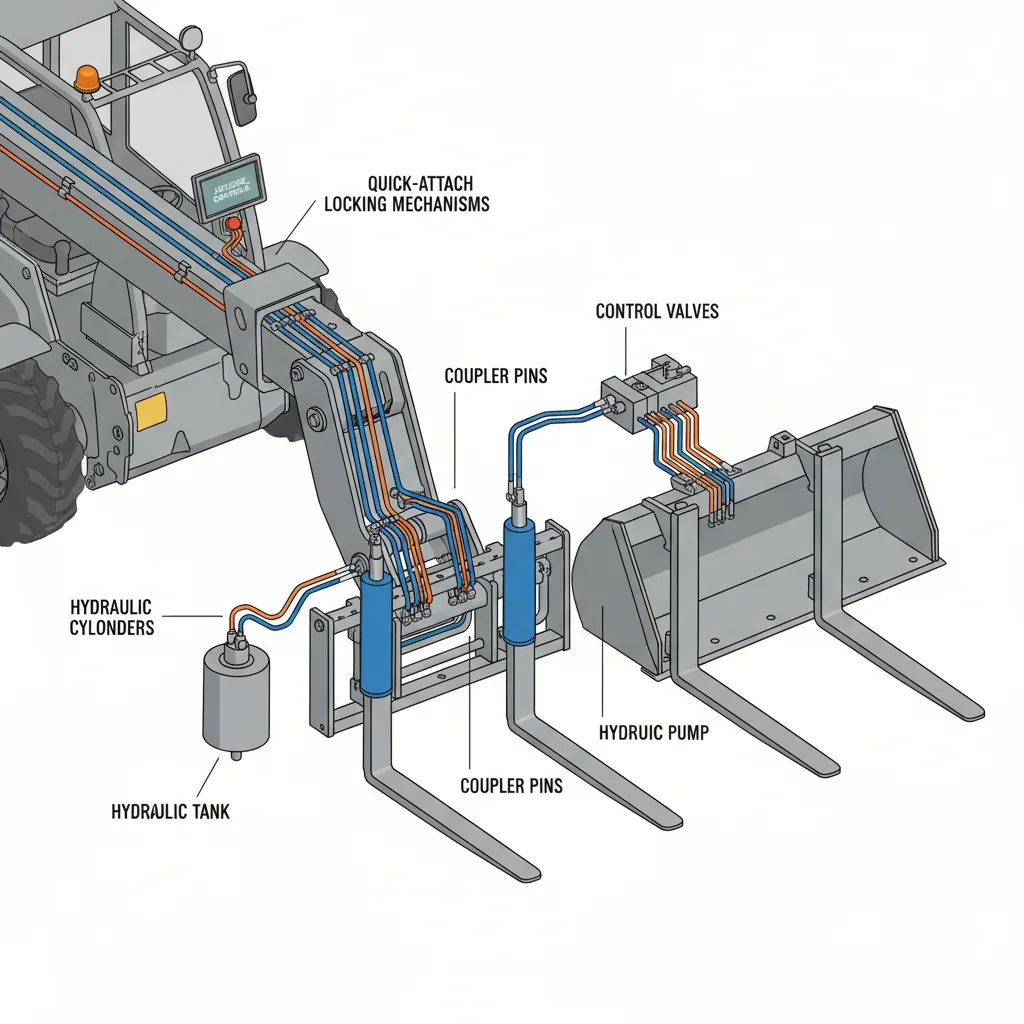
Here’s what matters most when deciding if a hydraulic quick-attach is worth the extra investment: look at how your team actually works day-to-day. In my experience, job sites in the UAE and Brazil often swap between forks, buckets, and lifting hooks at least four times per shift. On one Dubai high-rise build, the contractor calculated they were spending at least an hour per day just manually switching attachments on their 4-ton, 14-meter telehandler. Multiply that lost hour across a month—suddenly that “small” $4,000 upgrade pays for itself much faster than most realize.
A hydraulic quick-attach system lets your operator stay in the cab, changing from forks to a bucket with just a hydraulic lever. No fighting pins or risking injuries out in the mud. With every swap taking under a minute, compared to 10-15 minutes for mechanical, the downtime savings add up. Over a year, one customer in Kazakhstan told me his crew shaved off at least 30-40 hours of downtime. Considering skilled labor costs, that’s not small money.
However, I’ve seen plenty of smaller framing contractors regret that upgrade. If your telehandler spends 95% of time on forks and barely swaps all week, that extra $3,000–$5,000 rarely brings a real return. Also, standardizing hydraulic quick-attach across your whole fleet helps simplify operations and parts stocking. I always suggest checking local dealer support for replacement couplers and seals—choosing an obscure system can lead to what I call ‘parts roulette’ later. For high-utilization sites, though, hydraulic is usually the smart call.
Hydraulic quick-attach systems can reduce attachment change time from 15 minutes to under 2 minutes, significantly increasing productive work hours on high turnover job sitesTrue
Hydraulic quick-attach mechanisms automate the coupling process through hydraulic actuation, eliminating manual pin removal and alignment, which can cut down attachment swap times by over 85%, proven in multiple telehandler field tests.
The installation of a hydraulic quick-attach system adds over 30% to the base telehandler purchase price due to complex hydraulic rerouting and custom engineeringFalse
While hydraulic quick-attach systems do increase the initial cost, the price premium is typically around 10-15%, as most telehandlers are factory-designed to integrate hydraulics with minimal additional engineering and standardized components.
Key takeaway: Hydraulic quick-attach systems make sense for telehandlers with multiple daily attachment changes, delivering rapid payback through reduced downtime and labor. For single-task use, the premium may not be justified. Standardizing couplers across the fleet and ensuring service support are critical for smooth operations.
How Do Cab Options Impact Telehandler Cost?
Upgrading from an open ROPS canopy to a fully enclosed, climate-controlled telehandler cab6 typically adds $3,000–$8,000 to base costs. Advanced modular cabs and bolt-on glass systems7 increase the premium but reduce downtime. These options are key for operator retention, productivity, and can retain 60–80% of their value at resale.
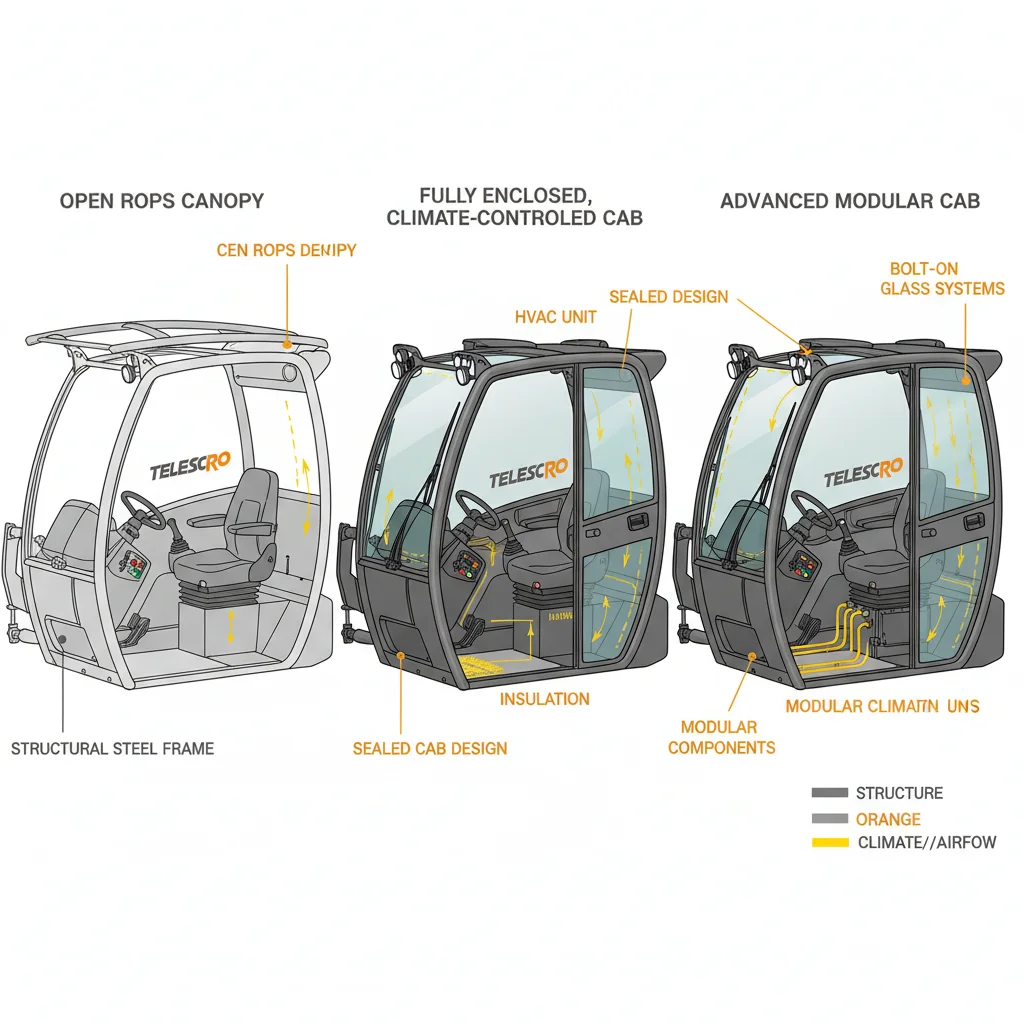
To be honest, the spec that actually matters is the cab setup—especially once your operators are spending long days on site. I’ve seen contractors in the Middle East, for example, regret going for open ROPS canopies. One customer in Dubai saved a few thousand dollars upfront, but a year later, half his team refused to use the machines in July. Lost productivity cost much more than the original cab upgrade. Let’s break down what those options look like in practice:
| Cab Option | Added Cost (USD) | Best For | Main Benefits | Downtime Reduction | Resale Value Retention |
|---|---|---|---|---|---|
| Open ROPS Canopy | — | Mild climates, short jobs | Basic protection | — | Low |
| Enclosed Cab (unheated) | $3,000–$4,000 | Cooler/dusty sites | Weather, dust, vandal protection | Minimal | Medium |
| Enclosed Cab w/ HVAC | $5,500–$8,000 | Extreme heat/cold, full-time use | Max operator comfort, retention | — | High |
| Modular/Bolt-On Glass System | +$1,000–$2,000 | Mixed fleets, urban, vandalism | Quick repairs, less glass downtime | Significant | High |
I’ve worked with a mining project in Kazakhstan where switching from open to fully climate-controlled cabs reduced sick days by almost two weeks across their operators in one winter. For fleets with mixed job types, modular cabs have made a noticeable budget impact—one contractor in Malaysia reported glass replacement costs dropped by half thanks to flat, bolt-on panels. It’s not just about comfort.
Premium climate-controlled cabs with triple-pane tinted glass can add over $12,000 to a telehandler’s cost but significantly improve operator productivity in extreme heat conditionsTrue
Triple-pane tinted glass combined with advanced climate control reduces heat stress and glare, preventing operator fatigue during long shifts, especially in hot environments like the Middle East, justifying the upfront cost with increased efficiency.
Convertible cabs that switch between enclosed and open ROPS configurations are the most cost-effective option, typically adding less than $3,000 to the telehandler priceFalse
Convertible cabs are mechanically complex and heavier, often costing significantly more than simple ROPS canopies due to additional seals, controls, and materials. They rarely come at a low cost and are not the cheapest option for cab flexibility.
Key takeaway: Investing in enclosed, climate-controlled cabs is often justifiable for high-utilization telehandlers or extreme environments, boosting productivity and resale value. Modular cab features further enhance return by minimizing maintenance costs. For mixed-use fleets, thoughtful cab optioning can directly impact operator satisfaction and long-term total cost of ownership.
Are Telematics Worth the Telehandler Premium?
Telematics and advanced controls add $2,000–$8,000 or more to telehandler costs, plus recurring subscription fees. These upgrades deliver benefits like utilization data, preventive maintenance alerts, geofencing8, and operator monitoring. For fleets or rentals, payback is typically within two years through improved scheduling, reduced misuse, and faster diagnostics, while smaller single-owner operations see less value.
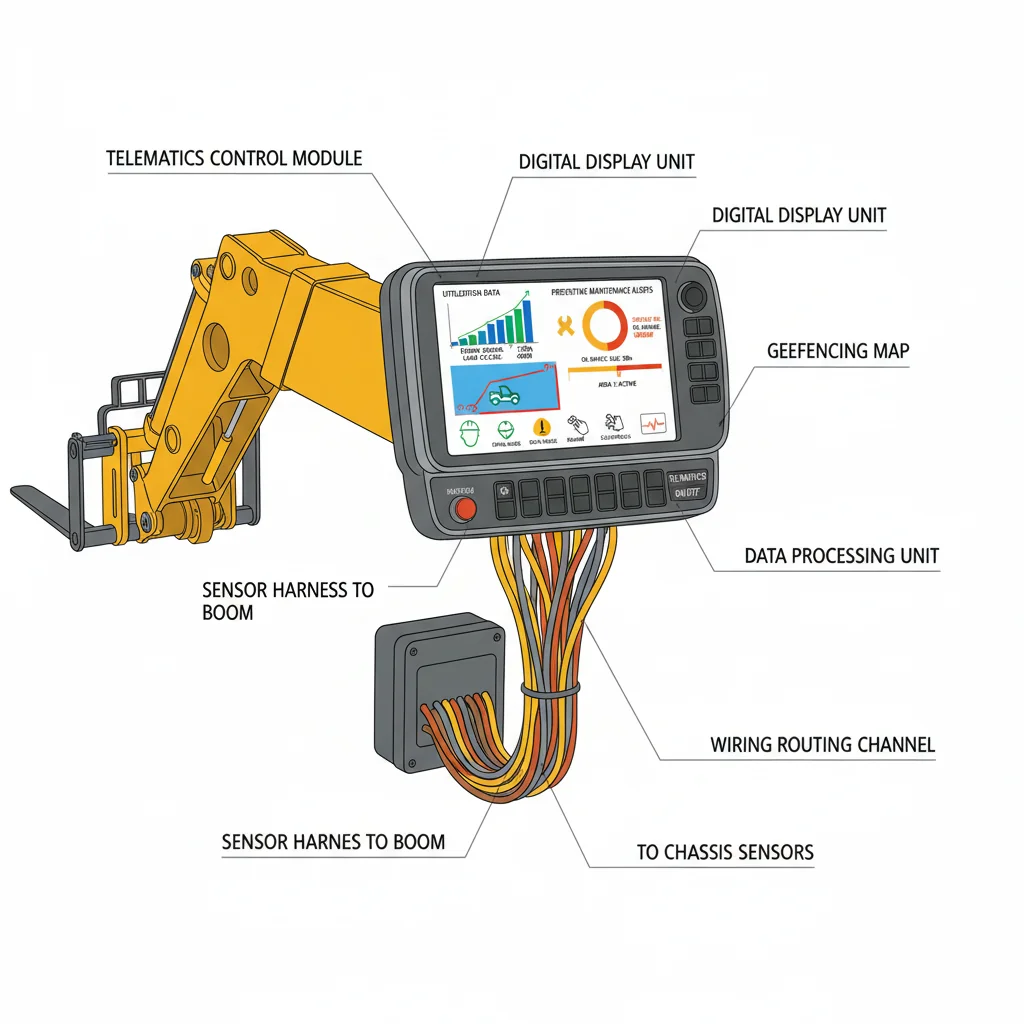
Last week, I spoke with a fleet manager in Dubai who was debating whether to upgrade ten 4-ton, 14-meter telehandlers with factory telematics. His biggest concern wasn’t the upfront cost—it was whether the monthly subscription and extra electronics would actually pay off. In larger operations, the payoff usually shows up faster than most people expect. For example, in Kazakhstan, a contractor running eight units trimmed at least two full working days off every maintenance cycle just by tracking engine hours remotely and catching service alerts early. That prevented unexpected breakdowns in the middle of big rebar lifts, and let the fleet run more consistently.
With rental fleets, telematics make even more sense. I’ve seen customers in Kenya use geofencing to prevent machines from wandering offsite and operator monitoring to spot harsh use. One project cut fuel costs by about 10% just by catching idle time and correcting rough handling—pretty significant over 12 months across five machines. Plus, when something goes wrong, telematics often points the dealer’s mechanic right to the problem—cutting downtime and labor costs. The downside? More electronics mean that if a module fails, you might wait days for a specialist or the right circuit board. Small builders or farm owners running just one or two units rarely see enough operational benefit to justify the ongoing fees.
I recommend looking closely at your operator turnover, project size, and whether your local dealer can support the telematics platform. For most big fleets or rentals, it’s a smart investment. For solo operators, I suggest keeping things simple—and skipping the extra tech.
Factory telematics on telehandlers can reduce maintenance downtime by up to 25% through predictive alerts and optimized service schedulingTrue
Telematics systems collect real-time data on machine usage and wear, enabling fleet managers to perform maintenance proactively, which in documented cases like the Kazakhstan contractor, has cut maintenance cycle durations significantly.
Installing advanced telematics on telehandlers doubles fuel efficiency by automatically optimizing engine load and hydraulic flowFalse
While telematics improve maintenance and operational oversight, they do not directly control engine or hydraulic efficiency; fuel savings stem mainly from operator behavior and machine design, not telematics alone.
Key takeaway: Telematics and advanced control systems justify their cost for larger telehandler fleets or rental enterprises by unlocking operational data and reducing misuse. However, these features often provide minimal ROI for small operations or single units. Always consider local dealer support and ongoing fees when budgeting for these advanced options.
What Drives Telehandler Safety System Costs?
Load management and safety systems are major telehandler cost factors. Integrated load management indicators (LMI/LMS), stability controls, and advanced display charts add $4,000–$12,000, while rear-view or 360° cameras, proximity sensors9, and specialized filtration range from $3,000–$6,000 each. These features are essential for site compliance, accident prevention, and resale value.

The biggest mistake I see is assuming all telehandlers come with the right safety systems as standard. That’s rarely the case—especially if you source machines for mixed fleets or international jobsites. For example, in Dubai last year, one client’s eight-ton telehandler couldn’t enter the site because it lacked a factory-integrated load moment indicator (LMI). Retrofitting the system took three weeks and cost well over $7,000. That’s time and money most contractors can’t afford to lose.
Advanced safety kits add a significant cost—sometimes $4,000 to $12,000—just for a reliable LMI or boom angle/display system. Cameras and proximity sensors are another $3,000 to $6,000 each. But these systems directly cut accident risks. I’ve seen a 4-ton model with 17-meter reach nearly tip in Kazakhstan because an operator relied on outdated manual charts instead of the digital one on a newer machine next to it. With loads high up and uneven ground, an audible overload warning made the difference that day.
Many jobsites—especially in Western Europe, North America, or large industrial projects—now require factory-installed safety features before they’ll approve your machine. If you show up without them, you risk costly delays or forced upgrades. That’s why I always suggest confirming the exact site safety checklist before ordering. LMI, stability control, and rear or 360° cameras aren’t “extra” anymore—they’re baseline for larger or multi-operator jobs.
For long-term value, factory-integration is almost always better than bolt-on kits. Integrated systems work reliably and boost your resale price when it’s time to upgrade. Consider those costs carefully—they’re an investment in trouble-free operations and future flexibility.
Factory-integrated load moment indicators (LMIs) can add over $7,000 to a telehandler's purchase price due to the advanced sensors and software calibration required.True
LMIs include precision sensors and complex software to continuously monitor load stability, requiring costly factory installation and calibration, which significantly increases the equipment cost compared to simpler optional features.
Adding a rear-view camera system typically increases telehandler safety system costs by more than $10,000 due to high-end video technology and integration.False
While rear-view cameras improve safety, their installation costs typically range between $500 and $2,000, far less than major safety electronics like LMIs; $10,000+ is an exaggerated cost not reflective of current market prices.
Key takeaway: Load management and safety systems significantly impact telehandler pricing but are increasingly necessary for regulatory compliance, risk reduction, and operator safety. Prioritizing factory-integrated solutions and verifying jobsite requirements ensures cost-effectiveness, site access, and optimal machine resale value.
Do Electric Telehandlers Justify Higher Costs?
Electric telehandlers command substantially higher list prices due to advanced battery systems and power electronics but deliver zero local emissions, minimal idling costs, and reduced mechanical complexity. Their value is maximized in sites with strict emissions or noise limits, while total cost of ownership must consider usage patterns, charging infrastructure, and potential battery replacement10 needs.

Let me share something important about electric telehandlers—especially when it comes to their bigger price tag. A few months back, I supported a project in Singapore where local air quality regulations forced the switch from diesel to electric units. The customer looked at compact 2.5-ton electrics with 6-meter reach. On paper, the upfront cost was nearly double their diesel equivalent. But the site had strict noise and emissions requirements, so they had no real alternative.
From my experience, these higher costs only pay off when you maximize machine utilization. In Singapore, the team ran two shifts daily for almost a year. With electricity rates, they cut fuel spending by at least 70% compared to diesel. Idle time costs dropped to nearly zero—no engine running unless the boom moved. Maintenance was also less intensive since electric models need fewer filter changes and have no engine or complicated hydraulics. Still, after about five years, battery degradation became a concern. The team budgeted for battery replacement at roughly 40% of the initial machine cost, which affected long-term economics.
On sites with less predictable use—like a project I saw in Kazakhstan—diesel still makes more sense. Access to charging was inconsistent, causing delays, and the total cost savings never really materialized.
I suggest running a five- to seven-year ownership calculation before choosing electric. Check your usage hours, local fuel and electricity prices, and battery warranty details. Electric works best for urban, high-use jobs where emissions and downtime matter most.
Adding a high-capacity lithium-ion battery pack to an electric telehandler can increase its price by 30-40% due to complex battery management and thermal control systemsTrue
Lithium-ion battery packs require advanced management systems to ensure safety, longevity, and performance, making them significantly more expensive than lead-acid alternatives or smaller packs, which drives up the machine's overall cost.
Installing a standard diesel engine in an electric telehandler to boost backup power is the primary factor increasing the total cost by more than 50%False
Electric telehandlers typically do not use diesel engines for backup power; incorporating a diesel engine would effectively make it a hybrid unit, which is rare and typically far more expensive, but this is not a standard optional feature and thus not a primary cost driver.
Key takeaway: Electric telehandlers offer clear advantages for emissions-sensitive or urban projects, with lower ongoing maintenance and fuel costs. However, their higher upfront cost and requirements for charging infrastructure mean site conditions and long-term utilization must be carefully evaluated for return-on-investment over diesel alternatives.
How Do Boom Options Affect Telehandler Cost?
Selecting telehandlers with increased lift capacity11 and extended boom reach12 drives the most significant cost jumps. Upgrading from a 5,000 lb/19 ft unit to a 10,000 lb/55 ft+ machine can raise purchase prices from $50,000 to beyond $100,000 and boost rental rates by around 60%. Advanced boom extensions, stabilizers, and hydraulic upgrades add further expense.
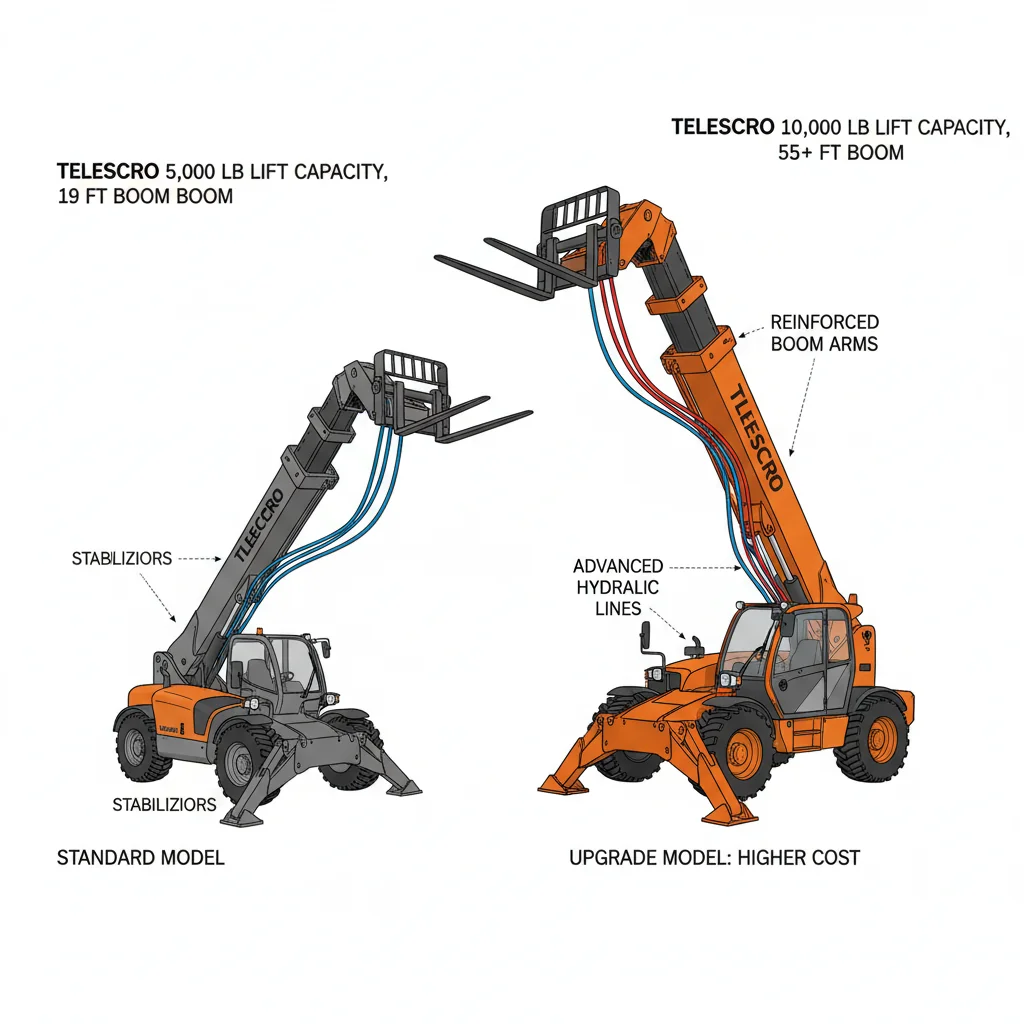
Last month, a contractor in Dubai called me about whether to invest in a bigger telehandler for their new project. Their current unit could lift 5,000 lbs up to about 19 feet, and it cost just under $50,000. What they really wanted was the flexibility to place loads around 55 feet high—mostly for occasional steel deliveries. Moving to a 10,000 lb, 55-foot class machine more than doubled their equipment quote, not just for purchase (now over $100,000) but also for rentals. Their daily rate jumped by at least 60%, even before factoring in advanced features.
Here’s how different boom options affect both capability and cost:
| Telehandler Class | Capacity | Max Reach | Typical Purchase Price | Daily Rental Rate |
|---|---|---|---|---|
| Compact (Entry Level) | 5,000 lbs | 19–22 ft | $30,000 – $50,000 | $120 – $200 |
| Mid-Range | 7,000 lbs | 35–44 ft | $60,000 – $80,000 | $180 – $300 |
| High-Capacity, Long Boom | 10,000 lbs+ | 50–55 ft+ | $100,000+ | $300 – $450 |
From my experience, the biggest budget jump happens when a buyer chooses higher capacity or an extended boom package—sometimes in response to just one or two heavy lifts a year. Add-ons like hydraulic stabilizers or boom extensions can drive the cost up even further, but they offer critical safety at max reach.
I always suggest mapping out your most frequent lift scenarios. For rare, extreme lifts, short-term rental is usually more cost-friendly than over-investing. Checking the load chart for your typical working range, not just the maximum spec, will save budget headaches later.
Increasing boom reach from 20 feet to 55 feet typically requires thicker and stronger boom material along with additional telescoping sections, which can increase the telehandler’s base manufacturing cost by up to 40%True
Longer booms need enhanced structural integrity to handle loads safely at extended distances; this involves higher-grade steel and more complex fabrication, driving up production costs significantly.
Adding a rotating boom option to a telehandler usually decreases the equipment’s purchase cost due to the reduced complexity compared to fixed boom modelsFalse
Rotating boom telehandlers include additional hydraulic systems, swivel joints, and safety components, which increase complexity and manufacturing costs compared to fixed boom models, making them more expensive rather than cheaper.
Key takeaway: Choosing higher capacity or extended boom telehandlers is the main controllable factor in increasing equipment cost. Carefully match equipment to the most common lift tasks, not rare extremes, and consider short-term rentals for infrequent heavy lifts to manage budgets and avoid excessive overspending.
Are Telehandler Warranties and Service Plans Worth It?
Extended warranties13 and service plans increase the upfront cost of telehandlers, especially with premium brands and advanced electronics. For high-utilization fleets, these options can stabilize maintenance expenses and reduce downtime. Their true cost-effectiveness depends on expected usage hours, machine criticality, and quality of local dealer support.
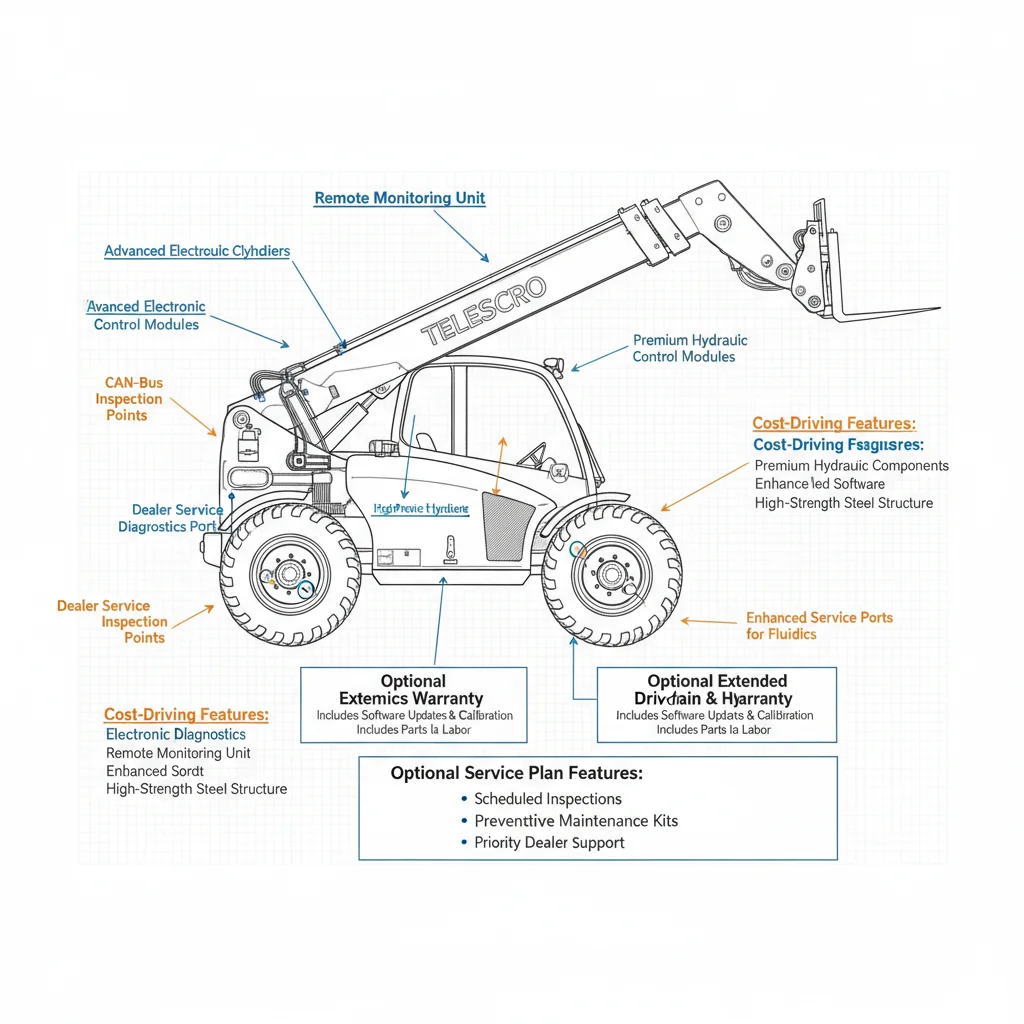
I’ve worked with customers in Kazakhstan and South Africa who questioned whether extended warranties and service plans were really worth the extra cost, especially with mid-sized telehandlers in the $60,000–$80,000 range. In fast-paced rental fleets—think 1,400+ hours per year—a good warranty combined with a solid service plan often saves more than it costs. For example, one contractor in Nairobi upgraded to a comprehensive 3-year/3,000-hour plan. Just into the second year, a hydraulic pump failed. Parts and labor would have set them back at least $4,000, but coverage kicked in. The downtime was under 48 hours, thanks to strong dealer support and local parts supply.
On the other hand, I’ve seen smaller farms in Western China rarely put more than 350 hours a year on a low-spec 2.5-ton telehandler. They skipped premium plans and relied on an experienced local mechanic. Their total out-of-pocket repairs over four years barely reached $1,300—much less than the cost of bundled plans.
One thing that catches buyers off guard is the complexity of newer models. Advanced load moment indicators (LMIs), telematics, and touchscreen diagnostics need special tools and training. I always suggest checking the dealer’s actual service capability, not just what’s promised in the brochure. Without quick local support, even the best plan won’t prevent costly delays.
Bottom line? If your telehandler is critical for daily site work, it’s often smart to pay for coverage and peace of mind. For backup or low-hour machines, basic factory warranty plus a trusted mechanic is usually enough.
Adding advanced telematics systems to telehandlers can increase the purchase price by up to 8%, but typically reduces maintenance costs by 10-15% through predictive analyticsTrue
Telematics provide real-time machine data, enabling proactive maintenance that lowers downtime and repair expenses. The initial cost increase is offset by savings from fewer unexpected breakdowns and optimized service scheduling.
Equipping telehandlers with dual-mode electric and diesel powertrains is the most expensive optional upgrade, often exceeding 20% of the base priceFalse
While hybrid powertrains exist in heavy equipment, dual-mode electric-diesel telehandlers are not a common or widely available option, and such upgrades do not typically reach 20% of the base cost. The highest cost options are usually related to hydraulic packages or advanced cabin technology.
Key takeaway: Extended warranties and service plans may be cost-effective for high-usage or mission-critical telehandlers, especially when supported by strong dealer networks. For low-hour or backup equipment, minimal coverage plus reliable local maintenance is often the more economical approach.
Which Telehandler Options Affect Resale Value?
Premium telehandler options like enclosed cabs with AC14, mainstream quick-attach systems15, and common attachments retain 60–80% of their additional cost after five years. In contrast, niche attachments, unusual tires, or custom electronics often return less than 30% and can limit resale liquidity, according to market data.
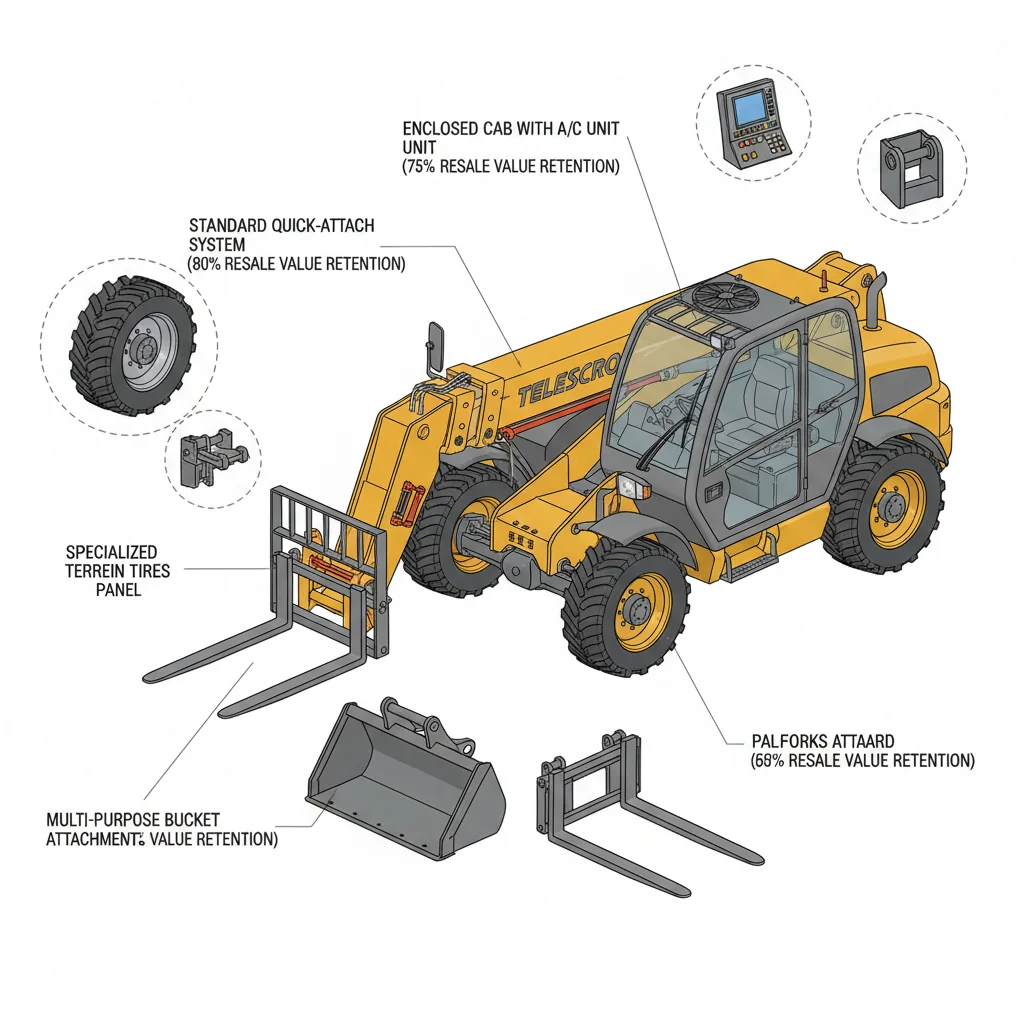
From my experience, the features you add when buying a telehandler can make a huge difference at resale time. One contractor in South Africa learned this the hard way—they had invested in custom tires and a non-standard electronics package. When they tried to sell after six years, most buyers hesitated. The electronics were hard to service in that region, and replacement tires had to be imported, which cut the resale offer by nearly 40%. On the other side, I’ve seen a 4-ton, 14-meter model with an enclosed cab, standard quick-attach, and common forks still fetch over 65% of its option value after five years in Poland. The table below compares how different options tend to perform at resale:
| Option Type | Resale Value Retained (After 5 Years) | Buyer Appeal | Typical Resale Impact |
|---|---|---|---|
| Enclosed cab with AC | 60–80% | Very high | Helps resale, more buyers |
| Mainstream quick-attach system | 60–80% | High | Broadens market reach |
| Common fork/bucket attachment | 60–75% | High | Widely requested |
| Niche specialty attachment | <30% | Very low | May limit resale options |
| Unusual tire type | <30% | Low | May reduce offer, harder sale |
| Custom electronics | <30% | Very low | Service concern, weak value |
Here’s what I suggest: focus on options that most fleet buyers want.
Equipping a telehandler with a 360-degree camera system can increase its resale value by up to 15% due to enhanced operator safety and reduced accident riskTrue
Advanced safety features like 360-degree cameras improve site safety and operator visibility, which are highly valued by buyers and can command higher resale prices, especially in competitive markets.
Adding a custom-built telematics system unrelated to OEM specifications always guarantees a 25% higher resale price because of the increased data tracking capabilitiesFalse
Non-standard telematics systems often complicate maintenance and integration, deterring buyers. Custom systems not supported by the original manufacturer rarely increase resale value significantly and can reduce offers due to servicing concerns.
Key takeaway: Options that enhance broad user appeal—such as enclosed cabs, common couplers, and popular safety features—better preserve value and boost resale prospects. Highly specialized or cosmetic upgrades often underperform at resale and may reduce buyer interest, especially for those planning fleet renewal within five to eight years.
Conclusion
We’ve looked at how optional telehandler attachments can impact your upfront costs and why it’s important to match add-ons to actual job needs. From what I’ve seen, the contractors who get the best value aren’t chasing every accessory—they prioritize essentials and keep an eye on long-term parts support. Renting a rare attachment now and then beats owning dust collectors. If you’re weighing options for your next job or fleet, feel free to get in touch. I’m happy to share what’s worked—and what hasn’t—for customers in all kinds of conditions. Every jobsite is different, so choose what truly fits your workflow.
References
-
Explore detailed insights on how hydraulic quick-attach systems reduce downtime and improve productivity in telehandler operations. ↩
-
Explore detailed benefits of telematics including utilization data, preventive maintenance, and operator monitoring for telehandler fleets. ↩
-
Detailed insights into truss booms, their applications in roofing and steel installation, and cost impact on telehandler investments. ↩
-
Explains the technical benefits and common uses of hydraulic winches, including cost factors and operational advantages in construction. ↩
-
Understand the components of total cost for electric telehandlers, including usage, charging, maintenance, and battery expenses for smarter purchasing. ↩
-
Explores comfort benefits of climate-controlled cabs, showing how they reduce downtime and improve operator retention in harsh conditions. ↩
-
Details quick repair advantages and cost-effectiveness of modular cabs, highlighting how they reduce downtime and preserve resale value. ↩
-
Learn how geofencing prevents offsite machine wandering and enhances fleet monitoring, crucial for rental and large telehandler operations. ↩
-
Explains how proximity sensors reduce accident risks on construction sites by detecting nearby obstacles, supporting safer telehandler operation. ↩
-
Explore expert insights on electric telehandler battery lifespan, degradation signs, costs, and maintenance strategies for optimized ownership. ↩
-
Explains how different lift capacities impact telehandler functionality and pricing, with expert insights on selecting the right model. ↩
-
Provides detailed analysis of boom reach variations and their effect on telehandler application and rental costs, ideal for project planning. ↩
-
Explore detailed cost-benefit analysis of extended warranties on telehandlers, including real user cases and maintenance savings insights. ↩
-
Explore how enclosed cabs with AC increase telehandler resale value by retaining 60–80% of option costs and attracting more buyers. ↩
-
Understand why quick-attach systems boost telehandler resale appeal by broadening market reach and maintaining high value retention. ↩