










Telehandler on Muddy Ground: Field-Tested Safety Tips & What Buyers Miss
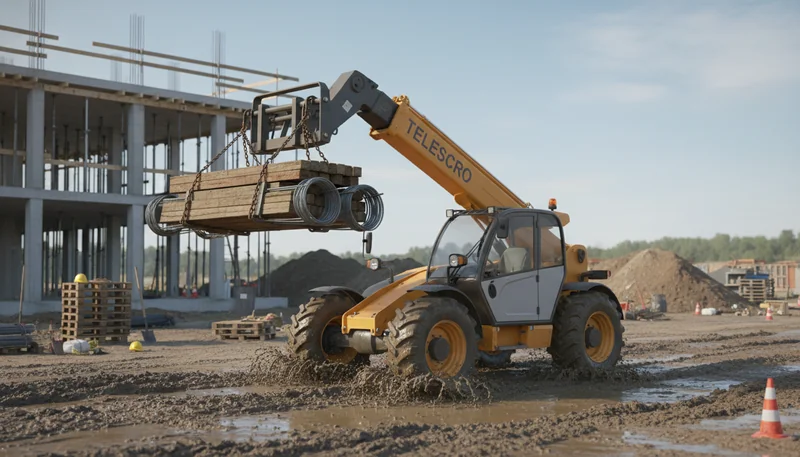
It always hits after a rainstorm—my phone starts buzzing with site photos from Turkey, New Zealand, or rural Anhui: a telehandler buried axle-deep, the tires churning up mud. Most folks are shocked by how quickly several tons of machine can sink, even with big “off-road” tires advertised by the rental company.
Telehandlers are capable of operating on muddy ground, but only within specific safety boundaries dictated by ground pressure1, stability, and machine configuration. On wet clay or saturated soil, a mid-size rough-terrain telehandler can impose ground pressures high enough to cause rapid rutting, sinkage, and loss of stability—especially during travel or when lifting with the boom extended. Because manufacturer capacity charts presume firm, level support, real-world operation on soft or muddy ground requires conservative judgment and effective de-rating.
Can telehandlers operate safely on muddy ground?
Telehandlers can operate on muddy ground, but only within strict limits. Mud increases ground pressure, reduces traction and stability, and can significantly raise tip-over risk—especially when the boom is extended. Rated capacity2 is defined assuming firm, level support under the manufacturer’s stated conditions. On soft or rutted surfaces, real-world safe capacity is often lower; operators should take a conservative approach, reduce working loads accordingly, and prioritize short reach, low lift heights, and improved ground support where possible.

Most people don’t realize how much a muddy jobsite can change telehandler safety, even for rough-terrain models. A typical mid-size unit weighs between 7 and 11 tons before lifting a load—put that on soft ground, and even the best tires will start to sink. I’ve seen this first-hand on sites in Indonesia during rainy season: an 18-meter high-reach telehandler could drive in, but the operator struggled getting out after the boom was extended. The problem? As soon as the front axle sinks, the machine’s stability is gone. It’s easy to drive into trouble before you notice how unstable things really are.
The rated load chart always assumes the manufacturer’s stated conditions—typically a stationary machine on firm, level ground that can resist sinking. When working on wet clay or recently backfilled areas, operators must be far more conservative, because loss of ground support often becomes the limiting factor before the load chart itself. Depending on machine configuration, tire type, and load position, wheel loads and effective ground bearing pressure can be high enough to cause rapid rutting and sinkage on soft soil after only a few passes or lifts.
On a recent job in Kenya, I advised a team to plan their lifts with a significantly larger safety margin because the ground already showed deep truck ruts and uneven support. Instead of treating the rated chart capacity as usable everywhere, they restricted lifting to areas near the site entrance with paved or well-compacted access, kept reach short, and avoided sending full pallets into zones where ground behavior was unpredictable. That conservative approach likely prevented both a stuck machine and a costly recovery operation.
Don’t get fooled by the fact that “the machine moves, so it must be safe.” Stability and capacity change fast once you’re boomed out on soft ground. My advice: check your load chart, cut capacity by 20–30% mentally on bad terrain, and keep lifts close to hardstanding whenever possible.
"TelehandlersFalse
"On
All rough-terrain telehandlers are designed to operate safely regardless of ground conditions, so muddy ground poses little risk when using these models.False
Rough-terrain telehandlers have specialized tires and higher ground clearance, but they are still vulnerable to instability and sinking when working on muddy or soft ground. Ground conditions always play a critical role in safe telehandler operation.
Key takeaway: Muddy terrain dramatically increases telehandler risk by reducing traction and stability. Always consult the manufacturer’s load chart, mentally derate real capacity by 20–30% on soft ground, and prioritize lifts close to hardstanding areas. Never rely solely on movement as proof of safe lifting conditions.
How to Assess Muddy Ground for Telehandlers?
Before operating a telehandler on muddy ground, conduct a detailed assessment similar to crane protocols. Inspect for water, soft spots, deep ruts, and uncompacted soil. Perform simple load or rut tests to evaluate bearing capacity. Regulatory guidance requires ‘firm, level, sink-resistant’ support to prevent overturning risks and ensure safe operation.

Let me share something important about working with muddy sites and telehandlers—ignoring ground conditions is one of the quickest ways to wreck both your schedule and your machine. It’s not just about seeing a patch of water and thinking, “Maybe it’s soft.” You need to be systematic. Walk the area on foot before ever rolling in equipment. Look for surface water, unevenness, fresh backfill, or tire ruts deeper than 100 millimeters. From my experience, those are warning signs, especially if you spot wheel tracks starting to fill with water after rainfall.
A site manager I worked with in Dubai once asked why their telehandler kept getting stuck, even after the surface had been graded. The issue was that the soil had never been properly compacted, and repeated delivery truck traffic had turned the area into a sponge. Visual grading alone didn’t change the ground’s bearing behavior.
Before committing the machine, I always recommend a basic field check of ground support, similar in intent to the precautions outlined in rough-terrain telehandler safety guidance4. Approach the soft area cautiously with one wheel or stabilizer pad, apply weight gradually, and observe how the ground reacts. If the surface shows rapid sinking, uneven settlement, or continued deformation under load, stop and mark the area as unsuitable for telehandler operation.
On many projects, heavy vehicle traffic is also used as an informal indicator of ground condition—but rutting or pumping under trucks is a clear warning sign, not a green light. Where ground behavior is uncertain or already degraded, the correct response is to improve support using mats, plates, or compacted stone routes, rather than pushing the machine farther into unpredictable soil.
Document your findings and brief every operator—unexpected ground behavior is a common cause of accidents. Industry safety guidance consistently emphasizes that telehandlers should only operate on firm, level, sink-resistant support for both wheels and stabilizers. While regulatory requirements and enforcement vary by region, the practical expectation is the same: ground conditions must reliably resist sinking and uneven support.
Skipping this step increases the risk of tip-over, machine recovery, or structural damage. Clearly flag suspect zones, brief operators before work begins, and always verify the load chart to confirm whether stabilizer use changes rated capacity under the actual site conditions.
Assessing muddy ground solely by visual inspection from the cab is not reliable, because surface appearance can hide deep soft spots or recent fill that can't support a telehandler's weight.True
A systematic assessment requires walking the ground to detect subtle changes in firmness, recent backfill, or compaction issues that may be missed from inside the equipment. This helps prevent the telehandler from getting stuck or tipping.
If muddy ground appears firm to the touch and shows no standing water, it is always safe for a telehandler to operate without further assessment.False
Even if the surface feels firm and appears dry, subsurface conditions may still be unstable or inadequately compacted, especially after recent construction work or heavy rain. Additional testing and inspection are necessary to ensure safe operation.
Key takeaway: Effective ground assessment before telehandler deployment on muddy sites prevents tip-overs and costly incidents. Use physical tests, mark unsafe zones, and communicate findings to operators. Meeting the ‘firm, level, sink-resistant’ support standard is mandatory for both safety and regulatory compliance.
How can site prep cut telehandler risk?
Proper site preparation on muddy ground5 involves compacting soil, installing crushed stone routes, and using mats or concrete strips to support telehandler movement. Controlled access routes and planned material drop points6 minimize machine sinkage and prevent rutting, reducing safety hazards. Upfront preparation costs are often lower than unplanned recovery and delays.

The biggest mistake I see is letting a telehandler roam freely across a muddy jobsite without clear ground prep. Fresh after heavy rain, even the best 4-ton machine can sink within minutes if there’s no compacted path. In Kazakhstan, I watched a team lose almost a full day when their 13-meter unit got bogged halfway to the material drop zone. They had to call for an excavator recovery—costing more than what basic ground prep would have.
Here’s what matters most when setting up for wet weather: think of your telehandler like a crane on wheels. Don’t expect it to float over mud. The most reliable sites lay out firm travel lanes right from the start. Common options include 30 cm of crushed stone, recycled concrete sleepers, or even simple strips of poured concrete—just wide enough for the tires. I’ve seen farm operators in the UK use old railway ties to bridge soft patches at field gates. You don’t need a massive concrete pad, just a stable, planned route.
Planned drop zones are equally important. If you know the bulk of your pallets will be offloaded at a certain point, reinforce those spots upfront. This prevents repeated rutting and keeps the telehandler from straying into soft zones. I always remind customers that even a basic mat system or 20 meters of stone can prevent weeks of frustration. The reality is, spending a little extra time and money on ground prep nearly always saves more on avoided delays and repairs. Plan your access before the rain hits.
A compacted gravel path created during site prep can prevent telehandlers from sinking, even on jobsites experiencing intermittent heavy rain.True
Compacted gravel increases ground bearing capacity and improves traction, reducing the risk of telehandlers getting stuck or bogged down compared to untreated muddy ground.
Telehandlers equipped with four-wheel drive can safely operate on any muddy terrain without additional ground prep.False
Four-wheel drive improves traction, but it does not eliminate the risk of sinking or getting stuck on soft, muddy ground. Site preparation is still essential to ensure safe telehandler operation.
Key takeaway: Investing in ground preparation, such as compacted paths, mats, or concrete strips, prevents telehandler bog-downs and minimizes safety and operational risks on muddy sites. Planning routes and drop points ahead of wet weather avoids costly equipment recovery and project delays.
Which telehandler tires excel in mud?
For muddy or soft ground, prioritize tires that increase contact area and self-cleaning traction: wider profiles (where OEM-approved), open tread patterns, and the correct load/speed rating for your machine. Wider, more aggressive patterns can reduce rutting and improve mobility, but the exact tire size, inflation requirements, and permitted options must be confirmed against the OEM tire chart and supplier specification for your model.
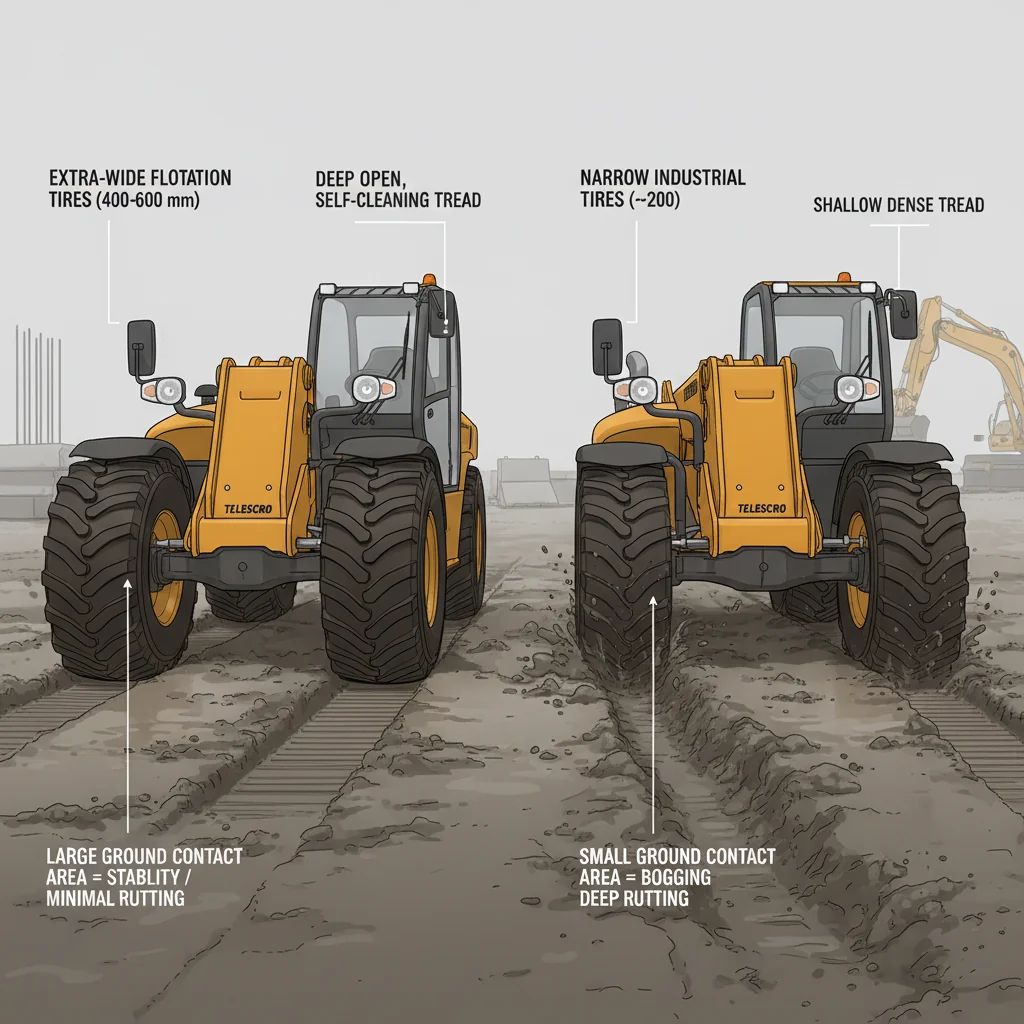
Here’s what matters most when you’re sending a telehandler into mud—tire selection can make or break jobsite productivity. I’ve seen projects in southern Brazil come to a halt because a new 4-ton telehandler arrived with industrial-pattern tires and began sinking into wet soil after the first rain. On soft ground, tires that increase the contact area and use open, self-cleaning tread patterns make a noticeable difference in mobility.
Wide flotation tires7—where approved by the OEM—help spread machine weight and reduce rutting compared with narrow industrial or hard-pattern tires, which tend to dig in and bog down on muddy sites. A customer in Kazakhstan once asked why his brand-new compact telehandler fitted with foam-filled tires8 struggled after several days of rain. Foam-filled options offer excellent puncture resistance, but in predominantly soft or muddy conditions, the added tire weight can increase ground pressure and worsen sinkage. In that case, switching to OEM-approved, air-filled flotation tires significantly improved performance.
Here’s a quick comparison for muddy ground:
| Tire Type | Mud Traction | Stability | Puncture Resistance | Weight Impact | Best For |
|---|---|---|---|---|---|
| Wide Flotation (Air-Filled, Aggressive Tread) | Excellent | High | Moderate | Lower | Soft/muddy ground |
| Standard Off-Road (Narrow/Hard Tread) | Low | Poor | Moderate | Lower | Mixed/hard surfaces |
| Industrial Pattern (Smooth/Blocky) | Very Low | Poor | Moderate | Lower | Paved/firm surfaces |
| Flotation (Foam-Filled) | Good | Moderate | Excellent | Higher | High puncture-risk sites |
Wide flotation tires with open tread patterns help telehandlers stay mobile in muddy conditions by distributing weight and reducing ground pressure.True
Flotation tires are designed to spread the telehandler’s load over a larger area, which reduces the pressure on soft soil and minimizes the risk of the machine sinking or getting stuck. The open tread also helps clear mud, maintaining traction.
Standard industrial-pattern tires offer the same level of traction and flotation in muddy environments as rough-terrain tires.False
Industrial-pattern tires are optimized for hard surfaces and paved worksites. In mud, their narrower profile and less aggressive tread cause them to sink more easily and provide less traction, increasing the likelihood of becoming bogged down.
Key takeaway: Tire selection critically impacts telehandler performance on muddy terrain. For soft ground, prioritize wide, flotation-pattern tires to maximize grip and minimize sinking. Avoid generic ‘off-road tires’—always confirm the specific tire size and tread pattern matches muddy or soft soil conditions for your application.
Which telehandler features aid muddy ground?
Critical telehandler features for muddy ground include four-wheel drive with high torque, axle oscillation9 for wheel contact on rutted surfaces, ground clearance commonly in the 350–450 mm range, and wide flotation tires to lower ground pressure. Stabilizers, frame leveling, and hydro-pneumatic suspension enhance stability on soft, uneven terrain.
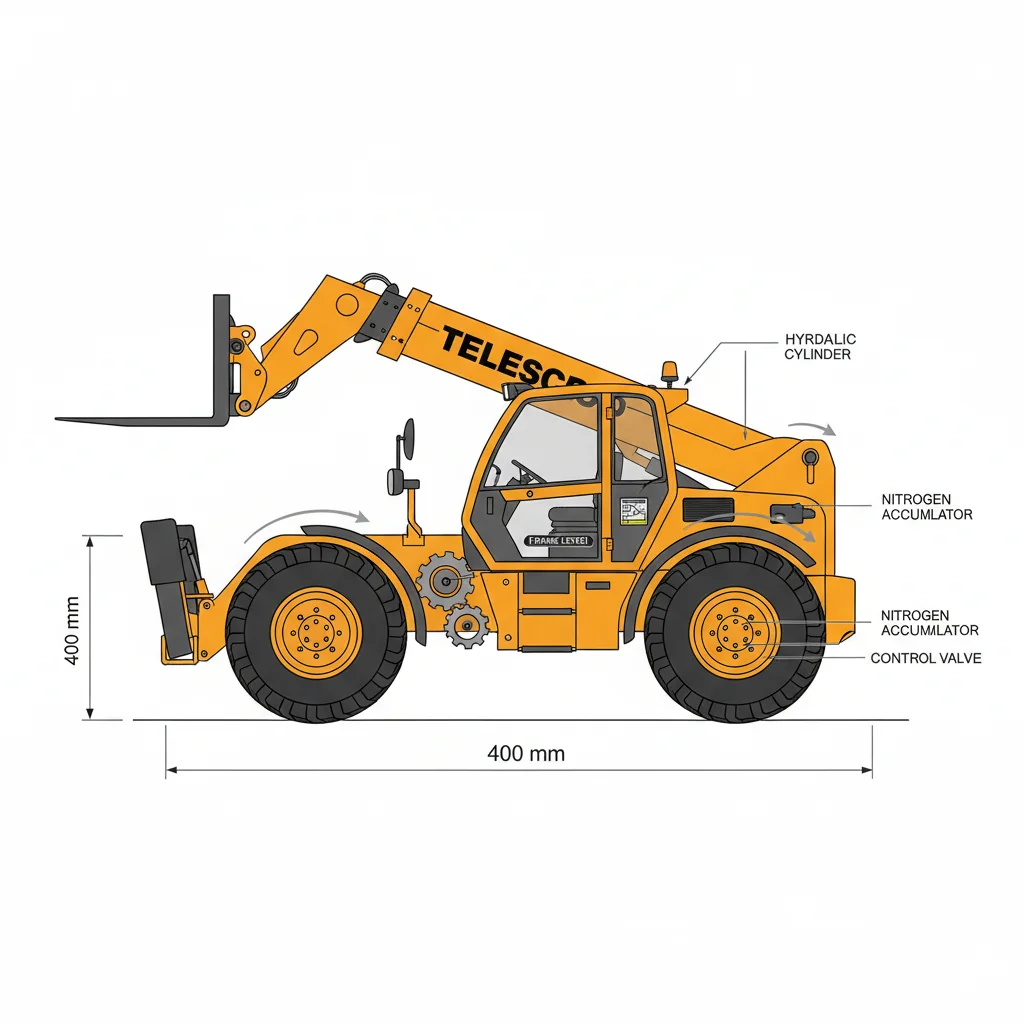
From my experience, buyers often focus on engine size or maximum reach and forget just how brutal muddy ground can be. The first feature I look for is a robust four-wheel drive system with good torque delivery—without that, you’re spinning your wheels and wasting fuel. I once had a customer in northern Poland who tried to cut costs with a two-wheel-drive unit; after one week, they called me desperate. Heavy rain had turned the jobsite into a marsh, and the machine just dug itself in. Axle oscillation plays a big role as well. When surfaces are uneven or full of deep ruts, this feature allows each wheel to maintain contact—so you keep moving and reduce the risk of sudden slippage. Ground clearance is another thing people underestimate. I recommend models with clearance in the 350–450 mm range for most muddy construction sites.
During a sugar factory expansion in Vietnam, a crew struggled daily with a unit that only had about 300 mm of clearance—they spent hours just getting unstuck. Wide flotation tires help too. Lower ground pressure means better traction on soft ground and less rutting, but always check actual tire sizes from the OEM, not just what the tire industry calls “R4.” For longer or higher lifts, you’ll want stabilizers and frame leveling. Stabilizers need steady support underneath; in Kazakhstan, a client solved constant tipping by putting mats under each pad. Hydro-pneumatic suspension (where fitted) gives a smoother ride across bumpy, soft terrain.
Axle oscillation allows a telehandler to maintain traction on uneven, muddy ground by keeping all wheels in contact with the surface, reducing the chance of getting stuck.True
Axle oscillation enables the telehandler's axles to flex, allowing its wheels to follow the uneven terrain and maintain grip even when some wheels would otherwise lose contact, which is crucial in muddy or slippery conditions.
Telehandlers with two-wheel steering perform just as well as four-wheel-steer models in muddy conditions.False
Four-wheel steering greatly improves maneuverability and the ability to navigate out of ruts or soft ground, which is difficult for two-wheel steering machines that have a larger turning radius and reduced control on slick, muddy jobsites.
Key takeaway: Telehandlers specified for muddy or soft ground should prioritize four-wheel drive with ample torque, axle oscillation, higher ground clearance, and wide flotation tires. For long-reach lifting, stabilizers, frame leveling, and, where available, hydro-pneumatic suspension are critical for sustained safety and stability in challenging field conditions.
What Increases Telehandler Safety on Mud?
Effective telehandler safety on muddy ground relies on both operator technique and machine configuration. Key practices include engaging 4WD10 before entering soft soil, maintaining low speeds below 5 km/h, avoiding sudden movements, keeping the boom low and retracted, and strictly adhering to manufacturer load charts11, especially on unstable ground.

Last month, a contractor in Kazakhstan sent me a video of his telehandler stuck on a muddy site, wheels spinning uselessly. He’d entered soft ground in 2WD, thinking he could just “power through.” This never works—by the time your wheels start to dig, it’s often too late to engage 4WD. I always advise operators to switch into 4WD before they even touch soft or saturated soil. On jobsites where mud is likely, plan every move ahead and keep your speed under 5 km/h. Sudden turns or hard braking on mud can cause skidding or, worse, one side of the machine to sink—putting you halfway to tipping over.
Operator technique really makes the difference. I’ve watched teams in Dubai moving trusses across muddy backfill without incident. Their secret? The boom is always held low and fully retracted, so the load stays as close to the axles as possible. This means a lower center of gravity and far less risk on unstable ground. If you lift the boom high or extend forward in mud, you’re asking for trouble. The load chart shows capacity on level, hard-packed surfaces. On soft or visibly deformed ground, I advise customers to reduce working loads by at least 20–30%—sometimes more if ground conditions are especially poor.
Avoid side slopes, even if they look minor—especially on wet or muddy ground. If the machine cannot be kept within the manufacturer’s permitted leveling or tilt limits, or if one side begins to sink, stability can deteriorate rapidly. Spotters become critical on muddy, cluttered sites, particularly when mirrors and windows are coated with mud. Plan slow, deliberate movements and avoid trying to power out of poor ground conditions, as sudden inputs and uneven support are common precursors to tip-over incidents.
Engaging a telehandler’s 4WD before entering muddy ground significantly reduces the risk of getting stuck by distributing torque to all wheels from the outset.True
When a telehandler is already in 4WD before touching soft or wet ground, traction is maximized for all wheels, making it less likely that any one wheel will dig in and lose grip. Switching to 4WD after losing traction is often too late, as wheels already spinning can’t recover lost momentum or shift weight distribution effectively.
Adding more weight to a telehandler’s rear counterweight always improves traction and safety on mud.False
While counterweights are essential for balance and lifting capacity, adding excessive weight to the rear does not always improve traction and can actually make the telehandler less stable or harder to maneuver on soft ground. The key to mud safety is proper weight distribution and traction control, not simply increasing counterweight.
Key takeaway: Safe telehandler operation in mud depends on deliberate planning, engaging 4WD early, low-speed movement, and keeping the boom retracted and low. Manufacturer load charts must be referenced, with reduced loads on unstable ground. Abrupt maneuvers and side slopes increase tipping risk and should be avoided.
How should telehandler stabilizers be used on mud?
Stabilizers on telehandlers12 must always be deployed onto firm, level, and sink-resistant ground to ensure rated capacity and stability. On muddy sites, wide, rigid pads or mats should be placed under each stabilizer to distribute load. Direct contact with deep mud risks sudden uneven sinking and loss of stability.

To be honest, the spec that actually matters is not just whether your telehandler has stabilizers, but how you use them when ground conditions get messy. Mud is a classic challenge—I’ve seen jobs in Thailand and southern China turn into slow-motion disasters because operators skipped the prep and just dropped stabilizer legs straight into wet ground. It’s never as simple as “just deploy and lift.” The whole purpose of stabilizers is to transfer heavy loads—sometimes two or three tons—safely to the ground. On soft, wet mud, that load gets concentrated on a point as small as a dinner plate, so you can get sudden uneven sinking. When that happens, stability is gone in seconds.
Here’s what best-practice looks like when you have to work in muddy or soft soil:
- Lay down wide, rigid pads or mats (timber, steel, or proper composite outrigger pads13) under every stabilizer foot—never use a thin board or whatever’s lying around.
- Visually check that your pads rest on compacted soil, not just a deceptively hard surface hiding deep mud. If you step on the ground and it gives way, it’s not ready.
- Deploy the stabilizers fully and check that any indicator lights or dashboard warnings show they’re set correctly before you even touch the load.
- Run a test lift—raise the attachment a few centimeters, pause, and get out for a visual check.
Look for signs of pad movement, tilting, or sudden sinking; even small shifts mean it’s not safe yet.
To ensure stability on muddy ground, it's necessary to use cribbing or pads under telehandler stabilizers to prevent them from sinking and losing load support.True
Cribbing or pads distribute the telehandler's weight over a larger area, reducing ground pressure and preventing stabilizer legs from sinking into mud, which helps maintain safe lifting conditions.
Telehandler stabilizers are designed to automatically compensate for soft or muddy ground by adjusting their pressure and extension.False
Stabilizer systems on telehandlers do not have the capability to sense and compensate for mud or poor ground conditions; proper operator judgment and ground preparation are required to ensure stability.
Key takeaway: Deploying telehandler stabilizers directly onto muddy or soft ground is unsafe and can lead to sudden instability. Always use wide, rigid pads or mats rated for the load and ensure they rest on compacted, solid soil. Visually confirm pad support before making any lifts.
How can telehandlers avoid getting stuck in mud?
Prevent telehandler immobilization in muddy conditions with thorough route planning14—select the firmest, smoothest paths, and steer clear of visible puddles or freshly filled trenches. Minimize sharp turns to reduce surface churning, monitor rut depth routinely, and halt at the first sign of bogging. For recovery, lower the boom, clear tire obstructions, engage 4WD, and avoid excessive wheel spinning.

Let me share something important about telehandlers and mud—most costly incidents start when operators think they can “just go a bit further.” A few months ago in Dubai, a team was moving bricks with a 4-ton, 14-meter unit after a rare rainstorm. Their regular path was blocked, so the operator tried a shortcut across fresh fill. The ground looked firm from the cab. But after just 5 meters, the front tires dropped into soft mud. They spun the wheels, hoping for traction, but only dug in deeper. In less than a minute, the telehandler was axle-deep and stuck, blocking access for the concrete crew the entire afternoon.
I always suggest planning routes with your ground supervisor, especially after heavy rain or earthworks. Choose the longest—but firmest—path if that means you’ll avoid puddles or deep ruts. I’ve seen contractors in Kenya laying steel plates for crossings, which works well for short-term access. Be cautious with using the same route too often: repeated crossings can form ruts that get easily waterlogged. Once ruts reach a couple of tire heights, the risk of chassis “beaching” increases, making self-recovery much harder.
If the wheels start to bog, stop immediately. Lower the boom and any load to bring weight back over the drive axle—this often helps you regain grip. Clear mud from in front of the tires, switch to low gear and engage 4WD if you have it. Gentle rocking works better than wheel spinning. If you can’t move forward, I recommend getting pulled out by another machine from solid ground using a single straight cable. Taking quick action reduces site damage and saves hours of frustration.
Using outriggers on a telehandler provides added stability, but it does not improve traction in muddy conditions.True
Outriggers are designed to prevent tipping by widening the base of support, but they do not actively contribute to the tires’ grip or flotation when the machine is moving across mud. Operators should not rely on outriggers to avoid getting stuck.
Increasing tire pressure on a telehandler helps prevent it from sinking into muddy ground.False
Telehandlers must be operated with tire types and inflation pressures specified by the manufacturer. Increasing tire pressure reduces the tire’s contact area and can worsen sinkage on soft ground, but reducing tire pressure outside OEM guidance is also unsafe and not permitted. Improved flotation on muddy sites should be achieved through OEM-approved tire selection, ground mats or plates, and route preparation—not by altering tire pressure ad hoc.
Key takeaway: Systematic route planning, ongoing ground assessment, and correct operational techniques are critical for telehandler mobility on muddy ground. Acting promptly when bogging is detected and applying safe self-recovery methods prevent escalation, reducing downtime and damage to both equipment and worksite surfaces.
What Maintenance is Needed After Muddy Use?
Post-operation in muddy conditions, telehandlers require thorough cleaning—especially around axles, steering cylinders15, brakes, and the boom pivot—to prevent rust and seal damage. Brakes should be tested carefully after exposure. Daily lubrication of pins and pivots, plus vigilant inspection of radiators and tires, are essential for prolonged safe operation.

The biggest mistake I see is thinking one quick rinse is enough after a muddy job. From my experience working with contractors in the UK and Southeast Asia, real trouble starts when mud packs solid around the axles and boom pivot. If you let that crud sit overnight, moisture and grit eat straight into seals—eventually causing hydraulic leaks and expensive downtime. I’ve seen a three-ton telehandler lose a steering cylinder after just four weeks of daily muck work because nobody cleaned around the seals, and the whole jobsite lost a day replacing it.
Here’s a simple bullet list I use on muddy jobsites—especially after rain or in livestock yards:
- Targeted cleaning: Wash the axles, boom pivot, steering cylinders, brakes, and anywhere rubber meets steel. Don’t forget steps and handrails—slippery access is an accident risk.
- Brake test: Mud and water layer inside brake drums. Always test brakes on flat ground before the next shift; stopping power can be much weaker right after washing or deep mud exposure.
- Extra lubrication: On rough jobs, grease every pin, pivot, and boom slide—sometimes daily. This pushes out moisture and keeps parts moving. Some models require daily lubrication in muddy or corrosive conditions.
- Radiator and cooler check: Mud mixed with grass can plug a radiator in a single shift. Overheating wrecks hydraulic and engine components quickly.
- Tire inspection: Look for cuts and embedded debris—hidden rocks in deep ruts damage sidewalls fast.
If mud is allowed to dry and harden around the telehandler's boom pivot, it can trap moisture against critical seals, accelerating wear and increasing the risk of hydraulic leaks.True
Mud acts as a barrier, holding moisture and abrasive particles in direct contact with sensitive components like pivot seals, hastening deterioration beyond what superficial cleaning addresses.
Only the exterior surfaces of a telehandler require cleaning after operating in mud; internal joints and undercarriage areas do not need any special attention.False
Internal joints and the undercarriage are especially vulnerable to mud build-up, which can cause premature wear, restricted movement, and eventual mechanical failure if not thoroughly cleaned after muddy use.
Key takeaway: Regular cleaning and inspection after operation in muddy or corrosive environments protect telehandler longevity and operator safety. Special attention to lubrication schedules, brake testing, and visual checks—especially of vulnerable components—reduces long-term maintenance costs and prevents injury from compromised access points and impaired visibility.
How should telehandlers operate on muddy farms?
Telehandler safety on muddy farms hinges on reinforcing predictable paths with concrete, sleepers, or compacted gravel, especially between feeding and storage areas. Short-boom models with wide flotation tires are preferred for stability. Avoid lateral work on wet slopes over 5–7°. Specify excellent sealing, mudguards, and underbody protection for high-mud exposure.

I’ve seen sloppy weather take down more telehandlers than any other factor on a farm—but the answer isn’t just slower driving. On muddy yards, it’s all about controlling where those heavy wheels go. Several years ago, a customer in northern France had constant ruts between their silage clamp and feed shed every winter. After spending weeks stuck and losing time, they finally put in concrete wheel strips16 on key routes. The difference was huge: less bogging, and almost no calls for recovery. That’s the value of hardening the routes you depend on daily. If concrete is out of budget, even laying thick wooden sleepers or properly compacted gravel where telehandler tires track most often will seriously cut downtime.
Short-boom models with wide flotation tires handle these conditions best. Typical farm work rarely needs the boom out more than 7 meters, but I’ve had buyers choose long-reach models and regret it. They’re more “showroom hero, jobsite zero” when the ground turns to soup. Wide tires spread the load out, so the machine stays on top instead of sinking. On soft ground, anything steeper than 5° sideways is risky—even if it looks safe. That’s when you can lose it fastest.
Another point: specify better protection when you buy. For high-mud or slurry areas, ask about underbody shielding, mudguards, and proper sealing. I recall a dairy in Ireland that lost a week to a blown electrical connection—cowsplash and aggressive wash-down did the damage. It’s a lot cheaper to protect those parts upfront than handle “second-year surprises” after your first muddy season. I’d always plan routes, machine spec, and maintenance for mud exposure before anything else.
Telehandlers fitted with agricultural tires offer significantly better traction and reduced soil compaction on muddy farms compared to standard industrial tires.True
Agricultural tires are designed with deeper, more widely spaced lugs that grip better in soft, loose soils and reduce rutting and compaction, which helps telehandlers maintain mobility in muddy conditions.
Engaging four-wheel steering on a telehandler increases the likelihood of getting stuck in mud compared to two-wheel steering.False
Four-wheel steering enhances maneuverability and distributes traction across more wheels, which actually helps telehandlers navigate slippery or uneven muddy terrain more effectively than two-wheel steering.
Key takeaway: Farmers can minimize telehandler risks in muddy environments by reinforcing key routes, selecting wide flotation tires, and choosing shorter-boom models better suited for typical farm heights. Avoiding cross-slope work on wet ground and specifying protective features during purchase reduces maintenance and improves long-term operational safety.
Conclusion
We’ve looked at how muddy ground changes the risks when working with telehandlers and why a careful approach matters. From my own jobsites, I can tell you—movement across mud doesn’t mean it’s safe to lift. The buyers who regret their decision usually skip mentally derating the load and forget the “parts roulette” that can hit if you’re stuck waiting for support. Before you commit, double-check the load chart with a real margin for muddy terrain and talk to others about their experiences in similar ground conditions. If you want help sorting out specs versus actual jobsite needs, just reach out—I’ve supported crews in 20 countries and am always happy to offer no-pressure advice. Every site is different—choose what actually works for your workflow.
References
-
Explains how increased ground pressure impacts telehandler traction and tip-over risks, key for safe operation on soft surfaces. ↩
-
Details why rated capacity assumes firm ground and how lifting limits must adjust on soft soil to prevent accidents. ↩
-
Explains bearing capacity concepts and measurement methods vital for ensuring safe telehandler use on unstable and muddy construction sites. ↩
-
Provides expert steps and safety insights for load testing telehandler support on soft soil to prevent equipment damage and overturning. ↩
-
Explains how proper ground prep prevents telehandler sinkage and operational delays, key for working safely on muddy sites. ↩
-
Details how planned drop zones reduce machine rutting and enhance site safety, helping avoid costly recovery operations. ↩
-
Explores how wide flotation tires improve stability and reduce ground pressure, preventing ruts and bogging on soft soil. ↩
-
Analyzes foam-filled tire drawbacks in mud, explaining why added weight increases ground pressure and causes sinking issues. ↩
-
Explains the mechanics of axle oscillation and its role in maintaining traction and stability on uneven, muddy surfaces. ↩
-
Explains the critical role of 4WD in improving traction and preventing telehandlers from getting stuck on soft or muddy surfaces. ↩
-
Details how adhering to load charts can prevent tipping and overload, especially when working on soft or uneven construction sites. ↩
-
Provides expert guidelines on safely deploying telehandler stabilizers on soft or muddy terrain to prevent accidents and maintain load capacity. ↩
-
Explains the critical role of wide, rigid outrigger pads in load distribution and maintaining stability on wet, soft, or muddy construction sites. ↩
-
Detailed insights on how careful route planning reduces telehandler mud risks, saving costly downtime and improving site safety. ↩
-
Explore expert tips on cleaning and protecting steering cylinders from mud damage to prevent costly hydraulic leaks and downtime. ↩
-
Learn how concrete wheel strips reinforce telehandler routes to prevent ruts and downtime, supported by real-world farm applications and benefits. ↩