










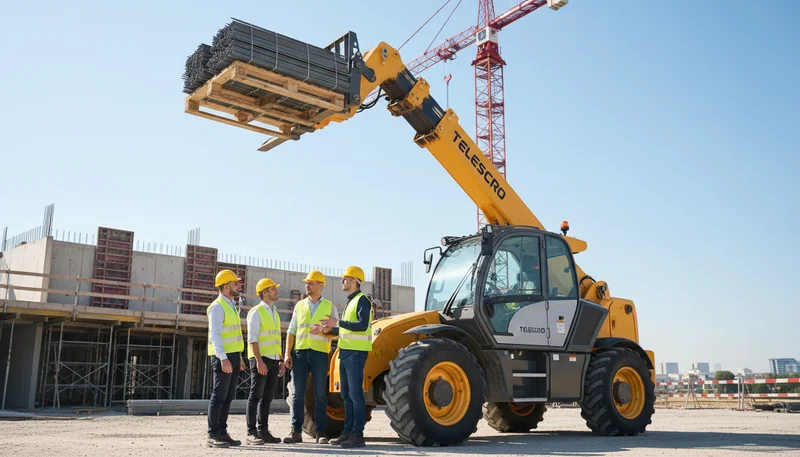
Telehandler Mistakes Beginners Make: Field-Tested Lessons to Avoid Costly Errors
Just last month, I watched a project manager in Turkey nearly overload his brand new telehandler because he trusted the brochure specs instead of looking at the real capacity chart in the cab. Moments like that make me wish more beginners knew what really matters before something goes wrong.
Common mistakes made by novice telehandler operators can create unsafe conditions, increase maintenance costs, and reduce jobsite efficiency. Misinterpreting rated capacity, failing to reference load charts, and selecting the wrong machine size are frequent issues. Treating telehandlers like warehouse forklifts introduces major stability risks—especially on uneven ground or with the boom raised. Improper attachment use (such as using the wrong tool for the load or attempting unauthorized personnel lifting) can compromise both safety and compliance.
How is telehandler rated capacity misjudged?
Many beginners mistakenly believe a telehandler’s rated capacity applies at all boom positions. In reality, usable capacity can drop sharply at higher boom angles and longer reaches, and the exact numbers depend on the model, attachment, and setup. Load charts show how capacity changes across the working envelope—helping prevent tip-overs and equipment damage.
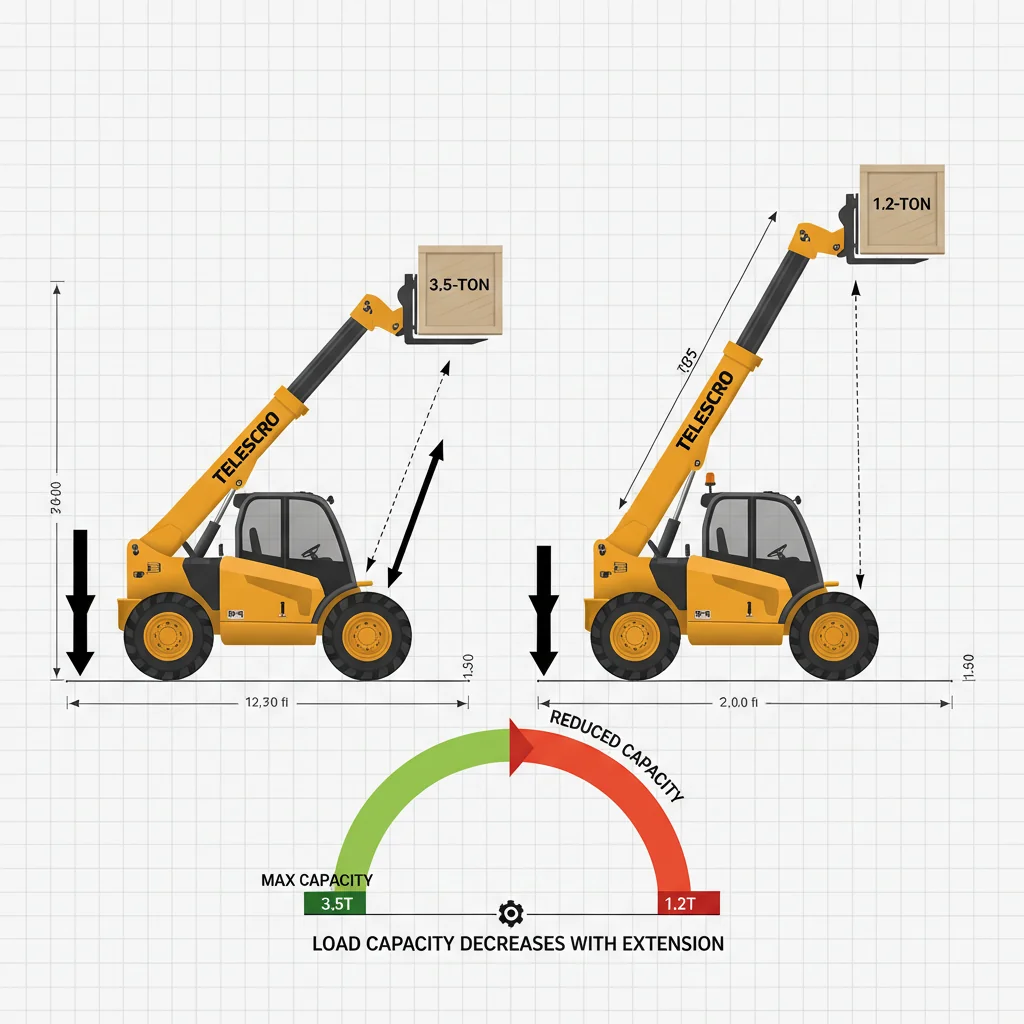
The biggest mistake I see—even with experienced teams—is assuming a telehandler’s rated capacity is available at every height and reach. On site in Dubai, I watched a crew expect a “3.5-ton class” telehandler to lift a heavy load over a truck side at extended reach. The reality—confirmed by the cab load chart—was that the allowable capacity at that boom position was far lower than the headline rating. One wrong assumption and they came close to tipping the machine; quick operator reaction prevented a serious incident.
Most people glance at the “tonnage class” and feel safe, but rated capacity only applies under the manufacturer’s stated conditions—typically with the boom fully retracted, the correct attachment fitted, and the machine positioned on firm, level ground. As boom height and forward reach increase, the overturning moment grows and usable capacity is reduced accordingly.
The load chart1 in the cab shows the real limits, mapping allowable loads for each boom height and reach combination. As the boom extends, the permitted capacity can drop sharply compared with the headline rating. If the actual load weight exceeds the charted limit for that position, the lift must be reconfigured or a larger machine selected—guessing at capacity is how tip-over risks and equipment damage begin.
I’ve had customers in Kenya buy telehandlers based on the “max lift” in brochures, only to find out on the first job that their machine couldn’t reach the third floor with a full load. My advice—before you buy or lift, check the exact load chart for your model. Compare your real pallet weights, height, and reach with those numbers.
If your planned lift is close to the charted limit for that boom position, treat it as a warning sign—either move closer, reduce the load, change the setup (where permitted), or select the next machine size. Never base the decision on tonnage class or brochure specs alone.
A telehandler's rated capacity dramatically decreases as the boom extends outward and upward, meaning the maximum load listed is only valid when the boom is fully retracted and low.True
Manufacturers specify rated capacity based on the safest possible position—retracted boom and minimal height. As the boom is raised or extended, leverage increases, causing the actual safe lifting capacity to drop substantially. Many operators overlook this when planning lifts.
Telehandler rated capacity can be safely assumed for any position as long as outriggers are deployed.False
While outriggers help stabilize the telehandler and prevent tipping, they do not alter the fundamental decrease in lifting capacity as the boom extends or rises. Load ratings are always based on boom position, not just machine stability features.
Key takeaway: Rated capacity is valid only at specific boom heights and minimal reach conditions. Operators must consult the model-specific load chart for every lift position—never rely on tonnage class alone. Comparing actual tasks with the load chart prevents costly tip-overs, equipment failures, and safety violations.
Why Do Buyers Select the Wrong Telehandler Size?
New buyers often misjudge telehandler sizing by overspecifying2 or underspecifying. Overspecifying leads to higher upfront costs, excess fuel use, and operational inefficiencies in tight spaces. Underspecifying risks unsafe lifts at full reach or unplanned rentals. Accurate sizing requires listing real job demands, verifying load chart scenarios3 with the dealer, and prioritizing frequent tasks over outlier needs.
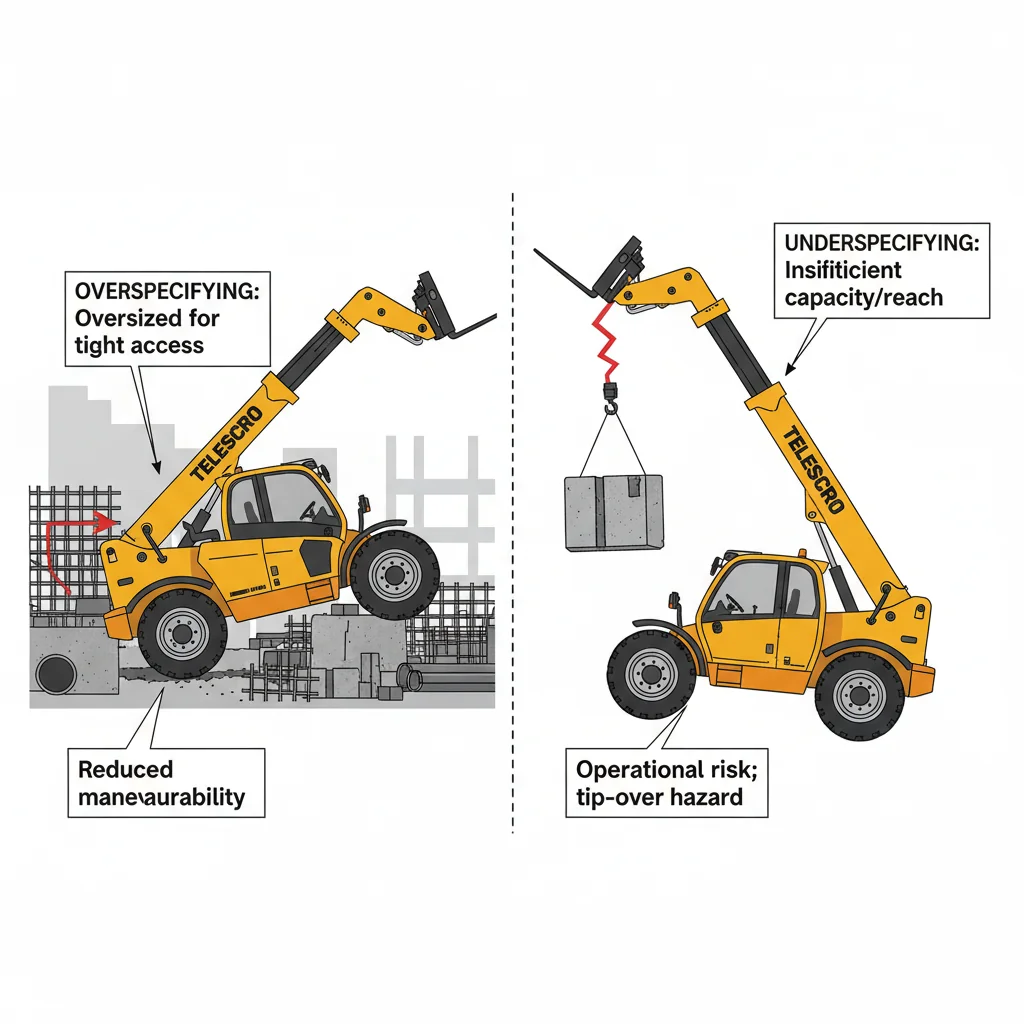
Let me share something important about why sizing mistakes happen so often. Many buyers believe the tonnage class—a “4-ton telehandler” for example—defines what the machine can actually do on their site. But the reality is, tonnage just sets the upper boundary at minimum reach, with the boom fully retracted and on level ground. On jobsites in places like Brazil and the UAE, I’ve seen plenty of buyers overlook how rated capacity drops as you reach higher or further. One customer in Dubai once ordered a 17-meter, 4-ton unit to unload trucks. On paper it looked “safe,” but most of their lifts were under 1,500 kg at less than 6 meters. The oversize machine struggled in tight spaces, burned more fuel, and wore down tires—costing them extra money every month with no real benefit.
Here’s the other side: underspecifying to save on purchase price. Just last year, I spoke with a team in Kazakhstan using a compact 2.5-ton telehandler. Their main job? Placing 1.8-ton concrete blocks onto the third floor, about 9 meters up and over a wall. When we checked the load chart, capacity at full extension was barely 1,300 kg. They ended up renting a bigger unit on short notice, halting work for days. That’s stressful—and easily avoidable.
I always advise listing your heaviest loads, maximum required heights, reach distances over obstacles, and details about your site terrain. Give these to your dealer and ask for a real capacity check, not just a sales brochure. A few minutes upfront can save you weeks of problems later.
A telehandler's rated capacity is measured with the boom fully retracted and on level ground, but this capacity decreases significantly as the boom is extended or raised.True
This is true because telehandler load charts show that increasing boom extension or height reduces the machine's rated capacity due to leverage and stability limits. Users often overlook these factors, leading to overloaded machines at greater reaches.
As long as a telehandler can lift the desired weight when stationary, it will be able to perform safely at any boom extension or height.False
This is false because the machine's lifting ability drops as the boom reaches out or up. Failing to consult the load chart may lead to dangerous situations, such as tipping or structural overload, especially at maximum reach or height.
Key takeaway: Telehandler selection errors arise when buyers ignore actual lifting height, load weight at maximum outreach, and job-site terrain. Sizing must be based on documented site requirements and validated load chart performance—not spec sheets or tonnage class—to minimize cost, safety, and productivity risks.
Why can’t telehandlers be driven like forklifts?
Treating telehandlers like forklifts is hazardous because telehandlers share more crane-like handling characteristics than warehouse trucks. As the boom is raised or extended, the machine’s stability changes significantly as the center of gravity4 shifts forward. Abrupt steering, rapid braking, or sudden direction changes—especially on slopes or uneven ground—with the boom elevated can quickly lead to loss of control or tip-over, resulting in serious safety and equipment risks.
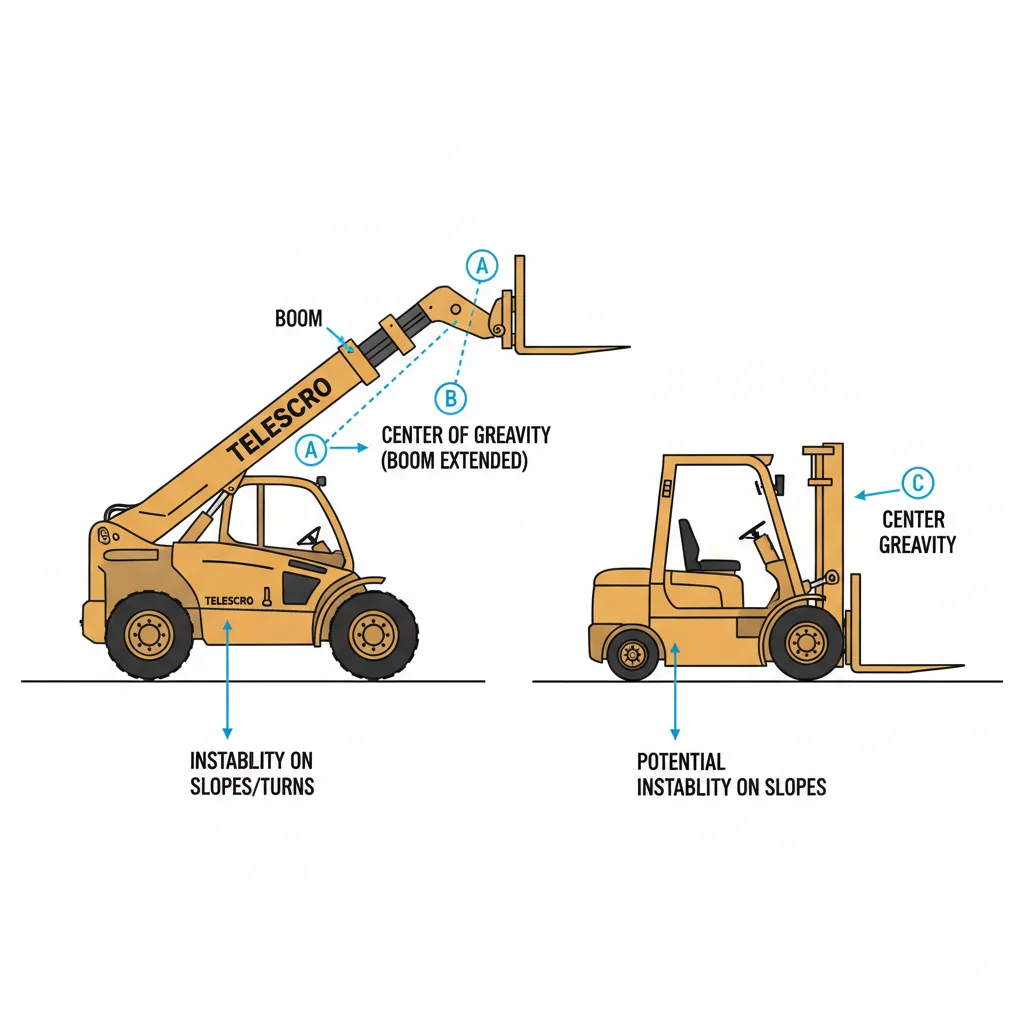
Most people don’t realize that telehandlers act very differently the moment you lift the boom or extend it forward. After nine years in this industry, I’ve seen even warehouse professionals make dangerous assumptions. They expect a 4-ton telehandler to “feel” just like a forklift, even out on a rough, uneven jobsite. But forklifts are designed for flat, predictable surfaces and the load stays close to the main body. With a telehandler’s boom up—even just halfway—your center of gravity moves far forward, and stability can drop sharply.
I remember a contractor outside Dubai who was used to running 3-ton warehouse forklifts. His team tried to move scaffolding with the boom partly raised, making a tight turn near a curb. The machine suddenly rocked—hard enough to shift the whole load—because the counterweight at the rear can’t compensate once the boom is out. At only 10 meters reach, rated capacity can drop from 4,000 kg to under 1,200 kg, depending on your load chart. That’s crane physics, not forklift handling.
Blind spots are worse too. The rear overhang is much bigger, especially compared to a compact warehouse truck. Traveling with the boom raised creates big blind areas—the “3-meter blind spot” I warn about. And if you hit even a slight side slope, the risk of tipping is real. I always suggest keeping the boom low while driving, slowing down if the ground is rough, and never assuming it will “correct itself” like a warehouse model.
I strongly recommend every telehandler operator completes proper training—not just forklift certification. The cost and risk of getting this wrong are too high for shortcuts.
Beginners often mistakenly believe that the steering response of a telehandler with its boom extended is the same as when the boom is retracted, when in fact, the machine becomes much harder to control due to the altered weight distribution.True
This is true because extending the boom shifts the center of gravity forward, making the telehandler less stable and changing how it reacts to steering inputs, which can catch even experienced forklift operators off guard.
A common mistake is thinking that lifting the boom on a telehandler does not impact its stability if the tires are properly inflated.False
This is false because, regardless of tire pressure, raising the boom increases the load's leverage and shifts the center of gravity outward, always reducing stability compared to lifting a load close to the chassis.
Key takeaway: Viewing telehandlers as forklifts ignores their crane-like instability when the boom is raised or extended. Operators must always travel with loads low, steer minimally with an elevated boom, and understand that side slopes or abrupt maneuvers greatly increase the risk of tipping or collision—proper training is essential.
What Are Common Telehandler Attachment Errors?
Beginner telehandler operators often make critical errors by using any attachment that fits or relying on pallet forks5 for all materials. Using improper tools, like forks for loose bulk or bales without proper clamps, reduces stability and increases accident risks. Illegally lifting personnel on forks is especially dangerous and prohibited in most jurisdictions.
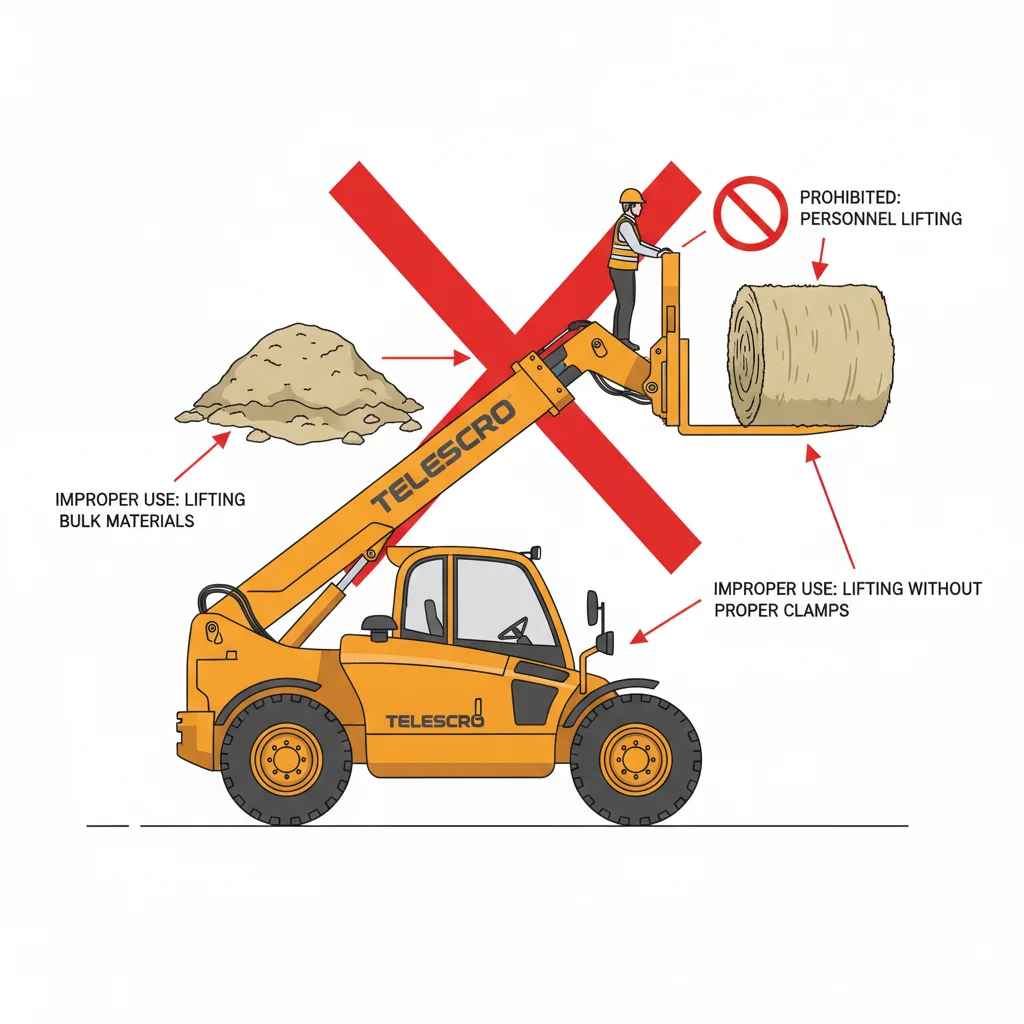
I’ve worked with customers who made this mistake—simply grabbing whatever attachment looked like it would fit the quick coupler. It happens all the time. They find a bucket or an old set of forks on the jobsite, hook it up to a 3.5-ton machine, and get to work without checking the rated load or the machine’s load chart. The reality? That “universal fit” mindset leads to unstable loads, lost productivity, or expensive damage. In Brazil, I saw an operator try to shift grain with forks instead of a material bucket. Not only was it slow, the entire load shifted as he raised the boom—he nearly lost 600 kg of product and risked tipping the machine.
Here are some common telehandler attachment errors I see around the world:
- Using forks for everything – Pallet forks are designed for stable, palletized loads. They are not suitable for bulk materials, bales, or loose pipe bundles, where load shift and instability are common.
- Improvising with the wrong tool – Handling silage or agricultural bales with generic forks instead of a proper clamp increases the risk of dropped or damaged loads. While standard bale clamps6 are designed for heavy bales, actual safe load limits depend on the clamp design, bale size, and moisture content, and must be verified against the attachment rating and the telehandler’s load chart.
- Unapproved personnel lifting – Hoisting workers on forks or in homemade baskets is extremely dangerous and typically non-compliant. Only manufacturer-approved work platforms with proper locking, guarding, and safety systems should be used.
- Ignoring attachment weight – Every attachment adds mass and shifts the load center forward, reducing usable lifting capacity and altering stability.
Attaching a non-rated or incompatible attachment to a telehandler can substantially alter the machine’s center of gravity, increasing the risk of tipping even if the load appears to be within capacity.True
Each attachment changes a telehandler’s weight distribution and lifting characteristics; manufacturers design load charts specific to both the machine and approved attachments, which is why improper pairing creates hidden hazards.
If an attachment fits onto the telehandler’s quick coupler, it is automatically suitable for lifting loads within the machine’s rated capacity.False
Physical fit does not guarantee compatibility; attachments not rated or designed for a specific telehandler can exceed safe weight limits or exert improper loads, easily exceeding the actual rated capacity and risking machine failure or instability.
Key takeaway: Always match attachments to the specific telehandler model and task, referencing approved equipment lists and load charts. Improvised solutions for bulk materials, bales, or man-lifting dramatically increase risks of dropped loads or severe accidents. Only certified work platforms should be used for elevating personnel—never pallet forks or homemade baskets.
How Do Poor Ground Conditions Cause Tip-Over?
Ignoring ground conditions can cause a loaded telehandler—often weighing several tons, and significantly more with load—to sink or tip, especially when the boom is extended. Soft soil, trenches, slab edges, or damaged concrete may not safely support concentrated wheel or outrigger loads, increasing the risk of instability. Wet spots and mud also reduce traction, raising sliding and tipping hazards.
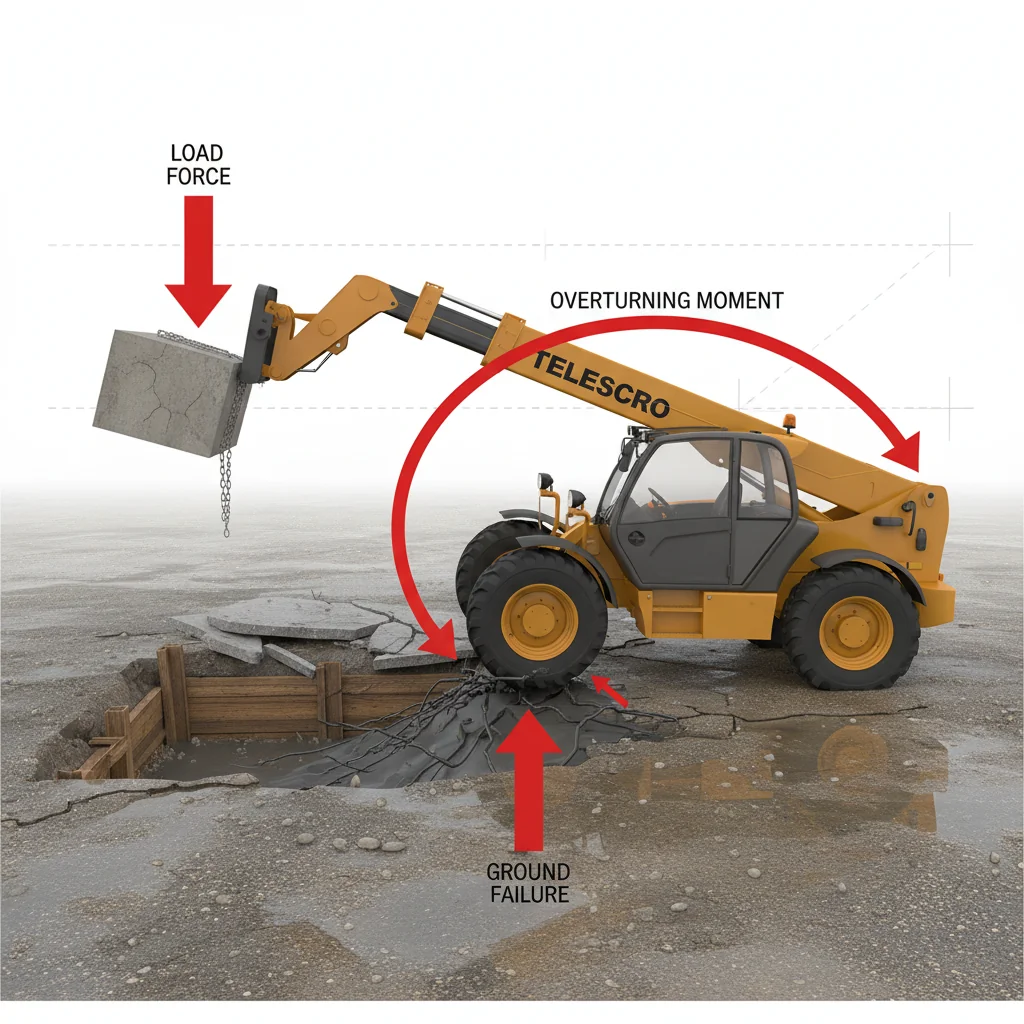
A lot of operators I meet believe, “If the ground looks good and the machine drives over it, I’m fine.” That’s where problems start. A fully loaded telehandler—say 10 tons with bricks—puts a huge force on each tire, especially when the boom is lifted. In Kazakhstan last year, a site manager called me after his 4-ton machine tipped on a renovation site. The culprit? The front wheels sank into soft, backfilled soil just meters from a slab edge. The telehandler looked stable until the boom extended. Then, the concentrated weight pushed through the weak ground, turning the machine into a seesaw.
Here’s what you need to check before moving any telehandler:
- Soft soil and mud7 – These look harmless, but even a few centimeters of sinking upsets your balance, especially with a raised boom.
- Backfilled trenches or utilities – Restoring a trench doesn’t make it strong. Sinking risk goes up near recent excavation, manholes, or underground pipes.
- Unsupported slab edges8 and damaged concrete – Driving too close can cause the slab to crack from the wheel load. I’ve seen this in Malaysia, and the repair cost was worse than the downtime.
- Wet patches, oil spills, or thick mud – Reduced traction means the machine can slide, especially when turning or stopping with the boom in the air.
- Hidden voids or weak spots – Sometimes the surface looks solid, but hollow beneath. That’s a setup for sudden collapse.
A telehandler can appear stable on seemingly solid ground, but if the soil underneath is recently backfilled or not compacted, the machine’s front wheels can suddenly sink when the boom is extended, dramatically increasing the risk of tip-over.True
This is true because the concentrated load from the front wheels with an extended boom can cause ground failure even if the surface looks adequate. Soft, loose, or backfilled soils lack the strength to support heavy equipment, especially under dynamic loading conditions.
If a telehandler drives over an area without any visible sinking or movement, it means the ground is sufficiently stable for all lifting operations, regardless of load.False
This is false because initial driving may not reveal soil weaknesses. While the machine may not sink with just its own weight, the stress multiplies when the boom is extended with a load, possibly causing sudden ground failure and tip-over later on.
Key takeaway: Assessing ground conditions is essential before operating a telehandler. Never assume mobility equals safety—identify and avoid weak surfaces, use mats to spread loads on marginal ground, and remember that slab edges and trenches can collapse under concentrated machine weight, especially with the boom raised.
How Are Stabilizers and Frame-Levelling Misused?
Stabilizers and frame-levelling are often misused by beginners who expect these systems to compensate for poor ground conditions or machine positioning. Frame-levelling should only bring the chassis near level, then return to neutral before lifting high. Stabilizers must be fully deployed on firm, level ground and verified per manufacturer protocols—never as a fix for extreme slopes or soft terrain.
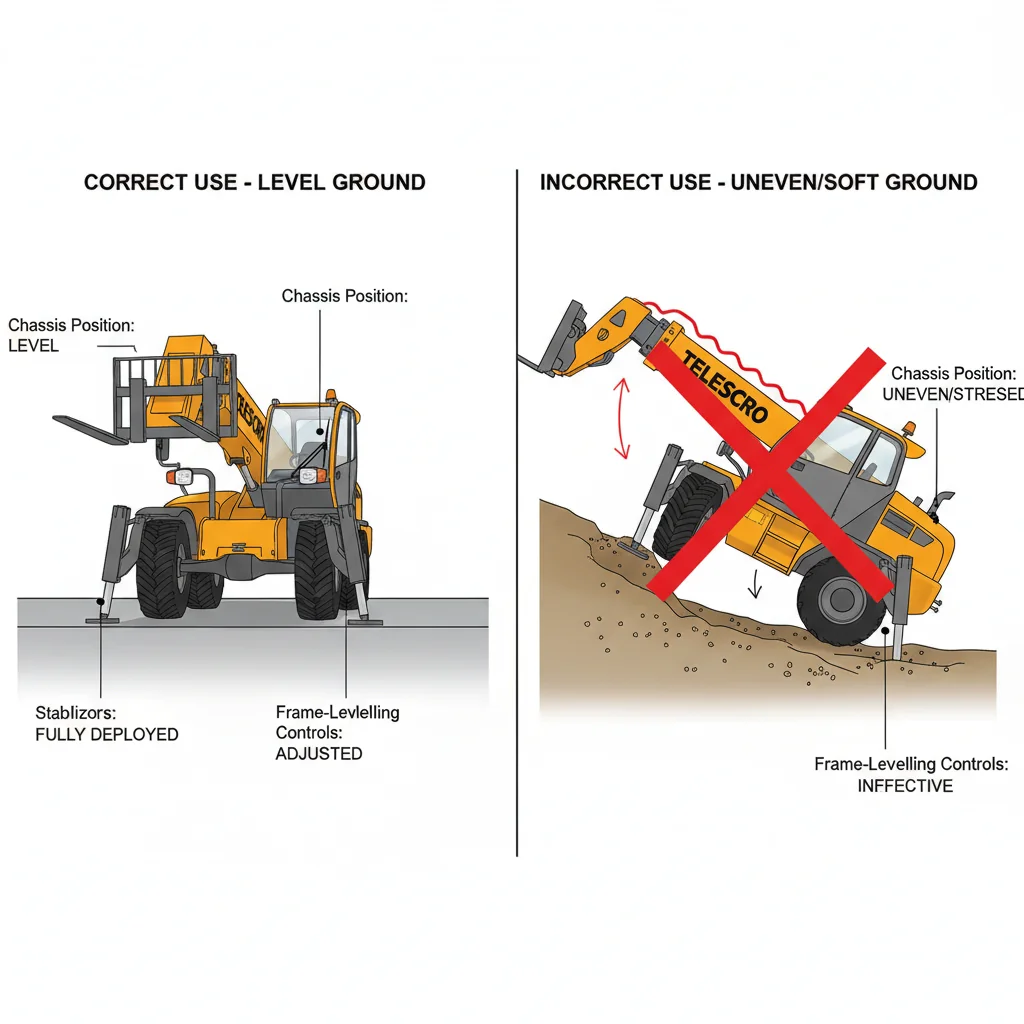
Here’s what matters most when talking about stabilizers and frame-levelling: these systems are there for safety margins, not for correcting poor planning or bad ground conditions. Too often, I see new operators trust the frame-levelling hydraulics to “straighten out” the machine on severe cross-slopes or expect stabilizers to magically create solid footing on soft mud. That’s a big risk—rated capacity is only valid when your machine starts nearly level, within the manufacturer’s tilt limits, and with full stabilizer deployment on firm ground. A customer in Dubai once tried lifting a 1.5-ton pallet to 14 meters, keeping the frame-levelling cylinder constantly extended because the ground sloped around 6°. The telehandler felt “steady,” but his actual stability envelope was much smaller than the data plate showed. If you drive or work with the frame tilted hard in one direction, you’re already cheating the safety formula—forward or side tip-over can come with very little warning.
Here are the common misuses I see around the world:
- Using frame-levelling as a substitute for proper site preparation—instead of grading or shimming, they just max out the hydraulic tilt.
- Only partially deploying stabilizers— thinking “half out is good enough,” especially in tight areas.
- Setting stabilizers on soft, untested ground— hoping they’ll compensate for deep ruts, mud, or slopes.
- Keeping frame-levelling or stabilizers active while lifting—instead of returning to neutral after fine adjustments.
The right approach? Level the machine first—either mechanically or by preparing the ground.
Relying on frame-levelling to compensate for extreme cross-slopes can lead to dangerously underestimated tip-over risks, since load charts assume the machine is already close to level.True
Telehandler load ratings are tested on level ground; using frame-levelling hydraulics outside manufacturer tilt limits does not restore rated capacity, so operators can misjudge safe handling limits.
Stabilizers can be safely used as the primary means to correct for unstable or soft ground, making up for poor site preparation.False
Stabilizers are designed to add stability but cannot create a safe operating surface; using them on soft ground can cause the machine to shift or sink, increasing overturn risk instead of preventing it.
Key takeaway: Relying on frame-levelling or stabilizers to ‘rescue’ unsafe setups is a major operational error. Rated capacity and stability require the machine to be properly leveled and all systems fully deployed on suitable ground. If these conditions cannot be met, a different approach or equipment is required.
Why Is Telehandler Training Essential for Beginners?
Telehandlers require specific operator training9 and, in many regions, formal certification—not just a forklift or car license. Beginners often skip this step, leading to critical errors: misreading load charts, overloading, ignoring safety warnings, and unsafe operation on slopes. Comprehensive telehandler training prevents accidents, reduces breakdowns, and is essential for meeting regulatory compliance.
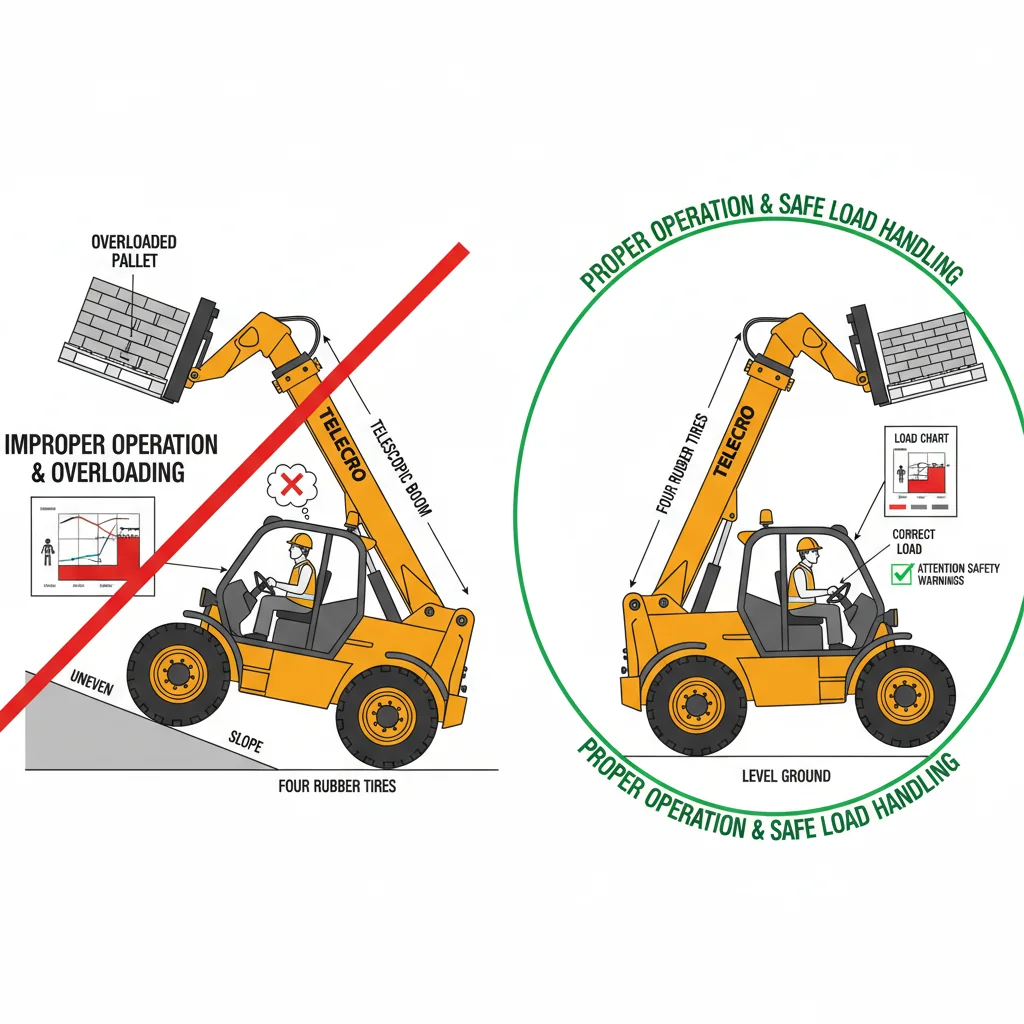
To be honest, the spec that actually matters is operator skill—not just machine specs or brand. I’ve seen cases in Kazakhstan and South Africa where new operators jumped onto a 4-ton, 17-meter telehandler thinking it was no different from their old forklift. Within a week, they’d ignored the load chart, tried to lift full pallets at maximum reach, and triggered overload alarms. One crew managed to jam the boom by driving uphill with the load too far out. Repairs took days, and the jobsite lost serious time.
Most beginners underestimate how different telehandler handling is—especially the way boom extension and machine angle affect stability. Unlike forklifts, a telehandler’s rated capacity drops off fast as you reach further or raise the boom. Let me give you an example: At full extension, that same 4-ton telehandler will only handle around 1,200 kg safely. If you don’t understand the load chart (the grid that shows what you can really lift at each position), you risk a tip-over. No forklift or car license covers this. That’s why most countries—like the UK, Australia, and the USA—require telehandler-specific certification.
It’s not just about avoiding accidents, either. Operator error means faster wear on hydraulics, cracked welds, or burnt-out pumps—costs that pop up six months later. I always tell buyers: budget for proper training and refresher courses, not just the machine itself. Ask your rental or dealer what support is included. In my experience, the sites with the fewest breakdowns always invest in practical, machine-specific operator training.
Beginner telehandler operators often overlook the importance of the load chart, leading them to attempt lifts at max reach without accounting for reduced capacity.True
Telehandlers have dynamic load capacities that decrease dramatically as the boom extends. Ignoring the load chart is a common and dangerous beginner mistake, as it can trigger overload alarms or mechanical failures.
As long as the telehandler's weight rating exceeds the load, operating at maximum boom extension is always safe for beginners.False
A telehandler’s weight capacity drops significantly when the boom is extended. Safe operation depends on boom angle and reach, not just the machine’s maximum weight rating. Overextending with a heavy load can cause tipping or structural damage.
Key takeaway: Overlooking telehandler-specific operator training is a leading cause of accidents and equipment failure among beginners. Budgeting only for the machine itself and skipping structured certification is a false economy. Always ensure every operator completes training aligned with manufacturer guidelines, covering load charts, stabilizer use, and machine-specific safety procedures.
Which Daily Telehandler Checks Are Essential?
Essential daily telehandler checks include inspecting engine oil, coolant, hydraulic fluid, hoses for leaks, tire condition and pressure, wheel nuts, forks, locking pins, boom structure, and safety devices. Many OEMs also specify regular greasing of key points10—such as boom pivots and telescopic sections—based on operating hours, duty cycle, and site conditions. The exact lubrication intervals and grease points must follow the operator manual for the specific model to prevent premature wear and costly mechanical failures.
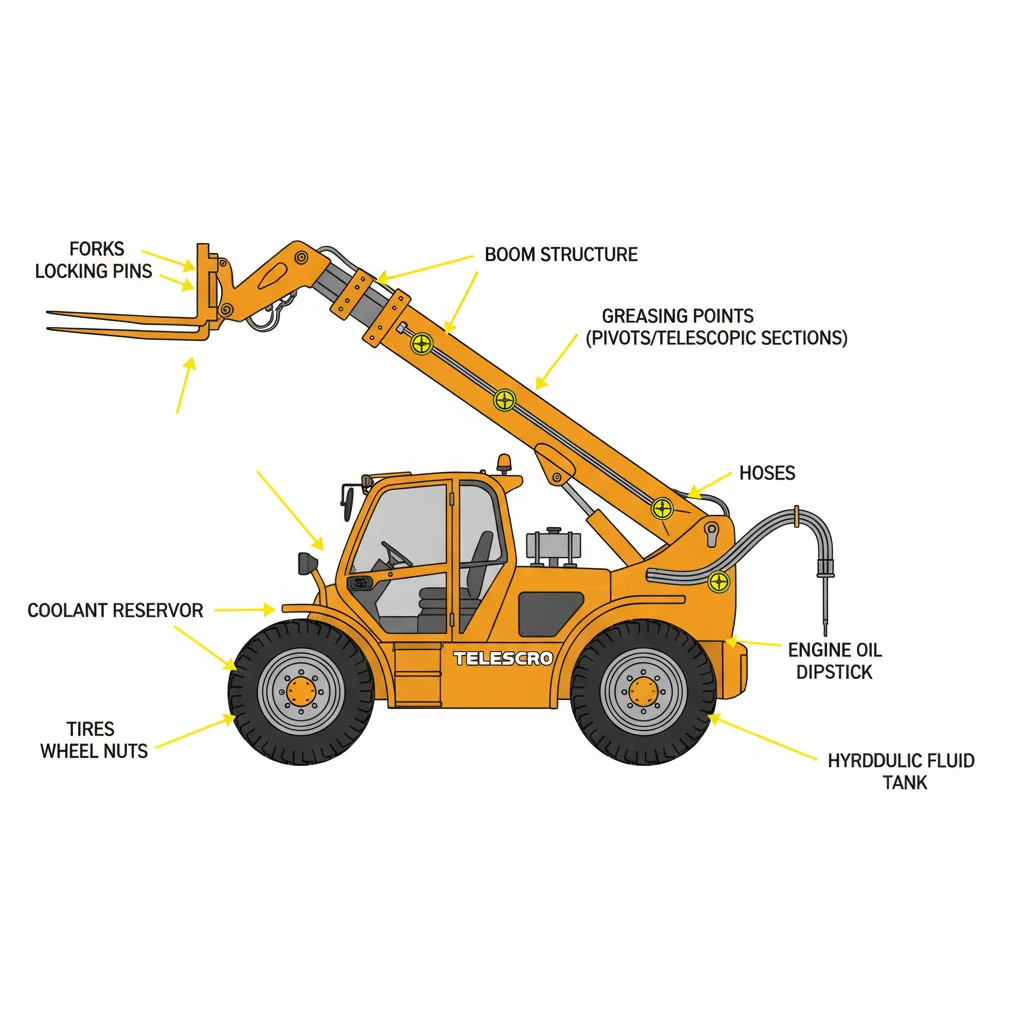
Last year, a team in Kazakhstan called me about repeated hydraulic faults on their 4-ton telehandler. They were losing at least half a day’s work each week. When I reviewed their pre-start routine, I found something simple but critical: the operator skipped almost every daily fluid check. He just fired up the machine and started work—same as you’d do with a car. This isn’t unusual, especially with new users. But telehandlers are far less forgiving. Even a small oil leak or underinflated tire can spiral quickly into damage. Here’s the thing—proper daily checks cover more than engine oil and coolant.
You also need to check hydraulic fluid, look for any leaks on all visible hoses, confirm tire pressure and check for sidewall cracks, inspect wheel nuts, test that all forks and locking pins are secure, and scan the boom structure for rust or bent welds. Don’t forget safety devices like the horn, warning lights, and alarms. I’ve seen a dry boom pivot seize up and put a rental unit out of service for three days. That cost the customer over $600 in lost production. Many operators also ignore daily lubrication points, especially on boom pivots and telescopic sections. Some OEMs—especially those used in dusty sites—require these points to be greased every shift, not just weekly. I always suggest keeping a grease gun on the machine and ticking off a pre-start checklist before every shift. Five to ten minutes invested can prevent days of downtime and unexpected repair bills.
Neglecting daily telehandler checks often leads to undetected hydraulic oil contamination, which can accelerate system wear even if fluid levels appear sufficient.True
Contaminants in hydraulic oil, such as dirt or water, may not affect fluid level readings but can cause internal component damage. Daily checks aren't only about fluid quantity—they include inspecting for signs of contamination, which beginners often overlook.
Daily air filter inspections are unnecessary because telehandlers are fitted with sensors that always alert the operator to filter blockages immediately.False
Most telehandlers lack advanced filtration sensors; many rely on periodic manual inspection. Relying solely on sensors can allow dust buildup, which restricts airflow, damages the engine, and reduces efficiency if not checked regularly.
Key takeaway: Skipping daily checks and lubrication on telehandlers is a leading cause of failures and safety incidents. Following an OEM-specific pre-start routine—including fluid levels, visible issues, and mandatory greasing—can prevent downtime, costly repairs, and hazardous situations. Invest 5–10 minutes per shift to maximize reliability.
How Does Skipping Telehandler Service Harm Reliability?
Neglecting scheduled telehandler servicing—beyond routine daily checks—significantly increases the risk of engine, hydraulic, and electrical failures. OEMs define staggered service intervals in their maintenance schedules, such as engine oil changes at around 500 operating hours11, while hydraulic oil and filter replacement intervals12 vary by manufacturer, duty cycle, and operating environment, commonly extending to 1,000 hours or more under approved conditions. Using non-approved fluids or low-quality filters increases contamination and heat-related wear, can impair safety systems, and may void warranty coverage while reducing long-term resale value.
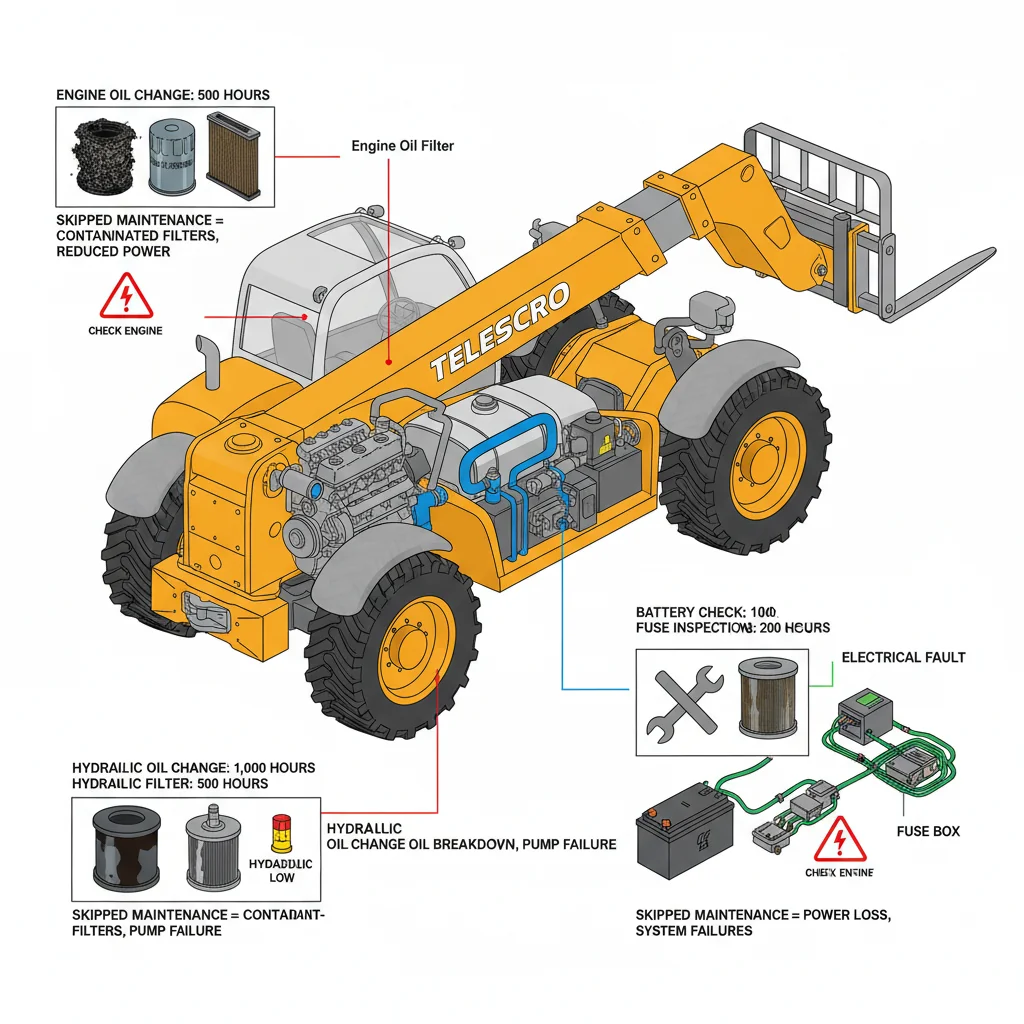
Last month, a contractor in Dubai called with a problem—two telehandlers down, both less than eighteen months old. The team relied only on daily walk-around checks and skipped scheduled servicing, including engine oil and filter changes around the 500-hour mark. Shortly after, one machine began losing hydraulic pressure during routine pallet handling, forcing work to stop for nearly two days. When the service technician inspected the hydraulic system, the root cause became clear: low-quality filters and non-approved fluids had accelerated internal wear and allowed contamination to circulate through the system. Fine metal particles had damaged pump seals and control valves—failure modes that develop quickly under poor filtration and lubrication conditions. I’ve seen similar cases in Turkey and Malaysia, especially on dusty sites where contamination control is already challenging.
Manufacturers define staggered service intervals for a reason. Engine oil service is commonly specified around 500 operating hours, while hydraulic oil and filter intervals vary by model, duty cycle, and environment—often extending toward 1,000 hours or more only when approved fluids and filtration are used. Delaying or ignoring these intervals increases the risk of overheating, valve sticking, and premature component wear. One agricultural customer in Sichuan attempted to reduce costs by postponing hydraulic filter replacement; the result was a pump rebuild at just 1,300 hours—far earlier than expected service life.
Using non-approved oils or filters also carries commercial risk. In many cases, OEMs may deny warranty claims if inspection shows unapproved consumables contributed to the failure. That alone can turn a minor service saving into a major financial loss.
My recommendation is straightforward: establish an hour-meter-based maintenance log from day one and link it to calendar reminders rather than memory. Retain all service records, fluid specifications, and invoices—these protect both uptime and resale value. Working with an authorized or certified service partner for planned maintenance is often the most cost-effective way to keep a telehandler productive, rather than waiting for breakdowns and parts delays.
Using non-approved hydraulic oil in a telehandler can accelerate internal wear, even if daily inspections show clean dipsticks and no leaks.True
Approved hydraulic oils contain specific additives tailored for the tight tolerances and components in telehandlers. Non-approved oils might lack these additives, leading to insufficient lubrication and wear that isn't immediately visible during surface-level daily checks.
If a telehandler passes its daily walk-around inspection, it is safe to delay the 500-hour service interval without risk to machine reliability.False
Daily inspections mainly catch obvious faults like leaks or loose components, but they cannot detect accumulating wear or contamination inside the engine and hydraulics. Skipping scheduled services means critical problems can develop unnoticed, eventually causing breakdowns despite daily checks.
Key takeaway: Skipping or delaying OEM-specified service intervals on telehandlers leads to breakdowns, safety risks, and potential warranty loss. Always establish hour-meter-based service logs, use OEM-approved fluids and filters, and partner with a certified service agent to protect machine reliability and future resale value.
Why Overlook Telehandler Tires and Terrain?
Many buyers focus on price and machine specs, overlooking vital operational factors. Telehandler tires and terrain compatibility dramatically impact running costs, performance, and longevity. The wrong tire tread can speed up wear, increase punctures, and compromise stability, while mismatched machines burn more fuel and increase wear part expenses over the equipment’s lifespan.
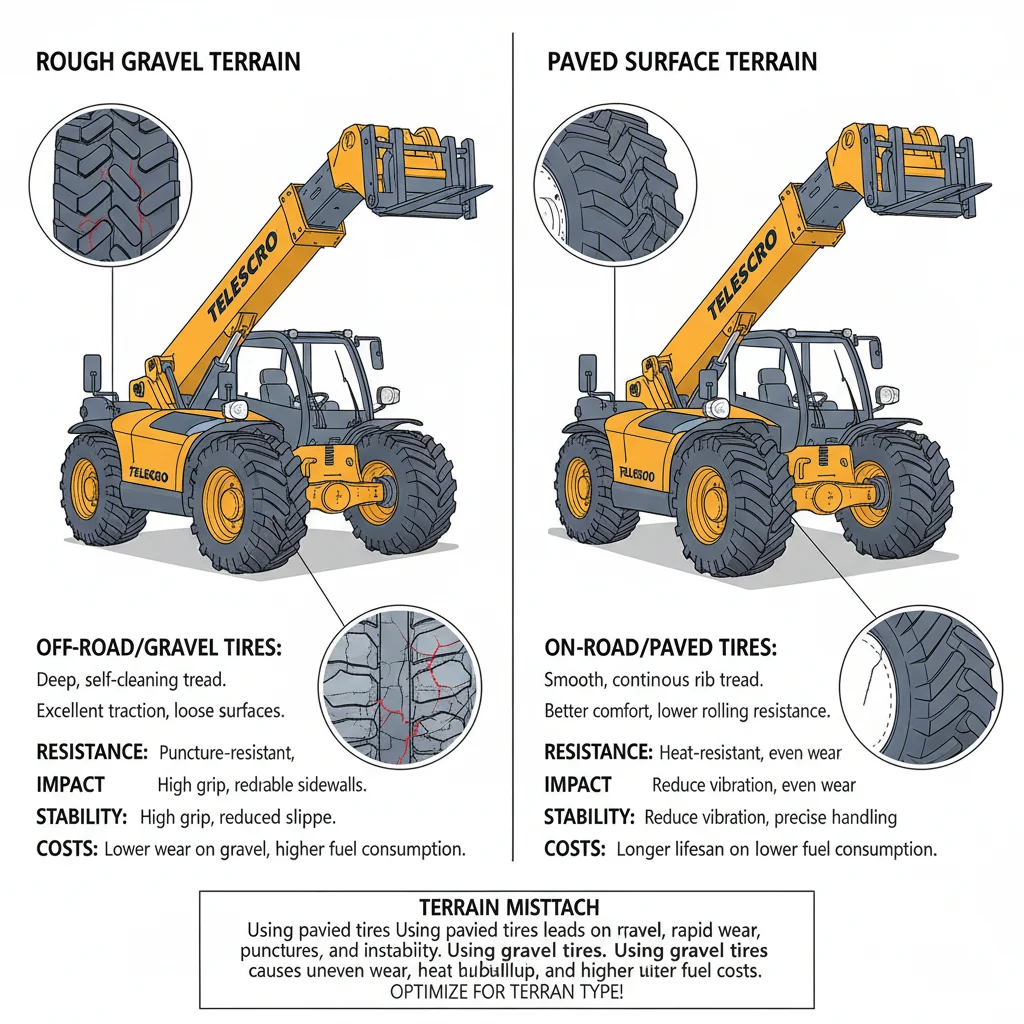
From what I’ve seen in the field, a lot of buyers zero in on getting the “right” tonnage or boom height, but pay little attention to something as basic as tire type or terrain. I remember a customer in rural Thailand who ran a 3-ton telehandler with deep, aggressive agricultural treads—perfect for wet fields but a disaster on their concrete yard. Within six months, sharp edges had worn off, traction dropped, and he dealt with constant stone bruises and costly punctures. He’d saved money upfront on spec—but ran up a bigger bill on replacement tires and downtime.
In practice, tire selection and ground conditions influence far more than operator comfort—they directly affect traction, rolling resistance, component wear, and overall machine efficiency. For example, telehandlers handling palletized materials on paved or reinforced concrete surfaces typically perform best with industrial or block-pattern tires13. These tread designs provide a stable contact patch, lower heat buildup, and improved wear characteristics on abrasive surfaces, often delivering substantially longer service life than agricultural-style tires under the same conditions.
By contrast, machines operating for extended periods in mud, soft soil, or unprepared ground benefit from wider agricultural or flotation-type tires. The larger footprint reduces ground pressure, limits rutting, and improves mobility, helping prevent the machine from sinking or losing traction in wet conditions—where recovery operations can quickly outweigh any upfront tire cost savings.
I always recommend that customers ask the dealer for typical fuel burn and tire wear rates for their specific jobsite. In Kenya, a grain cooperative I worked with switched from pneumatic to foam-filled tires for demolition work. Yes, the new tires were heavier and cost more upfront, but puncture risk dropped to almost zero and productivity went up—no more unscheduled stops. Real savings often hide in matching the machine to the worksite, not just the spec sheet.
Using off-road, deeply treaded agricultural tires on hard concrete surfaces can lead to accelerated tread wear and frequent punctures on telehandlers.True
Aggressive agricultural treads are designed for soft, muddy terrain but wear down quickly on concrete or asphalt, leading to both traction loss and an increased risk of stone bruises and punctures.
Tire type has little impact on a telehandler’s traction or stability as long as the tires fit the rims and are properly inflated.False
Tire type directly affects traction, flotation, stability, and wear characteristics; improper tire selection for the terrain compromises both machine safety and performance, even if the tires fit and are properly inflated.
Key takeaway: Considering operational costs, tire types, and how telehandlers interact with actual ground conditions is essential for cost-effective ownership. Selecting appropriate tires and matching the machine to its main working terrain reduces wear rates, fuel consumption, and the risk of costly operational errors.
How do cab visibility and ergonomics affect safety?
Cab visibility and ergonomic controls14 play a crucial role in telehandler safety. Poor visibility of fork tips or machine corners increases the risk of collisions with obstacles or personnel. Inadequate seat and control adjustments cause operator fatigue and slower response times, leading to higher incident rates and staff turnover, especially during prolonged shifts.
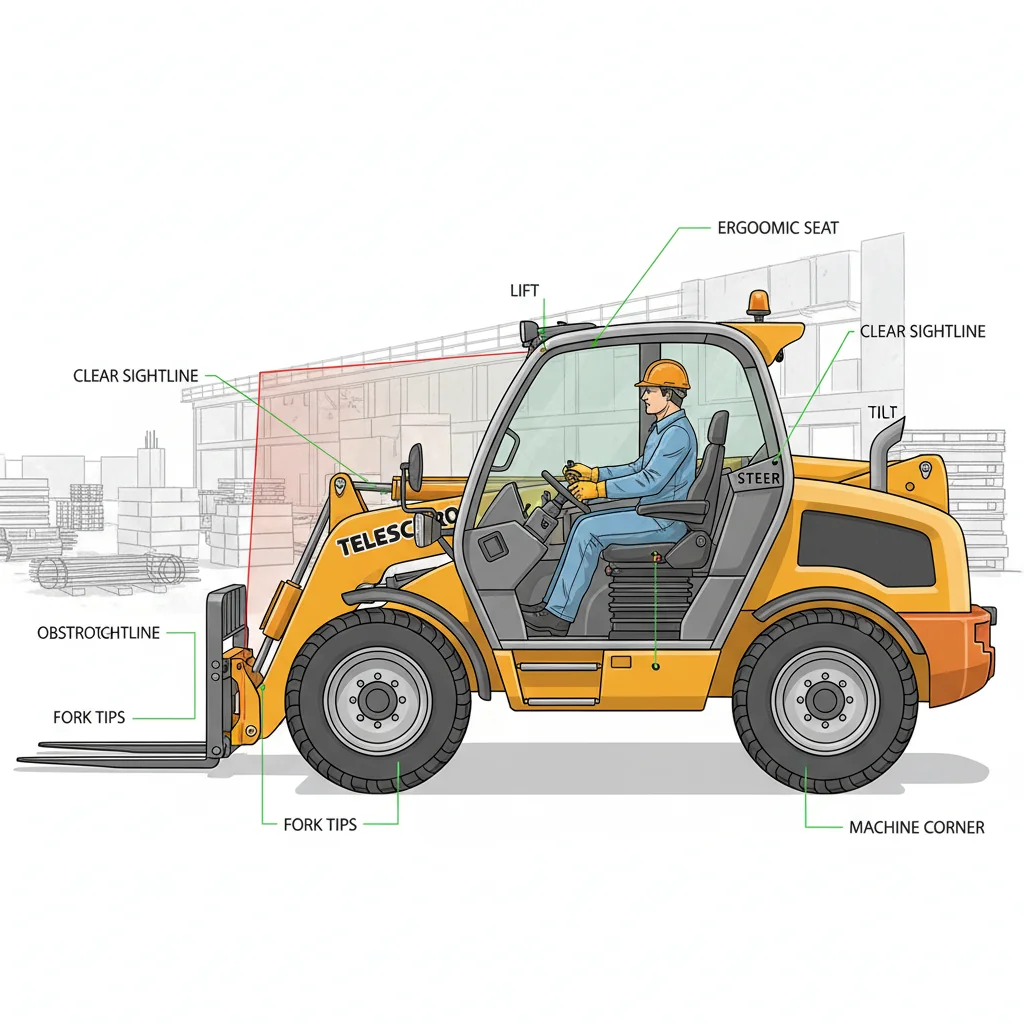
One thing many first-time buyers overlook is how crucial real cab visibility is for everyday telehandler work. You can read specs about “panoramic” glass or “all-around visibility,” but until you sit inside, you won’t see what actually matters. I’ve been on jobsites in Thailand and Romania where experienced operators struggled for a clear view of the fork tips—especially at ground level or with the boom halfway out. The result? Slow cycle times and near misses with ground personnel. It’s even worse at tight sites or loading trucks in low light.
Let me share a specific jobsite story from Kenya. The customer rented a 4-ton, 14-meter model based on cost, not realizing the thick pillar design blocked the right-hand corner view. Two months in, they had three minor collisions with columns and gateposts—nothing serious, but each meant lost hours for reports and repairs. By the third month, half the operators asked to be reassigned. Their site manager finally called me, frustrated by the turnover. When I visited, I saw it instantly: the mirror setup was almost useless for anyone shorter than 170 cm. No one could comfortably spot the rear wheels or fork tips at max steer.
Here’s what I recommend: always get your actual operators inside the cab—shortest to tallest—and make them position the seat, check the mirror sightlines, and use the joystick. If the reach to the controls or sight over the dash feels awkward in five minutes, imagine an eight-hour shift. Good cab visibility and real ergonomics directly reduce accidents and keep your best operators happy.
Ergonomically poor cab design can cause operators to shift their bodies or lean out of position to see the work area, increasing the risk of strain injuries and accidents during repetitive telehandler tasks.True
When cabs are not designed with optimal sightlines and controls, operators often compensate by stretching or twisting their bodies repeatedly. This not only causes fatigue and potential strains but also distracts the operator from maintaining a stable seated posture, raising the risk of mishandling or missing hazards.
Telehandler operators can always rely on aftermarket mirrors or cameras to fully compensate for limited cab visibility, so original cab design is no longer relevant to safety.False
While mirrors and cameras can assist with blind spots, they do not fully replicate the intuitive, direct sightlines provided by a well-designed cab. Delays in image processing, limited depth perception, and the need to split attention between displays and the actual work area mean that foundational cab visibility remains a key factor in safe telehandler operation.
Key takeaway: Prioritize cab visibility and ergonomic features when selecting telehandlers. Specs alone don’t reveal real-world operator experience. Test visibility with operators of different heights and evaluate control layout comfort to minimize safety incidents, improve productivity, and retain skilled staff.
What Are Transport Risks for Telehandlers?
Telehandlers require specialized transport due to significant weight and width. Beginners often select undersized trailers, misuse tie-down points, or overlook overall machine height. On public roads, many ignore legal requirements for lights, mirrors, and speed limits, while raising the boom too high increases the risk of accidents, fines, and instability. Proper planning is essential.
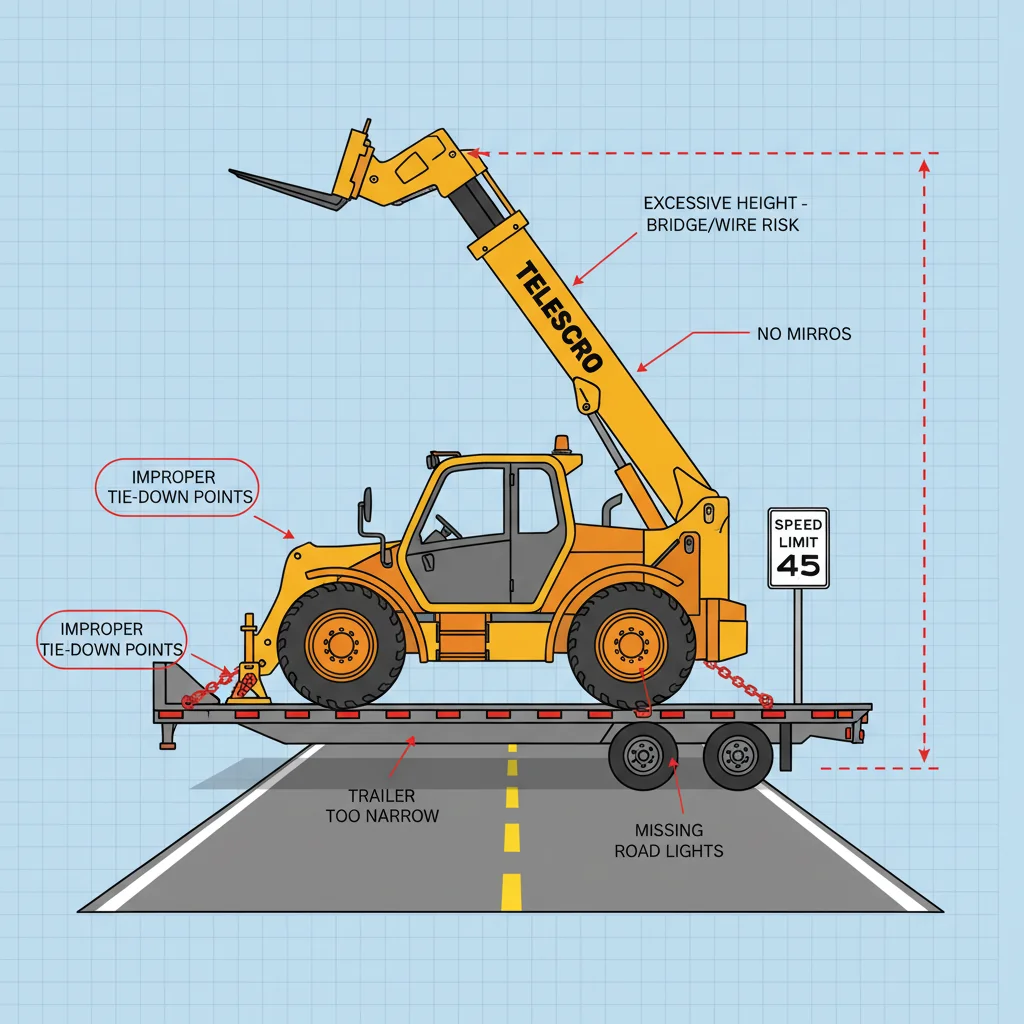
A lot of new telehandler owners don’t realize just how tricky transport can be until something goes wrong. I got a call from a contractor in Brazil who thought his regular flatbed was enough for transporting a 4-ton compact telehandler. But once loaded, the trailer sagged under the weight. Worse, they used tie-downs on the steering linkage—bent it, and faced two weeks of downtime waiting for parts. That sort of mistake isn’t rare, especially when people assume “any large trailer will do.” Telehandlers might look compact compared to cranes, but a typical unit can weigh between 7 and 12 tons, with a width easily over 2.3 meters. The load rating on the trailer and proper lashing points always matter more than the sales brochure says. I’ve also seen people overlook the total height. Even with the boom partly raised for “ convenience,” your total height can go well over 3.2 meters. I heard from a site manager in Thailand who took a shortcut under a city bridge—cracked the boom head because the machine was too high. The repair cost more than $8,000 plus lost time. That’s why I always tell customers—keep that boom fully retracted and low during transport. There’s also the legal side: on public roads, most countries require working tail lights, side mirrors, and a clean view. Many operators ignore speed limits, especially on local roads, which increases stopping distance and risk. My advice? Don’t rush transport planning.
Incorrectly using tie-downs on a telehandler's steering linkage during transport can bend or damage key components, resulting in extended downtime for repairs.True
The steering linkage is not designed to handle the forces imposed by load straps, and damage here can make the machine inoperable until specialized parts are sourced and installed. Tie-downs should be attached to manufacturer-approved anchor points instead.
Any flatbed trailer rated for heavy equipment is suitable for transporting all telehandler models without risk of frame damage or instability.False
Even among heavy equipment trailers, weight distribution, platform rigidity, axle ratings, and deck height vary. Using an unsuitable trailer can cause frame stress, sagging, or loss of control during transit, especially with compact or high-center-of-gravity telehandlers.
Key takeaway: Underestimating the complexity of telehandler transport and road travel can lead to costly errors. Always verify equipment ratings, use approved tie-down points, and comply with local road regulations. Keeping the boom low and checking all safety systems prevents avoidable accidents and regulatory penalties.
Conclusion
We’ve talked through the common mistakes beginners make with telehandlers, especially when it comes to misreading rated capacity and forgetting to check the load chart. From what I’ve seen on jobsites, the difference between a safe, productive day and costly trouble is nearly always in those details—not the tonnage class. I suggest you review your main lifting positions on the load chart, especially at typical working outreach, and check if critical parts are quickly available in your area. Have questions about specific telehandler models, attachments, or interpreting a tricky load chart? Feel free to reach out—I’ve helped crews from over 20 countries find the best fit. Every jobsite has its own realities—it pays to get the right match upfront.
References
-
Detailed guidance on interpreting telehandler load charts to ensure safe lifting capacity and prevent accidents on site. ↩
-
Explains how choosing an oversized telehandler leads to higher costs, excess fuel use, and operational inefficiencies in tight spaces. ↩
-
Details the importance of verifying load chart scenarios to ensure safe lifts and correct telehandler sizing for specific job demands. ↩
-
Explains how shifting center of gravity impacts telehandler tipping risks and safe operation on uneven sites. ↩
-
Explains the proper use of pallet forks to prevent accidents and improve telehandler stability with real-world examples. ↩
-
Details how specialized bale clamps can securely handle heavy bales, reducing damage and accident risks on construction sites. ↩
-
Detailed insights into how even shallow soft soil and mud can destabilize heavy telehandlers, increasing tip-over risk during boom extension. ↩
-
Explains how driving near damaged or unsupported slab edges can cause slab cracks and dangerous telehandler tip-overs, with real-world examples. ↩
-
Explains how proper telehandler operator training reduces accidents, ensures regulatory compliance, and improves site safety. ↩
-
Explains the importance of regular lubrication schedules to avoid mechanical failures and extend telehandler lifespan. ↩
-
Explains the critical role of timely engine oil changes in preventing engine damage and ensuring telehandler reliability. ↩
-
Details the consequences of skipping hydraulic oil and filter changes, including contamination risks and hydraulic failures. ↩
-
Learn why industrial/block pattern tires provide superior durability and traction on hard surfaces, doubling tire life in many scenarios. ↩
-
Learn how ergonomic controls minimize operator fatigue and improve response times, reducing accidents and staff turnover. ↩