










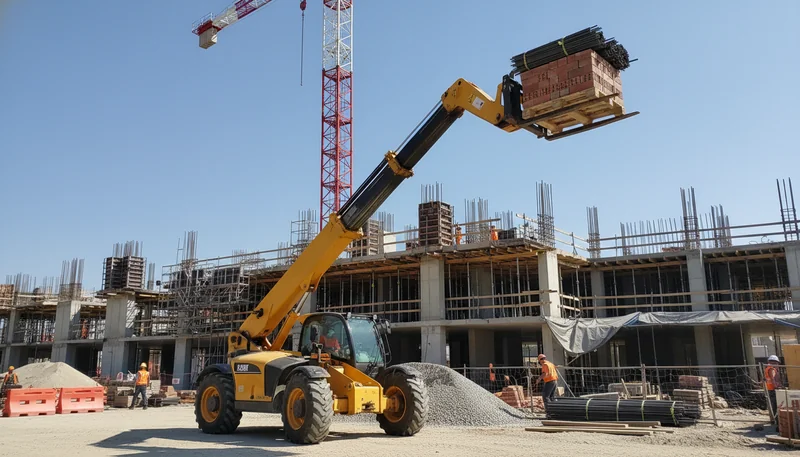
Telehandler Maximum Reach: Why Real Jobs Never Match the Brochure (Expert Field Guide)
I’ll never forget a jobsite in Germany where the site manager called me, frustrated that his brand-new 17-meter telehandler couldn’t place a heavy pallet where the “maximum reach” line was drawn in the brochure. He wasn’t alone—a lot of people expect brochure numbers to match real lifts.
“Maximum reach” in telehandler brochures is a geometric, best-case figure—the boom fully extended under controlled conditions (firm, level ground and a light or test load). Actual working reach is defined by the load chart1, which accounts for load weight, boom angle/extension, and the attachment’s load center or offset. At long reach, allowable capacity usually drops sharply due to stability limits (load moment) rather than a lack of hydraulic power. Ground firmness, slopes, required stand-off from obstacles, and real load geometry further reduce practical reach in everyday site work.
Why Is Telehandler Maximum Reach Misleading?
Brochure ‘maximum reach’ figures for telehandlers simply reflect geometric boom extension—measured with no or minimal load on firm, level ground. Actual usable reach is dictated by the load chart, showing much lower capacity at full extension. Usable distance shrinks further with real loads, attachment overhang, and pallet size.
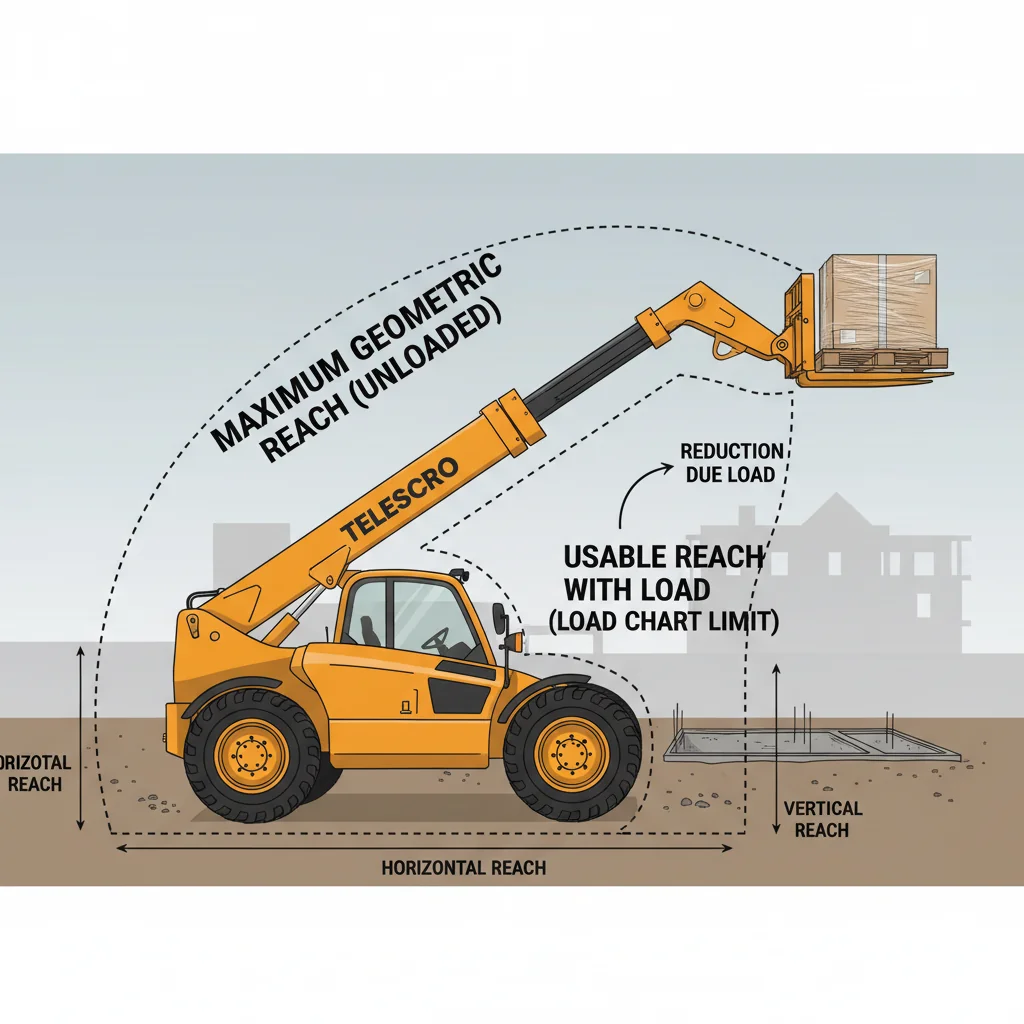
Most people don’t realize that the “maximum reach” shown in a telehandler brochure is not what they will achieve on a real jobsite. I see this all the time—buyers get excited by a 17-meter reach spec, but that number simply describes the geometric extension of the boom under ideal conditions. In practice, it reflects a machine positioned on level ground, with a very light or test load, and the reach referenced from the front tires to the attachment’s load center2.
What that figure shows is the machine’s physical limit, not the usable reach once you put a real load on the forks. As soon as you’re handling 1.5 tons of concrete blocks, pallets with overhang, or any attachment longer than standard forks, the usable reach changes. That’s why the real story is always in the load chart. The chart shows what the machine can safely lift at each specific combination of height and forward reach—and those values drop quickly as you extend the boom.
I worked with a contractor in Dubai last year who assumed their 4-ton telehandler could place full pallets all the way out to 15 meters. When we reviewed the load chart together, the allowable capacity at that reach was well under one tonne, even before accounting for pallet overhang or a 1.2-meter fork attachment. Once those real-world factors were included, the working margin was even tighter.
Real loads are rarely perfect cubes, and every extra bit of load center distance eats into your safe reach. Switching from standard forks to a bucket or a jib changes the geometry again, because each attachment shifts the load center forward in a different way and shrinks the working envelope. That’s why I always tell customers the same thing: never judge reach from the brochure number alone—use the load chart, with your real load and attachment, every time.
A telehandler’s maximum reach listed in brochures is measured without accounting for load weight, which significantly reduces usable reach on most jobsites.True
Brochure figures are based on the geometric extension of the boom without a realistic working load. In practical conditions, the effective reach is reduced because the machine must manage heavier loads without compromising stability or safety.
A telehandler can always operate safely at its maximum reach with any load within its rated capacity.False
Maximum reach ratings only apply to very light test loads or no load at all. Heavier or awkward loads shift the center of gravity and may exceed stability limits, so the safe usable reach decreases as the working load increases.
Key takeaway: Brochure ‘maximum reach’ figures do not represent what a telehandler can actually lift at full stretch. Always consult the load chart for specific capacity at each combination of reach and height, factoring in load type, attachment length, and real working conditions.
Why Does Telehandler Capacity Drop with Reach?
As a telehandler’s boom extends, the load moves farther from the front axle, shifting the center of gravity forward and increasing the tipping moment. Stability, not hydraulic power, strictly limits capacity at long reach. This is why load charts3 show sharply reduced rated capacity as reach and height increase.
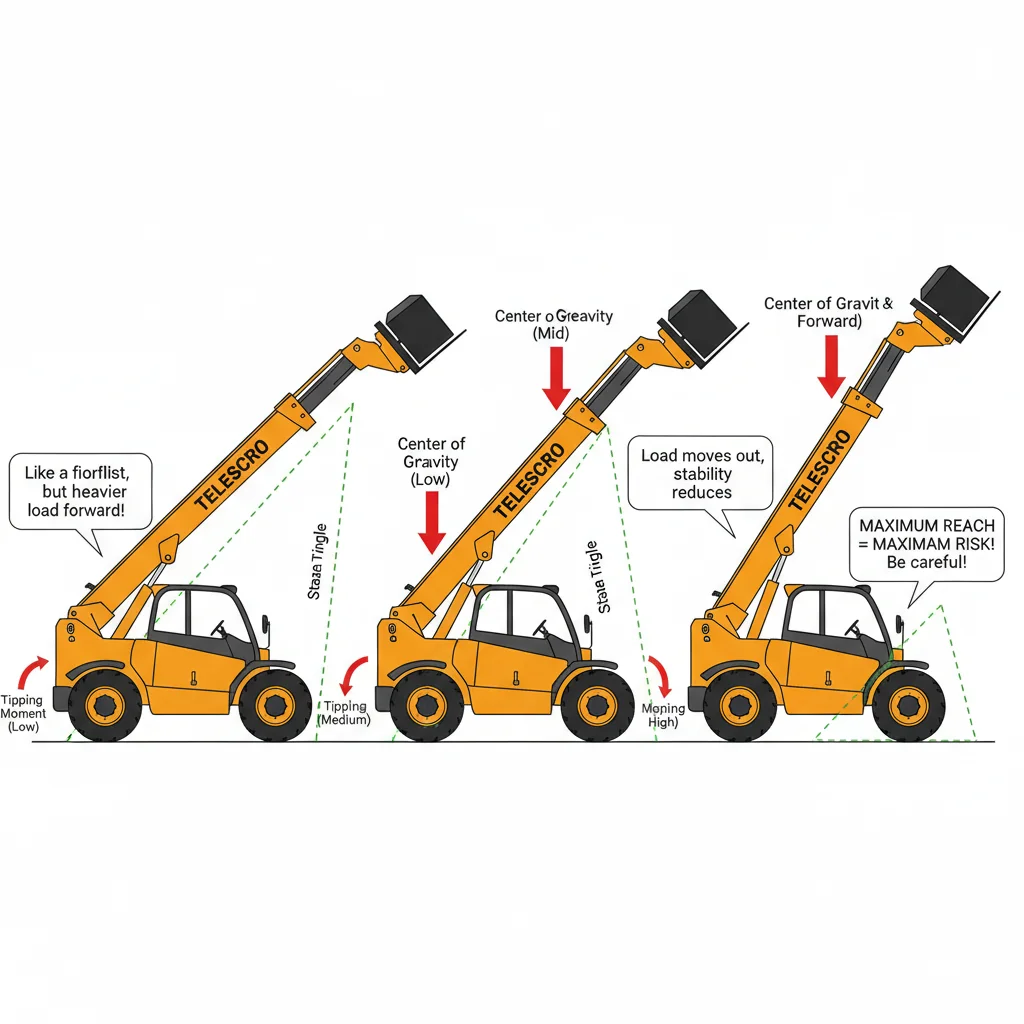
Let me share something about telehandler stability that often surprises buyers. The biggest mistake I see is focusing on the headline rated capacity4 without looking at how that number changes as the boom extends. Close to the front wheels, a 4-ton, 17-meter class telehandler can indeed handle its full rated load. But as you move toward maximum reach, the allowable capacity shown on the load chart drops sharply.
That isn’t a manufacturing flaw—it’s basic physics. As the boom extends, every kilogram is carried farther forward, and the machine starts to behave like a long lever. The load moves away from the front tire edge, which is the actual tipping axis for a telehandler. The greater that distance becomes, the higher the overturning moment, and the less weight the machine can safely support. This is why the only reliable figure at long reach is the specific value shown at that exact reach and height on the load chart, not the headline capacity printed on the machine.
I once worked with a team in Dubai who underestimated this drop. They planned pallet placements on the tenth floor and assumed the machine could handle 3,500 kg all the way out. Once they checked the load chart, reality hit—they were limited to just over 1,400 kg at that reach and height. Hydraulic strength wasn’t the issue. The telehandler could move the load easily, but stability systems and the actual physics drew a hard line. Modern machines often use load moment control systems5 to stop dangerous movements near these limits—helpful, but not a replacement for checking the chart.
The key takeaway? Always reference the load chart—shown as capacity at different reach and height combinations, measured from the front tire edge to the load center. I suggest mapping out your heaviest real jobs by exact distance and height before choosing a model. That’s the way to avoid costly surprises on site.
A telehandler's rated capacity is calculated with the boom fully retracted and the load close to the front wheels, not at maximum extension.True
This is true because the machine is most stable when the load is closest to the center of gravity, allowing for the maximum safe lifting capacity. As the boom extends, leverage increases and stability decreases, requiring lower loads for safe operation.
Telehandlers maintain their maximum lifting capacity regardless of boom extension, as long as the load is kept level.False
This is false because extending the boom increases the distance between the load and the machine’s center of gravity, amplifying the tipping risk. Capacity must be reduced at longer reaches to prevent instability, regardless of whether the load is level.
Key takeaway: Telehandler capacity is always determined by stability at longer reach, not by the hydraulic ability to extend or lift. Buyers and operators must reference load charts for the exact weight permissible at each reach and height—not rely on maximum capacity or boom length alone.
How do site conditions affect telehandler reach?
Telehandler load charts are based on operation on firm, level ground under controlled conditions. On real jobsites, soft soil, uncompacted fill, cross-slopes, or uneven edges can tilt the chassis, shift the combined center of gravity, and reduce usable reach and stability. Under these conditions, the assumptions behind the load chart no longer apply, and safe operation requires reducing reach and load well below charted maximums.
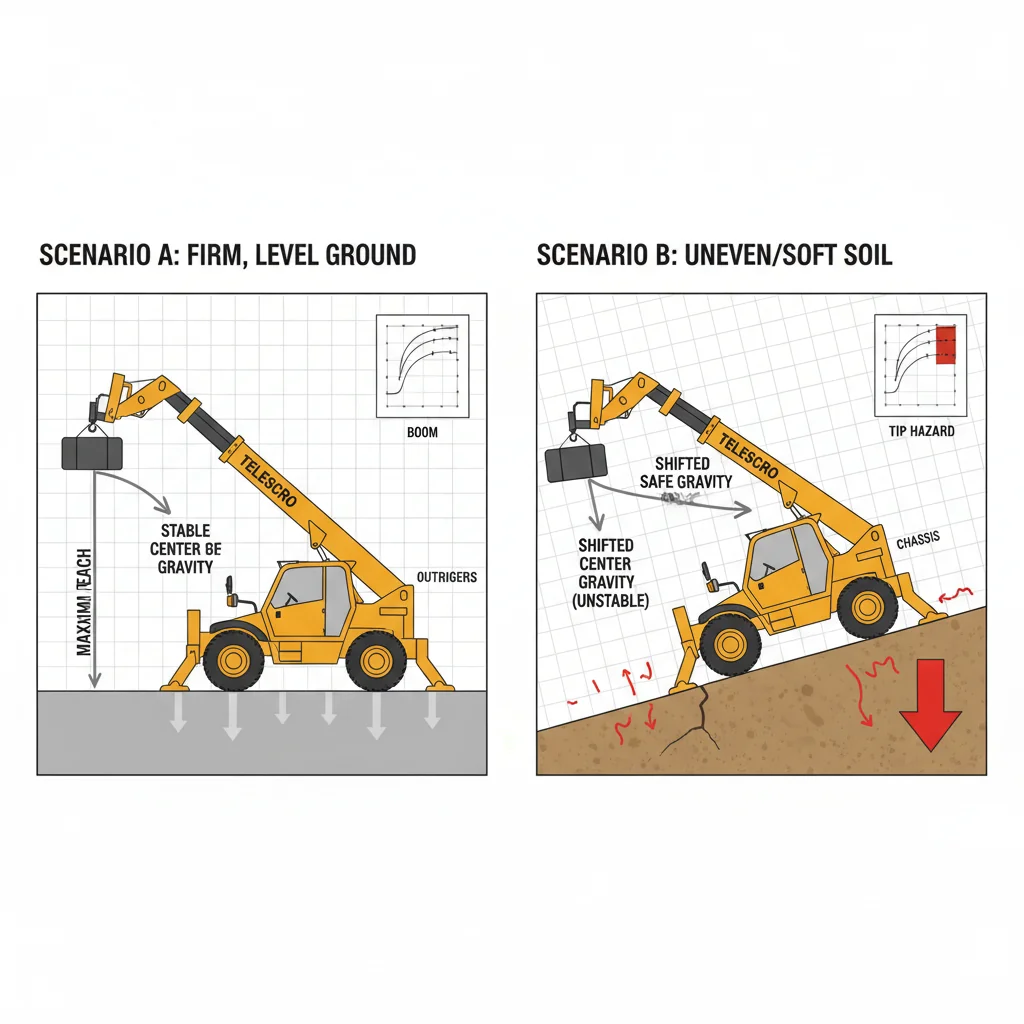
Here’s what matters most when you’re counting on telehandler reach: those impressive load chart numbers in the manual all assume perfectly level, well-compacted ground—with full bearing capacity under every wheel. But real jobsites rarely offer those conditions. I’ve seen projects in Dubai where the operator tried to lift a heavy HVAC unit over a soft backfilled trench. As soon as the boom extended past 12 meters, the front tires started to sink, instantly reducing stability. The tipping axis shifted forward, and the load felt twice as risky as the chart suggested. At that point, the operator stopped and retracted the boom just to regain control.
Site conditions like soft soil, uneven ruts, or working close to slab edges all shrink a telehandler’s safe operating envelope. From the cab, these factors often look minor, but they can introduce lateral tilt that shifts the center of gravity6 toward the low side and significantly reduces stability at reach. I’ve seen this firsthand with a contractor in Kazakhstan. Their team underestimated the effect of a small cross-slope while placing roofing materials near maximum outreach. In practice, the machine reached its stability limit earlier than expected, forcing repeated repositioning and load shuffling to complete the job safely.
My practical advice: always derate both reach and capacity on anything less than firm, level ground. Stay at least one or two steps inside the load chart’s max limits if you see any doubt about soil strength or slope. If you must operate near edges, on fill, or in unknown ground, involve your site engineer or geotechnical team. The safest lift is usually the one you refuse to push to the chart’s last box.
Telehandlers operating on soft or uneven ground can experience a significant decrease in effective reach compared to the maximum values listed in manufacturer load charts.True
Manufacturer load charts are based on ideal conditions—level, firm ground. When ground is soft or uneven, stability is compromised and the operator must telescope less to maintain safety, reducing practical reach.
As long as the telehandler outriggers are fully deployed, operators can always achieve the maximum rated reach, regardless of site surface conditions.False
Outriggers improve stability, but they cannot compensate for unstable or soft ground that cannot support load weight. Maximum reach still depends on adequate ground bearing capacity under all stabilizing points.
Key takeaway: Telehandler maximum reach and rated capacity7 assume ideal level and compacted ground. Real-world sites with slopes or weak surfaces shrink the safe operating envelope. Always operate with a safety margin: derate reach and capacity for anything less than ideal ground, and consult site engineers for critical situations.
How do attachments affect telehandler maximum reach?
Attachments and changes in load geometry can significantly reduce a telehandler’s usable reach compared with brochure values. Common jobsite tools—such as buckets, grabs, or man baskets—add attachment mass and typically move the load center forward, increasing the overturning moment. At long reach, this shift materially reduces allowable capacity and working envelope, even when the machine remains within its headline rating.

To be honest, the spec that actually matters is how attachments change both the weight and position of your load—much more than most buyers expect. On paper, telehandler reach and lift charts are usually based on standard forks, which don’t add much extra weight or shift the load forward. But as soon as you add a real bucket, man basket, or even a bale grab, everything changes. I see this mistake often—especially when buyers try to use the same numbers for every tool. Let me give you a real example. A customer in Kazakhstan added a 500 kg material bucket to a 13-meter telehandler rated for 3,500 kg at minimum reach. By the time the bucket was attached and the load was set 600 mm further out, the rated lift at full extension dropped by about 35%. Their team expected to place 1,500 kg concrete blocks at height. In reality, the combination of extra attachment weight8 and shifted load center limited them to just under 1,000 kg at 13 meters. It’s a big shock on busy job sites.
Here’s how attachments usually affect maximum reach:
- Attachment weight counts against capacity—no exceptions
- Most attachments move the load center forward (often 300–600 mm)
- Load chart values are specific to each attachment and load position
- Real-world working capacity at long reach drops by 20–40% with typical jobsite tools
- Pallets or bales set forward on a spike or platform can make the center of gravity worse
Using heavy or long attachments on a telehandler can significantly reduce its maximum safe reach, even if the raw lifting capacity seems unchanged on paper.True
Attachments often shift the load center forward and add weight, which increases the tipping risk and forces the actual maximum safe reach to be much less than the spec chart shows for standard forks.
Any attachment certified for telehandler use will allow the operator to achieve the full maximum reach stated in the brochure, regardless of attachment size or weight.False
Even certified attachments can change the load dynamics and move the center of gravity forward, which limits the safe maximum reach. Brochure numbers are typically based on standard forks, not heavier or projecting attachments.
Key takeaway: Telehandler maximum reach is highly dependent on the specific attachment and load position. Always consult the manufacturer’s load chart for the exact attachment and verify capacity at the actual load center. Brochure numbers rarely apply in field conditions without these checks.
Why Can’t Telehandlers Reach as Charted?
Maximum telehandler reach9 shown in the load chart is measured from the front tire edge to the attachment load center, assuming ideal machine placement. Actual jobsites rarely allow this—obstacles, required standoff distances, and tight access force set-back, which increases required reach and drastically reduces allowable capacity at the needed boom angle.
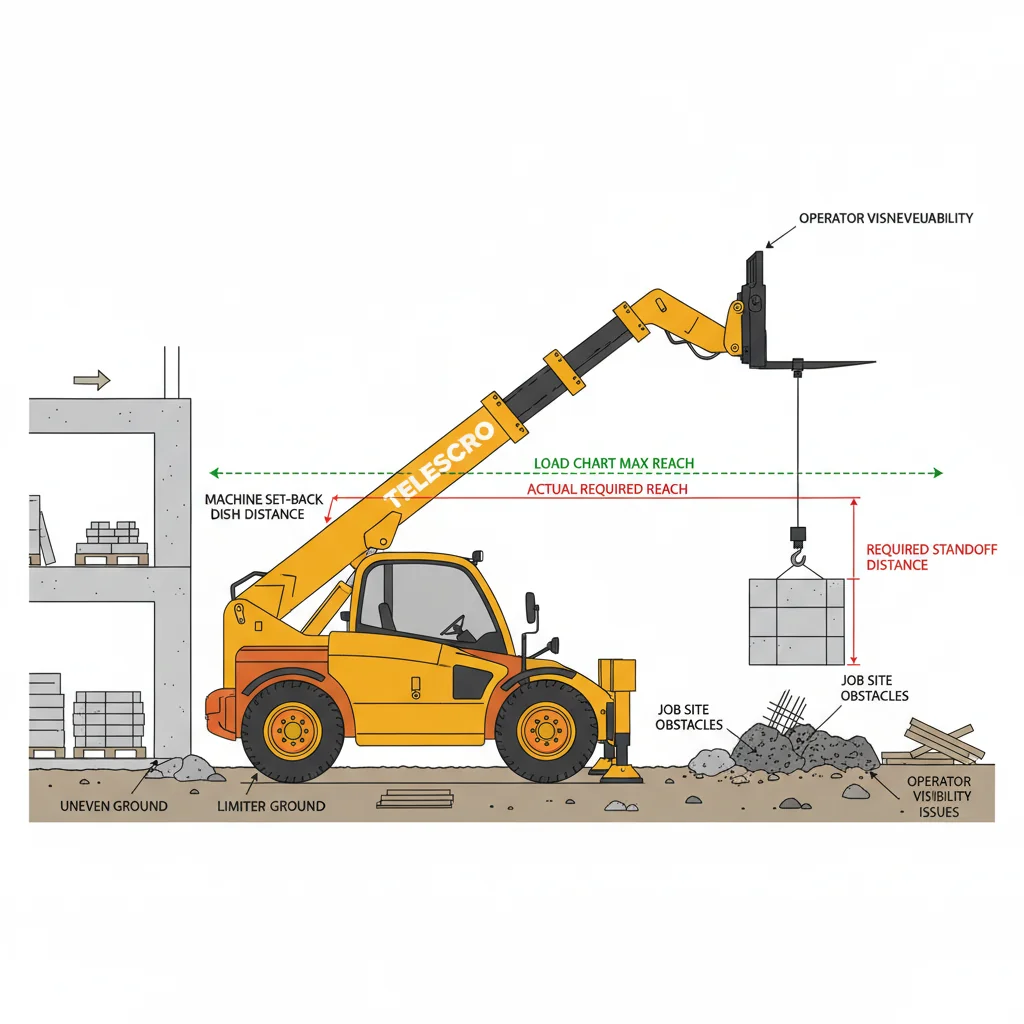
The biggest mistake I see is assuming the maximum reach shown on the load chart is what you will achieve on the jobsite. That figure—measured from the front tire edge to the attachment’s load center—looks impressive on paper, but it assumes the machine can be positioned in an ideal spot.
In real jobsites, that rarely happens. You’re almost never able to park directly at the base of a building, stack, or slab edge. I’ve seen this repeatedly on projects in Dubai and Vietnam, where scaffolding, traffic lanes, or safety barriers forced operators to set the machine back from the target area. Once that stand-off distance increases, the boom has to reach farther forward than planned.
As soon as you add that extra distance, the boom angle lowers, the working radius increases, and the allowable capacity drops much faster than most people expect. I’ve worked with crews who were surprised to find that a machine performing comfortably at close range became severely limited once real access constraints were factored in. This isn’t a safety margin issue—it’s simple geometry and load moment.
Load charts show safe capacity for each height and reach combination, but only from that ideal front-tire reference line. Add space for obstacles, aisle width, pallet thickness, or indoor clearances, and you’re immediately operating outside the strongest part of the chart. I’ve even seen compact machines in Kazakhstan fall short of their advertised reach indoors once aisle width and load geometry were considered.
That’s why my advice is always the same: before renting or buying, map the real access path. Stand at the actual stopping point, measure the distance to the load, and then check the load chart using those real numbers—not the brochure layout. That step alone prevents most reach-related surprises on site.
The load chart's maximum reach is calculated assuming the telehandler is positioned with its front tires almost touching the stack or structure, which is rarely possible on real jobsites due to site constraints.True
Manufacturers measure maximum reach from the front tire edge to the load center under ideal, unobstructed conditions. In actual working environments, obstacles like curbs, debris, or site traffic often force operators to set back from the load, reducing the effective reach available.
You can always achieve the load chart's maximum reach as long as the telehandler is parked on level ground, regardless of how far back from the load you are.False
Regardless of ground levelness, if the telehandler is set back from the obstruction or load—due to barriers, scaffolding, or other site limitations—the effective horizontal reach is reduced, and the boom cannot extend as far as the load chart maximum.
Key takeaway: Telehandler maximum reach is theoretical, based on ideal placement from the front tires. Real jobsites nearly always require a stand-off from buildings, stacks, or obstacles, which increases required reach and reduces allowable lifting capacity. Always plan with real site access and use load charts for actual positioning.
Why Avoid Maximum Load Chart Reach?
Operators rarely work at the extreme end of a telehandler’s rated reach, even when the load chart permits it. At full extension, boom deflection, load sway, reduced stiffness, and sensitivity to wind or ground movement significantly narrow the available stability margin. For this reason, experienced operators and planners typically treat charted values at maximum height or reach as upper limits, maintaining a conservative working buffer rather than operating continuously at the edge of the chart.

I’ve worked with customers in Dubai and Chile who asked why operators never use the very end of the telehandler’s reach, especially when the load chart still shows a “safe” capacity. Here’s the reality: at maximum forward reach or height, even small loads make the boom flex more. That flex isn’t just a number on a chart—it causes visible sway, especially with long or bulky materials. If there’s wind, things get worse fast. I’ve seen cases where a sudden gust or a slight ground dip (even just a few centimeters) eats up the entire stability margin, leaving the machine at risk.
Last year, a team in Kazakhstan loaded bricks onto a sixth-floor slab with a 4-ton, 17-meter telehandler. The load chart said 1,000 kg at full stretch—which looked usable. But with the boom fully extended, the bucket swayed over half a meter, and every movement felt “on the edge.” They wisely scaled back to handling only 700–800 kg per trip. The job took a bit longer, but nobody risked a tip-over.
At full extension, operator accuracy drops too. Looking up 16 meters or eyeballing distance from the ground, it’s extremely easy to over-extend the boom by accident. Most modern telehandlers have moment indicators and may even lock out movements near the edge of rated capacity. But best practice—on every jobsite I’ve visited—is to stick to 70–80% of the chart at maximum reach or height. If you find yourself “chasing” the last 200 kg near the edge, my honest advice is to size up your machine instead of gambling on perfect conditions.
Operating a telehandler at maximum load chart reach increases the risk of instability because boom flex and platform sway are not fully accounted for in static load chart values.True
Load charts are calculated under ideal static conditions; in real life, dynamic factors such as boom flex, site unevenness, and wind introduce instability not reflected in the chart. This is why industry professionals avoid maximum reach unless absolutely necessary.
Using a telehandler at maximum load chart reach is just as safe as operating at mid-reach, provided the load does not exceed the charted limit.False
Maximum reach amplifies the effects of minor ground shifts, wind, and boom deflection, increasing the chance of tipping or load loss. Even if a load is within the charted capacity, real-world variables make this position much less stable than operating at reduced reach.
Key takeaway: Actual telehandler performance at maximum reach is limited by real-world factors like boom flex, stability reduction, wind, and operator precision—not just what’s shown on the load chart. For planning, assume only 70–80% of charted capacity is usable at critical reach or height positions.
How should buyers interpret telehandler load charts?
To interpret telehandler load charts accurately, buyers should start from real job scenarios—not brochure maximums. Identify required height and forward reach, then match these on the load chart to verify rated capacity for the chosen attachment. If the charted capacity is near or below task requirements, select a larger machine or modify the work method.
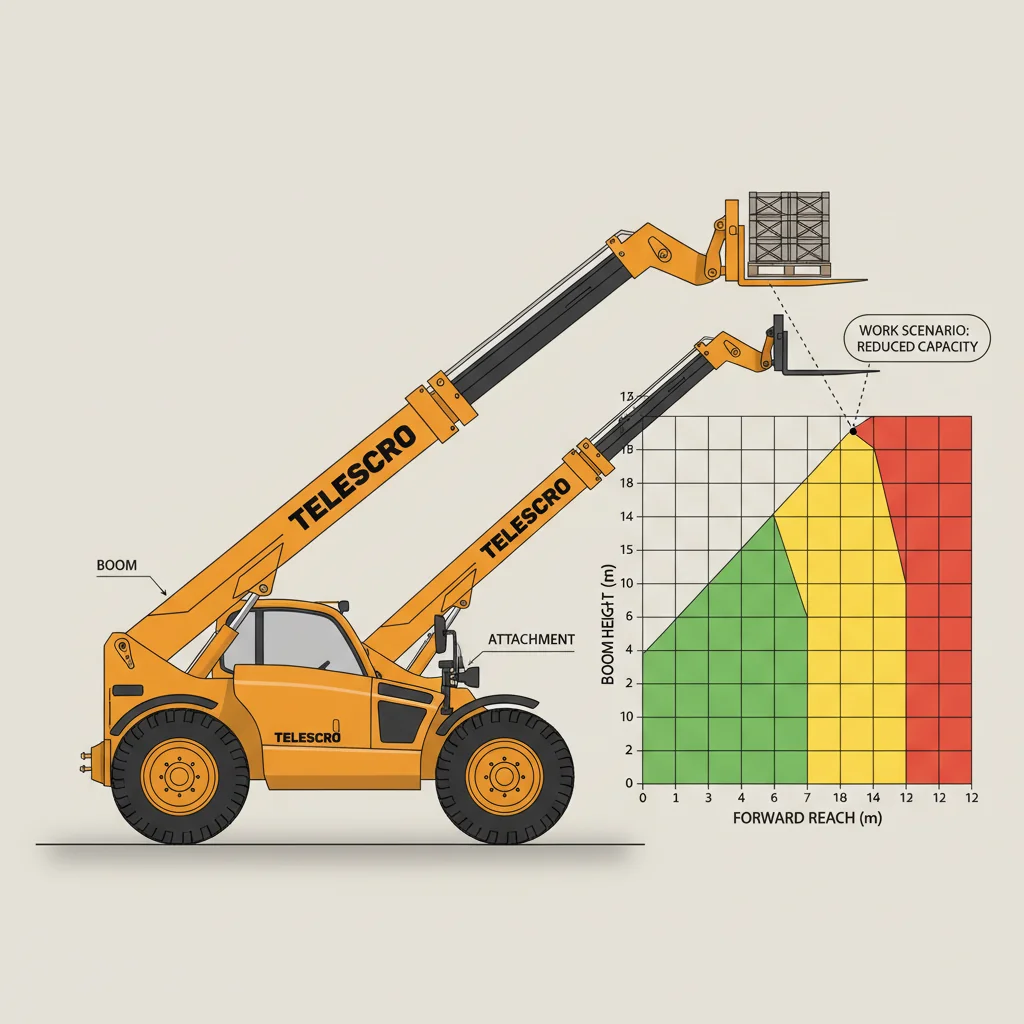
I’ve worked with customers who made this mistake—trusting the spec sheet headline instead of the actual load chart. For example, a team in Kazakhstan needed to lift 2,000 kg HVAC units to the fourth floor, about 13 meters up, but the machine they picked was labeled as a "3.5-ton telehandler." On site, at that reach and height, the chart said the real capacity was just above 1,200 kg. They ended up hand-carrying loads the last few meters. The lesson stuck: never assume the rated capacity at ground level covers your whole job.
Most buyers glance at maximum lift or tonnage, but the real decision comes down to jobsite numbers—actual working height, forward reach, and the specific attachment being used. On a load chart, find your working height along the left edge and forward reach across the bottom. Trace both to their intersection; that’s the “allowed capacity” box. Remember, reach is measured from the front tires out to the load’s center—not just the boom length. And if you’re even close to maxing out the box, that’s a warning sign, not a green light.
I always tell customers: plan for a working buffer. If your daily task needs 1,600 kg at 11 meters, don’t pick a unit charted for exactly 1,600 kg at that point—give yourself at least 20% margin. Site slopes, worn tires, or a slightly off-level chassis will cut into capacity fast. If your task and the chart don’t align with room to spare, choose a more capable model or rethink your approach. That’s how you avoid jobsite surprises.
A telehandler’s maximum rated capacity is typically only achievable at minimal boom extension and low lift heights, not at maximum reach.True
Load charts show that as the boom extends and the lift height increases, the allowable load decreases for stability and safety. The headline capacity is usually based on the most favorable geometry near the machine’s base, not at long reaches or high elevations.
If a telehandler is labeled as a '3.5-ton' model, it can safely lift 3.5 tons at any boom extension or height.False
The maximum rated capacity listed on a telehandler only applies under optimal conditions, usually with the boom fully retracted and the load close to the front wheels. The capacity at extended booms or greater heights is much lower, as shown in the load chart, due to stability and structural limits.
Key takeaway: Always use real job parameters—specific load weight, working height, and forward reach—when reading telehandler load charts. Rated capacity significantly decreases at full reach and elevation. Rely on OEM charts, not tonnage class, to avoid undersizing equipment or exceeding safe capacity during field operations.
What are the risks of undersized telehandlers?
Selecting a telehandler based only on maximum reach or headline rated capacity often leads to undersized machines that struggle with real field loads and working distances. On site, this results in frequent repositioning, split loads, higher fuel use, project delays, and increased risk of stability-related incidents10 such as tip-overs or structural damage.
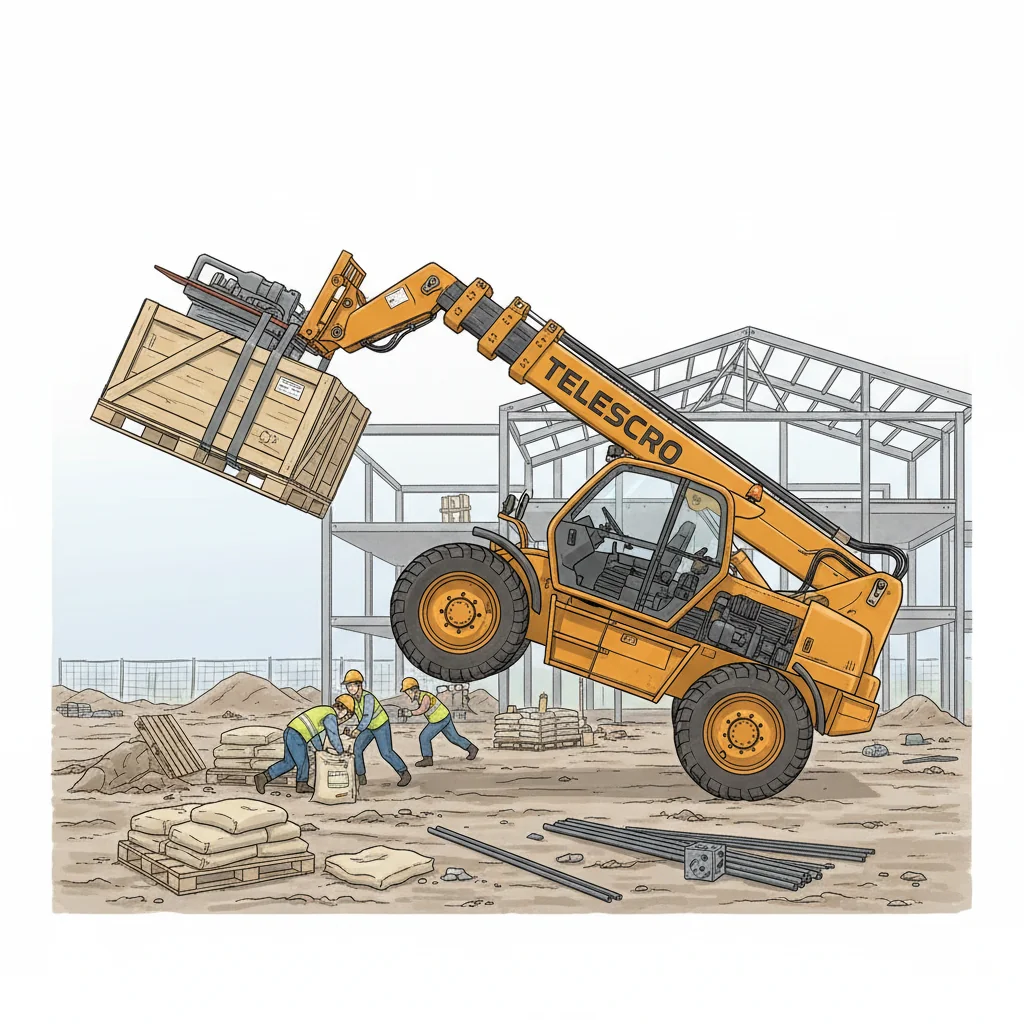
Last month, a contractor in Vietnam called me after his team realized their 2.5-ton telehandler couldn’t keep up. On paper, it matched their pallet weights—but their real lifting was at 9 to 11 meters away from the tires, not at ground level. The load chart told a different story: at those reaches, the safe capacity dropped to around 800 kg. Suddenly, every third load had to be split in half, and they spent each morning building makeshift ramps just to get closer. Fuel bills climbed, and one simple 10-ton material delivery took most of the day instead of an hour.
From my experience, these issues show up fast on jobsites with busy schedules. Undersized telehandlers mean experienced operators get frustrated, forced to reposition constantly. I’ve seen crews in Nigeria abandon rental units mid-project because the “headline capacity” didn’t translate to safe lifting at working distances. Even worse, some teams get tempted to push past the recommended limits. One job in Oman nearly turned tragic when a 3-ton machine tried to “make it work” at full extension—the machine tipped, damaging both the boom and the slab.
A key technical point is that the rated capacity assumes ideal conditions—level ground, specified load center, and tested with standard attachments. Real work rarely matches those textbook situations. The reality is, stepping up to the next size class—like moving from a compact 2.5-ton to a robust 3.5-ton unit—usually pays for itself. You avoid constant re-handling, reduce risk, and actually keep to your project timelines. I always recommend checking the full load chart, not just the big number at the top.
A telehandler’s maximum lift capacity is typically rated only when the boom is fully retracted and load is close to the machine’s front tires, not at maximum reach.True
Telehandler lift charts show that as the boom extends further from the chassis, its lifting capacity dramatically decreases due to leverage and stability limitations. This is why capacity at full outreach is often far below the machine's nominal maximum.
If a telehandler matches the pallet weight on paper, it will always be able to lift that weight at any height or outreach.False
A telehandler’s maximum rated capacity applies only under specific conditions, often with the boom retracted. When the boom is extended or the load is farther from the chassis, the safe working load can be much lower than the nominal rating, making it unsafe to assume performance based solely on the base capacity.
Key takeaway: Choosing a telehandler solely for maximum reach or capacity overlooks real jobsite demands, leading to significant hidden costs, safety compromises, and project delays. Stepping up to the next size class is usually more economical and safer, ensuring all routine lifts stay within the rated load chart limits.
How does maintenance affect telehandler reach?
Real-world telehandler reach often declines over time due to boom wear11, loose pins, bushing play, uneven tire pressures12, and hydraulic drift. Even minor boom sag or tire deflation increases effective load radius and reduces stability, making the original load chart less reliable without diligent inspection and maintenance.

One thing I see all the time on job sites: operators trust the load chart, forgetting it assumes perfect mechanical condition. I’ve seen jobs in Kazakhstan where an 18-meter machine, rated for 4,000 kg at minimum outreach, started struggling with only 1,200 kg at full extension—just because the boom had developed extra sag and the pins were slightly loose. Even a small amount of play in the bushings or pads—maybe 2 or 3 centimeters—pushes your load farther out than you think. That extra droop at the tip may not look serious, but it instantly increases your effective load radius and lowers stability.
Let me share a real scenario from a timber warehouse in Brazil. The customer called frustrated: their six-year-old telehandler wouldn’t reliably stack at the second-tier racking, even though the load was under the chart limit. When I checked, two problems jumped out—tire pressures varied by 0.5 bar side-to-side, and there was visible boom drift with the load raised. Uneven tires tilt the chassis, changing the boom angle and shifting your "real" reach and center of gravity. Low hydraulic holding pressure lets the boom slowly drop during a lift, increasing the working radius just enough to jeopardize stability.
From my experience, these issues sneak up on crews—long before anything looks obviously damaged. I always suggest keeping a close eye on tire pressures, and inspecting boom pins and bushings at every 250-hour maintenance. Don’t push to the published load chart, especially if your machine is over five years old. Staying ahead of wear is the only way to keep real-world reach—and safety—where you expect it.
Worn boom pads and loose pins can cause the telehandler’s boom to sag, which in turn shifts the actual load center outward and reduces the effective lifting capacity at maximum extension.True
Mechanical wear introduces play that increases the distance between the load and the machine’s pivot point, making the boom less able to hold its rated capacity safely at maximum outreach.
As long as the hydraulic system is working, maintenance-related wear in boom structures has no effect on the telehandler’s maximum reach or safe load capacity.False
Even with functional hydraulics, mechanical issues like worn pins, bushings, or pads alter the geometry and integrity of the boom, which directly affects both reach and load handling safety.
Key takeaway: Telehandler load charts assume perfect mechanical condition. Wear, sag, and poor tire inflation all erode working reach and safety margin—even before failure is visible. Routine inspection, strict tire pressure maintenance, and early replacement of high-wear boom components are vital for practical safe reach, especially with older machines.
What Limits Telehandler Reach Indoors or Farms?
In agricultural barns and industrial indoor sites, telehandler maximum reach is often restricted by structural factors like roof height, beams, and narrow aisles—well before load chart limits are reached. Uneven floors add side-slope risks, and actual loadable heights are typically lower than outdoor rated specifications.
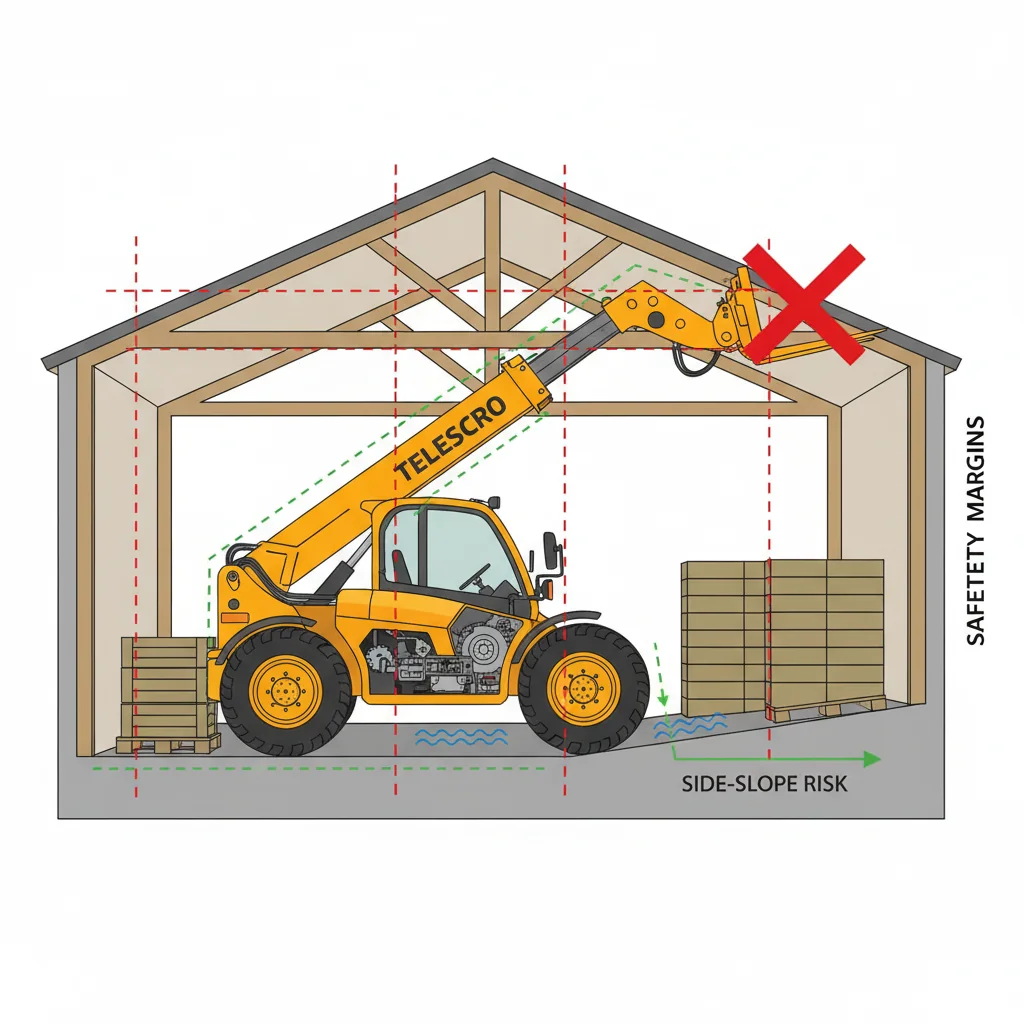
Walking into a dairy barn in the Netherlands last year, I saw a classic issue—telehandler reach that looked great on paper, but just didn’t work in reality. The machine listed a maximum reach of nearly 8 meters. But factor in the roof trusses at 4.5 meters, lighting fixtures, and narrow central aisles, and the operator could only lift bales to around 4 meters safely. No matter what the brochure claimed, the building set the real limit. I’ve also found that many agricultural sites have sloped or uneven floors for drainage. Even a small side-slope—say, 3° to 5°—can reduce your practical stacking height, because rated capacity assumes the machine sits nearly level (usually within 3°). On these floors, stability drops quickly—a risk most load charts don’t show.
One customer in Brazil called me frustrated after buying a compact 3-ton telehandler with 9-meter reach for their recycling warehouse. The aisle between racks was just under 3 meters wide. Turning required constant repositioning, and once they factored in the grab attachment’s length, their usable load center increased, further cutting into safe stacking heights. They planned for 3 high but could only stack two—real numbers, not just marketing.
Here’s what matters most when using a telehandler indoors or on farms: measure your actual building clearances, aisle widths, and floor slope. Check how many bales, pallets, or buckets can be placed at working height—not what “max lift” implies. I always suggest walking through the jobsite before picking a machine, even if the specs look perfect. In tight or low structures, the real limits aren’t on the datasheet.
Even if a telehandler's boom is fully extended, obstacles like low-hanging beams or trusses can drastically reduce the practical lift height available to operators indoors.True
Physical features of buildings such as beams or roof trusses limit the vertical space, preventing operators from using the telehandler's full rated reach even if the machine is capable of it.
Indoor telehandler reach is usually limited more by the machine’s hydraulic capabilities than by the dimensions or layout of agricultural structures.False
While hydraulics determine the maximum possible reach, in practice, building features like ceilings, beams, and fixture placements more commonly restrict usable telehandler reach indoors.
Key takeaway: Building geometry, low clearances, and floor conditions in agricultural and indoor environments often restrict telehandler reach and real-world stacking height—sometimes more than the official load chart. Farm operators and facility managers must measure actual site conditions to assess practical machine performance safely.
Conclusion
We’ve looked at why telehandler brochure specs rarely match what you can actually lift at full reach on the jobsite and how real-world variables change everything. From my experience out in the field, the crews who avoid trouble are the ones who study the load chart at their most common working positions, not just the glossy “maximum” numbers. Don’t let impressive showroom specs turn into a “showroom hero, jobsite zero” situation—that’s a mistake I’ve seen too many times. If you have questions about matching a telehandler to your workflow or how attachments affect capacity, feel free to reach out. I’m happy to share what’s worked for real crews across different sites. Remember, the right choice always comes down to your specific jobsite needs.
References
-
Provides detailed insights on how load charts determine safe lifting capacities at various heights and reach distances. ↩
-
Understand the critical effect of load center position on telehandler stability and safe lifting limits during operations. ↩
-
Explains how load charts determine safe lifting limits and why they assume ideal site conditions for telehandler safety. ↩
-
Explore how headline rated capacity differs from actual safe lifting capacity and why relying on it can cause operational risks. ↩
-
Details how load moment control systems prevent tipping by monitoring load and boom positioning for safer telehandler operation. ↩
-
Explains how shifting the center of gravity forward increases tipping risk and reduces lifting capacity with extended boom reach. ↩
-
Discover why rated capacity changes with telehandler reach and height to ensure safe lifting and optimal machine selection for your tasks. ↩
-
Explore how added attachment weight reduces telehandler capacity and impacts job site efficiency with real-world examples. ↩
-
Explains how real-world obstacles and standoff distances impact telehandler reach and load capacity on construction sites. ↩
-
Learn expert tips and safety standards to avoid tip-overs and structural damage in telehandler operations, reducing downtime and accidents. ↩
-
Explore how boom wear impacts stability and load capacity on telehandlers with real-world examples and maintenance tips. ↩
-
Understand how uneven tire pressures affect chassis tilt, boom angle, and safe load handling in telehandler operations. ↩