










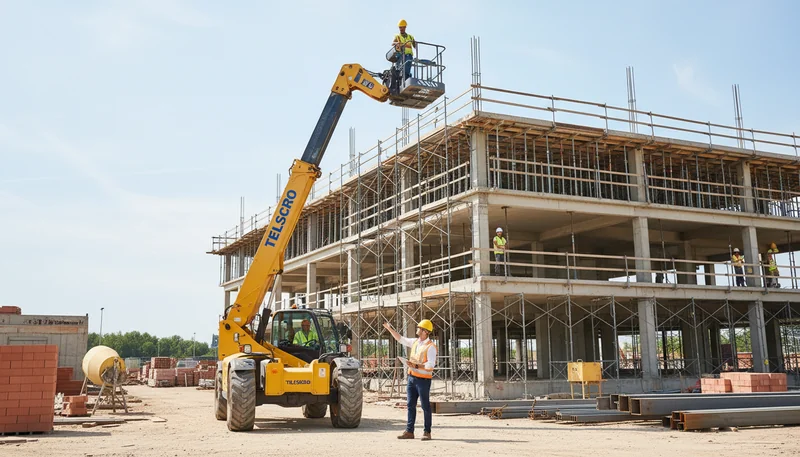
Telehandler Maximum Height: When Safe Limits End—Expert Field Guide
Not long ago, I watched an experienced operator in the UK try to land a full pallet of roof tiles at 15 meters—only to stop, white-knuckled, when the front tires left the ground. That jobsite lesson gets repeated every week somewhere around the world: maximum height in the brochure often isn’t a safe working height onsite.
Maximum height ratings for telehandlers describe geometric reach, not a guaranteed lifting height with real loads. The true working height must be confirmed on the model-specific load chart1, which accounts for boom angle and extension, attachment weight and load center, ground conditions, and the actual load. At upper boom positions and longer reach, rated capacity can drop to a small fraction of the base rating due to stability and leverage limits.
When Is Telehandler Maximum Height Unsafe?
Brochure maximum height describes only the telehandler’s geometric reach—not a safe, usable lifting height with real loads. Actual working height is governed by the load chart, which considers boom angle, extension, load center, attachment, and ground conditions. At maximum extension, rated capacity2 drops sharply; for typical payloads, the practical working height is often lower than the catalog maximum and must be verified against the model-specific load chart.

Most people don’t realize that the “maximum height” listed in telehandler brochures is just a physical measurement of the boom’s reach—not a safe working target. On real jobsites, the highest point you can actually lift a load is likely 1 to 3 meters below that marketing number. I’ve had clients in Dubai call me after their new 17-meter units couldn’t safely place standard concrete blocks at the top floor. The machine’s load chart (that detailed grid in every operator’s manual) showed only 800 kg rated capacity at max extension, even though the same model can lift 4,000 kg up close. That’s a huge difference—and it catches even experienced site supervisors off guard.
Here’s the thing: as the boom extends and rises, forward stability drops quickly—especially near full reach. The tipping axis on a telehandler runs along the front axle, so as the load moves farther out, the machine increasingly behaves like a lever. Rated capacity figures assume level, solid ground, an approved attachment, and the load positioned at the specified load center. In real field conditions, small changes—such as softer ground, a longer pallet, or a heavier attachment—can significantly reduce the available safety margin. I’ve seen this exact issue lead to lost productivity and near-misses in Kazakhstan, where winter conditions can turn firm ground into unstable soil almost overnight.
I always suggest checking the load chart for your real task—your height, your reach, your attachment, your load. Then plan with a buffer below the catalog maximum. That keeps both your project and your people safer.
A telehandler can remain stable at its maximum height only if the load is kept well within the reduced weight limits shown on the machine's load chart, which are much lower than what it can lift at ground level.True
Telehandler load capacity decreases sharply as the boom extends and elevates; the load chart reflects this, meaning the safe lifting weight at full height is much lower than the maximum advertised lift capacity.
If a telehandler’s boom can physically reach its maximum listed height, operators can always use that height for lifting loads, regardless of the load’s weight.False
The maximum physical height does not guarantee safe operation with any load; stability and safe lifting depend on the boom angle, extension, and the weight of the load, as shown in the load chart.
Key takeaway: The catalog or brochure maximum height is a theoretical boundary, not a true working zone. Real-world safe lifting height is set by the machine’s load chart and operational environment. Always check load chart values and plan for a margin below theoretical maximum when handling practical payloads.
Why do telehandler load charts limit height?
Telehandler load charts restrict maximum height capacity because stability decreases sharply as the boom extends and elevates. At full reach and height, the load’s center of gravity3 moves forward, increasing the risk of overturning. Charts ensure the center of gravity remains inside the stability envelope, preventing lifts that would exceed safe operating limits.

Let me share something important about telehandler load charts that many buyers overlook. Operators see big numbers like “4,000 kg” and “17 meters” and assume those apply together. But in reality, capacity drops sharply the higher and farther you reach. I worked with a team in Dubai last year—they tried to lift a 1,200 kg crate to a balcony at 14 meters. On the ground, that machine was rated for over 3.5 tons. Up at full height? The chart only allowed 800 kg at that forward reach. Pushing the limit would’ve put the whole team at risk.
Here’s why: as the boom extends and elevates, the load’s center of gravity moves away from the chassis. The entire machine acts like a huge lever, with the front wheel contact points forming the tipping axis. The further the load, the more it tries to lift the back wheels off the ground. Even a small misjudgment at height can cause a forward tip. Some operators think they can “feel” when they’re close to the edge, but I’ve seen jobsites where that false confidence nearly caused a disaster.
Every load chart is engineered to keep the machine within its defined stability envelope. That’s why a telehandler rated for several tons at close range may be permitted to lift only a much smaller load at full height—and often even less when forward reach is required at the same elevation. These limits are not negotiable: hydraulics may be capable of raising the weight, but stability always sets the true operating boundary. I always recommend checking the load chart for your exact height, reach, and attachment before committing to a lift. If the required configuration falls outside those values, the only safe options are to step up to a higher-capacity machine or change the lifting plan.
A telehandler’s maximum lift capacity on the ground does not reflect what it can safely support at its maximum extension and height, because the load chart accounts for the increased risk of tipping as the load moves further from the machine’s center of gravity.True
Load charts are specifically designed to limit the safe lifting capacity of a telehandler at different heights and reaches. As the boom extends higher or farther, the leverage acting against the telehandler increases, which can cause instability. The load chart provides reduced capacity limits at those positions to prevent tipping accidents, a fact often overlooked by operators who focus only on the unit’s maximum rated capacity.
If a telehandler is rated for a certain weight at ground level, it can safely lift the same weight to its maximum height as long as the boom is not extended forward.False
Even when the boom is raised vertically without extending forward, lifting to maximum height reduces the stability of the telehandler. The load’s center of gravity shifts, and wind or machine movement can increase the risk of tipping. Load charts always reflect lower capacity at height, regardless of forward reach, in order to maintain safety margins.
Key takeaway: Telehandler load charts account for shifting stability as boom height and reach increase. Lifting beyond the stated chart value at height is unsafe, regardless of operator technique. Always refer to model-specific load charts and never exceed the listed capacity at any boom position.
Why are unknown loads risky at max height?
Unknown or misjudged load weights become critically dangerous near a telehandler’s maximum height because the safety margin at full extension4 is very small. Even small weight errors can push beyond stability limits, causing rapid forward tip-over, especially when handling mixed pallets, bundled steel, or agricultural bales. Reliable weight verification and strict avoidance of guesswork are essential.
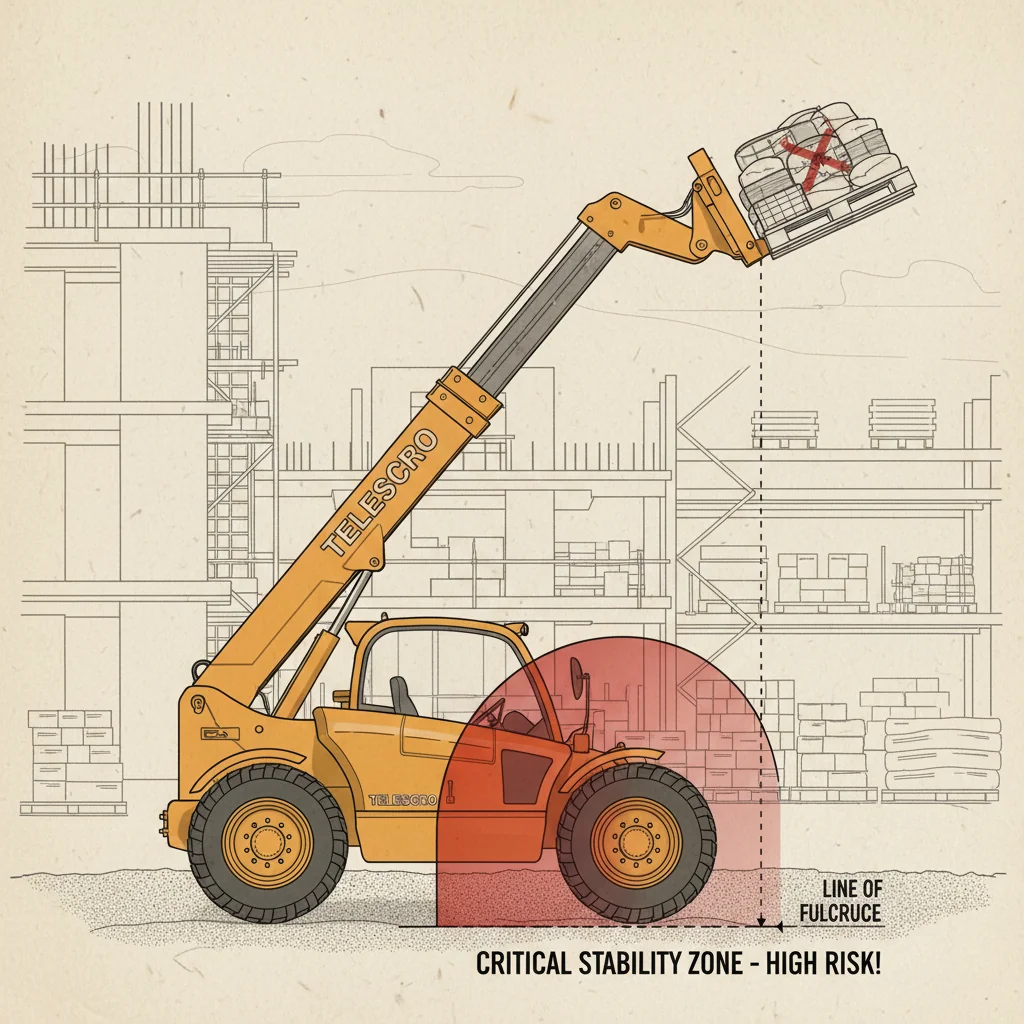
Here’s what matters most when you take a telehandler to maximum height with a load you haven’t verified: the safety margin is extremely thin. At full extension, even a small error in weight estimation can push the lift beyond the stability limit. The machine may feel stable at ground level, but as the boom rises, the rated capacity drops rapidly. I saw this firsthand on a site in Chile, where a contractor lifted a mixed pallet of blocks to the upper level of a structure based on an assumed weight. Once the load cleared the scaffold, the telehandler began to tip forward. They avoided a full incident by lowering immediately, but it was an uncomfortably close call.
This is one of those situations where “it felt light enough” is not a safety strategy. The load chart (which shows max safe weights for every boom position) is not forgiving at the top. At mid-extension, a small overload might not tip the machine—but at max height, you’re right on the edge. Many tip-over incidents I’ve seen during jobsite visits in Kazakhstan or Brazil had the same root cause: guessed weights, especially with irregular bundles or farm bales.
Overload protection systems can help, but their sensors depend on correct calibration and sometimes only warn you after stability is already compromised. I always suggest demanding clear weight info up front—get the supplier’s documentation, weigh at the yard, or use integrated load cells if available. If you have any doubt, drop the working height or use a higher capacity telehandler. At full outreach, there’s just no room for guesswork.
A telehandler’s rated capacity decreases substantially as the boom extends upward and outward, making unknown loads much riskier at maximum height.True
This is true because telehandler load charts show a sharp drop in capacity as both boom angle and extension increase. An unknown load that appears manageable at ground level can easily exceed safe limits once the boom is fully raised and extended, reducing stability and increasing tip-over risk.
If a telehandler feels stable with an unknown load at ground level, it is also safe to lift that load to maximum height.False
This is false because stability at ground level does not guarantee safety at height. The leverage effect increases as the boom extends, which can cause the machine to tip even if the load seemed manageable when not elevated.
Key takeaway: Near maximum height, a telehandler’s margin for error is extremely small—minor mistakes in load estimation can lead directly to tip-over incidents. Accurate weight information and strict adherence to load chart limits are non-negotiable for high-reach jobs; avoid any guesswork about load mass.
When do slopes make max height unsafe?
Telehandler stability tests assume firm, level ground. Even small side slopes5 or localized unevenness—often around 3° or less, depending on the manufacturer—can make maximum-height operation unsafe by shifting the center of gravity toward the edge of the machine’s stability base (stability triangle). Rated capacities and full-height lifts are valid only within the OEM-specified leveling tolerance stated in the load chart or operator’s manual.

The most common mistake I see is assuming full lift height is acceptable anywhere the telehandler appears roughly level. In reality, every rated capacity and load chart from major manufacturers is based on controlled test conditions: firm ground and a very limited allowable chassis inclination—typically around ±3°, unless the manual specifies otherwise. That tolerance is smaller than most operators realize. On real jobsites, a shallow cross slope, a single wheel on a kerb, or minor ground settlement can easily push the machine beyond that limit.
When the boom is raised to maximum height, the center of gravity rises sharply and becomes far more sensitive to lateral offset. Even a small side slope can move the combined machine-and-load center of gravity close to—or beyond—the tipping line formed by the front axle and rear axle pivot. At that point, the telehandler can side-tip well below the load chart’s stated capacity.
I saw this on a project in Kazakhstan where a crew needed to place roof trusses at around 13 meters. The load chart showed the weight was acceptable on level ground. However, the setup area had a mild cross slope of roughly 4°. Once we measured it properly, it was clear the machine was already outside the manufacturer’s leveling tolerance. Frame leveling could not correct the condition sufficiently at that height, so the team lowered the boom, repositioned on firmer ground, and completed the lift safely. It cost time—but avoided a rollover.
A telehandler’s maximum safe lift height is reduced once chassis inclination exceeds the manufacturer’s specified leveling tolerance, even if the machine appears level to the operator.True
Telehandler load charts and rated heights are established on firm, level ground within a narrowly defined slope tolerance, commonly around ±3°. Exceeding this tolerance shifts the center of gravity toward the edge of the stability base, significantly increasing the risk of tip-over at height. Visual judgment alone is unreliable for assessing small but critical slopes.
If the telehandler’s stabilizers or frame-levelling system are used, maximum rated lift height can always be achieved safely on sloped ground.False
Stabilizers and frame-levelling systems improve stability but do not override the manufacturer’s requirement for firm, level ground. If the underlying slope or ground condition exceeds the allowable tolerance, rated height and capacity are no longer valid, even with stabilizers deployed.
Key takeaway: Never operate a telehandler near maximum height unless the chassis is within the OEM-specified leveling tolerance—commonly around ±3°. Even modest cross-slopes or uneven ground can invalidate load chart values at height. If level cannot be achieved, reduce boom height, reposition the machine, or change the lift plan.
How Do Ground Conditions Limit Maximum Height?
Weak, soft, or recently backfilled ground may not support the concentrated wheel or stabilizer loads generated during high-reach telehandler operations. At near-maximum height, a large portion of the machine’s weight is transferred to individual contact points, creating very high localized ground reactions. Even minor settlement at one wheel or stabilizer can introduce a dangerous side slope, rapidly reducing stability and increasing tip-over risk. A ground bearing assessment is essential before any maximum-height lift.

Many operators assume that ground which looks firm will safely support a telehandler at maximum height. I’ve seen this assumption cost both time and money. In reality, when the boom is near full extension—especially on high-reach machines in the 17–21 m class—a large proportion of the machine’s weight is transferred to individual wheels or stabilizer pads, creating very high localized ground reactions. If the ground is weak, recently backfilled, or located above old trenches or services, it can fail under these concentrated loads.
I saw this happen last year on a site in Dubai. During a lift at roughly 16 m, one stabilizer pad settled only a few centimeters into fresh fill. That small movement was enough to introduce a lateral tilt and trigger the machine’s tilt alarm. Operations stopped immediately, and the crew lost half a day recovering the telehandler and rebuilding the support pad. The load itself was within the chart—the ground was not.
I always recommend a simple ground bearing capacity check before any max-height lifting. That isn’t just checking for mud—it means understanding soil type, compaction, slab thickness if working indoors, or hidden features like drainage lines. Even a slight sink at one tire turns level ground into a dangerous side slope. On a tall machine, that can amplify into a noticeable boom deflection or instability within seconds. Most customers never see this in the load chart, but the risk is real.
If the ground’s capacity is unknown, I suggest using mats or spreader plates to distribute the load, or even derating your max reach by several meters to stay within a safer envelope. Tires, even rough-terrain types, do not "automatically" solve weak ground problems. Take the ground out of the equation before you trust the height chart—your crew’s safety depends on it.
Even if a telehandler's outriggers are fully deployed, using maximum boom height on ground that has been recently backfilled can still lead to ground failure beneath the stabilizers.True
Recently backfilled soil has not compacted to the same degree as undisturbed ground, reducing its load-bearing capacity. The concentrated forces from stabilizers at full boom extension can exceed this capacity, causing the machine to sink or tip.
As long as the telehandler is equipped with stabilizers, any type of jobsite ground can safely support it at maximum boom height.False
Stabilizers help distribute the load but do not eliminate the risk of ground bearing failure. The underlying soil must have adequate strength to handle the high point loads, or there is still a risk of collapse, especially on soft, backfilled, or previously excavated ground.
Key takeaway: Ground that looks stable may not support telehandlers at maximum height. Soft, backfilled, or weak soils can sink unexpectedly, tilting the machine and severely compromising stability. Always require a ground bearing check and use mats or derate height if supporting capacity is uncertain.
When Do Wind Loads Limit Telehandler Height?
Wind and sail loads can significantly restrict usable telehandler height when gusts introduce lateral forces and overturning moments that are not represented in standard load charts. Large, flat, or lightweight loads—such as panels, cladding, or stacked insulation—can behave like sails as boom height and exposure increase. Most manufacturers therefore specify attachment- and application-specific wind speed limits for high-sail loads, beyond which lifting at height is prohibited, effectively reducing the safe working height in windy conditions.
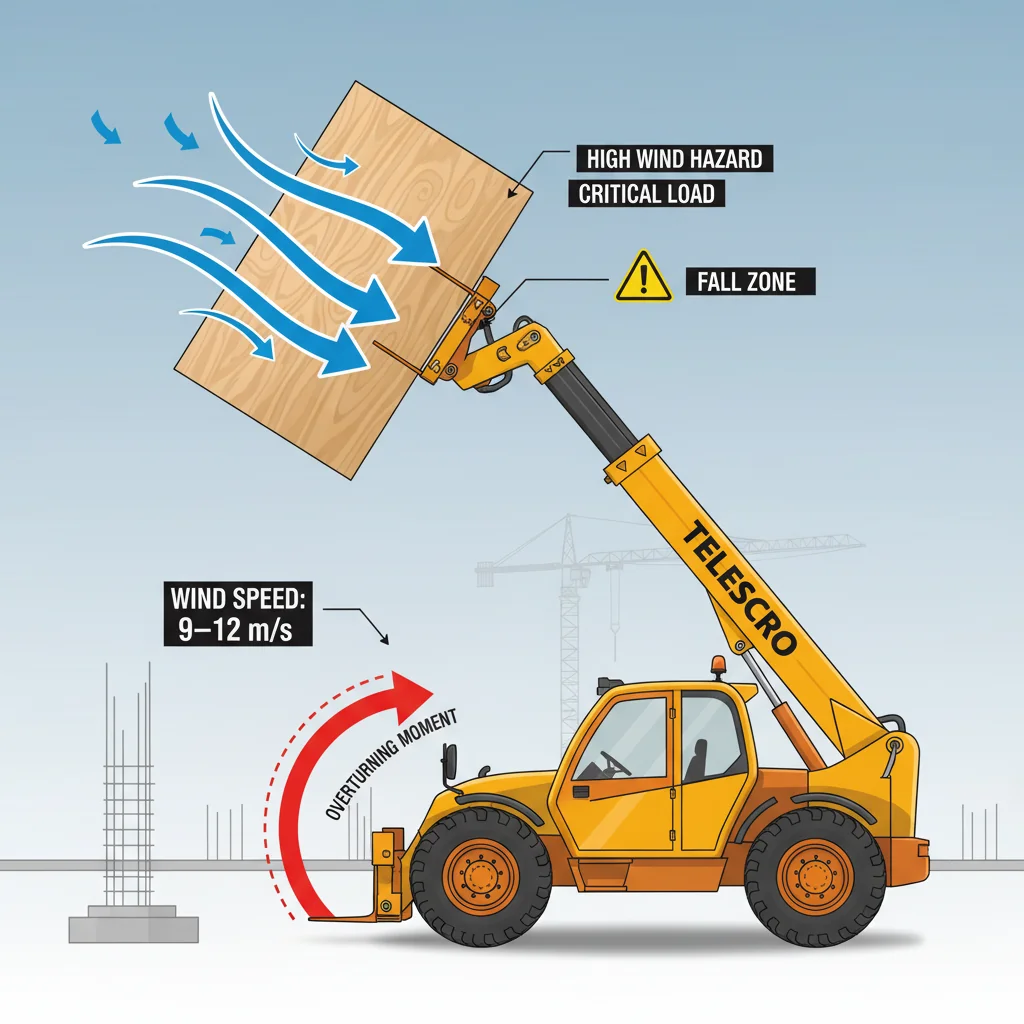
Last month, a contractor in Dubai called me after a close call with a wind-blown insulation lift. His crew was raising stacked panels—about 11 meters up—when a sudden gust nearly toppled the telehandler. The load weight was well within the chart, but the panels acted like a massive sail. That’s the risk many teams miss: wind and “sail effect6” can quietly limit your real max height, no matter what the brochure claims.
Above 8–10 meters, any wide or light load—think roof sheets, cladding, even large cages—will catch even a moderate breeze. The force isn’t just on the boom; the wind pushes the load sideways, which creates an overturning moment at the tipping axis (the front tire line). In these cases, most manufacturers set strict wind speed limits, usually between 9 and 12 meters per second, for high-sail loads or people platforms. The problem? Site gusts can spike fast—sometimes way higher than you expect on the ground.
I’ve seen customers in coastal Kenya and northern France shut down lifts because on-site readings hit 11 m/s, even on clear days. The height you “can” reach on paper becomes meaningless when gusts approach the limit. I always advise checking actual wind conditions at boom height—wind at 15 meters is rarely the same as it feels at ground level.
If wind is close to the allowed max, shorten your radius, drop the boom, or split bulky loads in half. Safety comes first. And always treat those wind limits as a firm boundary, not a flexible target.
Even when a telehandler’s load chart indicates safe lifting at maximum height, wind acting on wide or lightweight loads can reduce the true safe operating height significantly below the published limit.True
Load charts assume calm conditions and compact loads. Wind creates side forces and the sail effect, making long or flat items far more susceptible to tipping risk, so safe height is reduced in real-world wind conditions.
As long as a telehandler operates within its rated load chart, wind speed has no meaningful impact on maximum lifting height.False
Wind can introduce dangerous instability, especially with large or lightweight materials. The load chart does not account for wind forces, so wind conditions can greatly reduce safe lifting height even if the rated load is not exceeded.
Key takeaway: Treat manufacturer wind speed limits as hard cutoffs, especially when lifting bulky or sail-like loads near maximum boom height. Always monitor site wind conditions. If gusts approach the published limit, reduce height, shorten radius, or postpone lifts to maintain stability and safety.
How Do Attachments and Stabilizers Restrict Telehandler Maximum Height?
Advertised telehandler maximum height is based on a specific reference configuration—typically standard forks, no auxiliary attachment, and a defined stabilizer position (if fitted). Once attachments or stabilizer configurations change, the usable maximum height and capacity must be reassessed using attachment-specific load charts.
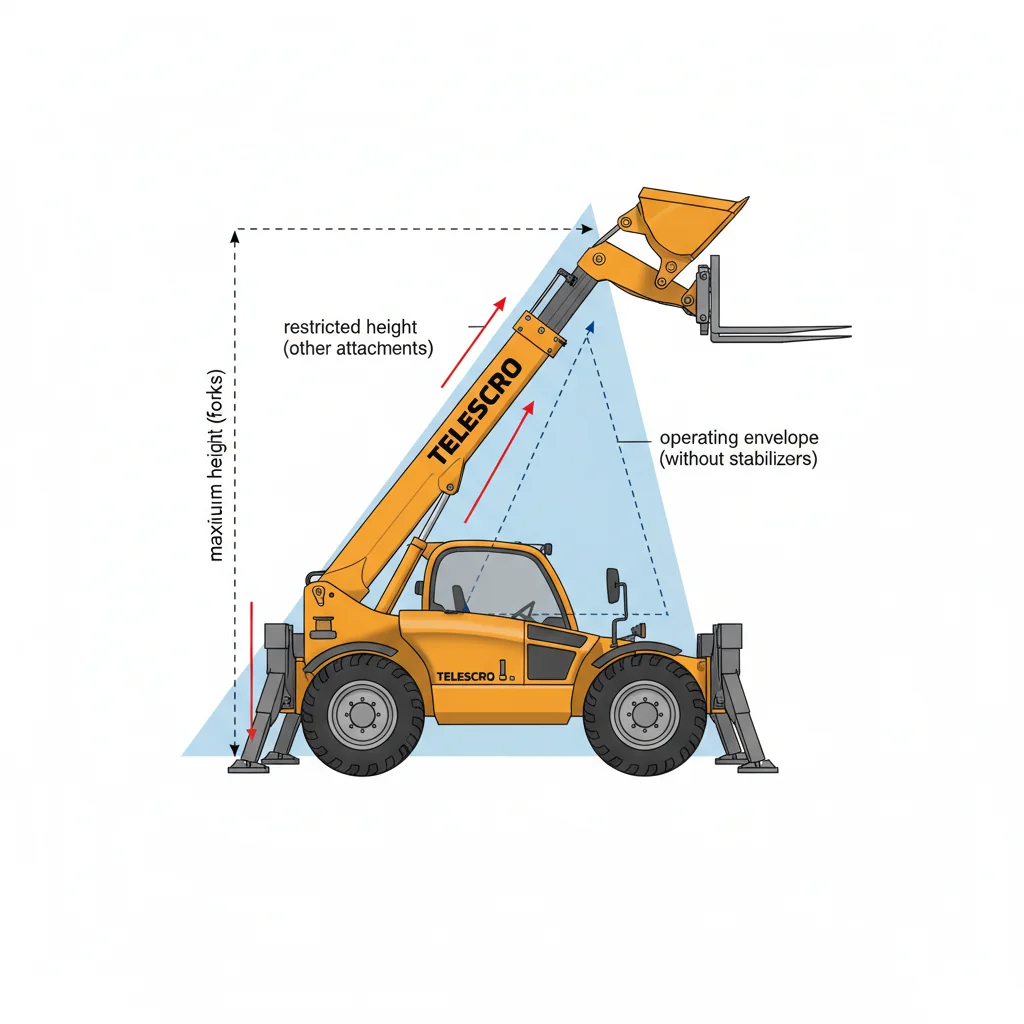
I’ve worked with many customers who made the same assumption—believing that any attachment will allow the same maximum height shown in the brochure with standard forks. In practice, that’s rarely true. Every time you install a jib, bucket, or man basket, two critical things change: the weight at the boom head increases, and the load center moves further away from the chassis. Both effects reduce stability. The result is a clear reduction in allowable lift height and outreach, sometimes significantly.
I saw this firsthand on a project in Kazakhstan. A contractor planned to lift HVAC units to 14 meters using a man basket, assuming the telehandler’s advertised height still applied. When we checked the attachment-specific load chart, the maximum permitted height for that configuration was just over 10 meters. The machine itself was capable of reaching higher, but the attachment shifted the stability envelope well before the brochure height.
Stabilizers add another layer of complexity. Their effect on stability depends entirely on whether they are deployed, partially deployed, or fully raised—and manufacturers publish different load charts for each condition. I once reviewed a site in Kenya where a 4-ton telehandler was rated for approximately 2,000 kg at 12 meters with stabilizers deployed. When the same machine was operated with stabilizers raised, the safe capacity at that height dropped to around 700 kg. The boom could still reach the height, but the usable load changed dramatically. This is exactly why stabilizer position must always be confirmed against the correct chart before lifting at height.
Here’s a practical breakdown of how attachments and stabilizers restrict usable height:
- Attachment weight7 directly reduces available capacity and often limits maximum height
- Shifted load center (further forward from the boom head) increases overturning moment
- Non-standard attachments always require their own dedicated load charts—never assume fork values apply
- Stabilizer position (deployed vs. raised) can significantly increase or reduce allowable capacity at height
- Missing, incorrect, or outdated charts make high-reach operation unsafe, regardless of experience
My standing rule on site is simple: no non-standard attachment goes up unless the correct, readable load chart for that exact configuration is physically on the machine. If the chart isn’t there, the lift doesn’t happen.
Using a telehandler with a man basket attachment often requires a lower maximum boom height than when using standard forks, even if the total load is within the rated capacity.True
Attachments such as man baskets add weight and move the load center further forward, reducing stability. Manufacturers therefore publish separate, more restrictive load charts for these attachments, often limiting maximum safe height and outreach.
Stabilizers allow telehandlers to safely use their maximum brochure-listed height with any attachment.False
While stabilizers improve stability, they do not offset the added weight or altered load center of attachments. Maximum safe height and capacity still depend on attachment-specific and stabilizer-specific load charts, which are often more restrictive than the brochure specification.
Key takeaway: Telehandler maximum height is configuration-dependent. Attachments and stabilizer position fundamentally change the stability envelope, often reducing usable height well below brochure figures. Always verify the correct attachment- and stabilizer-specific load chart before any high-reach lift.
When is lifting people unsafe at max height?
Lifting personnel with a telehandler at maximum height is unsafe unless the telehandler and platform are specifically certified for man-lifting by the manufacturer. Using a non-integrated, fork-mounted cage8, or applying the standard materials handling load chart, violates safety standards and may breach regulations. Certified man-platform operation9 requires a dedicated load chart and stricter wind and height limits.

Too often, I see crews attempt to use a standard telehandler at full extension for lifting people, just because the boom can reach 18 meters or more. The reality is, telehandlers are designed mainly for moving materials—lifting people is a completely different risk profile. Even if the machine’s load chart shows safe capacity at max height with forks or buckets, this doesn’t apply to people. For personnel lifting, you need a manufacturer-approved integrated platform, with its own dedicated man-platform load chart and safety systems. These platforms have features like interlocked controls and tilt sensors—if anyone tries to use a regular fork-mounted cage, you’re outside design specifications and into dangerous territory.
I once worked with a contractor in Singapore who thought he could save time by lifting workers in a fork-mounted cage at near maximum boom height—around 17 meters. Weather conditions changed quickly, and a sudden gust caused the cage to sway so severely that the operator had to lower the boom immediately. What the team hadn’t realized was that approved man-basket operation is subject to much stricter wind limits and a far more restrictive load chart than standard material handling. The wind threshold for personnel platforms is typically set well below that used for forks, and the allowable height and outreach are significantly reduced. In this case, the machine was still “within the material load chart,” but already outside the safe envelope for lifting people.
Here’s the key detail: lifting people at max telehandler height is only permitted with a certified integrated platform and under much stricter limits. If your load chart only shows material handling, operating at “max height” for personnel is a regulatory violation and puts lives at risk. For regular access work above ground level, I always recommend a MEWP or a telehandler that’s fully certified for man-platform use—anything less is not worth the risk.
Using a telehandler's load chart to determine if it can safely lift personnel at maximum height is incorrect, because these charts are designed specifically for material loads, not the dynamic risks associated with lifting people.True
Telehandler load charts account for static and balanced material handling. When lifting people, movements, shifting weight, and emergency situations introduce new forces and risks, making material load charts an invalid reference for personnel safety.
Any telehandler that can support its maximum rated material load at full extension is automatically safe for lifting personnel to that height, as long as the cage is properly secured.False
Supporting maximum material weight at full extension does not ensure the telehandler is safe for lifting people. Personnel lifting demands additional safety features, stability controls, and manufacturer approval, regardless of the material load rating.
Key takeaway: Personnel lifting at maximum telehandler height is only permitted with manufacturer-approved integrated platforms under dedicated man-basket load charts and stricter operational limits. Standard telehandler maximum heights for materials handling must never be applied to lifting people, as this may breach regulations and endanger lives.
Why are telehandlers risky at max height?
Telehandler load charts are based on static, level conditions. Dynamic movements—such as traveling, turning, or abrupt braking—at maximum height drastically increase the risk of tipping. Elevated booms amplify load inertia, making shock loading or uneven ground dangerous. Most manuals prohibit travel with raised booms due to these serious stability hazards.

To be honest, the spec that actually matters is not just “max height”—it’s the real stability envelope. Most telehandler load charts are based on perfectly level, stable ground and very careful boom movements. But on actual jobsites, that’s rarely the case. The higher you raise the boom, the more any small movement can put you outside the machine’s safe balance zone. I’ve seen operators in Kazakhstan lift 1,000 kg loads to 15 meters—on paper, that’s within chart limits. But when they tried edging forward or tapping the brakes, the telehandler rocked dangerously, and the load swung much further than expected.
Here’s the thing: dynamic movements at full height—traveling, sudden turning, or shock loading—aren’t covered by any load chart. At max elevation, even small ruts or bumps can transfer massive forces through the boom, shifting the center of gravity. In Brazil, a team once tried to turn with the boom raised at over 12 meters. Even though they were “under capacity” by the numbers, just a slight turn made the chassis lurch and forced an emergency stop. The stability margin evaporates at height because the load’s inertia is amplified—if you jolt the steering, the telehandler can easily tip forward or sideways.
I always recommend completing all machine travel with the boom low and retracted whenever possible. Only lift once you’re positioned and sure the ground is firm and level. If you have any doubt about how slopes or unsettled ground will affect stability, check with the manufacturer or lower your working height. The risk is simply too high to guess.
At maximum boom height, even a slight tilt in the ground can cause a telehandler to exceed its stability limits, putting the machine at risk of tipping despite staying within charted weight limits.True
Load charts assume perfectly level surfaces, but real jobsite conditions often introduce minor slopes. At full height, the telehandler's center of gravity shifts higher and further away from the machine, so even a small tilt can move the center of gravity outside the base of stability. This makes working at max height much riskier in practice.
As long as the load is below the rated capacity in the operator's manual, a telehandler can be safely operated at maximum height on any terrain.False
Telehandler capacities are rated for level and stable ground, but actual terrain may be uneven or soft. Such surfaces reduce stability and can cause tipping even if the load is below the charted maximum, especially with the boom raised high. Terrain conditions must always be considered, not just the load weight.
Key takeaway: Operating a telehandler at or near maximum height greatly increases the risk of stability loss, especially during travel, sudden movements, or when shock loading occurs. Always keep the boom as low and retracted as practical when moving, and consult the manufacturer’s load chart before dynamic operations.
How Does Condition Impact Max Telehandler Height?
Telehandler maximum height is directly affected by machine condition. At full extension, minor wear in boom pads10, pins, or hydraulic components can dramatically increase tip movement and reduce stability. Defects like leaking hydraulics11, damaged stabilizers, or underinflated tires compromise control, making up-to-date inspections and LMI calibration mandatory for safe high-reach operation.
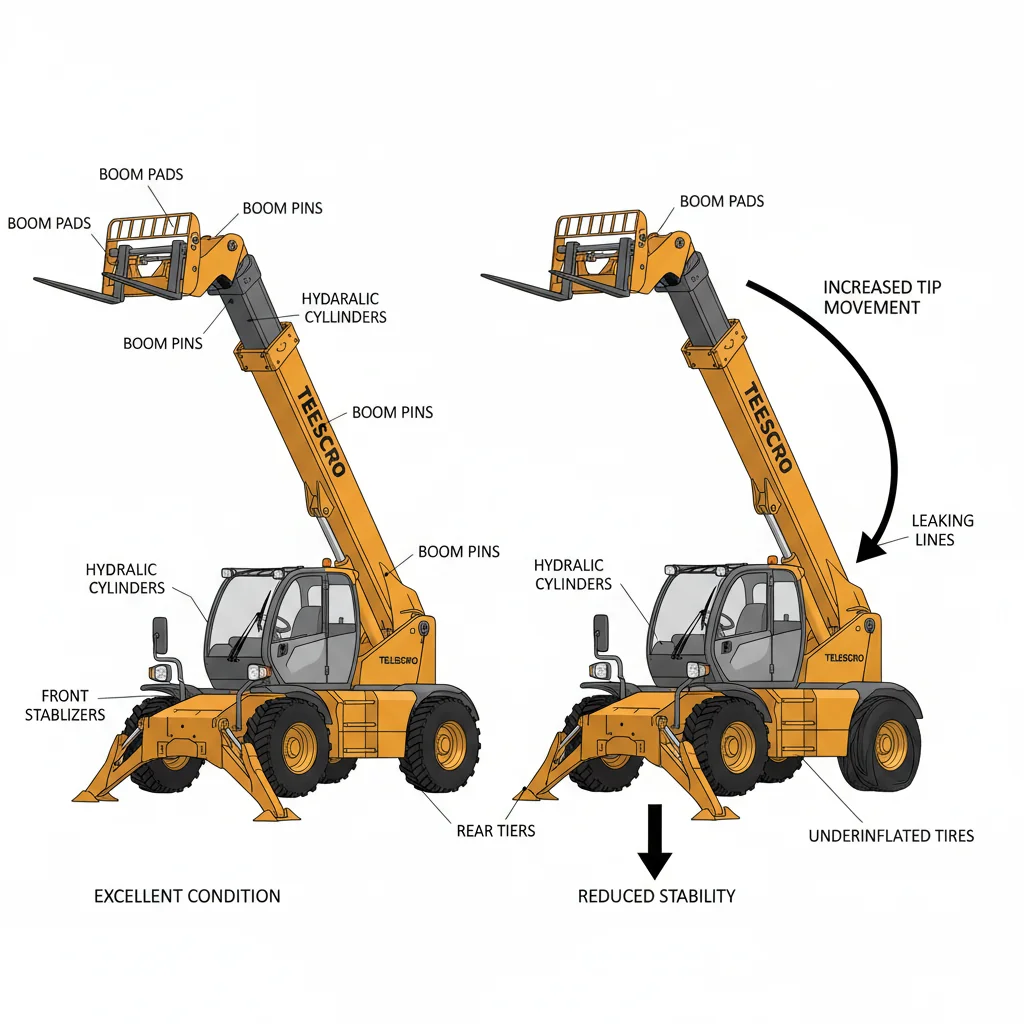
From my experience, even slight wear in boom pads or pins can make a telehandler feel unpredictable at height. Once, a site manager in Kazakhstan called me after noticing the load swaying nearly 150 mm at 16 meters—just from worn boom sections and old hydraulic hoses. That small amount of play felt minimal on the ground but became a big headache during precise placement. When you’re stretched out to maximum reach, every bit of slop or movement in the structure is amplified. It’s not just about operator skill—bad hydraulics or loose connections will fight you the whole way.
What you might not see in factory specs is how fast issues can cascade. Damaged stabilizers, underinflated tires, or leaking hydraulic cylinders don’t just impact controls—they directly reduce stability, especially at full extension. I remember a rental crew in Dubai who ignored a slow hydraulic leak. A few weeks later, their telehandler started drifting when loaded at 15 meters, and they lost confidence in every lift after that. The tip movement gets unpredictable, making it risky to place pallets close to edges or up against walls.
I always tell customers—especially for high-reach models above 15 meters—to insist on a current inspection record and documented load moment indicator (LMI) calibration. If you don’t know the maintenance history or you see any structural or hydraulic defect, restrict height and outreach right away. The load chart is only true when the machine is as tight as new—so don’t trust “maximum height” unless the telehandler is 100% ready. For crews working with man baskets or heavy loads at height, this isn’t optional. It’s mandatory for safety.
Even minor wear in boom pads or structural pins can make a telehandler’s maximum height unsafe for lifting loads, because the play amplifies at full extension and can lead to unpredictable load movement.True
At full boom extension, any slack or wear in boom components is magnified, increasing deflection and instability, which can compromise operator control and safety even if the machine seems sound at lower heights.
As long as a telehandler passes a basic daily inspection, its maximum lift height can always be used safely, regardless of the condition of wear parts.False
Basic daily inspections may not detect internal or progressive wear in components like boom pads, pins, or hydraulic hoses. Such wear can significantly impact structural integrity and stability at full height, making it potentially unsafe to use the maximum extension even if all checklist items appear normal.
Key takeaway: Any mechanical, hydraulic, or structural defect in a telehandler increases risk at full extension by reducing real-world stability and control. For high-reach work, only properly maintained, fully inspected machines with documented LMI calibration should be operated at maximum height. Restrict extension if uncertain or unsafe conditions exist.
How to Size Telehandlers for Safe Height?
Telehandlers should not be specified based on maximum advertised height and rated capacity alone. Actual load capacity drops significantly at maximum height and reach. For safe, efficient operation, select models offering 20–30% reserve capacity at 1–2 meters above the required working height, minimizing risk from unexpected job-site variables.

From my experience, many managers look at the maximum height and rated capacity listed on a brochure and assume that’s the answer. What actually happens on site is very different. I’ve seen crews in Kazakhstan operating a 13-meter unit, expecting to handle 3,500 kg at full extension. The reality? At 13 meters and 8 meters of reach, the capacity dropped to around 1,100 kg on the load chart—even less if the pallet was heavier than planned or the ground wasn’t perfectly level.
Here’s what matters most when sizing for safe height: never select a telehandler based only on advertised peak numbers. Always start with your real job requirement—the true lift height, needed outreach, and typical load weight. Then, check the model’s load chart for that specific height and add 20–30% spare capacity at 1–2 meters above your working level. Why the buffer? Even the smallest job-site variable—soft ground, unexpected wind, or a slightly shifted load center—can eat up your margin of safety. Telehandlers in the same tonnage class can also have very different stability envelopes, depending on chassis and boom design.
Last year, a customer in Brazil used a compact 3-ton machine to lift steel mesh to the fourth floor—about 11 meters. The paperwork said it could do the job, but actual working cycles were slow and sometimes unsafe since they had to max out every lift. Once they switched to a 4-ton, 14-meter unit and operated mainly in the mid-range, they saw faster loading, more stability, and less wear on the boom. I suggest always checking the charted capacity just above your working height—the difference in uptime and safety is easy to see.
A telehandler's maximum lift height can only be safely used at full rated capacity if the boom is not fully extended and the load is close to the machine.True
Telehandler load charts show that rated capacity decreases as the boom extends and outreach increases. The highest lift and maximum capacity rarely coincide, so operators must check the chart for the specific configuration.
If the ground is firm and level, a telehandler can always lift its maximum rated capacity to the full height listed in the brochure.False
Even on perfectly level ground, the telehandler’s load chart limits capacity at greater height and reach due to stability and structural considerations, meaning safe lifting limits are often lower than brochure specs suggest.
Key takeaway: Sizing a telehandler using actual job requirements—target height, outreach, and payload—plus a 20–30% capacity buffer above the working height ensures greater stability, safer operation, and faster cycles. Avoid routinely operating near maximum chart values to reduce wear and operational risks.
When Do Overhead Obstructions Limit Boom Height?
Usable telehandler boom height12 is frequently reduced by real-world overhead obstructions such as power lines, trusses, lighting, or roof structures. Operating close to these hazards increases the risk of impact and machine instability. Safe planning must verify actual clearances, establish a minimum buffer band13, and, if necessary, select alternative equipment for confined environments.

I get a lot of calls from site managers frustrated that their telehandler “can’t reach” under a warehouse roof or through factory trusses. The truth is, the maximum boom stroke you see in brochures assumes wide-open sky overhead—no power lines, no ductwork, no lighting, nothing in the way. But on real jobsites, even a simple overhead beam or a row of hanging lights can chop at least 1.5 meters off what your spec sheet says. If you’re working under a 13-meter roof with a 14-meter model, you won’t get full extension—and you’ll need extra overhead room just to tilt the attachment or adjust angle for final load placement.
In Kazakhstan last year, a logistics client asked me why their 12-meter telehandler struggled moving crates near the eaves. Walking the floor, I measured just 11 meters clear because of HVAC ducts and trusses—no way to safely crowd the forks up top. The operator was forced to stop short, which made their high stacking impossible. I always recommend mapping every obstruction before choosing a model, then building in a 1–2 meter "no-go band" beneath those points. That zone becomes your real working limit, not the max boom height on paper.
Getting too close to obstructions can easily damage the boom, side-load the chassis, or even tip the machine. If you’re squeezed for space, consider a shorter telehandler or a compact scissor lift instead. Your safest bet—always verify true working clearance and check that your load chart supports the height and reach you’ve actually got, not just what’s promised in the brochure.
Telehandler maximum boom height cannot be safely reached if any part of the load or attachment would strike or come dangerously close to overhead obstructions, even if the main boom itself appears clear.True
Obstructions like beams or pipes can interfere with the load's path or the attachment's movement, preventing the operator from safely using the full advertised height of the telehandler. The entire load envelope must be considered, not just the boom's arc.
As long as the telehandler's boom can physically fit between overhead obstructions, it is safe to operate at full extension regardless of proximity to the roof or trusses.False
Safe operation requires maintaining sufficient clearance from all overhead objects to allow for unexpected movement, load shift, or operator error. Working too close to obstructions greatly increases the risk of collision or damage, even if the boom technically fits.
Key takeaway: Telehandler brochure maximum heights assume open space, but in practice, warehouse roofs, trusses, or overhead services often cap safe boom extension. Always identify true overhead clearance, factor in a 1–2 m safety buffer, and use a shorter machine if the environment demands it.
Conclusion
We looked at what “maximum height” really means for telehandlers and why the safe working limit comes down to load charts, not just the specs sheet. From what I’ve seen, the real problem isn’t the brochure numbers—it’s the “3-meter blind spot” most buyers overlook: assuming the max height works for every load and every condition. I always suggest checking the load chart at realistic working ranges, and making sure parts support in your region is solid. Have questions about what will actually work on your jobsite? I’m happy to help—just reach out if you want to talk through the options. Every job is different; let’s make sure your next telehandler matches your real needs.
References
-
Provides detailed guidance on interpreting load charts to ensure telehandler stability and avoid accidents at various boom positions. ↩
-
Insight into the sharp drop of rated capacity at max boom extension and its impact on telehandler load handling and stability. ↩
-
Detailed insights on how the center of gravity shifts with the boom extension, directly impacting telehandler tipping risks. ↩
-
Explains the critical stability constraints and risks when operating telehandlers at max height, essential for safe load handling. ↩
-
Explore how even minor side slopes of 3–5° can shift the center of gravity and risk side tipping in telehandlers during max height lifts. ↩
-
Details the risk of bulky loads acting as sails that increase side wind forces, critical for safe load handling at height. ↩
-
Detailed insights on how attachments reduce rated capacity and safe height, critical for equipment safety and optimal use. ↩
-
Details the risks and regulatory breaches involved when lifting personnel with non-integrated, fork-mounted cages on telehandlers. ↩
-
Explains safety requirements and manufacturer certifications essential for lifting personnel with telehandlers at height to prevent accidents. ↩
-
Explains how minor wear in boom pads impacts tip movement and stability, crucial for safe telehandler operations at max height. ↩
-
Details the risks of hydraulic leaks on telehandler performance, emphasizing safety and reliability in high-reach operations. ↩
-
Detailed insights on how site obstructions reduce usable boom height and impact telehandler operation safety and efficiency. ↩
-
Explains the importance of establishing safe clearance zones to prevent collisions and maintain machine stability on jobsites. ↩