










Telehandler Maximum Height: What to Know Before You Choose
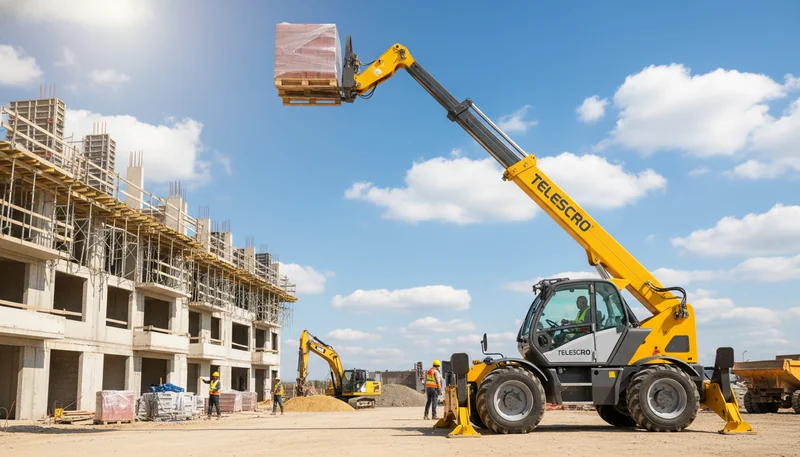
Two months ago, a site manager in Egypt sent me a photo: his crew balanced a pallet on stacked timber, just inches below a parapet their telehandler couldn’t quite reach. It’s a scene I’ve come across in Australia, Brazil, and right here in Jiangsu—always the same story: the “maximum height” on paper doesn’t tell the whole truth.
Telehandler maximum lift height is driven by boom design and machine configuration, but usable height on site also depends on outreach, attachment length, load center, and required stand-off from the structure. In construction fleets, many fixed-boom models are in the 40–56 ft (≈12–17 m) class, which suits a wide range of low- to mid-rise material placement. High-reach units around 65–70 ft (≈20–21 m) are used where top-level placement or clearance demands exceed mainstream machines, while specialist options—such as rotating telehandlers and certain heavy fixed-boom variants—can extend to roughly 30 m (≈100 ft) and beyond for placement-critical or high-access tasks.
What Is the Maximum Telehandler Lift Height?
Modern telehandlers typically offer maximum lift heights between 40 and 56 ft (approximately 12–17 m) for standard construction models. High-reach fixed-boom types extend to 65–70 ft (20–21 m), while specialist rotating telehandlers (“Rotos”) can reach 100 ft+ (30 m), though these are rare and costly.

Most people don’t realize how wide the range is for telehandler lift heights—it’s not just about “higher is better.” On most jobsites, you’ll see models in the 12–17 meter (40–56 foot) class. That covers everything from two-story residential frames in the UK to warehouse construction in Dubai. In fact, I’ve run projects in Kazakhstan where a 14-meter lift handled 90% of the work—roof trusses, HVAC units, steel beams, you name it. Once you step up to the 20–21 meter (65–70 foot) models, you’re in the “high-reach” zone. These fixed-boom machines are big, heavy, and ideal for multi-story commercial builds or façade work, but they’re not something most daily fleets need.
Now, let me share something important about the outliers. You may hear about telehandlers that reach 30 meters (over 100 feet), especially rotating types used for specialized applications—think stadiums or refinery maintenance. They’re impressive, but to be honest, I’ve only seen a few such machines on jobsites across 20 countries. They’re expensive to run and usually come as specialty rentals, not standard fleet assets. Most contracts simply can’t justify having a 35-ton machine when a 13-meter unit could do 80% of the lifting.
I always suggest you start with real site requirements—measure the highest lift point you actually need, like parapets, racking, or roof lines. Then match telehandler size to those tasks. If your work falls below 17 meters, you’re in the mainstream range. If not, consider a high-reach rental, but only when the job truly demands it.
Some of the tallest telehandlers on the market can reach maximum lift heights of around 21 meters, making them suitable for demanding multi-story construction projects.True
While many telehandlers operate in the 12–17 meter range, specialized high-reach models extend up to approximately 21 meters, which is essential for applications like erecting large industrial structures or accessing higher building levels.
"AllFalse
"Telehandler
Key takeaway: Most telehandler applications require models in the 12–17 m (40–56 ft) range. Heights above 21 m (70 ft) are specialty territory, best suited for unique projects and usually obtained through specialized rentals, not routine fleet purchase decisions.
What telehandler height ranges suit most jobs?
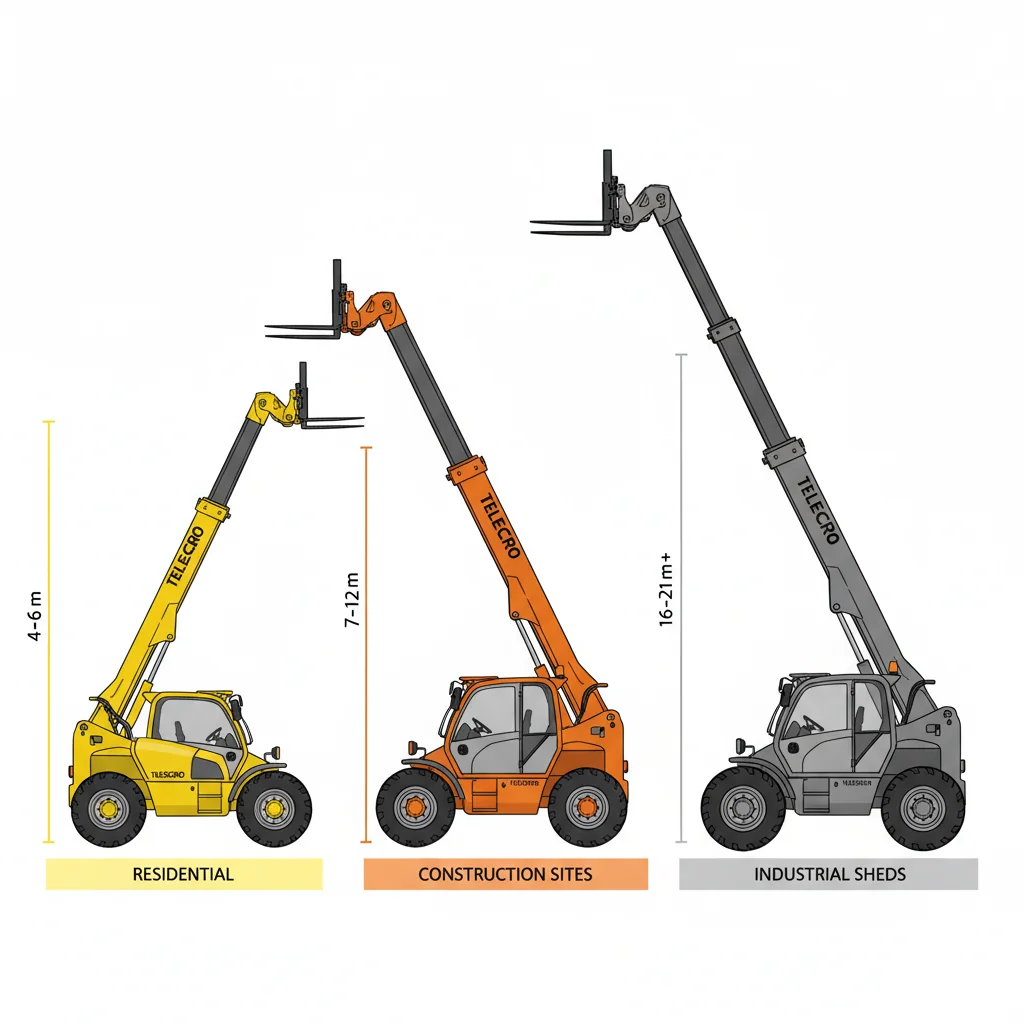
Most telehandler applications are covered by three height bands: compact models (4–6 m) for residential and landscaping, mainstream construction models (7–12 m) for multi-storey building and site use, and high-reach types (16–21 m+) for industrial sheds or tall structures. Selecting the right band avoids unnecessary cost and overspecification.
Let me share something important about telehandler height ranges: most jobs don’t actually require the tallest machine on site. In practice, many buyers default to 16-meter or higher models simply for flexibility, assuming the extra reach might be needed someday.
However, on a large number of low- to mid-rise construction projects, telehandlers in the 7–12 m lift height range handle the majority of daily tasks—such as placing pallets onto upper floor slabs, setting roof trusses, and moving blocks or rebar around a typical multi-storey structural shell. Selecting a machine in this range often delivers sufficient reach without the added cost, size, and logistical burden of higher-reach classes.
Take last year—a contractor in Kazakhstan contacted me after renting an 18-meter telehandler for six months. Their site was mostly low- to mid-rise buildings, and the extra reach was never used. All that oversized machine did was block access on tight corners and drive up transport and rental costs. I walked them through their daily loads and showed how a 12-meter, 3.5-ton unit was the sweet spot. After switching, they cut costs by at least 20% and maneuvered more easily in narrow lanes.
For smaller residential, landscaping, or farm jobs, that’s where compact 4 to 6-meter models shine. I’ve seen small 2.5-ton, 6-meter machines excel in narrow urban sites in Dubai, where bigger machines simply can’t turn. On the other end, high-reach models above 16 meters only make sense for jobs like steel erection on industrial sheds or specialized multi-story facilities. My advice: match the lift height band to where you spend 90% of your time. Overspecifying just adds cost, weight, and complexity you rarely need.
The tallest telehandlers on the market can reach working heights over 20 meters, but these specialty models are only necessary for rare, high-reach tasks in industrial or high-rise construction.True
Telehandlers with 20-meter-plus lifting capability exist mainly for niche applications like façade installation on high-rise structures, whereas most everyday jobs are accomplished with standard mid-range telehandlers, making ultra-high-reach models uncommon on typical sites.
All telehandler models offer similar max height options, so selecting a model usually comes down to preferred brand or engine size rather than reach requirements.False
Telehandler models vary significantly in their maximum reach, with some designed specifically for compact sites and others built for extreme elevation; selecting the right telehandler is heavily influenced by needed lifting height, not just brand preference or engine power.
Key takeaway: Choosing a telehandler in the 7–12 m lift height range covers most mainstream construction needs, while compact 4–6 m models suit urban, farm, or residential work. High-reach models above 16 m are reserved for specialized industrial or multi-storey applications, which reduces cost and maximizes efficiency.
How Does Building Height Affect Telehandler Choice?
The required telehandler lift height should exceed the building height to account for pallet thickness, attachment length, boom working angle, and the horizontal stand-off needed for safe operation near walls or façades. In multi-storey applications, it is good practice to allow an additional height margin beyond the highest working point, with the exact allowance determined by the attachment used and the required outreach as confirmed on the manufacturer’s load chart.
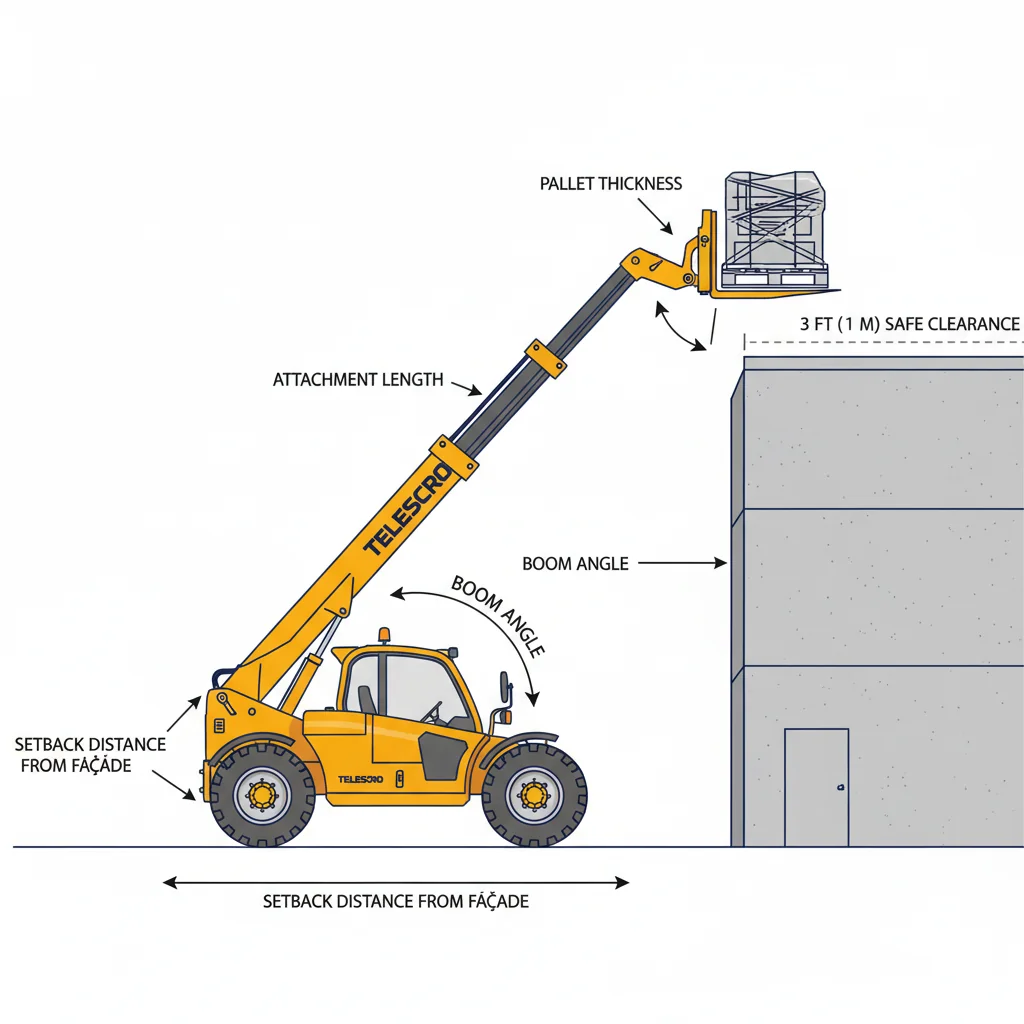
The biggest mistake I see is people matching telehandler max lift height to building height, without padding for real-world conditions. Last year, a developer in Dubai called me after his 12-meter telehandler couldn’t actually reach the third floor. Why? The parapet was 11.5 meters high, but once he added the pallet thickness, a long fork attachment, and set the machine back from the façade for safety, he was about a meter short. His crew tried stacking pallets just to “cheat” a little bit higher—totally unsafe.
Here’s what matters most when choosing height: always account for more than just the raw building dimension. For warehouse projects in Brazil, I usually recommend a telehandler with at least 3 meters (about 10 feet) extra reach over the roofline. That margin covers the pallet, attachment length, and the necessary distance to operate safely away from walls or scaffolding. If the roof edge is 26–30 feet (8–9 meters), you’re really after a machine rated for at least 35–40 feet (10–12 meters).
From my experience, multi-storey projects demand even more caution. A residential building with a 15-meter parapet? Go straight to a 17-meter telehandler. It’s not just about height—the boom angle flattens as you set back from the wall, which eats up more vertical reach than many first-time users expect. I always suggest laying out your actual working zone, checking the site geometry, and then picking a model that clears your maximum point by at least a meter. That’s what keeps people off unstable stacks and out of trouble.
Telehandler lift height specifications do not account for additional factors like fork attachment length, pallet thickness, and required stand-off distance from the building facade.True
The maximum lift height listed by manufacturers is measured at the telehandler’s highest point of fork travel, but real-world use often needs extra allowance for attachments and working space, which reduces effective reach.
A telehandler’s rated maximum lift height guarantees you can always deliver material to any point at or below that height on a building.False
The rated lift height does not consider obstacles like parapets, attachment length, safety setbacks from the structure, or pallet size, all of which can prevent the telehandler from actually reaching the desired height.
Key takeaway: Always select a telehandler with lift height exceeding the measured highest working point by a safety margin (minimum 3 ft/1 m). Consider building geometry, set-back distance, and attachments when matching telehandler height to project requirements, ensuring operators won’t resort to unsafe lifting practices.
Why Isn’t Brochure Lift Height Usable?
Brochure maximum lift height2 for telehandlers refers to the pin or fork fully extended vertically, with minimal outreach. In real work, attachments, pallet thickness, or required outreach can reduce usable height by 1–3 ft (0.3–1.0 m). Always consult the load chart3 to determine safe working height and capacity.

Here’s what matters most when sizing up a telehandler for real jobs: the brochure’s “maximum lift height” rarely matches what your crew can actually use. On paper, that number is measured at the fork tip or carriage pin, with the boom almost perfectly straight up and minimal outreach. But jobsites aren’t so perfect. Add a work platform, a brick fork, or even just a thicker pallet, and you instantly lose 0.3 to 1 meter from that spec. On a rooftop job in Dubai last year, a team needed to set aircon units onto a 16-meter roof. They thought their 17-meter telehandler would do it—until they realized the work platform took another 0.5 meters and a safe working angle cost even more height.
If you’re working close to the building edge, you’re lucky. Most of the time, I see crews having to stand 1–2 meters back to avoid trenches or landscaping. That means flattening the boom angle and extending the outreach. Capacity and vertical reach both drop, and I’ve seen more than one operator tempted to risk a dangerous lift. The load chart—usually posted right in the cab—shows the safe capacity at each angle and extension, not just the best-case scenario in the brochure.
My advice? Always add at least 1 meter over your top lift requirement when choosing telehandler height. Double-check with the load chart at real outreach, especially with attachments fitted. It’s a simple step, but it stops job delays and keeps your team safe. The extra meter covers most real-world losses—never count on brochure numbers alone.
The brochure’s maximum lift height for a telehandler is measured with the boom fully vertical and minimal attachment, which is rarely practical on jobsites with real-world loads and attachments.True
Manufacturers list the highest point reached at the fork tip or carriage pin in ideal lab conditions, but in practice, common attachments and irregular loads reduce usable lift height.
The maximum lift height listed in a telehandler brochure accounts for every type of attachment and load a crew might use.False
Brochure specs are calculated without factoring in most attachments or the effects of load size and shape; these real-world variables reduce achievable lift height compared to the idealized figure.
Key takeaway: Telehandler brochure heights rarely match real working conditions. Allow for lost height due to attachment thickness and outreach. Always check actual lift needs versus load charts—choose a telehandler that exceeds the task by at least 3 ft (1 m) for safety.
How Does Lift Height Affect Load Capacity?
Telehandler rated capacity4 decreases as lift height and forward reach increase due to changing leverage and stability limits. While a machine may achieve its full rated capacity at low lift with the boom retracted, allowable load is typically reduced as the boom is raised or extended, with the reduction varying significantly by model, configuration, and attachment. For accurate capacity at a given height and outreach, operators must consult the manufacturer’s load chart rather than relying on headline capacity figures.
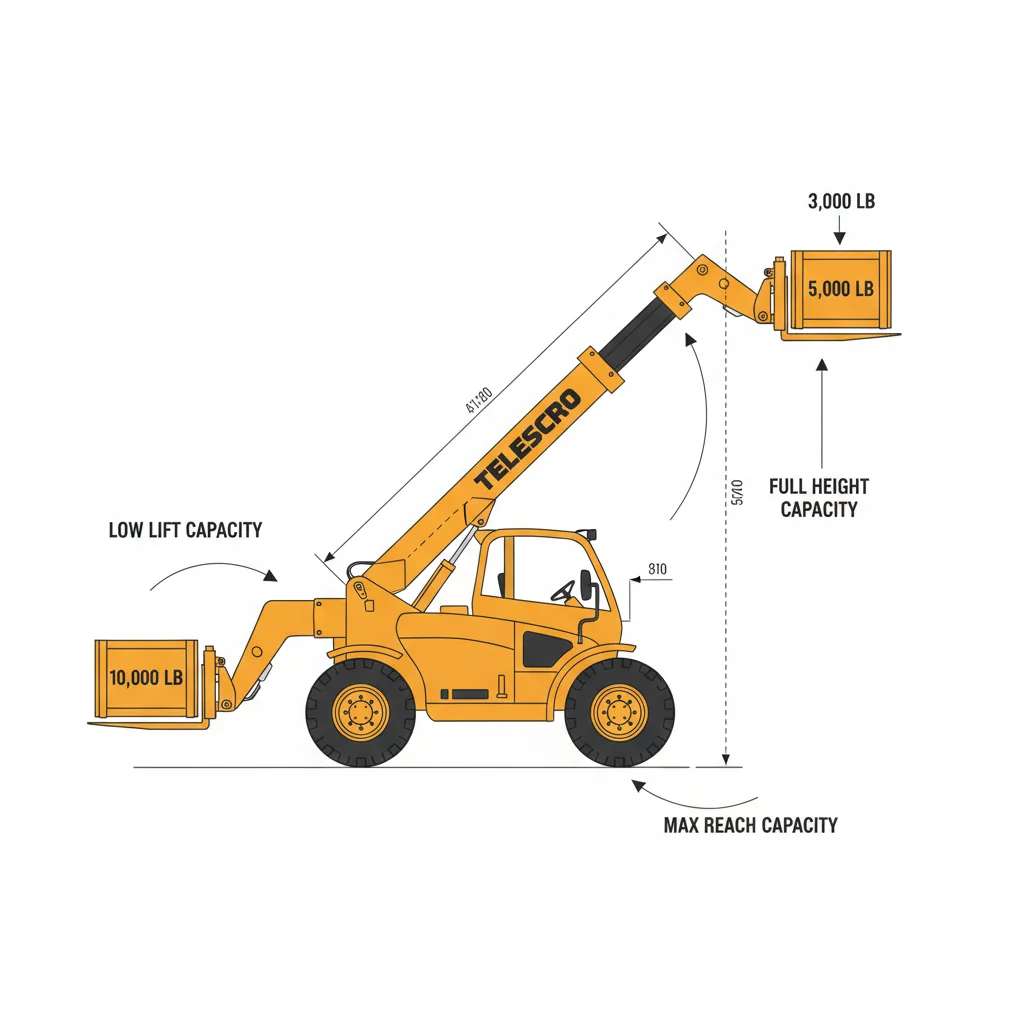
I’ve worked with customers who made the mistake of only checking the rated capacity on paper—then struggled on the jobsite when the real numbers dropped. One project in Kazakhstan comes to mind. The team ordered a 10,000 lb telehandler, assuming it could safely lift their 4,500 kg pipe bundles all the way up to the upper floors. But when they extended the boom to full height—about 16 meters—the load chart showed safe capacity had fallen to just over 2,200 kg. They ended up renting an extra crane for the biggest lifts. That kind of oversight slows down projects and adds unnecessary costs.
Here’s the thing: every time you raise the boom or extend it outwards, the leverage against the machine increases. This isn’t just theory—it’s basic physics. A 4.5-ton telehandler might lift its full rated load only when the boom is low and pulled in close to the cab. As soon as you lift higher, or reach forward over a truck or scaffold, the load chart (usually posted in the cab) will show a steep drop. In real jobsites from Kenya to Brazil, I see compact 5,500 lb (2.5 ton) machines drop to just 900 kg at maximum reach. That’s not a small change.
I always recommend: choose your telehandler based on the heaviest load you’ll need to move at your maximum working height and reach—not just the headline number. Allow at least 20% extra in capacity to avoid buzzer alarms and risky lifts. Double-check those load chart figures with your supplier before you commit.
A telehandler’s load capacity typically decreases as the boom is raised to greater heights or extended outward.True
This is due to the changing leverage and stability factors as the load moves farther from the machine’s center of gravity, which is why load charts show reduced capacities at higher boom positions.
A telehandler can safely lift its maximum rated load to any height within its maximum reach.False
Maximum rated load is only achievable at the optimal boom angle and retracted position; as the boom is raised or extended, structural and stability limits require a reduction in allowable load weight.
Key takeaway: Telehandler rated capacity drops significantly as the boom is raised or extended forward. Choosing equipment based solely on maximum capacity can be misleading; check the load chart for required height and reach, and always allow for a safety margin above anticipated loads.
How Does Telehandler Height Impact Costs?
Increasing telehandler maximum lift height generally results in higher acquisition and operating costs. As machines move into higher reach classes, overall weight, boom complexity, and chassis size increase, which in turn drives up purchase price, transport requirements, and rental rates. Taller models are more likely to require specialized transport, face higher insurance costs, and trigger stricter operator training or site controls—particularly in the high-reach categories. For many fleets, these cost increases outweigh the benefits unless the additional height is used regularly.
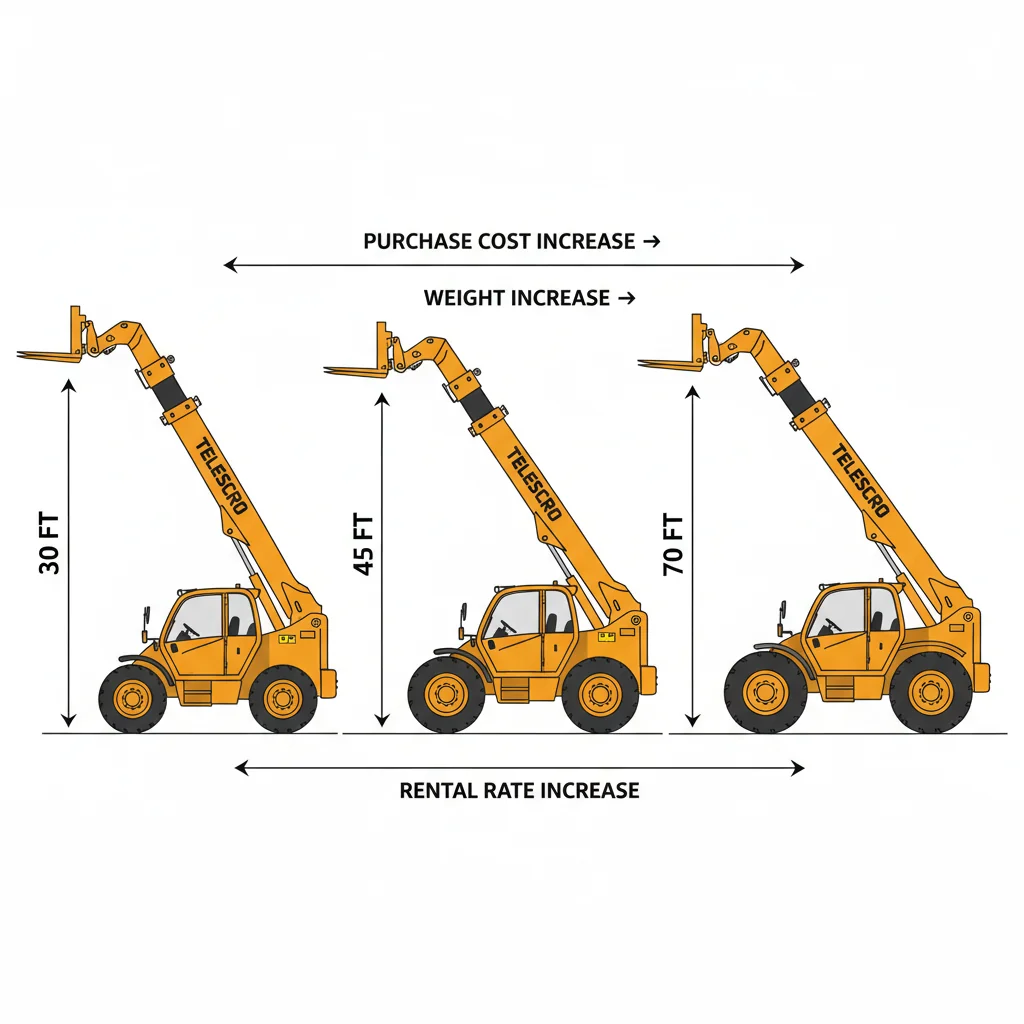
To be honest, a lot of buyers ask for the tallest boom in the catalog without realizing what comes along with extra height. The step from a 9-meter to a 14-meter telehandler isn’t just about adding one boom section. Taller models get heavier—sometimes by 1.5 to 2 tons. That means you’re now arranging permits and sometimes specialized low-boy trailers just to get the machine to site. In Kazakhstan, I worked with a contractor who moved into the 22-meter class. Their transport cost almost doubled overnight, and site access became a headache on tight city streets.
Rental rates and insurance climb steeply, too. In Dubai, I helped a fleet manager compare costs between a 13-meter and a 21-meter unit. Going from mainstream (around 13–17 meters) to high-reach models jumped their rental rates by 30–40%. Insurance providers asked for stricter operator certification—especially on anything above 20 meters. If you’re fetching a tall machine for one-off multi-story lifts, that can turn your budget sideways fast.
My advice? Most jobs—around 90% in my experience—fit within the 12–17 meter class, which is also where you see the best supply and fastest parts turnaround. If you only hit those big heights a few times per year, it usually makes more sense to buy a 13- or 15-meter model and just rent the 21-meter or rotating telehandler when you need it. That avoids tying up capital in oversized equipment and keeps your logistics practical. For most fleets, simpler really does mean cheaper—on paper and when the bills arrive.
The maximum height a telehandler can reach is often limited by road transport regulations, not just by engineering capability.True
Beyond a certain boom height, the overall machine size and weight trigger stricter transport requirements, which can make moving taller telehandlers cost-prohibitive even if technically feasible.
Most telehandlers can easily achieve maximum heights over 30 meters without significant increases in transport complexity or cost.False
Telehandlers designed for extreme heights require heavier frames and counterweights, quickly surpassing standard transport allowances; moving these machines often demands special trailers, escorts, and permits, which multiply logistics challenges and expenses.
Key takeaway: Moving into higher telehandler height classes significantly raises both upfront and ongoing costs. For operations only occasionally needing over 60 ft, owning a mainstream 40–55 ft model while renting high-reach units as required optimizes capital use, simplifies logistics, and controls fleet complexity.
What affects telehandler stability at max height?
Telehandler stability at maximum lift height is affected by factors such as ground slope, tire condition, boom deflection5, and environmental conditions. Operation on uneven or sloping ground, as well as exposure to wind—particularly when handling large or wind-sensitive loads—can materially reduce stability and allowable rated capacity. Longer multi-section booms also introduce additional wear points, making regular inspection and maintenance essential. Always follow the manufacturer’s load chart and operating instructions; experience-based judgment must never override documented stability limits.
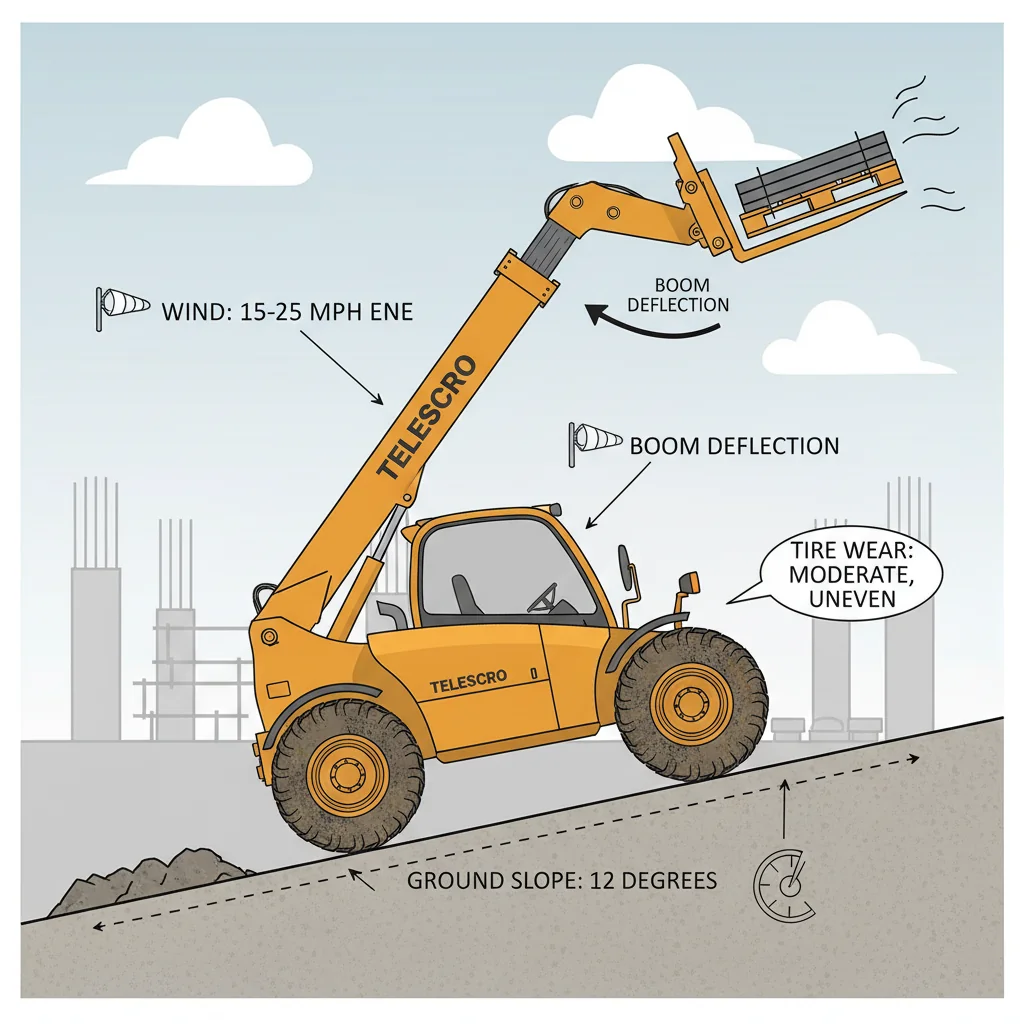
Last month, a contractor in Dubai asked me why their 20-meter telehandler felt unstable even though the load was well under the rated capacity. Their team was operating on a slight slope, with a pallet of drywall at maximum height. What many forget is that all load charts—no matter the brand—assume the machine is perfectly level. Even a three-degree side slope can slash your safe rated capacity, especially above 15 meters. When you’re working at 21 meters, wind is another silent threat. On an open jobsite, I’ve seen moderate winds—just 20 mph—push a load of panels hard enough to sway the entire chassis. That’s risky and outside stated capacity.
Tire condition makes a bigger difference than most buyers expect. One customer in South Africa loaded a high-reach unit with partly worn rear tires. The machine met all the specs on paper, but it rocked badly at 18 meters because the worn rubber allowed more sidewall flex. Inspections found small cracks on a boom wear pad—minor, but on a long multi-section boom, this multiplies over time. High-reach machines need more frequent lubrication and pad checks, or you risk a gradual loss of stability—what I call the “second-year surprise.”
I always advise operators: don’t ever rely on “yesterday’s success.” Every day means different ground, wind, or wear. Before lifting at height, verify ground level and tire pressure, use frame leveling or stabilizers, and treat the load chart as your absolute rulebook. Following these steps protects your machine—and your crew.
A telehandler's maximum safe height can be substantially reduced if it is operated on a slight side slope, even when the load is under the rated capacity.True
Telehandler load charts assume level ground; even a minor tilt can shift the machine’s center of gravity, reducing stability and the effective maximum height for safe lifting.
Wind speed has no significant effect on telehandler stability when lifting loads to maximum height as long as the load is within the weight limit.False
At elevated heights, wind pressure on the boom and load can create lateral forces, increasing the risk of instability or tipping, regardless of whether the load is within the stated capacity.
Key takeaway: At 40–70 ft (12–21 m) heights, small factors like ground level, wind, and boom wear critically affect telehandler safety. Only the manufacturer’s load chart determines safe operating limits—generic rules are unsafe. Higher units need more inspection, and operators must strictly follow specifications and wind limits.
When Are High-Reach and Rotating Telehandlers Needed?
High-reach (70 ft/21 m) and rotating telehandlers suit specialized tasks such as tall industrial buildings, multi-storey steel erection, and placing materials where crane rental would be costly or inflexible. These machines offer increased height, 360° rotation, and crane-like attachments, but require higher investment, additional training, and careful evaluation of job frequency.
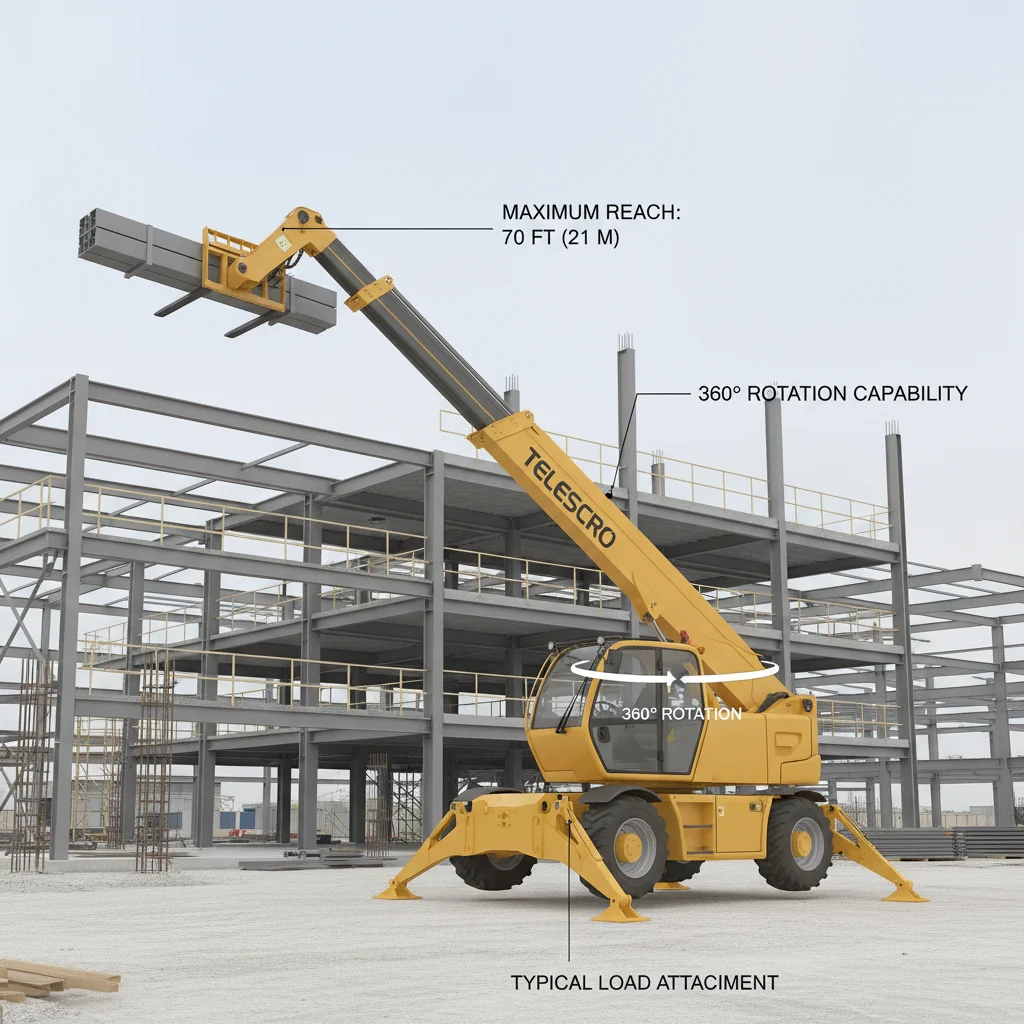
Some projects simply can’t be done with standard telehandlers—especially those involving tall structures or jobsites with awkward access. High-reach telehandlers, in the 21-meter (about 70-foot) class, come into play when you need to lift heavy loads to the fourth or fifth floor, or set roofing panels where a crane can’t get close. I worked with a contractor in Kazakhstan who had steel beams to install at 20 meters. Renting a small crane wasn’t an option—the site was too tight and setup took half a day. Their solution was a high-reach unit with stabilizers, rated for nearly 6,000 kilograms at mid-boom and around 2,000 kg at maximum extension. They finished the beam work a week ahead of schedule.
Rotating telehandlers—sometimes called “ROTOs”—are even more specialized. These models can lift up to roughly 35 meters and have a 360-degree rotating upper carriage. That means you can lift, extend over obstacles, and swing a payload into position without repositioning the entire machine. I’ve seen this make a huge difference in congested European city sites. One customer in France replaced both a small crane and a standard telehandler with a single rotating unit for installing HVAC on the sixth floor, placing loads through narrow gaps between existing structures. The boom plus winch attachment gave them just enough flexibility, and cuts their equipment rental bill by at least 20%.
I always advise weighing cost, training investment, and how often you really need these capabilities. For most contractors, renting is smarter unless you’re constantly working on high-rise or specialist projects. Check your load chart and reach requirements carefully—don’t overspend for occasional needs.
Rotating telehandlers are often chosen over cranes on tight jobsites because they can lift loads to high elevations while requiring much less space for operation and setup.True
Rotating telehandlers have a compact footprint and full 360-degree rotation, allowing them to operate effectively in confined areas where cranes may have trouble with access, stability, or extensive setup requirements.
Standard telehandlers are capable of reaching the same maximum heights as high-reach telehandlers, making them equally suitable for tasks on five-story buildings.False
Standard telehandlers typically have much lower lift heights than high-reach models. High-reach units are purpose-built for applications requiring vertical access beyond the capability of conventional telehandlers, such as servicing multi-story structures.
Key takeaway: High-reach and rotating telehandlers are niche solutions for jobs requiring extra vertical reach, precise material placement over obstacles, or combined lifting/material handling. For most general contractors, their value is in occasional, rental-based use—dedicated ownership is justified only for recurring tall-structure projects or specialist contracts.
What Telehandler Height Is Best for Farms?
Most agricultural telehandler tasks are efficiently handled by machines with 6–9 m maximum lift height, matching typical bale stacking and loading needs. Higher lift heights (13–14 m) are only justified for farms with frequent high stacking or silo work. Compact 4–6 m models provide significant maneuverability and reach improvements over tractor-loaders for tight farmyards.
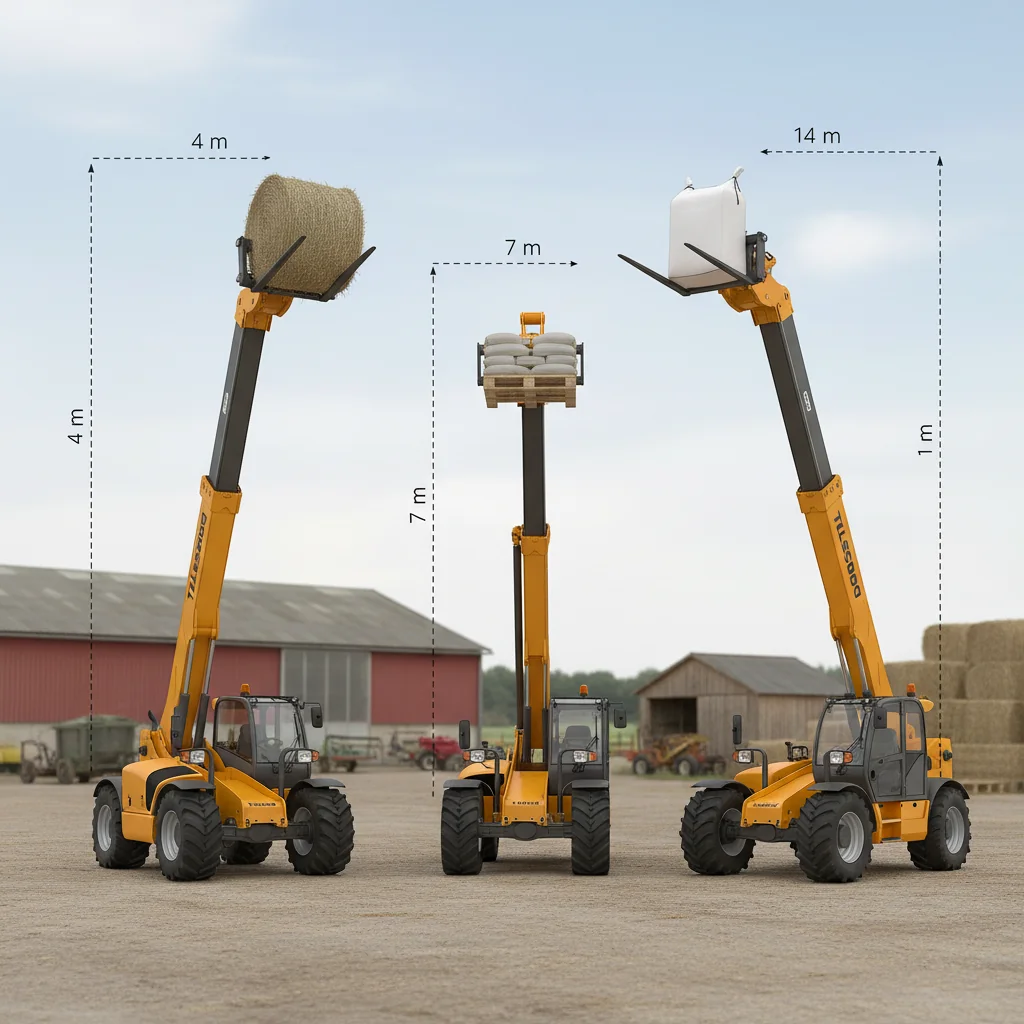
One thing I notice on farm visits is a tendency to chase “bigger is better” with telehandler specs. In reality, for most agricultural jobs—stacking big square bales, working inside sheds, loading grain into typical trailers—a machine with 6 to 9 meters of maximum lift height is more than enough. I’ve seen a farm in Poland regret buying a 13-meter model: their tallest bale stack was just over 7 meters, so all that extra boom simply made the machine heavier and tougher to maneuver in old cow yards. The operator ended up leaving the boom retracted 90% of the time. It also cost them extra in delivery and left less room in the yard for trucks to move.
Compact 4 to 6-meter telehandlers are catching on with smaller dairy and poultry farms, especially where turning space is tight. Compared to classic tractor-loaders, you get much better visibility, reach, and stability on muddy ground. One customer in New Zealand replaced two tractors with a 5.7-meter telehandler and told me it cut his daily bale-handling time by nearly half—mainly because the turning radius is under 4 meters and the low profile lets him duck straight into old barns.
Here’s what matters most when picking telehandler height for a farm: measure your tallest stack or required reach, then add roughly a meter. This gives you enough margin for sloping ground or uneven bale piles, without overspending on oversized machines. I always suggest checking the rated capacity at your main working height, not just full retraction—this avoids “showroom hero, jobsite zero” regrets.
Selecting a telehandler with a maximum lift height in the 6 to 9 meter range is usually sufficient for most farming operations, and opting for a taller machine often results in unnecessary added size and weight that can make handling more difficult in tight farm environments.True
Most agricultural applications, like stacking hay or loading trailers, rarely require lift heights above 9 meters. Machines with taller booms tend to have larger footprints and increased weight, decreasing maneuverability in farmyards or older sheds.
Telehandlers with higher maximum lift heights always provide greater lifting capacity, making them more suitable for heavy farm jobs.False
In reality, as the lift height increases, telehandlers often have lower maximum lifting capacity at full reach due to stability and leverage limitations. Bigger models don’t necessarily mean more lifting power, especially at their highest extension.
Key takeaway: For most farms, a telehandler with 6–9 m lift height offers the ideal balance of reach, capacity, and maneuverability. Measuring the tallest stacking requirement and selecting the smallest machine that exceeds this by about 1 m ensures optimal productivity without unnecessary cost, weight, or complexity.
When Is a Boom Lift Better Than a Telehandler?
Boom lifts (MEWPs) are often the safer and more appropriate choice for frequent or task-critical personnel access at height—particularly where regular work is required above roughly 40–50 ft (12–15 m). Telehandlers are primarily designed for material handling; using them to lift people is only permitted under specific conditions, such as with an OEM-approved work platform and full compliance with applicable standards and manufacturer instructions. In many markets, dedicated boom lifts certified to standards such as EN 2806 (Europe) or ANSI A92 (North America) are the preferred and legally clearer solution for planned personnel elevation, whereas telehandlers with platforms are generally limited to restricted or occasional use as defined by local regulations and OEM guidance.
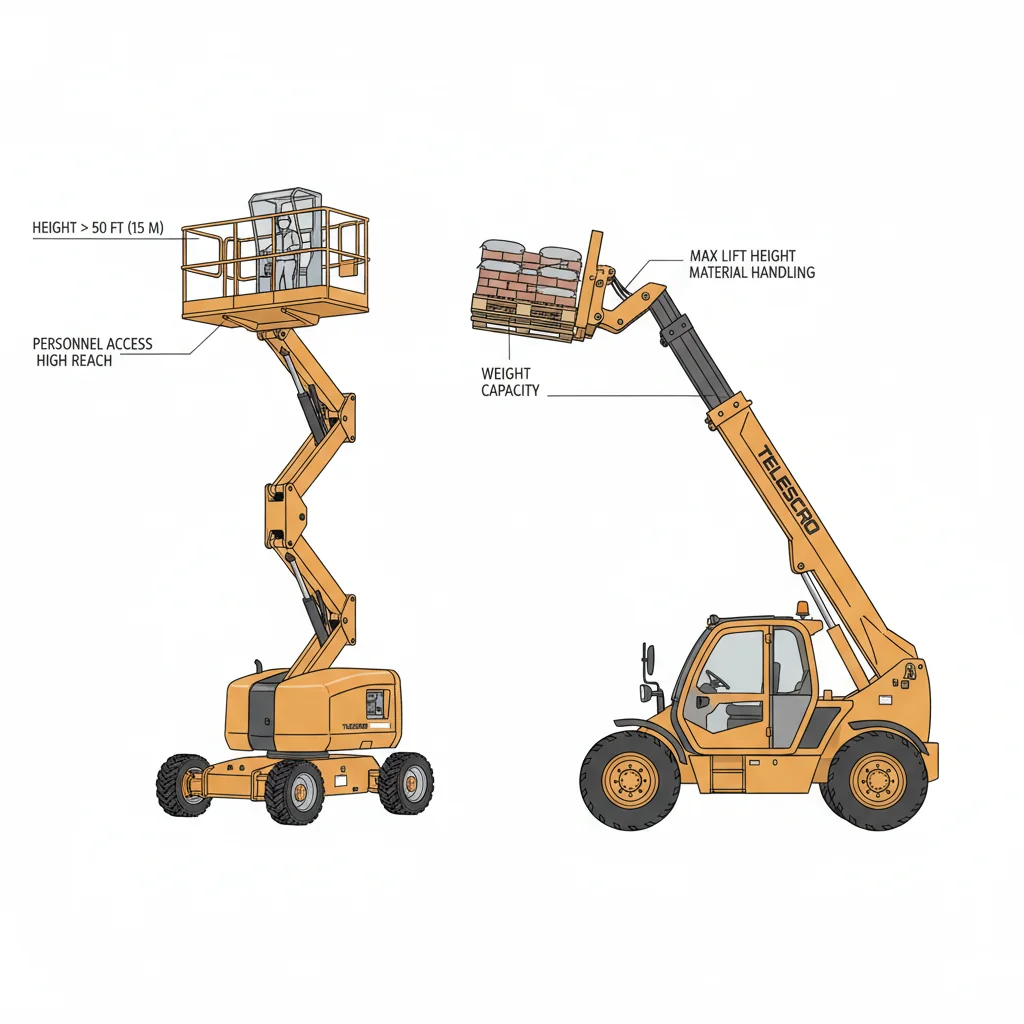
From my experience, the biggest safety headaches happen when people try to use a telehandler with a work platform instead of a proper boom lift. Technically, some telehandlers can reach 16 or even 18 meters. That doesn’t mean they’re approved for regular personnel lifting. In China, I’ve seen contractors modify baskets to save costs, only to lose days to a compliance check—local inspectors flagged the machine for missing overload protection and proper interlocks. It’s not just about the height; standards like EN 280 or ANSI require the right electronic and hydraulic safeguards if you plan to lift people, especially above 12–15 meters.
A jobsite in Dubai comes to mind. The team needed to access lighting for a warehouse expansion at nearly 17 meters. They had a high-reach telehandler on site. It could physically lift their man basket, but there was no moment indicator for personnel, no dedicated emergency lowering system. The client ended up renting a self-propelled boom lift for the workers. Why? The boom lift offered steadier controls and ticked every box for local legal requirements. It also allowed two operators to work continuously overhead while the telehandler stayed focused on material runs. Productivity actually improved.
My key advice: always separate your “material height” from your “people height” during planning. Don’t try to make one machine legally do both. Most sites across the Middle East and Europe now expect a dedicated MEWP for any frequent personnel elevation above 12–15 meters. I suggest checking your safety requirements early—renting both is often cheaper than failing a safety audit or pausing the job.
Most modern telehandlers can reach heights of up to 18 meters, but this doesn't mean they're designed or certified for lifting personnel to those heights.True
Telehandlers are primarily built for material handling, and while they may mechanically extend to 16–18 meters, using them with work platforms at those heights often violates safety standards because of missing features specific to boom lifts, such as automatic overload interlocks and full fall protection systems.
Telehandlers and boom lifts are generally interchangeable for any high-access job, as both can safely lift people to the same maximum height.False
Despite similar reach in some models, telehandlers and boom lifts are engineered for different functions. Boom lifts are specifically designed to safely elevate personnel and are equipped with critical safety devices and certifications that most telehandlers lack, making them far from interchangeable for personnel access tasks.
Key takeaway: Use telehandlers for material handling to upper levels, but select a self-propelled boom lift for regular personnel elevation above 12–15 m. Always separate ‘material height’ from ‘people height’ in project planning to ensure legal compliance and best safety practices.
Conclusion
We’ve looked at how telehandler max height impacts real jobsite use, especially why most applications call for models in the 12–17 meter range. Taller machines do have their place, but they’re rarely an everyday fleet item for most teams.
From my experience, it’s easy to get caught up aiming for the tallest model, but it’s smarter to focus on the boom’s capacity at typical working heights—and don’t forget to check how quickly you can get spare parts. The biggest spec can become a “showroom hero, jobsite zero” if it’s not practical for your site.
If you’re weighing options or have questions about specific models, reach out. I’m happy to help find what fits your real-world needs. Every site has its own best solution.
References
-
Explains ideal lift heights for various farm tasks, helping farmers choose machines matched to their operational needs and yard conditions. ↩
-
Explores why the brochure’s maximum lift height often overestimates real-world usable height due to attachments and jobsite factors. ↩
-
Provides expert explanation on interpreting load charts, crucial for safe telehandler operation under varying boom angles and outreach. ↩
-
Provide a detailed explanation of how rated load capacity decreases as lift height and reach increase, including real-world jobsite examples and load chart illustrations to support accurate safety assessments. ↩
-
Explains the effects of boom deflection on machine wear and load sway, helping operators maintain equipment integrity and safety. ↩
-
Detailed insights into EN 280 standards explaining safety, design, and operational requirements for elevated work platforms compliance. ↩