










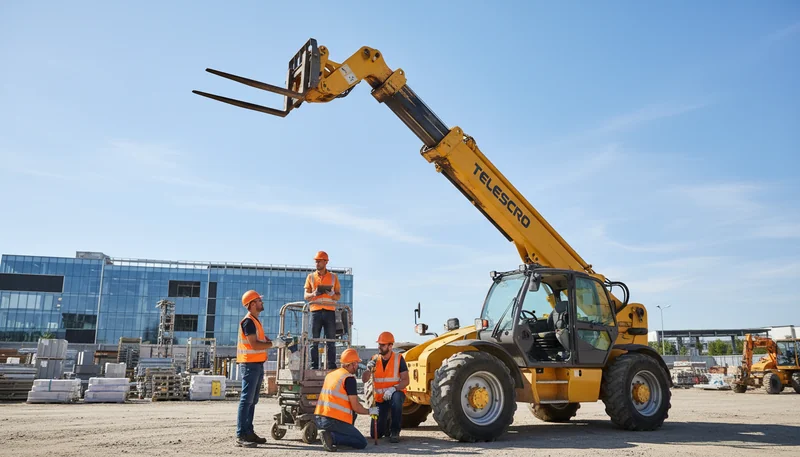
Telehandler Maintenance: What Most Buyers Miss About Upkeep & Pitfalls
Not long ago, I got a photo from a customer in Poland: his brand-new telehandler sidelined less than six weeks in, all because a clogged radiator and skipped daily greasing led to hydraulic trouble. He asked what so many do—is telehandler maintenance really that tricky, or is something else going on?
Telehandler maintenance is defined by frequent, routine checks rather than technical complexity. These machines integrate a diesel engine, standard hydraulic systems, and telescopic booms, using familiar mechanical components like wear pads, hoses, and pins. The primary challenge lies in the sheer number of daily wear points—particularly along the boom and in high-use pivot joints. Neglected intervals result in compounded issues such as hydraulic leaks1, excessive boom play, and excessive boom play, and erratic boom function or control response.
Are Telehandlers Difficult to Maintain?
Telehandlers are not fundamentally complex to maintain but are maintenance-intensive. Their systems—diesel engines, hydraulics, and telescopic booms—are familiar to equipment mechanics. Most upkeep involves routine oil changes, greasing, and inspections. The real challenge is schedule discipline; skipped services lead to compounded wear and downtime.

Most people assume telehandlers are hard to maintain just because they look complex on site, but that’s not really the case. I’ve worked with fleet managers in Dubai and rural contractors in Eastern Europe—almost all of them manage routine servicing with standard mechanical skills. The real trick is sticking to a schedule. You’re dealing with a diesel engine, a hydraulic circuit with hoses and cylinders, and a telescopic boom that slides on wear pads with chains and rollers. If you’ve maintained a farm tractor or wheel loader, the process will feel familiar—greasing, oil changes, checking fluid levels, and inspecting chains or bushes.
Here’s where it gets challenging: telehandlers have many moving parts exposed to dirt and heavy lifting, especially around the boom and hydraulic system. I remember a client in Kenya who ran a 4-ton, 13-meter machine doing brickwork. They skipped two scheduled greasing intervals. After six weeks, the boom pads showed accelerated wear, and hose leaks started cropping up—suddenly they lost a whole week to downtime. Skipping one oil change or missing boom chain checks doesn’t cause immediate disaster, but those small problems build up fast.
Technical work isn’t the biggest hurdle—discipline is. Each fluid has its own schedule: most engine oil changes at 500 hours, but hydraulic oil and filters can reach 1,000 hours or more. The moment you lose track of intervals or skip daily checks, you’re risking bigger repairs down the road. I suggest keeping a simple service log and following your OEM intervals closely. Routine discipline is your real insurance against unexpected stoppages.
Maintaining a telehandler's hydraulic system usually requires the same diagnostic tools and fluid management practices as most agricultural or construction tractors.True
Telehandlers and tractors both rely on common hydraulic components like pumps, hoses, cylinders, and control valves. Standard mechanical skills and commonly available tools are sufficient for routine maintenance, making telehandler upkeep approachable for technicians familiar with other heavy equipment.
Telehandlers require proprietary electronic diagnostic tools for all routine maintenance tasks.False
While some newer telehandlers may feature electronic control modules, the vast majority of routine maintenance tasks—such as oil changes, filter replacements, and hydraulic system checks—do not require specialized proprietary diagnostic equipment. Manual inspections and standard tools remain sufficient for most servicing.
Key takeaway: Telehandlers require frequent inspections and routine maintenance, but the technical work aligns with standard diesel and hydraulic systems. Maintenance success depends far more on consistent schedules and proper record-keeping than on unusually advanced skills—making adherence to interval and inspection discipline essential.
What Daily Checks Do Telehandlers Need?
Essential daily telehandler checks include engine oil, coolant, hydraulic oil levels2, inspection for leaks, tire condition and pressure3, fork or attachment lock security, braking and steering response, lights, alarms, and warning indicators. Lubrication needs vary by model and duty cycle, but boom sections, pivot points, and grease nipples often require frequent attention (commonly daily or per shift in harsh conditions); always follow the manufacturer’s lubrication chart to set the correct greasing interval for your machine.

The biggest mistake I see is treating daily inspections as a formality, instead of real jobsite protection. In my first year working with a highway contractor outside Dubai, their team skipped morning checks on a 3.5-ton, 13-meter telehandler to save time. By noon, a hydraulic hose split under pressure—oil everywhere, lost half a shift, and paid extra for a night repair. Since then, I always stress the “5-minute walk-around.” It’s not about paperwork. It’s about catching the small things—low engine oil, coolant under minimum, soft tires, loose fork pins—before they cost you thousands. Here’s what matters most when you build your daily routine. Start with fluid levels: check engine oil, coolant, and the hydraulic tank sight glass. Look for leaks along cylinders and hoses—anything wet or dripping is a warning. I’ve seen operators in Indonesia spot a slow leak at the steering cylinder in time to fix it with a standard seal kit, instead of a full replacement. Don’t forget tire checks. Many telehandlers carry nearly 8,000 kg when loaded, so low pressure means extra sidewall stress and higher risk of blowout. Greasing boom sections, pivots, and all grease nipples takes less than ten minutes—stick to every eight operating hours or once per shift in heavy use. Lights, reverse alarms, warning displays—test them every time. On one site in Kazakhstan, a customer’s moment indicator kept flashing red. The load was fine, but the sensor connector was loose. Quick fix, zero downtime.
"WaterFalse
"Hydraulic
Checking the telehandler’s tire pressure daily is unnecessary because most construction tires are designed to tolerate substantial pressure fluctuations without performance loss.False
Telehandler tires operate under high loads and low pressures; even small deviations can reduce stability, steering control, and lifespan, making daily pressure checks essential for safety and reliable performance.
Key takeaway: Consistent daily walk-arounds and greasing are vital for telehandler safety, reliability, and regulatory compliance. Missing these simple checks often leads to expensive repairs and operational hazards. Build daily inspection routines using a checklist to prevent avoidable downtime and protect both operators and equipment.
Do Hydraulics Increase Telehandler Maintenance Complexity?
Hydraulic systems are the most sensitive and heavily used aspect of telehandler maintenance. They commonly present issues such as boom hose leaks, jerky movements, cylinder wear, and oil contamination. Proper upkeep—including OEM oil intervals, filter changes, and quality components—prevents costly failures and should be treated as a standard, ongoing operating cost.
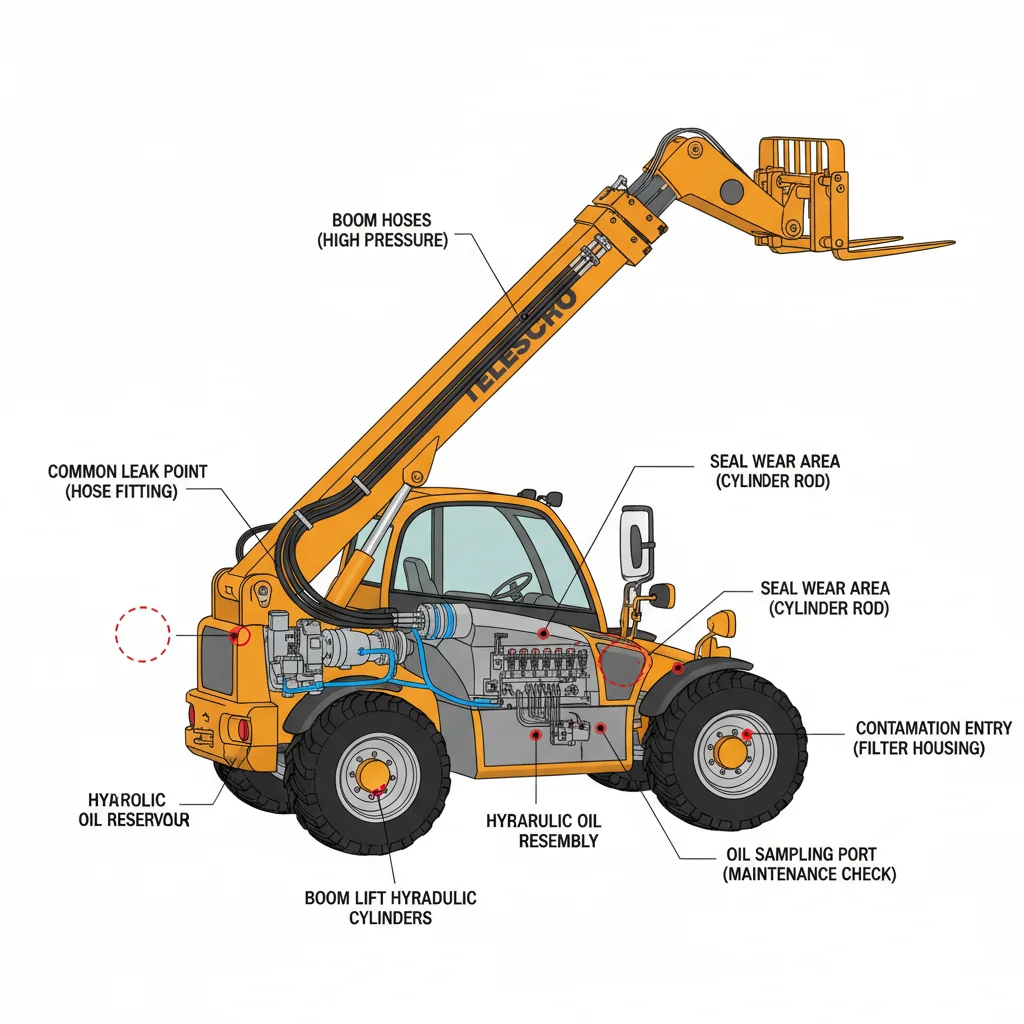
Let me share something important about telehandler hydraulics—they aren’t as mysterious as many buyers expect, but they do set the rhythm for your maintenance budget. On every jobsite I visit, hydraulic systems are the first thing operators ask about. Leaks along boom hoses, slow or jumpy boom control, and the occasional “spongy” feeling at the joystick—all of these usually trace back to hydraulic basics. For example, last year in Dubai, I saw a 4-ton machine with over 7,000 hours on it lose a full day’s production because a $30 hose blew during a high-pressure cycle. Their mistake? They stretched oil change intervals and used bargain filters—wear and sludge built up, and eventually a weak hose popped.
For many mid-size telehandlers, hydraulic oil change intervals typically fall in the 500–1,000 hour range, with filters replaced at the same time or earlier under severe duty cycles. In dusty or abrasive environments—such as brick and block production sites—filter service intervals are often shortened to protect pumps and control valves. Always follow the OEM maintenance schedule rather than a generic hour figure, as oil type, system volume, and cooling design vary by brand and model.
Over time, wear at the telescopic boom is unavoidable. Hose abrasion along boom sections and gradual seal leakage at cylinders commonly begin to appear as machines accumulate several thousand hours, especially if OEM service intervals5 are stretched or skipped. To reduce downtime, it is practical to keep common seal kits and a small selection of high-wear boom hoses in stock. Several fleets I’ve supported in Kenya and Brazil avoided multi-day stoppages simply by having these consumables on hand when parts lead times were long.
Don’t see hydraulics as a headache. Compared to engines or electronics, hydraulic maintenance is predictable—if oil stays clean and pressure is checked when performance drops, major failures are rare. Treat hydraulic service as a normal expense, not an emergency.
Regular inspection and replacement of telehandler hydraulic filters can help prevent boom control issues like jerky or slow operation.True
Hydraulic filters trap contaminants that would otherwise cause wear or clog passages in valves and cylinders. Neglected filters can lead to dirty oil, resulting in erratic or delayed boom movement. This is a practical but sometimes overlooked maintenance task that directly impacts hydraulic performance.
Hydraulics make telehandler maintenance so complex that only certified hydraulic specialists can perform routine servicing.False
While hydraulic systems do require knowledge and attention, most routine tasks such as checking for leaks, inspecting hoses, and changing filters can be performed by trained operators or general mechanics. Only advanced repairs or troubleshooting require specialized expertise.
Key takeaway: Hydraulic maintenance is a critical, predictable expense in telehandler ownership. Regular attention to oil quality, OEM service intervals, and common wear points on boom hydraulic lines reduces unexpected downtime and premature failure, ensuring long-term reliability for all duty cycles and operating environments.
What Wear Appears After 3,000 Operating Hours?
Between roughly 3,000 and 6,000 operating hours, many telehandlers begin to show predictable, age-related wear. Common findings include minor hydraulic hose seepage6, increased clearance at boom wear pads, looseness in steering joints, axle pin wear, intermittent switch or joystick faults, and—on newer emissions-compliant machines—early exhaust or DPF warnings. When routine maintenance is stretched or missed, these symptoms tend to appear earlier and become more pronounced as machines approach 8,000 hours, often leading to more involved and costly repairs.
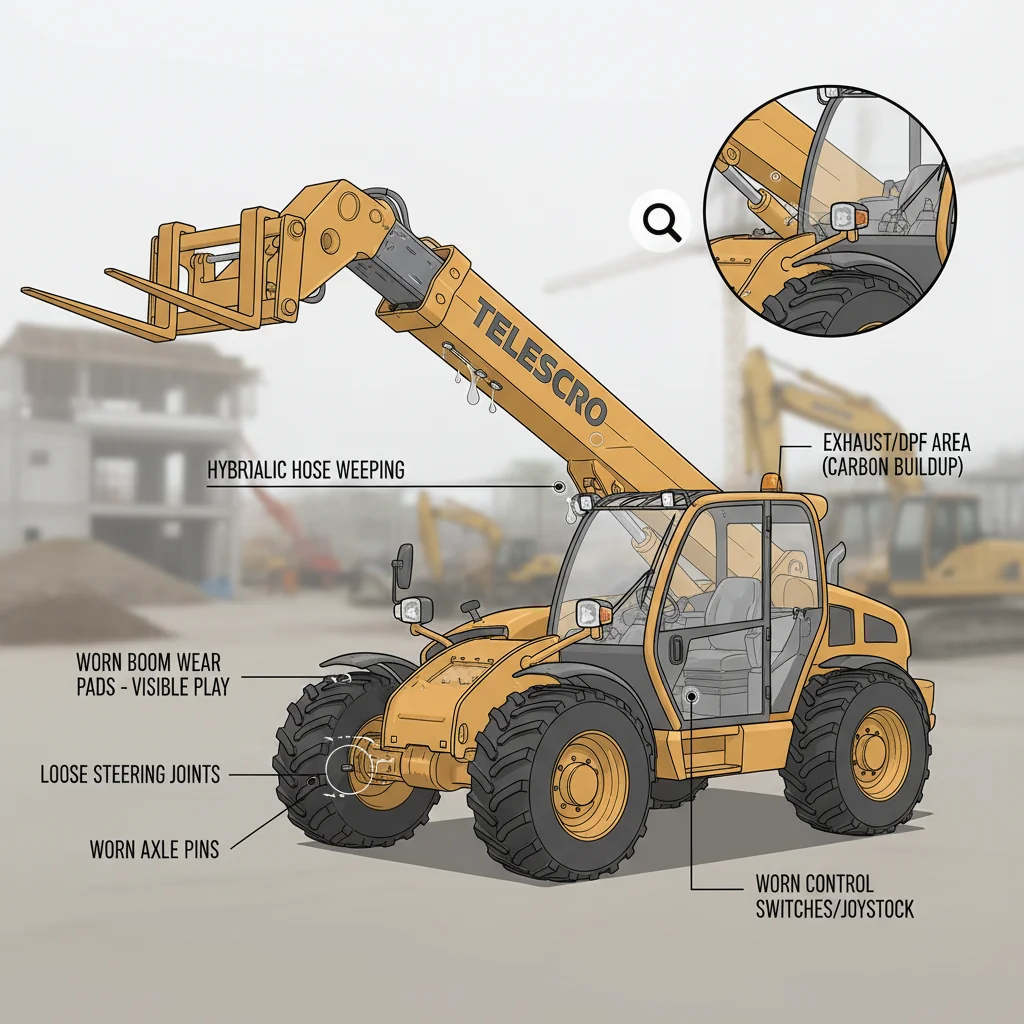
If you’re shopping a used telehandler with 3,000–6,000 hours, you’re probably wondering—what’s normal wear, and what’s a warning sign? I’ve seen dozens of these machines come through workshops in Dubai and Brazil, and certain patterns appear again and again. By this stage, expect to find some weeping hydraulic hoses along the boom, plus minor leaks around cylinder seals. These aren’t catastrophic, but they’re signs the hoses and seals are approaching mid-life. Even a basic visual check often reveals shiny oil on the boom or puddles under connection points.
Something buyers often overlook is boom wear pad play. I worked with a contractor in Kazakhstan who picked up a high-reach telehandler last year—rated for 16 meters, 4 tons. It looked fine, but there was almost 10 mm of side-to-side boom slop when we tested it fully extended. That’s a big red flag, because setting boom pads “tight but smooth” isn’t a quick job. Even for experienced techs, pad replacement and boom shimming can take most of a day. If there’s too much play, plan for significant downtime.
Other signs start small but get worse if maintenance has been skipped. Loose steering joints, axle pin wear, and electrical glitches—like intermittent joystick signals or warning lights—often show up around 4,000 hours. On newer engines, don’t ignore any DPF or exhaust warning codes. Neglecting these usually turns a minor service into a major repair by 8,000 hours.
I always suggest running the boom in and out under load, listening for clicks or pops, and checking for warning lights. Spending an hour on inspection can save you from surprise repairs that quickly add up.
Around 3,000 operating hours, it's common to see some slack developing in the telehandler’s boom wear pads, which can cause minor lateral movement but is usually not a sign of serious damage.True
Boom wear pads are designed to gradually wear and take up play; at this age, visible slack is expected but typically correctable with replacement, rather than indicative of major structural issues.
By 3,000 operating hours, the transmission of a telehandler almost always requires a complete rebuild, even with regular maintenance.False
With proper maintenance, telehandler transmissions typically last well beyond 3,000 hours; a complete rebuild at this interval is not standard and usually only necessary if the unit has suffered unusual abuse or poor servicing.
Key takeaway: Expect routine wear such as hydraulic leaks, boom pad play, and electrical issues from 3,000–6,000 hours, worsening if maintenance was neglected. Always inspect boom play, hydraulic condition, and electrical systems on used telehandlers to avoid costly, compounded repairs from hidden age-related wear.
Do Stage V telehandlers complicate maintenance?
Stage V and Tier 4 Final telehandlers introduce electronic engine management, DPF regeneration7, EGR, SCR (AdBlue/DEF), and sensors integrated with ECUs and CAN-bus wiring. While basic upkeep remains straightforward, diagnosing faults in these systems often requires OEM-specific diagnostic tools8 and dealer support, not just hand tools.

Here’s what matters most when working with Stage V or Tier 4 Final telehandlers: the basics—engine oil, hydraulic filters, visible hoses—still don’t require special skills. But emissions and electronic systems change the game when something goes wrong. On one job in Dubai, a 4-ton telehandler locked itself into “limp mode” after a DPF (diesel particulate filter) sensor tripped. The crew checked wiring and obvious faults, but couldn’t clear the error—a dealer laptop revealed the machine needed a forced regeneration and a new sensor. That’s a full workday lost if you don’t have prompt support.
From my experience in Brazil and Eastern Europe, smaller contractors usually manage daily inspections, battery maintenance, even filter swaps with no problem. Electronic faults are a different story. If the ECU (electronic control unit) or LMI (load moment indicator) throws a code, a simple scanner won’t always help. Often you need manufacturer-specific diagnostics, not just a multimeter or hand tools. Owners tell me it’s frustrating—machines that used to be “fixable in the yard” now require waiting on dealer schedules.
So, what should you plan for? Handle all routine care in-house, especially cleaning, looking for leaks, and topping fluids. For deeper engine or emissions issues—anything involving the DPF, DEF/AdBlue dosing, or wiring on a CAN-bus circuit—check your local dealer’s support before you buy. Ask about their diagnostic tools and how fast they respond to breakdowns. I always suggest lining up this backup, especially if your telehandler is critical for daily production. That’s how you avoid surprise downtime.
Stage V telehandlers often require specialized diagnostic tools to address electronic or emissions-related faults, unlike earlier models which could be serviced with basic mechanical skills.True
This is true because Stage V regulations introduce advanced emissions control systems, such as DPFs and SCR, which integrate with complex electronics. Resolving issues like sensor faults or regeneration failures typically needs OEM diagnostic laptops or software, not just mechanical repairs.
All routine maintenance tasks on Stage V telehandlers, including emissions system checks, can be performed without any training beyond what’s required for older Tier 3 machines.False
This is false because emissions system checks and troubleshooting—especially for faults or warnings—require technicians to understand new components and software tools unique to Stage V, exceeding the knowledge needed for earlier mechanical-only systems.
Key takeaway: Modern telehandlers with advanced emissions and electronic controls increase reliance on dealer diagnostics for engine faults, DPF, or sensor issues. Owners should plan to handle basic upkeep in-house but ensure local dealer support for complex ECU and emissions-related problems.
How Does Worksite Type Affect Telehandler Maintenance?
Worksite environments directly impact telehandler maintenance frequency and service intervals. Dusty or corrosive conditions—such as demolition, quarries, or agricultural sites—require more frequent cleaning and air filter changes9, sometimes shortening intervals by 20–30%. Indoor and sheltered storage reduces daily wear, prolongs hose and component life, and lightens overall maintenance needs.

Last month, a contractor in the UAE called me about persistent overheating on their 4-ton telehandler—just 900 hours old. Their site was a limestone quarry with thick dust swirling all day. Even after following a standard 250-hour inspection, radiators clogged up weeks early. The team had to blow out air filters almost twice as often as a warehouse operator would. When I compared site records, machines working mostly indoors needed filter changes every 500 hours or more, but the ones on dusty jobs required new filters after roughly 350 hours. For worksites with fertilizer and manure, like the farms I’ve visited in Australia, corrosion is the troublemaker. Steel fittings and pins start to pit and seize unless you rinse the boom and undercarriage every week. Fertilizer also cakes behind the boom, so I always suggest checking those wear pads and pins for early abrasion. Here’s a quick comparison of how site conditions drive maintenance schedules: | Worksite Type | Common Hazards | Typical Cleaning Interval | Air Filter Change | Special Checks Needed | |——————–|——————————|————————–|——————-|———————————–| | Quarry/Demolition | Dust, debris | Daily or every shift | 300-400 hrs | Radiator, boom, cooling pack | | Agriculture | Corrosive fluids, chaff | Weekly/after heavy use | 350-450 hrs | Pads, pins, steel corrosion | | Indoor/Warehouse | Dry, clean environment | Weekly | 500+ hrs | Minimal, focus on hoses | | Outdoor Storage | Rain, mud, UV | As needed | 350-450 hrs | Lubrication, rust control | I’ve seen
Telehandlers working in environments with persistent airborne dust, such as quarries, require air filter maintenance and radiator cleaning at much shorter intervals compared to similar machines operating indoors.True
Dusty outdoor environments cause particulate buildup in filters and radiators, restricting airflow and making maintenance more frequent to avoid overheating and engine damage. Indoor settings typically expose equipment to less dust, so standard inspection intervals often suffice.
The type of worksite does not impact the maintenance frequency of core telehandler components like the air filter or cooling system.False
Environmental factors at the worksite—such as dust, debris, and extreme weather—directly influence how quickly filters and cooling systems become clogged. As a result, the maintenance schedule must be adjusted to the conditions, not just the machine’s operation hours.
Key takeaway: Telehandler maintenance needs vary significantly by worksite. Dust, debris, and corrosive materials accelerate wear, demanding shorter cleaning and service intervals. Indoor or covered storage substantially reduces routine upkeep while extending component lifespan. Assess site realities and storage before determining likely maintenance demands.
Why Track Telehandler Service Intervals?
Adhering to manufacturer-recommended service intervals10—typically at 250, 500, and 1,000 hours for oils, filters, and inspections—directly impacts telehandler reliability, lifetime cost, and resale value. Neglecting proper service schedules leads to increased leaks, overheating, electrical failures, and boom wear, especially as machines approach 6,000–8,000 hours of operation.
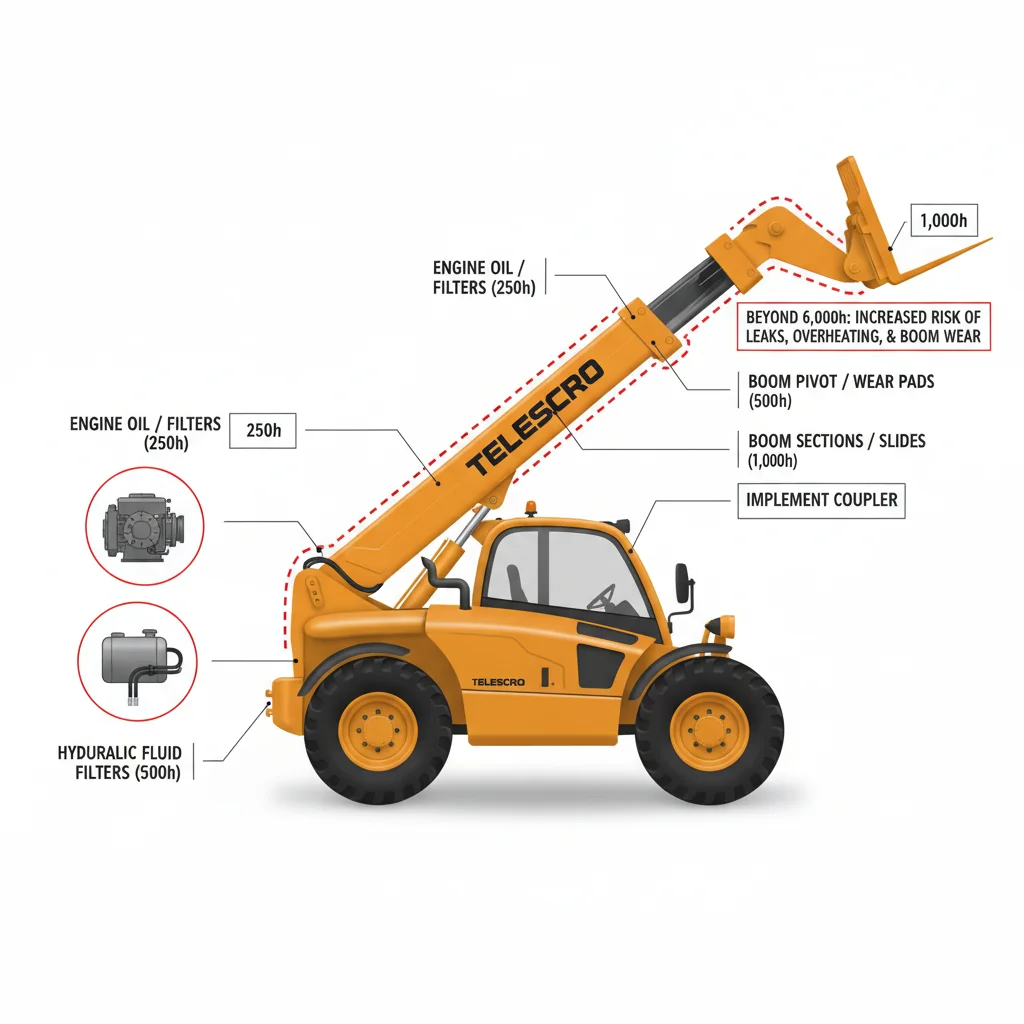
I’ve worked with customers in Kazakhstan and Brazil who learned the hard way—pushing service intervals just to save time almost always costs more in the end. A few years ago, a farm contractor in Kazakhstan ran a 3.5-ton telehandler over 1,200 hours without a proper 500-hour engine oil change. At about 7,000 hours, they started seeing small hydraulic leaks, rising engine temperatures, and even electrical warnings. They ended up replacing both oil seals and portions of the wiring harness—repairs that easily doubled their annual maintenance spend for that machine.
Here’s the thing: manufacturers set intervals—250, 500, and 1,000 hours for oils, filters, inspections—not as suggestions but as minimums based on real-world wear and heat cycles. For an owner running 500 hours a year, planning these services means about $1,000 to $2,000 annually for basic fluids, filters, and routine replacements. Most jobsites can handle this. What really hurts budgets are dealer callouts for unplanned repairs during harvest or a construction rush. Skipping just one service pushes the risk much higher, especially as machines pass 6,000 hours. I’ve seen more boom bushing wear and overheating in units where intervals were stretched, often leading to costly downtime.
Keeping a simple written or digital log—in my experience, just a notebook with date, hours, and work done is enough—makes everything easier. Warranty claims? The log proves proper care. Planning off-peak service? The records let you avoid surprises during busy seasons. I always recommend treating OEM schedules as strict rules, not flexible guides. Over time, the difference shows up in uptime, resale values, and total ownership cost.
Neglecting to track telehandler service intervals can accelerate wear not just in the engine, but also in hydraulic and electrical systems.True
When service intervals are missed, it's not only the engine components that suffer. Poorly maintained oil and filters allow contaminants to circulate, increasing wear in hydraulic cylinders and seals, and electrical warning systems may be triggered by heat and contamination effects.
Telehandlers are designed so that missing scheduled service intervals won't affect their hydraulic systems as long as the engine is running smoothly.False
Hydraulic systems rely on fluid cleanliness and seal integrity, which are directly maintained through regular servicing. Even if the engine runs smoothly, skipped service can lead to contamination and seal failure in hydraulics, eventually causing leaks and costly downtime.
Key takeaway: Strictly following telehandler OEM maintenance intervals minimizes costly unplanned downtime, prolongs machine life, and supports better resale values. Accurate service records allow operators to anticipate work during off-peak periods and are essential for warranty compliance and total cost of ownership (TCO) management.
What Telehandler Maintenance Can Be Done In-House?
Most small contractors and farms can perform 70–80% of telehandler maintenance in-house, including daily checks, greasing, engine and hydraulic oil/filter changes11, air filter replacement, hose swaps, minor boom adjustments, basic electrical work, and tire repairs. More complex repairs—such as ECU diagnostics, LMI calibration, or structural welds—require specialist expertise.

A lot of contractors ask me, “How much real telehandler maintenance can we manage ourselves?” If your workshop already services tractors or excavators, you’re more capable than you think. In Kenya, I worked with a medium-sized farm that cut dealer visits by 70% just by sticking to the basics—no fancy tools, just solid habits and a reliable manual. Most operators can cover their daily and weekly checks without calling in outside help.
For in-house maintenance, your team can safely handle jobs like:
- Checking and topping off hydraulic fluid and engine oil
- Replacing engine and hydraulic filters when the hour meter hits the target (usually 500 for oil, 1,000 or more for hydraulics—always double-check your model’s schedule)
- Swapping out air filters and basic hydraulic hoses
- Inspecting and greasing the boom sections and slide pads (no complicated setups—just a grease gun and torque wrench)
- Minor electrical repairs such as changing fuses or light bulbs
- Basic tire repairs and replacements
Last year in Brazil, a contractor told me their crew swapped two blown hoses and replaced worn boom pads in one afternoon, saving them at least two days of downtime. But some repairs really do require specialists—anything with structural welds, transmission rebuilds, or deep electronic diagnostics isn’t worth the risk. I suggest leaving LMI (load moment indicator) calibration or ECU troubleshooting to the dealer unless you have factory training.
Keep a “telehandler kit” on-hand—spare filters, oil, a few hoses, and pad shims. That way, your workshop stays ready. Know what’s realistic for your skills and leave the advanced jobs for certified techs to protect both your machine and your warranty.
Most telehandler hydraulic hose inspections can be effectively performed in-house by following manufacturer guidelines on visual checks and wear points.True
Routine hydraulic hose inspections primarily involve looking for signs of abrasion, leaks, or cracking, which can be reliably identified by trained staff using standard maintenance procedures and checklists provided in equipment manuals.
Telehandler engine diagnostics always require a manufacturer's proprietary scan tool, making in-house troubleshooting impractical.False
Many telehandler engine faults can be diagnosed using universal OBD tools or by interpreting dashboard error codes, especially for routine issues, which means basic troubleshooting can often be accomplished without specialized, proprietary equipment.
Key takeaway: In-house workshops equipped for tractor or excavator upkeep can handle most telehandler maintenance safely with basic tools and a good manual. Jobs involving structural repairs, advanced electronics, or major drivetrain work should be reserved for specialists, ensuring uptime and controlling dealer costs.
How to Identify Easy-Maintenance Telehandlers?
Selecting an easy-maintenance telehandler depends on design features such as ground-level engine access, wide side hoods, centralized greasing points12, clearly labeled fuse boxes, and accessible hydraulic test ports. Confirm service intervals for each fluid type and prioritize reputable engine and axle brands with strong local parts support to minimize downtime.
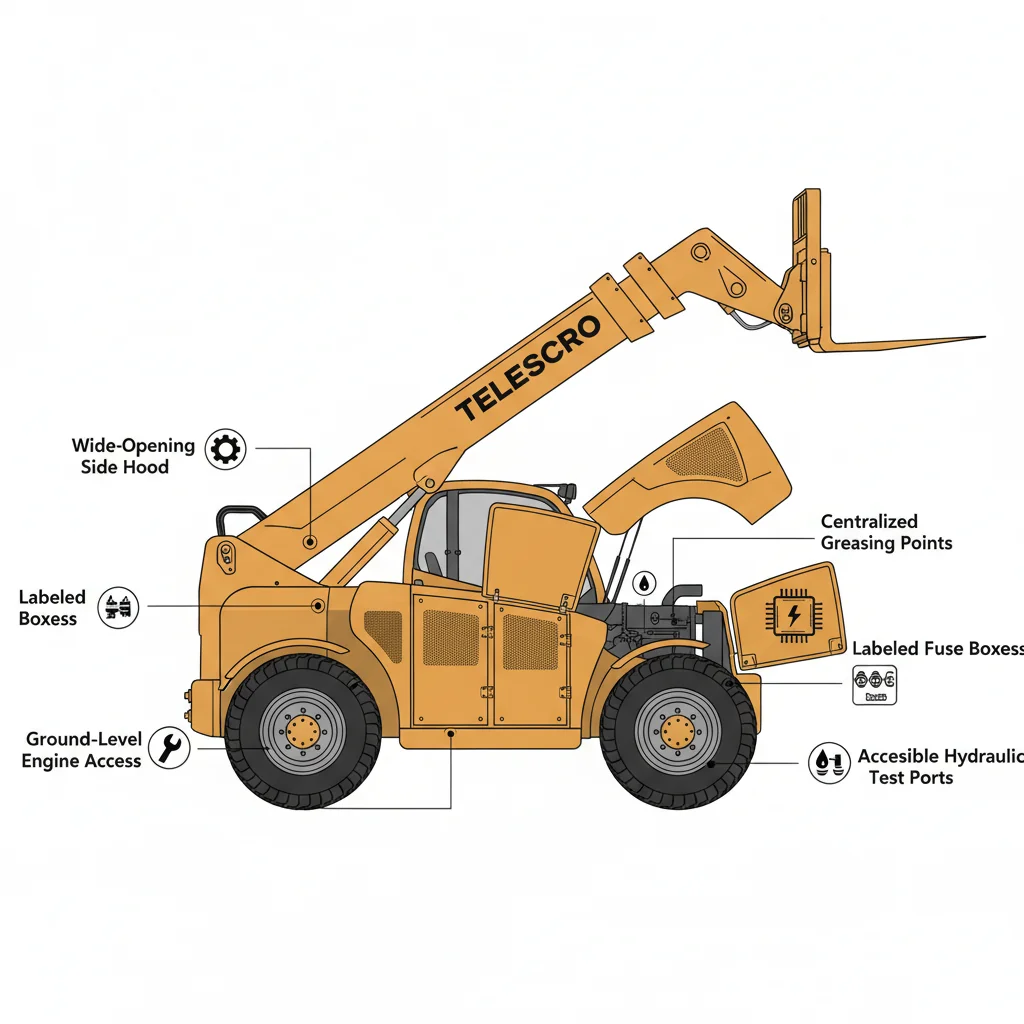
Most people don’t realize that a telehandler’s maintenance friendliness isn’t obvious from the outside. The real proof is in the details—like whether you can reach filters and dipsticks from ground level, or need to climb and stretch just to check engine oil. In Kenya, I supported a project where technicians lost nearly an hour every two days just opening a cramped side cover to check hydraulic fluid. That’s wasted time, especially on busy sites. I’ve worked with fleets in Brazil and Dubai where a centralized greasing point on the boom made a huge difference. Instead of crawling under the chassis, mechanics simply plugged a grease gun into two or three ports—even with gloves on. Fuse boxes should be easy to spot and clearly labeled. Digging around in a dark, crowded area during a power issue is the last thing you need when a rainstorm is coming. To be honest, long OEM-recommended service intervals can save thousands in operating costs over a year. Most modern telehandlers call for engine oil changes at 500 hours, but hydraulic oil and filters commonly last to 1,000 hours or more. I always confirm these numbers against the manufacturer’s manual—don’t trust a sales sheet or a quick answer from the dealer. Also, clarify if you need to tilt the cab for access, or if wear pads on the boom can be adjusted with a wrench instead of disassembling half the machine.
Telehandlers designed with ground-level access to filters and diagnostic points are significantly easier to maintain than those requiring technicians to climb or remove panels.True
Easy access to service points reduces the time and physical effort needed for routine maintenance, a design principle widely recognized in equipment engineering. This lowers downtime and the risk of skipping critical checks, unlike machines with poorly placed service components.
Telehandlers with electronically controlled engines always require specialized diagnostic equipment for basic maintenance, making them harder to service than purely mechanical models.False
Most electronically controlled engines offer basic on-board diagnostics and retain manual access points for routine maintenance tasks such as checking oil or coolant. While advanced troubleshooting may need specialized tools, day-to-day servicing is not necessarily more difficult than with mechanical engines.
Key takeaway: Buyers should evaluate telehandlers for accessible daily service points, longer OEM-recommended intervals for engine and hydraulic systems, and strong local parts support. Prioritizing proven brands and accessible designs reduces downtime and lowers total maintenance costs, especially for high-usage applications.
What About How much does operator training really?
How much does operator training really impact maintenance?: Operator behavior can double or halve your maintenance workload. Misuse—overloading13, fast
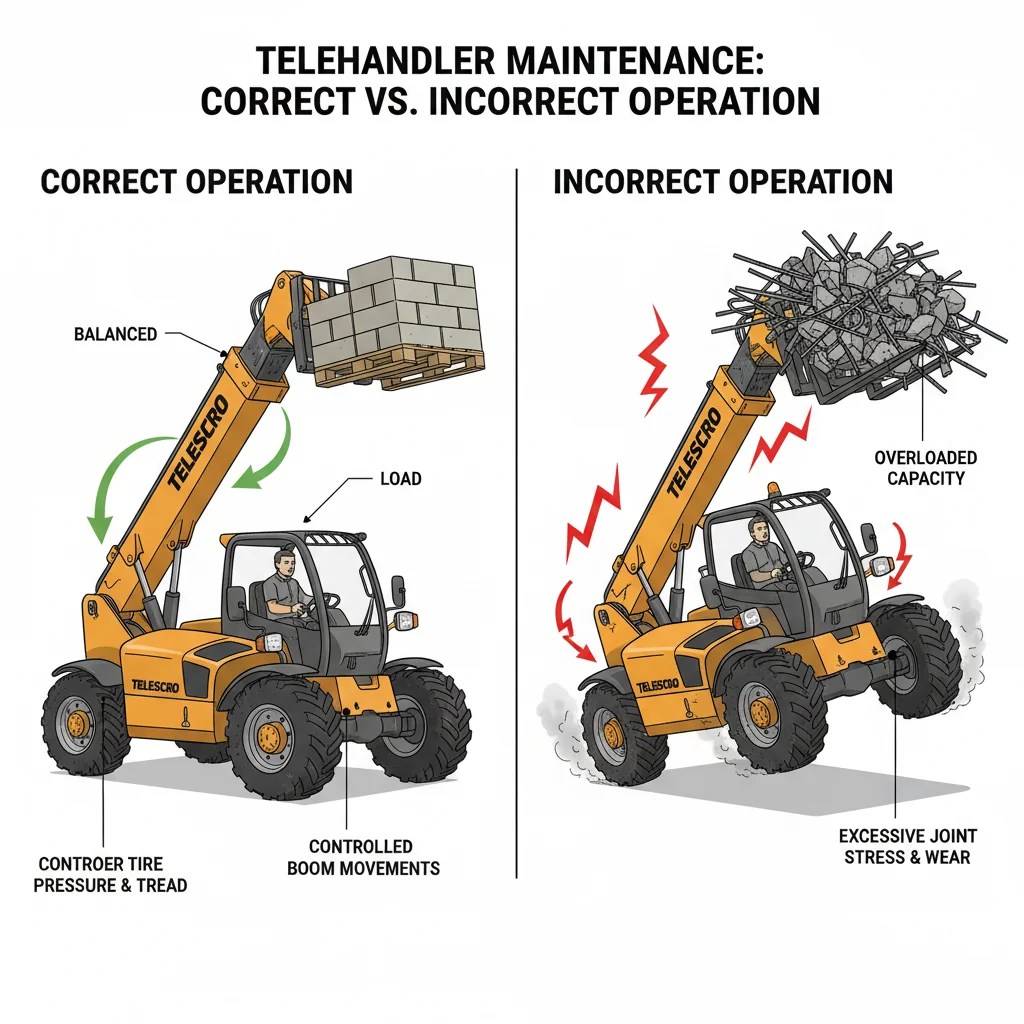
I’ve worked with customers who underestimated the effect of operator training, thinking maintenance only depended on hours and environment. The truth? How your telehandler gets driven day-to-day can double your repair costs—or cut them in half. I remember a project in Brazil where the fleet manager noticed one shift had constant hydraulic leaks and axle issues. Same machines, same loads—the difference was pure operator habit.
Take the basics: ignoring load charts leads to overloading, which puts excess strain on the boom and structure. I’ve seen a 4-ton telehandler with a 13-meter reach run perfectly for years when operators respected the rated capacity—usually below 1,500 kg at max reach. But in Kenya, a team running similar units routinely overloaded past safe limits, and their machines broke down months earlier. Fast driving with the load raised, harsh boom movements, or treating warning lights as optional—these all trash seals, accelerate tire wear, and can wipe out a hydraulic pump before 2,000 hours.
The best results I’ve seen come from a structured daily routine. Training isn’t about long courses. It’s about habits—walk-arounds to check for oil leaks, knowing which warning light signals low hydraulic oil, and greasing the right points. I always suggest picking one “champion” operator or mechanic to attend manufacturer-mandated maintenance courses, then train everyone else on practical care. Most small contractors find that a one-hour drill at the start of the job saves thousands in downtime. Care for your machine, and it will pay you back—ignore it, and you’ll be chasing faults every week.
Improper operator training can cause telehandlers to experience significantly more frequent hydraulic system failures, even if the machines are the same age and are used in similar conditions.True
Operators who are not properly trained may overload the telehandler or operate controls abruptly, putting extra stress on hydraulic components and seals. This accelerates wear and leads to more frequent hydraulic leaks and failures, as seen in fleets where operator habits vary.
Telehandler maintenance needs are almost entirely determined by factory-set service intervals and have little to do with daily operator behavior.False
While following manufacturer service intervals is important, operator actions such as overloading, misuse of controls, and neglecting pre-use inspections have a substantial impact on how often components fail or require unscheduled maintenance, proving that daily operator behavior significantly affects maintenance needs.
Key takeaway: How much does operator training really impact maintenance?:
Conclusion
We’ve talked about how regular inspections and maintenance discipline keep your telehandler running reliably—nothing fancy, just steady routines with a focus on diesel and hydraulics. Honestly, I’ve seen more trouble come from missed intervals and sloppy record-keeping than from any technical challenge. It’s often “the second-year surprise”—unexpected repair costs—when buyers don’t plan ahead.
If you’re not sure whether your team’s schedule or supplier relationships are up to the task, it’s worth double-checking those details now. Need help with maintenance planning or want to compare options for your fleet? I’m always happy to share practical advice from real jobsites, so feel free to reach out anytime. Every project has its own challenges—choose what actually works for yours.
References
-
Details common causes of hydraulic leaks in telehandlers and links proper maintenance to avoiding expensive repairs. ↩
-
Explains how monitoring hydraulic oil prevents costly failures and extends telehandler service life with expert maintenance tips. ↩
-
Details the impact of tire maintenance on load handling and safety, with practical advice to avoid downtime and costly repairs. ↩
-
Learn how corrosive environments like farms cause early wear on steel fittings and best practices to prevent damage and maintenance issues. ↩
-
Understand the impact of OEM-recommended service intervals on operating costs and downtime through detailed analysis and fleet management tips. ↩
-
Detailed analysis of why hydraulic hoses start leaking in telehandlers, including typical failure points and maintenance tips to prevent costly repairs. ↩
-
Explore how DPF regeneration works in Stage V telehandlers, impacting emissions compliance and maintenance downtime. ↩
-
Learn the necessity of OEM-specific tools for accurate fault diagnosis in advanced telehandler electronic systems. ↩
-
Explore how different worksite conditions accelerate air filter wear and the importance of tailored maintenance schedules for telehandlers. ↩
-
Explains how following service schedules ensures telehandler reliability, reduces costly repairs, and maintains resale value. ↩
-
Learn expert guidelines on scheduling oil and filter changes to prolong telehandler engine and hydraulic system life. ↩
-
Explore how centralized greasing points reduce maintenance time and improve safety on construction sites with expert insights and case examples. ↩
-
Details how overloading strains telehandler components, causing premature breakdowns and costly repairs, with examples from global operations. ↩