










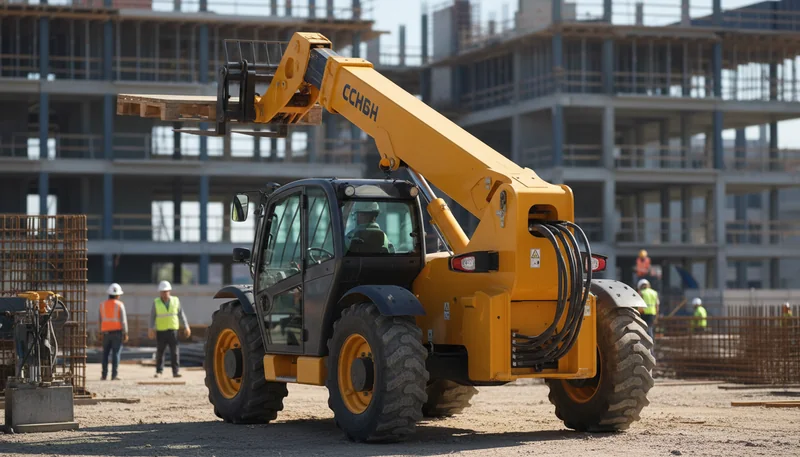
Telehandler Main Parts: Field Engineer’s Guide to Critical Components
The biggest mistake I see buyers make is choosing a telehandler based only on the headline lift height or capacity. I’ve worked with projects in Germany, Brazil, and South Africa where that “top spec” machine ended up struggling with tight spaces or the wrong attachments—costing time and money on site.
In this article, I’ll break down the main parts of a telehandler the way field engineers actually use them: boom, chassis, hydraulics, axles, attachments, and more.
Whether you’re sizing up a new purchase or comparing models in your fleet, knowing how each component impacts real‑world performance is key.
Which Parts Define Telehandler Performance?
The telescopic boom1, chassis/frame2, axles, wheels, engine, hydraulic system, operator cab, and attachment coupler/control systems are critical telehandler components. Their configuration determines lift capacity, reach, stability, and operating efficiency—directly impacting how well the machine matches your specific application and site requirements.
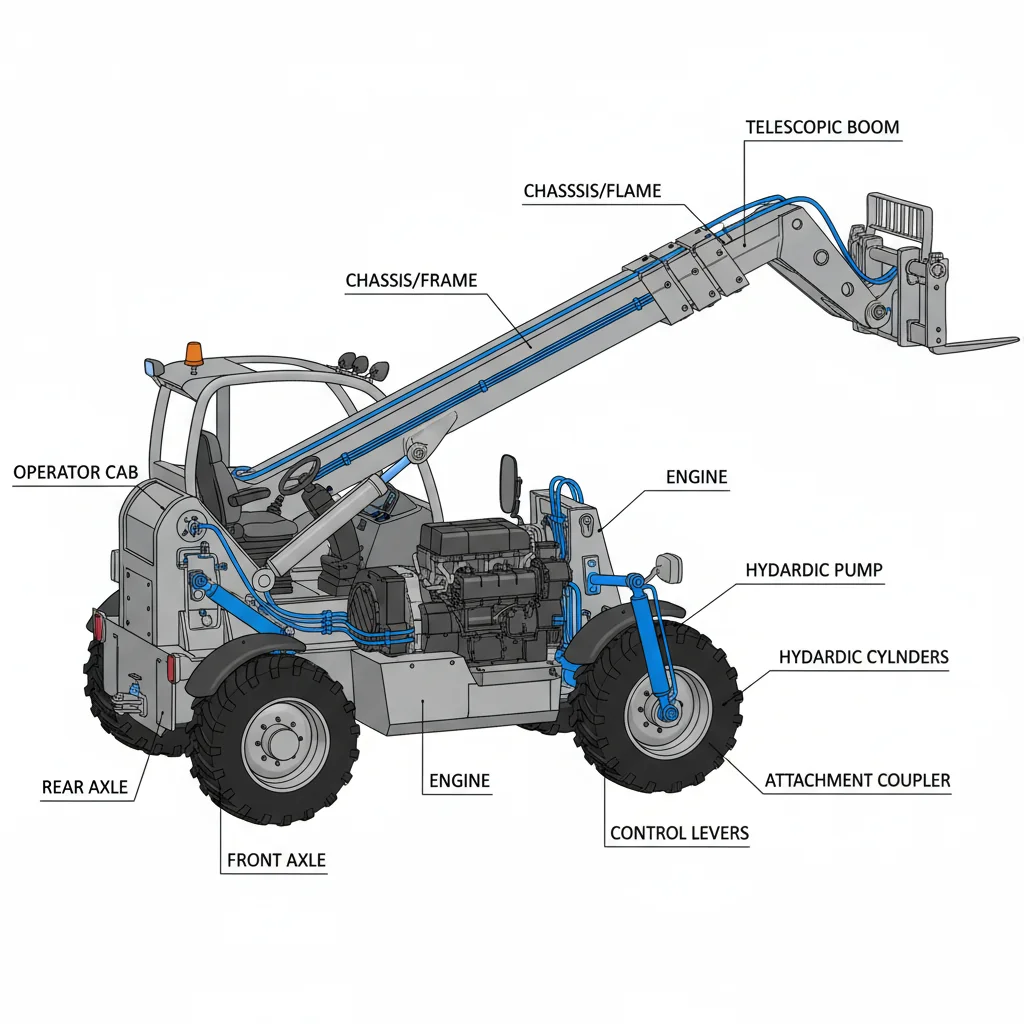
Most people don’t realize that the right combination of core components—boom, chassis, axles, hydraulics—makes or breaks telehandler performance on site. Let me give a practical comparison. In Kazakhstan, a client once needed to handle precast panels weighing 2,800 kg, lifted to around 11 meters. At first, they looked at a compact 2.5-ton unit with a short wheelbase. It was easy to maneuver but just couldn’t safely reach that height with their loads. Switching to a 4-ton telehandler with a longer boom and reinforced frame solved the issue—though ground clearance and turning radius did increase. Take a look at how the main parts stack up:
| Component | Main Impact | Consider When… | Common Range |
|---|---|---|---|
| Telescopic Boom | Reach & lift capacity | Tall placements, heavy loads | 6–18 meters, 2–5 tons |
| Chassis/Frame | Stability & maneuverability | Tight spaces, uneven terrain | Compact or heavy-duty |
| Axles & Wheels | Traction & load support | Muddy/rough ground, heavy pallets | Single/dual wheels, 2/4WD |
| Engine | Power & running costs | High duty cycles, fuel costs | 60–120 kW, diesel/electric |
| Hydraulics | Lifting speed/control | Precision work, quick cycles | Basic/advanced circuits |
| Operator Cab | Safety & visibility | Confined sites, long shifts | Open/closed, ROPS/FOPS |
| Attachment System | Versatility | Mixed tasks (forks, buckets, etc.) | Manual/auto coupler |
I’ve seen customers in Dubai regret skipping advanced hydraulic options—cycle times slowed, productivity dropped.
The chassis design of a telehandler directly affects its maximum reach and load capacity by influencing stability and weight distributionTrue
A well-engineered chassis provides structural support and impacts the machine’s center of gravity. This balance is critical for safely extending the boom while carrying heavy loads, making chassis design a determinant of both reach and lifting capacity.
Telehandlers with longer booms always have better fuel efficiency because they require less engine power to operateFalse
Longer booms typically demand more hydraulic power and stronger engine performance to handle greater torque and maintain control, which usually increases fuel consumption rather than reducing it.
Selecting the right telehandler means evaluating each major component—boom, frame, axles, hydraulics, cab, and attachment systems—in relation to your operational needs. This approach ensures you avoid under- or over-specifying, optimizing performance, safety, and total cost of ownership based on real-world site demands.
How Does the Telescopic Boom Affect?
The telescopic boom determines lift height and outreach, with single-stage booms offering 4–6 m and multi-section types reaching 9–18 m or more. Longer booms increase operational range but add complexity and maintenance. Capacity ratings3 depend on extension and angle, not the maximum headline figure.
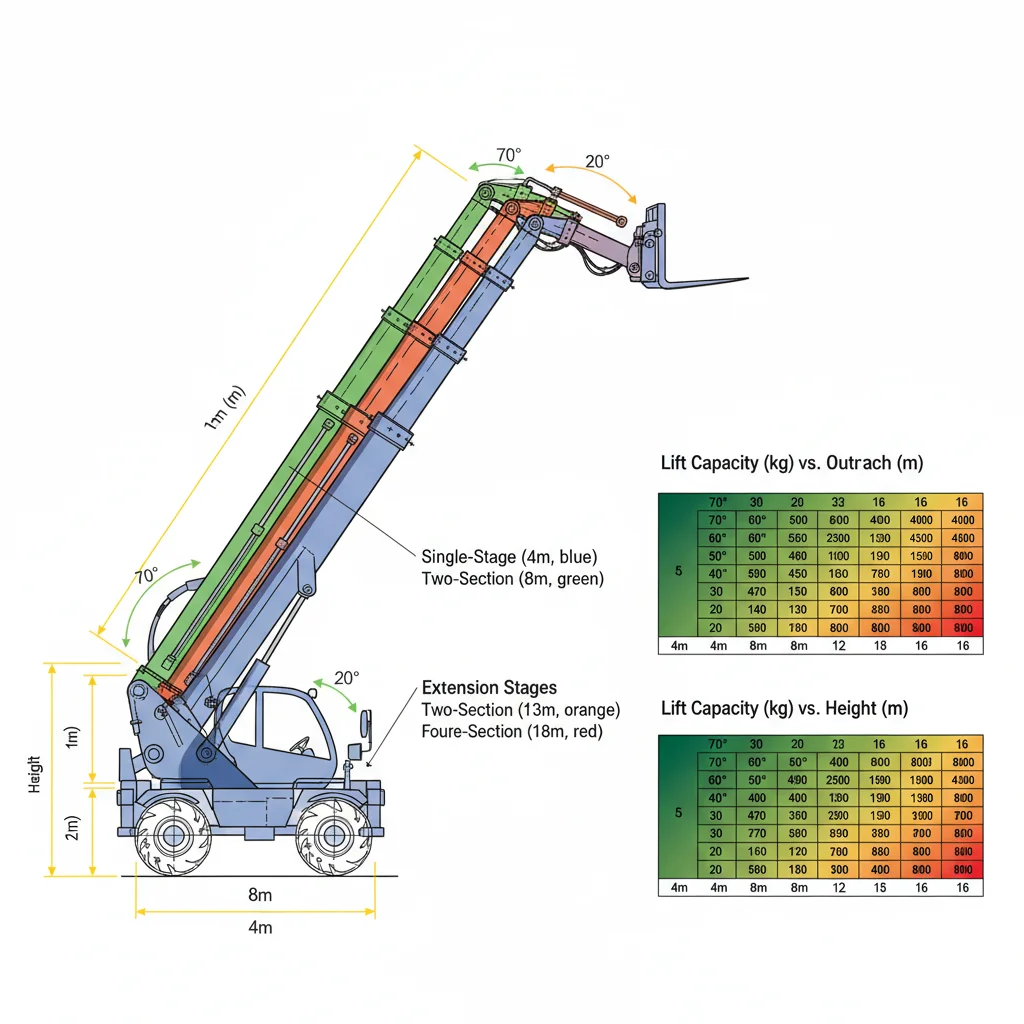
Let me share something important about telescopic booms, because this is where capability is truly defined—not just by the headline numbers you see in catalogs. Most buyers ask, “What’s the max lift height?” But day-to-day, what matters is how the machine performs at mid-extension and awkward angles. For example, I worked with a team in Dubai last year—they picked a 14-meter reach telehandler, expecting to handle 2,500 kg steel bundles three floors up. On-site, the job required reaching 11 meters out over scaffolding. The load chart showed safe capacity dropped to just 1,400 kg at that reach. They had to take double the trips. That’s a real productivity hit, plus more wear on the boom.
Single-section, or “single-stage,” booms (usually 4–6 meters) are solid and easy to service. Their simpler sliding system often means lower maintenance costs—usually only basic grease and occasional pad checks. But multi-section booms4—think 9, 12, or even 18 meters—use extra cylinders and more slide pads. In Kazakhstan, a customer called me about boom jamming after two years of heavy use; worn sliding pads and pivot pins were the culprits. I always stress: any excess play in the boom, even as little as 2–3 mm, can throw off alignment and eventually cause serious downtime.
My advice? Match your boom length to your actual site requirements. Inspect wear pads and pivot pins every 500 hours, or sooner if your jobsite is dusty or running multiple shifts. It’s cheaper and safer to catch wear early than face major repairs later.
Telehandlers typically lose about 20-30% of their rated lifting capacity at mid-extension due to increased leverage and boom angleTrue
As the telescopic boom extends, the leverage effect increases and the boom angle often becomes less ideal, causing the machine's stability system to reduce allowable load capacity to maintain safety. This means a telehandler rated for 2,500 kg at full retraction may only handle 1,750-2,000 kg at mid-extension.
The telescopic boom length has no impact on the telehandler’s stability or load capacity at any extensionFalse
Boom length significantly affects stability and load capacity because extending the boom increases leverage and shifts the center of gravity forward. The longer the boom extension, the lower the maximum safe load to prevent tipping or structural stress.
The telescopic boom’s design directly impacts lifting capacity, reach, and long-term reliability. Choose boom length and type to match your site requirements. Regularly inspect wear pads and pivot pins, and follow service schedules to avoid costly misalignment and maximize safe, productive operation.
How Do Telehandler Hydraulics Work?
Telehandler hydraulic systems power critical functions like boom lifting, extension, steering, and attachments. High-pressure hydraulics deliver smooth, accurate movements and enable heavy loads—up to 5,400 kg. Advanced flow-sharing allows multitasking, but increases system complexity, while hoses and cylinders require regular maintenance to avoid costly leaks and downtime.
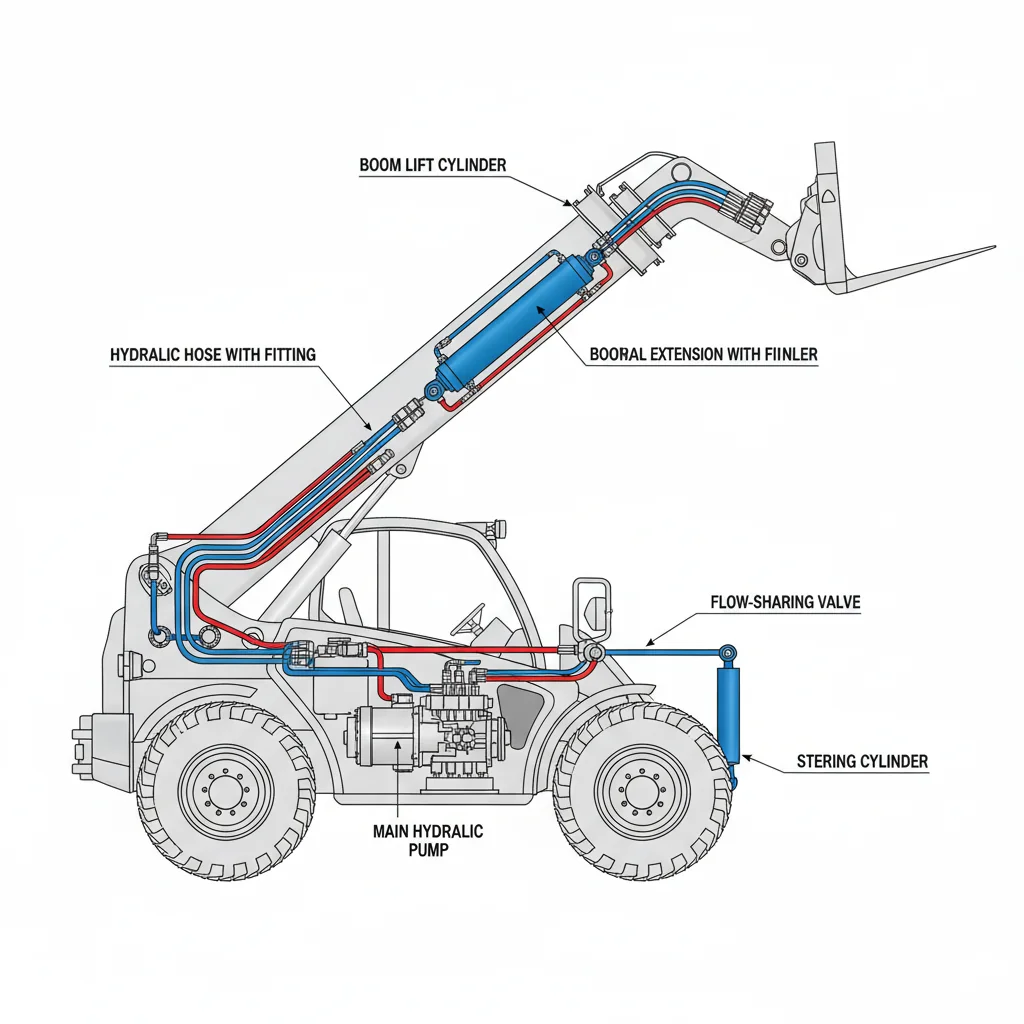
Here’s what matters most when looking at telehandler hydraulics: they control every major function, from lifting the boom to steering and running attachments. If the hydraulics aren’t strong and well maintained, you’ll lose both performance and reliability. Last summer, I worked with a client in Kazakhstan running a 4-ton, 13-meter machine. They complained that the boom movement was jerky and couldn’t multi-task—turns out the hydraulic pump output was only around 80 L/min when their job really needed at least 110 L/min for smooth, combined lift and extension. That’s a difference you feel immediately on site.
A good hydraulic system starts with a robust pump—usually gear or piston type—and a circuit rated above 200 bar. The higher the pressure and flow, the heavier and faster you can work. For example, lifting a full pallet of bricks—roughly 1,200 kg—to the fourth floor needs both high pressure and accurate control. In Dubai, I saw a situation where a small leak at the cylinder seal was ignored. Within a month, it led to contamination in the brake circuit and ended up costing over $1,000 in repairs and half a week of downtime.
I always suggest inspecting hose conditions and looking for any fluid seepage, especially at fitting points. Cylinder seals are another pain point—replacement isn’t expensive, but lost time adds up. For regular maintenance, machines with easy-access filters and clear test ports save hours each quarter. If your work demands running multiple attachments at once, check the flow-sharing valves and make sure the rated L/min matches your pace. That can keep you productive without surprise breakdowns.
Telehandler hydraulic systems typically use variable displacement pumps to efficiently modulate flow and pressure based on boom load and movement demandsTrue
Variable displacement pumps adjust output according to system requirements, allowing smooth boom operation and reducing energy waste compared to fixed displacement pumps, which run at a constant flow regardless of demand.
The main hydraulics in telehandlers operate independently from the steering system to avoid pressure fluctuations during boom operationFalse
In most telehandlers, the hydraulics for boom movement and steering share the same system and pump, so pressure and flow are carefully managed to maintain consistent performance across functions, rather than operating completely independently.
Hydraulic systems are the backbone of telehandler functionality, impacting both operational precision and reliability. Prioritize machines with robust hydraulics, maintain hoses and seals, and regularly change fluid to reduce failures. Evaluate flow rates and controls to ensure the machine meets your job’s lifting and handling needs.
How Do Telehandler Attachments Boost Versatility?
Attachments and quick-couplers transform a telehandler into a highly adaptable machine, enabling fast changes between forks, buckets, clamps, and more. Properly matched attachments maintain safety and efficiency, but exceeding rated capacities5 at certain boom angles and lengths can be hazardous.
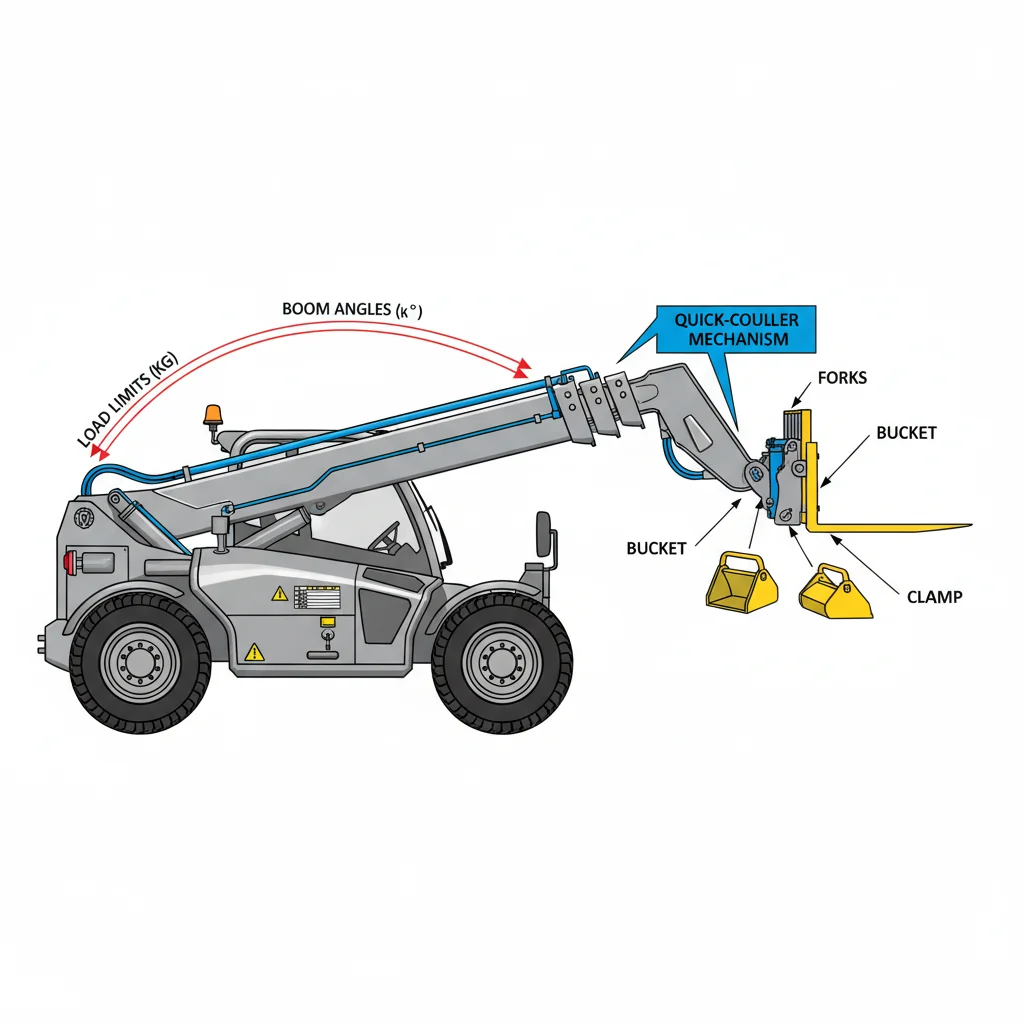
The biggest mistake I see is treating every attachment like it’s just another set of forks. That’s risky thinking. One customer I worked with in Kazakhstan fitted a heavy concrete bucket onto a 4-ton telehandler with a 14-meter boom. They assumed the machine’s full capacity still applied—even with the boom at full extension. But at 12 meters, the safe load dropped to under 700 kg. It’s a common situation: the wrong attachment or ignoring the load chart nearly led to a costly accident on that site.
Let’s break down how attachments and quick-couplers actually unlock jobsite versatility:
- Pallet forks – Standard for moving brick stacks, pipe bundles, and palletized loads.
- General-purpose buckets – Move sand, gravel, loose materials, even snow.
- Bale clamps or grabs – For agriculture sites handling hay, wool, or waste.
- Lifting hooks – Simple, but turn a telehandler into a mobile crane for beams or pipe.
- Work platforms – Let teams safely access elevations—for repairs or fitting façades.
A well-designed quick-coupler system6 means one operator swaps forks for a bucket in under five minutes. On a recent Dubai project, a team told me this time savings kept their pour moving without delays, compared to waiting for a separate loader. But those benefits only hold true if every attachment is matched to the hydraulic circuit and checked against the load chart—for each boom angle and reach.
I always suggest confirming the machine accepts industry-standard attachments, not just proprietary ones. This widens your choices and usually lowers long-term cost. To be honest, jobsite flexibility depends more on practical attachment use than raw lift specs.
The maximum safe load capacity of a telehandler decreases as the boom extends, often dropping to less than 25% of the rated capacity at full reachTrue
Telehandler load charts show that as the boom lengthens, leverage increases and stability decreases, requiring significant reductions in allowable payload—sometimes down to under 700 kg at 12 meters on a 4-ton telehandler, which is less than a quarter of its rated load.
Telehandler attachments are universally rated to support the machine's full load capacity regardless of boom position or extensionFalse
Attachments have their own weight and load dynamics, and the telehandler's rated capacity varies with boom extension and angle. Assuming full capacity without adjusting for attachment type or boom position risks overload and instability.
Telehandler attachments and couplers make a single machine multi-functional, but safe use requires careful attention to capacity at every boom position. Always use the load chart for the fitted attachment. Choose machines that support varied, cost-effective attachments to maximize jobsite flexibility and minimize long-term costs.
How Do Chassis and Axles Stabilize?
Chassis and axles form the telehandler’s structural backbone, enabling stability with features like four-wheel drive7, multiple steering modes, and axle oscillation8. Oscillating axles help keep tires grounded, while stabilizers9 and axle locks boost safety during heavy or high lifts, especially on uneven sites.
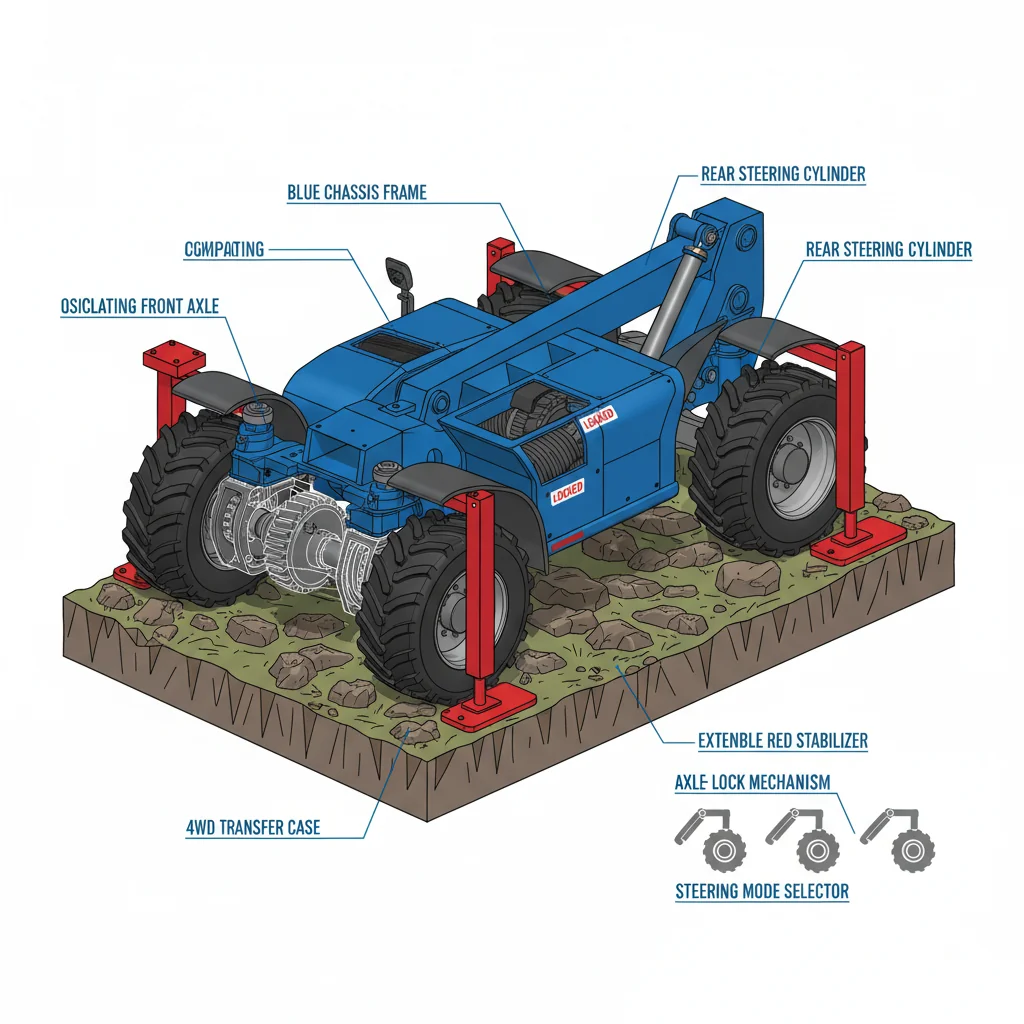
To be honest, the spec that actually matters is how well the axles and chassis keep your machine stable—especially when the ground isn’t flat. I’ve seen crews in Kazakhstan work on sloped sites where a 12-meter lift had to be done over uneven gravel. If your telehandler’s axles don’t allow enough oscillation—usually at least 10 to 12 degrees—all four tires might not stay in contact with the ground. And once a tire starts to lift, stability goes out the window.
A robust chassis supports everything, but advanced axle design really makes the difference. Four-wheel drive is standard, of course, but steering modes like crab or all-wheel steering are a big help in tight spaces. In Dubai, a customer used a 4-ton compact model to maneuver around scaffolded towers. That machine had an axle oscillation system—kept the tires grounded, even on a ramp with at least a 9-degree slope.
On larger or tall-reach machines, stabilizers (outriggers) and axle locks come into play. Outriggers extend from the frame and anchor the machine—absolutely critical when you’re lifting heavy loads high and far out. I remember a tilt-up job in Brazil where they never engaged the axle lock while using outriggers. The machine swayed. Lesson learned: always fix the axles when the stabilizers are down for max safety.
I suggest checking the machine’s wheelbase and width, too. Wider, longer bases mean better stability. Before choosing, ask for the oscillation angle, see how the stabilizers deploy, and follow the operating procedures for every lift.
Telehandler axles typically allow for 10 to 12 degrees of oscillation to maintain all four tires in contact on uneven terrainTrue
Axle oscillation in this range enables the wheels to adjust to ground irregularities, preserving tire contact and machine stability, which is critical when operating on sloped or uneven surfaces.
A stiffer chassis with minimal flex improves telehandler stability more effectively than axle oscillation on uneven groundFalse
While a rigid chassis provides structural support, too little flex can reduce tire contact on uneven terrain; axle oscillation is essential to adapt to ground contours and maintain stability.
For maximum telehandler stability—especially on uneven or sloping terrain—prioritize models with robust chassis, advanced axle oscillation (allowing up to 12° movement), and reliable stabilizers or axle locks. Assess wheelbase, machine width, and operational procedures for securing the machine during high or offset lifts.
How Do Tyres and Drivetrain Affect?
Tyres and drivetrain impact traction, turning radius, and ride quality. Large all-terrain tyres10 provide flotation on soft ground but widen turning arcs; solid tyres excel indoors. Powershift drivetrains11 suit heavy hauling, while hydrostatic offers precise low-speed control for tight spaces. Match choices to your jobsite needs.
Last month, a contractor in Dubai called me frustrated about wheel slip on sandy ground. He used a compact telehandler with standard solid tyres—great for warehouse floors but terrible on loose surfaces. Larger, pneumatic all-terrain tyres would have spread the weight more, helping the machine float instead of digging in. On muddy construction sites in Brazil, I’ve seen agricultural tread make the difference between steady progress and hours wasted getting unstuck. There’s a tradeoff, though: big tyres with deep treads improve flotation and shock absorption but increase the turning radius. That really matters in tight city projects where space is already limited.
I remember a site in Poland where the team kept swapping between all-terrain and solid tyres using quick-change wheel hubs. This let them handle both outdoor and indoor jobs without racking up downtime—tyre swaps took less than two hours. Tough jobs on demolition sites call for puncture-proof solid tyres, but the ride gets rough, and the machine vibrates more. Tyres wear faster if you run aggressive treads on concrete all day, so matching tread pattern to your surface saves money over time.
Now, drivetrain choice matters just as much. Powershift transmissions work well for moving heavy loads long distances—think large yards in Kazakhstan where every load is at full capacity, up to 4,000 kg or more. On the other hand, hydrostatic drivetrains shine when you need fine control for placements, such as glass handling jobs in city centers. They require more hydraulic maintenance, especially scheduled fluid changes. I suggest weighing your daily tasks and ground type before ordering—choosing right means less downtime and longer tyre life.
Using pneumatic all-terrain tyres with agricultural tread can improve traction on loose or muddy surfaces by up to 30% compared to standard solid tyresTrue
Pneumatic tyres distribute machine weight more evenly and their aggressive tread patterns penetrate loose ground, significantly reducing wheel slip and improving traction in soft soil conditions.
Solid tyres are generally preferred on all-terrain telehandlers for better flotation on sand and mudFalse
Solid tyres are durable but have limited ground contact area and no tread flexibility, making them less effective than pneumatic tyres for flotation and traction on soft or uneven terrains like sand and mud.
Correctly matching tyre type, size, and drivetrain style to your telehandler’s environment and duties optimizes grip, maneuverability, and uptime. Consider jobsite surfaces, required handling precision, and maintenance requirements when specifying components. Thoughtful selection reduces downtime, extends tyre life, and ensures efficient performance in varied field conditions.
How Do Engine Options Impact Performance?
Telehandler engines—mainly diesel, with emerging electric and LPG options—directly influence lift capacity, drive speed, and operational costs. Diesel engines12 excel in heavy-duty tasks but require complex maintenance. Electric and LPG models offer quieter, cleaner operation but generally handle lower loads and have shorter runtimes.
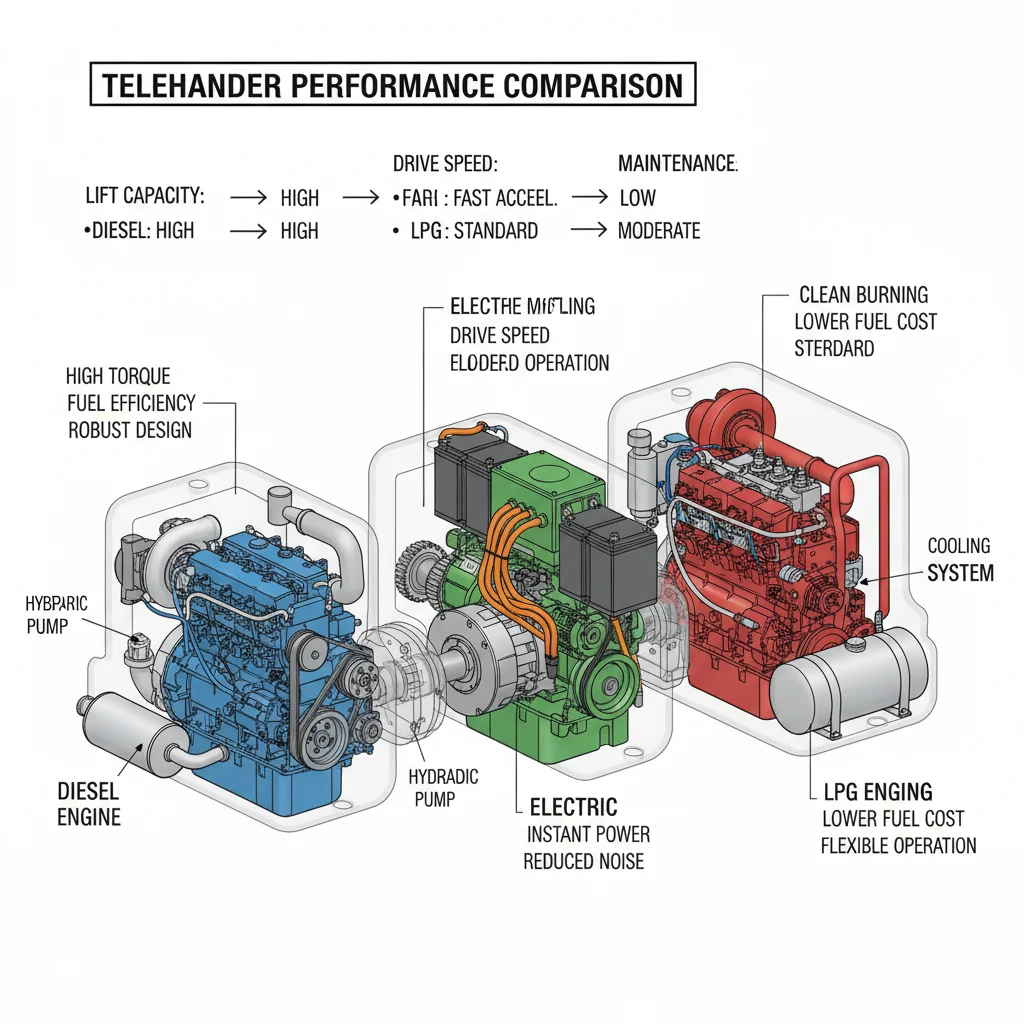
I’ve worked with customers in Brazil and Kenya who underestimated how much engine choice impacts daily efficiency. A contractor in São Paulo wanted a high-capacity telehandler for steelwork, so he picked a model with a 100-horsepower diesel engine. On flat ground, it performed well, lifting 3,500 kg to 10 meters. But when the job moved to a sloped site, the machine slowed down—engine torque made a big difference in travel speed and precision with heavy loads. That’s when he realized: selecting an engine just for peak numbers isn’t enough.
To compare options, it’s helpful to lay out the main points side by side:
| Engine Type | Typical Capacity | Runtime | Emissions/Noise | Maintenance Needs | Best For |
|---|---|---|---|---|---|
| Diesel | 2,500–5,000 kg | 8+ hours | Higher emissions/noisy | Complex (DPF/SCR) | Heavy lifts, outdoor sites |
| Electric | 1,500–3,000 kg | 4–6 hours | Zero emissions/quiet | Lower but battery care | Indoors, low-noise zones |
| LPG | 2,500–3,500 kg | 6–8 hours | Lower emissions | Moderate | Mixed indoor/outdoor |
From my experience, diesel still dominates large sites needing continuous, heavy operation—especially in places like Dubai or Kazakhstan where fuel and service support are available. But more jobsites in Europe now request electric units for indoor or emissions-sensitive projects, even if that means lower capacity. Keep in mind, diesel engines with after-treatment (like DPF filters) need strict service; I’ve seen projects delayed in Morocco because nobody stocked the right parts. I suggest clarifying not just your load size but also your typical work cycle and refueling options before making a choice.
A telehandler’s engine torque curve significantly affects lifting performance on inclined terrain by maintaining hydraulic pressure under loadTrue
Higher torque at lower RPM ensures consistent hydraulic pump output when climbing slopes or handling heavy loads, preventing speed reduction and improving operational precision.
Telehandlers with gasoline engines always outperform diesel engines in lifting heavy loads due to higher peak horsepower ratingsFalse
Diesel engines typically provide greater torque at lower RPM, which is crucial for lifting heavy loads efficiently; gasoline engines may have higher peak horsepower but usually deliver less low-end torque necessary for such tasks.
Telehandler engine selection profoundly affects machine performance, operating cost, and maintenance complexity. Balance your site’s load needs with fuel type, service support, and infrastructure requirements. Oversized engines increase costs, while undersized ones reduce efficiency—choose based on realistic load profiles and duty cycles.
How Does the Cab Improve Safety?
The telehandler cab combines ergonomic seating, joystick controls, and enhanced visibility with certified ROPS/FOPS protection13. Features like climate control, digital displays, and load monitoring systems14 reduce accidents and improve operator focus—directly impacting jobsite safety and productivity, especially in congested construction environments.
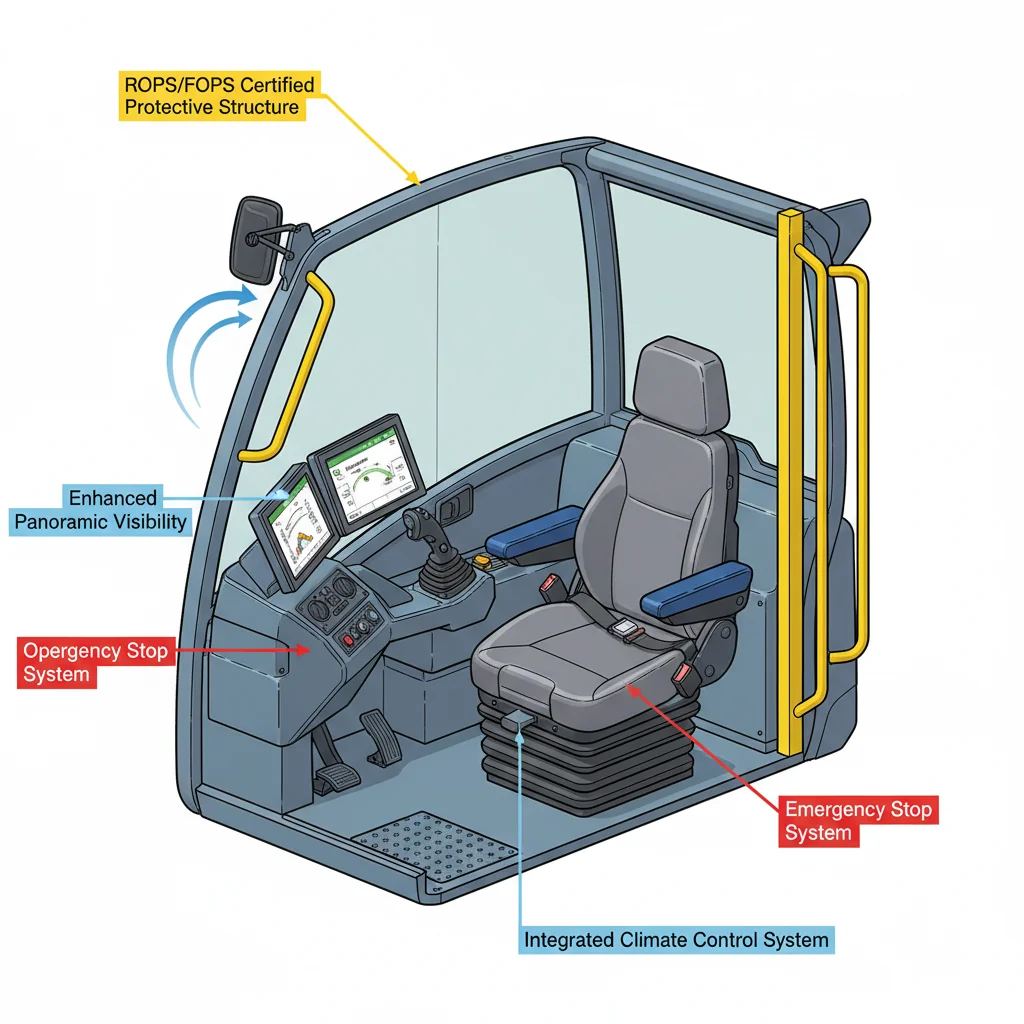
One thing I always notice on real jobsites—especially in congested areas like Shanghai or Mexico City—is how much a well-designed cab can make or break operator safety. Most people see just a seat and some levers, but there’s a lot more going on. For example, a telehandler cab with certified ROPS (Roll-Over Protective Structure) and FOPS (Falling Object Protective Structure) isn’t just a regulatory box to tick. In 2022, a customer in Qatar told me how their operator walked away from a tipping incident because the ROPS/FOPS structure did its job. It saved a life, and honestly, not all machines in the market offer this level of protection as standard.
When I hop in a new model for demo, I check sightlines first—especially to the right rear corner and down to the forks at maximum extension, which is where accidents happen most. If visibility is poor, it doesn’t matter how advanced the rest of the machine is. Newer cabs have raised seats, extra glass, and even cameras, helping to reduce blind spots. I’ve seen productivity jump on Kenyan sites using a 3.5-ton unit with 14-meter reach and a modern digital load moment indicator (LMI). The LMI warns operators when they’re nearing overload, cutting near-miss events almost in half according to one foreman’s records.
Cabs with easy entry and climate control may sound like comfort features, but when you’re on 12-hour shifts, tired operators make mistakes. I always suggest actually sitting in the cab—bring your PPE, check entry with your tools, and look for simple, intuitive joystick controls. That detail impacts safety more than any brochure can explain.
Certified ROPS (Roll-Over Protective Structure) in telehandler cabs must withstand at least a 2,000 kg impact force from falling objects to meet international safety standardsTrue
ROPS and FOPS certifications require telehandler cabs to endure substantial impact forces, often tested against specific weights like 2,000 kg or more, ensuring operator protection from rollovers and falling debris.
Telehandler cabs equipped with advanced air filtration systems can completely eliminate all dust exposure for operators on congested urban construction sitesFalse
While advanced air filtration systems significantly reduce dust exposure inside the cab, no filtration system can entirely eliminate all airborne particles, especially in highly polluted or dusty environments found on congested urban jobsites.
Operator cabs equipped with robust safety structures, improved sightlines, and intuitive controls significantly lower accident rates and enhance productivity. Always evaluate visibility, control layout, and entry/exit ease when comparing telehandler models; well-designed cabs help keep operators alert and safe during extended shifts.
What Prevents Telehandler Overloads, Tip-Overs?
Telehandler safety systems include stabilizers on high-reach models, axle locks, and well-marked load charts. Modern machines may feature load moment indicators15 or management systems, issuing warnings or disabling operation when limits are exceeded. Operator training and clear documentation remain critical to prevent dangerous overloads and tip-overs.
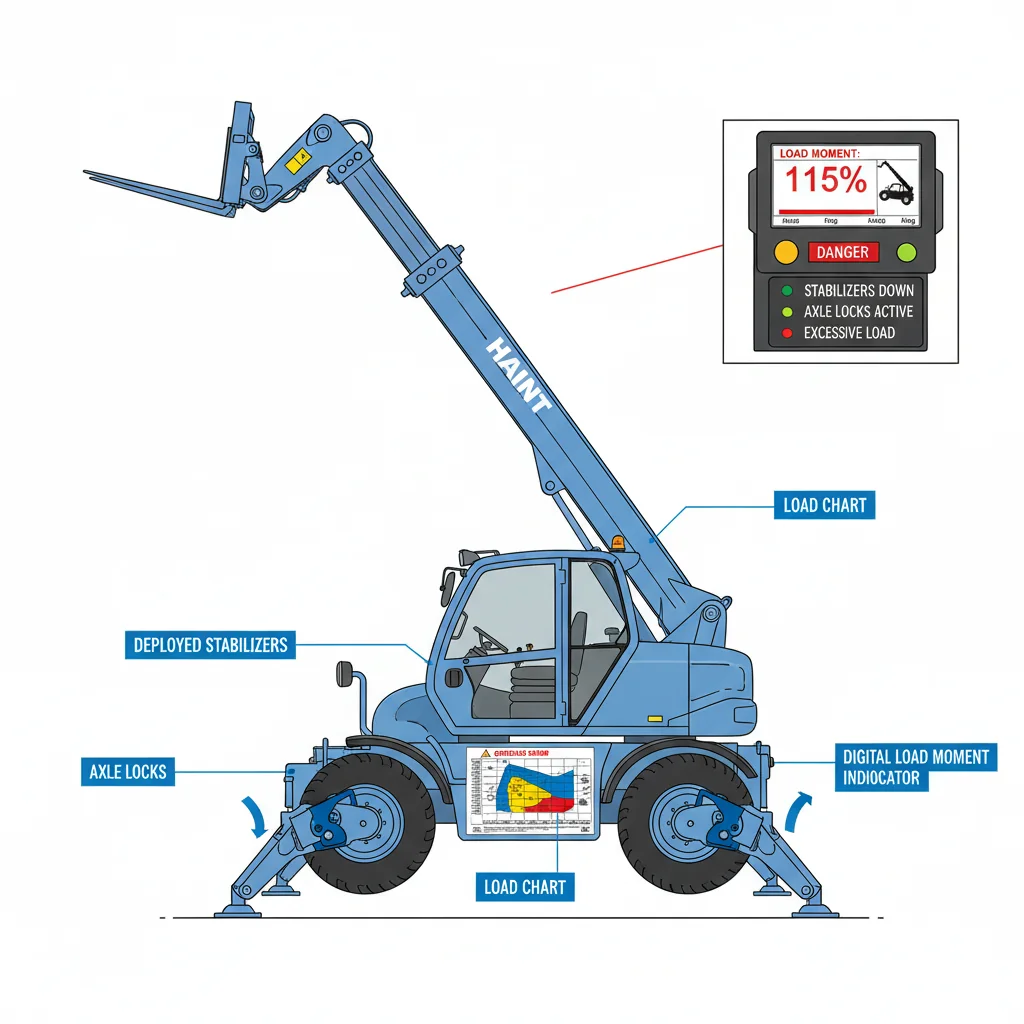
Let me share something important about telehandler safety—mechanical systems and electronic features only work if operators understand their limits. Last year, I supported a site in Kazakhstan where a newer operator tried to lift a 2,700 kg load at maximum reach (about 13 meters) on a 4-ton rated machine. The machine’s load moment indicator went off, flashing warnings and even disabling boom extension, but the real failure was improper reading of the load chart. The project lost half a day because they couldn’t offload supplies safely—an avoidable error.
Stabilizers, or outriggers, make a huge difference on high-reach units. If you’re working above 14 meters, you’ll often see these hydraulic legs extended to the ground for extra balance. In muddy or uneven terrain, I suggest always checking they’re fully deployed and locked; I’ve seen a lift in Brazil nearly tip because soft ground made the outrigger sink just 2 centimeters. That small dip was enough to trigger the tilt sensor.
Load charts are not just stickers—they map safe capacity at every boom angle and length. For example, a machine rated 4,000 kg can sometimes only lift 1,200 kg at full extension. Electronic load management systems help, but they can’t fix deliberate overloading or ignoring site slope limits. Training remains the foundation. I recommend fleet owners insist on refresher training every year and verify that load management interlocks are actually working.
Combining precise operator habits with up-to-date safety tech cuts risk and downtime. Those details protect both your people and your investment.
The load moment indicator (LMI) system on telehandlers not only alerts operators to overload conditions but can actively prevent boom extension beyond safe limitsTrue
LMIs use sensors to continuously monitor load weight and boom position, and when reaching unsafe thresholds, they can disable boom functions to physically prevent actions leading to tip-overs, adding a critical layer of safety beyond visual warnings.
Telehandlers rely solely on mechanical overload protection systems without integrated electronic safety features to prevent tip-oversFalse
Modern telehandlers incorporate electronic systems like load moment indicators and stability control to enhance safety; relying only on mechanical systems is outdated and insufficient for the precise overload prevention required on job sites.
Combining mechanical safeguards, electronic load monitoring, and clear load charts forms the backbone of telehandler safety against overloads and tip-overs. Ensuring operators are properly trained and insisting on up-to-date safety systems significantly reduces risk, downtime, and liability for fleets and worksites.
Which Telehandler Parts Need Regular Maintenance?
Critical telehandler maintenance features include grouped ground-level service points for engine oil, hydraulic filters, coolant, and air filters. Regular inspection of boom slide pads16, pivot pins, hydraulic hoses17, and drivetrain components greatly reduces downtime, increases component lifespan, and lowers the risk of expensive repairs caused
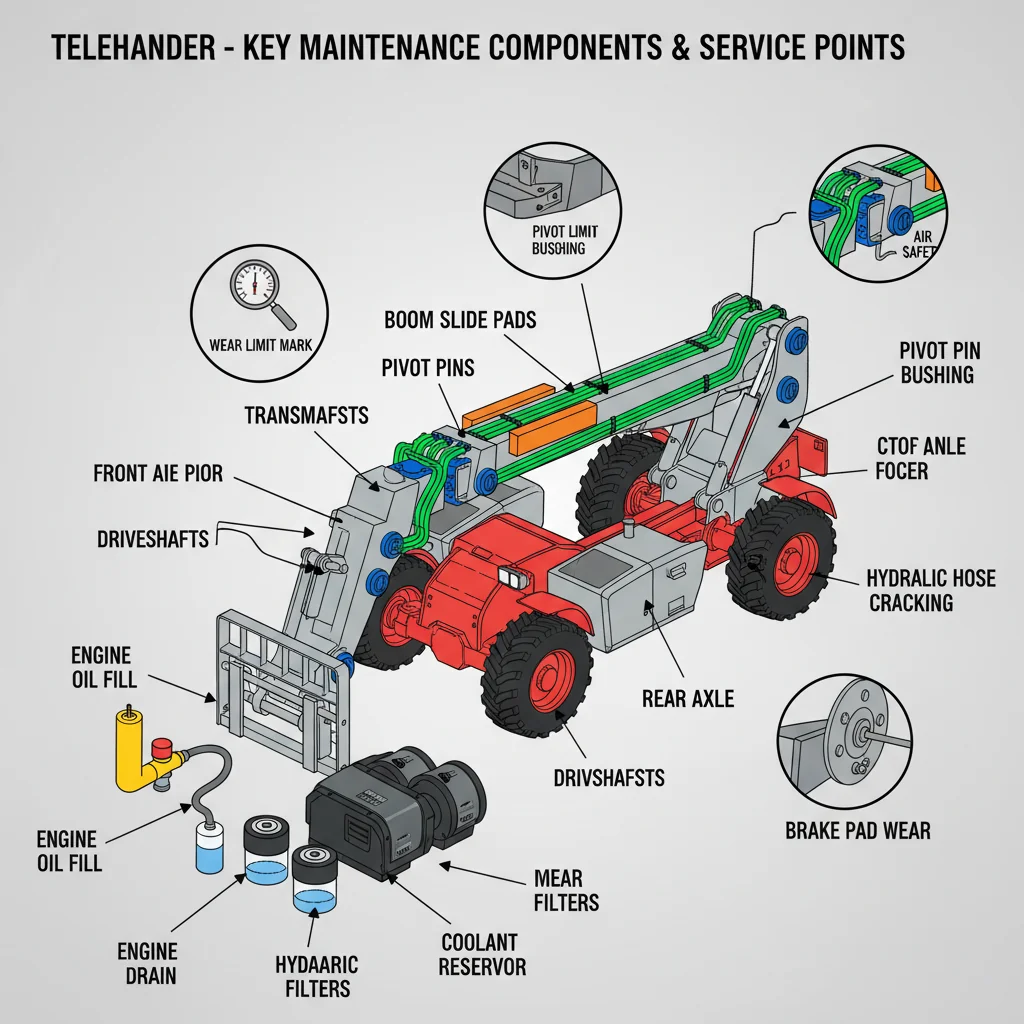
From what I’ve seen on jobsites in Turkey and Brazil, regular maintenance really comes down to how easy it is to access key components. If a machine forces engineers to climb or reach awkward panels, daily checks get skipped—then problems pile up fast. The most important areas to watch? Engine oil, hydraulic filters, coolant, and air filters. Grouped service points at ground level make it simple, especially when you’re running a larger fleet with a tight turnaround. But those are just the basics. The parts I’ve seen cause the most costly downtime are boom slide pads, pivot pins, hydraulic hoses, and anything in the drivetrain. For example, a contractor in Kazakhstan ignored pad wear for only a month. The result? Boom misalignment and a repair bill pushing $4,000. In my opinion, checking slide pad thickness and keeping an eye on hydraulic leaks can easily prevent these kinds of headaches. Let’s break down which parts need the closest attention and how often you’ll typically service them:
| Part | Typical Check Interval | What to Look For | Impact of Neglect |
|---|---|---|---|
| Engine Oil & Filter | Daily check, 250 hr change | Level, contamination, leaks | Early engine wear, breakdown |
| Hydraulic Filter/Oil | Inspect daily, 500 hr swap | Oil clarity, filter condition | Slow hydraulics, major failures |
| Air Filter | Daily in dusty areas | Clogging, physical damage | Engine power loss, overheating |
| Boom Slide Pads | Weekly | Pad thickness, wear, lubrication | Rough boom motion, premature wear |
Telehandler air filters typically need replacement every 250 to 500 operating hours due to high dust intake in construction environmentsTrue
Telehandlers operate in dusty conditions which can quickly clog air filters, leading to reduced engine performance; changing them every 250-500 hours ensures optimal airflow and engine protection.
The telescoping boom’s hydraulic cylinder seals usually require daily lubrication to prevent leaksFalse
Hydraulic cylinder seals are designed to be self-lubricating and sealed from contaminants, so they do not require daily lubrication; over-lubrication can actually attract debris and cause seal damage.
Prioritizing telehandlers with accessible, grouped service points and clear maintenance schedules simplifies daily checks and routine servicing. This proactive approach extends major component life, minimizes unexpected failures, and ultimately lowers total cost of ownership for fleet operators and field engineers.
Why Do Telehandler Parts Ecosystems Matter?
Parts and attachment compatibility18 directly affect telehandler uptime and long-term value. Hard-to-source parts or proprietary couplers can cause extended downtime, inflate operating costs, and limit attachment sharing flexibility. Assessing parts availability and coupler standards upfront can prevent costly delays and maximize fleet efficiency.
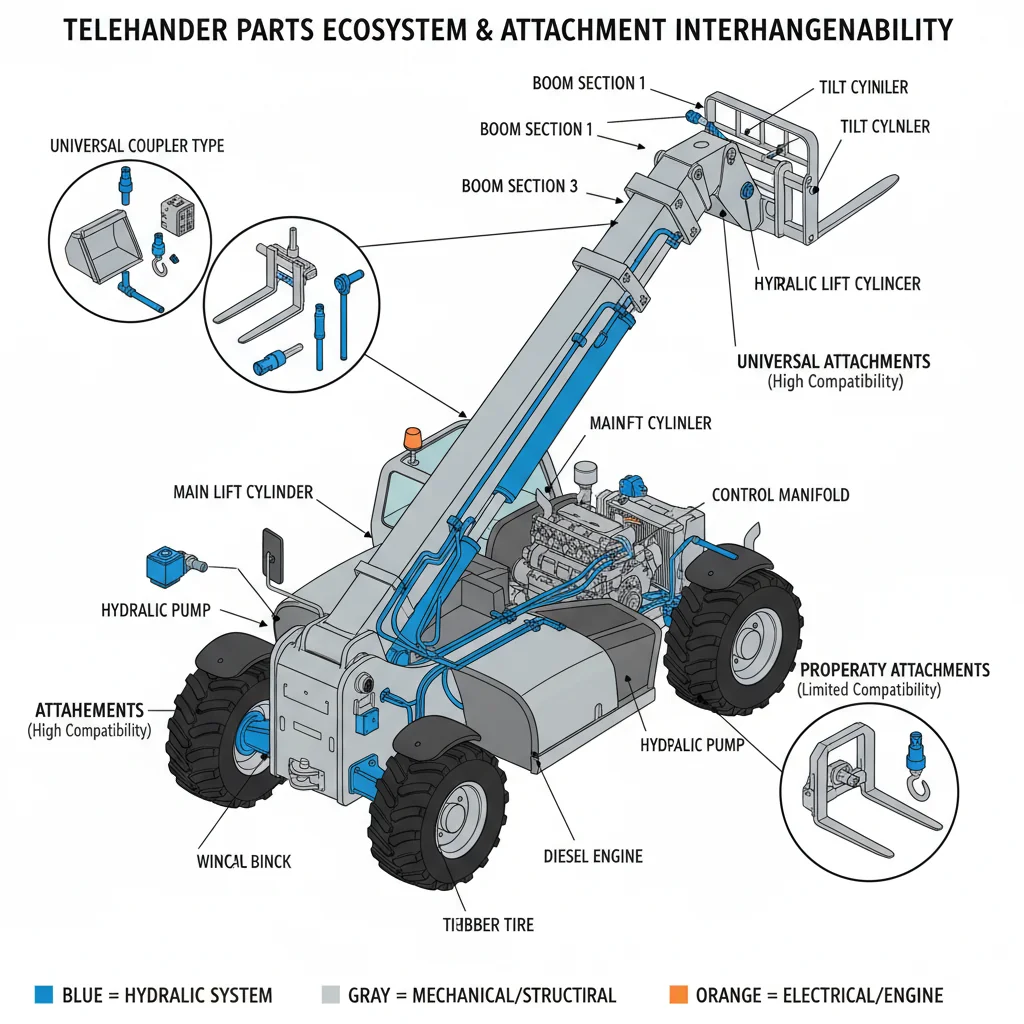
One question I hear from fleet managers in Southeast Asia is, “How will I keep my machine running if something breaks down during a busy project?” Parts ecosystems answer that directly. Telehandlers rely on so many components—hydraulic pumps, brake cylinders, electronic controllers, even simple couplers. If these aren’t easy to source locally, you risk waiting days or even weeks for replacements. Last summer, a contractor in Kenya needed a replacement hydraulic hose for a 4-ton, 14-meter model. Because it used a non-standard fitting, they lost five full working days before the part arrived by air. That downtime delayed their schedule and cost far more than the initial “savings” from choosing a rare-brand machine.
Attachment compatibility also impacts daily efficiency. If your machines use different coupler patterns, attachments can’t be shared across the fleet. I’ve seen jobsites stuck with idle telehandlers simply because the forks or buckets didn’t fit. In Brazil, one customer owned three units—each with a unique quick-coupler design. As a result, their attachments sat unused almost half the time, or they paid extra just to rent matching implements. Standardized couplers, like the common 3-point or Euro-style, allow you to swap forks, buckets, or hooks between machines. That flexibility saves real money and boosts productivity, especially when project deadlines get tight.
My advice: before buying, check with local dealers about parts inventory and average lead times—ask for real numbers, not just promises. Also, match the coupler type to what’s already in your fleet. A slightly higher upfront cost for mainstream models can pay back quickly through smoother operations and fewer “parts roulette” surprises down the road.
Telehandler hydraulic pumps typically operate at pressures between 2500 and 3000 PSI to provide the force needed for lifting heavy loads at extended reachTrue
Hydraulic systems in telehandlers use high-pressure pumps, usually rated around 2500-3000 PSI, to generate sufficient force for boom extension and load lifting, ensuring the machine can handle heavy materials safely and efficiently.
Electronic controllers in telehandlers primarily manage engine temperature rather than coordinating boom movement or load sensingFalse
Electronic controllers in telehandlers are mainly tasked with coordinating boom operation, load sensing, and safety interlocks. Engine temperature management is generally handled by separate engine control modules, making the statement inaccurate.
Prioritizing telehandlers with widely supported parts and standard coupler systems reduces costly downtime, increases attachment sharing, and protects fleet value. Checking local parts availability and compatibility before purchase can pay dividends by ensuring machines stay productive—especially during critical project timelines.
Conclusion
We’ve looked at the core parts of a telehandler and how each one impacts your worksite performance and costs. Choosing based on your actual workflow—rather than the most eye-catching features—always pays off in the long run. From my experience, smart buyers study the load chart at working heights and check local parts supply before committing. Picking just for price or max specs can lead to "showroom hero, jobsite zero" situations—machines that look great on paper but disappoint on site. Have questions about which setup suits your application or want to compare options? I’m happy to help—just reach out and I’ll share what’s worked for other crews. Every jobsite is different—base your choice on what really matters.
References
-
Explore how telescopic booms influence reach and lift capacity, essential for selecting the right telehandler for heavy and tall loads. ↩
-
Learn how chassis and frame design impacts telehandler stability and handling on uneven terrain, crucial for safe and efficient site operations. ↩
-
Explore how capacity ratings change with boom extension and angle, crucial for safe load handling and productivity on site. ↩
-
Detailed insights into the complexity and maintenance needs of multi-section booms, including common wear issues and service tips. ↩
-
Details safety implications and load handling limits to prevent accidents and maximize telehandler performance on job sites. ↩
-
Explains the technical advantages and operational efficiency of quick-coupler systems for fast attachment swaps on telehandlers. ↩
-
Learn why four-wheel drive is essential for maneuverability and stability in construction telehandlers, especially on rough or sloped sites. ↩
-
Explore how axle oscillation keeps all tires grounded over uneven terrain, enhancing telehandler safety and stability during lifts. ↩
-
Explore the vital role of hydraulic stabilizers in maintaining balance on uneven terrain and preventing tip-overs on high-reach telehandlers. ↩
-
Explore how large all-terrain tyres enhance flotation and traction on loose surfaces, improving productivity in challenging jobsite conditions. ↩
-
Understand the advantages of powershift drivetrains for heavy hauling, including power delivery and durability under demanding loads. ↩
-
Explore how diesel engines enhance heavy-duty telehandler capacity, but require complex maintenance, crucial for job site efficiency. ↩
-
Learn how ROPS/FOPS certified cabs significantly improve operator safety by preventing injuries in roll-over and falling object incidents. ↩
-
Explore how digital load monitoring systems reduce accidents and improve jobsite efficiency, especially under complex operating conditions. ↩
-
Detailed insights on how load moment indicators enhance telehandler safety by warning operators and preventing overload tip-overs with real-world examples. ↩
-
Details the impact of monitoring boom slide pad thickness on preventing misalignment and expensive repair bills. ↩
-
Explains how routine checks of hydraulic hoses prevent leaks and costly repairs, boosting telehandler uptime and safety. ↩
-
Discover how standardized coupler designs enhance attachment sharing and maximize daily telehandler fleet productivity on jobsites. ↩