










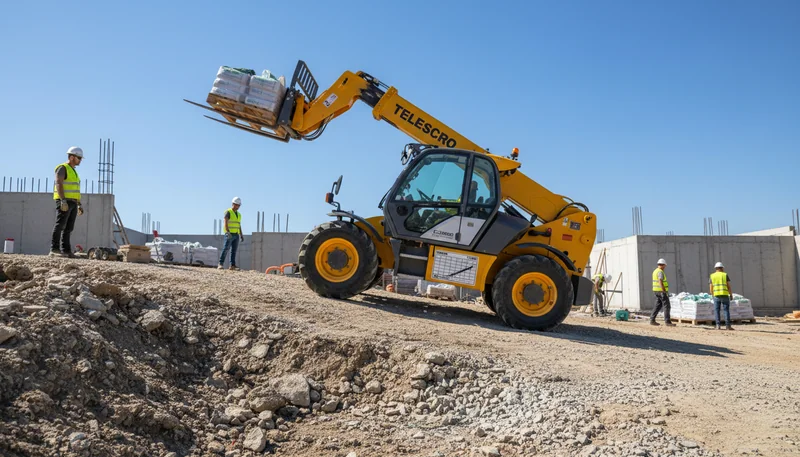
Telehandler Load Charts on Sloped Terrain: What Buyers Need to Know to Avoid Costly Mistakes
I’ll never forget watching a crew in Sweden try to set trusses on a frosty hillside—telehandler looked fine, but as soon as the boom went out, the downhill tires dug in and everyone’s heart rate spiked. More jobsites are on uneven ground than most buyers realize, yet telehandler load charts tell only half the story.
Telehandler load charts are based on manufacturer-specified setup conditions on firm, level ground, within safety frameworks such as EN 1459 and ANSI/ITSDF B56.6. Ratings are verified under controlled configuration (e.g., specified tire inflation and defined axle/steering settings where applicable). Load charts mainly relate boom angle/extension (reach) to allowable load—they do not account for slope, soft ground, wind, dynamic movement, or attachment effects unless the OEM states otherwise.
What assumptions do telehandler load charts make?
Telehandler load charts assume operation on firm, level ground with the machine fully leveled, tires at specified pressure, and all systems functioning per OEM standards. Charts are certified only for controlled conditions—factors like slope, soft soil, wind, or machine movement are not considered in the rated capacity1.

Most people don’t realize that a telehandler’s load chart is designed for “ideal” conditions—it’s certified on firm, level ground, with the machine perfectly leveled and all systems working as intended. I’ve visited job sites in Turkey and seen operators trust the rated capacity even though the machine was parked on gravel with a slight slope. That’s a big risk. The load chart assumes the chassis is level (usually within 3°), the ground is solid enough to fully support all wheel loads, tires are at factory-specified pressure, and the hydraulic circuit maintains proper pressure. If the ground shifts, a tire is low, or the frame isn’t leveled, the real lifting capacity drops—sometimes drastically.
Here’s the thing: load charts map out the safe capacity based only on boom angle, extension, and reach from the front tire edge to the load center. Outside factors—soft soil, slope, strong wind, or if you’re moving the machine—aren’t part of the chart. I’ve seen a contractor in Dubai get caught by this. They tried to lift 2,500 kg at full extension while the machine sat on a 5° cross-slope2. The result? The chassis tilted, and the load nearly toppled—far below what the “on paper” load chart said was possible.
This detail is important for fleet managers and site supervisors: the rated capacity is only valid when every “test stand” condition matches the real world. Anytime you’re on uneven ground or dealing with soft surfaces, count on lower capacity than shown. I always recommend measuring your actual site gradient and ground pressure before trusting the load chart. It’s the surest way to avoid costly mistakes.
Telehandler load charts assume the machine is level to within a small tolerance—typically 3 degrees or less—because even slight slopes can noticeably reduce stability and safe lifting capacity.True
Manufacturers test and certify telehandlers in idealized, level conditions for safe operation. Sloped terrain changes force distribution, increasing the risk of tip-over. Thus, load charts are not valid on inclines, and operators must avoid relying on them when the machine is not close to perfectly level.
Telehandler load charts are designed to account for mildly sloped jobsite conditions, so rated capacities remain accurate even if the ground is not perfectly level.False
Load charts do not factor in any degree of slope; they are calculated for flat, firm, level ground only. Using the rated capacities on uneven or sloped surfaces is unsafe and can lead to equipment overturn or structural failure.
Key takeaway: Load chart capacity is only valid when a telehandler is set up on level, solid ground as specified by the manufacturer. Any operation on a slope or unstable surface means the chart no longer reflects true stability—effective safe capacity will be lower and must be reassessed.
Why Are Telehandler Load Charts Invalid on Slopes?
Telehandler load charts are calculated for level ground, where the machine’s center of gravity3 and load stay predictably within the stability triangle. On sloped terrain, the center of gravity shifts in multiple directions, shrinking the stability margin unpredictably. As a result, the printed load chart is no longer valid, especially at extended reach or maximum boom height.
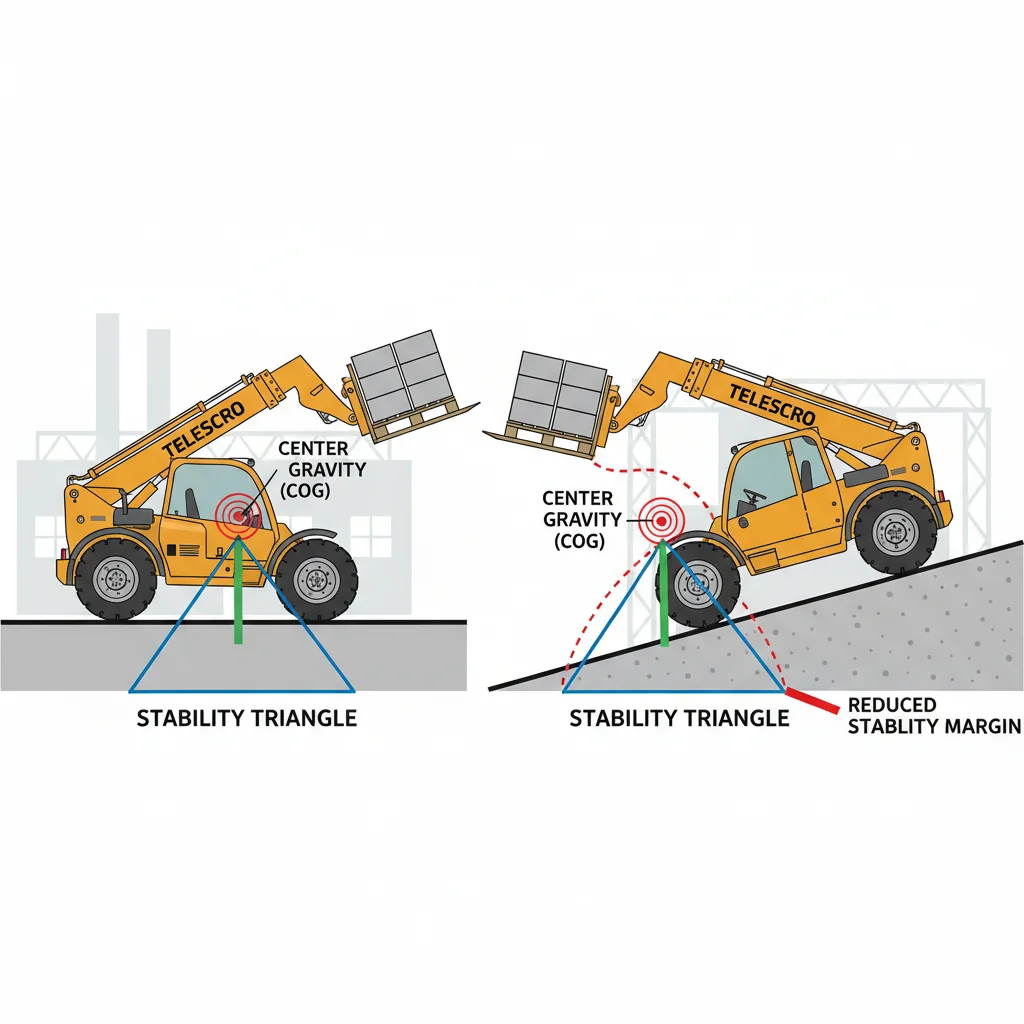
Let me share something important about telehandler load charts and slopes—almost every month, someone messages me from a jobsite in Kazakhstan or the Middle East, asking if it’s “safe to lift a bit less” on a mild slope because the ground seems firm. The reality is, no matter the soil, the published load chart is built only for a level machine—typically with less than 3° of tilt. If you drive onto even a small incline, the machine’s center of gravity doesn’t just move one way. It shifts both downhill and sideways at once, pushing the real limits of the stability triangle in unpredictable ways.
A team I worked with in Dubai tried to use a 4-ton, 17-meter reach telehandler on a sloped ramp, thinking they were under capacity since the load weighed just 2,200 kg. They extended the boom to about 80% of maximum, and the machine felt “wobbly” almost immediately—luckily, their operator backed off in time. The reality is that, on a slope, a telehandler’s practical stability can deteriorate rapidly even when the load is well below charted capacity. The machine’s tires on the downhill side compress more, moving the tipping axis4 closer and drastically narrowing the safety margin.
I always suggest this: before lifting on any jobsite, double-check your level indicator and use frame leveling5 or stabilizers6 if equipped. Never “guess” and reduce the load by eye—slopes make the load chart meaningless, especially with high reach. If the machine isn’t level, don’t trust the numbers. That’s advice that’s saved real equipment—and operators—more than once.
Telehandler load charts are invalid on slopes because even a mild incline causes the machine's center of gravity to shift in multiple directions, making load stability unpredictable.True
Manufacturers design load charts based on perfectly level ground, under tightly controlled conditions. On any slope, both lateral and longitudinal stability are affected, and the shifting center of gravity can lead to tipping risks not accounted for by the standard chart. This compound movement isn't reflected in the published lifting capacities.
Telehandler load charts can be safely applied on slopes as long as the lifted load is reduced proportionally to the angle of the incline.False
There is no safe or standardized way to adjust load chart values for sloped terrain. Loads behave unpredictably on inclines due to complex factors like center of gravity shift and tire traction. Even reducing the load doesn't account for these variables, so applying the chart on a slope is never safe.
Key takeaway: Telehandler rated capacity and load chart values strictly apply only on level ground (typically ≤3° tilt). Even small slopes dramatically alter stability, making OEM load charts invalid. Always level the machine first—never “estimate” safe loads on sloped terrain.
How Do Slopes Affect Telehandler Stability?
Even slight slopes can significantly reduce telehandler stability. Industry safety guidance and stability testing indicate that, under worst-case conditions (such as rated load at full height across a side slope), loss of stability can occur at cross-slopes around 7°—far below the 25–30° many operators assume is safe. Rated capacity applies only on level ground, not on inclines.
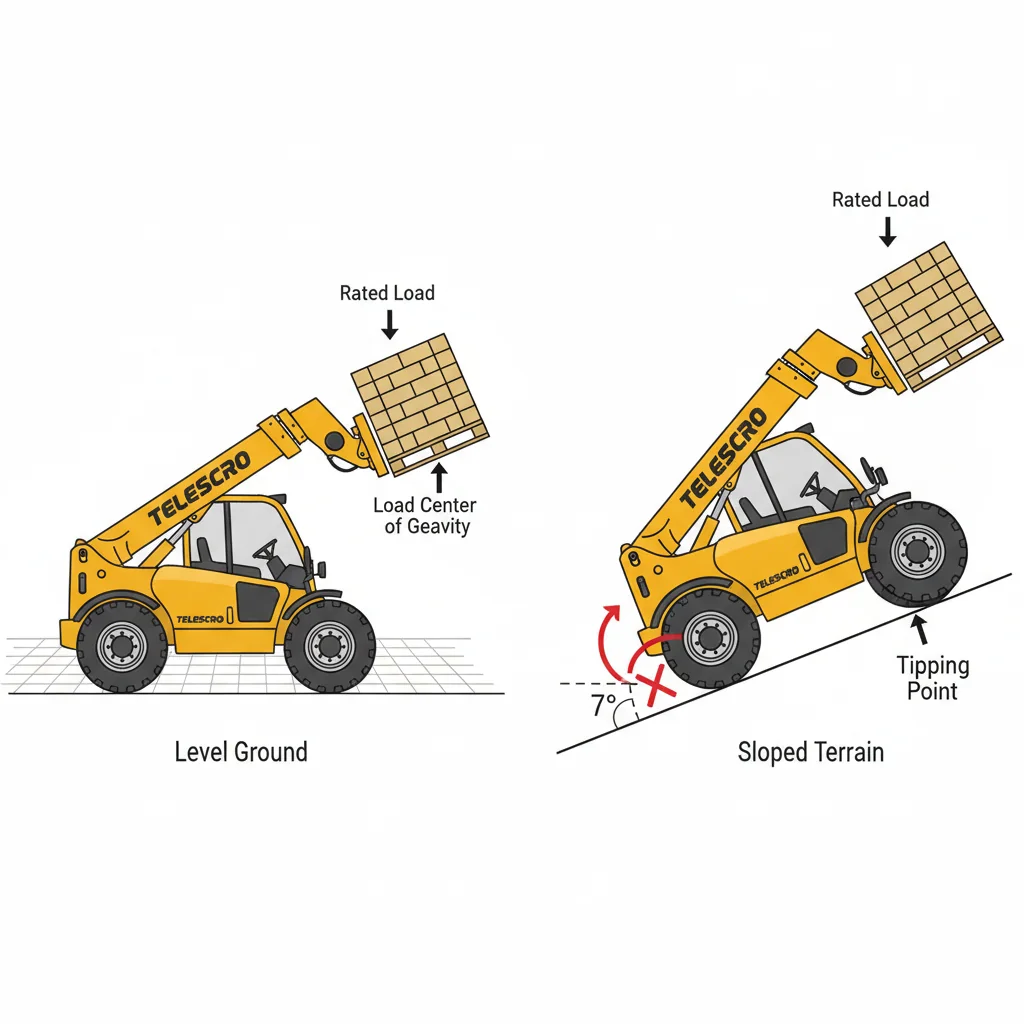
The biggest mistake I see is trusting the rated load chart without checking ground conditions first. I’ve worked on projects from Kazakhstan to Kenya, and this catches out even experienced operators. The rated capacity shown on a telehandler load chart only applies when the machine is properly leveled, within the manufacturer’s allowed tolerance. In the real world, jobsites are rarely that flat.
A 7° cross-slope doesn’t look steep when you’re standing on it, but with a fully loaded telehandler at maximum reach, that can already put you right on the edge of tipping. I’ve seen lab test data that confirms this, and I’ve also seen it happen on site. In one case in Malaysia, a machine slid while handling nothing more than a pallet of bricks—even though the operator believed he was following the load chart correctly.
What really matters when you’re assessing a site is how quickly stability disappears once the ground isn’t level. A small slope can wipe out your safety margin, especially at long reach or when the load is positioned downhill. Most OEMs require the machine to be very close to level for the load chart to apply, and once you get beyond that range, capacity usually needs to be reduced or the lift point moved entirely.
The geometry is working against you. On a slope, the tipping axis shifts, making it much easier for the load to pull the machine forward or sideways. Frame leveling systems help, but they’re not a cure-all—many machines simply can’t compensate if one side is soft or the slope is too great.
I’ve watched crews in Dubai spend hours repositioning just to find a spot flat enough to lift safely. It looks inefficient, but it’s the right call. Personally, I don’t recommend high or long-reach lifts anytime I see more than a few degrees of tilt. That extra patience is often the difference between a routine lift and a serious incident.
Telehandler load charts assume the machine is on level ground, which means their listed capacities become unreliable when operating on sloped terrain.True
Load charts are calculated based on the telehandler being on a surface within a few degrees of level. When on a slope, the balance point and center of gravity shift, so actual capacity can be much lower and risk of tipping increases. This is why load charts don't account for sloped terrain.
Manufacturers include adjustment factors for common slopes directly in standard telehandler load charts so operators can compensate on uneven ground.False
Standard telehandler load charts are designed only for level conditions. Operators are responsible for recognizing and accounting for sloped ground; manufacturers do not provide slope adjustment factors on load charts because the variation in site conditions is too great to standardize.
Key takeaway: Telehandler rated load charts assume level ground—working on slopes above 3–5° quickly erodes safety margins, even with a load chart followed. Treat spots over a few degrees of tilt as ‘no lift’ zones for high or long-reach work unless you can level the machine.
Why Aren’t Telehandler Load Charts Rated for Slopes?
Telehandler manufacturers do not publish rated capacities for sloped terrain because stability on inclines7 involves too many variables: slope angle and direction, boom and load position, tire compression, soil conditions, and machine motion. Safety standards require rated capacity to be specified only for level, firm ground to avoid misapplication and legal risk.
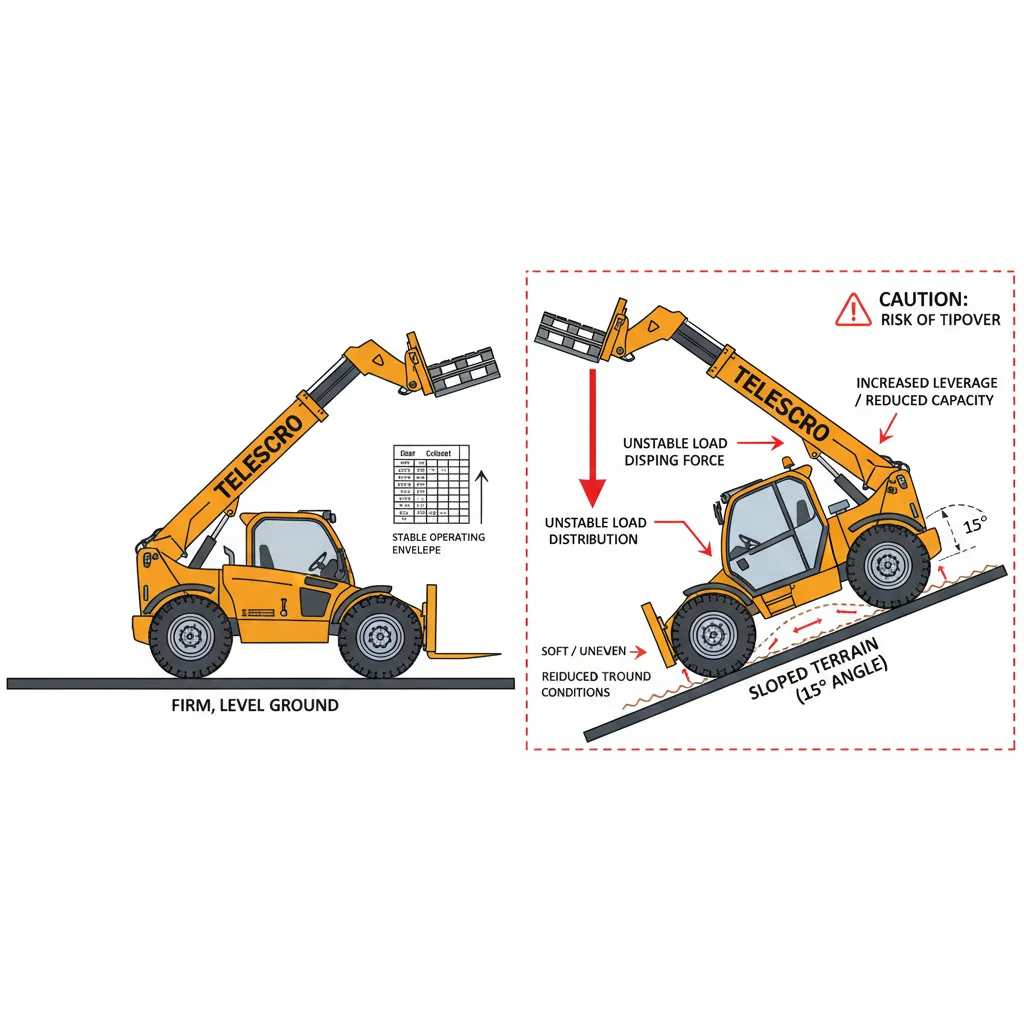
Here’s what matters most when you look at telehandler load charts—those capacity values aren’t rated for slopes, and there’s a good reason. As soon as you put a telehandler on an incline, too many things change: the direction and angle of the slope, where your boom is pointing, how far it’s extended, and even what happens if the soil gives a little under one tire. Engineers have run the calculations, and to be honest, there’s no simple way to cover all those variables in a single chart. The standards only allow manufacturers to rate capacities for ground that’s level—usually within 3° of tilt—because that’s the only situation you can control and reproduce everywhere.
Last year in Dubai, I worked with a contractor building a logistics warehouse on reclaimed land. The jobsite looked flat but actually had a consistent 5° cross-slope near the back wall. They tried to use the telehandler’s standard load chart for lifting 2,500 kg pallet loads up to 10 meters, assuming they had margin. What happened? The operator felt instability the moment he slewed the boom sideways—the moment indicator alarmed, and they had to stop the lift. The team realized the load chart didn’t mean much once the ground wasn’t level, especially when dynamic moves like turning or braking come into play.
I always recommend leveling the telehandler with frame adjustment or stabilizers before lifting—don’t try to “interpret” the chart for slopes. Rated capacity depends on the machine being level and stable. Anything else is guesswork and risks a tip-over. If your ground isn’t within the manufacturer’s leveling limit, treat capacity numbers as invalid until you fix the surface.
Telehandler load charts are based solely on level ground because stability calculations become unpredictable when the machine is positioned on a slope.True
When a telehandler is on an incline, the forces on the stabilizers and tires shift, making reliable capacity predictions impossible. Manufacturers must ensure published load ratings are safe and repeatable, which they can only do for level conditions.
Telehandler load charts include reduced capacity ratings for operating on moderate slopes up to a certain degree.False
No manufacturer provides official capacity reductions for operation on slopes in their load charts. Due to the complexity and variability of real-world slope conditions, it's not possible to include such ratings safely in standardized documentation.
Key takeaway: Telehandler load charts only apply to level, firm surfaces because slope conditions introduce unpredictable stability risks. Rated capacity assumes the machine is leveled within manufacturer limits (typically ≤3°). Creating level conditions before lifting is essential—never apply load chart values directly to sloped terrain.
How do frame leveling and stabilizers affect load?
Frame leveling and stabilizers are intended to bring the telehandler back to a level setup before lifting, not to extend rated capacity onto steeper terrain. Load charts apply only when the machine is within the manufacturer’s specified leveling tolerance. Adjust and level the chassis with the boom in a low carry position; never attempt to correct tilt or deploy stabilizers mid-lift.
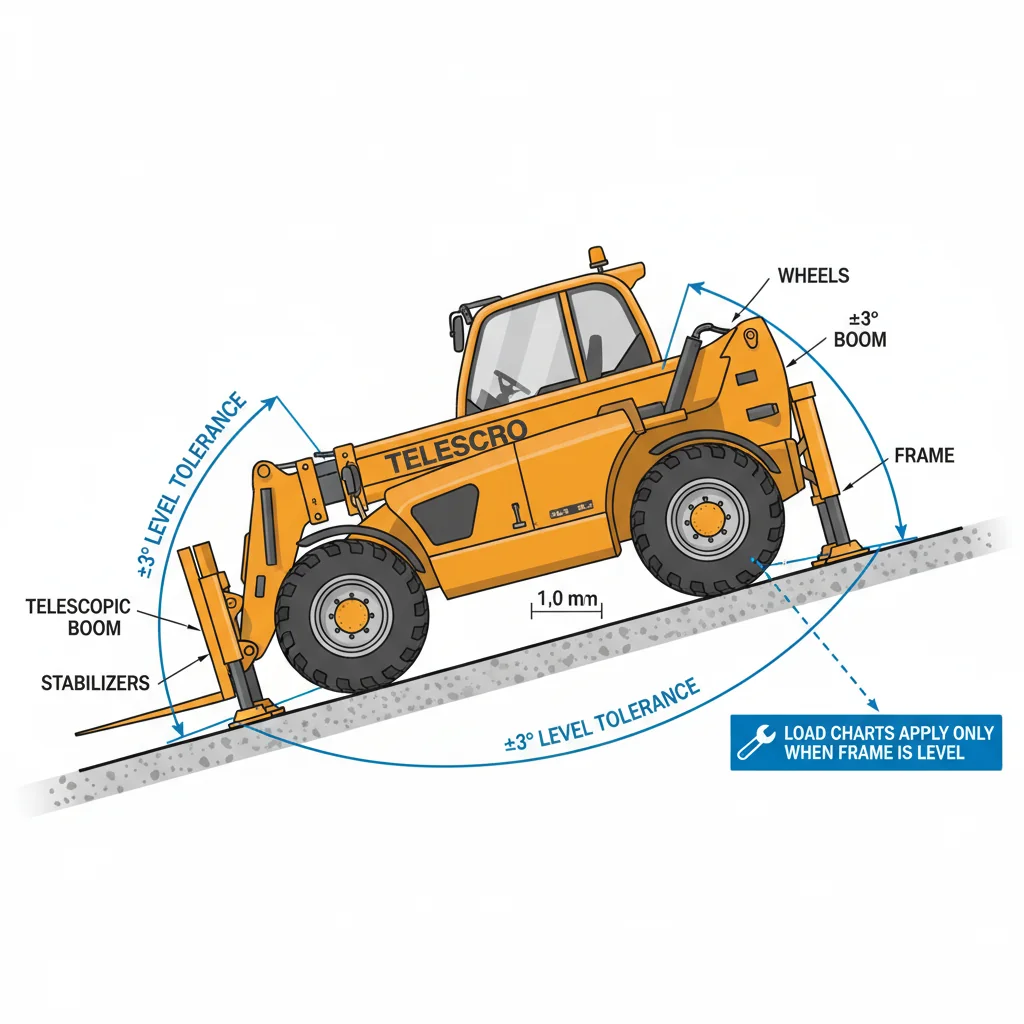
Last month, a contractor in Kazakhstan reached out after nearly tipping a 4-ton telehandler on a sloped entry road. They tried to use the frame leveling feature to “cheat” the slope and go ahead with their lift. The reality is, frame leveling and stabilizers are not magic—these systems are designed to bring your machine back to a level condition, nothing more. The load chart only applies when the chassis is within the manufacturer’s specified limit, usually within ±3°, and that’s non-negotiable.
From my experience, the biggest risk comes when teams try to adjust the frame with the boom already raised. That’s a recipe for instability, especially if your load is high or extended. Industry guidelines are very clear: always lower the boom to below 1.2 meters—roughly waist height—before touching leveling controls or deploying stabilizers. I’ve seen operators try to tweak the machine mid-lift, only to lose stability and end up with a near-miss that could have been far worse.
It’s also important to understand how stabilizers (those hydraulic support legs up front) work. On most standard high-lift models, you only get the “on stabilizers” ratings if you’re using them correctly on solid, level ground—and only when a specific chart says so. There is no extra capacity bonus just because stabilizers are down. If you can’t get the machine within the allowed level range at your location, the answer isn’t to force the lift. Move the machine, adjust the ground, or use another method—never push past what’s proven safe. I always suggest double-checking your setup before every key lift.
Frame leveling systems on telehandlers are designed to correct the machine's orientation within a small range, typically limited to around ±3°, to ensure the load chart remains valid.True
Telehandler load charts are only accurate when the chassis is close to level, since even small deviations can shift the center of gravity and compromise stability. Frame leveling provides minor adjustments to maintain this critical margin, but does not authorize operation outside the prescribed limits.
Stabilizers allow a telehandler to safely lift maximum capacity loads even if the chassis remains on a noticeable side slope.False
Stabilizers increase stability but do not compensate for the risks introduced when the chassis is not level. Load charts assume the machine is on level ground, and stabilizers do not override the necessity for the telehandler to be within its specified leveling tolerance.
Key takeaway: Frame leveling systems and stabilizers ensure the telehandler meets the level condition assumed by OEM load charts. They do not permit operation on steeper slopes or increase rated capacity beyond tested conditions. Always level the machine prior to lifting and strictly follow manufacturer guidelines.
How do telehandlers become unstable on slopes?
Telehandlers face increased tipping risk on slopes due to both static and dynamic forces. Driving across or diagonally on a hill shifts the center of gravity downhill; acceleration, braking, or hitting ruts can move it past the tipping line—especially with the boom raised or a swinging load, making rollovers much more likely.

I’ve worked with operators in Turkey and Brazil who underestimated how quickly a telehandler can become unstable on slopes. The first risk comes the moment you leave level ground—just parking on a 7° cross-slope is already outside most manufacturers’ safe limits, which are usually restricted to 3° or less. Now imagine driving across that slope with a pallet of blocks. The center of gravity shifts toward the downhill wheels, which moves the tipping axis toward the edge. That’s the danger point.
Let me share a real jobsite scenario: in western Kenya, a team tried to move steel bundles diagonally across a dirt incline, boom halfway up. As soon as they hit a rut and braked slightly, the load swung forward and the telehandler tipped—luckily, the operator managed to drop the load just in time to prevent a full rollover. What happened? The combination of static slope, boom position, and dynamic force from braking pushed the center of gravity past the tipping axis formed by the front wheels.
Here’s what matters most when you’re planning slope work. The rated load chart assumes perfectly level ground—typically no more than 3° tilt. No manufacturer covers “moving load on a hill, boom raised” in their specs. That means any movement (turning, stopping, raising the boom) can turn a stable position into a rollover risk in seconds. I always recommend keeping the boom as low as possible, travel straight up or down (never across), use low gear, and keep the load tilted back. When in doubt, keep the heavy end uphill. That’s saved more than one project from a costly accident.
Telehandler load charts do not account for sloped terrain because stability calculations are based on perfectly level ground, as even minor deviations from level can alter the center of gravity and introduce tipping risks manufacturers cannot safely quantify for every scenario.True
Load charts assume ideal conditions with the telehandler on flat, level ground, because the dynamic forces and shifting centers of gravity on slopes make it impractical for manufacturers to provide universal safe capacities on sloped surfaces. This is why operators must not rely on load chart ratings when working on inclines.
Load charts for telehandlers include compensation for moderate cross-slopes by automatically reducing rated capacities in those situations.False
Telehandler load charts do not provide derated capacities for work on sloped ground; they assume the machine is level. There are no automatic adjustments or allowances in the chart for working on inclines, so any slope invalidates the listed load ratings.
Key takeaway: Slope travel with a telehandler introduces dynamic forces that can rapidly shift the center of gravity, especially on uneven ground or with the boom raised. Load charts do not account for movement, so best practice is to minimize slope travel, keeping the heavy end uphill and boom low.
How do telehandler load charts apply on slopes?
Telehandler load charts assume rated capacity on level, firm ground—typically within a 3° tilt limit. On sloped or irregular terrain, standard rated capacities do not apply. Safe lift planning requires first determining if the machine can be leveled at the actual load placement site, using grading or engineered platforms as needed.

Here’s what matters most when you’re planning a telehandler lift on a slope. The load chart in the manual only applies when the machine is properly leveled, within the manufacturer’s allowed tolerance. In practice, that usually means the telehandler must be very close to level. Those rated capacities—shown for every reach and height—are calculated on flat, compacted ground, not on a dirt ramp or along a foundation edge.
If you try to use the standard chart numbers while the machine is parked on an incline, you’re not working within a defined safety margin—you’re guessing. I’ve seen crews in Kazakhstan try to “make it work” with a telehandler sitting on about a 6° slope. The load chart stopped being meaningful, and they nearly tipped a 3.5-ton machine forward at only half boom extension.
Every safe lift on a sloped site starts with one basic question: can you create a level working platform where the telehandler actually needs to operate? Sometimes that means grading a pad. Other times it means adding compacted fill or building an engineered base with steel plates or heavy timber mats. On one project in Dubai, we built a cribbed platform designed to carry more than 6,000 kg per wheel. It took one day to prepare and cost less than a fraction of what a damaged machine—or an injury—would have cost the job.
Operators should never eyeball a slope and guess what capacity might be safe. If you can’t achieve level ground at the lift location, the right move is to change the plan—shift material drop points, bring storage closer, or use equipment designed to work safely on slopes, such as a crawler crane. From my experience, that decision almost always saves time and money in the long run.
A telehandler load chart is only accurate when the machine is level within a small margin, typically around 3 degrees, because being on a slope drastically shifts the machine’s center of gravity and stability envelope.True
Load charts are calibrated under controlled, level conditions since even minor inclines can significantly affect the telehandler's stability and tipping point. Slope positions alter how the load’s weight is distributed, potentially causing the machine to become unstable far before charted limits are reached.
Manufacturers include alternate load charts in the manual for common slopes to help operators plan safe lifts on uneven terrain.False
Telehandler load charts are only provided for level ground. Manufacturers do not supply charts for sloped conditions because there are too many variables—like soil compaction, slope direction, and tire configuration—that make standardized ratings unreliable and unsafe.
Key takeaway: Telehandler load charts only apply to level ground conditions. On sloped terrain, operators cannot rely on rated capacities and must use engineered solutions or alternative equipment. Planning lifts on inclines is an engineering problem and must never be based solely on operator judgment or standard load chart data.
What Features Aid Telehandler Use on Slopes?
Telehandlers intended for sloped or uneven terrain benefit from features such as a wide frame-leveling range8 (for example, around ±8–10° on some models), automatic axle oscillation locks, stabilizers supported by clear load charts, and in-cab tilt indicators or digital inclinometers. Advanced load moment indicators with inclination sensing can further assist, but correct setup and operator training remain essential.
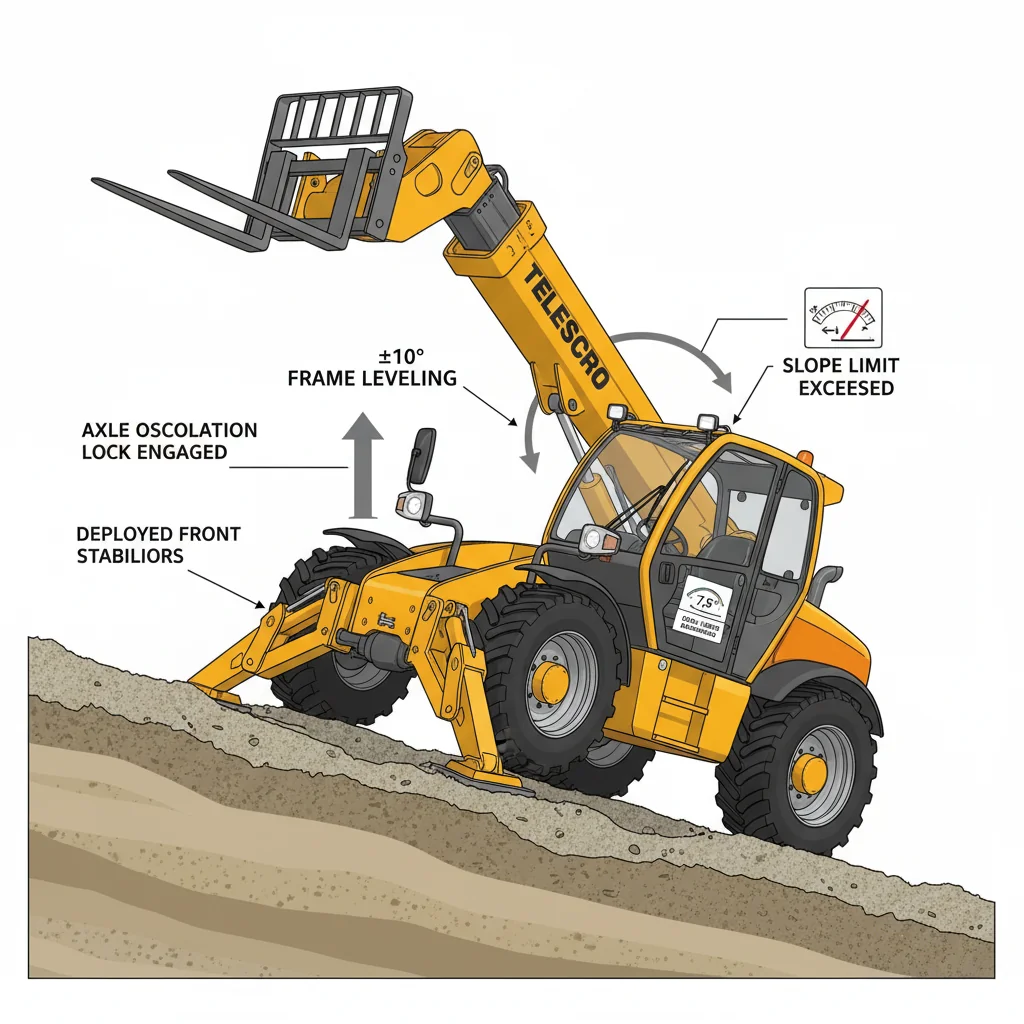
To be honest, the spec that actually matters is how well your telehandler lets you correct and monitor for uneven ground—not how big the load chart looks in a brochure. On real jobsites, keeping the machine level and stable is the foundation for safe lifting. I still see teams in Turkey and Kenya struggling because they focus on capacity at full height, but miss out on practical features that genuinely help manage slopes.
If you know your projects often mean working on uneven or sloped terrain, I always suggest looking for these features:
- Frame leveling system with a wide range (usually ±8–10°): This lets you actively adjust the chassis before picking any load. On a job in Brazil, a ±10° frame-leveling range made the difference between smooth progress and repeated delays. – Automatic axle oscillation lock9: As soon as you lift the boom, this system locks the rear axle so your stability envelope doesn’t shift unexpectedly.
- Effective stabilizers paired with clear load charts: Good telehandlers show separate ‘on tyres’ and ‘on stabilizers’ ratings. Make sure the stabilizer capacity covers your most frequent loads—don’t settle for charts that only look good when every leg is deployed.
- In-cab tilt indicators or digital inclinometers: The best operators I’ve seen in Dubai use these tools to check they’re always within the safe angle, especially on cross slopes. Advanced load moment indicators with inclination sensors are becoming standard and can help warn or block dangerous movements.
Automatic frame leveling systems in telehandlers allow operators to correct up to several degrees of machine tilt without repositioning, which enhances stability and safety on uneven ground.True
Frame leveling systems use hydraulic rams to adjust the chassis, letting the operator keep the upper frame and boom level even when parked on a slope. This is crucial for both load stability and safe load handling, especially since even slight lateral tilt greatly affects capacity and rollover risk.
Telehandler load charts always include safe working capacities for different grades of sloped terrain, ensuring operators can evaluate loads no matter the ground angle.False
Standard telehandler load charts are based on testing done on level, firm ground. They do not account for sloped or uneven surfaces, so actual safe capacity can be much lower on a slope. It's up to the operator to factor in site conditions, as manufacturers do not supply de-rated charts for sloped terrain.
Key takeaway: Selecting telehandlers with robust frame-leveling, tilt monitoring, and stability assist features can reduce human error and enhance safety on slopes. However, these technologies support—not replace—thorough site preparation and adherence to best operational practices when lifting on uneven ground.
Does gradeability affect safe telehandler lifting?
Gradeability indicates a telehandler’s ability to travel up slopes, not its safe lifting limits. Lifting operations are governed by far stricter criteria: rated capacity applies only when the machine is level (typically within ±3°). Safe lifting on slopes requires the machine to be leveled, not simply capable of driving the incline.
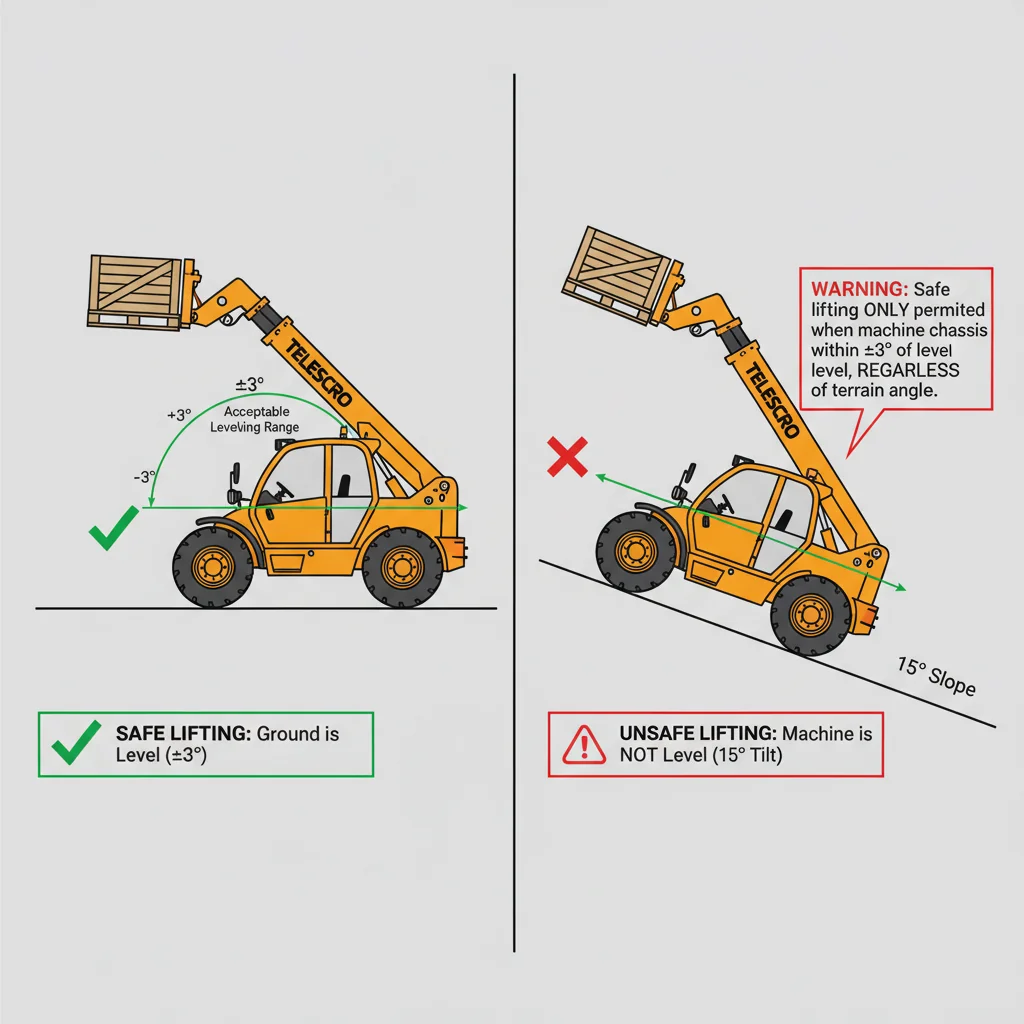
I’ve worked with customers in Kenya and Brazil who assumed that a telehandler rated for 40% grade could pick and place loads safely anywhere the machine could drive. That’s a risky misunderstanding. Gradeability is just the measure of how steep a slope the machine can physically climb with the boom retracted and no load raised. It has nothing to do with safe lifting while positioned on that slope. The reality is, a telehandler’s rated capacity—the number shown on the load chart—applies only when the machine is level, usually within three degrees front-to-back and side-to-side.
On actual jobsites, I’ve seen teams try to set out pallets of blocks on a ramp just because their telehandler could drive up it. One site in Dubai almost tipped a 3.5-ton machine trying to lift on a compacted slope. No manufacturer supports this—lifting on that angle shifts the center of gravity and can make the machine unstable fast, even if you’re under the maximum rated load. The sensors on many machines just sound an alarm or cut out if they detect too much tilt, but safety starts with setup, not electronics.
The best practice—and the instruction in every manual I’ve worked with—is to level the telehandler before raising the boom. Use stabilizers or leveling jacks if your model has them, or reposition to firm, flat ground. Always check the manufacturer’s load chart for information about lifting tolerance. I always remind customers: just because a telehandler can climb a slope doesn’t mean it can safely lift on it. Keep travel and lift decisions separate—the difference matters more than many people think.
Telehandler load charts are calculated for stable, level ground only, and using the rated capacity on a slope can drastically reduce stability, even if within the machine’s gradeability limit.True
Load charts assume ideal, level conditions because lifting on a slope shifts the machine’s center of gravity, increasing tip-over risk regardless of gradeability. This means a telehandler’s ability to climb does not equate to safe lifting capacity on inclines.
A telehandler's load chart automatically factors in the angle of any slope the machine is positioned on, so operators do not need to adjust rated loads for sloped terrain.False
Load charts do not account for sloped or uneven ground; they only apply to flat, stable surfaces. Lifting on a slope without reducing capacity is dangerous because it ignores the impact of shifting center of gravity and decreased stability.
Key takeaway: Gradeability and lifting stability are distinct concepts. Gradeability reflects travel competence, while rated lift capacity demands a level machine. Never assume a telehandler’s ability to climb a slope means it can lift loads there—always reference the load chart and manufacturer’s leveling requirements.
What Are Hidden Costs of Sloped Operation?
Operating telehandlers on sloped terrain exposes fleets to significant hidden costs. Even without a tip-over, repairs driven by component strain, accelerated tire wear10, and lubrication or driveline issues can easily escalate into five-figure expenses per incident, depending on machine size, parts availability, and downtime. Chronic misuse increases maintenance frequency, while injury-related legal and insurance costs can far exceed equipment hire or preventive ground preparation.

The biggest mistake I see is assuming a telehandler will handle slopes just because “it’s only a few degrees.” Most load charts—and every rated capacity you see—are based on level, solid ground. If you push the limits on a jobsite with a 7° or 8° incline, the risks aren’t just about tipping. Even when there’s no rollover, the repair bills pile up. In one case from Brazil, a team worked on sloped clay all week. By the time the project ended, the uphill tires were showing sidewall cracks, and one boom pivot had a small oil leak. That repair—plus downtime—ran over USD 17,000. And they didn’t even tip the machine.
I’ve seen even worse in Dubai, where a contractor insisted on “making it work” with a 5-ton unit on ungraded sand. After a month, downhill tire replacements and a bent axle added nearly USD 24,000 in costs. That doesn’t include how much time was lost waiting for overseas parts. Chronic misuse like this speeds up tire wear, bends frame components, and causes odd hydraulic failures11 from oil sloshing away from the pickup. The machine ends up spending more time in the workshop than on site.
To be honest, the cost of grading a jobsite or bringing in mats is usually much lower—often just a few thousand dollars. I always recommend budgeting for basic ground prep or, if the slope is unavoidable, considering an alternative lifting method. It may look like an “extra” at first. But neglecting it often leads to the kind of repair bills no fleet manager wants.
Telehandler load charts do not account for sloped terrain because ratings are derived from laboratory tests conducted on level, compacted surfaces, and even mild inclines can shift the load center, causing structural stress and unpredictable tire wear.True
Manufacturers base all rated capacities on ideal, flat conditions to ensure that comparisons between models are standardized and risk is minimized. On a slope, both static and dynamic forces change—the load center shifts, increasing stress on the boom and chassis, and tires can experience side-loading not accounted for in standard testing. This makes actual performance and wear very different from what the chart suggests, leading to hidden durability and maintenance costs.
Sloped operation is factored into standard telehandler load charts, so as long as you remain within charted limits, you do not need to worry about extra wear or safety risks.False
Standard load charts are calculated for level, firm ground; they do not include allowances for sloped or unstable terrain. Operating on inclines introduces additional risks such as shifting loads, stability issues, and uneven tire and chassis stress, all of which can cause damage or lead to unsafe conditions—even if you remain 'within' the listed capacities.
Key takeaway: Attempting to use telehandlers on sloped terrain frequently leads to overlooked costs, from major repair bills to accelerated component wear and injury liabilities. Proactively investing in ground preparation or alternate lifting methods generally results in lower long-term expenses and reduced operational risk.
Conclusion
We’ve looked at why telehandler load charts only apply when the machine is on level, stable ground—and how anything less changes the real capacity you can count on. From my experience, focusing only on max lifting specs is the classic "3-meter blind spot" buyers fall into. I always recommend checking how the load chart changes when you’re working on a slope—it makes a big difference to safe operation and project planning. If you have questions about load charts, attachments, or which telehandler actually fits your job needs, just reach out. I’m happy to share what’s worked (and what hasn’t) for crews in all sorts of conditions. Every jobsite is different, so choose practicality over showroom numbers.
References
-
Explains how rated capacity applies only on level ground and the safety risks of ignoring site slopes with expert insights and case studies. ↩
-
Provides detailed data on tipping risks starting as low as 7° cross-slopes, helping operators understand critical stability limits. ↩
-
Explores how center of gravity shifts increase tipping risks for telehandlers on slopes, essential for safe operation and load management. ↩
-
Details the tipping axis concept and its role in telehandler rollovers, important for operators handling loads on uneven terrain. ↩
-
Explains how frame leveling restores machine balance, critical for safe lifting on uneven terrain, avoiding tips and accidents. ↩
-
Detailed insights on hydraulic stabilizers’ function in leveling and supporting loads, essential for operator safety and machine integrity. ↩
-
Offer an in-depth discussion of how variables such as slope angle and soil conditions affect equipment stability, helping operators understand the safety hazards associated with slope operations. ↩
-
Provide a detailed explanation of how frame leveling range works and why it is critical for safe operation on slopes, helping users select lifting equipment suited for uneven terrain. ↩
-
Offer an in-depth analysis of how automatic axle oscillation lock systems engage the rear axle during boom lift operations, ensuring machine stability and safe real-world operation. ↩
-
Explore the factors behind accelerated tire wear on sloped terrain and how it drives costly maintenance and downtime in equipment fleets. ↩
-
Understand how oil sloshing and strain on components during sloped operations lead to hydraulic failures, impacting reliability and repair costs. ↩