











Telehandler Load Charts on Job Sites: Field-Tested Use & Mistake Prevention
At a muddy site in South Africa last month, I watched a crew argue over whether their telehandler could safely lift a steel frame to the fourth story. Most of the team trusted the “max capacity” from the brochure. One operator quietly unfolded the load chart1—he’s the only one who got it right that day.
A telehandler load chart2 defines the machine’s rated lifting capacity envelope for specific boom positions (angle/extension) and approved attachment configurations. Rather than a single “max” number, it shows allowable loads across the working range under standards such as ANSI/ITSDF B56.63 or EN 1459. The ratings assume the OEM-tested setup—firm, level supporting surface, correct tires and inflation pressure, the specified attachment, and the stated load center4.
What Does a Telehandler Load Chart Show?
A telehandler load chart shows the rated operating envelope where the machine can safely handle specific loads at defined lift heights and reaches, measured from the front face of the front tire to the load center. Chart zones indicate the maximum rated capacity5 at each reach–height combination, not the machine’s usable capacity in all conditions, as explained in the difference between rated and usable capacity6. These ratings are established through standardized stability testing and assume level supporting ground, the specified load center, and the approved attachment. Any lift outside the chart envelope requires changes to the setup, load, or equipment selection.
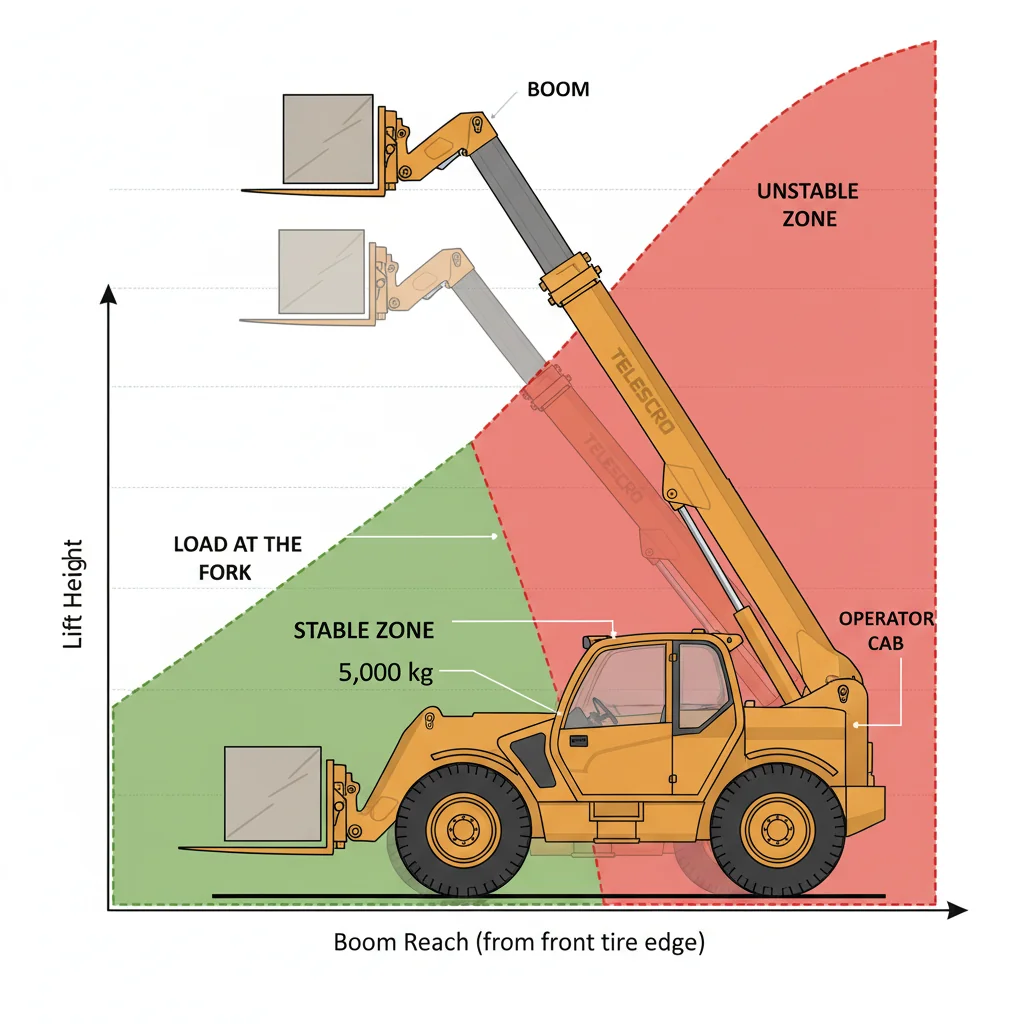
Most people don’t realize how strict a telehandler load chart really is. It is not a rough guide or a general “best practice”; it represents the OEM’s rated operating limits for the specific machine and configuration. The chart defines the approved operating envelope, showing where the telehandler can safely handle particular loads at given heights and reaches under tested conditions.
On most charts, the horizontal axis represents reach measured from the front face of the front tire to the load center, while the vertical axis represents lift height relative to the supporting surface. Each zone or cell on the chart—often labeled A, B, C, and so on—shows the maximum rated capacity for that exact boom position. These ratings apply only when the stated assumptions are met, including firm, level supporting ground, the specified attachment, the stated load center (as shown on the chart), and correct tire type and inflation pressure.
I’ve helped teams in Dubai and Malaysia who got tripped up by this—one tried to lift a 2,300 kg pallet at 12 meters on a 4-ton machine. On paper, they thought they were fine. But when they checked the chart, the true safe limit at that height and reach was just 1,400 kg. The moment you plan a pick outside the chart—maybe you’re on a slope, or using extra-long forks—you fall outside tested boundaries. No operator in those cases can “make it work” safely.
Here’s the thing: if your lift doesn’t fit inside the chart, you have to adjust your plan. That might mean moving the telehandler, lightening the load, or even switching to a different model. I always recommend checking the chart for your actual boom position and attachment before every lift. It’s the only way to guarantee both safety and compliance.
A telehandler load chart provides specific operating limits based on both the boom angle and the distance from the machine’s front tires to the load, ensuring that stability is maintained throughout the full range of motion.True
This is true because the load chart incorporates both horizontal reach (from the front tire edge to the attachment) and vertical lift height or boom angle to determine maximum safe loads for various positions, directly impacting the telehandler’s stability and legal operation.
A telehandler can safely lift any load shown on the load chart, regardless of whether it is fitted with different attachments such as buckets or pallet forks.False
This is false because load chart capacities are specific to both the telehandler model and the particular attachment being used. Using a different attachment can change the weight distribution and center of gravity, which may reduce the safe operating limits indicated on the chart.
Key takeaway: Telehandler load charts are legal limits, not guidelines. They map machine stability by reach and height under specific test conditions. Operators must strictly follow the chart; any lift outside its boundaries is prohibited and requires adjusting the plan, configuration, or equipment to ensure safety.
How should operators read telehandler load charts?
Operators must determine the total load weight—including pallets, rigging, and accessories—before consulting the telehandler load chart. By locating the intersection of required lift height and reach (measured from the front face of the front tire to the load center), operators can identify the rated capacity under the chart’s stated assumptions, typically firm, level ground. In real jobsite conditions, operators should avoid working at the edge of the charted envelope and maintain an appropriate safety margin based on site conditions and company operating policy.
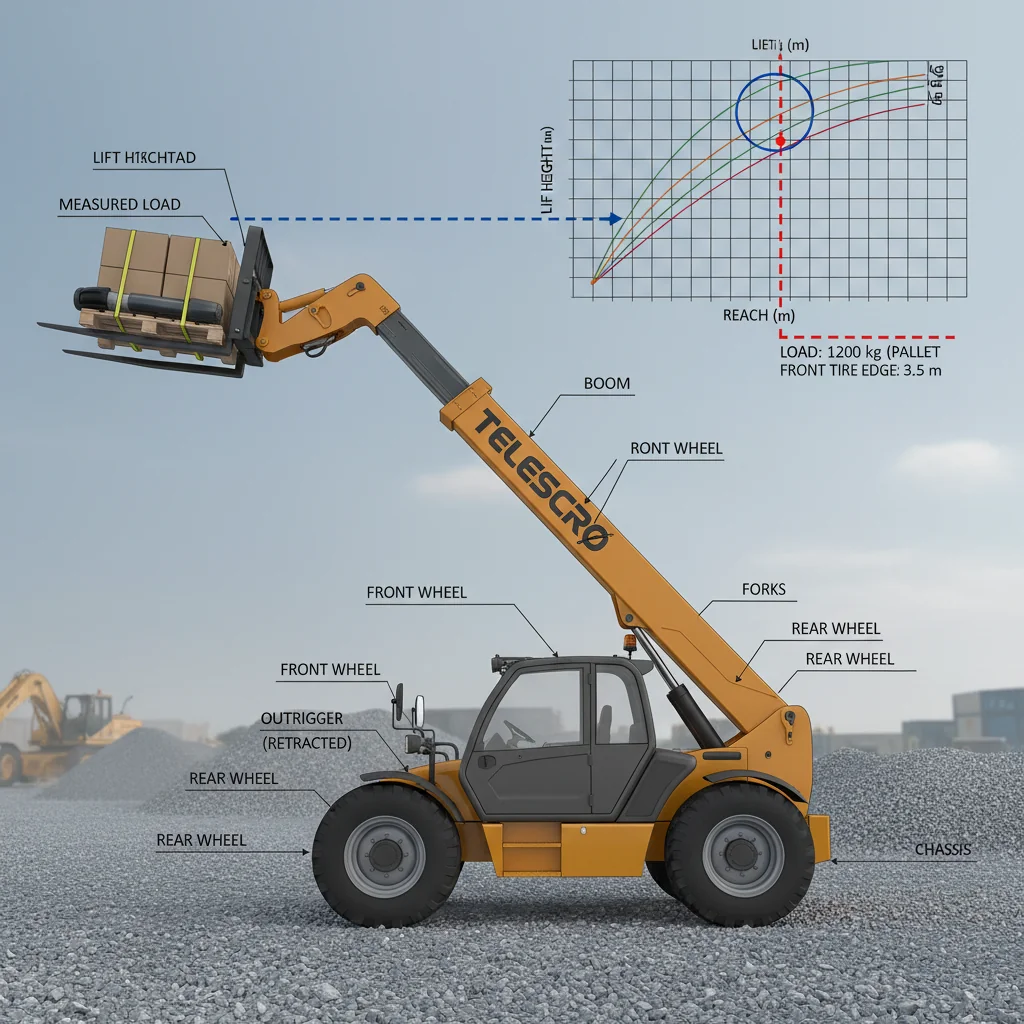
Let me share something important about reading telehandler load charts—getting it wrong puts both people and machines at serious risk. First, you have to know your actual load weight. I don’t just mean the material on the pallet. I mean everything: pallet, rigging, slings, winch—every kilo counts. Last year, a crew in Kazakhstan asked why their 3.5-ton telehandler kept tripping its load moment system before reaching full height. Turned out, their supposed 1,800 kg “load” actually weighed over 2,100 kg once the attachment and pallet were included.
The next step is checking lift height and reach. A common mistake I see is measuring reach from the boom or fork tip instead of the front tire edge. OEM load charts specify reach as the distance from the front tire edge to the load center. If your load sits further out—say with long forks or an unusual attachment—capacity drops fast. On a typical 4-ton machine, rated capacity at max reach (for example, 13 meters out) might be just 450–600 kg, even though the chart shows 4,000 kg at its shortest reach.
Now, remember: load chart ratings are developed under the assumption of a firm, level supporting surface as specified by the manufacturer. Real jobsites are rarely ideal. Uneven ground, minor settlement, or surface deflection can significantly reduce stability—especially at longer reaches. For this reason, operators should avoid working at the edge of the charted operating envelope. If a lift requires pushing the rated limits just to get the job done, it’s a signal to stop and reassess: reposition the machine, reduce the load, improve ground support, or select a higher-capacity telehandler. Maintaining margin within the rated envelope protects both equipment and personnel.
Telehandler load charts often indicate different lifting capacities depending on how far the boom is extended and at what angle, so operators must read both the horizontal reach and vertical height axes to determine the safe load limit at any given position.True
Load charts provide a grid or table format that shows how capacity changes with boom extension and angle. Failing to check both axes can result in exceeding limits, as the same load may be safe at low extension but unsafe when the boom is longer or raised higher.
If the load being lifted is under the rated maximum capacity listed anywhere on the telehandler’s load chart, the machine is always operating safely within its limits.False
The safe lifting capacity of a telehandler changes depending on the boom's position and extension. Even if a load is below the highest number shown on the chart, it could exceed safe limits at certain heights or reaches. Always refer to the specific cell in the load chart matching the boom and load configuration.
Key takeaway: Telehandler load charts require knowing exact load weight and placement specifics. Always measure reach from the front tire edge to the load center, and only use the charted rated capacity on level ground. In real-world conditions, treat any lift above 75–80% of charted capacity as high risk.
Why Does Telehandler Capacity Drop With Reach?
Telehandler rated capacity7 drops as reach increases because the load’s center of gravity moves farther from the tipping axis, dramatically increasing overturning moment and reducing stability. Load charts specify safe lifting limits at each height and reach; referencing only ‘max capacity’ leads to serious operational errors and tip risks.
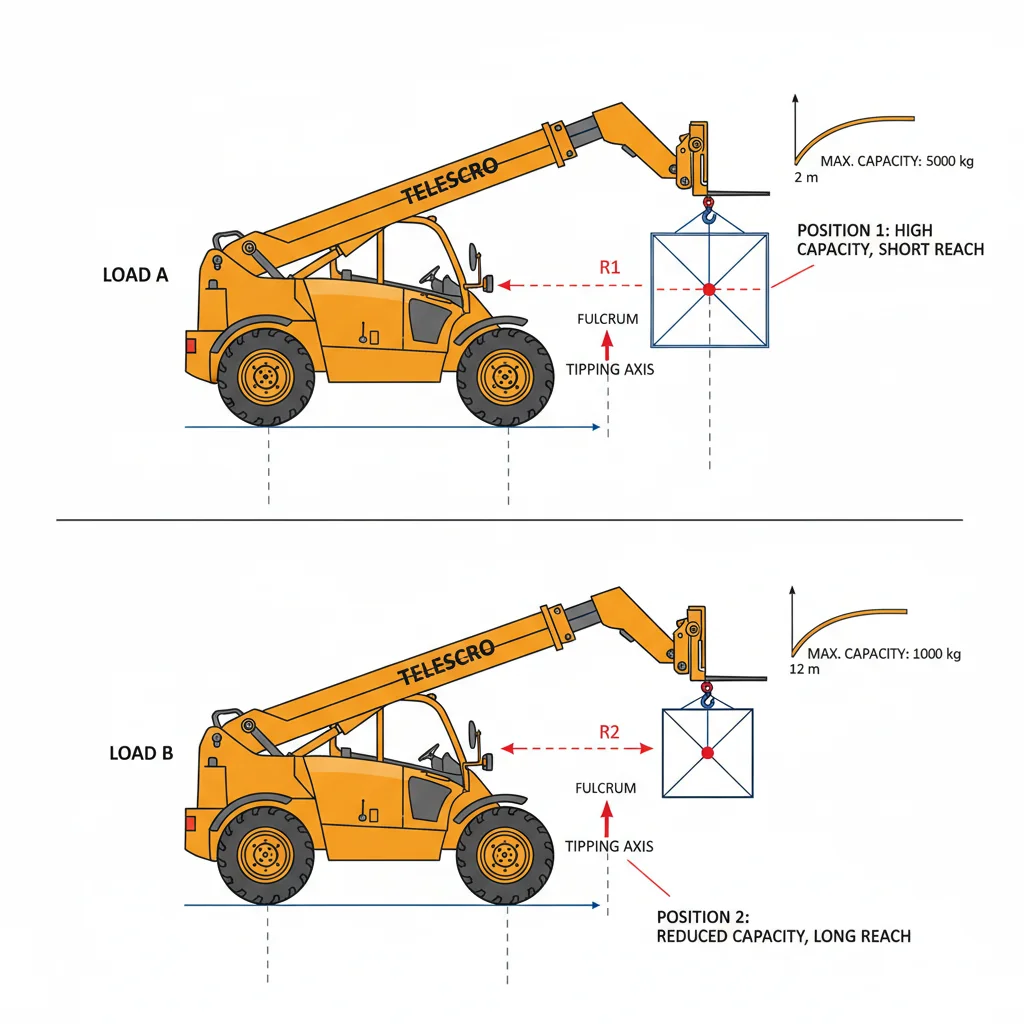
The biggest mistake I see is people focusing only on a telehandler’s “4-ton” or “5-ton” rated capacity—then getting surprised when that figure drops to one-third at full reach. The truth is, a telehandler boom works like a giant lever. As you extend the boom, the load’s center of gravity moves farther from the front tire edge, which is your tipping axis. That means the overturning force multiplies with every extra meter. I’ve helped a project team in Dubai plan for 4,000 kg steel pallet lifts, only for them to face a shock when their 18-meter machine handled less than 1,200 kg at 14 meters reach—well below their routine load.
Here’s what matters most on site: the load chart, not the glossy brochure number. This chart shows how much you can safely lift at each height and reach. On one standard 17-meter model, you start with 4,000 kg “on paper,” but hit just 900–1,200 kg past 12 meters out. All those numbers assume you’re on level ground, with the correct attachment, and the load right at the manufacturer’s specified center. Get any detail wrong—soggy ground, a thicker pallet, or an operator estimating the distance by eye—and that margin disappears fast.
From my experience, I always recommend planning work to use only 70–80% of the chart’s stated capacity at your worst-case reach and height. This buys you a safety margin when conditions aren’t perfect. Never gamble on max ratings—check the chart, allow for field surprises, and train every operator to read those numbers before each lift.
Telehandler capacity drops significantly at maximum reach because the load’s center of gravity moves farther from the machine’s tipping axis, greatly increasing overturning force.True
As the boom extends, the load acts on a longer lever arm, multiplying the overturning moment and making the telehandler more prone to tipping, which is why manufacturers rate capacities much lower at full reach.
A telehandler’s rated capacity listed on its data plate applies equally at all boom angles and extensions.False
The rated capacity is actually the maximum the telehandler can lift with the boom retracted and at a shallow angle close to the machine; as the boom extends or raises, the safe working load decreases due to leverage and stability limits, so capacity is not constant.
Key takeaway: Telehandler rated capacity decreases rapidly as boom reach increases, due to lever mechanics and stability limits. Always base site planning and routine lifts on chart values, not brochure figures, applying an additional safety margin to account for field variables and avoid dangerous near-tip events.
How do attachments affect telehandler load charts?
Attachments and load center have a direct impact on a telehandler’s rated capacity. Fork load charts are developed using a specified load center—commonly 24 in (610 mm) on many North American charts, or 500 mm on many EN/ISO charts—as stated on the chart itself. Any attachment or load that shifts the center of gravity farther forward reduces allowable capacity. For this reason, OEMs publish attachment-specific load charts, and fork charts must never be applied to platforms, jibs, or other tools, as doing so can create serious overload and stability risk.
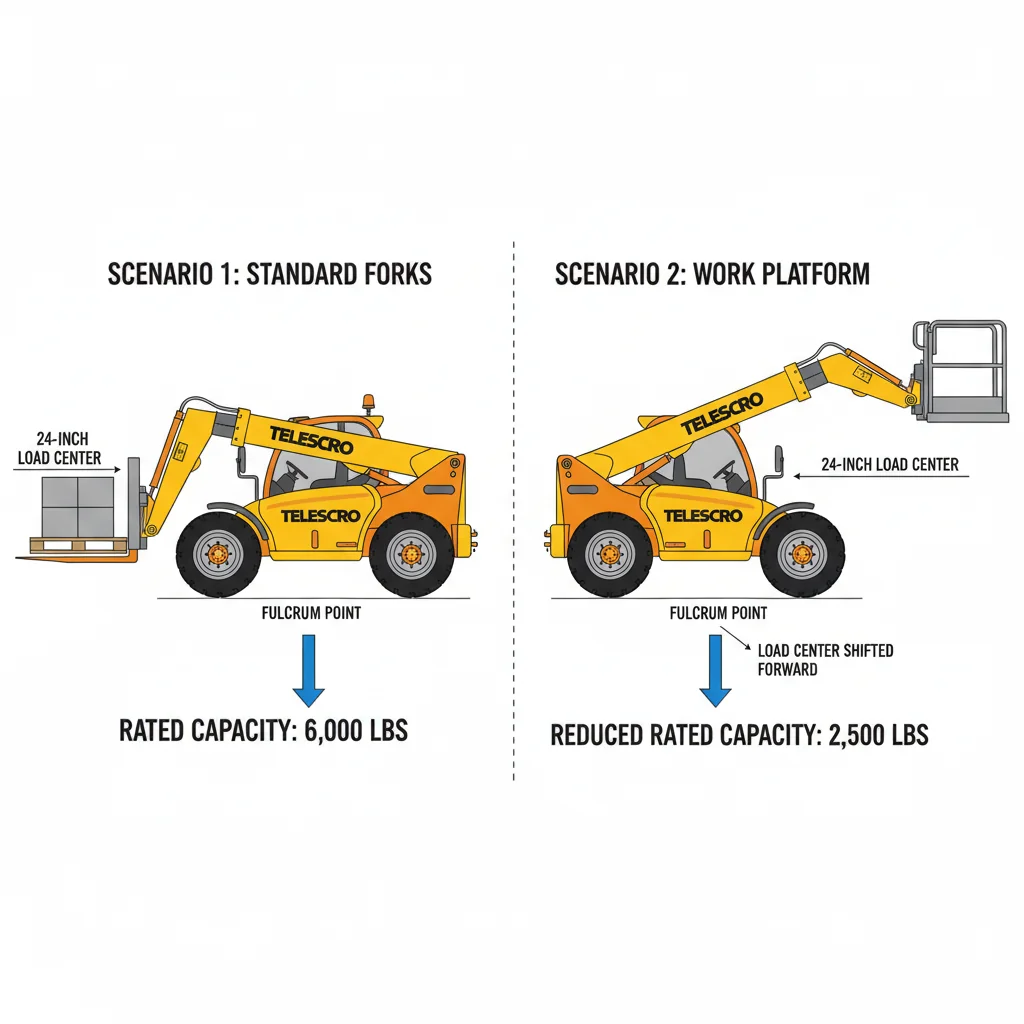
I’ve worked with customers who made this mistake, especially when jobs get busy and everyone grabs whatever attachment is available. The reality is, every attachment—even something as basic as a side shifter—changes your rated capacity. That’s because the extra weight and the shift in the load center move the "tipping point" forward. The further your load is from the fork face, the less weight your telehandler can safely lift, especially at full extension. Ignoring this isn’t just a paperwork issue—it’s why telehandlers get overloaded without operators noticing. A good example: last year in Dubai, a crew swapped forks for a 1.2-meter jib to lift HVAC units onto a rooftop. The original fork load chart showed 2,700 kg at 8 meters. With the jib, actual safe capacity dropped under 1,600 kg—not just because of the jib’s weight, but the extra 500 mm of reach. They nearly risked a tip-over before we reviewed the correct chart together.
Here’s what you need to double-check whenever using attachments:
- Always use the attachment-specific load chart8. The generic fork chart doesn’t cover jibs, work platforms, buckets, or clamps.
- Measure the actual load center—from the fork face to the load’s center of gravity. If it’s more than 600 mm (24 inches), capacity drops fast.
- Remember attachment weight counts against lifting capacity. A heavy bucket or jib can easily "eat up" 200–400 kg before you even add your load.
Using a jib boom attachment on a telehandler requires referencing a different load chart, because it changes both the load center distance and lifting geometry compared to standard forks.True
Different attachments, such as jib booms, alter the point at which loads are suspended and can move the center of gravity forward. This changes the machine's stability and rated capacity, so manufacturers provide specific load charts for various attachments.
As long as the combined weight of the attachment and load does not exceed the telehandler’s maximum capacity listed on the standard load chart, the machine can be operated safely at full extension.False
The standard load chart assumes only the base forks are fitted. Attachments affect load position and machine geometry, typically reducing safe lift capacities even when total weight is within the ‘maximum’. Not accounting for altered load centers can result in unsafe operation.
Key takeaway: Telehandler capacity is determined by machine model, boom size, and attachment-specific load charts—never assume fork ratings apply to other tools. Always confirm the actual load center from the fork face and use OEM-provided reduction factors; improper chart matching is a major cause of hidden overloads on site.
How Are Telehandler Load Chart Zones Used?
Telehandler load charts divide operation zones by boom angle and extension, with each defined on the chart (A–H, etc.). Operators reference boom angle indicators9 and reach markings to stay within the planned zone during the lift, preventing overextension. Modern models may include Load Moment Indicators (LMI), but accurate results require properly calibrated sensors and correct attachment selection.
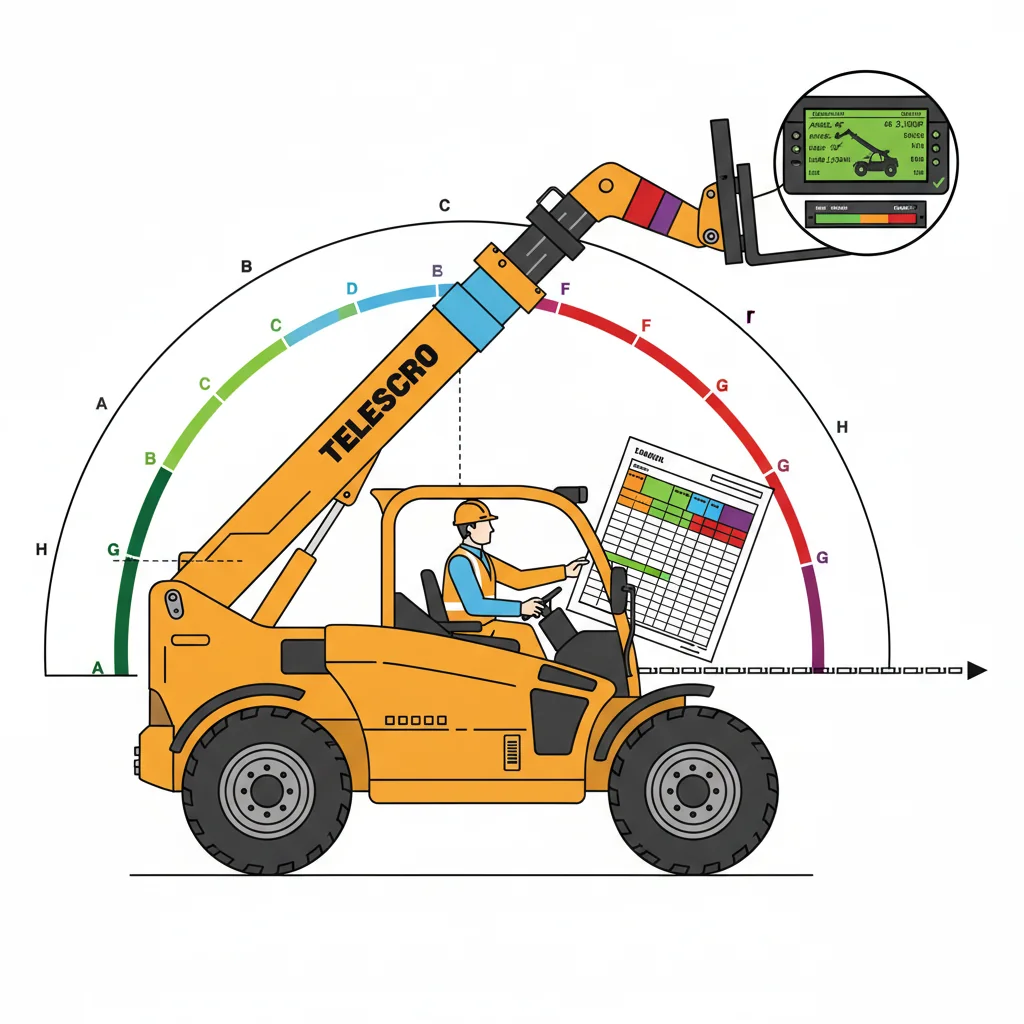
Here’s what matters most when using telehandler load chart zones: you need to match your actual boom angle and extension to the chart’s defined zones—no guessing, no shortcuts. The load chart is divided into labeled zones (A, B, C, etc.), and each one combines a maximum reach and boom angle with a matching safe capacity. That’s not just engineer talk. On site in Dubai, I saw a team nearly lose control of a 3-ton pallet because they extended the boom just past the zone boundary—thinking “a few centimeters won’t matter.” The chart doesn’t leave room for debate.
To use zone markings safely, operators rely on these tools and steps:
- Boom angle indicators—mounted on the side of the boom, show your current angle.
- Extension markings—painted scales or sensors showing how far the boom is out.
- Digital displays—many modern models provide combined readouts for reach and angle.
- Load Moment Indicator (LMI)—alerts you if you’re approaching or crossing safe limits, but only if it’s correctly calibrated and set to match your attachment.
From my experience, it’s tempting to “just go a bit further” when you’re under pressure. Resist that. If the load or basket needs to go beyond the planned zone, stop and re-check the chart. Last month, a customer in Kazakhstan assumed the LMI warning would always trigger early. Turns out, the sensors were overdue for calibration, and the display didn’t match the real attachment—very risky situation. I always suggest reviewing both the physical indicators and the chart before every critical lift. Rely on LMIs only as backup—your jobsite safety starts with the load chart.
Telehandler load chart zones account for both the boom angle and extension, meaning that maximum lift capacity can drop significantly even with only a small increase in extension at the same angle.True
This is true because load charts are engineered to reflect the physics of leverage: as you extend the boom, the machine loses lifting capacity rapidly due to increased moment arm, even if the boom angle is unchanged. Ignoring either parameter can cause unsafe loading.
If your load is within the weight rating for one zone, you can safely handle the same load in any other zone shown on the telehandler's chart.False
This is false because each zone represents a different combination of boom angle and extension, which affects the machine’s stability and lift capacity. A load that is safe in one zone may exceed the safe rating in another, leading to dangerous overloading.
Key takeaway: Safely using telehandler load charts requires matching actual boom angle and extension to the chart’s designated zones, confirming with physical or digital indicators. Always stop and re-check the chart if a task exceeds the planned zone. Rely on LMIs only when properly calibrated and configured.
How do ground and weather affect load chart?
Telehandler load chart ratings are established assuming a firm, level supporting surface and calm environmental conditions. Any deviation—such as sloped or uneven ground, soft or recently filled surfaces, or wind acting on the load—can significantly reduce stability, especially at extended reach. In these situations, operators should avoid working at the edge of the charted envelope, improve ground support where appropriate (for example, using ground mats10), and adjust the lift plan, machine position, or equipment selection to maintain an adequate safety margin.
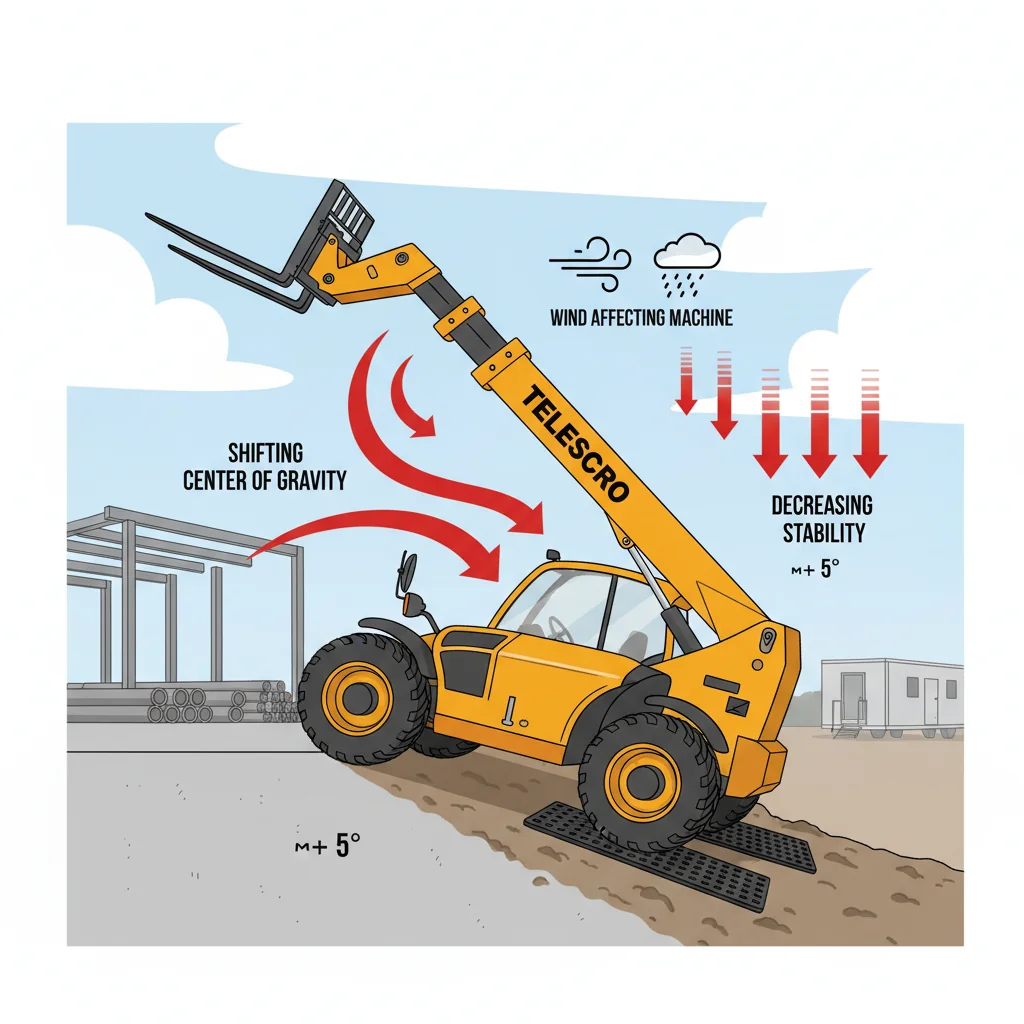
Last month, a contractor in Kazakhstan called me about a stability scare11 on uneven ground. Their site had just 4° of slope—hardly noticeable when you walk it. But when they tried to raise a 1,800 kg steel truss at full extension, the telehandler’s frame started to lean and their load moment indicator sounded an alarm. That machine was rated for 3,500 kg on level ground, but as soon as you’re outside the ±3° limit, the real safe capacity drops fast. If you check any OEM load chart, you’ll see capacities always assume a solid, flat site—never soft backfill, mud, or sloped yards.
From my experience on jobsites in Brazil and the UAE, soft ground causes just as many problems as slopes. Even compacted sand can shift as you lift, especially with a full boom extension. That’s why I advise using heavy ground mats under the tires if you’re anywhere near muddy or recently filled areas. If your telehandler has stabilizers, always deploy them per manufacturer guidelines, and make sure you’re using the “on stabilizers” load zone—never the tire ratings.
It’s also easy to underestimate the effect of weather. I’ve seen cases where long, flat loads—such as drywall panels—became unstable in moderate wind at extended reach, as wind pressure acting on a large surface area can significantly increase overturning forces. When wind, sloped ground, mud, or other non-ideal conditions are present, operators should avoid working near the limits shown on the load chart and reassess the lift plan. Slowing the operation, repositioning the machine, reducing the load, or selecting different equipment is far safer than attempting to complete a lift at the edge of the rated envelope. Capacity decisions must always be based on actual site conditions, not brochure figures.
Even a small ground slope outside a telehandler's recommended operating range can cause a significant reduction in safe lifting capacity, even if the total load is well below the charted maximum for level ground.True
Telehandler load charts are calculated for perfectly level conditions; even minor deviations like a few degrees of slope dramatically alter the load's leverage and can compromise machine stability long before the load limit is reached.
Weather conditions such as wind speed do not need to be considered when using a telehandler's load chart, as the chart only accounts for static machine capacity.False
Wind can exert additional force on lifted loads, especially large, flat items, and telehandler manufacturers specify that environmental factors like wind must be factored in for safe operation; ignoring these can result in overloads or tip-over scenarios.
Key takeaway: Telehandler load charts assume the machine is on level, firm ground with no wind. Any slope, soft area, or high winds requires a significant reduction in working limits and extra caution. Always adapt capacity decisions to real-world site conditions, not just published chart numbers.
How do supervisors use telehandler load charts?
Supervisors use telehandler load charts during lift planning to evaluate each lift scenario by measuring reach from the front face of the front tire to the load center, along with the required lift height and total load weight. By referencing these parameters on the load chart before work begins, supervisors can identify capacity limits12, adjust the lift plan or equipment selection as needed, and reduce risk by flagging critical lifts for review during toolbox talks.
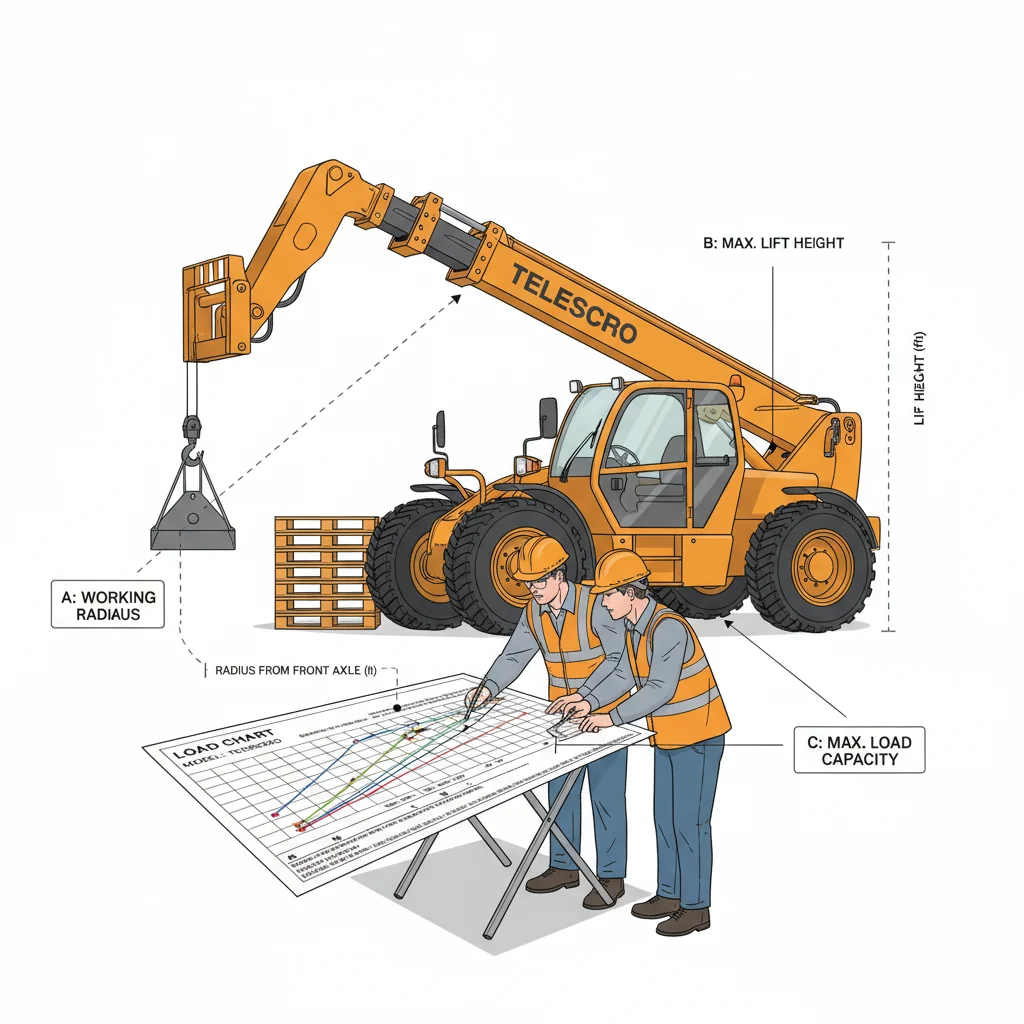
I’ve worked on jobsites in Kenya and the UAE where supervisors used laminated load charts covered in colored marks and notes—seriously, it almost looked like a bingo card. They don’t wait for problems during lifting. Instead, they measure each planned lift: from the front tire edge to the load center, up to the exact height needed. One Dubai site needed to place 1,500 kg HVAC units on a 10-meter roof with the telehandler parked 8 meters away from the building. When the supervisor checked the chart, that position used over 85% of the machine’s rated capacity. They made the smart call: split the unit into two lighter loads for safety, instead of pushing the limit. The main reason supervisors succeed with load charts comes down to preparation—long before anyone touches the controls.
Here’s the process I always see on professional jobsites:
- Site walk and measurement – Estimate reach from the front axle, height, and actual load weight for every critical lift.
- Scenario mapping – Pin each scenario onto a laminated load chart, using colored pens for common or risky lifts.
- Reviewing capacity – Compare actual load against the chart at those positions—if the chart says 1,200 kg at 9 meters but your pack weighs more, adjust right away.
- Toolbox talk sharing – Go through marked loads with the whole team, so operators and spotters know exactly where margins are tight.
Supervisors use telehandler load charts to plan lifts by measuring both the horizontal distance from the machine’s tires to the load and the lift height in advance, ensuring the telehandler’s rated capacity is not exceeded in real-world scenarios.True
Telehandler load charts are designed to provide rated capacities based on both reach (distance from the front tires to the load center) and lift height. Accurate, on-site measurements and referencing the chart prevent overloading and unsafe operations, which could otherwise occur if only estimated or generic values were used.
"IfFalse
"Telehandler
Key takeaway: Effective telehandler lift planning relies on interpreting load charts before field operations. Mapping lift scenarios against the chart’s height and reach axes reveals safe capacity margins. This proactive approach, shared during toolbox talks, prevents improvisation and reduces error, making job sites safer and more efficient.
How do load charts guide telehandler selection?
Load charts provide model-specific capacity at precise reach and height combinations, reflecting real-world job site demands. By comparing candidate telehandlers at the hardest required lift point, decision-makers can ensure sufficient working margin, optimize safety, avoid overspecifying, and prevent costly capacity mistakes, rather than relying on general tonnage or catalog figures.
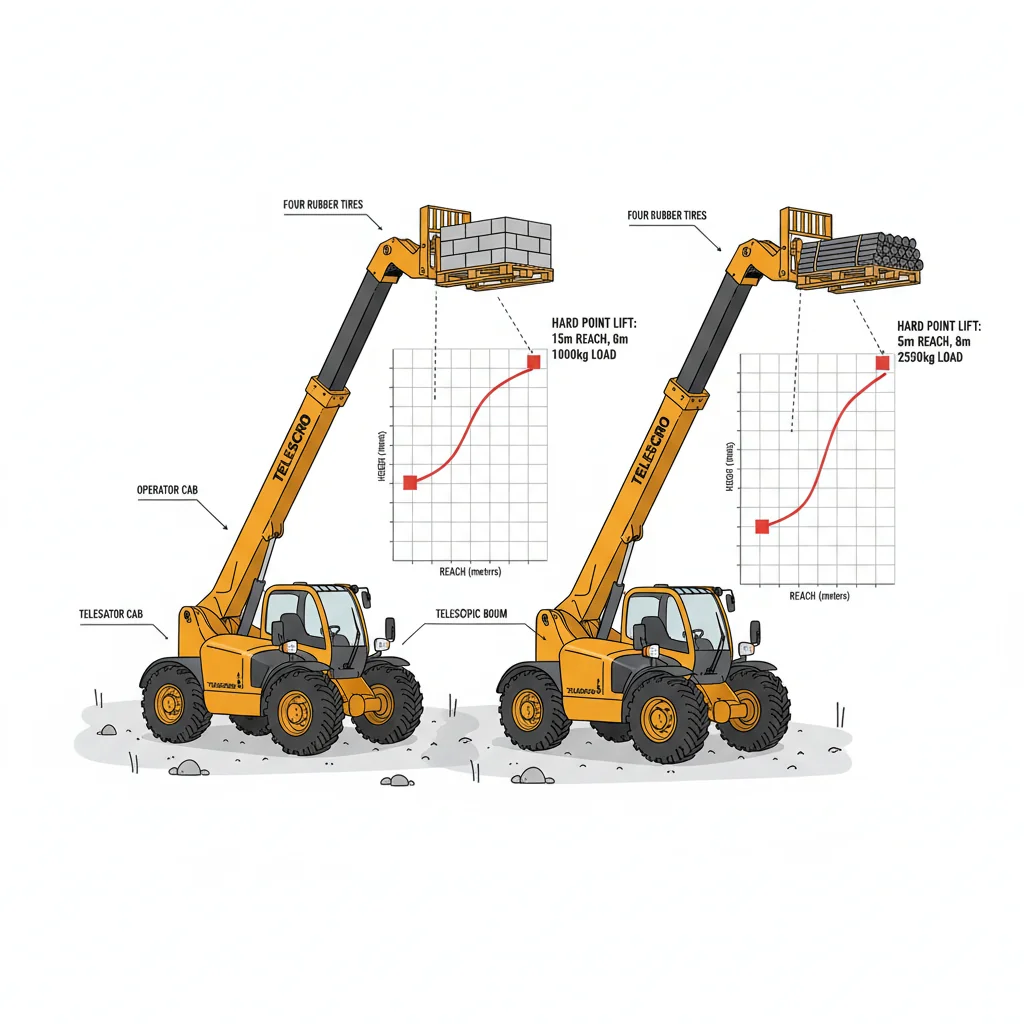
To be honest, the spec that actually matters is not the one shown in the glossy brochure. It’s the numbers on the load chart—those tell you what the telehandler can handle at real working positions. I’ve seen jobsites in Dubai where a contractor chose a "4,000 kg / 17 m" machine, only to find it could barely lift 1,300 kg at 10 meters up and 7 meters out. The rated capacity is just the max—usually at minimum reach, level ground, and the standard attachment. Actual lift is always lower once you extend the boom. The smartest approach? Start with your hardest routine lift. For example, you might need to raise a 1,800 kg pallet to a fourth-floor slab, about 10 meters high with 7 meters of reach from the front edge of the front tires to the load center.
Don’t just glance at the overall tonnage. Pull up the load charts for each candidate machine and find that exact height and reach point. One model may allow 2,000 kg there, another might offer 2,800 kg. That extra margin could mean finishing your project safely even if the ground softens or you’re running with slightly heavier loads. From my experience, customers who select telehandlers based on worst-case chart positions avoid big headaches down the road. It keeps operators out of the red zone on the moment indicator, reduces stress, and limits unplanned crane rentals later.
Load charts account for both vertical lift height and horizontal reach, meaning a telehandler’s actual lifting capacity at maximum extension can be much lower than its rated maximum capacity.True
Load charts are engineered to reflect the telehandler's load limits at specific boom lengths and angles, not just the maximum stated by manufacturers. As you increase reach and height, stability and leverage change, so actual capacities drop—sometimes dramatically—compared to the 'maximum' ratings shown in specs.
Once you know the telehandler’s maximum rated lifting capacity, you can safely lift that weight at any boom extension or angle.False
The maximum rated lifting capacity only applies under specific conditions, usually with the boom retracted and on level ground. At other positions, especially with the boom extended or raised, the machine’s safe lifting capacity is significantly reduced due to stability and leverage factors—hence the need to consult the load chart.
Key takeaway: Telehandler selection should always reference load charts at the actual lift’s required height and reach, not just the rated capacity. This approach increases site safety, reduces equipment overspending, and ensures enough margin for variable site conditions, avoiding underperformance or unnecessary upgrades.
Why Must Telehandler Load Charts Match Standards?
Telehandler load charts are mandatory reference documents directly linked to regulatory compliance and operator liability. Charts must conform to destination market standards (e.g., ANSI/ITSDF B56.6 or EN 1459), be legible on site, and precisely match the machine and attachment. Mismatched, missing, or foreign-language charts risk legal violations and invalidate certification or insurance.
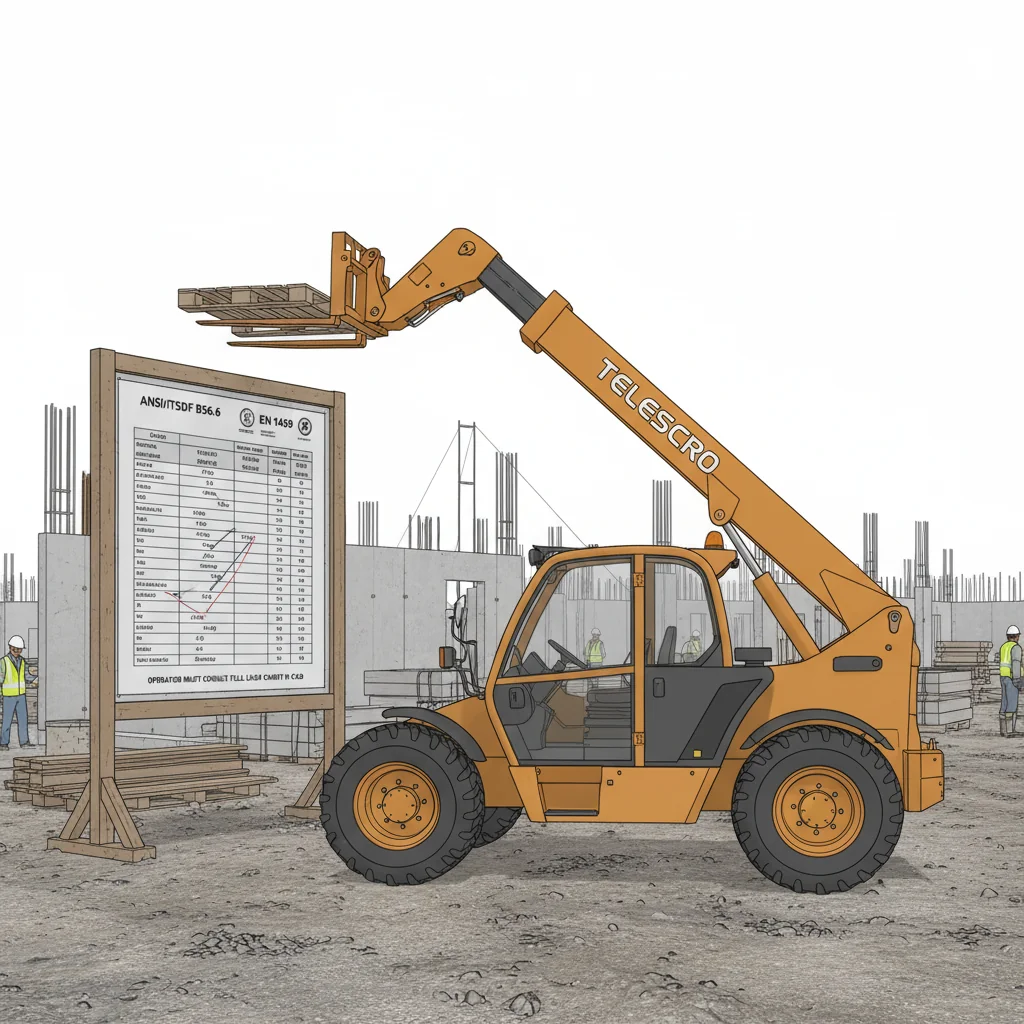
Let me share something important about telehandler load charts—they are non-negotiable when it comes to both safety and legal compliance. Some customers think a load chart is just a sticker in the cab, but it’s actually a legally required document directly tied to the machine’s rating, country regulations, and jobsite rules. For example, last year in Dubai, a client imported several 4-ton high-reach units, but they arrived with load charts in another language and didn’t match the fitted forks. The site safety officer flagged the issue right away. Without the correct OEM chart—showing the actual model, current attachment, and the site’s language—they risked fines and insurance refusal.
Charts can look similar, but even a small mismatch is a big problem. If you install a side-shift carriage or use longer forks, you must have the precise OEM chart for that configuration. The load chart isn’t just a graphic—manufacturers develop them by testing real stability limits according to standards like ANSI/ITSDF B56.6 in North America or EN 1459 across Europe. Each chart details safe capacity at various boom positions, based on level ground, specific load center, and actual equipment installed. Ignore any part of that, and you could misjudge the safe working envelope by hundreds of kilograms.
If a machine shows signs of cab repaint, sticker damage, or obvious import modifications, always stop and check that the chart fits the current configuration and is readable. I’ve seen projects in Eastern Europe fail inspections over a faded or foreign chart. My advice—before the first lift, double-check every telehandler’s load chart on site. Cutting this corner isn’t worth the risk.
Telehandler load charts must account for every attachment used, such as buckets or different fork types, because each can alter the machine’s lifting capacity and stability.True
This is true because load charts are specific to both the telehandler model and the configuration, including attachments. Using an attachment not listed may change the center of gravity and load limits, impacting safety and legal compliance.
If a telehandler’s load chart does not exactly match jobsite language requirements, operators can simply use a translation app on their phone to comply with regulations.False
This is false because regulatory authorities require that load charts are permanently affixed and clearly legible in the official language(s) of the region. A temporary or unofficial translation does not meet legal or safety standards.
Key takeaway: Telehandler load charts are legal and operational requirements, not just informational graphics. They must match the actual machine configuration and country-specific standards to avoid regulatory violations and liability in the event of incidents. Always ensure all site machines display the correct, legible OEM chart.
How does load chart training reduce incidents?
Field-based telehandler load chart training, incorporating real site scenarios and hands-on chart reading, measurably reduces lifting incidents and schedule delays. Training that uses actual distance and height measurements, attachment-specific charts, and discussion of overloading consequences builds operator intuition and habitually reinforces chart use, cutting near-misses and tip-over events linked to under-sized or misused machines.
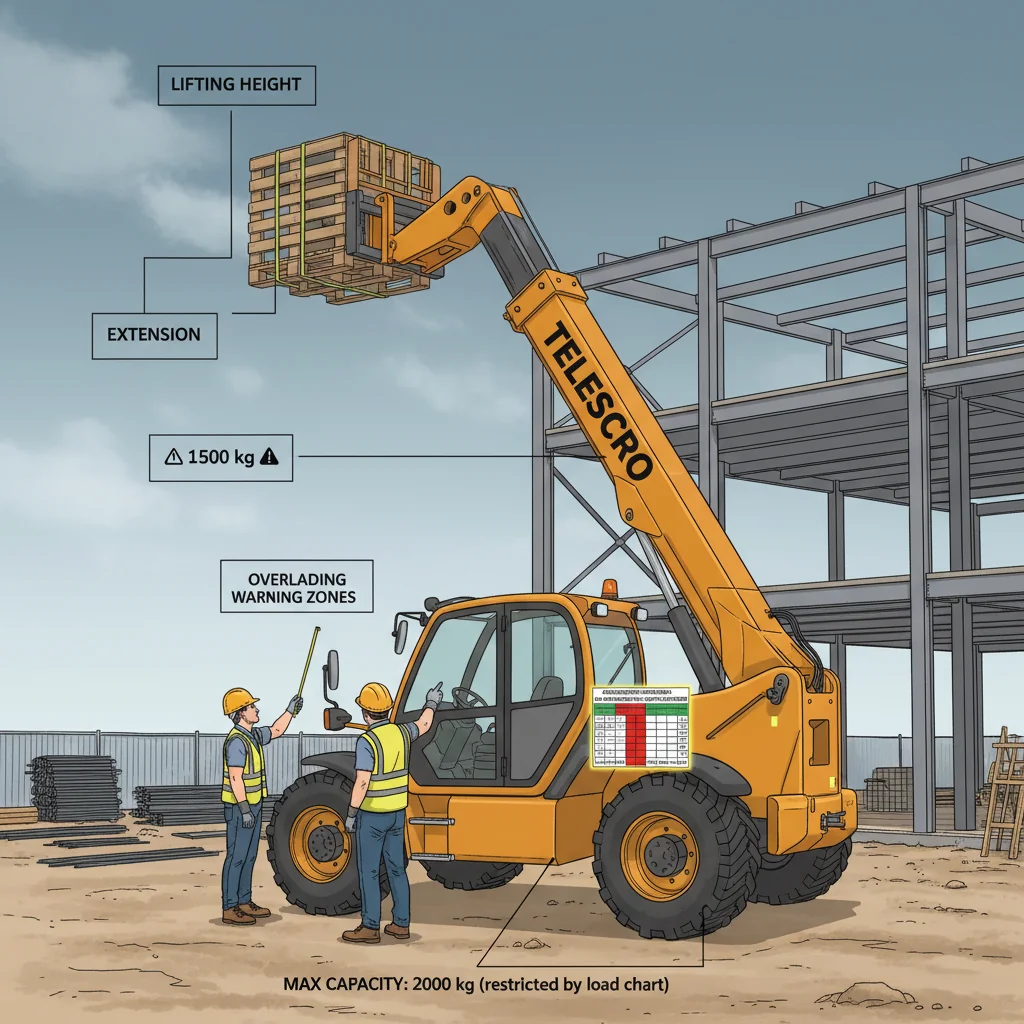
Operators often skip the load chart because they think it slows down the job. But the reality is, most of the lifting incidents I’ve seen—especially tip-overs or near-misses—come from guessing instead of checking capacity for actual site conditions. Effective load chart training changes that mindset. For example, on a recent project in Dubai, I walked operators through scenario-based practice: we picked three real lifts, measured boom reach and height on the ground, and found the matching limits on an industry-standard chart. Someone was surprised their 4-ton machine dropped to just 1,200 kg at full extension with a bucket attachment—that discovery prevented a risky lift later that week.
From my experience, hands-on practice with attachment-specific charts is what truly sticks. When an operator has to work out if a load needs a short or long boom, consider slopes, or compare working “on tires” versus “with stabilizers,” they suddenly see how fast the numbers change. One guy in Brazil admitted he never noticed that his 14-meter telehandler needed stabilizers extended just to handle a 900 kg pallet at full reach. Classroom theory alone misses those moments—real tools in hand, real distances on the tape, and “what happens if we overload by 20%?” is what builds habit.
I always suggest supervisors include these site-specific chart checks in toolbox talks, especially if tasks or ground conditions change. Keeping updated laminated load charts in the cab and making scenario drills quick—maybe just an hour—sharply reduces trial-and-error lifting. In my view, this simple habit cuts job delays and accidents more than any fancy technology.
Load chart training helps operators understand how changes in boom angle and extension affect lifting capacity, reducing the risk of tip-overs when site conditions change unexpectedly.True
This is true because telehandler load charts display varying capacities at different boom lengths and angles. Training operators to read and interpret these charts enables them to adjust to real-world changes like uneven terrain or shifting loads, preventing common types of incidents.
Once an operator has memorized the telehandler's maximum rated capacity, there is no additional benefit to referencing the load chart during lifts with different boom positions.False
This is false because the maximum rated capacity only applies at a specific boom position, usually fully retracted and at a particular angle. Actual lifting capacity drastically decreases as the boom extends and changes angle, so operators must consult the load chart for each specific lift scenario to ensure safety.
Key takeaway: Scenario-based load chart training—using actual task measurements, attachment-specific charts, and realistic discussion—builds operator intuition and safe decision-making habits. This approach cuts trial-and-error lifting, reduces near-misses, and adapts operators and supervisors to changing site conditions for better telehandler safety and efficiency.
Conclusion
We’ve looked at how telehandler load charts actually work on real jobsites, and why they’re strict legal limits—not just suggestions. From what I’ve seen, the crews who stay safest always treat the chart as the final word, even if it means changing the plan or switching equipment. It’s tempting to focus on max specs, but ignoring the real numbers on the load chart is the classic “showroom hero, jobsite zero” situation. If you’re unsure how to read a chart for your lifts, or want advice on choosing a telehandler, feel free to reach out. I’m happy to share what’s worked for different sites and help you avoid costly mistakes. Every jobsite is different—make sure your machine matches your actual workflow.
References
-
Details the importance of load charts for safe lifting limits and preventing operational errors caused by ignoring max capacity ratings. ↩
-
Explore detailed explanations of telehandler load charts, including stability zones and legal operating limits for safe lifting. ↩
-
Detailed explanation of ANSI/ITSDF B56.6 standards helps understand their role in load chart accuracy and telehandler safety validation. ↩
-
Details the impact of load center distance on lifting capacity and safety, crucial for operators handling extended attachments. ↩
-
Understand how maximum rated capacity is calculated based on standardized stability tests and operational conditions. ↩
-
Explains how rated capacity changes with lift height and reach, helping operators manage loads safely within equipment limits. ↩
-
Explains how load center of gravity affects stability and capacity, helping operators avoid tipping risks with detailed load chart insights. ↩
-
Explains how using the correct load chart prevents overload risks and tip-overs, ensuring safe telehandler operation with attachments. ↩
-
Insights into how boom angle indicators ensure safe lifting zones by providing real-time angle data critical for load chart compliance. ↩
-
Learn how heavy ground mats enhance stability and extend telehandler capacity in muddy or soft soil, backed by best practice field advice. ↩
-
Explore technical causes of telehandler stability issues on uneven ground and expert tips to prevent load-related accidents. ↩
-
Explains why understanding and respecting capacity limits prevents accidents, improves lift safety, and guides load adjustments on construction sites. ↩
-
Explains the significance of using attachment-specific charts to safely manage lifting limits and avoid risky overloads in varying site conditions. ↩