










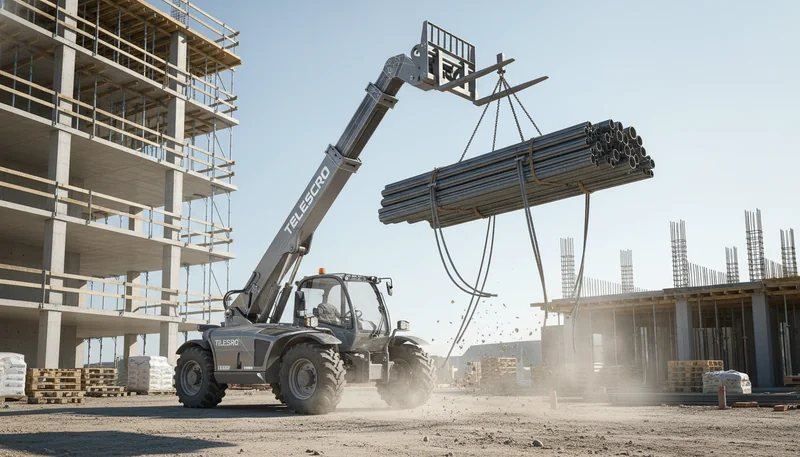
Telehandler Load Charts: Why Dynamic Movement Isn’t Accounted For (Field Guide)
One detail that surprises newer operators I train—whether they’re in Dubai or rural Sichuan—is how easy it is to overload a telehandler in motion, even with the load chart in hand. I’ve seen machines tip on sites where everyone thought they were “well under the limit.” So what’s going on?
Telehandler load charts represent static capacity testing performed under tightly controlled laboratory conditions, such as level ground, rated tires, specified attachments, and smooth boom operation without external forces. Dynamic movements1—like braking, steering, or rough travel—can create inertia forces that dramatically increase the effective load moment beyond static ratings, sometimes exceeding safety margins. Manufacturers do not include dynamic effects in load charts because accounting for all site variables—including ground conditions, operator
Why are telehandler load charts static only?
Telehandler load charts are based on static, laboratory test conditions—level, firm ground, specified tires, and no wind or motion. Rated capacity reflects the machine’s safe limit when stationary and stable. Dynamic factors like traveling, braking, or rough terrain are not accounted for and require strict operational controls beyond the standard load chart.
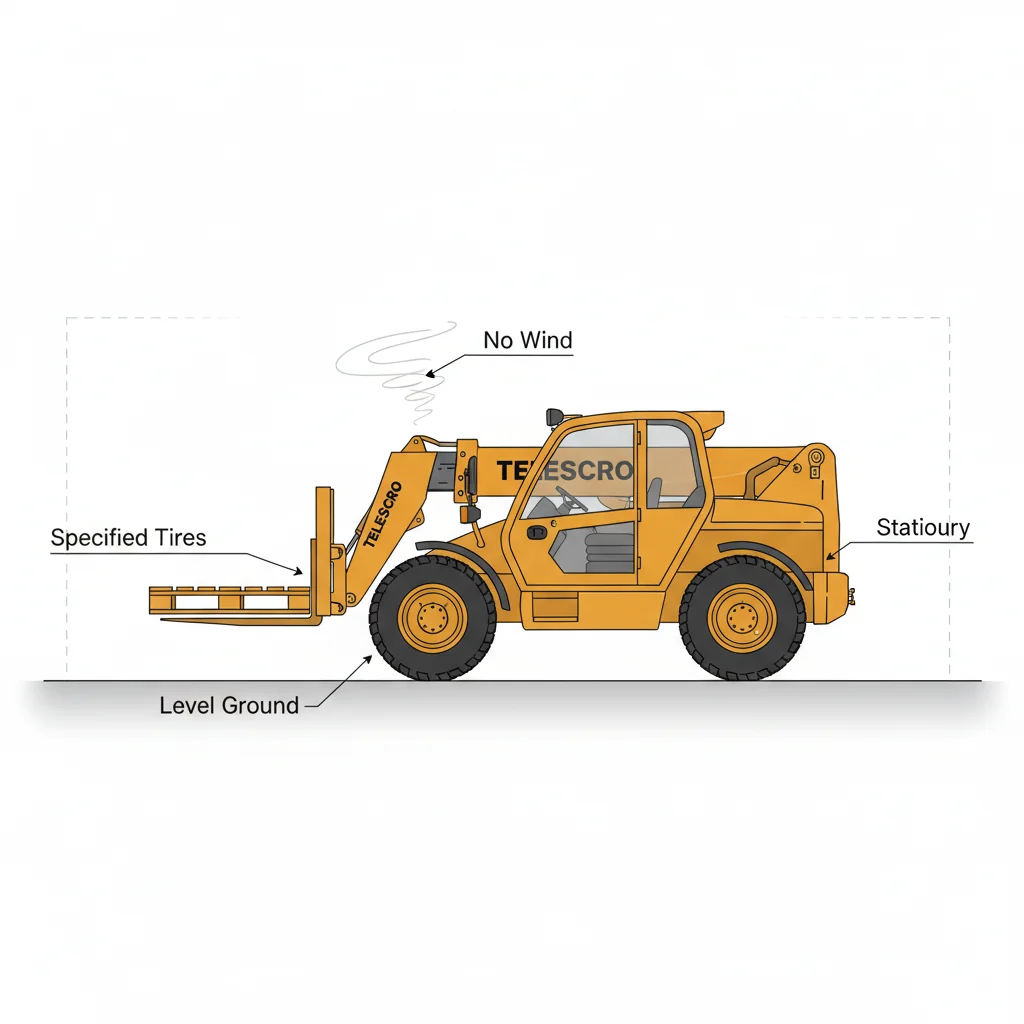
Most people don’t realize telehandler load charts are based on test conditions that rarely match the jobsite. In the lab, engineers set the machine on perfectly level and firm ground, use the exact tires and attachment, and measure capacity with no wind or motion. All the numbers on the load chart—like “4,000 kg at minimum reach” or “1,200 kg at 13 meters”—come from that ideal situation. I’ve seen many contractors in Turkey and South Africa misjudge what their machine can really do when surfaces get soft or uneven.
On real sites, things are very different. Machines drive over ruts, need to brake suddenly, or work on slopes that can reach around 5° or more. A few years ago, a customer in Peru planned to place steel sections with a 3.5-ton telehandler on a slight cross-slope. The load chart showed 2,000 kg for that boom position—but the machine wasn’t truly level, so the stability margin was already reduced and the tipping risk increased dramatically. Luckily, they asked before lifting. I told them the published chart is a baseline for a level, firm setup in the specified configuration, and it should not be treated as valid for cross-slope or any motion/shock loading—always follow the machine’s level indicator limits and site procedures.
To be honest, the load chart exists as a legal and engineering baseline, not a promise that covers every site scenario. Dynamic factors like driving, turning, or working over rough ground rapidly consume the built-in stability margin and can push the machine beyond what the static chart represents. My advice is simple: treat the printed load chart as a safe starting point, not a guarantee. Always assess real ground conditions, slope, and movement, and train operators to recognize when actual usable capacity is lower than the numbers on paper. That’s the real difference between textbook safety and jobsite reality.
Telehandler load charts are static because dynamic variables like wind gusts, uneven ground, or load swing are almost impossible to quantify consistently across all jobsite conditions.True
Engineers use fixed, controlled conditions to create load charts since real-world factors such as wind, sloped terrain, or sudden operator movements can make load capacity unpredictable and difficult to standardize in safety documentation.
Telehandler load charts account for slight machine movement, assuming that jobsites will always have minor instability during lifting.False
Load charts do not include allowances for any instability or movement; they exclusively reflect static, controlled conditions for safety. Real-world motion or unevenness must be assessed separately by operators and site managers.
Key takeaway: Telehandler load charts define safe lifting limits under ideal, static test conditions only. Real-world variables—such as motion, terrain irregularities, or wind—create risks not reflected in the chart. Site-specific procedures and operator training must bridge the gap between laboratory capacity ratings and dynamic jobsite realities.
Why Aren’t Dynamic Loads Shown on Load Charts?
Dynamic movements, such as sudden braking, sharp turns, or ground shocks, cause momentary increases in the load’s effective overturning moment, which are not reflected in telehandler load charts. These charts show rated capacity for static, level conditions only, meaning inertial spikes can easily exceed charted limits in real-world use.
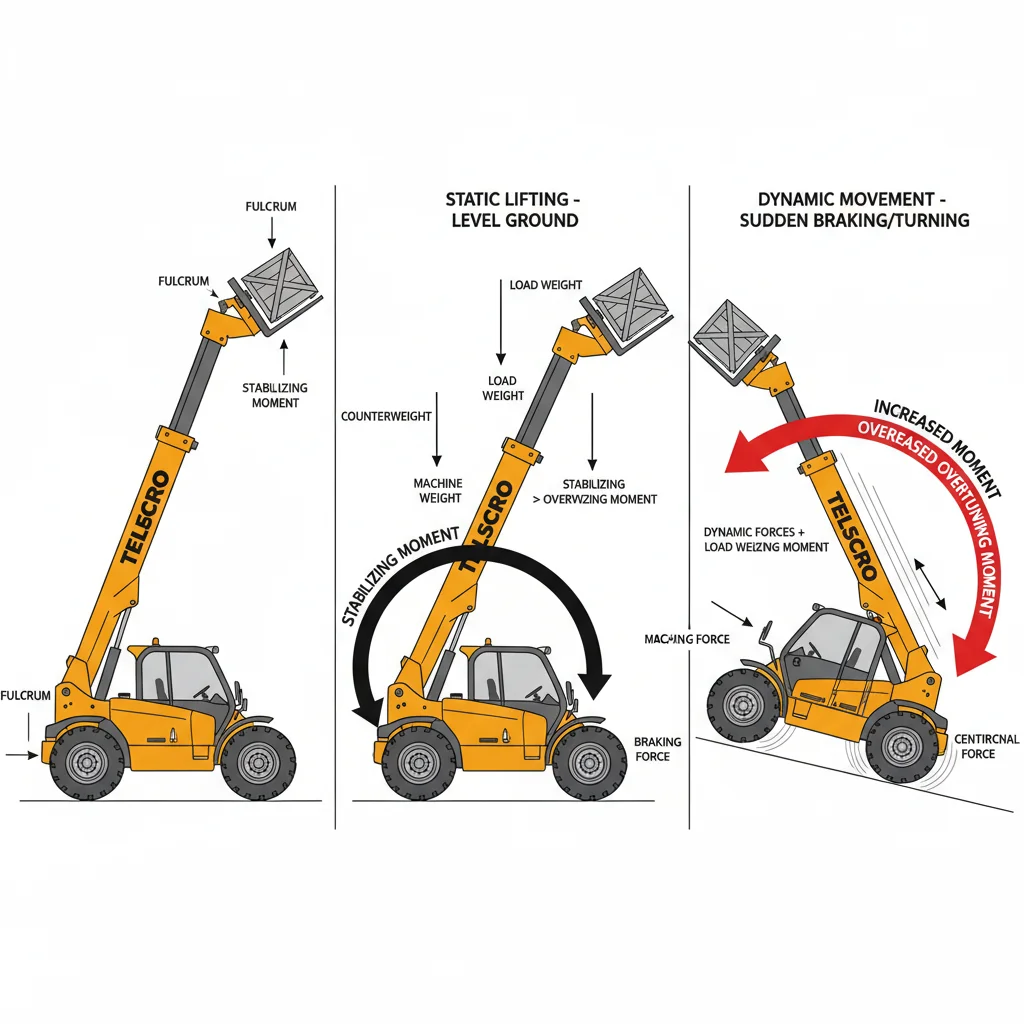
The biggest mistake I see is thinking the load chart covers every risk you’ll face onsite. It doesn’t. Those charts only reflect what your telehandler can handle under perfect, static, level-ground conditions—machine leveled to within 3 degrees, standard forks, and a fixed load at a specified center. But real jobs are never that simple. The rated capacity on the chart never accounts for what happens when the operator suddenly brakes, turns sharply, or travels across a rough site. I’ve seen it firsthand—in Saudi Arabia, one project involved lifting rebar bundles at 12 meters. The operator stopped suddenly for a site truck, but the suspended load swung forward, and the telehandler rocked dangerously forward. Capacity on the load chart was listed as 2,600 kg, but the real force was far higher in that moment.
Here’s the thing: once your machine is moving, dynamic forces quickly shift the effective load and the tipping axis. If you hit a pothole or brake hard with a 3,000 kg pallet at maximum reach, for a split second, your machine feels more like it’s holding 3,500 or even 4,000 kg. I’ve watched loads at the very edge of the chart tip the whole machine when operators assumed “chart equals safe.” Even with anti-roll indicators, the chart can’t predict these split-second surges.
So, never rely on being “under the chart” if your operation involves travel, slope, or swinging loads. I always advise site managers: treat every dynamic job as if your stability margin is much smaller than the paper numbers suggest. Double-check real working conditions and slow down every movement, especially with long or flexible materials.
Telehandler load charts exclude dynamic loads because capacity ratings are established using controlled, repeatable stability test methods defined in industry standards.True
Manufacturers develop load charts based on standardized stability verification procedures that assume controlled conditions—such as a stationary machine, defined configuration, and a level, firm test surface—so results are consistent and comparable across models. Site-specific dynamic factors like travel, braking, rough ground, or load swing are intentionally excluded and must be managed through operating procedures and training.
Dynamic loads are ignored in load charts because modern telehandlers are designed to automatically compensate for any tipping risk during dynamic movements.False
While some new telehandlers have stability aids or load moment indicators, they cannot fully compensate for the unpredictable forces from dynamic movements. Load charts remain based on static conditions, and safe operation still requires the operator to manage dynamic risks.
Key takeaway: Telehandler load charts only reflect static, level-ground conditions. Actual site movements—including braking, turning, hitting bumps, or handling swinging loads—can generate dynamic forces that exceed charted capacities. Managers should never assume ‘under the chart’ equals safety during dynamic or uneven operations.
Why Aren’t Telehandler Load Charts Dynamic?
Telehandler load charts exclude dynamic movement effects because accurately modeling variables like ground roughness, boom speed, tire pressure2, wind, slope, and operator actions would make charts unreadable and impractical. Instead, manufacturers certify rated capacity under static, level conditions with clear safety margins, and dynamics are addressed through training and operational warnings, not within the chart itself.
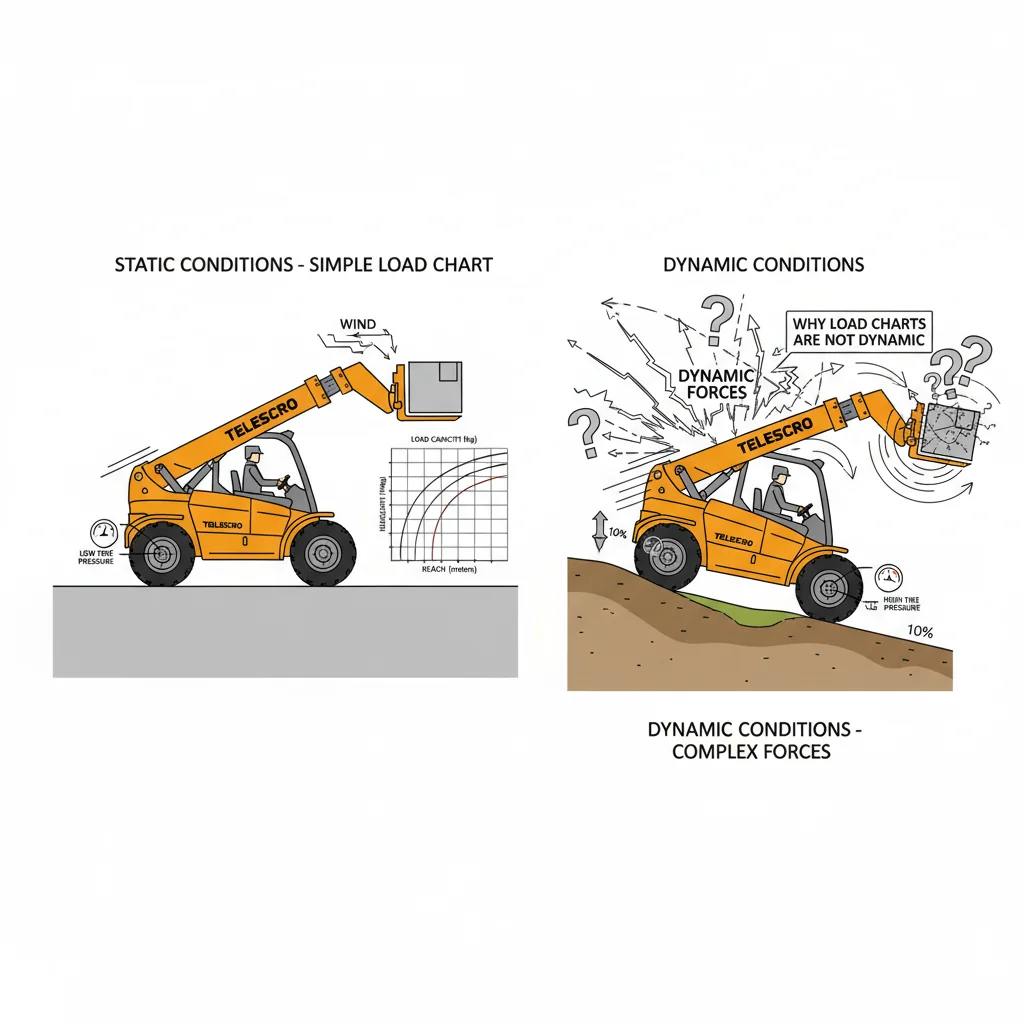
Let me share something important about telehandler load charts that confuses a lot of buyers. The charts you see from manufacturers are always based on static, level-ground conditions—not real jobsite movement. If we tried to include dynamic effects like rough terrain, changing boom speed, or wind gusts, the chart would turn into a mess—lines everywhere, numbers nobody could trust. I’ve worked with contractors in Brazil and Germany who asked for “all-condition” charts, but the reality is there’s just no way to predict what happens if the operator hits a pothole, turns too fast, or the tire pressure drops. Instead, manufacturers certify rated capacity with wide safety margins, assuming dead-steady, level setups.
Here’s what matters most: dynamic factors—traveling, shock loading, swinging loads—are always outside the load chart’s promise. For example, I once helped a team in Dubai who had to handle steel beams across an uneven site. The machine was rated for 3,500 kg at 11 meters, but as soon as they started moving with the load over rough ground, that safe margin disappeared quickly. The chart didn’t account for bouncing or side loads, and that’s where site protocols and operator training become critical. A moment indicator or load monitor helps, but no system can replace real skill and caution.
So if you’re comparing a 4-ton telehandler with an 18-meter boom on paper, remember those numbers only count when the machine is level, stationary, and using the specified fork or bucket. I always suggest training teams to read both the load chart and the real ground conditions. That’s how you keep operations safe—and keep the machine where it belongs.
Telehandler load charts are static because the engineering calculations for dynamic movement would require real-time monitoring of site-specific factors like ground slope, boom acceleration, and wind speed, which is not feasible to standardize on a printed chart.True
Dynamic forces introduce variables that change rapidly with site conditions and machine operation. Standard load charts must assume controlled, repeatable circumstances—like level ground and stationary loads—to ensure safety and provide universal guidance.
Telehandler load charts ignore dynamic movement because telehandlers are designed with advanced sensors that automatically compensate for any instability, so the charts do not need to account for these effects.False
While some modern telehandlers include stability aids or load moment indicators, the basic design of load charts is conservative and does not assume machines have active compensation for dynamic forces. Operators are still responsible for understanding limits under real-world conditions.
Key takeaway: Telehandler load charts are intentionally simplified for clarity and certification, representing only static, level-ground capacities. Dynamic factors—such as travel, rough terrain, and operator inputs—are excluded, placing responsibility on operator training and site protocols to ensure safe material handling beyond what the chart indicates.
How do load chart safety factors work?
Telehandler load charts include built-in design safety margins, but the rated capacity shown is already the maximum permitted working limit under defined, static test conditions. These margins account for manufacturing tolerances and controlled verification assumptions—not for driving, slopes, rough terrain, underinflated tires, or shock loading. The rated load is therefore a strict operational ceiling that applies only when the machine is level, stationary, and configured exactly as shown on the load chart.

To be honest, the spec that actually matters is the safety margin built into the load chart—not the raw capacity figure. I’ve seen site managers in Dubai treat the chart as “comfortable room” above the load, thinking their 4-ton machine could safely handle 4.5 tons if needed. Reality check: during stability testing, a telehandler must remain upright at about 120–125% of its rated load, but that’s in strictly controlled conditions—level ground, standard attachment, exact tire pressure. That margin covers things like small production differences or a bit of operator clumsiness. It’s there to absorb the little uncertainties, not careless risk.
Last year, I worked with a team in Kenya who believed the rated capacity was still “safe” even with the site sloped a few degrees. Their 3.5-ton unit started creeping forward on a 5° incline with a pallet of blocks—under the limit on paper. The tipping moment moves fast once you’re no longer perfectly level. The machine’s load chart isn’t valid on that slope, and the so-called safety factor doesn’t save you from physics. They ended up pausing the job and calling for ground leveling.
Here’s what matters most when reading a load chart: the rated number is your absolute ceiling, assuming everything is ideal. Real jobsites—soft ground, bumps, uneven tire pressure—eat away that built-in margin within minutes. I always suggest setting policy-based derating for actual site conditions. Treat the load chart value as a hard stop, then work out how much less you should handle whenever there’s any real-world risk.
Telehandler load chart safety factors are calculated based only on static, controlled conditions and do not account for the extra stresses introduced by uneven terrain or rapid operator movements.True
Manufacturers determine load chart figures under ideal, laboratory-like scenarios. Real-world factors like sudden braking, swinging, and working on slopes are not reflected in the chart, which is why the built-in safety factor shouldn't be 'used up' by overloading.
If a telehandler has a rated capacity of 4 tons, its safety margin ensures it can handle up to 4.5 tons in typical jobsite conditions without increased risk.False
The safety margin tested by manufacturers is meant to compensate for minor imperfections in testing but not for the variability and hazards found on actual worksites. Exceeding the rated load, even by a small amount, significantly reduces stability and greatly increases the risk of tipping, especially outside controlled testing.
Key takeaway: Telehandler load chart safety factors are designed for manufacturing variability and minor dynamic effects, not as extra working capacity for real-world risks. Rated capacity is the operational ceiling in ideal conditions; site hazards can quickly exhaust built-in margins. Always treat chart values as non-negotiable maximums.
How should telehandler operators derate for movement?
Telehandler load charts provide rated capacity for static, level ground only; dynamic movement is not reflected. When traveling, working on uneven or sloped surfaces, or handling suspended or flexible loads, operators must apply additional conservatism through site-specific procedures and risk assessment. Many fleets adopt internal derating rules and reduced reach limits in these situations, but the exact reduction should be defined by employer policy, OEM guidance, and actual site conditions rather than the load chart alone.
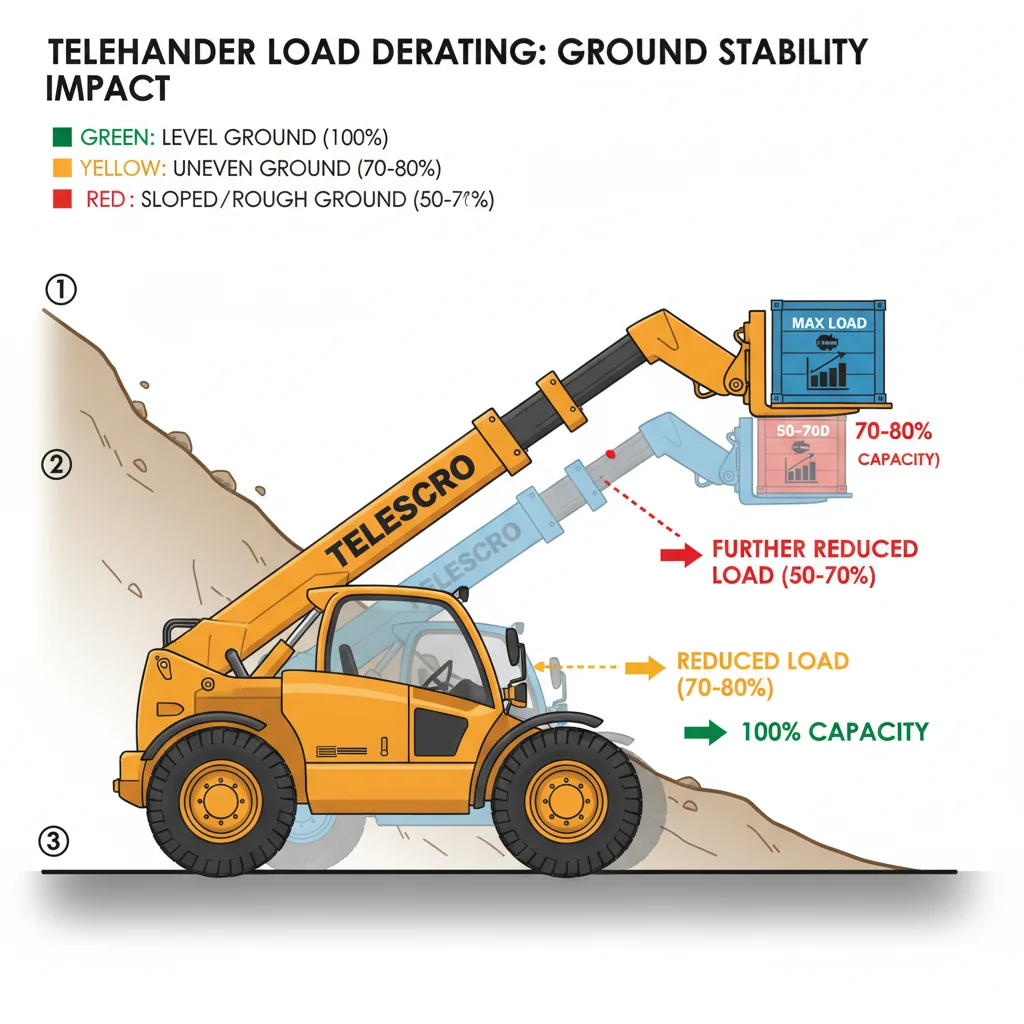
Here’s what matters most when derating a telehandler for movement: the printed load chart is based on flat, stable ground with the machine perfectly level—something we rarely get on a real jobsite. I often remind operators in the Middle East and Southeast Asia that if you’re driving slowly with a load, even across a site that looks mostly level, you should never assume the full rated capacity applies. Most experienced crews I’ve worked with use 70–80% of the load chart as a mental cap the moment there’s any uneven ground or minor travel. That means if your load chart says 3,000 kg, limit yourself to around 2,100–2,400 kg whenever the tires aren’t on perfect ground or you’re moving the boom even just a little.
The risk jumps on rougher or sloped surfaces. There’s a project in Kazakhstan I remember clearly—soft gravel, 5-degree incline, and frequent steering. I told their supervisor, “Use half to two-thirds of what the chart says, or you’re going to see the machine lean more than you expect.” At 50–70% of the posted capacity, yes, you lose some productivity, but you avoid a stability scare or even a tip-over. This isn’t just advice—it’s how most rental and contractor safety policies are written.
For suspended loads3 or anything that swings, I always recommend reducing your maximum reach by moving back one whole stability zone on the chart, not just dialing back the weight. These adjustments aren’t usually in the manual, but they make all the difference between “showroom hero” specs and safe, real-world operation.
Telehandler load charts do not account for dynamic forces created by movement, so operators should always reduce their working load below chart ratings when driving with a load.True
Load charts are typically generated for stationary, level conditions; real-world movement introduces additional forces and risks that the charts do not reflect, requiring prudent derating.
As long as a telehandler is driven slowly and appears stable, operators can safely handle the full rated capacity shown on the load chart.False
Even slow movement can create dynamic forces, especially over uneven ground, making it unsafe to use the chart’s maximum rated capacity while moving.
Key takeaway: Because telehandler load charts are static, operators and supervisors must apply their own derating rules for dynamic situations. Using clear percentage-based derating for movement, rough terrain, and suspended loads is a proven, low-cost way to enhance safety and align real-world practice with static chart limitations.
Which Telehandler Activities Increase Dynamic Tip Risk?
Most telehandler tip-overs occur during movement with a compromised geometry—such as traveling with a raised boom, braking sharply with a forward-reached load, or turning with the boom elevated. High risk also arises when handling suspended loads or driving over uneven ground, where vertical shocks amplify momentary load beyond static chart values.

I’ve worked with contractors in Kenya who assumed their crews could drive a telehandler across site with the boom raised “just to save time.” Unfortunately, many of the tip-over incidents I’ve encountered start with exactly this kind of shortcut.
Driving with the boom raised or extended—even one or two meters off the ground—significantly alters the machine’s stability geometry by raising the center of gravity and increasing the overturning moment. Under these conditions, sharp braking or steering inputs can quickly push the load moment toward one of the machine’s tipping axes, often along the front axle line during forward instability.
Traveling over uneven ground further amplifies the risk. Ground shocks, ruts, or transitions such as ramps introduce vertical and longitudinal forces that are not reflected in the load chart. The situation becomes even more critical when handling suspended or flexible loads—such as rebar bundles or pallets on a hook—where load swing adds additional, unpredictable moment.
A few years ago, I assisted a customer in Kenya after their 4-ton, 15-meter telehandler tipped forward while crossing a short ramp with a raised load. The slope was modest—around 5°—but a small bump at the transition caused a brief shock load. That momentary increase in effective load moment developed faster than corrective inputs could be applied, and the machine overturned.
This is exactly why the load chart must be read for what it is: a static rating for a stationary machine, set up on level, firm ground, using the specified attachment and boom geometry. It does not represent safe capacity during travel, over uneven surfaces, or while carrying a swinging load. Understanding that distinction is critical to preventing these kinds of incidents.
| Activity | Dynamic Tip Risk | Operator Error Impact | Real Jobsite Scenario |
|---|---|---|---|
| Traveling with boom raised (>2 m) | Very high | Rapid loss of stability | Material delivery on soft or uneven soil |
| Sharp turn with forward reach | High | Lateral tip risk | Tight corner inside warehouse or yard |
| Driving on slope with load | Very high | Forward tip on braking or bumps | Crossing ramps or access roads |
| Traveling over uneven ground | High | Sudden load moment spike | Rough site, ruts, or temporary haul roads |
| Carrying suspended or swinging loads | Very high | Unpredictable load shift | Rebar bundles or hooked pallets |
| Braking suddenly with raised load | Very high | Load momentum exceeds stability | Obstacle avoidance or downhill travel |
Telehandler load charts are based on static, level ground conditions and do not account for the additional forces created by driving or turning with an elevated boom.True
Manufacturers design load charts under controlled, stationary scenarios. Dynamic movements, such as turning or braking with the boom elevated, introduce inertia and side-forces that can dramatically alter the machine’s center of gravity and increase tip risk. These real-world factors are not reflected in the standard load chart ratings.
If you keep the boom extension short, you can safely drive a telehandler across uneven ground with a raised load because the risk of tipping is minimal.False
Even with a short boom extension, traveling with any elevated load substantially raises the center of gravity and increases tip-over risk, especially on uneven terrain. Variations in ground level, abrupt movements, or sudden stops can destabilize the telehandler regardless of boom length. Safe travel always requires the boom to be fully retracted and lowered, per industry best practices.
Key takeaway: Dynamic overturning risk in telehandlers peaks during movement with high boom or suspended loads, especially on uneven ground. Site controls—which limit speed, boom height, and specific maneuvers—should target these work patterns. Load charts do not account for these dynamic effects; operator awareness and supervision mitigate most incidents.
How should telehandlers be sized for real jobs?
Sizing telehandlers to match maximum load chart values assumes ideal conditions. Real-world factors—such as uneven ground, minor boom movement, pallet variations, and component wear—necessitate a 20–40% rated capacity cushion4 at the required reach. This buffer mitigates risks, reduces load management alarms, extends component life, and enhances operational safety over the fleet lifespan.

Last month, a contractor in Kazakhstan contacted me about sizing telehandlers for an industrial site expansion. His team calculated that their heaviest steel bundle—about 2,500 kg—needed to reach over scaffolding at exactly 8 meters. They picked a model showing a “2,500 kg at 8 m” limit on the OEM load chart and assumed that was good enough. But real jobs never match these textbook scenarios. Even a slight slope, a tilted pallet, or a change to longer forks can push loads beyond safe working limits. That “perfect” 2,500 kg figure depends on the machine being level (within 3°), standard forks, and no extra weight further out.
From my experience, I always advise leaving a meaningful capacity buffer at the critical reach, rather than sizing a machine to the bare minimum shown on the load chart. In this case, that means selecting a telehandler rated comfortably above 2,500 kg at 8 m, not one that only just meets that figure on paper. The reason is straightforward: uneven ground, minor boom movement, pallet variability, and normal component wear all reduce usable capacity over time. Attachments and forks can also become limiting factors—fork wear, for example, is widely recognized to reduce fork capacity significantly as thickness is lost. Without sufficient margin, the load moment indicator5 is more likely to trigger warnings or function limits, pushing operators to work around alarms or request a larger machine, both of which increase downtime and operating cost.
The reality is, working a telehandler at 60–70% of load chart values keeps component stress lower and reduces costly breakdowns. You also cut down on system alarms and operator stress. I suggest checking the load chart envelope at your real jobsite reach and adding that buffer before buying. It’s the simplest way to protect uptime, safety, and your budget over the machine’s life.
Telehandler load charts are based on static, ideal conditions and do not account for dynamic forces like braking, sudden tilting, or load movement during operation.True
Load charts assume stable, flat ground and a stationary machine. In real jobs, dynamic actions can shift load center and force, causing instability even within charted limits. Operators must factor in real-world variables that load charts omit.
If a telehandler is rated for 2,500 kg at 8 meters, it is always safe to lift any 2,500 kg load to that height regardless of terrain or load attachment.False
Actual lifting safety depends on multiple factors like ground conditions, attachment type, and load distribution. Deviations from ideal conditions—such as uneven terrain or extended forks—can reduce capacity and compromise stability, making the load chart limit unreliable as an absolute rule.
Key takeaway: Sizing a telehandler directly to its maximum rated load at reach is unrealistic. Including a 20–40% capacity buffer for critical placements is best practice to absorb real-world variability, reduce wear and alarms, and lower total handling cost, while protecting uptime and site safety.
How do telehandler electronic LMIs improve safety?
Electronic load moment indicators6 (LMIs) and dynamic load chart displays7 on modern telehandlers use sensors to monitor boom angle, extension, chassis inclination, and attachment configuration. These systems present a real-time capacity envelope on the in-cab display and warn—or limit functions—as the machine approaches its stability limits, helping operators manage risks that are not visible on a traditional paper load chart.
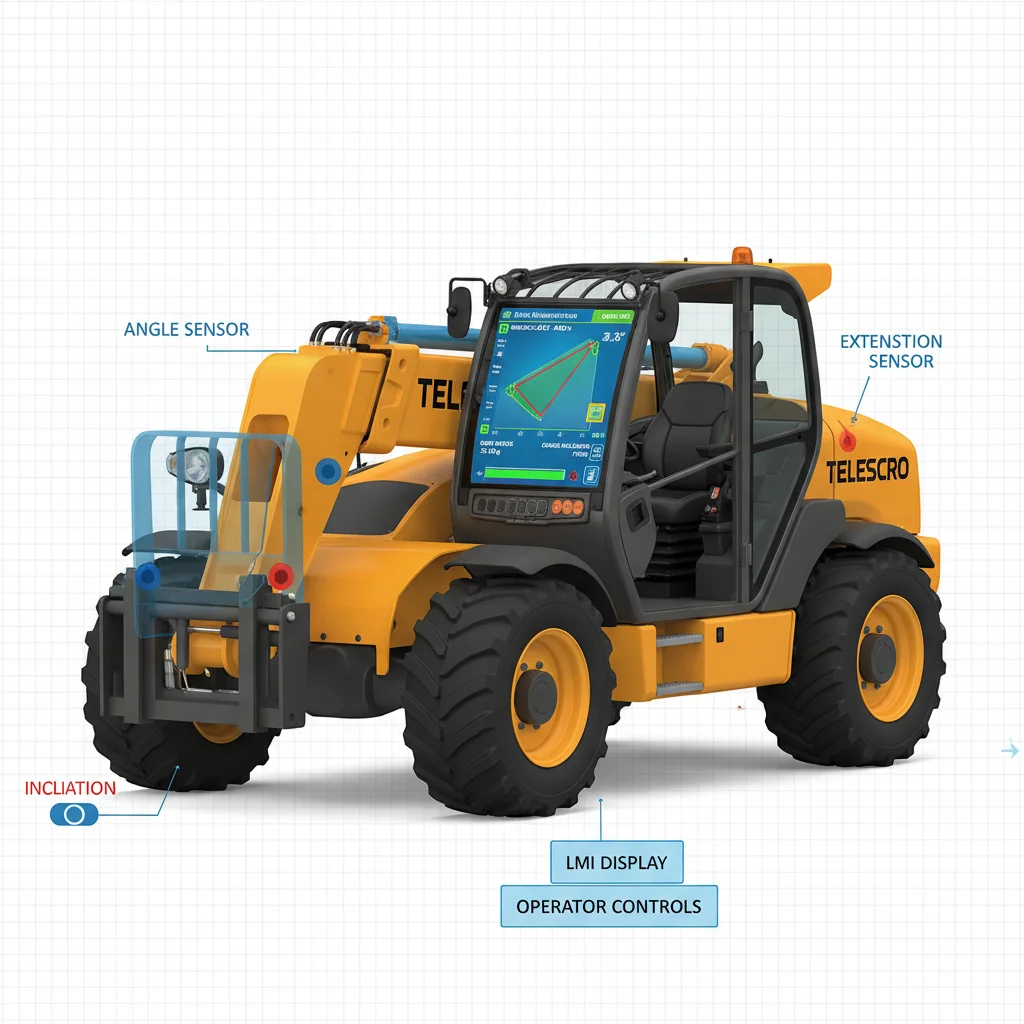
One thing I consistently see on jobsites—especially across Europe and parts of the Middle East—is how much safer telehandler operations become when the electronic LMI is actually used, not ignored. On one project, the crew was lifting 2,500 kg roof beams with a 16-meter rotating telehandler. The operator relied on the paper load chart until they began working with a jib attachment on a slight slope. That’s where the electronic LMI made the difference.
As the boom was extended, the system continuously evaluated boom geometry and chassis inclination, showed a shrinking safe zone on the in-cab screen, and issued an audible warning well before the machine reached its stability limit. A static chart would not have reflected that combination of attachment, reach, and ground condition.
From a practical standpoint, a proper electronic LMI integrates boom angle and extension sensors, chassis level sensors, and attachment recognition (which may be automatic on some machines, or selected manually on others). The system compares this live data against the machine’s approved load chart database and responds by warning the operator—or, on many machines, restricting further hazardous movements such as boom extension or lowering.
I’ve seen this prevent real incidents. In one case, an operator attempted to extend the boom at near-maximum reach with a pallet already close to the limit. Before the machine could become unstable, the LMI locked out the extend function. That intervention likely prevented a tip-over, not just a minor scare.
That said, the electronic LMI does not replace the load chart. The static load chart remains the baseline for job planning, attachment selection, and lift planning. The LMI is a secondary layer of protection—helping operators stay within limits as conditions change—but it cannot eliminate the need for correct setup, conservative operation, and proper training.
Electronic LMIs on telehandlers can warn operators as the machine approaches stability limits caused by factors such as chassis inclination, attachment changes, or boom geometry that are not reflected on static paper load charts.True
Paper load charts are based on defined, static test conditions. Electronic LMIs monitor live inputs such as boom angle, extension, and chassis level, allowing them to alert or restrict functions as stability margins are reduced by changing machine configuration or ground conditions.
Electronic LMIs are only effective when the telehandler is stationary and provide no benefit during pick-and-carry operations.False
Modern electronic LMIs continue monitoring machine geometry and stability-related parameters during movement. While they cannot eliminate all dynamic risks, they provide meaningful warnings and function limits during pick-and-carry and other non-static operations.
Key takeaway: Electronic LMIs and dynamic load charts enhance operational safety and reduce tipping risk by showing operators live capacity status and warning against overloads. However, they supplement—rather than replace—the fundamental static-rated load chart, reacting primarily as limits are approached rather than actively forecasting all dynamic scenarios.
How Does Machine Condition Impact Load Chart Accuracy?
Telehandler load charts are based on factory-tested conditions: correct tires and pressure, tight boom components, functioning stabilizers or axle locks, and a calibrated load moment indicator (LMI). Real-world wear, poor maintenance, or unapproved repairs can reduce actual stability margins, making strict inspections and routine recalibration essential to maintain accurate and safe rated capacity.
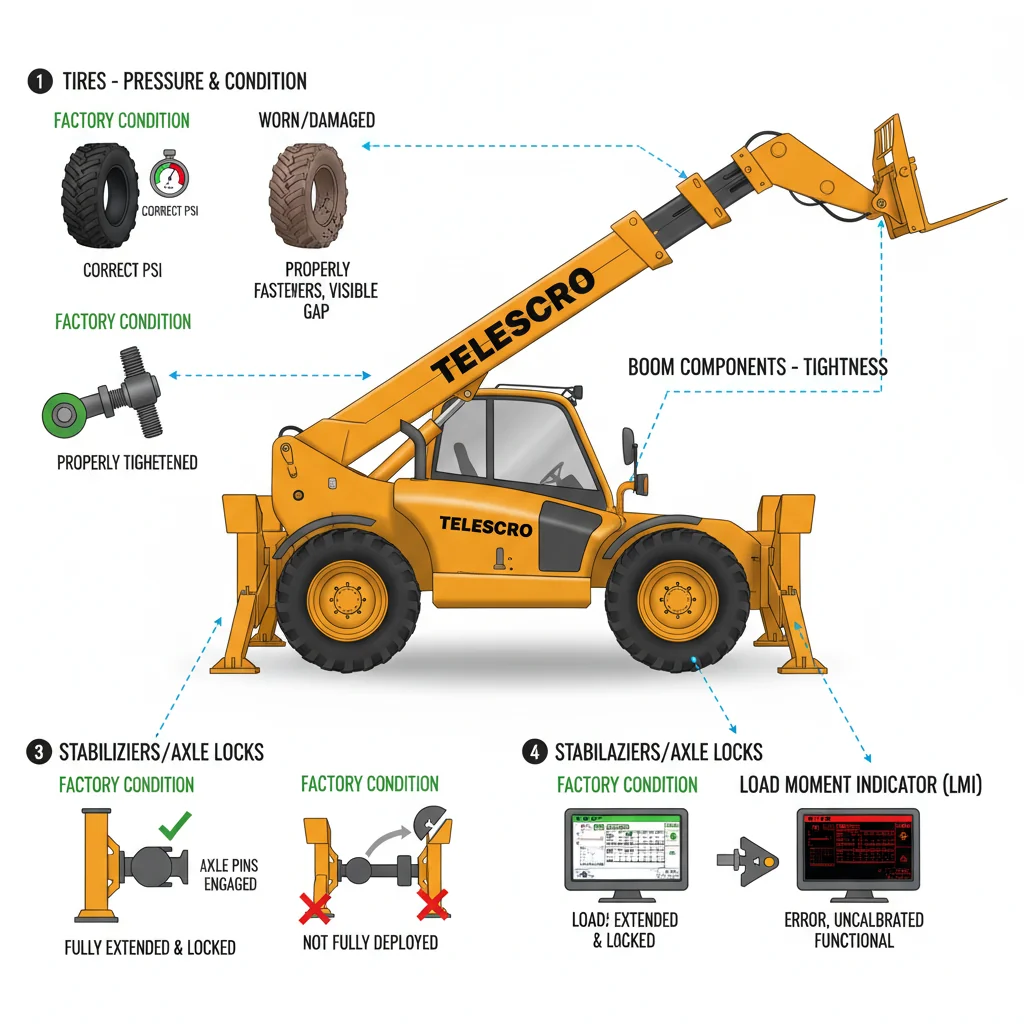
A question I get all the time: “Why does my telehandler feel unstable even when I stick to the load chart?” The real answer is most fleets never operate in perfect, as-tested condition. Factory load charts are built on assumptions—right tire size, correct pressure, tight boom pads, working stabilizers, and a calibrated load moment indicator (LMI). But on real jobsites in places like Malaysia or Kazakhstan, I often see units rolling out with mismatched tires, 20% low pressure, or worn boom pads that let the boom shift a few millimeters under load. These small variations add up and eat away at your real stability margin—sometimes more than operators realize.
I remember a contractor in Brazil who missed a weekly inspection. Their 3.5-ton telehandler was rated for 2,000 kg at 12 meters reach on the chart, but underinflated tires and a worn rear axle lock meant it nearly tipped with a 1,500 kg pallet. The LMI hadn’t been recalibrated in two years, so the alarm never sounded. That’s a scary situation. The chart looked good, but the machine condition told another story. A telehandler can only achieve its rated capacity when every system—tires, boom, chassis, hydraulics—matches the factory baseline.
This is why I always tell maintenance managers: treat strict tire policies and annual (sometimes even quarterly) LMI calibration as non-negotiable. Proactive boom bushing repairs and joint inspections between maintenance and operators catch most issues before they threaten safety. For older or hard-worked units, consider derating by 10-15% to build back lost stability. Don’t let a load chart lull you into a false sense of security.
Incorrect tire pressure on a telehandler can make the actual tipping point significantly lower than indicated on the factory load chart, even if all other conditions appear normal.True
Load charts assume standard tire pressure because underinflated tires compress more and shift the center of gravity, reducing stability and thus the true safe lifting capacity. This makes following the load chart riskier if tire pressure isn’t properly maintained.
Key takeaway: Actual telehandler stability often falls short of the load chart’s assumptions due to tire, boom, axle, or LMI issues. Maintenance managers must enforce strict inspection, tire policies, and regular LMI calibration. Otherwise, published rated capacity may dangerously overstate real-world safety margin, especially on older or poorly maintained machines.
How do site rules address telehandler dynamics?
Site rules and operator training compensate for the load chart’s static limits by mandating boom-low travel8, speed restrictions9 based on ground conditions, and prohibitions on sharp turns or hard braking with raised loads. Clear policies and active supervision are essential, as dynamic incidents are prevented only through enforceable on-site behaviors—not by the load chart itself.
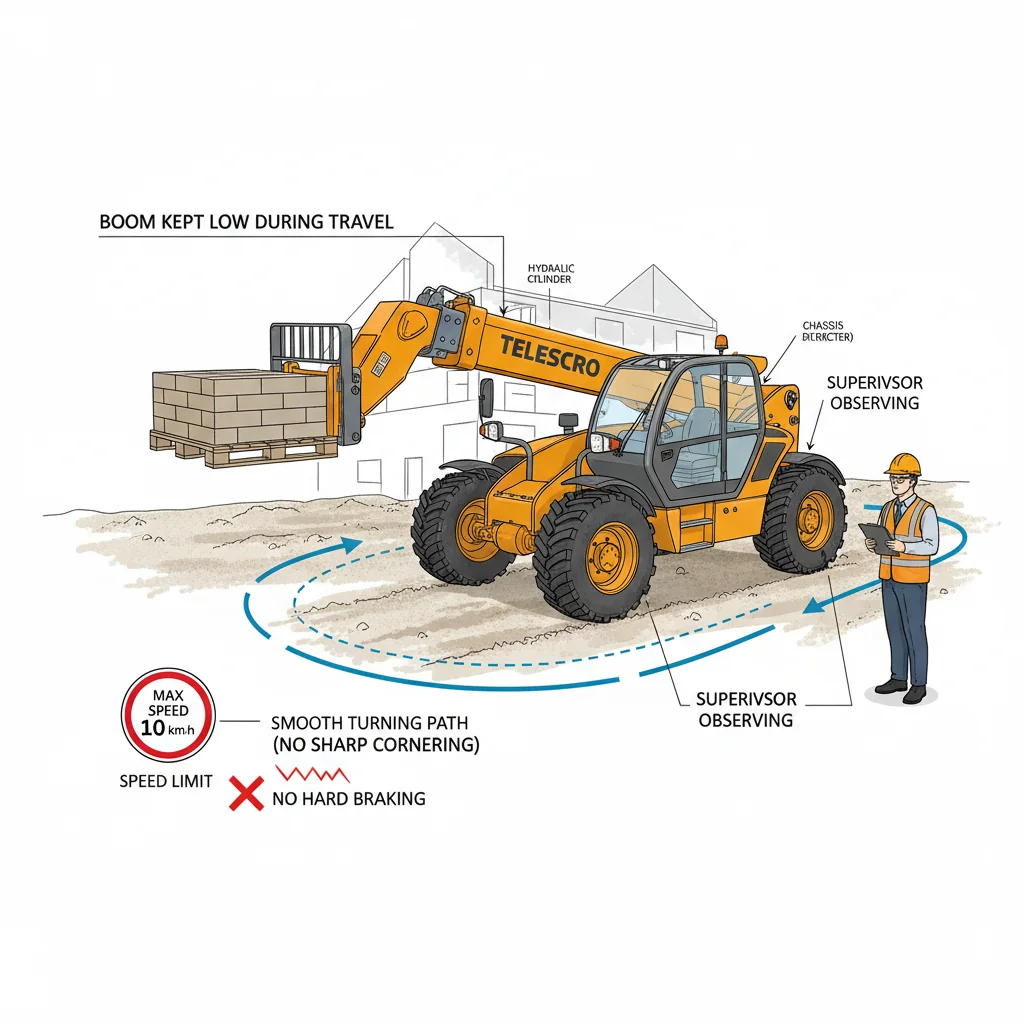
Let me share something important about telehandler site rules—real safety comes from how people behave on site, not just what’s written on a load chart. The chart is calculated for ideal, stationary conditions, yet every jobsite has rough surfaces, unexpected bumps, and shifting loads. Operators facing real mud or sloped ground quickly learn that a number on a chart doesn’t guarantee stability when the boom is halfway extended. That’s why most sites make it mandatory to travel with the boom low and retracted—if I see someone moving with the boom raised, I know they’re risking a rollover, no matter what the chart says.
A contractor I worked with in Poland had strict limits: boom height during travel no more than 2 meters, and speed capped at “walking pace”—about 4 km/h—especially when the ground was wet. Their site foreman would actually walk beside the machine for spot checks. It sounds strict, but since they started this, incidents dropped sharply. Another customer in South Africa ties operator performance reviews to telehandler safety—if someone is seen making a sharp turn or braking with a raised load, that’s logged and affects their next contract. These policies have real bite on site.
Training is just as critical. I always remind operators that the load chart is a “perfect world” maximum; in reality, dynamic forces mean you need a margin. Simple rules—like “cut capacity in half if moving with an extended boom”—don’t appear in OEM manuals, but teaching conservative habits saves accidents. My advice? Never treat the chart as permission for risky maneuvers. Active site supervision, tailored speed limits, and frequent reminders are what actually keep telehandler dynamics in check.
Telehandler load charts do not account for dynamic forces such as braking, turning, or driving over uneven ground, which is why site rules often require booms to be kept low while traveling.True
Load charts are calculated under static, ideal conditions, but real-world operations introduce dynamic forces that can destabilize the machine. Keeping the boom low helps maintain a lower center of gravity, reducing the risk of tipping when those forces occur.
Site rules assume that telehandler stability is always maintained as long as the operator stays within the load chart limits, regardless of site conditions or movement.False
This is incorrect because site rules recognize that factors like rough terrain, inclines, and movement create risks not accounted for in the load chart. Rules specifically address these variables to ensure safety beyond the static limits shown in the chart.
Key takeaway: Because telehandler load charts do not account for dynamic movement, only strict site rules, tailored training, and vigilant supervision can close this safety gap. Static load chart data must always be backed by practical, enforceable actions to reduce real-world dynamic incidents.
Conclusion
We’ve looked at how telehandler load charts only show safe limits in static, controlled conditions and don’t account for the real-world unpredictables like movement, wind, and rough ground. From what I’ve seen, the safest and most efficient jobsites are run by people who treat the chart as a starting point—not the full story. I always remind crews: “Don’t let showroom specs turn into a ‘showroom hero, jobsite zero’ situation.” If you’re comparing models or have questions about what works for your actual jobsite environment, I’m happy to share what’s worked for real teams in the field. Reach out anytime to talk through your project—it’s always worth double-checking the details. Every jobsite has its own challenges—your safety and productivity come first.
References
-
Explore how sudden braking, sharp turns, and ground shocks impact telehandler stability and load limits beyond static charts. ↩
-
Details the critical role of correct tire pressure in maintaining telehandler stability and safe load handling under real jobsite conditions. ↩
-
Details how handling suspended loads impacts machine balance and risk factors, providing expert insights for safer telehandler operation. ↩
-
Explains why a 20-40% capacity buffer improves telehandler safety, reduces alarms, and extends equipment lifespan on rugged sites. ↩
-
Details how load moment indicators prevent overloads and enhance operational safety in telehandler applications. ↩
-
Explore detailed benefits of electronic LMIs in real-time risk management and preventing telehandler tip-overs onsite. ↩
-
Learn how dynamic load charts adapt to real-time sensor data, offering superior safety over traditional static charts. ↩
-
Explains critical safety practices for telehandlers, emphasizing stable load handling to prevent rollovers on rough jobsite terrains. ↩
-
Details how controlled speeds on uneven or wet surfaces reduce accidents, supported by real-world policy examples and incident reductions. ↩