










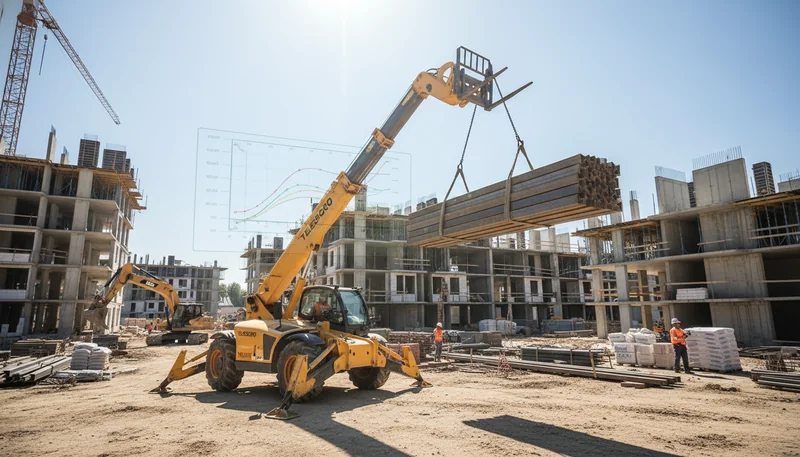
Telehandler Load Chart Myths: What Buyers Miss About Real Capacity
A project manager from Brazil recently shared photos of a telehandler teetering on two wheels, cargo halfway up a new hotel facade. He pointed at the load chart sticker and asked, “Shouldn’t we be fine?” That moment sums up why so many people misread what those charts really mean in practice.
Telehandler load charts define the OEM-rated capacity envelope for specific boom positions and approved configurations (attachment and load center). The published ratings assume the manufacturer’s stated setup conditions—firm, level supporting ground, correct tires and inflation pressure, and the specified load center. In real operations, factors such as ground settlement, boom motion, wind acting on large loads, non-uniform load positioning, and machine wear can reduce available margin. Headline “max” ratings usually describe best-case positions at short reach; capacity drops quickly as reach and lift height increase.
What Does a Telehandler Load Chart Guarantee?
A telehandler load chart sets the OEM rated capacity1 for a specific configuration under the manufacturer’s stated assumptions—typically a firm, level supporting surface, correct tires and inflation pressure, the specified forks or attachment, and a static load at the defined load center. The chart marks regulatory stability limits, not a routine daily working target. Under real construction site conditions, many contractors plan operations with additional margin and avoid working at the edge of the charted envelope, as variables such as ground conditions, load placement, and machine wear can reduce practical capacity.

Most people don’t realize just how strict the test conditions are for telehandler load charts. The numbers look impressive—3,500 kg, 4,000 kg or even more. But here’s the thing: those values come from controlled tests on a brand-new machine, parked on level, solid ground, with the manufacturer’s standard forks and exact tire pressure. The boom is stopped, not moving, and the load is static—no swinging pipes or tilted pallets like you see on real jobsites.
I worked with a project team in Peru that assumed the telehandler’s “rated capacity” reflected what the machine could safely lift on a daily basis. The site was built on compacted granular soil, which looked firm but did not fully meet the load chart’s supporting surface assumptions. During one morning lift, the telehandler became unstable while handling a heavy pallet at extended reach.
When we reviewed the conditions, several factors stood out: the machine was operating on a slight slope, tire pressures were below the manufacturer’s recommendation, and the fitted fork carriage was heavier than the standard configuration referenced on the load chart. None of these conditions matched the assumptions under which the charted ratings were established.
My advice in situations like this is straightforward: treat the load chart as a hard ceiling, not a daily operating target. If a task requires working close to the edge of the rated envelope, it’s a signal to reassess—reposition the machine, improve ground conditions, reduce the load, or select a higher-capacity telehandler. Relying on margin, rather than pushing chart limits, is what keeps lifts stable when real jobsite variables come into play.
A telehandler load chart only reflects lift capacity when the machine is equipped with its factory-standard forks and tires, not attachments like buckets or personnel platforms.True
Manufacturers develop load charts based on specific machine configurations, usually with standard forks and tires. Using other attachments alters the center of gravity, weight distribution, and ultimate lifting ability, meaning the published capacities no longer apply.
Telehandler load charts are calculated to include a safety margin for uneven ground, so actual jobsite conditions will rarely cause overloads if you stay within chart limits.False
Load charts are based on ideal, level ground and static conditions with no allowance for slopes, movement, or inconsistencies found on jobsites. Relying on the chart for uneven or unstable ground can still result in dangerous overloading situations.
Key takeaway: Telehandler load charts provide rated capacity under strict test conditions that rarely match daily work environments. Operators should treat load chart values as a ceiling, not a target, and plan to work within 70–80% of these limits for safe, reliable handling on real sites.
Why Doesn’t Rated Capacity Match Real Jobs?
Telehandler rated capacity—such as “10,000 lb”—only applies at minimum reach and low lift heights. Capacity drops sharply as boom height and forward reach increase, with load charts showing significant reductions after just a few feet. Evaluating load chart data for specific height and reach requirements is essential for accurate machine selection.

Let me share something important about telehandler “rated capacity” that often trips up even experienced buyers. The headline figure on the datasheet—such as 10,000 lb or 4,000 kg—typically applies only at short reach, with the boom retracted and the load positioned close to the machine. As soon as lift height or forward reach increases, the available lifting capacity drops rapidly. This is basic physics: extending the boom moves the load’s center of gravity farther forward, increasing the overturning moment about the front-end support line defined in the load chart. That growing leverage is why capacities shown on the chart reduce sharply as reach and height increase, even though the machine’s “rated” tonnage remains unchanged.
I’ve seen this surprise contractors everywhere from Dubai to Vietnam. For example, in Australia, a site manager called me confused because his 3.5-ton telehandler couldn’t lift a 2,500 kg pallet to the third floor, about 12 meters up. We checked the load chart together. At that height and reach, the actual safe capacity was barely 1,200 kg—less than half the headline figure. That’s a common scenario. You might see the brochure say 4,000 kg, but at 13 meters out, you’re limited to just 1,500 kg.
Here’s what matters most when sizing a telehandler: always review the load chart for your exact height and forward reach. The load chart maps out, position by position, what the machine can safely pick—not just at ground-level. I suggest you estimate your heaviest routine lift at maximum expected reach, then check that specific point. Choosing based on headline tonnage alone risks costly delays, dangerous lifts, and, sometimes, hiring a second machine.
A telehandler's rated capacity does not account for the reduced stability and increased tipping risk when loads are handled at full boom extension or high lift heights.True
Telehandler rated capacities are specified for optimal conditions, typically with the boom retracted and the load close to the machine. As the boom is extended or raised, leverage and stability change dramatically, so the actual safe handling capacity decreases significantly.
You can safely lift the rated capacity of a telehandler at any boom angle or extension, as long as the machine is on level ground.False
Rated capacity only applies under specific conditions, generally with the boom retracted and the load closest to the chassis. At longer boom extensions or steeper angles, the telehandler’s capacity drops due to increased leverage and risk of tipping, regardless of ground levelness.
Key takeaway: Headline telehandler capacities rarely reflect actual working limits at typical job-site heights and outreach. Buyers must consult the load chart for the precise rated capacity at required height and reach, not just the maximum capacity, to ensure safe, effective machine choice and avoid costly site delays.
How Much Extra Capacity Do Load Charts Require?
Telehandler load charts include the regulatory safety factors required by applicable standards, but they are developed under defined assumptions and do not account for jobsite variables such as ground variability, wind acting on the load, attachment differences, or imperfect load positioning. For this reason, telehandler selection should be based on the machine’s charted capacity at the actual working height, reach, and attachment, with sufficient margin remaining within the rated operating envelope rather than matching loads exactly to the chart limits.

Here’s what matters most when sizing a telehandler: load chart values are established assuming firm, level ground, correct tire pressure, specified attachments, and controlled operation. Real jobsites rarely meet all of those conditions at the same time—particularly in regions where loose soil, wind, or uneven surfaces are common. I’ve seen projects in the Middle East run into trouble because the selected machine only just met the charted capacity at the required reach. On paper, the lift was possible. In practice, a slight slope combined with a bucket attachment was enough to push the machine to its stability limit and trigger a shutdown.
Best practice is not to “add a percentage,” but to evaluate the telehandler’s load chart at the most demanding working position—the maximum expected height and reach, with the actual attachment installed—and confirm that the required load remains comfortably within the rated capacity envelope. If the planned lift sits at the edge of the chart, that is usually an indication that the machine is undersized for the jobsite conditions, even if it meets the specification on paper.
A good example comes from a project in Brazil, where a client needed to place heavy pallets onto scaffolding at approximately 10 meters using a suspended attachment. The selected telehandler technically met the load chart requirement at that position. However, once humidity increased and the supporting surface softened, tire settlement reduced the available stability margin. The issue was not that the chart was wrong—it was that the machine was operating too close to the limit assumed by the chart. The only practical solution was to bring in a higher-capacity model with more reserve at that working point.
Even with features like frame leveling and experienced operators, successful telehandler selection comes down to margin. Machines that operate comfortably within their rated envelope are more tolerant of normal jobsite variability and far less likely to cause delays, shutdowns, or near-tip events. If a task routinely requires operating at the edge of the load chart, the safer and more economical decision is usually to step up to a larger class machine rather than rely on perfect conditions every day.
Telehandler load charts do not account for factors like wind or soft ground, which can significantly reduce the safe lifting capacity on real job sites.True
Standard load charts assume ideal, controlled conditions that rarely exist in practice. Environmental variables or unstable ground can compromise stability, reducing the actual safe capacity below what the chart states.
Matching your load precisely to the telehandler’s maximum charted capacity guarantees safe operation, regardless of site conditions.False
If a load matches the maximum listed on a load chart but real-world conditions like uneven ground or shifting wind are present, there is an increased risk of tipping or overloading. The chart does not account for these hazards, so following it precisely can be unsafe in non-ideal situations.
Key takeaway: Always select a telehandler whose load chart shows 20–30% greater capacity at the actual working point—height, reach, and attachment—relative to the maximum expected load. This extra margin addresses real-world risks and prevents costly handling errors, especially when working with suspended or awkward loads.
How Does Load Center Affect Rated Capacity?
Telehandler load charts assume a standard load center—often 24 inches from the fork face, matching a typical 48-inch pallet. If the actual load center increases, such as with long or uneven loads, the rated capacity drops sharply. OEM-specific reduction factors must be used, as no universal percentage applies.

The biggest mistake I see is buyers relying on the rated capacity shown on the spec sheet without considering the load center assumption behind it. Most telehandler load charts are based on a specified load center—commonly 24 inches (610 mm) on many North American charts, or 500 mm on many EN/ISO charts, depending on the manufacturer and market. This assumption aligns with a standard pallet, but real jobsite loads are rarely that uniform.
For example, on a project in Dubai, a client needed to handle 6-meter steel pipes using standard forks. Although the telehandler’s load chart showed sufficient capacity for the listed weight, the long pipes shifted the load’s center of gravity significantly forward of the charted load center. Once that happened, the available lifting capacity at the same boom position dropped substantially, forcing the team to reassess the lift plan and nearly delaying the project. The chart itself was not wrong—the load no longer matched the geometry the chart was based on.
I’ve worked with teams in Kazakhstan handling oversized formwork panels. They thought as long as the weight didn’t exceed the machine’s rating, they were safe. But those panels, with weight distributed far out, moved the load center past the standard. The moment indicator alarmed before the boom was even halfway extended. The key issue? The rated capacity only applies if you’re using the specified load geometry. As soon as the load center and shape change—even by 10–12 inches—your safe capacity can dip by several hundred kilos, or more.
So, for any real job, always map the load as it really is—length, weight distribution, rigging method. If you’re moving non-standard or bulky items, I suggest treating published capacities as optimistic. Either play it safe and derate yourself by 20–30%, or select a larger machine with extra margin. Never guess—always reference the manufacturer’s load center correction table before deciding.
A telehandler’s rated capacity can decrease significantly if the load is positioned further out than the standard 24-inch load center.True
This is true because moving the load’s center of gravity away from the fork face increases leverage on the machine, reducing its lifting capability even when the total weight remains the same. The load chart assumes a standard 24-inch load center, so longer or off-centered loads will reduce actual capacity.
If a load weighs less than the rated capacity, it can be safely lifted regardless of its length or how it’s positioned on the forks.False
This is false, because moving a lighter load further from the standard load center can still create enough leverage to exceed the machine’s tipping moment. Load length and position always impact stability, even if the weight is low.
Key takeaway: Telehandler load chart capacities are valid only for the specified load center and load geometry shown on the chart. When the center of gravity moves further forward than the stated value—whether due to long materials, uneven weight distribution, or attachment geometry—the available lifting capacity can decrease significantly. Always consult OEM load center correction tables or attachment-specific charts for real-world applications rather than relying on the base rated figure.
How do attachments affect telehandler capacity?
Attachments such as jibs, buckets, and man baskets add dead weight2 and shift the load center forward, which reduces the telehandler’s usable rated capacity. Standard load charts are based on forks or the standard carriage; each attachment type requires a specific chart reflecting its capacity-reducing impact to ensure regulatory compliance and job safety.

I’ve worked with customers who made this mistake—assuming the rated capacity on the standard forks always applies, even when they switch to a man basket or a long jib. Last year, a builder in Kazakhstan tried lifting HVAC units with a 4-ton telehandler using a 2.5-meter jib. The load chart in the cab showed 4,000 kg at minimal reach. But once we checked the attachment-specific chart, the real safe lift dropped to around 2,300 kg at that same position—a major difference. That dead weight and extra reach from the jib quietly stole more than a third of the machine’s usable capacity.
Every attachment you add—buckets, side-shift carriages, man baskets, longer forks—impacts the usable capacity. Here’s how they directly affect you:
- Dead weight: Each attachment adds several hundred kilograms before you pick any load.
- Shifted load center: Jibs, baskets, or buckets move the weight point farther from the front tires, increasing the overturning moment.
- Variable geometry: Some buckets or custom carriages are longer, changing the reach calculation in the load chart.
- Attachment strength: The limit is sometimes the attachment itself, not just the machine.
Applicable standards and OEM instructions—such as EN 1459 and ANSI/ITSDF B56.6—require that telehandlers be operated within the rated capacities defined for the specific machine configuration, including the attachment in use. Because different attachments change load geometry and weight, manufacturers provide attachment-specific capacity charts or tables to define the allowable operating limits.
In practice, operators and buyers should always verify that the correct, OEM-approved chart is available for the attachment being used. If a supplier or rental company cannot provide a capacity chart or documentation covering that attachment, the lift should be reassessed before operation. Never rely on assumptions or “close enough” estimates—the applicable capacity is defined by the chart for the actual configuration, not just the standard fork chart displayed in the cab.
Telehandler load capacity can drop significantly when using attachments like jibs or buckets, even at minimal boom extension.True
Attachments change the load’s position and add dead weight, making the telehandler more prone to tipping. Load charts for each attachment account for these changes, usually resulting in a lower safe lifting capacity compared to standard forks.
As long as the total lifted weight does not exceed the telehandler’s base rated capacity, it is safe to use any attachment without consulting the attachment-specific load chart.False
Each attachment alters the load center and structural dynamics, so using only the base rated capacity is unsafe and can lead to machine instability or overloading. The attachment-specific load chart must always be used to determine the actual safe lifting limits.
Key takeaway: Always demand attachment-specific load charts, as using only the standard fork load chart with additional attachments can severely overstate true lifting capacity. If a supplier cannot provide proper charts for required attachments, treat that configuration as non-compliant and potentially unsafe—never assume capacity without documented proof.
How do slopes and soft ground affect load?
Telehandler rated capacity is established under OEM-defined test conditions, which assume a firm, level, and uniform supporting surface. Sloped terrain, soft or recently filled ground, and surface settlement can significantly reduce stability by shifting the machine’s effective center of gravity. For operations outside ideal conditions, OEM guidance emphasizes leveling the machine, improving ground support, or reassessing the lift plan rather than operating near the limits shown on the load chart.

Last month, a contractor in Brazil contacted me after a near miss on a commercial site. They were lifting a 1,400 kg HVAC unit with a 4-ton telehandler on recently compacted fill. Even with the boom only partially extended, one front tire began to settle into the surface. On paper, the lift appeared well within the charted capacity. In reality, the slight chassis lean caused by ground settlement was enough to make the machine feel unstable. The crew stopped the lift and installed steel plates to restore a solid base before continuing.
What many operators overlook is that load charts assume a stable, level supporting surface. When a telehandler is placed on a side slope or on ground that can compress under load, the machine’s stability envelope changes immediately. Tire settlement or lateral tilt shifts the effective support line at the front of the machine, reducing forward stability long before the charted capacity is reached. In these situations, a lift that appears acceptable on paper can quickly move outside the machine’s tested operating envelope.
On jobsites with sand, trench edges, backfilled areas, or uneven rock, ground conditions must be treated as a critical part of lift planning. In regions such as Brazil or Central Asia, I regularly advise crews to improve ground support using cribbing or mats, to take advantage of frame-leveling systems where available, and to reposition the machine whenever possible to maintain a level stance. If a solid, level base cannot be ensured, the lift plan itself should be reconsidered rather than relying on the chart alone. Maintaining margin through site preparation and equipment selection is far safer than attempting to work at the edge of rated capacity.
Even minor ground settlement or tire sinkage can compromise telehandler stability by shifting the load’s center of gravity outside safe boundaries before you reach rated capacity limits.True
Telehandler load charts assume level, firm ground. When a tire drops into soft fill, the chassis tilts and shifts the center of gravity, making tipping possible even if the lifted weight is under charted capacity. This instability often occurs with less than five centimeters of settlement.
If the load’s weight is below the telehandler’s charted capacity, working on a mild slope or newly compacted ground will not affect its lifting stability.False
Stability depends on more than just weight—uneven or soft ground can cause the machine to lean or sink, changing how forces are distributed and increasing tip-over risk even at sub-capacity loads. Charts do not account for these field variables.
Key takeaway: Telehandler load chart capacity is valid only on firm, level ground. Slopes and unstable surfaces dramatically reduce stability, often necessitating capacity derating by 20–30%. Always level the machine or consult the manufacturer’s guidance before lifting on uneven, sloped, or soft terrain.
How do wind and movement affect load chart?
Telehandler load charts are developed for static, compact loads under calm conditions. In real operations, wind effects and dynamic actions—such as traveling with the boom raised, braking, or handling large, high surface-area loads—can significantly reduce the available stability margin. Under these conditions, operators should avoid working near the limits shown on the load chart and reassess the lift plan, control methods, or equipment selection to maintain safe operation.

Here’s something many buyers overlook: telehandler load charts are developed based on defined operating assumptions, including a level supporting surface, static load handling, and calm environmental conditions. Real jobsites rarely match all of these assumptions at the same time. Once side wind is introduced or the machine is operated with the boom raised, the stability margin shown on the chart can be reduced significantly.
In northern China, I supported a team lifting 8-meter wall panels weighing around 1,000 kg each. On a windy day, those panels began to sway noticeably at approximately 12 meters of lift height. Although the load was well within the charted capacity for that position, the operator reported a clear loss of control margin due to wind-induced movement. The chart was not wrong—the operating conditions had moved outside what the chart was intended to represent.
Experienced operators recognize that wind-sensitive or awkward loads require a more conservative approach. Large surface-area materials, suspended loads, or any operation involving travel with the boom elevated introduce dynamic effects that are not reflected in static load charts. In these situations, the correct response is not to rely on a fixed reduction rule, but to reassess the lift plan—slow movements, minimize travel, use taglines and spotters, or select a machine with greater capacity at the working position.
Dynamic effects such as braking, ground irregularities, or sudden gusts can momentarily push the machine beyond its stable operating envelope, even when the indicated load is within chart limits. For tasks involving bulky or wind-exposed materials, planning with margin and avoiding operation near the edge of the load chart is essential. If the work routinely approaches chart limits under variable conditions, upgrading equipment or changing the handling method is usually the safer choice.
Side winds can exert lateral forces on a suspended load, causing telehandlers to lose stability even when the load is within the charted capacity.True
Load charts assume calm conditions; wind pressure against large or light loads can increase tipping risk by creating dynamic movement that the charts do not account for.
As long as the telehandler's load is within the capacity shown on the load chart, it is safe to drive with the boom raised, regardless of wind or terrain.False
Load charts are calibrated for stationary, level conditions—moving with the boom raised or in windy environments introduces dynamic forces and instability the chart doesn't reflect, making such operations hazardous.
Key takeaway: Rated telehandler capacity assumes level ground, calm air, and stable loads. Wind, movement, and large load surfaces can greatly increase overturning risks versus the load chart. For wind-sensitive or awkward loads at high reach, always apply a conservative buffer and consider machine upgrades or alternative methods.
How do tire and wear impact telehandler capacity?
Telehandler load charts assume factory conditions: correct tire pressure, OEM tires, and minimal wear. In reality, foam-filled or underinflated tires, worn tread, and machine add-ons shift the center of gravity, increasing chassis movement and reducing stability. Capacity on older or poorly maintained units may be significantly derated compared to the original chart.

Last year, I visited a jobsite in Saudi Arabia where the customer complained their 3.5-ton telehandler seemed unstable any time they approached maximum reach. When I checked the machine, two tires were underinflated—down nearly 30% from the recommended pressure. On telehandlers, the load chart capacity is based on factory conditions: correct tire pressure, OEM-approved tread, and minimal wear. Swap in foam-filled or solid tires, let the pressure drop, or allow the tread to wear down, and you’re suddenly shifting the center of gravity. That leads to more chassis movement—especially when you extend the boom for a long reach.
Here’s what matters most when you’re working with an older unit or one that’s had heavy jobsite use. Worn boom pads, slack in the kingpins, or sidewall deflection on soft tires all stack up. I’ve seen a seven-year-old, poorly maintained machine that was rated 4,000 kg on the chart handle less than 3,000 kg safely at similar reach. The stability margin shrinks, but your gauges won’t always alert you—moment indicators can’t compensate for hidden mechanical slop or soft tires.
To be honest, I always recommend treating older machines or those with aftermarket modifications as derated, even if the load chart looks good on paper. Keep a strict maintenance schedule: check tire pressure every shift, inspect tires for even tread, and watch for extra weight from non‑approved add-ons. If you’re not sure—work well below the charted limit or select a model with at least 20% higher rated capacity. That approach avoids surprises and keeps the job running safely.
Using foam-filled or solid tires instead of pneumatic tires can noticeably reduce a telehandler’s effective lifting capacity due to increased tire rigidity altering the load distribution and stability.True
Unlike pneumatic tires, foam-filled and solid tires do not flex under load, changing how weight is transferred to the ground and often resulting in a shift in the machine’s center of gravity, which can limit safe capacity at full reach.
Tire tread wear has no impact on telehandler stability as long as the tire pressure is maintained at recommended levels.False
Even with proper inflation, worn treads reduce traction and can compromise stability on rough or uneven surfaces, especially during load handling or when maneuvering, increasing the risk of slippage or tip-over.
Key takeaway: Telehandler load chart capacities reflect ideal factory conditions, not the realities of aging equipment or non-standard tires. Regular maintenance, correct tire pressure, and cautious use of add-ons are essential to stay near published capacities. Older or modified machines should always be operated well below chart limits.
Are LMIs Enough for Safe Telehandler Capacity?
Load Moment Indicators3 (LMIs) and load charts are valuable, but they cannot compensate for off-chart conditions such as side slopes, improper load centers, or unstable ground. Actual rated capacity depends on factory configurations, level ground, and correct attachments—factors electronic systems cannot always detect. Operator error or site variability can invalidate charted capacities.

The biggest mistake I see is operators trusting LMIs as if they’re a guarantee. Yes, load moment indicators warn when you approach the charted envelope, but they depend on assumptions—level ground, factory-supplied forks, standard load center. I’ve worked with a contractor in Kazakhstan who relied on the LMI. They were lifting concrete blocks, thought they were safe at 12-meter reach. But the ground had a slope close to 4°, and the blocks sat further out on the forks than the manual showed. The result? The alarm went off just as the rear tires started to get light—not before. That was a close call.
Here’s the thing—no electronic system can sense everything the site throws at you. LMIs can’t measure if you’re on soft ground, or if your load center is now 700 mm instead of 600 mm. I’ve seen jobs in Brazil where dirt fill settled after a rainstorm. The load chart only worked when the machine was leveled within 3°. Once, a 3.5-ton telehandler tipped back to the pivot point at less than 2.5 tons actual load—just because the platform was 5° off-level and the operator used the wrong chart. Tiny differences stack up fast. At even 1.5 meters more reach, the allowable load can drop by a third.
I always suggest treating LMIs as your final warning, not your safety net. Train operators to use the correct load chart for every attachment and measure reach from the front tire edge to the load center. On any non-level ground or tricky setup, manually derate your capacity—don’t expect electronics to “save” the lift. That’s what truly keeps people safe on real jobsites.
Load moment indicators (LMIs) can fail to reflect a telehandler’s true capacity if the load center is different from the standard assumed in the load chart.True
LMIs base their calculations on factory assumptions, such as a standard load center, and do not adjust for real-world deviations like loads placed further out on forks, which can increase tipping risk.
Telehandler LMIs automatically compensate for ground slope, so capacity readings remain accurate even on uneven surfaces.False
Most LMIs measure boom angle and load moment but do not account for terrain slope or instability, meaning readings can be dangerously misleading when the machine is not level.
Key takeaway: LMIs and load charts must be treated as safeguards—not guarantees—when determining telehandler capacity. Actual safe operation requires operator training, precise measurement of reach and height, and manual derating for non-ideal conditions. Relying solely on electronic or chart data risks overload and instability in real-world use.
How to Field-Test True Telehandler Capacity?
A field test of telehandler capacity4 involves using a verified test load, the intended attachment, and operating on the actual working surface. Operators must extend the boom to planned and slightly greater reach, monitoring for signs like rear axle lightening, tire compression, or machine instability to reveal real-world limits beyond what load charts suggest.

I get a lot of questions from customers who trust the load chart, but still want proof on their own jobsite. Honestly, that’s smart. Manufacturer charts are made with perfect ground and a specific attachment, but real jobs are never textbook. Take a project I supported in Saudi Arabia last year—an 18-meter high-reach machine was supposed to lift 1,200 kg HVAC units onto a steel mezzanine. On paper, totally within spec at 14 meters of reach. But once we ran a field test with the actual pallet and forks, we noticed the rear tires started to lift slightly when the boom moved just 0.5 meters past the planned point.
Here’s what matters most when you check real capacity: set up a verified test load, use the attachment you’ll actually fit, and perform the test exactly on the work surface. Slowly extend the boom to the planned working position, then a little further—don’t rush. Watch for warning signs: if the rear axle starts to lift, tires compress deep into soft ground, or the chassis rocks when you feather the controls, you’re past your safe buffer. The load chart says you’re in range, but your stability margin might be gone.
I always suggest you and your spotter document the weight, reach, and ground conditions where the machine feels secure. Share this during operator briefing. If you can’t keep things stable at your target point, swap for a bigger model or rethink the lift plan before you start real work. That call, made early, can save a job and keep people safe.
Field-testing a telehandler’s capacity on the actual jobsite can reveal reduced safe working limits compared to the manufacturer’s load chart, especially when factors like uneven ground or custom attachments are present.True
Real-world site conditions often differ from the controlled environments used for manufacturer testing. Slopes, soft ground, and non-standard attachments can all lower the effective load that a telehandler can safely handle, making field-testing a critical step in verifying true capacity.
If a telehandler can successfully lift a load during one field test, it will always be able to repeat that lift at the same reach regardless of changes in tire pressure or machine angle.False
The safe lifting capacity of a telehandler can change with variations in machine configuration, such as tire inflation or the angle of the equipment relative to the ground. Consistent performance requires that all variables remain unchanged; otherwise, stability and load limits may be compromised.
Key takeaway: Real-world telehandler capacity can differ from load chart values due to site and equipment variables. Controlled on-site capacity checks, with documented results and proper margin assessment, are essential to ensure safety and project success before committing a machine to critical lifts.
How Should Telehandler Jobs Be Specified?
Specifying telehandler jobs by generic capacity, such as “4-ton,” leads to mismatches. Dealers and rental houses require detailed criteria: lifting height, horizontal reach5, load type, ground conditions, and attachment use. Providing specifics allows suppliers to consult real load charts and select machinery based on actual working requirements, not nominal brochure figures.

A lot of contractors tell me, “Just give me a 4-ton telehandler.” But real jobsites almost never match those simple numbers. For example, last spring in Kazakhstan, a customer needed to place brick pallets about 11 meters high, but the machine had to reach over a 4-meter-deep foundation trench. On paper, a 4-ton telehandler looked perfect. But when I pulled out the actual load chart (which shows safe lifting at each extension), the rated capacity at 11 meters with the boom fully out was under 1,400 kg—barely enough for their lightest loads, not the average pallet weight. We nearly avoided a major problem by switching to a 5.5-ton model early.
When you specify telehandler needs, always give these real-world details: the highest point you’ll place loads, horizontal reach, exact load weights, type of material, ground conditions (mud, slope, gravel), and which attachment you’ll run most. For instance: “I need to lift 1.8 ton cladding panels to 10.5 meters, up to 4 meters out, over crushed stone—forks most of the time, man basket 15%.” That forces dealers or rental suppliers to check the machine’s load chart at your working position, not just the marketing figure at minimum boom.
The other thing: Be honest about those occasional heavy or awkward loads, not just the averages. I’ve seen projects in Brazil stop for a day simply because wind conditions or an odd-shaped pallet pushed a telehandler past its safe limit. I always suggest double-checking the chart at your worst-case scenario. It’s the difference between smooth progress and unexpected downtime.
A telehandler's maximum rated lifting capacity only applies when the boom is fully retracted and close to the machine, not when it's extended at height or outreach.True
Telehandler load charts show that the further you extend the boom or reach out, especially at higher elevations, the less weight the machine can safely lift. The maximum rating is usually based on optimal, retracted conditions.
If a telehandler is rated for 4 tons, it can safely lift 4-ton loads to maximum height and outreach listed in the specifications.False
A telehandler's lift capacity drops significantly as the boom extends or when reaching over obstacles. The 4-ton rating is only valid at minimal extension; at maximum reach or height, the safe load is usually much lower.
Key takeaway: Always specify telehandler applications with job-specific details like height, reach, load type, ground condition, and attachment use. This ensures suppliers match the correct machine to actual site demands, avoiding common capacity overestimation based on general labels or marketing data.
Conclusion
We’ve talked about how telehandler load charts show ideal numbers but don’t always match up with real jobsite conditions. From my experience, the teams that stay productive treat those chart figures as a ceiling, not a target, and build in a solid safety margin for everyday work. The “showroom hero, jobsite zero” trap is easy to fall into if you only focus on headline specs.
If you want a hand reviewing load charts for your actual application—or need advice on parts and attachments—I’m happy to help. Just reach out and let me know your site details. The right telehandler choice depends on your specific jobsite needs.
References
-
Understand the importance of rated capacity, how it’s calculated, and why exceeding it or ignoring load geometry risks safety and project delays. ↩
-
Explore how added dead weight from attachments reduces usable lift capacity and impacts telehandler safety and performance. ↩
-
Detailed insights into how LMIs work, their limitations, and why relying solely on them can risk telehandler stability and safety. ↩
-
Detailed guide on testing telehandler capacity on actual job sites to ensure safe load lifting beyond standard charts. ↩
-
Details the critical role of horizontal reach in telehandler specs to ensure equipment meets jobsite requirements safely and efficiently. ↩