










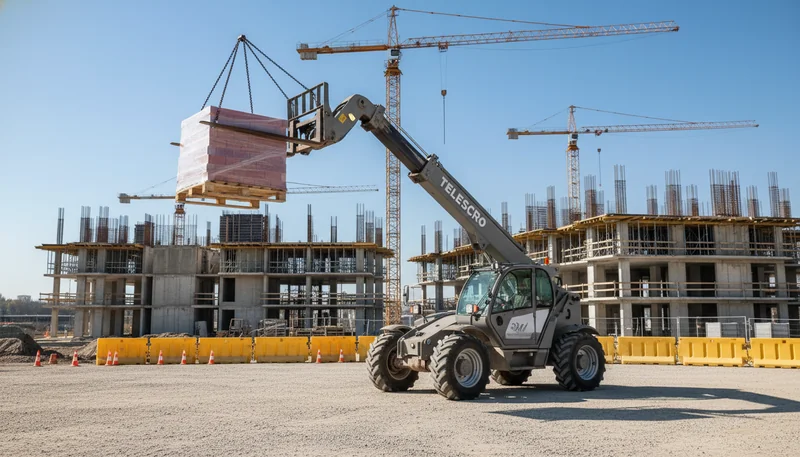
Why Does a Telehandler Load Chart Assume Ideal Ground? Field-Tested Answers Buyers Miss
I’ll never forget watching a crew in Vietnam try to max out their telehandler’s rated capacity1—only to get stuck as the tires sank into wet packed soil. They waved the load chart at me and asked, “Why does this number not match reality?” It’s a common trap.
Telehandler load charts are established through standardized stability verification and OEM testing, with the machine set up on firm, level, non-yielding support and in the configuration stated for the chart. Standards such as ANSI/ITSDF B56.62 and ISO 10896 provide the safety and verification framework that helps make ratings consistent and comparable across brands and models. When ground conditions depart from the chart assumptions—slopes, uneven or yielding surfaces, or mixed support—the published chart values can no longer be treated as an allowable lifting limit and stability margin is reduced.
Why Do Telehandler Load Charts Assume Ideal Ground?
Telehandler load charts are developed under standardized test and verification frameworks, such as ANSI/ITSDF B56.6 and ISO 10896, which assume the machine is supported on firm, level, non-yielding ground and configured as specified by the OEM. These controlled conditions allow rated capacities to be defined consistently and compared across models. Chart values remain valid only when site conditions stay within those stated assumptions.

Most people don’t realize how much ground conditions3 affect what a telehandler can really lift. The rated capacity on a load chart is only guaranteed when you’re on level, firm, non-yielding ground—basically a flat, solid concrete pad with no soft spots or slopes. Last year, I had a customer in Kazakhstan who planned to use a 4-ton telehandler on packed gravel near a steel frame build. On paper, the load chart said 4,000 kg at minimum reach. But that site was sloped around 4–5°, and part of the ground was loose. I warned him—anything outside the “ideal ground” assumption isn’t covered by the chart.
Most OEM charts assume the telehandler is on firm, level ground. Some industry guides define ‘level ground’ as roughly 0±2% gradient, but the key point is that the machine must be within the OEM’s stated levelling tolerance before you apply chart values.
The machine must be set with correct tire pressure, frame level, and no dips under the wheels. Stability is checked by shifting the weight on tilt platforms, making sure the tipping axis (the line at the front wheels) isn’t crossed. If you try picking up a heavy load on mud, ramps, or a 7° cross-slope, the stability calculations and rated numbers just don’t apply. I’ve seen accidents in Brazil where the operator trusted the chart but didn’t check if the site was truly level.
The reality is, the load chart is a best-case guide, not a promise for every jobsite. I always suggest: before planning your lifts, walk the ground and use a spirit level. If the surface doesn’t match the standard, adjust your plan—or your risk goes way up.
Telehandler load charts are based on ideal ground conditions because uneven or soft surfaces can shift the center of gravity and drastically reduce safe lifting capacity.True
Load charts are created assuming firm, level conditions to ensure stability. On non-ideal ground, the machine is more likely to tip or lose traction due to changes in how its weight and the load are distributed, affecting safe operation.
If the ground under a telehandler is only slightly sloped, the rated capacity on the load chart can still be safely used.False
Even a small slope or soft ground can compromise stability and invalidate the load chart’s stated capacity, increasing the risk of tipping or structural failure. Load chart figures are not valid unless ground conditions exactly meet the ideal standard.
Key takeaway: Telehandler load chart capacities are only valid on level, firm, non-yielding ground as defined by industry standards. Attempting to apply rated capacities on uneven, muddy, or sloped surfaces falls outside the tested envelope and invalidates manufacturer guarantees. Always verify ground conditions match the chart assumptions before planning lifts.
How Do Slopes Affect Telehandler Load Capacity?
Telehandler load charts assume the machine is supported on firm, level ground. When operating on side slopes or uneven surfaces, lateral weight transfer reduces the available stability margin, and published chart values no longer represent a reliable safe working limit. Even relatively small cross-slopes can significantly affect stability at extended reach, particularly during high or forward boom positions.
(See lateral stability discussion: lateral tilt4)
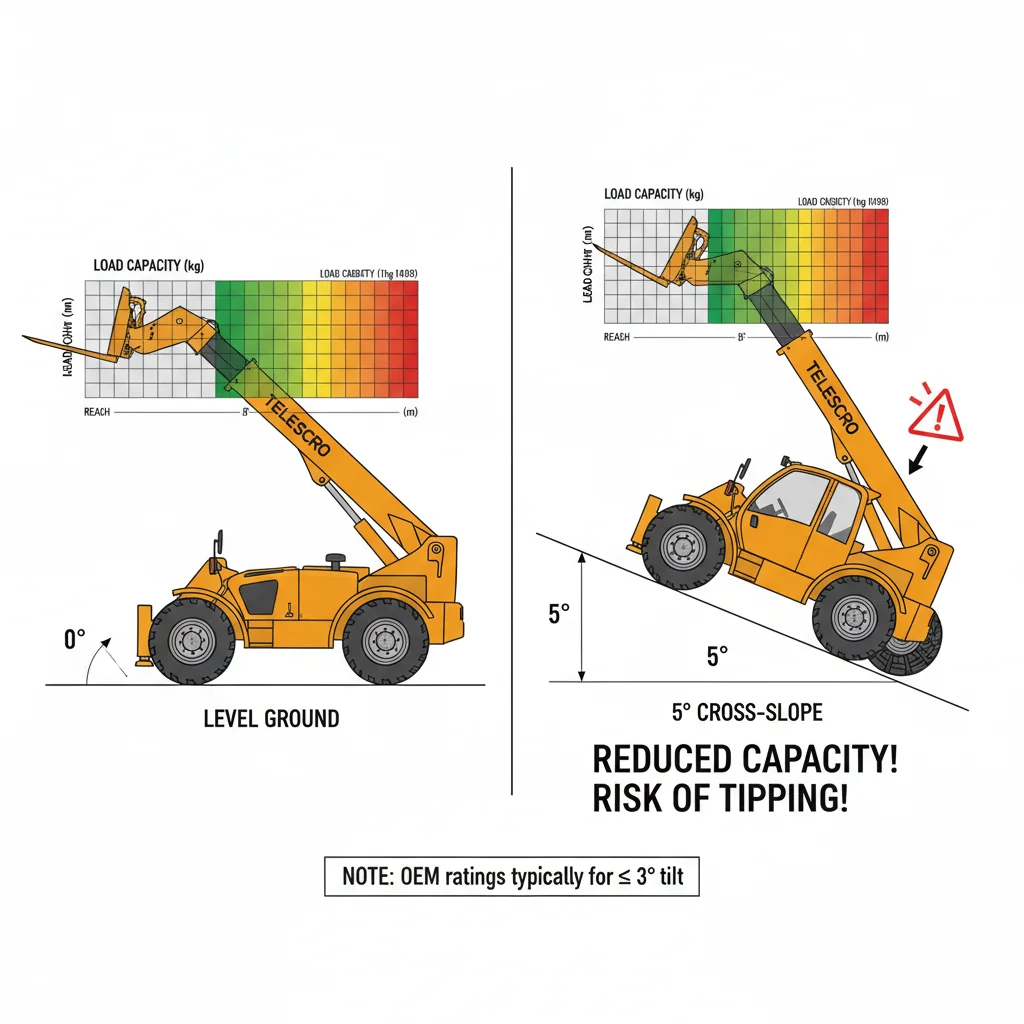
Let me share something important about telehandler work on slopes. Many operators trust the load chart without realizing that it assumes the chassis is essentially level. Once you introduce a side slope, the machine begins leaning as a whole, shifting both its own mass and the load toward the downhill side.
I saw this firsthand on a project in Kazakhstan. The crew positioned a 4-ton telehandler with a 14-meter boom on what looked like a minor cross-slope. At mid-boom extension, the machine began to feel light on one side—even though the lifted weight was well below the charted value. The issue wasn’t the load itself; it was the lateral shift of the center of gravity toward the tipping axis. The operator lowered the boom in time, but it was a clear reminder of how quickly stability margin disappears once the machine is no longer level.
The physics behind this are straightforward. Load charts are developed with the machine set up on a flat test surface, where weight is evenly distributed across the axle and tire footprint. On a slope, that balance changes immediately. The farther the boom extends or the higher the load is carried, the more pronounced the effect becomes. What “looks safe” from the cab can already be outside the assumptions behind the chart.
On busy sites in places like Dubai or Vietnam, perfectly level ground is the exception, not the rule. That’s why I always recommend leveling the machine before any critical lift, using frame leveling or site preparation where available. If leveling isn’t possible, the only safe approach is to work well inside the chart limits—keeping the boom as retracted as possible and avoiding lifts near maximum reach. Never assume the telehandler will simply “handle it” on a slope; the margin for error is far smaller than most operators expect.
Telehandler load charts are calibrated for flat, level support because even modest side slopes shift the center of gravity and reduce lateral stability.True
Load charts are based on controlled, level test conditions. When a telehandler operates on a slope, weight transfer toward the downhill side reduces the available stability margin, making charted capacities unreliable without reassessment.
Telehandler load charts automatically compensate for side slopes, allowing operators to rely on chart values even when the machine is not level.False
Load charts do not adjust for slope or uneven ground. They assume level support, so any off-level operation requires the operator to reassess stability and reduce working loads accordingly.
Key takeaway: Telehandler load chart capacities are valid only when the machine is level and supported as assumed by the OEM. Side slopes—especially when combined with extended reach or elevated loads—rapidly erode stability margin. Always level the machine where possible, and if not, operate well inside chart limits rather than relying on rated capacity alone.
What Jobsite Conditions Invalidate Telehandler Load Charts?
Many everyday jobsites quietly break the core assumptions of telehandler load charts. Conditions like parking on mixed surfaces (concrete and gravel), sitting on un-compacted fill, straddling trenches, or working near slab edges undermine the uniform, firm, and level ground required for rated capacity. Operators risk exceeding stability margins long before chart limits are reached.

The biggest mistake I see is assuming that if your telehandler sits “flat enough,” the load chart still applies. The reality is, rated capacity is only valid when your machine sits on level, firm, and uniform ground—within about 3 degrees of tilt. I’ve watched teams in the UAE lose stability margin just because a front tire rested half on concrete, half on loose sand. Even a small difference like that can shift the tipping axis, turning a chart-rated lift into a real risk. The load chart always measures reach and capacity from the front tire edge to the attachment load center, but that calculation means nothing if the tires aren’t equally supported.
I’ve worked jobsites in Poland and Indonesia where a machine looked stable on the surface. But underneath, one side sat on new backfill that wasn’t compacted yet. The problem appeared mid-lift—just as the boom came out, the soft ground compressed under one wheel. The operator stayed under the rated load, but the telehandler rocked dangerously—proof that questionable support destroys the safety margin built into the chart. I always remind site managers: sitting over a trench, old utility line, or even deep ruts under one wheel breaks the most basic load chart assumption.
So, what’s the fix? Treat every mixed, soft, or uneven surface as a red flag. Before you approach the chart limit, stop and check ground stability. Use mats or cribbing to create a uniform base under all four tires. If you’re working near slab edges or on ramps, reposition onto fully supported ground. This extra step keeps your real capacity aligned with what’s on the chart.
A telehandler's load chart becomes invalid if the machine is positioned on ground sloping more than 3 degrees, as this compromises the machine's rated stability and capacity.True
Telehandler load charts are based on level, firm surfaces within about 3 degrees of tilt. Exceeding this slope shifts the center of gravity, altering the tipping axis and invalidating the rated lift capacities. This is a key reason why ground conditions must be controlled for safe lifting.
If only one tire of the telehandler is on soft or uneven ground while the others are on hard surfaces, the load chart can still be used safely as long as the machine appears stable.False
Even small differences in ground firmness, such as a single tire on soft or sloped material, can cause uneven weight distribution and compromise stability. This invalidates the load chart because the lifting capacity is no longer predictable according to factory conditions.
Key takeaway: Most telehandler load charts assume level, firm, uniform ground—conditions rarely guaranteed on real jobsites. Any variability in support can shift the tipping axis and reduce safety margins. Always confirm stable ground or use mats/cribbing before lifting near chart capacities to maintain true rated performance.
How Should Load Charts Be Adjusted for Soft?
Telehandler load charts assume the machine is supported on firm, level ground. When operating on soft, uneven, or sloped surfaces, the published chart capacity cannot be applied directly. In practice, operators must plan for a substantial reduction in usable capacity—particularly at long boom reach or near maximum lift—based on ground support, machine setup, and operating conditions, rather than relying on the headline chart value.

I’ve worked with customers in Kazakhstan and Brazil who learned the hard way that rated capacity just doesn’t mean much on soft ground. One project in Kazakhstan involved laying pre-cast panels in spring—the ground looked solid after grading, but one wheel started sinking during a lift. The operator was using a 5-ton telehandler, but once the machine tilted a few degrees, things got risky fast. The load chart assumed a level, compacted surface—something they absolutely did not have that day.
To be honest, no manufacturer will give you a neat table for how much to reduce capacity on soft or uneven sites. What many experienced fleets do—and what I always suggest for jobsite safety—is set your own margin. If you can’t fully verify the ground is firm and level, cut to 60–70% of rated chart capacity at any reach, especially with the boom extended. On obviously sloping or unstable ground, I’ve seen customers in Dubai reduce by 30–50% or refuse the lift entirely. It might feel cautious, but the alternative is getting stuck—or worse, tipping over.
The practical way to keep operations safe is to limit boom extension and keep the load as close as possible. This not only keeps the load within the safer region of the load chart, but also lowers stress on the hydraulic circuit and reduces tipping risk at the front axle line. If you regularly find yourself needing full capacity in bad footing, that’s a sign—either upsize to a heavier telehandler or rework your site plan so you can operate on firm ground. I always say, losing a little capacity is better than losing your machine.
Telehandler load charts are based on testing conducted on firm, level, and compacted surfaces, as variations in ground conditions are too unpredictable to standardize.True
Manufacturers create load charts under idealized conditions to provide a consistent baseline. Soft or uneven ground introduces variables like reduced stability and unexpected tipping risk that can't be factored into a universal chart. Operators must assess ground conditions and compensate accordingly.
Load charts automatically account for any decrease in stability caused by soft or uneven ground without the need for operator adjustments.False
Load charts do not compensate for changes in site conditions such as soft, muddy, or sloped ground. It’s up to the operator to recognize when real-world conditions differ from those assumed by the load chart, and make adjustments to lift plans as needed.
Key takeaway: Telehandler rated capacity is only valid on level, firm ground as stipulated by OEMs. Operators should implement significant capacity reductions—down to 60–70% or even 50%—on non-ideal ground, especially under high reach or extended boom conditions. Always maintain a safety margin; never assume chart values apply on poor terrain.
How Do Ground Pads Safeguard Telehandler Stability?
Ground bearing failure5 poses as great a risk as machine instability for telehandlers. Each wheel or stabilizer transmits concentrated loads to the soil or slab—if bearing pressure6 exceeds ground capacity, it can sink or punch through. Spreading loads with mats or pads reduces pressure, especially on marginal surfaces like sand or asphalt.

Last month, a contractor in Dubai called me after their telehandler’s front wheel sank into freshly laid asphalt during a pipe lift. On paper, the wheel loads appeared reasonable for what was assumed to be a “hard” surface. But asphalt is far weaker than most people expect—especially in high ambient temperatures. As the load came onto the front axle, the surface began to deform under the tire contact area, reducing support and allowing the wheel to sink. That’s how a machine that feels stable can lose stability very quickly—not because of the chassis or boom, but because the ground beneath it can no longer carry the load.
Here’s what matters most when keeping telehandlers stable: every wheel and, if fitted, each stabilizer foot acts as a pressure point into the ground. If the actual load on that point exceeds the soil or slab’s capacity, you’re risking sudden settlement or even a punch-through—the kind that tips a machine when you least expect it. On sand or poorly compacted fill, true bearing values can be shockingly low—sometimes just 5,000 kg/m² or less. I’ve seen jobsites in Southeast Asia where large timber mats were the only way to work safely.
I always suggest checking your telehandler’s maximum wheel or stabilizer point load in the OEM data and matching it against the weakest ground bearing value you might face—then go larger on your pads or mats than you think is ‘enough.’ If you’re working on soft or hot surfaces, try to double your safety margin. And don’t just place the pads and forget them. A quick walkaround mid-shift can save you from major headaches by catching early settlement or pad movement before it becomes a stability issue.
Ground pads increase telehandler stability by distributing load over a larger surface area, reducing the risk of subsidence on weak surfaces like fresh asphalt.True
Ground bearing capacity is often overestimated, especially on materials like asphalt or wet soil. By spreading the machine's weight more evenly, ground pads prevent point-loading that can lead to tire sinking and loss of stability, a risk not accounted for in load charts that assume ideal ground conditions.
Telehandler load charts automatically adjust rated capacity based on the ground’s actual bearing strength at the worksite.False
Load charts are created under the assumption of firm, level, and solid ground. They do not factor in varying site conditions, so operators must assess ground bearing capacity separately and use aids like ground pads when the surface is less than ideal.
Key takeaway: Always verify the ground bearing capacity against the maximum wheel or stabilizer load stated in the telehandler OEM data. Use appropriately sized pads or mats to distribute weight, especially on asphalt, fill, or soft soils, and regularly inspect for settlement to maintain safe stability during operation.
How to Assess Ground for Telehandler Loads?
Ground conditions rarely match the assumptions behind telehandler rated capacity. Basic field checks such as proof rolling7—observing rutting or surface deformation under a loaded machine—and simple rebar probe tests8 can quickly indicate weak or poorly supported ground. Any visible rutting, excessive penetration, or proximity to trenches and uncompacted backfill signals that load chart values should not be applied without additional ground preparation or capacity reduction.

I often get asked, "How can I really know if the ground is good enough for a full-capacity lift?" The reality is, most job sites aren’t textbook-perfect, and there’s no lab report waiting for you before each lift. In Saudi Arabia, I saw a team attempt to move concrete pipe—over 2,500 kg each—across what looked like solid gravel. But their 4-ton telehandler left 40 mm ruts with the first crossing. That’s a clear warning—when a loaded machine sinks more than about 25–30 mm, you’re already pushing the limits of ground support.
If you don’t have a soil report, I suggest a quick probe test. Use any steel rebar or rod and push it by hand into the ground. If it slides in deeper than 200–300 mm, treat the surface as soft. I’ve done this on muddy renovation sites in Shenzhen after typhoon season; it only takes a minute and prevents much bigger problems.
Don’t ignore visual clues, either. Standing water, cracked pavement, or patchy ground repairs signal trouble spots. Avoid positioning telehandlers near old trenches, manholes, or backfilled areas—unless you have firm compaction data. I’ve seen upside-down forks and toppled loads just because someone underestimated how loosely-packed fill behaves under load.
When you’re not 100% certain the ground meets those “level, firm pad” conditions listed on the load chart, play it safe. Either reinforce the surface with mats and cribbing, or pick a better spot. For any heavy or high-reach lift, I recommend getting an engineer’s input before risking a capacity move.
Telehandler load charts assume that the ground beneath the machine is firm, level, and capable of supporting the machine's total weight—even at full extension.True
Load charts are developed based on ideal conditions to provide a baseline for safe lifting, and these charts do not account for ground variability or instability. Ground assessment is the operator's responsibility.
If a telehandler’s tires sink up to 50 mm into gravel during loading, it means the ground is still within safe operational limits for most telehandlers.False
Sinking more than about 25–30 mm indicates compromised ground support, and 50 mm of rutting is a clear sign of instability. Continuing to lift could risk machine tipping or failure.
Key takeaway: Telehandler load charts assume a stable, level pad, which is uncommon on real job sites. Quick checks like proof rolling and probe tests help identify poor support conditions. When in doubt, improve ground support, reposition, or consult engineers before attempting capacity lifts.
How should telehandlers be chosen for weak ground?
Telehandler selection for soft or uneven ground should go beyond the standard load chart, considering ground interaction factors like wheelbase9, overall weight distribution, stabilizer design, tire width, and ground pressure10. Heavier, long-wheelbase models may increase stability but risk overloading weak soils; lighter units with wider tires often better suit marginal ground.

The biggest mistake I see is choosing a telehandler just by the rated capacity from the spec sheet. Rated capacity always assumes level, firm ground—almost never the case on soft sites. I’ve worked with customers in Argentina and Vietnam who found out the hard way. One construction team in Argentina tried using a 4-ton, long-wheelbase telehandler on fill ground with loose sand underneath. The ground couldn’t handle the concentrated pressure. They ended up bogged down, wasting half a day getting the machine pulled out.
Ground interaction is what matters most for weak soils. Heavier models might look safer, but all that weight ends up focusing pressure on a small patch of ground, especially if the tires are narrow. I always ask customers to check the unladen and laden axle loads from the machine’s serial plate or manual, then compare those with the soil bearing pressure on their site. Wide tires—at least 500 mm—make a massive difference, spreading load and reducing the chance of sinking. Some jobs in Kenya have used ground mats under the tires and stabilizers to spread pressure, especially when carrying heavy materials.
To be honest, if you’re not sure, sizing up slightly gives peace of mind—just don’t use the full charted capacity on soft ground. Operating at 70–80% of load chart values and keeping the boom as retracted as possible improves stability. If the ground seems weak, put down crane mats or steel sheets before moving in. I suggest looking beyond the catalog numbers and focusing on ground pressure, weight distribution, and tire width. Those details are what keep jobs running—not specs on paper.
Telehandler load charts assume the machine is operating on level, firm ground because uneven or soft surfaces can drastically reduce both stability and lifting capacity, making the chart inaccurate in real-world conditions.True
Load charts are based on controlled test environments. Soft or sloped ground can cause the telehandler to tip sooner or sink, reducing usable capacity well below the chart value because ground support is a key stability factor.
A telehandler’s rated capacity automatically adjusts downward when used on weak ground, ensuring operators never overload the machine even in soft conditions.False
Rated capacities shown on a telehandler’s load chart do not adjust for ground conditions. Operators must manually compensate; the machine has no way to sense or automatically reduce its rated load on poor ground, so the risk of overloading remains if ground conditions are ignored.
Key takeaway: Rated capacity in load charts assumes level, firm ground. For weak soil sites, compare models using wheelbase, mass, and tire dimensions to assess ground pressure. If in doubt, select a slightly larger telehandler for added safety margin and use ground matting for effective load distribution.
What Operator Practices Ensure Telehandler Stability on Slopes?
Critical operator practices for telehandler stability on sloping ground include always traveling straight up or down the slope, never across with a raised load, and keeping the boom low and retracted while moving. Frame-leveling11 should be performed before lifting. Operators must stop immediately if any wheel lightens while booming out, as this signals nearing tipping limits.

Here’s what matters most when working with telehandlers on sloping ground: your daily habits make or break stability—far more than the load chart numbers. I remember training a crew in Turkey where the ground was often uneven after rains. We went over the basics, but what really stuck was hands-on practice. Whenever we started moving, I stressed never to travel sideways across a slope with a raised load. It’s tempting when space is tight, but this is where tipping accidents start. You always want to go straight up or down the slope, boom fully retracted and as low as possible.
One customer in Kenya ignored this advice—he raised the boom to clear some low scaffolding and turned sideways on a six-degree slope. Instantly, one rear tire started lifting, and his spotter shouted. He lowered the boom just in time. That moment showed the crew how quickly stability can vanish, even on a slope most people would call "mild." I always say: if any wheel feels light while you’re booming out, stop and reset. That’s the telehandler’s early warning sign your center of gravity is shifting beyond safe limits.
Before you even think about lifting on a slope, use frame leveling to get the chassis as close to level as possible. But—and this is critical—always do this before lifting the load. Never try to re-level or use stabilizers with the boom high or load out. Lower to a safe height first, usually under 4 feet. After all these years, I can tell you: disciplined habits save more telehandlers—and operators—than any technical feature.
Telehandler load charts assume the machine is on level, firm ground, so their stability ratings don't account for sloped or soft surfaces.True
Load charts are calculated based on ideal conditions that maximize stability—typically flat, compacted ground. When operating on slopes or uneven terrain, the actual stability is reduced, making the load chart an unsafe guide for those situations.
When working on a slope, the load chart remains fully accurate as long as the load is kept low and close to the machine.False
Even if the load is kept low, working on a slope changes the telehandler's center of gravity and reduces lateral stability. The load chart no longer reflects safe capacities or tipping risk because it was not designed for sloped conditions.
Key takeaway: Embedding specific slope safety habits—like boom position, travel direction, frame leveling before lifting, and monitoring wheel contact—reduces risk beyond what the load chart assumes. These disciplined behaviors are among the most cost-effective ways to keep real-world operation aligned with telehandler stability limits.
Why Use Attachment-Specific Telehandler Load Charts?
Telehandler load charts are tailored for each attachment. Changing from forks to a jib, bucket, or platform alters the machine’s weight balance and maximum safe load. Regulations require adequate ground support regardless of the chart. Failure to account for ground conditions or attachment weight risks costly tip-overs, equipment damage, and regulatory violations.

I’ve worked with customers who made this mistake—using the wrong load chart after switching attachments, thinking the numbers would be close enough. In South Africa, a team replaced a fork with a jib to lift a generator on rough terrain. They missed the fact that the jib itself weighed nearly 300 kg and shifted the center of gravity forward. Their "safe" load ended up tipping the telehandler onto its front tires. It cost them weeks in repairs and insurance headaches. I always remind clients: each attachment has a unique weight and geometry, and that changes everything—the rated capacity, working reach, and most importantly, stability. Why is this so critical? Attachment‑specific load charts aren’t just a paperwork exercise. Most jobsites use multiple tools—forks, buckets, work platforms, even winches. Every swap changes load limits, not just by a few kilos but sometimes by 500 kg or more. Regulations also demand more than just following the chart. If your ground is soft, sloped, or near a trench, rated capacity doesn’t apply—even if you checked the correct chart. Investigators will ask for ground condition assessments, especially after an incident. Here’s what I check every time before a heavy lift: – Review the load chart for that exact attachment, not just the main machine – Factor the attachment’s own weight into the lifted load – Confirm the load center matches the chart reference (500 mm, 600 mm, etc.) – Assess ground conditions—firm, level, and designed to support the load – Call in an engineer if
Telehandler load charts are calculated assuming firm, level ground because even slight variations in ground slope or compaction can drastically affect stability and tipping risk.True
Manufacturers must standardize their load charts for consistency and safety, so they base calculations on ideal ground conditions. Any deviation—such as soft, uneven, or sloped surfaces—changes the center of gravity and reduces the effective lifting capacity, but this isn't reflected in the chart. Operators must make their own adjustments in less-than-ideal site conditions.
Attachment-specific load charts can be ignored when the new attachment weighs less than the original, as lifting capacity will always improve or stay the same.False
Even if an attachment weighs less, its geometry—such as a longer horizontal reach or different mounting—can negatively impact stability and reduce rated capacity. The specifics of how an attachment shifts the load's center of gravity and affects the moment calculations are just as critical as its weight.
Key takeaway: Always reference the load chart specific to the current attachment, factor in the attachment’s weight, and ensure the ground meets regulatory support standards. Skipping these steps can result in severe financial, operational, and safety consequences, regardless of adherence to published load charts alone.
Conclusion
We’ve looked at why telehandler load charts are based on the idea of level, solid ground, and what that means in real jobsite conditions. From my own experience, the biggest issues I’ve seen come up when ground conditions are ignored—mud, soft patches, or slight slopes can quickly turn a safe lift into a risky one, and that’s something the load chart won’t warn you about. Before planning any lift, I always suggest taking a close look at your site’s surface and making sure it matches what’s assumed in the chart. If you’re unsure about a specific jobsite or want to talk through what ground support actually looks like in the field, feel free to reach out. The right call depends on what’s beneath your telehandler, not just what’s in the brochure.
References
-
Details why rated capacity requires level, firm ground within 3 degrees of tilt to maintain safety margins and prevent accidents. ↩
-
Provides detailed insights into safety and testing standards for telehandler load charts, crucial for reliable operation and compliance. ↩
-
Understand why ground support and terrain type are critical factors impacting telehandler safety and rated load capacity on jobsites. ↩
-
Explains the critical impact of side slope angles on stability with real-world examples, guiding safe telehandler operation off-level. ↩
-
Explains causes and risks of ground bearing failure with expert insights on soil pressure and telehandler stability to prevent costly accidents. ↩
-
Details how bearing pressure influences machine safety, highlighting critical load thresholds and ground conditions to ensure secure telehandler operation. ↩
-
Detailed explanation of proof rolling as a practical field test to identify weak ground, helping operators avoid unsafe lifting conditions. ↩
-
Comprehensive guide on performing rebar probe tests to assess soil strength, crucial for operators to prevent telehandler instability on soft ground. ↩
-
Explore how wheelbase length influences machine stability and pressure distribution, crucial for choosing telehandlers on weak soils. ↩
-
Understand how ground pressure impacts telehandler performance and prevents sinking, essential for work on marginal soils. ↩
-
Understand how proper frame-leveling before lifts boosts safety and prevents tipping hazards on uneven work sites. ↩