











What Assumptions Are Built Into a Telehandler Load Chart? Field Guide for Safe Use
Last month, I visited a jobsite in Vietnam where the crew thought the load chart was “extra safe” and went ahead with a marginal pick, assuming the chart allowed plenty of wiggle room. They were surprised when the telehandler creaked to its limit much sooner than expected.
Telehandler load charts are established through OEM testing and standardised stability requirements (e.g., ANSI/ITSDF B56.6 in North America). The published capacities represent maximum permitted loads for the stated configuration and assumptions—they do not provide extra allowance for soft ground, uneven surfaces, unapproved attachments, shifted load centres, or dynamic/shock loading.
What Conditions Do Telehandler Load Charts Assume?
Telehandler load charts are based on controlled, ideal conditions including level, firm ground, correct OEM tires, specified attachment, defined load center1, and a trained operator using smooth controls. Maximum rated capacity2 shown is valid only under these prerequisites—real-world deviations reduce true safe capacity below published values.

Most people don’t realize that telehandler load charts are established under controlled test and assessment conditions, not as a guarantee for every site scenario. The assumptions typically include firm, level ground, OEM-approved tires inflated to the specified pressure, and the exact attachment configuration stated for that chart.
Even small details matter. Charted capacities apply only with the load center defined by the OEM for that specific machine and attachment—commonly 500–600 mm on many EN/CE charts, and 24 in (610 mm) on many North American fork-carriage charts. The published values are based on static stability and capacity limits; they do not include any built-in allowance for dynamic effects such as abrupt starts or stops, load snags, or uneven footing.
I often get calls from contractors who overlook these assumptions. One manager in Brazil tried to use a 4-ton telehandler to lift full loads while positioned on a noticeable slope. In that configuration, the machine was already outside the assumptions of the OEM load chart, and the charted capacity could no longer be treated as an allowable working limit.
I explained that rated capacity is valid only when the machine is set up on firm, level ground and configured exactly as shown on the load chart. If slopes, ramps, or uneven ground are present, the manufacturer does not consider the published chart values applicable. Where fitted, frame leveling or stabilizers must be used to bring the machine back within the permitted lifting configuration before attempting heavier picks.
My advice is simple: treat load chart numbers as an absolute upper bound, not a comfort zone. If your operation deviates in any way—uneven ground, worn tires, incorrect attachment selection, or aggressive boom handling—plan for less capacity. In many cases, that means applying a conservative site-specific margin or stepping up to the next size machine. That margin is what keeps jobsites productive—and incidents off the report.
Telehandler load charts are only valid when the lift is performed on level, firm ground, not on sloped or uneven surfaces.True
Load charts are developed under ideal, controlled conditions with level, solid ground because sloped or uneven surfaces can dramatically alter a telehandler's stability and reduce safe lifting capacity.
Telehandler load charts automatically account for typical job site conditions like partially deflated tires and minor ground unevenness.False
Load charts assume optimal conditions with OEM-specified, properly inflated tires and perfectly level ground; they do not account for common job site variances, which can significantly affect safe operating limits.
Key takeaway: Telehandler load charts reflect best-case, controlled test conditions—not field realities. Any deviation from level ground, correct configuration, or smooth operation reduces actual safe capacity. For safe planning, treat load chart figures as an upper bound and apply site- or operation-specific de-rating as needed.
Why Must Telehandlers Operate on Level Ground?
*Telehandler load charts are based on OEM testing with the machine stationary on substantially flat, level and compacted ground. Any slope or uneven surface reduces stability and takes the operation outside the chart assumptions.

The biggest mistake I see is assuming a telehandler’s rated capacity is valid everywhere on a site, regardless of ground conditions. That’s a dangerous assumption.
I had a customer in Dubai last year who called me after the machine’s front wheel suddenly lifted while moving a 2,500 kg pallet. On paper, his 4-ton telehandler with a 14-meter boom looked more than capable. But when I asked about the setup, he admitted the machine was parked on a slight construction ramp. It didn’t look dramatic to the crew—but it was enough to change everything.
That’s the part many operators miss: load chart values apply only when the machine is essentially level and set up within the manufacturer’s stated assumptions. Once you introduce a ramp, cross-slope, uneven gravel, or soft fill, the published chart no longer reflects what the machine can safely handle. Stability margin disappears much faster than most people expect—often before the machine “feels” unstable in the cab.
Here’s why this happens. Telehandler load charts are developed with the machine positioned on a rigid, flat test surface, with correct tire pressures and the frame properly leveled. Reach is measured from the front tire edge, and rated capacity assumes the load’s center of gravity sits exactly at the specified load center distance shown on the chart.
As soon as you work on a slope, a ramp, or soft ground, the machine’s center of gravity shifts toward the downhill or weak side. That moves the tipping axis closer to the edge and shrinks the safe operating envelope very quickly. The chart doesn’t “adjust” for that—it simply no longer applies.
That’s why I always recommend checking level conditions before any heavy lift. A simple bubble level or the machine’s built-in indicator can tell you whether you’re still operating within the assumptions behind the load chart—especially on mixed or temporary ground.
Telehandler load charts assume the machine is on level, firm ground, so any tilt or slope reduces the actual lifting capacity even if the charted capacity appears sufficient.True
Load charts are based on ideal conditions where the entire weight of the machine is evenly distributed across all tires. Even a slight slope alters load distribution and stability, risking tip-over at much lower weights than the chart indicates.
A telehandler’s stabilizers automatically compensate for moderate slopes, so the rated lift capacity remains unchanged on uneven ground.False
Stabilizers help with minor ground leveling but do not eliminate the impact of slopes on stability and lifting capacity. Load charts do not account for stabilizer use on inclines, so operators must always follow capacity ratings as if on level ground.
Key takeaway: Telehandler rated capacities and load chart values assume the machine is on compacted, level ground with the frame leveled and proper tire pressure. Even modest cross-slopes or uneven terrain can reduce stability margin by 20–40%. Always verify level conditions before applying load chart data.
How Do Attachments Affect Telehandler Load Charts?
Telehandler load charts are attachment-specific: each chart reflects the weight and geometry of the exact attachment shown, such as fork carriages, jibs, or platforms. Using a different or unapproved attachment can shift the load center, reduce rated capacity, and invalidate the chart for safe operation.

Let me share something important about telehandler attachments—changing what’s on the boom isn’t just a convenience. It completely changes the machine’s safe lifting limits. For example, I once helped a contractor in Dubai who swapped from forks to a 1.2-meter jib for lifting air conditioning units. Nothing else changed, but suddenly the max safe load dropped by nearly 30% at full extension. That’s because the extra length and weight of the jib shifted the load center forward—creating a bigger overturning moment on the chassis and boom. Here’s where many people go wrong: they look at the load chart printed in the cab, which usually shows rated capacity for the standard fork carriage. But if you attach a bucket or work platform, that chart is no longer valid. I’ve seen operators try a homemade platform, thinking it looked similar to the approved one, and trust me—OEM engineers calculate every attachment’s effect when designing those charts. You can’t rely on “close enough” or try using an unapproved attachment just because it fits the quick-coupler.
Keep these critical points in mind:
- Every attachment has its own weight and geometry—which impacts safe lifting limits.
- OEM load charts are always attachment-specific—never mix and match charts and tools.
- Unapproved or homemade attachments can invalidate rated capacity—never take that risk.
- Electronic load moment indicators (LMI) must be calibrated to the correct attachment—always check settings before lifting.
Telehandler load charts assume the machine is equipped with its standard carriage and forks; alternative attachments like buckets or jibs require separate charts because they alter the load center and overall capacity.True
Manufacturers create load charts based on a baseline configuration, which typically includes factory-supplied forks. Different attachments change how weight is distributed and where forces are applied, so using the incorrect chart could lead to dangerous overload situations.
Telehandler load charts automatically compensate for any attachment you put on the boom, so manual recalculation or chart replacement is unnecessary.False
Load charts do not update themselves for non-standard attachments. Operators or supervisors must use the correct chart for each attachment, as each type can significantly change the safe operating limits and stability of the telehandler.
Key takeaway: Always match the load chart to the exact telehandler attachment being used. Mixing attachments without consulting the OEM’s approved load chart can invalidate safety data and increase the risk of overturning. Only use attachments listed by the manufacturer and verify electronic indicators are set correctly.
Why Does Load Center Shape Affect Telehandler Charts?
Telehandler load charts for pallet forks assume a standard load center, typically 500–600 mm from the fork face, based on a uniform pallet. When loads are longer, irregular, or the center of gravity extends beyond this point, stability decreases sharply. Capacity is governed by the distance from carriage, not just total weight.
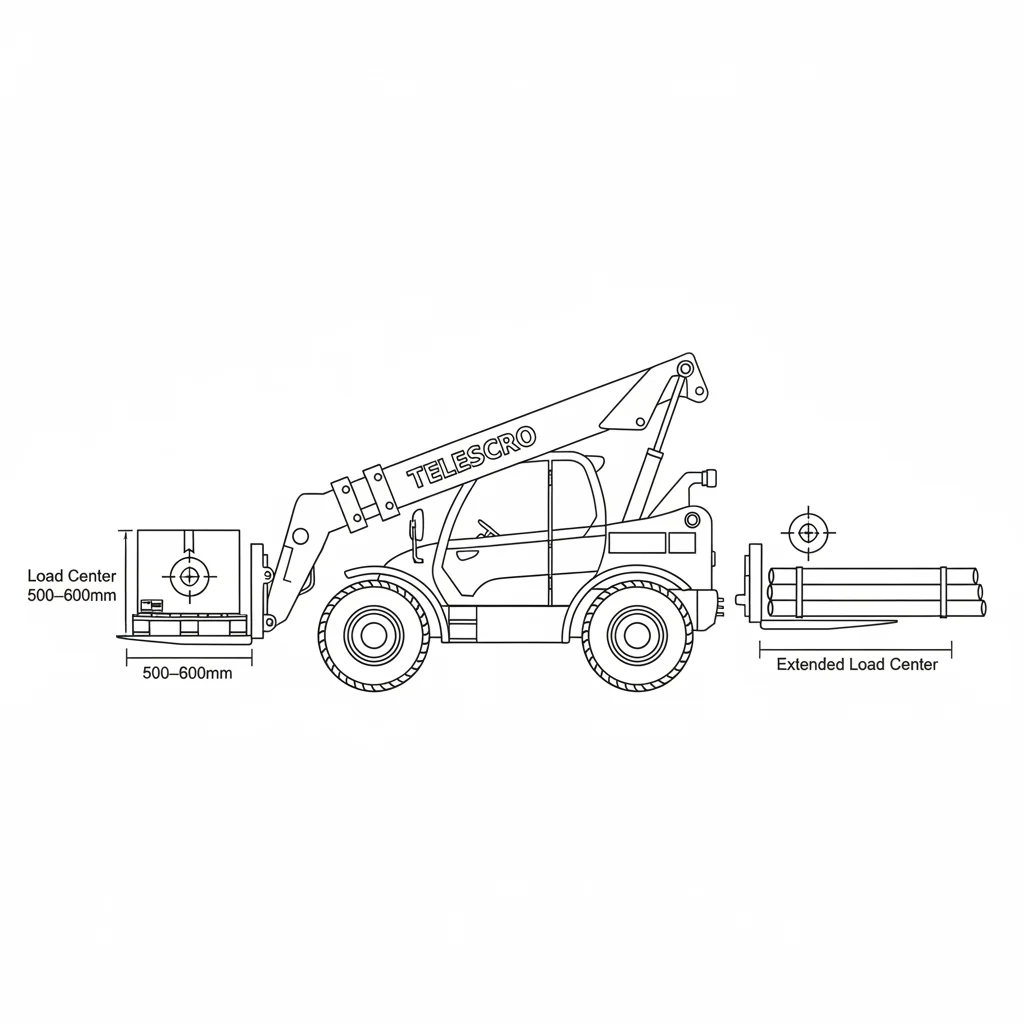
I’ve worked with customers who made this mistake—taking the rated capacity at face value, without checking how the load actually sits on the forks. For example, a client in Dubai had to move long steel trusses, each nearly 4 meters. On paper, their 3.5-ton telehandler should have been more than enough. But once we measured, the truss center of gravity was almost 1.2 meters from the fork face—well past the standard 600 mm load center used in the machine’s load chart. Their real working capacity was less than half the rated figure. The job stalled until they upsized to a heavier model.
Engineers set up telehandler load charts using strict test conditions—level ground, the specified fork attachment, and a standard load center (usually 500 or 600 mm). All the stability calculations are based on the load center position, not just the total weight. The further out the load’s center of gravity, the bigger the moment pushing the machine over its tipping axis (which is along the front axle or tire edge). So, a lighter but longer load can become more dangerous than a heavy, compact pallet. You also risk overloading a single fork with one-sided or off-center loads, which can twist the carriage.
To be honest, the spec that actually matters is the distance from the carriage—not just the load’s weight. If your job involves roof panels, rebars, or anything longer than a standard pallet, always check the manufacturer’s de-rating tables for extended load centers. I suggest planning for at least a 30% capacity margin when your load isn’t a perfect pallet. That way, you stay well inside the safe operating envelope.
A telehandler's load chart assumes the load's center of gravity is at a standard 600 mm load center from the fork face, and any deviation from this assumption can drastically reduce the actual lifting capacity.True
Load charts are standardized for a typical palletized load with its center of gravity positioned 600 mm from the carriage, but if a load is longer or the center of gravity is further out, the leverage on the machine increases, greatly reducing safe lift capacity.
The load shape and how it sits on the forks do not significantly impact a telehandler’s lifting capacity, as long as the total weight is within the rated limit.False
Even if the total weight is below the rated capacity, a longer load or one with an off-center mass can extend the center of gravity beyond standard assumptions, resulting in a substantial reduction in stability and safe lifting capacity. Load shape matters as much as total weight.
Key takeaway: Telehandler rated capacity is tied to a specific load center assumed by the manufacturer. When handling loads with greater length, irregular shape, or off-center weight, actual capacity may be significantly lower—always consult OEM de-rating tables and treat the true limiting factor as distance from carriage, not just load weight.
What Assumptions Underlie Telehandler Load Charts?
Telehandler load charts are based on static loading assumptions: level ground, stationary machine, smooth boom movement, and rigid loads. Published rated capacities do not account for shock loading3, swinging, or movement over rough terrain. Any dynamic effects, such as sudden stops or load snags, can exceed the stability margin and cause dangerous overloads.

Here’s the thing—every load chart you see for a telehandler is built on static, lab-like conditions. Rated capacities assume the machine is on level, firm ground (within about 3°), with the specified fork or attachment, and the load positioned exactly at the chart’s designated center. In reality, no jobsite in Dubai or Brazil is ever perfect like that. I’ve tested models “rated” for 4,000 kg at minimum reach, but the moment the boom extends or the load center increases (for example, handling I-beams instead of standard pallets), real lifting capacity drops fast—sometimes below 2,000 kg at full reach.
A project manager in Kazakhstan once asked why his telehandler’s alarm kept triggering when picking awkward crates at height. The answer was simple: the chart didn’t factor in the shifting load center or minor ground slope. The moment his team snatched a stuck crate loose—just a bump from the boom—load moment briefly spiked well above the safe margin. Even if the scale shows you’re “under chart,” any shock loading or rough travel can instantly overload the stability system. The load chart can’t account for a pile of debris under the tire, a sudden stop, or a swinging bundle of pipe.
From my experience, safe operation means planning for less-than-ideal conditions. I always recommend working at about 70–80% of the charted max, especially on messy jobs or with live loads that could swing. Keep the boom low and fully retracted for travel, and never use the boom to “yank” material free. That working margin can prevent a tip-over or expensive repair—even if the numbers look safe on paper.
Telehandler load charts assume that the machine is equipped with factory-approved attachments and that altering to an aftermarket or non-standard accessory can invalidate the published lifting capacities.True
Load charts are developed and calibrated with specific, approved attachments; using non-specified attachments can change the load handling dynamics, making the load chart inaccurate and potentially unsafe.
Telehandler load charts always adjust automatically to account for uneven ground or slopes during operation, so operators do not need to recalculate capacities in these conditions.False
Load charts are based on ideal, level ground conditions; they do not compensate for uneven terrain or slopes. Operators must manually assess capacity reductions when operating on non-level surfaces, as stability and lifting capability are significantly reduced.
Key takeaway: Telehandler load charts assume ideal, static conditions and do not reflect dynamic risks from movement, shock loading, or rough terrain. For safe operation, always apply a working margin below chart limits—especially when handling awkward loads or working in less-than-perfect site conditions.
How Does Machine Condition Affect Load Chart Accuracy?
Telehandler load charts assume the machine is new or fully within tolerance—meaning snug boom wear pads, pins and bushings with no elongation, and undamaged structure. Boom wear, increased clearances, or miscalibrated indicators can cause actual reach and deflection to exceed charted values, risking operation outside the safe envelope defined by the OEM.
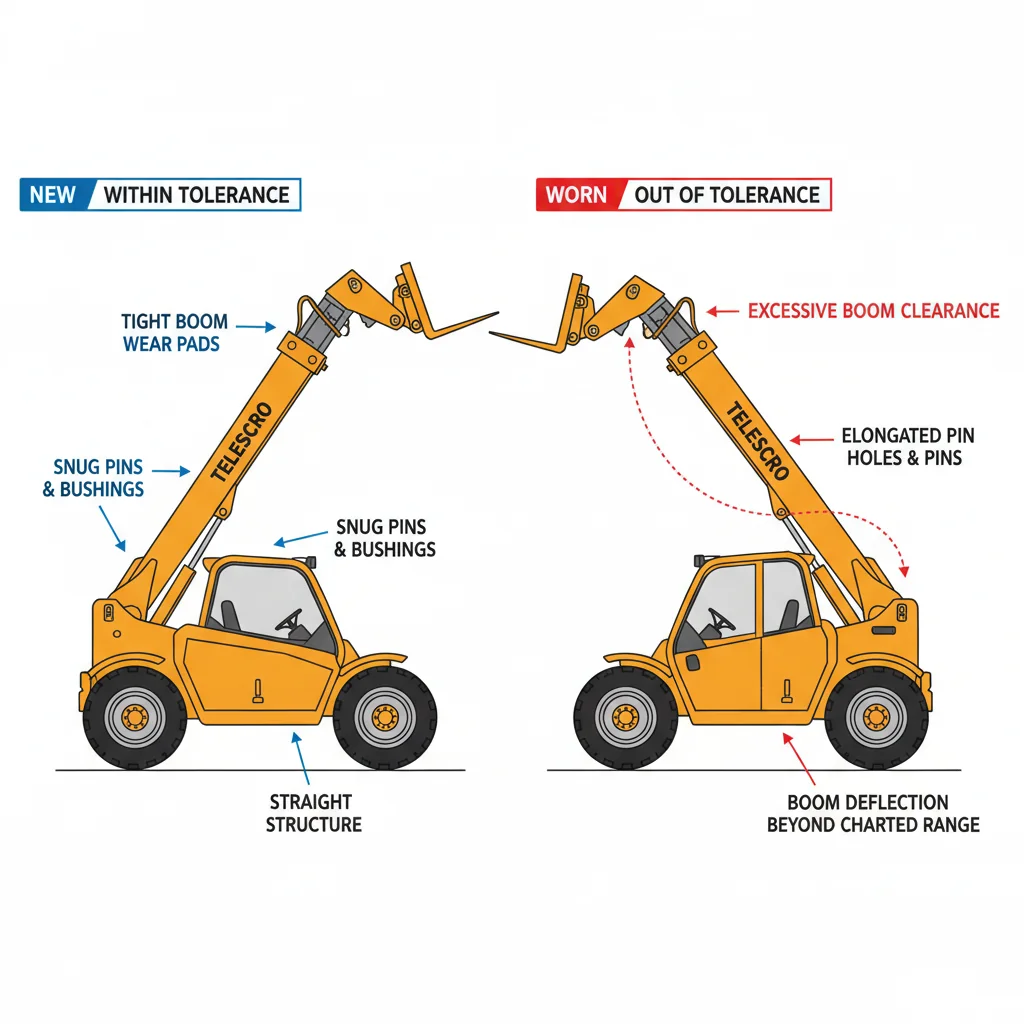
Last month, a rental customer from Dubai called me about a telehandler that suddenly felt unstable at full extension. Their site manager checked the load chart, saw a rating of 2,200 kg at full reach, and expected trouble-free lifts—but they didn’t account for machine condition. When I asked about maintenance, they admitted the unit had over 4,000 hours and hadn’t had the booms or wear pads measured in months. That’s a red flag. Worn boom pads and bushings allow the boom tip to flex more under load, which means the actual reach becomes longer than what’s plotted in the OEM load chart. Even an extra 25 mm of deflection at full extension can move you outside the safe cell—without the operator realizing it. To be honest, I see this risk in a lot of used fleets, especially units over three years old. In Kazakhstan, one contractor ended up derating a 4-ton, 17-meter telehandler to just 2,700 kg at full extension after we found severe boom wear and elongated pin holes during inspection. The placard still said 4,000 kg, but delivering that in practice would have pushed the machine outside its stability limits. Their hydraulic moment indicator was also out of calibration, which made it even easier to operate unknowingly outside the safe envelope. Here’s what matters most: you can only trust the rated capacities on the load chart if your machine is in new or fully within-tolerance condition.
Telehandler load charts are based on the assumption that all structural and wear components, such as boom pads and bushings, are within manufacturer-specified tolerances and in good condition.True
If components like boom pads or bushings are excessively worn, the machine's boom can flex more under load, leading to instability or inaccurate capacity performance compared to the chart.
The condition of the telehandler has no effect on load chart ratings as long as the machine is not visibly damaged.False
Load charts assume the telehandler is in optimal mechanical condition, including parts that may not show visible damage (such as worn internal wear pads). Ignoring maintenance or hidden wear can result in unsafe lifts even if the machine appears undamaged externally.
Key takeaway: Telehandler load charts reflect rated capacities only for machines in new or fully within-tolerance condition. Worn booms, deflected tips, and miscalibrated indicators can reduce real-world stability and capacity, so routine inspection, wear measurement, and recalibration are essential prerequisites before trusting the OEM chart for safe lifting operations.
Why Do Load Charts Limit Modifications?
Telehandler load charts are engineered for a specific factory configuration, including OEM‑approved tires4, counterweights, cab, boom, and any stabilizers. Modifications like non‑approved tires or aftermarket weights change structural stresses and machine balance, invalidating published load capacities. Only manufacturer-approved changes, with documented load charts, meet ANSI/ITSDF B56.6 safety5 and legal requirements.
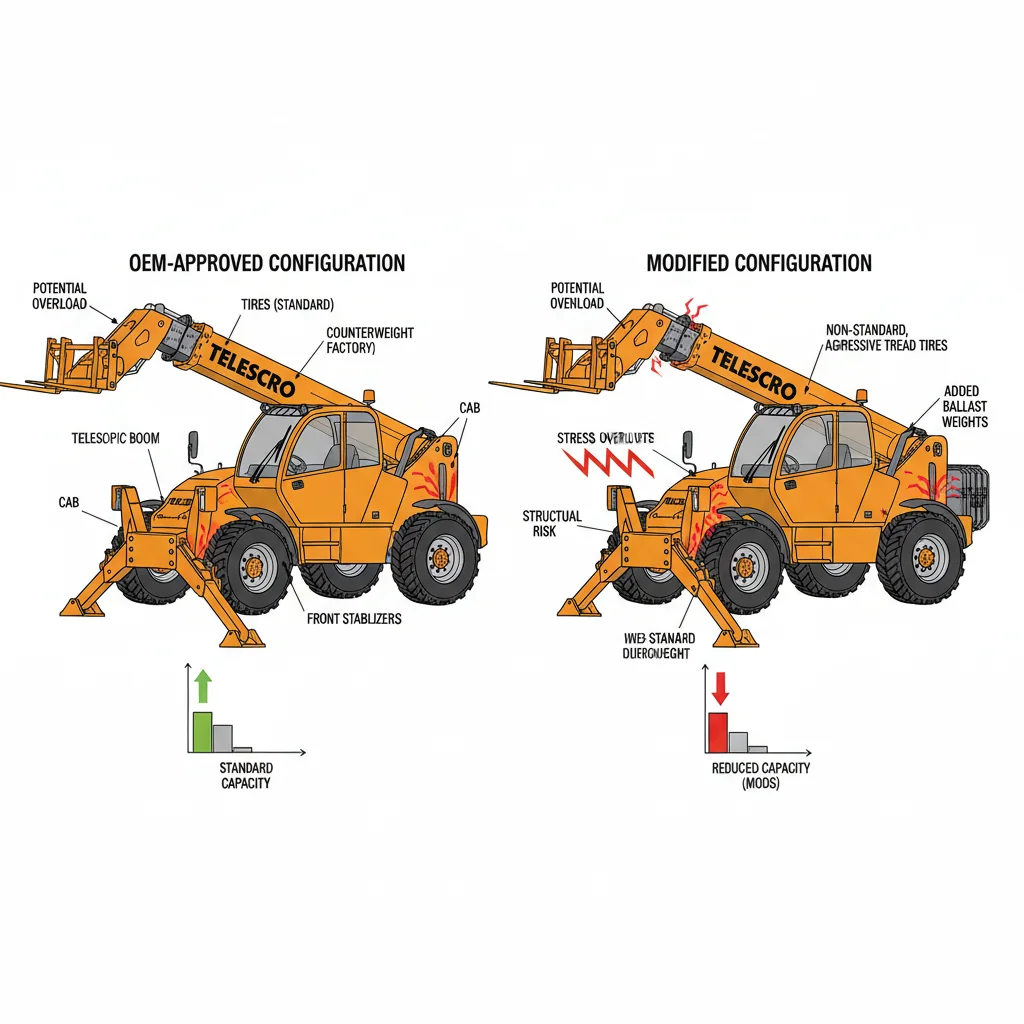
To be honest, the spec that actually matters is the exact machine setup—right down to tire type and any optional stabilizers. The load chart you see in the manual or on the dashboard is based on the configuration that left the factory. Every detail—OEM-approved tires, factory-fit counterweight, specific cab and boom—gets factored into those numbers. Change any critical part, and you’re rolling the dice. I’ve seen jobs in Kazakhstan where someone swapped in heavier aftermarket tires to save money. On paper, small change. On site, the stress on the boom changed and the tipping point crept much closer than the chart showed. That could turn a safe 2,500 kg lift at 9 meters into a dangerous gamble.
Let me share something important about the “unapproved modifications” trap. Whenever you add an extra counterweight or switch to local-market tires because they’re cheaper or supposedly “heavy-duty,” you shift the telehandler’s center of gravity. The load chart no longer applies. I remember a team in Kenya that fitted homemade rear weights to their 3-ton unit. Their regular 1,200 kg lifts at 10 meters felt safe—until the rear axle started flexing and a moment indicator kept lighting up. The cost? Machine downtime and a nerve-wracking safety audit.
If you ever need to change major components—tires, stabilizers, even attachments—always request an updated load chart from the manufacturer. Only factory-approved options comply with ANSI/ITSDF B56.6 standards. Skipping these steps doesn’t just risk your machine, it puts people in danger. My advice? Stick to OEM-approved parts and verify your capacity every time the setup changes. The paperwork might seem slow, but it keeps your team—and your telehandler—out of trouble.
Telehandler load charts are calculated assuming the factory-installed tires meet specific OEM-specified dimensions and ratings.True
Load charts are engineered for the exact wheel and tire size, ply rating, and compound chosen by the manufacturer, since these affect stability, overall height, and handling. Substituting different tires—even if they roughly fit—alters critical stability and performance factors the load chart assumes are unchanged.
You can rely on the factory load chart even if you switch to a different manufacturer’s counterweight, provided the weight is similar.False
Changing the counterweight, even to one with a similar mass, can alter weight distribution and the machine's balance in ways not assumed in the factory calculations. This can significantly impact stability, tipping risk, and the actual safe lifting capability, making the load chart potentially invalid.
Key takeaway: Only use manufacturer‑approved options and load charts that match the actual telehandler configuration. Unauthorized modifications can create hidden safety risks, invalidate load chart data, and violate industry safety standards. Always request updated documentation if changing tires, stabilizers, or other key components.
How do side slopes affect load chart safety?
Telehandler load charts are based on the assumption of level ground and proper frame leveling, with stability calculated in all directions. Side slopes shift the center of gravity toward the downhill axis, eroding the tipping margin. The published load chart does not account for significant cross-slopes or lateral forces, making standard capacities invalid in such conditions.

I always remind operators that telehandler load charts only “tell the truth” when the machine is level—usually within a 3-degree tilt side-to-side or front-to-back. The reality is, most job sites aren’t perfectly flat, especially those in hilly places like northern Vietnam or busy city projects in Poland. Once you park a 4-ton, 16-meter unit on a side slope, even a few degrees more than the allowance, your real tipping point shifts fast. That’s because stability isn’t just about forward reach—it’s a three-way balance. Stability depends on the front axle line, the width between wheels, and the position of the load center. On a cross-slope, the center of gravity drifts downhill, bringing the tipping axis dangerously close to the downhill tires.
Last year, an Italian customer called after his crew tried to lift roofing panels on a 5-degree embankment. The load chart showed 1,300 kg was fine at 12 meters, but their telehandler actually tipped at under 1,100 kg. Why? The machine left “chart territory” the moment it was no longer level—the rated capacity was no longer valid. No load chart includes a “slope penalty” or adjustment factor for this because the math just gets too risky.
So, before you trust the chart, check your ground and use frame leveling if equipped. If you’re near a slope greater than 3 degrees, I suggest switching work methods or getting the surface leveled first. Side slopes don’t just “shave off a bit” of capacity—they can erase your safety margin completely. That’s not a guess—that’s engineering and real jobsite experience speaking.
Telehandler load charts assume the machine is on a level surface, and even a slight side slope can significantly reduce the stability margin and tipping point.True
Load charts are calculated based on ideal, level conditions; introducing any lateral tilt changes the center of gravity's path when a load is elevated, causing the machine to become unstable much faster and at lighter loads than the chart suggests.
If you stay within the rated load on the chart, it is always safe to operate a telehandler on moderate side slopes.False
Load ratings are only valid when the telehandler is level; side slopes alter weight distribution, meaning a load that appears 'within the chart' could result in a tip-over because the actual capacity is now much lower than the stated rating.
Key takeaway: Telehandler load charts are only valid when the machine is on level ground or within strict manufacturer leveling tolerances (typically ≤3°). Operating on side slopes significantly erodes stability and voids rated capacities. Always level the machine and consult OEM side-slope limits before lifting.
How Does Wind Affect Telehandler Load Charts?
Most telehandler load charts assume calm or modest wind conditions acting on compact loads such as pallets or blocks. They do not account for large sail-area loads—like glass panels or sheet metal—where wind can dramatically reduce stability and effective rated capacity, increasing the risk of overturning even at weights well below the charted limit.
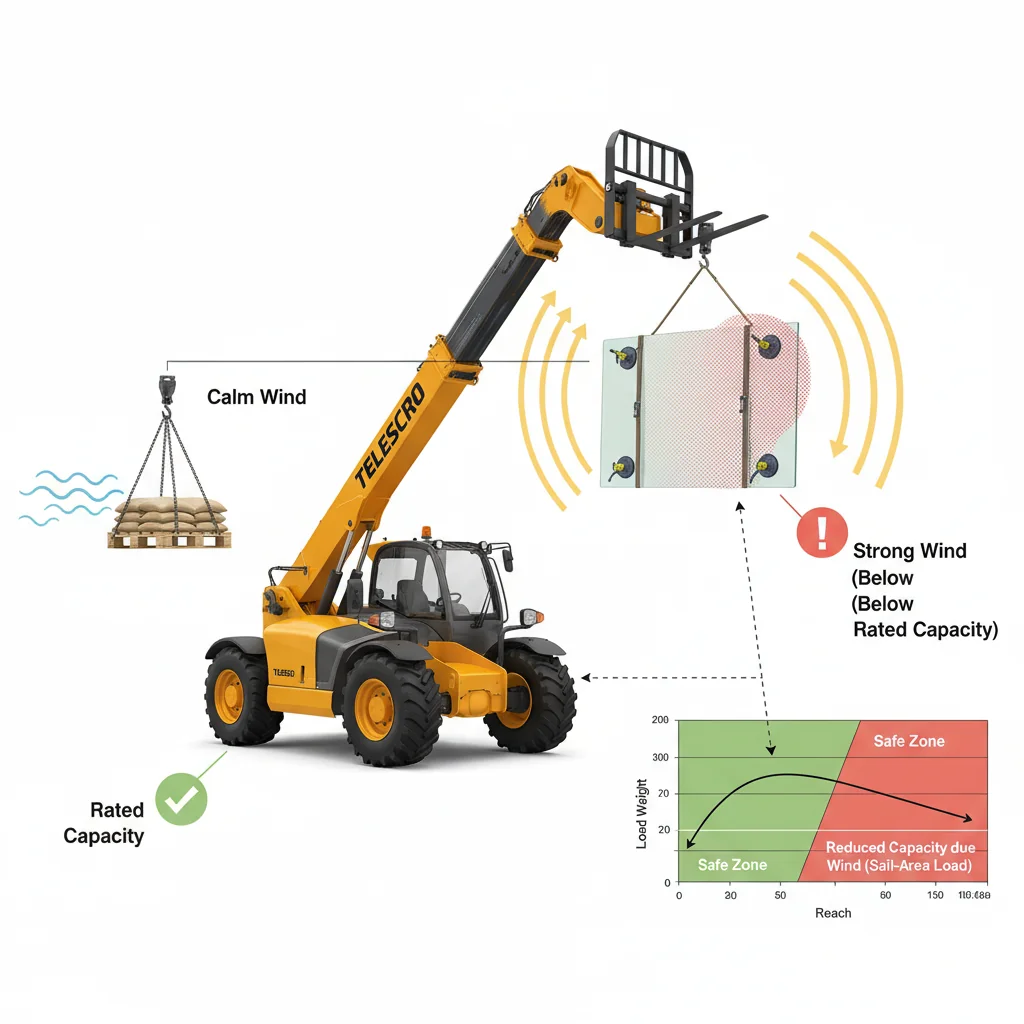
From what I’ve seen on sites in windy places like coastal Turkey and northern China, wind can turn a safe telehandler lift into a dangerous gamble. Most operators trust the load chart—what they don’t realize is those charts are based on calm conditions and compact loads. If you swap out a pallet of bricks for a broad glass panel, the whole math changes. A 400 kg glass sheet at 10 meters height doesn’t act like 400 kg when the wind hits. Even a moderate 12–15 m/s gust can push that panel hard enough to tip the stability margin right to the edge.
One project in Kazakhstan comes to mind. A crew was installing aluminum cladding—each panel was around 3 meters wide. On paper, their 3.5-ton telehandler with a 12-meter boom appeared to be within the load chart limits for that reach. But as wind conditions changed, the panel began to sway and momentarily jerk at the end of the boom. The machine’s moment indicator started alarming, even though the lifted weight was well below the headline rated capacity.
They halted the lift and went back to the manufacturer’s documentation to review wind-related operating limits, cross-checking guidance such as published wind speed limits6 and attachment-specific restrictions. The takeaway was clear: while the load chart covered weight and reach under calm conditions, it did not account for wind acting on large sail-area loads. Continuing the lift under those conditions would have meant operating outside the assumptions behind the chart.
It was a close call—and a good reminder that wind effects can trigger stability systems long before the load chart limit is reached, especially when handling wide or lightweight panels.
Here’s what matters most when you’re planning lifts with sail-area loads: always consult the machine manual for wind limits on your specific attachment. Treat every wide panel or sheet like a sail on a mast. I always suggest adding extra safety margin below the charted capacity and reorienting broad surfaces edge-on to the wind whenever possible. If the gusts are borderline, just wait it out. It’s never worth the risk.
Telehandler load charts assume calm wind conditions and do not account for the added forces exerted by crosswinds on broad or irregular loads.True
Load charts are typically calculated for static, uniformly compact loads with no consideration for wind. Lifting materials like glass panels or large formwork amplifies wind effects, causing instability not reflected in the published chart limits.
If a telehandler’s load is within chart limits, it remains stable in all wind conditions, regardless of the load’s size or shape.False
Chart limits apply only under specified conditions, typically calm weather and compact loads. Wind can create significant lateral forces on large, flat loads, leading to instability and potential tip-over risks even when within chart-rated capacity.
Key takeaway: Telehandler load charts are based on test conditions excluding substantial wind and large sail-area loads. When lifting broad, wind-sensitive materials, operators must apply additional safety margins, consult manufacturer wind limits, and stop operations if gusts exceed permissible thresholds to avoid unexpected stability loss.
How Do LMIs Affect Load Chart Use?
Modern telehandlers often include a Load Moment Indicator (LMI) that tracks boom angle, extension, and load moment, warning or locking out before overload. However, load charts—displayed on paper or placard—remain the legal reference. Both LMI and load chart assume correct attachment, standard configuration, level ground, and calibrated sensors.
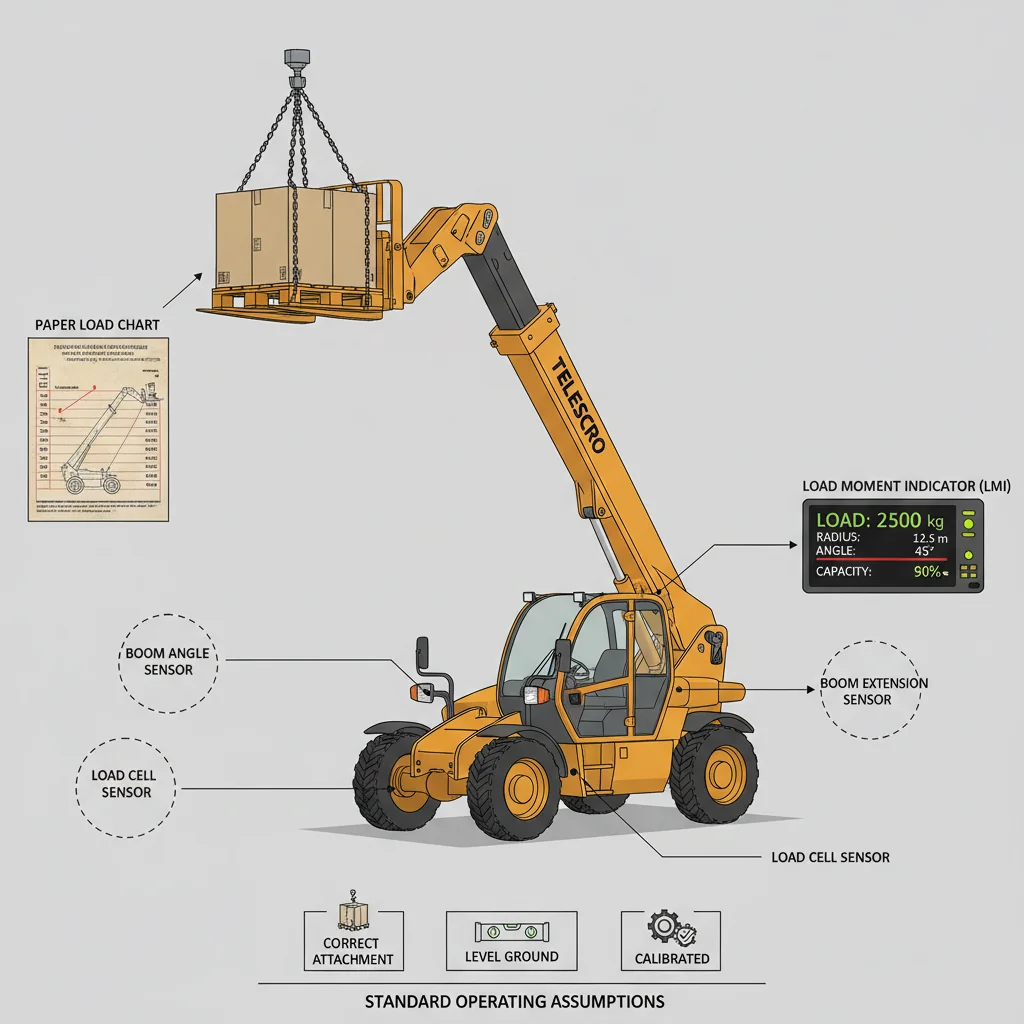
I’ve seen a lot of confusion about how Load Moment Indicators (LMIs) and load charts actually work together on modern telehandlers. The biggest mistake I see is operators trusting the LMI’s green lights without double-checking the machine’s load chart in the cab. It feels safe because the LMI alarms and even locks out controls before overload, but both systems are only as accurate as the inputs—attachment selected, ground levelness, sensor calibration. If any detail is off, the LMI’s “safe zone” can be a false sense of security. One real example: a project in the UAE used a 4-ton telehandler with a work platform attached. The LMI was left on its default fork profile. The system allowed much more movement than the chart actually permitted for platforms at height. The result was a near-overload incident—luckily, no injuries, but it shook up the operator team. Since then, I always encourage customers to verify that the LMI profile matches their actual attachment for every change. The load chart is still the legal and engineering reference, printed right next to the seat for a reason. Here are four essentials every fleet manager and operator should keep in mind: – Always select the correct attachment profile in the LMI before work starts – Double-check that LMI settings match the real configuration (platform, winch, bucket, etc.) – Cross-check any LMI overload warning with the printed load chart for that position and reach – Never treat the LMI alone as permission to work near capacity limits—treat alarms
Telehandler load charts assume the machine is on firm, level ground and that the specified attachment is installed, which means using incorrect attachment settings can cause both the LMI and the load chart to give inaccurate capacity information.True
Load charts are designed based on controlled conditions: level ground, correct attachment, and a calibrated machine. If operators select the wrong attachment or ignore sloped terrain, both the LMI and load chart can misrepresent safe lifting limits.
If the telehandler's LMI is functioning properly, there's no need to consult the load chart since the system always prevents unsafe lifts automatically.False
The LMI's accuracy relies on correct input information and calibration. Load charts provide context and safety margins that cannot be replaced solely by electronic monitoring, so operators must still reference the chart and not rely on the LMI alone.
Key takeaway: Telehandler LMIs provide critical overload protection, but their logic is based on the same assumptions as the printed load chart. Operators and fleet managers must ensure LMI profiles match actual attachments and always use the load chart for authoritative capacity decisions. LMI alarms are a safeguard, not a replacement for chart compliance.
Why Is Telehandler Rated Capacity So High?
Telehandler load charts quote rated capacity based on idealized test assumptions—firm, level ground, a specified attachment, and a defined load center. These published values represent the maximum allowable load under those conditions, not what can be expected across all jobsite scenarios. Real operating variables such as ground conditions, machine wear, attachment choice, and boom position reduce the usable working capacity.
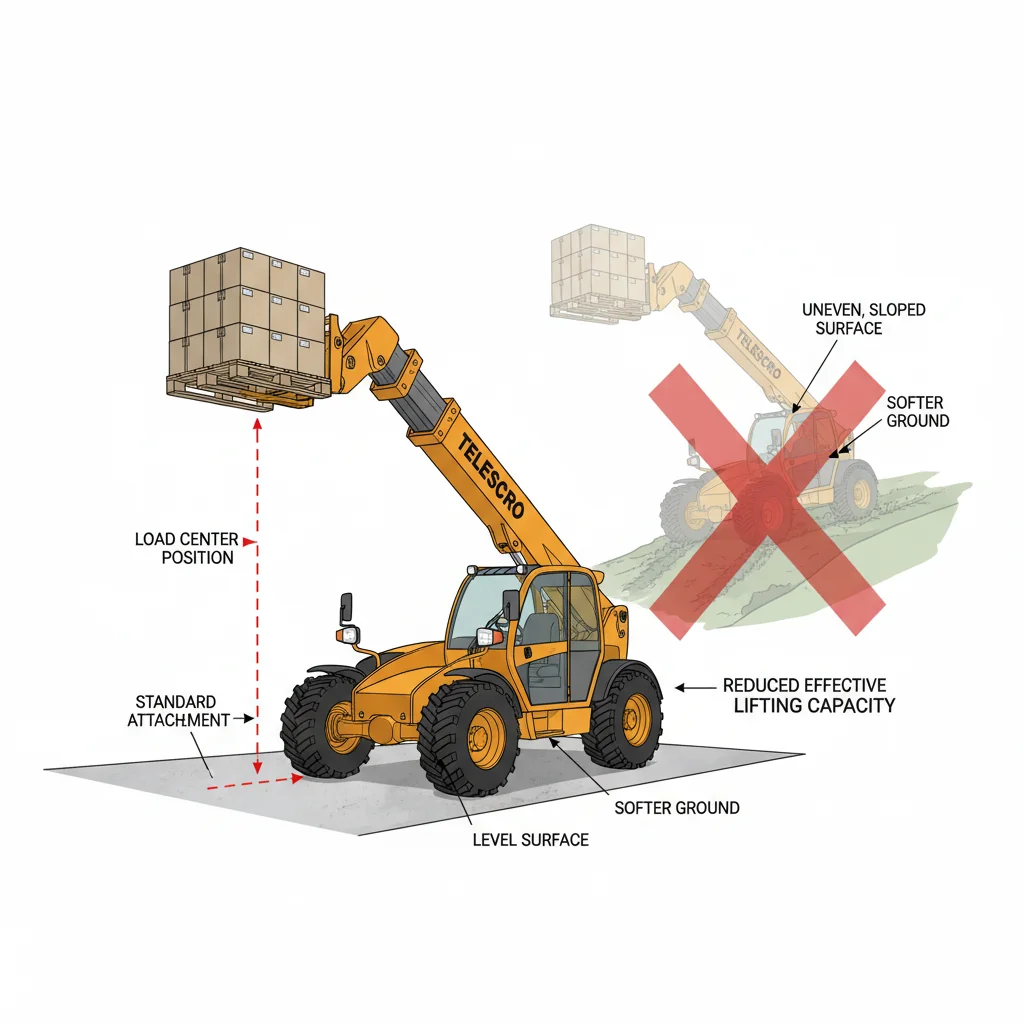
When someone looks at a telehandler brochure and sees a headline figure like “4,000 kg at 17 meters,” it’s easy to assume that capacity is available anywhere and anytime. In reality, that number reflects performance measured under controlled conditions: level, compacted ground, a specified attachment, a known load center, and a machine in proper condition.
On real jobsites, those conditions rarely exist all at once. I’ve worked on projects in Kazakhstan and Brazil where relatively minor factors—soft ground, slight unevenness, or worn tires—were enough to reduce the practical lifting margin well below what the brochure figure suggested. The machine was still operating safely, but only because the crew adjusted expectations and stayed within what the load chart allowed for the actual setup.
A project in Kenya illustrates this well. The task involved placing concrete blocks onto a second-floor slab at roughly 13 meters of reach. On paper, the load chart showed adequate capacity at that position. But once tire condition, ground contamination, and attachment weight were taken into account, the working margin narrowed significantly. The load chart hadn’t changed—the operating conditions had.
That’s why I always recommend looking beyond the bold headline number. Review the load chart at the exact reach, height, attachment, and load center your job requires. If site conditions are less than ideal, it’s often safer to select the next size machine rather than operate close to the edge of the chart. Experienced fleets plan with margin, not optimism.
Telehandler rated capacity assumes the load is lifted with a specific attachment, usually a set of forks or a designated bucket, not any attachment the operator chooses.True
Manufacturers determine rated capacity using defined attachments with known weight and geometry. Changing attachments alters load center and overall stability, reducing the actual allowable lifting capacity compared to the base rating.
The rated capacity shown on a telehandler load chart remains unchanged regardless of ground slope or tire condition.False
Ground slope, surface condition, and tire condition all influence stability. Load charts are based on ideal test conditions, so deviations in these factors can significantly reduce safe lifting capability even if the charted weight appears acceptable.
Key takeaway: Telehandler brochure capacity represents a best-case upper limit established under controlled conditions. Real jobsite variables—ground quality, machine condition, attachment choice, and boom position—reduce usable capacity. Always size machines based on the load chart at real working positions, not just the headline rating.
How Do De-rating Rules Adjust Load Charts?
Telehandler load charts are based on ideal assumptions—firm, level ground, a specified attachment, and a defined load center. When site conditions depart from those assumptions, operators and supervisors must reassess usable capacity. While some safety trainers describe this process as “de-rating,” the key principle is not a fixed percentage, but recognising when the published chart no longer reflects the actual working setup.
(See: telehandler load chart interpretation7)
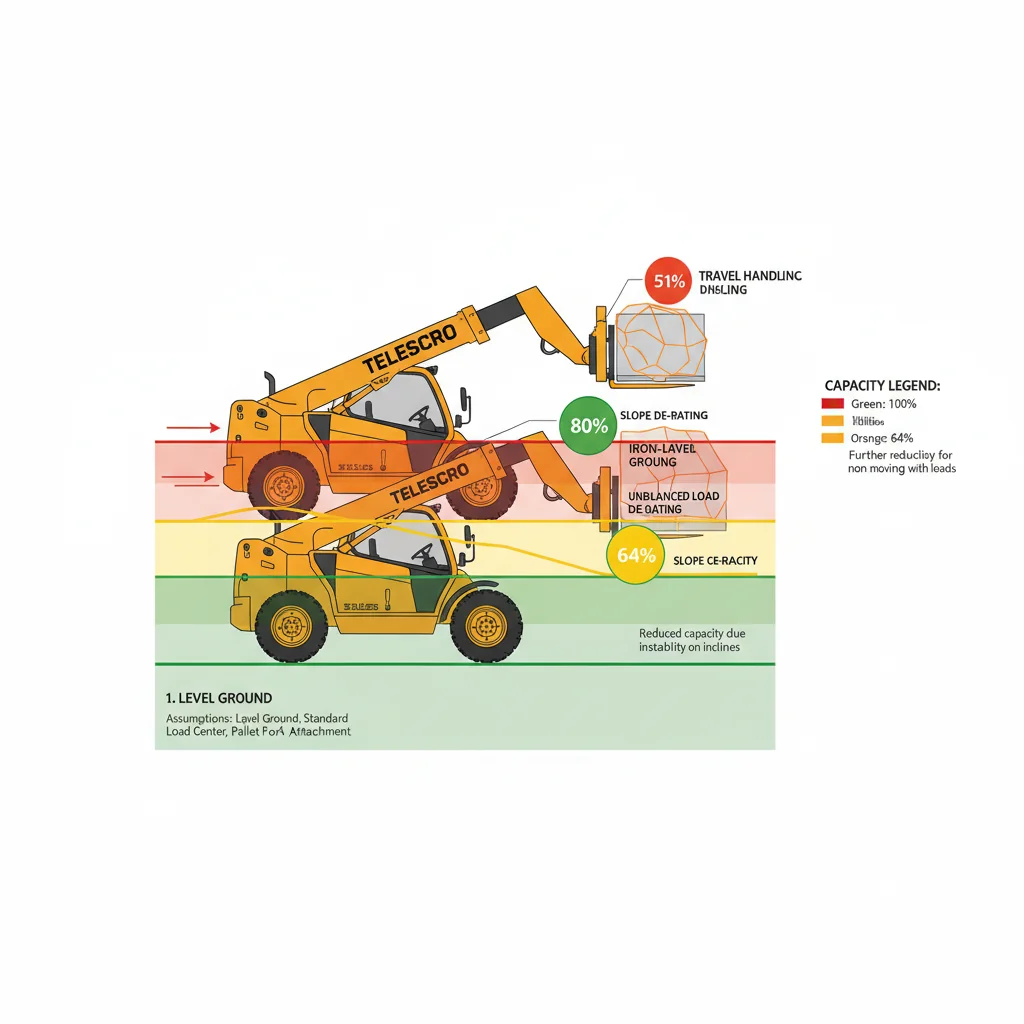
I see this misunderstanding all the time. Operators look at the number on the load chart without asking what conditions it assumes. In practice, those values only apply when the machine is set up as shown on the chart—properly supported, using the listed attachment, and working within the intended operating envelope.
I remember a job in Kazakhstan where a client was working on uneven, rocky ground and handling oversized pallets. The telehandler itself was correctly specified on paper, but once ground conditions and load geometry were considered, the original chart value was no longer a realistic working limit. The issue wasn’t that the chart was “wrong”—it was being used outside its assumptions.
Some trainers explain this adjustment process by talking about percentage reductions for factors like uneven ground, awkward loads, or traveling with a raised boom. I don’t treat those percentages as rules. What matters is the conclusion they point to: each deviation from the chart assumptions eats into stability margin, and once several factors stack up, the safe working capacity can be far lower than the headline figure.
From my experience, the safest approach is straightforward. If site conditions are uneven, loads are irregular, or handling will be dynamic, I plan conservatively and reassess whether the machine is still appropriate. If the lift feels like it’s getting close to the edge of the chart, the answer usually isn’t to “push it”—it’s to change the setup, improve ground conditions, or move up to a larger machine.
Telehandler load charts are developed assuming the machine is positioned on firm, level ground and configured exactly as shown on the chart; once those assumptions change, the published capacities no longer represent a safe working limit.True
Load charts are calculated under controlled conditions. When ground conditions, attachments, or operating methods differ from those assumptions, stability margins change and the charted values can no longer be relied on without reassessment.
Load charts automatically adjust for different attachments and site conditions, so no additional evaluation is needed once the chart is known.False
Load charts are attachment- and configuration-specific and do not compensate for uneven ground, non-standard loads, or dynamic handling. Operators must reassess capacity whenever conditions differ from those shown on the chart.
Key takeaway: Telehandler load charts show the maximum allowable load under specific assumptions—they do not include built-in allowance for uneven ground, awkward loads, or dynamic handling. When conditions change, capacity must be reassessed. Treat the chart as an upper boundary, and size the machine so normal work stays comfortably inside it, not right at the edge.
Conclusion
We’ve looked at how telehandler load charts are built on ideal lab conditions and why real jobsite variables always limit those published numbers. From my own experience, smart operators never trust the max chart—what matters is performance when the boom’s actually working, not parked on level concrete. I suggest you always check load limits at typical reach and apply your own safety margin, especially if the site’s uneven or crowded. That’s how you avoid the “showroom hero, jobsite zero” trap. If you have questions about safe working loads, attachments, or what’s realistic for your crew, feel free to reach out—I’m happy to help based on what works in the field, not just the brochure. Every site has its own challenges—choose what works for you.
References
-
Understand how shifts in load center due to attachments reduce rated capacity and increase safety risks during telehandler operation. ↩
-
Explores how ideal testing conditions differ from real jobsites, affecting telehandler lifting limits and operator safety decisions. ↩
-
Discover how sudden impacts and dynamic forces can exceed telehandler stability margins and cause dangerous overloads on the jobsite. ↩
-
Explore how OEM-approved tires ensure accurate load chart calculations and maintain telehandler stability and safety under factory guidelines. ↩
-
Learn the critical safety and legal standards for telehandler modifications required by ANSI/ITSDF B56.6, ensuring compliance and operational safety. ↩
-
Learn why adhering to manufacturer wind speed limits is critical to prevent accidents and maintain telehandler stability under gusts. ↩
-
Explore detailed safety adjustments and practical de-rating methods to understand real-world telehandler load capacities on uneven terrain. ↩