










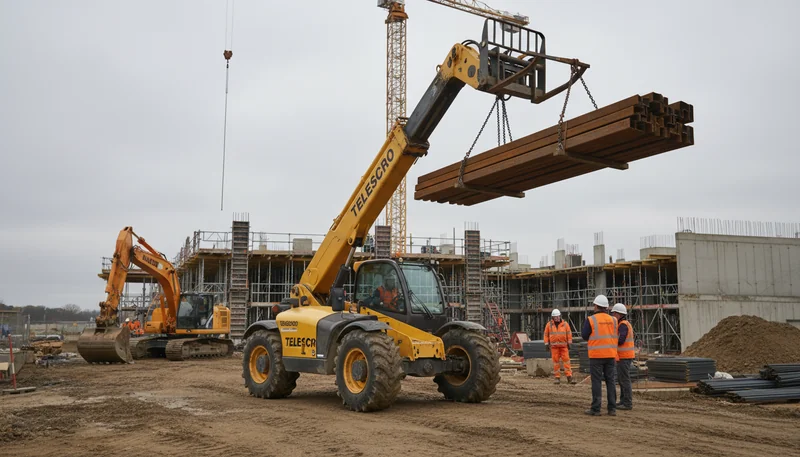
Telehandler Limitations: What Buyers Overlook & How to Avoid Costly Mistakes
One vivid memory comes to mind—a project in Spain where the site manager insisted his new telehandler could tackle every material movement, from lifting steel beams to bulk earth loading. By week’s end, two jobs were behind schedule and the telehandler’s front axle had kissed the mud more than once.
Telehandlers combine forklift, loader, and crane-like functions in one machine, but that versatility comes with trade-offs in capacity, stability, and precision. The telescopic boom1 geometry means rated capacity2 drops sharply as outreach increases, limiting safe lifting at height or distance. Compared with dedicated cranes or wheel loaders, telehandlers rely mainly on chassis stability (and stabilizers on some models) and typically deliver slower cycle times for sustained bulk loading.
Can a telehandler fully replace other machines?
A telehandler combines features of forklifts, cranes, and loaders but is not a complete substitute. Its telescopic boom offers reach but lacks the precision and support of cranes. While versatile for mixed tasks, telehandlers are less efficient for intensive loading, lifting, or tight-space maneuvering than dedicated equipment.

Most people don’t realize that a telehandler’s strength is its flexibility, not total replacement of other equipment. You get reach from the telescopic boom—up to 18 meters on some models—and a solid 4,000 kg rated lift. That looks impressive on paper, but compare it to a dedicated crane with a full counterweight and precise hydraulics. For steel frame work in Dubai, I’ve seen teams try to use a telehandler for everything. The result? Slower cycle times, especially at long reach, and real trouble when the lift needed better stability. Even with stabilizers down, a telehandler can’t match the fine control or load chart3 detail of a real crane, especially above 12 meters.
Here’s a scenario from Kenya: A contractor had a 3.5-ton telehandler with a bucket, loading gravel daily from stockpile to truck. After two days, operators complained about boom speed and hydraulic power4. I measured—each loading cycle took at least 30% longer than with a compact wheel loader. Wheel loaders route hydraulic power directly to the bucket linkage, so their cycle times stay quick and aggressive. Telehandlers always trade some speed for reach flexibility. That’s the compromise.
If you do mixed tasks—like unloading, light bucket work, or placing pallets at height—a telehandler shines as a support machine. But whenever a job calls for high precision, constant loading, or tight maneuvering (like in a 4-meter wide warehouse aisle), I always suggest renting or owning a dedicated forklift, loader, or crane. I’ve learned to match the main workload to the specialist, not the all-rounder. Check your top two job needs and see where the telehandler truly fits.
Telehandlers cannot match the high-precision load placement or continuous lift capacity of dedicated cranes, especially when operating at maximum boom extension.True
While telehandlers provide good reach and versatility, their stability and hydraulic control are fundamentally limited compared to cranes designed specifically for high, precise, and repeated lifts. At maximum extension, telehandlers experience more deflection and reduced capacity, making them less suited for tasks that require consistent, accurate placement.
A telehandler equipped with attachments can efficiently perform all the specialized material handling tasks of a forklift, crane, and aerial work platform without any compromise.False
While telehandlers accept attachments for various roles, their design is always a compromise. They cannot provide the same level of stability as a counterbalanced forklift, the fine movement control of a crane, or the safety systems mandated for aerial platforms. Efficiency and performance are reduced when expecting one telehandler to fully replace multiple specialized machines.
Key takeaway: Telehandlers excel as versatile support machines but cannot fully replace specialized equipment for high-frequency or precision tasks. Buyers should evaluate their core operational needs and view telehandlers as secondary tools, reserving dedicated cranes, loaders, or forklifts for primary, intensive, or accuracy-driven workloads.
How does reach affect telehandler capacity?
A telehandler’s rated capacity can drop dramatically as reach increases. In high-reach positions, usable capacity may fall to well under 1 ton on many 4-ton-class machines—always confirm the exact limit using the OEM load chart for your height/reach and stabilizer configuration.

Let me share something important about telehandler capacity that too many buyers overlook. The number you see on the brochure—say, “4-ton rated capacity”—only applies with the boom fully retracted and the load right up close. As soon as you extend the boom, especially at any significant forward reach, that capacity plunges. I saw this firsthand on a site in Dubai, where a team needed to place 1,400 kg HVAC units onto a slab 11 meters out. They brought in a 4-ton model after reading only the headline spec. At full outreach, the operator checked the load chart and found the maximum safe lift at that position was just 1,200 kg—barely enough. Any mistake, like an uneven surface or extra fork length, could have tipped the machine into overload.
Here’s the key technical reason: the telehandler’s boom works like a lever. The further you extend it, the further your load’s weight moves away from the tipping axis—that’s the line between the front wheels. This reduces forward stability fast. The load chart (which you’ll find on every machine) spells out exactly where the safe limits are for every reach and height combination. From my experience, most jobs rarely work at minimum boom—real work happens at 70–90% extension, especially for placing loads onto scaffolding or up through window openings.
I always suggest you figure out your true scenario—like a 1,500 kg pallet at 9 meters of reach—then check the load chart for that exact spot. Choose a machine that leaves at least a 20–30% margin at your max working reach. That small step prevents a “showroom hero, jobsite zero” disaster.
A telehandler’s maximum rated capacity can drop to less than half as the boom is extended to full reach, even if the chassis remains level.True
Telehandler rated capacities are based on the boom being retracted and the load close to the front wheels. As the boom extends outward, the leverage on the machine increases, making it much more prone to tipping, so manufacturers significantly derate the lifting capacity at these reaches for safety reasons.
A telehandler’s rated lifting capacity remains the same regardless of how far the boom is extended as long as the machine is on level ground.False
Boom extension increases the distance between the load and the machine’s center of gravity, creating more leverage and a higher risk of tipping. Manufacturers compensate for this by reducing the allowable capacity at greater reach, even on level surfaces.
Key takeaway: Telehandler capacity is highest at minimum reach and falls drastically as the boom extends. Always select a model based on the load chart capacity at the maximum working reach required, not just the headline rated capacity. This prevents costly underperformance or unsafe lifting scenarios.
How do slopes and ground affect telehandler safety?
Telehandler stability depends on firm, level ground. Load charts assume the machine is level and properly set up; even small side-to-side tilt or ground sink can quickly consume stability margin—especially with a raised/extended boom. Use the OEM manual and on-machine indicators/frame-leveling instructions to confirm the machine is level before lifting.

The biggest mistake I see is assuming that “all-terrain” tires or 4WD make a telehandler stable anywhere. The reality is, even a 4-ton unit with big off-road tires can tip if the ground is soft, rutted, or on too much of a slope. One of my customers in Kazakhstan was unloading rebar near a trench—looked flat, but the edge was backfilled and settled overnight. The right front tire sank just five centimeters, and with a 2,000 kg load halfway out, the machine rocked badly. The load moment indicator flashed red, but only quick reactions kept it upright. That’s why I always remind buyers: the rated capacity you see on the spec sheet assumes level, compacted ground.
Here’s what matters most when you’re planning to use a telehandler on challenging sites. First, always walk the ground yourself—don’t just rely on maps or site managers saying “it’s fine.” Soft spots, hidden voids, and even old pipe trenches can surprise you. On most models, side slopes above 5–7° or travel ramps over about 10% grade push you outside the safe zone—especially with the boom out. It only takes a small tilt to shift thousands of kilograms off balance.
I’ve watched crews get caught out because they thought a machine could go anywhere the truck did. It’s not true. If you can, mark safe routes, compact your haul roads, and keep heavy loads far from embankments or culvert edges. I suggest checking the load chart in the manual every time ground conditions change—even with lightweight loads. That’s the difference between safe operation and a costly accident.
A telehandler’s stability can be compromised even if only one tire sinks slightly on soft or backfilled ground, due to the uneven distribution of load forces through the chassis.True
Telehandlers transfer substantial weight through each tire, especially when loaded and extended. If a single tire sinks, the weight is redistributed unpredictably, increasing the risk of tilting or tipping, especially on softer surfaces or near excavation edges.
Engaging the telehandler’s four-wheel drive ensures the machine remains stable and safe to operate on any slope or uneven terrain.False
Four-wheel drive improves traction, not stability. Telehandlers can still become unstable or tip if operated on excessive slopes or soft ground, regardless of drive mode, because stability depends on load position and ground support rather than traction alone.
Key takeaway: Telehandlers are engineered for stable, level surfaces and their rated capacity assumes ideal ground conditions. Operating on slopes or unstable ground can cause tipping, even with lighter loads. Evaluate site conditions, map safe paths, and strictly follow the manufacturer’s load chart and manual for safe operation.
How Do Attachments Affect Telehandler Capacity?
Attachments such as fork carriages, buckets, and jibs alter a telehandler’s load center5, typically reducing usable rated capacity. Each attachment has a specific load rating and requires its own load chart. Improper or non-approved attachments invalidate load charts and are a leading cause of overloads and tipping incidents.

To be honest, the spec that actually matters is not just the telehandler’s tonnage or lift height—it’s how your attachment changes the whole stability envelope. Every time you swap out standard forks for a jib, bucket, or work platform, you’re shifting the load center further out from the front tires. That means—right away—your rated capacity drops, especially at full reach or high boom angles. I see this every month when someone in the Gulf or South Africa calls me after a tipping near-miss. Nine times out of ten, they used an oversized bucket or home-made jib without a matching load chart.
Here’s what you need to watch for with attachments:
- Fork carriages and extensions – Even longer forks can push the load center forward. Capacity loss may look small on paper, but the real impact shows up fast at full extension.
- Buckets, large or light material – These shift the center of gravity far forward. For example, a 1.5 m³ bucket on a 3-ton telehandler often drops rated capacity by half or more at mid-reach.
- Jibs and hooks – A 2-meter jib moves the working load dramatically forward. I’ve seen a 4-ton machine limited to just 800 kg at maximum reach because of this.
- Work platforms and personnel cages – Require their own certified load chart. Attaching a cage to the forks is never safe or legal, and is a leading cause of jobsite accidents.
Using a bucket attachment instead of standard forks generally lowers a telehandler's maximum safe lifting capacity at full boom extension due to the increased distance of the load from the machine’s front axle.True
Attachments like buckets extend the load further outward, increasing the load center distance and reducing leverage, which negatively affects stability and the rated capacity of the telehandler.
Switching to a work platform attachment allows operators to maintain the same rated capacity as standard forks, regardless of boom position.False
Work platforms typically reduce a telehandler's maximum capacity because the attachment adds weight and shifts the load center, making the machine less stable and safe to operate at its highest rated loads, especially at extended reach.
Key takeaway: Every approved attachment changes a telehandler’s load chart and safe operating limits; using non-approved or improvised attachments is a frequent cause of costly accidents. Only select manufacturer-certified tools for core tasks, ensure correct load charts are accessible, and train operators to recognize these limitations.
How Do Telehandler Suspension Limits Impact Productivity?
Most telehandlers do not use true suspension systems, instead relying on rigid axles6 and tire compliance for shock absorption. This results in a firmer ride, particularly when equipped with foam-filled or solid tires. To maintain stability, especially with the boom raised or partially extended, safe travel speeds are limited—reducing efficiency on large or uneven jobsites compared with machines designed for frequent long-distance travel.

I’ve worked with customers in Kazakhstan and South Africa who didn’t realize how much the lack of real suspension slows down a telehandler fleet on a big jobsite. The axles are rigid, and except for the rear axle pivot, there’s no shock absorption beyond what the tires provide. If you’re running foam-filled or solid tires—pretty common for puncture-prone sites—the ride gets even harsher. One customer in Almaty tried shuttling steel bundles 300 meters round trip across a rough yard. His 4-ton machine maxed out at walking speed, and the operator was exhausted by noon.
Here’s the thing: with the boom raised, even partway, any bump on the jobsite affects stability. Manuals often warn against traveling above a crawl if the boom isn’t fully lowered. I’ve tested several models and noticed that hitting an uneven patch at more than 8 km/h with a load feels borderline dangerous. Quick steering or braking can cause the whole machine to sway or jolt. That risk is why travel speed gets limited in practice—machines rated for 30 km/h often run much slower on site.
If you need to move material long distances—let’s say more than 150 meters per trip—I always recommend planning fixed loading and unloading points closer to the work zone. One project in Nairobi used a yard tractor for bulk transport, then a telehandler just for placing heavy pallets. It improved speed and kept the operators fresher. And always keep tire pressures correct—low or flat tires absolutely destroy both stability and productivity. Run flat, and you risk a rollover.
Telehandlers with rigid axle suspension experience significantly slower travel speeds and higher driver fatigue on rough terrain compared to machines with true axle suspension systems.True
Without proper suspension, shock from uneven surfaces is transferred directly to the chassis and operator, leading to reduced speed, comfort, and productivity, especially over long distances or rough terrain.
Switching to foam-filled or solid tires on a telehandler compensates for the lack of suspension and results in a smoother ride over uneven ground.False
Foam-filled or solid tires reduce punctures but actually make the ride harsher, as they cannot flex to absorb impacts like pneumatic tires, worsening the lack of suspension and increasing jolts and strain on the machine and operator.
Key takeaway: Telehandlers’ rigid axle design and lack of suspension can reduce travel speed and operator comfort, making long movements across large sites less efficient. Planning work zones and using dedicated transport equipment for bulk yard movements can mitigate these productivity limitations.
How Do Telehandler Blind Spots Affect Safety?
Telehandlers have significant blind spots due to the telescopic boom and engine hood, particularly on the right and rear. Bulky loads further hinder forward visibility. These limitations increase collision and rollover risks, especially on busy jobsites. Mirrors, cameras, clear pedestrian routes, and proper load handling are essential to mitigate these hazards.

I’ve worked with customers who made this mistake—assuming the telehandler’s huge wheels mean great all-around visibility. The truth is, the boom and engine create a big blind spot, especially to the right and rear. When you’re carrying a pallet of bricks or bulky insulation, forward sightlines can shrink to less than two meters. Operators sometimes lift the boom to peek underneath the load, but that’s risky. Raising the boom while driving bumps the center of gravity way up. If you hit a pothole or need to brake quickly, the machine can tilt or even roll. I saw this nearly happen in Dubai last year, when a new operator tried to get a better view and the machine almost tipped on a side slope.
On busy jobsites, these blind spots become much more than a comfort issue—they turn into real safety hazards. In Brazil, a contractor’s telehandler clipped a parked pickup because the right-rear blind zone was underestimated. Repair costs plus downtime added up to at least a week of lost work. That’s why I always recommend more than just the standard mirrors—rear cameras7 and clear pedestrian walkways help a lot, especially on tight urban builds or rental yards crowded with machines and people.
The key is good planning and strict routines. I suggest always traveling with the boom fully retracted and the load as low as possible. If you’re working in a congested area, use a trained spotter. And when selecting a new unit, don’t just look at fancy displays—actually sit in the cab to check right-side and rear visibility for yourself. That’s what keeps operators—and everyone else—safe.
A telehandler's boom, especially when angled or extended, can obscure the operator's view of pedestrians or obstacles on the right-rear quarter, leading to significant blind spots.True
The size and positioning of the boom and engine disrupt direct lines of sight to key areas, particularly on the right-rear side, increasing the risk of accidents during maneuvers.
Because of their elevated cabs, telehandler operators always have a clear line of sight to the rear, even while carrying large or bulky loads.False
Elevated cabs do not eliminate rearward blind spots, as the boom, load, engine, and counterweight can still obstruct the operator’s view, especially when the machine is loaded.
Key takeaway: Telehandler visibility challenges raise collision and rollover risks, especially when carrying bulky loads. Buyers should prioritize cab design, camera options, and strategic jobsite planning to reduce accidents and operator stress. Implementing spotters, mirrors, and strict operating protocols significantly improves safety outcomes on busy worksites.
How Do Operator Skills Impact Telehandler Safety?
Safe telehandler operation depends on adherence to strict manufacturer limits, not just experience. Overload warnings, load moment indicators, and stabilizer interlocks protect against instability—but only if operators are properly trained and sensors are maintained. Legal requirements may mandate operator certification, risk assessments, and compliance with local lifting standards above certain capacities and when lifting people.

Here’s what matters most when it comes to telehandler safety: even the most advanced safety features—like load moment indicators and stabilizer interlocks—won’t prevent accidents if the operator doesn’t follow the manual and respect every warning. Last year, I worked with a rental fleet in Dubai that replaced several hydraulic sensors and recalibrated their warning systems, only to see operators still travel with loads raised too high. The systems beeped, lights flashed, but without the right training, the signals were ignored. Proper knowledge of the load chart, not just “forklift experience,” is what actually keeps the machine upright.
From my experience in Southeast Asia, novice operators often run into trouble when changing attachments or setting up on imperfect ground. One crew in Malaysia tried lifting a pallet of bricks—about 1,000 kg—with the boom almost fully extended and only partial stabilizer deployment. They assumed being under “rated capacity” kept them safe. The result? The rear wheels lifted off the ground. They were lucky it stopped there. The manufacturer’s load chart clearly showed that boom angle and stabilizer extension dramatically reduce actual capacity. No shortcut or rule of thumb replaces direct chart reference.
Legal requirements add another layer. In many countries, lifting people—even occasionally—triggers regulations like EN 1459-3 or local licensing. I’ve seen projects in the UK halted because only general forklift certificates were held, not model-specific telehandler training. The smartest fleets I’ve visited always budget for refresher courses and document operator checks every quarter. If you want to truly avoid accidents and stay on the right side of inspectors, invest in model-by-model training and reinforce site rules with toolbox talks. That’s the foundation for real telehandler safety.
Even with advanced safety features, improper operator habits such as driving with the boom raised significantly increase the risk of tip-over incidents, because mechanical safeguards cannot counterbalance every unsafe maneuver.True
Telehandler safety systems can warn of instability, but if operators ignore alerts and travel with the boom raised, the machine's center of gravity shifts and stability decreases, making tip-overs more likely regardless of the technology in use.
A telehandler’s automatic safety features can always prevent an accident, even if the operator disregards load limits and stability warnings.False
Safety systems provide warnings and intervention to some extent, but they cannot override all operator actions or compensate for repeated neglect of proper procedures, so operator skill and attention remain critical for preventing incidents.
Key takeaway: Telehandler safety systems and legal compliance rely on skilled, model-specific operators—not generic forklift experience. Investing in formal training, routine safety checks, and clear site rules about load limits and travel is critical to avoiding accidents, downtime, and regulatory violations.
What Are Telehandler Duty Cycle Limits?
Telehandlers are engineered for intermittent lifting8, not continuous high-cycle loading. Their booms, hydraulics, and steering components can wear rapidly if used like loaders, especially in dusty environments. Overloading, improper use, and neglecting preventive maintenance increase wear and risk costly downtime. Proper maintenance schedules and application matching are essential for longevity.
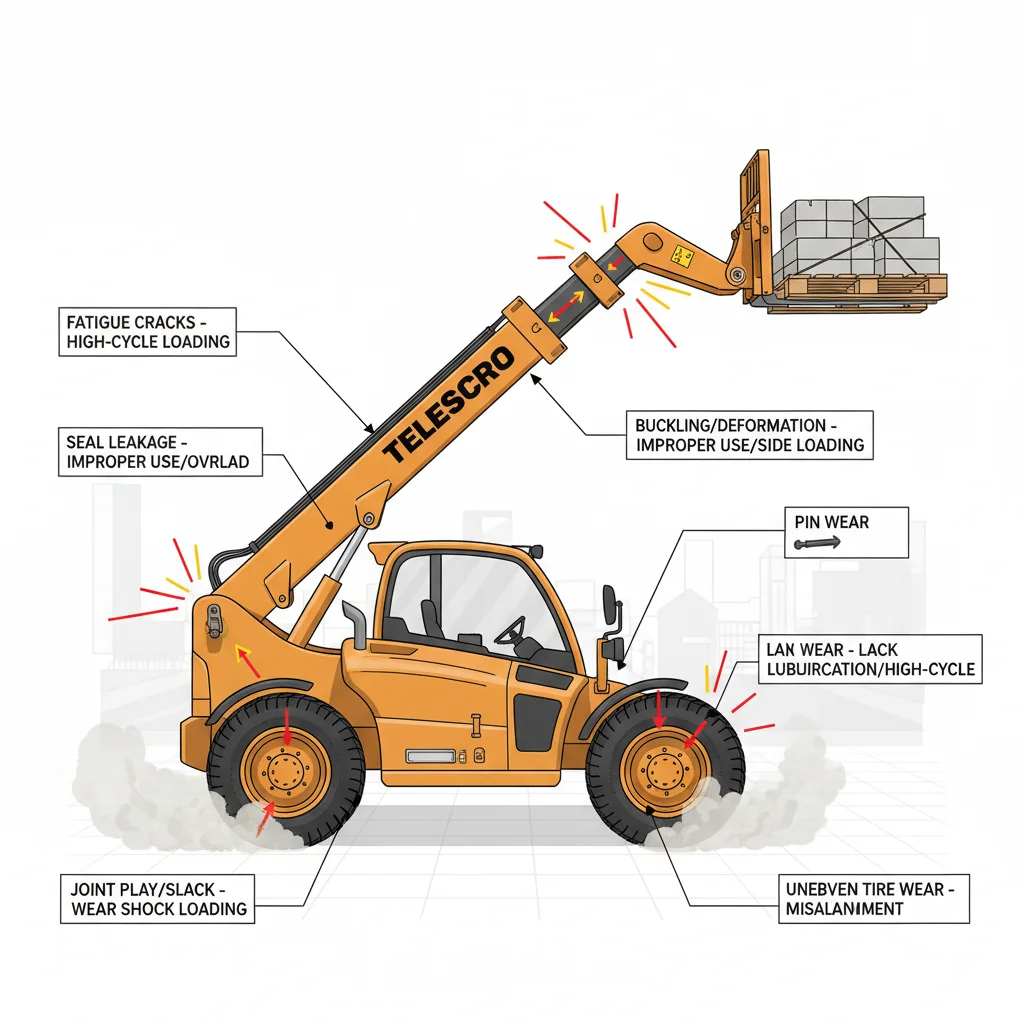
Last month, a site manager in Dubai contacted me after burning through two sets of hydraulic hoses9 in just four months. His team was running a 4-ton telehandler for continuous gravel loading—8 hours straight, day after day. That’s not how these machines are engineered. Telehandlers are designed for intermittent lifting tasks: placing pallets, moving material, staging loads. When you use them like a loader, constantly cycling the boom and steering in dusty conditions, component wear accelerates fast. Dust acts like sandpaper on boom pads and bushings. Hydraulic oil picks up fine particles, turning routine lubrication into an abrasive paste.
Here’s what matters most for anyone planning workload: heavy, continuous operation shortens the lifespan of hydraulic circuits, boom structure, and steering joints. I’ve seen this first-hand with customers in Brazil who assumed a high-reach unit could load bulk material all day. Within one year, their machines developed jerky boom movement, leaky cylinders, and noisy pivot points. Repair bills climbed quickly—especially with imported parts.
To protect your investment, I always suggest applying preventive maintenance as if you were running two machines: double-check oil condition, inspect boom pads monthly (not just at service intervals), and pressure-clean cooling systems. If your daily job means non-stop cycle work—hauling, loading, or carrying—spec a true wheel loader for that task, not a telehandler. Remember, rated capacity comes with limits meant for safe, level, and controlled lifts, not for loader-style abuse. Select the right tool for the cycle—your service life (and budget) will go much further.
Running a telehandler for continuous, loader-style operations dramatically increases the wear on hydraulic components compared to its intended intermittent use.True
Telehandlers are engineered for lifting and placement tasks, not for constant material handling. Prolonged, repetitive duty cycles put stress on hydraulic systems, leading to faster component degradation such as hoses, pumps, and seals.
Telehandlers are specifically designed for sustained heavy-duty, loader-style operations without increased maintenance requirements.False
Telehandlers are not engineered for continuous, high-frequency material handling like loaders. Extended operations of this kind exceed their design parameters and result in accelerated wear, especially to hydraulic and drive components.
Key takeaway: Telehandlers are not designed for all-day, loader-style usage. Heavy, continuous duty cycles accelerate wear on hydraulics and booms, while dusty environments exacerbate component degradation. Preventive maintenance and application-appropriate machine selection are crucial to avoid unexpected failures and maximize telehandler service life.
What Limits Telehandlers Indoors and for Lifting People?
Telehandlers are often limited for indoor and people-lifting tasks due to diesel exhaust, heat, and noise, making them unsuitable without significant ventilation. Electric models are quieter but costlier and may not run a full shift. Strict standards require only manufacturer-approved, mechanically secured platforms for people lifting, with further restrictions in wind and reach.

Last year, a project supervisor in Brazil asked if his team could use a diesel telehandler for moving pallets and lifting workers indoors on a factory upgrade. The main problem? Most telehandlers in his fleet ran on Tier 4 engines10 and put out too much exhaust and heat for safe indoor use. Even with big fans or open loading dock doors, the fumes and noise caused complaints. Electric telehandlers11 are becoming more available—I’ve seen compact 3-ton models with zero emissions—but they cost at least 30% more than diesel, and you still get battery limits. A typical battery unit might only last 6 hours on heavy cycles, which is rarely enough for a full shift in busy jobsites. Telehandlers are also tricky to maneuver inside tight spaces. Their turning radius can be over 4 meters on mid-size units, and clearance with the boom raised is an issue in low-ceiling warehouses. A warehouse forklift is simply better for aisle work—faster, more nimble, and able to keep working all day if you have battery swaps. I usually tell customers: unless you absolutely need boom reach, a telehandler is just not the right tool for constant indoor moves. For lifting people, there are even stricter limits. Only manufacturer-approved platform attachments with mechanical locks are allowed. In Kazakhstan, a client wanted to use a welded steel cage on forks—definitely not safe, and usually illegal. When you add a platform or jib, wind speed and reach limits drop sharply.
Telehandlers are generally not certified for lifting personnel unless equipped with a manufacturer-approved work platform and safety features, limiting their use for elevating workers indoors.True
Most telehandlers are designed for material handling, not for carrying people. Regulatory standards require specific attachments like purpose-built personnel platforms, along with interlocks and fall protection, to safely lift workers, especially indoors where risks are higher.
Switching to low-sulfur diesel fuel allows standard Tier 4 telehandlers to be safely used indoors without additional ventilation.False
Low-sulfur diesel reduces certain pollutants, but Tier 4 engines still emit exhaust gases that can accumulate to dangerous levels indoors. Adequate ventilation or alternative power sources, such as electric models, are necessary for safe operation in enclosed spaces.
Key takeaway: Telehandlers are not ideal as primary indoor machines or for routine personnel lifting. Diesel emissions, maneuverability, battery limits, and strict platform safety standards constrain their use compared to electric forklifts or dedicated MEWPs. Consult OEM documentation for all indoor and elevated work applications.
How do transport needs affect telehandler use?
Telehandlers’ high operating weight and limited road speeds—typically 20–40 km/h—make long-distance road travel impractical. Many models require additional equipment to meet road-legal requirements, such as lighting and braking systems. In practice, most deployments rely on specialized low-bed trailers12, increasing transport planning, downtime, and total operating cost—especially for multi-site projects.

Here’s what matters most when you’re planning to deploy telehandlers across several sites: transport logistics and cost can change your whole approach. Unlike forklifts you might trailer behind a pickup, telehandlers often tip the scales at 7 to 15 tonnes and usually max out at around 40 km/h—sometimes less. I’ve seen contractors in Kenya budget for the daily rental but completely forget the cost and scheduling needed for a low-bed trailer, especially when moving between two rural jobs each week.
It’s not just about weight and speed. Most machines aren’t road-legal without special modifications—think lighting kits, added braking, and even temporary permits or insurance. Moving a telehandler on public roads is rarely as simple as just driving it down the street. From my experience, every site transfer means arranging space for a trailer, coordinating with delivery schedules, and making sure you don’t block other site traffic. That’s real downtime—sometimes you lose half a day just on loading and positioning.
Before you commit to telehandlers for multi-site work, here are four transport factors you should always weigh:
- Trailer logistics and costs: Factor in the frequent need to hire low-bed transport, not just once but for every move.
- Permit and compliance needs: Realistically assess what’s required to make your model road-legal—or accept you’re trailering, every time.
- Site setup and access: Is there enough space at both departure and arrival points for safe loading/unloading?
Transporting telehandlers between sites often requires specialized low-bed trailers due to the machines' weight and road speed limits.True
Telehandlers can weigh several tonnes and have low maximum road speeds, making them unsuitable for standard trailers or highway travel under their own power. Specialized equipment and careful scheduling are frequently necessary for safe and legal transport.
Telehandlers can typically be towed behind a standard pickup truck just like smaller forklifts.False
Unlike smaller forklifts, telehandlers are much heavier and often exceed the towing capacity and legal road weight limits for standard pickup trucks. Special transport arrangements are usually required.
Key takeaway: Factoring in transport logistics and costs is critical when planning telehandler use across multiple sites. Their heavy build and road travel limitations mean that frequent relocations require careful coordination, potentially making smaller equipment more practical for scattered jobs or minor lifting tasks.
Conclusion
We’ve talked about where telehandlers shine and where they can fall short, especially compared to more specialized gear. From what I see on real jobsites, the biggest pitfall is choosing a telehandler based on headline specs or price, then running into "parts roulette" when something breaks and spares are slow to arrive. Before making a decision, I suggest you look closely at your actual lifting needs, check the load chart at common working positions, and ask about local support and spare parts speed. If you’re unsure, or just want to bounce questions about attachments or jobsite fit, feel free to reach out—I’m happy to help. Every jobsite is unique, so the right choice is always about what works best for your daily reality.
References
-
Detailed insights into how telescopic booms provide extended reach and versatility in material handling and construction tasks. ↩
-
Explains why rated capacity numbers vary with boom position, offering insight into safe load limits and machine stability from expert sources. ↩
-
Details how load charts define safe lifting limits at various reaches and heights, crucial for preventing overload and accidents on site. ↩
-
Explores the role of hydraulic power in telehandler performance and speed, with comparisons to specialized loaders for better decision-making. ↩
-
Detailed insights on how load center shifts impact telehandler stability and capacity reductions at various boom angles and reaches. ↩
-
Explore how rigid axle design limits shock absorption and impacts ride comfort and stability in telehandlers on rough terrain. ↩
-
Details how rear cameras improve visibility in blind zones, helping operators avoid accidents and costly repairs on busy jobsites. ↩
-
Details why telehandlers are designed for intermittent lifting, not continuous cycles, helping users avoid costly wear and maintenance issues. ↩
-
Explains causes of rapid hydraulic hose wear, including continuous loading and dusty conditions, and prevention tips from industry experts. ↩
-
Understand how Tier 4 diesel engines impact indoor telehandler use due to exhaust emissions, heat, and regulatory restrictions affecting safety and ventilation. ↩
-
Explore the benefits and challenges of electric telehandlers including zero emissions, quieter operation, and battery life constraints for indoor jobs. ↩
-
Explore the role of low-bed trailers in safely and efficiently moving heavy telehandlers across sites, with tips for best practices. ↩