










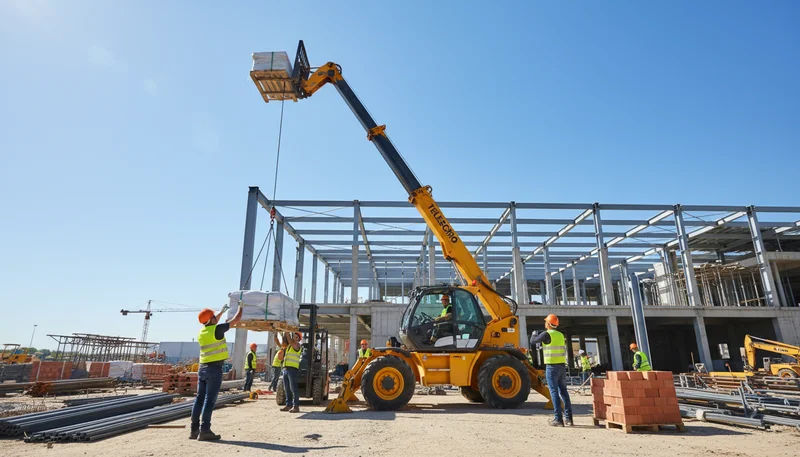
Telehandler Lifting Precision: Why Accuracy Drops as Machines Age (Field Guide)
Not long ago, I was troubleshooting with a team in Poland who swore their three-year-old telehandler “just didn’t line up like it used to.” After checking the forks and hydraulics, what we found shocked them—wear no one had measured, turning smooth controls into daily frustration.
Telehandler lifting precision can decline over time as wear accumulates in boom pads, pins, and bushings, and as hydraulic components lose tightness under load. Small increases in joint clearance can translate into noticeable fork-tip movement at height. Hydraulic components may also develop internal leakage1, which can show up as boom drift or inconsistent response—especially when working near the limits assumed by the load chart and on a level, properly maintained machine.
How Does Boom Pin Wear Impact Lifting Precision?
Boom pin and bushing wear increases clearance at joint interfaces, reducing telehandler lifting precision. Even millimeter-level play at one wear point can be amplified at the fork tips when the boom is extended, making placement less predictable and increasing the risk of operating closer to the stability triangle2 limits. For practical inspection and capacity context, refer to Telehandler rated capacity2.
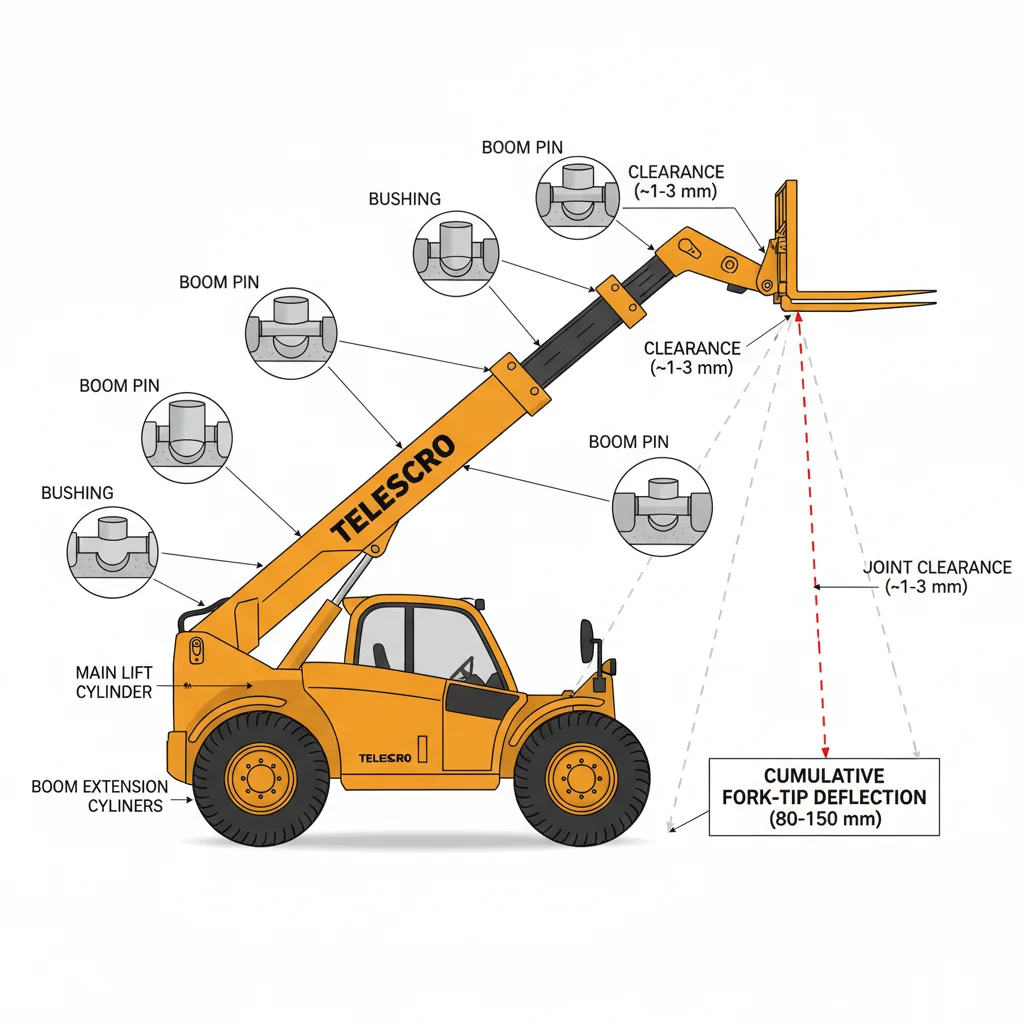
Most people don’t realize just how much a small amount of boom pin wear can throw off your lifting precision. I worked with a site in Dubai last year using a 4-ton telehandler with a 14-meter boom. The operators started noticing the fork tips would drift sideways as much as 100 mm—even when the boom was fully retracted and they weren’t touching the joystick. With each pin or bushing worn by just 0.8 mm, that movement multiplied down the boom. The result? Pallet placement at height became a trial-and-error game, not something you could do on the first try.
I’ve seen this kind of fork-tip “wander” cause big headaches, especially when handling heavy blocks at 12 meters up. In Kazakhstan, a customer had to slow their lifts to nearly half speed to avoid clipping scaffold frames. The moment indicator was still showing loads in the safe zone, but the play in the boom meant everything felt unstable. That extra clearance in the joints—maybe less than a millimeter per pair—quickly adds up across four or five points. At full extension, your forks can be out by 150 mm or more. It’s not just frustrating; it pushes operators closer to the edge of stability.
Here’s what matters most: measure pin and bushing clearances at regular service intervals, not just when problems appear. Replacing worn pads early is a lot cheaper than repairing a deformed boom section. I always suggest checking for side-to-side play in the carriage before every shift—those few minutes can save hours and prevent accidents on site.
Even minor boom pin wear can cause cumulative misalignment along the boom, leading to noticeable inaccuracy at the fork tips when placing loads at height.True
As small clearances develop in pins and bushings, the play at each joint adds up, multiplying by the boom’s length and resulting in significant movement at the load end—this principle is known as stack-up tolerance or accumulated wear.
As telehandlers age and boom pin wear increases, the machine’s onboard sensors will automatically compensate to maintain original lifting precision.False
Most telehandlers do not have advanced automated compensation for mechanical wear in their structure. Sensors may detect position, but they cannot correct for physical slack or misalignment introduced by worn pins and bushings.
Key takeaway: Regular inspection and timely maintenance of boom pins, bushings, and boom pad clearances are essential for maintaining tight control and accurate fork positioning. Neglected wear compounds over time, translating into significant and tangible fork-tip wander, which directly affects jobsite safety and productivity.
Why Does Telehandler Boom Accuracy Decline?
As telehandlers accumulate service hours, internal hydraulic leakage can develop within cylinders, pumps, and control valves, leading to boom drift and reduced positional control. Worn seals3 allow oil to bypass internally without visible external leaks, which diminishes lifting precision and load holding ability. These effects become most evident near rated capacity and at extended reach, where stability margins are narrow and small hydraulic losses require greater operator correction. Scheduled hydraulic inspection and maintenance help limit this loss of control.
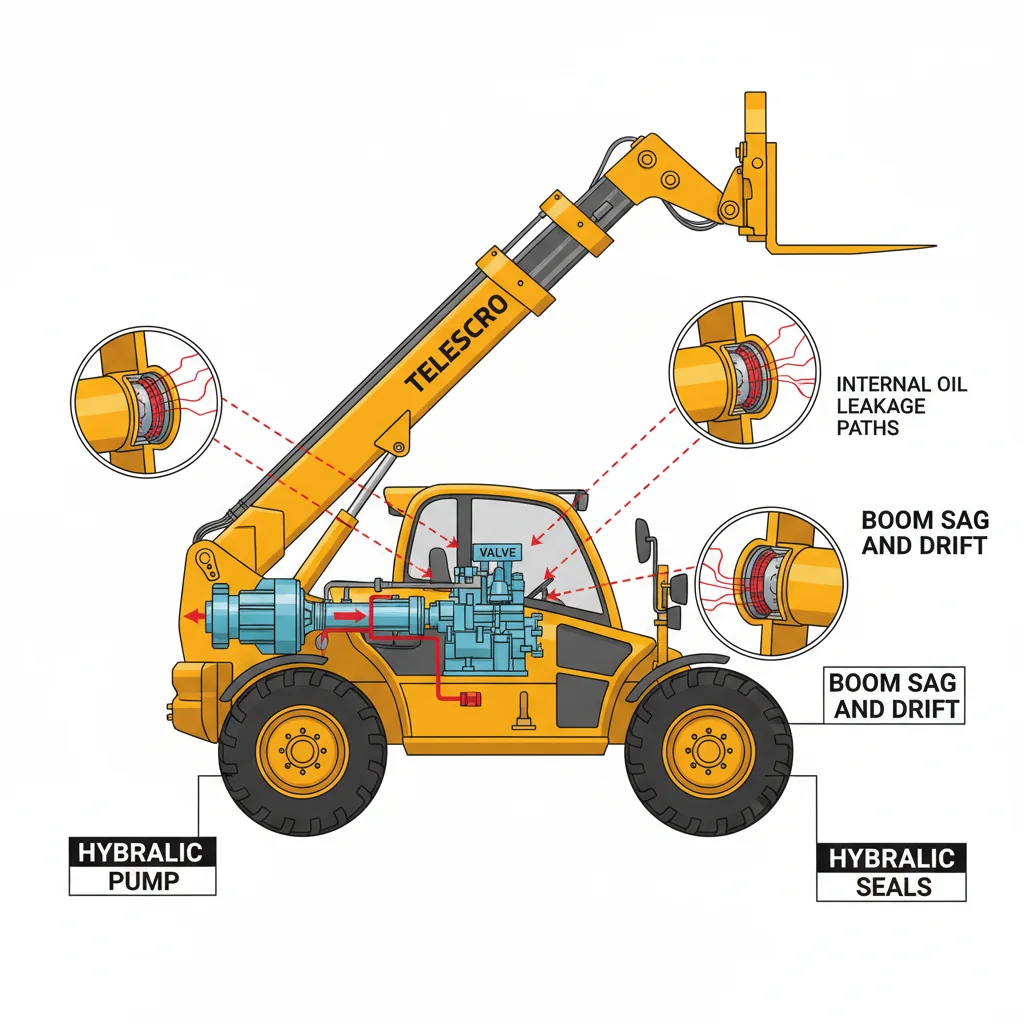
Let me share something important about telehandler boom accuracy—internal hydraulic leakage isn’t just something you read about in manuals. I’ve seen it hundreds of times, especially with machines working beyond 5,000 hours. Those seals inside the cylinders and valves may look fine from the outside, but inside they’re slowly wearing out. Oil starts slipping past the seals, even when there’s no drip on the ground. That’s when the boom begins to drift. You might notice the end of the boom dropping 10 to 30 millimeters within a few seconds after stopping the joystick. On a job in Kazakhstan, a customer with a high-reach 4,000 kg model complained his operators kept “chasing” the load at full extension. The culprit? Worn seals and oil that hadn’t been changed in two years.
The biggest impact happens when you’re near rated capacity or stretching the boom past 75% of its reach. At those positions, even a slight internal leak makes the whole machine feel less stable. You’ll find yourself trimming the boom position constantly just to keep the load where it belongs. If the oil is old or dirty, things get even worse—controls start to feel ‘spongy’, and response slows down. That precision operators rely on? It starts to disappear.
For anyone running telehandlers over 3,000 hours, I always suggest pressure testing the hydraulic circuits and changing filters based on engine hours, not just calendar time. It’s a small investment compared to the cost of a dropped load. That attention keeps your boom steady and your site safe.
Internal hydraulic leakage within telehandler cylinder seals can cause gradual boom drift, even if there are no visible external oil leaks.True
Hydraulic seals can wear internally over time, allowing oil to bypass within the system. This loss of hydraulic integrity leads to subtle, continuous downward movement of the boom, which reduces lifting precision even in the absence of obvious external leaks.
Telehandler boom accuracy primarily declines because the steel structure of the boom itself becomes misshapen or warped with normal use.False
Boom structures are engineered from high-strength steel designed to withstand normal operational stresses with minimal deformation. The main cause of declining accuracy is wear in the hydraulic system and components, not significant shape changes in the boom structure under typical use.
Key takeaway: As telehandler hydraulics age, internal leaks erode boom stability and precision, especially under heavy loads or full extension. Regular maintenance, such as scheduled oil changes, circuit pressure testing, and cylinder resealing, is critical for preventing performance decline and maintaining safe, accurate material handling.
Why Does Telehandler Lifting Precision Decline?
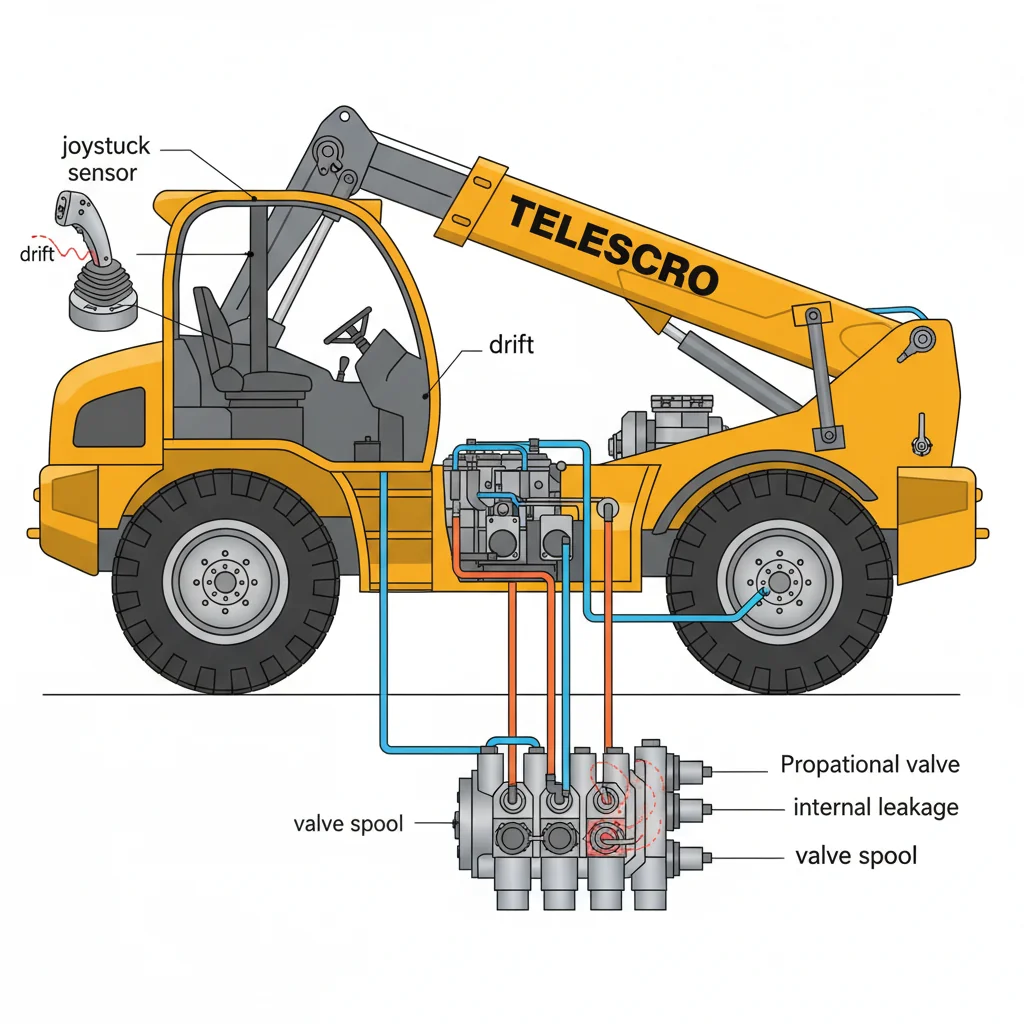
Telehandler lifting precision is strongly influenced by the condition of proportional valves4 and electronic joystick controls. As valve spools and metering edges wear, internal leakage and control deadband increase, while joystick sensors may gradually drift from calibrated zero. These changes reduce fine feathering capability, causing less predictable boom response, overshoot during placement, and longer correction time in precision lifting tasks.
Here’s what I watch for when a telehandler’s boom starts to feel less responsive: worn hydraulic control components and joystick assemblies are almost always involved.
I’ve seen this first-hand on older 4-ton machines in Saudi Arabia. Operators complained that feathering felt “jumpy” when placing glass panels around eight meters high. That’s a red flag. Proportional valves and electronic joysticks are designed to convert very small lever movements into smooth, metered oil flow—this is what allows controlled positioning at height.
After several years and thousands of operating cycles, internal wear starts to show. Valve spools lose edge definition, centering springs weaken, and contamination causes components to stick or respond inconsistently. The most common symptom is joystick deadband: the operator moves the control slightly and nothing happens, then the boom suddenly reacts too aggressively. When you’re working near finished façades or fragile materials, that kind of response is unacceptable.
I saw the same issue on a job in Brazil, where a contractor was struggling to place steel pipes accurately with a high-reach machine that had passed 7,000 hours. The operator described the controls as feeling more like an on/off switch than a proportional system. Placement that should have taken seconds turned into repeated micro-adjustments, slowing the job and increasing stress on both the operator and the machine.
Even newer control designs aren’t immune if maintenance is neglected. Once valve wear and joystick drift go unchecked, precision tasks stretch out, fatigue sets in, and the likelihood of minor impacts or handling damage increases. When feathering quality starts to degrade, it’s a signal to inspect the control system—not something to work around.
Telehandler lifting precision often declines over time because tiny internal leaks develop in proportional hydraulic valves, leading to delayed or inconsistent boom response.True
Wear in proportional valves allows pressurized oil to bypass critical pathways, which decreases the accuracy and speed at which the boom follows joystick commands, especially during fine movements at height.
Telehandler lifting precision usually declines primarily due to tire wear, which causes the chassis to rock and destabilize the boom during operation.False
While tire condition can affect overall machine stability, the core cause of reduced lifting precision is wear in the hydraulic and control systems, not the tires. Boom movement accuracy is governed by the hydraulic circuit and electronic controls rather than by tire integrity.
Key takeaway: Worn hydraulic valves and joystick components reduce telehandler boom control precision over time, especially in older models. Regular maintenance, component inspection, and following OEM calibration routines can help restore smooth, predictable boom movement, minimizing time lost during precision handling tasks and enhancing operator safety.
How Does Sensor Drift Affect Telehandlers?
Sensor drift in telehandlers—especially affecting boom angle, extension, and hydraulic pressure sensors—can cause Longitudinal Load Moment Control (LLMC) systems to miscalculate by several percent over time. Even a 3% error on a 3,000 kg load means a 90 kg mistake, potentially triggering erratic safety cutouts or enabling unsafe operating margins.
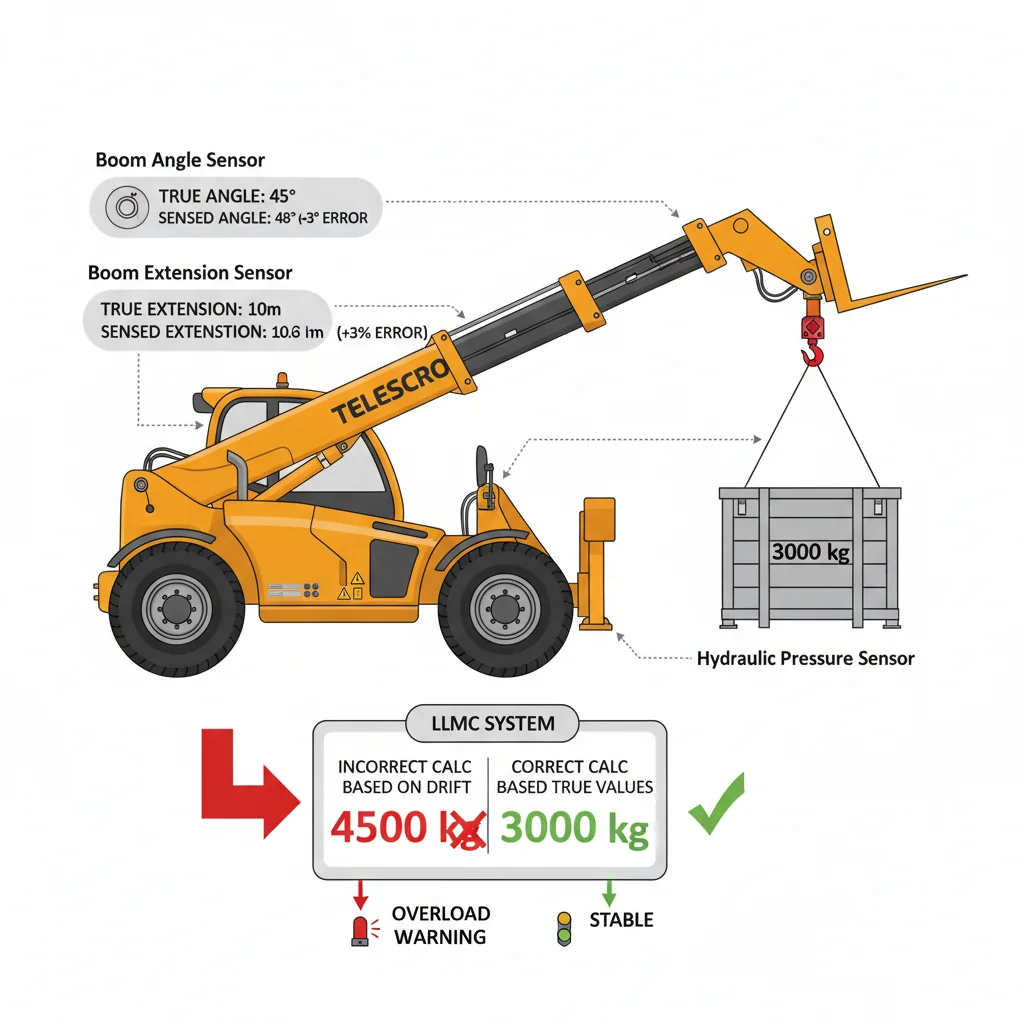
The biggest mistake I see is assuming the sensors on your telehandler stay accurate just because the machine “feels” the same from week to week. Sensors for boom angle, extension, and hydraulic circuit pressure all drift over time—usually so gradually that most operators don’t notice. But even a 3% error can mean a 90 kg difference when you’re working near that 3,000 kg load chart limit. That’s enough to trigger sudden LLMC cutouts, or worse, let you lift more than is actually safe at full reach.
Last year in Dubai, a contractor called me after their 14-meter telehandler started cutting out unpredictably near max extension. Their operators thought the machine was “overreacting,” but when we checked, the boom angle sensor was reading off by almost four degrees—translating to hundreds of kilos’ difference in calculated load. The team admitted they hadn’t recalibrated the sensors since buying the unit two years earlier, assuming factory settings were good indefinitely. This is classic “second-year surprise”—hidden maintenance problems showing up after the warranty ends.
To be honest, I always suggest scheduling full recalibration at least every 12–18 months if your fleet sees daily use, or any time you replace a hydraulic component or LMI sensor. If you see frequent overload warnings or odd cutouts in your maintenance logs, treat that as an early warning—it’s not just annoying, it might mean your machine thinks it’s safer than it actually is. Inconsistent sensor data makes every lift a risk near the limit. Build recalibration into your maintenance plan to keep both productivity and safety predictable.
Sensor drift in a telehandler's boom angle sensor can cause the load moment indicator to underestimate the load, increasing the risk of accidental overload.True
When a boom angle sensor drifts, its signal may not reflect the true boom position. If the system thinks the boom is lower than it really is, it underestimates the leverage applied to the load, potentially letting the operator lift more weight than is actually safe for the machine.
Once calibrated, hydraulic pressure sensors in telehandlers do not require further maintenance because modern sensors are immune to drift.False
Even modern hydraulic pressure sensors can experience minor changes in their output due to factors like temperature cycles, aging, and mechanical wear. Regular recalibration is needed to maintain lifting accuracy and safe operation.
Key takeaway: Regular recalibration of telehandler sensors, especially those feeding load moment indicators, is essential for maintaining precise lifting capacity and predictable safety cutouts. Unchecked sensor drift leads to inconsistent machine behavior and can create hazardous situations near the limits of the load chart.
How do tyres and axles impact telehandler precision?
Tyres and axles directly influence telehandler lifting precision, especially as machines age. Mixed tyre brands, uneven wear, or incorrect inflation can introduce lean and instability. Even minor axle height variations5 translate into significant fork-tip movement at height, reducing precision and rated capacity during high-reach operations.

Last month, a contractor in Kazakhstan called me after his telehandler started leaning during a job. He was baffled—this was a four-year-old 3.5-ton machine, and the issue seemed to come out of nowhere. When I dug into the details, he’d mixed two different tyre brands on the front axle. One was nearly new, the other about 60% worn. Even though the height difference was barely visible from a distance, at 14 meters boom extension the forks drifted nearly five centimeters to one side. That’s a serious problem if you’re placing pallets on narrow scaffolding.
To be honest, the spec that actually matters for stable, precise lifting isn’t just the boom—it’s what touches the ground. I’ve seen more jobs derailed by underinflated or mismatched tyres than by hydraulic issues. In Dubai, a site had three machines with tyres at 15% below OEM pressure. When they tried to pick up 1,600 kg loads at height, the moment indicator would flash warnings even though they were under rated capacity. The culprit? Low tyres reduced axle height and caused extra chassis roll—small on the ground, but amplified at maximum reach.
Here’s what I always suggest: keep all tyres on the same axle matched for brand, wear, and ply rating. Stick to the pressure your OEM manual lists, not “close enough.” If you spot deep sidewall cracks or uneven tread, swap that tyre before it causes a lean. Don’t just treat tyres and axles as consumables—they’re part of your lifting accuracy system, especially as the telehandler ages.
Uneven tyre wear across a telehandler's axles can cause small differences in ride height, which become amplified at full boom extension, resulting in measurable fork drift during precise lifts.True
Tyres with different diameters or levels of wear create a tilt in the machine's chassis, and any tilt is exaggerated as the boom extends, leading to unexpected lateral movement at the boom tip. This effect grows more pronounced as the machine and tyres age, negatively impacting lifting precision.
Provided the telehandler's suspension is in working order, the type and condition of tyres on each axle have little effect on the machine's lifting accuracy.False
The type and condition of tyres directly affect machine stability and geometry. Mismatched or unevenly worn tyres change the height or level of each axle, compromising overall stability and causing errors in fork positioning, especially at longer boom reaches. Suspension integrity alone cannot compensate for these physical variances.
Key takeaway: Treat tyres and axles as precision components. Standardize tyre sizes and brands per axle, maintain inflation to OEM specifications, and inspect for wear or sidewall damage. Inconsistent or poorly maintained tyres quickly undermine lifting accuracy and safety in aging telehandlers—especially at extended boom reach.
How does boom fatigue affect lifting accuracy?
Structural fatigue in a telehandler’s boom and chassis leads to increased and unpredictable flexing, especially after years of heavy lifting, shock loading6, and exposure to impacts or corrosion. This results in noticeable boom tip movement—often several centimeters—during stops and starts, directly undermining precision and increasing long-term safety risks.
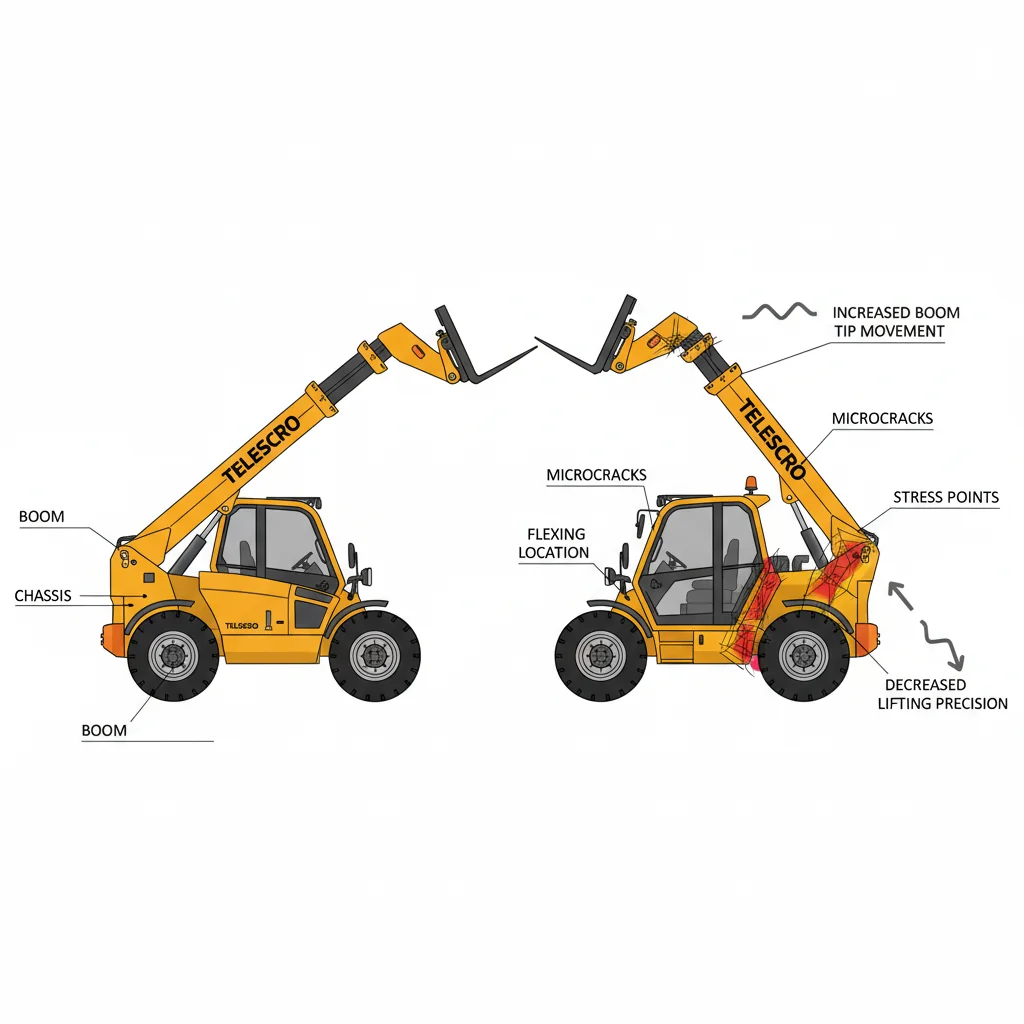
To be honest, the specification that really matters is how much flex and permanent deformation the telehandler’s boom and chassis have accumulated after years of jobsite use. Buyers often focus on maximum lift height or load moment indicators, but far fewer realize that boom fatigue directly affects where a heavy load actually ends up—sometimes by several centimeters.
I saw this clearly with a client in Kenya operating a 4-ton telehandler that had logged over 7,000 hours. They were placing palletized concrete blocks into a tunnel opening with only about 100 mm of clearance. On paper, the machine was well within its rated capacity. In practice, every stop or slight change in direction caused the boom tip to sway side to side. That flex meant each placement took two or three attempts instead of one, wasting time and increasing operator fatigue.
Here’s the critical point when precision matters: once a boom or chassis has experienced years of shock loading—such as abrupt stops, digging forces, or accidental impacts—it no longer flexes in a smooth, predictable arc. Instead, movement becomes inconsistent. You start seeing unexpected boom-tip oscillation even when pins, hydraulics, and bearings appear to be in acceptable condition.
I’ve inspected machines where small weld cracks had formed near primary pivot areas, and others where boom pad wear left measurable gaps you could feel by hand. Corrosion accelerates this process, particularly on coastal or agricultural sites, and it’s far more common on models with inadequate sealing between telescopic sections.
My advice after 6,000–7,000 operating hours is straightforward: don’t rely on “it still feels okay.” Schedule a proper structural inspection. At that stage, fatigue-related deformation becomes a real factor in lifting accuracy and safety, not just a theoretical concern.
Boom fatigue causes micro-bending and permanent deformation in the boom structure, which can result in noticeable deviation from intended load placement even if sensors and controls are functioning correctly.True
As telehandlers age, repeated heavy loading introduces subtle but cumulative distortions in the boom’s steel geometry. This means the machine’s physical output no longer matches its designed movement, leading to reduced lift accuracy regardless of the operator’s skill or the machine’s electronics.
Lifting precision only decreases in telehandlers if the machine’s controls or electronics fail, not due to structural changes in the boom or chassis.False
Even if control systems and electronics remain in perfect condition, structural fatigue in the boom or chassis can still impair lifting precision. Physical deformations alter the relationship between control commands and boom position, so precision issues can arise solely from mechanical wear and tear.
Key takeaway: Over time, telehandler booms and chassis develop permanent deformation and wear, causing significant loss of lifting precision and potential safety hazards. Inspections for structural integrity—including boom straightness, welds, and pad wear—are essential after heavy use or around 6,000–7,000 operating hours.
How Does Maintenance Discipline Affect Precision?
Telehandler lifting precision over time is largely influenced by maintenance discipline, not just machine age or total hours. Structured 500-hour service regimes—including boom alignment7, torque checks8, tyre inspections, and scheduled component replacements—can cut wear rates dramatically, enabling older telehandlers to maintain tight tolerance and reliable performance longer than poorly maintained, younger machines.

The biggest mistake I see is crews assuming that a newer, low-hour telehandler will always lift with more precision than an older unit. That simply isn’t true. In fact, I’ve worked with a contractor in Dubai running 8,000-hour machines next to fresh 3,000-hour models. Their older telehandlers actually held tighter boom alignments and had less drift during pick-and-place work—all because their fleet manager stuck to a strict, hour-based service plan. What made the difference? They never skipped on boom pad checks, pin lubrication, or cylinder inspections every 500 hours.
Most of the real-world loss in lifting accuracy comes from neglected maintenance, not age or rough conditions. When service crews ignore routine checks—like torqueing boom pivot bolts or matching tyre sets—you end up with excess play. I remember a client in Brazil who thought their “almost new” 4-ton telehandler felt sloppy. Turned out, the team had skipped two pre-use inspections after rain. A loose pivot pin and mismatched tyres caused the boom to drift nearly 3 centimeters under load. Simple checks could have caught this early.
I suggest using manufacturer maintenance schedules as your baseline—don’t fall into the trap of “fix it when it breaks.” That means engine oil at 500 hours, hydraulic filters around 1,000 hours or as the OEM says, and more frequent boom cleaning based on dust or site conditions. Track your trends—play in the boom, any new leaks, changes in hydraulic drift. This discipline lets even high-hour units keep their rated tolerance, boost operator confidence, and cut costly downtime. Accurate lifts start with solid habits, not luck.
Telehandlers with higher operating hours can maintain tighter boom alignment than newer units when subjected to a disciplined, hour-based maintenance schedule.True
Consistent, proactive servicing—such as hydraulic fluid changes, cylinder inspections, and wear-part replacements—directly mitigates the main causes of drift and boom misalignment that accumulate with age, allowing even older machines to outperform poorly maintained newer ones in precision tasks.
Only brand-new hydraulic cylinders determine whether a telehandler achieves optimal lifting precision, regardless of overall machine maintenance.False
Lifting precision depends on a combination of factors—including valve calibration, bushing wear, and regular hydraulic maintenance—not just the age of the cylinders. Neglecting other components can cause drift or control lag even with new cylinders installed.
Key takeaway: Consistent, OEM-guided maintenance—including pre-use inspections, hour-based service tracking, and trend monitoring—directly impacts telehandler precision and longevity. Disciplined regimes outperform ad hoc repairs, allowing even high-hour units to deliver accurate, safe lifts while minimizing costly downtime and extending service life.
When Is Telehandler Precision Rebuild Worthwhile?
A telehandler precision rebuild—typically including re-bushing the boom and carriage, resealing cylinders, and addressing valves or sensors—costs around USD 3,000–8,000 for 7–12 t machines. If the chassis and engine are solid, and the technology still suits the work, targeted rebuilds at 5,000–7,000 hours usually provide strong ROI.
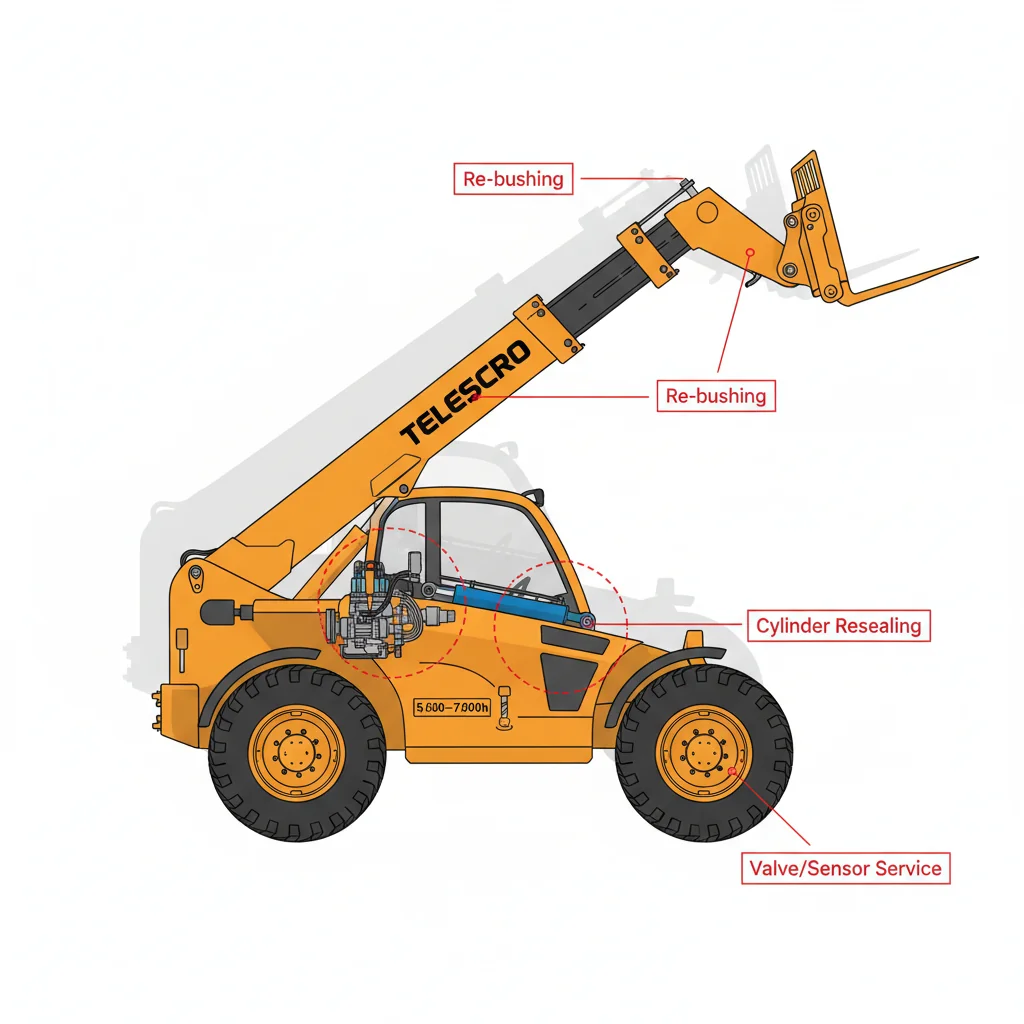
The biggest mistake I see is operators running telehandlers well past 5,000 hours without tackling critical wear points. I worked with a project manager in Dubai managing a fleet of 9-ton units for curtain wall installation. After about 6,500 hours, the boom slop9 and joystick drift crept up on them—crew started missing placement targets by a few centimeters. That sounds minor, but on glazing jobs, it meant 10% longer install time and more glass edge chips. When they finally invested $5,500 per machine to re-bush the boom and carriage and reseal all main cylinders, cycle times bounced back and accidents dropped. The payback came within months just from regained productivity.
From my experience, the true tipping point is when minor inaccuracy starts to drain workflow and lift confidence. High-hour machines often show their age first in boom tightness, followed by small control lag from valve or sensor wear. On sites in Kenya and Eastern Europe, I’ve watched older 12-ton models develop enough play in the boom to make high stacking or panel hanging risky—even with a strong chassis and solid engine. What’s interesting is that the underlying tech (hydraulics, control system) still did the job. The rebuild, costing roughly $7,000, gave them another 2,000–3,000 reliable working hours before having to consider new technology or full replacement.
I suggest taking a close look at your rebuild decision once you cross 5,000 hours, especially if your jobs depend on precise placement. If core systems aren’t shot and the original features meet your needs, a properly scoped rebuild beats premature upgrades almost every time.
Boom section wear in a telehandler can subtly degrade precision by increasing lateral movement, which may not be detected by standard operational checks until placement errors become frequent.True
Wear between boom sections can cause 'slop' or unintended movement, which doesn't always show up in routine inspections but becomes evident when precision tasks reveal unpredictable deviations.
Joystick drift in a telehandler’s control system is primarily caused by hydraulic fluid temperature rather than wear in the valve or sensor assemblies.False
While hydraulic fluid temperature can affect system performance, persistent joystick drift is more often due to wear or degradation in the control valves or sensors rather than fluid temperature alone.
Key takeaway: Operators managing telehandlers in precision-critical roles should weigh the productivity loss from degraded accuracy versus the rebuild cost. Well-timed, targeted rebuilds often offer better ROI than deferring repairs or prematurely upgrading, provided major systems and machine technology remain viable.
When Does Telehandler Lifting Precision Decline?
Telehandler lifting precision declines primarily with accumulated operating hours and older design generations, not just with age alone. Noticeable accuracy loss may occur around 4,000–5,000 hours in poorly maintained machines, while well-maintained, modern units with advanced controls can retain precision well beyond 8,000 hours.
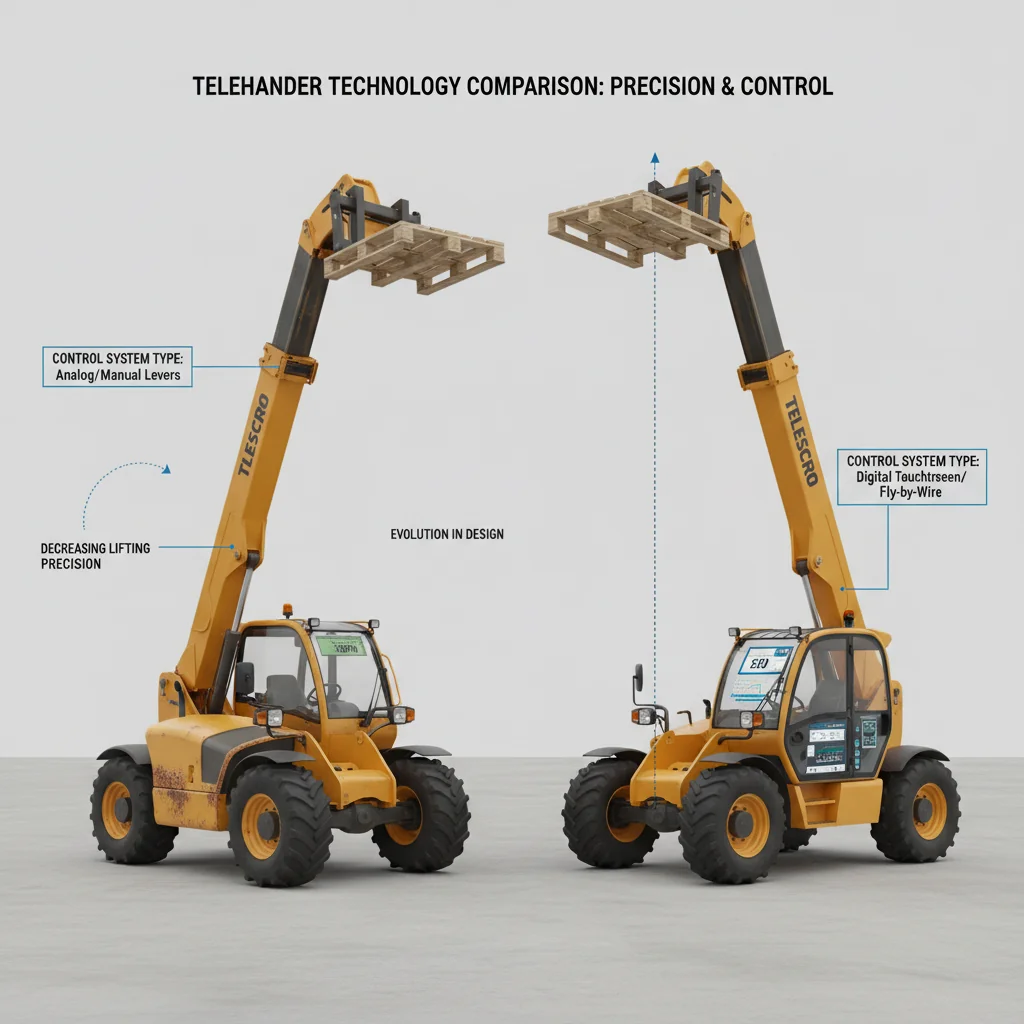
Let me share something important about telehandler precision—it’s not just about age or a calendar number. From my experience, what really matters is how many working hours a machine has logged, and especially which design generation you’re running on your jobsite. I’ve seen older telehandlers with only 2,500 hours show more “slop” in the boom and joystick response than a modern 6,000-hour unit, simply because the hydraulic metering and boom pads on the older model wear much faster. So, don’t let the paint fool you. Precision fades first at the controls and boom—if you’re handling glass or steel where every millimeter counts, wear comes quicker than you think.
I’ll never forget a customer in Dubai who ran a mix of 4-ton, 17-meter machines from two different years. One model, built with proportional joysticks and improved hydraulic valves, still held tight placements at nearly 8,000 hours. Their older “on/off” joystick unit—just 5,200 hours—had a visible lag and needed constant operator correction swinging beams into place. They tried swapping operators, blaming training, but it came down to design and hours. That difference cost them real time on every lift.
For sites where you demand tight placement—like façade work or formwork at full extension—I always suggest using your 5,000–7,000 hour window as a checkpoint. Either invest in a full precision restoration (pins, shims, recalibration) or rotate the machine into less critical duties. Let your hour meter and control system guide upgrades, not just the age on the registration. That approach saves both money and headaches in the long run.
A telehandler's lifting precision can substantially decline if its boom wear pads are made from older-generation materials, even if the total machine hours are relatively low.True
Older-generation boom pads often use materials that degrade faster, leading to increased play and less precise boom control as wear accelerates. Newer pads are engineered for improved longevity and smoother motion, which preserves precision longer despite higher usage hours.
Hydraulic fluid age has no impact on telehandler lifting precision as long as the fluid level is maintained.False
Even if hydraulic fluid levels are kept within the correct range, old or degraded fluid can lead to increased internal wear and less effective metering, contributing to imprecise or jerky boom movements. Fluid condition is critical for optimal hydraulic performance.
Key takeaway: Telehandler replacement planning should be based on a combination of actual working hours and the sophistication of the control system, not just calendar age. Implement a decision window around 5,000–7,000 hours for precision-critical tasks, prioritizing maintenance or equipment rotation according to machine condition and design generation.
How to Test Used Telehandler Precision?
To assess used telehandler lifting precision, extend the boom with empty forks, raise it to 8–10 meters, and nudge the joystick in small increments. Look for delayed response, sudden speed surges, or side play at the carriage10. Test with a moderate load; observe for boom creep11 or oscillation, indicating wear or hydraulic issues.
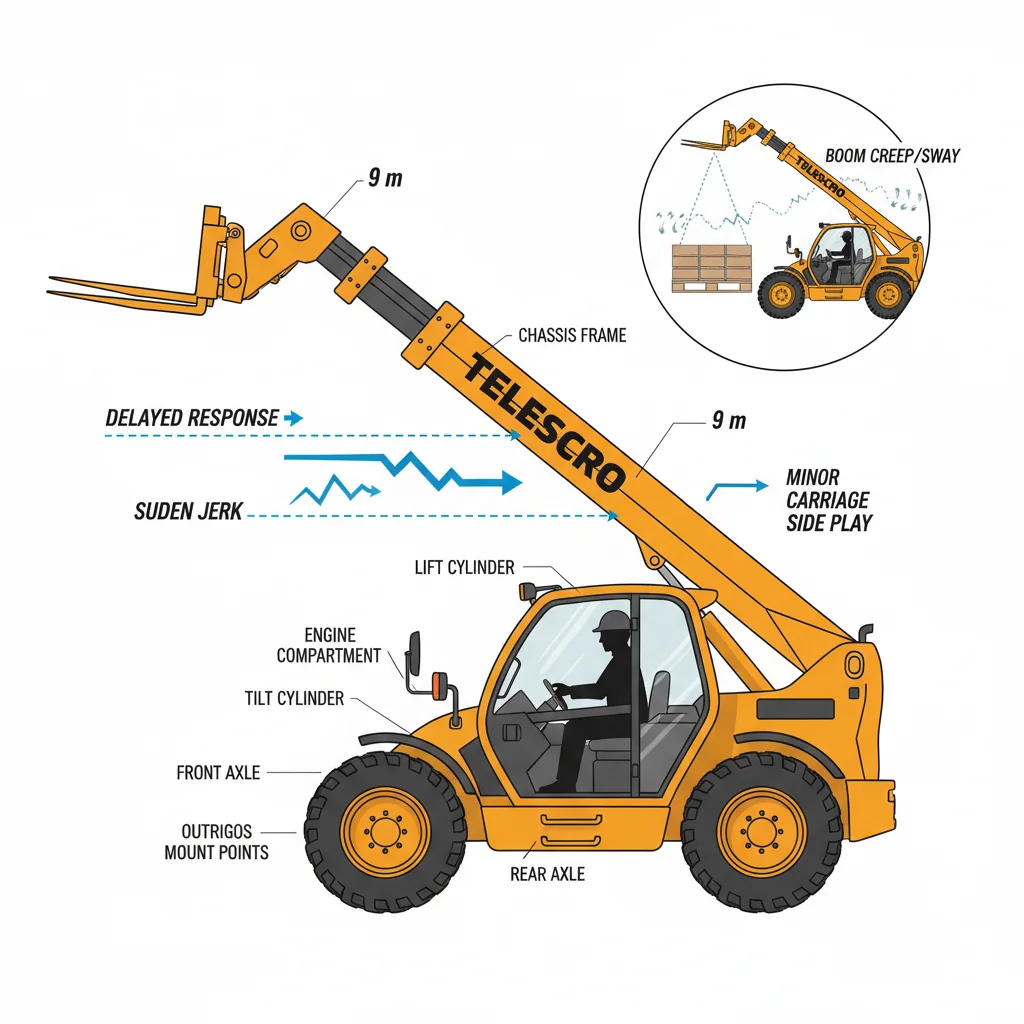
Most buyers just watch the boom go up and down and call it a day. But real precision issues hide at full extension and working height. I always suggest starting with empty forks—raise the boom all the way out, up to 8 or even 10 meters, and then gently tease the joystick in small nudges. I’ve watched operators in Dubai move the stick just a hair, only to see a jerky response or a big lag. That’s your first warning sign. If you notice unwanted side play at the fork carriage—especially when you put a ladder up at full height—you’re probably looking at worn boom pads or loose pins.
When testing used telehandlers for precision, I recommend following these steps:
- Extend the boom fully with empty forks. Work at 8–10 meters, not just ground level.
- Nudge the controls in tiny increments. Watch for slow hydraulic response or sudden speed surges.
- Check for play at the carriage. Side-to-side movement often signals component wear.
- Repeat with a moderate load. I usually use something around half the rated capacity—say, 2,000 kg on a 4-ton machine.
- Hold the boom steady for 30–60 seconds. Any drift (creep) or boom oscillation points to hydraulic or structural issues.
- Inspect tyres for even pressure and excessive wear. Uneven tyres make small precision movements almost impossible.
Wear in the boom’s extension chains and pivot pins can lead to noticeably imprecise fork movement at full reach, even if lower-height operation still feels smooth.True
Chains and pivot pins play a major role in guiding the boom extension. As these components wear with age, they introduce additional play and looseness, which becomes amplified at maximum extension, resulting in jerky or delayed fork responses not apparent at shorter reaches.
Hydraulic hoses are solely responsible for loss of precision in older telehandlers, so replacing them always restores original performance.False
While aging hydraulic hoses can contribute to degraded control, other factors like worn boom pivots, slack in the extension chains, and internal cylinder leakage also impact lifting precision. Replacing just the hoses cannot fully restore a telehandler’s handling if other mechanical components are also worn.
Key takeaway: Field tests such as precise joystick movements at height and under load, combined with checks for boom or carriage play, reveal hidden precision issues in used telehandlers. Significant drift or oscillation means buyers should budget for repairs like boom re-bushing and hydraulic resealing.
What Techniques Improve Telehandler Lifting Precision?
Operators can enhance lifting accuracy on aging telehandlers by approaching the target from the same direction to manage mechanical slack12, reducing engine rpm for finer hydraulic control, avoiding maximum boom extension to limit flex, using visual guides for placement consistency, and ensuring all tyres are matched and properly inflated to reduce instability caused by wear.
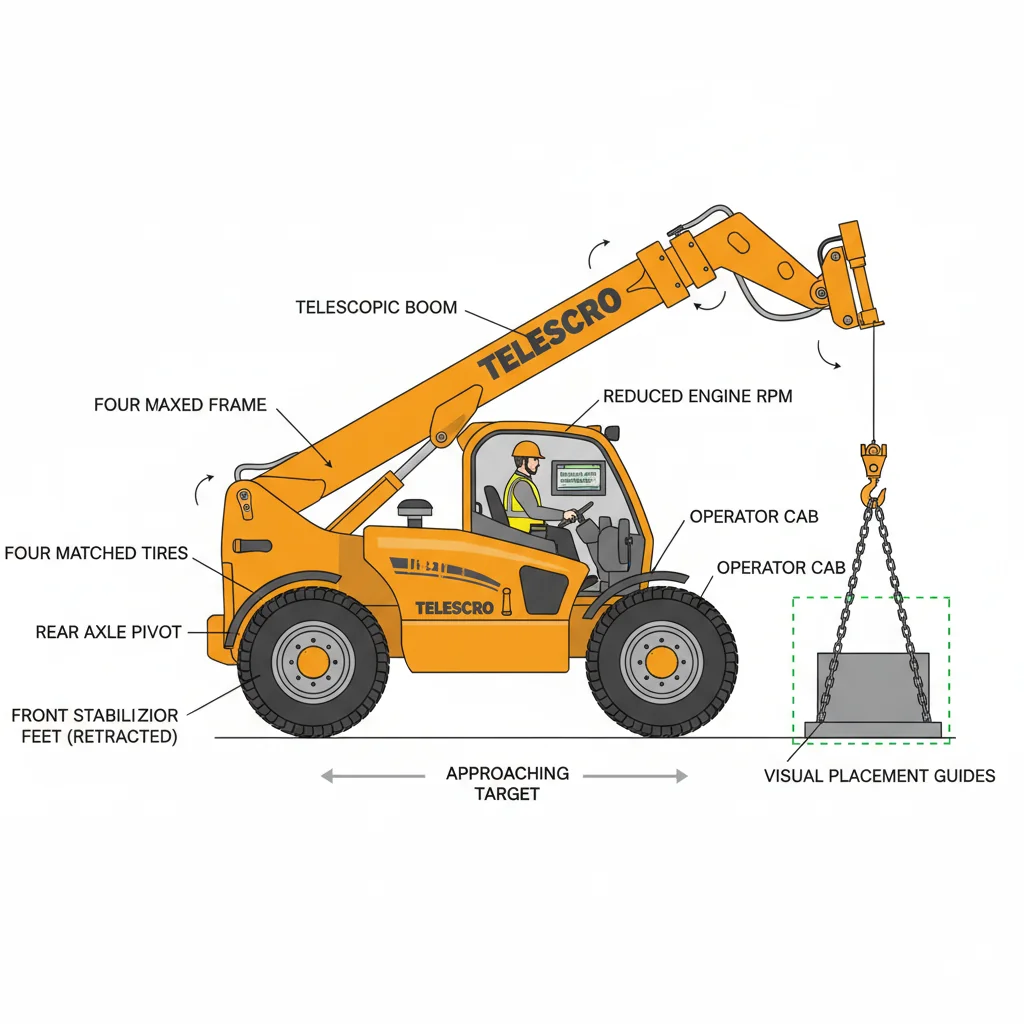
One thing I’ve learned on jobsites in Dubai and Kenya is just how much operator technique matters once a telehandler is no longer new. When a boom has developed some play after years of heavy lifting, consistency becomes critical. If you always approach the target from the same direction, you take up mechanical slack in a predictable way instead of letting it shift randomly.
An operator in Dubai explained this perfectly. When stacking 1,200 kg pallets at nine meters, he stopped approaching racks from alternating sides. By keeping his final approach consistent, placement accuracy improved noticeably. It sounds minor, but that single habit made an older 3.5-ton machine far more reliable for precision work.
I also recommend reducing engine rpm during the final positioning phase. Aging hydraulic systems are less crisp than new ones. Lower rpm means reduced oil flow, which smooths control response and helps avoid sudden movements that can swing a suspended load. On a 14-meter reach telehandler in Brazil, one customer dropped the engine to idle while placing bulk bags onto a mezzanine. He found that simply idling during placement nearly halved positioning errors—especially beyond 12 meters, where boom flex13 becomes significant.
For repetitive tasks like stacking pallets or hay bales, visual reference points also make a real difference. I’ve seen contractors in Poland use heavy tape or paint marks on the carriage or on racking uprights to create consistent visual cues. That kind of reference reduces over-correction and speeds up placement.
All of these techniques work best when combined with basic mechanical discipline—regular tyre pressure checks and matched tread depth on each axle. Small inconsistencies at ground level quickly translate into large positioning errors at height.
Approaching the lift target from the same direction every time helps compensate for play in a worn telehandler boom, leading to more predictable and precise load placement.True
Consistent approach direction uses mechanical slack in a repeatable way, minimizing unpredictable movement caused by wear in the boom or joints. This technique is especially useful as telehandlers age and tolerances increase.
Increasing travel speed when positioning a telehandler always results in greater lifting precision, regardless of the age of the machine.False
Higher travel speeds can actually increase the impact of mechanical play and make precise placement more difficult, especially in older telehandlers where wear introduces more variability in movement. Slow, controlled movements are generally preferred for precision work.
Key takeaway: Adopting precise techniques—such as minimizing boom extension, controlling approach direction, adjusting engine rpm, adding visual reference marks, and maintaining tyre uniformity—can mitigate the decline in telehandler lifting accuracy caused by machine aging and looseness until major repairs are possible.
Conclusion
We’ve walked through why older telehandlers can develop fork-tip wander and how that impacts accuracy on the job. Staying on top of boom pins, bushings, and pad clearances makes a real difference for safety and daily productivity. From my experience, little things like extra play in the boom don’t seem urgent until you’re fighting with misaligned loads every day. That’s what I call a “showroom hero, jobsite zero”—machines that look good on paper but disappoint under real jobsite conditions. If you want honest advice about maintenance routines or choosing models that stay precise longer, I’m always happy to help. Feel free to reach out anytime—the right telehandler choice really depends on your actual working environment.
References
-
Explains how internal hydraulic leakage causes boom drift and reduces lifting precision, critical for telehandler maintenance and operation. ↩
-
Analyzes how small joint clearances cause significant fork-tip deviation, affecting precise pallet placement and operator control. ↩ ↩
-
Details the role of worn seals in oil bypass and boom instability, offering valuable insights for diagnosing telehandler hydraulic issues. ↩
-
Detailed insights on how wear in proportional valves impairs hydraulic control, causing boom jerkiness and reduced precision. ↩
-
Learn how small axle height differences cause significant fork movement, affecting high-reach operations and rated capacity. ↩
-
Understand the effects of shock loading on telehandlers, including how sudden impacts cause boom flex and permanent deformation over time. ↩
-
Detailed insights on how precise boom alignment reduces wear and improves lifting accuracy, helping operators maintain reliable performance. ↩
-
Explains the critical role of torque checks in preventing mechanical looseness and ensuring safe, precise lifting on construction sites. ↩
-
Learn about boom slop impacts on telehandler accuracy and safety, plus practical maintenance tips to restore precision and prevent accidents. ↩
-
Learn expert methods to detect side play indicating worn components, ensuring safer telehandler operation and maintenance. ↩
-
Explore in-depth causes and diagnostics of boom creep, helping operators prevent unsafe conditions and costly repairs. ↩
-
Explore how managing mechanical slack improves load placement accuracy and reduces unpredictable boom movement in aging telehandlers. ↩
-
Learn about boom flex impacts on stability and how limiting extension can enhance precision during heavy lifting tasks. ↩