










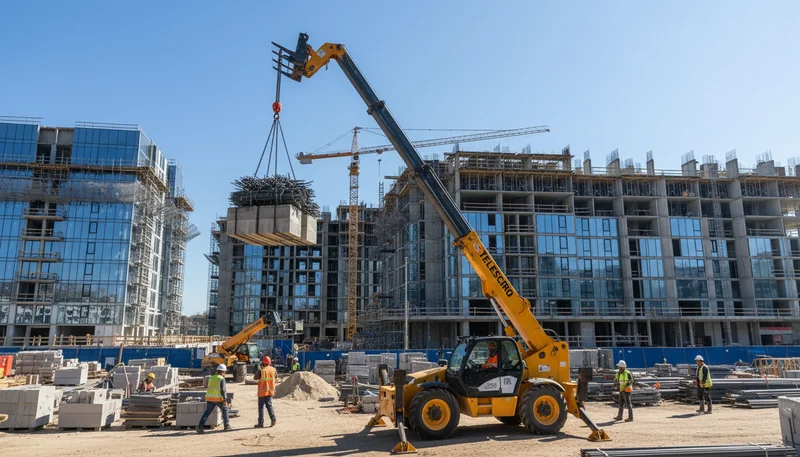
Telehandler Lifting Heights vs Capacity: Buyer Pitfalls and Expert Field Guide
Earlier this year, a site manager in Australia shared his surprise when a freshly rented 21-meter telehandler struggled with standard brick pallets at the top floor. He expected brute strength at any height—until I showed him what the numbers really meant on the load chart1.
Telehandler lifting capacity is not directly correlated with maximum lift height. Across manufacturers, rated capacity2 is measured with the boom low and retracted, often on stabilizers, not at maximum height or outreach. As the boom extends and elevates, the machine must derate allowed load to manage stability, governed by the overturning moment and the shifting center of gravity3. Load charts4 provide this data in a two-dimensional grid—safe capacity at every position of boom angle and in a two-dimensional grid—showing safe capacity at specific combinations of height and forward reach, referenced to the attachment’s stated load center.
Does higher telehandler lift mean more capacity?
Higher telehandler lift height does not guarantee higher usable capacity5 at working reach. Across leading brands, maximum rated capacity6 is achieved with the boom low and retracted under the manufacturer’s specified conditions (typically firm, level ground and the stated attachment/load center, with separate stabiliser ratings where fitted). At maximum height and forward outreach, allowable loads can drop to a small fraction of the headline rating—so the load chart, not the brochure number, must drive lift planning.
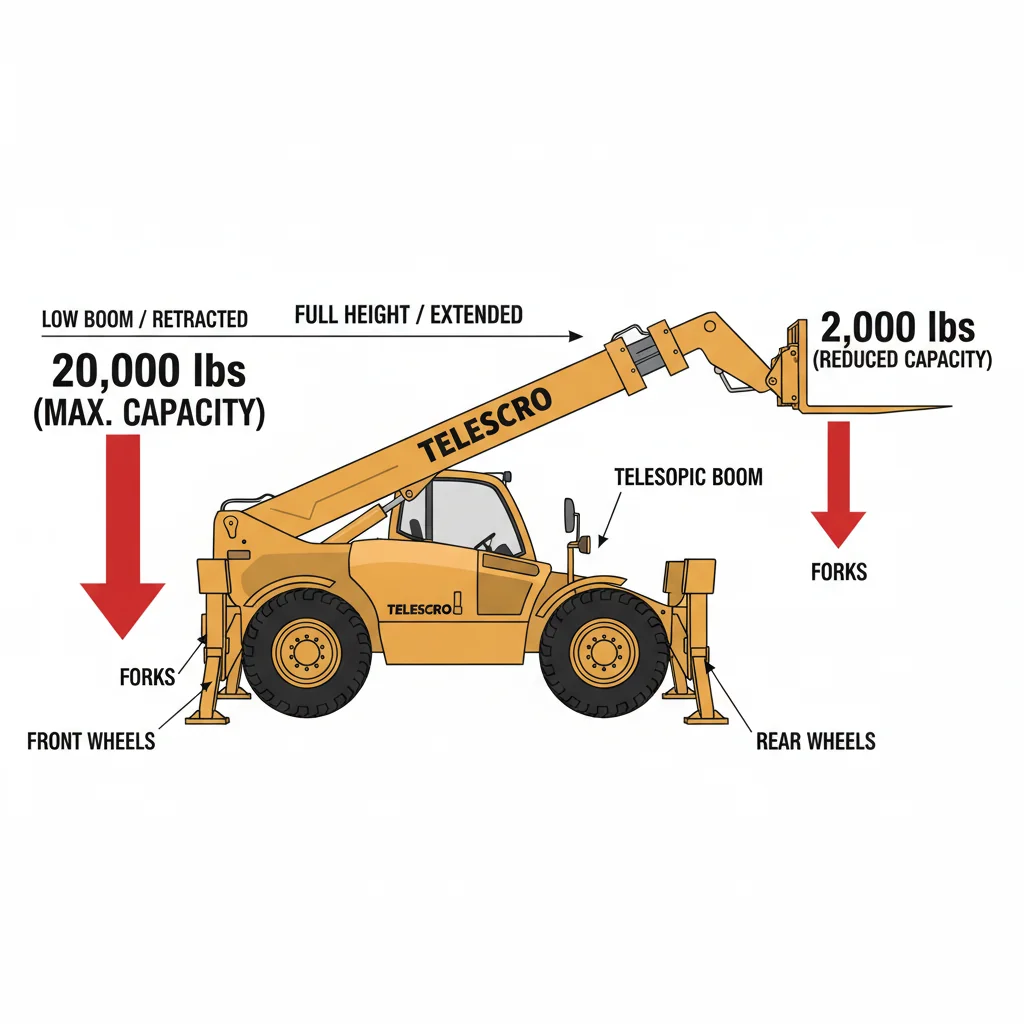
Most people don’t realize that lifting higher almost always means lifting less. Across the jobsites I’ve supported, the mistake I see most often is buying based on the big “rated capacity” without ever checking the load chart. Let me share a real example from a warehouse project in Dubai. The team chose a 5-ton, 17-meter telehandler, expecting to safely lift heavy HVAC units to the rooftop—about 16 meters up. On the day, the machine handled 5,000 kg like a champ at ground level. But at full reach and extension, it could barely handle 400 kg. That’s less than 10% of the spec sheet number, and the crew had to change their entire lift plan.
It’s not just a one-off. Compact 7-meter machines rated for 2.5 tons will usually lift only 1,200 kg at full boom height. For high-reach 19-meter models, I’ve measured actual lift capacity drop to 300–500 kg at max extension, even with stabilizers out. The rated capacity is always based on a nearly horizontal boom with minimal extension—and the machine perfectly level, usually within 3 degrees.
Here’s what matters most: height and rated capacity are separate specs. Never assume that more height gets you more useful lift. Always check the load chart (usually a graph near the cab), which shows safe load weights at each boom position. If you need to place 1,800 kg at the fourth floor, confirm that exact spot before renting or buying. I always suggest verifying your load scenario at full extension on level ground. That single step saves so much time and trouble.
A telehandler's maximum lift capacity usually decreases as the boom extends to higher elevations.True
This is because the machine's stability and structural limits are challenged as the boom angle increases and extends further from the center of gravity, which reduces safe lifting capacity.
If a telehandler is rated for 5 tons, it can safely lift that weight to its maximum height.False
The rated capacity is based on optimal conditions, usually at minimal boom extension and lower heights. At maximum extension or height, the safe working load is typically much less due to mechanical and stability factors.
Key takeaway: Telehandler lifting height and rated capacity are not directly linked. Maximum capacity is only available at low boom angles with minimal extension. Buyers must confirm required load weights at the intended height using the load chart, as assuming more height means more capacity is a critical error.
How do height and reach limit capacity?
Telehandler rated capacity7 is determined by both boom height and forward reach, not height alone. Load charts display capacity as a grid, with the highest values at low height and retracted boom. Capacity drops sharply at greater heights and longer outreach, often to just 30–40% of the nominal rating.
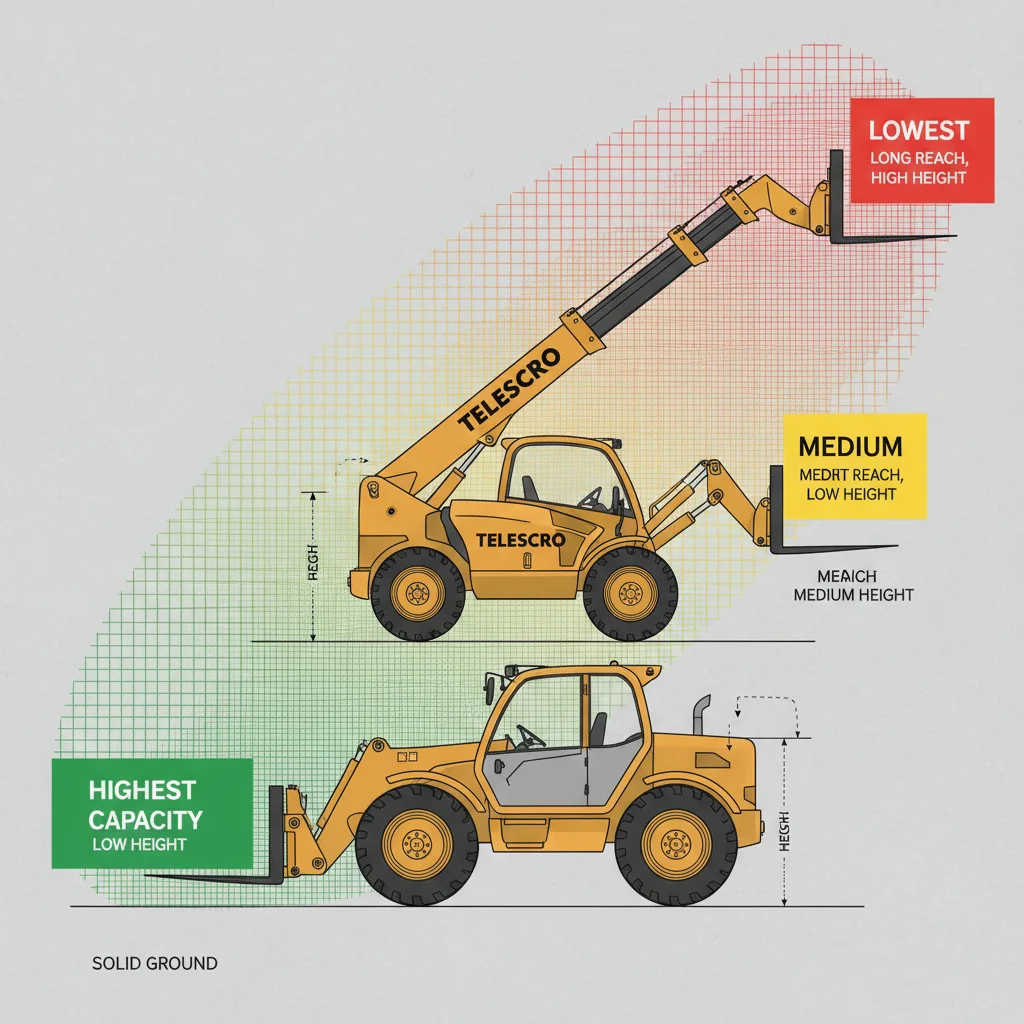
Let me share something important about telehandler capacity that even experienced operators ignore: boom height and reach always work together to limit what you can safely lift. It’s not just about how high the boom goes. The real restriction kicks in once you start extending the boom outward—capacity drops steeply at each new height and reach combination. I’ve seen plenty of buyers in Dubai focus on “14 meters of lift” but get a shock on site when their machine can only handle about 1,800 kg at 12 meters reach, even though the rated capacity was 4,000 kg with the boom retracted.
I remember working with a jobsite in Kazakhstan last year. Their crew needed to unload palletized bricks onto a platform roughly 11 meters high and 4 meters out. The operator glanced at the spec sheet and assumed he could lift three tons—but when we checked the load chart, max safe capacity at that point was barely 1,200 kg. The manufacturer’s load chart—showing a grid of heights vs. reach—is the only reliable tool here. Each cell in that grid gives you a different number, and it’s rarely what you see in big print on the side of the machine.
This detail is critical for planning. If two models both reach 17 meters, that doesn’t mean they’ll perform equally at 14 meters and 5 meters out. I always suggest lining up their load charts and reading actual capacity at your working point. That’s how I’ve helped teams avoid costly mistakes and keep lifts within a safe envelope.
A telehandler’s maximum weight capacity at full extension is often much lower than its rated capacity at minimum reach, even if the boom height remains the same.True
This is because the farther the load is from the fulcrum (the front axle), the greater the tipping risk, which requires the capacity to be reduced significantly for safety, regardless of the boom height.
If a telehandler can lift 3,000 kg at its maximum height, it will always be able to lift 3,000 kg at any point along the boom's reach.False
Lifting capacity drops as reach increases because the load's center of gravity moves further from the telehandler’s base, increasing leverage and risk of tipping. Capacity charts always show much lower safe lifting weights as both height and reach extend.
Key takeaway: Telehandler users must evaluate capacity at specific height and reach positions using the manufacturer’s load chart—never assume the rated capacity applies throughout the working envelope. Comparing models requires matching load chart points at equal heights and reaches for valid performance assessment.
Why Does Telehandler Capacity Drop at Height?
Telehandler lifting capacity decreases as the boom extends and raises because the load’s center of gravity moves further forward, increasing the risk of tip-over. Manufacturers derate allowed loads according to the load chart to prevent instability, with every 10 cm of load eccentricity cutting capacity by 15–20%.

Here’s what matters most when you’re lifting with a telehandler: as the boom extends or raises, the rated capacity drops—sometimes by half or more. Why? The further the boom reaches, the more the load’s center of gravity shifts forward. This creates a greater tipping force, and the telehandler’s stabilizers, counterweight, and tires can only counter so much before stability is lost. The load chart—the placard every operator should check—shows exactly how fast capacity falls. A contractor in Dubai learned this the hard way last year, trying to send 1,500 kg of glass panels up to the sixth floor with a 17-meter telehandler. At maximum extension, the actual safe working load was only around 800 kg. Their crew nearly tipped the unit before realizing the limit.
Think about what happens with long or awkward loads such as steel beams or wide pallets. When the load’s center of gravity moves forward—due to overhang, long pallets, or fork extensions—the effective lifting capacity can drop sharply. Even relatively small changes in load position can have a disproportionate impact on stability, which is why manufacturers specify standard load centers and require reduced ratings when those are exceeded.
These effects are not theoretical; they are reflected directly in load charts and attachment-specific capacity tables. Loads that feel manageable at ground level can quickly become unsafe once the boom is raised or extended forward. That’s why I always ask customers to verify the load chart for the exact load center and working position, especially when stacking at height or operating on uneven ground. Relying on headline “maximum tonnage” instead of real load geometry is where operators get into trouble.
To be honest, ignoring these stability limits isn’t just a paperwork issue—it risks serious accidents. I suggest you treat the load chart as your best friend. If the numbers look tight at full reach, play it safe and switch to a bigger machine or split your lifts.
As a telehandler’s boom is raised and extended, the reduction in capacity is primarily due to the forward shift in the load’s center of gravity, which increases the tipping moment acting on the machine.True
Raising and extending the boom moves the load further away from the machine’s chassis, increasing leverage and the risk of tipping. This means the stabilizers, tires, and counterweights can only offset so much force before the machine becomes unstable, explaining the steep drop in rated capacity at greater heights.
Telehandlers are designed so that their maximum lifting capacity remains unchanged regardless of how high the boom is raised or how far it is extended.False
In reality, telehandlers lose capacity as the boom is raised and extended because the load moves farther from the pivot point, increasing the risk of overturning. Load charts always show diminished capacity at greater reach and height to reflect this decrease in stability.
Key takeaway: Capacity always falls as boom height or reach increase due to stability limits set by the telehandler’s geometry and design. Ignoring load chart ratings risks tip-over, especially with long or overhanging loads. Never estimate capacity from height or tonnage rating alone—always reference the manufacturer’s load chart.
How should telehandler load charts be used?
Telehandler load charts must be treated as the definitive specification reference, indicating maximum rated capacity for each boom height and reach configuration. Rather than quoting headline capacities, buyers should pinpoint 2–3 specific working positions, then request exact capacity data for these points to compare models reliably.

The biggest mistake I see is relying on a telehandler’s “maximum rated capacity” as if it’s available at every boom position—it’s not. The load chart is your real roadmap. It breaks down exactly what load you can safely lift at each specific boom height and outreach. For example, a 4-ton telehandler might handle 4,000 kg with the boom fully retracted and low, but at 12 meters high and 4 meters out, you could be limited to 1,100 kg or less. Last year, I helped a project team in Dubai who had assumed their machine could place 2-ton air conditioners onto a 10-meter roof. On checking the load chart, we realized their safe capacity at that working position was only 1,350 kg. If we hadn’t checked, they would have overloaded the machine—risking stability and safety.
To use load charts effectively, I suggest following this process:
- Identify your main work points—for example: truck loading at 2 m height, roof placing at 10-12 m, or max outreach for facade work.
- Find exact boom angles and outreach values on the chart that match these points.
- Record the rated capacity for each scenario—don’t trust the highest capacity number in the brochure.
- Compare these capacities across several models side-by-side, using a simple table. This quickly shows which unit will perform best at the actual tasks on your jobsite.
One more thing—load charts usually show different data for stabilizers up or down, or when using special attachments. Make sure to match your real setup. I always remind customers: real performance comes from matching the machine to the job, not just the headline numbers.
A telehandler's load capacity can decrease significantly as the boom is extended higher and farther, even to less than half of its maximum rated capacity.True
This is because the load chart accounts for the increased leverage and tipping risk as the boom extends upward and outward, requiring operators to consult the chart for each specific lift scenario.
If a telehandler can lift its rated maximum weight at ground level, it can also safely lift the same weight at maximum boom height and outreach.False
This is incorrect because the telehandler's lifting capacity is greatly reduced at higher boom extensions and outreach due to stability and structural limitations, which is exactly what the load chart is designed to illustrate.
Key takeaway: Always refer to the telehandler load chart for actual capacity at every boom height and outreach. Comparing manufacturer headline figures is misleading; use job-specific working positions and gather precise data for each candidate machine to ensure safe, efficient performance.
Can shorter telehandlers lift more weight?
At common jobsite heights, shorter telehandlers often offer higher usable capacity and greater stability than taller models. Data show a 6.9–7.5 m telehandler rated at 3.2 t can lift around 1,250 kg at full reach, while a 15–18 m unit may manage only 550–850 kg at maximum extension.

I’ve worked with customers who made this mistake—thinking a higher lift means a stronger telehandler. That’s not always true. If you compare the load chart (the table showing safe lifting limits at every boom angle), shorter machines have more muscle where it counts. For example, on a jobsite in Dubai last year, a contractor needed to move pallets of blocks to the second floor—about 8 meters up. He rented a 17-meter telehandler rated for 4 tons, assuming “bigger reach, higher capacity.” But at full extension, the machine only managed around 750 kg — less than a mid-range 7.5-meter unit rated at 3.2 tons. His crew ended up shuttling double the trips.
That’s why, for most jobs under 10 meters high, a typical 7–12 meter model actually outperforms those towering high-reach machines. These shorter telehandlers often lift 1,200–1,400 kg at their maximum forward reach—sometimes double what an 18-meter rig can safely pick at the same angle. From my experience, they’re also steadier, easier to maneuver, and burn less fuel, especially on tight sites or rough ground. The stability comes from a shorter boom and less “leverage” pulling on the chassis. Less tire wear is another bonus, especially if your work keeps you moving all day.
I always suggest buyers check the load chart for the exact height and outreach needed. Only pay for a 17- or 18-meter model if you truly need to go that high on a regular basis. Most jobs are done sooner—and safer—with a mid-range telehandler and careful verification of lifting limits.
Shorter telehandlers usually have higher maximum lift capacities at low boom angles compared to taller models.True
This is because shorter boom designs allow for a stronger structural configuration and better stability at minimal outreach, enabling the machine to safely lift heavier loads close to the mast. As the boom extends or elevates on taller models, leverage increases and safe lifting capacity drops.
If a telehandler boasts a taller boom and higher reach, it will have at least the same or greater lifting capacity at all heights than a shorter machine.False
Lifting capacity decreases as boom height and outreach increase due to leverage and stability limits. Taller telehandlers are optimized for reach, not maximum weight capacity at all positions. Often, they lift less weight at maximum height than shorter machines do at their maximum heights.
Key takeaway: Shorter, mid-range telehandlers typically outperform taller, high-reach models for heavy pallet handling at common working heights. Buyers should not assume higher reach means higher capacity—check load charts for each height. Use high-reach units only when maximum elevation is regularly required.
How do attachments affect telehandler capacity?
Telehandler rated capacity is calculated using standard pallet forks. Switching to attachments like jibs, hooks, buckets, or man baskets reduces effective capacity—especially at height—due to increased load leverage and tipping risk. Each attachment requires its own load chart, and users must consult derated charts for safe operation at maximum reach.
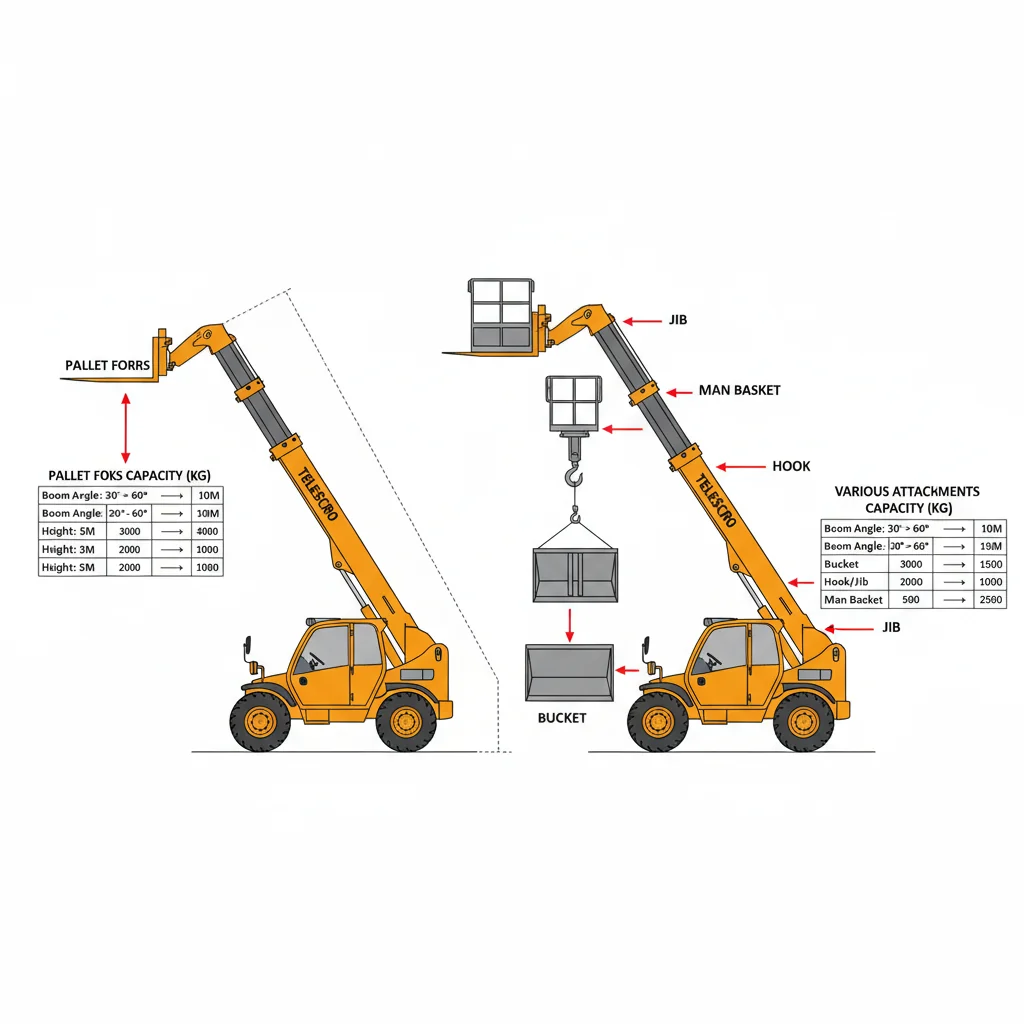
To be honest, the spec that actually matters is not just the telehandler’s “rated capacity” but how that number changes once you put on a different attachment. I’ve seen this confusion everywhere—from Dubai to Brazil. Every manufacturer rates their machines with standard pallet forks, but the second you fit a jib, hook, bucket, or man basket, your real-world capacity can drop sharply—sometimes by 30% or more, especially at height. Last year in Kazakhstan, a client with a 3,500 kg/14 m unit was shocked when their long material-handling jib derated practical lift at 10 meters to just under 1,700 kg. The further out or higher you go, the more that attachment acts as a lever, multiplying the tipping force.
Each attachment comes with its own load chart. That’s not a paperwork exercise—it’s an absolute must for safe work. Common attachment impacts I see include:
- Jibs and fixed hooks – move the load’s center forward, sharply reducing maximum safe weight at reach
- Buckets – increase weight even before loading material, so effective capacity often cuts in half at extended boom
- Man baskets (platforms) – add structural length and personnel weight, causing major derating near full height
- Rotating or swing attachments – shift load laterally and forward, increasing overturning moment even more
- Winches or hydraulic grabs – add significant deadweight before lifting starts
I always remind buyers: unless that specific configuration appears on the manufacturer’s approved load chart, it’s off-limits. Don’t trust “rule of thumb” estimates—use the actual attachment chart at the height and outreach you need. That’s the real-world number that keeps your crew safe.
If the manufacturer does not provide capacity information for a specific attachment/configuration, that lift should not be carried out.
Switching from standard pallet forks to a jib attachment on a telehandler can significantly reduce its rated lifting capacity, especially at maximum boom extension.True
Attachments like jibs move the load further from the telehandler’s center of gravity, increasing leverage and stress on the boom, which can result in a significant reduction in safe lifting capacity, particularly at extended reaches.
Using a bucket attachment instead of forks will always increase a telehandler’s lifting capacity since buckets are designed for bulk materials and not pallets.False
Bucket attachments typically have a higher weight and position the load farther out, causing the telehandler’s lifting capacity to drop, not increase. Buckets are for bulk handling but often reduce the overall rated lifting capability due to their weight and load distance.
Key takeaway: Never assume a telehandler’s rated capacity applies with non-standard attachments or at all boom positions. Each attachment changes load dynamics—always consult attachment-specific load charts to verify safe capacity at working height and extension. Only configurations listed by the manufacturer are permissible for safe lifting.
How to Specify Telehandler Capacity Accurately?
Accurate telehandler capacity specification begins with project details, not machine class. Define the heaviest load—including pallet, packaging, and overhang—the lift height, and required horizontal setback8. Plot these parameters on candidate machines’ load charts. Select units offering 20–30% capacity margin at the actual working point, ensuring safety under real site conditions.
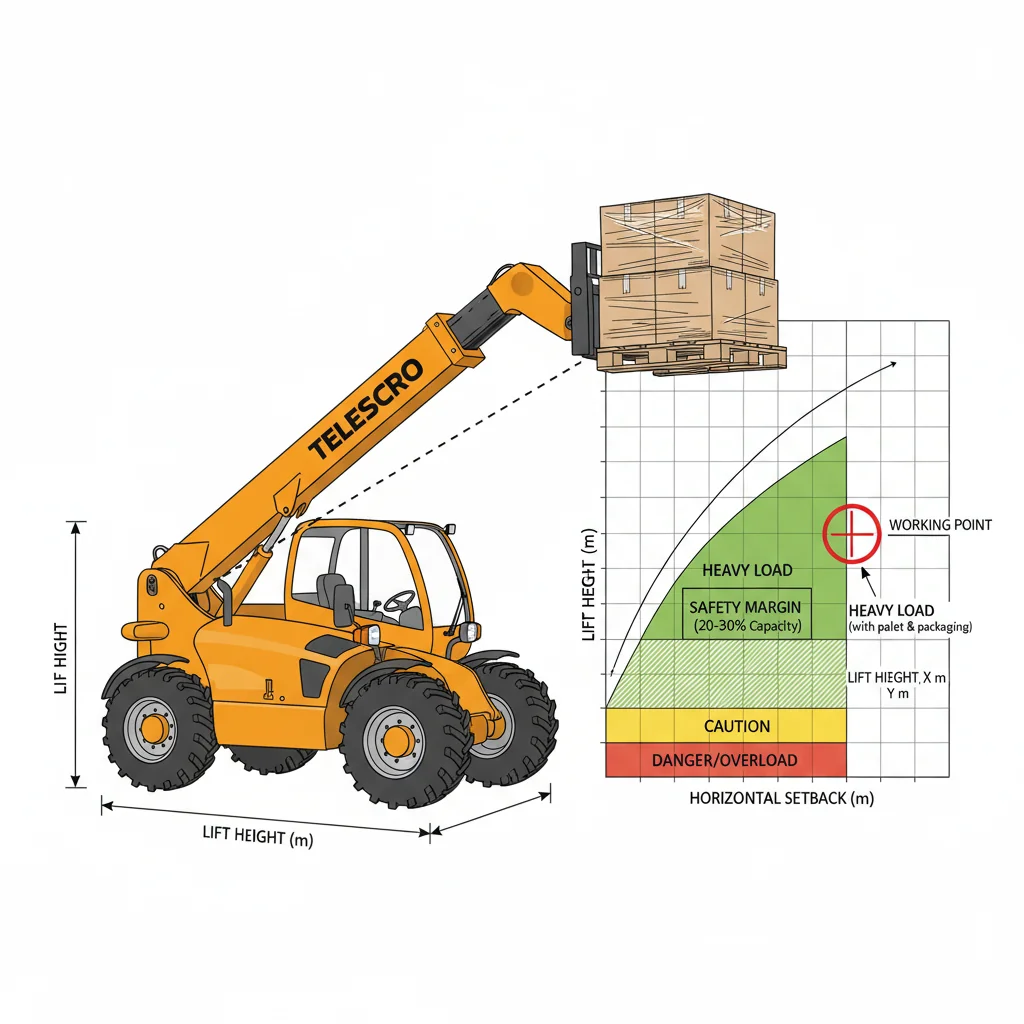
The biggest mistake I see is teams picking a telehandler just by its class or maximum lift rating. They get a “4-ton, 17-meter” model thinking it can hoist any 4-ton load all the way up. On site, the reality stings—at full reach, most of these units are only good for lifting around 1,200 to 1,500 kg. I’ve seen this happen in Dubai more than once. The steel beams or heavy pallets show up, but the machine can only manage half the expected load at working heights. That’s when panic calls start coming in.
Here’s what actually works. First, take time to define your real, heaviest lift—including the pallet, wrapping, and any overhangs. Make sure you add a safety buffer for sloping ground or uneven surfaces. Next, specify the highest point you need to reach—are you lifting to a third-floor balcony (say, 12 meters) or just truck bed level? Finally, walk out the setback: is there a scaffold, pit, or slab edge pushing your telehandler back? Now you have your three “must-have” numbers—weight, height, and reach.
Plot this exact point on each candidate machine’s load chart (the graph that shows how capacity drops as the boom extends). If your real jobsite load sits right at the edge, don’t risk it. I always suggest picking a model with 20–30% more capacity than you calculated. This margin protects you if the machine isn’t perfectly level or if wind picks up. I’ve seen crews in Kazakhstan avoid expensive rentals or last-minute upgrades just by double-checking at this step. It’s a habit that prevents costly mistakes—and keeps everyone safer.
A telehandler’s maximum lift capacity is only valid at its minimum boom extension and low lift height, and actual capacity decreases substantially as the boom telescopes out or is raised higher.True
The load chart for every telehandler shows that capacity drops significantly with increased reach and height. This is due to leverage effects and stability limits. Operators must refer to load charts to specify machines accurately for elevated lifts.
If a telehandler is rated for 4 tons, it can safely lift 4 tons at any boom length or height within its maximum ratings.False
The lift capacity decreases at greater reach or higher boom angles due to changing balance and structural loading. The 4-ton maximum usually only applies at low heights and with the boom retracted.
Key takeaway: Never select telehandlers by size class alone. Always specify based on the site’s real load, height, and setback, then verify on the load chart. A 20–30% margin at the intended working point helps prevent on-site capacity shortfalls, safety risks, and costly emergency upgrades.
What safety limits apply at high lift heights?
At greater lifting heights and reach, rated capacity decreases significantly. Safety standards such as EN 1459 and ANSI/ASME B56.6 require telehandlers to pass stability tests9 and display clear load charts. These assume level ground, proper stabilizer deployment, and operator understanding—any deviation, including slopes or wind, sharply reduces safe working loads.
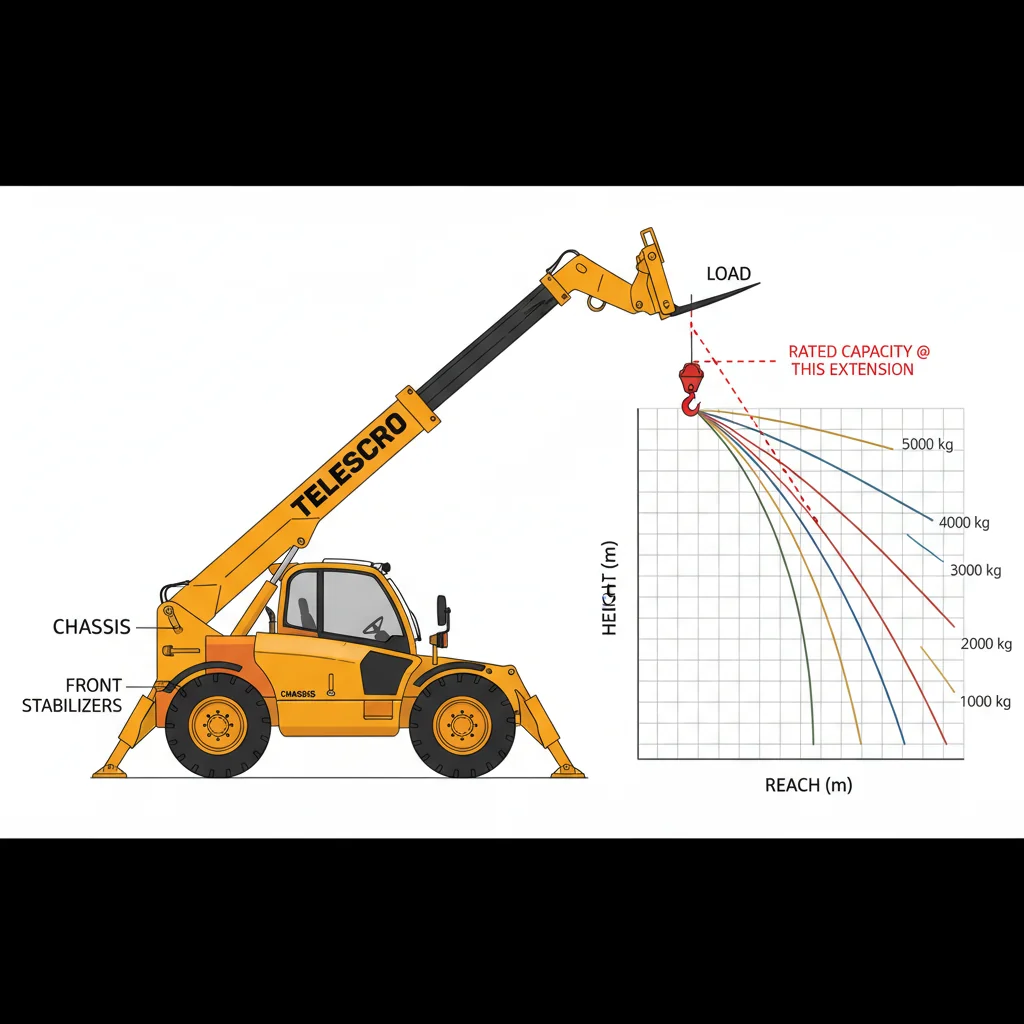
I get a lot of calls about loads tipping or alarms going off when the boom is high. Here’s where operators trip up most: as the boom lifts higher or extends farther, the rated capacity drops—sometimes by half or more. A load that feels stable on the ground can become risky at full extension. For example, in Dubai last year, a team tried lifting a 2,000 kg pallet to 14 meters with a 4-ton telehandler. The load chart only allowed around 1,000 kg at that height without stabilizers down. The moment sensors kept beeping, and the site manager almost ignored it. That kind of risk just isn’t worth it. The reality is, rated capacity in the load chart assumes the telehandler is perfectly level—usually within 3 degrees of tilt. Any slope or uneven terrain causes stability to fall off quickly. I’ve seen projects in Kazakhstan where operators worked on gentle slopes, thinking “it’s close enough.” But even a 5-degree tilt puts the machine outside the safe range in the manual. The load chart numbers do not apply. Frame leveling or deploying stabilizers becomes absolutely necessary, especially above 8 to 10 meters. Sudden factors—like a gust of wind or hitting a snagged pallet—can push the machine over the edge, literally. Wind, side slopes, or picking up a swinging load all chip away at the margin. I always tell fleet managers: don’t let anyone “test” the chart.
At maximum lift height, a telehandler's rated capacity is usually much lower than at ground level, due to reduced machine stability and increased leverage on the front axle.True
As the boom extends upward and outward, the telehandler’s center of gravity shifts forward, increasing the risk of tipping. Manufacturers account for this in their load charts, which often show substantial drops in allowable weight at higher positions, even if the machine can physically lift more at lower heights.
A telehandler can safely lift its maximum rated capacity to any height as long as the tires remain in contact with the ground.False
Maximum rated capacity is typically only valid for low boom positions. As the boom is raised or extended, stability and structural limits reduce safe lifting capacity, regardless of whether the tires are on the ground. Load charts and stabilizer usage must always be consulted for high lifts.
Key takeaway: Safe telehandler operation at high boom angles and heights requires strict adherence to load charts, ensuring level ground and correct stabilizer use. Exceeding or misinterpreting rated capacities—even by small margins—increases instability risks and can result in severe incidents. Always train operators to interpret load charts accurately.
How do pallet size and load position affect?
Telehandler capacity is highly sensitive to pallet size and load position. Extending the load’s center of gravity further from the fork heel—such as with long pallets, overhanging bricks, or longer forks—dramatically increases the tipping moment. Engineering guidelines note that every additional 10 cm of load center can reduce rated capacity by 15–20%.

From my experience, buyers often underestimate how quickly pallet size and load position eat into a telehandler’s rated capacity. It’s not just about how much a pallet weighs—it’s where that load sits on the forks. For example, I saw this firsthand on a logistics project in Dubai. The palletized bricks arrived on 1.4-meter-long pallets, but the site only calculated total weight, not the pallet dimensions. The center of gravity ended up about 30 cm in front of the fork heel, instead of the typical 50 cm. That extra distance meant the 3-ton telehandler could only lift roughly 2,000 kg safely at mid-boom—almost a 30% reduction compared to the spec sheet. Long heavy items or overhanging loads amplify this effect even more. I’ve had customers try to “fix” the problem by using longer forks, hoping it would help balance the load. But actually, longer forks often make things worse, since the load’s center shifts even farther out. The moment indicator10 (if installed) will usually light up or even lock out the machine before the operator hits the max weight. This isn’t a software bug—it’s the machine doing its job to keep you safe. On sites where pallet sizes or load shapes change frequently, like a big warehouse project in Malaysia, I recommend always checking the load chart for the real capacity at your planned reach and position. Don’t just look at pallet weight in isolation. Always factor in length, stacking method, and fork choice.
A longer pallet that positions the center of gravity further from the fork carriage can significantly reduce a telehandler's effective lift capacity at any height.True
Telehandlers are rated based on load centers; when the pallet is longer, the weight sits farther from the machine, resulting in a greater tipping moment and reducing safe lifting capacity regardless of lift height.
As long as the pallet weight does not exceed the telehandler's rated capacity, the pallet’s size and load position have no effect on operational safety.False
Even if the weight is within the capacity, a larger pallet with an off-center load shifts the center of gravity outward, increasing the risk of instability or tipping, especially at height.
Key takeaway: Rated telehandler capacity assumes standard pallet dimensions and centered loads. Bulky pallets or off-center loads substantially reduce safe capacity—often by 15–20% for every 10 cm of extra overhang. Always consult the load chart and choose a machine with a comfortable capacity margin for awkward or oversized loads.
Conclusion
We’ve looked at how telehandler lifting height and capacity are often misunderstood, and why checking the load chart is essential before making a decision. From my experience, the biggest pitfall is focusing on max lift height or capacity numbers without confirming whether the machine can actually handle your loads at the real working positions. That’s the "3-meter blind spot" I see regularly—buyers miss the details that matter most on the jobsite. If you’re unsure which specs really fit your project, or need a second set of eyes on a load chart, feel free to reach out. I’m happy to help you sort through the options, no pressure. Every site is different—choose what actually works for your workflow.
References
-
Explore detailed load charts to understand safe lift capacities with different telehandler attachments and prevent tipping hazards. ↩
-
Detailed explanation of how rated capacity changes with lift height and factors affecting safe telehandler operation. ↩
-
Explains how shifting the load’s center of gravity impacts telehandler tipping moments and safe lifting capacity, essential for operator safety. ↩
-
Details the importance of manufacturer load charts in accurately assessing safe lift capacities at various boom heights and reaches. ↩
-
Explore how usable capacity impacts lifting efficiency and safety, with real-world data comparing shorter vs taller telehandlers. ↩
-
Explains common misconceptions about maximum rated capacity and highlights the importance of consulting the load chart for safe telehandler operation. ↩
-
Explains how boom height and forward reach jointly affect lifting capacity, crucial for safe telehandler operation and planning. ↩
-
Explains how horizontal setback affects lifting capacity and stability, helping operators choose appropriate telehandlers safely. ↩
-
Explores the role of stability tests in ensuring telehandler safety and compliance with standards like EN 1459 and ANSI/ASME B56.6. ↩
-
Details the function of moment indicators in preventing tipping by alerting or locking out overload conditions, crucial for construction safety. ↩