











Telehandler Lifting Capacity vs Boom Extension: Field-Tested Mistakes to Avoid
I still remember a project in northern Italy where a brand new 4-tonne telehandler nearly tipped while trying to lift just a 900 kg pallet—simply because the operator had the boom fully extended. That moment stuck with me, and it’s far more common than most would think.
Telehandler lifting capacity decreases rapidly with increased boom extension and elevation due to the principles of load moment1 and machine stability. The maximum rated capacity is typically only achievable with the boom retracted and load close to the front axle. At maximum outreach or height, allowable loads may drop to less than one-third of the headline figure, regardless of boom strength.
How Does Boom Extension Affect Lift Capacity?
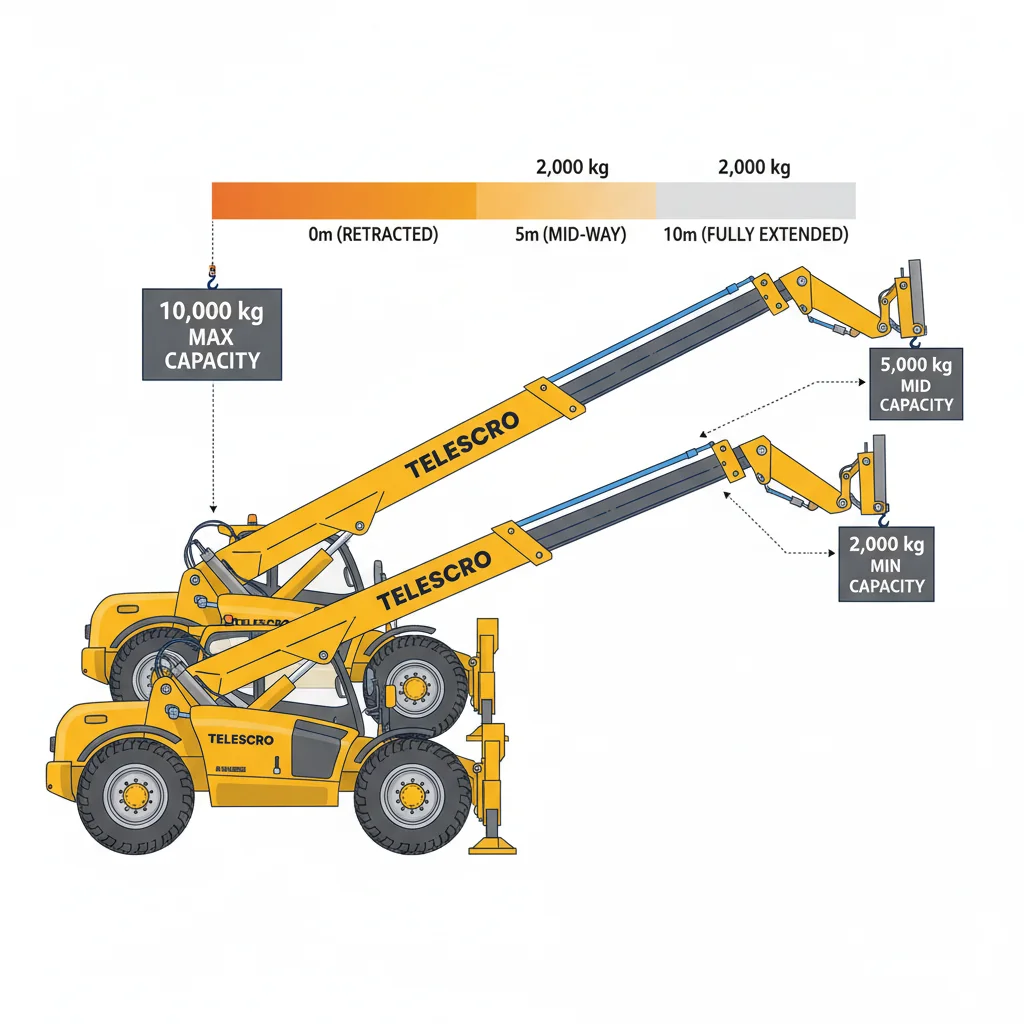
A telehandler’s lifting capacity decreases rapidly as the boom extends outward and upward. The maximum rated capacity applies only with the boom retracted or slightly extended, near the front axle. At full extension, safe lifting is dramatically reduced—often to less than one-third of the headline rating, depending on outreach and height.

Most people don’t realize that a telehandler’s maximum rated capacity is only useful when the boom is nearly retracted, close to the front axle. The further out and higher the boom goes, the more the load “leverages” against the machine’s stability. For example, I recently worked with a customer in Dubai who needed to lift heavy pipe bundles to a third-story scaffold, about 12 meters up and 8 meters out. On paper, their 4-ton telehandler looked perfect. But at that outreach, the load chart2 clearly showed a safe capacity of just under 1,000 kg—one quarter of the headline rating.
Here’s what happens mechanically: As you extend the boom, the load’s effective “distance” from the front axle increases, applying more downward force at the tip and more overturning moment at the base.
The hydraulics and stability system—including the rear counterweight and, on larger units, deployable outriggers—try to compensate, but physics always wins. The load chart (the table or graphic that shows how much you can lift at every boom angle and extension) becomes your most important tool. I’ve seen operators in Kazakhstan underestimate this and get stuck halfway through a crucial roof lift—they could pick 3,000 kg at 6 meters, but only 700 kg at full extension.
I always suggest planning critical lifts around the actual outreach and height, not the spec sheet’s top numbers. Give yourself at least a 15-20% safety margin. It’s better to size up your machine than risk an unsafe lift or costly delays.
"AtFalse
"The
Extending the boom of a telehandler does not affect its hydraulic lifting power, so the maximum lift capacity remains the same regardless of boom positionFalse
While hydraulic power may be consistent, the machine’s rated lift capacity decreases with boom extension due to increased leverage and reduced stability, which load charts account for by lowering allowable load limits at extended reaches.
Key takeaway: Always consult the telehandler’s load chart before specifying a machine. Maximum reach and maximum capacity are never available together. Operators risk undershooting critical lift requirements if only headline capacities are considered, especially for long or high lifts. Build in a safety margin based on actual task conditions.
How Does Boom Extension Impact Lifting Capacity?
Boom extension directly affects telehandler lifting capacity due to load moment—the product of load weight and horizontal distance from the tipping axis. As the boom extends, the overturning moment increases, reducing lifting capacity despite hydraulic or structural strength. Stability limits4, not just mechanical power, ultimately determine safe operating thresholds and are defined by manufacturer load charts.

The biggest mistake I see is assuming a telehandler’s maximum lift capacity stays the same, no matter how far the boom is extended. It doesn’t. I’ve worked with a contractor in Saudi Arabia who once tried to lift a 2,000 kg load with a 17-meter unit—no problem at 5 meters out, but at full 14-meter extension, the load moment was just too high. Even though the hydraulics and boom felt strong, the machine’s real limit was stability. At long reach, that same telehandler could only handle about 700 kg safely. The difference caught them by surprise and nearly led to a costly tip-over.
What actually matters most here is the load moment—basically, how much force the load applies to the front axle as you move it further away. The formula is simple: load weight times distance from the tipping axis.
Every extra meter adds stress fast. From my experience, operators often forget that small increases in boom extension reduce safe capacity dramatically, sometimes by more than half. Wind, uneven ground, or soft tires make it even riskier.
Manufacturers bake all this into the load chart—a chart I always tell customers to keep handy in the cab. That chart translates engineering limits and safety factors into simple numbers for each boom position.
Modern models have sensors or cutouts to warn if you’re pushing the envelope, but I still see people try to override them. To be honest, no sensor beats pre-planning. I suggest double-checking your required lift at the exact reach before bringing materials on site—it prevents trouble and keeps your team safe.
Key takeaway: Load moment increases as the boom extends, which reduces safe lifting capacity regardless of the machine’s hydraulic or structural capabilities. Always reference load charts and adhere to warning systems, as exceeding stability limits significantly increases the risk of telehandler tip-over incidents.
How Do Boom Angle and Reach Affect Capacity?
Telehandler lifting capacity is dynamically affected by both boom angle and extension. Load charts use grids where lift height and forward reach determine the safe working load. Shifting either the boom’s extension or its angle shifts the operator into a new capacity zone, significantly altering maximum allowable load limits. Overlooking this interaction is a common field-tested error.

Let me share something important about boom angle and reach that doesn’t always make it into the sales brochure. I’ve seen more than one project in Dubai stall because operators tried lifting a heavy pallet to a second-floor slab—only to find they’d lost nearly two-thirds of their capacity by extending the boom just a few meters further.
The load chart isn’t just a sticker by the seat. It’s a living tool for real jobsite decisions.
Here’s a real scenario: A customer in Kazakhstan needed to lift 2,500 kg of block to a platform 5 meters high but with a 5-meter forward reach (measured from the front tires). On paper, their telehandler was rated for 3,000 kg.
But at that combination of height and reach, the safe capacity dropped to just over 1,000 kg. That’s a huge difference—easily missed if you focus only on the headline number. Even something as simple as tilting the boom down to “just get under” a ledge can move you into a lower capacity zone within the load chart grid.
This triple interaction—boom angle, extension, and load weight—means every adjustment can change your allowable load. In my experience, relying on past habits or rough guesses is where accidents happen, especially under time pressure. I always suggest checking the actual required height and reach for your task, then matching that to the specific cell on your machine’s load chart. Ten seconds with the chart can prevent serious downtime or worse.
Extending the boom by just 3 meters can reduce a telehandler’s maximum lifting capacity by up to 60%, due to the increased moment arm and leverage effect on stability.True
Telehandler load capacity decreases as boom extension increases because the load acts farther from the machine’s center of gravity, significantly increasing tipping risk and reducing safe lifting limits according to the load chart.
Increasing boom angle always increases the maximum lifting capacity regardless of reach, because the load is positioned closer to the machine base.False
While raising the boom angle can reduce horizontal reach and improve capacity, the boom angle alone doesn't guarantee increased capacity; capacity is primarily governed by both reach and boom angle in combination, as indicated by the load chart.
Key takeaway: Always consider boom angle, height, and reach together when evaluating telehandler lifting capacity. Even small adjustments can place the machine in a lower-capacity zone, increasing operational risk. Operators must consult load charts for every combination rather than relying on estimates or experience alone.
Why Compare Telehandler Load Charts, Not Just Capacity?
Two telehandlers with the same maximum lifting capacity can differ greatly at specific boom extensions and heights. One may safely lift 1,200 kg at a 7 m outreach, while another manages only 700–800 kg. Evaluating capacity solely on maximum ratings risks critical jobsite limitations and operational inefficiencies.

Here’s what matters most when you’re selecting a telehandler: don’t be fooled by the max capacity on the brochure. Real jobs rarely need the absolute maximum. Instead, it’s the load chart—showing how much weight you can handle at different reaches and heights—that truly governs what you can do on site. I’ve seen this play out firsthand. A contractor in Dubai once called me after realizing his “4-ton” unit could only manage 800 kg with the boom fully out at 7 meters—he actually needed at least 1,100 kg at that position to lift cladding panels onto the third story. They lost nearly two days waiting for a bigger machine.
Here’s a quick comparison to illustrate why headline specs can mislead you:
| Model Spec | Max Capacity | Max Lift Height | Capacity at 7 m Reach | Moment Indicator? |
|---|---|---|---|---|
| 4-ton Standard | 4,000 kg | 17 m | 1,200 kg | Yes |
| 4-ton Compact | 4,000 kg | 13 m | 850 kg | Yes |
| 4.5-ton High Reach | 4,500 kg | 18 m | 1,350 kg | Yes, digital |
Notice how two “4-ton” machines can have a 30-40% difference in real work capacity at common boom positions. That’s why I always suggest: before signing any contract, list your heaviest, farthest lifts—like “1,200 kg pallet at 7 meters and 7 meters high”—and ask to see that exact point on the load chart for each machine. This step prevents costly workarounds or unsafe improvisation. If you’re operating near the rated edge, going to the next size up might actually save both money and time.
Telehandler load capacity can decrease by up to 80% when the boom is fully extended to its maximum reachTrue
As the boom extends, the load moment arm increases, drastically reducing the machine's lifting capacity to maintain stability; for example, a 4-ton telehandler may only safely lift about 800 kg at full extension of 7 meters.
Telehandler load capacity remains constant regardless of boom length due to electronic load moment limiters automatically adjusting pressureFalse
Load moment limiters prevent unsafe lifts by restricting hydraulic functions but do not increase the physical lifting capacity, which inherently decreases with boom extension due to mechanical leverage and stability limits.
Key takeaway: Always analyze telehandler load charts at planned working reaches and heights, not just maximum capacity. Comparing only headline specs can result in equipment unable to complete critical lifts, leading to costly workarounds, delays, or unsafe methods. Specify worst-case tasks and confirm suitability before selection.
How Do Attachments Affect Lifting Capacity?
Attachments alter a telehandler’s effective lifting capacity by changing both the load center5 and overall load moment. Standard fork carriages assume a 600 mm load center, but jibs, buckets, or man platforms extend this distance and add their own weight. Always refer to the attachment-specific load chart; never rely solely on base fork capacity ratings.
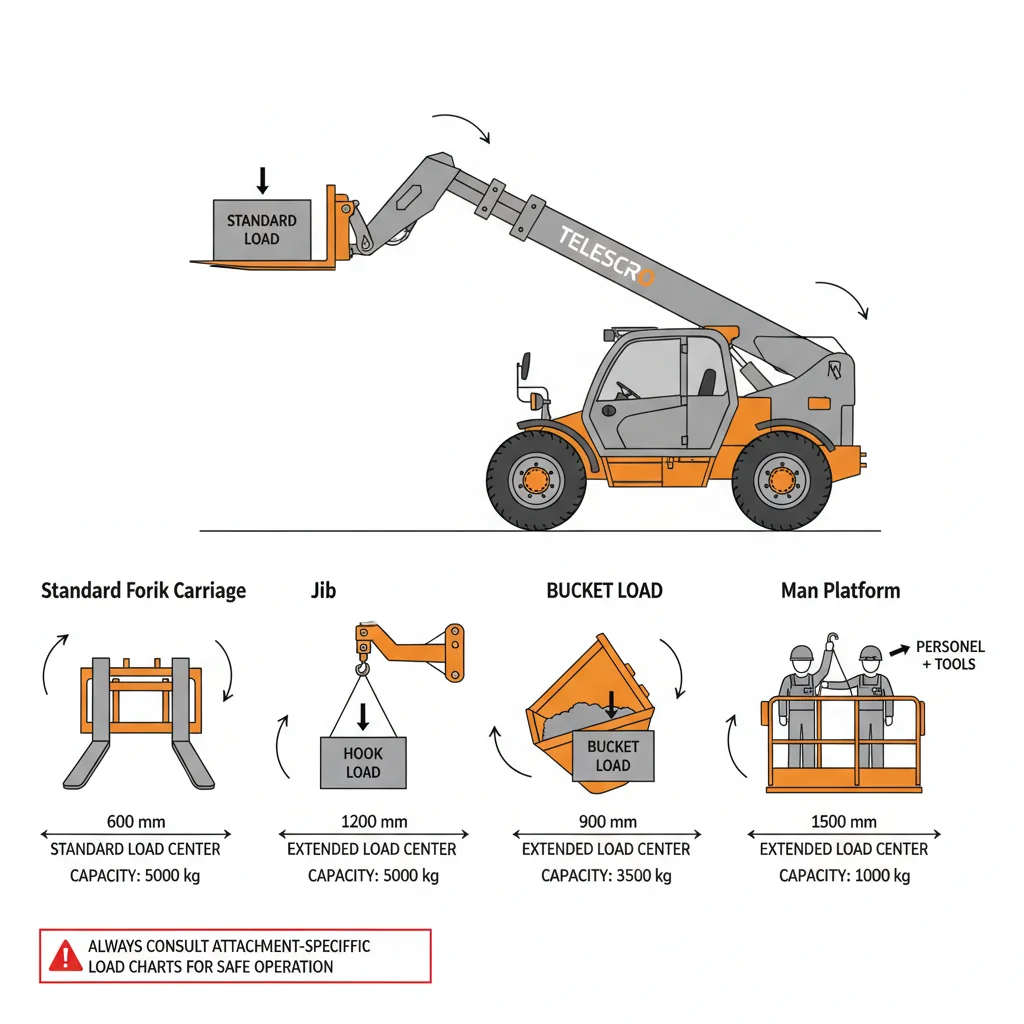
To be honest, the spec that actually matters is how your attachment shifts the load center—not just the maximum capacity printed on a sticker. I’ve seen telehandlers on sites in Vietnam that could lift 2,500 kg with standard forks at a 6-meter reach, but once they switched to a jib for suspended loads, safe capacity dropped to just 1,200 kg at the same boom extension. Why? The jib moves the load further forward, increasing the load moment. That extra distance, plus the weight of the jib itself (often 150–250 kg), eats into your available lifting capacity fast.
If you’re not careful, it’s easy to overestimate what your machine can actually handle with different attachments. Here’s what I always remind my customers:
- Attachment weight counts – Every kg of the bucket, jib, or man basket reduces what you can safely lift.
- Load center shifts matter – Standard forks use a 600 mm load center; attachments like jibs or buckets often push this out to 1,200 mm or more.
- Load moment increases – A longer reach or heavier attachment makes the telehandler feel the load as ‘heavier,’ even if actual kg stay the same.
- Separate load charts apply – Manufacturers issue a specific chart for each approved attachment—always check it before working.
One customer in Dubai learned this the hard way. They planned to lift brick packs on a suspended platform, assuming it matched their 2.5-ton rating. The moment indicator alarmed halfway up—they were already overloaded.
I suggest always verifying the attachment’s load chart for your planned reach and height. It’s a simple check that can prevent accidents and unexpected downtime.
Using a jib attachment on a telehandler typically reduces the maximum lifting capacity by more than 50% at the same boom extension due to the significantly increased load center distance and the attachment's own weightTrue
Attachments like jibs shift the load forward, increasing the load moment which decreases the safe lifting capacity more drastically than just boom extension alone.</p> <p>For example, a telehandler lifting 2,500 kg with forks might only safely lift around 1,200 kg with a jib at 6 meters, as the effective load center shifts forward and adds extra leverage.
The lifting capacity of a telehandler remains constant regardless of the attachment used, as long as the boom extension remains the sameFalse
Lifting capacity depends heavily on the load center, which changes with different attachments.</p> <p>Even at the same boom extension, attachments like jibs or buckets move the load further away from the mast, increasing the load moment and reducing the safe lifting capacity. Capacity ratings on the placard only apply to standard forks or specific attachments.
Key takeaway: Always consider both the weight and position of attachments and loads, and consult the specific load chart for each telehandler attachment. Never assume base fork ratings apply with other attachments—capacity can decrease significantly depending on the attachment and load center.
How Do Ground Conditions Change Lift Capacity?
Published telehandler load charts assume ideal operating conditions—firm, level ground and factory-specified tires. In practice, soft soil, slopes, potholes, or improper tire pressure can significantly reduce lifting capacity and stability. Wind loads further increase risk at height. Operators must check ground firmness6, verify equipment configuration, and treat load chart limits as theoretical maximums, derating capacity for real-world field conditions.

Not long ago, I got a call from a project supervisor in Kazakhstan. Their crew needed to lift formwork panels—about 1,200 kg each—to the second level, roughly 6 meters up. Everything looked fine on the load chart with a 3.5-ton telehandler.
But the ground, just compacted fill after recent rain, caused serious problems. The machine started to lean as they telescoped out. Operators felt the tilt, and the moment indicator alarmed early. That’s when they called me for advice.
I always remind teams that load charts assume you’re on firm, level, stable ground with correct tire inflation. In the real world, soft soil, sloped areas, potholes, or underinflated tires can change things fast.
I’ve seen a 4-ton telehandler on soft ground lose up to 40% of its rated capacity due to extra lean and shifting of the tipping axis. Even a minor slope—a few degrees—reduces stability more than most realize. Add a gusty wind, and your margin gets razor thin.
Configurations matter as well. Some telehandlers allow swapping between pneumatic and foam-filled tires, or adjusting width with stabilizers. Each setup affects how much weight you can handle at reach. It’s critical to double-check that the capacity chart posted actually matches your current machine configuration—including what’s bolted on the boom.
My advice? Before any long or high lift, take five minutes: walk the surface, verify tire pressure, and consider recent weather. If conditions aren’t ideal, deliberately scale back your load target—never push for the posted maximum. It’s just not worth the risk.
Extending the boom beyond 4 meters typically reduces a telehandler's lift capacity by at least 30% due to increased leverage and machine instabilityTrue
As the boom extends, the load moment arm increases, causing greater tipping force on the telehandler. This reduces the maximum safe lifting capacity substantially, often by 30% or more beyond mid-extension, to maintain stability.
Telehandler lift capacity remains constant regardless of boom extension if the ground conditions are stable and compactFalse
Lift capacity decreases as boom length increases due to mechanical leverage and stability limits inherent in the machine design, even on stable ground. The load chart always accounts for this reduction irrespective of surface firmness.
Key takeaway: Always assess ground conditions, tire configuration, and wind before attempting long or high lifts. Load chart ratings represent best-case scenarios; real-world factors often reduce safe capacity. Make it policy to verify site-specific conditions and deliberately de-rate maximum capacity for marginal or uneven terrain to prevent instability or tip-overs.
How Does Overloading at Boom Extension Harm Telehandlers?
Overloading a telehandler with the boom extended stresses boom sections, pins, and welds, leading to accelerated fatigue and cracks. High load moments increase hydraulic pressure7, causing leaks and premature wear on boom pads and sliders. Even if tipping does not occur, repeated overloading shortens machine life, increases maintenance costs, and lowers resale value.

Here’s a scenario I see too often: an operator in Dubai gets asked to lift a heavy pallet of tile, about 2,300 kg, to the fourth floor—13 meters up—with the boom fully extended. The telehandler’s on-paper max is 4,000 kg, so they think it’s fine. But when you check the load chart, safe capacity at that height and reach often drops below 1,500 kg.
I’ve visited sites in China and Brazil where continual overloading at maximum reach led to fatigue cracks in the boom after only two years—much sooner than expected.
The technical reason is simple. Extending the boom multiplies the load moment—the twisting force—which puts huge stress on the boom sections, pins, and welds. Every time someone works “just a little over” the chart limit, those welded joints and pivot pins are taking a beating. Hydraulic cylinders and hoses feel the strain, too.
Pressures spike, seals start leaking, and you see oil stains develop around the ram and hose fittings. Eventually, boom pads and sliders—those components that keep telescoping movement smooth—wear unevenly, and operators start to feel more play or even jerky motion.
For fleet managers, this turns into higher repair costs and downtime. I’ve seen units lose up to 30% of resale value simply because inspectors found evidence of cracked boom welds or deformed pins. My advice? Train every operator on the meaning of the load chart, not just the “big number” painted on the side. Regularly inspect boom sections and pins, especially if you suspect overloading has occurred. This habit pays off in lower lifecycle costs and safer jobsite operation.
Telehandler maximum lifting capacity can decrease by more than 60% when the boom is fully extended to maximum reach compared to when it is retractedTrue
As the boom extends, leverage increases and stability decreases, forcing the machine's load chart to significantly reduce allowable weight to prevent tipping or structural damage, often cutting rated capacity by over half at maximum extension.
The maximum lifting capacity of a telehandler remains constant regardless of boom extension because the hydraulic pressure does not changeFalse
While hydraulic pressure may remain consistent, mechanical leverage, stability, and chassis forces vary with boom position, requiring reduced load limits at extended reaches to avoid structural stress and tipping hazards, as shown in detailed load charts.
Key takeaway: Consistently overloading telehandlers at full boom extension significantly accelerates component wear and risk of damage, even without tipping. Prioritizing comprehensive operator training, enforcing strict adherence to load charts, and conducting regular inspections can meaningfully reduce downtime, maintenance costs, and depreciation, helping fleet managers maximize equipment lifespan and return on investment.
How Does Boom Extension Impact Lifting Capacity (Continued)?
High-reach telehandlers (over 17 m) feature specialized engineering—multi-stage booms, robust steel, advanced hydraulics, and reinforced chassis—to handle greater heights. Despite these upgrades, load capacity drops sharply with boom extension8. Critical load charts must be consulted at full reach; headline heights do not reflect attainable lifting loads at maximum extension.

Last month, a project manager in Dubai asked me why his new 19-meter telehandler couldn’t lift more than 1,200 kg at full extension when the brochure promised 4,000 kg capacity. It’s a question I get often—and the answer always comes down to the physics of long booms.
Even with heavy-duty steel and larger hydraulic cylinders, the further you extend the boom, the less weight it can safely handle. Think of the boom like a big lever: more extension means more force pulling the machine forward, so manufacturers have to limit capacity or risk tipping.
From my experience, customers often overlook the actual load chart in real working conditions. For example, on a warehouse project in Brazil, a team needed to raise HVAC units to a rooftop 17.5 meters high. Their machine was rated for 3,500 kg, but at that maximum height, the safe load was just under 1,000 kg. The crew needed two lifts per unit instead of one—slowing their schedule and adding costs. This drop-off in capacity catches even experienced operators by surprise.
You also need to consider factors beyond just lifting specs. Heavier, high-reach models weigh over 12 tons and can stress weaker ground or slabs. One client in Kazakhstan saw damage to a parking deck after parking a full-size 18-meter telehandler loaded with bricks. It’s not just about what the machine can lift—it’s where and how you’re using it.
I recommend checking the load chart at your actual working height and reviewing your site’s ground bearing capacity before making a final decision.
Extending the boom of a telehandler from 10 meters to its full 19-meter length can reduce its lifting capacity by up to 70%, due to the exponential increase in leverage forces acting on the machine's chassis.True
As the boom extends, leverage forces increase exponentially, amplifying tipping moments.</p> <p>Even with stronger steel and hydraulics, the machine’s stability and safe lifting capacity are significantly reduced to prevent rollover or structural failure. This is why brochures often list maximum capacities only at minimal boom extension.
Increasing the boom extension on a telehandler generally has minimal impact on lifting capacity because modern hydraulic systems automatically compensate to maintain lifting power.False
While advanced hydraulics improve efficiency, they cannot counteract the physical leverage and stability limitations imposed by a longer boom. The further the boom extends, the greater the tipping moment, which reduces safe lifting capacity regardless of hydraulic power.
Key takeaway: High-reach telehandler designs include significant reinforcements, but their lifting capacity declines rapidly as the boom extends. Always check true load ratings at the working height required and factor in chassis weight, transport logistics, and site bearing to avoid costly operational mistakes.
How Should Tasks Guide Telehandler Selection?
Effective telehandler selection begins with listing actual job requirements—such as load weight, lift height, reach, and attachment type9—rather than relying solely on manufacturer specifications. By mapping each recurring scenario to real load charts, buyers can avoid under- or over-specifying, ensuring safe and efficient operation tailored to specific site demands.
A lot of buyers get caught up chasing the biggest numbers—max height, max lift capacity—but real jobsite needs are often much more specific. For example, I worked with a team in Kazakhstan that needed to unload 1,200 kg steel pipes and position them through a window opening on the second floor, about 7 meters up, but also 4.5 meters horizontally from the building’s edge.
On paper, their “4-ton, 14-meter” unit looked more than capable. When we checked the actual load chart with the side-shift fork attachment fitted, safe capacity at that reach dropped closer to 1,300 kg—a tight margin that left no room for error if the load shifted.
Here’s what I always suggest: jot down your main lifting tasks before you even look at spec sheets. Are you picking up 1,000 kg pallets of bricks daily? Need to reach over a 2-meter fence or concrete wall? Will you swap between buckets, jibs, and platforms? Every combination changes the safe load on the boom—those details matter more than a headline capacity.
Take these tasks to your dealer or rental company. Have them go over the real load charts with you. For instance, “Can this 3-ton machine safely place 1,500 kg at 8 meters with a platform fitted?”
This step helps avoid buying a “showroom hero, jobsite zero.” You avoid the trap of over-investing in a telehandler that’s too big, or worse, under-specifying and facing safety issues later.
I recommend reviewing each scenario and adjusting setup or machine choice as needed. That’s how you get safe, efficient lifting tailored to your real site needs.
Telehandler lifting capacity can decrease by up to 50% when the boom is fully extended horizontally compared to when it is retracted close to the chassisTrue
As the boom extends, the leverage effect increases, significantly reducing the maximum safe load according to the load chart; this reduction can reach around 50% at maximum reach due to decreased stability and higher tipping risk.
A telehandler's lifting capacity remains constant regardless of boom extension because hydraulic pressure is maintained at a fixed levelFalse
Although hydraulic pressure may stay consistent, the mechanical leverage and load chart limitations mean lifting capacity decreases as boom extension increases to maintain stability and safety, making capacity variable rather than constant.
Key takeaway: Always prioritize real-world lift requirements—load, height, reach, and attachments—when choosing a telehandler. Task-based planning helps avoid costly specification errors and ensures reliable, safe performance for recurring site conditions.
Conclusion
We looked at how telehandler lifting capacity changes with boom extension, and why checking the load chart is so important—especially for longer or higher lifts. From my experience, the operators who get it right don’t just glance at the max capacity; they dig into what the machine can safely lift at the working height and extension they actually need.
Don’t let “showroom hero, jobsite zero” specs lead you into trouble on site. If you’re weighing options or want to be sure you’re picking the right model for your lifts, feel free to reach out. I’m always happy to share what’s worked (and what hasn’t) for real crews in the field. Every jobsite is different—focus on what works for your workflow.
References
-
Explore detailed insights on load moment calculation and its critical impact on telehandler stability and safe lifting limits. ↩
-
Explains how load charts evaluate safe lifting limits at various boom angles and extensions, essential for operator safety and planning. ↩
-
Detailed explanation of load charts usage to safely manage boom extension and angle, reducing lift failures on site. ↩
-
Understand how stability limits, beyond mechanical strength, define safe telehandler operation to prevent tip-overs and accidents. ↩
-
Explains how shifting the load center impacts telehandler safety and capacity with expert load chart insights. ↩
-
Explains the impact of ground firmness on telehandler lift capacity and stability with real-world examples and tips. ↩
-
Insight into how overloading raises hydraulic pressure causing leaks and wear, helping operators prevent costly repairs and downtime. ↩
-
Explains the physics and engineering behind load capacity reduction as boom reaches maximum extension, crucial for safe telehandler operation. ↩
-
Details various telehandler attachments and how selecting the right type enhances versatility and safety for different lifting tasks. ↩