











Telehandler Lifting Accessories: Field-Tested Compatibility Guide for Buyers
Last month, a site manager from South Africa sent me a photo—brand new telehandler, but the bucket wouldn’t connect. His team had three attachments ready, none of them matched the machine’s coupler. It’s a common story that too many fleets learn the hard way.
Telehandler lifting accessory compatibility depends on the coupler type, hydraulic circuit requirements, and how attachment geometry impacts the load chart. Industry-standard quick couplers and fork carriages allow most machines to accept pallet forks1, fork carriages, certified lifting hooks, buckets, work platforms, lifting jibs, and agricultural tools. Hydraulically powered implements require auxiliary circuits matching the attachment’s flow and pressure ratings, with incompatibilities leading to poor function or system damage.
Which Attachments Fit Most Telehandlers?
Most telehandlers are compatible with a standard set of lifting accessories using quick couplers or carriages. The core kit includes 48–72 inch pallet forks, various fork carriages, lifting hooks, general-purpose or debris buckets, work platforms, and jibs. OEMs like JLG, Genie, and JCB catalog these tools for broad machine compatibility.
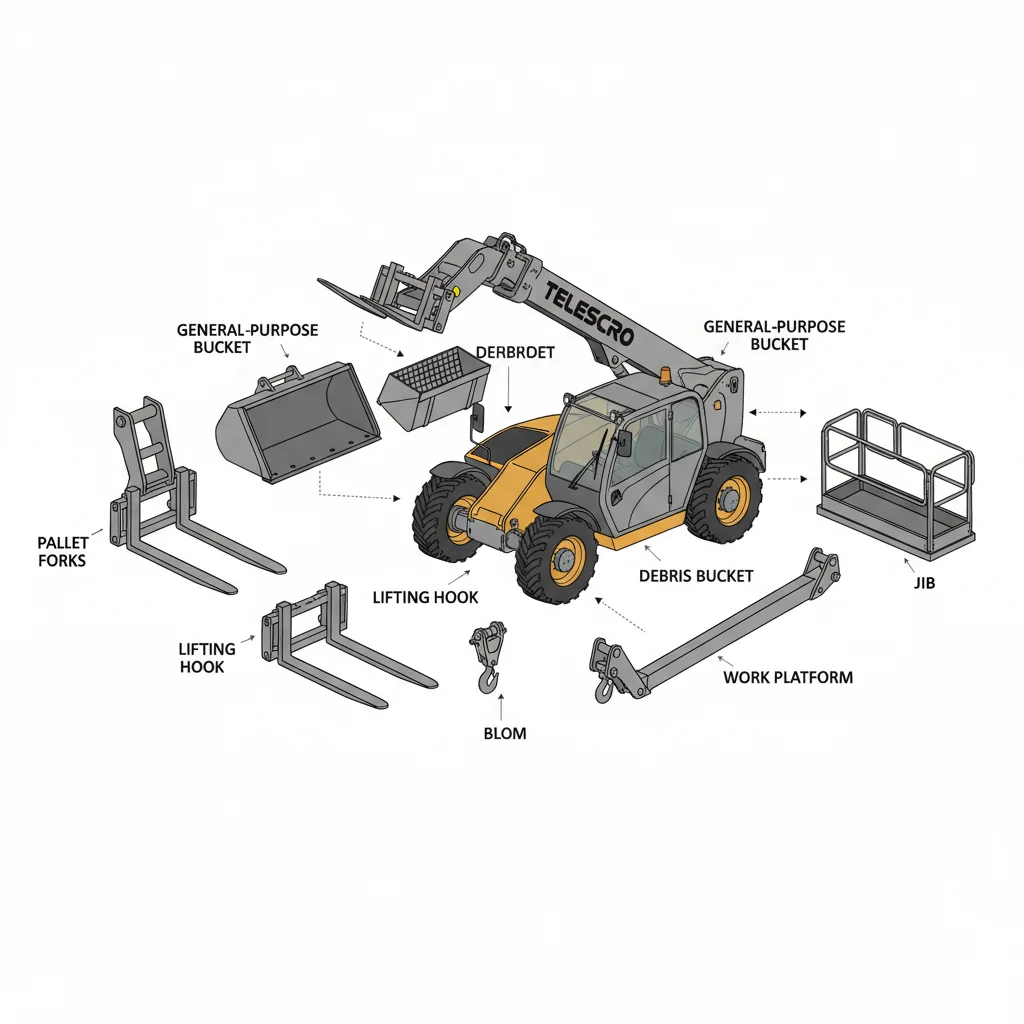
Most people don’t realize that telehandlers are so adaptable mainly because of the quick coupler2 and the broad range of attachments that fit it. On almost every jobsite I’ve visited—from high-rises in Dubai to grain yards in Australia—there’s a “core kit” crews count on for daily work. It usually starts with 48 to 72-inch pallet forks (or two sets for heavy rotation), at least one certified lifting hook for slings, and a choice of buckets, depending on whether you’re moving gravel, sand, or trash.
Here’s how the main attachments compare for typical use:
| Attachment | Typical Use | Capacity (approx.) | Special Notes |
|---|---|---|---|
| Pallet forks | Pallet loading/unloading | 2,000–5,000 kg | 48–72 in. types, quick swap |
| Lifting hook | Suspended loads | 2,000–4,000 kg | Needs certified adapter |
| General bucket | Gravel, sand, debris | 0.8–1.5 m³ volume | Optional bolt-on teeth |
| Work platform | Personnel, tools at height | Follows telehandler rating | Safety rails required |
| Lifting jib | Pipes, beams, odd shapes | 1,000–3,000 kg | Variable extension lengths |
Last year, I helped a client in Kazakhstan outfit two telehandlers for a six-month project building warehouses. By rotating forks, a 1.2 m³ bucket, a jib, and a 4-person platform, the team saved at least two weeks compared to using several single-purpose machines. That kind of flexibility is where telehandlers prove their value.
Certified lifting hooks on telehandlers must have a working load limit at least equal to the maximum rated capacity of the telehandler’s boom to ensure safe sling operationsTrue
Lifting hooks are rated to match or exceed the telehandler’s maximum boom capacity, preventing overloading during sling lifting tasks and maintaining compliance with safety standards. Using hooks with lower ratings risks equipment failure and accidents.
Most telehandler attachments, including pallet forks and buckets, are standardized globally to fit any telehandler regardless of manufacturer or modelFalse
Attachment compatibility is not globally standardized; quick coupler sizes and hydraulic connections vary significantly between manufacturers and models, requiring specific attachments designed or adapted for each telehandler brand or size class.
Key takeaway: Selecting a core group of telehandler attachments—pallet forks, lifting hooks, buckets, work platforms, and jibs—ensures maximum versatility for most jobsites. Matching certified attachments from top OEMs allows buyers to efficiently switch between lifting, loading, and material handling duties with a single machine.
How Do Couplers and Hydraulics Affect Compatibility?
Telehandler attachments depend on specific coupler types3—such as Manitou, JCB Q-Fit, CAT IT, and JLG/Genie systems—which are not interchangeable without adapters. Moving accessories also require precise hydraulic flow and pressure4. Incorrect coupler selection or inadequate hydraulics can result in poor performance, stalling, and may violate lift capacity limits, leading to operational risks.
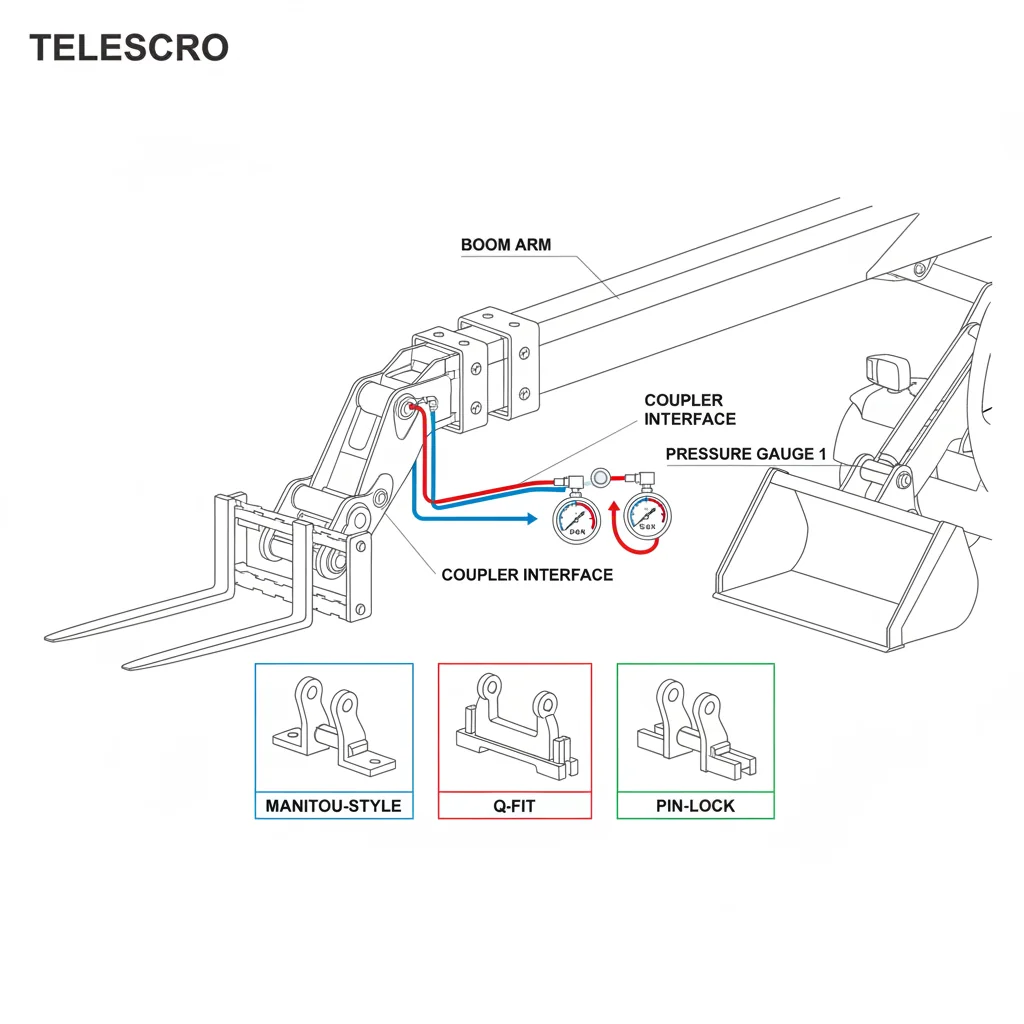
Let me share something important about couplers and hydraulics that often gets overlooked. Attachments are not simply plug-and-play—compatibility is a real issue. Each telehandler uses a specific coupler or carriage system, and these don’t match up unless you use an adapter. The result? I’ve seen a contractor in Poland order a high-capacity bucket for their 4-ton handler, only to realize it wouldn’t fit their coupler on delivery. Waiting two weeks for a custom adapter cost them over $1,000 in lost productivity.
Here’s another point: Moving attachments, like rotating grabs or hydraulic clamps, rely on the machine’s auxiliary hydraulic circuit. It’s not just about having a hydraulic outlet—flow and pressure matter. I worked with a client in Dubai who tried to run a concrete mixer attachment designed for 60 liters per minute, while their machine could only provide 40. The mixer ran slow and stalled under load. This caused them delays and forced a machine swap mid-project. Not only was this frustrating, but it also added unexpected rental and transport costs.
Always check the attachment’s weight and center of gravity against the load chart (which shows the safe lifting limits at different boom positions). A heavier or longer tool can reduce your actual safe load by 30% or more. I suggest verifying three things every time—coupler type, hydraulic flow/pressure requirements, and how attachment weight impacts your lifting chart. Overlooking just one point can lead to costly downtime or, worse, unsafe operations.
Telehandler coupler standards vary globally, with European machines often using the Euro quick hitch system, which is incompatible without adapters on many North American modelsTrue
The Euro quick hitch has distinct geometry and pin spacing compared to North American standards, meaning attachments must be matched or adapted; this mismatch causes common compatibility issues internationally.
Hydraulic quick couplers universally allow telehandler attachments to be swapped without any pressure loss or flow rate reductionFalse
While hydraulic quick couplers facilitate faster attachment changes, they can introduce minor pressure drops or flow restrictions depending on their design and condition, potentially affecting attachment performance.
Key takeaway: Always verify a telehandler’s coupler type, auxiliary hydraulic specifications, and the effect of an attachment’s weight on the load chart before purchasing or renting. Compatibility gaps between couplers, hydraulic flow, and pressure often lead to performance loss, safety violations, or costly equipment downtime.
What Factors Determine Telehandler Attachment Compatibility?
Telehandler attachment compatibility depends on matching the accessory’s load rating5 to the machine’s safe capacity at actual boom reach and angle. Hydraulic flow and pressure requirements6 must fit the attachment—especially for powered accessories. Load center shifts, visibility impacts, and job-task alignment also affect safe and efficient selection. Dealer-supplied compatibility charts provide model-specific guidance.
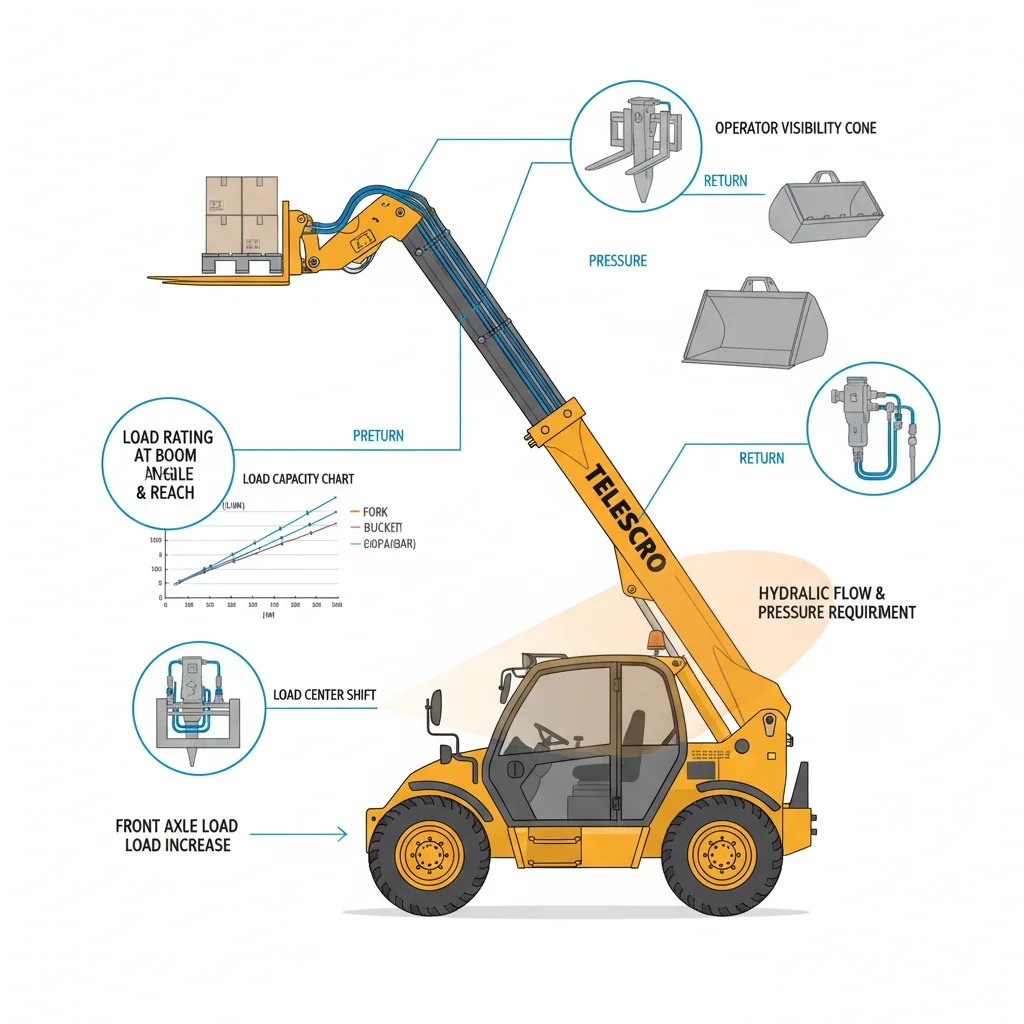
The biggest mistake I see is buyers assuming that if an attachment physically locks onto their telehandler, it’s automatically safe to use. That’s not the case. When you look closer, real attachment compatibility is about more than coupler size. I’ve worked with a warehouse project in Dubai where the team tried to use a four-ton lifting jib on their 3-ton telehandler. The result? At a 12-meter reach, the rated load dropped to less than 1,100 kg—well below what their job required. Even though the jib “fit,” it didn’t match the true capacity at working extension.
Here’s what you need to consider before selecting any telehandler attachment:
- Actual load rating at reach—Always check the load chart (the grid showing safe weight limits at different boom angles and lengths). Headline max capacity isn’t enough; it’s the real number at your extension that counts.
- Hydraulic requirements—Powered tools, like rotating grabs or winches, need a specific oil flow and pressure. I’ve seen machines in Brazil offline for days because the hydraulic circuit couldn’t supply a new bucket’s requirements.
- Load center and balance—Long jibs and wide buckets shift the load forward, often cutting working capacity by 20-30%. This can tip a safe machine into dangerous territory faster than most expect.
- Visibility and safety—Oversized buckets or high attachments limit sightlines to your load or ground crew, which is a real risk on busy jobs.
- Job suitability—Match the attachment to your core work—moving blocks, bales, waste, or steel beams—otherwise you’ll end up with underused equipment.
To be safe, I always suggest double-checking model-specific compatibility charts from your dealer before purchase. Showroom fit doesn’t guarantee jobsite safety.
Telehandler attachment compatibility depends not only on coupler size but also on the telehandler’s maximum lift capacity and reach, as using attachments that exceed these limits can drastically reduce the safe working load.True
The rated load capacity of a telehandler decreases with increased reach and heavier attachments; therefore, an attachment designed for a higher-capacity machine may not be safely used on a lower-capacity telehandler despite physical coupling compatibility.
Any telehandler attachment that fits the universal quick coupler on the machine is guaranteed to meet the telehandler’s load rating without adjustment.False
While many telehandlers have common coupler designs, load ratings vary by telehandler and attachment design. Physical fit does not ensure compatibility with the telehandler’s rated capacity, as lift ratings depend on load geometry, reach, and machine hydraulics.
Key takeaway: Effective telehandler attachment selection requires validating real-world capacity at working reach, ensuring hydraulic system compatibility, and considering visibility and operational application. Relying on generic ‘fit’ alone risks safety and performance. Always consult manufacturer or dealer compatibility charts before purchasing or deploying any new lifting accessory.
Which telehandler accessories lift suspended loads?
Lifting suspended and precision loads with telehandlers requires specialized accessories such as lifting jibs, material-handling arms, crane jibs, and coupler-mounted winches. OEM options like fixed or rotating crane jibs and winches mount directly to the coupler, providing crane-like control for HVAC units, roof trusses, and similar loads, while hooks and spreader bars expand rigging flexibility.
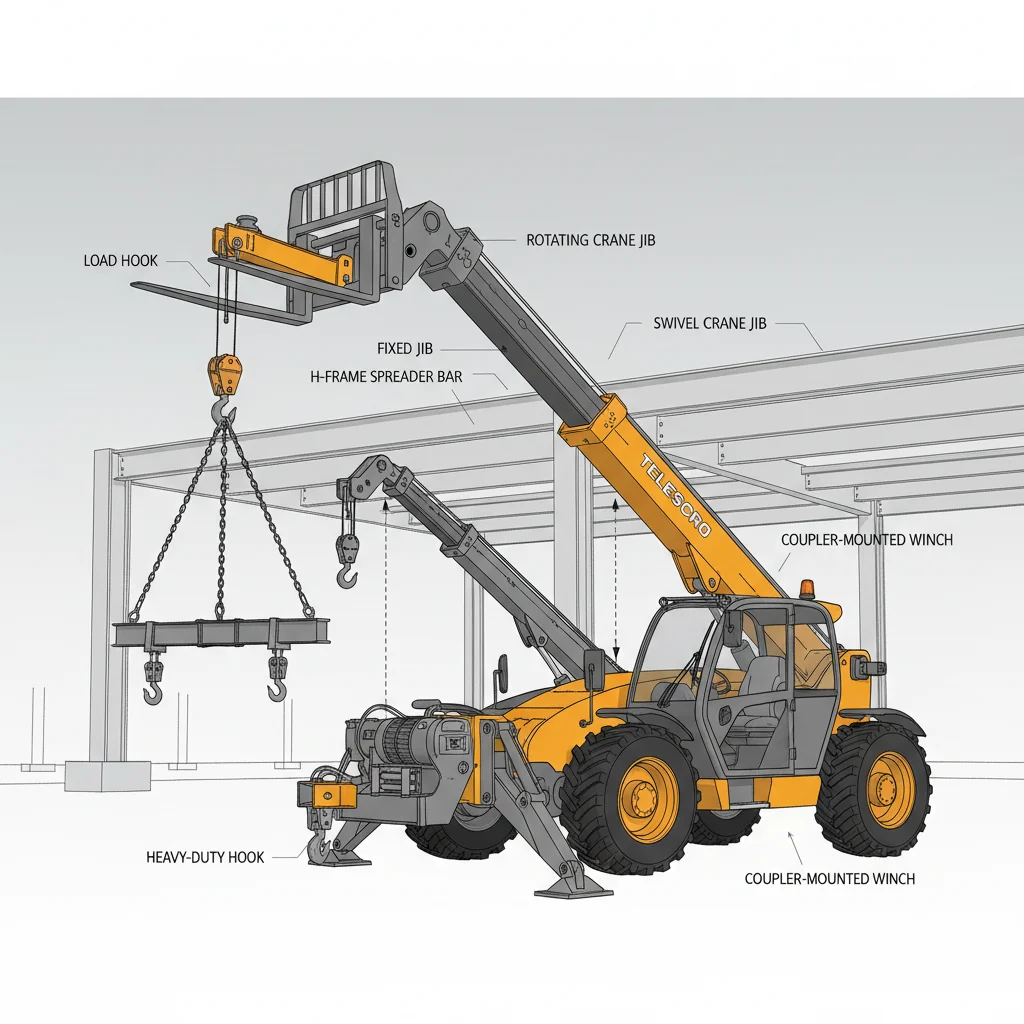
Here’s what matters most when lifting suspended loads with a telehandler: you need the right accessory, rated for your exact machine and the task. Just last year, I worked with a glass contractor in Dubai who needed to set 700-kg window units eight stories high. He thought forks and slings would be enough. But precise placement called for a rotating jib and winch combination—otherwise, alignment was impossible and there was real risk of swinging the load. Different accessories have specific uses and limitations.
To make it clear, I’ve summarized the key telehandler accessories for suspended and precision lifting below:
| Accessory Type | Typical Use Cases | Max Rated Capacity | Max Reach | Special Features |
|---|---|---|---|---|
| Fixed Lifting Jib | Roof trusses, beams | 2,000–3,500 kg | 7–18 m | Simple, cost-effective |
| Rotating Crane Jib7 | HVAC units, rebar bundles | 1,000–3,000 kg | 12–18 m | Swivel head, better control |
| Coupler-Mounted Winch8 | Precast, glass panels | 900–2,500 kg | 10–15 m | Vertical lift, no forks |
| Fork-Mounted Lifting Hook | Palletized, odd shapes | 1,000–4,000 kg | 7–15 m | Quick fit, basic precision |
| Spreader Bar | Long, flexible items | 1,000–2,000 kg | 8–12 m | Load leveling, stabilizes length |
Even load distribution | Capacity is always lower with suspended loads—sometimes by 30% compared to forks.
A rotating jib equipped with a winch can improve load placement accuracy by enabling 360-degree rotation and vertical lifting, reducing the risk of load swing during high-elevation lifts up to 8 stories.True
Rotating jibs provide precise angular positioning combined with controlled vertical movement via a winch, essential for delicate and high-elevation installations such as setting heavy glass panels, minimizing load swing and alignment errors.
Standard telehandler forks combined with lifting slings can safely handle all suspended loads regardless of weight or height without additional accessories.False
Standard forks and slings alone often lack the control and load stabilization required for precise, high-elevation lifts; specialized accessories like rotating jibs with winches are necessary to prevent swinging and ensure safe, accurate placement of suspended loads.
Key takeaway: Always match telehandler accessories—like jibs, winches, hooks, and custom devices—to both the load type and machine ratings. Only use accessories engineered for telehandlers, verify capacity using ‘with attachment’ load charts, and consult the OEM or a qualified engineer for any non-standard lifting configurations.
When Can Telehandlers Lift People Safely?
Telehandlers may lift personnel only when equipped with engineered, model-approved work platforms9 specifically certified for man-lifting on that telehandler. Acceptable platforms feature secure fork pockets, guardrails, toe boards, and tie-off points. Using generic baskets, non-certified platforms, or adapters violates OSHA and EN 1459 standards and may create serious safety and compliance risks. Documentation and operator training are also mandatory.
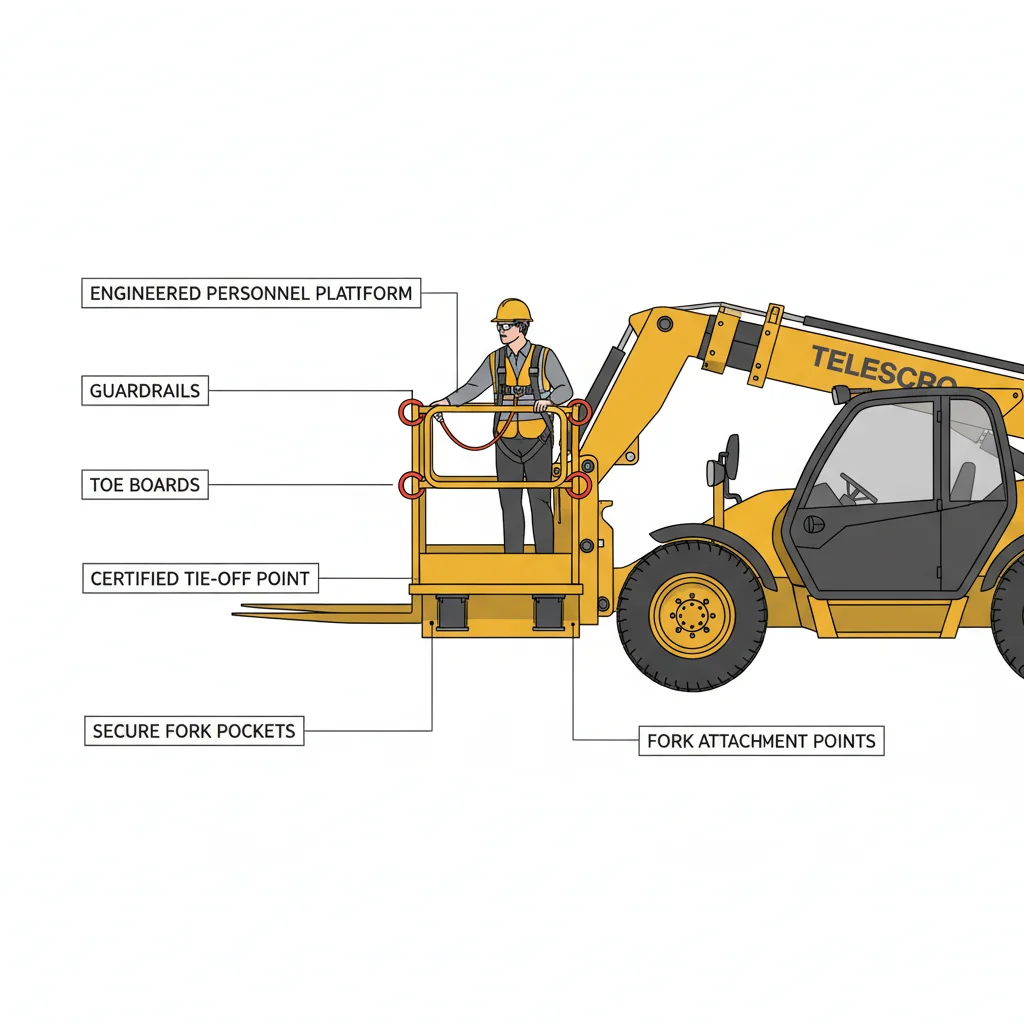
Last winter, I had a call from a contractor in Dubai who wanted to use their standard telehandler with a forklift basket for quick facade repairs, about 14 meters up. I explained that this setup isn’t just risky—it’s actually non-compliant under both OSHA and European EN 1459 standards. Telehandlers can only lift people safely when paired with work platforms specifically engineered and certified for man-lifting on that exact model.
These platforms aren’t simple baskets; they have reinforced fork pockets, full guardrails, toe boards, and at least two tie-off anchor points for harnesses. You’ll see clear labels listing the compatible telehandler model and a load rating, usually around 300 kg for a 4×6-foot platform.
I’ve seen operators in Kazakhstan add aftermarket adapters or use baskets designed for forklifts. It may look secure, but these solutions create major hazards—the main one is bypassing the telehandler’s moment indicator10, a device that measures load position to prevent tip-over. With uncertified platforms, safety systems often aren’t engaged, and that puts everyone at risk. Most manufacturers also require an overload indicator, and some sites in Singapore even mandate secondary emergency controls inside the platform.
Another detail that’s often missing is documentation. From my experience, if your work platform paperwork doesn’t match your telehandler’s serial number, you’ll fail jobsite safety checks and sometimes face stop-work orders. For short-term, elevated jobs, renting a certified platform—or even a scissor lift—usually makes more sense than improvising. I always recommend checking both certification paperwork and operator training records before any lift involving people.
Certified man-lifting platforms for telehandlers must include reinforced fork pockets and secure attachment mechanisms tailored to the telehandler’s specific load chart to ensure safe personnel lifting up to heights of 20 meters or moreTrue
Work platforms designed and certified for telehandler man-lifting are engineered with reinforced fork pockets and locking mechanisms that match the telehandler’s geometry and load capacities, adhering to standards like EN 1459, which is essential to maintain stability and prevent accidents at substantial heights.
Any standard forklift basket can be safely used on telehandlers for lifting personnel as long as the operator respects the maximum load capacity indicated on the telehandler’s data plateFalse
Standard forklift baskets are not engineered or certified for lifting personnel when attached to telehandlers; safety standards require specific man-lifting platforms because regular baskets lack structural reinforcements, secure attachments, and fail to account for dynamic stability and safety factors beyond simple load capacities.
Key takeaway: Lifting people with a telehandler is only allowed and safe when using a certified, telehandler-compatible work platform approved for that specific model. Non-approved baskets and makeshift solutions violate regulations and compromise safety. For work-at-height, always use documented, engineered platforms, and ensure operators undergo specific training.
How do buckets and grapples boost telehandlers?
Buckets and grapple buckets11 transform a telehandler into a versatile light loader for site cleanup, demolition, and debris handling. Attachment options include general-purpose buckets, light material buckets, grapple buckets, concrete hoppers, and trash hoppers. Correct capacity matching ensures safe operation, as oversized buckets can exceed forward stability12 limits before hydraulic overload occurs.
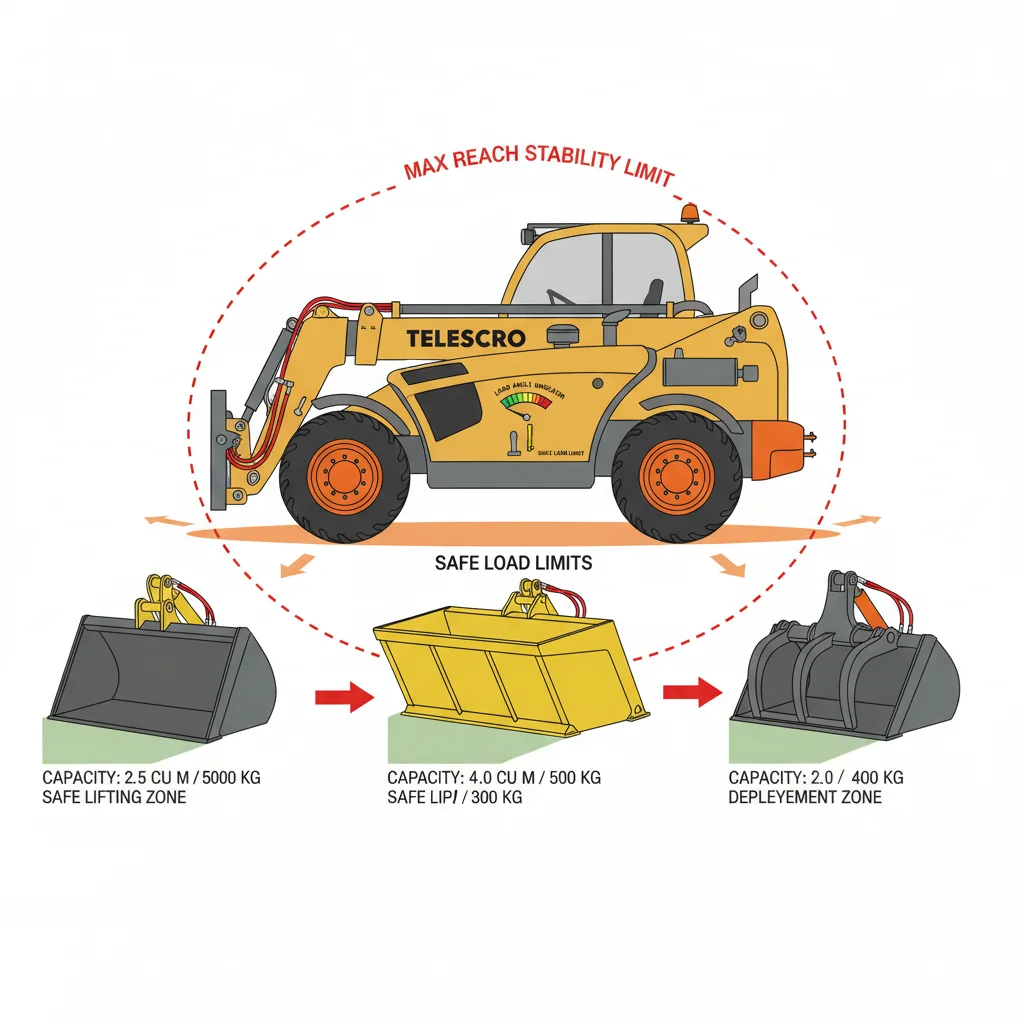
To be honest, the spec that actually matters is whether your telehandler can safely handle a full bucket of wet rubble—not just dry soil. I’ve seen this catch out more than one customer. Last spring, a team in Dubai needed a quick way to clean up demolition debris between high-rise slabs. They requested the largest bucket possible, thinking bigger meant faster. But even on a 4-ton, 14-meter machine, a heaped 1.2 cubic meter bucket of broken concrete approached the limit way before the hydraulic system maxed out. The telehandler’s forward stability became the real constraint—not the lifting power.
Buckets and grapples let your telehandler become a cleanup tool, not just a forklift. The most popular options I see are general purpose buckets (about 0.7-1.0 cubic meters) and light material buckets with bigger volume for things like mulch or insulation. For tougher jobs, an industrial grapple bucket is incredibly useful on sites with tangled rebar, roots, or torn-up roofing materials. Just last month, a customer in Kazakhstan added a 0.8 cubic meter grapple—transforming their standard fleet unit into a debris specialist for post-storm site work. They told me the job finished at least two days faster.
Capacity charts matter here. I always suggest matching the bucket width and volume to the telehandler’s real load chart at half and full extension. Don’t forget material density—wet sand isn’t the same as scrap foam. For grapples, make sure your auxiliary hydraulics provide enough flow so the clamp acts quickly. In my experience, most fleets start with a standard GP bucket, then add hoppers or grapples only once new needs become obvious.
Telehandlers equipped with high-capacity buckets must account for the increased hydraulic pressure caused by wet, dense materials like rubble, which can exceed 1200 kg/m³, reducing lifting safety margins even if the bucket volume remains constant.True
Wet demolition debris has significantly higher density than dry soil, increasing the load weight and hydraulic system pressure during lifting. Operators must consider this to avoid exceeding the telehandler's rated capacity and risking hydraulic or structural failures.
Using a grapple attachment on a telehandler allows the machine to lift up to twice its rated load capacity due to the improved grip distribution and leverage.False
Attachment type does not increase the telehandler’s rated load capacity; lifting capacity is defined by the machine’s structural design and hydraulics. While grapples improve material handling precision, they do not alter maximum safe load limits.
Key takeaway: Buckets and grapples expand telehandler capability, enabling debris, waste, and material handling tasks. Proper selection considers capacity charts, typical material density, and hydraulic requirements to avoid overloading. Fleets should prioritize standard buckets, adding specialty attachments only when recurring operational needs arise.
Which telehandler attachments boost agricultural performance?
Specialized telehandler attachments—such as bale spears, grabs, silage and manure buckets13, and pipe/pole grapples—enable safe and efficient handling of diverse agricultural loads. OEM-approved tools optimize material transport, minimize damage, and enhance operator safety compared to standard forks. Compatibility requires attention to coupler type and adequate auxiliary hydraulics for reliable clamp or grapple function.
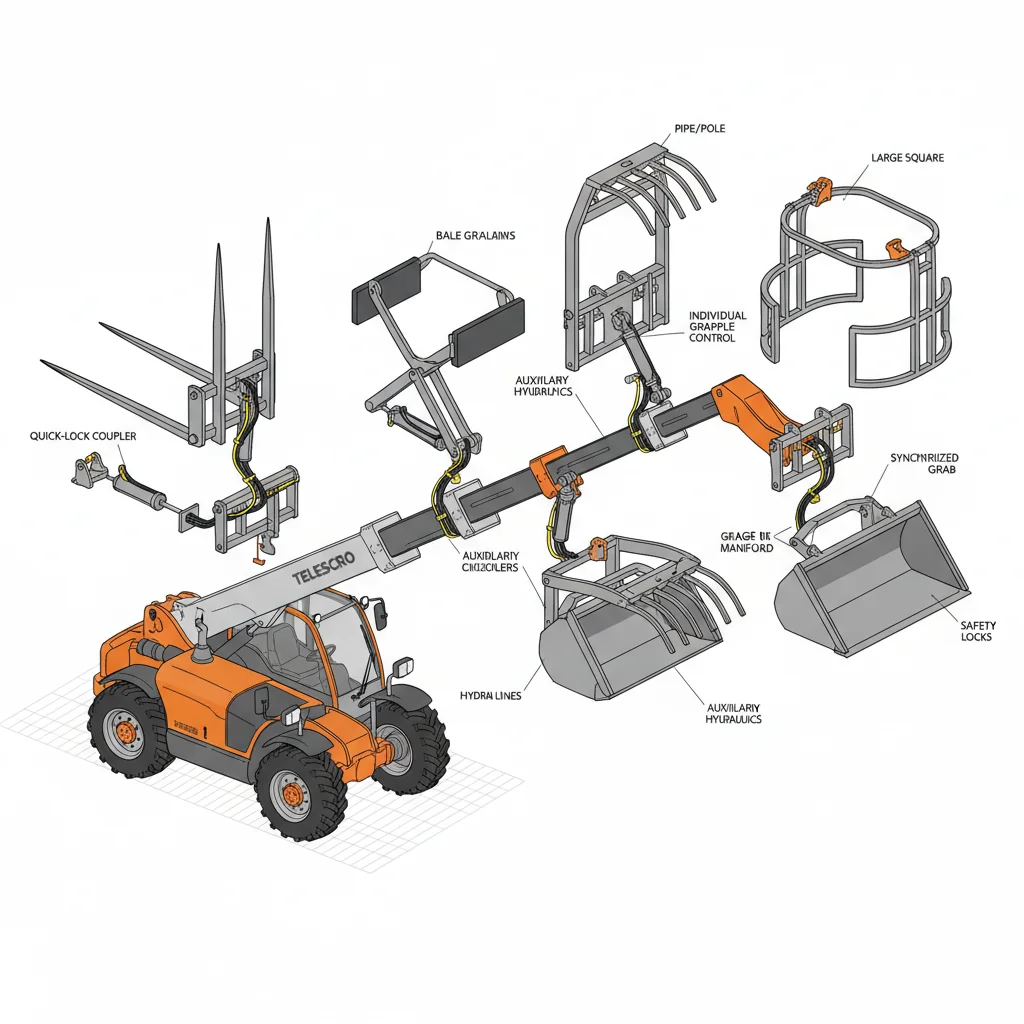
Last spring, a farm co-op in Kazakhstan asked how to safely move heavy round bales without tearing the plastic wrap. I recommended a bale grab, which clamps from the side rather than spearing the bale. This dramatically reduced crop loss and downtime—especially at stacking heights above 5 meters. Many buyers still default to pallet forks for all agricultural tasks, but that’s limiting. From my experience, the right attachment easily doubles both output and safety.
Let’s break down the most useful telehandler attachments for agriculture:
- Bale spears – For moving round or square bales without shifting. Fast for stacking inside barns.
- Bale grabs14 (clamps) – Secure wrapped bales without piercing, preventing spoilage.
- Silage and manure buckets – Extra-wide capacity to handle bulk material like chopped feed, silage, or manure. Typical buckets hold 2–3 cubic meters, much more than a standard bucket.
- Pipe/pole grapples – Essential for fence posts, irrigation pipe, or stacking round items. They clamp down to prevent rolling—much safer on uneven ground.
Here’s a simple comparison of these attachments:
| Attachment | Best Use | Capacity | Hydraulic Needed | Key Advantage |
|---|---|---|---|---|
| Bale spear | Unwrapped bales | 800–1,200 kg | No | Quick bale transport |
| Bale grab (clamp) | Wrapped bales | 800–1,000 kg | Yes | Prevents wrap damage |
| Silage bucket | Bulk silage/manure | 2–3 m³ load | No | Moves loose/light materials |
| Pipe/pole grapple | Round loads | Up to 1,000 kg | Yes | Secure grip on long round items |
Bale grab attachments designed for telehandlers apply uniform side pressure, reducing damage to plastic wrap by up to 80% compared to spear forksTrue
Bale grabs clamp round bales gently from the sides without piercing them, preserving the plastic wrap integrity and significantly minimizing crop loss, especially important when stacking above 5 meters.
Using pallet forks instead of specialized attachments like bale grabs increases lifting capacity by 50% on telehandlers in agricultural applicationsFalse
Pallet forks are not designed to handle round bales safely and do not increase lifting capacity; in fact, using the wrong attachment can reduce operational efficiency and increase risk of damage or accidents.
Key takeaway: Equipping a telehandler with purpose-built agricultural attachments—like bale spears, material buckets, and pipe grapples—unlocks far greater value and versatility than pallet forks alone. Always confirm mechanical fit and hydraulic compatibility to ensure efficient, safe operation in mixed farming, yard, and contracting environments.
Can Telehandlers Use Skid Steer Attachments?
Telehandlers can often operate skid steer-style attachments using a telehandler-to-universal skid steer adapter plate. Official OEM adapters exist for compact models, enabling use of augers, brooms, and small buckets. However, such adapters are rarely approved for lifting people or heavy loads, and using non-approved attachments may void warranties and increase liability. Always verify compatibility and restrictions with the manufacturer.
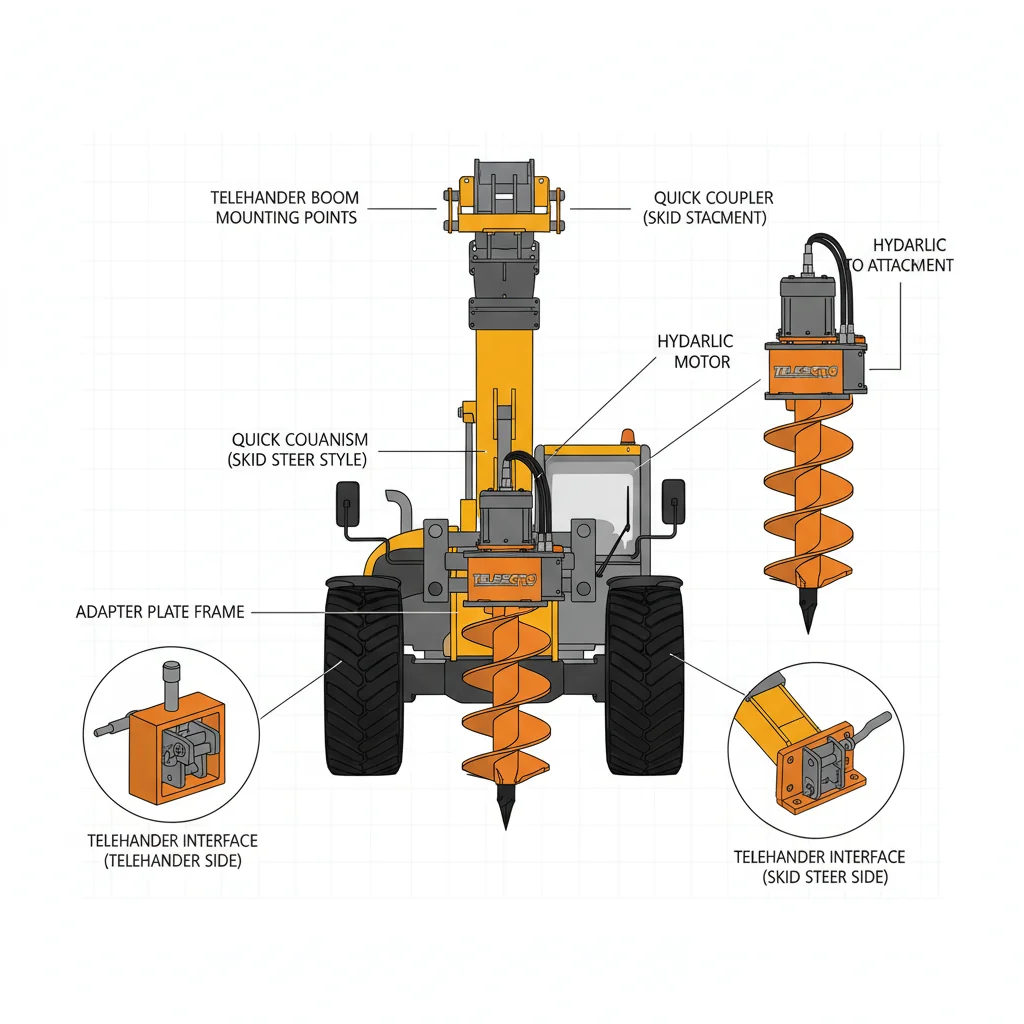
I’ve worked with customers who made this mistake—assuming any skid steer attachment will fit straight onto their telehandler. The reality is more complicated. For compact telehandlers, an adapter plate (sometimes called a universal skid steer coupler) can let you use tools like light buckets or angle brooms. I saw this on a jobsite in Dubai last year. A contractor there switched between an auger and a small sweep broom for outdoor maintenance. It worked well for light groundwork, but there were strict limits.
Here’s what most people miss when using these adapters:
- Hydraulic demand15 matters – Many skid steer attachments need more hydraulic flow and pressure than a compact telehandler can give. For example, a light-duty broom might need 50-60 L/min, but some telehandler auxiliary circuits max out at 45 L/min.
- Capacity and balance – Attachments designed for skid steers can push a telehandler’s rated load even with modest weight. Always check the load chart—your machine may only allow 500 kg at full extension with a non-original tool.
- Warranty and liability – Using non-approved adapters or attachments can void your warranty and may put your insurance at risk if there’s an accident.
- Personnel lifting is never approved – I’ve had questions from customers in Kenya wanting to use a skid steer work platform on their telehandler. Every manufacturer I know prohibits this—use only purpose-built access platforms.
My advice? Treat these adapters as a way to run select light-duty tools, not a shortcut for heavy lifting or personnel work. Always confirm with your dealer or OEM what attachment types and weights are safely allowed for your model.
Key takeaway: Adapter plates enable some telehandlers to run light-duty skid steer and mixed-brand attachments for ground work, but strict limits apply. Heavy or personnel lifting is not permitted, and using non-approved tools risks warranty and safety liability. Always consult the OEM before purchase to confirm approved use cases.
How Should Buyers Weigh OEM vs Aftermarket Attachments?
OEM telehandler attachments16 cost 20–40% more but are engineered for model-specific safety, warranty retention, and regulatory compliance. Aftermarket options may require $300–$800+ adapters and extra engineering checks. Industry best practice: use OEM for safety-critical accessories, consider quality aftermarket for simple ground-level tools, and rent seldom-used specialized attachments to optimize total ownership cost.
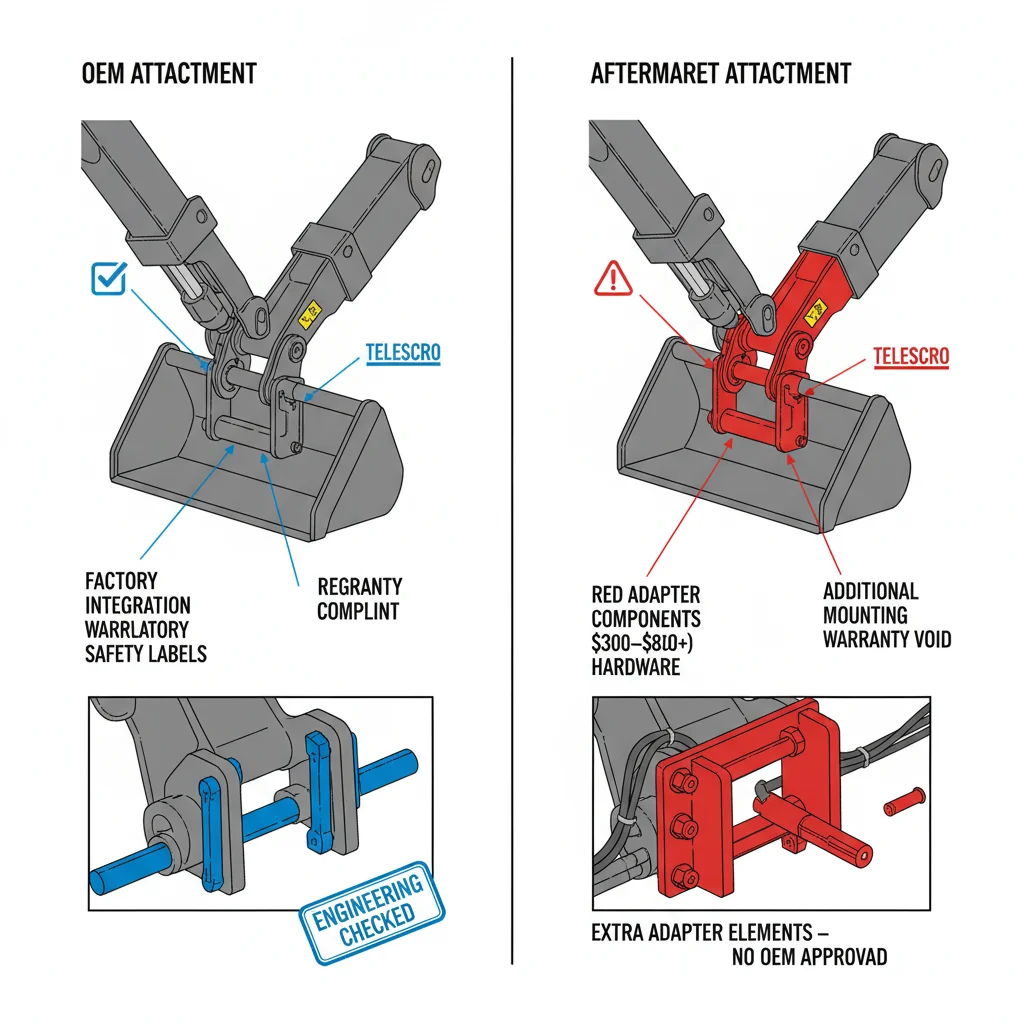
Let me share something important about balancing OEM and aftermarket attachments—this is a topic that comes up with almost every fleet manager I speak to. The price gap is real: OEM attachments can be 20–40% higher up front. But what you’re paying for is fit, verified capacity, and that all-important warranty protection. For instance, last year I helped a logistics company in Dubai replace a personnel platform.
The manager tried to save costs with an aftermarket unit. In the end, local regulations flagged a missing compliance plate and the rental office demanded OEM paperwork for insurance. They spent an extra $700 just on adapters and still had to swap back to OEM.
Here’s a quick comparison I use with new buyers:
| Factor | OEM Attachments | Aftermarket Attachments |
|---|---|---|
| Upfront Cost | 20–40% higher | Lower, but may need adapters |
| Safety Certification | Model-specific, easy compliance | Varies, may lack local approval |
| Warranty Impact | Maintains factory warranty | Can void/limit manufacturer cover |
| Fit/Compatibility | Direct fit, no re-engineering | Sometimes needs $300–$800 adapters |
| Application | Best for load handling, personnel, safety tasks | Simple ground tools, low risk |
From my experience, OEM or OEM-approved is the only safe route for lifting jibs, hooks, buckets over 1,500 kg, or anything involving personnel. For simple, non-critical tools—like sweepers or grain pushers—I’ve seen reputable aftermarket brands perform well if the ratings are verified.
OEM telehandler attachments are tested and rated to match the machine's exact load chart, ensuring compatibility with lifting capacities specified within ±5% accuracyTrue
OEM attachments undergo rigorous testing with the specific machine models they are designed for, aligning attachment capacity ratings closely with the telehandler's load chart to maintain operational safety and compliance.
Aftermarket telehandler attachments are always designed to exceed OEM lifting capacities by at least 10% to provide better performanceFalse
Aftermarket attachments are not universally designed to exceed OEM specifications; in fact, many lack comprehensive testing and certification, meaning their rated capacities may be approximate or lower than OEM standards, risking safety and machine damage.
Key takeaway: Prioritize OEM or OEM-approved attachments for load handling, personnel lifting, or safety-intensive tasks. Use reputable aftermarket tools for non-critical jobs. For infrequent needs, rental is often most economical. Plan coupler and hydraulic spec at purchase to maximize long-term compatibility and minimize costly retrofits.
What Safety Checks Do Telehandler Attachments Require?
Safe telehandler lifting demands treating the telehandler, coupler, attachment, and rigging as a unified engineered system. Only manufacturer-rated attachments17 with proper capacity plates and documentation should be used. Below-the-hook devices must be explicitly approved for lifting. Regular maintenance—including greasing, inspecting for wear, and recording service details—minimizes equipment failure and upholds compliance with safety regulations such as OSHA.
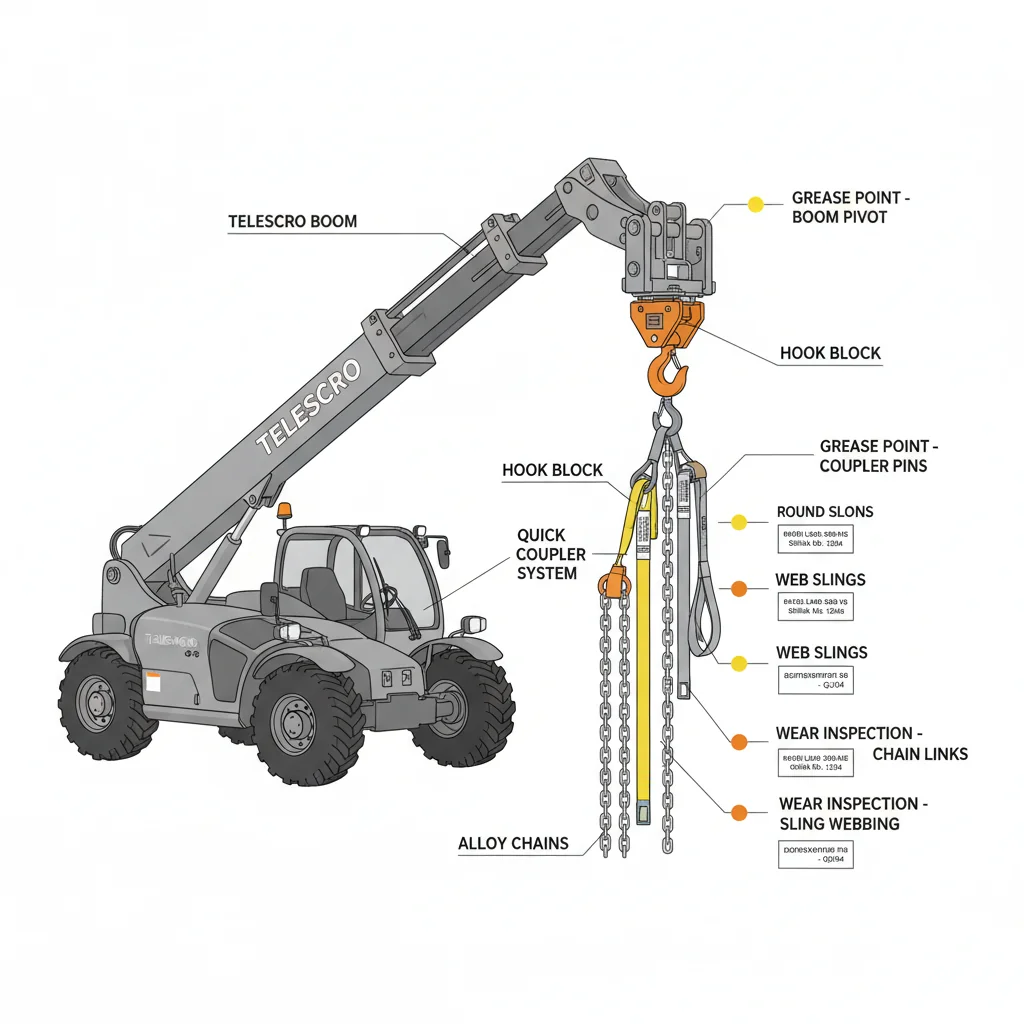
I often get questions about which safety checks really matter with telehandler attachments, especially from new project managers. The reality is, treating the telehandler, coupler, and attachment as a single engineered system isn’t just theory—it saves lives. Let’s look at the essentials. From my experience, some sites skip a critical first step: confirming the attachment has a clear capacity rating and manufacturer-approved documentation.
I saw this go wrong on a jobsite in Kenya—a team used a generic bucket for lifting without any capacity plate. The hydraulic circuit overheated, and the machine locked out. They lost almost a full day getting a service tech in just to reset the load moment indicator18 and inspect the damaged hoses. Here’s a bullet list of attachment safety checks I recommend before every shift:
- Verify attachment ID – Match serial number and capacity plate with machine records.
- Check documentation – Only use manufacturer-rated attachments; confirm with load chart or manual.
- Inspect structure – Look for cracks, bent tines, worn hooks, or loose welds on forks, jibs, or buckets.
- Hydraulic check – Inspect hoses and coupler connections for leaks or external wear.
- Grease and lube moving parts – Especially on grabs, rotators, and buckets, to prevent premature failure.
- Secure mounting – Ensure the coupler is locked and safety pins are in place.
- Record inspections – Log each check, especially for man-baskets or lifting hooks that may need periodic certified tests.
Telehandler attachments must have manufacturer-approved load charts that specifically include the coupler type used, as improper matching can reduce the rated capacity by up to 20%True
The attachment’s rated capacity depends on the combination of telehandler, coupler, and attachment. Using load charts that incorporate the exact coupler type ensures accurate load limits, preventing overload and potential failure.
Any standard forklift fork attachment is universally compatible with telehandlers without affecting load capacity or safety certificationsFalse
Forklift forks are not universally compatible with telehandlers because telehandlers have different coupler systems and load dynamics. Using non-approved forks can void safety certifications and reduce load capacity, increasing accident risks.
Key takeaway: Properly rated attachments, clear documentation, and rigorous maintenance are essential for safe telehandler operation. Routine inspections and accurate recordkeeping help ensure equipment compatibility, prevent costly failures, and satisfy regulatory requirements, protecting both personnel and assets during lifting operations.
Conclusion
We talked through the main telehandler lifting attachments and how using a few well-matched, certified tools can cover most typical jobsite needs. From my experience, buyers who really get the most from their telehandler pay close attention to compatibility and double-check load charts at actual working positions—not just what looks good in the brochure. I’ve seen too many crews fall for "showroom hero, jobsite zero" setups, only to discover limitations once work starts. If you have questions about mixing attachments, local parts support, or want to know what works for jobs like yours, just reach out—I’m happy to share what I’ve seen work for real projects. Every site is different—choose what really works for your workflow.
References
-
Detailed insights into pallet forks’ sizes, typical capacities, and why they’re essential for daily telehandler operations on diverse jobsites. ↩
-
Explores the technical benefits of quick couplers for fast tool changes and broad telehandler attachment compatibility across applications. ↩
-
Provide a detailed introduction to different types of couplings and their compatibility considerations across various lift models, helping engineers avoid mismatches that could lead to unplanned downtime. ↩
-
Offer an in-depth analysis of how hydraulic flow and pressure affect attachment performance, including practical cases such as poor operation of concrete mixers, to improve overall equipment utilization. ↩
-
Explore how accurate load ratings ensure telehandler safety and prevent equipment failure by matching capacity at various boom angles and reaches. ↩
-
Learn about the critical hydraulic needs for powered telehandler accessories, ensuring proper operation and avoiding costly downtime. ↩
-
Detailed insights on how rotating crane jibs enhance control and precision when lifting HVAC units and rebar bundles with telehandlers. ↩
-
Expert explanation on coupler-mounted winches that provide crane-like control, improving safety and precision for heavy and suspended lifts. ↩
-
Provides detailed insights on safety-certified platforms designed specifically for telehandler man-lifting, preventing OSHA and EN 1459 violations. ↩
-
Explains the critical role of moment indicators in monitoring load positioning to ensure telehandler stability and operator safety during lifts. ↩
-
Explore how grapple buckets enhance telehandlers for handling tangled debris, increasing site cleanup efficiency and operational safety. ↩
-
Understand forward stability limits and how exceeding them affects telehandler safety and lifting capacity, especially with heavy or wet loads. ↩
-
Detailed insights on how specialized buckets increase capacity and efficiency for bulk agricultural materials like silage and manure. ↩
-
Explains how bale grabs secure wrapped bales without damaging them, reducing crop loss and enhancing operator safety in farming. ↩
-
Explains hydraulic flow and pressure requirements for skid steer attachments to avoid overloading telehandler circuits and maintain safety. ↩
-
Provide a detailed explanation of the advantages of OEM attachments in terms of safety, warranty protection, and regulatory compliance, helping purchasers make more informed decisions when balancing cost and safety considerations. ↩
-
Detailed insights on the safety and compliance benefits of using manufacturer-rated attachments, crucial for preventing equipment failure and accidents. ↩
-
Expert explanation on how load moment indicators prevent overload conditions and improve operational safety on telehandlers. ↩