











Telehandler Lifespan: What Real Buyers Should Expect (Field Experience)
Earlier this year, a fleet manager from South Africa sent me photos of a battered yet reliable telehandler clocking over 14,000 hours—still feeding concrete hoppers daily, despite what most specs suggest. Stories like his always remind me: equipment life isn’t just about numbers on a spec sheet.
Telehandler service life is driven mainly by total operating hours, duty severity, and maintenance discipline. For most mainstream machines maintained to OEM schedules in standard applications, a practical core service window is typically around 8,000–12,000 hours. Sustained heavy-duty work, harsh environments, or poor operation can shorten this to roughly 5,000–8,000 hours, while light-duty use combined with disciplined maintenance and timely component rebuilds can extend service well beyond 15,000 hours.
What Is a Realistic Telehandler Lifespan?
Mainstream telehandlers typically deliver a core lifespan of 8,000–12,000 operating hours under standard, well-maintained conditions. High-quality or larger units may reach 10,000–15,000 hours, while heavily used or abused machines may see practical life reduced to 5,000–7,000 hours before major rebuilds become necessary.

Most buyers expect a telehandler to last many years, but the more practical question is how many productive operating hours it delivers before repair frequency and downtime begin to rise. In typical applications, mainstream telehandlers commonly achieve around 8,000–12,000 hours when operated within rated limits and maintained to OEM schedules. This aligns with fleet data I’ve reviewed and with a contractor I worked with in Dubai, where three 3.5-ton machines each surpassed 10,000 hours with routine servicing—engine oil changes at roughly 500-hour intervals, and hydraulic oil and filter service performed per factory recommendations. Beyond that point, wear items such as bushings, seals, and hoses began to drive higher downtime and maintenance cost.
Some buyers aim high and ask about hitting 15,000 or even 20,000 hours. It’s possible—especially with larger or premium machines, or when used for lighter jobs like warehouse work—but it requires two things: strict maintenance and gentle operators. I had a customer in Poland get nearly 16,000 hours out of a 4-ton high-reach unit by keeping a logbook for every inspection, from hydraulic system checks to daily boom lubrication.
On the flip side, jobsites in tough conditions—like a precast yard in Brazil—can wear out a telehandler in as little as 6,000 hours. Constant heavy lifts, dirt, and overloaded booms forced frequent downtime. For most buyers, I suggest planning around a “safe” 10,000 hours of useful life. Anything beyond that is a bonus if you keep up with OEM maintenance schedules and train operators on proper handling. That way, you avoid expensive surprises and budget with confidence.
Telehandlers that are frequently used in harsh conditions like demolition or mining typically experience a significantly shortened lifespan compared to those used in less demanding environments.True
Operating in harsh environments exposes telehandlers to more wear, debris, and stress, which accelerates component fatigue and increases the need for major repairs earlier than telehandlers used in standard material handling or construction applications.
The lifespan of a telehandler is usually unaffected by how consistently the maintenance schedule is followed.False
Adhering to a regular maintenance schedule is critical for prolonging a telehandler's operational life; neglecting maintenance leads to the premature failure of key components and increases the likelihood of major repairs, directly reducing lifespan.
Key takeaway: Most buyers should budget on a baseline telehandler lifespan of around 10,000 operating hours for low-risk, cost-effective use. Higher-quality machines or lighter-duty applications can result in even longer service life if maintenance and operation are carefully controlled.
How Many Years Does a Telehandler Last?
A telehandler typically delivers over 10 years of service life under standard operating conditions. Front-line use spans 7–12 years at 800–1,200 hours annually, while lighter-duty applications at 300–600 hours can extend usable lifespan to 10–15 years. Multi-owner machines often perform reliably across multiple operational cycles.

Let me share something important about telehandler lifespans that buyers often overlook. It’s not just about the year number on the machine—it’s really about annual working hours and how tough your jobs are. For example, I recently worked with a rental company in Dubai running their fleet nearly 1,000 hours per year. Their standard 4-ton telehandlers served as front-line machines for 8–10 years before being rotated out. That’s typical for heavy users: after 8,000–10,000 hours, you’ll see structural wear around the boom pivots, and hydraulic cylinder seals start needing major overhaul. Those units aren’t dead though—they’re just ready for lighter jobs somewhere else.
On the other hand, I’ve sold compact telehandlers to a farm in Kazakhstan that racks up only 350 hours per year. Even after 12 years, those machines mainly show age in hoses and electrics, not core structure. With scheduled maintenance and parts replaced at regular intervals (filters, pins, batteries), they keep working another 2–3 seasons without any scary downtime. The key? Lower hour usage puts less stress on all major components—so the machine ages by calendar years, not just by the clock.
For bigger contractors or rental fleets, it makes sense to plan replacement cycles by year—most start looking at 7–10 years in primary use. But for smaller operators, I suggest tracking total machine hours and checking age‑wear points: look for cracking hoses, brittle wiring, and signs of corrosion1 at pivot points. That’s how you maximize value, even across two or three owners.
A telehandler's typical lifespan is more accurately measured in total engine hours rather than calendar years, as machines subjected to lower annual usage can remain serviceable much longer than heavily-used counterparts of the same age.True
Industry practice bases equipment replacement on accumulated working hours because wear and fatigue occur over time in use, not simply with the passage of years. A lightly used older telehandler may outlast a newer but heavily worked machine.
All telehandlers, regardless of job site conditions or annual hours, will require major structural repairs after eight years in service.False
Structural wear is influenced by both intensity of use and environmental conditions. Light-duty telehandlers that work few hours each year and in less demanding environments can last well beyond eight years without major structural repairs, while heavily-used units in tough conditions may need repairs much sooner.
Key takeaway: Telehandler lifespan ranges from 7 to 15 years depending on annual usage hours and operational intensity. Higher-hour users should plan replacement cycles by years, while low-hour operations can focus on total machine hours and maintenance to maximize value across multiple ownership stages.
How Do Duty and Environment Affect Telehandler Life?
Telehandler lifespan varies widely by application and environment. In clean, light-duty settings such as warehousing or light agriculture, fleets often see five-figure hour totals with strong maintenance records, and some machines run well beyond that with rebuilds. In general construction, service life is usually shorter due to rough terrain, higher shock loads, and dust exposure. In harsh, abrasive, or corrosive conditions, major repairs typically occur earlier and the economic life can be significantly reduced—so inspection and service intervals should be tightened accordingly.

Here’s what matters most when judging telehandler lifespan: how—and where—the machine actually works. Clean warehouses, flat yards, or sheltered agricultural jobs give you the best shot at long service life. I’ve seen compact 3-ton units in indoor logistics run smoothly for over 13,000 hours in central China. That’s because dust, weather, and rough loading cycles are limited. In these conditions, hitting 10,000–12,000 hours with only routine maintenance2 isn’t special at all. The key is lighter, consistent loads—not constant max capacity or rough terrain.
But move that same machine to a busy construction site in Dubai, and things change dramatically. Rough concrete, unpaved ground, exposure to silica dust, and daily shock loads from moving bricks or steel all beat up the transmission and the boom. I worked with a contractor near the Burj Khalifa site who replaced two telehandlers after just over 8,000 hours—even with regular oil changes and hydraulic filter replacements. The machines weren’t destroyed, but loosening joints and corrosion started pushing up repair costs fast.
In the harshest places—like coastal cement plants in Brazil—I always recommend you de-rate your expectations by at least 20%. Salt air, fine abrasive dust, and shift-after-shift operation can mean a nominal 10,000-hour telehandler really needs replacing or a major overhaul after just 7,000 to 8,000 hours. So look beyond just the spec sheet. Don’t expect showroom conditions on tough jobsites. I suggest choosing duty-appropriate machines and planning for more frequent inspections if your site pushes the limits.
Telehandlers operated continually in dusty or corrosive outdoor environments often require major component rebuilds much sooner than those used indoors.True
Harsh environments accelerate wear on critical systems like hydraulics and electricals, reducing time between necessary overhauls even if total hours are similar.
All telehandlers, regardless of jobsite conditions, will achieve roughly the same operational lifespan if maintained per the manufacturer's recommendations.False
Environmental factors such as exposure to dust, weather, and rough terrain greatly influence wear rates and failure modes, so lifespan varies significantly even with proper maintenance.
Key takeaway: Telehandler service life depends not just on design, but also on how and where the machine is used. Light, clean operations maximize lifespan, while harsh environments and heavy-duty tasks can reduce longevity. Proper maintenance and selecting the right machine for each site are essential.
Why Does Maintenance Impact Telehandler Lifespan?
Maintenance discipline is the most controllable factor in telehandler longevity. Regular engine oil changes3 (typically every 500 hours), on-schedule hydraulic filter changes4, daily greasing of boom pins in harsh environments, and keeping hydraulic oil clean can extend service life well beyond 10,000 hours, often outperforming poorly maintained lower-hour machines.
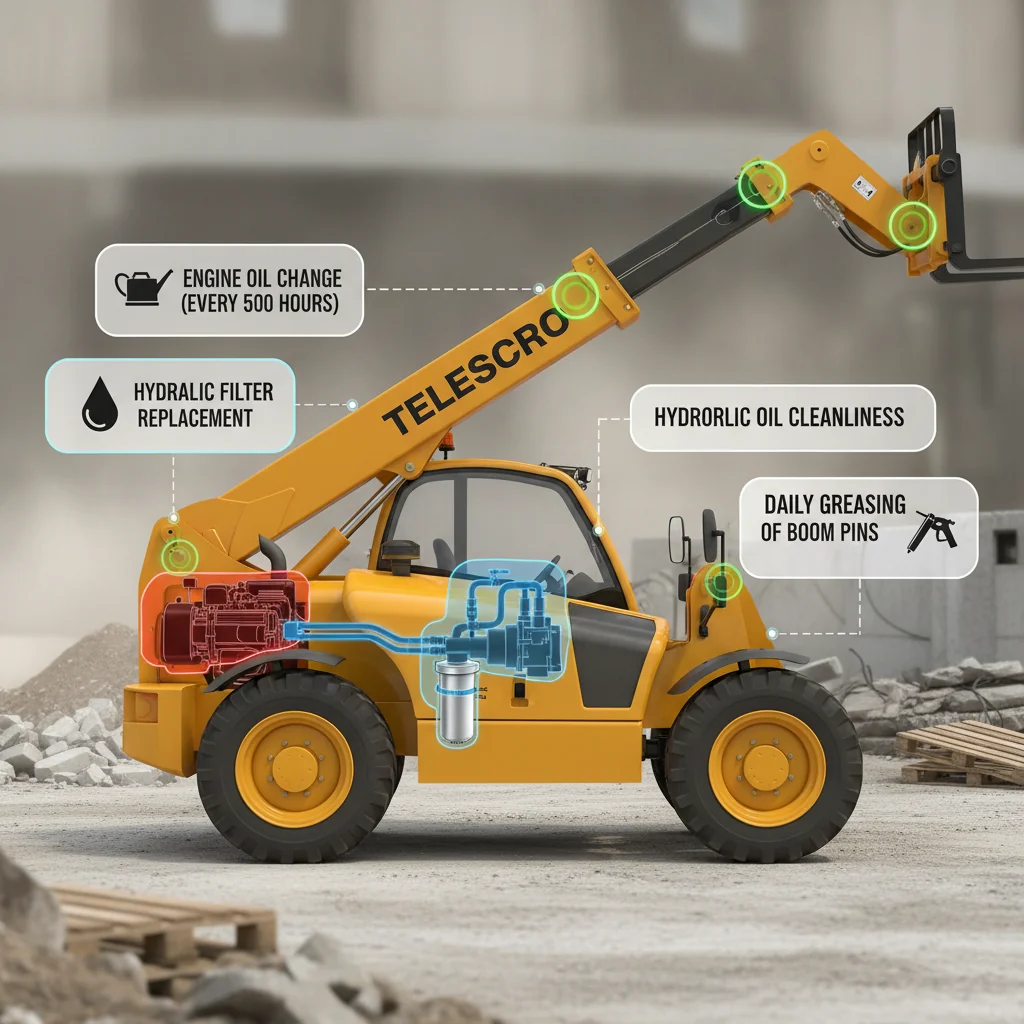
The biggest mistake I see is treating maintenance as a “when there’s time” job instead of part of the daily routine. I’ve worked with a team in Dubai who ran a 3.5-ton telehandler for high-rise construction—hours were racking up fast, but daily greasing and monthly oil checks kept the machine tight and responsive, even after 8,500 hours. Their secret wasn’t fancy technology or the latest model. It was strict discipline: engine oil changed every 500 hours, hydraulic filter swapped every 1,000, and never skipping the operator’s daily walk-around, especially when sand and dust were blowing.
From my experience, what really stretches a telehandler’s service life is sticking to the OEM intervals and not cutting corners. Different fluids have different change schedules—engine oil at 500 hours, but hydraulic oil and filter changes much less often. One customer in Kenya ignored hydraulic oil cleanliness, thinking it could wait. At 3,200 hours, their machine needed a full hydraulic pump rebuild that could’ve been avoided with a simple filter swap. The cost for parts and downtime was almost as much as two years of routine maintenance.
To be honest, most telehandlers will eventually need a major intervention—an engine or hydraulic overhaul—somewhere between 5,000 and 10,000 hours, especially in tough jobs. That’s not a failure; it’s normal wear. But well-maintained units can push well past 10,000 hours before anything major. I always suggest building a clear hour-based maintenance plan and sticking to it. It pays off—less downtime, safer operation, and longer life from every machine.
Neglecting regular hydraulic filter changes can lead to internal contamination, which accelerates wear on critical telehandler components and shortens overall lifespan.True
Hydraulic systems are sensitive to contamination; dirty filters allow abrasive particles to circulate, damaging pumps and valves and increasing the risk of early system failure.
Running a telehandler on a strict maintenance schedule has little effect on component longevity compared to infrequent servicing, as most wear occurs from normal operation rather than maintenance intervals.False
Routine maintenance directly affects component health; tasks like lubrication and fluid replacement reduce friction and prevent buildup of contaminants, significantly extending the usable life of parts.
Key takeaway: Consistent, OEM-guided maintenance—including oil and filter changes, daily greasing, and thorough fluid management—directly determines telehandler lifespan. Well-maintained machines can achieve 10,000–15,000 hours of reliable operation, while neglected units often suffer premature failure regardless of total hours.
How Does Sizing Affect Telehandler Lifespan?
Running a telehandler near its rated capacity or maximum reach on a daily basis accelerates wear on critical components, including boom sections, pins, bushings, hydraulic cylinders, and the drivetrain. In real-world construction use, this sustained high-load operation often brings forward major repairs and shortens overall service life. Selecting a model that typically operates at around 60–70% of rated capacity reduces mechanical stress and can extend usable lifespan by several thousand operating hours.

Last month, I got a call from a contractor in Peru who was having issues with a 3.5-ton, 12-meter telehandler. His crew was lifting heavy block pallets every day—always close to the rated capacity shown on the load chart. After just under 5,000 hours, the main boom developed cracks near the weld joints, and the pins in the articulation points had worn out far faster than he expected. This kind of early fatigue isn’t rare when you’re pushing the machine near its limits all shift, every day.
Here’s the thing: telehandlers are designed to handle their full rated load only under strict test conditions—level ground, specified attachment, and a defined load center. In real life, site surfaces are rarely perfect. If you run at 90–100% capacity for key lifts, hydraulics and structural parts experience far higher stress than during occasional max loads. Boom sections, bushings, and hydraulic cylinders will show wear much sooner, and you start risking unexpected breakdowns or costly rebuilds, sometimes in half the hours you’d normally expect.
I always suggest sizing up for worst-case loads—not just the “typical” pallet or material. On one site in Poland, a customer switched from a compact 3-ton model to a slightly heavier 4-ton machine after seeing constant repairs. Even though daily loads were usually under two tons, the heavier machine ran easier, worked at just 60–70% of its rating, and their maintenance costs dropped noticeably. If you want your machine to last, let it work comfortably within its capabilities instead of right on the edge.
Consistently operating a telehandler at or near its maximum rated capacity can significantly shorten its structural lifespan, especially in critical components like the boom and articulation points.True
Repeatedly using a telehandler close to its load limit causes cumulative stress and fatigue in structural components. Over time, this accelerates wear, resulting in early failures such as cracks or excessive pin wear, even if the machine is not technically overloaded.
The physical size of a telehandler alone determines how long it will last, regardless of how it is used on-site.False
Telehandler lifespan depends more on usage patterns and maintenance than on raw physical size. A larger model can wear out faster if routinely overloaded or misapplied, while a smaller unit operated within its limits can last much longer.
Key takeaway: Telehandlers routinely operated near their rated limits experience accelerated wear and early component failures. Sizing the machine for the most demanding realistic task—so normal loads are below 70% of rated capacity—significantly extends equipment life and reduces long-term maintenance costs.
How Do Engine and Machine Lifespans Compare?
Telehandler engine life is relatively predictable and, with proper maintenance, engines can often be rebuilt or overhauled to extend service. In practice, overall machine lifespan is more commonly limited by hydraulic and structural components—including boom sections, pins, bushings, and pumps—which experience cumulative wear and typically drive major mid-life rebuild decisions in construction applications.

To be honest, the spec that actually matters is rarely just the engine hours. Many buyers assume a telehandler’s service life ends when the engine needs a rebuild, but that’s only part of the story. The real decision comes when the hydraulics—specifically the pumps, cylinders, and valves—and structural wear points show their age. In my experience, a typical 3.5-ton machine in a hot, dusty place like Dubai might need engine work after 5,000 hours. But if the boom pins, bushings, or main wear pads aren’t inspected and serviced at the same time, you risk major downtime.
Last year I worked with a contractor in Kazakhstan who purchased a used high-reach telehandler showing just over 8,000 operating hours. The engine started easily and ran smoothly, with no obvious performance issues. However, within a few months of rental use, minor hydraulic seepage began appearing around the main lift cylinder.
A detailed inspection revealed that the lift-cylinder seals and several high-wear hydraulic and structural interfaces—including pins, bushings, and on this rotary unit the slew bearing—were at the end of their practical service interval given the machine’s duty history. What followed was a major hydraulic and wear-point refresh, covering cylinder resealing, replacement of worn pins and bushings, associated hoses and lines as required, and the necessary labor.
The total repair cost represented a significant share of the replacement cost of a comparable new machine in that market, with the final figure driven by parts availability, labor rates, and the scope of work included. After the overhaul—and with strict lubrication and inspection discipline—the telehandler returned to rental service and accumulated several thousand additional hours with normal, predictable maintenance.
The takeaway is not that engines are unimportant—they are—but that on many telehandlers, hydraulic condition and structural wear points (pins and bushings, boom wear pads, lift cylinders, and on rotary models the slew bearing) often become the economic limiting factors before the engine does, particularly in rough-terrain or high-cycle applications.
Common Intervention Windows Observed in the Field
The figures below are planning ranges, not fixed lifespans. Actual intervention timing varies by brand, model, duty cycle, environment, lubrication discipline, and maintenance history.
| Component Area | Common intervention window (hrs)* | Typical early warning signs | Overhaul cost characteristics (market & scope dependent) |
|---|---|---|---|
| Engine (diesel) | ~5,000–10,000+ | Hard starting, smoke, power loss, oil consumption | Often rebuildable; cost varies widely with rebuild depth |
| Hydraulic pumps & valves | ~6,000–10,000 | Slow response, pressure loss, overheating, contamination | Highly sensitive to oil cleanliness and filtration history |
| Lift / tilt cylinders | ~5,000–9,000 | Seal seepage, load drift, rod pitting or scoring | From reseal to full rebuild or replacement depending on damage |
| Boom pins & bushings | ~4,000–8,000 (sooner in dust or poor greasing) | Excess play, knocking, uneven or ovalized wear | Labor and machining scope often dominate total cost |
| Boom wear pads / sliders | ~3,000–7,000 | Boom chatter, side play, metal-to-metal contact | Typically lower-cost parts, but labor varies by design |
| Slew bearing (rotary units) | ~6,000–10,000 | Noise, backlash, uneven rotation, grease contamination | Generally high cost due to component price and heavy labor |
“Intervention window” reflects commonly observed points where inspection, resealing, or rebuild becomes economically or operationally advisable—not a guaranteed failure threshold.
A telehandler’s hydraulic components, such as pumps and cylinders, typically dictate the end of machine life before the engine does, especially in demanding environments.True
While engine hours are often referenced, the main limiting factors of a telehandler's working lifespan are usually hydraulic and structural wear. Hydraulic pumps, valves, and cylinders experience significant stress and can become costly to replace, often signaling the end of economical machine use before the engine completely fails.
Once a telehandler’s engine reaches the end of its service life, the machine as a whole is generally considered beyond practical repair.False
An engine rebuild or replacement is only one factor in a telehandler's lifecycle. Other components—particularly the boom structure, hydraulics, and key wear points—often remain serviceable after engine repairs, and machines are frequently overhauled or have engines rebuilt to extend operational life.
Key takeaway: Engine life is relatively predictable and rebuildable, but true telehandler lifespan depends on the condition of hydraulic and structural components. Major overhauls at midlife are common and can extend reliable service, making documented rebuilds in used machines a sign of value rather than a risk.
How to Assess Used Telehandler Lifespan?
Hour meter readings are a useful starting point, but they should not be treated as a definitive indicator of a used telehandler’s remaining service life. Actual condition is better assessed by inspecting key wear areas such as boom wear pads5, pin and bushing clearances6, steering components, brake performance, hydraulic hoses7, and by reviewing maintenance records. Where available, hour claims should be cross-checked against ECU data and observable control and cab wear.

Most people don’t realize that a telehandler’s hour meter is just the start—actual jobsite life depends on how the machine was used, maintained, and where it worked. Last year, I helped a client in Dubai compare two 4-ton telehandlers—one showed nearly 9,000 hours on the meter, the other only 5,200. The catch? The “low-hour” machine spent years on a demolition site, running hard and often overloaded, while the higher-hour one worked in a clean logistics warehouse. The difference in their true condition was obvious as soon as I started my inspection. You can’t rely on just one number.
Here are key things I look for to assess real remaining lifespan:
- Boom wear pads and play – Excessive movement between boom sections means faster structural wear. Check for side-to-side play and scored pads.
- Pin and bushing clearances – At boom base and carriage, loose pins or worn bushings signal serious fatigue.
- Steering and axle pivots – Inspect for slop or heavy play in these joints, especially on older units. – Brake performance – Weak brakes or uneven pedal pressure hint at hard use or neglected maintenance.
- Hydraulic hose age and leaks – Brittle hoses, visible cracking, and fluid leaking from hubs or cylinders all cut into remaining life.
I always ask for maintenance logs and cross-check the hour claims against seat, pedal, and cab wear. On newer units, requesting ECU (engine control unit) data helps confirm true operating hours.
A telehandler that operates primarily indoors on smooth surfaces can have a significantly longer usable lifespan than one used outdoors in harsh, uneven terrain.True
Smooth indoor environments reduce wear on critical components like tires, hydraulics, and the drivetrain, helping the machine last longer compared to harsh outdoor usage.
The total hours displayed on a telehandler’s hour meter are always the most accurate indicator of its remaining lifespan.False
Hour meters only show how long the machine has run, not how hard it was worked or how well it was maintained; factors like overloading, maintenance practices, and site conditions play a much larger role in determining true lifespan.
Key takeaway: Hour meter readings alone do not determine a used telehandler’s lifespan. In-depth inspections of structural, hydraulic, and control components, combined with maintenance records and ECU hour logs, are essential for accurately judging usable life and making informed buying decisions.
When Does a Telehandler’s Economic Life End?
A telehandler’s economic life typically ends after 5–7 years or 3,000–6,000 hours in major rental or contractor fleets, when repair costs near machine value. However, with proper maintenance, structural integrity, and lighter use, telehandlers often deliver 15+ years in secondary roles before physical lifespan issues become decisive.
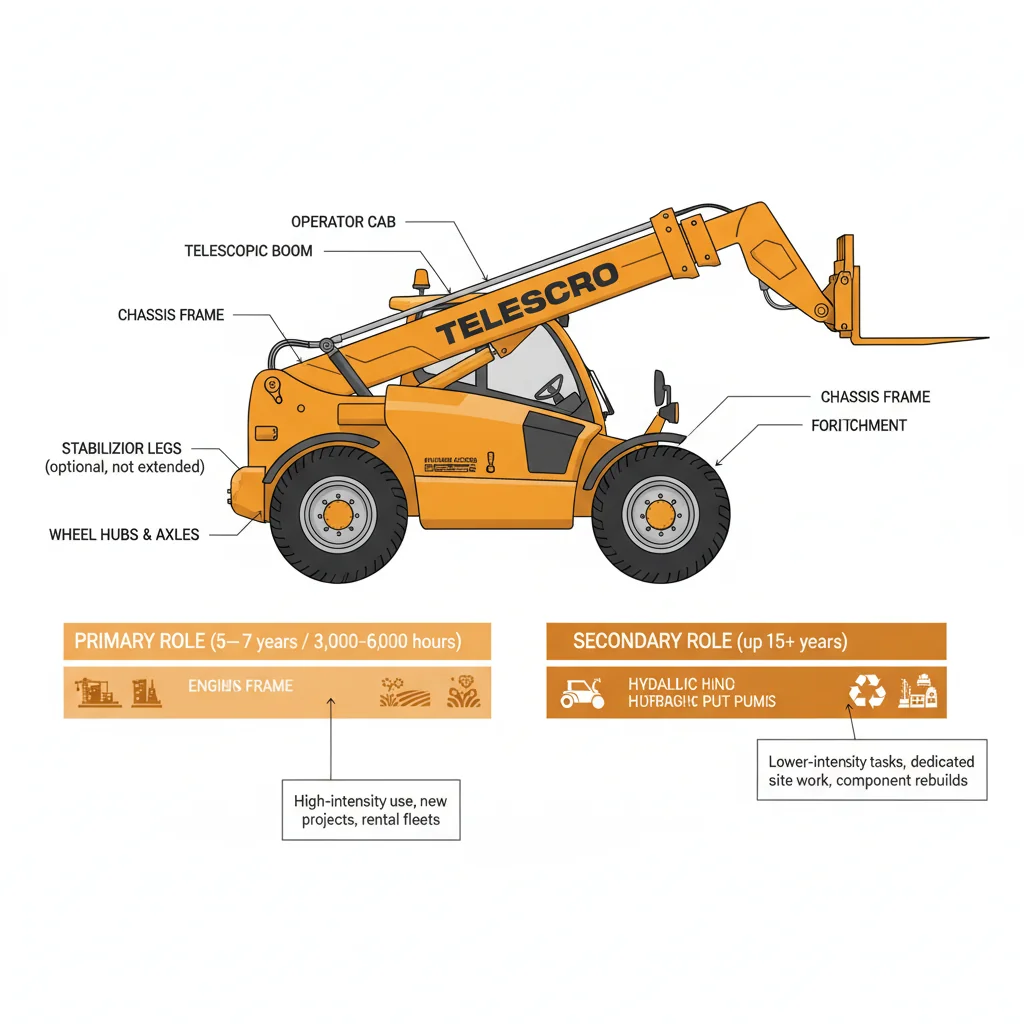
I’ve worked with contractors from Indonesia to the UK who ask, “How do I know when my telehandler’s time is up?” The simple answer—repair cost versus machine value. When fixing the hydraulics, engine, and pins starts to rival what your machine is worth, that’s the economic end, even if the boom and chassis look fine. In big rental fleets, I see 4-ton, 14-meter telehandlers cycled out after 6,000 hours or around seven years. Why? At that stage, even basic hydraulic leaks or electronic faults can cost several thousand dollars per repair.
But the story doesn’t end there. I remember a project in Kazakhstan where a retired fleet machine, already at 7,500 hours, found a second life on an agricultural site. Light use—moving pallets, occasional bucket work—meant fewer cycles per day, far less wear on hydraulic cylinders and the transmission. With annual servicing and regular checks on the moment indicator and boom welds8, the owner got another five years before oil leaks started showing up everywhere.
The decision gets tricky if you push past 8,000 hours. Around then, big overhauls hit—engine rebuilds, full hydraulic circuit replacements, hoses, worn bushings. If you face a repair bill that’s 25–40% the price of a new unit, step back. Ask yourself: Is your use getting lighter, or do you need max uptime? I always suggest considering remanufacturing only if the structure is rust-free and you can keep the work light. Otherwise, it’s smarter to retire the machine and invest in something newer—your jobsite safety and cost-per-hour will thank you.
A telehandler can reach its economic end of life even if the structural components are still in good condition, primarily due to the high cost of repairing worn mechanical or hydraulic systems.True
The decision to retire a telehandler is often based on whether essential repairs begin to approach or exceed the machine’s remaining value, regardless of whether the boom and chassis still appear intact. This reflects how operational cost, not just structural condition, determines economic life.
The economic life of a telehandler is determined solely by the number of operational hours on the machine, with all units expiring at a fixed threshold.False
While operating hours contribute to wear and depreciation, the true economic life depends on the balance between repair costs and remaining machine value, which varies by maintenance history, application, and repair costs—not just a uniform hour limit.
Key takeaway: Telehandlers are commonly retired from frontline service when repair costs outweigh value, usually around 7 years or 6,000 hours. With sound structure and lighter use, these machines can remain productive for 15 years or more, maximizing investment before major overhaul or replacement is necessary.
What Safety Risks Rise as Telehandlers Age?
As telehandlers accumulate higher operating hours—typically beyond 6,000–10,000 hours depending on duty severity—safety-critical components such as the boom structure, welds, fork carriage, steering joints, axle pivots, and braking systems are increasingly susceptible to fatigue and wear. Progressive issues such as pin and bushing wear or developing weld cracks can effectively reduce usable load chart capacity9 and stability margins, making more frequent inspections and proactive component repair or replacement essential for continued safe operation.

One thing I’ve noticed after years in this industry is that many fleet managers underestimate how quickly fatigue can build up in key components once a telehandler passes the 6,000-hour mark in demanding applications. For example, a customer in Dubai ran several 4-ton models on a concrete job for almost four years, often on double shifts. By around 8,500 hours, close inspection revealed early hairline cracks in the main boom weld areas—minor at first, but sufficient to trigger a full structural inspection.
The site team initially focused mainly on routine items such as hydraulic hoses, but further checks showed that both the main boom pins and the fork carriage interfaces had developed noticeable wear, including early elongation at contact points. While the machines still appeared serviceable from the outside, this type of structural wear indicates that the telehandler may no longer be operating within the as-designed safety margins assumed by the load chart, making inspection and corrective repair necessary before continuing rated lifting operations.
The reality is, the load chart assumes everything is still in as‑new structural shape. But with heavy use, pins, joints, and structural welds develop micro-movement or cracks. In Kazakhstan, I saw an axle pivot fail right after a machine hit 10,000 hours. The operator had noticed a little extra play in the steering joint, but it was brushed aside during busy season. The cost of repairing that axle… far outweighed what a scheduled parts replacement would have run.
I always suggest annual structural inspections for any machine past 6,000 hours—sooner if you run them in tough conditions like mining or 24-hour construction. Non-destructive tests on welds and proactive pin replacements aren’t cheap, but they protect both your team and your investment. Doing this before there’s visible failure is true preventive maintenance.
Telehandlers that exceed 8,000 operational hours are at much higher risk for structural fatigue in boom welds, even when regular maintenance is performed.True
Fatigue in structural components such as main boom welds accumulates over time due to repeated stress cycles, which cannot be entirely prevented through standard maintenance. This risk increases significantly as total operating hours accumulate, especially in high-duty-cycle operations.
Hydraulic hose replacement is typically the only critical maintenance task needed for telehandlers beyond the 6,000-hour mark.False
While hydraulic hoses do require regular inspection and replacement, telehandlers past 6,000 hours are also at risk for wear and failure in structural welds, pins, bushings, and load-handling components. Focusing only on hydraulic components overlooks other crucial areas that can compromise safety and performance.
Key takeaway: As telehandlers reach mid-life, especially after 6,000 hours of hard use, the risk of structural fatigue increases sharply in critical areas. Annual or biannual inspections—including non-destructive testing and proactive replacement of worn parts—are essential for maintaining rated safety and capacity in aging machines.
How is telehandler cost per hour calculated?
Telehandler cost per hour combines purchase price, routine maintenance, major repairs, and actual working hours. For example, a $90,000 machine with $6/hour in maintenance over 8,000 hours totals $17.25/hour. Real-world costs vary by build quality, maintenance rates, and required major interventions, making $/hour more accurate than just upfront price.

Most people don’t realize that telehandler cost per hour isn’t just about the sticker price. It’s a mix of how much you pay upfront, what you spend on routine maintenance, and the cost of major repairs along the way. The hours you actually get out of the machine really matter. I’ve seen two identical-looking units on a site in Dubai, but one ends up far costlier per productive hour because maintenance was ignored early on. Parts availability and quality of components can quietly double your real costs if you’re not paying attention.
Let me give you a real-world example. In Kazakhstan, a contractor bought a 4-ton model for about $90,000, planning for 8,000 hours of work. His day-to-day preventive maintenance averaged $6 an hour, so after eight thousand hours, his total cost landed near $138,000—or roughly $17.25 per hour. Now, his competitor went for a cheaper $75,000 unit. On paper, that looks smart. But the maintenance jumped to around $10 an hour, and he was forced into an expensive hydraulic repair at just over 5,500 hours. By the time he reached the same 8,000 hours, his true cost per hour was closer to $23.70.
Here’s what matters: always budget for one major intervention between 5,000 and 10,000 hours. Ask the dealer for expected maintenance costs per 1,000 hours and check if parts are easy to get locally. I suggest comparing telehandlers based on cost for every productive hour—not just upfront price. That’s how you avoid nasty surprises mid-project.
A telehandler with high-quality components and consistent preventive maintenance can achieve a much longer usable lifespan, which decreases the cost per hour compared to a similar model that is poorly maintained.True
Preventive maintenance prevents early component failure, and high-quality parts last longer under jobsite stresses. Over years, this results in more productive machine hours for the same initial investment, reducing hourly ownership cost.
All telehandlers, regardless of usage intensity or maintenance, are expected to have a typical lifespan of exactly five years before major components fail.False
Telehandler lifespan varies significantly based on factors like jobsite environment, frequency of use, operating conditions, and maintenance regularity. Strict timelines do not account for units that are lightly used and well maintained, which can last considerably longer.
Key takeaway: Evaluating telehandler investment based on total cost per productive hour—including purchase, routine service, likely major repairs, and machine lifespan—enables fleet managers to make more cost-effective decisions than considering sticker price alone. Always factor maintenance rates, parts availability, and likely interventions when budgeting.
Do Telehandlers Last as Long as Forklifts?
Telehandlers and forklifts can accumulate comparable operating hours over their service lives, with forklifts—particularly in indoor or controlled environments—commonly reaching 10,000–20,000 hours. Telehandlers are capable of high-hour operation as well, but their lifespan outcomes are more variable due to rough-terrain use and boom-related structural and hydraulic loads, which drive the need for more frequent inspection of critical components.

Here’s what matters most when comparing telehandler and forklift life on the jobsite: both machines can clock similar hours before major overhaul—usually in the 10,000 to 20,000 hour range if they’re properly maintained. But telehandlers take a lot more punishment on rough ground, uneven sites, and full reach lifts. I once worked with a contractor in Kenya running a mixed fleet. Their 4-ton warehouse forklifts showed less boom and chassis fatigue after 9,000 hours than their 4-ton telehandlers did at only 7,000 hours. The difference? The telehandlers spent more time outdoors, carrying variable loads over bumpy ground and using the boom at max extension.
When you introduce a boom and complex hydraulics, wear patterns change fast. I’ve seen pins, bushings, and hydraulic hoses on 12-meter telehandlers in Kazakhstan need replacement every 2,000 to 3,000 hours, especially if operators skip routine greasing. One big risk is hidden cracking on the main boom or wear in the stabilizer feet. If these components fail, your costs skyrocket—and safety takes a hit. That’s why I always recommend boom and structure inspections every 1,000 hours, while forklifts can often wait until 2,000 hours between deep checks.
My practical suggestion? If you already manage forklift fleets, set your main replacement and maintenance intervals by hours, but double-check booms and stabilizers on your telehandlers more often. Plan on extra routine maintenance costs—especially for boom wear parts and hydraulics. A little vigilance here makes all the difference for uptime and long-term cost control.
Telehandlers are generally subject to more structural fatigue in their booms and chassis than forklifts, leading to a higher likelihood of major component rebuilds before reaching maximum operating hours.True
Telehandlers operate on rough terrain and often use their booms at full extension, putting more cyclical stress on the structure compared to forklifts that mostly work on flat, even surfaces and perform vertical lifts.
Telehandlers typically require less frequent maintenance than forklifts because their components are designed for tougher environments.False
Although telehandlers are built for rugged conditions, their exposure to harsh sites and complex movements usually drives a need for more attentive and frequent maintenance compared to forklifts operating indoors or on smooth surfaces.
Key takeaway: Telehandlers and forklifts can achieve broadly similar total operating hours, but telehandlers demand more vigilance regarding structural and hydraulic wear. Fleet managers should align replacement and inspection intervals while placing extra emphasis on boom and stability systems to maintain safe, cost-effective operation across mixed equipment fleets.
Conclusion
We’ve looked at what really affects a telehandler’s working life, including realistic hour expectations and the big impacts of application and maintenance. From my experience, the buyers who stay confident on their jobsites are the ones who dig deeper than just the price tag—they ask about parts supply, familiar brands, and how the machine performs at actual boom extensions, not just at max reach. Before you choose your next machine, check the support network for spare parts locally—nobody wants to get caught in a round of “parts roulette” mid-project. Need help making sense of options for your jobsite? I’m happy to share field stories or walk through load charts. Just reach out anytime. Every jobsite is different—pick what works best for how you really build.
References
-
Explains the effects of corrosion on telehandler components and offers strategies to minimize repair costs in harsh environments. ↩
-
Explains the impact of routine maintenance on lowering telehandler operating costs and extending machine lifecycle with practical examples. ↩
-
Explains how timely engine oil changes prevent wear and extend telehandler life, backed by maintenance schedules and expert tips. ↩
-
Detailing the critical role of hydraulic filter changes in avoiding costly repairs and maintaining system efficiency for telehandlers. ↩
-
Detailed guidance on identifying wear and play in boom wear pads to assess telehandler structural integrity and lifespan. ↩
-
Explains how worn pins and bushings indicate fatigue and affect telehandler safety and longevity with inspection tips. ↩
-
Detailed guidance on hydraulic hose lifespan, common wear issues, and maintenance tips to prevent costly telehandler downtime. ↩
-
Detailed insights into boom weld fatigue, common cracks, and the importance of inspections to prevent failures. ↩
-
Explore how wear and structural fatigue reduce rated load capacity and impact telehandler safety and performance. ↩