










Telehandler: Key Differences Between Construction and Agricultural Models (Buyer’s Guide)
Not long ago, I was on a muddy pig farm near Shandong, watching a telehandler squeeze past feed bins and duck under low eaves. The owner joked it handled more like his old tractor than the oversized loader a neighbor bought for construction sites. That got me thinking—most folks don’t realize how different these two machine types really are.
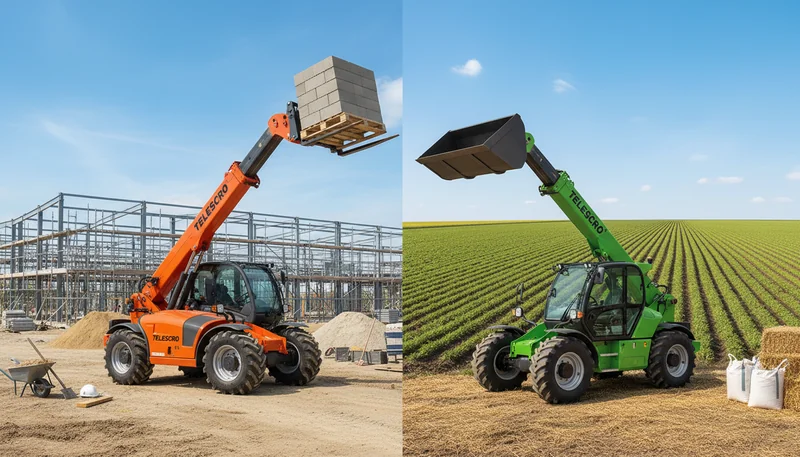
Construction and agricultural telehandlers are engineered with fundamentally different priorities. Construction models feature extended boom reach, greater lift capacities1—often up to 7,000 kg and 18 meters—and reinforced chassis, trading some agility for stability and vertical performance. Agricultural variants typically offer more compact frames, 3–4 ton lifting at 6–8 meter reach, and advanced steering configurations for maneuverability in confined barns and fields.
How Do Lift Capacity and Reach Compare?
Construction telehandlers offer greater lift capacities—typically 3,000–7,000 kg—and extended reaches up to 18 meters, making them ideal for heavier, high-elevation tasks. Agricultural telehandlers generally provide around 3–4 t capacity with a 6–8 meter reach, prioritizing stability and compactness for farm-related duties below 8 meters in height.

Most people don’t realize that bigger isn’t always better with telehandlers. In construction, you often need to lift steel beams, palletized bricks, or heavy pipes up to second or even fourth floors. I remember a job in Dubai where the contractor needed to place materials at 15 meters—well above what a farm-spec telehandler handles. Their 7,000 kg model with a long boom and heavy counterweight got it done in a single pick. If they’d used a compact ag machine, they’d be making multiple trips, or worse, not reaching at all.
Let me share something important about the numbers. Construction telehandlers regularly handle 3,000–7,000 kg and reach anywhere from 12 up to 18 meters. Longer wheelbases and heavier counterweights keep them stable—even when the boom is extended and the load is far from the machine. Ag models, on the other hand, are designed for around 3,000–4,000 kg and a 6–8 meter reach. That’s perfect for stacking bales, loading grain, or cleaning out feed lots, especially if your buildings have low clearance or tight layouts.
Here’s a quick comparison:
| Specification | Construction Telehandler | Agricultural Telehandler |
|---|---|---|
| Lift Capacity | 3,000–7,000 kg | 3,000–4,000 kg |
| Max Reach | 12–18 meters | 6–8 meters |
| Key Focus | High lift, heavy weight | Stability, compactness |
| Typical Tasks | Bricks, beams at height | Bales, grain, manure <8 m |
| Turning Radius | 4.5–5.5 meters | 3.5–4.5 meters |
Construction telehandlers typically feature longer boom reach and higher lift capacities, often exceeding 7,000 kg at 15 meters, whereas agricultural models prioritize maneuverability and usually max out around 3,500 to 4,000 kg at lower heightsTrue
Construction telehandlers are engineered with extended boom lengths and reinforced counterweights to handle heavy loads at significant heights, reflecting job site demands like placing materials on multiple building floors. Agricultural telehandlers focus on versatility and compactness to navigate farm environments, resulting in lower maximum capacities and reach.
Agricultural telehandlers generally have higher lift capacities than construction telehandlers because farm machinery needs to handle denser loads like silage and hay balesFalse
Agricultural telehandlers prioritize versatility and field mobility rather than extreme lifting capacity or reach. Construction telehandlers are purpose-built with stronger chassis, heavier counterweights, and longer booms to manage heavier loads at greater heights, while agricultural machines typically have lower lift specifications.
Key takeaway: Select a construction telehandler for demanding lift heights or heavy weights above 4–5 tonnes at elevation. For most agricultural tasks below 8 meters, an ag-spec telehandler is more cost-effective and efficient, avoiding unnecessary bulk and fuel consumption while meeting typical farm lifting requirements.
How Do Size and Maneuverability Differ?
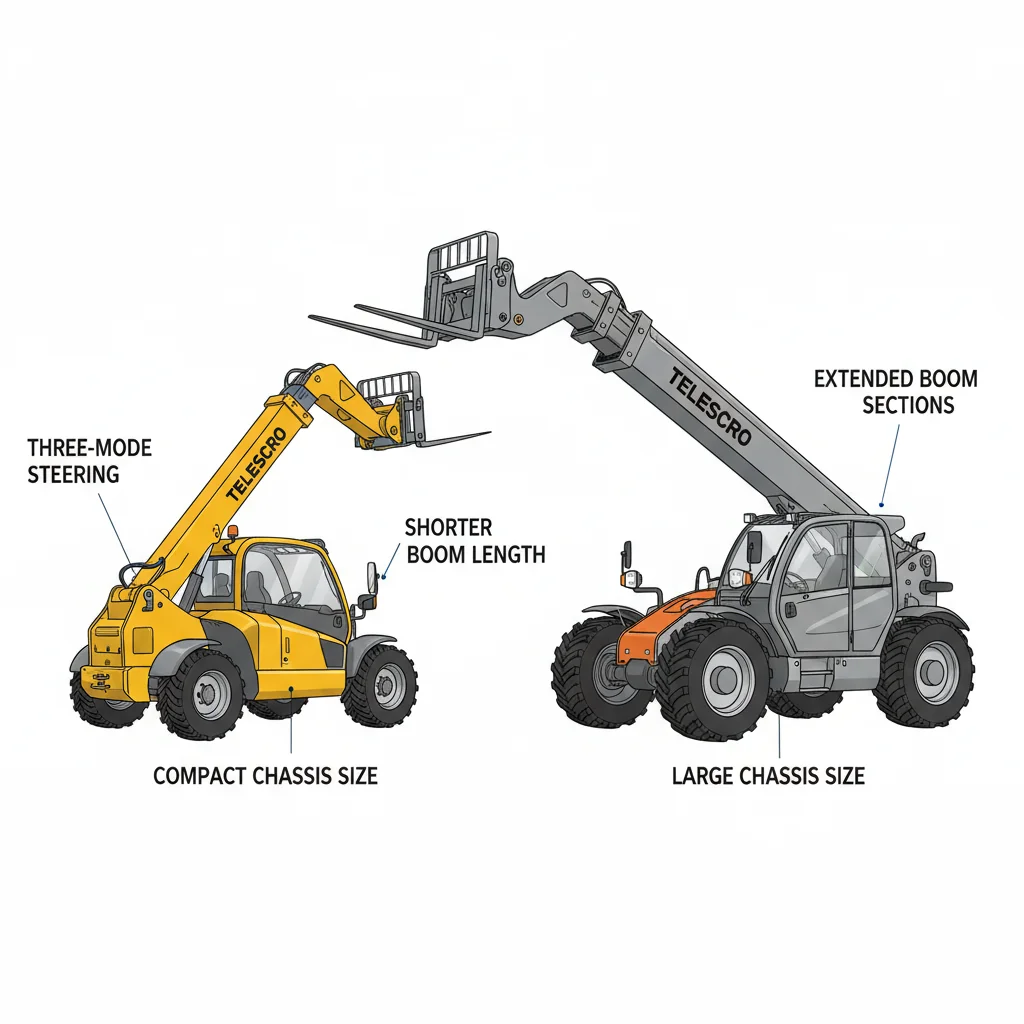
Agricultural telehandlers feature compact chassis2, shorter wheelbases, and lower heights for tight barns and sheds. Three-mode steering3 enables agile movement in restricted spaces and around obstacles. Construction telehandlers have larger frames and longer booms, prioritizing lift height and reach for open sites, but sacrificing maneuverability in confined environments. Choosing the right model depends on operational space and required agility.
Let me share something important about telehandler size and maneuverability—two specs many buyers underestimate until the machine is already on site. Not long ago, a dairy farmer in New Zealand called me regretting his purchase of a big 4-ton model. Great for open yards, but with that longer wheelbase and almost 2.6-meter overall height, he struggled to get through barn doors and maneuver around tight feed alleys. He ended up losing at least an hour every day just repositioning, compared to his older, lower telehandler that could turn in a much smaller space.
Agricultural telehandlers are built for those tight, unpredictable environments. Their compact chassis, lower heights (sometimes under 2.1 meters), and three steering modes—front, all-wheel, and crab—mean you can snake between feed bins or get right up against a wall without constant back-and-forth. Shorter wheelbases also keep the center of gravity low, which I’ve noticed really helps on sloped or muddy ground.
Construction telehandlers, by comparison, usually measure over 2.5 meters tall and can tip the scales at 9,000 kg or more. They prioritize reach—often above 14 meters—and frame stability for handling heavier loads at height. I saw a team in Dubai struggling when they brought a 17-meter, 4-ton machine onto a cramped indoor warehouse renovation. Maneuvering between pillars took double the time, and they had to switch to a more compact 2.7-ton model to hit their schedule.
When comparing options, I suggest looking closely at the minimum turning radius, overall height, and steering modes listed in the specs. If your daily work means navigating gates, shed doors, or uneven rows, favoring a compact, agile design will make your life much easier—and safer.
Construction telehandlers typically have a shorter wheelbase and lower overall height than agricultural models to improve maneuverability on confined job sitesTrue
Construction telehandlers are designed for tighter urban and industrial environments, so manufacturers prioritize compact dimensions and tighter turning radii, whereas agricultural telehandlers often sacrifice some compactness for greater reach and lifting capacity in open areas.
Agricultural telehandlers always have higher lifting capacities than construction telehandlers due to the heavy loads on farmsFalse
While agricultural telehandlers need good lifting capacity, construction models often have equal or higher rated capacities to handle construction materials like pallets of bricks or steel beams, reflecting different load requirements rather than a fixed hierarchy.
Key takeaway: Matching telehandler size, height, and steering capabilities to the typical work environment maximizes productivity and minimizes operational frustrations. Agricultural models excel in confined or uneven spaces, while construction units are optimized for reach and stability on larger, open jobsites.
How Do Telehandler Hydraulics and Cycle Times Differ?
Agricultural telehandlers feature faster, more responsive hydraulics and optimized boom geometries for repetitive farm tasks, enabling 15–20% greater productivity in typical operations. Construction models, by contrast, prioritize controlled, deliberate movements with slower cycle times for improved load stability and placement accuracy, particularly when operating at height or in tight site conditions.
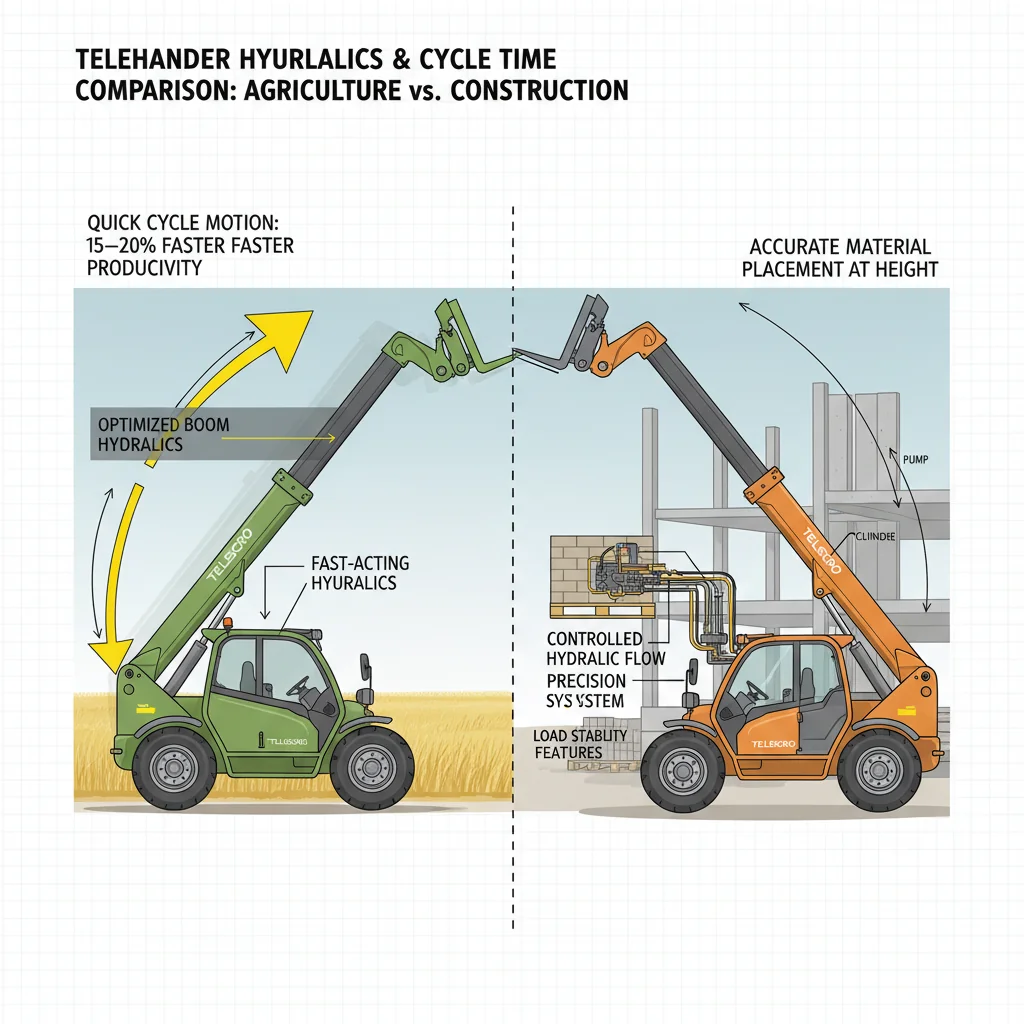
Here’s what matters most when deciding between agricultural and construction telehandlers: hydraulic system speed and how it matches your daily work. In ag settings, time is money. I’ve watched farm crews in New Zealand move hundreds of tons of grain a day with an ag-spec telehandler—fast hydraulic cycles, responsive boom, and crowd angles that let operators empty buckets in one smooth motion. Their model had a boom cycle time under 10 seconds, so they filled trailers almost nonstop, stacking bales or swapping attachments easily. In practical terms, I’ve seen ag machines complete up to 20% more load cycles an hour versus standard construction models.
Now, construction is a different world. Last year, a contractor from Dubai contacted me frustrated by slow placement on a high-rise job. The issue wasn’t capacity—his 4-ton, 17-meter machine had plenty. The real problem? They had borrowed an ag telehandler that was just too jumpy for delicate work at height. Fast hydraulics don’t help when you’re landing a pallet over a slab edge, especially when it’s breezy. That’s where the construction spec shines—hydraulics tuned for slower, steadier operation, reducing boom swing and keeping the load stable even at maximum extension. Some models can fine-tune pump flow between 80–120 liters per minute for extra control.
To be honest, cycle time isn’t a one-size-fits-all number. I always suggest watching a full load cycle on the actual jobsite—lift, extend, crowd, lower—before you commit. For farms, prioritize responsiveness; for construction, choose deliberate, controlled movement for precision and safety. The right speed depends on your main tasks, not the spec sheet alone.
Agricultural telehandlers typically have boom cycle times under 10 seconds to maximize loading efficiency during harvesting operationsTrue
In agricultural settings, rapid hydraulic cycles under 10 seconds are common to keep pace with fast-moving tasks like grain loading, minimizing downtime and increasing daily throughput. This speed is achieved through optimized hydraulic flow and responsive controls tailored for repetitive loading cycles.
Construction telehandlers generally use slower hydraulic systems than agricultural models to prioritize lifting capacity over cycle timeFalse
Construction telehandlers are often designed with hydraulic systems that balance lifting capacity and cycle speed; they do not inherently operate slower than agricultural models. In fact, cycle time can be similar, as efficient cycles are important on construction sites to maintain productivity alongside load handling capacity.
Key takeaway: Agricultural telehandlers excel with quick, responsive hydraulics, boosting productivity in rapid, repetitive cycles. Construction telehandlers emphasize slower, steadier movements to ensure precise placement and safety with heavy loads at height. Buyers should match hydraulic speed and cycle times to their sector’s operational demands.
How Do Telehandler Tires Differ by Application?
Agricultural telehandler tires4 feature wider footprints, softer rubber compounds, and specialized tread patterns for enhanced traction on mud, wet grass, and fields, minimizing soil compaction. Construction telehandlers use harder, puncture-resistant tires designed for durability on concrete, rebar, and crushed stone, sacrificing gentleness on sensitive ground for longevity on abrasive surfaces. Application determines the optimal tire choice.
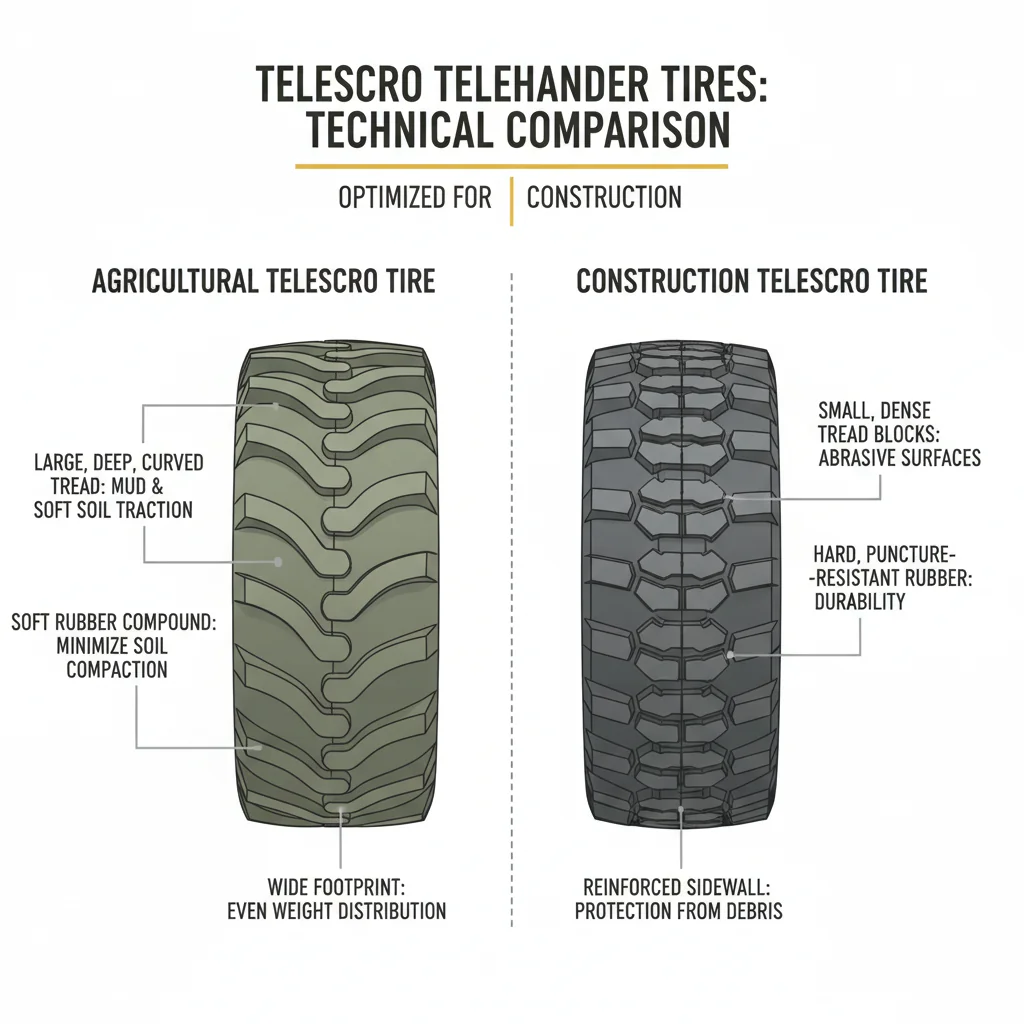
The biggest mistake I see is assuming all telehandler tires perform the same, regardless of the jobsite. In reality, tire choice should match where you’ll spend most of your working hours. Let me give you a real example. Last year in Kazakhstan, a grain farm switched from standard construction tires to wider agricultural patterns on a 3.5-ton telehandler. Before the swap, drivers kept getting stuck along the silage clamp—mud and wet grass turned every load into a battle. With the ag tires5, they noticed sharper grip and far fewer ruts. More importantly, soil compaction dropped, which helped preserve the next crop yield.
Why does this happen? It’s all about how the tire interacts with the ground. Construction-spec tires use harder rubber and a denser tread for durability—they shrug off sharp debris like rebar and stand up to broken concrete or crushed stone. But that toughness comes at a cost. On soft fields or lawns, they cut deep and can leave lasting surface damage, especially if you’re lifting near the telehandler’s rated load or maneuvering at full boom extension.
Here’s a quick breakdown of how tire specs match different applications:
- Wider, softer tires — Boost flotation on fields, minimize compaction
- Aggressive tread patterns — Improve traction in mud, grass, and uneven ground
- Hard compound, reinforced sidewalls — Resist cuts and punctures on abrasive surfaces
- Hybrid or dual-purpose treads — Offer middle-ground performance for mixed-use fleets
I always suggest checking how often you’ll cross between jobsite types. For true mixed use, budgeting for an extra tire set may save you headaches later.
Agricultural telehandler tires typically have tread patterns with wider lugs spaced further apart to provide better traction and self-cleaning capabilities in soft and muddy terrainsTrue
Wider lugs with larger spacing help prevent mud and debris buildup, maintaining grip on uneven farm surfaces such as silage clamps or wet grass, unlike construction tires that prioritize durability on hard surfaces.
Construction telehandler tires are generally softer than agricultural tires to absorb shocks better on rough terrainsFalse
Construction telehandler tires are usually made with harder rubber compounds for increased durability on abrasive surfaces; softer tires are more common in agricultural applications to improve traction and reduce soil compaction, not shock absorption.
Key takeaway: Tire selection is critical for telehandler performance and ground preservation. Agricultural models require tires designed to protect soil and improve grip on variable terrain, while construction models need robust, long-lasting tires for abrasive sites. Mixed-use may demand compromises or dual tire sets for optimal performance.
How Do Telehandler Controls Differ by Sector?
Agricultural telehandlers feature joystick controls6 similar to tractors and loaders, with primary boom and tilt functions, enabling smooth transitions for experienced farm operators. Construction telehandlers often separate boom and tilt functions onto different controls, prioritizing precise load placement. This split increases the learning curve for operators accustomed to loader-style layouts and can impact initial productivity and safety during onboarding.
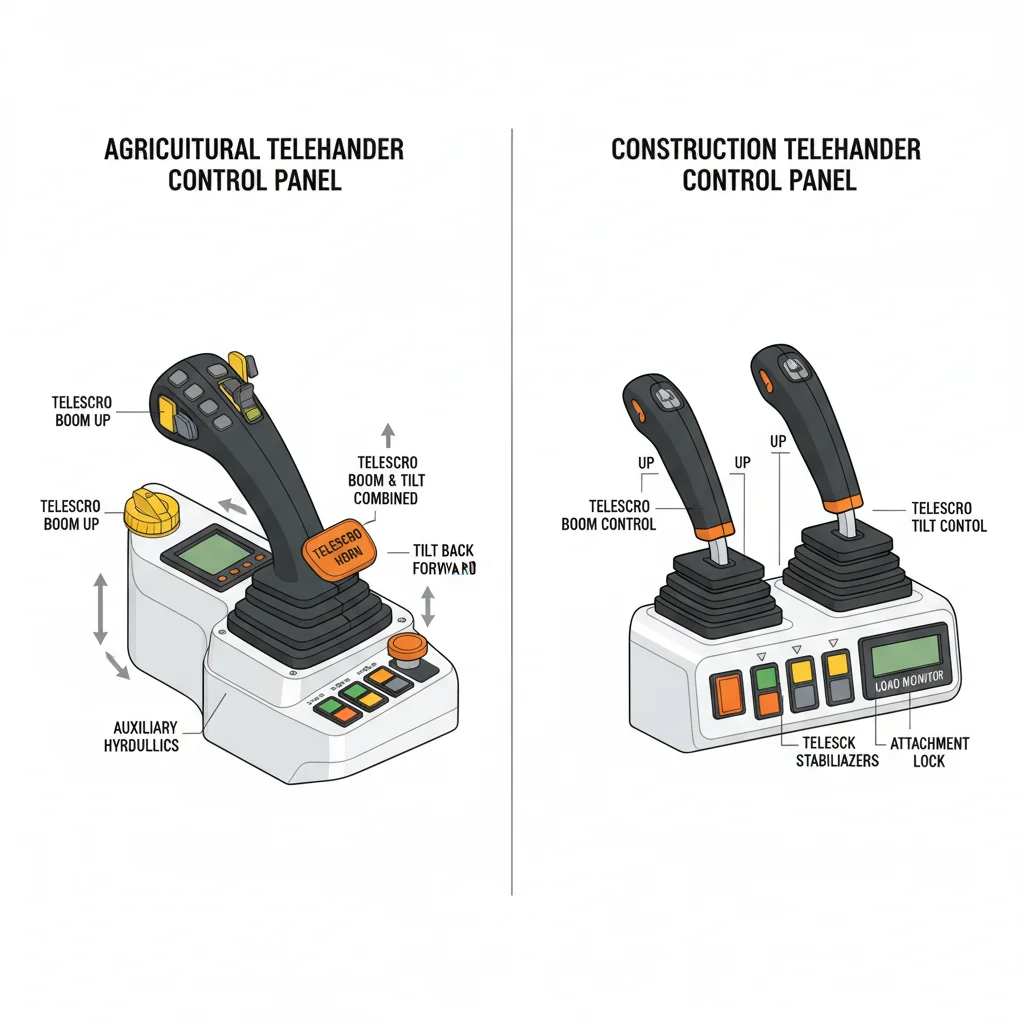
I’ve worked with operators in Australia who jumped from loader-based farm work to construction telehandlers. The main feedback? Control layout made the biggest difference to their first week on the job. On agricultural sites, most telehandler models mimic tractor controls—single joystick handling both boom lift and tilt. That means an operator moving from a 3-ton loader to a 3,000 kg ag telehandler can start working almost immediately. The proportional response also lets them “feather” heavy hay bales or pallets without jerky motion. For farms running shifts with seasonal labor, this familiarity pays off. One client in Inner Mongolia reduced new operator training time by half when they standardized on loader-style machines.
In construction sectors, things change. Telehandlers rated for 4,000 kg and up, with 15-meter reach, often use two separate controls: one for boom extend/retract, the other for carriage tilt. This setup supports placing pallets at 10–12 meters high, especially on scaffolding or in tight city projects. But I’ve seen new operators in Dubai struggle with this split layout. They often overshoot or make sudden movements, especially when trying to place blocks at height. The learning curve is real. One site manager told me it took at least a week for their crew to handle loads smoothly—and minor productivity losses were common during the transition.
My honest advice? Before you choose, put actual operators in a demo unit. For high-rotation teams, simpler controls mean fewer errors and safer operations. When you need inch-perfect placement at height, the split controls are worth the learning curve. It’s a trade-off many buyers overlook.
Agricultural telehandlers typically use a single joystick controlling both boom lift and tilt functions with proportional response, enabling operators to handle delicate loads like hay efficiently.True
Ag telehandlers mimic tractor controls by integrating boom lift and tilt into one joystick with proportional hydraulics. This setup lets operators perform fine, controlled movements (‘feathering’), essential for handling lightweight, fragile materials such as hay without causing damage.
Construction telehandlers universally adopt the same single-joystick control layout as agricultural machines, prioritizing operator familiarity across sectors.False
Construction telehandlers usually employ separate controls or multi-function joysticks to independently manage boom lift, extension, and attachments for precise material handling, differing from the simpler, single-joystick layout common in agricultural models.
Key takeaway: Familiar loader-style controls on agricultural telehandlers minimize training time and errors, supporting high-rotation teams. Construction models use split controls to improve precision but present a steeper learning curve for operators not used to this setup, potentially causing jerky movements and reduced early-stage efficiency.
How Do Telehandler Attachments Differ by Sector?
Construction telehandlers typically use forks on ITA or proprietary headstocks, prioritizing stable lifting of uniform, palletized materials. In contrast, agricultural telehandlers feature multi-attachment headstocks with hydraulic quick couplers compatible with Euro or tractor interfaces. Their design allows frequent, safe swaps for buckets, grabs, bale spikes, and more—enabling versatile, daily handling tasks in confined farm environments.
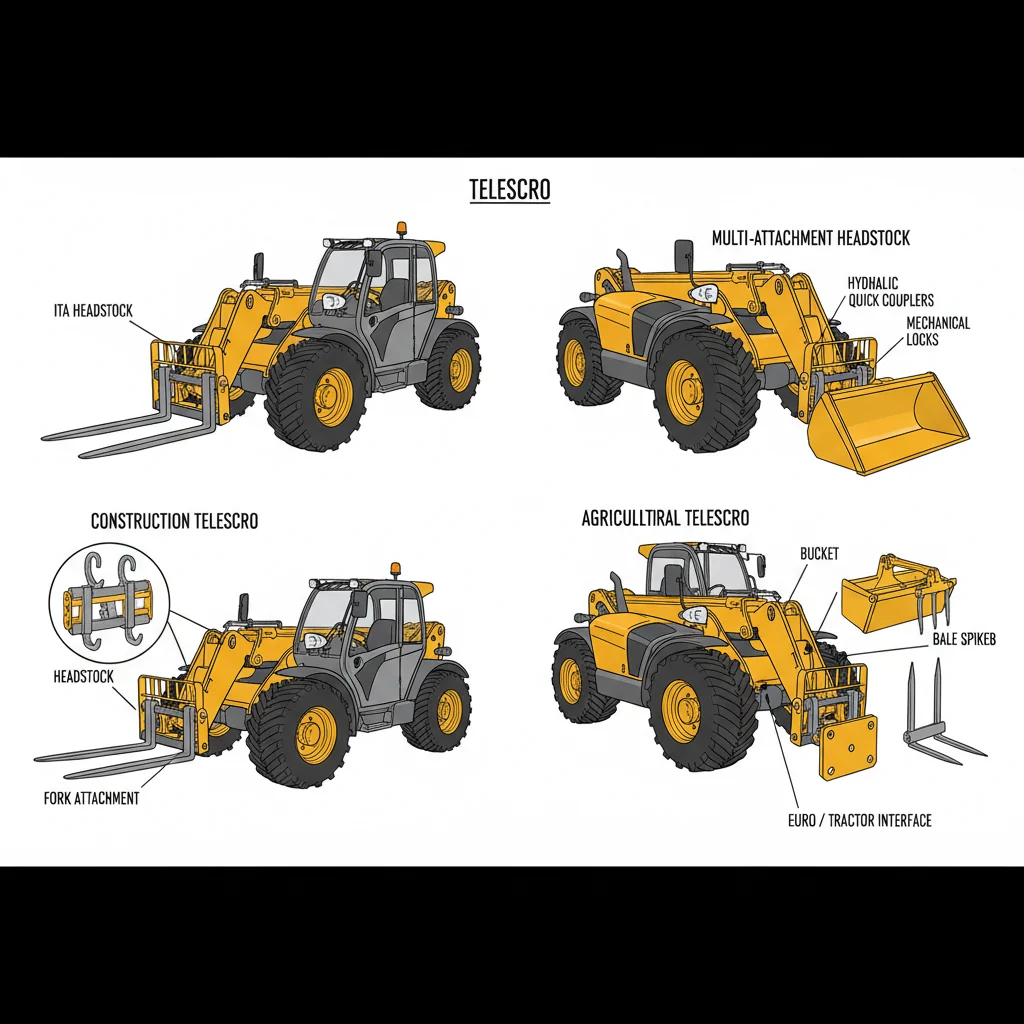
I’ve worked with customers who made attachment mistakes and paid for it later. One contractor in Dubai contacted me after his new 4-ton telehandler couldn’t connect securely with the farm-style bucket he’d sourced locally. Construction models usually come with ITA forks7 or custom headstocks—great for lifting uniform loads like bricks or pallets, but not set up for quick changes. Switching between attachments can involve manual pin swaps and extra tools. That’s fine on large sites where most work is lifting, not material handling. But if your crew needs to change from forks to buckets a few times a day, that process starts eating into productivity.
On the other hand, most agricultural telehandlers—like the compact 3-ton machines I shipped to New Zealand last year—feature a hydraulic quick-coupler and Euro headstock. These let operators swap out a bale spike or silage bucket in under two minutes, often without leaving the cab. Farm tasks change fast: shifting bales in the morning, loading grain by lunchtime, clearing manure after. Ag machines usually have a shorter wheelbase and tighter turning radius, typically under 4 meters, so they work around livestock and fences better.
Here’s how attachment differences show up:
- Construction headstocks: ITA forks or proprietary, rarely interchangeable
- Agricultural headstocks: Multi-attachment, Euro or tractor-standard, fast coupler
- Switching attachments: Manual pin locks (construction) vs. hydraulic release (ag)
- Load types: Pallets and bricks (construction), loose/bulk/bales/feeds (agriculture)
- Safety risk: Adapters can reduce rated load and increase handling problems
I suggest always checking headstock compatibility and considering how often your team will actually switch tasks on site. That detail can save real headaches and downtime.
Agricultural telehandlers typically feature quick-attach systems compatible with ISO9826 couplers, allowing tool-free attachment changes critical for diverse farming tasksTrue
ISO9826 quick couplers are widely adopted in agricultural telehandlers to enable farmers to switch attachments rapidly without additional tools, improving operational efficiency when handling varied implements like buckets, hay forks, or bale spears.
Construction telehandlers universally use universal quick-attach systems identical to those in agriculture for faster attachment changesFalse
Construction telehandlers often rely on ITA fork carriages or custom headstocks that typically require manual pin removal and tools to change attachments, unlike agricultural models that favor quick-attach couplers designed for rapid switching.
Key takeaway: Select telehandlers with sector-appropriate headstocks and coupling systems—construction models suit stable, uniform loads with minimal attachment switching, while agricultural versions offer superior versatility and rapid attachment changes for varied farm tasks. Avoid interface mismatches, as adapters can reduce rated capacity and introduce safety or handling issues.
How do cab comfort and visibility differ?
Agricultural telehandler cabs prioritize extended operator comfort, offering superior side and rear visibility, advanced climate control, suspension seating8, lower noise, and smoother boom suspension—suitable for long hours and frequent road travel. Construction telehandler cabs focus on protection from dust and impacts, often providing basic amenities and optimizing visibility mainly for site safety and load handling.
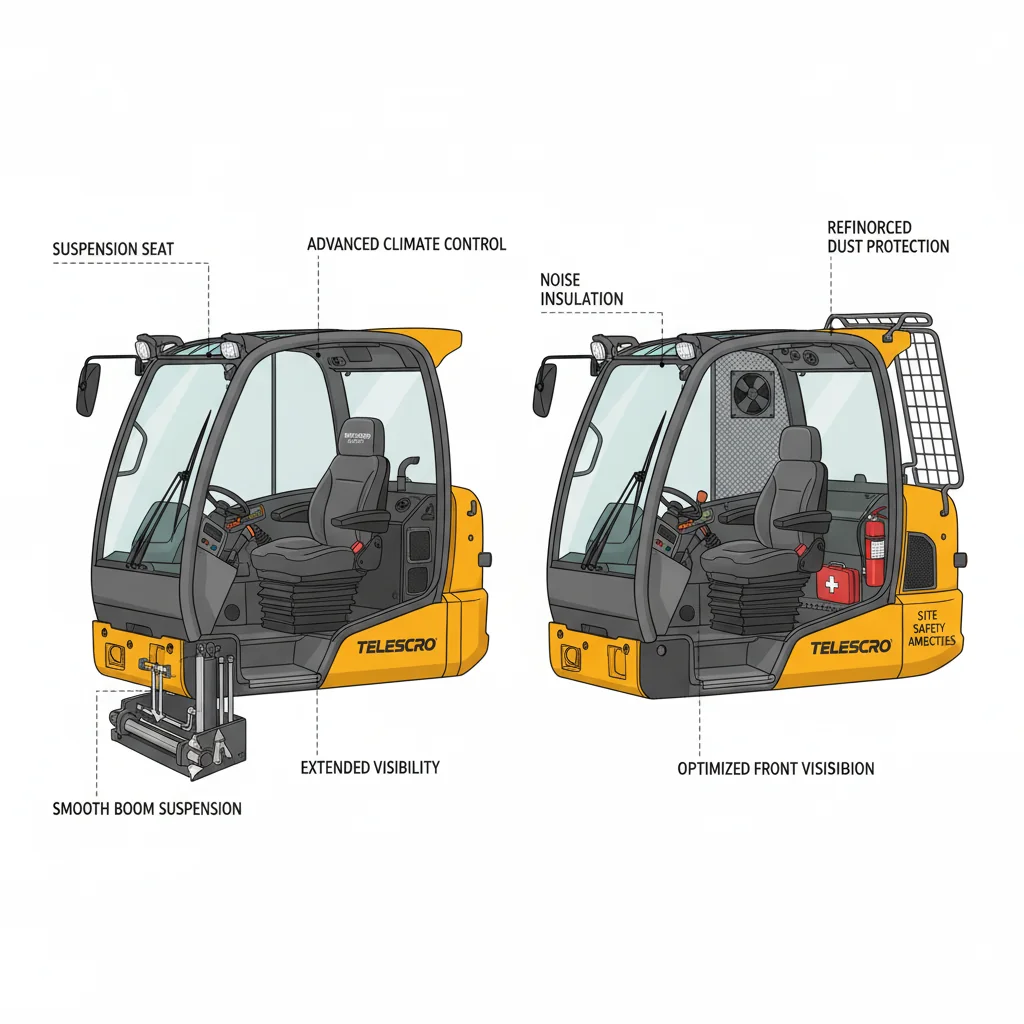
From my experience, many buyers underestimate just how much cab comfort and visibility impact daily productivity—especially over long shifts. In Kazakhstan, I visited a dairy farm where operators spend 10 hours straight in their machines during harvest season. Their telehandler cabs had suspension seats, powerful A/C, and easy-reach controls. More importantly, big side and rear windows meant the operator could spot animals or obstacles when reversing. Noise inside the cab stayed below 75 decibels, which really matters when you’re listening to instructions by radio all day.
Let me share something important about construction telehandlers. Unlike the farm units, most jobsite models are built tough rather than comfortable. On a recent project in Kenya, contractors ran the telehandler six hours per day—but mainly in short stints, moving bricks and steel. Cabs had reinforced steel mesh9, thick sealing to stop dust, and high-mounted mirrors focused on seeing the forks and load. These features matter more in construction where dropped debris is a real risk, but a few operators complained the seats were stiff and A/C was weak—especially during afternoon heat.
To be honest, if you’re running a single machine all day, cab features like boom suspension, climate control, and visibility lines aren’t extras—they’re essentials. Good visibility reduces small accidents, while better seating keeps your best operators coming back for another season. I suggest checking the cab in person and asking your staff for feedback before you decide. This is one area where spec sheets don’t tell the whole story.
Agricultural telehandlers typically feature larger glass areas in their cabs, increasing visibility to monitor livestock and field conditions compared to construction telehandlers.True
Agricultural telehandlers prioritize wide and tall windows—often covering side and rear areas—to help operators spot animals and obstacles during long shifts, enhancing safety and productivity in open farm environments. Construction telehandlers usually have smaller windows, focusing more on protection from site debris.
Construction telehandlers generally have more advanced cab suspension systems than agricultural telehandlers to enhance operator comfort over rough terrain.False
While cab suspension improves comfort, agricultural telehandlers often have superior suspension systems because operators spend longer periods in the cab over uneven fields; construction telehandlers typically sacrifice some comfort for durability and protection on construction sites.
Key takeaway: Agricultural telehandlers are engineered for operator comfort and visibility during prolonged use, while construction models emphasize ruggedness and safety in demanding environments. Assessing these cab differences is critical for maximizing productivity, reducing operator fatigue, and retaining skilled users in both sectors.
What Safety Rules Apply to Telehandler Types?
Construction telehandlers are classified as lifting equipment and must adhere to strict site rules, daily inspections10, and operator certification requirements11. Agricultural telehandlers comply with farm machinery regulations, prioritizing visibility, animal safety, and maintenance access. Cross-use may expose gaps—such as inadequate lighting or tires—making it essential to confirm local regulatory compliance before purchasing or operating any telehandler.
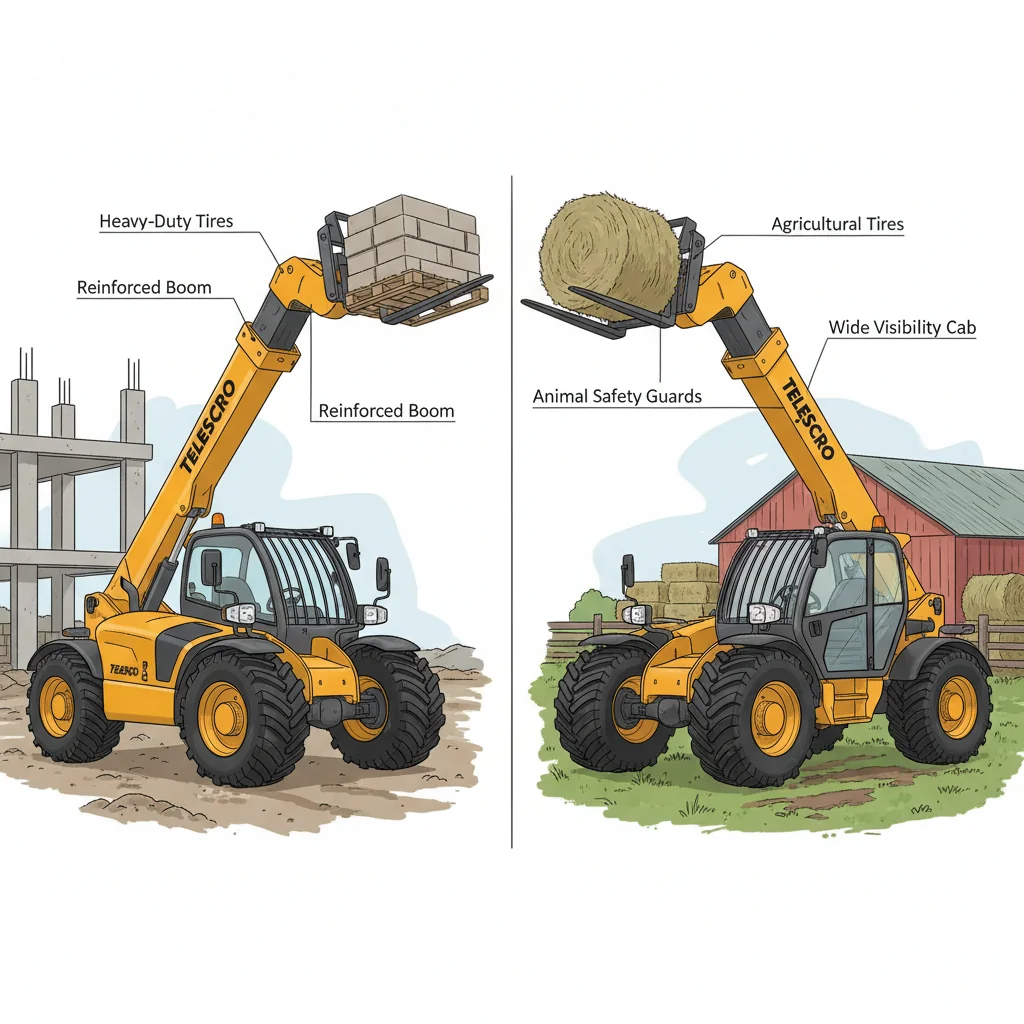
Last month, I spoke with a project manager in Kazakhstan who asked if he could use their 3,000 kg construction telehandler for both roadwork and general farm jobs. On paper, it looked versatile enough. But I immediately flagged several issues—from missing agricultural lighting to lack of boom suspension for uneven fields. This is a common challenge. Safety and regulations for telehandlers aren’t one-size-fits-all. They actually split into two worlds: construction and agriculture.
Here’s how key requirements compare across types:
| Compliance Area | Construction Telehandler | Agricultural Telehandler |
|---|---|---|
| Core Regulations | Lifting equipment (CE/ISO, site rules) | Farm machinery (agricultural codes) |
| Operator Requirements | Certified operator, site induction | Farm license or basic machine safety |
| Daily Inspections | Mandatory (brakes, boom, hydraulics) | Less formal; focus on maintenance access |
| Lighting/Visibility | Powerful work lights, rear-view mirrors | Road lighting, rotating beacons, animal safety |
| Safety Systems | Load management, moment indicators, interlocks | Boom suspension, hydraulic line guard, boom lock |
| Attachments | Rated for lifting (hooks, platforms) | Ag buckets, bale clamps, general forks |
| Tires | Solid/foam-filled, rough-terrain | Road-friendly, high-speed or turf tires |
I’ve seen sites in Dubai that demand moment indicators and automatic forks leveling just to pass inspection. On a farm in Australia, I helped a client refit work lights and install guards after a near-miss with livestock.
Agricultural telehandlers often require specialized lighting configurations, including amber warning lights and wider rear white floodlights, to comply with farm vehicle regulations, which are not mandatory on construction telehandlers.True
Farm telehandlers must be visible in low-light rural environments and comply with agricultural vehicle codes, necessitating specific lighting setups that differ significantly from construction site requirements.
Construction telehandlers are universally equipped with boom suspension systems to handle uneven terrain, whereas agricultural telehandlers typically do not include such systems.False
Boom suspension is more commonly found or required on agricultural telehandlers to improve operator comfort and stability on uneven fields, while many construction telehandlers operate primarily on more even surfaces and may lack this feature.
Key takeaway: Regulatory and safety requirements differ between construction and agricultural telehandlers. Understanding these differences—and local compliance needs—is critical to avoid safety gaps, operational delays, or legal issues, particularly when deploying a machine outside its primary use environment.
How do telehandler maintenance needs differ?
Agricultural telehandlers prioritize easy-access maintenance, featuring wide-opening hoods12 and service points suited for frequent operator checks to handle dust and debris common on farms. Construction models are built for durability, with reinforced undercarriages13 and component guards to withstand shock loads, debris, and rough terrain, resulting in different maintenance intervals and risk profiles.
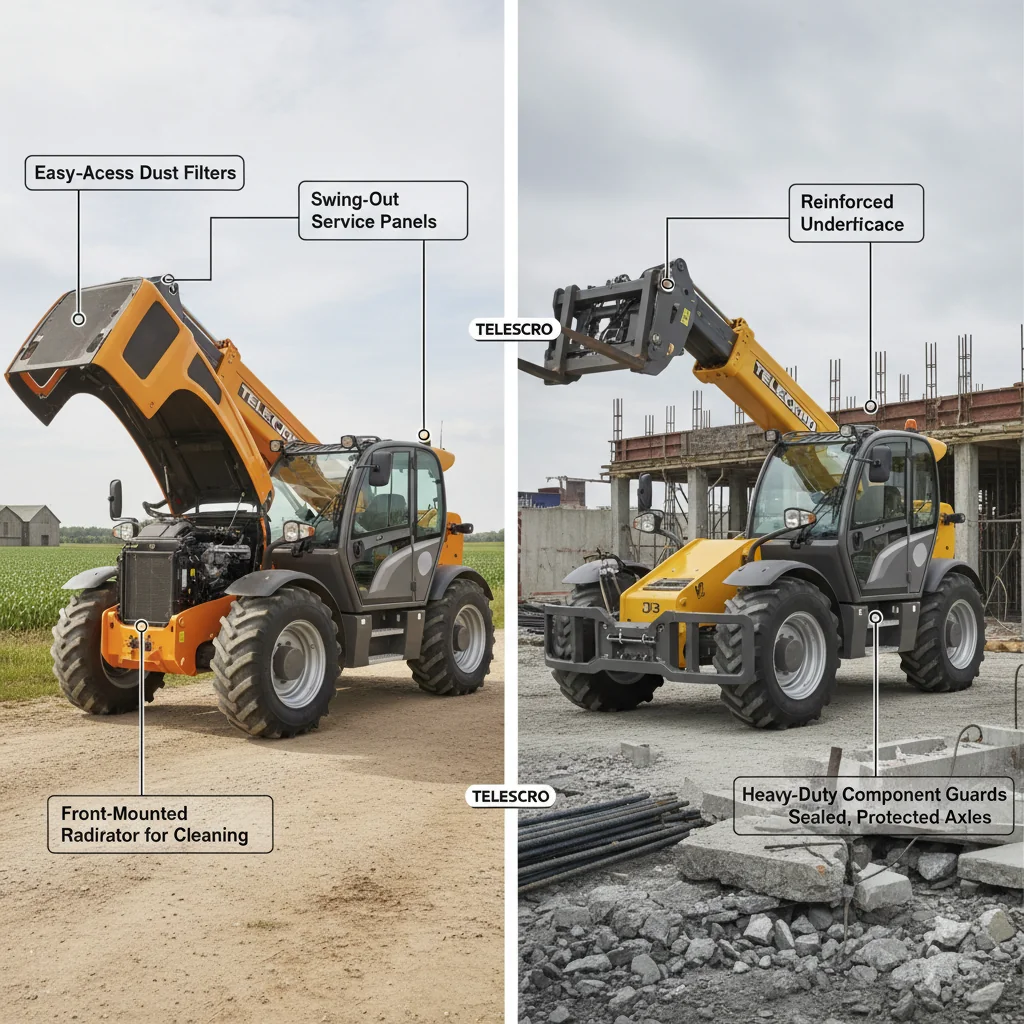
Farm and construction telehandlers might look similar, but—trust me—their day-to-day maintenance stories are completely different. On farms, operators often handle daily checks themselves. In Kazakhstan, I visited a customer running three 3.5-ton machines handling hay and silage. Their operators appreciated the wide-opening engine hoods and side-mounted radiators. “We need 30-second access to filters and cooling fins,” the owner told me.
That easy access means you can clear out dust, straw, and seeds before they clog up the radiator, which is a real risk during summer harvest. Cooling systems get hammered with debris and chaff, so skipping a day’s cleaning can quickly lead to overheating or hydraulic pump damage. Farm telehandlers are all about straightforward daily upkeep—grease points and fluid checks right where you want them.
Now, construction sites in places like Dubai or São Paulo bring something else altogether: constant shock loads, sharp debris, and rough surfaces. That’s why construction-spec machines use thick undercarriage plates and reinforced covers around the axles and transmission. I saw a 4-ton model in Dubai with a bent lower boom support because an operator hit exposed rebar—luckily, the boom was overbuilt for exactly this kind of abuse. These models usually have longer intervals between scheduled servicing, but when access is needed, it’s not always simple. Extra guarding sometimes means you need to remove a plate or two, so downtime can be longer if you catch a hydraulic leak late.
Choosing the right telehandler? I suggest matching maintenance features to your real work. Agricultural crews benefit from easy-clean designs, while construction machines demand protection—even if service takes a bit more time.
Agricultural telehandlers often feature side-mounted radiators and wide-opening engine hoods to allow operators quick access for cleaning debris like straw and dust during daily maintenance.True
Farm telehandlers operate in dusty, debris-rich environments, so designs prioritize easy access to cooling components to prevent overheating; side-mounted radiators and wide engine hoods enable rapid cleaning without specialized tools.
Construction telehandlers typically have simpler filter layouts than agricultural models because they operate in less dusty environments and require fewer maintenance checks.False
Construction telehandlers usually encounter a variety of harsh conditions, including dust, mud, and debris, necessitating complex filter systems and regular maintenance similar to agricultural models; simpler filter layouts are uncommon because durability and reliability are critical on construction sites.
Key takeaway: Match telehandler maintenance features and protection levels to the demands of either farm or construction sites. Agricultural units make daily upkeep simple, preventing cooling issues. Construction models emphasize component shielding and durability to withstand harsh worksite abuse, affecting service intervals and technician accessibility.
How do telehandler costs differ by use?
Agricultural telehandlers generally have a 10–15% higher purchase price than basic construction models due to advanced hydraulics, ag tires, and farm-focused features. Tax and insurance classifications often favor ag-registered machines, and resale values can be stronger if well maintained. Total cost of ownership depends on matching specifications to intended applications.
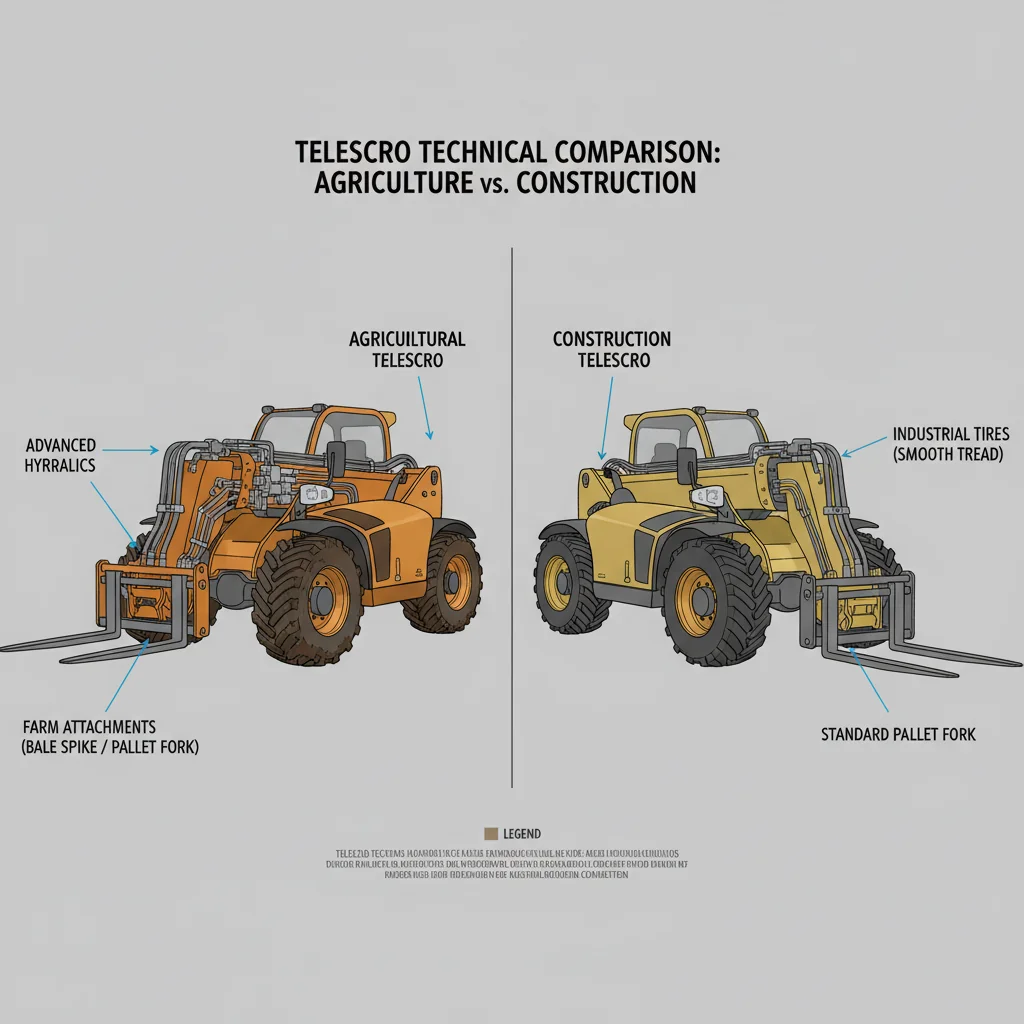
To be honest, the spec that actually matters is how closely the machine matches your daily tasks. I’ve seen farmers in Australia pay about 12% more for an ag-spec 3.5-ton telehandler versus a construction model of the same size. Why accept the premium? Because ag units include larger-diameter flotation tires, extra hydraulic circuits for bale clamps, and full glass cabs with suspension—features that handle muddy fields and long shifts far better.
But cost isn’t just about the sticker price. Here’s how costs break down depending on real-world use:
- Initial purchase: Agricultural versions generally run 10–15% more up front due to higher-spec hydraulics, ag tires, and farm-ready controls.
- Tax & insurance: In Europe and New Zealand, ag-classified telehandlers may qualify for lower vehicle tax and insurance if registered as on-farm machines.
- Resale value14: Well-kept farm telehandlers can hold 65–70% of value after five years, especially if maintenance records show regular service. Construction machines, facing tougher site abuse, often drop below 60%.
- Operating costs: Using a budget construction unit for farm chores usually leads to faster tire wear, more downtime due to dust in the hydraulic system, and operator complaints—I’ve had two ranchers in Kazakhstan swap machines after just one season because of this.
- Regulatory factors: Local rules on on-road travel, road tax, and insurance categories can significantly change cost calculations. I always suggest confirming with your broker or tax advisor.
The key is to run the numbers for what you actually do, not just what looks cheapest on paper. Consider whole-life cost, not just the invoice.
Agricultural telehandlers typically include at least two additional hydraulic circuits compared to construction models to operate attachments like bale clamps and mowersTrue
Ag telehandlers require extra hydraulic circuits to power implements such as bale clamps or mowing equipment, which construction telehandlers rarely use. This design difference increases complexity and cost but improves functionality in farm tasks.
Construction telehandlers always have larger-diameter flotation tires than agricultural telehandlers to better navigate uneven terrainFalse
In fact, agricultural telehandlers usually have larger-diameter flotation tires to minimize soil compaction and improve traction in muddy or soft fields, whereas construction telehandlers generally have standard tires optimized for firm ground and paved surfaces.
Key takeaway: While agricultural telehandlers often cost more upfront, they may yield greater long-term value if their features better suit farm tasks, enjoy favorable tax categories, and hold resale value. Assess ownership costs and regulatory factors alongside purchase price to select the most cost-effective telehandler for the intended application.
Which Telehandler Type Suits Each Application?
Construction telehandlers are engineered for lifting palletized loads on stable surfaces, requiring high reach and strict compliance with site regulations. Agricultural telehandlers excel in handling bales, grain, feed, and frequent attachment swaps within confined farm environments, favoring agility, rapid hydraulics, and operator comfort. Choosing the ideal model depends on primary workload, work environment, and operational priorities.
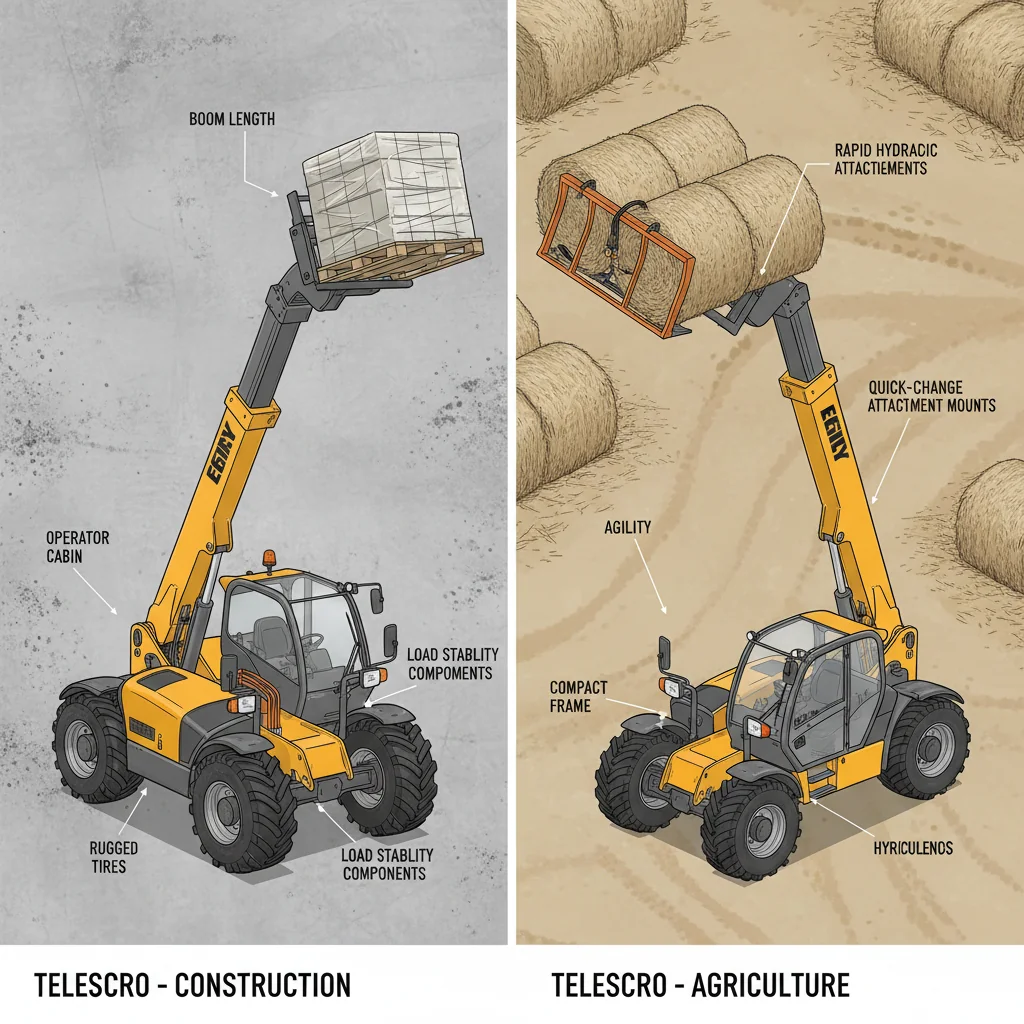
I often get calls from customers trying to use a construction telehandler on the farm—or the other way around. Last year in Kazakhstan, a grain operation tried to save costs by using a 4-ton, 13-meter construction-spec machine for loading wheat and moving bales. On paper, the capacity and reach were enough. In practice, the slower hydraulics and stiff road tires meant they lost at least two hours every day. The machine struggled in muddy yards and tight sheds. The operator complained about poor visibility and the lack of a suspension seat after just three weeks.
To make things clearer, here’s a quick comparison:
| Telehandler Type | Best For | Typical Capacity | Max Reach | Turning Radius | Key Features |
|---|---|---|---|---|---|
| Construction-Spec | Palletized loads, sites | 3,000–5,000 kg | 10–18 m | 4.5–5.5 m | High stability, load chart, rugged chassis |
| Agricultural-Spec | Bales, grain, tight barns | 2,500–4,000 kg | 6–10 m | Under 4 m | Fast hydraulics, compact size, comfort cab |
From my experience, even a mid-size ag telehandler—say, 3,500 kg at 7 meters—outperforms a bigger construction unit in cattle sheds or grain stores. You get tighter turning, faster attachment changes, and better ground clearance for rough tracks. Construction units shine on building sites: stable on rough surfaces, with strict load charts and advanced moment indicators (devices that warn if you’re close to tipping).
Agricultural telehandlers typically use larger, low-pressure flotation tires to maintain traction and minimize soil compaction in muddy or soft field conditionsTrue
Agricultural models prioritize ground engagement by fitting larger tires with lower ground pressure, which helps prevent soil damage and enhances maneuverability in uneven or muddy terrain compared to the smaller, stiffer tires on construction telehandlers.
Construction telehandlers are equipped with advanced all-wheel steering systems that allow for tighter turning radii than agricultural telehandlers, enabling them to operate more efficiently in confined farm settingsFalse
While construction telehandlers often have robust steering systems designed for site maneuverability, agricultural telehandlers generally have equal or better steering versatility—including crab and coordinated steering modes—specifically to navigate tight farm lanes and sheds, making the claim inaccurate.
Key takeaway: Assess the dominant application—construction or agricultural—before selecting a telehandler. Specialized features like reach, hydraulic speed, tire selection, and operator comfort directly impact productivity and safety. Matching the machine spec with at least 60% of expected use hours typically yields the best performance and economic value.
Conclusion
We’ve covered the main differences between construction and agricultural telehandlers, and when each type makes sense for your needs. From what I’ve seen, the buyers who end up satisfied pay close attention to the real lifting requirements on their site—not just max specs or price tags. Before finalizing your choice, I always suggest checking both the load chart at your typical working height and how quickly you can get spare parts locally. Need help figuring out which telehandler fits your workload or just want a second opinion on options? I’ve worked with clients across 20 countries and I’m happy to help—just reach out anytime. The right machine is the one that actually fits your jobsite.
References
-
Detailed insights on lift capacity ranges help operators choose the right telehandler for heavy lifting tasks on construction sites. ↩
-
Understand how compact chassis design benefits agricultural telehandlers by improving maneuverability and stability in confined spaces. ↩
-
Explore detailed insights on three-mode steering systems that enhance telehandler agility in tight and obstructed environments. ↩
-
Explore how wider footprints and softer rubber improve traction and reduce soil compaction for farming telehandlers. ↩
-
Explore the specialized features of ag tires that enhance performance on muddy fields and uneven farm terrain for telehandlers. ↩
-
Explore how joystick controls mimic tractor movements, enabling smooth, precise telehandler handling and reducing training time for farm operators. ↩
-
Details the design and industry role of ITA forks in stable lifting of palletized materials, essential knowledge for construction telehandler operators. ↩
-
Detailed insights on suspension seating benefits, reducing operator fatigue and enhancing comfort during long telehandler shifts. ↩
-
Technical explanation of reinforced steel mesh for cab protection, preventing debris entry and enhancing operator safety onsite. ↩
-
Covers key inspection points like brakes, hydraulics, and boom condition that ensure operational safety and compliance with regulations. ↩
-
Explains essential certification standards and training needed for safe telehandler operation across construction and agriculture sectors. ↩
-
Explore how wide-opening hoods improve accessibility to service points, reducing downtime and simplifying routine checks on farm telehandlers. ↩
-
Learn how reinforced undercarriages protect telehandlers from shock loads and rough terrain, extending equipment lifespan in harsh construction environments. ↩
-
Understand factors affecting resale value, including maintenance and usage patterns, to optimize telehandler investment decisions. ↩