










Telehandler Job Types: Where Telehandlers Truly Outperform Other Machines
Not long ago, a project manager in Poland sent me site photos showing a forklift stuck in mud, pallets stranded far from workers on scaffolding. He asked, “Would a telehandler really make a difference here?” Believe me, it happens more than most people expect—especially once ground conditions get tricky.
Telehandlers are the go-to machines on jobsites that require lifting and accurately placing heavy loads at height or over obstacles—especially on uneven, muddy, or undeveloped ground. Bridging the gap between a rough-terrain forklift and a small crane, telehandlers cover a wide range of lift classes (commonly 2.5–6 t) and can reach around 18 m in high-reach models. Their telescopic booms and quick-swap attachments allow crews to place palletized materials directly onto upper floors, roofs, or into formwork areas, reducing double-handling and keeping projects moving.
When Are Telehandlers the Optimal Choice?
Telehandlers outperform forklifts and cranes when heavy loads must be lifted and precisely placed at height or over obstacles—especially on rough or uneven terrain. Versatile attachments, rated capacities of 2.5–6 tons, and reach up to 18 meters enable efficient handling of pallets, construction materials, and irregular loads on dynamic job sites.

Most people don’t realize how quickly forklifts or cranes struggle on rough, uneven ground or highly dynamic jobsites. I remember a project in Kazakhstan where the ground was so muddy that forklifts sank within minutes. The team brought in a 4-ton telehandler with a 14-meter boom—suddenly, they could lift construction panels over drainage ditches and place them directly onto the second floor. The telehandler’s all-wheel drive1 and generous ground clearance—typically around the 0.4-meter class on rough-terrain models—made all the difference. This is exactly where telehandlers shine: lifting and placing heavy or awkward materials over obstacles when site conditions change day to day.
Here’s what matters most: versatility. Telehandlers handle pallet forks2, buckets, work platforms, even lifting jibs, all swapped in a few minutes. On a renovation job in Dubai, a customer needed to bring HVAC units to a rooftop one day, then fork pallets into a tight courtyard the next. A medium-sized telehandler (about 3.5 tons, 12-meter reach) did both. Try that with a standard crane or warehouse forklift—they just don’t have the flexibility or maneuverability.
To be honest, if your main work is low-level, flat-ground loading, a classic forklift probably makes more sense—simpler and often cheaper to maintain. But if you run into high lifts, mud, tight turns, or ever-changing loads (like trusses, blocks, or prefab panels), a telehandler saves hours and reduces equipment shuffling on-site. I suggest always checking both the rated capacity at working boom angles and whether you’ll need quick attachment changes on your job. That’s where telehandlers earn their keep.
Telehandlers are often the optimal choice for jobs that require placing loads at height over obstacles, such as lifting construction materials over fences or drainage ditches.True
This is true because telehandlers have telescopic booms that allow precise placement of loads in hard-to-reach areas and can extend over obstacles, unlike standard forklifts which are limited to vertical lift in front of the machine.
Telehandlers are typically preferred over cranes for repetitive heavy lifting on smooth, open surfaces due to their higher lifting capacity.False
This is false because cranes generally provide much higher lifting capacities for stationary, repetitive heavy lifts compared to telehandlers. Telehandlers are chosen for their mobility and versatility on uneven or rough terrain, not for the highest lifting capacity.
Key takeaway: Telehandlers are most effective for jobs requiring high lifts, precise placement, and adaptability on uneven or confined sites. Their ability to handle varied attachments and traverse challenging terrain gives them a distinct advantage over forklifts and cranes in non-standard or frequently changing material handling scenarios.
Why Are Telehandlers Essential for Building Sites?
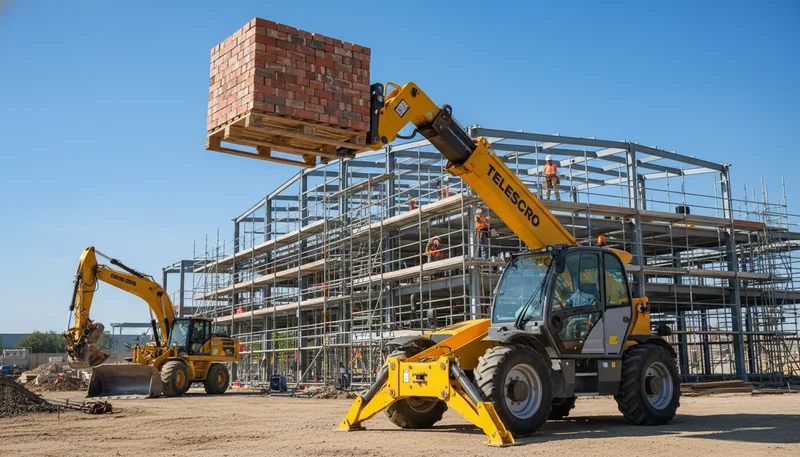
On construction and masonry sites, telehandlers serve as primary feeder machines, efficiently lifting and placing palletized materials such as bricks, rebar, and drywall to elevated areas. Their ability to maneuver on uneven ground and deliver full pallets directly to work zones streamlines operations, reducing manual handling and minimizing reliance on small hoists or short-duration crane hires.

Let me share something important about using telehandlers on real building sites—these machines are almost never just “nice to have.” They’re the core material movers, especially where ground conditions evolve daily. In Dubai, I worked with a contractor tackling a mid-rise apartment block. The pouring crews needed bricks, rebar, and drywall delivered to different floors on a tight schedule. With a 3.5-ton telehandler reaching up to 14 meters, they placed full pallets right onto scaffolding platforms. No need to wait for a crane or break down loads for manual hoisting.
From my experience, crane rentals sound efficient on paper but bring delays and higher costs in practice—especially for the half-hour lifts that pile up every day. Telehandlers, with their compact size and all-wheel drive, can get through mud, debris, and half-finished ramps where forklifts would get stuck. I’ve seen sites in Kenya where only a telehandler with stabilizers and a low-profile boom could set windows in place—over uneven ground and between scaffolding bays. Standard forklifts just can’t do this work safely or efficiently.
Another advantage? You can reposition a telehandler quickly, even in tight infill sites with almost zero laydown space. The right model can unload an entire truck’s worth of bricks—pallet by pallet—to three different elevations in less than an hour. Crews waste less time handling material and avoid double-handling from street level. If your job involves shifting materials up, over, and around obstacles, I suggest reviewing the load chart3 closely and making the telehandler your “feeder”—it really is a productivity game-changer on modern sites.
Telehandlers are commonly used for placing materials onto upper floors of buildings where tower cranes are not practical due to space or schedule constraints.True
Telehandlers can maneuver in tighter spaces compared to tower cranes and can deliver materials directly to various heights and locations, making them invaluable on congested or rapidly changing sites.
Telehandlers are only suited for lifting lightweight loads, such as insulation or small tools, rather than heavy materials like bricks and rebar.False
Telehandlers are designed to handle heavy and bulky loads, including full pallets of bricks and bundles of rebar, thanks to their robust lift capacities and variety of attachments.
Key takeaway: Telehandlers are critical for material handling efficiency on building projects, particularly mid-rise and infill sites. Their maneuverability and reach allow for rapid, precise material placement in areas inaccessible to cranes or standard forklifts, greatly enhancing productivity and safety in evolving jobsite conditions.
When Do Roofing Jobs Need Telehandlers?
Telehandlers are often preferred for roofing, siding, and cladding jobs where moderate loads like shingles, panels, and glazing units must be lifted repeatedly along a building edge up to about 18 meters high. Their extendable boom4 enables precise placement over obstacles without requiring the extensive setup or street closures of cranes.

Here’s what matters most when deciding if your roofing job calls for a telehandler: are you looking at repeated lifts of materials like shingles, insulation, metal panels, or glazing units—along a building that’s two to five stories high? If so, you’re right in the zone where telehandlers outperform other solutions. Most jobs like this are under 18 meters, and crews often need to move quickly from one section to another. A telehandler’s extendable boom lets you reach over scaffolding, fences, or landscaping. No need for major road closures or complex crane mobilization. That flexibility saves a huge amount of time, especially on tight urban sites.
Last spring, I worked with a contractor in Dubai tackling a hotel roof project at 16 meters height. Their team used a 4-ton telehandler with a rotating carriage5. Every morning, they lifted bundles of roofing sheets—up to 1,000 kg at a time—right over parked cars and site fences. The machine had a turning radius under 4.5 meters, so repositioning was quick, even in confined areas. Compared to their previous crane setup, they cut daily prep time in half and slashed street closure costs.
To be honest, the key spec is not just maximum height, but the load chart at your actual working outreach. Many customers expect full rated capacity at every boom angle, but as extension increases, allowable load drops sharply. At high-reach positions around 16–18 meters, usable capacity can fall to well under one ton on many models. I always suggest checking rated capacity at your real working height and horizontal reach before renting or buying.
If your roofing work involves frequent, moderate lifts along the edge, a telehandler streamlines the job—without crane-level disruption or cost.
Telehandlers are especially valuable on roofing jobs for buildings between two and five stories high, where repeated lifting of bulky materials is required.True
Telehandlers are designed to efficiently move heavy or bulky roofing materials up to moderate heights, making them ideal for multi-story projects that are beyond the safe reach of forklifts but do not require the vertical reach of a tower crane.
Telehandlers are typically required for all single-story residential roofing projects, regardless of material type.False
Most single-story residential roofing jobs do not require telehandlers because the height and material volume can usually be managed with ladders, conveyors, or small material lifts. Telehandlers are generally reserved for taller buildings or when handling especially heavy or repeated material lifts.
Key takeaway: Telehandlers provide an efficient, flexible solution for repetitive material lifts in roofing and cladding projects below 18 meters, especially when frequent repositioning and obstacle clearance are required. Their adaptability and load handling streamline tasks while minimizing disruption compared to cranes, making them integral for many roofing applications.
Which Farm Tasks Demand a Telehandler?
Telehandlers excel in agricultural tasks requiring significant lift height6, extended reach, and robust handling. Common applications include stacking big square bales up to five layers, loading tall feed mixers, transferring grain to high-sided trucks, and operating in deep manure or silage. Ag-spec models (3–4 t, 7–9 m) suit large and mixed-use farms.

The biggest mistake I see on large farms is underestimating just how much daily work depends on lift height and reach. Last season, I worked with a customer in New Zealand managing 700 hectares of mixed crops and dairy. They had always stacked their big square bales two layers high with a tractor loader—until a wet autumn forced them to stack five-high inside older barns. The loader topped out well below the third row, and they spent hours shifting bales by hand. Once they switched to a 3.5-ton telehandler with 7.5-meter reach, two people finished the same job in half the time, without strained backs or damaged feed.
Telehandlers prove their value where jobs demand high stacking, extended reach over feed barriers, or work in deep muck. I’ve seen operators in Kazakhstan use a 4-ton, 9-meter ag-spec machine to reach over 2-meter silage walls and fill giant feed mixers mounted on tall chassis—something most loader tractors just can’t do efficiently. The rough-terrain tires and 4-wheel steering7 also let them work inside tight farmyards or muddy silage clamps with less risk of getting stuck.
| Task Type | Tractor with Loader | Telehandler (3–4 t, 7–9 m) |
|---|---|---|
| High bale stacking (4–5 rows) | Reach limited, slow | Full reach, faster stacking, less labor |
| Loading tall feed mixers | Struggles above ~3 m | Handles 4–5 m easily |
| Reaching over feed barriers | Limited dump and reach angle | Long forward reach over barriers |
| Work in deep muck or silage pits | Traction issues, wheel spin risk | Better clearance, rough-terrain tires |
| Tight farmyards / barn access | Large turning radius | Four-wheel steering, tighter maneuvering |
| Labor efficiency | More manual handling required | Fewer people, less physical strain |
| All-day mixed lifting tasks | Adequate for low, occasional work | Purpose-built for repetitive lifting |
Telehandlers are often required for lifting bulk feed ingredients into high-sided mixer wagons, a task that can exceed the reach and height limits of standard front-end loaders.True
High-sided feed mixers are common on large farms, especially in dairy or feedlot operations. Standard tractor loaders often cannot achieve the necessary lift height or forward reach to safely and efficiently load these mixers, whereas telehandlers are specifically designed for such vertical and outreach demands.
Telehandlers are primarily used for plowing and soil preparation jobs on the farm due to their high traction and ground-engaging capabilities.False
Telehandlers are not designed for plowing or significant ground-engaging work; their strengths lie in lifting, extending, and stacking. Plowing and soil preparation require dedicated implements and power that are provided by tractors or specialized equipment, not telehandlers.
Key takeaway: Telehandlers provide clear efficiency and labor savings for large farms managing high stacking, challenging reach, and heavy loads. For lighter, ground-level, or primarily towing work, tractors with loaders are typically more cost-effective. Matching equipment to primary task demands optimizes operational value on the farm.
Where Do Telehandlers Outperform Forklifts?
Telehandlers excel in industrial yards, steel plants, precast depots, and heavy-material warehouses where forklifts face limits from uneven ground or restricted height. Their all-terrain travel8, boom reach9, and man-basket attachments enable efficient loading, elevated placement, and outdoor logistics, providing greater flexibility than standard forklifts in challenging work environments.

Last month, a site manager in Dubai reached out because his standard forklifts kept getting stuck on the cracked outdoor pavement at a steel yard. That job involved moving bundled pipes—some over six meters long—between the warehouse and staging area. The forklifts managed only on smooth concrete, but as soon as they hit the uneven outdoor surface, wheel spin and ground clearance became a problem. Switching to a 4-ton telehandler with all-terrain tires and 13-meter boom changed their workflow entirely. Suddenly, they could load flatbeds directly from outdoor stacks, reach over parked material, and even place bundles on elevated racks—jobs where his forklifts had no chance.
To be honest, reach and flexibility matter more than just rated capacity on sites like this. Precast plants in Vietnam and even rental depots here in China face similar challenges. A telehandler’s boom lets operators lift heavy molds onto raised forms or feed production lines at different heights, something fixed-mast forklifts can’t do. You also get the advantage of attachments—man-baskets for maintenance on high lighting or ducting, buckets for cleanup, or even hooks for short rigging work. It’s not about replacing your forklift but handling all the “in-between” material moves that chew up time and manpower.
If you run outdoor logistics with frequent elevation changes—like in Kazakhstan’s heavy-material depots—you’ll see that a single telehandler often replaces two or more specialized machines. I’ve seen it save weeks of equipment shuffling every year. My advice? Check the load chart for outreach at height, not just ground-level numbers. That’s where the real productivity starts.
Telehandlers can safely move and place bulky loads, such as long steel pipes, over obstacles or onto elevated surfaces that forklifts can't reach due to their limited vertical lift and lack of telescopic booms.True
Telehandlers feature extendable booms and higher ground clearance, allowing them to deliver loads above ground-level barriers and onto upper floors—tasks that standard forklifts, designed mainly for ground transport on smooth surfaces, cannot perform effectively.
Telehandlers are less capable than forklifts when working on uneven ground because their stability is compromised on rough terrain.False
Telehandlers are actually designed with all-terrain tires and a higher ground clearance, making them more stable and efficient than forklifts for handling loads on uneven outdoor surfaces.
Key takeaway: Telehandlers outperform forklifts in environments with rough ground, height or reach challenges, and diverse handling tasks. Their versatility reduces the need for multiple single-purpose machines, making them ideal for industrial yards, precast plants, rental depots, and heavy-material warehouses facing varied material movement demands.
How are telehandlers used in infrastructure?
Telehandlers provide versatile lifting and placement for infrastructure and utilities projects, excelling where frequent, short-duration lifts are required along long, linear worksites. Contractors utilize telehandlers for moving formwork, rebar, pipe bundles, cable drums, utility poles, and access platforms, benefiting from rapid mobility and reliable outreach unavailable from loaders or small cranes.

I’ve worked with customers who underestimated just how often they’d need mobile lifting along highway or pipeline projects. Light-duty cranes take too long to mobilize site-to-site, and loaders simply can’t reach over concrete barriers or bridge decks. On a recent bridge job in Kazakhstan, the crew used a 3.5-ton telehandler with a 14-meter boom to place rebar mats and formwork panels directly onto the deck—working from stable ground below. That saved the team at least two days compared to waiting for a crane every time they needed to move material.
The biggest advantage telehandlers bring to infrastructure work is rapid repositioning10. Contractors often cover hundreds of meters a day—laying pipe, erecting guardrails, or setting cable drums. Telehandlers easily follow the alignment and deliver overhead reach11 with minimal setup. I’ve seen highway contractors in Kenya use them for daily placement tasks that would slow to a crawl with a truck crane, especially on soft ground or unfinished subgrade.
For infrastructure and utility jobs, you’ll find telehandlers handling:
- Formwork and rebar – placing and shifting large mats, panels, and frames across varying deck heights
- Pipe bundles and cable drums – lifting and feeding materials for trenching and linework
- Barrier segments – moving heavy concrete or polymer barriers quickly along road projects
- Utility poles and access platforms – reaching over ditches or uneven ground for installation and maintenance
- Sign structures and guardrails – positioning and holding materials with pinpoint control
I always suggest checking the load chart and on-site ground conditions before committing. For frequent, low-to-medium weight lifts along changing worksites, a well-matched telehandler usually outruns both cranes and loaders—even on tough terrain.
Telehandlers are often used on infrastructure projects to place materials like rebar and formwork over barriers or onto bridge decks, tasks that standard loaders cannot accomplish due to limited lift height and reach.True
Unlike loaders, telehandlers have extendable booms that allow them to reach over obstacles such as concrete barriers and safely position materials at height, making them more versatile for jobs on elevated or obstructed areas.
Telehandlers are primarily designed for high-speed travel between distant job sites, making them ideal for quickly moving crews along long pipeline routes.False
While telehandlers are mobile, they are not designed for high-speed road travel; their main advantage is the ability to lift and place loads where other equipment cannot, rather than transporting personnel or materials quickly across long distances.
Key takeaway: Telehandlers significantly boost productivity for infrastructure and utility projects by enabling frequent, mobile material handling along varying site conditions. Their ability to place materials over edges or across linear alignments, with minimal setup, makes them preferable to cranes or loaders for many repetitive small-lift tasks.
Why Choose Telehandlers for Waste and Mining?
Telehandlers are preferred in waste transfer, recycling, quarry, and small mining sites where rough terrain, variable surfaces, and demanding reach are common. Their robust booms and protected hydraulics12 enable safe loading, feeding, and pile maintenance—tasks that wheel loaders or forklifts cannot perform efficiently in high-reach, unstable, or abrasive environments.

The biggest mistake I see in waste and mining sites is underestimating just how tough these environments are on equipment. Abrasive dust, unstable piles, and constant load cycles quickly expose any weak link. For example, a customer in Kazakhstan called me after two forklifts failed within months—frames cracked and hydraulics leaked badly. They switched to a 4-ton telehandler rated for rough terrain and 14-meter reach. Immediately, their crew could load bins from behind retention walls and feed crushers without getting too close to unstable edges. Standard wheel loaders simply couldn’t reach or handle the incline.
I’ve also seen recycling yards in Brazil rely on telehandlers for multi-shift work. These sites aren’t running 24/7, but they do operate long hours in high-utilization cycles. The telehandler’s protected boom sections and reinforced hydraulic hoses last longer around broken glass and scrap metal. One job there handled large, irregular waste with a bucket and then switched to a lifting hook to service conveyors—all with the same machine.
Here’s what matters most: in waste transfer or small mining environments, your telehandler will face higher wear on pins, pads, and all moving joints. Daily greasing and cleaning aren’t optional—they’re essential if you want reliable performance. I always remind customers to check the load chart every time stacking against a wall or loading at full extension, since the rated capacity drops sharply. If your material stays on flat ground, a wheel loader might work. But if you handle high piles, reach over obstacles, or need attachment versatility, the right telehandler makes the job safer—and a lot cheaper in the long run.
Telehandlers are uniquely equipped for tasks like clearing debris on sloped or unstable ground, where a traditional forklift would risk tipping due to lack of four-wheel drive and stabilizers.True
Telehandlers are designed with features such as four-wheel drive, higher ground clearance, and stabilizers, allowing them to safely operate on uneven or loose surfaces commonly found in waste and mining environments—conditions that standard forklifts are not built to handle.
Telehandlers are primarily designed for indoor warehouse work and cannot operate efficiently in excessively dusty or abrasive outdoor conditions.False
Telehandlers are specifically engineered for rugged, outdoor environments such as waste and mining sites, with sealed cabs, heavy-duty filtration, and robust components, while indoor warehouse work is typically handled by smaller forklifts or pallet jacks.
Key takeaway: In waste, recycling, quarry, and small mining operations, telehandlers outperform other equipment for tasks involving high placement, extended reach, and rugged conditions. Their durability, daily service needs, and precise adherence to load charts are essential due to abrasive materials and near-continuous multi-shift duty cycles.
When Is a Telehandler Overkill?
Telehandlers become excessive when most material handling tasks occur at ground level or involve only low lift heights, such as routine warehouse pallet moving and flat-surface loading. In these cases, conventional forklifts or loaders are usually more cost-effective and simpler to operate—particularly when high-reach placement, obstacle clearance, or rough-terrain work is only an occasional requirement rather than a regular part of daily operations.

The biggest mistake I see is buying a telehandler when the day-to-day work simply doesn’t require its reach or versatility. If most of your tasks involve moving pallets inside a warehouse or loading trucks on smooth concrete, you’re paying for capabilities that rarely get used. I once worked with a logistics operation in Vietnam that insisted on a 7-meter telehandler. After a year of operation, the reality was clear: most lifts stayed low, and the machine spent its life doing work a standard forklift could have handled more efficiently. It looked impressive on paper, but on site it was over-specified, under-utilized, and costly to run.
Maintenance and operating costs are another factor many buyers underestimate. Telehandlers are heavier and mechanically more complex than forklifts or basic loaders. Parts—especially hydraulic components like cylinders, hoses, and pumps—are more expensive, and transport is less straightforward. Moving a large telehandler just to support light warehouse work rarely makes economic sense. Operator training also adds cost. In markets like the UK, telehandler certification is more demanding than conventional forklift training. If you only need boom reach for short periods each year, renting is often the more practical option.
Before committing to a purchase, I always recommend stepping back and listing your actual lifting tasks over a full year. How often do you truly need to place loads well above standard forklift height? Do you regularly lift over fencing or scaffolding, or work on soft, uneven ground? If those situations come up only occasionally rather than forming part of your daily operation, sticking with forklifts or loaders—and renting a telehandler when required—will usually save both money and frustration.
Telehandlers are often overkill for repetitive pallet moving tasks on flat, indoor surfaces because these jobs rarely utilize their full reach or lifting versatility.True
Telehandlers are designed for jobs that require all-terrain mobility and high-reach capabilities. When used primarily for predictable, low-height lifting on smooth floors, their advanced features go unused, making simpler equipment like forklifts a better fit.
Telehandlers are the most efficient choice for all material handling jobs, regardless of surface conditions or typical lift heights.False
While versatile, telehandlers are not always the most efficient or cost-effective solution, especially in controlled environments like warehouses where traditional forklifts perform better for low lifts and smooth surfaces.
Key takeaway: Telehandlers are best reserved for high-reach, obstacle-clearing, or uneven terrain tasks. If such demands make up less than 20% of annual operations, using forklifts or loaders and renting telehandlers as needed ensures cost-effective, practical material handling solutions.
How should telehandlers be sized for jobs?
Telehandler sizing should always match the heaviest load and the maximum placement height13 or reach required for each specific job. Rated capacity drops sharply as boom extends; actual usable capacity must be referenced from the load chart at the exact working radius. Always factor in attachment weight and allow a safety margin.

Here’s what matters most when sizing a telehandler for any project—always pin down the real heaviest load and exactly where it needs to go. I’ve seen too many buyers focus on headline capacity or reach, then realize their “4-ton machine” only manages 1,200 kg at full 17-meter extension. That can create serious delays. For example, a customer in Malaysia last year needed to lift concrete blocks to the fourth floor, about 13 meters up. On paper, their machine had enough height and a 3.5-ton rating. But the load chart (which shows capacity at specific reach and height combinations) dropped them below 1,300 kg at that radius—less than half of what was needed. They had to rent a larger unit, which cost both money and time.
To size correctly, start by checking both your maximum required reach (measured from the front tire edge to the load center of your attachment) and the maximum load you expect to lift. Then, pull up the load chart for your exact working position: not just “max” numbers, but the real spot you’ll work at. Don’t forget, attachments like buckets or platforms eat into capacity, sometimes by several hundred kilograms. I always recommend factoring in at least a 10% safety margin so you’re never running the telehandler at its absolute limit during daily operations.
For typical housebuilding up to three stories, a 12-14 meter reach usually gives enough flexibility. In tight city sites or when you need to place loads around obstacles, a rotating telehandler can earn its keep—especially if it prevents extra machine moves. Every jobsite is different, but the right way is always load chart first, headline specs second.
A telehandler's maximum lifting capacity at full extension is often much lower than its rated maximum capacity at minimum outreach.True
Telehandlers are rated for maximum lift capacity at minimal boom extension, but as the boom extends and the load moves farther out, the machine's leverage decreases, reducing safe lifting capacity. This is a key consideration when sizing for projects with high or long-reach requirements.
A telehandler rated for 4 tons can safely lift 4 tons to its maximum listed height, regardless of outreach.False
The rated maximum capacity is only achievable with the boom retracted or at limited outreach. As the boom extends or lifts higher, the capacity drops due to increased leverage and stability limits, so actual lifting ability at maximum height is significantly reduced.
Key takeaway: Telehandler selection must be based on both the real-world maximum load and required reach or height on site, not just headline capacity or height figures. Always reference the OEM load chart for specific working positions and include attachment weight and safety margin in all calculations.
Which Telehandler Attachments Suit Each Job?
Telehandler attachments should match specific operational demands. Construction sites typically require pallet forks, general-purpose buckets14, crane jibs, and man-baskets. Agricultural tasks favor grain buckets, bale spikes, and manure forks. Industrial applications benefit from fork positioners and rotating carriages. Effective task mapping determines if a telehandler can cover 70% or more of job requirements, justifying its role as a primary machine.
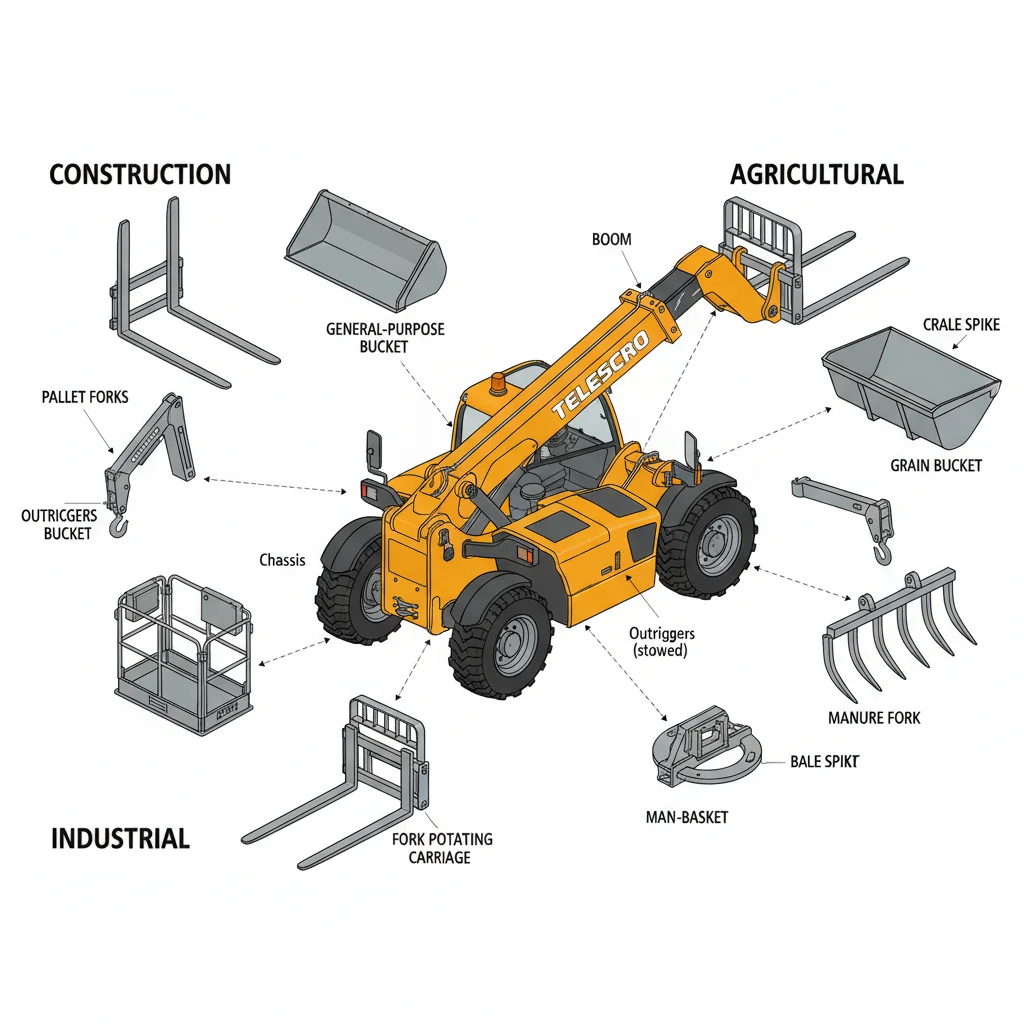
From my experience, the smartest way to decide if a telehandler makes sense as your primary machine is by tracking how much work you actually do with core attachments. I’ve seen projects in South Africa where 80% of site material movement was handled just with pallet forks and a general-purpose bucket. But on a dairy farm in Shandong, the operator switched attachments almost daily—bale spikes for hay in the morning, a manure fork by lunch, and a grain bucket after.
The right fit always comes down to what jobs dominate your calendar. Common telehandler attachments include:
- Pallet forks – handling loads on pallets, bricks, bags
- General-purpose buckets – loose material, cleanup, sand
- Crane jibs – hoisting rebar, beams, rooftop deliveries
- Man-baskets – safe access for overhead repair or inspection
- Grain buckets – moving silage and grain (agriculture)
- Bale spikes / clamps – handling round or square bales
- Manure or grab forks – waste and bedding on farms
- Fork positioners / rotating carriages – precise pallet placement (industry)
Here’s a quick comparison:
| Attachment | Best For | Typical Capacity | Notes |
|---|---|---|---|
| Pallet forks | Palletized loads, bricks, bags | 2,500–4,500 kg | Most universal; used on majority of jobs |
| General-purpose bucket | Soil, sand, debris cleanup | 0.8–2.5 m³ (volume-limited) | Watch load center and de-rating at reach |
| Crane jib | Rebar, beams, rooftop deliveries | ~2,000 kg at moderate reach | Capacity drops sharply with boom extension |
| Man-basket / work platform | Personnel access and inspection | 1–2 persons (per certification) | Must be certified; strict safety and site approval |
| Grain bucket | Grain, silage (agriculture) | 1.5–3.0 m³ | High-volume, low-density materials only |
| Bale spikes / clamps | Round or square bales | 800–1,200 kg per bale | Match spike length or clamp type to bale size |
| Manure / grab fork | Manure, bedding, farm waste | 1.0–1.8 m³ | Protect hydraulic lines; check tine strength |
| Fork positioner / rotating carriage | Precise pallet placement (industry) | Same as forks, reduced by 5–15% | Adds control but reduces net capacity |
A telehandler equipped with a bale spike is specifically suited for agricultural jobs involving hay or straw handling, but is not efficient for moving loose materials like gravel or sand.True
Bale spikes are designed to penetrate and lift baled materials, making them ideal for tasks like stacking or transporting bales, commonly found in farming operations. However, they offer no containment for loose materials, which require bucket attachments.
A general-purpose bucket attachment should always be used instead of pallet forks for unloading pallets of bricks on construction sites.False
Pallet forks are specifically designed for lifting and transporting palletized materials such as bricks, providing stability and minimizing the risk of load displacement. Buckets are not suitable for handling palletized loads and can result in damage or unsafe movement.
Key takeaway: Mapping a year’s work by attachment use reveals if a telehandler, equipped with a few standard tools, replaces multiple machines. If most tasks align with core attachments, a telehandler is justified as the primary asset; otherwise, further evaluation of machine type investment is recommended.
When Should Telehandler Rental Be Preferred?
Renting a telehandler is usually the better option for irregular or project-based use—such as seasonal work, one-off jobs, or situations where transport and mobilization costs are high compared with actual operating time. Ownership becomes more economical when a telehandler is used consistently across multiple projects or as a daily site feeder, particularly for mid-size machines (3–4 t, 10–14 m) in ongoing operations. Rather than relying on purchase price alone, buyers should evaluate real annual utilization15, downtime risk, and logistics costs to make the right rent-versus-buy decision.

To be honest, the real deciding factor is how steady your telehandler usage is—don’t just look at the price tag. If your projects are spread out and you only need a machine for a few weeks at a time, renting keeps your books clean. I’ve seen this firsthand in Kazakhstan, where a contractor rented a 12-meter, 3.5-ton telehandler for three seasonal jobs. Their total usage was under 350 hours for the year. They saved a lot by avoiding insurance, annual inspection costs, and not dealing with surprise breakdowns—especially when transport between two sites added over $1,000 per move.
Some jobs just can’t predict demand. I’ve worked with factories in Brazil that own a core 4-ton, 14-meter machine for daily work, then rent high-reach units above 18 meters only when a big job pops up. Renting fills those short-term specialty gaps—like lifting HVAC equipment to a rooftop or unloading containers when the standard machine is too short. You won’t get caught by “parts roulette” if a rental machine goes down, either; the rental company swaps it, no downtime for you.
But if your hours go over 600 a year, it starts to make sense to own—especially for mid-size models around 10-14 meters. The math changes fast: you spread costs across more hours, and you control maintenance standards. I always suggest tracking your actual usage for a few projects before making long-term decisions. When in doubt, plan for a mix—own what covers 70% of your work, and rent the rest. That strategy works in markets from Kenya to Eastern Europe.
Telehandler rental is often preferable for jobs requiring sporadic lifting across multiple non-consecutive sites, since owning a machine introduces idle time and unnecessary maintenance costs.True
When work is intermittent and spread over different locations, ownership is inefficient due to downtime and ongoing upkeep regardless of use. Renting shifts these burdens to the rental provider, fitting irregular site needs.
Rental telehandlers are the best option for long-term, daily heavy material handling tasks on a single permanent site.False
For consistent, high-utilization needs at one location, ownership is usually more cost-effective over time, as frequent rental costs quickly surpass purchase and maintenance expenses.
Key takeaway: The decision to rent or own a telehandler depends mainly on annual usage hours, machine transport costs, and equipment specialization. For operations with unpredictable demand, renting covers peak or specialty needs while ownership suits higher, steady utilization—always account for total operating and logistical costs.
Conclusion
We’ve looked at where telehandlers really come into their own—handling high lifts, precise placement, and adapting to uneven or tight jobsites. These strengths make them the right tool when flexibility matters more than sheer size.
From my experience, the smart buyers don’t just fall for the tallest or most powerful models. They take a close look at the full load chart and double-check how fast they can get parts on site. It’s the difference between a "showroom hero, jobsite zero" and a machine that keeps your project running.
If you have questions about matching a telehandler to your actual job conditions, or want advice based on what’s worked for real crews, feel free to reach out. The right choice depends on your site’s demands, not just the brochure.
References
-
Learn how all-wheel drive enhances telehandlers’ maneuverability on mud and debris, ensuring reliable material delivery in tough site conditions. ↩
-
Explore how pallet forks optimize material handling on construction sites, improving efficiency for loading pallets, bricks, and bags. ↩
-
Detailed guidance on interpreting load charts to ensure safe telehandler sizing and prevent costly job delays. ↩
-
Explains how extendable booms enhance precision and efficiency in lifting materials over obstacles without crane setup hassles. ↩
-
Details how rotating carriages improve maneuverability and reduce setup time, critical for tight urban roofing projects. ↩
-
Explore how optimal lift height improves efficiency in stacking, loading, and handling farm materials, reducing labor and damage. ↩
-
Detailed insights into how 4-wheel steering improves maneuverability and reduces risk in tight farmyards and muddy silage clamps. ↩
-
Explore expert insights on how all-terrain travel enables telehandlers to handle uneven and rough surfaces, boosting site efficiency and safety. ↩
-
Learn technical advantages of boom reach for telehandlers, including elevated placement and flexible load handling in complex work environments. ↩
-
Discover how telehandlers’ rapid repositioning enhances productivity on long, linear worksites and saves valuable project time. ↩
-
Learn how telehandlers provide efficient overhead reach on complex sites where loaders or small cranes fall short. ↩
-
Explore how protected hydraulics enhance durability and reduce leaks in harsh environments with abrasive dust and constant load cycles. ↩
-
Explains the critical role of maximum placement height in selecting the right telehandler for job efficiency and safety. ↩
-
Learn about general-purpose buckets for handling loose materials and cleanup tasks, crucial for site maintenance and material transport. ↩
-
Details how owning a telehandler becomes cost-effective beyond 600–800 annual hours, helping operators decide between renting and buying. ↩