











Telehandler Jib Boom Uses: Field-Tested Guide to Safe Lifting
Just this morning, I messaged a site supervisor in Poland who was struggling to set 8-meter trusses over a scaffold-lined edge. His problem was simple: forks could get the load close, but not close enough—or safe enough—to drop into place without some creative thinking.
A telehandler jib boom is a specialized lifting attachment designed to convert a standard telehandler into a highly versatile hook-lifting device. This attachment consists of a robust steel boom, typically between 2 and 4 meters in length, featuring a rated swivel hook and security latch. By mounting onto the carriage or over fork tines, the jib boom extends the lifting point both forward and upward.
What is a telehandler jib boom?
A telehandler jib boom is a dedicated lifting attachment that converts a telehandler into a compact mobile crane. It typically features a 2–4 meter steel boom with a rated swivel hook, mounted on the carriage or over the forks. Jib booms enable safe handling of suspended loads using hooks, slings, or chains.

Most people see a telehandler and think “forks for pallets.” But the reality on sites from Dubai to Brazil is different—a jib boom attachment transforms your basic telehandler into a genuine mini-crane. Instead of carrying pallets, you get a steel boom, usually around 2 to 4 meters long, with a rated swivel hook at the end. The way it mounts—directly onto the carriage or sliding over the forks and secured by pins—makes it quick to adapt without buying extra lifting equipment. I’ve worked on projects where just swapping in a jib boom let the same 4-ton telehandler handle 1,500 kg HVAC units, roof trusses, and even small generators at height.
Let me share something important about load capacity1. When you install a jib boom, its own weight—often 150 to 300 kg—immediately reduces your telehandler’s rated capacity2. Plus, the lifting point shifts forward, so you lose even more usable capacity due to leverage. On one job in Kenya, the team expected to lift 2,000 kg at maximum outreach. But with the jib, their real safe lift was just 1,100 kg—less than 60% of their “standard” capacity. It’s always the load chart3 (showing safe weights at every boom length) that tells the real story—not just the numbers in the brochure.
So, while a jib boom is a cost-effective way to add new lifting abilities to your existing fleet, you have to respect the physics. I suggest checking the specific derated capacities with your actual attachment before deciding what jobs you can take on. That prevents expensive surprises on site.
A telehandler jib boom can reduce usable lifting capacity to around 20–25% of the telehandler’s fork rating at long reach, depending on boom length and load center.True
When a jib boom is used at long radii, the load hangs farther from the telehandler’s fulcrum, sharply reducing safe capacity. Many truss and industrial jib charts show allowable loads of only about 20–25% of the base fork rating at maximum extension to avoid tipping.
Telehandler jib booms are designed exclusively for lifting rigid loads like steel beams and are not rated for suspended or dynamic loads.False
Most jib booms are specifically made to handle suspended loads, such as lifting HVAC units or trusses, using a swivel hook. They are regularly used for dynamic lifts, unlike fork attachments intended only for stable loads.
Key takeaway: Telehandler jib booms provide a cost-effective way to safely lift and place suspended loads with an existing telehandler, eliminating the need for a separate mobile crane. Attachment weight and load center shift must always be considered, as they reduce the machine’s rated lifting capacity.
When Is a Jib Boom Safer Than Forks?
A jib boom is the preferred telehandler attachment when the load cannot be safely supported on forks or requires lifting from a dedicated lifting point. Typical cases include trusses, HVAC units with lifting lugs4, machinery with eyebolts, precast anchors, and rigged or irregular loads where direct fork lifting is unsafe.
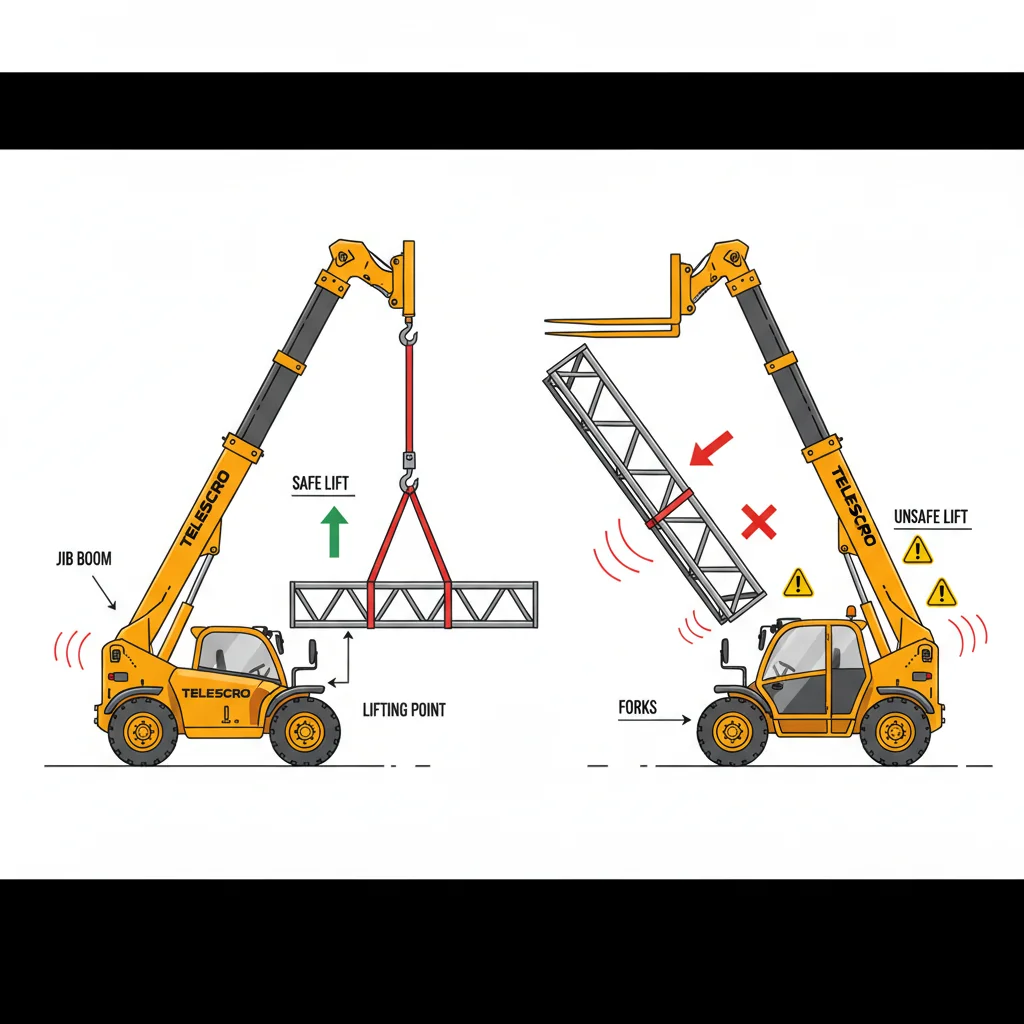
Let me share something important about jib booms and forks that many operators miss. Forks work well for anything designed to sit flat—like palletized bricks or rebar bundles with proper fork pockets. But the moment you face a load with a dedicated lifting point or irregular balance, using forks gets risky fast. I’ve seen projects in the UAE where crews tried lifting HVAC units using the fork tips because it was “quicker.” The job actually slowed down due to constant repositioning—plus the safety manager stopped work because chains on forks weren’t allowed on site.
Loads that need slings, lifting lugs, or eyebolts are exactly why telehandler jibs exist. A jib boom gives you a certified lifting hook and crystal-clear load ratings, shown right in the load chart (not just on paper—a sticker at eye level on the attachment itself). With a 2-ton jib, you know the safe working limit at every boom angle, and the machine’s moment indicator watches for overloads. I always tell new customers: if you’re ever tempted to wrap a chain or sling over the forks, reach for the jib instead. That’s safer, and you won’t violate site rules that prohibit “tip-of-fork” lifts.
On a jobsite in Kazakhstan, a client used a 4,000 kg rated telehandler to position roof trusses—each over 13 meters long—with a jib and spreader bar. The rig hung perfectly vertical, avoided side loads, and the team finished two days ahead of schedule. Jibs aren’t for every lift, but for odd-shaped, rigged, or hanging loads, they’re the right call every time.
A telehandler jib boom is safer than forks for lifting loads with a single top-mounted lifting eye, as it keeps the load centered and minimizes the risk of unintentional swinging.True
Jib booms allow the operator to secure the lifting hook directly to a designated lifting point, resulting in more controlled handling of irregular or tall items that would be unstable on forks, especially when positioning at height.
Using a jib boom increases the rated lifting capacity of a telehandler compared to using forks.False
Jib booms actually decrease the rated capacity because the load is carried farther from the machine's center of gravity, which increases leverage and reduces maximum safe lifting weight.
Key takeaway: Use a telehandler jib boom whenever site rules prohibit tip-of-fork or improvised lifting, or when handling loads with dedicated lifting points, slings, or spreader bars. Jib booms provide certified hooks and clear load ratings, substantially improving lifting safety compared to forks in these scenarios.
When should a telehandler use a jib?
A telehandler jib boom is intended for lifting and placing materials—not personnel. Use a jib when the task involves handling heavy loads like trusses or pumps, ensuring workers access the area independently. Lifting people on hooks or slings from a jib is a serious safety and regulatory violation.
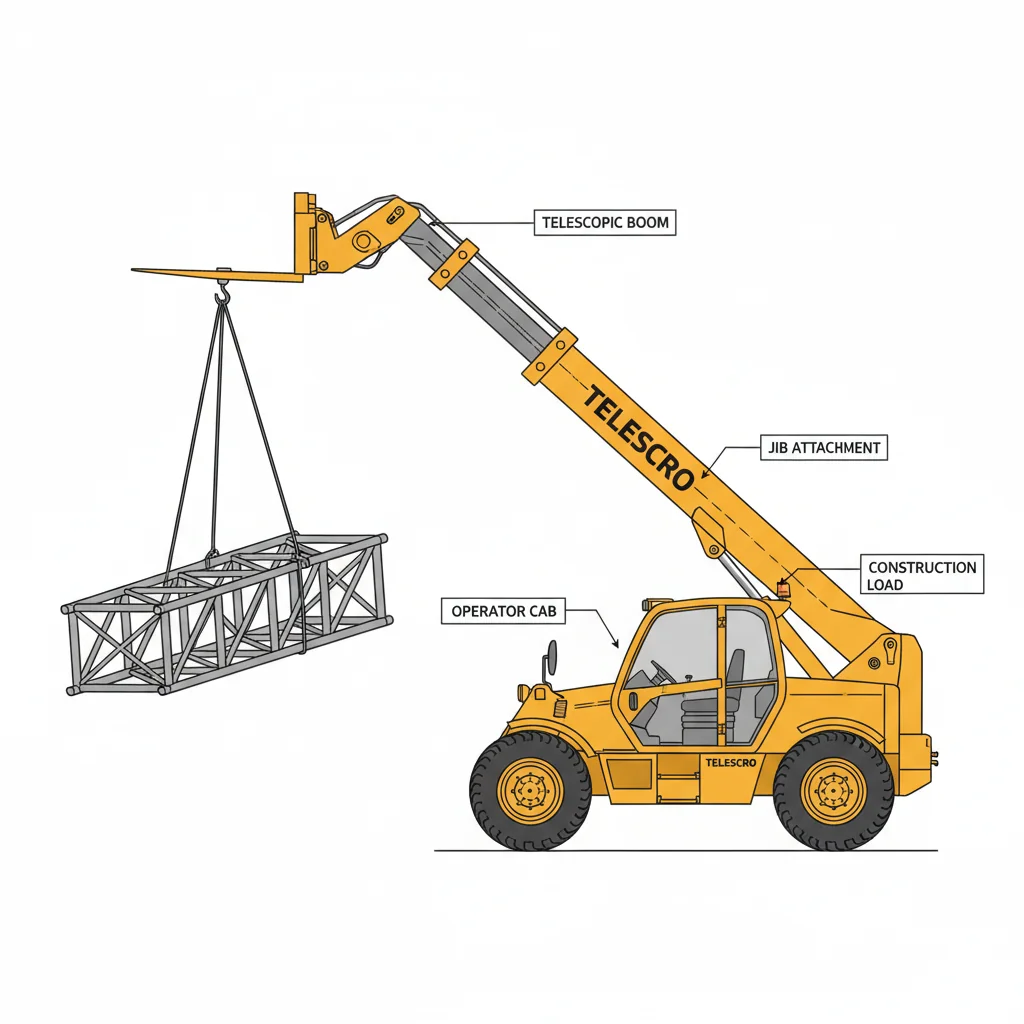
The biggest mistake I see is using a telehandler jib to lift people—usually because someone needs “just a little extra reach.” I’ve watched this happen in Dubai, on high-rise projects where schedules are tight and the team is tempted to rig up a man basket on a jib for quick access. That’s a serious safety violation, and it’s banned on nearly every jobsite I’ve visited. Jibs are built for handling material loads, like steel trusses or pumps, not personnel. The load chart on your telehandler shows safe capacities for a reason—and trust me, it doesn’t account for human lives in a sling.
Here’s a quick checklist for knowing when a telehandler should use a jib versus another attachment:
- Use a jib when your task involves moving suspended loads: beams, HVAC units, pumps—anything lifted via hook.
- Never use a jib to lift people or man baskets, even “for a quick job.” Use an approved work platform with proper guardrails and anchorage.
- Check the load chart every time—adding a jib shifts the load center forward and lowers rated capacity, sometimes by 30-50%.
- Workers should access the area independently—by ladder, stairs, or when the load is placed, not by riding on the load or hook.
- If the main goal is personnel lift for tools or inspection, pick a telehandler work platform or a MEWP, not a jib.
- Mixing roles creates major risk—don’t hang baskets from jibs to “save time.” I’ve seen regulators in Australia shut down entire projects for this.
I always suggest keeping it simple: people ride platforms, materials go on hooks. That’s how you stay safe—and legal—anywhere in the world.
A telehandler jib boom is typically rated with significantly lower capacity than the base boom—often 30–50% or more reduction at comparable reach—because of the increased load radius and reduced stability margin.True
Adding a jib moves the load farther from the telehandler’s tipping axis, sharply increasing the overturning moment. Combined telehandler–jib load charts commonly show capacities that are 30–50% lower, or even less, than the fork rating at the same boom angle and reach.
Telehandler jib booms are suitable for lifting personnel when equipped with a proper man basket attachment.False
Even with a man basket, telehandler jib booms are not designed or rated for personnel lifting. Standards strictly prohibit using a jib for lifting people, due to the increased instability, lack of fall protection, and absence of necessary safety features required for personnel handling.
Key takeaway: Always use a telehandler jib boom only to lift materials, never people. Select a man basket or approved work platform for elevating personnel. Mixing these roles creates major safety hazards and liability risks—people on platforms, loads on hooks is the safe and legal standard.
How does a jib boom increase reach?
A jib boom extends the lifting point of a telehandler forward and upward, providing up to 12 ft (3–4 m) of additional horizontal reach beyond the fork tips. This allows safe placement of loads over obstacles, such as parapets, guardrails, or scaffolds, where direct access by forks is impossible.

Here’s what matters most when thinking about reach: a jib boom doesn’t just give you a little more length—it actually pushes your lifting point up to 12 feet (about 3–4 meters) further forward and, just as importantly, higher than your fork tips. This means you can lift over parapets, scaffolds, or even low roofs without repositioning your entire telehandler. That "up-and-over" ability is the real value. I’ve seen it solve major problems, especially on tight renovation sites in Singapore where contractors install HVAC units on second-story ledges. Without the jib, access would require removing a railing or even renting expensive supplementary lifting gear.
For a specific example, last year in Dubai I worked with a crew that needed to set glass panels behind a water feature—no way to approach directly. Their standard 4-ton telehandler could only get the forks within six feet of the drop point. Swapping in a 3-meter telescopic jib made the difference, allowing safe delivery of panels onto a narrow platform behind the obstacle. The job finished a week ahead of schedule because no extra scaffolding was required.
But here’s the catch: every bit of extra reach means your load hangs further forward, which increases the effective load radius. That reduces your rated capacity—sometimes by half or more, depending on the jib length and machine size. Always check the combined load chart for your unit and jib. I always remind customers to work only on level, stable ground when using any extension. The right attachment can make tough placements easy, but only if you respect the limits detailed in the load chart.
A jib boom can increase a telehandler's maximum forward reach by up to 12 feet, allowing operators to position loads over obstacles such as parapet walls without moving the base machine.True
Jib booms extend both the horizontal and vertical reach of the telehandler, pushing the lifting point significantly further forward and higher than fork tips. This extended geometry is especially useful for jobs where up-and-over placement is needed, such as working past barriers or onto rooftops.
Using a jib boom on a telehandler allows you to safely lift heavier loads than using standard forks, since the extended length improves leverage.False
While a jib boom increases reach and flexibility, it actually reduces maximum safe lifting capacity due to increased leverage forces on the telehandler. The longer the attachment, the lower the rated lifting capacity, which is why manufacturers provide specific de-rated load charts for jib attachments.
Key takeaway: A jib boom attachment significantly enhances a telehandler’s ability to deliver loads over barriers or into confined spaces. However, increased reach also shifts the load center and reduces rated capacity. Always consult the combined telehandler and jib load chart and operate only on firm, level ground.
What Are Common Telehandler Jib Boom Uses?
Telehandler jib booms excel at light-to-medium lifts where a small crane might otherwise be used. Common applications include placing roof trusses5, steel beams, HVAC units, and precast panels in construction, as well as equipment swaps in industrial plants and handling large implements in agriculture or boatyards.

I’ve worked with customers who made the mistake of thinking a jib boom is only for special jobs. The reality is, these attachments see action daily across a surprising range of industries. In construction, I see jib booms moving roof trusses onto two-story frames, placing small steel girders, and staging HVAC units—especially where access is too tight for a mobile crane. A client in Dubai recently told me they used a 4-ton telehandler with a 2.5-meter jib to place precast stairs up to the third level. The contractor avoided the cost and wait time of bringing in a crane for each minor lift. Jib booms really shine in industrial plants and agricultural work.
In Kazakhstan, a plant maintenance team needed to swap a 900 kg pump on an elevated deck, but the main aisle couldn’t fit a crane. Their 14-meter telehandler with a short-angle jib did the job: straight up, tight in, done in half a shift. I’ve also helped farms specify jibs for handling seed drills or repairing irrigation pivots—places you can’t fork under safely.
Typical telehandler jib boom uses include:
- Placing roof trusses, beams, and HVAC units on residential/light commercial jobsites
- Handling precast concrete components (panels, stairs, formwork)
- Lifting equipment in factories—motors, tanks, or service parts—where overhead cranes aren’t available
- Moving implements on large farms (fertilizer spreaders, seeding attachments)
- Boat handling for stepping masts or shifting small hulls in marinas
A telehandler jib boom can safely place loads up to several meters below ground level, such as lowering equipment into elevator shafts or foundations.True
Because a jib boom extends the reach and can articulate loads vertically, it is frequently used for precise downwards placement in confined construction sites, outperforming fixed forks in such applications.
Jib booms are never used for installing glazing panels because they cannot be equipped with suction attachments.False
Special jib boom designs often include provisions for attaching vacuum lifters or suction cups, making them ideal for handling and installing glass panels in areas inaccessible to other lifting equipment.
Key takeaway: Telehandler jib booms provide versatile, efficient lifting for construction, industrial, agricultural, and marine sectors. They bridge the gap between forklifts and cranes, allowing one machine to serve multiple trades for non-standard, elevated, and confined lifting tasks—especially where overhead cranes or dedicated lift equipment are impractical.
How Do Jibs Change Telehandler Capacity?
Attaching a jib boom to a telehandler shifts the load center forward, drastically reducing usable capacity compared to using forks at the same boom extension. Safe lifting depends on both the base machine’s load chart and the jib’s position-based ratings, with the lowest value always governing.

I’ve worked with multiple clients who underestimated how much a jib changes usable capacity. For example, last summer in Dubai, one of our rental partners ordered a 3.5-ton telehandler expecting to lift 2,500 kg with a 4-meter jib at full outreach. When their team tried to pick steel pipe bundles, the moment indicator alarmed before they even got close. The actual safe limit was just 1,200 kg at that radius—less than half the fork rating at the same boom angle. That difference comes from two factors: the weight of the jib itself, and the fact that adding a jib moves your load center much farther forward.
Jibs often look simple, but their capacity rating always changes according to pin position. Most telescopic jibs have steps—maybe 6,000 lb (about 2,700 kg) at the shortest extension, down to just 2,000 lb (900 kg) fully out. But here’s where some people go wrong: the telehandler’s base load chart combined with the jib’s own chart can result in much lower values. The lowest number always wins. If your base machine says 1,800 kg at a certain radius but the jib shows 1,000 kg, you must use 1,000 kg as your upper limit—including any slings, shackles, or spreader bars.
From my experience, the safest approach is to ask your supplier for the combined load chart specific to your jib and machine. Don’t just rely on sticker ratings or assumptions. Train your crew to confirm capacity for every lift setup—especially when using attachments that shift the load center forward. I always recommend operators check these numbers before putting any weight on the hook.
Attaching a 4-meter jib to a telehandler can reduce its maximum lift capacity at full extension by over 50% compared to forks at the same boom length.True
Jibs extend the load further from the boom pivot, increasing the moment arm. This sharply reduces safe capacity, often by more than half, even if the base telehandler is rated for that weight on forks.
Telehandler load charts remain unchanged when a jib is installed, as long as the operator keeps within the telehandler's maximum capacity.False
Attaching a jib always requires consulting a different load chart or capacity table. The added length and offset create greater leverage forces, significantly lowering safe lifting limits regardless of the machine’s fork rating.
Key takeaway: Always reference the combined load chart for the specific telehandler and jib model. Rated capacity can decrease by more than half when a jib is attached, and the lowest limit between machine and attachment must be used for safe operation. Never rely on base machine capacity alone.
How to Select a Telehandler Jib Boom?
Selecting a telehandler jib boom requires listing the most common lifts to determine required reach, capacity, and frequency. Telescopic jibs (2–4 m) suit lighter, extended reach tasks, while fixed jibs (1.5–2.5 m) offer greater rated capacity. Always check load chart, OEM approval, certification, and attachment compatibility. Avoid uncertified or undocumented jibs.
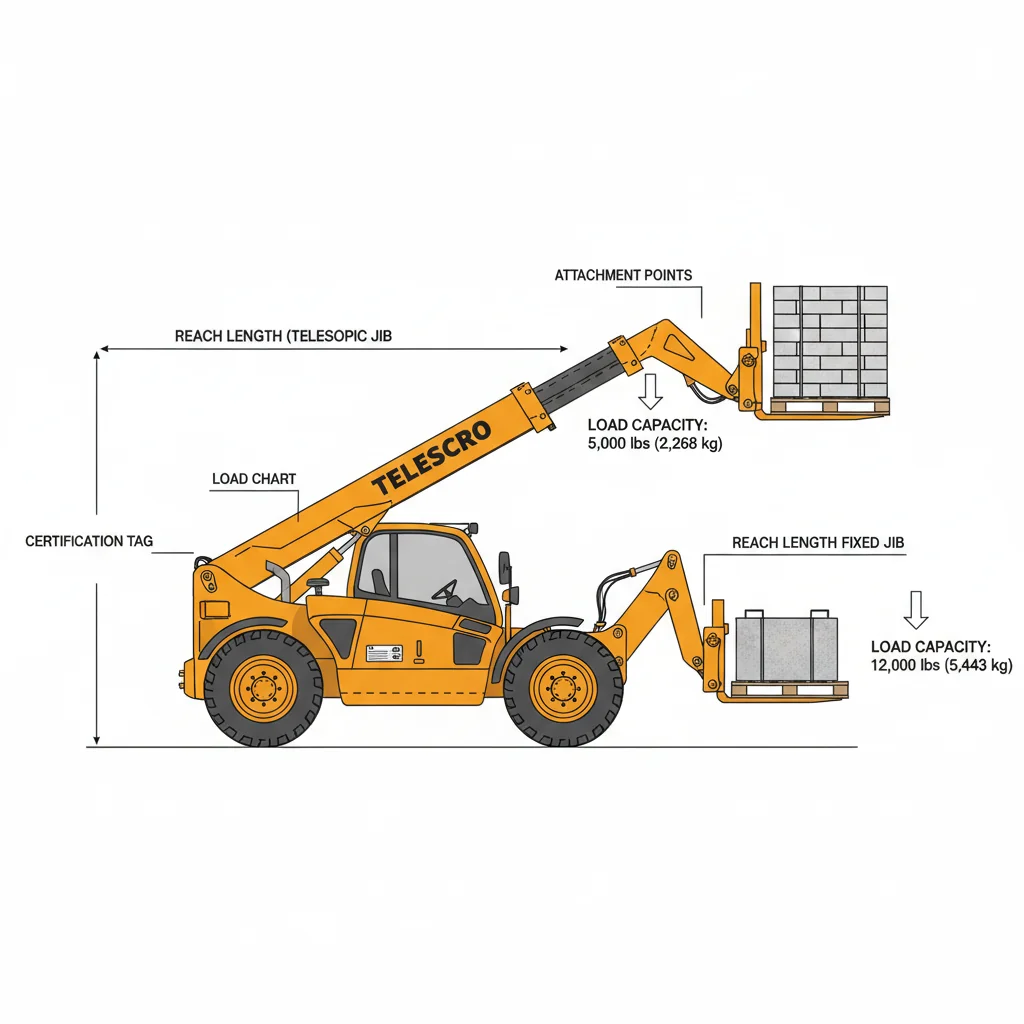
Most buyers start with “How much can this lift?” but there’s a bigger question—what are your top five most frequent lifts? In my experience, especially with construction firms in Dubai and Singapore, everything changes when you map out your real needs. For example, one client in Dubai thought they needed a 4-meter telescopic jib for HVAC units. Truth was, 80% of their lifts were 700–900 kg, rarely beyond 2.5 meters. They switched to a fixed-length jib, gained almost 30% more rated capacity, and saved time swapping attachments.
Here’s what matters: telescopic jibs (normally 2–4 meters with several pin positions) work best if you need reach and flexible placement, like installing trusses or maintaining rooftop equipment. Their limitation? Lower rated capacity at the longest extension. If your work is heavy or repetitive—lifting transformers, pipes, or concrete blocks within 2 meters—go fixed. Fixed jibs (1.5–2.5 meters) are lighter and preserve more of your telehandler’s rated capacity. Always count the attachment’s own weight. The load chart should show capacity at each length and angle, not just the “maximum” headline number.
I always suggest checking three critical points: first, verify the jib is OEM-approved for your machine and comes with a certified load chart. Second, check that the hook and lifting points are properly rated (CE or ASME certification is a good sign). Third, never use home-made or undocumented jibs. Rental clients in Kenya failed a surprise safety audit—and lost major contracts—because their jib lacked serial numbers and load-test paperwork. Safe operation comes from picking a jib that’s certified, compatible, and clearly documented.
Choosing a fixed-length jib boom for repeated short-reach lifts often provides noticeably higher rated capacity than a telescopic jib of similar reach.True
Fixed jibs have fewer moving parts and less structural extension, so more of the telehandler’s base capacity can be used at short radii. In many attachment ranges this translates into a clearly higher allowable load for the same machine and reach compared with a comparable telescopic jib.
Telehandler jib booms are primarily designed for digging and earthmoving tasks on construction sites.False
Jib booms are intended for lifting, positioning, and placing suspended loads—which is fundamentally different from digging or earthmoving, tasks commonly associated with attachments like buckets or grapples rather than jibs.
Key takeaway: Always choose a telehandler jib boom based on typical lift requirements, verifying rated capacity, attachment compatibility, OEM approval, and certified load charts. Certified jibs ensure safe operation and compliance, especially for rental fleets and during safety audits. Prioritize properly documented and tested equipment.
How Are Telehandler Jib Booms Secured?
Telehandler jib booms are either fork-mounted or quick-coupler-mounted. Fork-mounted jibs6 slide over forks and lock using heel pins or clamps, with a front pin as a bump stop. Quick-coupler jibs pin directly to the carriage, ensuring integration. All jibs must be positively secured—never operate with unsecured or mismatched attachments to prevent detachment hazards.
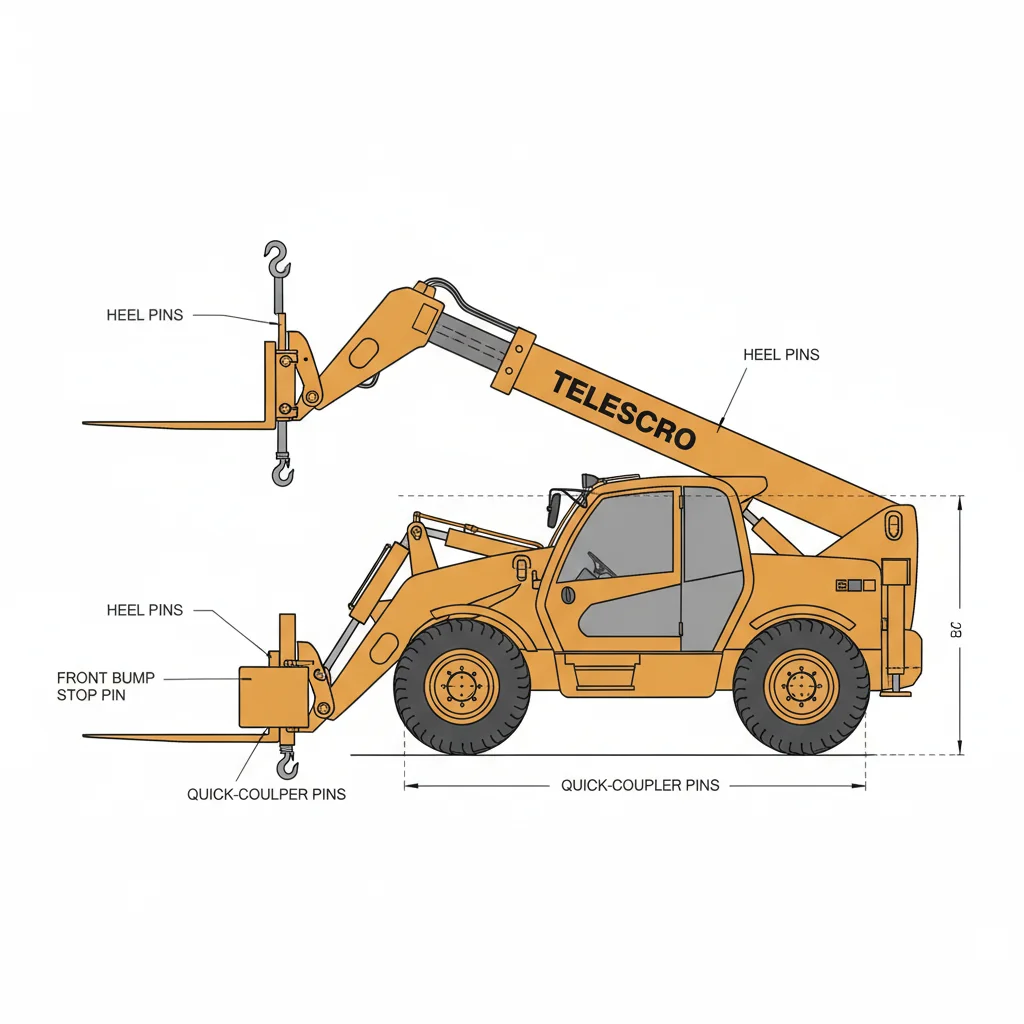
I get a lot of questions about mounting jib booms—especially from teams switching between different telehandlers. There are really two main ways to secure a telehandler jib: fork-mounted and quick-coupler mounted. Fork-mounted jibs slide directly over both forks, then you use heel pins or locking clamps behind the heels. There’s usually a front pin that acts as a bump stop, so the jib can’t slide forward by accident. I saw in Dubai last year where a crew tried to use a jib without heel pins—luckily, we caught it before any lifting began, but that’s exactly the kind of shortcut that causes accidents. Always check your fork dimensions. If your forks don’t match the jib’s slots—say, forks too wide or too thin—that attachment simply isn’t safe to use.
Quick-coupler-mounted jibs7 are a bit different. These pin directly to the telehandler’s carriage, using the machine’s standard quick-hitch mechanism. You get a more integrated fit with less play, but the downside is that quick couplers aren’t always compatible across brands or models. I helped a buyer in Kazakhstan who tried to mount a 3-ton jib from a European supplier onto a domestic 4-ton telehandler. The pins lined up, but the locking lever wouldn’t engage properly—he nearly had an unsecured boom on site.
Here’s what matters most: Always visually and physically check that every locking device is fully engaged before every lift. Look for a firm heel pin connection (on fork-mounts) or a properly locked quick-coupler. If you’re unsure, compare directly to the manual or ask your supplier. Detachment is a real hazard, and it’s always preventable with the right habits.
A telehandler jib boom is often used for precise placement of suspended loads in areas where crane access is restricted, making it valuable for installing HVAC units on mid-rise rooftops.True
Jib booms extend the reach and versatility of a telehandler, enabling operators to position loads accurately in locations cranes might not access, such as recessed rooftops or behind façade elements.
Telehandler jib booms are primarily designed to dig trenches and move soil, similar to an excavator arm.False
Jib booms are not intended for excavation; they are lifting attachments meant for picking, suspending, and placing loads. Using them for digging would damage the attachment and is unsafe.
Key takeaway: Proper mounting and positive securing of telehandler jib booms—by using locking pins or couplers—directly impacts mechanical safety. Always confirm fork or coupler compatibility and check that all locking devices are engaged before each use to prevent dangerous detachment incidents.
What Safety Rules Apply to Jib Boom Use?
Telehandlers with jib booms require strict adherence to the manufacturer’s load chart, with specific attention to stability margins. Operations must occur on firm, level ground, with stabilizers deployed as indicated by the load chart. Never perform side-pulls, dynamic movements, or use the hook for personnel lifting. Proper rigging and post-incident inspections are mandatory.
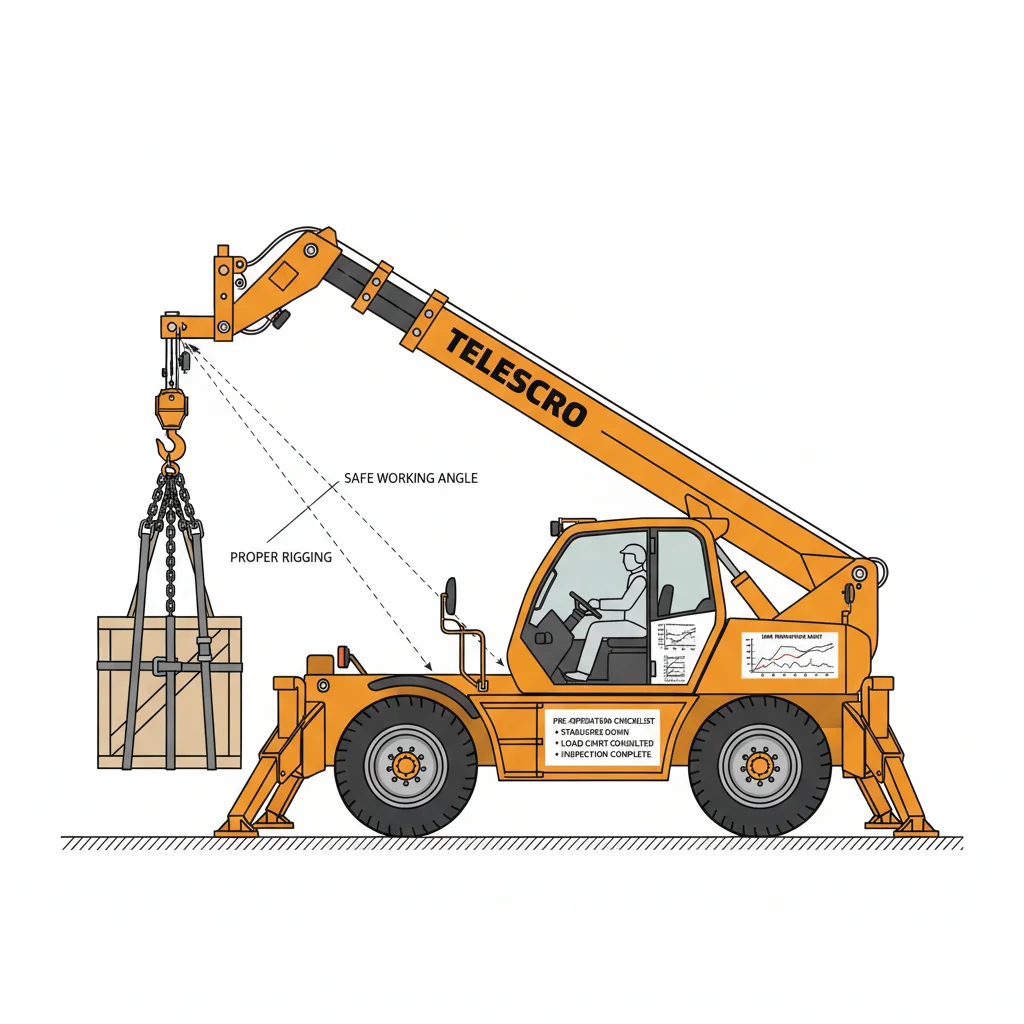
To be honest, the spec that actually matters is the manufacturer’s load chart—no shortcuts, no “general rules of thumb." The moment a jib boom is fitted, every lift must start with a careful check of your machine’s specific load chart. I see this misstep all over the world. Last month, a project in Dubai tried hauling HVAC units—about 800 kg—at 12 meters reach with a 4-ton telehandler. On paper, it looked fine, but at that extension, with the jib, they were working close to the limit. The load chart flagged the actual safe capacity as only 900 kg with stabilizers deployed. That left them with almost no safety margin, and they hadn’t factored in the wind. Jobsite stability is never generic.
Let me break down the top safety rules for jib boom work:
- Check the load chart for your machine with the jib fitted—never guess or use “standard” capacities.
- Only operate on firm, level ground. If even a single tire lifts off the ground, stop and reassess.
- Deploy stabilizers exactly as the chart specifies—short-jacking is allowed on some models, but only within the strict load chart limits.
- Never side-pull, drag, or swing loads using the hook. Telehandlers can’t handle side loads like dedicated cranes.
Another important detail—never use the hook or any improvised platform for lifting personnel. Safe lifting needs certified equipment. After any overload, collision, or suspected shock load, remove the jib from service and arrange a competent inspection. That’s non-negotiable, no matter how tight the project schedule is. I always remind customers: real safety decisions rely on your specific machine’s documentation, not old habits or hearsay.
When a jib boom is attached to a telehandler, the machine's rated capacity at maximum reach can drop by more than 70% compared to its standard fork rating.True
Jib booms increase the load distance from the telehandler’s centerline, amplifying the tipping moment and drastically reducing safe lifting capacity at full extension. Load chart data typically shows sharply lower limits once a jib is in use—e.g., a 4-ton capacity may drop to 1 ton or less at maximum extension.
It is safe to use a telehandler’s standard load chart for lifting with a jib boom as long as the total load is within the telehandler's maximum rated capacity.False
Using the standard load chart for fork lifts ignores the added leverage and altered weight distribution introduced by the jib. Only the load chart specific to the jib configuration accurately reflects safe limits, regardless of overall machine capacity.
Key takeaway: Safe jib boom operation on telehandlers demands compliance with the load chart—never rely on generic thresholds. Only operate on stable surfaces, correctly use stabilizers per model-specific guidance, and prohibit risky maneuvers or inappropriate lifting. Professional inspections are essential following any overload or collision events.
When is a telehandler jib boom sufficient?
A telehandler jib boom is most effective for everyday light to medium suspended lifts—very often in the 600 to 1,500 kg range—when a telehandler is already on site. Heavier or critical lifts still belong to dedicated cranes and engineered lift plans.
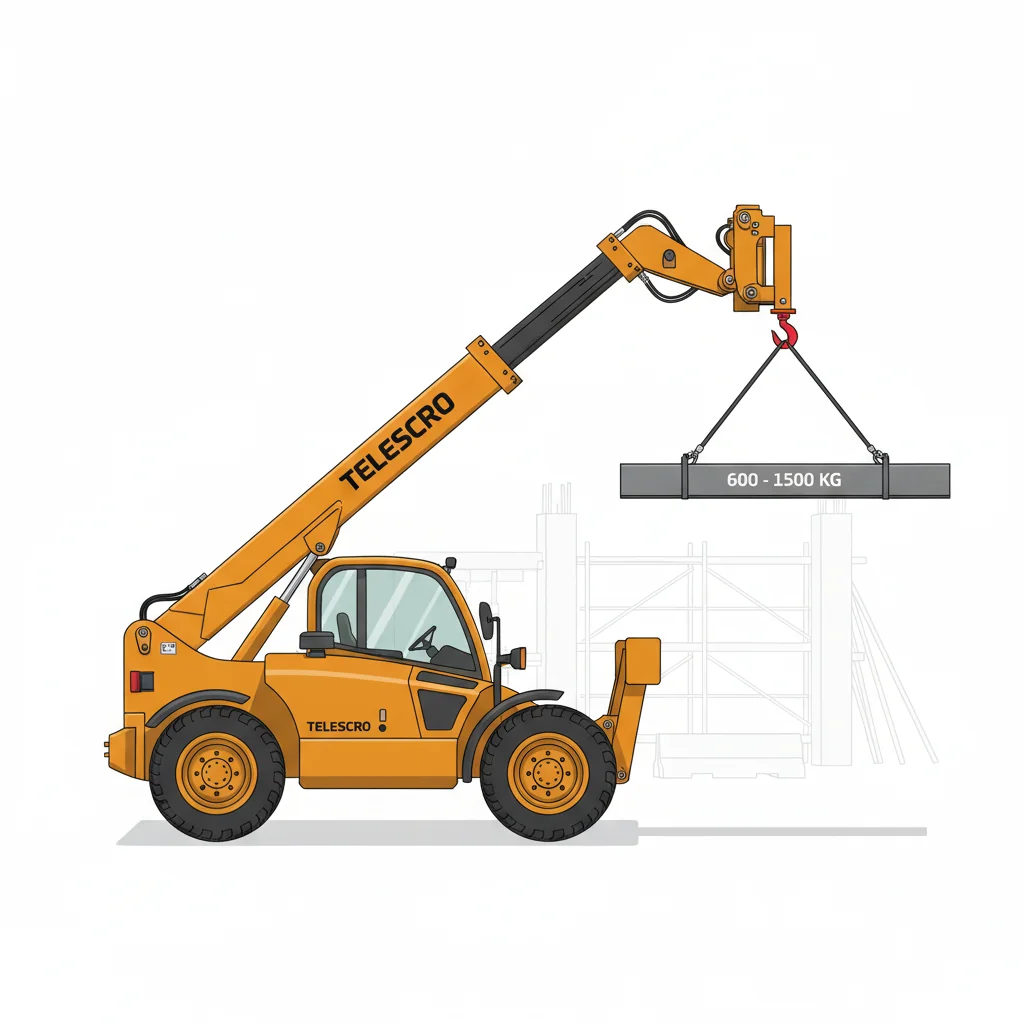
Most people don’t realize how much a telehandler jib boom can streamline routine lifting if you already have the right machine on site. On a mixed-use development in Dubai, the crew had to lift ductwork, HVAC units, and piping—nothing over 1,200 kg per pick. They used a 4-ton telehandler with a certified jib instead of bringing in a mobile crane, which usually takes at least half a day to schedule and set up. Switching between forks and a jib took under 10 minutes. They finished the week’s lifts without extra rental costs or delays.
From my experience, the real advantage appears when jobsites need moderate suspended loads—pipes, small steel assemblies, or mechanical equipment—moved to second or third floor heights. If the telehandler’s rated capacity (after subtracting the jib’s weight and shifting the load center) still covers the load, you’re set. For example, an industry-standard 3.8-ton machine with a 1.5-meter jib often handles up to 1,000 kg safely around 8–10 meters out. Always check the machine’s specific load chart for jib attachment—the safe capacity is typically much less than with forks.
But I always remind buyers: a jib doesn’t turn your telehandler into a crane. The limits show up fast with long or awkward loads, anything near maximum outreach, or when regulations require a formal lift plan. In Kazakhstan, I saw a project stall because the team tried to install heavy curtain wall panels with a telehandler jib. The moment indicator alarmed halfway out—load was too much, and they had to rebook a crane. I suggest using jibs for repetitive, non-critical lifts and saving the crane for heavy or high-risk jobs.
A telehandler jib boom can safely handle loads with a higher reach and offset than standard forks, provided the load is below the rated capacity and proper attachment is used.True
Jib booms extend the reach and improve the versatility of telehandlers, allowing operators to place loads in locations forklifts cannot easily access. However, capacity decreases with distance and boom angle, so it's essential to consult load charts for each configuration.
Telehandler jib booms are designed to lift loads heavier than the machine’s rated capacity by distributing weight across the boom.False
A telehandler’s rated capacity is an upper safety limit that cannot be exceeded, regardless of attachment. Jib booms do not increase lifting capacity; in fact, they reduce it because the load moves farther from the machine’s center of gravity, increasing the risk of tipping.
Key takeaway: Use a telehandler jib boom for routine, moderate lifting where crane rental is cost-prohibitive and the telehandler’s rated capacity suffices. Reserve cranes for heavy loads, complex jobs, critical lifts, and situations requiring engineered lift plans or specialized rigging expertise.
How is a telehandler jib boom maintained?
Telehandler jib booms require daily inspections for cracks, distortion, worn fork pockets or couplers, damaged pins, and hook or shackle deformation. Telescopic jibs need checks for tube elongation and greased sliding surfaces. Capacity decals must be legible. Annual documented inspections by a competent person are essential, especially after shock loading incidents.
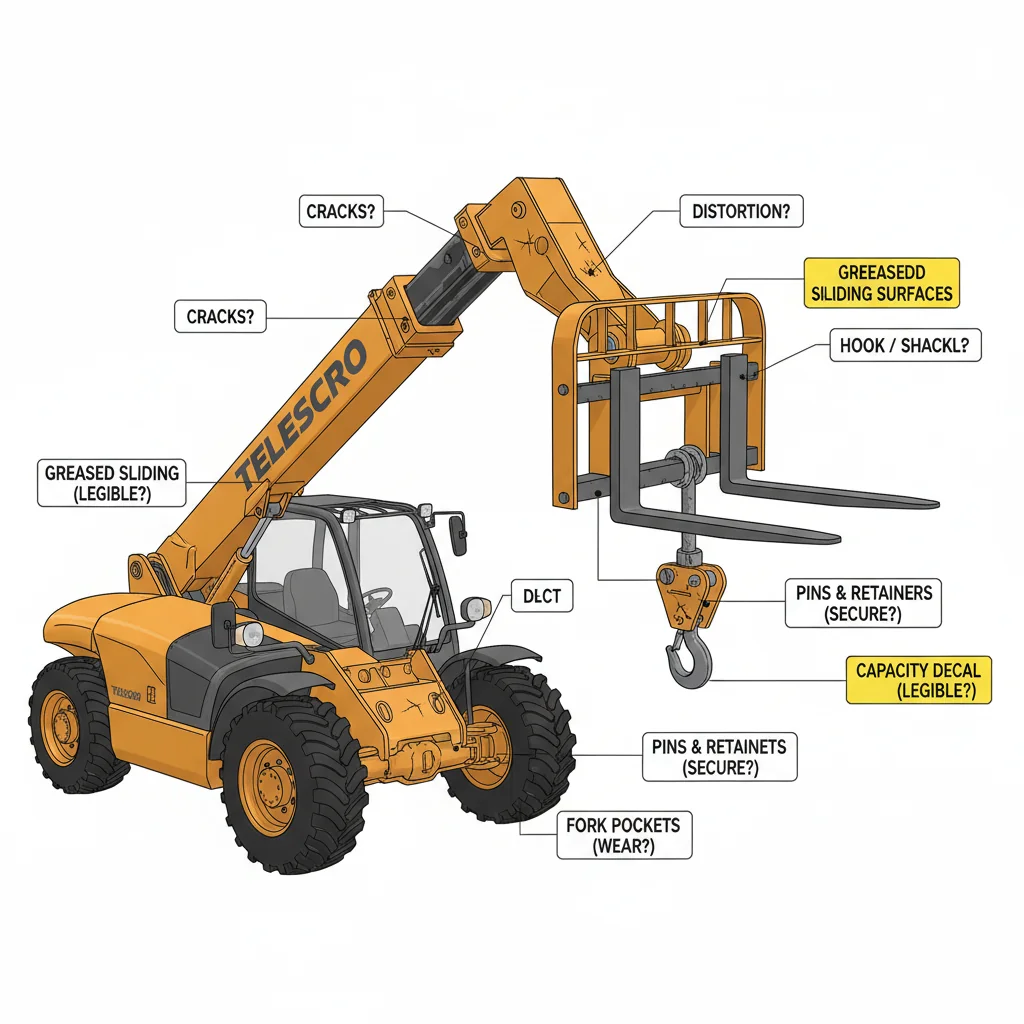
I always remind operators that neglected jib booms are a real jobsite risk—a cracked weld or worn latch can fail when you least expect it. Before every shift, start with a careful visual check. Scan the main beam and especially all welds for even small cracks or any sign of distortion.
Fork pockets and coupler areas should fit tightly—any looseness or rounded corners mean it’s time for repair, not just more grease. Every steel pin and retaining clip must be present, undamaged, and fit snugly. Pay special attention to the hook or shackle: the safety latch must snap shut, and there shouldn’t be any visible bending or gapping.
A project in Dubai last year is a good example. The crew used a telescopic jib to lift glass panels up 14 meters. After a minor collision, they noticed the boom didn’t retract smoothly. When I walked them through a check, we found the inner boom tube elongated at the pin holes and grease had dried up—classic signs of overload and missed daily maintenance. Taking it out of service for inspection and some straightforward repairs likely prevented a much costlier failure.
Telescopic jibs need a bit more care. You should check for tube elongation, pinhole wear, and keep all sliding surfaces greased—follow the manufacturer’s schedule closely. Load charts need to be readable at all times, since guessing the rated capacity is just asking for trouble.
For heavily used or critical-service telehandler jib booms, annual non-destructive testing (such as magnetic particle inspection of critical weld seams) is a recommended part of a thorough maintenance program.True
Daily visual checks can catch obvious damage, but non-destructive testing helps reveal fatigue cracks or defects that are not visible on the surface. Many crane and lifting-equipment guidelines recommend periodic NDT on critical welds for attachments that see high loads or frequent use.
It's acceptable to weld minor cracks on a telehandler jib boom in the field using standard MIG equipment, as long as the area is painted after repair.False
Field welding or unapproved repairs can compromise the structural integrity of the jib boom. Only certified facilities with proper equipment and procedures should perform jib boom structural repairs, and many manufacturers require recertification after any weld repair.
Key takeaway: Proper maintenance of a telehandler jib boom includes pre-shift checks, correctly greased components, legible load charts, and annual professional inspections—especially vital after shock loads. Careful record-keeping helps ensure safe operation, compliance, and early detection of issues before in-service failures occur.
Conclusion
We’ve looked at how telehandler jib booms can make suspended load lifting safer and more cost-effective, as long as you work within the machine’s limits. From my experience, it’s easy to focus on big lift numbers and forget how much the jib’s attachment weight and load center actually cut into your real capacity. Don’t let a “showroom hero, jobsite zero” situation sneak up on you—check your load chart at each extension and know your safe range before starting the job. Have questions about matching jib booms with your telehandler or want to double-check load ratings? I’m happy to share what works in the field, so feel free to reach out. Every jobsite has its own challenges—let’s make sure your setup fits yours.
References
-
Understand how jib booms reduce telehandler capacity and why load charts are critical for safe lifting performance. ↩
-
Details how jib attachments affect telehandler load limits and highlights the importance of checking load charts for safe operation. ↩
-
Details how jib use shifts load center and lowers rated capacity by up to 50%, critical for safe material handling. ↩
-
Comprehensive insights on lifting lugs role in load safety, rigging practices, and their integration with telehandler jib booms for secure lifts. ↩
-
Learn how telehandler jib booms facilitate precise roof truss placement, avoiding crane delays and reducing project costs on site. ↩
-
Detailed explanation of fork-mounted jib installation, highlighting safety pins and proper fit to prevent attachment failure and accidents. ↩
-
Comprehensive insights on quick-coupler jib integration, compatibility issues, and enhanced stability for secure telehandler operations. ↩