










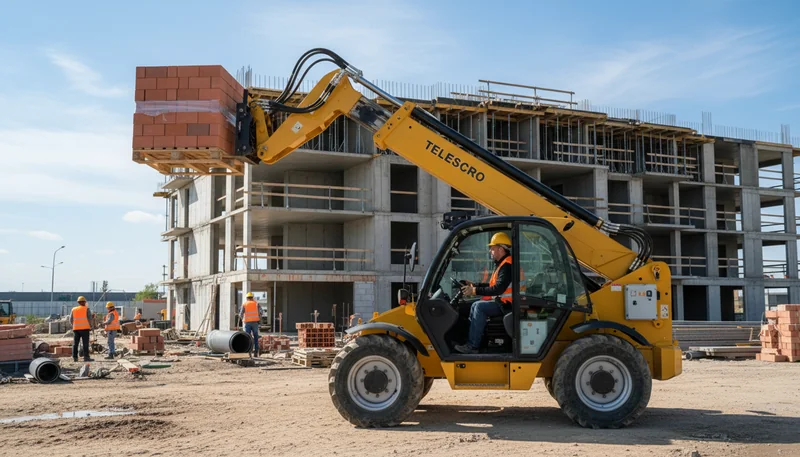
Telehandler Hydraulic Flow: Why More Isn’t Always Faster—Field Guide for Buyers
Not long ago, a German rental company sent me specs for two telehandlers—one boasted a much higher hydraulic pump flow1. They simply asked, “Which model will actually move the boom faster on site?” The answer isn’t what most expect, and that confusion is surprisingly common across the many countries I work with.
A telehandler’s real working speed is set by the whole hydraulic package—pump flow and available pressure, cylinder size2 and stroke, valve porting3, plus the machine’s control software and safety interlocks. A higher “max pump flow” number alone doesn’t guarantee faster boom lift or telescope cycles, because valve blocks, circuit prioritization (steer/aux vs boom), cylinder bore/port limits, and electronic ramping/limit logic can cap the usable flow reaching the main cylinders.
Does Higher Pump Flow Mean Faster Boom?
A higher hydraulic pump flow rating does not automatically translate to faster boom movement in telehandlers. Boom speed depends on the total hydraulic system—cylinder size, valve porting, pressure, and electronic controls. Frequently, system components or software limits restrict flow to key functions, regardless of the pump’s maximum output.

Most people don’t realize that hydraulic pump flow is just one piece of the puzzle. I’ve seen plenty of buyers in Kazakhstan get excited about a spec sheet showing a 140 L/min pump, only to call later and ask, “Why isn’t my boom moving any faster than the old 120 L/min unit?” The reality is, boom speed depends just as much on the entire hydraulic circuit as the pump itself. Cylinder thickness, valve port size, relief valve settings, even how the electronic controls manage flow—all these can make or break your actual lift speed.
Here’s a real example: A customer in South Africa was comparing two 4,000 kg telehandlers with 17-meter booms. On paper, the first machine’s pump was rated at 135 L/min, while the second listed 120 L/min. On site, we timed the full boom-raise cycle, and both machines completed the lift in about 13 seconds—no noticeable difference. The reason was simple: the valve blocks limited usable flow to the boom circuit to roughly 80 L/min. Any additional pump output was diverted to steering and auxiliary circuits, not to the boom lift cylinders.
Too often, I hear buyers say, “Give me whatever has the highest number.” That’s a risk. If your valves, cylinders, and control software aren’t matched to the pump, you’ll never see that “extra” speed. I always suggest checking the actual rated flow to each main function. If the technical sheet isn’t clear, ask the supplier directly or request a jobsite demo before finalizing your decision. In the end, how the whole system is integrated matters far more than just that one headline pump figure.
A telehandler with a high-flow pump will not achieve faster boom movement if the hydraulic cylinders or control valves are undersized for the flow.True
Hydraulic system speed depends on the ability of all components to handle the flow, not just the pump. If cylinders or valves restrict flow, the pump's higher output won't translate to faster operation.
Increasing the hydraulic pump flow rate alone will always result in significantly faster boom operation, regardless of other system components.False
Pump flow is just one factor in boom speed. Other components, like cylinders and valves, must also be designed to accommodate increased flow; otherwise, bottlenecks will prevent any speed gains.
Key takeaway: Pump flow alone does not dictate telehandler boom speed. Cylinder dimensions, valve capacity, and control system settings are equally critical. Always assess actual hydraulic flow to cylinders and system integration, rather than relying solely on advertised pump ratings when comparing telehandler models.
Does More Hydraulic Flow Mean Faster Lifting?
In telehandlers, increasing hydraulic flow does not guarantee faster cylinder movement. Larger cylinders, chosen for higher lifting capacities, require more fluid to move the same distance. As piston area increases, speed decreases at a given flow. Manufacturers may raise pump flow to offset this, but practical speeds remain limited by cylinder size.

Let me share something important about hydraulic flow and lift speed, because I see a lot of confusion. Many buyers see higher pump flow—say, 120 liters per minute versus 90—and assume it means faster boom or lift movements. But, especially on high-capacity telehandlers, that’s not always the case. The real story is cylinder size: when you move to a machine that can lift, for example, 5,000 kg at maximum reach, the lift and boom cylinders have to be much larger. Larger bore means more piston area, and more area demands more oil to move the same distance.
I once worked with a contractor in Dubai who upgraded from a 3-ton to a 5-ton telehandler. They expected the new machine to feel just as quick because the hydraulic pump rating was slightly higher. In real operation—lifting blocks to the third floor—the boom was noticeably slower. The reason wasn’t poor hydraulics; it was cylinder sizing. The higher-capacity machine used significantly larger lift and telescope cylinders to generate the extra force. Even with more pump flow available, the larger piston area meant more oil was required for every millimetre of movement, so extension speed dropped.
From a physics standpoint, cylinder speed equals oil flow divided by piston area. If cylinder bore increases substantially, piston area rises with the square of the diameter. So a large jump in bore size demands a much larger increase in flow just to maintain the same speed. Manufacturers may upsized the pump to compensate, but in practice it usually offsets the slowdown rather than making the machine faster.
Manufacturers sometimes boost the pump size to compensate. But I’ve never seen a linear jump in working speed—it usually just keeps things "not too slow" rather than fast. If you’re comparing machines, always look at the actual lift and extend times in the specs, or better yet, ask for a real-world demo. I always remind customers: pump flow tells you one part, cylinder size tells the rest.
A telehandler with a larger hydraulic pump flow does not always have a faster lift speed, because larger lift cylinders require more oil to move, which can offset the increased flow.True
On high-capacity telehandlers, cylinder size increases to handle greater loads. Even if the pump delivers more flow, the increased volume needed to fill larger cylinders means that cycle times may not actually improve; sometimes, they stay the same or even get slower.
Increasing a telehandler’s hydraulic flow rate will always result in faster boom and lift movements, regardless of cylinder size.False
While higher hydraulic flow provides more oil to the system, larger cylinders—common in high-capacity telehandlers—demand significantly more oil to move the same distance. This means the relationship is not direct, and increasing flow does not guarantee faster operation.
Key takeaway: Higher hydraulic flow does not automatically translate to faster telehandler operation. Larger cylinder bores, necessary for increased lifting force, reduce extension speed at constant flow. Always compare actual lift and extend times between models, rather than relying solely on pump flow or cylinder size as speed indicators.
What Limits Telehandler Hydraulic Flow Speed?
Telehandler hydraulic flow is often restricted by bottlenecks such as hose size, valve spool diameter4, and cylinder port dimensions. Even with a high-capacity pump, excessive oil velocity5 increases heat, noise, and risk of cavitation. Engine power and control system protection further limit available flow at working pressure, impacting real-world performance.

Here’s what matters most when you’re looking at telehandler hydraulic flow: the pump rating is only the starting point—real performance depends on the entire hydraulic system. Even if a machine is advertised at 140 liters per minute, that’s not the flow your boom functions will actually receive under load. Hose diameter is a good example. If the pressure or return lines feeding the boom are undersized, oil velocity increases sharply. I’ve measured return lines on sites in Chile running well above recommended limits because crews were pushing for faster cycle times—within a week, the machines were showing overheating issues and noisy valve operation.
The biggest mistake I see is relying on the headline flow number without checking valve block and port sizing. Last year, a contractor in Chile’s mining and steel construction sector upgraded to a larger pump, expecting faster boom extension for work around 12 meters. Instead, the additional flow was simply throttled at the main control valve, and the excess energy turned into heat. By early afternoon, hydraulic temperatures were high enough to force downtime. From my experience, sustained oil velocity above about 20 ft/s (6 m/s) in pressure lines isn’t just a theory—it leads directly to seal damage, leakage, and sluggish, imprecise control under real working loads.
It’s also easy to forget that engine power puts a hard cap on what’s possible. On a 60 kW engine, you simply can’t get both high pressure and full flow at the same time—no matter what the pump’s max rating claims. Control systems will automatically reduce flow if load pressure rises, protecting the engine and hydraulics. I suggest always asking: at your typical working pressure, how much usable flow actually reaches the boom? That number tells you how the telehandler will really perform on your site.
A telehandler with a high hydraulic pump flow may still experience slow boom operation if its hydraulic hoses are too narrow for efficient oil movement.True
Hose diameter directly impacts oil velocity; narrow hoses increase resistance and restrict actual flow to the boom, limiting operational speed even if the pump’s flow rating is high.
As long as a telehandler’s pump offers a high enough flow, the size of the hydraulic lines has minimal impact on how quickly the boom operates.False
The size of hydraulic lines is critical—if lines are too small, they create excessive restriction and velocity, reducing the effective flow to the boom regardless of pump output.
Key takeaway: A telehandler’s maximum hydraulic flow is governed not just by pump rating, but by the size of hoses, valves, ports, and the engine’s power limit. Always compare how much usable flow the boom actually receives under real loads, not just pump-based specifications.
Why Do Telehandlers Slow at Full Reach?
Telehandlers often slow or limit boom functions near the edge of the working envelope because stability/overload management systems (LMI/RCI) prioritize control and tip-over prevention over speed. Even with a high-flow pump, these systems can limit the commanded movement to keep the machine within its safe operating envelope.

I’ve worked with contractors in South Africa and Chile who called me, worried their telehandlers were “underpowered” because the boom slowed down when they reached maximum height with a heavy pallet. The reality is that this slowdown is not a sign of weak hydraulics or an undersized pump.
In most modern machines, the cause is the electronic safety system—specifically the load moment indicator (LMI) and the stability logic integrated into the valve block and control software. These systems continuously monitor boom angle, extension, and actual load. As soon as the machine approaches the stability limits defined by EN 1459 and applicable ISO standards, hydraulic flow to certain boom functions is deliberately reduced or blocked—regardless of pump size. The logic is simple: high speed at the edge of stability increases tip-over risk.
I’ve seen this many times on high-reach stacking jobs. On a logistics site in Kazakhstan, a crew was using a 3.5-ton telehandler with an 18-meter boom to place brick pallets. At ground level, with the boom retracted, all movements were quick and responsive. But at full extension—around 900 kg at the boom tip—the boom slowed noticeably, and some movements, such as fast lowering or further telescoping, were restricted.
The operator assumed the machine was struggling. In reality, the control system was doing exactly what it was designed to do: preventing any movement that could push the combined center of gravity past the front axle tipping line.
This is why a larger hydraulic pump will not “fix” slow movement at long reach. Boom speed near maximum height is governed by the electronic stability envelope—not by available flow or pump output. At that point, safety, not hydraulics, sets the limit.
Telehandlers at full boom extension may slow their hydraulic functions intentionally, even if the hydraulic pump can deliver more flow, to prevent tipping or structural overload.True
This slowdown is due to the machine's electronic safety systems—specifically, the load moment indicator and software logic—which monitor load and stability to reduce risk. The system will override available hydraulic flow and speed to maintain safety, regardless of pump capacity.
Increasing the hydraulic flow rate always enables a telehandler to operate at its fastest speed, even when the boom is fully extended and heavily loaded.False
Hydraulic flow alone does not determine speed at full reach; electronic controls and safety systems limit speed to maintain stability and prevent accidents, regardless of pump output.
Key takeaway: Boom speed reduction at long reach or full lift in telehandlers is an intentional safety feature, not a sign of weak hydraulics. Advanced logic and sensors override available hydraulic flow to prevent instability, so bigger pumps do not enable faster stacking beyond these programmed thresholds.
Can Excessive Hydraulic Flow Reduce Control?
Excessive hydraulic flow in telehandlers can reduce boom control and safety. Over-speeding cylinders may cause piston end-cap “hammer,” risking seal failure and shock transmission through the boom. High flow often leads to jerky joystick responses, making precise load positioning more difficult and uncomfortable for operators. Prioritizing smoothness over speed typically improves productivity and safety.

The biggest mistake I see is assuming higher hydraulic flow always makes a telehandler more productive. It sounds logical—more oil means faster movement, right? But on real jobsites, there’s a limit before things get risky. I’ve watched operators in Kazakhstan struggle with 4-ton high-reach machines where excessive boom speed made the cylinders slam at the end of stroke. Each time, the boom shuddered, the load rocked, and you could see the discomfort on their faces. It’s not just about comfort, either. That “hammer” effect can stress the end caps of hydraulic cylinders, blow seals, and push shock loads into the boom’s welds. Over time, I’ve seen this lead to costly downtime for repairs—sometimes within the first year.
High flow also means less controllability. On sites in Brazil, for example, operators reported “twitchy” joystick response with a 17-meter telehandler. A tiny movement would jerk the boom or send the forks bouncing. When you’re placing bricks at the third floor, that lack of feathering can be the difference between smooth progress and a broken pallet. Engineers often install flow restrictors or set programmable ramps to slow things down for a reason. It’s not just for novice operators—even pros benefit from predictable, gentle hydraulic action.
Here’s what actually boosts site efficiency: smooth, precise boom movement. I always tell clients to test machines with real loads, not just empty. Watch for how the boom settles after stopping. Slightly slower speeds usually deliver more consistent results, fewer load drops, and less operator fatigue by the end of the shift.
Excessive hydraulic flow can cause telehandler controls to become overly sensitive, leading to abrupt and less predictable boom and attachment movements.True
When hydraulic flow exceeds what the system is designed for, the actuators react faster than the operator can smoothly control, making fine positioning difficult and increasing the risk of jerky or unintended movements.
Increasing hydraulic flow always improves a telehandler's lifting precision because the boom and attachment respond more quickly to operator inputs.False
Higher hydraulic flow can reduce lifting precision by making the controls too sensitive and causing boom or attachment overshoot, which actually makes it harder to perform careful or delicate maneuvers.
Key takeaway: Higher hydraulic flow does not always translate to faster, safer telehandler operation. Excessive speed can cause harsh shocks, control difficulties, and operator fatigue. For optimal efficiency and safety, buyers should prioritize controllability, smooth boom movements, and observe machine behavior in real-world demos.
Does Higher Hydraulic Flow Lower Telehandler Booms Faster?
On most modern telehandlers, increasing hydraulic pump flow does not significantly increase boom-lowering speed. Boom descent is primarily gravity-assisted, while hydraulic circuits—such as counterbalance valves6 and calibrated orifice restrictions—meter and limit lowering speed for stability and load control. Additional pump flow during lowering is typically bypassed or recirculated, providing little or no productivity gain.

Last month, a contractor in Kazakhstan called me asking why his brand-new 17-meter telehandler didn’t lower the boom any faster than his older 13-meter model, even though the brochure showed a much higher hydraulic pump flow. He was disappointed, expecting lower cycle times. I explained that for boom-down operations, almost every modern telehandler uses gravity to bring the boom down—hydraulics mainly control and slow the descent, not force it down. The hydraulic circuit is deliberately restricted by the OEM, using counterbalance valves and orifices, to prevent unsafe speed and protect both workers and the load.
On a real jobsite, you can have a pump delivering over 120 L/min, but the lowering speed is still capped by those safety circuits. I’ve seen this on projects in the UAE, where operators tried high-output rental units hoping to save a few seconds per cycle. In reality, the difference was minimal—cycle times for lowering were within a few tenths of a second compared to a standard 4-ton telehandler. Any extra pump flow just recirculates, sometimes adding unnecessary heat or noise to the system.
Most manufacturers design these systems to balance productivity and safety. Too fast, and you risk dropping loads or making the boom feel unstable. That’s why specs for pump output shouldn’t be your main focus when you care about lowering speed. I suggest always asking the supplier for official OEM cycle times and whether the telehandler uses gravity-lowering—especially if you’re comparing models for high-frequency up-and-down work. Numbers on paper can be misleading; real-world operation tells the real story.
Most modern telehandlers use hydraulic circuits to regulate and slow the boom descent rather than actively power it down, which means higher hydraulic flow ratings have little influence on boom-lowering speed.True
On almost all current telehandler models, the boom-down movement is primarily achieved by allowing gravity to lower the boom. Hydraulics are engaged mainly to meter and control the speed for safety, not to force the descent, so increased pump flow doesn’t make lowering cycles noticeably faster.
A telehandler equipped with a higher-flow hydraulic pump will always bring its boom down significantly faster than a similar model with a lower-flow pump.False
Boom lowering is normally gravity-assisted, with the hydraulic system restricting rather than driving the motion. Increasing hydraulic pump flow primarily speeds up active hydraulic functions like boom extension or lifting, but has minimal effect on boom-down cycles, since these are deliberately controlled for safety.
Key takeaway: Increasing telehandler hydraulic flow does not speed up gravity-driven boom lowering. Manufacturers design lowering circuits for safety and stability, meaning higher pump L/min does not improve cycle time for boom-down operations. Always reference OEM cycle times and ask about gravity-lowering when comparing models.
How Does Hydraulic Flow Affect Telehandler Speed?
Higher hydraulic flow does not always mean faster telehandler operation. Excessive flow through restrictive components generates heat, reducing oil viscosity and increasing leakage at pumps, valves, and cylinder seals. This causes a drop in effective flow and pressure at the actuators, resulting in noticeably slower and softer machine performance, especially during continuous use.

Last year, I visited a jobsite in northern China where an 18-meter telehandler was struggling during mid-summer operations. At first, the crew assumed that increasing the hydraulic pump setting would speed up lifting cycles.
After about an hour of continuous work, the boom began to feel sluggish—especially at full extension. The operator noticed that even with the control lever fully open, the boom would hesitate mid-stroke. At the same time, hydraulic oil temperature at the sight glass climbed past 70 °C, which is a classic indicator that restricted flow is being converted into heat rather than useful work.
As oil temperature rises, viscosity drops. That loss of viscosity increases internal leakage across cylinder seals, valve spools, and pump clearances. The result is misleading pressure readings: the dashboard gauge may still look acceptable, but the actual pressure available at the actuator is much lower. From the operator’s seat, everything—from boom lift to fork tilt—starts to feel slow and “soft.”
From my experience, high flow rates are not always your friend—especially when hoses, valves, or return circuits are undersized. Forcing more oil through a restricted hydraulic path simply turns input energy into heat instead of productive motion.
I’ve seen the same pattern on large sites in Dubai, where I tracked cycle times across dozens of machines. When lift cycles increase by 20–30% after lunch, the root cause is almost always a clogged return filter or an undersized oil cooler—not a weak pump. Too often, technicians replace the pump, only to find the problem unchanged because overheated oil can no longer seal effectively inside the system.
That’s why I always recommend monitoring both oil temperature and cycle times throughout the day. Those two indicators together tell you far more about hydraulic health than pump flow numbers alone.
Increasing hydraulic flow beyond the telehandler system's thermal capacity can lead to overheating, which reduces boom speed and may even cause hydraulic functions to stall at high temperatures.True
When hydraulic fluid is circulated faster than the system can cool it, excessive heat builds up. Rising oil temperature reduces fluid viscosity, which increases internal leakage in pumps, valves, and cylinders. As leakage increases, effective pressure and usable flow at the actuators drop. In parallel, load-sensing and protection valves may limit flow to prevent damage, resulting in slower boom movements or temporary function lockout despite a higher pump flow setting.
Raising the hydraulic flow setting will always produce faster boom and attachment movement, regardless of operating temperature or system condition.False
Hydraulic speed depends not only on fluid flow, but also on temperature, component tolerances, and system pressure. Excessive heat or stress can cause the system to self-limit speed, even when flow is increased.
Key takeaway: Monitoring hydraulic temperature and oil viscosity is as important as pump size for telehandler efficiency. Rising cycle times often indicate leakage or restriction, not lack of flow. Use the correct oil grade, maintain coolers and filters, and track lift/extend times to detect performance issues early.
Does Higher Hydraulic Flow Always Boost Speed?
Higher hydraulic flow enhances attachment performance, notably for continuous-drive tools like mulchers and planers, by increasing tool speed and torque within design limits. However, boom lift and telescope cycles may see only marginal improvements, as OEMs often cap flow for stability and operator comfort, making a single “max flow” figure potentially misleading.
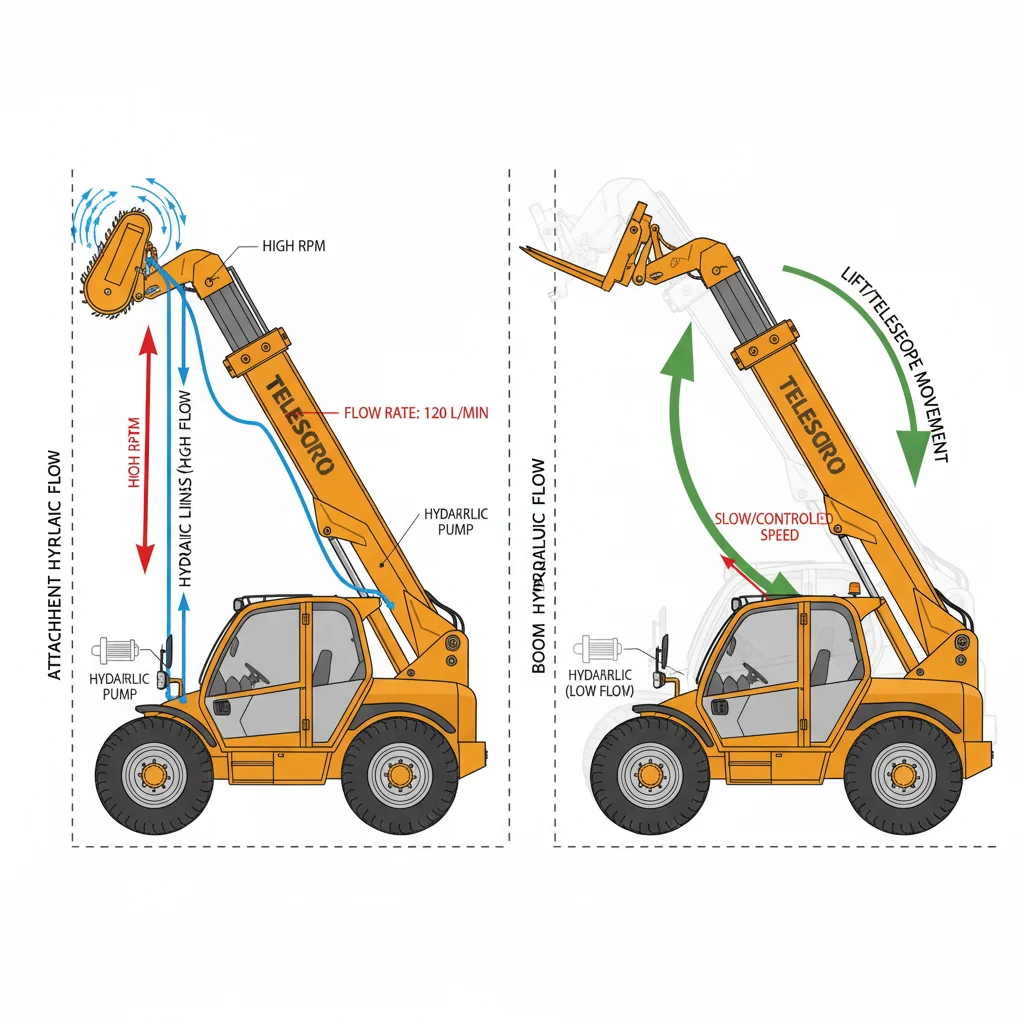
To be honest, the spec that actually matters is how the machine splits up hydraulic flow between boom functions and attachments. Some customers get excited about a “high-flow auxiliary7” but don’t realize it won’t make the boom itself noticeably faster. On many sites—for example, a road maintenance job I worked on in Australia last year—the crew relied on a mulcher attachment needing over 110 L/min at around 240 bar for maximum drum speed. The telehandler delivered excellent output with that tool. But when operators tried to raise or extend the boom at the same time, all movement slowed down.
Here’s the reality: OEMs deliberately limit flow to the boom raise and telescope circuits. Why? It’s about stability and operator safety. If the main functions moved too quickly, sudden load shifts or jerks could make the machine unstable, especially at height. This is why you’ll see only marginal gains in boom cycle times, even if the main pump can deliver much more overall flow.
I always recommend separating your questions when specifying for any telehandler project. Ask for:
- Attachment auxiliary flow (at working pressure) – What’s the real continuous flow available?
- Boom raise and telescope cycle times – With rated load, not empty, and see if that changes when the auxiliary is used.
- Hydraulic circuit layout – Is there a dedicated pump for attachments or does it share with boom functions?
- Operational impact – What functions slow down when running a high-flow attachment?
Checking these details with the technical data sheet is essential—don’t just accept a single “max flow” number. That’s how you avoid unhappy surprises on the jobsite.
Increasing hydraulic flow to the auxiliary circuit can power high-demand attachments like mulchers at optimal performance, even if it does not make the main boom movements any faster.True
Hydraulic system design separates auxiliary flow (for attachments) from boom function flow. High-flow is critical for running certain attachments at their required speed, but this higher flow does not necessarily impact how quickly the boom itself moves.
Specifying a telehandler with the highest possible hydraulic flow will always make both boom operation and attachments significantly faster.False
Hydraulic flow is often divided between circuits, so increasing maximum system flow may benefit attachments but not necessarily speed up boom actions. Boom and attachment circuits can have flow limits based on the telehandler’s internal design and valving.
Key takeaway: More hydraulic flow can improve performance for demanding attachments, but main boom functions are often flow-limited by design for safety and stability. When specifying a telehandler, review separate cycle times and verify how using high-flow attachments may impact simultaneous boom operation.
What Measures Telehandler Hydraulic Productivity Best?
Time-based boom cycle tests, not just hydraulic flow rates, best reflect real telehandler productivity. Buyers should request documented cycle times for boom lift, extension, and lowering—performed with a realistic payload and at operating temperature. Multifunction ability and controllability under load also critically impact practical jobsite performance.

Last year, a project manager in South Africa asked me why his “high-flow” telehandler felt sluggish compared to his older machine. On paper, the new unit had 120 L/min pump flow—much higher than the old 90 L/min spec. But when we timed the boom lift and extension with a 2,800 kg load, the newer machine was five seconds slower to full height. The difference? The older unit had better-matched valves and a smarter load sensing setup, so it delivered oil exactly where it was needed, even with hot hydraulic oil after a full day’s work.
I always recommend buyers do a simple boom cycle test, not just check the brochure specs. Start with the machine fully cooled and then again after an hour of real operation—that’s when leaks or lazy controls show up. Watch how long it takes to lift from ground to max height and fully extend and retract, using at least 75% of rated load. On a typical 4-ton telehandler with a 15-meter boom, anything over 18–22 seconds for full lift or extend means you’ll lose serious time on site.
Another practical test: try raising the boom, extending it, and steering in a tight circle—all at once. Some machines lose power or stall on one function, which slows operator rhythm and messes up fine positioning. I’ve seen this especially on jobs in the Middle East where crews need tight control fitting roof trusses or unloading trucks quickly in summer heat.
Don’t just trust L/min numbers. Insist on real-world cycle times, multitasking ability, and smooth control—ideally proven during a jobsite demonstration.
Hydraulic valve design and load-sensing efficiency are often more important than pump flow rate when it comes to actual telehandler productivity.True
Even with a higher pump flow, poorly matched valves or basic open-center hydraulics can waste energy and slow down cycle times, while a well-designed load-sensing system directs oil only where needed, improving performance.
Increasing a telehandler's hydraulic pump flow rate will always result in faster boom and attachment movements, regardless of other system factors.False
Actual productivity depends on multiple factors such as valve configuration, hose sizing, and system pressure losses; simply having a higher pump flow does not guarantee faster operation if the rest of the hydraulic circuit cannot make use of it efficiently.
Key takeaway: Cycle times under load and real-world conditions are a far more reliable productivity indicator than L/min flow ratings. Prioritize models proven in boom performance, multitasking capability, and smooth positioning—always verified by on-site demonstration, not just by brochure specifications.
When Is High Hydraulic Flow Worth It?
Higher hydraulic flow in telehandlers is only beneficial for tasks demanding fast boom speeds or frequent use of high-consumption attachments, and where strong service support exists. Otherwise, the added complexity, higher purchase price, increased fuel consumption, and maintenance demands may outweigh benefits, making simpler lower-flow systems more cost-efficient for typical field users.

I often get asked if high-flow hydraulics8 are worth it, and honestly, it’s not a simple yes or no. The real value of a telehandler with high-flow—say, 150 to 160 liters per minute from a piston pump—only shows up on jobs where you’re pushing the machine hard. Two years ago, I worked with a large infrastructure contractor in Brazil who ran heavy hydraulic attachments9 like concrete mixers and high-capacity buckets for 10+ hours daily. Their old 110 L/min setup just couldn’t keep up; boom movements lagged, and attachment power faded after lunch. Upgrading to a high-flow system cut their cycle times by about 20%, but more importantly, they had no mid-day slowdowns even in 35°C weather. Of course, the initial price—and ongoing maintenance for the upgraded pump, bigger oil cooler, and more complex valve block—was higher, but their productivity gains paid for it in less than a year.
Now, I’ve seen the flip side in Kenya. A rental fleet owner bought high-flow machines expecting “more power for any job,” then had frequent downtime. Why? Local service centers struggled with the complex controls and pumps. Regular users ran standard forks and buckets, so the extra flow didn’t bring real benefits—just extra fuel use and higher repair bills. For these customers, I recommend sticking with a simpler 100–110 L/min gear-pump system; the machines run longer between services, and any trained mechanic can handle repairs using standard parts.
Before deciding, check your actual attachment flow needs and local support options. High-flow isn’t always better—sometimes simplicity wins for real-world uptime.
A telehandler with high-flow hydraulics provides the most value when operating heavy hydraulic attachments that require continuous and intense flow, such as concrete mixers or high-capacity buckets.True
High-flow systems are specifically designed to meet the increased hydraulic demand of certain attachments. When used with tools that need prolonged high flow, standard systems may not keep up, leading to sluggish performance and potential job delays. The benefit of high-flow is realized only in these scenarios, not with standard lift and placement tasks.
Any telehandler equipped with high-flow hydraulics will always move its boom faster than a standard-flow telehandler, regardless of the attachment being used.False
Boom speed is not determined solely by maximum hydraulic flow. Other factors, such as valve design, software limitations, or the type of attachment, play a significant role. In many cases, telehandlers restrict boom speed for safety and stability, so high-flow capability does not automatically translate to faster boom movement.
Key takeaway: High-flow hydraulic systems justify their added cost and maintenance if constant high-demand attachments or maximum boom speed are essential, and robust technical support is available. For most users or in regions with limited service, a lower-flow, simpler setup offers better long-term uptime and lower ownership costs.
Conclusion
We looked at why advertised hydraulic pump flow doesn’t tell the whole story about telehandler boom speed, and why cylinder size, valve quality, and system setup matter just as much. From my experience, the buyers who end up happiest are the ones who ask to see real cycle time tests and check how the machine performs at typical boom heights—not just what’s listed on a spec sheet. There’s a ‘3-meter blind spot’ in this industry, where it’s easy to overlook integration and end up with a machine that’s a showroom hero but a jobsite zero. If you have questions about comparing models or want help making sense of the specs, feel free to reach out—I’m always happy to share what works for real crews. The best choice is the one that truly fits your workflow.
References
-
Explains why hydraulic pump flow alone doesn’t determine boom speed, focusing on system design and real-world testing insights. ↩
-
Understand how cylinder bore size affects piston area and lifting speed, crucial for selecting telehandlers with optimal performance. ↩
-
Details how valve port size limits hydraulic flow to boom cylinders, affecting operational speed beyond pump specs. ↩
-
Learn how valve spool diameter limits hydraulic flow speed and affects telehandler boom performance under load. ↩
-
Explore the impact of oil velocity on heat buildup, noise, and cavitation risk in telehandler hydraulics for optimal system performance. ↩
-
Detailed explanation of how counterbalance valves ensure safe and controlled boom descent in telehandlers, preventing load slips. ↩
-
Explore how high-flow auxiliary hydraulics improve attachment performance but impact boom speed and stability in telehandlers. ↩
-
Explore the benefits and trade-offs of high-flow hydraulics in telehandlers including productivity gains and maintenance challenges. ↩
-
Learn about heavy hydraulic attachments like concrete mixers and high-capacity buckets and how they impact telehandler performance. ↩