











Telehandler High-Altitude Operations: Field Guide to Safe and Effective Use
The first time I watched a telehandler place concrete blocks onto a fourth-floor balcony in Vietnam—while parked well away from the soft soil near the excavation—I realized just how much safer and simpler high workface access can be. Most people still underestimate what telescopic booms truly allow.
Telehandlers designed for high-altitude construction employ telescopic booms capable of vertical and horizontal extension, providing significant reach from stable ground positions. Maximum lifting height and rated capacity1 are not achieved simultaneously, as capacity drops significantly with increased boom outreach and elevation. Machine selection should focus on load charts2 reflecting actual weights at planned heights and reach. Attachments such as platforms and jibs broaden operational versatility, enabling material placement and personnel lifting tasks.
How Do Telehandlers Reach High Workfaces Safely?
Telehandlers achieve safe high-altitude access using a telescopic boom3 capable of vertical and horizontal extension, typically reaching 12–18 meters, with specialized models up to 30 meters. The boom’s ability to reach over obstacles allows placement on stable ground while the load chart4 determines safe reach and capacity at elevation.

Most people don’t realize that reaching high, awkward workfaces safely is not just about the boom’s maximum height. The real secret is how a telehandler’s telescopic boom lets you work over obstacles from solid, stable ground. For example, I supported a project in Kazakhstan where the team had to lift HVAC units onto a setback roof—about 16 meters above, with a trench blocking direct access. They used a 4-ton telehandler with an 18-meter boom, working from a paved area well back from any hazards. This “reach over” approach not only kept the machine secure, but also sped up the entire lift.
But here’s what matters most: the rated capacity changes dramatically as you extend the boom. I’ve seen buyers in Brazil get caught out, expecting to lift heavy loads at maximum reach. In one case, a client tried to raise 2,000 kg to 14 meters, but their load chart showed just 1,100 kg allowed at that extension. The load chart is your only reliable guide—it factors in boom angle, extension, and ground support. Ignore the load chart, and you risk tipping.
Stability depends not just on the machine’s size, but also on ground conditions and whether stabilizers are used. Many compact models have no stabilizers at all, so position is everything. On rotating units, stabilizer deployment can provide full lift performance if the manual and chart allow, but sometimes partial extension (“short-jacking”) is permitted with reduced loads. My advice—always check ground firmness and verify the exact chart position for your lift, especially when working at height or across obstacles.
A telehandler's outreach capacity can easily drop by more than 60% at maximum horizontal extension compared to lifting close-in at low height.True
Telehandlers are rated for both lift height and forward outreach. As the boom extends horizontally, leverage increases and stability decreases, drastically reducing the safe load capacity—often by well over 60% compared to lifting close to the machine. This derating helps keep the telehandler stable and reduces tip-over risk when reaching across obstacles.
Telehandlers can safely drive with their boom fully extended when carrying loads above 80% of maximum capacity.False
Driving a telehandler with the boom fully extended—especially under heavy load—greatly increases the risk of tipping and loss of control. Manufacturer guidelines generally require travelling with the boom lowered and retracted, and they restrict or prohibit movement with an extended boom near maximum capacity to maintain stability and safe operation.
Key takeaway: Telehandlers utilize their telescopic booms to safely access elevated or obstructed workfaces from firm ground. Operators must always consult the manufacturer’s load chart for safe height and reach limits, as ground conditions, boom extension, and machine stability all impact high-elevation lifting safety.
Why is telehandler capacity less at height?
Telehandler rated capacity decreases as boom height and outreach increase due to leverage acting on the chassis. Published figures such as “4 t at 17 m” do not apply together; at maximum height and reach, actual safe load may drop to well under half of the headline rating—often around 800–1,500 kg on a 4-ton class machine. Always consult the load chart for specific positions.

Let me share something important about telehandler specs that catches a lot of buyers out: the rated capacity and the maximum boom height almost never “work together” in real use. Many customers see “4,000 kg at 17 m” in the brochure and assume they can lift four tons to the top floor. But the reality on a jobsite is very different. The further you extend the boom—especially when reaching high or far forward—the more leverage is applied to the telehandler’s chassis, and the safe working load can drop below 1,500 kg. This isn’t a marketing trick. It’s just physics: as you increase the working radius, the center of gravity shifts and the tipping moment goes up fast.
Last year in Dubai, I visited a site where the crew needed to place 1.8‑ton pallets of brick on a roof balcony nearly 17 meters up. Their telehandler was rated for 3.5 tons but could only raise about 1,200 kg at that height and reach. They were surprised—the data sheet looked perfect. The issue was all in the load chart, which they hadn’t checked carefully enough. I see this scenario come up worldwide, from Kazakhstan to Brazil.
Rated capacity always refers to minimum outreach on level ground (usually with the boom retracted). Every model’s load chart—usually a grid or curve—is the only way to know actual lifting ability at real heights and distances. Before buying, I always suggest matching your true load weights and pallet sizes to the load chart positions you’ll actually use. If you plan on heavy loads at full height, confirm the safe capacity at that spot with at least a 10% margin.
A telehandler rated for 4,000 kg may only safely lift about 1,000 kg when its boom is fully extended at maximum height.True
As the boom extends and the center of gravity moves forward and upward, the risk of tipping increases dramatically. Manufacturers' load charts reflect this drop in capacity, which is often just 25% or less of the maximum rating when the boom is at full reach.
Counterweights automatically compensate for boom extension, so the telehandler's lift capacity remains the same at all heights.False
Telehandler counterweights are fixed and cannot dynamically adjust to changes in boom extension. As the boom extends or rises, leverage increases and stability decreases, forcing a reduction in safe lifting capacity regardless of counterweight size.
Key takeaway: Telehandlers cannot safely lift their rated capacity at full boom height or maximum reach. Load charts should always be referenced for planned lift positions, and purchasing decisions must factor real loads at actual working heights and radii—not just advertised maximum capacities.
How can one telehandler replace multiple lifts?
A high-reach telehandler5 can switch between forks, work platforms6, buckets, jibs, or winches to perform both material lifting and people elevation. This multimode capability improves fleet utilization and efficiency, often reducing maintenance and transport costs compared to running separate boom lifts and material handlers on mixed-access jobs.
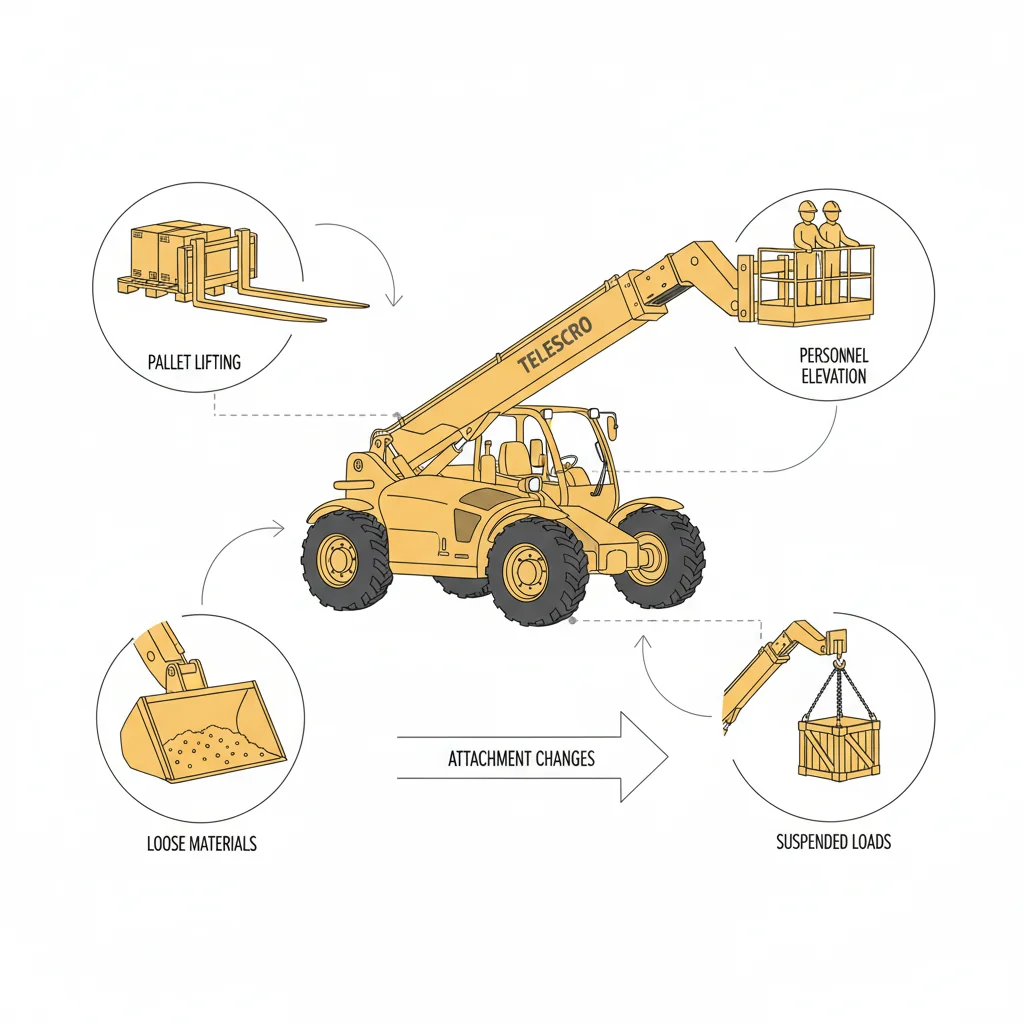
Here’s what matters most when considering a high-reach telehandler for both lifting and access work: you’re really getting multiple machines in one. By swapping forks, buckets, man platforms, or a lifting winch, you can handle palletized loads, bulk materials, and even elevate workers safely—all using a single base machine. I’ve seen this in action on large mixed-use projects in the UAE. One team started the day placing 1,500 kg curtain wall panels at 15 meters with forks, then changed over to a fully certified work platform for façade installers. No separate boom lift needed. That kind of flexibility can’t be matched by a standard rough terrain forklift or mobile elevating work platform.
From my experience working with contractors in Kazakhstan and Brazil, this approach makes a real impact on the bottom line—especially where transport and fleet sizes drive up costs. For example, one site in Brazil replaced an 18-meter boom lift and a 4,000 kg telehandler with two high-reach units rated for 4,000 kg and 17 meters. Over six months, they reported noticeable savings on maintenance and logistics—on the order of around 15%—because each machine could handle both steel beams and people as needed. The key is knowing your work mix: if it’s 60% materials, 40% access, telehandlers are the right call.
But I’m always honest with customers—if you spend every day just lifting people, a dedicated boom lift is simpler, faster, and usually cheaper to certify for elevated work. On projects with mixed access and materials handling, a high-reach telehandler boosts overall utilization and keeps your fleet lean. Always check the rated capacity and certification for man basket use in your region before committing.
"AFalse
"Modern
Telehandlers are limited to lifting materials only and cannot be equipped to raise workers due to regulatory restrictions.False
While there are regulations governing personnel lifting, many telehandlers are certified and equipped with approved man baskets that meet safety standards. When used within manufacturer guidelines and local regulations, telehandlers can legally and safely elevate workers, making them a viable option for both material handling and access tasks.
Key takeaway: Telehandlers with interchangeable attachments can safely perform both lifting and personnel elevation tasks at height, reducing the need for separate machines. This versatility helps optimize fleet size and costs, particularly on projects requiring mixed material handling and access, but is less efficient for pure people-lifting jobs.
Which Telehandler Types Excel at High Altitude?
High-altitude construction favors high-lift fixed-boom telehandlers (12–18 m reach) for feeding upper floors, while rotating telehandlers offer turret rotation for precise load placement in tight urban spaces. Key selection criteria include capacity at full height8, stabilizer systems, boom rigidity, hydraulic smoothness, and operator visibility.
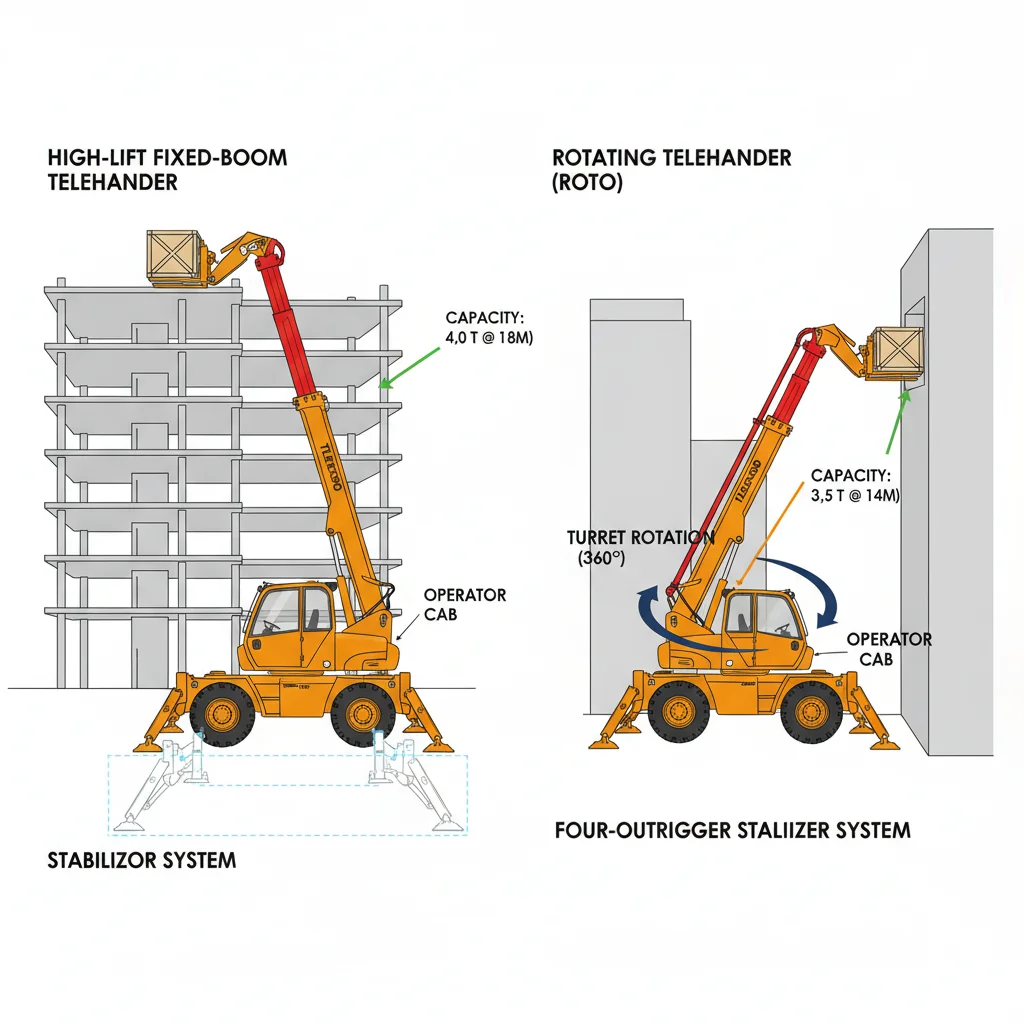
The biggest mistake I see is choosing a high-lift telehandler based only on maximum boom height. What matters more is safe capacity at that height, especially for challenging jobs like multi-story concrete work or installing curtain wall panels. Fixed-boom models in the 12–18 meter class move pallets or rebar to upper floors efficiently—provided you check the load chart for what they’ll actually lift at maximum extension. On dense sites, though, rotating models save space by letting you deliver loads from one spot, turret spinning up to 360 degrees—ideal for city jobs in places like Dubai or Shanghai, where ground access is tight.
Last winter, a customer in Kazakhstan called me with a rooftop HVAC installation problem. They sent a fixed-boom 17-meter telehandler, but had to reposition four times just to reach each edge of the roof. Switching to a 16-meter rotating type not only cut movement in half, it made load placement safer with stabilizers and a camera for blind spots. That job taught me—look at stabilizer footprint and hydraulic control finesse for high-altitude precision.
Here’s a quick side-by-side:
| Type | Best For | Capacity at Height | Reach | Turning Radius | Stabilizer System |
|---|---|---|---|---|---|
| Fixed-Boom (High-Lift) | Feeding tall structures | High if load chart ok | 12–18 m | 4.2–5.3 m | Optional, basic |
| Rotating (Roto) | Tight urban/courtyards | Lower at max height | 14–25 m | 4.5–5.8 m | 4-point, advanced |
To be honest, I always recommend walking the jobsite and checking real site dimensions—especially boom deflection and visibility. Most mistakes happen when buyers trust the brochure more than their own site needs.
Rotating telehandlers fitted with stabilizers can safely support significantly higher loads at full boom extension than comparable fixed-boom units operating without stabilizers.True
When outriggers are deployed, rotating telehandlers gain a much wider and more stable support base. This increases their allowable capacity at height and outreach compared to fixed-boom models working solely on tyres, which experience greater stability limitations without stabilizer support.
All telehandlers with booms over 15 meters are equipped with automatic wind compensation sensors to prevent unsafe operation.False
While some advanced telehandler models offer wind warning systems, there is no universal requirement or standard feature for automatic wind compensation sensors, even on high-reach machines. Operators must rely on external wind measurements and load charts.
Key takeaway: For high-altitude construction, select between high-lift fixed-boom or rotating telehandlers based on site density and reach needs. Prioritize machines with robust stabilizers, high capacity at full extension, minimal boom deflection, smooth hydraulics, and excellent visibility to ensure both safety and precision.
How do ground conditions affect boom height?
Telehandler boom height is strictly limited by ground stability9. Even moderate cross-slopes can seriously reduce stability at full extension. At around 7° of cross-slope, many machines will already be operating well outside their intended working range at rated loads. At 12–18 m, uncompacted fill or soft ground10 can lead to sudden wheel sinking, loss of stability, or overturning.

Last month, a contractor in Kazakhstan asked me why his 17-meter telehandler felt unstable when lifting above 13 meters, even though he was well within the rated capacity on paper. The problem wasn’t the machine—it was the jobsite. He’d set up on ground that looked solid, but part of the work area was old backfill, and one rear wheel sank almost 5 centimeters as soon as he raised the boom with load.
That sudden shift threw the telehandler off-level. It triggered the moment indicator alarm, and the operator backed off just in time. If he’d kept going, an overturn wasn’t out of the question—especially on soft fill or near the edge of an excavation.
To be honest, the spec that actually matters is ground preparation, not just boom height or rated capacity. Most manufacturers quote capacity assuming the machine is level to within 3 degrees on hard, well-compacted ground. Try pushing a 4-ton telehandler to 15 or 18 meters on a 7-degree cross-slope, and the loss of stability is dramatic. Even a small slope or soft patch can unload a tire or overload one side. At maximum height, each tire might carry 4-5 tons.
On uncompacted soil or newly filled areas, that’s enough to cause dangerous sinking in seconds. I always tell customers in places like Dubai or South Africa: before going high, check your base. Use mats, steel plates, or compact the pad—whatever it takes to keep every wheel fully supported.
Even a 5 cm depression under a single telehandler wheel can drastically reduce the usable boom height because of lost stability margin, triggering alarms or cut-outs much earlier than the load chart on level ground would suggest.True
Stability calculations rely on the telehandler being level. A small ground depression can dramatically shift the center of gravity as the boom extends, triggering safety cutouts or alarms much earlier than on firm, level ground. This effectively limits the usable height even when within rated capacity on paper.
Ground conditions only affect machine mobility and have no significant impact on boom height limitations.False
In reality, unstable or uneven ground can compromise the telehandler’s stability, causing the center of gravity to shift and increasing the risk of tipping at height. Manufacturers base rated lift heights on ideal ground; poor conditions can necessitate significant derating.
Key takeaway: Ground preparation is essential for safe high-altitude telehandler use. Stability and rated capacity ratings apply only on level, well-compacted ground. Even minor slopes or soft spots can compromise safety, so operators must assess, level, and reinforce footing before lifting near maximum height.
What must telehandler man platforms include?
Telehandler man platforms must be purpose-designed, certified (EN 280 or ANSI A92), and rated for personnel use—typically 500–1,000 lb including tools. The telehandler itself requires manufacturer approval for lifting people, an LMI system to prevent unsafe movements, and integrated rescue procedures for emergency lowering. Wind speed limits and local regulations must also be checked.
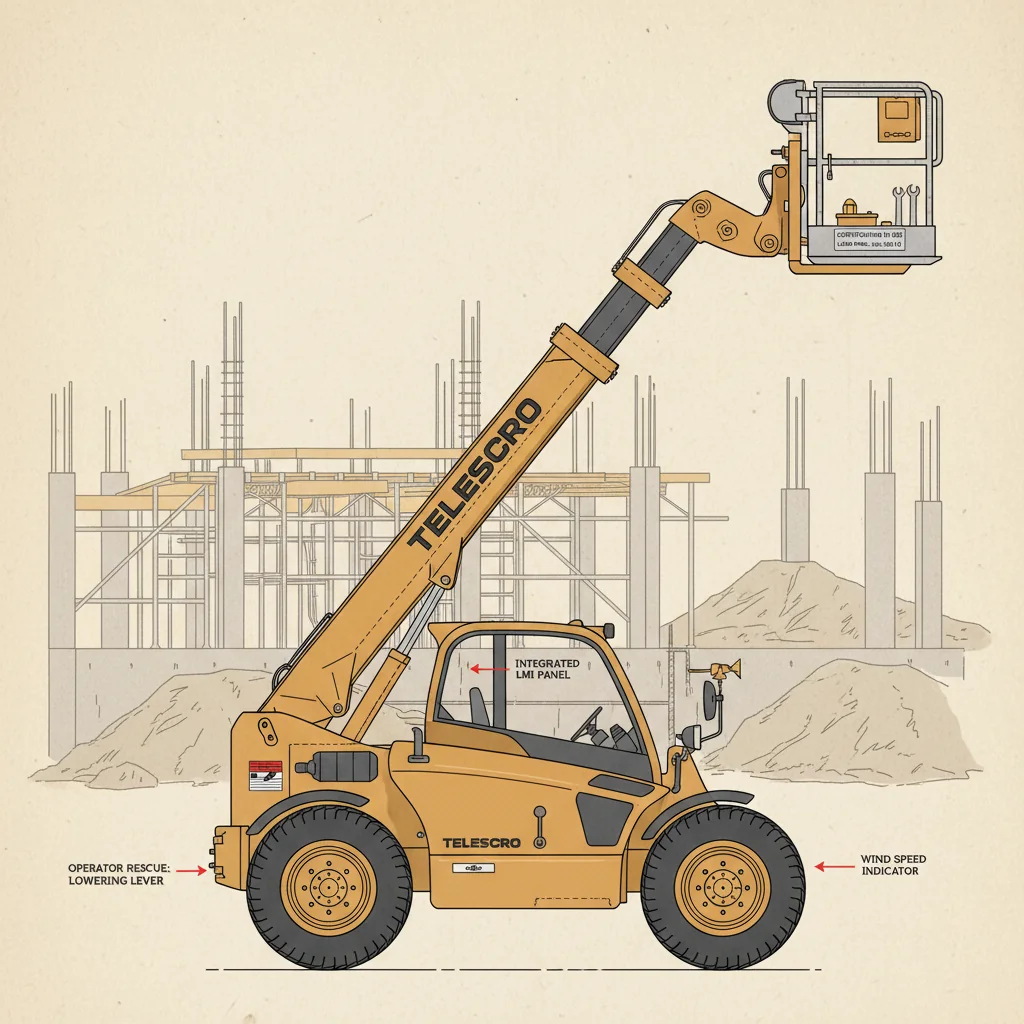
I’ve worked with crews in Dubai who thought any platform attachment was enough for man-lifting, but regulations are strict for a reason. The platform itself has to be certified specifically for personnel use—usually by EN 280 or ANSI A92. Capacity is key: most meet the 500–1,000 lb range, which means two people plus their hand tools, not a pile of material. If the platform isn’t certified or the machine manual says “material use only,” don’t even consider putting people up there—it’s a huge risk for safety and insurance.
The real difference with man platforms is the level of safety control. You need telehandlers with a proper load management indicator (LMI): this is the system that tracks the boom angle, extension, and the platform’s weight in real time. If you overload or put the boom at a dangerous angle, the LMI automatically locks movement. I saw a site in Kenya skip this step—no LMI, just a standard fork carriage with cage. Two weeks in, the boom overloaded and jammed, stranding a worker 10 meters up. Emergency lowering procedures weren’t clear either, so it took almost half an hour to bring them down.
Always remember, wind speeds matter much more at height. Up on a 12-meter platform, a 6 m/s ground wind can feel like 12 m/s—and many certifications set 12.5 m/s as the “no-go” cutoff. Before you buy or rent, check local regulations; some countries only allow travel with people in the platform if the telehandler brand allows it and only on firm level ground. I strongly suggest confirming integrated safety controls and machine approval for personnel before lifting anyone.
Certified telehandler man platforms must include a self-closing entry gate to prevent falls during elevated access.True
Both EN 280 and ANSI A92 standards require a platform gate with an automatic self-closing mechanism to reduce the risk of accidental falls when personnel enter or exit the platform at height.
Telehandler man platforms can be certified for personnel use solely based on their load capacity rating, regardless of design or safety features.False
Certification for personnel lifting requires the platform to meet specific design and safety standards, such as guardrails and anti-slip surfaces, not just load capacity. Load rating alone does not ensure compliance with EN 280 or ANSI A92 requirements.
Key takeaway: For safe personnel lifting, verify the man platform’s certification, the base machine’s approval for such use, integrated safety controls like LMI and tilt alarms, and clear emergency procedures. Always confirm platform and regulatory standards before committing a telehandler to high-altitude man-lifting applications.
How do attachments affect telehandler safety?
Attachments directly impact a telehandler’s safe rated capacity at height. Each attachment—such as pallet forks, work platforms, or jibs—requires consulting its own load chart, as added weight and altered load centers typically reduce usable capacity and outreach. Proper operator training on each attachment’s limits is essential for high-altitude safety.
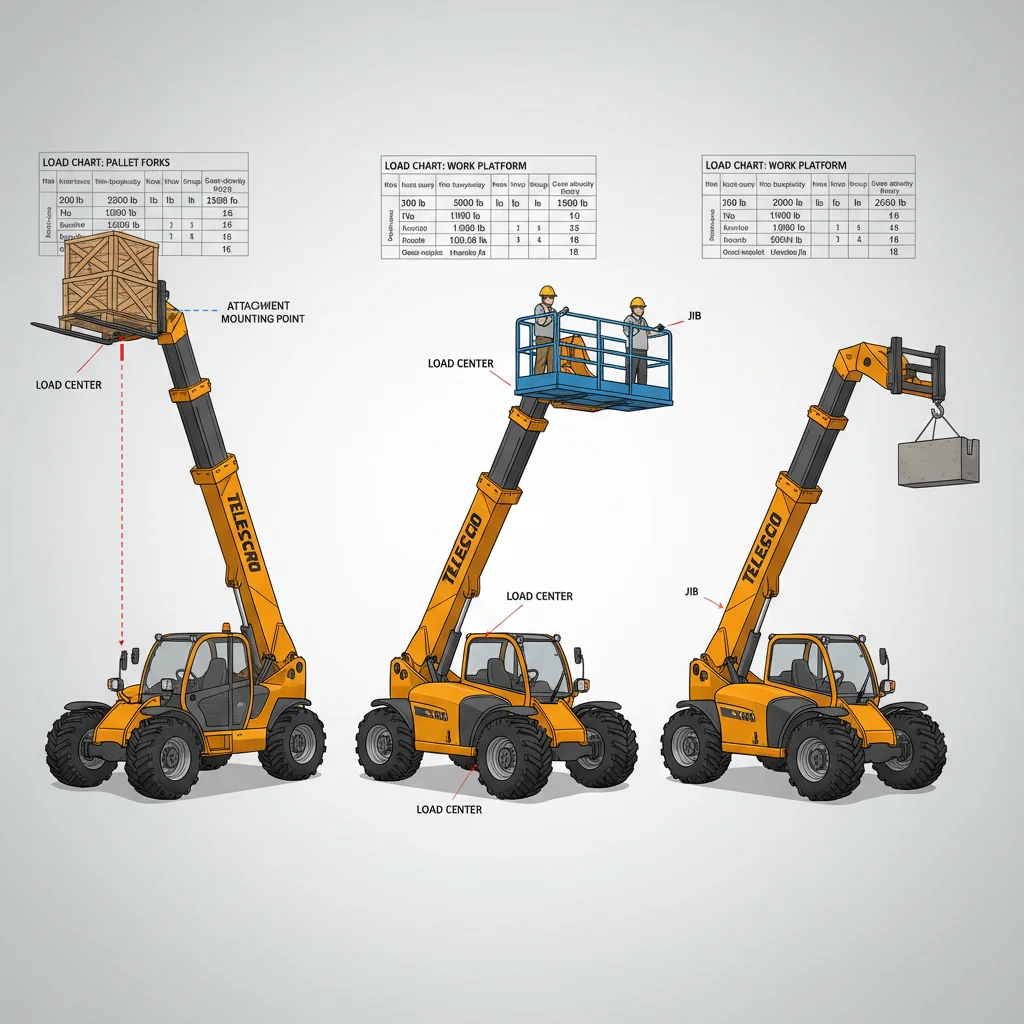
I’ve worked with customers who made this mistake: they assumed swapping a bucket for a jib on their telehandler wouldn’t change much. But every attachment—forks, platforms, winches—directly affects both how much you can lift and how far you can safely extend the boom. The rated capacity listed on the machine is just the starting point. As soon as you attach a 600 kg work platform or a 350 kg jib, usable capacity drops fast, especially at height. In a recent project in Turkey, a contractor tried lifting HVAC units to the seventh floor using a winch. With a max machine capacity of 4,000 kg, they thought a 1,000 kg load was safe—but at 18 meters out, the actual safe lift limit was under 900 kg once the attachment weight and new load center were factored in.
I always remind operators and site managers to treat each attachment as a different “machine” when calculating safety margins. It only takes one wrong assumption to risk a tip-over at height. So, practical strategy on busy jobsites includes:
- Always consult the individual attachment’s load chart, not just the main machine specs.
- Factor in the attachment’s own weight—this counts directly against rated capacity.
- Understand how the load center shifts forward with work platforms, jibs, and winches.
- Train every operator specifically on attachment limits, not just general telehandler operation.
- Double-check quick-coupler compatibility on imported machines. I’ve seen customers stuck with “orphaned” jibs that didn’t fit their local fleet.
I suggest treating load chart checks and operator training as non-negotiable steps before any lift at height. This keeps productivity up—and everyone safe.
Attaching a work platform to a telehandler can reduce its maximum safe lifting capacity by up to 50% at maximum boom extension, even if the platform itself weighs less than 10% of the machine's rated base capacity.True
Attachments shift the load center of gravity and add weight at the boom tip, amplifying leverage forces on the machine. Manufacturers typically derate the safe load for each approved attachment, with platforms in particular causing significant reductions at height due to both added weight and increased moment arm.
Telehandlers with a jib attachment can always operate at the same maximum height as when using forks, as the capacity chart remains unchanged regardless of attachment type.False
Capacity charts are specific to each attachment because different tools affect both weight distribution and boom loading. Jibs, especially when extended, shift the load farther from the machine and often reduce maximum safe working height and outreach to prevent tipping or structural overload.
Key takeaway: Selecting the right telehandler attachments and understanding their individual load charts is critical for safe high-altitude operations. Each attachment alters capacity and handling, so a tailored buying strategy and specific operator training help maximize productivity while ensuring compliance with safety limits.
When Are Suspended Loads Unsafe?
Suspended loads are unsafe on telehandlers when wind exposure, swinging, or dynamic movement exceeds what the load chart assumes for rigid loads. Most manufacturers place very strict limits on travelling with suspended loads—especially on any kind of slope—and always require you to stay well within the reduced capacities specified for this type of work. Always consult official guidance and derate performance for non-standard lifts to prevent instability and accidents.

The biggest mistake I see is treating a telehandler like a mobile crane—especially with suspended loads. These machines are designed first and foremost for handling rigid, supported cargo, such as pallets or bundled rebar. The moment you lift with a hook, winch, or jib, the entire risk profile changes. For example, I worked with a team in Turkey that tried to move glass curtain wall panels—each one nearly 250 kg but over three meters wide. Even a moderate gust sent the load swinging, and their 4-ton telehandler with a boom out twelve meters suddenly reached its stability limits, despite the “rated” capacity looking safe on paper.
Most manufacturers actually prohibit traveling with suspended loads, especially on any kind of slope or rough ground. The load chart—the only chart you can trust—assumes the cargo is rigid and not moving. If the load starts to swing or twist, the dynamic force multiplies, stressing hydraulic components and shifting the machine’s center of gravity. I’ve seen it firsthand in Dubai: a rooftop HVAC unit, just under 1,000 kg, started oscillating as the operator slewed the turret. That extra movement sliced almost 20% off the machine’s effective capacity, and the operator had to set it down fast.
If your site needs frequent high-lift suspended moves, I always suggest comparing a telehandler-plus-jib to a compact mobile crane. Take time to review the derated load chart, especially for long, flat materials with high wind exposure. And don’t skip creating a formal lift plan—the safest telehandler operators I know in Brazil never treat non-routine suspended lifts as “just another pick.”
A suspended load on a telehandler can dramatically increase the risk of tip-over when the boom is fully extended at height, because any swinging or gusts add extra, hard-to-predict forces to the machine.True
Suspended loads introduce unpredictable swinging forces and a higher center of gravity, especially when the boom is raised. At high altitude, wind gusts have a greater impact, amplifying the tip-over risk compared to handling rigid loads. Industry studies have quantified this elevated risk in controlled scenarios.
Telehandlers equipped with outriggers can safely operate with any suspended load as long as the load stays within the rated capacity.False
Even with outriggers, telehandlers are not designed for dynamic, swinging loads like cranes. The load chart does not account for the additional forces from swinging, wind, or shifting mass, which can cause instability even when under the nominal rated capacity.
Key takeaway: Telehandlers are engineered for stable, supported loads—not frequent suspended lifts. Attaching jibs, winches, or hooks increases instability, especially at height or in wind. Always follow manufacturer limits, create formal lift plans, and consider using a mobile crane for demanding suspended lifts at altitude.
Why is high-altitude telehandler training vital?
Specialist training for high-altitude telehandler operation is critical because height amplifies the risks of minor errors. Operators must accurately interpret load charts, assess ground conditions, understand stabilizer requirements11, and maintain awareness around façades and power lines. Effective training reduces overturn, collision, and dropped load risks, while poor habits can result in serious incidents.

To be honest, even experienced telehandler operators can underestimate just how quickly small mistakes get magnified when you’re working at height. Lifting a pallet of brick to 16 meters isn’t the same as moving it at ground level. At that height, wind, uneven ground, and even minor miscalculations can push the machine past its safety threshold. The load chart for a 4-ton, 17-meter machine, for example, might only permit 1,100 kg at maximum reach when stabilizers are correctly positioned—far less than the rated capacity people see on spec sheets.
Last year, I worked with a contractor in Brazil who wanted to use a rotating model to install HVAC units on a high-rise. Their lead operator assumed any stabilizer setup would do. But EN 1459-2 is strict about this—partial stabilizer extension (short-jacking) reduces safe capacity, and only the manufacturer’s load chart defines those limits. On their site, ignoring the load chart would have put expensive equipment—and workers—at real risk. I spent an afternoon walking the team through correct setup, how to verify ground conditions, and the importance of exclusion zones, especially around façades and power lines.
It’s not just about the operator, either. I’ve seen plenty of accidents traced back to supervisors or spotters who weren’t trained to guide or enforce safety. If you plan to lift people in platforms at height, expect even tighter procedures—at least a full extra day of certified training, from my experience. I suggest budgeting for thorough, model-specific training at the start of every high-altitude project. The incremental cost is nothing compared to the risk of an overturn or regulatory shutdown.
The maximum rated capacity of a telehandler often drops by over 70% at full boom extension compared to its capacity at minimal lift height.True
At high altitudes with the boom fully extended, leverage and stability challenges force manufacturers to significantly reduce rated lifting capacity due to increased risk of tip-over and structural strain.
Using boom extension alone, without repositioning the machine or stabilizers, always maintains the telehandler's rated capacity as shown for lower heights.False
Extending the boom increases leverage, decreasing lifting capacity dramatically. Without adjusting position or stabilizers, the risk of tipping is much higher and capacity is far less than at minimal extension.
Key takeaway: Rigorous, model-specific operator training for high-altitude telehandler use is essential. It minimizes the amplified risks of instability, collision, and regulatory violations by ensuring operators and supervisors correctly interpret load charts, deploy stabilizers per manufacturer instructions, and maintain safe site practices at height.
How Does Maintenance Impact Telehandler Safety?
Maintenance has a direct impact on telehandler safety at height. Wear on boom pads and improperly calibrated load management sensors12 can reduce stability and the accuracy of safety systems, particularly when working above 15 meters. Regular inspection of boom sections, routine cleaning, and timely sensor calibration help maintain structural integrity and ensure the load indication system functions correctly during high-altitude lifts.
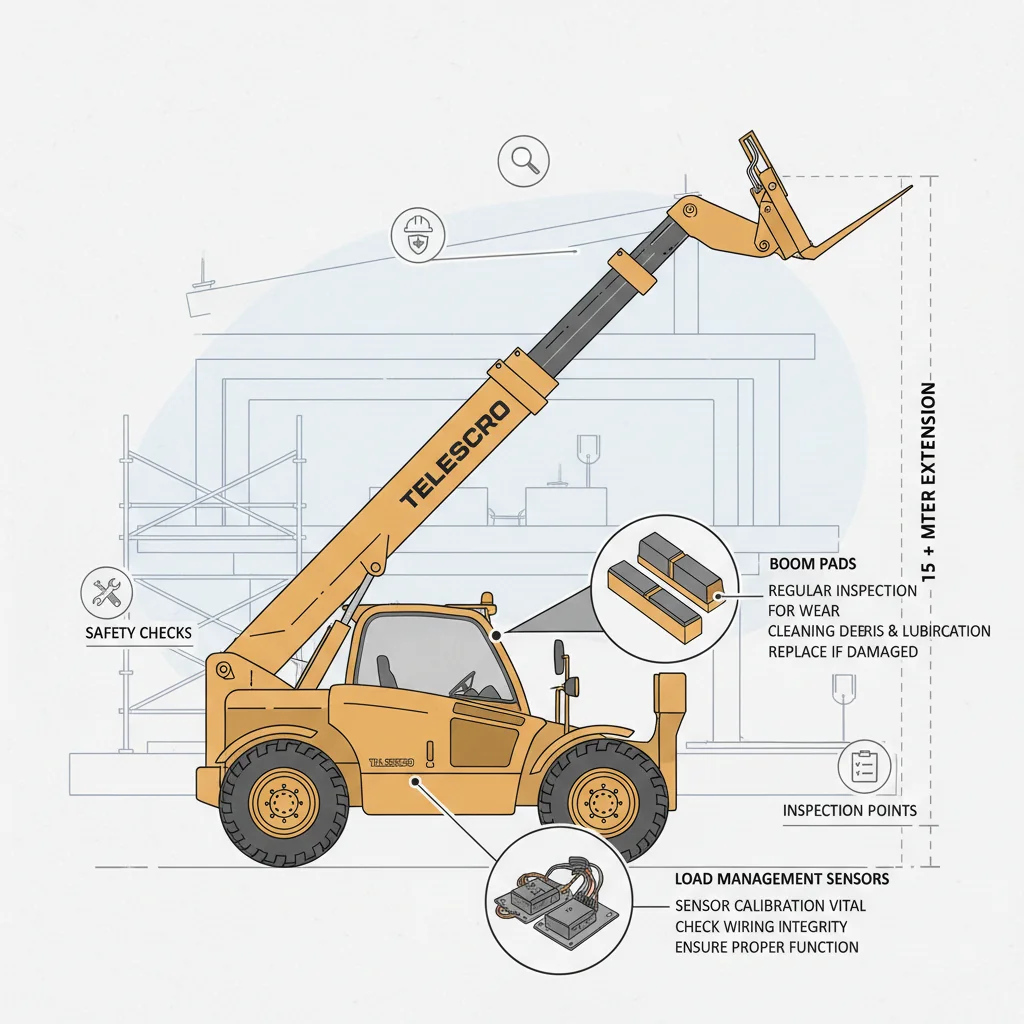
I’ve seen firsthand how maintenance makes or breaks telehandler safety—especially on high-rise jobs. Just last year, I worked with a crew in Nairobi using an 18-meter unit for cladding work. Their biggest problem? Boom drift13 and unexpected platform sway above 15 meters. When we checked, the wear pads on the second boom section were already thinning out, which let the boom develop side play. At ground level it felt harmless, but at full extension, even a few millimeters translated into a wobble you could really feel—and trust me, nobody wants that with two men in a platform.
Neglecting boom cleaning is another real danger. Cement dust and quarry fines act like sandpaper, wearing down pad surfaces and even damaging hydraulic hoses routed inside. I always tell customers to wipe the boom sections daily on dusty sites, and add lubricant sparingly; this small habit doubles the life of sliding parts. In Brazil, a sugar mill operator ignored this advice and ended up with a seized boom at 16 meters and a major downtime bill.
Load management sensors are the next weak link if ignored. These angle and length sensors, plus pressure transducers in the hydraulic circuit, must stay calibrated. If not, the load moment indicator (LMI) gives false readings, or worse, lets the boom reach unsafe angles. I’ve seen operators skip annual calibration to save time, only to trigger blackout zones or sudden safety cutoffs above 14 meters. My advice? Test the full boom range every shift and never override LMI alarms—those are usually the first warning signs. A disciplined maintenance plan keeps telehandler performance predictable and safe, even at maximum reach.
Excessive wear on boom section wear pads can increase horizontal boom deflection by several centimeters at full extension, directly impacting platform stability at height.True
Wear pads are designed to keep the telescopic boom sections aligned and minimize lateral movement. When pads thin out, clearances grow, amplifying side play at height. Even a 1 mm increase in pad clearance at the base can translate to several centimeters of movement 15 meters above ground, risking occupant safety and precise load placement.
Routine tire pressure checks are unnecessary for telehandler stability on high-altitude work since outriggers entirely prevent tilting.False
Outriggers improve stability, but tire pressure remains critical because tires compensate for surface irregularities and absorb dynamic loads. Under-inflated or uneven tires can still cause instability or uneven outrigger contact, especially on rough terrain, increasing the risk of tipping even when outriggers are deployed.
Key takeaway: Proactive maintenance—including frequent boom inspections, wear-pad checks, and timely sensor calibration—is essential for safe telehandler use at height. Failure to maintain structural and electronic systems increases risk of instability, false readings, or unnoticed damage, particularly during platform work at maximum extension.
How does altitude impact telehandler performance?
At high-altitude sites (2,000–4,000 m), reduced air density lowers diesel engine power and cooling efficiency in telehandlers. Expect engine derating14 of 3–4% per 300 m above 1,000 m, slowing travel and hydraulic response. Turbocharged engines perform better but still require altitude and cooling adjustments for safe, effective operation.
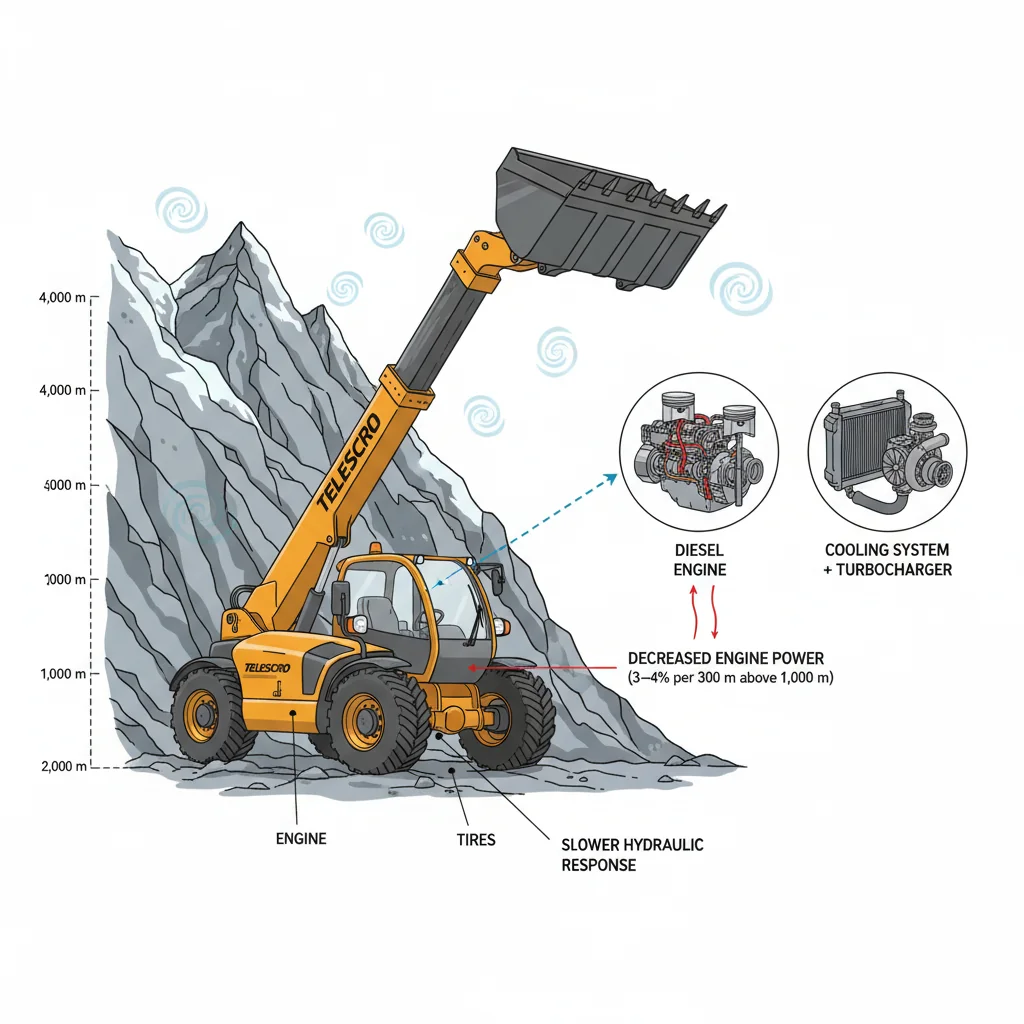
Last year, a crew in Bolivia ran into serious trouble with a standard 75-hp telehandler on a mining project at 3,800 meters. On paper, the machine matched their needs for 3,500-kg lifts to nearly 12 meters. But once they started work on steep, rocky roads and longer boom cycles, the real limitations appeared. The diesel engine just couldn’t deliver full power—especially when climbing with a loaded bucket or running multiple hydraulic functions at once. Every 300 meters above 1,000 meters elevation means you lose about 3–4% of engine output. Up at 3,800 meters, that adds up to roughly 30% loss. Travel speed drops, and hydraulic response feels sluggish. Their productivity dipped, and on hot days, the cooling system couldn’t keep up.
But this isn’t just a South American issue—I’ve seen similar problems on construction projects in western China, India, and Ethiopia. Even turbocharged machines can’t fully escape derating, though they do perform better than non-turbo units. That’s why I always recommend reviewing altitude derating curves from the manufacturer before making a final decision. For most jobs above 2,500 meters, I suggest jumping at least one engine class higher—think 110-hp instead of 75-hp for a similar rated capacity. It’s not just the engine; check that your hydraulic pump and seals are rated for lower air pressure and sudden weather swings.
The reality is, reliable performance in the mountains means thinking beyond standard specs. Don’t get caught choosing a “showroom hero, jobsite zero.” I always advise customers—factor in altitude, cooling, and hydraulic ratings, so your telehandler still works as promised once the real work starts.
A telehandler’s engine loses approximately 3% of its rated power for every 300 meters increased in altitude above 1,000 meters, impacting lifting and driving performance significantly at high elevations.True
Diesel engines rely on atmospheric oxygen for combustion. As altitude increases, air density drops, resulting in less oxygen and a proportional reduction in engine power output. This power loss is cumulative and can drastically diminish performance in mountainous environments.
Switching to larger tires is a reliable way to compensate for all performance loss experienced by telehandlers at high altitude.False
While tire size can improve ground clearance and traction, it does not address the loss of engine power caused by reduced oxygen at high elevations. The core issue remains air density, which affects combustion efficiency regardless of tire modification.
Key takeaway: High-altitude mountain operations require telehandlers with upgraded engine power and cooling—typically a higher power class than low-altitude sites. Consult manufacturers for altitude derating and select models with components rated for local elevation and temperature extremes to ensure reliable lifting and cycle times.
Conclusion
We explored how telehandlers handle high-altitude tasks and why manufacturer load charts matter for safe, stable operation. From my experience, don’t let max height or outreach on the spec sheet distract you—that’s the classic “3-meter blind spot.” Success comes from double-checking the load chart at your actual working range and making sure spare parts are accessible locally. If you still have questions about matching a telehandler to your jobsite or want help interpreting load charts, feel free to reach out. I’m always happy to share what’s worked—or what hasn’t—for real crews around the world. Every site is different, so focus on what actually supports your workflow.
References
-
Explore how telehandler rated capacity varies with boom height and outreach, crucial for safe load management and jobsite efficiency. ↩
-
Detailed guide on interpreting load charts to prevent overload risks and ensure telehandler safety at height, essential for operators. ↩
-
In-depth explanation of telescopic boom mechanics, extension capabilities, and how it enables safe overhead access over obstacles. ↩
-
Detailed guide explaining load charts, how they ensure safe lifts, and prevent tipping by accounting for boom angle and extension. ↩
-
Explains how high-reach telehandlers replace multiple machines, boosting efficiency and cutting maintenance costs on mixed-access projects. ↩
-
Details the certified work platform advantages for safely elevating workers, reducing the need for separate boom lifts on site. ↩
-
Details advantages of 360-degree turret rotation and stabilizers that enhance precision and safety on dense sites. ↩
-
Explains the importance of safe lifting capacity at maximum boom height for multi-story construction and load safety. ↩
-
Explore how varying ground stability impacts telehandler safety and operational limits, with expert tests and practical examples. ↩
-
Understand the risks of operating telehandlers on soft or uncompacted soil and learn safety measures to prevent overturning. ↩
-
Explains the critical role of correct stabilizer setup in maintaining telehandler stability and avoiding accidents during high-altitude lifts. ↩
-
Details how sensor calibration improves load accuracy and stability, essential for preventing accidents at elevated working heights. ↩
-
Explores key factors behind boom drift, helping operators prevent unstable platform sway and improve safety on high-rise jobs. ↩
-
Explains the impact of altitude on diesel engine power loss and how to adjust telehandler use for optimal performance. ↩