










Telehandler Hidden Costs: What Smart Buyers Overlook (Field Guide)
I’ll never forget the Australian farm manager who called furious because his “bargain” telehandler snapped a driveshaft halfway through harvest. Turns out, hidden wear in the drivetrain and a missing service log wiped out his entire maintenance budget for the season—and nearly his trust in used equipment deals.
Hidden costs in telehandler ownership frequently arise from unreported mechanical damage, accelerated component wear, and incomplete service records. Core systems—engine, transmission, axles, and hydraulics—may have undergone severe stress or improper maintenance that remains undetected during casual inspection. As telehandlers age, out-of-schedule repairs on items such as boom cylinders, brake systems, and electrical wiring increase both direct expenditures and operational downtime.
Can Hidden Damage Inflate Telehandler Costs?
Hidden mechanical damage1 to telehandler core components—engine, transmission, axles, and hydraulic system—can trigger major, unexpected repair expenses. Problems from past overloading or abuse may remain undetected in quick inspections. Lacking maintenance records amplifies financial risk, making independent inspections essential for cost control.

Most people don’t realize that damage beneath the surface can quickly turn a so-called “bargain” into a budget disaster. I remember helping a buyer in the UAE who thought he landed a great deal on a 4-ton, 17-meter telehandler from Europe. After only three weeks on a jobsite, hydraulic pressure2 dropped and the boom started creeping down, even on level ground. Inspection showed the main cylinder seals were worn and metal shavings in the oil pointed to previous overloading. The repair bill—around $9,000—not counting the downtime. Honestly, it’s this hidden mechanical damage that catches operators off guard.
The biggest risks lurk where you can’t easily see them: inside the engine block, gear sets in the transmission, axle differentials, and high-pressure circuits. Quick visual checks usually won’t reveal problems like heat stress, micro-cracks, or internal wear—especially if someone cleaned up leaks and painted fresh over rust. I’ve seen machines from Kazakhstan with low reported hours, but the axles were loose from years of crane work. Replacing a transmission or major hydraulic pump can cost as much as 30% of the machine’s value.
That’s why I always suggest independent pre-purchase inspections, even if it adds $500 to your upfront cost. Match wear signs—like boom play, paint discoloration, or odd noises—to the service records and hour meter. No complete maintenance history? Consider it a warning flag. For imports, a pre-shipment inspection can save thousands and plenty of headaches. A little diligence up front protects your entire operating budget.
Metal shavings found in hydraulic oil often indicate internal component wear from repeated overloading, which can lead to unexpected seal failures and costly boom repairsTrue
Metal particles circulate within the hydraulic system when components like pistons or cylinder walls wear down due to stress beyond design limits, causing seal degradation and hydraulic leaks that require extensive maintenance.
Telehandlers with older diesel engines generally have fewer hidden hydraulic issues because older designs are simpler and more robustFalse
Older diesel engines do not correlate with fewer hydraulic problems; in fact, aging machines often have deteriorated seals, hoses, and cylinders that increase the risk of hidden damage regardless of engine age.
Key takeaway: Major telehandler repair costs often arise from undetected damage to essential systems, leading to budget overruns. Insisting on complete maintenance records and third-party inspections before purchase is the most effective way to minimize financial risk—especially when buying used units or imports.
Why Do Old Telehandlers Cost More?
Aging telehandlers incur higher maintenance costs due to accumulated wear on hydraulics, drivetrains, electronics, and structural joints. Scheduled servicing3 typically costs $1,200–$2,000 annually; however, older units frequently require unscheduled repairs4 like boom cylinder reseals or brake overhauls, costing $3,000–$8,000 per event. Neglecting this hidden expense can turn a bargain purchase into a financial liability.

Let me share something important about aging telehandlers—cost isn’t just about the purchase price. Too often, buyers spot a used 4-ton unit for $28,000 and think it’s a bargain. But in reality, old machines are like hidden icebergs: most of the trouble (and money) is below the surface. In Dubai last year, I advised a contractor who found a 14-meter telehandler at a steep discount. It looked tidy, but in six months, he faced two emergency repairs—a leaking boom cylinder and a failed wiring harness. Each call-out ran over $4,500, not counting lost days on site.
Here’s what matters most when you’re weighing old versus new: every extra year or 1,000 operating hours means more wear inside the hydraulic circuit, drive axles, and the boom’s pivot points. Scheduled maintenance—filters, fluids, and inspections—might only set you back $1,500 per year. But when an unexpected event hits, like a brake overhaul or main valve replacement, the bill often jumps to $3,000–$7,000. If you get two or three of these in one season, that “affordable” machine quickly costs more than a newer one.
From my experience, savvy buyers always request a complete service log and check for long gaps between hydraulic repairs or boom checks. If this information isn’t available, I suggest budgeting at least 30% extra for the first year. Don’t get caught by what I call the “second-year surprise”—that’s when neglected issues pop up and turn a bargain into a big headache. In many cases, a newer machine ends up as the smarter long-term investment.
Aging telehandlers often incur higher maintenance costs because boom cylinder seals tend to degrade significantly after 8,000 operating hours, leading to frequent hydraulic leaks.True
Boom cylinder seals are subject to continuous pressure and movement, which cause wear and hardening over time. After approximately 8,000 hours, seals commonly fail, resulting in leaks that require costly repairs and downtime. Buyers who overlook operating hours may face unexpected expenses.
Older telehandlers typically consume more fuel due to less efficient engine combustion technology, resulting in fuel consumption rates at least 30% higher than models built within the last five years.False
While newer telehandlers may have improved engine efficiency, the fuel consumption difference is generally moderate, not as high as 30%. Factors like maintenance condition and load acceptance have greater impact than engine age alone on fuel use.
Key takeaway: Budget for higher contingency maintenance and repair costs with aging telehandlers. Cheaper upfront pricing can be quickly offset by frequent, expensive repairs on critical systems. Smart buyers request maintenance histories, compare annual service data, and consider newer models if long-term reliability and predictable costs are priorities.
How Do Parts Availability and Service Impact Costs?
Parts availability and local service support5 directly affect total telehandler operating costs. Models with obscure engine or hydraulic brands may offer lower upfront prices but often face longer downtimes when parts fail. Every day awaiting imported parts can cost $500–$2,000 in lost productivity, easily surpassing any initial savings. Check for local dealers and spare parts support.

The biggest mistake I see is buyers choosing a telehandler purely on initial price, without looking into local parts support. Last year, I worked with a contractor in Kazakhstan who selected a 3.5-ton model with a lesser-known hydraulic system—mainly because it was 10% cheaper. Six months in, a main hydraulic cylinder seal failed. The local dealer couldn’t help, and the part had to be imported. That machine sat idle for almost three weeks. Every lost day on that jobsite meant over $1,000 in wasted labor and equipment lease fees. Suddenly, their “savings” cost at least $18,000—much more than sticking with an industry-standard model.
From my experience, this kind of downtime is most expensive on busy projects where one machine holds up the entire workflow. I’ve seen similar cases in South Africa and Brazil. Even basic spares like filters and sensors can take at least 7-10 days to arrive if the brand isn’t locally supported. On remote sites, it’s worse—sometimes you’ll wait a full month for a simple part.
Here’s what matters most when cutting costs: always check how close the authorized dealer is, and whether they stock common parts locally. Ask about average response times for field service or hydraulic repairs. Saving a few thousand dollars up front doesn’t compare to the risk of multi-day shutdowns. My advice? Prioritize brands with strong parts networks in your region. This keeps your maintenance predictable and your telehandler working, not parked. Consider supply reliability a core part of your cost calculation.
Choosing telehandlers with widely adopted hydraulic components reduces average repair downtime by up to 50% due to faster parts availabilityTrue
Common hydraulic components are more likely stocked locally, minimizing wait times for parts and repairs. In contrast, proprietary or rare parts often require importation, causing significant project delays and increased downtime costs.
Telehandler repair costs are mostly fixed regardless of the brand or parts availability, so initial purchase price is the most accurate indicator of total cost of ownershipFalse
Repair costs vary greatly depending on parts availability and local service support. Machines with rare or imported parts can incur much higher repair expenses and downtime, making initial price alone a poor indicator of total ownership cost.
Key takeaway: Always assess local parts availability and service networks before choosing a telehandler. Even routine maintenance becomes more expensive and time-consuming for lesser-known brands, which can severely erode initial cost savings. Prioritize strong regional support to reduce downtime and protect jobsite productivity.
How Do Depreciation and Resale Value Affect Costs?
Telehandlers depreciate sharply in the first 1–3 years, especially new machines priced at $70,000–$140,000. Used units lose value more gradually, with future resale tied to maintenance and service records. Well-maintained telehandlers from reputable brands retain value better, reducing total cost of ownership compared to neglected or hard-used machines.

Here’s what matters most when you’re weighing up depreciation and resale value: it’s not just about the sticker price—what happens in the years after purchase can make or break your equipment budget. I’ve worked with contractors in Dubai and Malaysia who bought new 4-ton telehandlers for around $100,000. Within just two years, those machines dropped to about $65,000—almost a third lost, just like that. That’s normal for new equipment in the first three years, especially if you put on heavy hours or skip scheduled maintenance.
But I’ve seen a different story when customers buy used telehandlers, especially units around five years old with solid service documentation. For example, an agriculture client in Kazakhstan picked up a 3-ton, 12-meter reach machine for about $55,000. Two years later, after keeping up all oil changes and running regular hydraulic checks, he sold it for nearly $45,000. That’s much gentler depreciation—about $5,000 per year instead of $15,000 or more.
Condition is everything. Machines that arrive with incomplete service records, worn boom pads, or hydraulic leaks lose value fast. Repairs get expensive, but resale stays flat. I always suggest requesting detailed service logs before you buy any used telehandler. Units with clear histories almost always sell quicker and closer to expected value, regardless of brand.
My advice? Estimate the resale value for the timeframe you plan to own the machine—three, five, or even seven years. Carefully factor in maintenance, duty cycles, and brand reputation. In the end, that’s what actually protects your investment.
Telehandlers typically lose about 30-40% of their value within the first two years due to rapid depreciation driven by heavy usage and market saturationTrue
New telehandlers depreciate quickly because heavy operational hours impact wear, and a high volume of used machines entering the market suppresses resale prices, leading to significant value loss shortly after purchase.
The resale value of telehandlers is not affected by the hours of operation, only by the machine's ageFalse
Resale value is heavily influenced by hours of operation; machines with high operational hours typically depreciate faster and sell for less than similar-aged equipment with fewer hours, as hours reflect wear and potential maintenance costs.
Key takeaway: Depreciation and resale value significantly impact telehandler ownership costs. Prioritizing well-maintained machines with strong service histories and choosing reputable brands can protect long-term value. Smart buyers compare total ownership costs, not just the purchase price, to avoid hidden expenses associated with rapid depreciation or poor resale prospects.
How Much Do Telehandler Financing Costs Add?
Telehandler financing typically adds 8–15% to total acquisition costs over a 36-month term, once interest rates, arrangement fees, and documentation charges are included. Additional expenses can result from mandatory insurance, GPS tracking, or asset registration. Focusing solely on monthly payments often hides these cumulative amounts, so buyers should analyze total repayable figures and clarify all financial terms in advance.

I’ve worked with customers who made this mistake: focusing too much on getting the lowest monthly payment, then being surprised when they add up the total cost at the end of the term. Last year, a construction manager in Dubai financed a 4-ton telehandler with a 14-meter boom. The sticker price looked reasonable, but after 36 months, the total amount repaid was nearly 13% higher due to interest, arrangement fees, and mandatory insurance. He hadn’t factored in GPS tracking charges the lender added—including asset registration fees—so every month the actual expense crept up quietly.
In my experience, these extra costs cause the most frustration after delivery. Dealers often highlight a “competitive” rate, but dig deeper—what’s the actual interest? Are you being charged a documentation fee, or is there a clause for early payoff that adds penalties? For example, a customer in Kenya once discovered their 3-ton unit’s overall cost was almost $5,000 higher than planned, just from required insurance and compliance inspections listed as “standard” in tiny contract print.
Technically, financing costs also influence how you maintain and use the telehandler. If you spread payments over five years instead of three, you might pay less each month, but total interest grows sharply. Sometimes, putting down a 30% deposit upfront makes more sense than stretching your budget thin every month. I suggest always asking the dealer or lender for the full “total repayable” figure—and double-check the cost breakdown for every line item. That’s the only way to see the real number, not just the monthly illusion.
Mandatory insurance on financed telehandlers can add over 5% to the total repayment amount, significantly increasing overall costs beyond just interest and feesTrue
Lenders often require insurance coverage such as comprehensive or theft insurance on financed telehandlers, which is bundled into the financing cost and accumulates over the term, sometimes exceeding 5% of the financed amount, thus raising the total repayment beyond principal and interest.
Telehandler financing costs rarely include additional technology fees like GPS tracking, so buyers only need to consider interest and arrangement fees when calculating total costFalse
Many lenders now impose additional charges for mandatory GPS tracking or telematics devices, which are incorporated into financing agreements as ongoing fees, making total financing costs higher than just interest and arrangement fees alone.
Key takeaway: Telehandler buyers relying on financing should compare the full repayable amount, not just monthly payments. Additional costs like insurance and fees often drive up the true price. Strategic decisions on down payments and term length can reduce overall interest, delivering meaningful savings over the equipment’s lifecycle.
What Are Typical Telehandler Delivery Charges?
Telehandler delivery, freight, and setup charges can amount to 5–15% of the purchase price. Costs vary by origin—domestic hauls may be $2,000–$8,000, while overseas options add packing, marine insurance6, customs, and port fees. Incoterms define buyer responsibility. Written freight quotes and clear agreements on inclusions are industry best practices.

Let me share something important about telehandler delivery costs—almost every buyer I’ve worked with underestimates how quickly they add up. Moving a 12-ton, 17-meter reach machine from a factory in China to a jobsite in Kazakhstan isn’t just about hiring a truck. You’ll face ocean freight charges, packing and crating (especially if the boom stays extended for shipping), marine insurance, customs duties, and port handling. That’s before overland transport, which can include low-loader trailers and special permits if local roads don’t allow oversize loads. I’ve seen one customer in Kenya pay over $9,000 just in combined international and inland charges for a single shipment. That’s not uncommon when the port is two days’ drive from the site.
Domestic deliveries aren’t exactly cheap either—especially when remote locations or agricultural projects are involved. In Australia last year, I arranged a delivery of a 4-ton telescopic handler to a wheat farm more than 800 kilometers from the dealer. The carrier required a low-loader and a pilot vehicle due to local regulations, so the invoice jumped to almost $7,500. It’s important to ask if unloading and setup are included. Sometimes, you’ll need a crane or telehandler already onsite—as odd as that sounds.
Before you sign anything, I always suggest insisting on an official, itemized freight quote. Clarify if it covers fuel, return pickup, marine insurance, and customs. Sometimes paying a bit more for a local unit saves thousands on logistics—and saves a lot of headaches down the line.
Customs duties can add up to 10-15% of the telehandler’s total invoice price, significantly increasing overall delivery costsTrue
Import duties vary by country but often range from 5-20%. For heavy equipment like telehandlers, duties around 10-15% of invoice value are common, making them a substantial expense beyond basic freight.
Telehandler delivery charges typically exclude marine insurance because manufacturers cover all transit risks by defaultFalse
Manufacturers rarely cover marine insurance by default; buyers or freight forwarders must arrange it separately to protect against loss or damage during ocean transport, adding to delivery costs.
Key takeaway: Logistics expenses for telehandlers—domestic or international—can be substantial and are often underestimated. Accurately itemizing freight, setup, and handling charges before purchase helps prevent budget overruns. Local deals may be more cost-effective overall once all delivery costs are considered.
What Drives Telehandler Attachment Costs?
Attachment costs for telehandlers are frequently underestimated. OEM tools like pallet forks, buckets, and platforms range from $1,000 to $6,000 each. Compatibility issues may require upgraded carriages, hydraulic lines, or electrics, raising expenses further. Non-OEM attachments can affect warranties and performance. Standardizing quick-attach interfaces simplifies integration and saves costs across telehandler fleets.
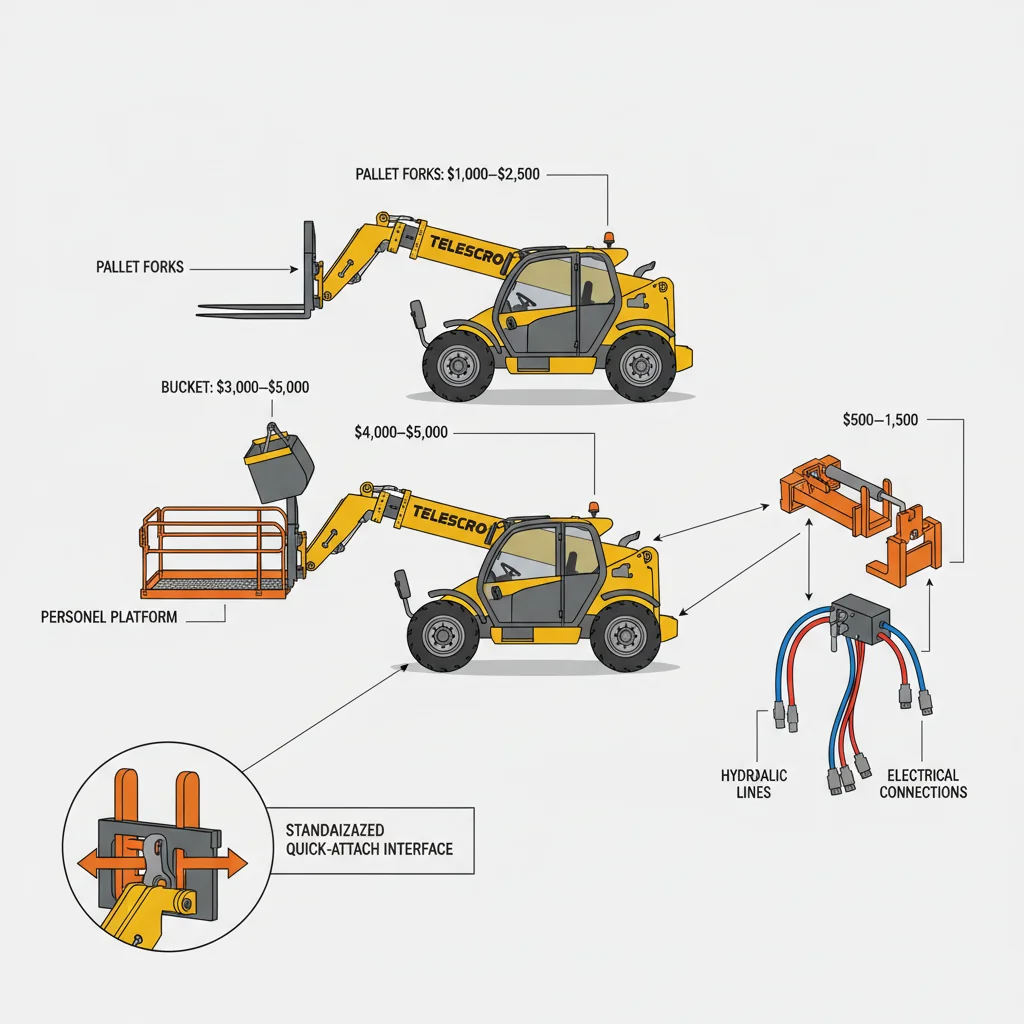
To be honest, far too many buyers overlook the real costs hiding behind telehandler attachments—and it’s a problem I see everywhere, from job sites in Dubai to metro projects in Chile. The base price of a telehandler always looks manageable, but as soon as you start listing the attachments you actually need, the math changes fast. Most essential tools—like pallet forks, buckets, work platforms, and lifting jibs—typically fall between $1,000 and $6,000 each. But the real headache comes when you discover, mid-project, that your new bucket doesn’t fit the carriage or that you’re missing a required third hydraulic function.
Let me break down the cost drivers I see most often:
- OEM vs Non-OEM tools7: Genuine manufacturer attachments protect warranty and deliver reliable hydraulic or electrical integration, but often cost more. Non-OEM gear might look cheaper up front, but can cause issues.
- Compatibility upgrades8: Sometimes your base machine lacks needed hydraulics or electrical circuits. Upgrading for auxiliary hydraulics, quick coupler retrofits, or a new carriage adds several thousand dollars.
- Integration challenges: Different quick-attach systems (like manual vs hydraulic) mean some fleets end up locked into a single supplier, raising long-term costs.
- Operational fit: The wrong attachment—even if it “fits”—can underperform or reduce safety margins. I once worked with a concrete contractor in Kazakhstan whose winch attachment limited lifting at max height by 30% due to machine hydraulics.
I always suggest mapping your future tasks, double-checking compatibility specs up front, and standardizing your quick-attach system when possible. It’s a small investment in planning that keeps your site running—and your costs predictable.
The ongoing maintenance and replacement costs of telehandler attachments can exceed 30% of the initial attachment price within the first two yearsTrue
Attachments like hydraulic-powered buckets and lifting jibs experience wear and require regular servicing, seals replacement, and sometimes hydraulic hose changes, which cumulatively drive substantial maintenance costs often overlooked at purchase.
Telehandler attachments generally do not require any additional hydraulic upgrades beyond the machine's standard factory settingsFalse
Many telehandler attachments, especially specialized tools like high-capacity lifting jibs or work platforms, require hydraulic system upgrades or additional auxiliary circuits to operate safely and effectively, which adds to the total cost.
Key takeaway: Hidden costs in telehandler ownership often result from required attachments and compatibility challenges. Buyers should map task requirements, verify machine-tool integration, and seek precise pricing before purchase. Standardizing interfaces and confirming technical specs up front prevents unexpected expenses, warranty issues, and operational downtimes.
Which Telehandler Warranty Exclusions Add Costs?
Telehandler warranties9 often exclude high-wear components such as tires, brakes, glass, filters, and hydraulic hoses, leading to unexpected repair bills. Electronics and control modules may also be subject to restrictive conditions. Extended or ‘full-coverage’ options frequently add cost without covering essential consumables, making it critical to review detailed warranty documents and exclusion lists before purchase.
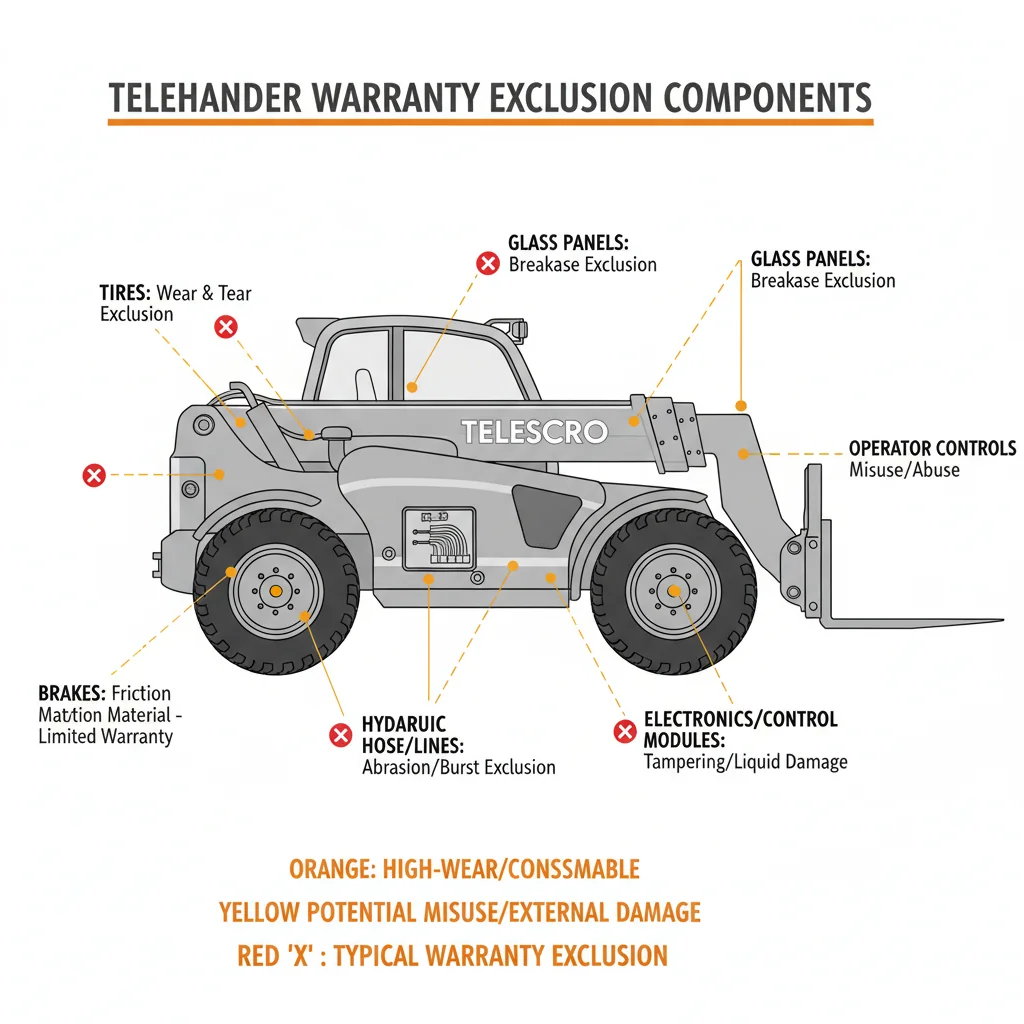
Last month, a project manager from Dubai sent me detailed photos of a cracked hydraulic hose—just six months after taking delivery of a 3-ton telehandler. The surprise? His standard warranty didn’t cover it, leaving him with a repair invoice that topped $600, including labor and downtime. That’s not uncommon. Many standard telehandler warranties look generous at the surface—often one or two years—but the exclusion list can catch buyers off guard. Tires, brake pads, filters, and glass are almost always listed as “consumables.”
I’ve seen owners in Brazil frustrated to discover that overloaded wear on the brakes or a punctured tire means reaching into their own pockets, even during the coverage period. What really causes headaches are electronics and control modules. Replacement sensors or touchscreen displays often come with extremely restrictive terms—a poor power connection or dust ingress can void coverage. I’ve helped crews in Kazakhstan who assumed that a joystick fault would be a simple warranty claim, only to find the fine print excluded “operator error,” so they paid the full cost.
Here’s a quick table comparing which parts are typically covered (or not) under standard and extended telehandler warranties:
| Component | Standard Warranty | Extended Warranty | Typical Exclusion? |
|---|---|---|---|
| Engine | Yes (major components) | Yes (longer hours/years) | Neglect, bad fuel, overheating |
| Transmission/Drivetrain | Yes | Yes | Improper towing/abuse |
| Hydraulics (pump/valves) | Yes | Yes | Contaminated oil, missed service intervals |
| Hydraulic Hoses | Limited | Sometimes (optional) | Wear & tear, abrasion damage |
| Electrical Harness | Limited | Yes (in premium plans) | Rodent damage, impact damage |
| Sensors (pressure/temp) | Usually no | Sometimes yes (depends on brand) | Dust ingress, poor connections, corrosion |
| Joysticks & Controls | Limited | Yes (higher-tier plans) | “Operator error,” impact, water ingress |
| Touchscreen Display | Rarely covered | Sometimes (expensive add-on) | Moisture, cracked screens, power surges |
| Brake System | No (wear items) | No | Overloading, worn pads/rotors |
| Tires | No | No | Punctures, wear, improper inflation |
| Filters & Fluids | No | No | Considered consumables |
| Boom Components | Yes (structural faults) | Yes (longer duration) | Overloading, collision, deformation |
Standard telehandler warranties typically exclude wear parts such as tires, brake pads, filters, and glass, which can result in unexpected repair costs even within the warranty periodTrue
These components are considered consumables and are prone to wear and tear based on usage conditions. Manufacturers exclude them from coverage to limit warranty costs, so buyers should budget for their replacement despite having an active warranty.
Hydraulic hoses on telehandlers are always covered under standard warranty policies for at least two years, regardless of usage or damage typeFalse
Hydraulic hose failures often result from wear, contamination, or operator error and are frequently excluded from standard warranties or only covered under limited terms. Coverage varies and may not extend to hoses damaged within the first year.
Key takeaway: Telehandler warranties commonly exclude wear items and critical electronics, exposing owners to unexpected repair costs. Always review the warranty details and compare the price and coverage of extended warranties with potential out-of-pocket repair risks—especially for demanding or high-usage applications.
What Do Telehandler Certifications Really Cost?
Telehandler certifications and operator licenses incur substantial hidden costs. Initial safety inspections or third-party conformity assessments10 typically range from $500–$1,500, while dedicated operator training11 averages $250–$800 per person. Regular re-inspections and refresher courses may also be legally required. Non-compliance exposes owners to significant fines, site shutdowns, or voided insurance claims if incidents occur.
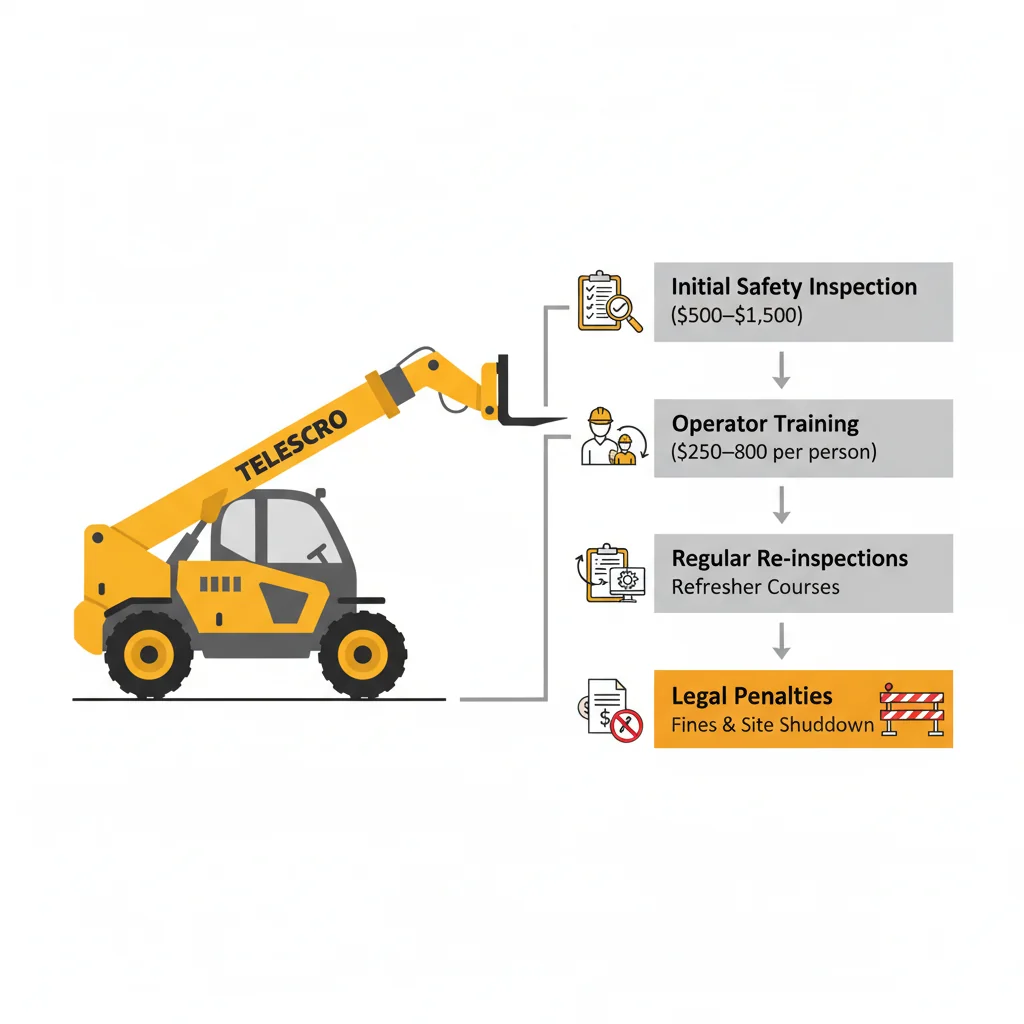
When I talk with international buyers, most are surprised by the ongoing certification costs for telehandlers. In Kazakhstan last year, a contractor bought a 4-ton unit with a 13-meter reach for a big logistics center. Their budget covered only the machine, not the extra $1,100 for conformity inspection or the $350 per operator for hands-on training. The surprise? Locally, annual re-inspections are mandatory, and missing paperwork halted their first week on-site until the costs and sessions were sorted out. That kind of delay can quickly eat into your project timeline.
Unlike forklifts or tractors, telehandlers often fall under stricter construction regulations. In Europe, for example, third-party safety assessments usually cost between $500 and $1,500. That’s just the start. Operators need specific licenses—in several East African countries, I’ve seen training requirements reach $700 per person, especially if attachments like work platforms are involved. Periodic refresher courses are sometimes non-negotiable, and failing those dates can void insurance instantly. A client in Dubai learned this the hard way after a minor incident—because their certificates had lapsed, insurance refused the claim and the contractor covered all damages out of pocket.
Don’t overlook technical records either. Site managers on large projects nearly always ask for documented load charts, up-to-date maintenance logs, and proof of recent safety tests. I suggest confirming with your dealer who will handle the initial machine certification and budgeting for training whenever you change operators. Skipping this step often costs more later—in time, fines, and plenty of frustration.
In many countries, telehandler certification requires annual conformity inspections that can cost over $1,000 per machine, which often catches buyers off guardTrue
Annual conformity inspections ensure ongoing compliance with safety standards and can incur significant costs, especially in regions like Kazakhstan where these are mandatory and non-negotiable. This ongoing expense is often not included in the initial purchase budget.
Operator certification for telehandlers is a one-time cost and does not require periodic renewal or additional training sessionsFalse
Most jurisdictions mandate periodic renewal of operator certification to ensure skills stay current and to comply with updated safety regulations, often requiring refresher courses and recurrent training fees.
Key takeaway: Buyers must budget for telehandler-specific certifications, licensing, and ongoing training. Skipping these steps can lead to legal penalties and project delays—often at a much greater cost than preventive compliance. Always check local requirements and clarify responsibility for initial and recurring certification before purchasing or deploying a telehandler.
How Do Tires Indicate Telehandler Costs?
Telehandler tire condition12 directly signals operational wear and impending replacement expenses, as a full set for large units can cost thousands. Damaged or mismatched tires, alongside cosmetic issues like bent panels or cracked glass, often reveal both heavy use and possible neglect. Such signs frequently correspond with internal wear in pins, bushings, and boom assemblies.

When I walk jobsites in places like Turkey or South Africa, the first thing I check isn’t the spec sheet—it’s the tires and bodywork. Severely worn or mismatched tires on a telehandler don’t just mean you’ll be replacing rubber soon. They almost always hint at how the machine’s been treated. I’ve seen a replacement set for a 4-ton, 17-meter unit cost over $4,500, and that’s before factoring in downtime or shipping if your site’s remote. Cracks in sidewalls, uneven tread, or tires of different brands? Those are warning signs. I had a customer in Kazakhstan who thought a “good deal” would just need new tires—but a deeper inspection showed the boom end pins were ovalized, and several bushings had way too much play.
Heavy tire wear often correlates with hard landings or constant overloading. Bent side panels and rust, or things like cracked windshields and fogged-up lights, shouldn’t be dismissed as “just cosmetic.” They point to rough operation and skipped maintenance checks. From my experience, when you see that kind of outside neglect, the hydraulic circuit and steering joints usually need a close look too. A cracked glass here, a bent outrigger there—it all adds up both in cost and downtime. In Brazil, one client brought in what looked like a minor fixer-upper. In reality, poor cosmetics hid a leaking boom section and several joints out of spec. My suggestion? Factor in exterior condition while negotiating.
Uneven tire wear on a telehandler often indicates underlying chassis misalignment, which can lead to accelerated component wear beyond just the tires themselvesTrue
Uneven wear patterns suggest the telehandler's frame or axle alignment may be off, causing stress on suspension and drivetrain components, increasing maintenance costs beyond tire replacement.
Replacing telehandler tires with mismatched tread depths improves overall traction and stability, reducing operational risks on uneven terrainFalse
Using tires with different tread depths reduces traction consistency and can cause unstable handling, increasing the risk of machine instability and accidents rather than improving safety.
Key takeaway: Pay close attention to tire and exterior condition when evaluating a telehandler. These visual cues often point to substantial hidden costs and deeper mechanical issues. Factoring in appearance during inspections can help negotiate pricing or prevent expensive surprises after purchase.
When Is Telehandler Rental More Expensive?
Telehandler rental costs13 can exceed ownership expenses when machines are used frequently throughout the year. Rental agreements often impose strict hour limits, with penalties for overuse, late returns, or improper condition. In high-utilization scenarios, accumulated rental fees—including idle-time charges and repeated transport costs—may surpass the total cost of purchasing and maintaining a telehandler.

A question I hear all the time is, “When does renting actually cost more than owning?” Let me break it down with a real example. A contractor in Kazakhstan contacted me last year—he was renting a 4-ton telehandler with 17-meter reach for his warehouse project. On paper, the monthly rental fee looked attractive. But once the job dragged into a second phase, he ran over the allowed 160 hours per month. The penalty? He paid overtime rates for every extra hour—sometimes nearly 30% more than the base rental. That’s before factoring in late return fees, idle-time charges if the machine wasn’t working but still onsite, and multiple transport costs moving between jobs.
If you’re using a telehandler almost daily—let’s say 1,200 hours a year—rental expenses add up fast. In that Kazakhstan job, the annual rental ended up over 40% higher than if he’d financed a new unit, including all maintenance and insurance. Rental agreements are strict: exceeding hour limits, returning the machine dirty, or even a minor hydraulic leak can lead to extra charges.
There’s a technical angle too. Many rental contracts specify you’re responsible for “excessive wear,” especially on hydraulic cylinders and the boom. I’ve seen operators in Brazil hit with high bills for scratches on the carriage or “abuse” to outriggers.
For short-term gigs—maybe a few weeks on a site in Malaysia or seasonal work on a farm—renting still makes sense. But if your usage is steady, I suggest calculating real annual hours, delivery cycles, and possible penalties. Owning starts to make financial sense much sooner than most people expect.
Exceeding the contractual monthly usage hours on a rental telehandler can trigger overtime fees that increase the hourly rate by up to 30% above the base rental costTrue
Rental agreements often include a maximum allowed usage time per month; surpassing this limit results in overtime charges that can significantly increase rental costs, sometimes by around 30%, as penalties for extended use.
Rental telehandlers typically include all maintenance and repair costs within the base monthly fee, so users can expect no additional expenses regardless of equipment conditionFalse
While rental agreements often cover routine maintenance, damage caused by improper use or excessive wear usually incurs additional fees, making it incorrect to assume all maintenance and repairs are included in the base rental price.
Key takeaway: High annual utilization makes ownership more cost-effective than renting due to recurring rental penalties, idle-time fees, and frequent transport charges. For short-term or seasonal projects, renting may remain preferable, but buyers should calculate projected use to avoid unexpected telehandler rental expenses.
Conclusion
We’ve talked about how unexpected costs with telehandlers usually come from hidden issues in the main systems, especially if maintenance history isn’t clear. From my own experience, it’s the “second-year surprise” that catches buyers off guard—the repair costs that pop up once the warranty runs out or when small problems were missed early on. If you’re considering a used or imported telehandler, my best advice is to insist on a full service record and get a reliable third-party inspection. Want help making sense of inspection reports, or curious about what to look for with imports? I’ve supported customers in 20 countries—I’m happy to help you with honest, practical advice. Every jobsite is different, so make the choice that really fits your real-world needs.
References
-
Explore how undetected internal damage increases repair expenses and risks, with real-world telehandler case studies and expert maintenance advice. ↩
-
Learn about causes of hydraulic pressure drops, typical symptoms, and expensive repairs to avoid costly downtime in telehandler machinery. ↩
-
Detailed insights on planned maintenance routines that prevent costly repairs and extend telehandler lifespan. ↩
-
Explains the impact of unexpected repairs on maintenance budgets and downtime, vital for managing telehandler expenses. ↩
-
Explains the critical role of local service support in minimizing telehandler downtime and avoiding expensive part import delays. ↩
-
Understand how marine insurance protects high-value telehandler shipments against ocean risks and why it’s crucial for international delivery. ↩
-
Detailed comparison of OEM and Non-OEM attachments covers warranty impacts, integration reliability, and cost implications for telehandler users. ↩
-
Explains how upgrading carriages, hydraulic lines, and electrics can increase telehandler attachment expenses, avoiding costly project delays. ↩
-
Detailed insights on warranty terms and exclusions crucial for avoiding costly repairs on telehandlers. ↩
-
Explore detailed insights on third-party conformity assessments, crucial for compliance and avoiding fines in telehandler operations. ↩
-
Understand the importance of operator training costs and legal requirements to ensure safe and compliant telehandler operations. ↩
-
Explains how tire wear signals operational stress and predicts costly repairs, aiding buyers in assessing telehandler expenses accurately. ↩
-
Explore detailed cost factors and penalties making telehandler rentals pricier than ownership in high-usage scenarios. ↩