










Telehandler Ground Clearance: What It Means & How It Impacts Your Jobsite (Expert View)
Not long ago, I was walking a muddy site in Brazil with a project manager, tape measure in hand, when their “high-clearance” telehandler ended up balanced on its belly like a teeter-totter over a rough pile of broken concrete. That’s when it hit me—ground clearance is one of the most misunderstood specs out there.
Telehandler ground clearance refers to the vertical distance between the lowest fixed point of the machine’s undercarriage—typically the axle housing, differential, or belly pan—and the surface beneath, measured on level ground with properly inflated tires. This dimension determines how effectively a telehandler can traverse obstacles such as ruts, rubble, and curbs without damaging essential driveline and hydraulic components.
What Is Telehandler Ground Clearance?
Telehandler ground clearance is the vertical distance from the lowest fixed point of the chassis, axle, or undercarriage to the ground, measured with properly inflated tires. It determines the maximum size of obstacles, such as ruts or rocks, that a telehandler can clear without underbody contact.

Most people don’t realize ground clearance isn’t just about big tires or lift height. It’s the vertical gap between the lowest fixed point under your telehandler—usually the axle differential or the chassis cross-member—and the ground, with properly inflated tires. I’ve seen jobsites in Kenya where crews thought their 400 mm ground clearance would be fine, only to get stuck on deeply rutted tracks after heavy rain. They had to spend hours with a service jack just to free the belly pan.
Here’s what matters most: minimum ground clearance directly limits what the machine can physically travel over without underbody contact. If you’re driving across construction debris, field stubble, rutted tracks, or uneven farm lanes, this spec helps predict when the undercarriage—or a belly guard, axle housing, or cross-member—may strike the ground.
However, ground clearance varies widely by model and by how the OEM defines the measurement point. Some telehandlers sit in the mid-200 mm range, while others exceed 400 mm, so it’s not an industry “standard.” Always confirm the OEM’s stated “minimum ground clearance” and where it is measured (e.g., under the axle/differential, under the chassis, or at the center belly). And don’t assume bigger tires automatically mean more clearance—on some machines the lowest point is still a fixed chassis or driveline component tucked below the frame.
I’ve worked with fruit packers in Brazil who needed every bit of their machine’s 480 mm clearance to get through muddy orchards. Their old unit, with only 350 mm, often lost half a day when it scraped and hung up on rocks or curbs. My advice? Double-check “minimum ground clearance” before you buy—especially if your site has ruts, curbs, or piles of loose material. That one figure makes a real difference.
Key takeaway: Ground clearance on a telehandler refers specifically to the lowest fixed portion of the machine, not the tires or attachments. Always check OEM spec sheets for “minimum ground clearance,” as this value dictates real-world capability across jobsite obstacles and should influence model selection for specific terrain demands.
How Does Telehandler Ground Clearance Affect Jobsites?
Telehandler ground clearance—often around 380–500+ mm depending on model—allows the machine to pass over ruts, rubble, broken concrete, and mud without undercarriage contact. When combined with axle oscillation, this clearance supports stable travel on uneven terrain1, a capability that standard warehouse and many rough-terrain forklifts lack due to their lower underbody clearance.

Let me share something important about ground clearance on telehandlers—it’s more than a spec for the brochure. High clearance, typically around 380–500 mm on most construction and farm models, is what lets these machines climb out of muddy ruts and bounce over broken concrete. If you’ve ever tried to cross a debris-filled site in Dubai or a silage yard in Kazakhstan with only 300 mm under your chassis, you’ll know the frustration. The undercarriage starts scraping, you lose traction, and sometimes you’re stuck wasting half an hour digging out under the axles. Telehandlers outshine forklifts here.
Many rough-terrain masted forklifts sit lower than telehandlers, so they may handle hard-packed gravel well but can struggle in deeper ruts or debris where undercarriage contact becomes an issue.
On one project in Kenya, a customer switched from a fork truck to a compact 3.5-ton telehandler with 400 mm ground clearance. Their crew could finally run loads up to a partially poured foundation—no more shoveling out a stuck machine. The trick isn’t just raw clearance, though. Axle oscillation makes a big difference. When one wheel drops in a rut, the axle pivots to keep the others grounded—boosting traction and stability. Without this, even a tall chassis struggles on ungraded sites.
If your site changes daily—from muddy tracks in the morning to piles of spoil by noon—don’t treat ground clearance as an afterthought. I always tell buyers: put it up there with lift height and rated capacity2. A few extra centimeters of clearance can save you hours and a lot of frustration over the course of a project.
False
"Greater
Machines with very low ground clearance tend to offer superior off-road traction compared to high-clearance telehandlers.False
Low ground clearance increases the chance of the undercarriage dragging or getting stuck on obstacles, which actually reduces traction and impedes off-road performance rather than improving it.
Key takeaway: Telehandler ground clearance is a critical factor for effective operation on rough, changing ground. Machines with higher clearance navigate obstacles and ungraded surfaces with less risk of getting stuck or damaging the undercarriage, directly impacting productivity and safety on construction and agricultural jobsites.
How Much Ground Clearance Does a Telehandler Need?
Required telehandler ground clearance depends on the worst ground conditions on site and on how the OEM measures clearance. As a practical buying guideline, prepared yards may work with lower clearance, while mixed or rough sites typically benefit from higher clearance and appropriate rough-terrain tires4. Always verify the OEM measurement point and, if possible, validate against real ruts, ramps, and debris on your site.
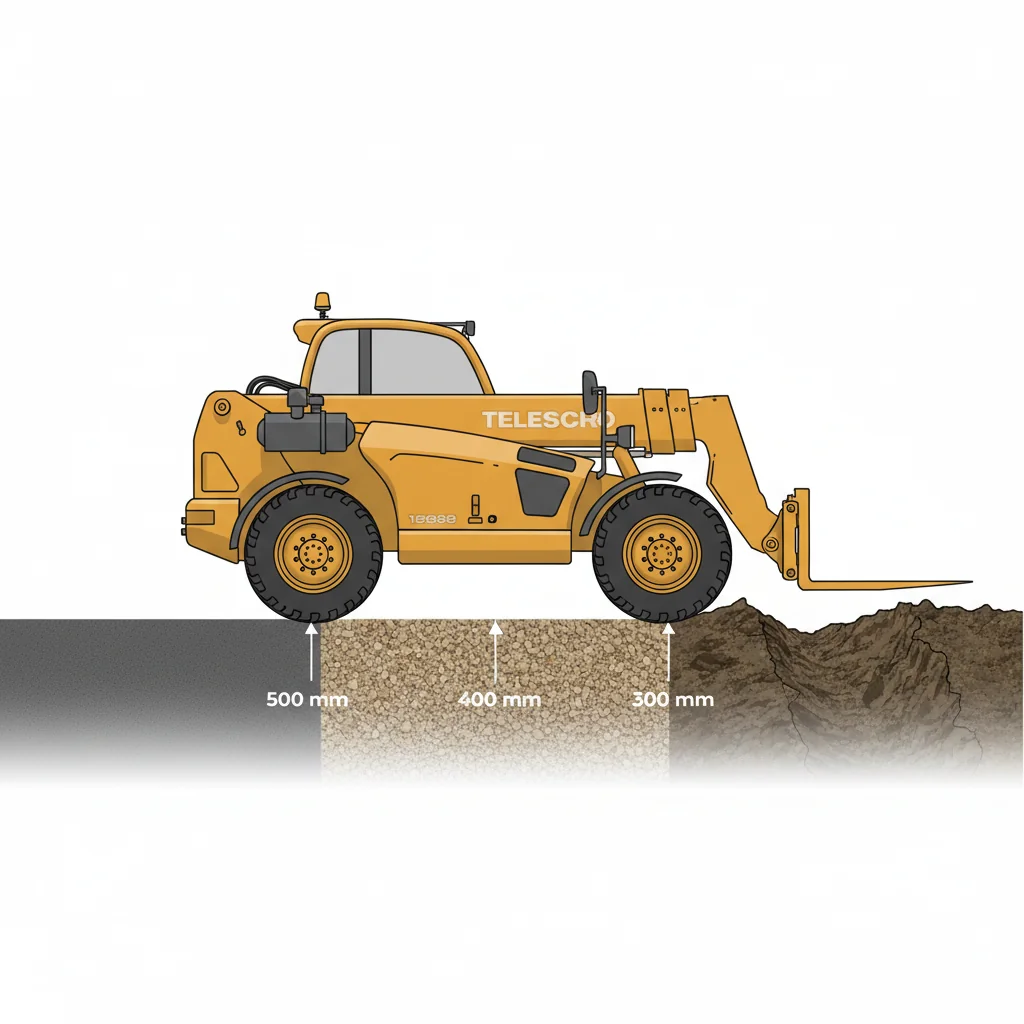
The biggest mistake I see is buyers choosing telehandler ground clearance based on brochure numbers, not their real site. Jobsite conditions vary so much—what works in a new industrial yard in Dubai probably won’t survive the same week on a rural project outside Nairobi. I still remember helping a crew in Kazakhstan who ordered a compact 3-ton telehandler with about 320 mm ground clearance because most of their work was on packed gravel. Then the rainy season hit, and deep ruts turned every delivery into a rescue mission. They ended up stuck twice a day until they switched to a model with around 440 mm clearance and heavy-duty tires—that solved it. Here’s what matters most when checking specs: always verify where and how the clearance is measured. Some brands show clearance at the axle, while others record the lowest point under the belly or between wheels. I’ve seen differences of 40 mm just from that. For mixed-use construction sites or demolition work, I suggest aiming for clearance around 400 mm or more. If you’re facing deep ruts, old concrete, or farm tracks, think upwards of 430 mm. But specs mean nothing if you don’t measure your actual site obstacles—use a simple tape or rod to check ruts, ramps, and slab edges. To be honest, ramp-over angle and wheelbase matter almost as much as clearance. A long machine with high clearance can still get hung up on a sharp ridge or pipe run if it has a big overhang.
Ground clearance on a telehandler affects not just the ability to avoid getting stuck, but also protects crucial components like axles and driveline from debris and terrain damage.True
Ground clearance determines how much space is between the bottom of the telehandler and the ground, so higher clearance means sensitive undercarriage parts are less likely to be impacted by rocks, mud, or obstacles common on uneven jobsites.
Telehandler ground clearance is mainly important for high-speed travel on paved surfaces.False
Ground clearance matters most on rough or uneven terrain where obstacles and ruts are common, not during high-speed movement on flat, paved surfaces where clearance is rarely an issue.
Key takeaway: Ground clearance for telehandlers is not defined by a universal standard. Always assess the worst terrain at the jobsite and verify real-world ruts, ramps, and obstacles with actual measurements before selecting a machine. Reference OEM specs, as clearance varies by model and measuring method.
How Does Ground Clearance Protect Components?
Greater ground clearance safeguards critical telehandler components—such as axle housings, transmission cases, hydraulic lines5, and belly guards—by providing a protective buffer above rocks, debris, and jobsite obstacles. Insufficient clearance leads to regular impacts, bending steps, gouging belly pans, and risking cracks in key mounts, resulting in expensive repairs and extended downtime.
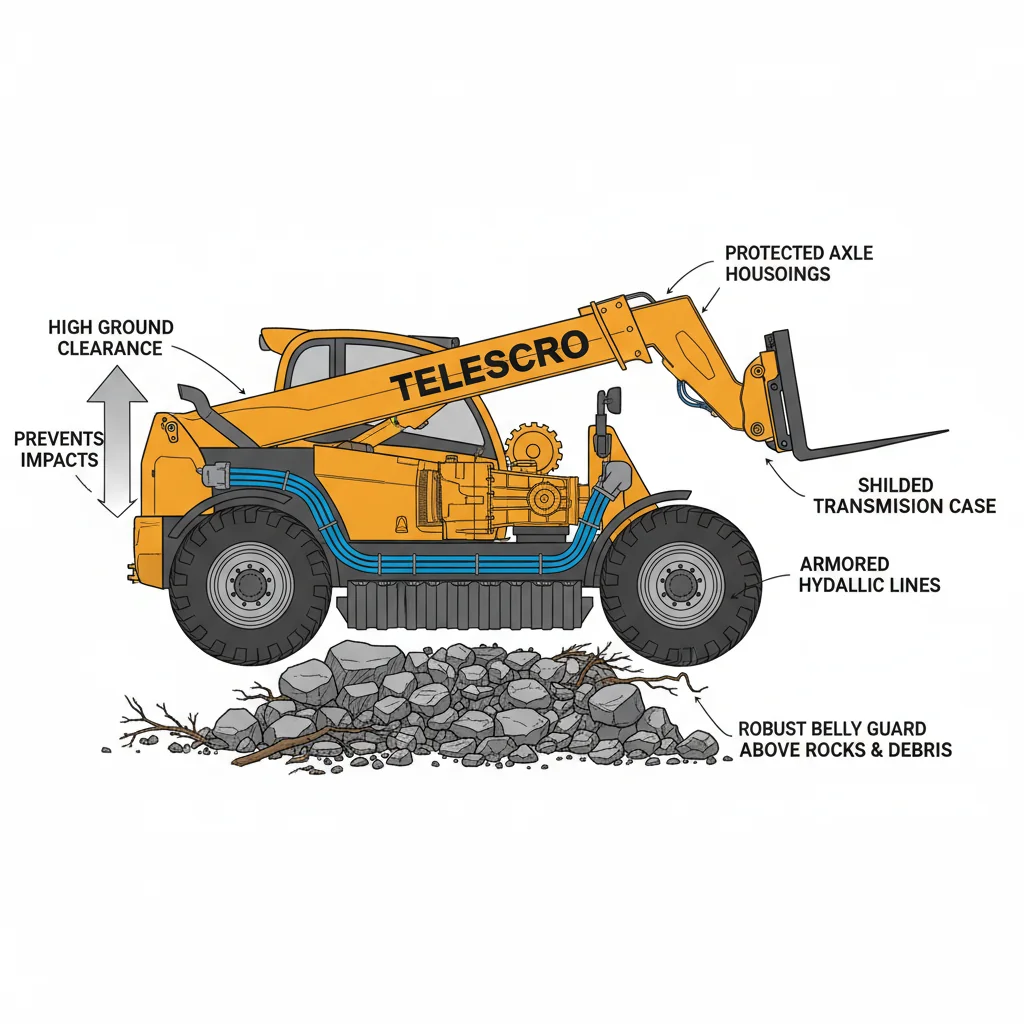
Last month, I got a call from a recycling yard in Malaysia after their 3.5-ton telehandler lost a day’s work. The issue? Rocks and scrap metal wedged against the transmission housing, even though the operator was careful. Their ground clearance was only about 340 mm—typical for standard models, but not enough for such rough conditions. When you’re regularly working over rubble, that extra 50–70 mm of clearance makes a huge difference. It’s not just about “height”—it’s the buffer zone that keeps axle housings, hydraulic lines, and brackets out of harm’s way.
Here’s what really happens when clearance is too low: steps and guards get bent upward, and even a modest impact can start gouging the belly pan. Hydraulic hoses or gearbox mounts positioned lower than the frame will catch wire or debris. In the timber yards I’ve visited in Kazakhstan and Russia, I’ve watched guards deform and bolts loosen after just a couple of months in uneven yards. Once anything starts hanging down, you’ve lost even more clearance—and the risk of further damage increases.
If you’re already hearing scraping or feeling hard bumps under the floor, stop and check your route or the machine spec. Early wear on the belly guard or signs of bolts working loose mean future breakdowns aren’t far away. I always suggest choosing machines with smooth, well-protected undersides and checking actual clearance on site—don’t just trust the brochure number. Protecting vital components up front saves you far more than chasing the lowest price or relying on luck.
Increasing a telehandler’s ground clearance significantly reduces the risk of underbody damage to critical components like the transmission and drive shafts when operating over uneven surfaces.True
Ground clearance serves as a buffer, minimizing the chance that rocks, debris, or scrap will contact and damage vital components positioned along the undercarriage, especially in rough terrain applications.
Ground clearance has no effect on how well a telehandler can navigate over obstacles since all vital components are already housed above the axle line.False
Many critical telehandler components, such as the transmission or hydraulic lines, are located beneath or level with the chassis and axles. If the ground clearance is insufficient, these parts are vulnerable to direct impact from obstacles, so clearance directly affects obstacle navigation and protection.
Key takeaway: Prioritizing adequate ground clearance and a smooth, shielded undercarriage is essential to protect vital telehandler components from damage, reduce maintenance costs, and avoid downtime—especially in rough or debris-heavy environments. Early signs of scraping indicate an under-specified machine or poor site routing and should be addressed immediately.
How Does Load Affect Telehandler Ground Clearance?
Published ground clearance is typically stated for an unloaded machine on firm, level ground with correctly inflated tires. In real operation, clearance can be reduced by tire deflection under load, tire wear, and different tire constructions (e.g., foam-filled or solid options), and it can be further reduced by damaged or deformed undercarriage guards.
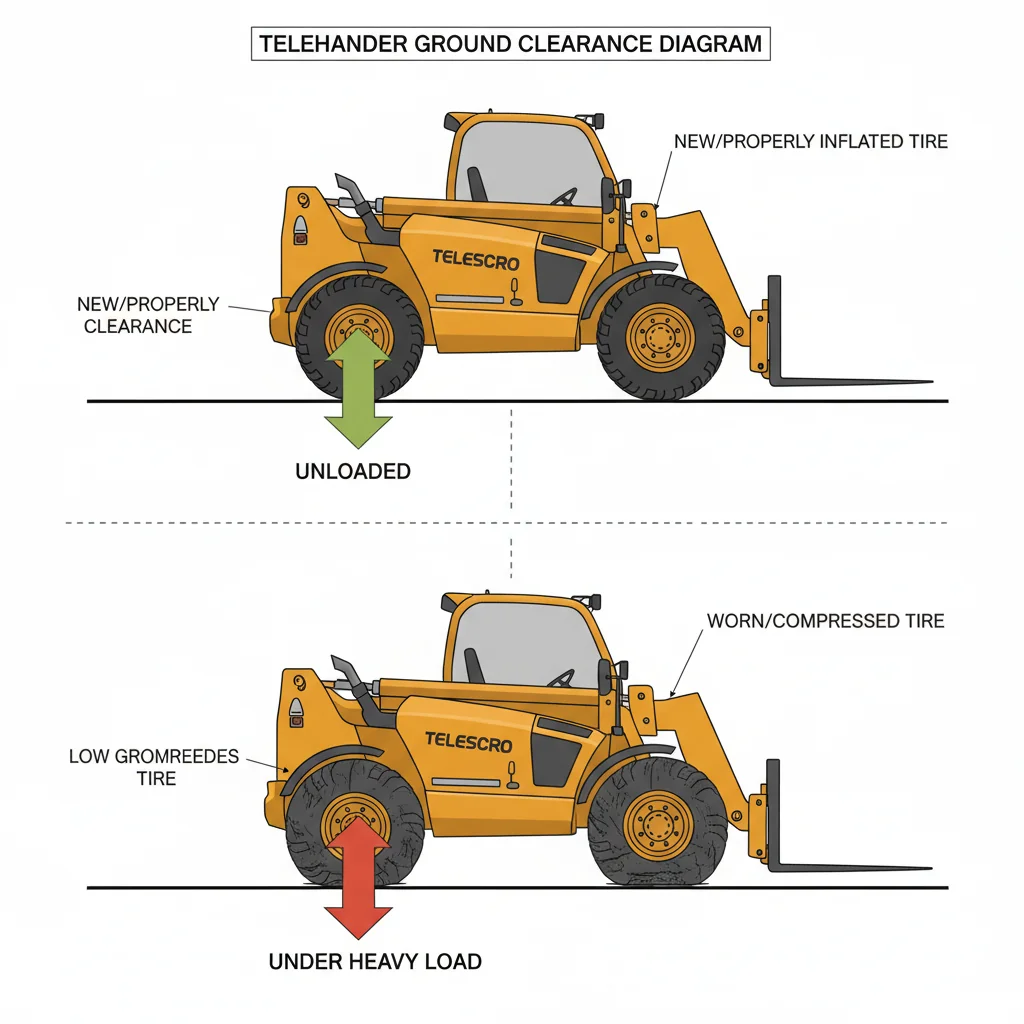
Here’s what matters most when evaluating telehandler ground clearance: the catalog figure only reflects ideal test conditions. That number—often quoted as something like “450 mm clearance”—is typically measured with new, correctly inflated tires, no load, and the machine positioned on level, hard ground. In real operation, especially with a suspended load or on soft surfaces such as mud or gravel, tire deflection alone can reduce effective ground clearance by several centimeters.
I’ve seen this firsthand. On a winter job in Kazakhstan, a 3.5-ton telehandler that met its brochure clearance became stuck simply because worn, under-inflated tires compressed further when lifting moderate concrete blocks, reducing real underbody clearance enough for the belly pan to hang up.
Tire construction also plays a role. Foam-filled or solid tires—commonly used by rental fleets to avoid punctures—often result in a lower effective rolling radius than equivalent pneumatic tires. Combined with tread wear, this can reduce real ground clearance by several tens of millimeters over time. In practice, a machine marketed as “high clearance” may behave very differently after months of hard use, bringing hydraulic lines, guards, or belly plates closer to ground hazards.
For this reason, I always recommend a short pre-shift walk-around, especially on rough ground or agricultural sites. Look for guards, hoses, or brackets hanging below their original design line, as these are common snag points in mud, rubble, or ruts. Maintain correct tire pressures, and when operating in deep mud or loose gravel, select appropriate tread patterns and verify clearance under load—not just when the machine is unloaded. A few minutes spent inspecting the undercarriage can prevent hours of recovery and unplanned downtime.
A fully loaded telehandler can experience a noticeable reduction in ground clearance due to tire deflection, especially when operated on uneven or soft terrain.True
When a telehandler carries a heavy load, the tires compress more, particularly on surfaces like mud or gravel, which reduces the effective ground clearance compared to unloaded measurements on flat, hard surfaces.
The ground clearance specified in a telehandler's catalog remains consistent regardless of load or operating surface.False
The catalog-specified ground clearance is measured under ideal, unloaded conditions, but in practical use, both added load and soft terrain cause tire compression that lowers real ground clearance beneath the machine.
Key takeaway: Real-world telehandler ground clearance is often less than the catalog figure due to load, tire type, wear, and undercarriage condition. Operators should regularly check tires, verify nothing is hanging below design clearance, and choose suitable tires and pressures for rough or muddy sites.
What Are the Trade-Offs of Higher Ground Clearance?
Increasing telehandler ground clearance typically requires taller axles and chassis, which raises the center of gravity and can affect stability. To compensate, manufacturers use wider axles or heavier counterweights6, increasing machine weight and transport width. Higher clearance may also reduce visibility near wheels, demanding careful jobsite operation and OEM-approved configurations.
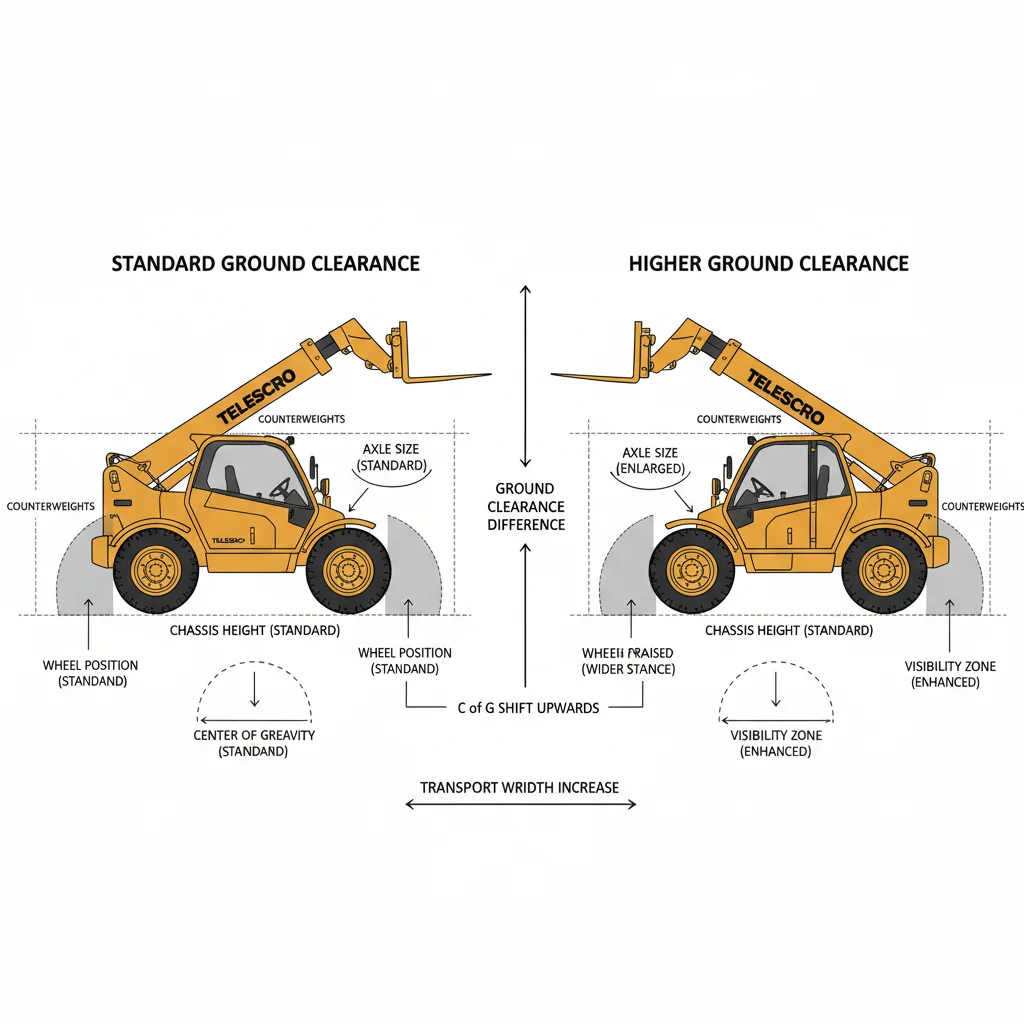
Last week, a customer in Kazakhstan called me after his team struggled with a new high-clearance telehandler on packed gravel. He expected the extra 450 mm clearance to handle site ruts with no issues. But after a few days, he noticed the machine felt “tipsy” on slight side slopes, especially with the boom partially out. That’s a classic trade-off—raising the ground clearance means the axles and chassis sit higher, so the center of gravity goes up. More ground clearance is great for climbing over debris, but stability gets trickier, especially on uneven sites.
Manufacturers compensate with wider axles or heavier counterweights. I’ve seen standard 3.5-ton machines gain almost 400 kg and 200 mm more transport width just to balance extra clearance. The downside? Extra weight adds fuel burn and may limit road transport options. I tell buyers in markets like Kenya or Brazil to check local road regulations, since wide axles can make movement between sites much harder. Visibility can also be affected—taller chassis and bigger wheels create blind spots right around the steps and under the boom. On busy jobsites with foot traffic, that can be a serious hazard if you’re not careful.
The temptation to “lift” the machine by fitting bigger tires or home-made spacers comes up a lot. I always advise sticking to OEM-approved configurations and checking the load chart for your specific model and setup. Aftermarket mods can throw off moment indicators and may invalidate your safety certification or insurance. My advice? Choose the right ground clearance up front, match it to your terrain, and operate within the rated charts. That’s how you avoid the second-year surprise.
Increasing a telehandler's ground clearance can negatively impact its lateral stability, especially on uneven sites, due to the raised center of gravity.True
A higher ground clearance lifts the entire chassis, which results in a higher center of gravity. This makes the machine more susceptible to tipping, particularly when traversing side slopes or extending the boom.
Higher ground clearance always improves lifting capacity because it enables the telehandler to handle heavier loads on rough terrain.False
Lifting capacity is primarily determined by factors like boom geometry, hydraulic system strength, and chassis design. Increased ground clearance does not increase load limits and can sometimes reduce stability, especially when carrying loads at height or on inclines.
Key takeaway: Higher ground clearance improves off-road ability but comes with trade-offs in stability, cost, transport width, and operator visibility. Avoid aftermarket modifications; always select an OEM-approved configuration for safety and compliance, operating within the load chart and intended terrain assumptions of the machine.
Does Ground Clearance Replace Site Assessment?
Telehandler ground clearance helps avoid striking surface obstacles, but it does not reinforce weak or unstable ground. Safety standards and rated capacities assume firm, level surfaces that support machine weight without excessive sinking. Proper ground assessment—checking bearing capacity7, avoiding soft or compromised areas—remains essential to prevent bogging, tipping, or ground failure.
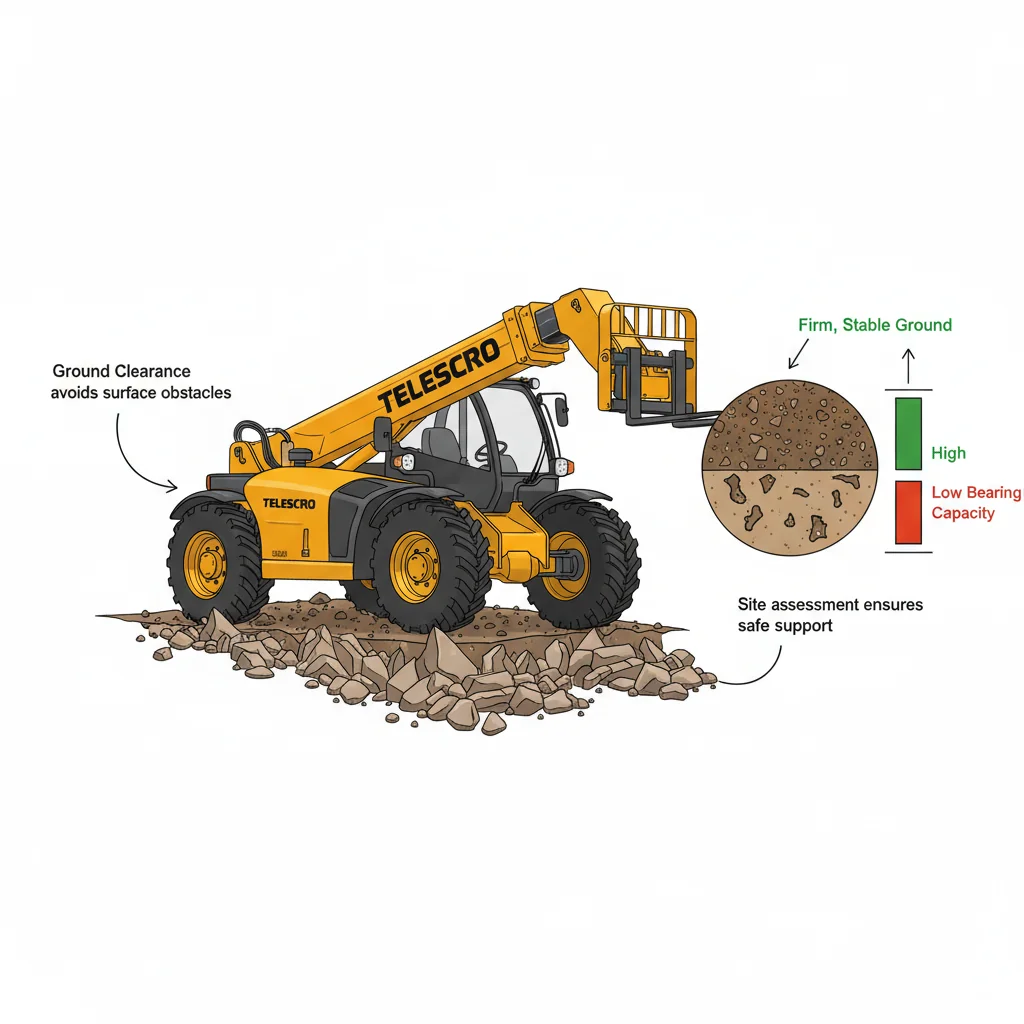
Last winter, I got a call from a site manager in Denmark who’d just taken delivery of a 4-ton compact telehandler with ground clearance around 410 mm. His crew tried crossing a soft, rain-soaked utility trench—hoping the clearance would keep the undercarriage safe. Instead, the front wheels sank right up to the axles, and it took their team half a day to recover the machine. The manager was surprised. He thought ground clearance alone would get them over soft spots. This is a common misconception I see—especially on jobsites with both paved and unprepared areas.
The reality is, ground clearance helps avoid hitting rocks, debris, or curbs, but it won’t keep you out of trouble if the surface underneath can’t hold the load. Telehandlers—even rough-terrain models—are rated assuming firm, level ground. For example, an industry-standard 4,000 kg unit with a 14-meter reach can put over 6,500 kg wheel load onto soft ground when loaded. If you drive that near newly backfilled trench edges or above old manhole covers, it’s easy to break through or tip unexpectedly. I’ve seen this happen twice—once in Dubai on sandy fill, and once, surprisingly, on a farm in Inner Mongolia near a silage clamp.
So, I always suggest: before moving a loaded telehandler, inspect bearing capacity—especially near excavations or utilities. If the ground feels soft or shows tire ruts, lay matting or build a simple haul road first. Never let high ground clearance give a false sense of security. The real safeguard is proper ground assessment, not just relying on spec sheets. That’s the difference between safe operations and a costly recovery call.
High ground clearance on a telehandler helps protect critical components from direct contact with obstacles, but it does not prevent the wheels from sinking in soft or unstable surfaces.True
Ground clearance refers to the vertical distance between the lowest part of the telehandler's chassis and the ground, reducing the chance of undercarriage contact with objects. However, it has no effect on the load distribution or flotation of the tires, which determines whether the machine will sink in soft ground.
If a telehandler has more ground clearance, it automatically means it can safely traverse any ground condition, including soft or marshy terrain.False
Ground clearance does not determine a machine’s ability to cross soft or loose surfaces. The risk of getting stuck in such conditions depends on factors like tire type, weight distribution, and soil bearing capacity, not simply on how high the chassis is raised above the ground.
Key takeaway: High ground clearance supports obstacle avoidance but cannot compensate for weak or improperly prepared surfaces. Always conduct thorough ground assessments and, when necessary, use suitable matting or haul roads to ensure telehandler safety and stability, particularly near excavations, utilities, or soft ground.
How Does Ground Clearance Differ on Telehandlers?
Ground clearance is a distinct specification for telehandlers, separate from lift height, reach, or overall size. A compact telehandler can offer high ground clearance, while a large model may have moderate clearance. Rated capacity and maximum lift height do not indicate the machine’s ability to traverse uneven or rough terrain safely.
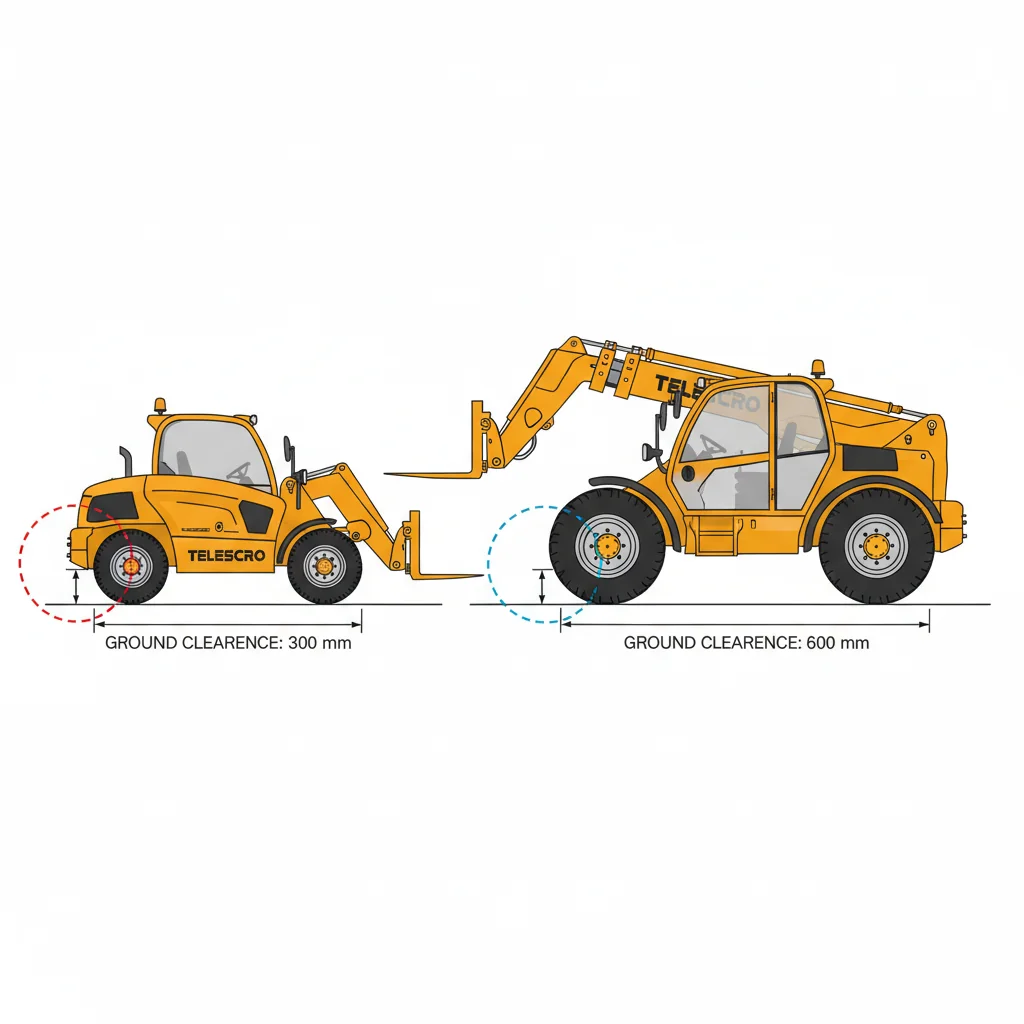
Last month, a contractor in Poland asked me why his high-reach telehandler kept getting stuck on a deeply rutted site. On paper, the machine looked ideal: a 17-meter model, strong lifting capacity, and large tires. In reality, its underbody clearance was only about 370 mm. His previous compact telehandler, with similar tire size but a different chassis layout, offered nearly 430 mm of ground clearance and handled the muddy terrain far better—despite having only half the lift height.
This highlights a critical detail many buyers miss: ground clearance is not directly linked to lift height or rated capacity. A compact 2.5-ton telehandler can provide close to 400 mm of clearance, making it well suited to bumpy sites, curbs, and uneven access routes. Conversely, some large high-reach machines prioritize boom length, axle loading, and forward stability, trading off underbody height to maintain a lower center of gravity.
I’ve seen contractors in Kenya and Australia frustrated when a so-called “big machine” bottoms out on debris or uneven ground simply because they assumed bigger meant higher. It doesn’t. When comparing spec sheets, ground clearance should be treated as a separate decision factor—just like load charts or maximum forward reach. And while masted rough-terrain forklifts may appear stable or cost-effective for pallet work on hard, level surfaces, their underbody clearance is typically much lower than that of a standard telehandler.
Telehandlers with larger tires do not always have higher ground clearance; the underbody design and axle configuration can result in lower clearance even with big tires.True
Ground clearance is determined by the lowest point of the machine, often the axles, differential, or chassis, not just by tire diameter. Some high-reach or heavy-duty designs prioritize stability or lifting performance over max ground clearance, resulting in lower underbody height despite larger tires.
Telehandlers with higher lift capacities are always designed with the maximum possible ground clearance to ensure they can work in the roughest conditions.False
While lift capacity and ground clearance are both important, they are not directly linked. Manufacturers often reduce ground clearance on high-capacity or long-reach models to improve stability and lower the center of gravity. As a result, some high-capacity models have less ground clearance than smaller, more compact telehandlers.
Key takeaway: Ground clearance must be considered independently from lift height, reach, and lifting capacity when selecting a telehandler. Always review ground clearance as a separate specification, especially when comparing telehandlers to masted rough-terrain forklifts or evaluating underbody suitability for demanding jobsites.
How Does Ground Clearance Affect Site Productivity?
Telehandler ground clearance determines which on-site routes are accessible and how efficiently material can move between key areas. Higher clearance allows machines to cross uneven terrain, ruts, or ramp transitions directly, minimizing detours. Low-clearance models risk route restrictions, increased travel distances, fuel consumption, and potential downtime due to stoppages or machine hang-ups.
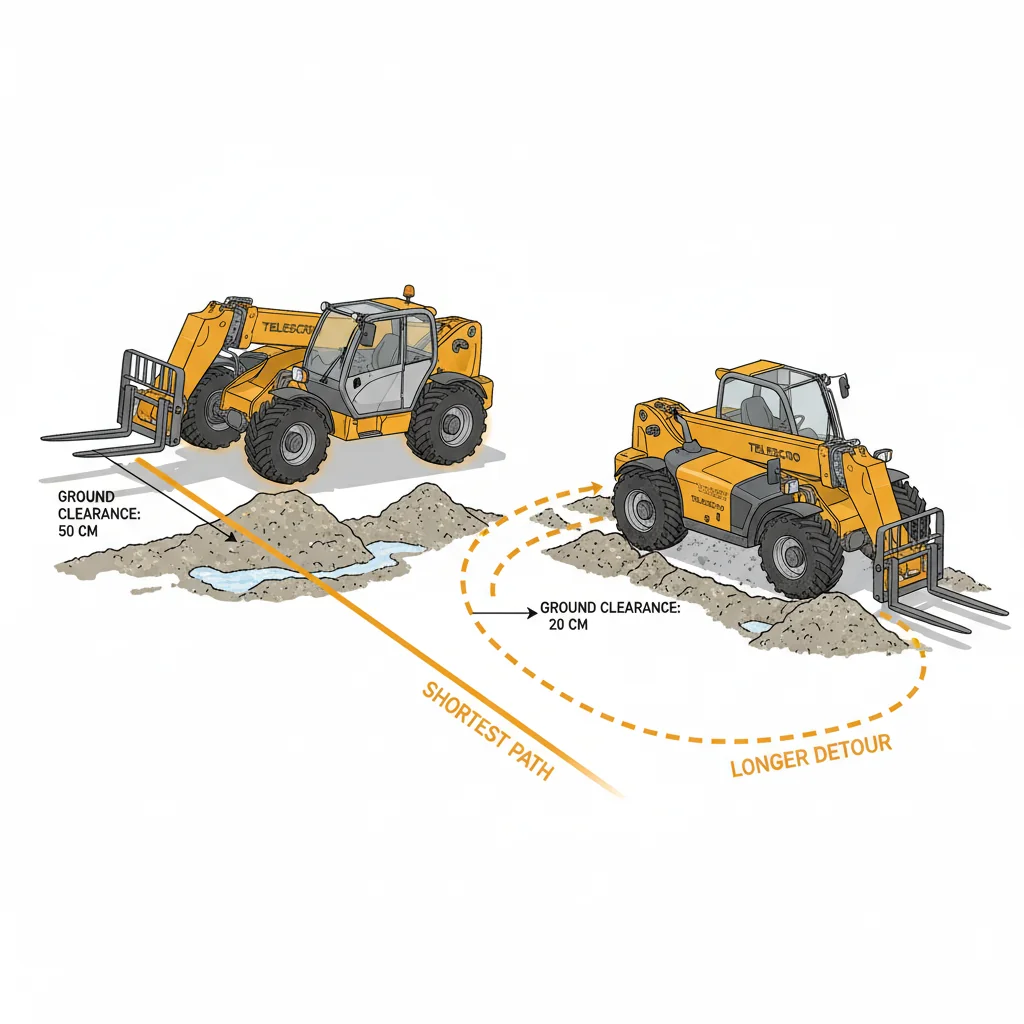
To be honest, the spec that actually matters is how your telehandler handles the roughest parts of your site—not just the smooth haul road you see at the entrance. Last year, a contractor in western Kenya tried to save budget with a model that had ground clearance around 340 mm. It looked fine on level concrete, but once rains hit, deep tire ruts and uneven ramp transitions turned routine trips into detours. Their team lost nearly two hours per shift because the telehandler had to backtrack to the only graded path. That extra fuel and time added up fast.
I’ve seen this in northern Kazakhstan as well, where clay and gravel surfaces shift weekly. Machines with 400 mm or more clearance could take the direct route over timber mats and spoil piles, while lower-profile models waited each time for loaders to fill potholes or clear debris. Fewer routes cause congestion, especially in the morning rush when everyone needs materials delivered at once. Every missed delivery window means workers stand by, which eats into real productivity—not just machine stats.
The real risk shows up when a telehandler bottoms out—axle hung up, tire caught, or hydraulic hoses at risk. I’ve helped crews in Brazil recover machines stuck mid-delivery, with two mechanics and a loader just to free the undercarriage. That’s half a day lost, plus unexpected repair cost. I always suggest verifying the worst crossing on your site and matching your clearance to that point. It’s usually cheaper to invest in a high-clearance model than to fix site access every month.
A telehandler with insufficient ground clearance is more likely to suffer undercarriage damage and experience drivetrain strain when crossing deep ruts or uneven terrain, which can lead to increased downtime.True
When ground clearance is too low, components like axles, drive shafts, and hydraulic lines are at greater risk of impact or being snagged on uneven surfaces, causing mechanical failures that disrupt workflow.
Increasing ground clearance always reduces the risk of tip-over accidents on job sites, regardless of other telehandler specifications.False
While ground clearance helps avoid obstacles and uneven surfaces, excessive clearance can raise the machine's center of gravity, potentially making it less stable, especially when handling heavy loads at height. Stability involves multiple factors such as axle width, boom extension, and load handling, not ground clearance alone.
Key takeaway: Matching telehandler ground clearance to the most challenging site conditions—rather than average ones—can improve material flow efficiency, save time, and prevent costly downtime. Investing in suitable clearance often proves more cost-effective than frequently modifying or maintaining site access routes.
How to Verify Telehandler Ground Clearance Onsite?
To verify ground clearance onsite, measure at multiple low points (e.g., axle housings, transmission area, belly pan/guards) and compare with the OEM’s stated measurement location. Simple gauge blocks (such as a known-height timber) can be used as a quick check, but a tape measurement at the OEM reference point is the most reliable comparison.

One question I get a lot is: how do you know the real ground clearance, not just what the brochure says? Specs might give you a number—say, “430 mm at the axle”—but onsite, modifications can change everything. I often tell buyers in Dubai or Vietnam to grab a 300 mm or 400 mm timber block and physically slide it under the lowest machine points—the axle housings, transmission, and especially the belly pan. If the block catches, your actual clearance is less than advertised. It’s a simple trick, but it’s saved clients a lot of hassle, especially on jobsites where uneven ground or debris is common.
Let me share a case from Kenya. A contractor swapped out tires for foam-filled types on a 4-ton, 13-meter reach telehandler—expecting similar underbody clearance. When I visited the site, we found the center belly pan now sat almost 25 mm lower than before, just by sliding a block underneath. This could’ve gone unnoticed until a ramp crossing caused damage mid-project. That’s why I always suggest rechecking clearance after any repair, new tire, or if belly guards have been installed. Even two identical machines in your fleet might measure differently after a few years of hard work.
If you’re planning to cross ramps, curbs, or rough areas, I advise measuring your most difficult onsite obstacle—height and width. Bring the dealer for a demo run, and test your telehandler over that section. Don’t rely on demo yard conditions. A block test takes five minutes and can prevent costly surprises. It’s a habit worth building into your maintenance routine.
The actual ground clearance of a telehandler may be reduced onsite by factors such as after-market belly guards or different tire profiles, even if the original specs indicate otherwise.True
Many telehandlers are modified after delivery, for example with protective belly pans or non-standard tires, which can lower ground clearance below what the manufacturer states. Hands-on checks are vital to identify these changes.
Measuring the ground clearance at only one point, such as the rear axle, guarantees that the entire undercarriage has at least that much clearance.False
The lowest ground clearance might occur at different undercarriage locations, like belly pans or transmission housings, not just the axles. Measuring only one point can overlook lower spots elsewhere, leading to inaccurate assumptions.
Key takeaway: Relying on brochure ground clearance figures is insufficient. Onsite measurement using standardized blocks under critical low points ensures real-world confirmation. This check is vital after any equipment modification, repair, or tire change, particularly for mixed or older fleets where actual clearance may differ from specifications.
When Is High Ground Clearance Unnecessary?
High ground clearance is less critical when a telehandler operates primarily on flat, hard, prepared surfaces, such as paved yards or concrete slabs. In these environments, models with 300–350 mm clearance offer sufficient performance and can provide improved chassis stability and visibility for precise load handling.

A lot of buyers ask if bigger ground clearance means better performance, but that’s not always true. If you’re mainly working on paved yards, concrete slabs, or well-graded gravel, high clearance—say over 400 mm—doesn’t deliver much benefit. I’ve seen this on commercial sites in Dubai, where 300–350 mm clearance is all they need, even on busy distribution centers. Lower chassis often mean a steadier machine when you’re picking and placing pallets all day. I’ve had operators tell me that they feel safer, and the visibility over the engine hood can make inching up to tight stacks much easier.
Take a project I handled in Singapore. The customer ran a 3.5-ton, 12-meter telehandler with about 320 mm clearance purely indoors and on smooth outdoor slabs. Their main concern was speed and maneuverability, not hopping curbs or crossing deep ruts. The lower ground clearance actually helped—less rocking when carrying sensitive electrical equipment and better stability for stacking to the max height. On these types of sites, you’ll get more value by focusing on turning radius8, rated capacity at full reach, and support for attachments like work platforms or buckets.
But here’s the thing—be completely honest about “mostly flat.” One client in Brazil switched to a low-clearance model and instantly had trouble as soon as expansion work moved onto rougher subgrade at the yard’s edge. Even if just 10% of your travel includes potholes or unpaved ground, that’s enough to justify a mid-range option around 380–420 mm. I always tell customers: match clearance to the worst-case spot, not the average. It saves headaches later.
Key takeaway: For telehandlers working mostly on paved or well-graded sites, extreme ground clearance adds limited value. Instead, focus on maneuverability, rated capacity, reach, and compatible attachments. Still, ensure clearance matches any occasional rough-terrain use by verifying actual jobsite requirements.
Conclusion
We’ve looked at what ground clearance on a telehandler actually means and why that specific spec matters for real jobsite mobility—not just what looks good in a brochure. From my experience, it’s easy to get sidetracked by big numbers, but the “minimum ground clearance” figure is what truly decides if your machine can handle ruts, rocks, or debris on-site. Don’t let showroom hero specs turn into jobsite zero surprises. If you’re trying to pick the right model or not sure how much clearance you really need, feel free to reach out—I’ve helped crews in over 20 countries adapt to all sorts of terrain. Every site is different—choose for practical workflow, not just paper stats.
References
-
Understand the challenges uneven terrain presents for telehandlers and how appropriate ground clearance reduces downtime and fuel costs. ↩
-
Understand why rated capacity alone doesn’t reflect terrain handling, highlighting key factors for safe operation on uneven sites. ↩
-
Detailed analysis of stability, weight increase, and operational challenges caused by higher ground clearance on telehandlers. ↩
-
Explains the critical role of rough-terrain tires in improving telehandler mobility and durability in challenging environments. ↩
-
Details the risks to hydraulic lines from low clearance and debris, and how proper protection ensures reliability and safety on rough jobsites. ↩
-
Explains how heavier counterweights balance telehandler stability and their impact on fuel use and transport logistics. ↩
-
Details the critical role of ground bearing capacity in safe telehandler operation and preventing tipping or sinking on site. ↩
-
Details how turning radius improves telehandler maneuverability on tight job sites, enhancing operational efficiency and safety. ↩