











Telehandler Fuel Consumption: Field Insights to Avoid Costly Mistakes
A site manager from Brazil once showed me two almost identical jobs—one using a 17-meter telehandler, the other a 7-meter. He couldn’t believe how much fuel the bigger one guzzled just moving empty pallets. Too many fleets fall into that trap without realizing where the cost creeps in.
Telehandlers don’t inherently “guzzle fuel.” In the field, operating efficiency is mainly driven by machine class (reach/capacity and weight), powertrain & hydraulic specification, and—most importantly—the duty profile (idle share, travel distance, lift intensity, attachment use). Hourly fuel burn can vary widely even on the same model, so the safest way to benchmark is to compare OEM/standardized test figures or your own telematics under comparable work cycles. As a practical reference only, compact 6–7 m agricultural/yard handlers often fall in the single-digit to low-teens L/h range depending on cycle; mainstream 7 m / 3–3.5 t construction handlers can move from mid-single-digit to mid-teens L/h as hydraulic intensity and site travel rise; and 17–20 m, 4–5 t high-reach units in sustained heavy lifting typically sit in the mid-teens and can climb above that in high-demand cycles.
Do Telehandlers Consume Excessive Fuel?
Telehandler fuel consumption is not inherently high; it depends on machine class, specification, and—most critically—the duty cycle1 under which the machine is operated. Hourly fuel use can vary significantly even on the same model, depending on idle time, travel distance, lift intensity, and hydraulic demand. As a practical field reference rather than a fixed benchmark, compact 6–7 m farm or yard telehandlers are often seen operating from the high single digits into the low-teens L/h across typical cycles, while large 17–20 m, 4–5 t high-reach units engaged in sustained heavy lifting commonly run in the mid-teens and can climb higher in demanding applications. For meaningful cost comparison, fuel consumption should be evaluated per unit of work completed—not simply liters per hour.

Most people don’t realize that telehandler fuel consumption isn’t just about the engine size or machine weight. It’s mainly driven by the tasks you’re doing—how much you lift, how far you move it, and how much time you spend idling. For example, a 7-meter, 3.5-ton telehandler in a warehouse in Dubai clocked around 9 liters per hour when used for steady pallet stacking. That same machine climbed to nearly 14 liters per hour moving heavy precast sections outdoors with a lot of hydraulic functions running.
Last year, I worked with a farm in southern Brazil comparing a compact 6-meter handler to a larger 17-meter, 4.5-ton machine for hay loading. The smaller unit averaged about 7 liters per hour, while the bigger one hit 18-20 liters during peak loading times. But here’s the thing—when we measured fuel used per ton of hay moved, the 17-meter unit actually came out ahead. It finished the job much faster, with fewer trips, so the cost per ton was lower overall. That’s why I always tell customers: don’t just look at liters per hour, check liters per unit of work.
If you want the real picture, ask your supplier for telematics records—fuel consumption, idle time, and actual output on similar jobs. Too many buyers fall for the “headline” fuel spec and miss how the duty cycle or attachment type flips the equation. I suggest comparing at least two machines on your target site if you can. That’s where efficiency really shows up.
Telehandler fuel consumption can increase significantly during tasks requiring extensive hydraulic use, such as frequent boom movements and attachments operation.True
Hydraulic systems place extra demand on the engine, causing higher fuel use when operated intensively, which is often overlooked compared to load or travel distance.
Telehandlers with larger engines will always consume more fuel than smaller-engine models, regardless of the application.False
Fuel usage depends more on duty cycle, operator behavior, and hydraulic workload than simply engine size; a smaller-engine telehandler used inefficiently can sometimes consume more fuel than a larger one used efficiently.
Key takeaway: Telehandler fuel use varies by job and machine type. Buyers should compare real-world fuel consumption per unit of output, not just liters per hour. Request telematics data to assess efficiency for specific applications, avoiding mistakes based solely on headline figures.
How Does Right-Sizing Cut Telehandler Fuel Use?
Oversized telehandlers2 often lead to unnecessary fuel use when they are routinely operated well below their rated reach and capacity. In real-world fleet data, larger high-reach machines commonly show higher hourly fuel consumption than right-sized models under light or moderate duty cycles, due to greater machine mass, higher baseline engine load, and hydraulic systems designed for peak performance. In many projects, the majority of daily lifts remain within moderate height and capacity ranges, yet fleets frequently default to 17–18 m, 4–5 t machines for flexibility—resulting in avoidable fuel cost increases when those capabilities are rarely utilized.
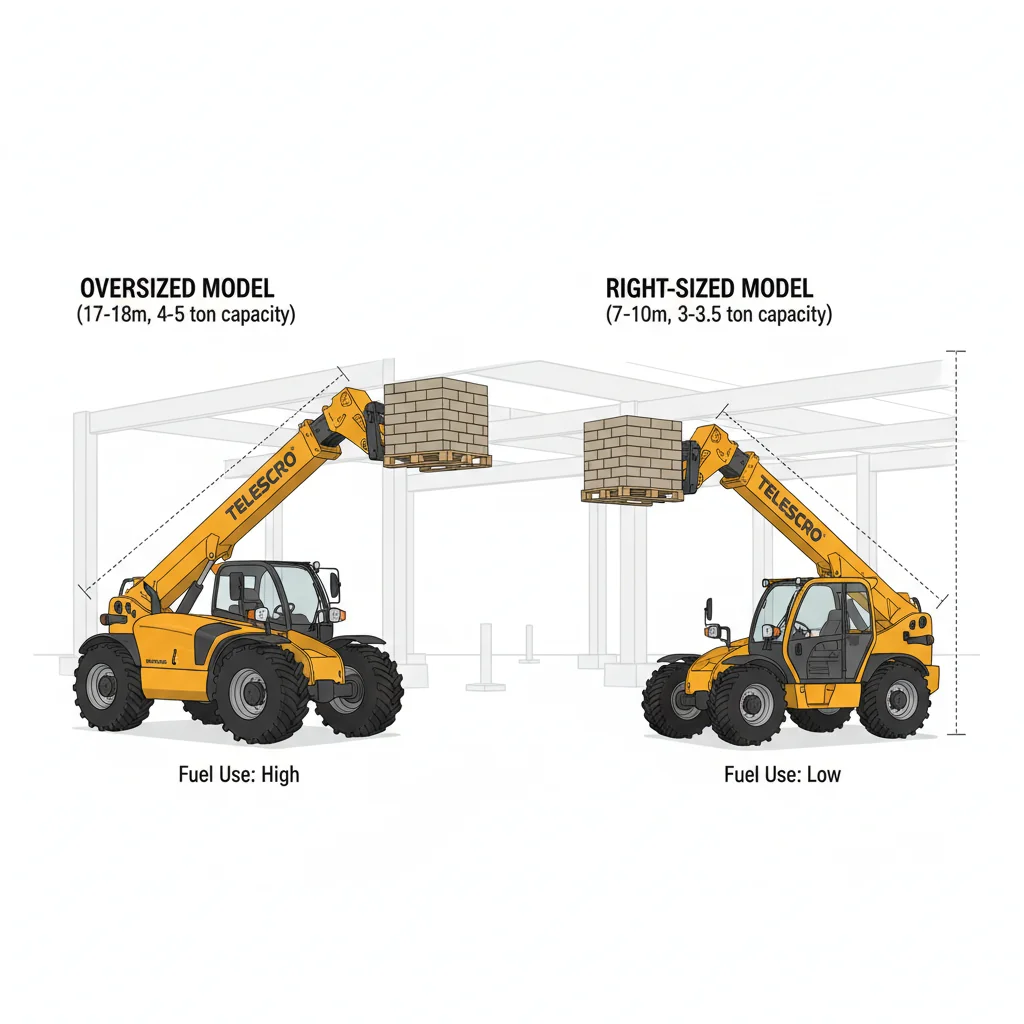
Let me share something important about telehandler sizing that I see overlooked on jobsites. Oversizing isn’t just about extra upfront cost—it drains fuel budget fast. Last year, a client in Dubai called me surprised how their 18-meter, 4-ton telehandler guzzled fuel even on light work. When we tracked their tasks, over 80% stayed below 8 meters and 3 tons. That big machine simply never ran near its real limits—the engine and hydraulics ran less efficiently, burning around 4 liters more diesel per hour than needed.
Here’s what actually drives up unnecessary fuel use with oversized telehandlers:
- Heavier base machine – More weight means the engine works harder to move and stabilize, even with basic tasks.
- Large displacement engines – Sizing for max capacity uses more fuel, especially at lower loads.
- Inefficient hydraulic circuits3 – Systems sized for extreme reach lose efficiency when running lighter cycles.
- Frequent idling – Operators often leave big machines running “just in case,” which amplifies waste.
I’ve seen this pattern repeat in places like Kenya and Kazakhstan—fleets defaulting to high-reach models for every site. The reality is, picking a compact 3-ton, 10-meter handler would have met 90% of needs and cut annual fuel spend by at least $6,000 per machine.
My advice? Before buying or renting, log actual lifts: height, weight, reach, attachment. Then choose a model that fits 95% of your tasks, leaving a small margin. That simple adjustment can save real money without limiting your capability.
Selecting a telehandler with lift height and capacity closely matched to actual job demands helps engines and hydraulics operate closer to optimal efficiency, reducing unnecessary fuel consumption.True
When telehandlers are consistently used below their rated capacity, their engines and hydraulic systems may run at suboptimal loads, which can lead to increased fuel use compared to operating a machine that's appropriately sized for the work.
Using a telehandler with much higher capacity or reach than necessary always results in lower fuel consumption because it requires less effort to complete simple tasks.False
Oversized telehandlers often have larger engines and more robust hydraulics that consume more fuel, even when performing light jobs. This means using a bigger machine for small tasks can actually increase, not decrease, fuel use.
Key takeaway: Selecting a telehandler aligned with typical lift height and rated capacity needs can reduce fuel consumption dramatically—saving $5,400–$10,800 annually for each machine. Logging actual task requirements before purchase or rental ensures the chosen model cuts hidden fuel waste without limiting operational capability.
Should Fuel Use Be Measured Per Job?
Evaluating telehandler fuel consumption solely by liters per hour is misleading. For accurate assessment, fuel use should be measured per job, tonne, or cubic meter handled. A telehandler may consume more per hour but often replaces multiple machines, reducing total fuel use and increasing material moved per unit of fuel.
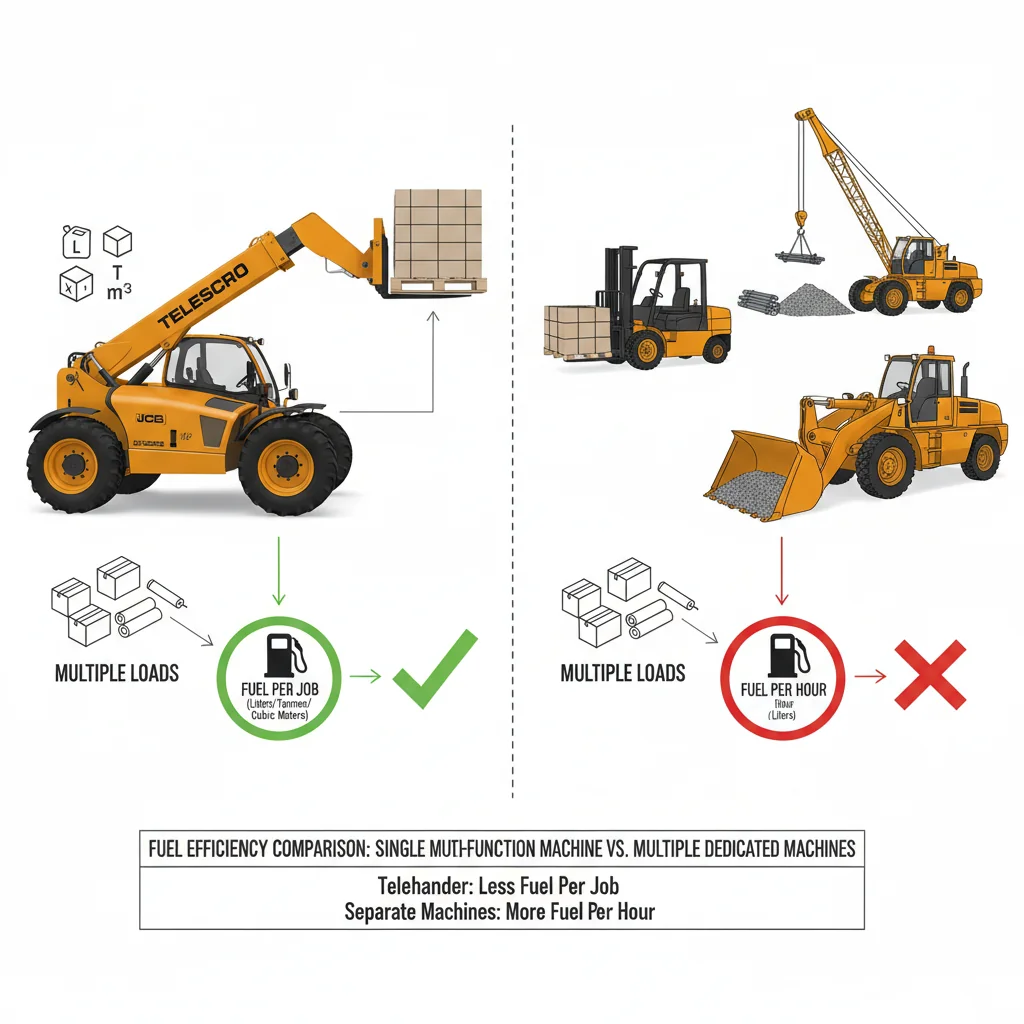
The biggest mistake I see is judging fuel use by liters per hour without looking at the scope of work the machine actually does. I had a customer in Kenya last year who compared a 3.5-ton telehandler—averaging around 12 liters per hour—to a 3-ton forklift that used under 4 liters per hour. On paper, the forklift looked more efficient. But the telehandler moved roof trusses to 11 meters, unloaded bricks straight onto upper floors, and picked scrap with a bucket—jobs the forklift couldn’t touch. With just one engine running, they ditched the need for a crane and a manlift. Their total fuel use dropped by at least 25% across the project.
Here’s what matters most when you really want to track telehandler efficiency:
- Fuel per tonne lifted4 – Higher hourly use can be misleading. What matters is liters consumed for every tonne moved.
- Material moved per cubic meter – Track how much material is placed or relocated per liter. I’ve seen a 12-meter telehandler move 38% more material than a similarly sized wheel loader, yet burned 58% less fuel per cubic meter handled.
- Total machines replaced – One well-matched telehandler often replaces two or three specialized machines, slashing idle time and doubling productivity per drop of fuel.
- Real jobsite conditions – Include waiting, setup, and repositioning. All those engine hours matter for the final calculation.
I always suggest asking, “How much finished work did we get per tank?” instead of “How many liters an hour does it burn?” That’s how you’ll see the real savings.
Measuring telehandler fuel use per job task rather than per operating hour gives a more accurate picture of productivity and efficiency.True
Telehandlers often perform tasks that would otherwise require multiple machines or manual labor, so evaluating their fuel consumption in relation to the actual work completed reveals their operational efficiency more effectively than using only an hourly rate.
Telehandlers of similar size always consume less fuel than forklifts on any project because they are designed for higher efficiency.False
Telehandlers are built for versatility and reach, not necessarily for energy efficiency. Their specialized hydraulic systems, heavier build, and task complexity often mean higher fuel consumption compared to simpler forklifts when judged by fuel per hour.
Key takeaway: Focus on fuel consumption per task—such as per tonne or cubic meter moved—instead of just liters per hour. This approach gives a true picture of a telehandler’s real-world operating efficiency and highlights cost savings from replacing multiple machines with a single versatile unit.
How Much Do Telehandlers Spend on Fuel?
Fuel is one of the largest components of a telehandler’s total operating cost and, in many fleets, represents roughly around one-third of lifetime ownership expenses, depending on annual hours, fuel price, and duty cycle. For a typical 7–10 m machine operating about 1,500 hours per year, annual fuel expenses5 can easily reach five-figure levels under real jobsite conditions, especially where idle time and hydraulic demand are high. Over the service life of the machine, even modest differences in fuel efficiency can materially impact profitability—particularly for rental fleets that track costs on a per-hour or per-project basis.
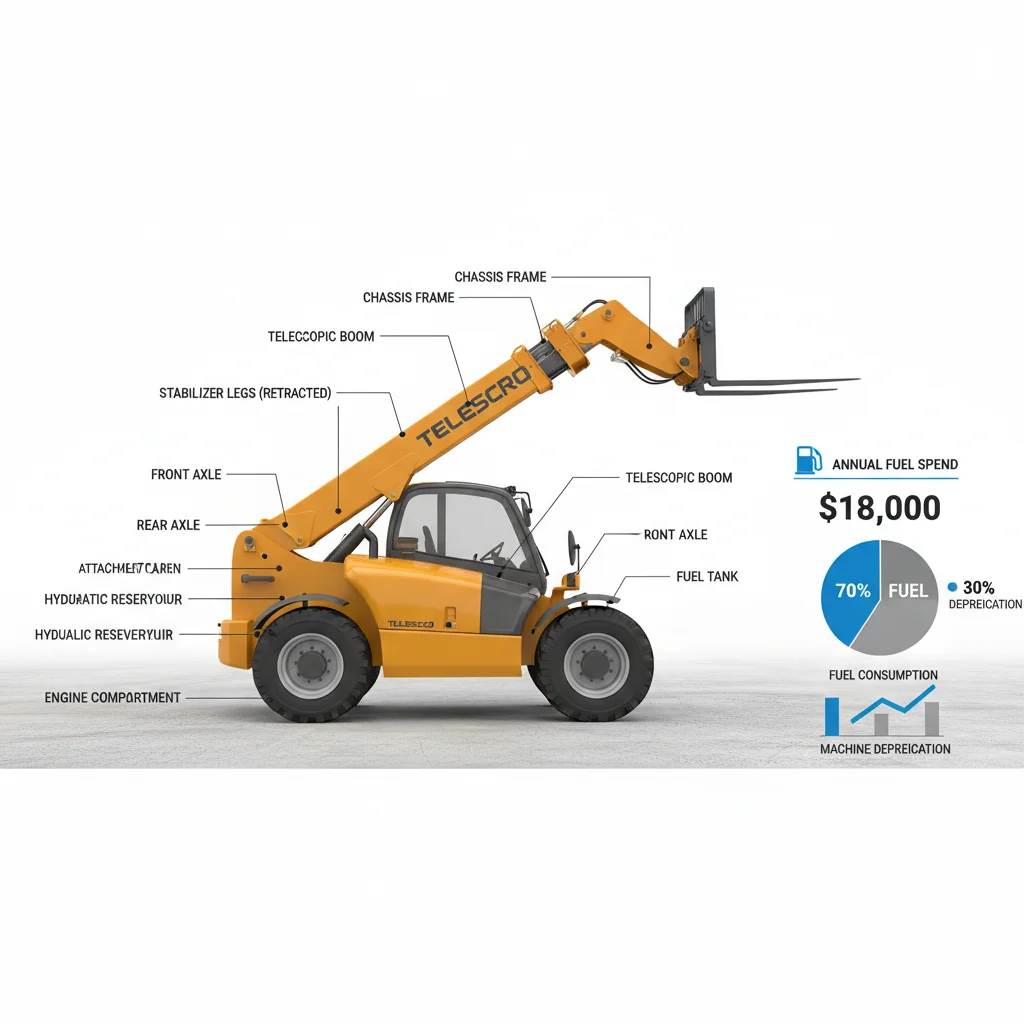
To be honest, the spec that actually matters is how much fuel the machine burns per hour—too many buyers overlook this. A few years ago, I worked with a rental company in Dubai running a fleet of 7-meter telehandlers on high-rise sites. They called me complaining their fuel bills rivaled the monthly lease payments. We reviewed their telematics data and found several units were averaging over 11 liters per hour, with annual fuel costs around $20,000 per machine. Most of that money was just disappearing into the exhaust pipe—profit margins took a real hit.
I’ve seen this pattern in Kenya and Brazil, too. Contractors often focus on initial price or lift capacity, but when you multiply yearly fuel by five years, a “cheap” model can cost more than a premium low-consumption one. Think about a 10-meter unit running 1,500 hours yearly: even a 2-liter-per-hour difference means about $3,600 extra every year, assuming diesel is $1.2 per liter. Over the full service life, that’s enough to buy a second machine or upgrade key attachments.
Here’s what matters most when choosing a telehandler: always ask for real-world fuel consumption, not just brochure numbers. The best way is to review telematics data from actual jobsites with similar loading and idle patterns. I suggest including those numbers in your total cost calculations before signing any order. Even if a fuel-efficient machine costs a bit more up front, the savings become obvious by year two. Fuel isn’t a side expense—it shapes your entire ownership cost.
Telehandlers left idling between tasks can dramatically increase overall fuel consumption compared to machines that are shut down during downtime.True
Idling consumes fuel without performing productive work, and telehandlers often idle on jobsites while waiting for new tasks, leading to unnecessary fuel use and higher costs.
Electric telehandlers currently dominate the construction market because they consume no diesel fuel during operation.False
While electric telehandlers are gaining interest, diesel-powered models still make up the vast majority of machines on jobsites, and most fuel consumption discussions refer to diesel units.
Key takeaway: Fuel costs are substantial in telehandler ownership, typically representing 25–40% of total operating expenses. Choosing more fuel-efficient models, even at a higher initial price, delivers significant long-term savings. Always verify average fuel consumption with telematics before specifying a unit.
Which Telehandler Features Boost Fuel Efficiency?
Telehandler fuel efficiency is influenced primarily by engine emission tier, transmission design, and hydraulic system architecture, rather than by horsepower alone. Modern Stage V/Tier 4 Final engines equipped with idle shutdown, hydrostatic transmissions6 operating in ECO or automatic modes, load-sensing hydraulics7, along with features such as auto-throttle and variable-speed cooling fans, are designed to limit unnecessary engine load and reduce energy losses during light to moderate duty cycles. When matched to the right application and operating pattern, these systems can materially lower real-world fuel consumption compared with older or less optimized configurations. For procurement decisions, spec sheet evaluation should focus on these functional efficiency features rather than headline horsepower figures alone.
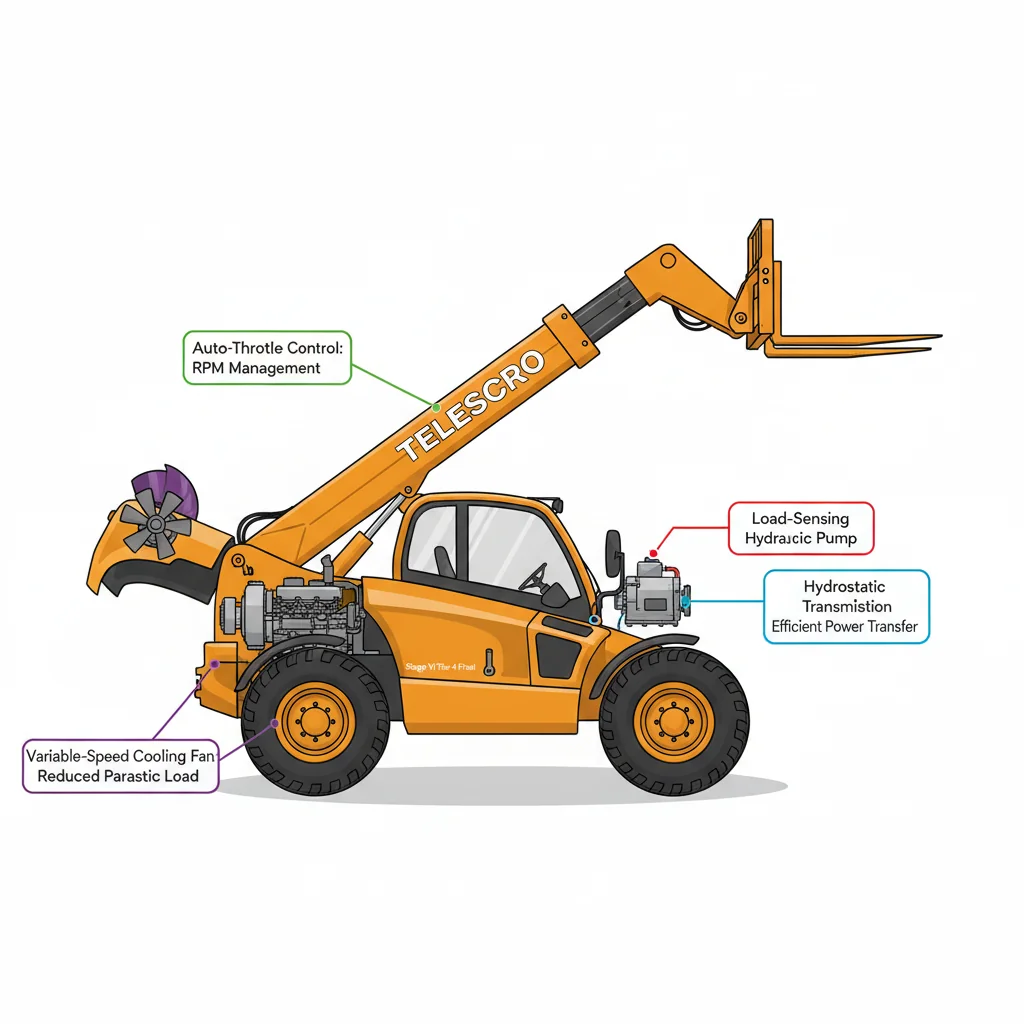
Here’s what matters most when you’re aiming for lower diesel bills: don’t judge by horsepower alone. I’ve worked with buyers in Kenya and Turkey who thought bigger engines always meant stronger savings. In reality, the secret is advanced engine management and smart hydraulics.
For example, a customer in Brazil swapped out an older Tier 3 unit for a new model with Stage V engine, idle shutdown, and an auto-throttle feature. Their average site fuel use dropped by almost 25%—with no loss in lifting power for loads under 3 tons. On the jobsite, transmission type is a big factor. Hydrostatic transmissions, especially when used in ECO or auto modes, hold engine RPMs low during light travel or when waiting between lifts.
Last December, a site in Dubai switched from a torque-converter telehandler to a compact unit with hydrostatic drive. Over a month, operator logs showed diesel fill-ups dropped from twice weekly to once every ten days. Small difference in specs—huge impact on cost.
Below is a simple comparison of the core features that actually cut fuel burn:
| Feature | Fuel Saving Impact | Typical on… | Real Jobsite Benefit |
|---|---|---|---|
| Stage V / Tier 4 Final Engine | High | Modern units | Lower emissions, reduced idle fuel loss |
| Hydrostatic Transmission (ECO) | High | Most ~75 hp compact units | Lower RPM during travel and waiting |
| Load-sensing Hydraulics | Medium | Newer 3–4 t telehandlers | Less wasted hydraulic power under light load |
| Auto-throttle & Idle Shutdown | Medium–High | Most new-generation models | Cuts fuel burn during pauses and light duty |
Auto-throttle and idle shutdown features on modern telehandlers can significantly reduce fuel waste without impacting lifting performance.True
These advanced controls help by automatically adjusting engine speed and turning off the engine during inactivity, which cuts unnecessary fuel consumption during low-demand periods while maintaining the machine’s operational capacity.
Higher horsepower always leads to better fuel efficiency in telehandlers.False
Greater horsepower can enhance performance in demanding tasks, but without efficient engine management and hydraulic systems, it often results in increased fuel consumption instead of savings. Efficient features, not just raw power, make the biggest impact on fuel efficiency.
Key takeaway: Selecting telehandlers with advanced engine management, hydrostatic or modern powershift transmissions, and fuel-saving hydraulic features can yield substantial diesel savings. For jobs below 7 m/3 t, a 75 hp machine with these technologies often outperforms higher-hp alternatives in real-world fuel consumption.
When Do Hybrid Telehandlers Save Fuel?
Hybrid and electric telehandlers deliver up to 70% energy savings8 versus diesel in suitable applications. Their advantages are most significant on indoor, urban, and ESG-sensitive sites with low emission demands, moderate hours, and reliable charging or methane supply. For extended outdoor shifts, advanced Stage V diesels9 may remain more cost-effective.
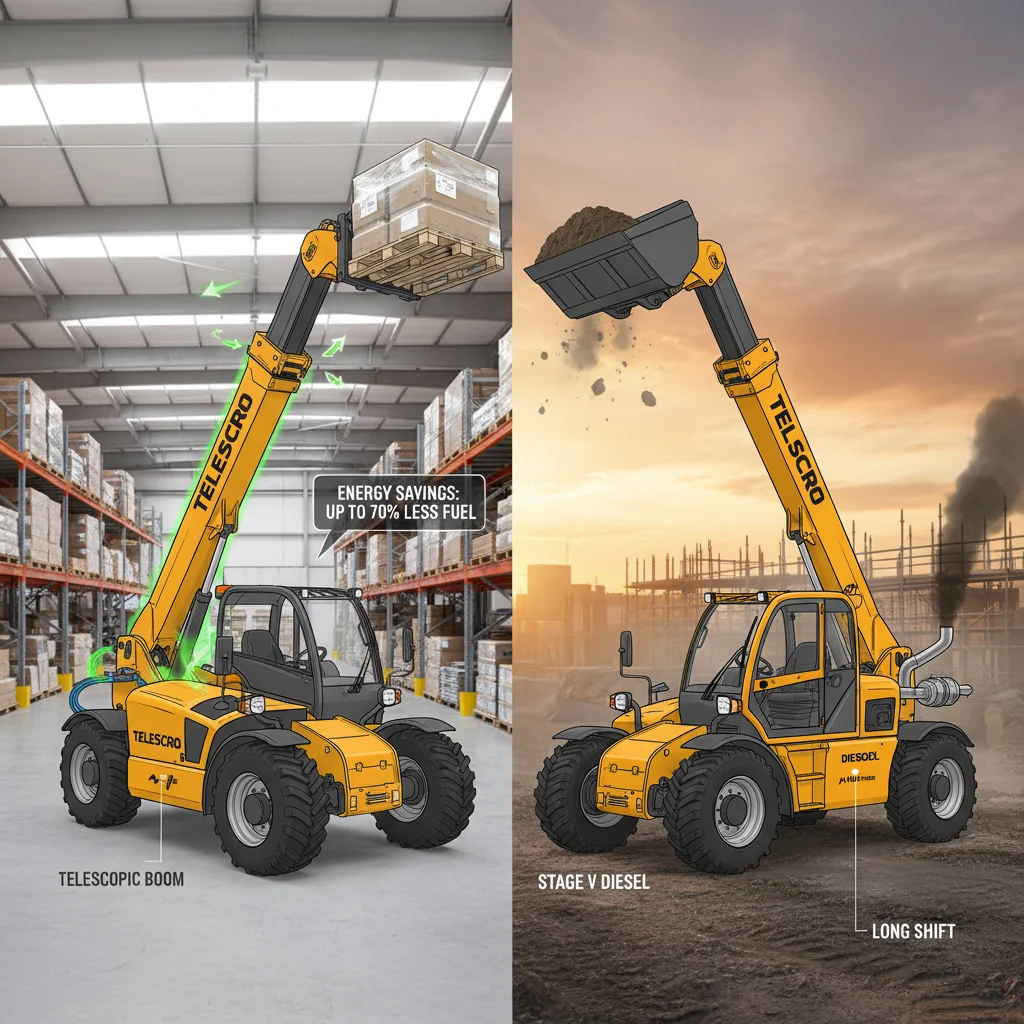
I’ve worked with customers who expected hybrid telehandlers to always deliver huge fuel savings, but that’s not guaranteed everywhere. In Singapore, a logistics company ran three compact hybrid units inside a food distribution center. Their average duty cycle was around 5 hours per shift, and charging stations were installed right next to their loading bays. Over a year, they saw their energy costs drop by nearly 70% compared to what they spent on diesel before. Maintenance was simpler too—no diesel particulate filters, less wear on the hydraulic pump system, and zero downtime from exhaust cleaning cycles.
But move to a large infrastructure jobsite in Kazakhstan, and the story changes. On those sites, long 12-hour shifts and harsh winter weather make pure electric or hybrid units less practical. Traditional Stage V diesel models still win on runtime and reliability there, especially if charging or methane supply isn’t available. One local contractor tested a hybrid 4-ton telehandler and had to bring in a generator just for charging—this erased any energy savings.
From my experience, the biggest gains from hybrids or electrics show up where low emissions and moderate hours are required—think urban redevelopment, tunnel works, or warehouse jobs under ESG pressure. If your lifting schedule is around 4–6 hours a day, and you have access to cheap electricity or gas, the math works out in your favor over the life of the machine.
I always suggest tracking not just your fuel use, but also maintenance and charging downtime. That’s how you’ll know if a hybrid telehandler really gives you the practical savings you’re looking for.
Hybrid telehandlers deliver significant fuel savings primarily in applications with frequent stopping and starting, such as indoor material handling with short duty cycles.True
Hybrid systems excel when machines operate in environments requiring repeated accelerations and decelerations, allowing electric components to recover and reuse energy while reducing idling time.
Hybrid telehandlers automatically save fuel regardless of duty cycle or access to charging infrastructure.False
Fuel savings from hybrid telehandlers depend heavily on specific usage patterns and the availability of charging. Without adequate charging facilities or suitable operational profiles, hybrids may not reduce fuel consumption significantly compared to traditional diesel models.
Key takeaway: Hybrid and electric telehandlers are most effective in settings with moderate working hours, accessible clean energy, and strict emissions targets. Accurate duty cycle assessment and total lifetime cost analysis—including energy and maintenance—are essential to determine whether these models will deliver practical fuel savings over traditional diesel telehandlers.
How do telehandler duty cycles affect fuel use?
Telehandler fuel consumption varies significantly with duty cycle. On construction sites, frequent idling leads to average usage of 8–12 L/h, with up to 50% idle time. Agricultural units face more sustained loading and travel, pushing consumption to 12–15 L/h but with less idle time. Accurate benchmarking requires matching application, shift pattern, and operator style.
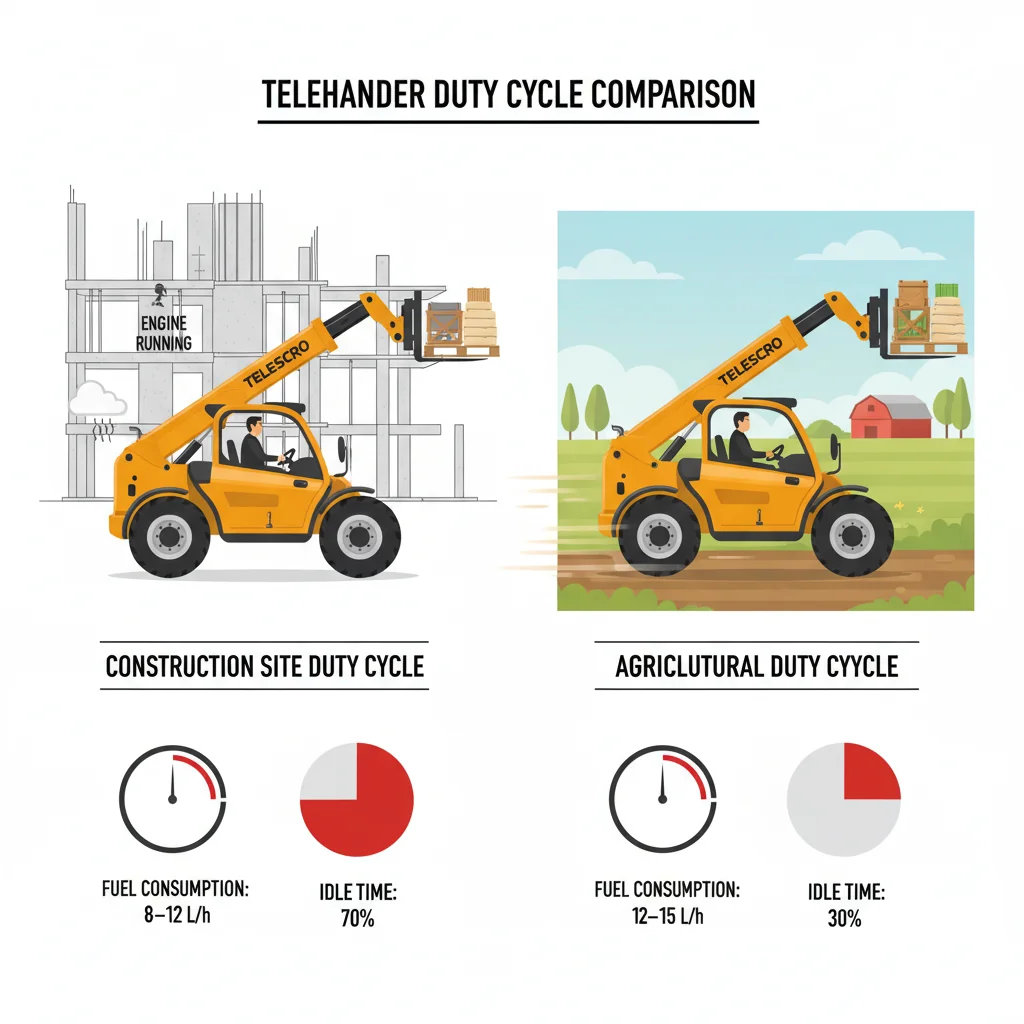
Last month, a project manager in Dubai called me, puzzled by why their 7-meter telehandler showed higher diesel bills compared to a similar unit running on a farm outside Chengdu. I hear this a lot, and the answer always comes back to duty cycle. The type of work—and how the operator runs the machine—directly shapes fuel use. The same telehandler moving a few pallets per hour on a construction site will burn less fuel than one lifting silage and hauling trailers all day on a large farm.
From my experience, these duty cycle patterns make a bigger difference than most buyers realize. On busy construction sites, I regularly see telehandlers idling with engines on—waiting for loads or working in short bursts. In Kenya, a customer’s hour-meter logs revealed nearly 50% idle time, which pushed average fuel use to around 9 L/h for a 4-ton, 12-meter model. Agricultural jobs? Very different. A client in Kazakhstan ran the same-size machine steadily, loading grain and traveling between sheds at higher speeds—consumption climbed to roughly 14 L/h but with idle time much lower, under 15%.
Here’s what I recommend checking when benchmarking telehandler fuel use:
- Idle percentage – Actual idle time can reach 40–50% on many jobsites.
- Work intensity – Frequent lifting versus sustained bucket or trailer work.
- Travel distance – Short shuttle runs use less fuel than extended road travel.
- Operator habits – Aggressive throttle or coasting makes a real difference.
The best advice? Review your own telematics or hour-meter logs before making fuel cost comparisons. That’s the only way to find true efficiency—and spot waste you can fix.
Telehandlers performing frequent, high-load lifting cycles consume significantly more fuel than those used mainly for light material handling or idling periods.True
This is true because higher duty cycles with frequent heavy lifts and constant movement keep the engine under greater load, increasing fuel consumption compared to machines with intermittent, lighter tasks.
The engine size of a telehandler is the only factor that determines its total fuel consumption during daily operations.False
This is false because while engine size influences baseline fuel use, duty cycle, operator habits, and the nature of the work have a major impact on actual daily fuel consumption.
Key takeaway: Benchmarking telehandler fuel efficiency is only meaningful when comparing machines handling similar tasks and workloads. Duty cycle—including idle time and load intensity—can dramatically change hourly fuel use, so actual field data and telematics are essential for cost analysis and optimization.
Which Operator Habits Raise Fuel Usage?
Operator behavior can cause telehandler fuel consumption to vary by as much as 20–30%, even on identical machines. Key factors include unnecessary full-throttle operation, extended idling, excess repositioning, and overloading. Neglecting ECO or travel modes compounds the issue. Systematic operator training and real-time telematics data review10 are proven strategies to reduce fuel waste and operating costs.

I’ve worked with so many operators who think more throttle always means faster work. The reality is, holding the pedal down burns through diesel without giving you more lifting power, especially when the boom isn’t moving or you’re just maneuvering on flat ground. Last winter in Kazakhstan, I tracked a project that ran two identical 4-ton telehandlers on the same job. The only real difference? One crew kept machines at full throttle and idled during breaks—the other matched RPMs to the load, used ECO mode11, and shut down during long pauses. After a month, the first team’s fuel bill ran at least 25% higher, just from habit alone. Extra repositioning is another silent killer. I’ve seen operators inch forward three or four times to line up a pallet, instead of planning a single approach. Each extra move adds up—more fuel, more transmission wear. In Brazil, I watched a crew cut daily moves nearly in half by marking boom positions and sharing radio calls on bigger lifts. It saved them not just time, but several liters of diesel per shift. It’s also common for operators to overload, thinking a few extra bags or bricks will save trips. But the actual effect? The engine and hydraulics strain, raising fuel use and risking tip-over. To be honest, it’s smarter to follow the load chart—even stopping 200 kg short—than to chance costly downtime or an accident. I always suggest comparing telematics data by operator if your fleet allows. You’ll spot habits fast.
High throttle usage on a telehandler when the boom or hydraulics are not being operated leads to unnecessary fuel consumption without improving machine performance.True
A telehandler’s engine does not deliver additional lifting or hydraulic power merely from higher RPMs when there’s no load demand. Maintaining high throttle while idling or during travel on level ground only increases fuel burn and engine wear.
Allowing a telehandler to idle at full throttle during breaks is beneficial because it keeps hydraulic systems ready and reduces total fuel usage.False
Idling the engine at high RPM during breaks actually consumes more fuel and puts extra wear on components. Telehandlers do not need full throttle to keep hydraulics ready at rest; low idle is sufficient and more efficient.
Key takeaway: Small adjustments in telehandler operator habits, like minimizing engine idling, matching RPM to tasks, and avoiding unnecessary loads or movements, can cut fuel consumption and operating costs by up to 30%. Leveraging telematics and available ECO features further optimizes efficiency and safety across job sites.
Which Telehandler Maintenance Slashes Fuel Usage?
Regular inspection and replacement of air filters, maintaining tire pressure to manufacturer specifications, and timely hydraulic oil and filter changes directly improve telehandler fuel efficiency. Field data shows a 5–15% reduction in fuel consumption with routine maintenance, particularly in dusty or demanding environments. Neglect raises operational costs and risks avoidable engine load.
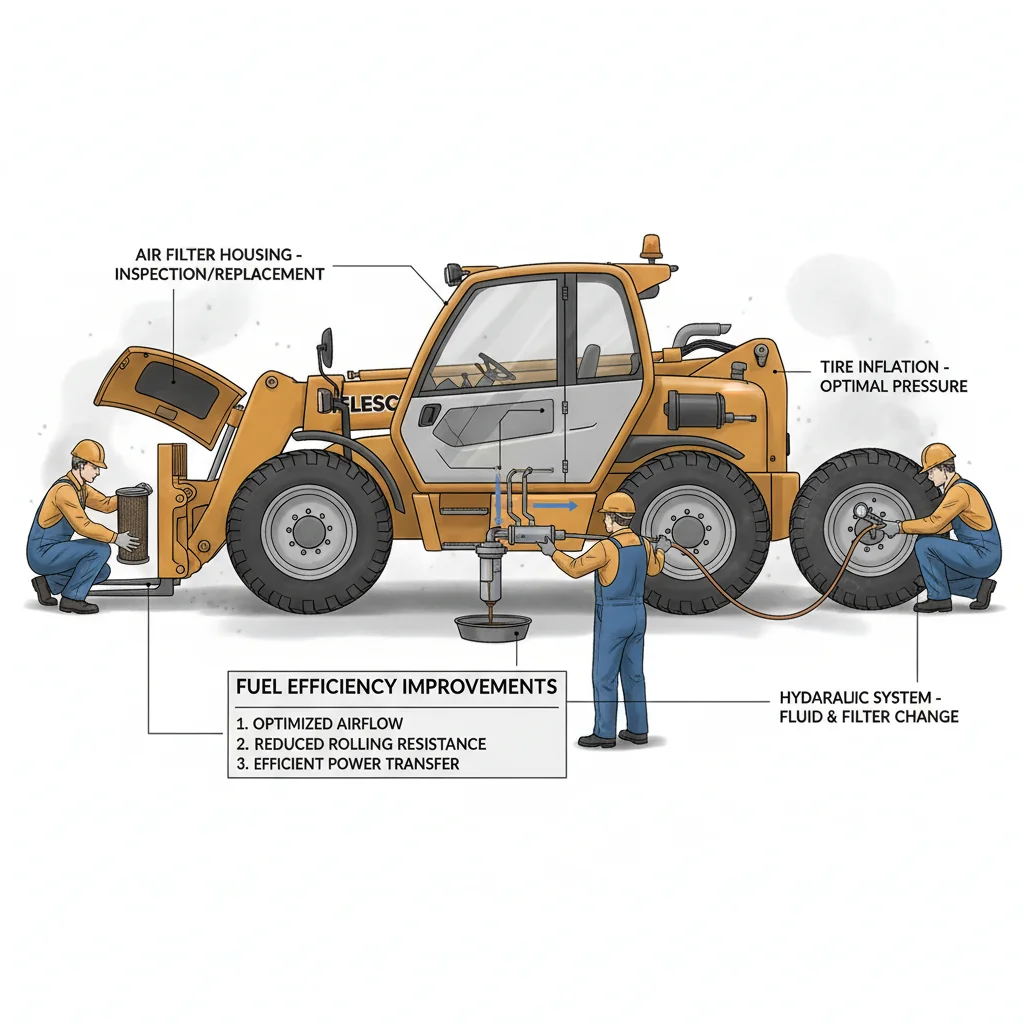
I’ve worked with customers in Kazakhstan and Kenya where dusty sites and long hours made fuel bills spiral. The biggest mistake I see is thinking maintenance is just about reliability, not fuel cost. Simple tasks—like air filter checks—actually impact diesel use day to day. When an air filter is clogged, airflow drops, and the engine burns more fuel to compensate. I watched one operator swap a filthy filter for a new one and see fuel usage drop by at least 10% within a week. It’s such an easy win. Tire pressure is another detail people ignore, but it matters more than you might think. Under-inflated tires—sometimes just 0.5 bar below spec—create extra rolling resistance. That drags down efficiency, especially when traveling loaded. On one job near Dubai, a rental fleet manager found that top-up air every Saturday saved his fleet hundreds of liters per month. A two-minute check can mean the difference between sluggish and smooth. Hydraulic system neglect also burns fuel quietly. Old oil, contaminated by dust or water, forces the hydraulic pump to work harder. Dirty hydraulic filters or sticky valves do the same. Stick to the manufacturer’s intervals: engine oil around 500 hours, hydraulic oil and filters at 1,000 hours or longer depending on your model. I always recommend using fuel reports to spot rising consumption—usually, it’s a cue for maintenance, not just more refueling.
Clogged air filters in telehandlers force engines to work harder by restricting airflow, which leads to significantly higher fuel consumption even if the machine's immediate performance seems unchanged.True
Diesel engines rely on a precise air-fuel mixture for efficient combustion. When air filters are dirty or clogged, less air enters the combustion chamber. The engine compensates by injecting more fuel, resulting in increased fuel usage that may not be obvious in day-to-day operations but accumulates over time.
Because telehandlers are designed for heavy-duty applications, routine air filter maintenance has little to no effect on their overall fuel efficiency.False
Air filter condition directly impacts the efficiency of a diesel engine, regardless of application. Even in rugged, heavy-duty scenarios, neglecting the air filter leads to poor fuel economy by disrupting optimal combustion, showing that maintenance is crucial for fuel savings.
Key takeaway: Simple daily and scheduled maintenance—especially air filters, tire pressure, and hydraulic fluid—has a direct, quantifiable impact on telehandler fuel consumption. Adhering to OEM-specific intervals prevents avoidable diesel waste, cuts costs, and helps fleet managers identify issues early based on rising fuel usage patterns.
How Do Telematics Reduce Telehandler Fuel Use?
Telematics systems provide detailed fuel and idle time reports12 for telehandlers, allowing fleet managers to identify wasteful engine idling and implement corrective measures. By reducing idle time from 40% to 25%, total fuel consumed per productive hour drops significantly. Emerging AI-driven telematics13 also enable proactive fleet optimization for lower consumption and operating costs.
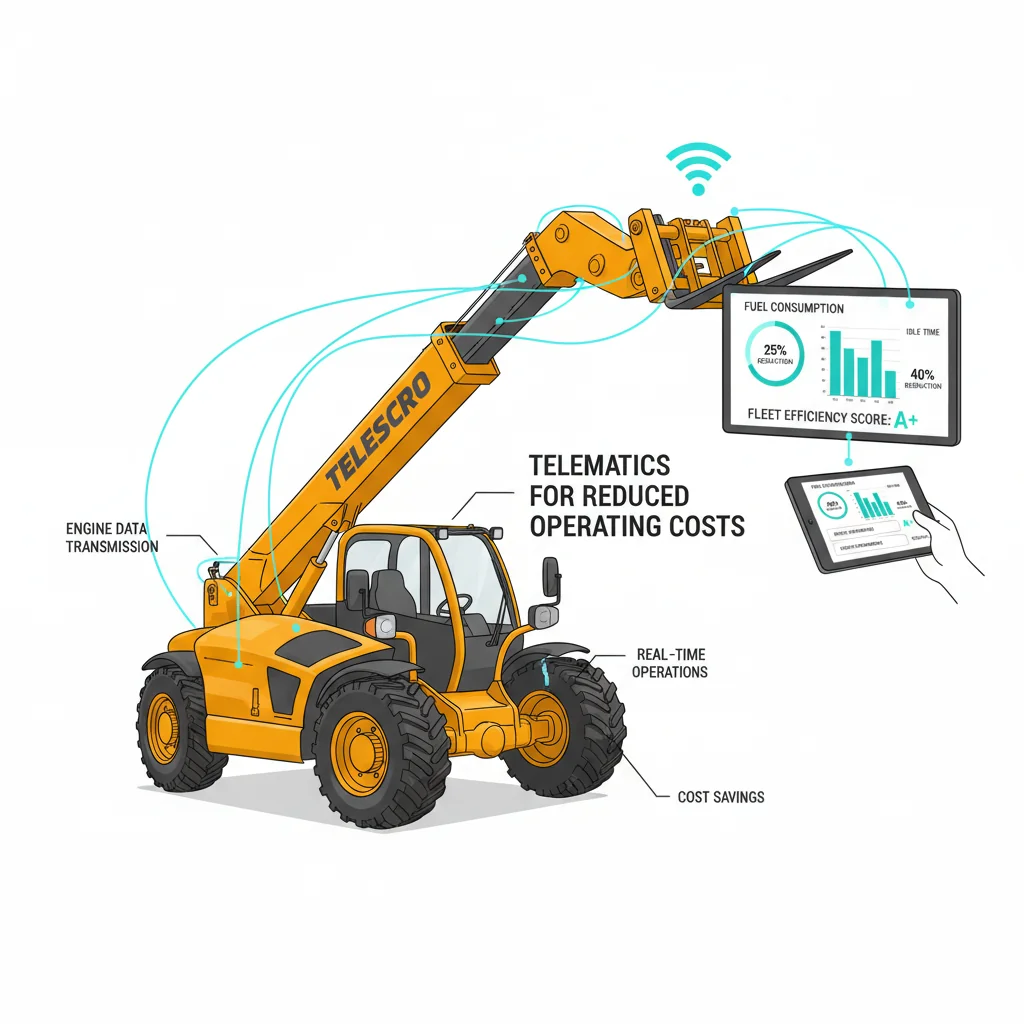
Let me share something important about telehandler telematics: many fleets have the system, but almost no one bothers to dig into the fuel and idle data. That’s a wasted opportunity. I remember visiting a customer in Kenya—three 4-ton telehandlers with over 42% of their engine hours spent just idling during shift changes and breaks. That’s a lot of diesel. After reviewing their telematics reports, the site manager realized they were losing around 80 liters a week per machine to unnecessary idling.
Here’s what fuel-saving telematics can highlight for you:
- Detailed idle time breakdowns—see exactly when and where each machine isn’t working
- Real-time alerts for excessive idling—operators get reminders when to shut down
- Monthly fuel consumption trends—spot machines using more fuel than expected
- Benchmarking tools—compare your telehandlers’ performance across multiple sites
From what I’ve seen in Brazil, just by sharing these idle reports with operators and setting a strict 30% maximum idle target, sites cut their fuel bills significantly—sometimes over 15% a month. Don’t ignore simple fixes. Activate auto-idle when possible, and plan jobs so teams share fewer machines instead of leaving multiple engines running all day.
One more tip: make it a habit to review telematics fuel and idle summaries every month. If a machine is over your idle threshold (like 35%), discuss it with your team. Even a small reduction means hundreds of liters saved yearly. I always suggest making these checks a routine part of your fleet meetings.
Telematics systems on telehandlers can identify excessive engine idling, enabling operators to adjust practices and reduce unnecessary fuel consumption.True
Telematics data reveals patterns like idling and runtime, helping site managers understand when machines are burning fuel without working. By analyzing this data, they can implement practical changes, such as adjusting shift protocols, to minimize engine run time and save fuel.
Telematics data alone is sufficient to reduce telehandler fuel use, without requiring any changes in operator behavior.False
Telematics systems only provide data; meaningful fuel savings require that operators or managers act on the insights, such as modifying work schedules or training operators to limit idle time. Data without action will not lead to reduced fuel consumption.
Key takeaway: Telehandler telematics unlock major fuel savings by highlighting excessive idling and guiding targeted operational improvements. Contractors and fleet owners should routinely review data, enforce idle time limits, and discuss findings with operators. Even moderate adjustments—such as shared machines and auto-idle—can yield substantial diesel cost reductions annually.
Conclusion
We’ve talked about how telehandler fuel consumption isn’t a one-size-fits-all figure—it comes down to your actual machine, workload, and jobsite conditions. From what I’ve seen, focusing only on liters per hour is a quick path to “showroom hero, jobsite zero”—the specs might look good, but you could end up paying more in fuel when the application changes. I always recommend asking for real-world telematics or jobsite data, so your choice matches your workflow, not just the brochure.
If you have questions about comparing models, interpreting telematics data, or finding a fit for your project’s needs, I’m happy to share what’s worked for customers worldwide. Feel free to reach out anytime. Every site is different—choose what works for your workflow.
References
-
Understand how different duty cycles influence telehandler fuel efficiency across construction and agricultural applications, backed by real usage data. ↩
-
Explores how using oversized telehandlers leads to higher fuel use and the impact of machine size on operational costs with data insights. ↩
-
Details the role of hydraulic circuit sizing in energy waste and how inefficiency at lighter loads drives up fuel use in telehandlers. ↩
-
Explains why measuring fuel consumption by tonnes lifted offers a clearer efficiency picture than hourly rates, backed by project examples. ↩
-
Details how yearly fuel costs can reach $18,000-$20,000 per telehandler, affecting long-term savings and fleet profitability. ↩
-
In-depth explanation of hydrostatic transmissions and their role in lowering engine RPM and fuel burn during light travel and idle periods. ↩
-
Detailed insights into load-sensing hydraulic systems that dynamically adjust flow to reduce fuel consumption and enhance equipment performance. ↩
-
Explore detailed analysis of how hybrid telehandlers cut energy use by up to 70%, including real-world applications and cost benefits. ↩
-
Understand the reliability and cost-effectiveness of advanced Stage V diesel telehandlers in harsh environments and long shifts. ↩
-
Explores how real-time telematics data helps monitor operator behavior and optimize fuel usage, improving productivity and reducing costs. ↩
-
Detailed insights into how ECO mode optimizes engine performance to lower fuel costs and reduce emissions during telehandler operations. ↩
-
Explore how detailed fuel and idle time reports help fleet managers identify waste and optimize engine use, cutting costs significantly. ↩
-
Discover how emerging AI-driven telematics enable proactive fleet optimization, reducing fuel consumption and operational costs effectively. ↩