










Telehandler Forward Reach vs Maximum Height: What Buyers Overlook
Not long ago, an Australian project manager showed me a telehandler spec sheet and asked, “Why can’t I lift my usual 2 tons when I’m reaching over this foundation trench?” It’s a question I get in every country, and almost always, the culprit is forward reach—not maximum height.
Telehandler lifting capacity decreases sharply as boom outreach increases due to the physics of leverage and stability. Forward reach substantially extends the load’s center of gravity beyond the front axle, amplifying the tipping moment far more than simple vertical lifting. Most construction sites require loads to be placed across obstacles, so lift height alone rarely determines machine suitability.
Why Does Forward Reach Reduce Capacity?
Telehandler lifting capacity drops sharply as forward reach increases because the load acts as a longer lever about the machine’s forward stability boundary (often described as the front wheel line or tipping axis) (tipping axis1). As the load center moves farther away from the front tires, the overturning moment increases significantly, which reduces the available rated capacity2—even when boom height itself does not change.
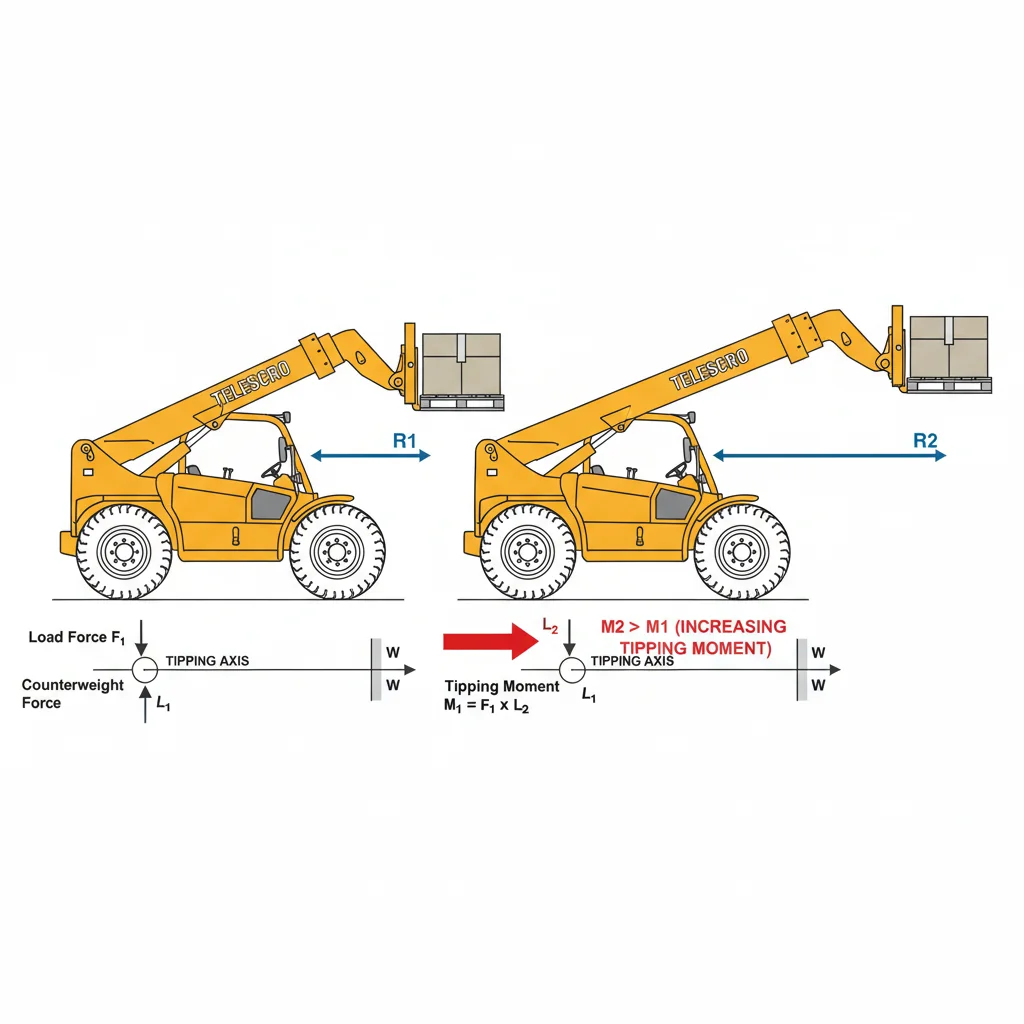
Most people don’t realize that a telehandler’s lifting power can drop by half—or more—when you extend the boom forward. I remember a job in Dubai where a client asked why his 3.5-ton unit, which handled 3,500 kg easily right by the front tires, refused to lift more than about 1,300 kg once he reached out to 6 meters. The answer is simple physics but has real-world consequences: when you push the load out, you turn it into a long lever, and that increases the tipping risk around the front axle, which we call the tipping axis. The "reach" is measured from the edge of the front tires to the load center where your attachment grips the load—every extra meter matters a lot.
Let me share something important about how this plays out on site. In Brazil, a contractor needed to place 2,500 kg pallets over a 3-meter trench. His machine was rated 4,000 kg at minimum reach, but the load chart3 showed only 1,700 kg was safe at his required distance and height. He was shocked. But that’s how load charts work—the further out you reach, the less you can lift, even if your boom height stays the same. It all comes down to stability: as the load center moves away from the tipping axis, the moment increases, and the rated capacity drops4 sharply.
If you size your telehandler by maximum height alone, you risk stalling or worse—tipping—when the job requires real outreach. I always suggest reviewing the actual load chart for each reach and height, and building in a safety margin. The rated number on the brochure only tells part of the story.
The further a telehandler extends its boom forward, the more the load acts as a lever, increasing the tipping risk and requiring a significant reduction in rated lifting capacity.True
Extending the boom changes the machine's center of gravity and mechanical leverage, magnifying the force trying to tip the telehandler over its front axle, which means the equipment must be limited to lighter loads at greater reaches.
A telehandler can always lift its maximum rated capacity regardless of how far its boom is extended, as long as the load is within the lifting chart limits.False
The rated capacity listed for a telehandler is based on the load being close to the front axle; as the boom extends, the load chart specifies significantly reduced capacities to prevent tipping and maintain stability.
Key takeaway: Telehandlers lose significant lifting capacity at maximum forward reach due to leverage effects around the front axle. Buyers should reference the load chart for capacity at specific forward reach and height—not just maximum height—ensuring adequate safety margins for real-world jobsite conditions.
How do load charts compare reach vs height?
Telehandler load charts5 define rated capacity using both boom angle (height) and forward reach, measured from the front tire edge to the load center. As forward reach increases, allowable lifting capacity can drop dramatically, depending on the machine configuration, boom position, and attachment shown on the load chart. Buyers should prioritize actual capacity at their required reach and height—not just maximum lift height figures listed on the brochure.
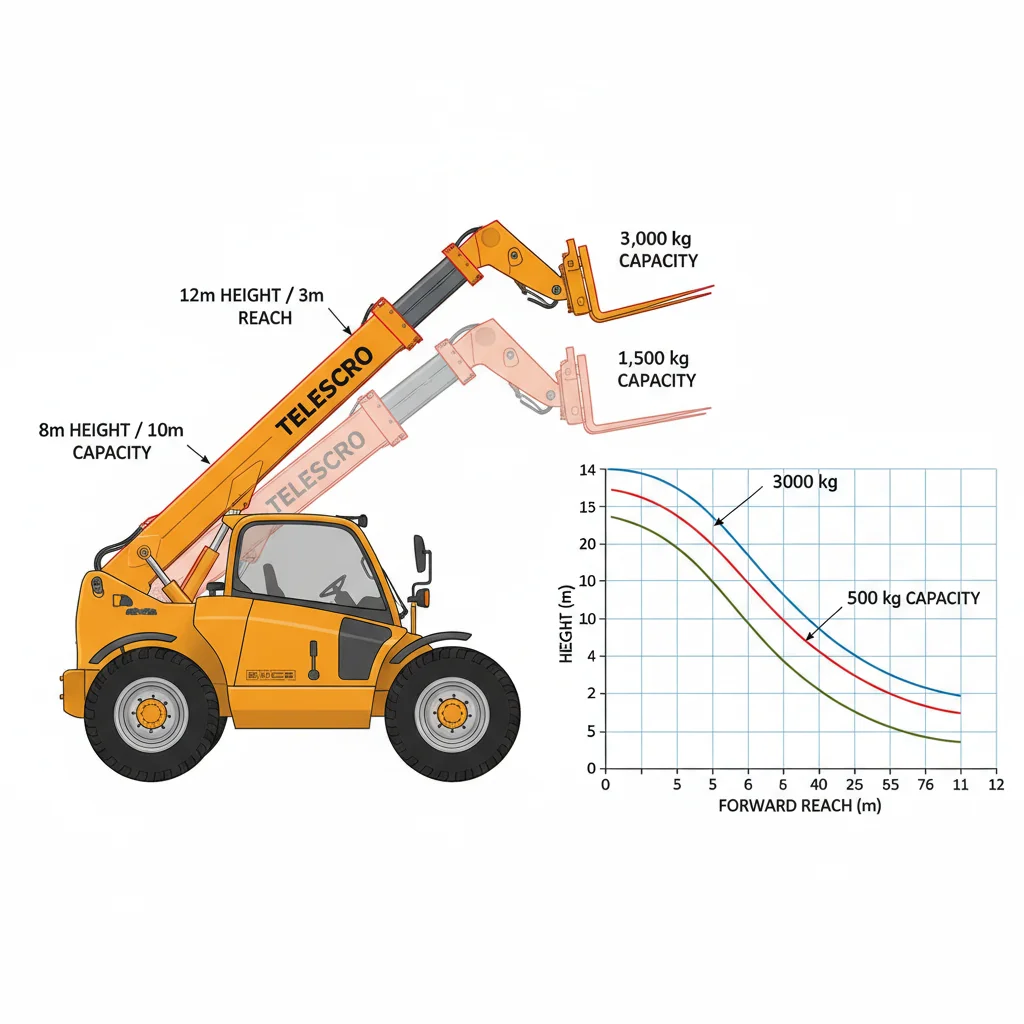
Let me share something important about telehandler load charts—height and reach are never separate. The biggest mistake I see is buyers only asking about “maximum lift height” or “rated capacity” without digging into how these two work together on the chart. The truth is, rated capacity drops fast as reach increases. For example, I’ve worked with a customer in Kazakhstan who needed to place blocks at 6 meters out and 9 meters up. On their 4-ton, 13-meter unit, the load chart’s “safe box” at that point wasn’t 4 tons—it was closer to 1,700 kg.
Illustrative example only (values vary by model and attachment—always use the manufacturer’s load chart for specifications):
| Boom Height (m) | Forward Reach (m) | Rated Capacity (kg) |
|---|---|---|
| 4 | 2 | 4,000 |
| 8 | 4 | 2,950 |
| 10 | 6 | 2,200 |
| 12 | 8 | 1,300 |
Notice how each step further out means a big drop. This pattern holds, whether you’re running a compact 7 m telehandler or a high-reach 17 m model.
To be honest, I always check actual capacity at the job’s critical point—not just “max height.” I’ve seen teams in Dubai set up for a 3-ton lift at 14 m and find out the machine only manages 1,000 kg at max reach. That’s a costly surprise.
My advice? Mark your real working locations on the chart, then choose a model that keeps you at least 20–30% above your heaviest actual load, at that reach and height. That’s the smart—and safe—way to avoid project delays.
On a telehandler load chart, the rated capacity at maximum forward reach is usually much lower than the capacity at maximum height, even if both points are along the same vertical plane.True
This is true because the further forward you extend, the greater the leverage effect on the machine. The telehandler has to handle increased moment forces, so manufacturers derate the safe working load much more as reach increases, compared to simply lifting straight up.
The maximum lift height shown on a telehandler load chart always corresponds to the machine's highest rated capacity.False
This is false because at maximum lift height, the boom is usually fully extended, which means the load is farther from the machine’s center of gravity. This positioning reduces rated capacity significantly, so the highest capacity is usually reached with the boom partially raised and retracted, not at maximum height.
Key takeaway: Telehandler rated capacity rapidly decreases as forward reach increases, regardless of maximum lift height. Selection should focus on load chart capacity at the specific forward reach and height needed for the task, ensuring a safety margin over the heaviest regular load.
Why is forward reach a stability risk?
Forward reach creates a major stability risk for telehandlers. Tip-over risk increases significantly when the boom is raised and extended, as the load center moves toward the machine’s forward stability boundary (often described as the front wheel line), reducing the available safety margin. As reach increases, rated capacity is aggressively derated—especially on soft, sloped, or uneven ground—making accurate assessment of load weight, forward reach, and lift height critical for safe operation.
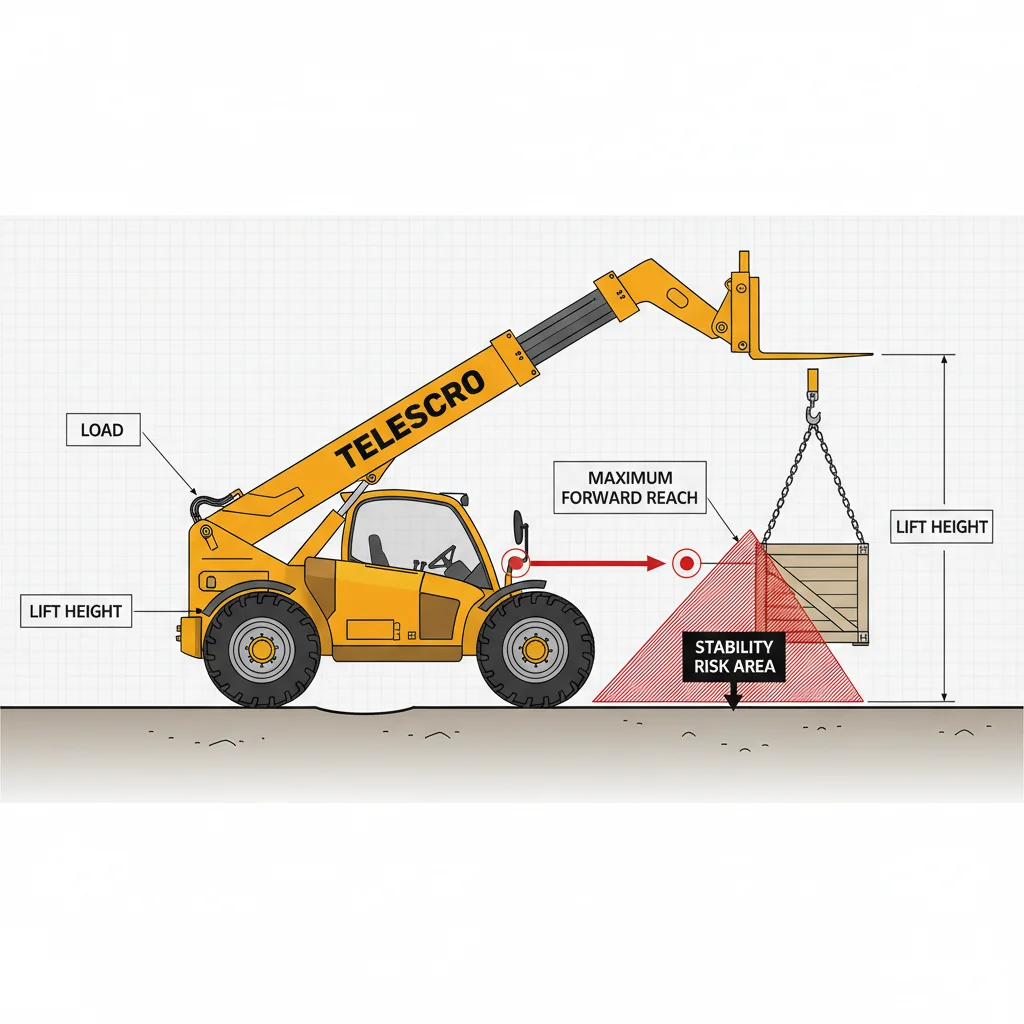
The biggest mistake I see is operators focusing on lifting height, not realizing how fast stability drops when you extend the boom forward. I saw this firsthand on a project in Dubai. The team had a 4-ton telehandler with an 18-meter boom, moving concrete blocks over a foundation. They thought a 1,500 kg load would be no problem. As soon as they boomed out past 10 meters reach, the machine started to feel light in the front—and their load chart showed only around 900 kg rated capacity at that extension.
Here’s what matters most when working with any telehandler: the moment you extend the boom, the load center moves out from the front axle—right to the edge of the stability envelope. The front wheel contact line becomes your tipping axis. Even a small overload suddenly becomes dangerous, especially if you’re on soft or uneven ground. In Kazakhstan, I watched an operator “boom out just a little more” trying to reach inside a pit. The machine lost stability and tipped—luckily, nobody was hurt, but the repair bill was huge.
From my experience, wide loads or longer forks make things even riskier. They push the center of gravity further out, so your safety margin disappears faster than most operators expect. That’s why the load chart aggressively reduces capacity the farther you reach. Never assume you can lift the headline number at long reach. I always suggest checking the load chart—look for the exact capacity at your planned reach and height, and never guess a load’s weight on site.
A telehandler’s forward reach dramatically reduces its rated lifting capacity due to the longer load center, making boom extension a greater stability risk than lifting at maximum height.True
As the boom extends forward, the load moves further from the machine’s fulcrum point, greatly multiplying the overturning moment. This shifts weight off the rear axle, drastically reducing what can be safely lifted compared to vertical lifting at maximum height.
A telehandler can always lift its maximum rated load regardless of boom extension as long as the stabilizers are deployed.False
Deploying stabilizers can increase stability in manufacturer-approved configurations, but it does not eliminate the effect of forward reach. As the boom extends, rated capacity is still reduced according to the load chart for the specific configuration (on stabilizers, attachment, and duty). Safe lifting capacity must always be determined from the applicable load chart, not from the headline rated capacity alone.
Key takeaway: Forward reach, not maximum lifting height, most often determines a telehandler’s tipping risk. As the boom extends, stability drops quickly and load chart limits become stricter. Safe operation depends on knowing the maximum authorized load for each specific reach and height—not just headline machine capacity.
Why Does Forward Reach Matter on Site?
Forward reach in telehandlers directly impacts job productivity, as real work sites often require a 2–3 m setback from placement points due to obstacles like trenches or scaffolding. Insufficient reach forces frequent repositioning, slowing cycles and increasing risk. Adequate reach allows operators to place loads efficiently from stable, level ground—avoiding unnecessary rehandling.
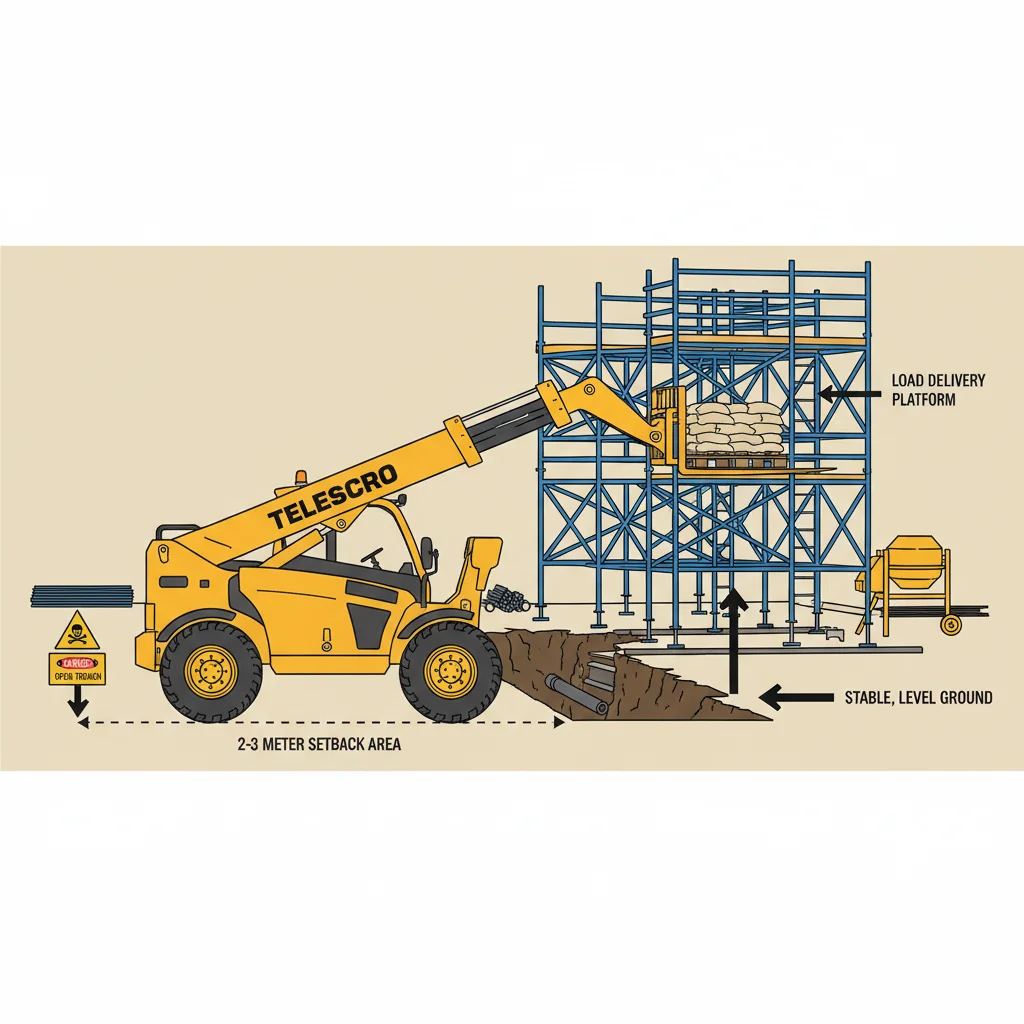
Here’s what matters most when you’re picking a telehandler for actual job sites: forward reach is often the difference between smooth, safe operations and constant headaches. You rarely get to park right against the drop zone—there’s usually a barrier, trench, material stack, or scaffolding forcing you to stand off by 2 or 3 meters. If you add the depth of a pallet (around 1.2 meters) and fork length, your load center could easily be 4 meters away before you even start extending the boom. I’ve seen this on big housing projects in Saudi Arabia—the operators spend more time inching the machine forward and hunting for stable ground than actually placing loads.
A customer in Brazil called me last month frustrated because their “4-ton, 17-meter” telehandler kept falling short placing rebar packs into the middle of slab forms. The machine had the height, but at 6 meters of forward reach the capacity dropped under 1,400 kg—nowhere near the weight they needed. They lost at least a full day each week repositioning, moving materials twice, even blocking other trades. The reality is, job productivity isn’t about max capacity on the spec sheet. It’s about how fast and safely you finish each cycle—and that depends on having enough reach to clear obstacles and keep all four tires on solid, level ground.
I always suggest checking the load chart at your typical working stand-off—a 5 to 7 meter forward reach is common on real jobs. If you underestimate this, you’ll pay for it in lost time and added risk. It’s much better to invest in the reach you actually need than gamble with tight margins.
A telehandler's forward reach performance directly impacts its ability to safely place loads over gaps like trenches or barriers, making it more important than maximum lift height on many construction sites.True
Because job sites often require materials to be placed beyond obstructions, adequate forward reach is essential for situational flexibility and safety, whereas maximum height alone doesn't address these common layout challenges.
If a telehandler's maximum lift height is sufficient for your tallest lift, forward reach becomes irrelevant when selecting a machine for the site.False
Maximum lift height does not guarantee the machine can place loads at distance, especially when access is restricted by obstacles; forward reach is frequently the limiting factor in real-world material placement.
Key takeaway: On real-world job sites, forward reach is just as critical as maximum lift height. Adequate reach reduces cycle times, risk, and operator effort by enabling precise load placement from safe, level ground—even when obstacles prevent parking close to the drop zone.
How to size telehandlers for reach?
Telehandler sizing by forward reach should start from on-site measurements, not brochure data. Critical steps include measuring safe parking distance, obstacle width, setback, pallet length, and safety allowance. These define the true reach required. Actual working height at this reach must be checked against model load charts with a 20–30% safety margin.
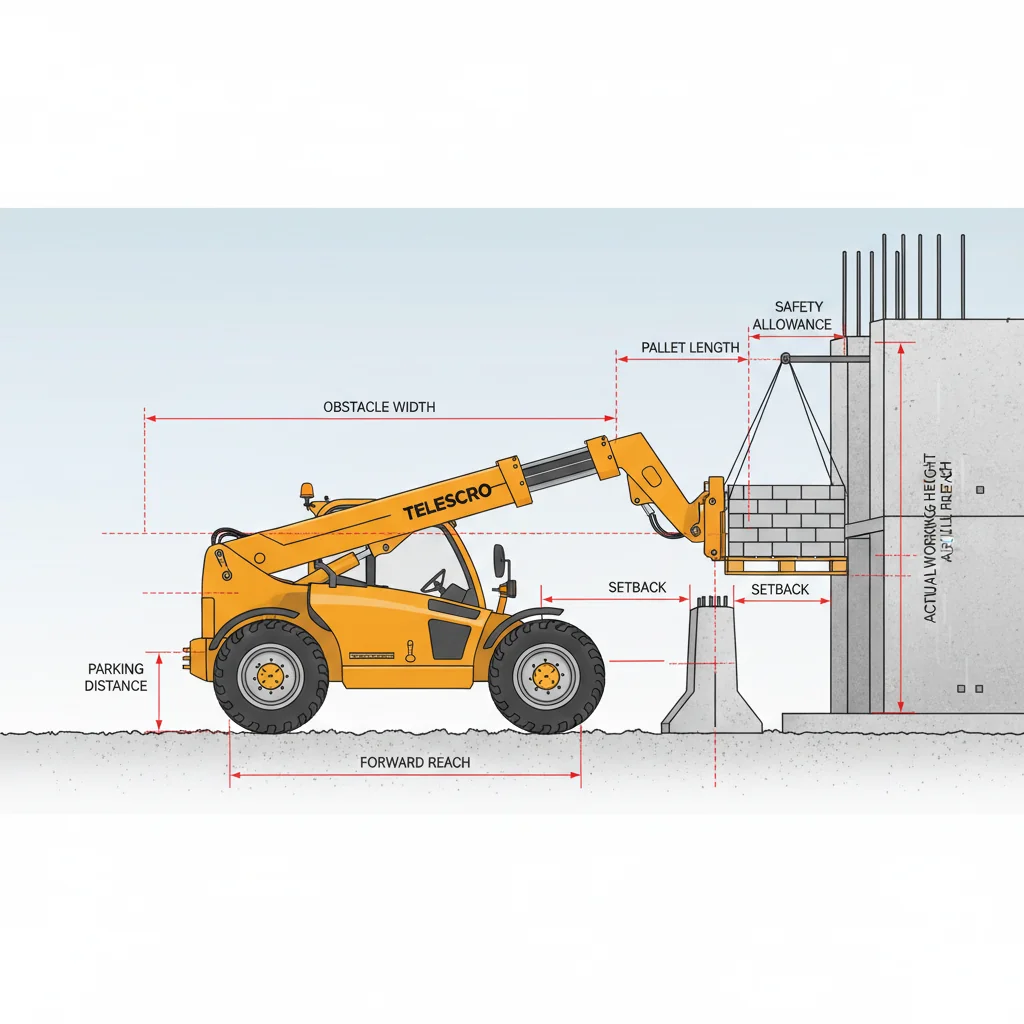
From my experience, buyers often misunderstand what “reach” really means. I’ve seen project managers in Dubai plan for jobs using only the maximum reach figure on the brochure, forgetting critical factors like obstacles or required parking setbacks. The reality is, on site, you need to measure from the front edge of the telehandler’s front tires all the way to the load center—usually the midpoint of your pallet or load. This is your true working reach and what every load chart uses for calculations.
Here’s an example: Last year, a farm in Kazakhstan needed to lift bulk feed bags over a row of feed barriers. We measured the safe parking distance (about 1.5 meters from the barrier), the width of the concrete barrier itself (another 0.5 meters), added the feed bag’s full pallet length (1.2 meters), plus a safety allowance of 0.3 meters. That’s a total effective reach of about 3.5 meters. Their working height at that point was 4 meters.
Once you know your real reach and height targets, check the load chart for each machine—don’t just look at max numbers. I usually advise customers to add a 20–30% safety margin, since rated capacity is only guaranteed on level ground with the specified attachment. And remember, telehandlers with compact frames can park a bit closer, but may lose capacity at full stretch. On the other hand, a bigger machine keeps more capacity at reach, but needs more room. My advice: Always size the machine to your jobsite’s measured dimensions, not what looks good on paper.
On most telehandler manufacturer load charts, forward reach is referenced from the front face/edge of the front tires to the attachment’s load center (not from the rear of the machine or the cab). Always confirm the exact reference point shown on the specific model’s load chart for your region.True
Many OEM load charts define horizontal reach from the front tire line to the load center because that reflects the tipping boundary and the real lever arm used in stability calculations. However, chart formats and reference notes can vary by manufacturer and market, so the load chart’s own definition should be treated as the source of truth.
The maximum forward reach of a telehandler refers to the highest vertical lifting point the boom can achieve.False
Maximum forward reach describes how far a load can be placed out from the machine, horizontally, not how high the boom can lift vertically; these are two distinct specifications in telehandler operation.
Key takeaway: Always determine telehandler reach and height requirements based on real site conditions—measuring from the front tire edge to the load center. Validate with model-specific load charts at the exact reach/height combination, accounting for safety margin, rather than relying on advertised maximum values.
What Are the Risks of Overspecifying Telehandler Height?
Selecting a telehandler with more lift height than the job actually requires can increase purchase and operating costs, machine weight, and turning radius—without improving usable lifting capacity at real working distances. Many high-reach models optimized for extreme height still offer limited rated capacity at mid-height and long forward reach, which is often the critical requirement for safely placing heavier loads.
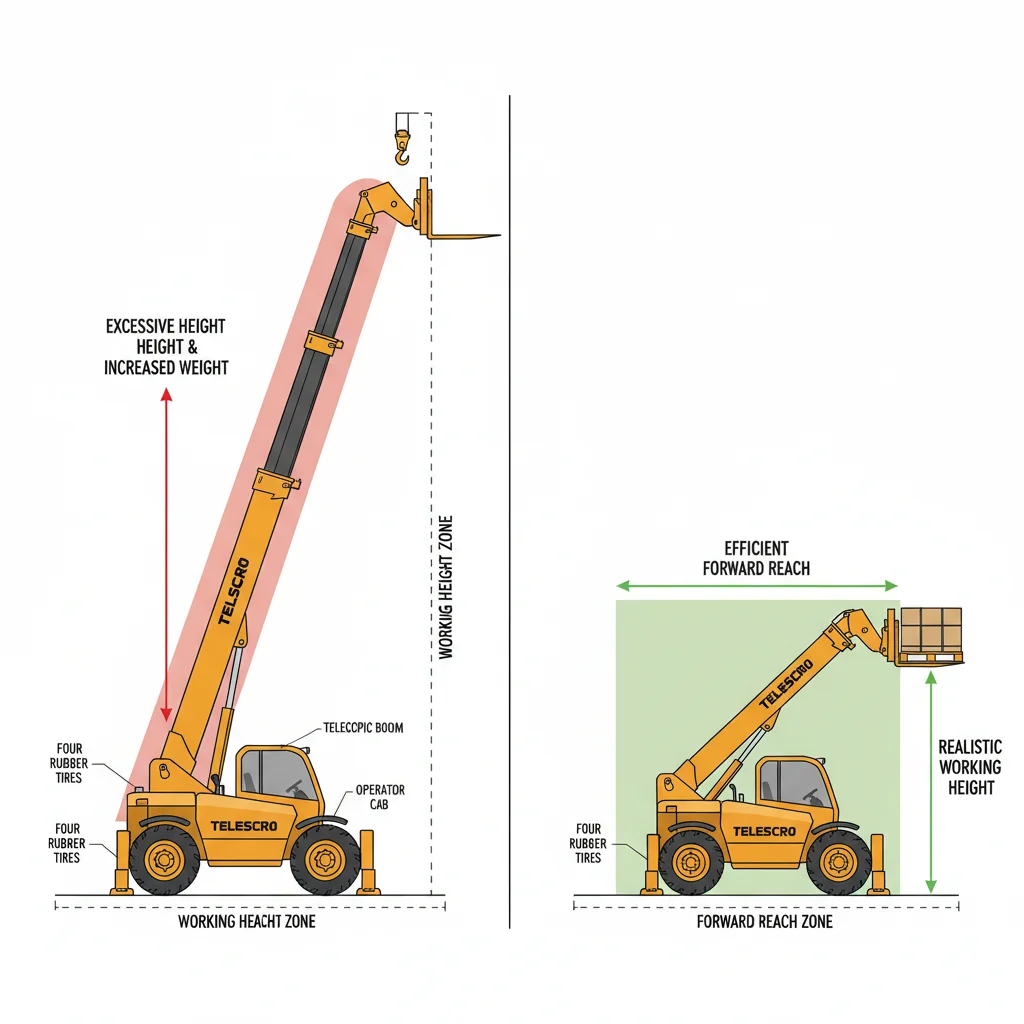
I’ve worked with customers who made this mistake—choosing a high-reach telehandler6 just to feel “covered” for every possible job. One contractor in Dubai picked a 17-meter model, thinking it would handle everything on a busy 3-story build. The reality? Ninety percent of their lifts happened below 10 meters, mostly to balconies and interior floors. The extra boom length didn’t help—at long outreach, that big machine could barely move two-ton pallets to mid-height. They paid at least 25% extra on the purchase, plus higher fuel costs. Worse, that longer machine felt sluggish navigating crowded jobsite corners.
What catches a lot of buyers off-guard is the actual load chart—those tables showing what you can lift at each boom angle and extension. A big machine’s “rated capacity” might look impressive at minimum reach. But stretch the boom out six or eight meters horizontally, and safe capacity can drop below 1,500 kg, especially at mid-height. That’s not enough for many prefabricated panels or heavy pallets. I’ve seen crews in Kazakhstan stuck halfway—paying a premium for high-reach, then still needing to rent a crane just to finish the job.
For most 2–4 story projects, I always suggest considering a 13-meter telehandler with beefy forward reach. These “mid-height, strong-reach” models usually cost less, weigh a ton or two less (so they’re easier to transport), and turn tighter in confined areas. Plus, you’ll burn less fuel, replace tires less often, and actually get more work done safely. Check capacity at real outreach distances—it matters more than headline boom height.
Overspecifying telehandler height can actually reduce effective lifting capacity at mid-level reaches due to increased boom length reducing stability and rated load.True
Longer booms are engineered for high-reach, but at moderate heights and outreach, their extended length increases leverage on the chassis, leading to derated lifting capacities compared to a shorter, purpose-fit machine.
Choosing a telehandler with the highest maximum lift height always guarantees the greatest forward reach and load capacity at any elevation.False
Maximum lift height and forward reach are separate specifications. Machines optimized for extreme height often have poorer performance at mid-reach or outreach compared to models designed specifically for those working ranges.
Key takeaway: Overspecifying telehandler height leads to unnecessary expenses and operational drawbacks without improving productivity onsite. For 2–4 story work, prioritizing a mid-height model with strong forward reach delivers better utilization, lower operating costs, and safer, more versatile fleet performance than extreme high-reach units.
How do attachments affect telehandler reach?
Attachments such as truss booms, jibs, and oversized carriages can move the load center farther forward than standard forks and add attachment weight. This increased leverage sharply reduces the safe rated capacity at the same boom extension. Always reference the load chart specific to the machine-and-attachment combination—not the base machine chart—to ensure safe operation.
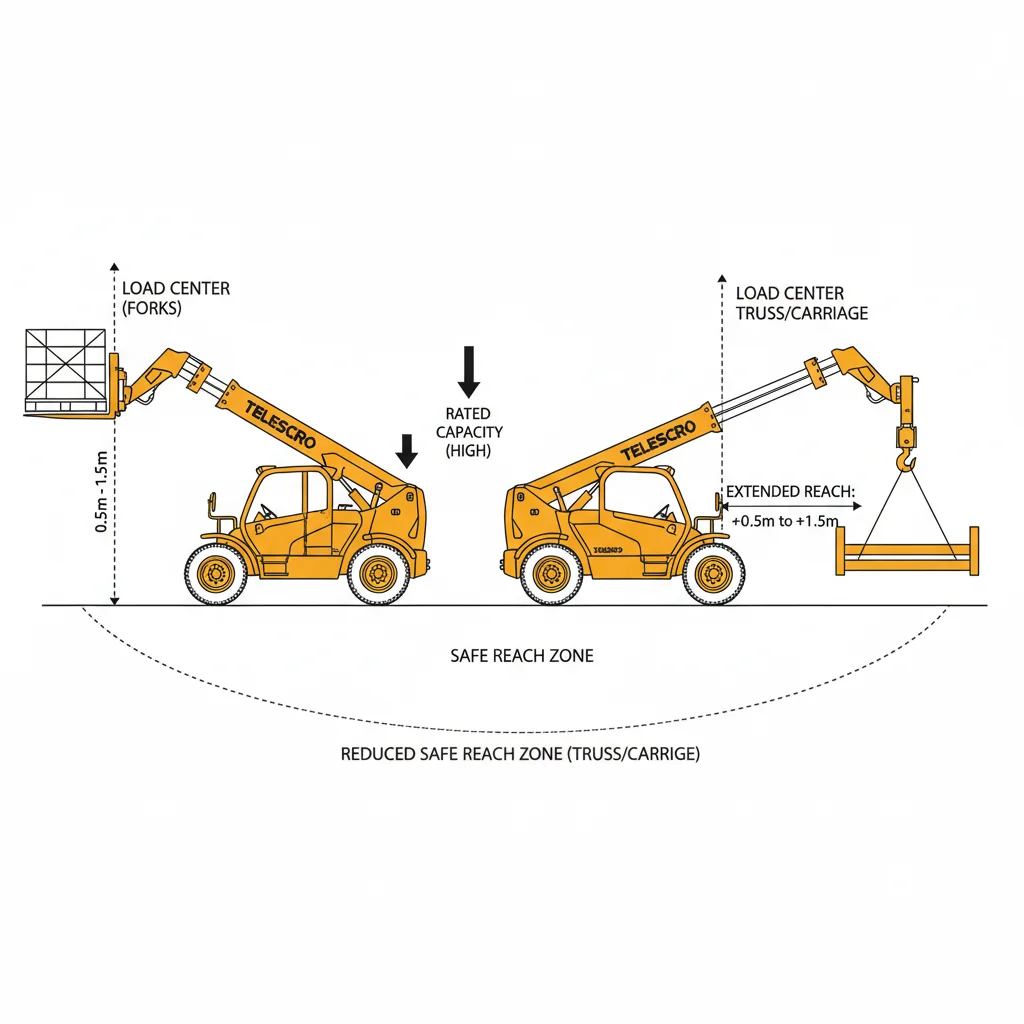
To be honest, the spec that actually matters is where your load center sits—not just what’s written on the telehandler’s nameplate. The moment you add an attachment like a truss boom, long fork carriage, or a heavy bucket, you shift the load point farther out from the front tires. That extra 0.5 to 1.5 meters might not sound like much, but on the jobsite, it makes a massive difference to your rated capacity at full reach.
I’ve seen this catch crews out in Dubai and Indonesia. One team added a 2-meter jib for lifting HVAC units onto a rooftop. According to their base machine’s load chart, they thought 1,300 kg at 11 meters was safe. With the jib installed, actual safe lifting dropped to barely 700 kg at the same reach. The operator had to unload and re-rig the load mid-way—not just inefficient, but risky.
Attachments reduce capacity mainly because:
- They add their own weight (which counts directly against rated capacity)
- They move the load center forward (acting as a longer lever on the chassis)
- They can reduce boom stability—especially with big buckets or long jibs at height
- Load charts must be recalculated for each attachment, not just for the base unit
My advice: always check the machine + attachment load chart right at your main working distance (typically 3–6 meters out). If your margin looks too slim, consider using a shorter jib or smaller bucket—stability and safety beat max volume every time. And train operators that swapping attachments almost always means accepting a lower allowed load, especially when you need extra outreach.
Adding a long fork carriage to a telehandler shifts the load center further forward, which substantially decreases the maximum safe lifting capacity at full forward reach—even if the machine’s maximum lift height remains unchanged.True
This is true because telehandlers are designed with rated capacities based on a specified load center. When an attachment moves the load farther out, it increases the leverage on the telehandler, reducing stability and allowable lifting capacity at a given outreach.
Using a heavy bucket attachment increases the telehandler’s maximum forward reach by providing additional counterweight at the front of the machine.False
This is false because a heavier attachment on the front does not serve as a counterweight; instead, it adds to the load being carried and moves the load center further away from the stability base, reducing both capacity and safe forward reach.
Key takeaway: Telehandler attachments increase forward reach by shifting the load center, which substantially reduces rated capacity at working heights. To maintain safety and productive capacity, always use the machine-specific load chart with the intended attachment and consider selecting smaller or shorter attachments if capacity margins are critical.
When Does Telehandler Forward Reach Matter?
Forward reach in telehandlers is crucial for agricultural tasks such as stacking large bales, feeding, and loading, especially when horizontal access from 3 to 6 meters is needed. Models with strong rated capacity at mid-reach often outperform taller units when operating in bale sheds, feed bunkers, and typical farm buildings.
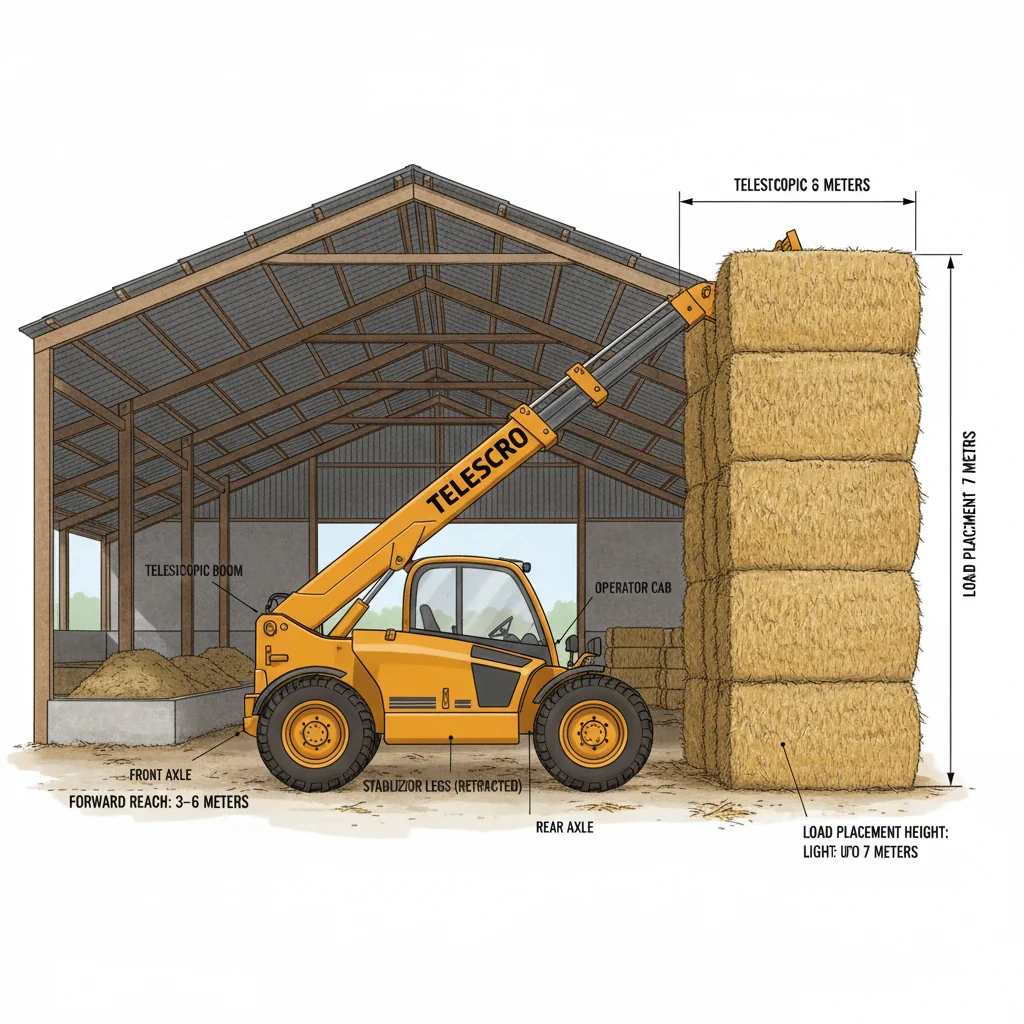
I’ve seen many farm operations in Australia run into trouble after choosing a telehandler just for its lift height. What I’ve noticed is that in low barn settings or when reaching into deep bale stacks, it’s not about how high the boom goes—it’s about what the machine can actually lift at 4 or 5 meters out from the front tires. In one case, a customer needed to routinely stack big square bales three deep along a 5.5-meter-wide shed. Their “high-reach” 17-meter machine sounded impressive, but once the load chart came out, it struggled to lift a 1,200 kg bale past 5 meters forward. They spent more time moving the machine and re-handling bales than actually stacking.
On dairy farms in the Netherlands, forward reach makes a real difference at the feed bunker. Most TMR mixers are set back from the edge, so the operator needs 3 or 4 meters of horizontal reach just to get over the side. But the key detail is the rated capacity—how much the telehandler safely lifts at that 3- to 6-meter zone (measured from the front tire edge to attachment load center). I always suggest checking the load chart for those specific working positions, not just the headline figures.
If your farm jobs focus on tight barns, wide stacks, or loading over feed barriers, map out those access points first. Choose a telehandler with enough strength at your most common forward reach, and you’ll cut handling time and avoid tip-over risks. It’s these small details—often ignored—that keep operations smooth and safe.
A telehandler’s maximum forward reach capacity is usually much lower than its maximum rated lifting capacity at full height.True
Telehandlers are designed so their rated lifting capacity decreases as the boom extends outward because leverage increases and stability decreases. Operators who do not consider the reduced capacity at maximum forward reach risk overloading the machine, even if they stay within lift height ratings.
As long as a telehandler can lift a load to its maximum height, it will also be able to place the same load at its maximum forward reach.False
This is false because the lifting capacity of a telehandler drops as the boom is extended forward. The machine’s stability and structural limits vary significantly between maximum height (with boom nearly vertical) and maximum reach (boom fully extended horizontally), so relying solely on lift height ratings can lead to unsafe or impossible operations.
Key takeaway: For agriculture, prioritizing a telehandler’s rated capacity at 3–6 meters forward reach ensures safer, faster, and more efficient loading and stacking—especially in low-roof barns and bale sheds—compared to simply choosing models with maximum lift height specifications.
How Does Maximum Reach Impact Telehandler Wear?
Operating a telehandler frequently at long or maximum reach with heavy loads imposes higher bending forces on the boom, accelerating wear on boom sections, wear pads, and key pivot points. Extended reach tasks also raise hydraulic and valve stress, increasing maintenance needs and reducing service intervals.
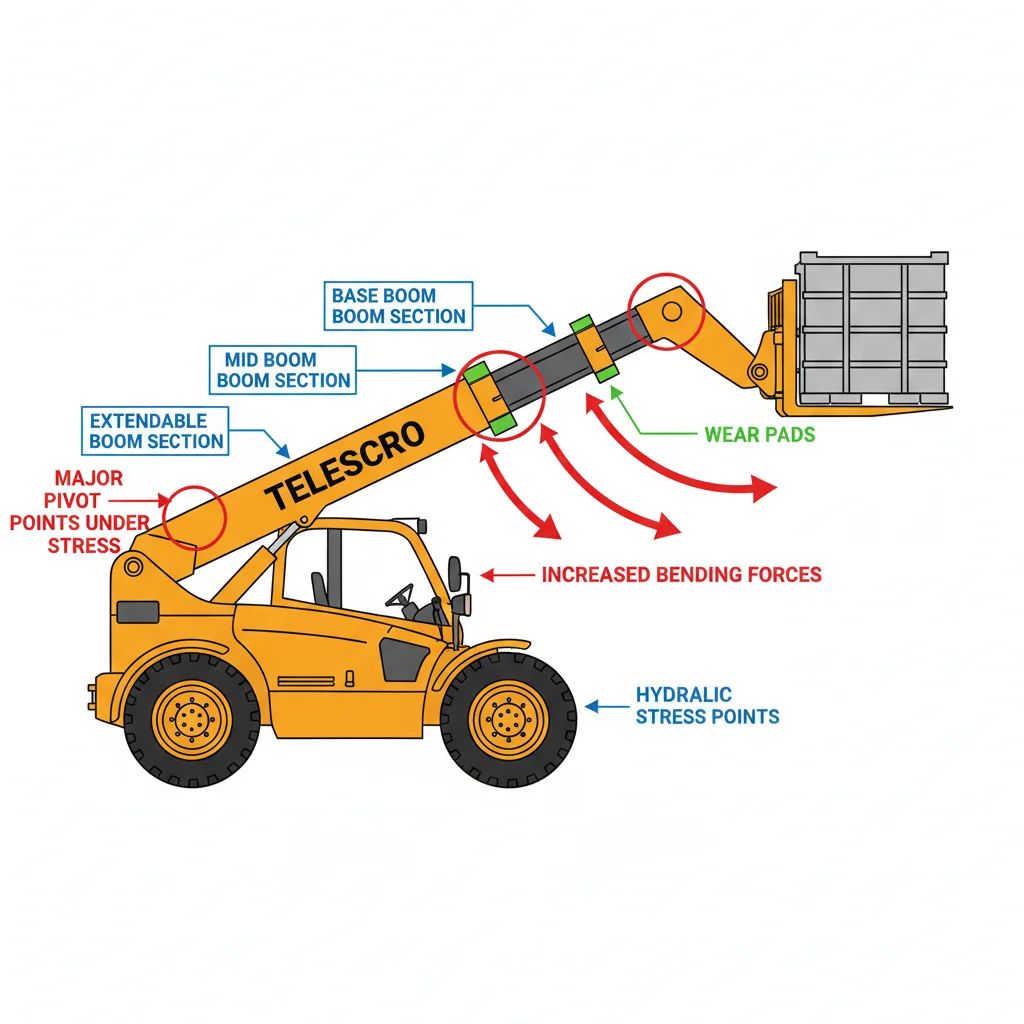
One question I get asked frequently is how regular long-reach work affects telehandler wear. From what I’ve seen on site, the further the boom is operated out—especially near maximum reach with heavier loads—the more stress is placed on boom sections, wear pads, bushings, and key pivot points. The increase in bending force at extended reach accelerates wear compared to work done with the boom more retracted.
I saw this clearly on a structural project in Latin America, where a 4-ton telehandler with a 17-meter boom was used day after day to place steel members at long forward reach. After a few months, operators started reporting rougher boom movement and visible wear marks around the boom heel and pad contact areas. The machine was still working within its load chart, but the duty cycle involved a high percentage of lifts at extended reach, which drove faster wear than the team initially expected.
Extended reach also leaves much less tolerance for side-loading. Tasks like pushing into material, nudging loads into position, or raking with the boom out can quickly accelerate pad wear or introduce uneven loading in the boom sections. I’ve also seen hydraulic systems work noticeably harder under these conditions. When the boom is close to full extension, pumps and valves have to maintain higher load moments, and oil temperatures tend to climb faster during the shift.
When a machine spends most of its time working at long reach, I usually advise treating maintenance as duty-cycle driven rather than hour-based alone. On one site, where extended-reach work accounted for well over half of daily operation, shortening inspection intervals for boom wear pads, pivot pins, and tilt linkages helped catch early wear before it turned into excessive play or costly repairs. The key point is that frequent long-reach operation changes how quickly components wear, and maintenance practices need to reflect that reality.
Operating a telehandler at its maximum forward reach puts much higher forces on boom wear pads and pivot points than working at maximum height with the boom retracted.True
At maximum forward reach, the load creates more leverage (moment) on the boom structure and its supporting components, accelerating wear on pads and bushings more than when the boom is mostly vertical, even at the same load.
The main factor in telehandler wear is total lifting time, regardless of whether the machine is working at maximum reach or retracted boom positions.False
While total hours do affect maintenance cycles, extended work at maximum reach places disproportionately higher stress on structural and moving parts compared to lifting the same loads closer in. Reach position is a critical wear factor, not just runtime.
Key takeaway: Consistent work near maximum reach puts significant stress on a telehandler’s boom structure, wear pads, and hydraulics, demanding shorter greasing intervals and more frequent inspection of critical components. Selecting a model rated for higher capacity at typical working reaches can extend service life and reduce unplanned downtime.
Conclusion
We’ve looked at how telehandlers can lose real lifting ability at full reach, even if max height specs look impressive on paper. From what I’ve seen on jobsites, the crews that avoid problems always double-check load charts—not just the headline stats—because that’s where your real working limits are. My advice is to pay close attention to capacity at the actual reach and height you’ll use most often, and keep a safety margin in mind. If you’re unsure about which model fits your site or need help reading the charts, feel free to reach out. I’m always happy to share what’s worked for real crews. Every jobsite is unique, so let’s find what truly fits your workflow.
References
-
Provides in-depth understanding of tipping axis mechanics and its impact on load stability for construction equipment safety. ↩
-
Details how rated capacity at specific reach distances impacts practical lifting limits, helping operators choose suitable telehandlers. ↩
-
Explore how consulting load charts with safety margins ensures optimal telehandler performance and prevents operational hazards. ↩
-
Understand the critical relationship between forward reach and lifting capacity reduction, supported by real-world telehandler load chart examples. ↩
-
Explore detailed explanations on interpreting telehandler load charts, including how boom angle and reach affect safe lifting capacities. ↩
-
Detailed analysis of cost, maneuverability, and capacity issues caused by choosing excessively tall high-reach telehandlers. ↩