










Telehandler Fixed Jib vs Adjustable Jib: Key Differences Buyers Overlook
Not long ago, a project manager from Poland sent me photos of a broken jib, puzzled over why his telehandler could barely handle the loads it managed last year. Turned out, he’d switched from a fixed to an adjustable jib—thinking “more positions means more productivity”—but hadn’t factored in the real trade-offs.
Fixed jibs1 offer a rigid, unchanging extension, maximizing capacity and stability by eliminating movable joints and hinge points. Adjustable jibs introduce telescoping or luffing mechanisms, providing more reach and access to difficult locations, but these features reduce the safe working load2 as the geometry changes. Safety inspections for adjustable jibs must include all locking and articulation mechanisms, whereas fixed jibs require simpler checks.
What Differentiates Fixed and Adjustable Jibs?
Fixed jibs maintain a constant length and angle, offering reliable, repeatable hook positions for predictable lifting tasks. Adjustable jibs allow changes in length and angle—often through telescoping or luffing—enabling greater versatility for varied or obstructed lifts. The main trade-off is fixed-jib predictability versus adjustable-jib adaptability, with added complexity and inspection requirements for adjustable designs.
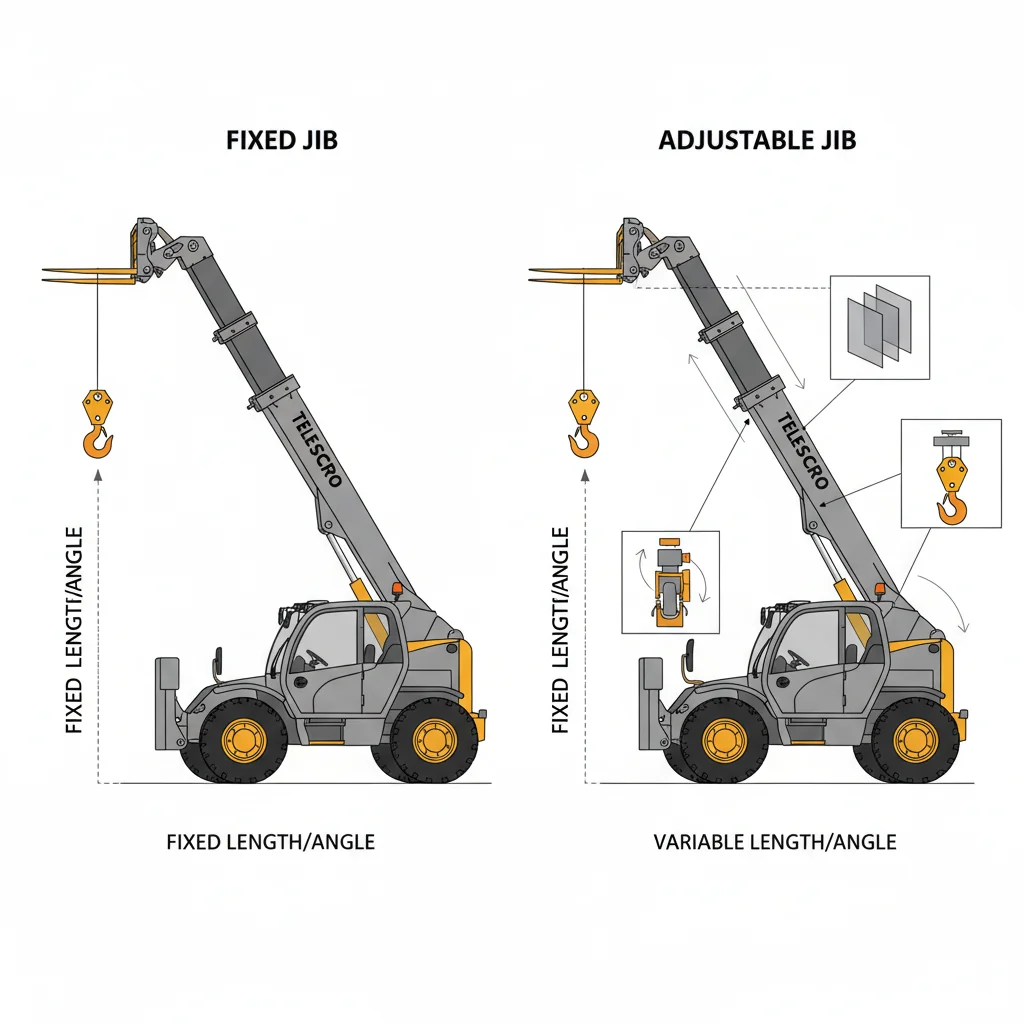
Most people don’t realize that choosing between a fixed or adjustable jib impacts daily workflow more than initial specs suggest. Fixed jibs work like a strong, simple arm—they don’t change shape or size. Whatever the load chart gives you at a set angle and reach, you can trust it’s repeatable, every single lift. I’ve seen steel fabricators in Dubai rely on a standard 2-meter fixed jib because they needed to set similar 1,000 kg beams all day with no variation. They value predictability—no surprises, no time lost reconfiguring. Fixed jibs generally cost less up front and have fewer moving parts, so inspections and maintenance are faster and cheaper too. Adjustable jibs are a different story. Here’s what matters: if your worksite has obstacles—like a contractor I worked with last year in Brazil, navigating tight warehouse aisles—then being able to change length or angle mid-task makes a huge difference. Their adjustable jib covered 2 to 4.5 meters in reach and had three angle positions. They didn’t need a second telehandler or extra movement—the jib did the adapting. Of course, adjustable jibs introduce more complexity: additional locking pins, moving sections, and weight. You need to check that every locking point is secure before each lift. Safety inspectors pay closer attention here—especially with load charts that reduce capacity significantly at the longest, steepest configurations.
Fixed jibs provide a consistent load chart at a specific reach and angle, allowing operators to rely on repeatable lift capacities without recalculating for variable boom positionsTrue
Because fixed jibs have a set length and no adjustable geometry, their load charts remain constant at given angles, offering predictable lift performance that benefits tasks requiring identical repeated lifts.
Adjustable jibs generally increase the maximum load capacity of a telehandler by up to 30% compared to fixed jibs of the same lengthFalse
Adjustable jibs provide variable reach but typically reduce maximum capacity at extended lengths due to mechanical complexity and leverage effects; they do not inherently increase the maximum load capacity over fixed jibs.
Key takeaway: Selecting between fixed and adjustable telehandler jibs comes down to application needs—choose fixed jibs for consistent, repetitive operations and adjustable jibs for projects demanding variable reach or working around obstacles. Consider how much flexibility the working environment genuinely requires before purchase.
Which Telehandler Jib Handles Heavier Loads?
A fixed jib attachment3 typically offers higher safe load capacity and better stability than an adjustable jib on the same telehandler. The rigid, one-piece design minimizes deflection and avoids hinge points that reduce capacity. Adjustable jibs trade load rating for reach; as extension increases, safe working load decreases per manufacturer and regulatory requirements.
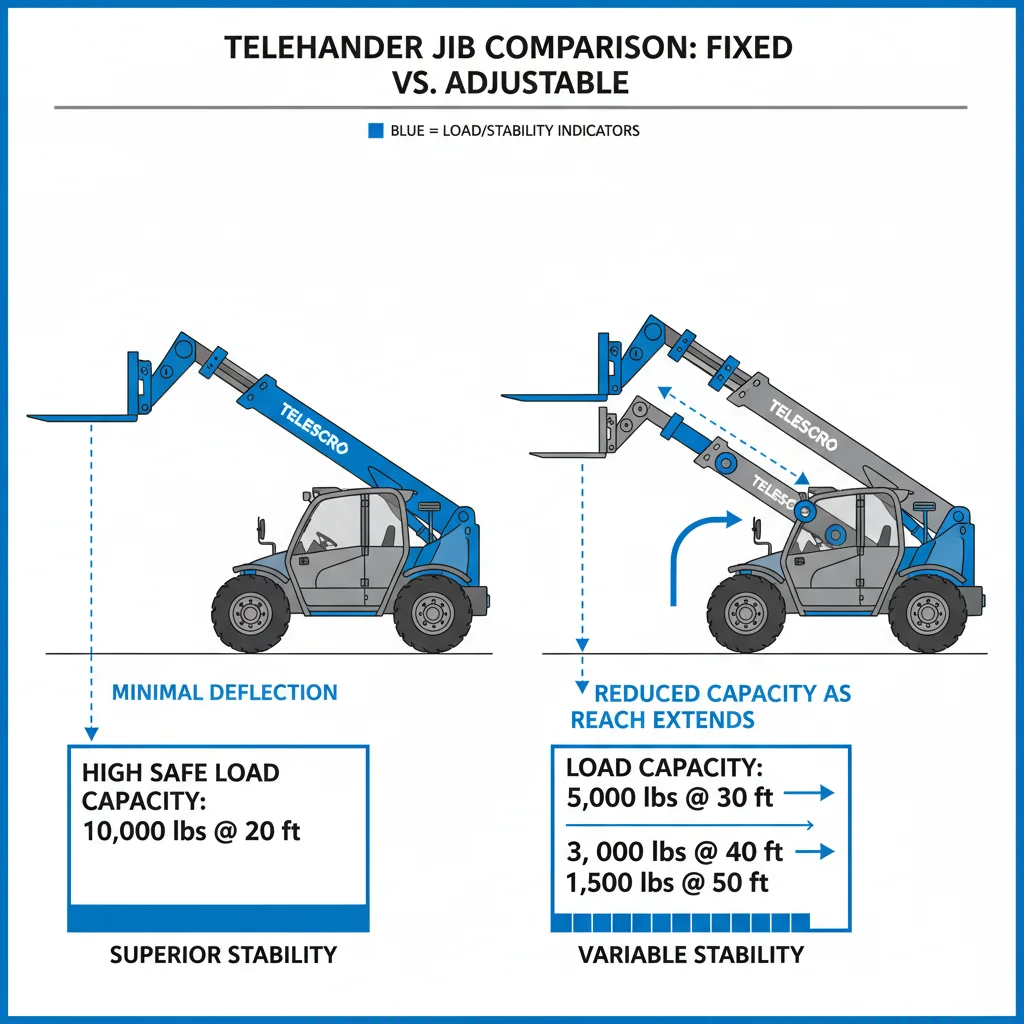
Let me share something important about jib capacity that many buyers overlook. The biggest strength of a fixed jib is how much of the telehandler’s original lifting power it maintains. I’ve seen this proven again and again—especially when customers demand heavy, stable lifting instead of extra reach. For example, a contractor in Dubai needed to move 3-ton HVAC units onto fourth-floor platforms. Using a standard 4-ton telehandler with a fixed 2-meter jib, they lifted loads up to 3,200 kg without exceeding safety limits. When they tested an adjustable model at similar radius, capacity dropped below 2,000 kg due to extension sections and hinge points.
Here’s a quick comparison based on what I see in real jobsites:
| Jib Type | Max Safe Load (on 4t Telehandler) | Max Reach (Typical) | Pros | Cons |
|---|---|---|---|---|
| Fixed | 3,200–3,600 kg | 2–2.5 m | Highest capacity, strong, simple | Limited reach |
| Adjustable | 1,500–2,200 kg (full extension) | 3–4.5 m | Flexible, adaptable reach | Reduced capacity, more complex |
Adjustable jibs are great if you need versatility—like lifting smaller items into awkward spaces or over fences. But every extra joint or extension reduces your allowable load, often sharply at the furthest positions. I always remind operators to check the load chart (that’s the chart showing capacity at every angle and extension). If weight is your main concern—moving blocks, beams, or industrial equipment—a fixed jib keeps things safer and simpler. My advice: Choose fixed for maximum load, adjustable for flexibility, but always check real-world capacity before committing.
"FixedFalse
"Fixed
Adjustable jibs generally handle heavier loads than fixed jibs because their telescoping capability allows operators to position loads closer to the machine’s center of gravity.False
Adjustable jibs extend the reach but increase the load moment arm, reducing lifting capacity. Positioning the load further out actually decreases stability and rated capacity, so they typically handle lighter loads than fixed jibs registered for the same telehandler.
Key takeaway: Buyers prioritizing lifting heavier loads and maximum stability should select a fixed jib over an adjustable model. Fixed jibs preserve more of the telehandler’s rated capacity by minimizing load-reducing joints and extensions, making them a safer, more robust choice when reach is less important than safe load handling.
When Does an Adjustable Telehandler Jib Pay Off?
An adjustable telehandler jib is most valuable on sites with frequently changing load positions, obstacles, or task requirements. Luffing and telescopic jibs5 enable precise placement over formwork, scaffolding, or equipment without repositioning the telehandler. For operations with repetitive, similar lifts, a fixed jib typically offers faster setup and fewer errors at a lower cost.
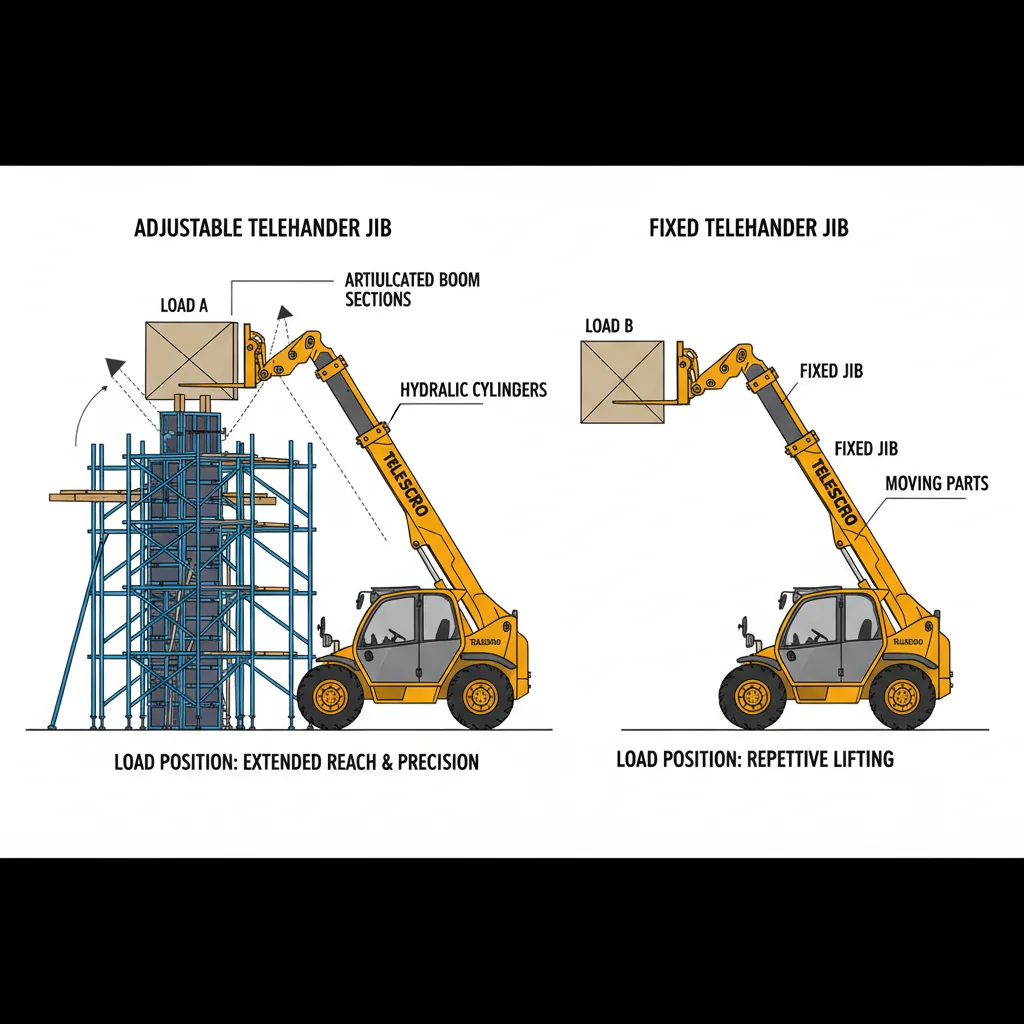
Here’s what matters most when deciding if an adjustable telehandler jib is really worth it: how often your tasks actually require different lift positions and outreach. In Dubai last year, one of my customers worked on a busy mixed-use high-rise. Their crew had to place heavy HVAC units behind temporary safety rails, then shift pallets of tile over scaffolding—all on the same day. With a luffing and telescopic jib, they adjusted the reach and hook height in minutes. The result? No wasted time repositioning their 4-ton telehandler, and no squeezing machinery into cramped spots. Compared to fixed jibs, this saved them at least a day per week on complex lifts.
Contrast that with a logistics hub I supported in southern Brazil. Their team mostly offloads 1-ton containers onto identical storage racks, always from the same angle. They initially thought they needed adjustability, but after mapping their twelve most common lifts, I pointed out nine were identical. In cases like this, a fixed jib does the job faster—less time setting angles, less risk of operator error, and a lower upfront cost (about 30% less for most models).
Technical details matter too. For sites using highly variable outrigger settings or irregular ground (think Kazakhstan’s mining projects), the extra hydraulic circuits and moment indicators on adjustables do pay off—but only if the variability is real, not just “nice to have.” My honest suggestion? Write out your top 15 jobsite lifts. If more than half demand different outreach or height, adjustable is smart. If not, fixed saves cash—and you can always rent specialty jibs when that rare tricky lift comes up.
An adjustable telehandler jib with both luffing and telescopic capabilities allows operators to modify outreach by up to 50% and hook height by several meters, enabling complex lift positions without repositioning the entire machineTrue
Combining luffing (angle adjustment) and telescoping (length adjustment) in a jib gives operators fine control over load placement, increasing versatility and reducing downtime, especially in congested or multi-task job sites.
False
"While
Key takeaway: Adjustable jibs deliver superior flexibility on dynamic job sites where lift heights and outreach vary often. However, if most lifts follow repeating patterns, buyers benefit more from the speed and simplicity of fixed jibs—supplementing with rentals for the occasional specialized task as needed.
How Do Telehandler Jib Types Affect Safety?
Fixed jibs require basic visual inspections and torque checks, with fewer moving parts minimizing setup errors and potential failures. Adjustable jibs, however, introduce multiple failure points including pins, locking collars, and articulating joints, requiring more frequent inspections and operator retraining. Incorrect adjustment on adjustable jibs can lead to capacity overloads, structural damage, or tip-over risk in telehandler operations.
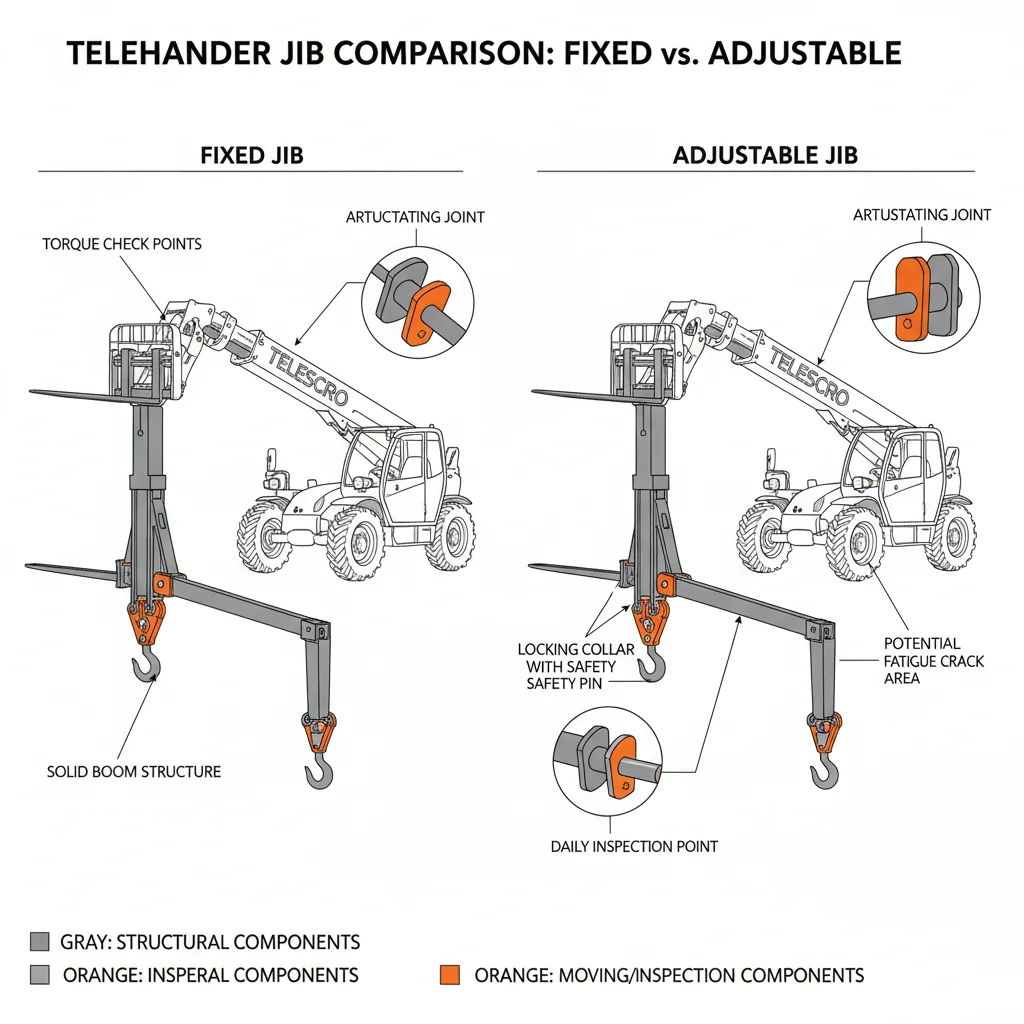
The biggest mistake I see is assuming all telehandler jibs are the same when it comes to safety checks. That’s just not the case. Fixed jibs are much more straightforward—I’ve seen crews in Dubai get set up in under 15 minutes. The routine? Quick visual inspection, look for cracked welds, check the bolt torque with a wrench, verify the shackle, and confirm the hook is intact. Fewer moving parts mean fewer opportunities for something to go wrong on the jobsite. Adjustable jibs, though, demand a lot more attention. Last year in Kazakhstan, a team was lifting prefab panels with a 5-meter adjustable jib attached to a 4-ton telehandler. One pin was only partially seated—nobody noticed during the pre-shift. Unfortunately, the load shifted, damaging the pin and ovalizing the hole. Repairs and lost time cost them over $2,000. When you have sliding sections, articulating joints, and locking collars, the list of things that can fail grows fast, especially with heavy use and vibration. I always tell customers: double-check every adjustment point, every time.
Let’s compare the key safety factors side by side:
| Jib Type | Inspection Focus | Failure Points | Operator Risk | Inspection Frequency |
|---|---|---|---|---|
| Fixed | Structure, bolts, welds, hook | Minimal | Low if inspected | Every 200–300 hours |
| Adjustable | Pins, collars, joints, extension | Multiple (pins, joints) | Higher—misadjustment | Every 100 hours or less |
I suggest retraining operators when you switch to adjustable jibs and tightening your inspection schedule.
Fixed telehandler jibs typically require fewer safety inspections per shift than adjustable jibs due to having 30-40% fewer moving components prone to wearTrue
Fixed jibs have a simpler design with minimal moving parts, reducing the frequency and complexity of inspections needed to identify potential failures from wear or loosening, unlike adjustable jibs which include telescoping mechanisms or pivot points.
Adjustable telehandler jibs do not require shackle checks since the adjustment mechanisms eliminate the need for traditional lifting hooksFalse
Despite their adjustable nature, adjustable jibs still use standard lifting hooks and shackles, which must be regularly inspected for integrity and proper torque to ensure safe load handling. The adjustment mechanisms supplement but do not replace these safety-critical components.
Key takeaway: Fixed jibs offer simpler safety maintenance due to fewer moving parts, while adjustable jibs require more intensive inspections and operator training. Overlooking these differences can increase risk of equipment failure or operator error, making tailored safety protocols and frequent checks especially important for adjustable telehandler jibs.
What Are Fixed vs Adjustable Jib ROI Trade-Offs?
Fixed telehandler jibs are typically 15–30% less expensive to acquire and maintain than adjustable models, making them ideal for repetitive, high-volume tasks. Adjustable jibs, while costlier and requiring more care, can reduce equipment needs and increase site flexibility, potentially offering higher long-term return if project demands justify the investment.

To be honest, the ROI difference between fixed and adjustable jibs comes down to the kind of jobs you’re running and how predictable your site is. A few months ago, I spoke with a fleet manager in Kazakhstan doing high-volume precast panel work. They used two fixed jibs on their 4-ton telehandlers, lifting the same 1,200 kg loads, hour after hour. Their feedback? Fixed jibs rarely broke down, needed almost no daily adjustments, and cost roughly 20% less than adjustable jibs—both to buy upfront and to keep running. That kind of reliability is gold when every minute of downtime delays your whole schedule. But I’ve seen another side—especially on changeable sites.
Last year in Dubai, a contractor tackled a tight residential project where lift points and entry spaces changed every week. He invested in adjustable jibs with folding sections. Initially, the higher price was a sticking point. However, being able to switch reach or angle without swapping attachments saved him at least two extra machine hires and a couple of days’ setup per month. He told me the added servicing—greasing pins, checking welds—was worth it because one adjustable unit handled everything from HVAC install to balcony glass lifts.
Here’s how fixed and adjustable jibs stack up on ROI:
| Jib Type | Best For | Upfront Cost | Maintenance Needs | Downtime Risk | Flexibility |
|---|---|---|---|---|---|
| Fixed | Repetitive, high-volume | Low | Minimal | Very low | Limited |
| Adjustable | Variable, complex projects | Medium | Pins & joints | Low–moderate | High |
Fixed jibs typically reduce maintenance costs by about 20% compared to adjustable jibs due to fewer moving parts and less frequent on-site adjustmentsTrue
Fixed jibs have simpler mechanical designs without articulation points, which lowers the chance of wear and breakdowns during repetitive tasks, as shown in high-volume precast panel handling operations. This simplicity translates directly into reduced downtime and maintenance expenses.
Adjustable jibs always provide higher ROI than fixed jibs because their flexibility leads to faster job completion on any siteFalse
While adjustable jibs offer versatility, their complexity can increase maintenance and adjustment time, particularly on predictable repetitive jobs where the flexibility advantage is minimal, sometimes resulting in lower ROI compared to fixed jibs optimized for specific tasks.
Key takeaway: Fixed jibs minimize costs and downtime in predictable, repetitive operations, while adjustable jibs justify their premium when versatility, transport ease, or multi-tasking impact project margins. Strategic fleets often combine both: fixed jibs for daily efficiency and adjustable jibs for complex or peak-season work, while factoring in operator training and scheduled inspections.
How Do Jib Types Handle Space Constraints?
Adjustable and articulating telehandler jibs7 excel in congested environments by allowing operators to maneuver loads around obstacles such as columns, piping, or machinery. Fixed jibs and compact fixed extensions, however, require less floor space and can be installed near walls or ceilings. The optimal choice depends on whether site challenges involve overhead clearance or limited horizontal workspace.
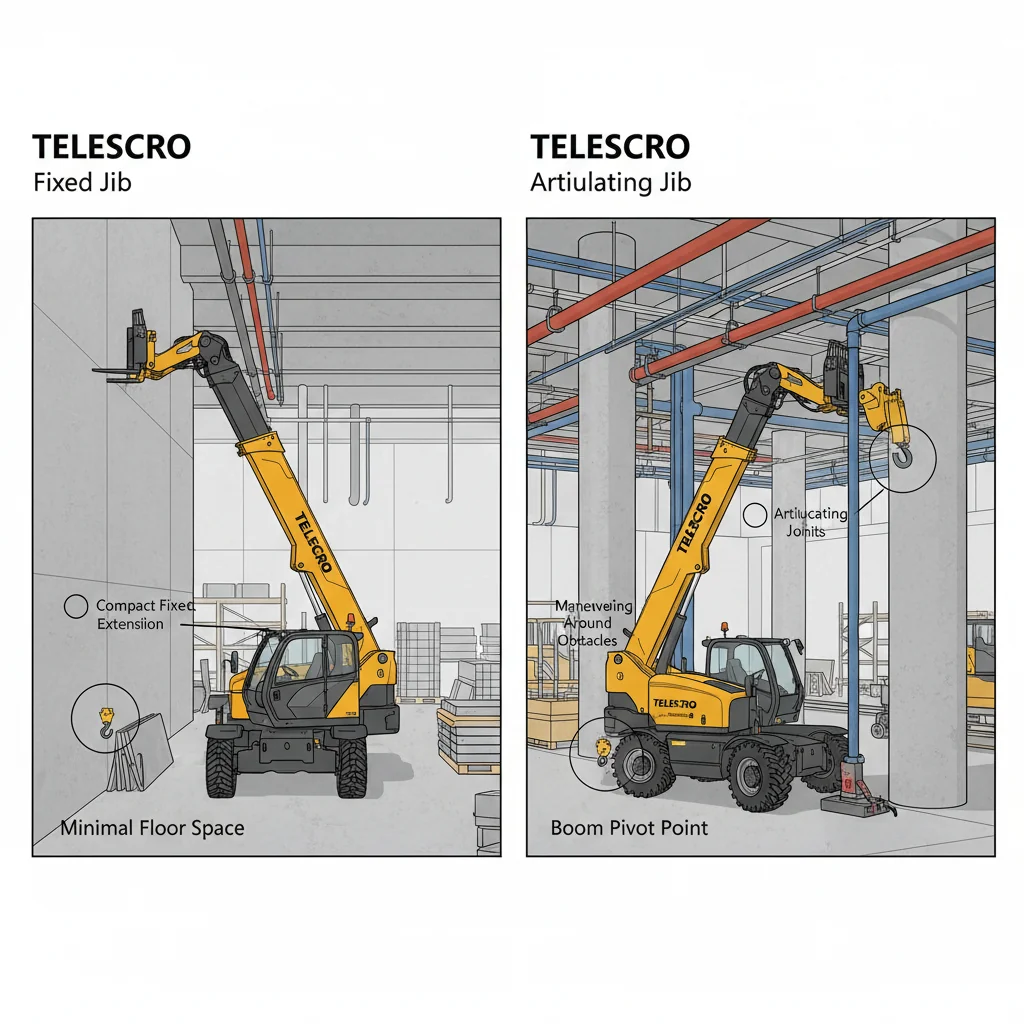
Last month, a contractor in Dubai asked me which jib type would let him unload HVAC units in a crowded plant room. The jobsite was packed—piping overhead, a wall just two meters from the access point, and barely any floor space. This is exactly where adjustable and articulating jibs shine. I recommended an articulating extension with a luffing function. It let his team position loads under low beams and shift sideways, threading through confined gaps. Without that flexibility, even a 4-ton telehandler with an 18-meter boom wouldn’t have reached the set-down point.
But sometimes simple is better. On projects in Brazil’s older factories, I’ve seen crews go with compact fixed jibs. These models are just 1.2 to 1.5 meters long and mount close to ceilings or along walls. They work well when space on the ground is at a premium, but overhead isn’t blocked. Operators can work inches from walls and still keep loads clear of other machinery.
Here’s a quick comparison based on what I’ve seen on actual sites:
| Jib Type | Best for | Capacity (typical) | Reach | Maneuverability |
|---|---|---|---|---|
| Articulating/Adjustable | Obstacle-rich, overhead pipes | Up to 2,500 kg | 2–4 m arc | Excellent (luffing) |
| Compact Fixed | Near-wall, minimal floor space | Up to 3,000 kg | 1.2–1.5 m | Good (straight) |
| Standard Fixed | Open, unobstructed settings | 3,000–4,000 kg | 2–2.5 m | Moderate |
My advice? Always map out exactly where the real barriers are—overhead or at ground level—before picking a jib. That decision will save costly rework and wasted site time.
Adjustable jibs with articulating joints can increase operational reach by up to 30% in congested environments compared to fixed jibsTrue
The articulating sections and luffing movements of adjustable jibs enable operators to maneuver loads around obstacles and into tighter spaces, effectively extending reach where a fixed jib would be blocked. This capability often translates to a 20-30% increase in usable positioning range.
Fixed jibs are always lighter than adjustable jibs, making them the preferred choice for jobs requiring high mobilityFalse
While fixed jibs have a simpler structure, adjustable jibs use advanced materials and design to minimize weight differences. In some cases, adjustable jibs can be comparable in weight to fixed jibs, and preference depends more on operational flexibility than solely on weight.
Key takeaway: Selecting between adjustable and fixed telehandler jibs depends on specific space limitations. Adjustable jibs provide flexibility in navigating tight, obstacle-rich environments, while compact fixed jibs suit sites with minimal floor space. Analyze whether obstructions are overhead or on the ground to choose the most effective solution.
How Do Rotation and Adjustment Limits Differ?
Rotation and adjustment capabilities of telehandler jibs vary based on type and mounting. Freestanding fixed jibs8 often allow 360° rotation, while wall-mounted or articulating adjustable jibs are typically limited to 180–200°. Some fixed jibs offer preset angle installation. Adjustable jibs may only be altered when unloaded, whereas select designs support adjustments under load.
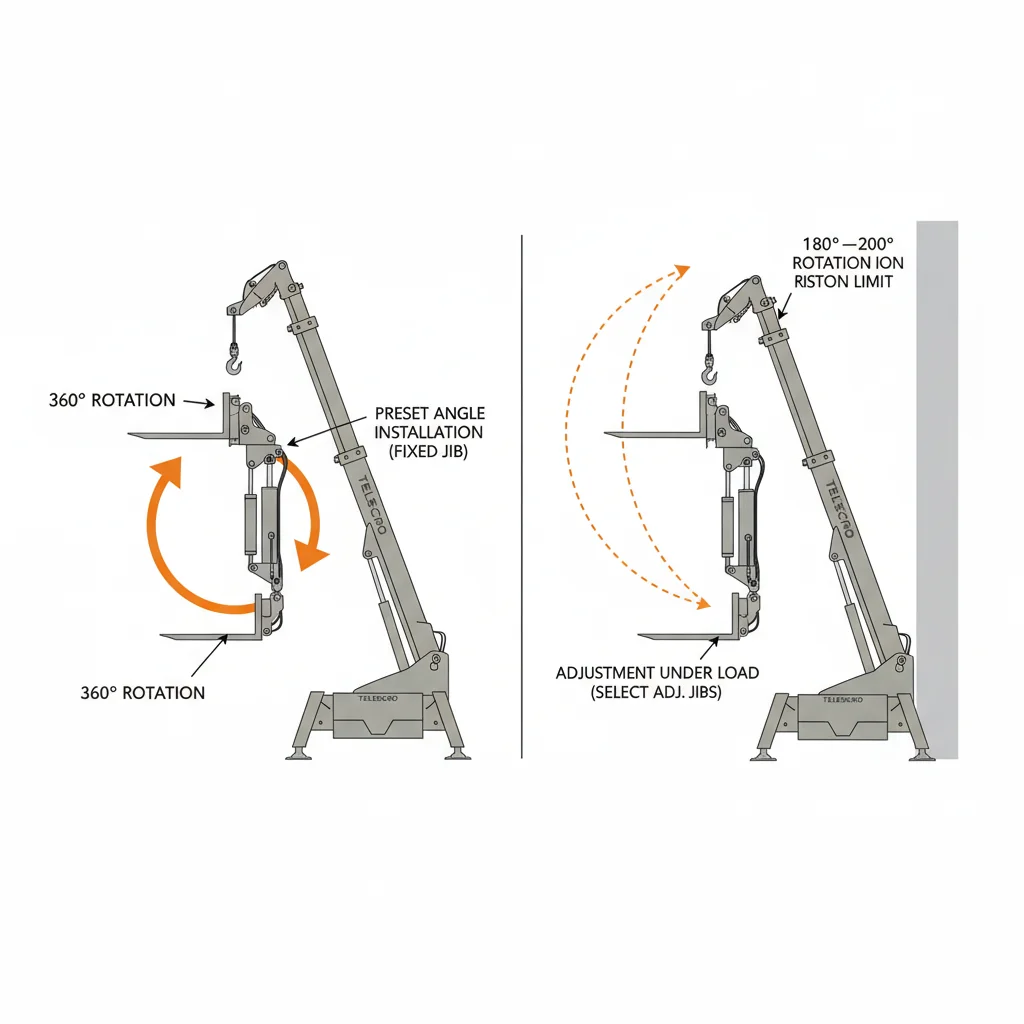
I’ve worked with customers who made this mistake—assuming their jib would swivel full-circle, only to run into hard stops mid-operation. In Kazakhstan, a builder upgraded to a wall-mounted jib for material staging along a warehouse bay. The team expected to sweep loads 270°, but the mounting only offered about 190°, limited by adjacent columns. That missed arc forced them to reposition the telehandler several extra times each shift. On a job moving heavy pipe sections—at least 800 kg per lift—they lost almost two hours per day just on setup workarounds. It doesn’t sound like much, but over a three-month contract, that chewed up weeks of productivity.
Rotation isn’t the only catch. With freestanding or mast-mounted fixed jibs, you often get full 360° movement—sometimes even with the load suspended, thanks to heavy-duty slewing bearings or hydraulic slewing drives. These setups shine on open sites, like concrete yards in Brazil, where operators need to move bundles around obstacles without constant repositioning. However, most adjustable-height or length jibs—especially those bolted or welded to a main frame—can only be repositioned while unloaded. The mechanical design prioritizes safety: you don’t want to fight gravity and load swing just to save a minute.
From my experience, the questions I ask before recommending a jib: Do you need to change reach or angle during a lift, or only between jobs? Will you work in tight structural bays, or open ground? I always suggest reviewing the manufacturer’s load chart and installation diagrams carefully—those details protect both workflow and safety.
Fixed jibs typically have a restricted rotation arc, often limited to around 190°, to maintain structural stability and to avoid interference with nearby obstacles.True
Fixed jibs are mounted in a way that limits their swivel to prevent collisions or damage, often less than a full 270° rotation, especially when mounted near columns or walls, ensuring safe operational boundaries.
Adjustable jibs can always rotate a full 360° regardless of their mounting location or nearby obstructions.False
Although adjustable jibs provide enhanced flexibility via hydraulics or mechanical linkages, their rotation limits depend heavily on mounting constraints and surrounding structures, so they rarely achieve unrestricted 360° rotation in confined spaces.
Key takeaway: Choosing between fixed and adjustable jibs requires understanding rotation and adjustment restrictions. Rotation range depends on jib mounting, and adjustment methods may be limited to unloaded conditions. Overlooking these details may cause workflow delays or safety hazards during telehandler operations.
How to Size and Specify a Telehandler Jib?
Correct jib selection for telehandlers requires matching the jib’s rated capacity to the base machine, ensuring full compatibility with quick-attach systems and hydraulic circuits. Always consult the attachment-specific load chart for capacity changes at different boom angles and extensions. Oversizing or undersizing compromises stability, may void warranties, and affects safe operation.

From my experience, buyers sometimes assume any jib will fit their telehandler as long as the rated capacity looks high enough. That’s a risky shortcut I’ve seen cause problems on jobs in Kazakhstan and Vietnam. It’s not just about lifting more—matching the jib’s rated load to your base machine is absolutely critical. For example, a 5-ton telehandler (about 11,000 lbs) shouldn’t use a heavy-duty jib intended for an 8-ton class. That setup can shift the load center forward and trigger the machine’s moment indicator, which immediately stops further operation for safety.
In Kenya, a rental yard I worked with once paired a standard adjustable jib with a 4-ton compact machine. They overlooked that the quick-attach locking pins were the wrong diameter—by just a few millimeters. As soon as they tried to boom out to 12 meters, side play in the connection introduced dangerous instability. That’s why I always tell customers: check both the mechanical interface (quick-attach system9) and, if hydraulic controls are needed, make sure hose diameters and couplers match the telehandler’s auxiliary circuit.
Consulting the attachment-specific load chart is equally important. Capacity at maximum outreach or boom angle can drop by 50% compared to minimum—so that “3-ton jib” might only safely handle 1.5 tons fully extended. Before deciding, share your typical load weights, preferred max height, and average outreach with the supplier. I suggest verifying specs under real conditions, not just brochure numbers. That attention to detail keeps jobs running smooth and safe.
Adjustable jibs typically offer between 0° to 30° of angle variation, allowing operators to fine-tune load positioning and reduce strain on the telehandler’s boom compared to fixed jibsTrue
The ability to change the angle of the jib helps maintain the machine's balance and optimize load center, which is critical for preventing stability issues and extending telehandler life. Fixed jibs lack this adaptability, limiting operational flexibility.
Fixed jibs are generally lighter than adjustable jibs because they are made using hollow aluminum alloy rather than steel, which is only used in adjustable modelsFalse
Most jibs, whether fixed or adjustable, are fabricated from steel due to its strength and durability. Aluminum alloy is rarely used because it does not provide the necessary structural rigidity and wear resistance for heavy lifting attachments.
Key takeaway: Matching jib capacity and interface to the telehandler base machine is crucial for safe, efficient operations. Always verify load charts, attachment compatibility, and consult reputable manufacturers for advice tailored to typical load weights, heights, and outreach requirements. Incorrect jib selection can undermine warranty coverage and overall machine stability.
Conclusion
We’ve looked at the key differences between fixed and adjustable telehandler jibs, and how each fits different jobsite needs. From what I’ve seen, the buyers who avoid headaches are those who go beyond the brochure—double-checking load charts and making sure parts don’t turn into “parts roulette” after the first year. Before deciding, I suggest you think about where you really need flexibility, and how often those site conditions change.
If you’re weighing options or want an honest view about attachment choices, feel free to reach out. I’m always happy to help share what’s actually worked for crews in the field. Every site is different—choose what truly fits your workflow.
References
-
Explore how fixed jibs provide predictable lifting and lower maintenance, ideal for repetitive construction tasks with consistent loads. ↩
-
Details how safe working load ratings impact lifting capacity and safety, helping buyers choose the right jib for their needs. ↩
-
Explains why fixed jib attachments offer higher load capacity and stability, crucial for heavy lifting in construction projects. ↩
-
Learn how correct rated capacity matching prevents load center shifts, warranty voids, and ensures safe telehandler jib operation. ↩
-
Learn how luffing and telescopic jibs enable precise load placement in tight spaces, reducing repositioning and boosting site productivity. ↩
-
Explore detailed cost savings and maintenance benefits of fixed telehandler jibs for high-volume construction tasks. ↩
-
Explore expert insights on how articulating jibs enable precise load handling in congested sites, improving operational efficiency. ↩
-
Explore how freestanding fixed jibs provide 360° rotation and enable load handling under full swivel, boosting efficiency on open worksites. ↩
-
Explore the technical design and safety role of quick-attach systems in telehandler attachments to avoid costly mismatches and instability. ↩