











Telehandler Customization in China: Field Guide to Factory Options
Last month, I got an urgent call from a Norwegian fleet manager struggling to find a telehandler that could handle both heavy construction work and occasional farm tasks—without blowing his budget. His main question: how much can Chinese factories actually tailor these machines to real-world needs?
Chinese telehandler manufacturers commonly support a broad range of modular customization options as a standard practice. Leading brands and smaller factories alike enable customers to select boom lengths, lifting capacities, powertrain choices, and diverse attachment packages tailored for industry-specific requirements. Most customization operates within existing machine platforms, utilizing pre-engineered configurations to ensure quality and cost-effectiveness. Full engineering changes1—such as new chassis or structural elements—are available but subject to higher minimum orders, increased cost, and
Do Chinese telehandler factories offer customization?
Most major Chinese telehandler manufacturers now treat customization as a standard service, not a premium add-on. Brands like SANY, XCMG, Telescro, and Welift market configurable boom lengths, tailored lifting capacities, and job-specific attachment packages as key differentiators. Customization typically works within pre-engineered chassis and powertrain platforms for fast, cost-efficient delivery.
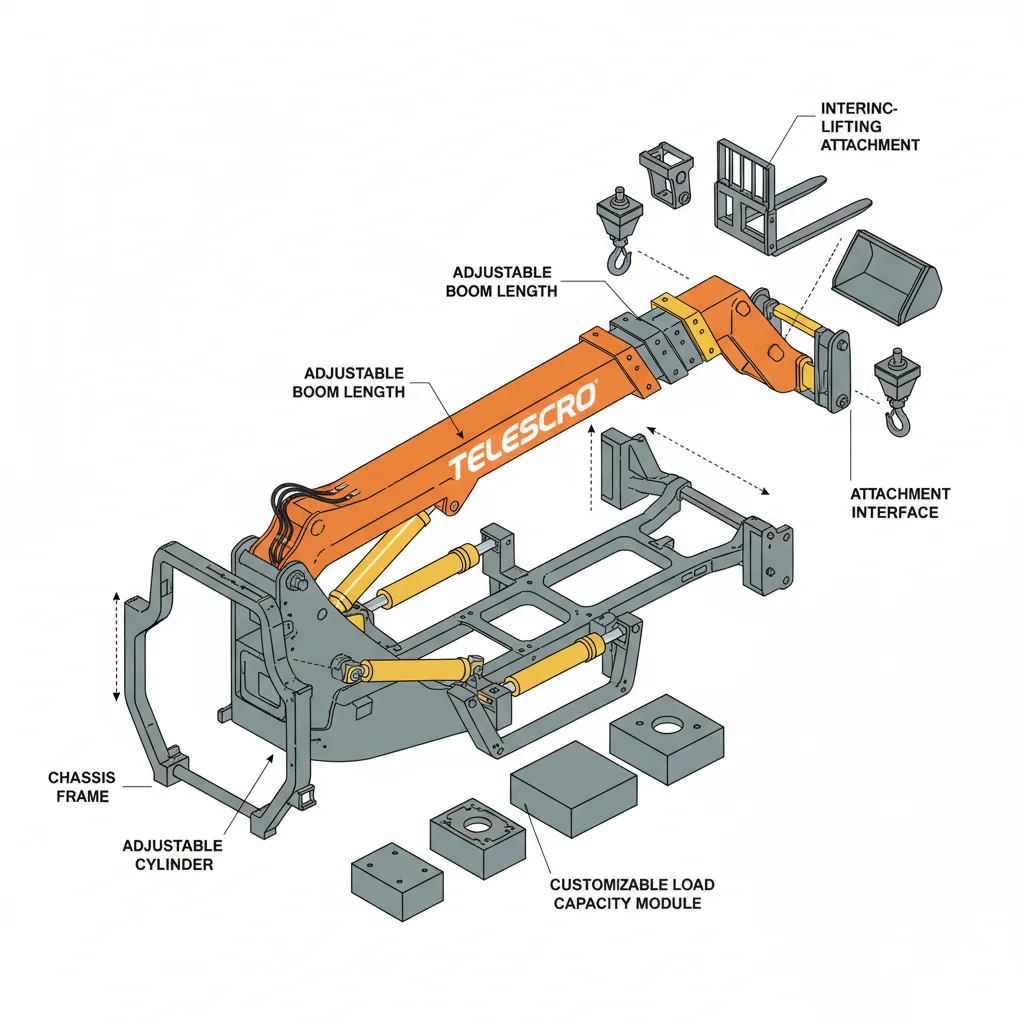
Most people don’t realize that in China, customization for telehandlers isn’t just possible—it’s the standard for almost every order over three units. I’ve worked with buyers in Brazil and Dubai who assumed a tailored machine would cost double and take months. In reality, for a 4-ton telehandler, you might specify a 13-meter or 16-meter boom and get hydraulic quick-couplers2, a climate package, or even unique paint branding—all within six to eight weeks. The base chassis, boom section, and powertrain (usually Yuchai or Cummins engines, rated between 75–110 kW) stay consistent, but nearly everything else can be tweaked. Let me share something important from a recent job in Kazakhstan.
The client needed a high-reach unit—18 meters—capable of handling pallets in winter. He required an enclosed cab, robust heating, and oversized snow tires. We coordinated with the factory to include a dedicated hydraulic circuit for a side-shift fork and a load moment indicator3 to pass local safety checks. The cost stayed about 30% less than the lowest European quote. Custom options like this are now common, especially for agriculture and rental fleets wanting buckets, winch kits, or concrete skips. To be honest, Chinese factories rarely engineer a machine fully from scratch unless you’re talking 50+ units. That’s not really necessary for most customers. Instead, you leapfrog from a long menu: boom sizes (7, 12, 15, or 18 meters), rated capacity (2.5, 3.5, 4, or even 5 tons), and attachments matched to your market.
Chinese telehandler factories typically deliver customized units, like 4-ton models with 13 or 16 meter booms and hydraulic quick-couplers, within a 6 to 8 week lead timeTrue
Chinese manufacturers have streamlined customization processes, enabling tailored telehandler specifications such as boom length and hydraulic attachments to be integrated efficiently within industry-competitive delivery schedules.
Customization of telehandlers in Chinese factories usually doubles the price and extends delivery times to over six monthsFalse
Contrary to common assumptions, customization rarely doubles costs or drastically extends delivery; competitive manufacturing practices in China keep the price increase moderate and delivery times around one to two months.
Key takeaway: Leading Chinese telehandler factories routinely offer customization, allowing buyers to specify boom sizes, load capacities, and attachments within proven platforms. This flexibility—paired with 20–40% lower prices than Western brands—makes tailored machines accessible for a wider range of projects and contractors.
Which Telehandler Parts Are Customizable in China?
Chinese telehandler factories typically offer modular customization in key areas such as boom length, rated load4, and attachment interfaces—including forks, buckets, and man baskets. Additional factory options include engine brand, emissions compliance (Euro V, EPA Tier 4), drivetrain configuration (2WD/4WD), paint color, decals, company logos, and operator cab details, supporting diverse client requirements efficiently.
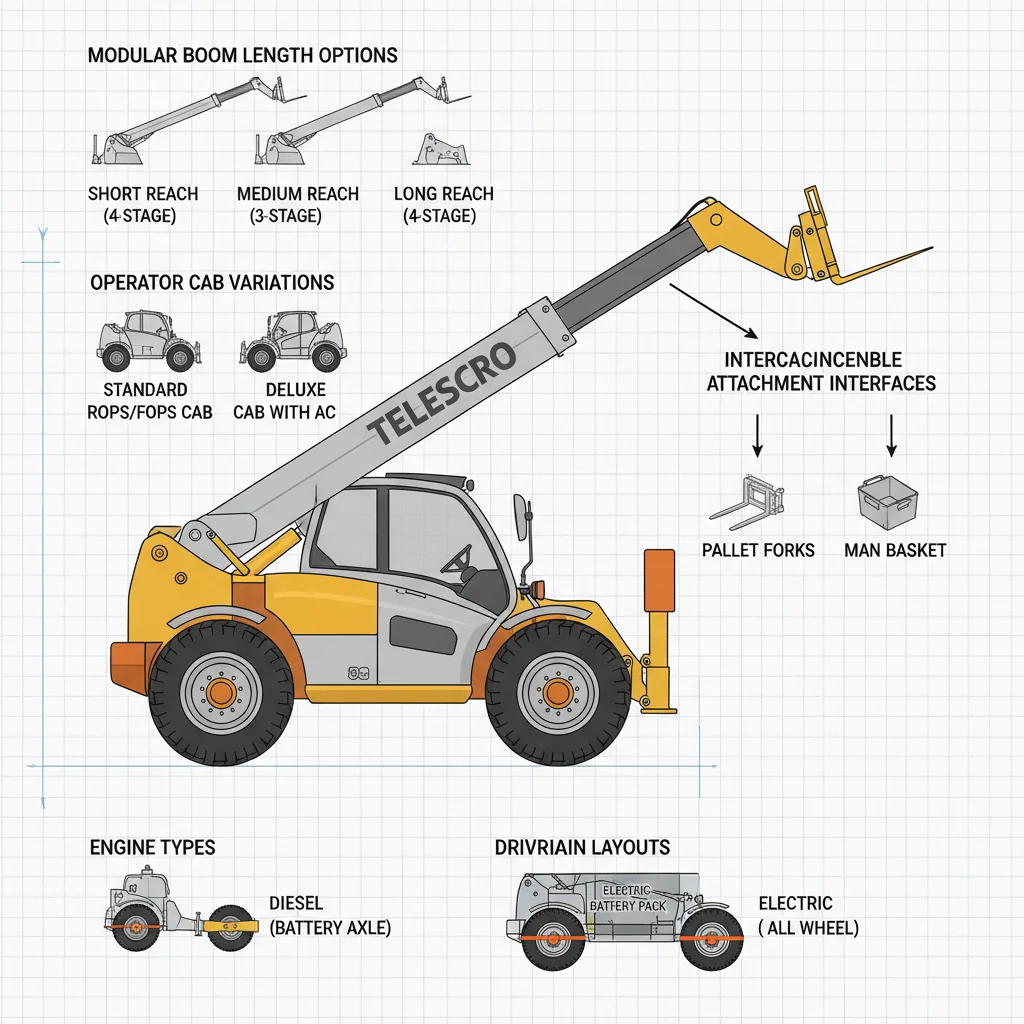
Let me share something important about customization in Chinese telehandler factories—they really focus on modular systems so you don’t have to reinvent the wheel with every order. I’ve worked with a customer in Kazakhstan last year who needed extra boom length but a compact chassis. The local jobsite had tight access and required a 10-meter lifting height, but the site manager wanted to keep overall length under 5 meters for transport. Luckily, the factory offered a pre-validated 10-meter boom module with a 3.5-ton rated load, all fitted onto a standard compact frame. That order didn’t cost much more than the base model, and delivery only took an extra three weeks.
Here’s a simple breakdown of the most common areas you can customize directly from the factory:
| Component | Typical Options | Customization Impact | Availability |
|---|---|---|---|
| Boom length | 7–18 meters | Higher reach or tighter footprint | Very common |
| Rated load | 2.5–4.5 tons | Lift heavier/lighter materials | Very common |
| Attachment interface | Forks, buckets, baskets, clamps | Handle different jobsite needs | Very common |
| Engine & emissions | Regional brands, Euro V/Tier 4 | Regional fuel & compliance fit | Common |
| Drivetrain | 2WD, 4WD | Traction & off-road adaptation | Common |
| Paint & decals | Any color, custom logos | Matches company branding | Common |
| Cab & controls | Heat/AC, L/R drive, joystick | Operator comfort, safety upgrades | Usual |
Chinese telehandler factories frequently use modular component designs that allow clients to combine standardized booms with customized chassis dimensions, enabling configurations like a 10-meter boom on a compact under-5-meter chassis for tight jobsite accessTrue
Modular systems in Chinese telehandler manufacturing standardize parts interfaces, so verified boom lengths can be paired with tailored chassis sizes without redesigning the entire machine, reducing lead times and ensuring reliable performance.
Customization in Chinese telehandler manufacturing always requires a complete redesign of the hydraulic system to accommodate different boom lengthsFalse
Because modular design principles include standardized hydraulic connections and components, factories can often fit various boom lengths without overhauling the entire hydraulic system, streamlining customization and maintaining system integrity.
Key takeaway: Chinese telehandler manufacturers provide modular, pre-validated factory customization for both performance-critical and cosmetic components. Buyers can select major specs like boom reach, load ratings, powertrain, and operator features without significant cost or risk, thanks to established bill-of-materials and robust vendor testing procedures.
How Flexible Are Telehandler Factory Customizations?
Chinese telehandler factories distinguish between modular options—such as standard booms, attachments, or pre-approved engines—and full engineering changes like custom chassis or unique cabs. Modular customization is quick and economical, often for single units. Genuine engineering modifications require new design, significant lead times, and minimum order quantities, making them less feasible for low-volume orders.
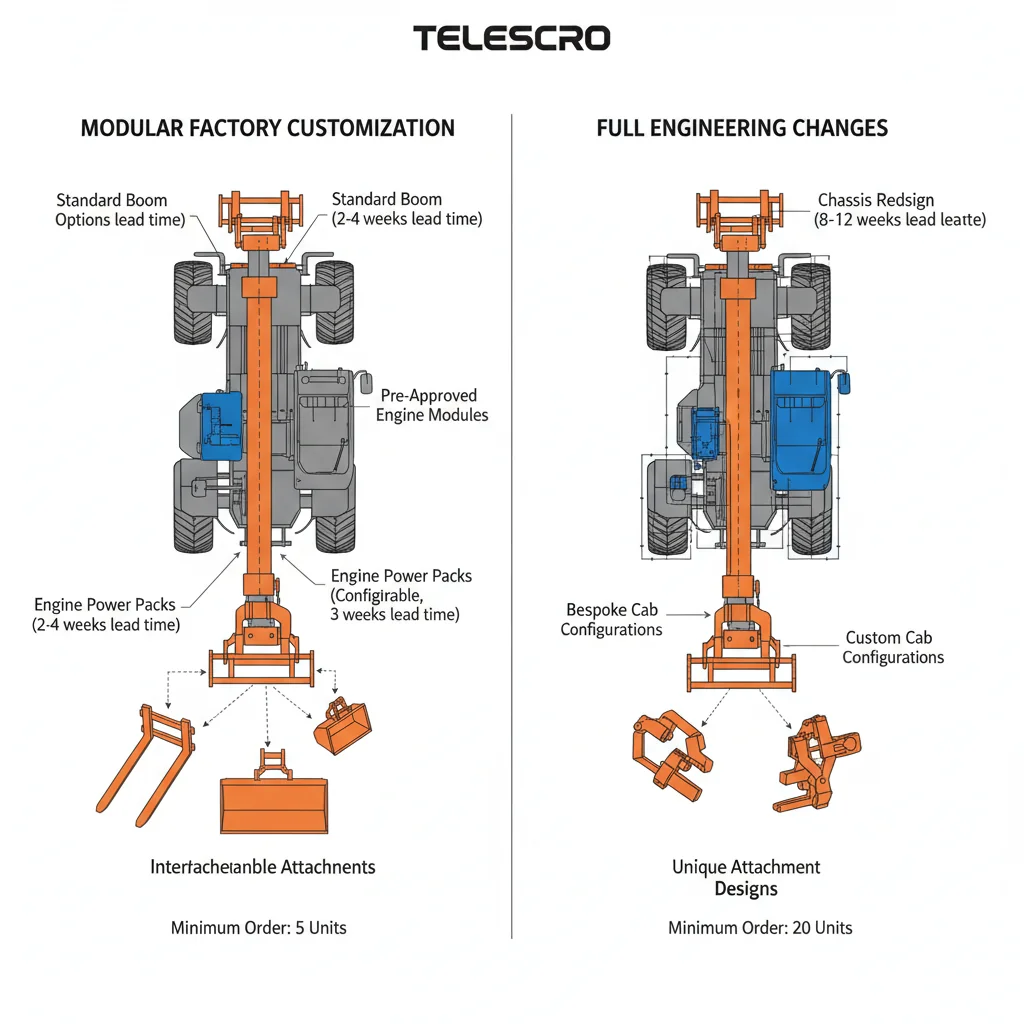
Here’s what matters most when talking about telehandler customizations from Chinese factories: there’s a big difference between swapping modular options and requesting full-scale engineering changes.
Modular choices are things factories already know—alternative booms, pre-approved engines, hydraulic quick-couplers, or attachments like buckets and winches. I’ve seen customers in Kazakhstan order a 3.5-ton telehandler, then ask for a side-shift fork carriage and enclosed cab with factory heater. That type of request barely adds a week or two to delivery. For modular changes, the factory just pulls from existing design libraries and parts bins—costs stay low, and minimum order is often just one unit.
But when buyers want unique specs, things change fast. Last year, a contractor in Dubai wanted a low-profile cab for underground tunnels and a rear-exit ladder. That meant new drawings, frame reinforcements, and extra safety testing.
Lead time jumped to almost 90 days—and the factory insisted on a minimum of six units. Engineering changes mean new welding jigs, electrical harnesses, maybe even updated load charts5 to reflect the altered structure. Suddenly, your “one-of-a-kind” telehandler carries R&D costs that only make sense on larger orders.
I always suggest: get clear on what the factory calls “modular” before negotiations start. Ask them which features are standard swaps, and which need custom engineering hours. In most cases, modular upgrades will cover 90% of jobsite needs while keeping costs and lead times reasonable. For rare, engineered changes, weigh the extra time and minimum order against your actual workloads.
Chinese telehandler factories typically offer modular customizations like alternative booms and pre-approved engine options, but full-scale engineering changes such as entirely new chassis designs are rarely accommodated.True
Most Chinese manufacturers maintain standardized mainframe designs to optimize production efficiency, allowing modular swaps but avoiding costly full redesigns that complicate manufacturing and certification.
Chinese telehandler factories commonly accept requests for completely bespoke hydraulic systems tailored to unique operational needs on every order.False
Fully customized hydraulic system engineering is complex and expensive, so factories generally provide a limited set of standardized hydraulic configurations rather than designing new systems for individual customers.
Key takeaway: Modular customization is efficient and cost-effective for most telehandler needs in China, leveraging existing components and designs. True engineering changes, involving new structures or atypical features, demand longer lead times, minimum order sizes, and higher costs. Accurate specification early in negotiations avoids costly surprises and aligns buyer expectations with supplier capabilities.
How Do Custom Telehandler Options Affect Cost?
Customizing Chinese telehandlers6 typically adds 10–25% to base pricing, with non-standard components driving premiums. Additional one-off setup or tooling fees7 may range from $500 to $3,000 per part. Delivery lead times increase by 1–8 weeks, depending on configuration complexity and required engineering modifications. Fleet buyers should calculate these factors in total cost and timeline planning.
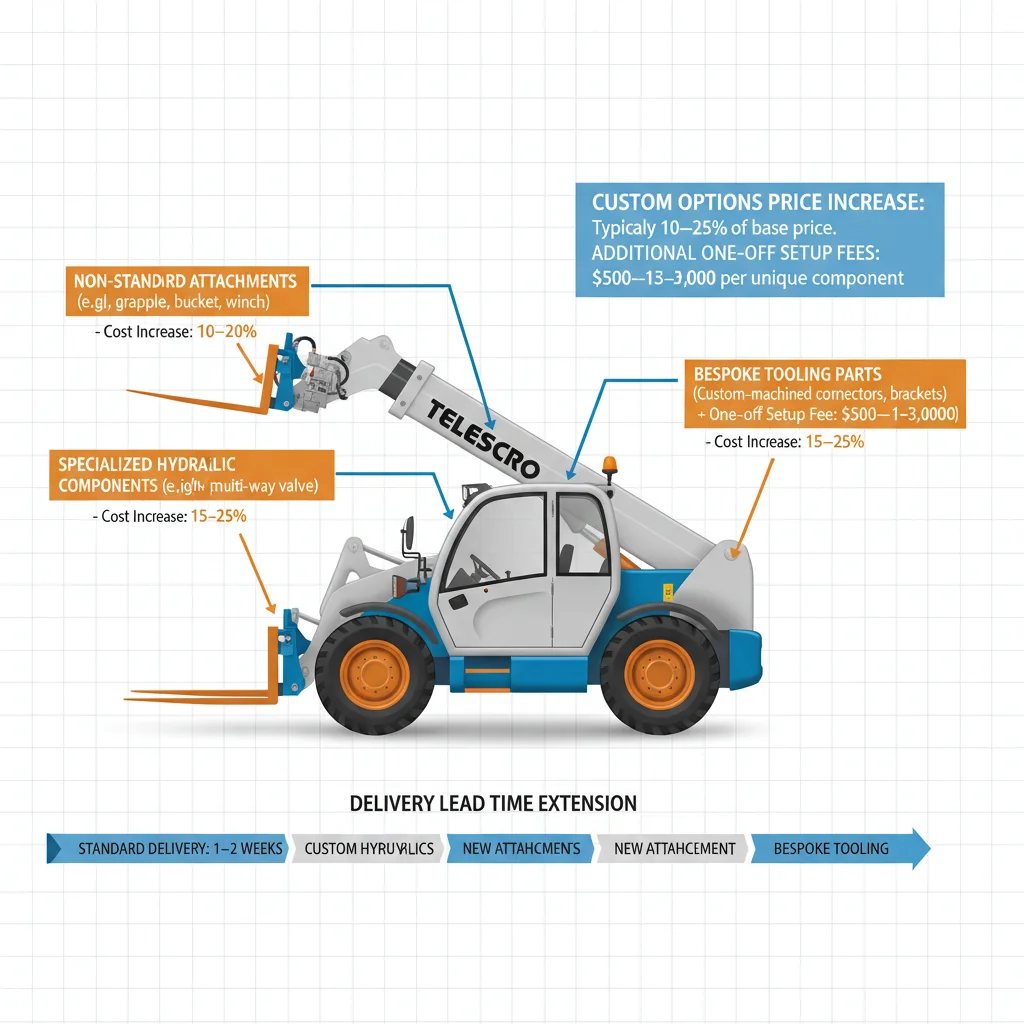
The biggest mistake I see is fleet buyers forgetting how customizations stack up—both in cost and time. On paper, a standard 3-ton telehandler with a 7-meter reach from a Chinese factory looks like an unbeatable deal, usually 20–40% less than Western models. But the moment you add non-standard options—like solid tires for rocky sites, climate-controlled cabins, or upgraded hydraulic circuits—the price goes up fast. In my experience, expect a 10–25% premium on the base price, plus setup fees that can range from $500 for a unique joystick to $3,000 for a new boom welding jig.
Let me give you a real example. A rental company in Dubai once requested 15 units with more robust counterweights and enhanced filtration because desert dust was clogging standard systems too quickly. The factory needed new molds for the counterweight and an upgraded filter housing. Cost climbed by about $2,200 per unit, and delivery lagged six weeks beyond the usual lead time. They planned for four weeks. The delay pushed their total project schedule out, and it wouldn’t have been workable if they hadn’t built extra time into their bids.
Here’s a quick comparison to help estimate the impact:
| Custom Feature | Typical Price Increase | Extra Lead Time | Common One-off Fee |
|---|---|---|---|
| Solid/non-pneumatic tires | 12–15% | 2–3 weeks | $700–$1,200 |
| Upgraded hydraulics | 10–18% | 3–4 weeks | $1,000–$2,500 |
| Special cabins | 20–25% | 4–8 weeks | $2,000–$3,000 |
I always recommend spelling out customization details and penalties clearly in contracts. For big orders, those extra weeks and dollars can make a huge difference.
Chinese telehandler factories commonly offer a range of customizations, but implementing non-standard hydraulic upgrades often requires minimum order quantities causing additional lead times and setup feesTrue
Many Chinese manufacturers support customization, yet complex hydraulic options usually trigger retooling or supplier changes, which increases both the cost (typically 10-25% premium) and delivery time due to batch processing.
Chinese telehandler factories generally do not support any custom options, offering only fixed configurations to maintain their low price pointsFalse
While Chinese telehandler models are competitively priced, most factories provide customizable options such as tires, cabins, and hydraulics; rejecting all customization is rare because Western buyers increasingly demand tailored specifications.
Key takeaway: Non-standard telehandler features in China bring a 10–25% price premium and may extend lead times by several weeks. Businesses should budget extra for both costs and project delays, ensuring contract terms clearly define customization impact on schedules for large orders.
How Do Chinese Factories Assure Telehandler Compliance?
Serious Chinese telehandler manufacturers ensure customization quality through dedicated R&D teams, modular production lines, and strict quality control systems. They document CE marking, ROPS/FOPS certification8, updated load charts, and type-test reports for each unique build. Export experience and reference projects confirm reliability for regulated markets, while early involvement of certification bodies helps address non-standard configuration requirements.
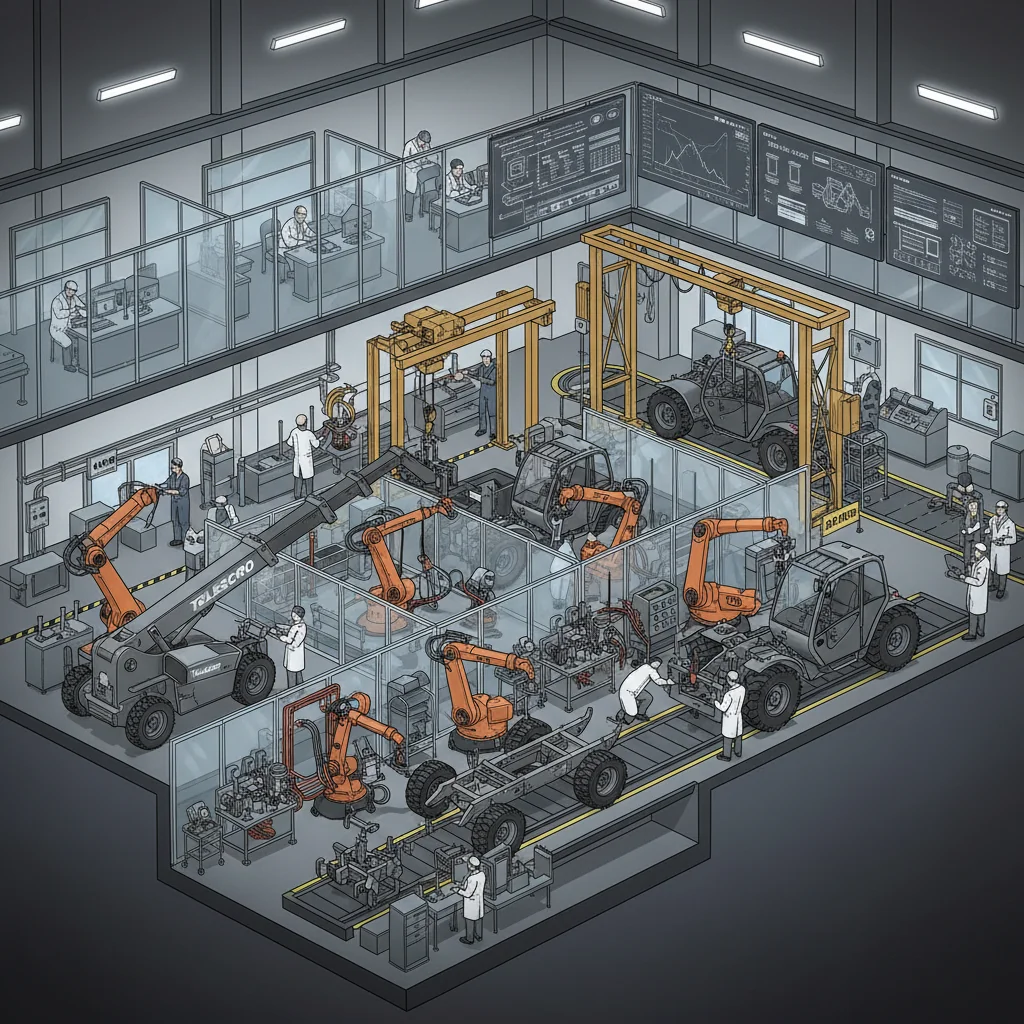
Last month, a contractor in Dubai reached out about a customized 4-ton telehandler with a 17-meter boom. Their project required a unique cab layout and extra hydraulic circuits for specialized attachments. That’s where compliance gets tricky—any change to the cab’s structure or hydraulics triggers the need for new ROPS/FOPS and CE certificates. From my experience, serious factories in China handle this with dedicated R&D teams who work directly with certification bodies from the start. It saves a lot of headaches down the line.
On a recent project for the UK, I saw a factory update the load chart and type-test reports for each modified configuration. For example, extending the reach beyond the standard 14 meters meant new stability tests, not just a software update.
They provided full technical documentation: updated load charts (which are essential for operator safety), CE declarations, and specific ROPS/FOPS certificates. I always suggest double-checking these documents, especially if you’ve requested non-standard booms, cabs, or auxiliary hydraulic circuits. In regulated markets like the EU or Australia, you’ll also want to see reference projects—actual export records—to confirm the supplier knows local standards.
It’s easy to get excited by long options lists, but the real question is whether the final unit will pass inspection and operate safely. I recommend involving your local certification body early if you’re planning major changes. Even a 2-week delay for an unexpected retest can hold up an entire project. Consider verifying all technical documents before shipment leaves the factory. It’s a simple step that can prevent costly surprises later.
Chinese telehandler factories typically establish collaboration agreements with notified bodies early in the design phase to streamline the re-certification process after cab or hydraulic modificationsTrue
Early engagement with certification bodies allows manufacturers to anticipate and incorporate compliance requirements into custom designs, reducing costly delays associated with retesting and ensuring adherence to ROPS/FOPS and CE standards. This practice is common among serious Chinese factories to maintain export quality and compliance.
Once a telehandler model receives CE certification, Chinese factories can implement any customization to the cab or hydraulics without additional re-certificationFalse
Modifications affecting structural safety components such as the cab or hydraulic circuits typically invalidate prior ROPS/FOPS and CE certifications, requiring new or updated certifications. Ignoring this can compromise operator safety and legal compliance in global markets.
Key takeaway: Always verify that customized telehandlers from China include comprehensive technical documentation—such as updated load charts and certification reports—to ensure compliance with target market regulations. Engage early with certification bodies if any major structural or hydraulic changes are requested, as re-testing and homologation may be required.
Can Chinese telehandlers meet EU emissions?
Chinese telehandler manufacturers now offer engine and exhaust after-treatment options compliant with Euro V, Stage V, and EPA Tier 4/5 regulations9. Catalogs often list these emission variants as selectable options, along with features like lighting and braking systems tailored to EU or Australian standards. Advanced compliance can require documentation and third-party certification, potentially extending lead times.
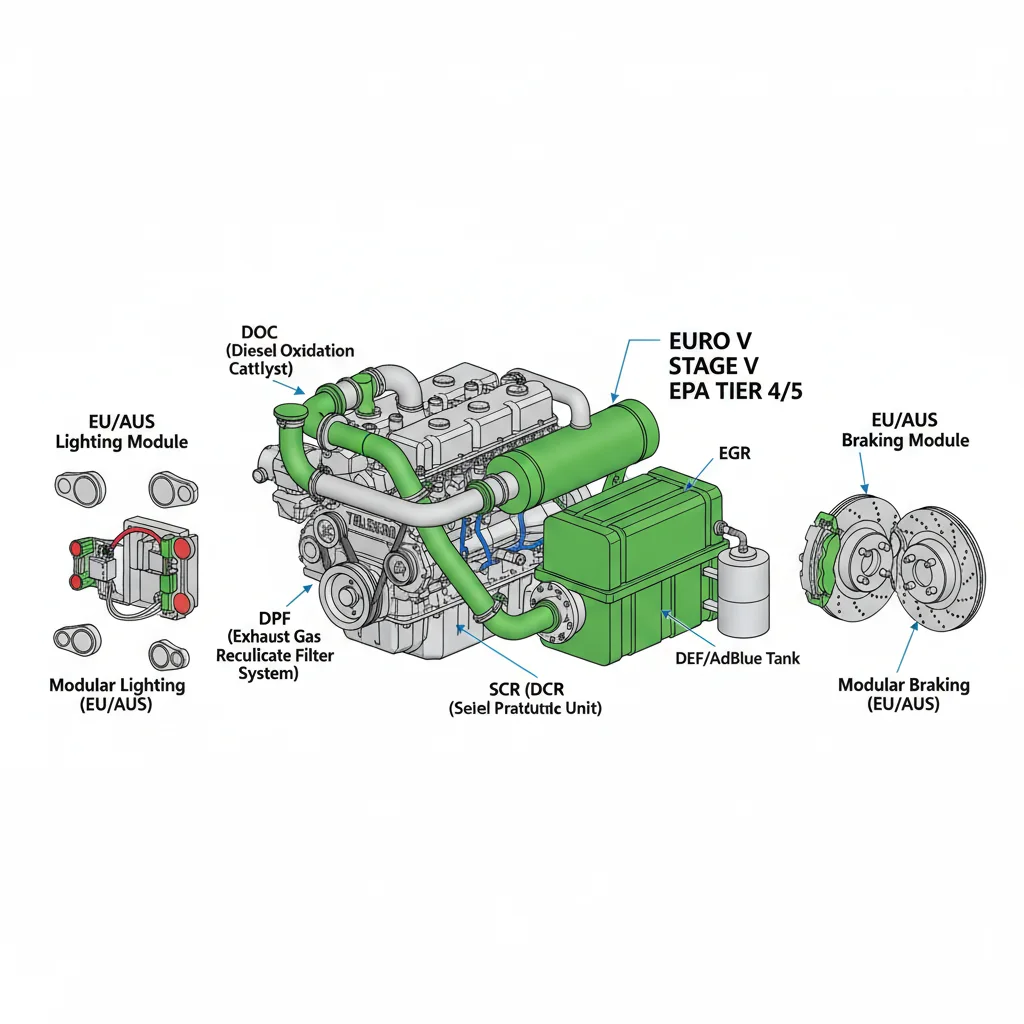
I’ve worked with customers across Europe who hesitated to trust that telehandlers made in China could actually clear the tough emissions rules. The truth is, most Chinese factories now install engines rated for Euro V, Stage V, or EPA Tier 4/5—the same standards you’ll find on any EU jobsite. For example, a Dutch rental fleet ordered 12 units, all fitted with after-treatment systems including DOC and DPF10. Emissions tests matched requirements for noise and particulates. What surprised the customer most? The catalog let them pick emissions level, just like choosing tire size or boom length.
But there’s a catch when you go from “emissions compliant” to “road legal” in the EU. Adding road-use features—like EU-standard LED lighting, two-circuit brakes, and e-marked mirrors—takes extra build time. I worked with a contractor in Spain who needed seven 4-ton, 14-meter telehandlers certified for road use. Documenting all the safety and noise requirements, plus third-party testing, added almost three months before shipping. It’s not just about the hardware; local authorities often require full test reports and original certificates.
The smart move is to send a detailed checklist to the factory early—covering emissions, road features, and safety. I always suggest asking which certifications are already in place, what will require new lab testing, and who pays for each step. Don’t assume a machine labeled “Stage V” is ready for any EU site or road. You’ll save serious time and cost by making all requirements clear at the start.
Chinese telehandler factories commonly offer engine configurations that comply with Euro V, Stage V, and EPA Tier 4/5 emissions standards, including integrated after-treatment systems like DOC and DPF to meet strict particulate and noise limits.True
Many Chinese manufacturers have upgraded their production lines to include engines certified to international emissions standards, using advanced technologies such as Diesel Oxidation Catalysts (DOC) and Diesel Particulate Filters (DPF) which are essential to passing EU regulations for nitrogen oxides and particulate matter.
Chinese telehandler factories typically do not allow customization of engine emission packages, as all machines are produced with a standard engine configuration to simplify their production process.False
Contrary to this claim, many Chinese manufacturers provide options to customize engine emission packages, allowing clients to specify compliance with different regional standards such as Euro V, Stage V, or EPA Tier 4/5, including after-treatment systems tailored to specific market regulations.
Key takeaway: Chinese telehandler factories increasingly support export markets by offering engines and features compliant with strict regional standards like Euro V and EPA Tier 4/5. However, complete road homologation for the EU can be complex and time-consuming, requiring early coordination and clear regulatory checklists to prevent delays.
What Maintenance Issues Do Custom Telehandlers Cause?
Custom telehandlers often use non-standard engines, joysticks, tires, or hydraulic components that may not be readily available in other countries. This complicates routine servicing and can lead to extended downtime when parts fail. Factories may bundle customization with targeted after-sales support, but supplier responsiveness and spare parts availability vary significantly between manufacturers.
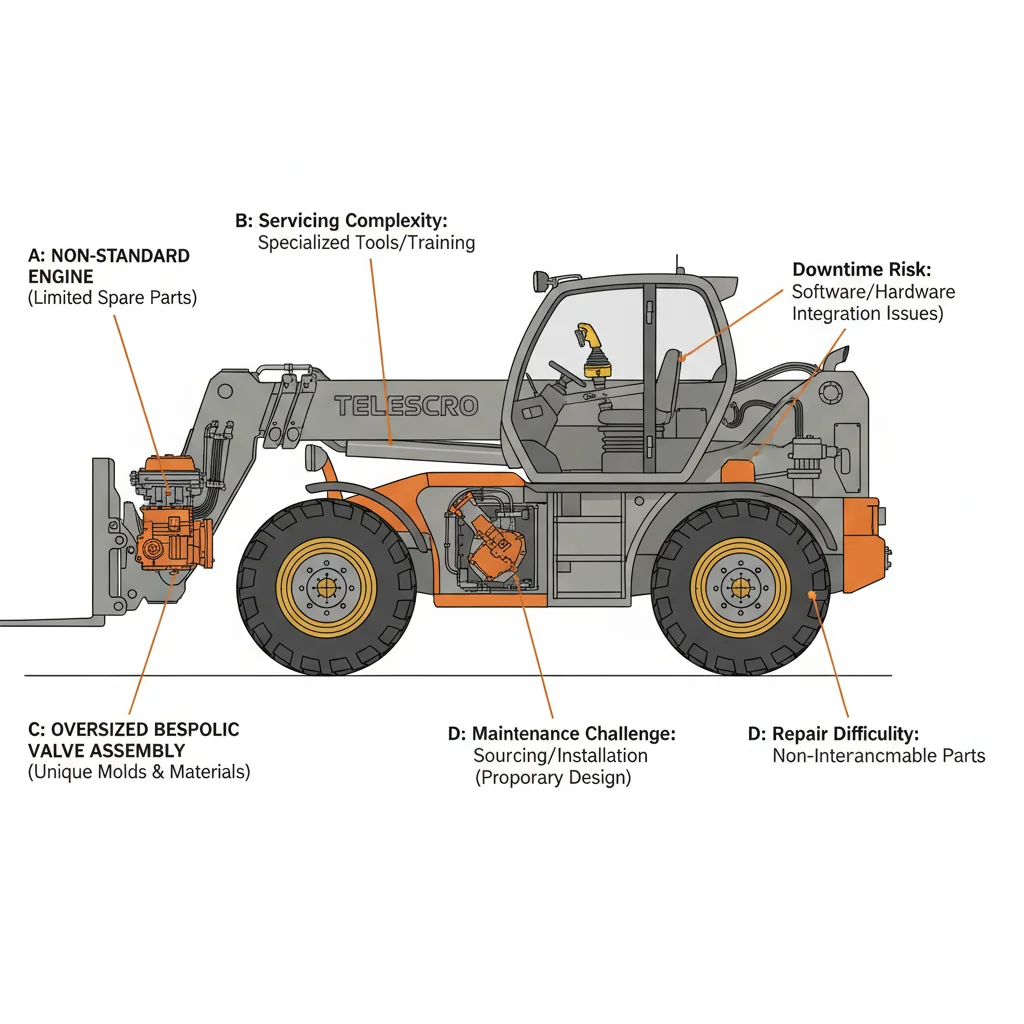
To be honest, custom telehandlers always sound appealing when you’re planning a complex project. But the biggest headaches I see come after delivery—especially on jobsites far from the factory. A client in Kazakhstan ordered a 4-ton, 14-meter custom telehandler with a special joystick and upgraded high-flotation tires for pipeline work. They loved the extra flotation until one tire split six months in. No local supplier could match the unique specs, and the jobsite sat idle for three weeks waiting on a replacement.
Here are the most common maintenance issues I see with custom telehandlers:
-
Engine and electronics: Non-standard engines or ECUs might need software or diagnostics tools not available locally.
-
Joysticks and controls: Custom joysticks fail more often from dust, heat, or vibration. Sourcing these outside China can be painful—some customers in Brazil waited over 30 days.
-
Hydraulics: Special cylinders or pumps may use unique sizes or seals—not stocked by generic suppliers.
-
Tires and wheels: Upgraded tires or rims can be hard to match locally, causing extended downtime if damaged.
-
Filters and wear parts: Even something as simple as a non-standard air filter can lead to long waits and forced improvisation.
From my experience, factories might promise “fast” after-sales parts, but supplier responsiveness varies. Some offer excellent support, especially if you buy spares up front. For remote sites or rental fleets, I always suggest ordering at least 12 months’ worth of critical parts—especially for anything unique. Before finalizing your order, ask for a parts cross-list and clarify warranty terms (parts and labor coverage). A little planning now saves a lot of trouble later.
Chinese telehandler factories commonly offer customization options such as special joystick controls and non-standard tire sizes, but sourcing replacement parts for these custom specs can take 3 to 6 weeks due to limited local suppliers.True
Many Chinese manufacturers provide tailored configurations to meet specific jobsite needs; however, unique components like custom joysticks or high-flotation tires often aren't stocked locally, causing extended downtime when replacement parts are needed.
Chinese telehandler factories only allow customization of color and decal placement, with all technical specifications standardized to accelerate delivery times.False
Chinese manufacturers frequently support a range of technical customizations beyond cosmetic changes, including load capacities, boom lengths, and specialized attachments, to cater to diverse project requirements.
Key takeaway: Custom telehandlers can improve operational performance, but they may introduce maintenance risks if spare parts and support are not well-planned. Always secure a parts plan, clarify warranty terms, and consider stocking critical spares to mitigate potential delays from component shortages.
How to Assess Telehandler Customization Capability?
Buyers should request a detailed, written “customization list11” from telehandler suppliers, distinguishing standard options, modular add-ons, and modifications needing new engineering or certification. Evaluating real-world case studies, inspecting organized assembly lines and in-house R&D, and consulting directly with design engineers are vital steps. Formal technical protocols should document all specifications, ensuring reliable, repeatable custom builds that meet agreed acceptance criteria.
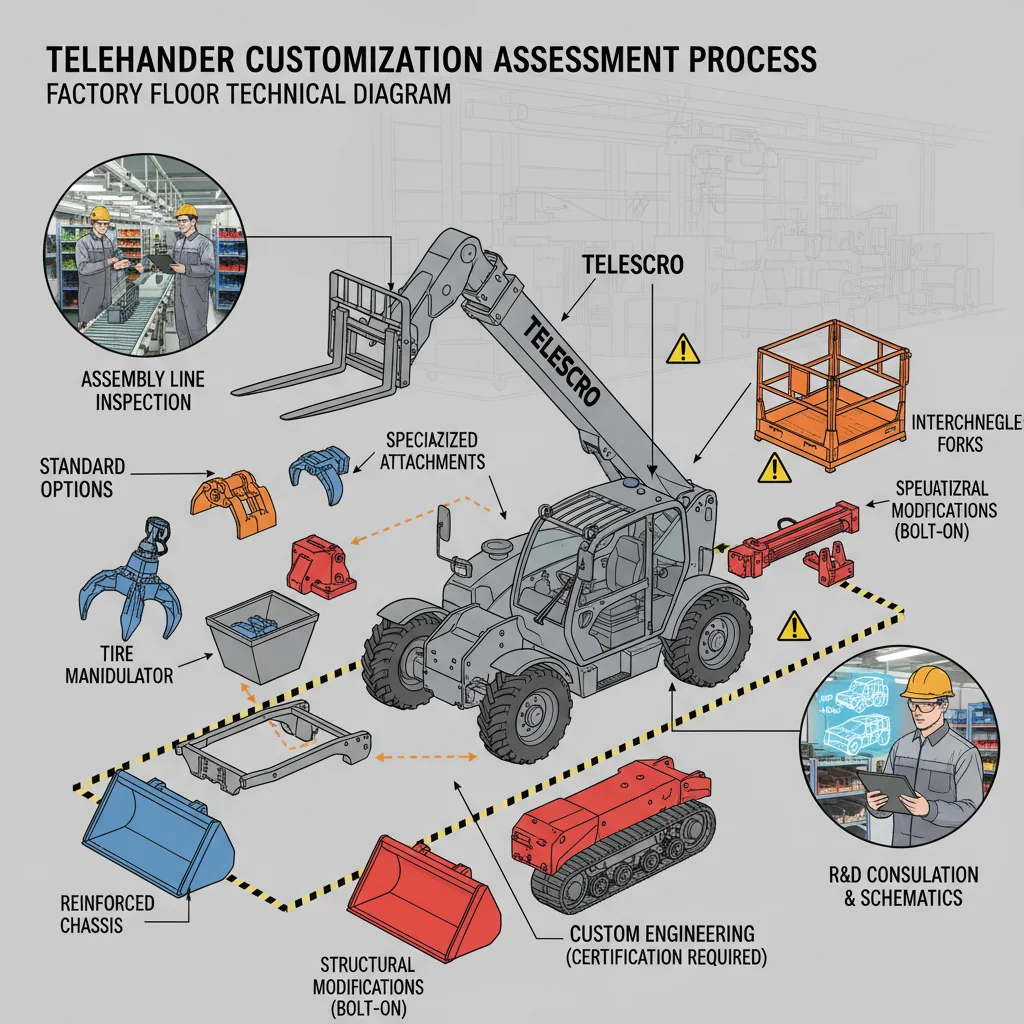
I’ve worked with buyers who thought a supplier’s basic spec sheet meant real customization ability. It’s not enough. The smartest customers I help always start by requesting a written “customization list” that clearly separates standard options—like tire types, cab layouts, or even different quick couplers—from true custom work. For example, I had a client from Kazakhstan who needed telehandlers modified for -35°C winter use, including engine heaters and reinforced seals for the hydraulic circuit.
The supplier’s list broke it down: options available off the shelf, modular cold-weather kits12, and points where new engineering or even low-temperature re-certification was required. That level of detail builds trust and saves time.
But specs on paper rarely tell the full story. I suggest arranging a video walkthrough of the assembly line, especially if you’re ordering specialized units or more than five machines. Look for modular jigs and flexible stations. In-house R&D teams—actual engineers on site, not outsourced—mean the factory can tackle changes, like extending the boom from 14 meters to 18 meters or fitting anti-collision sensors tied into the main control circuit. I’ve seen jobsite cases in Brazil where skipping these steps led to extra delays, because the factory wasn’t set up for repeatable, high-quality custom builds.
One last point: lock in every detail with a signed technical protocol. This includes drawings, load chart updates, any special acceptance tests, and production standards. If project schedules slip or staff changes, this document protects both sides. I always tell clients—structured documentation matters more than any glossy catalogue.
Many Chinese telehandler manufacturers can provide fully customized cold-weather packages, including engine block heaters, hydraulic system heaters, and reinforced seals, tailored for operations below -30°CTrue
Leading Chinese factories have developed extensive customization capabilities to suit extreme environments, leveraging modular designs that integrate heating elements and seal materials compatible with ultra-low temperatures, ensuring reliable machine performance in harsh winter conditions.
Chinese telehandler factories typically only offer standard customization options like tire types and cab layouts but cannot modify hydraulic systems or engine components for extreme temperature operationsFalse
Contrary to this belief, many Chinese manufacturers have invested in engineering capabilities to customize key systems, such as hydraulics and engines, enabling telehandlers to operate effectively in temperatures well below freezing, not limited to basic accessory changes.
Key takeaway: To ensure reliable telehandler customization in China, buyers must verify supplier capabilities with written option lists, engineering consultations, and documented technical protocols. Relying only on sales brochures or promises is risky—insist on structured documentation and proven export experience to similar markets for dependable results.
Conclusion
We’ve looked at how Chinese telehandler factories let you tailor machines—choosing boom length, capacity, and attachments—all at more accessible prices than many Western brands. From what I’ve seen, the smoothest projects come from thinking beyond headline specs and checking how the machine performs at your real working height, not just on paper. Parts roulette can turn a good deal into long downtime if you’re not careful with local support.
If you want help sorting through options or have questions about what actually fits your site, feel free to reach out. I’m always happy to share what’s worked for real crews across different countries. Every site is different—choose for your real workflow, not just the specification sheet.
References
-
Explains why full engineering changes require long lead times and minimum orders, crucial for buyers needing unique telehandler specs. ↩
-
Detailed insights on how hydraulic quick-couplers enhance telehandler versatility and speed up attachment changes on job sites. ↩
-
Explains the technical function of load moment indicators and their critical role in preventing overloads and accidents in telehandler operations. ↩
-
Understand the impact of rated load customization on lifting capacity and safety, backed by real case examples from Chinese telehandler manufacturers. ↩
-
Explains the critical role of load charts in maintaining telehandler stability and operator safety during various operational configurations. ↩
-
Detailed insights on how non-standard options increase costs by 10–25% and extend delivery by weeks, vital for fleet buyers. ↩
-
Explains additional fees ranging from $500 to $3,000 per part, helping buyers understand hidden cost factors in telehandler options. ↩
-
Provides detailed insights into safety standards ensuring operator protection during rollovers and falling object incidents in telehandlers. ↩
-
Detailed overview of stringent EU and US emissions standards, helping readers understand compliance requirements and technical limits. ↩
-
Clear explanation of diesel oxidation catalysts and diesel particulate filters, key technologies for achieving emissions compliance in construction equipment. ↩
-
Explore how a detailed customization list helps distinguish standard options from true custom engineering to ensure reliable telehandler builds. ↩
-
Learn about modular cold-weather kits designed to enable telehandler operation in extreme temperatures, enhancing reliability and functionality. ↩