










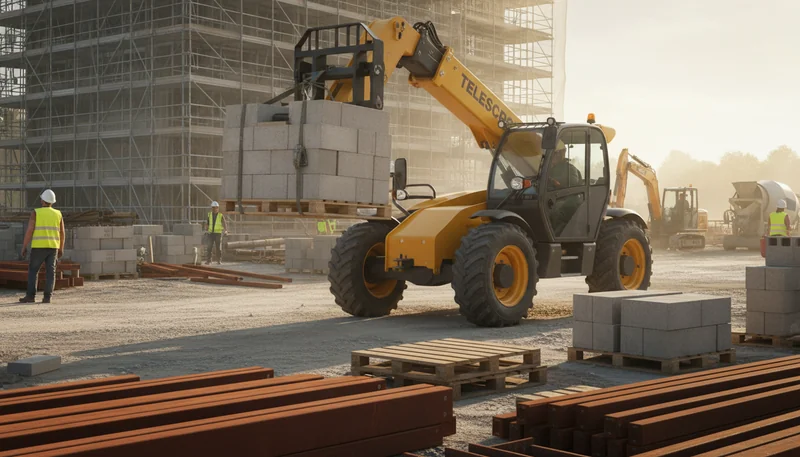
What is the Purpose of a Telehandler Counterweight? Field Engineer’s Guide to Stability & Safety
Not long ago, I watched a crew in Brazil struggle with a fully loaded telehandler that began to tip dangerously as they tried to reach over a stack of bricks. They had the right machine, but overlooked a key element that determines safe lifting every time: the counterweight.
A telehandler’s counterweight is a carefully engineered steel mass mounted at the rear of the machine to offset the forward tipping moment generated during lifting operations. By positioning the counterweight to maximize the opposing moment arm relative to the load, manufacturers keep the center of gravity1 within the machine’s stability base2, preventing forward tip-overs. Counterweight size and placement3 directly impact rated lift capacity at reach, load distribution on axles, and long-term wear on major structural and mechanical components.
Why Do Telehandlers Need Counterweights?
A telehandler counterweight is a heavy steel mass mounted at the rear to prevent forward tipping. By opposing the load’s moment as the boom extends, the counterweight keeps the unit’s center of gravity within its stability base. This design is essential for safely lifting, carrying, and placing heavy loads according to the manufacturer’s published capacity chart.

Most people don’t realize that counterweights are the silent heroes when it comes to telehandler safety. I’ve seen contractors ignore this detail in places like Kenya, and it always ends the same way—unexpected instability. Here’s why: as soon as you extend the boom, the load’s force pulls the front end down, almost like a giant seesaw. The rear counterweight—usually a slab of steel weighing between 800 and 1,600 kg on 4-ton machines—pushes the center of gravity back inside the stability triangle between the tires. That means the telehandler stays upright, even as you reach out with heavy pallets or bricks.
Last winter, a customer in Dubai called me after his team tried using a telehandler without enough rear counterweight to lift steel beams to the third floor, about 12 meters high. The load chart4 said 1,500 kg at max reach, but even a 1,200 kg lift made the rear wheels lift off slightly. It’s a scary scenario, especially if the ground isn’t perfectly level. The right counterweight size let him finish the job without extra risks—or unplanned downtime.
To be honest, the counterweight is as important as brakes or outriggers. It’s engineered into every load chart—the table that shows safe capacities at various boom lengths and heights. I always suggest checking the rear counterweight specs for your model, not just the headline numbers. If you operate within the chart and keep your boom low while moving, you’ll avoid 99% of tip-over incidents. Safety starts with that chunk of steel.
The rear counterweight on a 4-ton telehandler typically weighs between 800 and 1,600 kg to ensure the center of gravity remains within the stability triangle when the boom is fully extendedTrue
This weight range is carefully calculated to counterbalance the forward tipping moment generated by loads at maximum reach, maintaining stability and preventing rollovers during operation.
Telehandlers rely primarily on electronic sensors rather than physical counterweights to maintain balance during boom extensionFalse
Counterweights provide a fundamental physical force that stabilizes the machine by shifting the center of gravity; electronic sensors alone cannot replace this mechanical balance, though they may assist with load monitoring.
Key takeaway: The counterweight is not an optional feature but a critical component that preserves telehandler stability. Correctly sized counterweights enable safe operation by balancing load forces during lifting and movement, reducing the risk of tipping incidents and ensuring adherence to safety guidelines and load chart limits.
How Does Counterweight Impact Lift Capacity?
A telehandler’s counterweight directly affects lift capacity, especially at maximum reach. By providing a rear counter-moment, the counterweight keeps the center of gravity within a safe zone while handling heavy, extended loads. Counterweight size and placement are engineered for stability based on the most demanding positions outlined in the machine’s load chart.

Let me share something important about counterweights that gets overlooked on many sites. Just last month, a customer in Dubai called me about their “4,000 kg” telehandler struggling to lift a cement pallet at full extension. On paper, their model looked almost identical to a competitor’s—same engine size, similar reach. But when they checked the load chart, they saw a big difference: at 15 meters out, their machine could only hold around 1,100 kg safely, but the competitor handled closer to 1,400 kg. Why? Counterweight design and placement made all the difference.
From my experience, this isn’t rare. The counterweight does far more than just “balance” the machine. It creates a counter-moment to offset the forward load, keeping the center of gravity inside the safe zone—especially when the boom is low and extended. Manufacturers spend a lot of time testing counterweight size and position, engineering them precisely for the “worst-case” positions on the load chart. I’ve seen two telehandlers, both with 17-meter booms, but one could manage an extra half ton at full reach, simply because of smarter counterweight geometry.
Here’s what matters most: don’t just trust the max lift number at the wheels or the brochures. If your job involves lifting at height or long forward reaches—like stacking bales in Australia or setting steel trusses in South Africa—study the load charts5 carefully. I suggest comparing what each model can handle at 80–100% extension before making a decision. It’s the real-world difference between finishing the job safely or getting stuck halfway.
Increasing the telehandler's counterweight by 10-15% can improve lift capacity at maximum reach by providing better stability and reducing the risk of tipping.True
A heavier counterweight shifts the center of gravity rearward, increasing the machine's stability. This allows the telehandler to safely lift heavier loads at extended reach without compromising balance or safety margins.
The counterweight's only function is to balance the telehandler when it is stationary; it does not affect lift capacity during operation.False
Counterweights influence the machine's dynamic stability while lifting, especially at extended reach. They help prevent tipping by offsetting load weight, directly impacting safe lift capacity during operation, not just when stationary.
Key takeaway: Counterweight size and position are critical factors in a telehandler’s safe lifting capacity at long reaches. Always compare models’ load charts at full boom extension for real-world performance differences, not just the maximum lift rating at the wheels.
How Does Counterweight Position Affect Stability?
Counterweight position is crucial to telehandler stability. Locating the counterweight at the rear shifts the center of gravity backward and keeps it low, reducing the risk of forward tip-overs as the boom extends or as different attachments are used. Proper counterweight placement offers a critical stability margin in challenging, real-world operating conditions.

Here’s what matters most when we talk about counterweight position on a telehandler. It’s not just about bolting on more metal—where you put that weight makes all the difference. By mounting the counterweight at the very rear, engineers shift the center of gravity backwards and keep it lower to the ground. This becomes especially important when you’re working with a boom that’s fully or partly extended. I’ve seen jobs in Saudi Arabia where a 4-ton telehandler lifted ducting up to 14 meters. Without that rear counterweight, just a small misjudgment from the operator could have tipped the whole machine forward—especially with a bucket or a jib attached.
From my experience, the real danger isn’t always in obvious overloading. It’s those everyday scenarios people overlook: traveling with the boom low but extended, tight turns on uneven ground, or sudden stops on a slope. In one case in Brazil, the operator drove with a 1,000 kg pallet at half boom extension across patchy terrain. The rear counterweight gave enough margin so the telehandler didn’t tip—even as the center of gravity shifted. That’s a safety buffer you’ll appreciate when things don’t go perfectly.
But let’s be honest, no counterweight design can save you from ignoring the load chart or pushing a machine past its limit. Side slopes, jerky controls, or sudden loads will override even the best engineering. I always suggest: check your actual working conditions, review your load charts, and don’t rely on counterweight alone. It’s your training plus good design that keeps the machine—and everyone nearby—safe.
Positioning the counterweight at the rear of a telehandler lowers the center of gravity by up to 10-15%, significantly enhancing lateral stability during boom extensionTrue
Mounting the counterweight at the rear shifts the center of gravity backward and downward, reducing the machine's tipping moment when the boom is extended, which improves overall stability and load capacity. Studies show this repositioning can lower the center of gravity by around 10-15%.
Installing the counterweight above the telehandler's boom increases stability by directly counterbalancing the lifted loadFalse
Placing the counterweight above the boom raises the center of gravity, which reduces stability and increases the risk of tipping. Effective counterweight placement aims to lower and shift the center of gravity rearward, not upwards.
Key takeaway: While a well-designed counterweight enhances telehandler stability by maintaining a rearward center of gravity, it is not a substitute for safe operation. Operators must still adhere to load charts and best practices to avoid tip-overs, especially on uneven terrain or when facing unexpected loads.
How Does Counterweight Impact Telehandler Wear?
A correctly sized counterweight is critical in telehandler design; it prevents excessive load transfer to the front axle and tires during lifting. Insufficient rear ballast leads to premature axle, hub, and tire wear, increasing repair costs and reducing uptime. Proper weight distribution also improves hydraulic and drivetrain efficiency, ultimately lowering long-term maintenance and operating expenses.

The biggest mistake I see is assuming counterweight is just about stabilizing the machine. In reality, the size and position of the counterweight play a huge role in how stress is transferred through the telehandler’s frame. I’ve seen this firsthand on job sites in Saudi Arabia, where several units with undersized rear ballast started showing front axle bearing issues after less than 1,200 hours. When the rear isn’t heavy enough, the front axle becomes the main support every time you raise a load, especially when lifting close to the machine’s maximum capacity—think 3,500 kg or more. It’s not just about the axle, either: those front tires wear unevenly, and hub seals can start leaking long before you expect. One contractor told me he was changing his front tires nearly twice as often just because of improper weight distribution.
From my experience, it’s also about hydraulic and drivetrain efficiency. When a telehandler runs nose-heavy, the hydraulic system and pumps have to work harder every time you boom out or retract. In a large agri-operation in Kazakhstan, the maintenance team tracked fuel usage closely. Machines with properly balanced counterweights used at least 8% less diesel over a season—thousands of dollars saved on fuel alone. You also reduce stress on the boom pivot and chassis welds, which means less downtime for structural checks.
So, for anyone spec’ing a telehandler, I always suggest checking the counterweight is rated for your real-world tasks, not just test-stand loads. Balanced machines last longer and cost less on repairs—simple as that.
An undersized counterweight can cause premature wear on front axle bearings due to increased stress during lifting operationsTrue
If the rear ballast is insufficient, the front axle bears more load than designed when lifting, accelerating bearing wear and reducing equipment lifespan as seen in telehandlers operating under 1,200 hours in harsh conditions.
The primary function of a telehandler counterweight is to increase the overall machine weight to improve traction on soft groundFalse
While counterweights add mass, their main purpose is to balance the machine and stabilize the load during lifting, not specifically to enhance traction, which is more influenced by tire type and ground conditions.
Key takeaway: An optimized telehandler counterweight improves weight distribution, reduces structural and tire wear, and lowers the burden on hydraulic and drivetrain systems. This translates to fewer costly failures, longer machine life, and more predictable maintenance—directly impacting operating costs for contractors and agricultural users.
Why Optimize Telehandler Counterweight Placement?
Optimizing telehandler counterweight size and placement is crucial for stability and safety. Manufacturer-designed counterweights are precisely matched to boom geometry, wheelbase, and load chart requirements. Excessive counterweight may increase machine weight, stress components, and hinder maneuverability, while insufficient weight reduces capacity and destabilizes operations, highlighting the importance of adhering to original equipment configurations.

Last month, a project manager in Dubai asked me why their 4-ton telehandler lost traction after adding extra steel plates to the rear. It sounded simple—more counterweight means more stability, right? Not exactly. Telehandler manufacturers calculate counterweight size and placement to balance the boom geometry, chassis, and hydraulic circuit. If you change that, small mistakes create big safety risks.
I’ve seen what happens when operators improvise. In Kazakhstan last year, a crew added about 500 kg of scrap metal to a 3-ton unit, hoping to boost capacity for longer lifts. The result? The machine turned sluggish, and they struggled to navigate sandy ground. Excess weight also stressed their rear axle and reduced brake life—they had to replace wear parts after just eight months, not the usual twelve.
From my experience, the real specs that matter are hidden in the load chart and moment indicator—not in adding more ballast. For example, a standard 18-meter telehandler rated for 4,000 kg might only support around 1,400 kg safely at full reach. Increase the counterweight, and you might boost lift at low boom angles, but you risk overloading components, violating transport rules, or even causing tip-over if the load swings.
My advice? Trust the OEM configuration for your application. Always check the load chart at your key working heights and outreach. If you need more capacity, select a higher-rated machine—don’t shortcut with extra ballast. Before purchase or operation, verify that the counterweight matches OEM data and your jobsite needs. It saves money and keeps your crew safe.
The precise placement of a telehandler’s counterweight is designed to counterbalance the maximum extended boom load, ensuring stability across its entire operating envelopeTrue
Manufacturers position counterweights based on the telehandler's maximum reach and lifting capacity to maintain a stable center of gravity, preventing tip-overs even when the boom is fully extended. Incorrect placement can shift the center of gravity forward, reducing overall stability.
Increasing the rear counterweight always improves traction on all telehandler models, regardless of terrain or chassis designFalse
Adding more counterweight does not guarantee improved traction universally; excessive weight can overload the rear axle or reduce ground contact on the front tires, especially on uneven terrain, negatively affecting traction and maneuverability.
Key takeaway: OEM-engineered counterweights balance telehandler stability, performance, and transport limits. Customizing or increasing ballast beyond manufacturer specifications can compromise safety, maneuverability, and compliance. Always verify that counterweight setup aligns with OEM data and site requirements before purchase or operation.
When Are Modular Counterweights Beneficial?
Modular or adjustable counterweights are beneficial in higher-capacity telehandlers, crane-style models, or machines with very mixed duty cycles. They enable operators to add ballast for stability in heavy lifting scenarios and remove weight to comply with road limits or reduce ground pressure during lighter work. Configuration changes require correct documentation, load charts, and operator training.

To be honest, the spec that actually matters is how flexibly you can configure your telehandler for both transport and lifting. Modular counterweights become valuable the moment your fleet moves between jobs like heavy concrete placement on a Tuesday and lighter pallet work on a Friday. For example, I worked with a contractor in Kazakhstan last year using a 5.5-ton, 17-meter unit. On big lifting days, they’d bolt on an extra 1,200 kg of counterweight. When it was time to road the machine across town, they dropped the slabs in under 30 minutes—keeping their transport weight under 12,000 kg and dodging permit headaches.
What really counts is understanding that modular counterweights introduce more moving parts—literally and operationally. From my experience, teams sometimes forget to update load chart references after changing configurations. I’ve seen an operator in Brazil nearly overload a machine because he used the “full ballast” chart with half the counterweight fitted. That’s a real risk—not just on paper. Simple mistake, but it could have tipped the machine if the moment indicator wasn’t working.
The real advantage is adaptability, especially if your work shifts between heavy modules, man basket jobs at maximum boom, and lighter agricultural loads. But remember, the operator needs training for each configuration, and documented proof of which counterweight setup is in use. You’ll also want to check for signs of extra wear around mounting points and make sure all fasteners are torqued correctly after every swap. My advice? Modular counterweights make sense if versatility is critical—but only with rock-solid procedures and training in place.
Modular counterweights allow operators to optimize telehandler stability by adjusting ballast weight to match specific lift requirements, improving maneuverability during lighter duty without compromising safety on heavy liftsTrue
By adding or removing counterweights in modules, operators can tailor the machine’s center of gravity and overall mass to suit different tasks, reducing unnecessary transport weight and enhancing operational flexibility without risking tipping.
Adding modular counterweights to a telehandler increases fuel consumption by more than 50% regardless of workload because the engine always works harder to move the added weightFalse
While additional weight can increase fuel use, the impact isn’t universally this large and depends on workload. Modular counterweights are only added for heavy lifts and removed during lighter work or transport, so fuel penalties are minimized through flexible configuration rather than constant extra load.
Key takeaway: Modular counterweights are valuable for fleets that frequently switch between heavy construction and lighter tasks, allowing for adaptable stability and easier transport. However, they involve more complexity, extra maintenance, and demand diligent adherence to specific load charts and configuration management for safe operation.
How Do Counterweights Impact Telehandler Certification?
Counterweights are critical for telehandler safety certification, as regulatory standards like EN 1459 require the original, factory-installed configuration for compliance. Modifying, replacing, or repairing counterweights with non-approved materials voids certifications and load charts, increasing insurance and liability risks. Only factory-approved counterweight options ensure adherence to safety standards and regulatory requirements, especially when purchasing or inspecting used machines.

Here’s something that catches a lot of buyers off guard: counterweights aren’t just big blocks of steel—they’re engineered to precise specs for each telehandler model. Every stability test, from side-slope tilts to maximum reach, is performed with that exact counterweight in place. I had a customer in Kazakhstan who bought a used 3.5-ton telehandler advertised as “just like new.” But during a local inspection, the rear counterweight had been swapped out with a homemade steel slab. The machine physically lifted well, but it failed the compliance check on the spot. No valid load chart, no insurance coverage, and their rental contract was rejected. That buyer ended up spending nearly $4,000 importing the correct factory part just to get certified.
From my experience, factory-approved counterweights6 form the foundation of every certification—especially for standards like EN 1459 in Europe or equivalent regulations in Australia and the Middle East. Load charts (the tables showing safe lifting capacity at every boom angle and extension) only apply if the machine’s configuration matches what the manufacturer tested. Modifications, even if they look solid, wipe out that paperwork and open the door to legal headaches if anything goes wrong.
I always suggest double-checking counterweight authenticity before signing off on any purchase, especially for units coming from secondhand dealers. Look for clear markings, intact mounting bolts, and documentation that matches the original build. If anything seems off—like welded repairs or added blocks—get the OEM part number verified. It’s a small step, but it protects your crew, your investment, and your ability to operate legally.
A telehandler’s counterweight is precisely calibrated to balance the machine's maximum rated lift capacity at full boom extension, ensuring stability under specific load charts.True
Manufacturers engineer counterweights based on the telehandler’s load moment, which accounts for boom length and maximum load capacity, to prevent tipping and maintain safety per design standards.
Counterweights on telehandlers primarily serve as a storage place for hydraulic fluid reservoirs to optimize space.False
Counterweights are heavy masses designed to balance the load and stabilize the machine; hydraulic fluid reservoirs are housed elsewhere and serve a hydraulic function, not weight balancing.
Key takeaway: Counterweights must remain in their original, factory-approved configuration to maintain telehandler compliance with safety and stability standards. Any modification, whether by adding or removing weight, not only risks machine stability but also invalidates certifications, insurance coverage, and legal compliance. Always confirm counterweight authenticity before operation or purchase.
What Counterweight Checks Ensure Telehandler Stability?
Essential telehandler counterweight checks include inspection for cracks, corrosion, loose or missing bolts, bent brackets, and worn pins on removable modules. Evaluating for signs of welding, mismatched paint, or non-original plates can indicate prior overloading or non-standard repairs. Service records should confirm repairs, and counterweight specifications must match original manufacturer details to ensure ongoing safety and value.

I’ve worked with customers who made this mistake: ignoring the rear counterweight when inspecting used telehandlers. Three months ago, a team in Kazakhstan bought a 3.5-ton telehandler with a 13-meter reach. On their second big job, persistent instability showed up—just lifting normal pallet loads felt risky. When I checked recent jobsite photos, I spotted clear welding marks and mismatched paint on the counterweight bracket. The service history didn’t mention any repairs. That raised a red flag immediately.
A counterweight doesn’t have moving parts, but it carries hidden risks. Any cracks—especially near mounting points—can lengthen under repeated shocks, making the entire frame less stable. I always suggest checking for rust creeping out of seams, bent attachment brackets, and pins on any removable counterweight modules. In humid regions like Vietnam, I’ve seen corrosion inside the bracket tunnel eat away almost a full centimeter of steel within two years. That’s enough to seriously reduce stability. Missing or loose bolts? Even one can cause vibration and load shifts over time.
If you see fresh welding beads, non-factory plates, or uneven paint around the counterweight, ask for detailed service records. These might reveal overloading events or impacts that could compromise the chassis. For any 2.5-ton or larger telehandler, the counterweight and its mounting should match the original specification in the parts manual. If you’re considering a deal on a used machine, I suggest measuring and comparing the counterweight dimensions and checking the serial tag against the OEM records. Neglecting this step can lead to expensive downtime—or worse, on-site accidents.
A telehandler's rear counterweight is precisely calculated to offset the moment generated by the boom at its maximum rated reach, ensuring stability during lifting operationsTrue
Counterweights are engineering-calculated to counterbalance the forward tipping moment caused by extended loads, especially at full boom extension; improper weight or modifications can compromise machine stability and safety.
Increasing the size of a telehandler's counterweight beyond manufacturer specifications always improves stability regardless of load or boom positionFalse
Excessive counterweight can overload the rear axle, negatively affect steering, and damage suspension components, potentially creating unsafe operating conditions rather than improving stability.
Key takeaway: Regular, thorough counterweight inspections and careful due diligence for used telehandlers are critical. Look for structural damage, improper repairs, and ensure components match OEM specifications to maintain stability, safety, and machine value. Undetected counterweight issues can compromise performance, increase accident risk, and negatively affect resale prospects.
Conclusion
We’ve looked at why the counterweight is a vital part of any telehandler, especially for stability and safe lifting during real-world jobs. From my experience, what matters most is understanding your actual lifting patterns, not just the specs in a brochure—too many buyers fall into the “showroom hero, jobsite zero” trap. Before choosing a unit, check how the counterweight impacts the load chart at working height, and confirm you can get replacement parts locally. Need advice on matching a telehandler to your project or sorting through load chart details? I’m always happy to help—feel free to reach out with your questions. Every site is different, so pick what fits your workflow.
References
-
Learn how center of gravity shifts impact telehandler safety and stability, with real-world examples of load handling and terrain challenges. ↩
-
Details the role of the stability base in maintaining center of gravity and balancing loads for safe telehandler operation. ↩
-
Explores how proper counterweight sizing balances boom geometry and load capacity for safer telehandler operation, reducing risk. ↩
-
Detailed guide on interpreting load charts to ensure telehandlers operate within safe lifting capacities and prevent equipment damage. ↩
-
Understand the critical role of load charts in ensuring safety and proper machine configuration when adjusting modular counterweights. ↩
-
Explore how only factory-approved counterweights ensure compliance with safety regulations and maintain valid load charts to avoid liability issues. ↩