











Telehandler Cost-Effectiveness for Small Contractors: Field-Tested Tips to Avoid Costly Mistakes
Not long ago, a builder from South Africa called me, frustrated after spending thousands on monthly telehandler rentals—only to realize his machine sat idle most days. It’s a common story: the right telehandler can be a jobsite hero, but the wrong choice quickly drains cash.
Telehandlers deliver highly versatile material handling for small-scale residential and light commercial jobsites—combining lift, reach, and rough-terrain mobility in ways that standard forklifts often can’t match, and that can reduce dependence on cranes for routine placement work. A compact telehandler1—often in the ~6–10 meter lift-height class with ~2.5–3.5 ton maximum capacity (market and model dependent)—supports efficient unloading, more precise placement, and better reach on uneven or confined ground. Ownership can become cost-effective when annual utilization is consistently high, but recurring expenses such as maintenance, insurance, fuel, and transport must be budgeted realistically.
What Tasks Do Telehandlers Solve On Site?
A telehandler addresses key material handling challenges for small contractors by combining rough-terrain mobility with a telescopic boom, enabling tasks that traditional forklifts, skid steers, or pickups can’t handle. Typical compact units can efficiently unload trucks, reposition pallets on muddy sites, place materials on upper floors, set roof trusses, and move loose materials—covering a large share of everyday lifting and placement needs on multi-story residential projects, depending on site conditions and load requirements.

Most small contractors underestimate just how many tasks a compact telehandler can cover. I’ve seen crews in Qatar unload full pallets of block straight off trucks, spin through soft sand, and set those loads two stories up—without needing to move materials by hand or hire a mobile crane. On muddy residential jobs in southern China, a 2.7-ton telehandler with about 9-meter reach replaced the old forklift-and-wheelbarrow routine. The operator simply drove across uneven ground, lifted pallets over foundation forms, and dropped materials right where bricklayers needed them. Saving time and effort, job after job.
One customer in Poland shared how he used his telehandler’s bucket attachment to clear construction debris between pours. That same week, he added fork extensions to reposition insulation up to the roof frame. The best part was the result: his team completed material placement nearly two days faster than with manual labor and avoided losses from mud or weather. I always point out that actual lifting capacity at second- or third-floor working heights varies by model, attachment, and boom extension. Many compact telehandlers can handle common residential pallet loads at these heights when operated within the load chart, which is sufficient for the majority of day-to-day lifts on two- or three-story builds.
Here’s the thing: traditional forklifts or skid steers just can’t reach over garden walls, newly poured slabs, or scaffolding. Pickups can’t safely lift packs of cement to an upper floor. A telehandler does these jobs in one go, every day. If you want to reduce crane hire frequency and keep lifting under your own control, I suggest reviewing the rated capacity at working heights that match your real projects. That’s where the true savings happen.
Compact telehandlers often eliminate the need to rent separate lifting equipment, such as mobile cranes or rough-terrain forklifts, for many small contractor tasks.True
Telehandlers combine lifting, reaching, and material moving capabilities in one machine, which allows small contractors to handle a broader array of site tasks without incurring extra rental costs for specialized lift equipment.
Telehandlers are only cost-effective for contractors working on large, flat commercial sites and not suitable for small or uneven residential projects.False
Modern compact telehandlers are designed for maneuverability and stability on rough or uneven terrain, making them highly suitable and cost-effective for small-scale residential sites where larger equipment would be impractical.
Key takeaway: Telehandlers provide small contractors with versatile lifting for common residential project jobs, reducing manual labor and the need for both separate forklifts and frequent crane hires. This multipurpose capability maximizes on-site uptime, lowers costs, and improves material placement efficiency across 2–3 story builds.
When Is Buying a Telehandler Cost-Effective?
For small contractors, buying a telehandler can become more cost-effective than renting when utilization is consistently high and predictable. In many cases, ownership begins to compete with rental once annual usage reaches several hundred hours, or when annual rental spend approaches the cost of ownership over a multi-year horizon. For compact telehandlers, published market examples show new purchase prices often in the USD 80,000–120,000 range, while U.S. rental rates commonly fall in the USD 400–650/day or USD 2,500–3,500/month band, depending on region, capacity, and term.
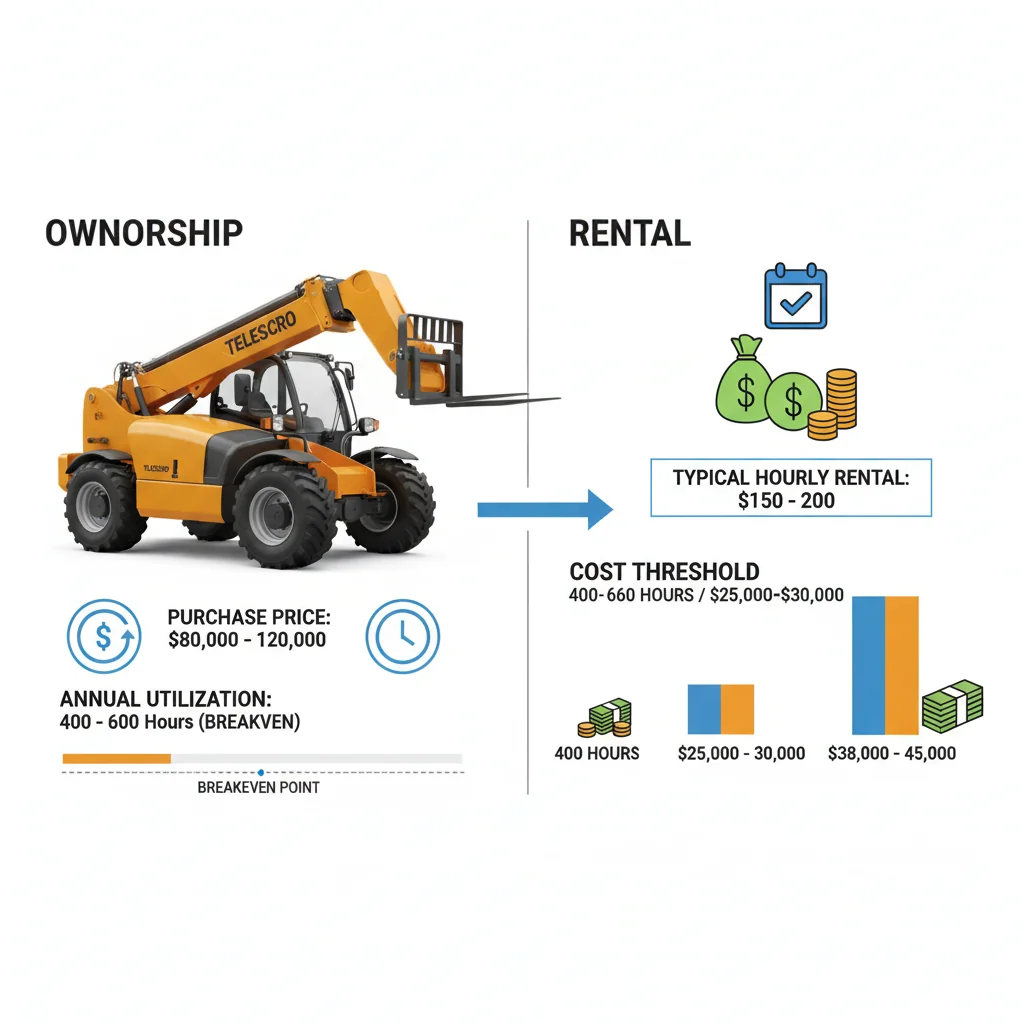
What really determines whether buying saves money is actual utilization, not the idea of ownership itself. I always advise contractors to review the previous 12 months of work: total telehandler hours on site, how often machines were idle on rent, and what the rental invoices really added up to. In practice, many contractors find that once a compact telehandler is used regularly across projects—often in the range of a few hundred hours per year—rental costs start to approach what ownership would cost over time.
In the U.S., for example, compact telehandler rental rates are frequently quoted around USD 2,800–3,200 per month, with daily rates reaching USD 650 in some markets. For contractors running only a handful of large jobs per year, renting can still make sense. Tying up USD 80,000–120,000 in a machine that sits idle between projects often costs more in depreciation and opportunity loss than paying rental invoices.
Last year, I worked with a contractor in Dubai managing ten mid-rise projects. They tracked telehandler hours closely and found their annual utilization was well above typical rental-only use. By month eight, rental spend had already reached roughly USD 38,000. When we modeled ownership—including insurance, routine maintenance, and expected wear items such as hydraulic hoses—the numbers showed that purchasing a compact 2.5-ton telehandler would pay back within a few years. In contrast, another contractor in Kazakhstan, with irregular project flow and long idle periods, found that renting remained the lower-risk option even over a five-year horizon.
The key is discipline. Track actual boom hours, total rental invoices, transport charges, and downtime. If utilization is inconsistent or unpredictable, renting avoids depreciation risk, unexpected repair exposure, and dependence on slow parts supply. Ownership only makes sense once usage patterns are stable enough to justify the capital commitment.
Buying a telehandler is often more cost-effective for small contractors who consistently use the machine for several hundred hours per year, as cumulative rental costs can approach or exceed ownership costs over time.True
When utilization is high and predictable, rental expenses accumulate quickly. In these cases, purchasing and operating a telehandler—while accounting for maintenance and resale—can deliver a lower long-term cost per hour.
Small contractors can always offset the full cost of buying a telehandler by renting it out to others during downtime.False
While occasional sub-renting is possible, insurance requirements, logistics, liability, and uncertain demand make it unreliable as a primary strategy for offsetting ownership costs.
Key takeaway: Buying a telehandler makes financial sense only when utilization is consistently high and predictable. Rather than relying on a fixed hour or dollar threshold, small contractors should base the decision on real usage data, rental invoices, and a simple multi-year cost comparison that includes maintenance, depreciation, and downtime risk.
What Are the True Telehandler Ownership Costs?
Telehandler ownership costs extend well beyond the initial purchase price—often quoted around USD 70,000–120,000 for new machines or USD 40,000–80,000 for used units, depending on brand and specification. Ongoing expenses typically include routine preventive maintenance (often on the order of USD 1,000–2,000 per year for lower-hour use, as discussed in yearly maintenance2), periodic tire replacement that can run into several thousand dollars over time, fuel consumption that varies widely with duty cycle and idle time, and transport costs that are commonly charged per move. Insurance, storage, downtime risk, and depreciation further influence the true cost of ownership and must be factored into any realistic budget.
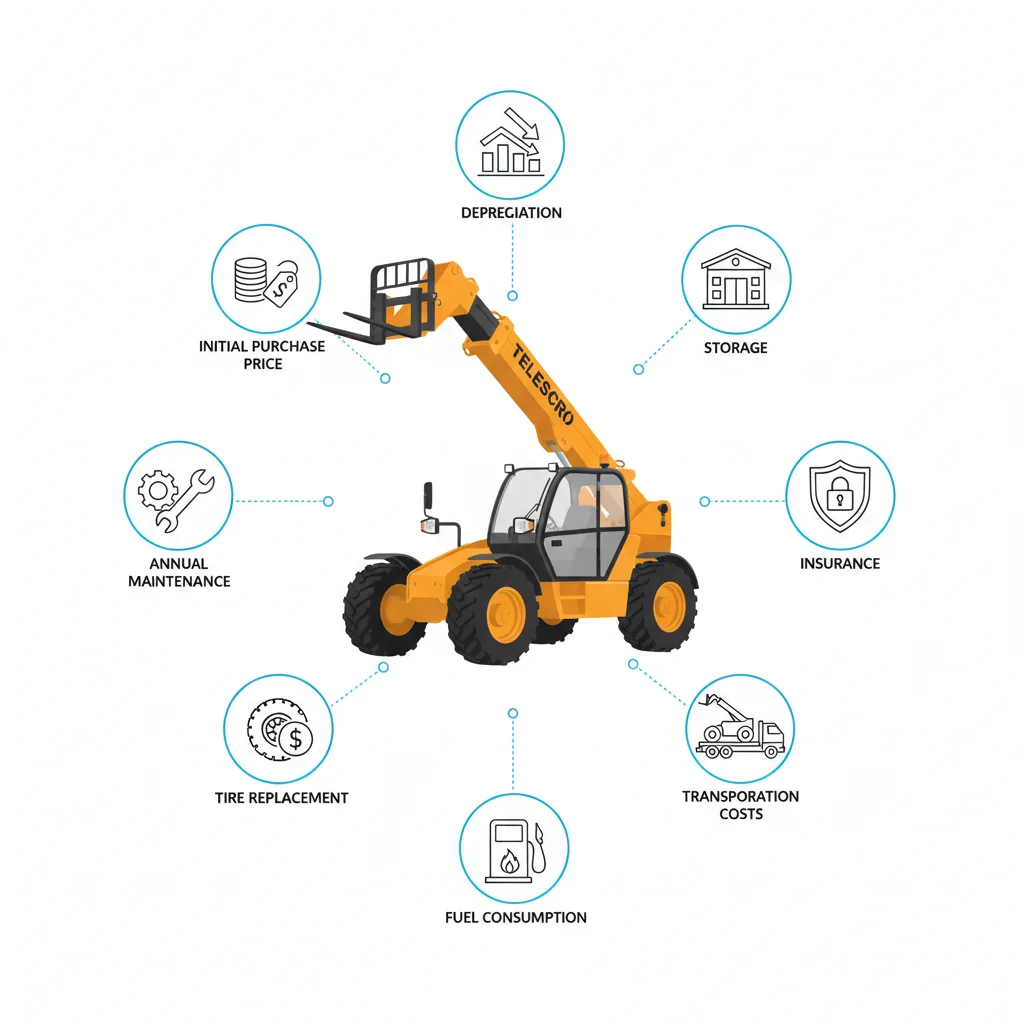
Let me share something important about telehandler ownership costs—many first-time buyers only look at the upfront price and overlook the ongoing commitments. Sure, buying a new compact 3.5-ton telehandler for $100,000 or a used one at $65,000 feels like the hard part. But the real journey starts after delivery. I’ve seen contractors in Dubai shocked by yearly maintenance bills—$1,500 just for 400 hours of routine service. Miss a scheduled check or use the wrong hydraulic fluid, and those costs jump fast, especially if you run extra hours in harsh, dusty sites.
I remember a customer in Kenya who wore out two sets of rough-terrain tires in just three years—$4,500 each time. Their telehandler was hauling bricks over rocky ground daily. Fuel was another reality check. Most diesel units burn between 9 and 12 liters per hour. That’s hundreds of dollars per month if you have a busy site, and it climbs quickly if the operator leaves the machine idling, which happens more than you’d think.
Then there’s transport. Projects aren’t always close. I’ve worked with crews in Kazakhstan who spent $400 per move just to get their telehandler to remote sites—sometimes four or five times in a project. Add insurance, storage, and even downtime risk if parts aren’t available locally. The total running cost can hit $4–7 for every hour the machine works.
My advice? Always budget for lifecycle costs, not just the initial investment. Check local parts supply and resale trends before choosing a specific model. It’s the difference between saving money and fighting “the second-year surprise.”
Telehandler resale values can fluctuate significantly based on adherence to manufacturer-recommended maintenance schedules, even if the machine is only a few years old.True
Consistent, documented maintenance preserves the value of a telehandler, as buyers and dealers are wary of future repairs when maintenance records are lacking. This makes proper servicing a critical but often overlooked ownership cost factor.
Once you pay off a telehandler, the only ongoing cost most small contractors face is fuel.False
Ongoing ownership costs include not only fuel, but also periodic maintenance, inspections, insurance, and replacement of wear parts like tires and hydraulic hoses, all of which can add up significantly over the machine’s life.
Key takeaway: Telehandler ownership demands budgeting for significant hidden costs—maintenance, fuel, insurance, transport, and tire replacement—far beyond the upfront price. Reliable resale value and brand support factor into long-term cost-effectiveness. Short-sighted savings on less-supported models risk severe downtime and higher total expenses.
How Much Labor Can Telehandlers Really Save?
A compact telehandler can reduce manual lifting crews from 3–4 workers down to a single trained operator, completing jobs in one to two hours instead of half a day. This efficiency also replaces up to 70% of small crane hires, yielding substantial annual savings in both labor hours and equipment rental costs.
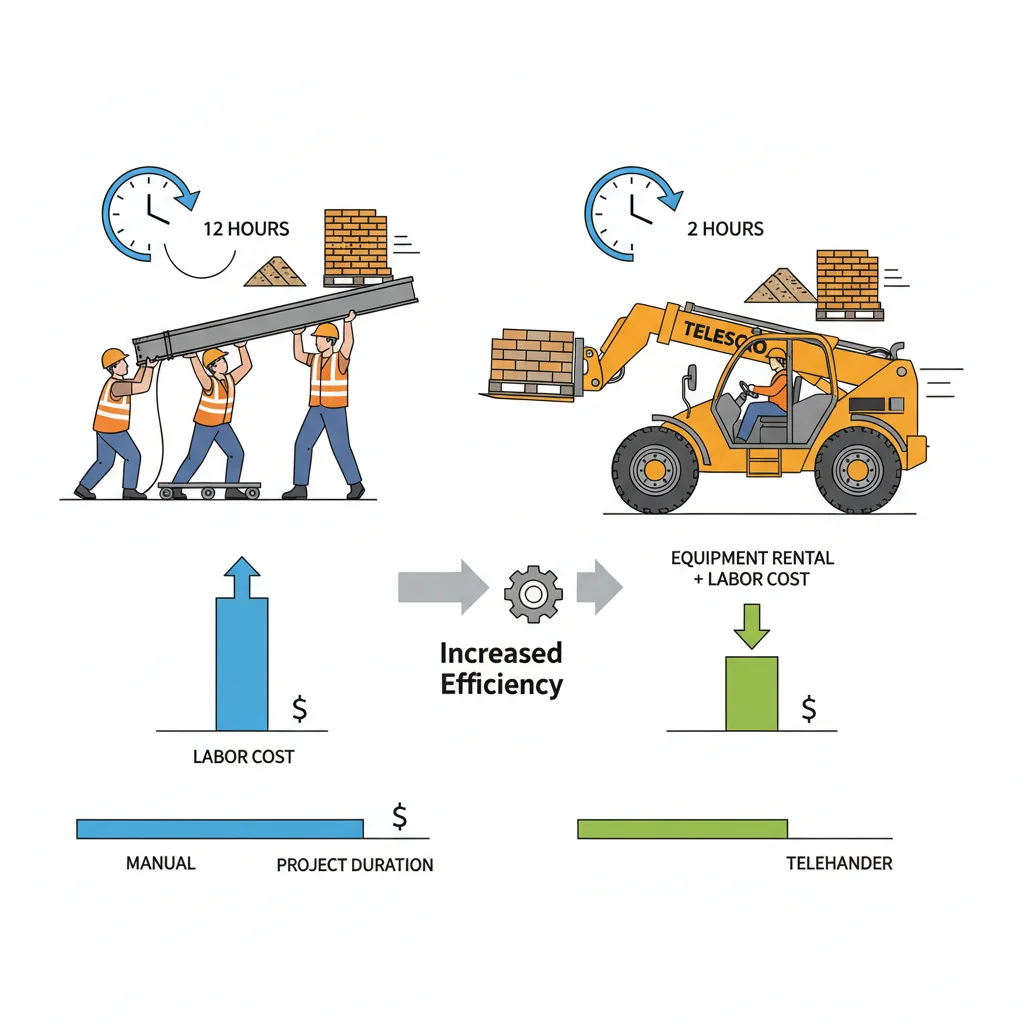
The biggest mistake I see is thinking a compact telehandler just shaves an hour or two off a job. The reality is bigger—over months, it can change your entire site workflow. Without a telehandler, you’re relying on three or four laborers to hand-lift blocks, bags, or timber up scaffolding, often half a day for a modest load. I’ve visited sites in Kenya where that was the daily routine. Then, after switching to a 2.7-ton, 7-meter model, one operator moved eight pallets in under two hours. The crew nearly halved their manual labor hours overnight and lost less time to injuries or fatigue.
I remember a customer in Dubai who used to spend over $1,200 every time they called in a mobile crane for roof trusses and HVAC units. By investing in a telehandler with a rated lift of 3 tons and reach up to 9 meters, he cut those crane hires by at least 60%. Now, most upper-floor lifts are handled internally. The savings added up to thousands of dollars by the end of the year—not just in labor but in lower equipment rental bills and less schedule disruption. Compact models, especially with a low turning radius under four meters, make a real difference on tight sites or urban jobs.
For anyone considering ownership or a long-term lease, I always suggest running real numbers: how many crane days or labor shifts were cut last year? If you’re consistently moving materials to the second or third story, a reliable telehandler pays for itself surprisingly quickly.
Compact telehandlers can enable a single operator to perform material handling tasks that would otherwise require multiple laborers, streamlining site workflow for small contractors.True
Telehandlers are engineered to handle heavy and bulky loads at height, reducing the need for manual lifting crews and allowing one trained operator to efficiently move materials, which directly impacts site logistics and labor allocation.
For small contracting jobs, telehandlers usually provide no labor savings because manual handling is equally fast for modest loads.False
Manual handling is slower and more labor-intensive for repetitive or heavy lifting tasks when compared to telehandlers, which are specifically designed to optimize such work, even on smaller jobs.
Key takeaway: Deploying a compact telehandler often enables small contractors to drastically cut labor requirements and reduce frequent small crane rentals—potentially saving thousands over a year. Analyzing labor hour savings and eliminated external lift costs is essential to assessing the true cost-effectiveness of ownership or long-term leasing.
Which telehandler size suits small contractors?
For small contractors handling residential or light commercial work, compact telehandlers with 19–32 ft lift height and 5,000–8,000 lb rated capacity offer optimal cost-effectiveness. Ultra-compact models excel in tight access environments. Oversizing leads to unnecessary costs—specify based on 80–90% of recent project requirements for efficiency.

From my experience, small contractors often overestimate the size of telehandler they really need for residential or light commercial jobs. If you’re regularly working on projects up to three stories, a compact model with around 19–32 feet of lift height and rated capacity in the 5,000–8,000 pound range usually covers 80–90% of typical site demands. I’ve helped teams in South Africa and Thailand spec machines for these tasks—moving blocks, lumber, and roofing bundles—where an affordable compact unit gets materials where they’re needed without burning extra fuel or requiring bigger transport trucks. I’ve seen jobs in tight urban lots in Dubai where ultra-compact telehandlers3, with reach between 13 to 16 feet, made a real difference.
These smaller units squeeze through alleys and work on narrow driveways where full-size models simply can’t turn. The lower running costs and purchase price also matter when margins are tight. Many customers ask if bigger is safer—my answer is always the same: unless you routinely lift over 8,000 pounds or above 10 meters, oversized machines just drain your budget with no real benefit.
Here’s a quick comparison to help clarify what fits best:
| Type | Best For | Capacity | Max Lift Height | Turning Radius |
|---|---|---|---|---|
| Ultra-Compact | Tight access, alleys, backyards, urban infill | 2,500–4,000 lb | 13–16 ft (4–5 m) | <12 ft (≈3.7 m) |
| Compact | Most residential & light commercial work | 5,000–8,000 lb | 19–32 ft (6–10 m) | ~13–15 ft (4–4.5 m) |
| Standard / High-Reach | Large sites, >3 stories, heavy materials | 8,000–12,000+ lb | 33–56+ ft (10–17+ m) | 15–18+ ft (4.5–5.5+ m) |
Compact telehandlers with a lift height up to 32 feet are typically sufficient for small contractors handling materials for buildings up to three stories.True
For residential and light commercial construction, tasks such as lifting roofing materials, lumber, and masonry blocks rarely require greater reach or capacity. Compact telehandlers offer enough performance for these jobs and are more maneuverable on tight sites.
Small contractors should invest in high-capacity telehandlers exceeding 10,000 pounds to future-proof their equipment needs.False
High-capacity telehandlers are generally unnecessary for most small contractor tasks and come with higher costs, increased size, and reduced maneuverability. These machines often exceed the requirements for typical jobs, making them inefficient and less cost-effective compared to compact models.
Key takeaway: Selecting a compact or ultra-compact telehandler tailored to actual lift height, weight, and jobsite constraints maximizes value and efficiency for small contractors. Oversizing increases acquisition and running costs without added utility—focus on units capable of handling the majority of recurring tasks for best results.
When Is Telehandler Rental Most Cost-Effective?
For small contractors with seasonal or intermittent workloads, telehandler rental is often more cost-effective than ownership. In 2025, published market examples show compact telehandler rentals commonly priced in the mid-hundreds of U.S. dollars per day or low-thousands per week, depending on region, capacity, and term. Selecting day-, week-, or month-long rentals based on actual job duration—and using nearby rental yards to minimize transport charges—helps maximize overall cost efficiency.
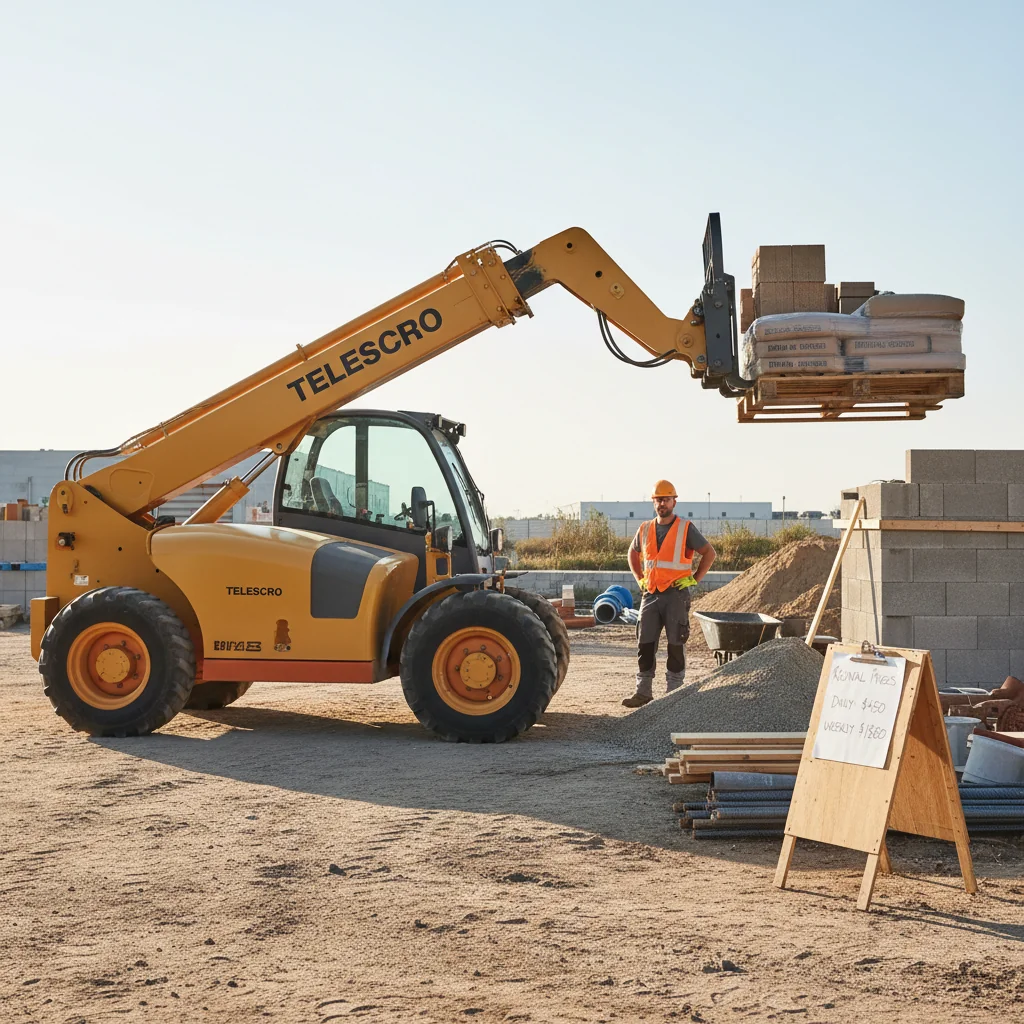
Most people don’t realize that timing and duration shape the entire rental cost equation for telehandlers. Renting is rarely one-size-fits-all—especially for smaller contractors dealing with unpredictable job schedules. In 2025, compact 5,000 lb (2.5-ton) telehandlers with roughly 6-meter reach typically cost between USD 400–650 per day or about USD 1,100–1,800 for a week. I’ve seen these numbers hold true in places like Malaysia and Eastern Europe, especially for urban jobs where site access is tight and turnaround needs to be quick.
Here’s a situation I ran into in Kazakhstan: a contractor needed a telehandler just four days per month to unload finish materials on a new school site. Their first instinct was to rent monthly, but with monthly rates stretching to USD 2,200–2,600, they ended up overpaying for machine downtime. When they switched to weekly and half-day terms, and started tracking actual hours (often under 20 per month), their costs dropped by around a third. The key is matching the rental term to your real usage—not just the project’s timeline.
Local yard choice can make or break your budget. Delivery fees on a compact machine can run USD 150–300 each trip if you use a distant supplier. Picking a nearby rental yard means faster drop-off and less lost time, especially when weather or site conditions cause delays. I always recommend contractors track monthly utilization. If you consistently pass 40–50 working hours or spend more than about USD 2,500 per month, it’s time to consider owning or leasing long-term. Smart data, not guesswork, should drive your decision.
Telehandler rentals are most cost-effective for small contractors when used on multiple consecutive projects, since transport and delivery fees can be spread out over several jobs instead of just one.True
Transport and delivery fees are fixed costs that apply each time a machine is moved. By scheduling several projects close together, contractors minimize the impact of these recurring fees on their overall rental budget.
It is always cheaper for small contractors to rent telehandlers on a daily basis rather than a weekly or monthly basis, regardless of project duration.False
Daily rental rates are set higher to account for short-term usage and rapid equipment turnover, making weekly or monthly rentals more cost-effective when the equipment is needed for more than a few days.
Key takeaway: Small contractors can cut costs by matching rental term to project length and selecting nearby rental yards. If monthly telehandler rental exceeds about 40–50 hours or USD 2,000–2,500, purchasing may be advisable. Regular utilization tracking supports practical, data-driven decisions between renting and buying.
Are electric telehandlers a cost-effective choice?
Electric and hybrid compact telehandlers offer zero on-site emissions, quiet operation, and reduced routine maintenance4, making them cost-effective for small contractors in urban or emissions-regulated environments. Despite higher upfront costs, these models deliver savings through lower fuel and maintenance expenses, especially with frequent, high-hour use or where diesel and compliance costs are high.
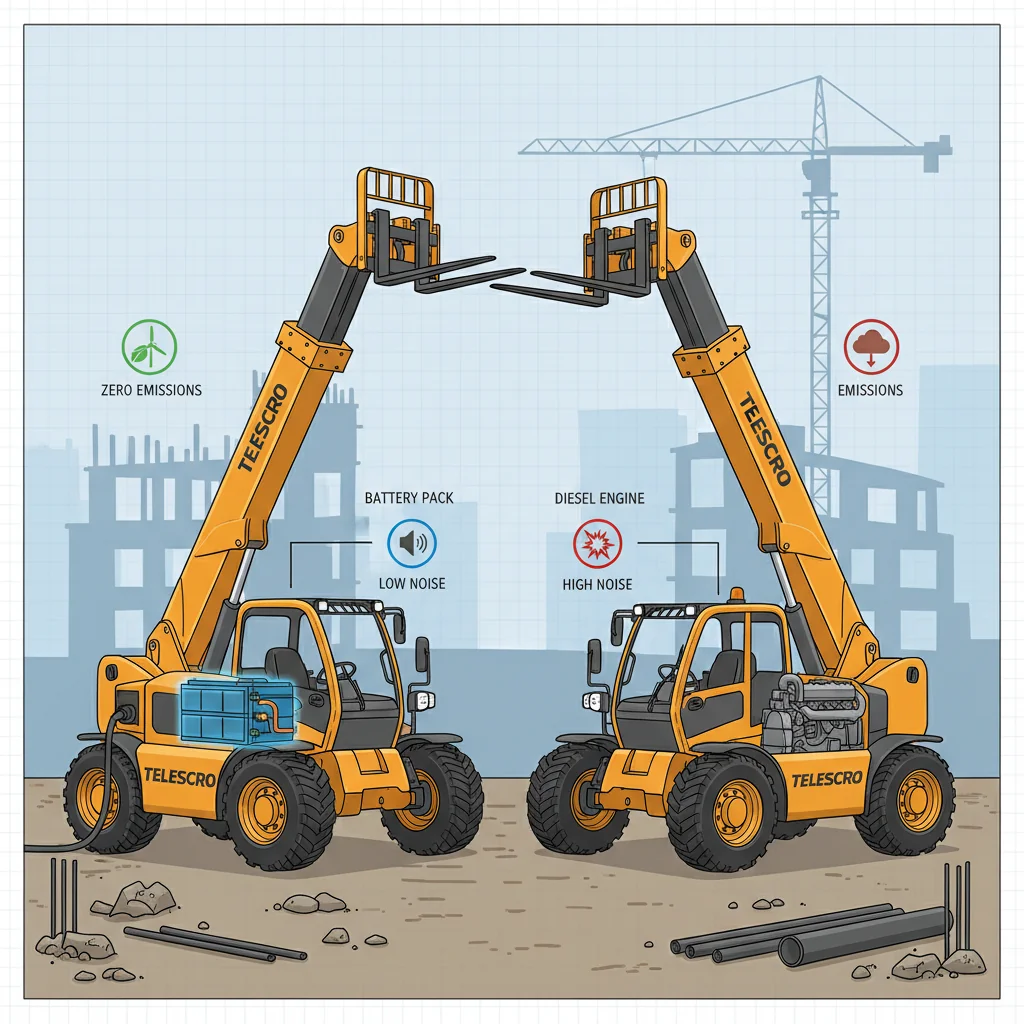
Most people don’t realize that electric telehandlers can actually be the cheaper option over a few years—if the conditions are right. The initial price is definitely higher; in China, I’ve seen compact electric models cost at least 25% more than their diesel equivalents. But when you factor in charging versus fueling, plus fewer service calls, the numbers start to shift. One contractor in Dubai replaced his two diesel machines with electric units for high-rise residential work. He told me his monthly running costs dropped by around 40%, mainly because he could plug in overnight with cheap power and skip oil changes and engine maintenance entirely.
For contractors working indoors or in areas with strict emissions rules—like parts of Western Europe or city centers—these electric models can pay for themselves faster. I’ve supported sites in the Netherlands where diesel machines aren’t even allowed inside the building. There, the ability to work quietly and without exhaust is essential. Even the hydraulic system on electric models often needs less service, since there’s less vibration and heat compared to diesel engines. For a 2.5-ton compact model running two shifts per day, the savings on fuel and filters alone can add up to the price difference in under two years.
But, I always suggest checking if your jobs really need that level of low emission and silent operation. If you mostly work outside and only use the machine a few hours per week, a diesel unit is likely the better value. Make sure you also consider charging logistics and the real battery cycle time—don’t rely on the brochure number alone.
Electric telehandlers can lead to lower total cost of ownership for small contractors operating primarily indoors or on predictable schedules.True
Electric models reduce fuel and maintenance costs, especially when used in environments where charging downtime can be scheduled without impacting productivity. This makes them cost-effective when operational conditions align with their charging and usage profiles.
Electric telehandlers always cost less to operate than diesel units, regardless of jobsite conditions.False
Operating costs for electric telehandlers can exceed those of diesel models if jobsites lack reliable charging infrastructure or involve high utilization where charging time delays productivity. High initial purchase price and limited runtime can make them less cost-effective in such situations.
Key takeaway: Electric and hybrid telehandlers can provide strong long-term value for small contractors working in low-emission, noise-sensitive, or indoor environments with high utilization. Contractors should carefully weigh higher upfront costs against potential operational savings, frequency of use, and charging logistics before making a purchase decision.
How Do Maintenance and Telematics Impact ROI?
Disciplined maintenance5 and effective use of telematics play a major role in telehandler ROI for small contractors. Daily checks—such as engine oil, coolant, hydraulic hoses, tires, lights, and boom pins—combined with OEM-recommended service intervals help sustain reliability and control wear. Telematics add value by tracking hours, idle time, and fault codes, enabling proactive maintenance and more efficient utilization, which can significantly extend productive service life when machines are properly operated and maintained.

Here’s what matters most when you want a telehandler to stay productive—and profitable—long after the warranty expires: disciplined, everyday maintenance shapes your real return on investment. I’ve seen this lesson play out everywhere from busy Dubai sites to remote farms in Inner Mongolia. Most breakdowns I’ve witnessed weren’t caused by big accidents—they were the result of skipped daily checks or ignored service schedules. A 4-ton, 14-meter telehandler that’s greased and inspected daily, engine oil swapped out at the manufacturer’s 500-hour mark, and hydraulic filters changed at 1,000 hours will typically work well past 8,000 hours. That’s the difference between a machine that keeps generating revenue and one that turns into a costly yard ornament.
But there’s another factor you shouldn’t ignore—telematics. I worked with a contractor in Vietnam who used telematics to track actual working hours and idle time on a small fleet. By spotting which machines idled too much, they set new operator guidelines and cut fuel waste by at least 12%. More importantly, fault code alerts let their mechanic catch a boom cylinder seal problem early—preventing two weeks of downtime and a repair bill that could have hit $2,500. Telematics won’t directly tell you “component X is 80% worn,” but it does give the data to act early.
If you’re operating just two or three telehandlers, these details matter even more. I always suggest setting up a maintenance log and reviewing telematics reports weekly. That small discipline protects your uptime, helps you plan budgets, and ensures your machine retains solid resale value—not just a few years, but for the entire decade you own it.
Telematics systems can help small contractors reduce unplanned downtime by alerting them to maintenance needs before failures occur.True
Telematics provides real-time data on machine health, enabling proactive maintenance and catching potential issues early, which is especially valuable for small contractors who may lack dedicated service staff.
Telehandlers with advanced telematics are only cost-effective for large construction firms and provide little benefit for small contractors.False
Small contractors can also benefit from telematics, as early maintenance alerts and usage tracking help extend equipment life and reduce expensive repairs, directly impacting return on investment regardless of company size.
Key takeaway: Adhering to disciplined maintenance schedules and leveraging telematics data ensures high uptime, cost control, and sustained telehandler value. Small contractors using telematics for proactive service management and utilization tracking can minimize costly breakdowns, optimize ownership decisions, and protect long-term return on investment.
What Telehandler Financing Reduces Contractor Risk?
Small contractors benefit from flexible telehandler financing, including operating leases6, finance leases, and rent-to-own agreements—generally priced at $1,200–2,000/month for mid-size models—releasing capital for core operations. Joint ownership7 splits costs but demands strong coordination. Service-inclusive lease terms, while higher, may minimize costly downtime. Careful dealer and warranty evaluation is essential.
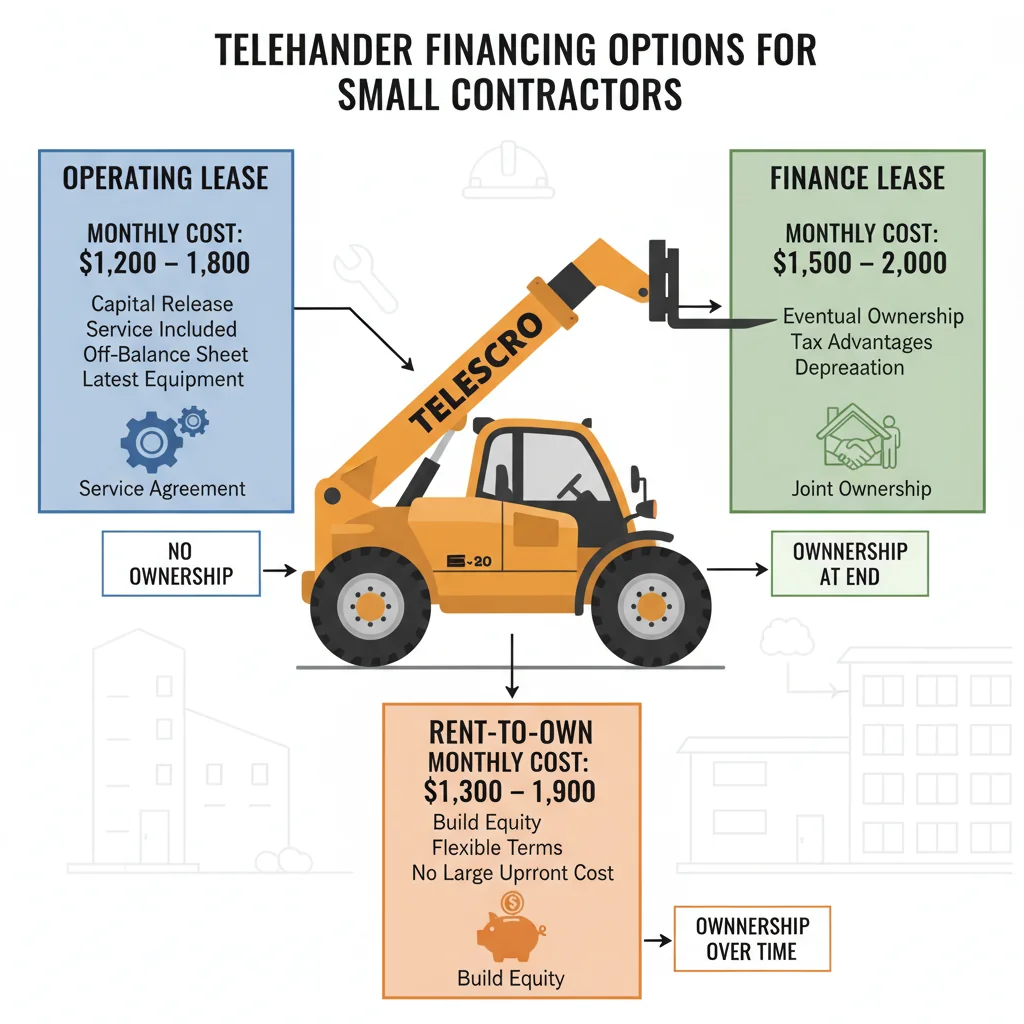
To be honest, most smaller contractors worry about cash flow more than specs. The reality is, you rarely need to put down $60,000 or more upfront for a mid-size telehandler. Operating leases, finance leases, and rent-to-own deals all spread the machine’s cost over two to five years—normally $1,200 to $2,000 a month for a 3.5-ton unit with a 12-meter boom. That keeps cash on hand for payroll and materials, not stuck in a parked machine. I’ve seen this work well for a builder in Malaysia: he used a three-year rent-to-own plan and had zero payment stress, even during a slow month.
Joint ownership is another way to cut risk, but you need total trust between partners. In Dubai, two subcontractors I worked with split a 4-ton telehandler. Written schedules prevented booking clashes, and they agreed upfront how to handle damage, insurance, and monthly service. It saved them over $10,000 per year each—only because their projects ran on precise timelines. If your schedule is chaotic or partnerships get messy, joint ownership can create more headaches than savings.
Monthly cost isn’t the only risk factor. Downtime kills productivity fast—one jobsite in Kazakhstan lost three days waiting for a local dealer’s spare hydraulic hose. That’s why I always recommend comparing dealer response times and checking if maintenance is included in lease terms. Sometimes, a $100 higher monthly fee that covers repairs saves a fortune over a year. Confirm the warranty: is it parts only, or does it include labor and travel? Minimize surprises by getting this in writing before you sign anything.
Operating leases for telehandlers can help contractors avoid residual value risk, since the machine is typically returned to the lessor at the end of the term.True
With operating leases, the contractor does not own the machine at the end of the agreement and does not need to worry about selling it or its market depreciation, reducing financial uncertainty.
Finance leases always include routine maintenance coverage, which protects contractors from unexpected equipment repair costs.False
Finance leases usually require the lessee to handle all maintenance and repairs as if they owned the machine; routine maintenance coverage is only included with some operating leases or rental agreements, not finance leases by default.
Key takeaway: Spreading telehandler costs through leasing, rent-to-own, or joint ownership keeps cash flow healthy for small contractors. Prioritizing dealer support and maintenance-inclusive agreements can yield long-term savings by reducing downtime, even if monthly payments are slightly higher. Risk is minimized with careful partner selection and clear responsibility guidelines.
Which telehandler attachments boost ROI fastest?
Telehandler cost-effectiveness for small contractors increases when a small set of high-use attachments can replace multiple machines. Pallet forks8, a general-purpose bucket sized to the machine and material density, and a lifting jib or hook can cover most day-to-day handling tasks efficiently. A man basket—where permitted and when using approved platforms and procedures—adds access capability. Quick-coupler systems reduce changeover time, encouraging correct attachment use and improving overall productivity.

When small contractors ask me where to start with attachments, my honest advice is to focus on what gets used every single day. Most jobs come down to three essentials: pallet forks, a general-purpose bucket (1–1.5 cubic meters), and a lifting jib or hook. A team I worked with in Kenya relied on forks for nearly 70% of site moves—brick packs, timber, even formwork. The bucket saw action clearing debris and shifting gravel, while the jib handled everything from rebar bundles to HVAC units. These three attachments let one telehandler take over most lifting and carrying jobs, so you don’t need a dedicated loader or small crane onsite. The fastest payback usually comes from a quick-coupler system9.
Swapping forks for a bucket in two or three minutes—versus wrestling with manual pins for fifteen—means crews actually use the correct attachment for the task. I’ve seen sites in Brazil where workers skipped switching because it took too long, which led to broken pallet tines and near accidents. Time saved on every change adds up to extra loads moved each shift, and that’s real productivity.
Here’s a table I use to break down typical ROI impact for small contractors:
| Attachment | Daily Usage | Main Tasks Covered | Impact on ROI | Notes |
|---|---|---|---|---|
| Pallet Forks | 60–80% | Material handling, palletized goods | Highest | Essential, used on nearly every shift |
| GP Bucket (1–1.5 m³) | 15–25% | Loading, backfill, debris cleanup | High | Versatile; replaces small loader on site |
| Lifting Jib / Hook | 10–20% | Rebar, HVAC units, awkward or slung loads | Medium–High | Expands lifting capability without a crane |
| Quick-Coupler System | Indirect | Fast attachment changes | Very High | Multiplies ROI of all attachments |
A lifting jib attachment can transform a telehandler into a versatile small crane, allowing contractors to handle loads like rebar bundles or HVAC units without hiring additional lifting equipment.True
Lifting jibs utilize the telehandler's reach and capacity for overhead lifting tasks, reducing the need for dedicated cranes on smaller sites, which boosts equipment utilization and ROI.
General-purpose buckets are rarely cost-effective for small contractors because telehandlers cannot efficiently move materials like gravel or debris.False
Telehandlers with buckets are commonly used for material handling tasks, such as shifting gravel or debris, and this versatility makes them valuable attachments that improve ROI, especially for small contractors without dedicated loaders.
Key takeaway: Focusing investment on high-usage attachments—pallet forks, general-purpose bucket, and lifting jib—maximizes telehandler ROI for small contractors. Track attachment utilization and rent specialty tools used less than 10% of the time. Upgrading to a quick-coupler encourages safer, faster attachment changes, further improving daily jobsite productivity.
What safety rules affect telehandler costs?
Safety noncompliance—such as ignoring the manufacturer’s load chart10, inadequate operator certification11, or misuse of fork-mounted platforms—raises risk of tip-overs, material damage, legal exposure, and insurance premiums. Telehandler stability, rated capacity at maximum reach, and regional certification all directly impact cost-effectiveness and ongoing operational expenses for small contractors.

I’ve worked with customers who underestimated how small mistakes with safety rules can escalate costs. For example, a contractor in Dubai skipped proper operator certification to save a few days. By week two, an untrained operator overloaded a 3.5-ton telehandler at maximum reach. The result? The boom dipped, dropped a pallet of tiles, and the insurance company refused coverage due to noncompliance. Material losses aside, their premium jumped the next renewal. It’s a tough way to learn that safety shortcuts never pay off.
Another thing I see is contractors ignoring the load chart, trusting the "max capacity" number. On most jobsites, you rarely lift at minimum radius. At full extension, a 3-ton model might only be safe for around 1,100 kg—far less than expected. Last year in Kenya, a small builder sent me photos after a soft edge collapsed under the front tire. Their telehandler’s stability warning light had already flashed, but the operator thought it was "just a sensor issue." Repairs cost them three weeks of downtime, and the lost project time easily topped $8,000.
To be honest, paying for operator training and routine machine inspections sounds like an extra burden upfront. But compared to the cost of project delays, legal trouble, or high insurance deductibles, it’s a small investment. I suggest every contractor check local man basket regulations—often you need extra approval even with certified equipment. The goal is to make your telehandler a reliable asset, not a source of expensive surprises.
Telehandler insurance premiums can increase substantially after an incident if operators are found noncompliant with safety certification requirements.True
Insurance companies often include clauses in their policies that require strict adherence to safety rules and operator qualifications. When noncompliance leads to an accident, insurers may refuse claims and increase future premiums, making operational costs rise significantly for small contractors.
Using a telehandler without strict attention to load charts and rated capacity is only a minor safety risk and has little effect on insurance or repair costs.False
Ignoring load charts and rated capacities exposes operators to serious safety hazards, including tip-overs and component failure. Such incidents lead to costly machine repairs and insurance complications, especially if rules have been disregarded. Insurers typically penalize policyholders who don't follow basic safety protocols, leading to higher costs.
Key takeaway: Ignoring safety and compliance requirements drives up telehandler ownership costs through accidents, downtime, legal action, and insurance hikes. Small contractors should prioritize training, clear load chart use, and compliant equipment selection to ensure long-term cost-effectiveness and avoid preventable financial losses.
Conclusion
We’ve looked at how telehandlers can help small contractors handle lifting and material placement more efficiently on typical residential sites. In my experience, the real wins come from matching machine specs to daily tasks—not just chasing the highest reach or lift numbers. I always recommend checking the load chart at about 75% boom extension, since that’s where most work happens, and making sure you won’t get caught in “parts roulette” if something breaks down. Want help weighing options or have questions about attachments and local support? I’m happy to share practical advice based on what’s worked for crews in 20 countries—just reach out anytime. Every site is different, so go with what truly fits your workflow.
References
-
Explore how compact telehandlers improve efficiency by handling multiple lifting tasks on rough terrain and tight job sites. ↩
-
Provides detailed insights on typical telehandler annual maintenance costs and what expenses to expect, helping owners budget effectively. ↩
-
Understand how ultra-compact telehandlers with 13-16 ft reach maneuver in narrow spaces, cutting costs and boosting efficiency in restricted environments. ↩
-
Understand the maintenance savings from electric telehandlers, including fewer service calls and less hydraulic system servicing, improving total cost of ownership. ↩
-
Explore how regular checks and OEM-recommended servicing extend telehandler life and maximize return on investment with expert insights. ↩
-
Detailed insights on how operating leases reduce upfront costs and support cash flow management for contractors. ↩
-
Expert advice on cost splitting, coordination, and risk management through joint ownership agreements in construction. ↩
-
Explore how pallet forks enhance daily lifting tasks, increasing site efficiency and reducing the need for multiple machines. ↩
-
Learn how quick-coupler systems save time by enabling faster attachment swaps, boosting productivity and safety on construction sites. ↩
-
Explore how adhering to the manufacturer’s load chart prevents tip-overs, ensures operator safety, and avoids costly insurance claims. ↩
-
Understand why proper operator certification reduces risks, enhances compliance, and cuts down insurance premiums for contractors. ↩