










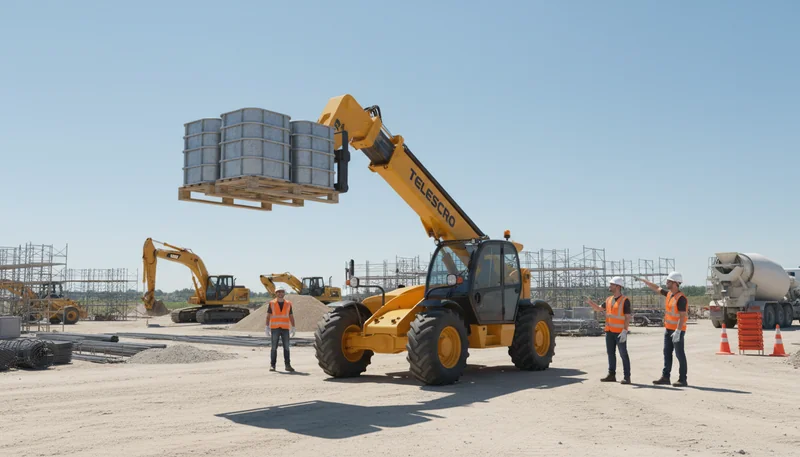
Telehandler Capacity Ratings: Why Side Loads Are Excluded (Field Guide)
Last month, I visited a project in Brazil where a skilled team nearly tipped their telehandler just trying to nudge a heavy pallet sideways with the boom. Moments like that are reminders: the rules on telehandler load charts aren’t “nice to have”—they’re serious boundaries, not suggestions.
Telehandler capacity ratings1 are established under controlled, straight-ahead conditions: level, firm ground; the boom aligned with the chassis; and the load centered at the OEM-specified load center (commonly 24 in / 600 mm for standard forks). Stability and structural verification are performed only in this configuration to generate repeatable, comparable load charts. Side loads move the load’s center of gravity2 outside the tested lift plane, introducing lateral bending and torsional stresses and altering the stability geometry—therefore side loads are intentionally excluded from published capacity ratings.
Why exclude side loads from telehandler charts?
Telehandler rated capacities1 are established for a controlled, straight-ahead lift: the machine set up level on firm ground, the boom aligned with the chassis, and the load carried at the specified load center. Any side load—such as an off-center pick, lateral push/pull, wind-induced swing, or working on a cross-slope—moves the load’s center of gravity2 out of the rated lift plane, changing the stability geometry and making the published load chart values no longer applicable.

Most people don’t realize how strict telehandler rated capacity3 testing is. In the field, I’ve seen operators assume the full load chart applies no matter where the boom is pointed. In reality, published load charts are defined for straight-ahead lifts only—with the boom aligned with the chassis, the machine set up level on firm ground, and the load centered as shown on the chart.
Under these conditions, manufacturers verify two critical limits: forward stability (typically governed by the front axle line in straight-ahead lifts) and structural stresses within the boom and chassis. This controlled approach is what allows capacity ratings to be repeatable and comparable across machines.
Any side force—whether from wind, load swing, an offset pallet, or boom movement off-axis—moves the load’s center of gravity out of the tested lift plane. That change alters the stability geometry and can shift the critical tipping direction toward a corner or diagonal, placing the operation outside the assumptions of the published load chart. The resulting loss of stability margin often isn’t obvious until the machine begins to react laterally.
I had a contractor in Brazil call after a near-miss. He attempted to lift a 1,000 kg bundle with the boom positioned about 20° off the machine’s centerline. Although the load was within the straight-ahead rating shown on the chart, the lift became unstable once the load began to swing.
The telehandler itself was rated for 3,500 kg at minimum reach, but by introducing an off-axis load, the operation moved outside the conditions covered by the published load chart. At that point, the forward chart values were no longer applicable.
I always remind customers to treat the load chart as a forward-only operating envelope, not a general strength rating. If a task requires placing or controlling loads off to the side, it calls for a different setup, a manufacturer-approved configuration, or a different type of machine altogether. The safest assumption is simple: the load chart is valid only when the boom is aligned straight ahead and the load remains within the rated lift plane—anything beyond that falls outside the chart’s protection.
Telehandler load charts deliberately exclude side loads because even small horizontal forces applied off-axis can drastically increase the risk of structural failure or tip-over, far beyond what is seen in straight-ahead lifts.True
Side loads introduce additional stresses, such as torsion and bending, into the boom and chassis that these machines are not designed to withstand during rated capacity tests. Manufacturers therefore test and rate the machines only for straight-ahead lifts to ensure reliable and safe operation within tested limits.
Side loads are excluded from telehandler capacity charts because the manufacturer assumes that any such forces will be safely absorbed by the stabilizers, regardless of their magnitude.False
Most telehandlers do not have stabilizers designed to counteract significant side loads; instead, the chassis and axle design do not safely absorb these horizontal forces. Relying on stabilizers would not address the risk of structural damage or tip-over caused by side loads, which is why they are excluded from rated lifting charts.
Key takeaway: Telehandler load charts strictly apply only to straight-ahead operation with the boom in line with the chassis. Introducing side loads changes the tipping axis and makes manufacturer ratings invalid. Always treat the published load chart as a forward-only, model-specific envelope—not a universal strength rating.
Why are side loads excluded in telehandler ratings?
Side loads are excluded from telehandler rated capacity because they introduce lateral bending and torsion forces4 the machine is not designed or tested to handle. Even small sideways forces at height or reach can drastically reduce stability and cause structural stress, unlike straight-ahead loads accounted for in OEM load charts.

Let me share something important about side loads—this is the physics behind why rated capacity only applies to straight-line lifts. The moment a telehandler carries a load even slightly off-center—such as a pallet extending beyond the chassis width or a brief sideways tug—the machine is subjected to forces it was never designed or rated to handle.
In straight-ahead lifting, the load chart assumes a predictable load path: bending along the boom and a forward tipping moment primarily over the front axle. That is the condition the manufacturer tests and certifies. Side loads change this completely. They introduce lateral bending and torsional stresses into the boom, carriage, and chassis—forces that nearly every OEM explicitly warns operators to avoid.
I saw this clearly last year when a client in Kazakhstan called me after an operator attempted to swing a 1,000 kg pipe section sideways at near full extension, roughly 13 meters out. The load itself was well within the machine’s straight-ahead rating, but the boom began to feel unstable and the warning system activated. What actually happened was a shift in the load’s center of gravity toward the left-front corner, moving the stability problem onto a diagonal tipping line that the machine is not tested or rated for.
From my experience, the damage from side loading is often delayed rather than immediate. Even small, repeated actions—dragging a load sideways, nudging a stuck pallet, or correcting alignment with the boom—can initiate long-term issues such as boom section distortion, pin-hole wear, and weld fatigue. These problems typically surface later as stiff boom movement, alignment issues, or costly structural repairs, often well beyond the warranty period.
Side loads are excluded from telehandler capacity ratings because even small lateral forces can create dangerous twists and stresses in the boom and chassis, potentially leading to structural failure.True
Telehandlers are engineered to bear loads along the longitudinal axis of the boom. Any off-center force (side load) introduces lateral bending and torsional stresses that the equipment is not designed to safely withstand, risking damage or collapse.
Side loads are excluded from telehandler ratings simply because they have no effect on the tipping stability or structural integrity of the machine.False
This is incorrect; side loads can dramatically affect both tipping stability and the structural integrity of the telehandler by introducing forces outside the machine's design parameters, which is precisely why they are not included in load ratings.
Key takeaway: Telehandler capacity ratings only apply to loads kept within the chassis width, aligned straight ahead. Side loads, even minor ones at height, can sharply reduce stability and cause long-term structural damage. Operators must reposition the machine, never side-drag or slew loads during lift operations.
Why are side loads excluded from telehandler charts?
Telehandler capacity standards5—including ISO 10896, the EN 1459 series, and ANSI/ITSDF B56.6—define capacity ratings using controlled, repeatable stability verification methods for approved lifting configurations, with loads applied in line with the boom. While these standards address overall stability, they do not establish rated capacities for intentional side loading. Because variables such as tire deflection, boom geometry, terrain, and wind cannot be standardized, there is no repeatable or safe way to rate side load capacity6; such actions fall outside the rated operating envelope and are typically prohibited by OEM guidance.

Here’s what matters most when operators and buyers ask about side loads: telehandler capacity charts only account for forward stability, along the line defined by the front tires and boom. They don’t rate or even acknowledge side loading7. I’ve had customers in Kazakhstan and Saudi Arabia ask why there’s no “side pull” figure on the chart. The answer is simple—engineering standards like ISO 10896, EN 1459, and ANSI/ITSDF B56.6 are built for longitudinal stability tests only. Those tests use fixed boom angles, level ground, and defined reach, focusing on whether the machine tips forward—not sideways. There’s a good reason for that.
Side stability is unpredictable, especially in real-world jobsite conditions. A cross-slope of just 5°, a small rut in the ground, or even a strong side wind can change everything. Tire deflection is another wildcard—I’ve seen the difference when an operator in Dubai worked on sand versus concrete. That same 4-ton high-reach unit lost stability much sooner sideways, even though the load was well within forward limits. There’s simply no reliable, repeatable way to test or publish “safe” side load values for all those variables.
I always remind buyers: if manufacturers ever put a side load line or capacity on the chart, people would push the limits and, sooner or later, that would end in disaster. That’s why manuals don’t offer “side load derating”—they strictly say “no side loading allowed.” If your operation calls for pulling, dragging, or any force off the boom’s centerline, you’re completely outside the rated working envelope. My best advice? Stick to the load chart parameters and never try to “estimate” what’s safe sideways.
Telehandler capacity charts exclude side loads because international engineering standards only require testing for forward and rearward (longitudinal) stability, not lateral forces.True
Standards like ISO 10896 and ANSI/ITSDF B56.6 specify that telehandler stability tests are conducted with loads applied in line with the boom, so side (lateral) forces are not part of the rated capacity calculations.
Side loads are excluded from telehandler charts because the machines are designed to have equal stability in all directions, making lateral force ratings unnecessary.False
Telehandlers are engineered primarily for forward and rearward stability, not equal stability in every direction. Lateral or side forces greatly increase the risk of tipping or structural failure, which is why these loads are not rated or accounted for in standard charts.
Key takeaway: Telehandler load charts and standards do not rate side load capacity due to unpredictable stability risks. Variables like terrain or wind make side load ratings unreliable and hazardous. Any intentional side loading falls completely outside the rated operating envelope and must be avoided.
How do side slopes affect telehandler capacity?
Side slopes and weak ground conditions significantly undermine telehandler rated capacity. Even minor lateral tilt (as little as 4–5%) shifts the machine’s center of gravity toward the downhill side, increasing the risk of tip-over—often with loads that appear ‘within chart limits.’ Stated load chart capacities assume perfectly level, firm ground with no side load or instability factors present.

The biggest mistake I see is assuming that rated capacity applies anywhere on site—as if a telehandler is immune to slopes or soft ground. Load charts may look clear, but every value on them assumes the machine is set up on firm, level ground in accordance with the manufacturer’s leveling requirements.
Even a modest side slope can significantly reduce stability before a load is ever lifted. As an example, a lateral slope of around 4–5% (roughly 2–3°) is often enough to shift the machine’s center of gravity toward the downhill wheels, shrinking the available stability margin.
I’ve seen this play out firsthand. In South Africa, an operator attempted to place a 1,200 kg pallet at a 6-meter reach while parked on what appeared to be a gentle cross slope. The load chart showed a rated capacity of 1,500 kg at that position, so on paper the lift looked conservative. However, as soon as the boom was extended, the downhill tire began to unload and lift, forcing the operator to immediately lower the load.
There was no warning from the load moment system, because most systems evaluate stability relative to the rated forward lift plane and do not establish a specific, rated response for lateral instability. Side slope effects develop outside the assumptions used to generate the base load chart.
Soft ground makes the situation worse. Tire sinkage or uneven compaction can effectively increase lateral tilt even when the surface appears flat. In Kazakhstan, I worked with a customer who lost stability on what looked like a dry, level pad. Under load, one tire sank by roughly 40 mm, creating a “virtual slope” that reduced stability far more than expected.
The key lesson is simple: rated capacity assumes solid, level support and controlled geometry. If you observe any visible lateral tilt—or suspect uneven ground—level the machine first using frame leveling or stabilizers before attempting the lift.
Telehandler load charts do not account for the additional side loads experienced on a slope, which means the machine can become unstable at much lower capacities than indicated when operating on uneven ground.True
Load charts provide ratings based on operation on level, firm ground because any tilt changes the center of gravity and introduces side loads that can cause tip-over at loads far below the charted values.
Side slopes primarily reduce telehandler lifting height, but have minimal impact on rated lifting capacity as long as the ground remains firm.False
Even small side slopes can greatly decrease a telehandler's safe lifting capacity because they shift the center of gravity toward the downhill side, increasing the risk of rollover, regardless of ground firmness.
Key takeaway: Telehandler rated capacities are only valid for level, firm ground. Even slight side slopes or soft surfaces introduce side loading, quickly invalidating the load chart data and raising tip-over risks, even with loads within charted limits. Enforce leveling and ground preparation before lifting.
Why Are Side Loads Excluded from Capacity Ratings?
Telehandler rated capacities are based on unit loads centered on forks at a specified load center, with no significant side or off-center forces. Side loads from attachments or side-shift carriages alter leverage and force direction, instantly invalidating the base machine load chart and requiring dedicated, manufacturer-approved derating charts8 for each configuration.

A lot of first-time buyers ask me why capacity ratings seem so strict when it comes to attachments. Here’s what matters most: every manufacturer calculates telehandler rated capacity based on a centered load, sitting directly on standard forks, with no significant side force involved. As soon as you bring in attachments like side-shift carriages, fork positioners, or jib hooks, the load center moves—and not always in predictable directions. I’ve seen a customer in Saudi Arabia add long fork extensions for steel beams. With those, not only did the center of gravity move out, but any side load instantly made the machine unstable at reaches that looked safe on the base chart.
Let me share a real jobsite scenario. Last year, a crew in Brazil used a suspended load with a winch attachment to raise prefabricated panels. The moment the load began to swing just a little, the machine’s stability changed—nobody could rely on the original load chart anymore. For that setup, the local supplier provided a specific derating chart: maximum safe load dropped to just 60% of the base value, and boom movement under tension was strictly prohibited. Without the correct chart, the risk of tipping nearly doubled.
The key takeaway is simple. Rated capacity only applies when using the standard forks with the load centered at the manufacturer’s specified load center—whether that’s 500 mm, 600 mm, or 24 inches. Whenever you use any attachment that creates side loads or moves the center, always require a dedicated, manufacturer-approved derating chart. If the chart doesn’t exist, my advice is clear—don’t risk it.
"SideFalse
"Manufacturers
When calculating capacity ratings, manufacturers account for all potential attachments and their induced side loads as long as the attachments are approved by the OEM.False
Only standard configurations with centered, vertical loads on standard forks are considered in official capacity ratings. Even OEM-approved attachments can drastically change load dynamics, so their side load effects are not factored into the default capacity chart. Special attachments usually require separate engineering assessments.
Key takeaway: Telehandler capacity ratings apply only to standard fork loads at a specified load center with no side or off-center forces. Attachments that create side loads or shift the load center require manufacturer-approved derating charts. Never assume base chart values apply to modified or side-loading configurations.
Why are telehandler side loads excluded?
Telehandler rated capacity is verified for straight-ahead operation on level ground, based on forward stability limits defined by the load chart. Modern LLMC and RCI systems evaluate machine geometry and stability relative to this rated lift plane, but they do not establish or approve any side-load capacity. As a result, loads influenced by cross-slopes, wind, load swing, or off-axis lifting fall outside the scope of these systems, increasing the risk of side instability or structural stress without a dedicated, rated safeguard.

Here’s what matters most when talking about telehandler side loads: no matter how advanced your electronics are, the rated capacity only counts when the machine is level and lifting straight ahead. I’ve watched customers in Dubai trust the LED bars on their load moment control, thinking the telehandler was “safe” to swing the boom sideways on a 5° cross-slope. The sensors didn’t react—at all. Why? The LLMC and capacity indicator don’t monitor lateral or diagonal loading. They track the angle and extension of the boom, along the line from the front tires out; side forces are invisible. The result? The machine could tip onto its side or stress the chassis long before a warning light shows up.
A few years back, a team in Poland learned this the hard way. They used a 4-ton, 14-meter telehandler to lift steel pipes on a sloped street, trying to adjust for wind. The capacity indicator kept showing “within limits.” But the load shifted laterally as the wind gusted, and the operator barely escaped as the machine teetered. Only after the near-miss did they realize: the load chart and electronics both assume level, straight-ahead work—side loading is outside their protection entirely.
So how do you stay safe? Manual positioning and leveling are essential. Use frame leveling or stabilizers if the ground isn’t flat—never ignore a slope, even if it looks minor. I always remind operators: treat the electronic systems as backup, not permission to push the rules. Your skill and setup are the only real defenses against side-tip risk.
Most telehandler load monitoring systems only detect overload risk when the boom is extended in a vertical plane, not when side loads are applied.True
Telehandler rated capacity indicators and load moment limiters are primarily designed to track tipping and overload in the direction of the boom’s reach, not to sense forces applied laterally from swinging the boom or working on a cross slope.
Side loads can be safely accounted for by recalibrating the telehandler’s load moment control system before each lift.False
Load moment control systems are not designed to measure or compensate for lateral or diagonal forces. Their sensors and software are engineered to monitor load and stability in the forward lift plane only, so recalibrating does not make the machine safe for side loads.
Key takeaway: Electronic safety systems on telehandlers cannot detect or prevent tip-overs from side loads. Rated capacity assumes a level machine and straight-ahead lifting; any operation involving side loads greatly increases risk and falls outside the protective scope of LLMC/RCI systems. Manual positioning and operator training are essential.
Why are telehandlers rated for vertical loads only?
Telehandler capacity ratings exclude side loads because lateral pulling applies damaging torsional forces to the boom, carriage, and pivot—areas not engineered or tested for such stresses. Relying on the rated capacity for sideways tasks can cause undetected fatigue, structural distortion, or catastrophic failure during later lifts.

I’ve worked with customers in the Middle East who wanted to use their telehandler for dragging steel beams sideways along a deck—thinking, "Why not? The rated capacity is 3.5 tons." This is a dangerous misunderstanding. That 3.5-ton rating on the load chart is for vertical lifting only, measured under specific conditions: boom extended forward, machine level, and with a standard fork attachment. The key point—every part of the telehandler’s structure, including the boom, carriage, and the main pivot, is engineered to handle vertical loads. When you apply a side load or try to "snatch" something at an angle, you introduce twisting stress into those boom sections and pins. These torsional forces are not accounted for in any standard test, and the risk isn’t just theoretical.
I saw this mistake first-hand on a project in Dubai. The operator used a 4-ton, 18-meter telehandler to help pull a stuck scaffold post sideways. That maneuver didn’t cause an instant breakdown, but three weeks later, the boom began to bind and "jump" when extending—classic signs of internal distortion. When we opened up the boom, there were visible hairline cracks around the pivot area. If he’d kept operating, a routine lift could have ended with a catastrophic failure.
To be honest, saving a few minutes by dragging loads this way puts both your machine and crew at risk. Telehandlers are built for safe, controlled vertical lifting. If you need to pull or drag, use a proper winch or a recovery truck. I always suggest supervisors put this in their site rules—no side pulling, ever. That small policy prevents a lot of headaches (and expensive repairs) down the line.
Telehandler load charts do not account for side (lateral) loads because the machine's boom and stabilizers are engineered primarily for vertical forces, making them vulnerable to structural damage or tipping when subjected to lateral forces.True
The engineering design of telehandlers prioritizes vertical lifting strength and stability, as these are the forces encountered in standard lifting operations. Lateral or side loads introduce unexpected stresses into the boom, attachment point, and chassis, greatly increasing the risk of component failure or overturning, which the ratings do not cover.
Side loading with a telehandler is considered safe as long as the rated vertical lifting capacity is not exceeded.False
The rated capacity on a telehandler's load chart applies exclusively to vertical loads applied in line with the boom. Side loading introduces different stress patterns that the structure is not designed for, even if the total load is within the vertical rating, resulting in a high risk of damage or accidents.
Key takeaway: Telehandlers are designed exclusively for lifting and placing loads vertically as specified by the manufacturer’s load chart. Any attempt to use them for side pulling or dragging exposes the machine to dangerous, untested stresses—greatly increasing the risk of hidden damage and unpredictable structural failure.
Which machines excel at side load placement?
Fixed-boom telehandlers are optimized for straight-ahead lifting and are not recommended for regular side placement. For tasks involving frequent parallel or lateral load positioning, rotating telehandlers10 (Roto/MRT types), mobile cranes, or mast forklifts with side-shift11 provide safer and more stable performance, as these machines are engineered and rated for side outreach.

Last month, a contractor called me about a façade installation problem. His crew needed to place glass panels parallel to a building wall, but they only had a fixed-boom telehandler on site. They quickly found that they couldn’t work safely without constantly repositioning the machine.
Fixed-boom telehandlers are fundamentally designed for straight-ahead lifting. As you try to position loads to the side of the chassis, usable stability drops off quickly because the rated capacities assume the load remains aligned with the boom and within the tested lift plane. Routine side placement with a fixed-boom machine pushes the operation outside the intent of the base load chart and introduces unnecessary tipping risk.
For jobs that involve frequent side placement, I generally recommend rotating telehandlers. With a rotating upper structure, the operator can position the chassis, deploy the stabilizers as required, and then rotate the boom assembly to place loads parallel to the structure while remaining within manufacturer-approved working zones. In my experience, façade crews using rotating telehandlers often complete panel installation more efficiently than with fixed-boom machines, simply because they eliminate constant repositioning.
Tasks like placing heavy glass, long drywall stacks, or steel beams parallel to buildings become far more controlled when the machine itself is designed for that load path. Mobile cranes and mast forklifts equipped with side-shift attachments can also be appropriate for lateral placement, provided the ground conditions and access are suitable.
Here’s a simplified comparison I often use with clients when discussing side placement requirements:
| Machine Type | Suitable for Side Placement | Typical Capacity | Rated for Side Load (horizontal force)? | Footprint Stability |
|---|---|---|---|---|
| Fixed-boom Telehandler | Limited – repositioning required | 2.5–5 tons | No | Asymmetric |
| Rotating Telehandler | Yes – within OEM working zones | 2.5–13+ tons | No (side placement ≠ side load) | Wide, symmetric (with stabilizers) |
| Mobile Crane | Yes – designed for lateral outreach | Project-specific | No side load; rated lifting only | Very stable |
Rotating telehandlers, unlike fixed-boom models, are specifically engineered to place loads to the side while maintaining stability, making them ideal for façade installation and lateral positioning tasks.True
Rotating telehandlers have a turret that allows the entire upper structure to pivot, allowing precise side placement without moving the chassis, and their stabilizers help counteract the destabilizing forces of side loads.
Fixed-boom telehandlers are rated for side load placement because their outriggers always compensate for lost stability.False
Most fixed-boom telehandlers are not equipped with outriggers or stabilization features for continuous side loading; their capacity charts assume loads are handled in-line with the chassis, and side loads introduce dangerous instability.
Key Takeaway: choose equipment based on the actual load path, not just maximum capacity on paper. If the job routinely requires placing loads to the side, rotating telehandlers or cranes are far better suited than fixed-boom machines—and they keep operations aligned with rated capacity assumptions instead of fighting them.
What are hidden costs of telehandler side loading?
Side loading in telehandlers is a major lifecycle cost driver because it introduces chronic lateral and torsional stresses that the boom and chassis are not rated to withstand. Over time, these forces can deform boom sections, ovalize pin holes12, and accelerate weld fatigue. Early signs often appear as uneven tire wear, boom drift, or small cracks, but if left uncorrected, side loading can lead to extensive structural repairs, long downtime, and high ownership costs well beyond routine maintenance.

Let me share something important about side loading—it’s not just a technicality, it’s a real profit killer for fleets. Every time a telehandler lifts at an awkward angle or the operator tries to "walk" a load sideways, extra stress goes straight into the boom, pins, and critical welds. Over a few months, these side loads can ovalize pin holes, stretch brackets, and start almost invisible cracks. From my experience, the first sign is often uneven tire wear—if the left rear tire is bald while the right still looks decent, that’s a red flag. I’ve seen this exact issue pop up on high-rise sites in the UAE, where operators were pressured to make tight lifts near the slab edge.
One project in Kazakhstan stands out. They ran three 4-ton, 14-meter machines with heavy concrete panels—most lifts seemed routine. But after about a year, pins were almost impossible to remove for service. When we finally disassembled one of the booms, the main pivot holes were out of round by over 3 mm. It cost at least a third of new machine value to replace damaged sections and reset the whole hydraulic circuit. Parts alone ran nearly USD $18,000, without counting two weeks of downtime.
The reality is, by the time there’s noticeable boom drift or minor cracks, the structural damage is already expensive. I suggest including side load checks in all fleet inspections—use a straight edge on the boom and carriage, and check for asymmetrical wear before buying used units. This attention early on protects both safety and your budget.
Side loading is excluded from telehandler capacity ratings because even moderate side forces can rapidly cause structural fatigue in the boom and chassis components, which standard load charts are not designed to account for.True
Capacity ratings for telehandlers are based solely on vertically applied loads, as side loads introduce unpredictable bending and torsional stresses that dramatically reduce the structural margin of safety, leading to potentially premature failures if operators assume the charted capacity applies.
Side loading is safely accounted for in telehandler load charts, so operators can freely move loads laterally as long as rated capacity is not exceeded.False
Telehandler load charts strictly assume loads are lifted and carried in line with the boom, with no significant side forces. Load charts do not account for the damaging effects of side loading, so using them in this way can result in dangerous structural damage and unexpected failures.
Key takeaway: Side loading is not just a safety concern—it directly accelerates telehandler wear and leads to high-cost repairs. Routine inspections for asymmetrical wear, strict operational discipline, and targeted derating in affected machines protect fleet asset value and prevent unplanned capital expenses.
Which rules control telehandler side loads?
Telehandler manufacturers exclude side loads from capacity ratings because capacity assumes vertical loads only. In the field, three rules minimize side load risks: keep the load line inside the tire track13, never push or pull sideways with the boom, and greatly reduce height and reach on side slopes.

To be honest, most operators on busy jobsites want clear, enforceable rules—not complicated physics lessons. The problem with telehandler side loads isn’t theory; it’s what actually happens during day-to-day operations. Manufacturers calculate rated capacity for vertical loads only, with the load line centered between the wheels and the machine set up as shown on the load chart.
Once you start generating side load—by reaching outside the tire track, prying with the boom, or correcting alignment sideways—the risk escalates quickly. Even moderate lateral force can shift stability and overload components that were never designed to take that kind of stress. I’ve seen this go wrong more than once, particularly on fast-paced sites in Kazakhstan and Brazil, where uneven terrain and pressure to unload trucks encourage shortcuts.
When I’m talking to crews, I break side-load control down into three simple, field-proven rules that are easy to remember and enforce:
First, always keep the load line—the vertical plane down from the attachment—inside the tire track. If the forks or bucket extend well outside the chassis at reach, reposition the machine before lifting or placing the load.
Second, never use the boom to push, pull, or pry a stuck load sideways. It may seem harmless when a pallet hangs up on rebar or block, but using the boom as a lever can bend structural members or damage hydraulic components in seconds.
Third, on any visible side slope—even a few degrees—significantly reduce lift height and reach, regardless of what the load chart suggests. Rated capacity assumes level ground, and side slope rapidly consumes the available stability margin.
These rules aren’t about being overly cautious—they’re about keeping operations within the assumptions that the load chart and the machine itself are built around.
Telehandler manufacturers explicitly exclude side loads from rated capacity charts because these loads introduce complex stresses the frame and boom are not engineered to handle during standard operations.True
Capacity ratings for telehandlers are calculated based solely on vertical lifting with the load line centered between the wheels. Side loads create unpredictable stress concentrations that can damage the equipment, so they are not included in official load charts.
Most telehandler load charts provide a separate, reduced capacity rating for operations that involve side loads, ensuring operators can safely account for lateral forces.False
Telehandler load charts are based strictly on vertical lifting conditions with no side load present; side loads are not accommodated with alternate ratings because their effects are unpredictable and unsafe, so they are simply prohibited.
Key takeaway: Side loads are excluded from telehandler capacity ratings because they fundamentally compromise stability and structure. Applying clear, field-validated rules—including repositioning instead of prying, maintaining proper load alignment, and adjusting operations on slopes—prevents hazardous side loading and aligns operator behavior with capacity chart assumptions.
Conclusion
We’ve covered how telehandler load charts are built strictly for straight-ahead lifting, and why side loads just aren’t covered by those ratings. From my experience, the safest operators are the ones who treat the published chart as a model-specific envelope, not a guarantee under all conditions. I suggest always double-checking the load chart at boom angles you’ll actually use—and remembering that “showroom hero, jobsite zero” happens when side loads get overlooked. If you have questions about a specific jobsite, or need clarity around attachments and safe operation, feel free to reach out. I’m happy to share what’s worked for real crews across different countries. Every site is different—choose what actually works for your workflow.
References
-
Explore how telehandler rated capacities are strictly tested to ensure safe lifting limits and prevent tipping hazards. ↩ ↩
-
Understand the impact of load’s center of gravity shifts on telehandler stability and why side loads invalidate load charts. ↩ ↩
-
Explore how load center, forks, and side forces affect telehandler capacity ratings with expert insights for safer equipment use. ↩
-
Details the impact of lateral bending and torsion forces on telehandler structure and why these forces are critical safety concerns in operation. ↩
-
Detailed explanation of telehandler standards like ISO 10896 and ANSI/ITSDF B56.6 focusing on forward stability and their safety implications. ↩
-
In-depth insights into why side load capacity is unpredictable due to real-world variables like terrain and tire deflection, affecting safe operation. ↩
-
Explore how side loading causes boom deformation, uneven tire wear, and costly repairs, essential for fleet maintenance and cost reduction. ↩
-
Understand why manufacturer-approved derating charts are essential when side loads or attachments alter telehandler stability and load limits. ↩
-
Detailed insights on how torsional forces damage telehandler components and why they’re excluded from standard capacity ratings. ↩
-
Explore why rotating telehandlers offer superior stability and safety for side outreach tasks, with expert insights on their design benefits. ↩
-
Understand how mast forklifts equipped with side-shift attachments enhance efficiency and safety for parallel load placement on construction sites. ↩
-
Understand the damage caused by ovalized pin holes and its costly impact on telehandler serviceability and part replacement. ↩
-
Learn why positioning the load line within the tire track maximizes stability and prevents tipping risks on sloped terrain. ↩