










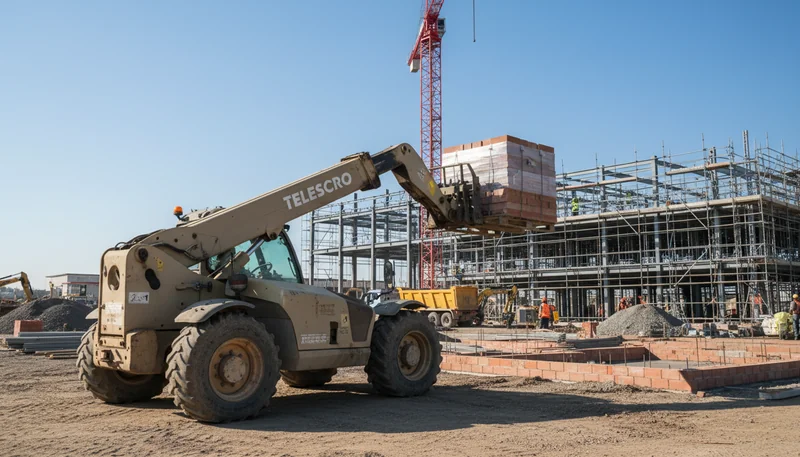
Telehandler Capacity Margins: Why Real Limits Shrink With Use (Field Guide)
A few months ago, I met a site manager in South Africa who swore his 5-year-old telehandler “still lifts just like new.” Then we loaded a full pallet of bricks to 12 meters—and the boom slowed, flexed, and suddenly, nobody looked quite so confident. That jobsite feeling is more common than most realize.
Telehandler rated capacities are established under controlled conditions that rarely match the realities of long-term field use. Over extended service hours, gradual wear occurs in boom pads, pins, bushings, seals, tires, and hydraulic systems. This cumulative degradation reduces both lifting performance and machine stability, even when no single component is fully out of spec.
Why Do Telehandler Capacity Margins Shrink?
Telehandler rated capacity1 and load charts are established under factory-spec conditions—correct tire size and pressure, tight pins and bushings, calibrated indicators/sensors, and a level, firm surface. As operating hours accumulate, normal wear in boom pads, joints, tires, and calibration can reduce the stability margin assumed by the rated data and may cause earlier load-management cutbacks or require additional derating. The appropriate working margin should be set using the OEM instructions, inspection results, and site conditions.

Most people don’t realize that telehandler rated capacity is really a best-case scenario—factory fresh, level ground, everything spot-on. In real jobs, that perfect condition doesn’t last. Over time, bushings and boom pads wear down a millimeter at a time, pins work loose, and the boom structure itself sees thousands of cycles. I’ve seen aging 3.5-ton, 12-meter units in Kazakhstan that started to feel “skittish” at high reach after about 5,000 hours. Tires also lose stiffness as they age, especially on rough sites or with repeated heavy loads. The original rated figures—say, 3,500 kg at minimum reach—assume those tires still maintain the right ground contact and shape. Once the sidewalls soften or crews run them a bit underinflated, stability shifts fast.
Another often overlooked factor is sensor calibration2. Load moment indicators, boom angle sensors, and pressure sensors rely on correct calibration to interpret load chart limits accurately. Over time, calibration can deviate due to wear, vibration, component replacement, or electrical drift. In one case, a customer reported reduced lifting confidence at long reach despite operating within the charted limit; inspection showed the boom angle signal was outside its specified tolerance, triggering earlier stability intervention. Issues like this do not invalidate the published load chart3, but when combined with mechanical wear, they reduce the usable operating margin assumed by the chart.
So while the spec sticker never changes, the true safety buffer shrinks. I always suggest builders planning lifts at maximum reach work with 80–90% of the rated load for machines past a few thousand hours. At full extension—when the boom is out past 10 meters—you’ll really notice the difference. For critical lifts, check load charts and remember: age and wear quietly chip away at your capacity margin.
Telehandler boom pads and bushings gradually wearing down over years of use can lead to increased play in the boom, reducing real-world load stability well before structural failure occurs.True
As boom pads and bushings wear, the precise alignment and tightness that maintain boom stability degrade. This increased slack can make the machine less stable when lifting, causing operator hesitation and reducing usable capacity, even if the telehandler hasn't reached its official service life limits.
As long as routine inspections are performed, the telehandler's effective lifting margin will remain virtually the same as when it was new.False
Even with regular inspections, mechanical wear and tear—such as on bushings, pins, and structural joints—gradually accumulate. This natural degradation affects the effective stability and lifting performance over time, making real-world capacity margins shrink regardless of maintenance efforts.
Key takeaway: Telehandlers lose real capacity as components wear, tires soften, and sensors drift. Though the rated load chart remains static, accumulated degradation steadily eats into stability margins. Planners should apply conservative limits for aging machines—especially at long reach—using 80–90% of charted capacity as a practical guideline.
How Does Hydraulic Wear Affect Capacity?
Hydraulic wear reduces telehandler lifting performance by introducing internal leakage within pumps, control valves, and lift cylinders. In high-duty construction or rental applications, these effects commonly become noticeable after several thousand operating hours. Typical symptoms include slower boom response under load, reduced lifting force at extended reach, and greater performance drop as hydraulic oil4 temperature increases. Depending on duty cycle and maintenance history, effective lifting performance may decline by approximately 10–20% before corrective repair or component overhaul is required.

Hydraulic wear is another factor many buyers underestimate. As operating hours accumulate—particularly on high-duty or poorly maintained sites—internal components in hydraulic pumps, lift cylinders, and control valves gradually wear. This wear allows high-pressure oil to bypass internal sealing surfaces, reducing the effective force available at the boom. As a result, a telehandler that appears capable on paper—for example, rated at 3,800 kg at minimum reach—may struggle to deliver the same lifting performance at extended boom positions.
In one recent case, a contractor reported that a 17-meter telehandler lifted confidently at short reach but stalled at full extension with loads that were still within the load chart. Inspection confirmed classic internal hydraulic leakage5, a common condition in aging hydraulic systems. Depending on duty cycle, oil cleanliness, and service history, effective lifting performance can decline by approximately 10–20% over time.
Early indicators typically include slower boom response under load and increased sensitivity to oil temperature, with lifting speed and force dropping noticeably once the hydraulic oil heats up. In several fleets I’ve supported, restoring hydraulic components—such as pump refurbishment, cylinder resealing, and system flushing—has significantly recovered lifting performance. Until corrective maintenance is completed, however, operators should plan lifts assuming reduced effective capacity, regardless of the rated figures shown on the specification plate.
My standing advice to site managers is simple: avoid planning critical lifts at full reach when hydraulic condition is uncertain, and periodically verify lifting performance using known test loads with the oil at operating temperature. For high-hour machines, performance checks at regular service intervals are far safer than relying solely on published ratings.
Hydraulic wear causes a gradual internal leak that reduces boom lift capacity, even when external signs of failure aren't yet visible.True
As internal surfaces wear, high-pressure fluid bypasses seals within cylinders and valves. This decreases the force delivered at the boom, so actual lifting power drops before obvious leaks or external symptoms appear. Early performance loss can occur without visible hydraulic oil leaks or warning lights.
Hydraulic wear only affects the speed of boom movements and does not impact the telehandler’s actual lifting capacity.False
While speed may decrease due to internal leakage, the critical effect of hydraulic wear is the loss of pressure available to perform lifting work. This pressure loss directly reduces boom force, which translates to a drop in the machine's real-world lifting capacity, not just slower operation.
Key takeaway: Hydraulic system wear in telehandlers leads to a noticeable 10–20% loss in effective rated capacity, especially at long reach or under real-world loading. Regular fluid analysis, correct oil selection, and proactive hydraulic maintenance are essential to minimize loss and extend service life before a major rebuild is needed.
How Does Wear Impact Telehandler Stability?
Wear in boom pads, pins, and bushings causes the boom and carriage to sit further forward or lower, altering the geometry assumed in the load chart. This slight shift can significantly increase overturning moment at full extension, requiring practical derating6—often by 20% or more—especially in high-hour, rough-terrain units.

A common oversight among fleet managers is underestimating how cumulative wear in boom pads, pins, and bushings alters a telehandler’s stability characteristics over time. With repeated load cycles—particularly on rough terrain or at extended boom positions—incremental clearance develops at key contact points, allowing the boom assembly to sit slightly further forward under load.
On several high-hour machines I have inspected, the effective boom position under load was measurably further forward than on a factory-new unit. While this displacement may appear minor, at maximum reach it increases the overturning moment acting about the front axle. When handling multi-ton loads, even small geometric changes can materially reduce the remaining stability margin assumed by the load chart, bringing the machine closer to its tipping threshold than operators expect.
Over thousands of hours, the problem isn’t just the boom or pins. The frame, axles, and carriage connections all start to develop slight flex and cumulative slack. When this happens, the actual geometry is no longer what the load chart assumes. I’ve seen 5-year-old, 5,000-hour machines—still clean and quick in the yard—struggle badly at full extension. In some cases, the safe working load needed a practical derate of at least 20% to keep risk under control, especially when working on uneven ground.
My advice? Treat pin, bushing, and boom pad checks as capacity-preservation, not cosmetics. Schedule periodic shimming and replacement—not just for “smoothness” but to keep real stability. Always check for axle movement, frame cracks, and unexpected boom play before trusting the load chart at maximum reach. High-hour units are far more sensitive to slopes or side loads, and you don’t want to find out the hard way.
Even minor wear in boom pads and bushings can cause the center of gravity for a telehandler to shift enough that its real lifting margin is reduced, especially at full reach.True
As components wear, increased play allows the boom to move forward or vertically beyond its designed position. This changes the load geometry, which can reduce stability and effective lifting capacity even before the machine reaches its rated limits.
Wear in the boom pads, pins, and bushings primarily affects operational speed but has no meaningful impact on telehandler stability in load chart conditions.False
Although wear can slow operations, its most critical effect is altering load paths and geometry, which impacts the stability and safe capacity margins as detailed in manufacturer guidance. Ignoring wear-related changes to stability risks unsafe operation.
Key takeaway: Even minor wear in boom, pin, and frame components shifts the telehandler’s geometry relative to the rated assumptions on the load chart. Over thousands of hours, accumulative slack and flex can force a significant practical derating—so fleet managers should treat pin and bushing replacement as critical to preserving real capacity and stability.
Why Do Telehandler Tires Affect Capacity?
Telehandler load charts7 are developed assuming the specified tire size, correct inflation pressure, and operation on firm, level ground. As machines accumulate service hours, factors such as tire wear8, uneven inflation, and reduced ground bearing strength can increase chassis lean and alter axle load distribution. These conditions reduce the effective stability margin assumed by the load chart and may require a practical reduction in allowable lifting capacity—particularly at maximum outreach or when operating on slopes.
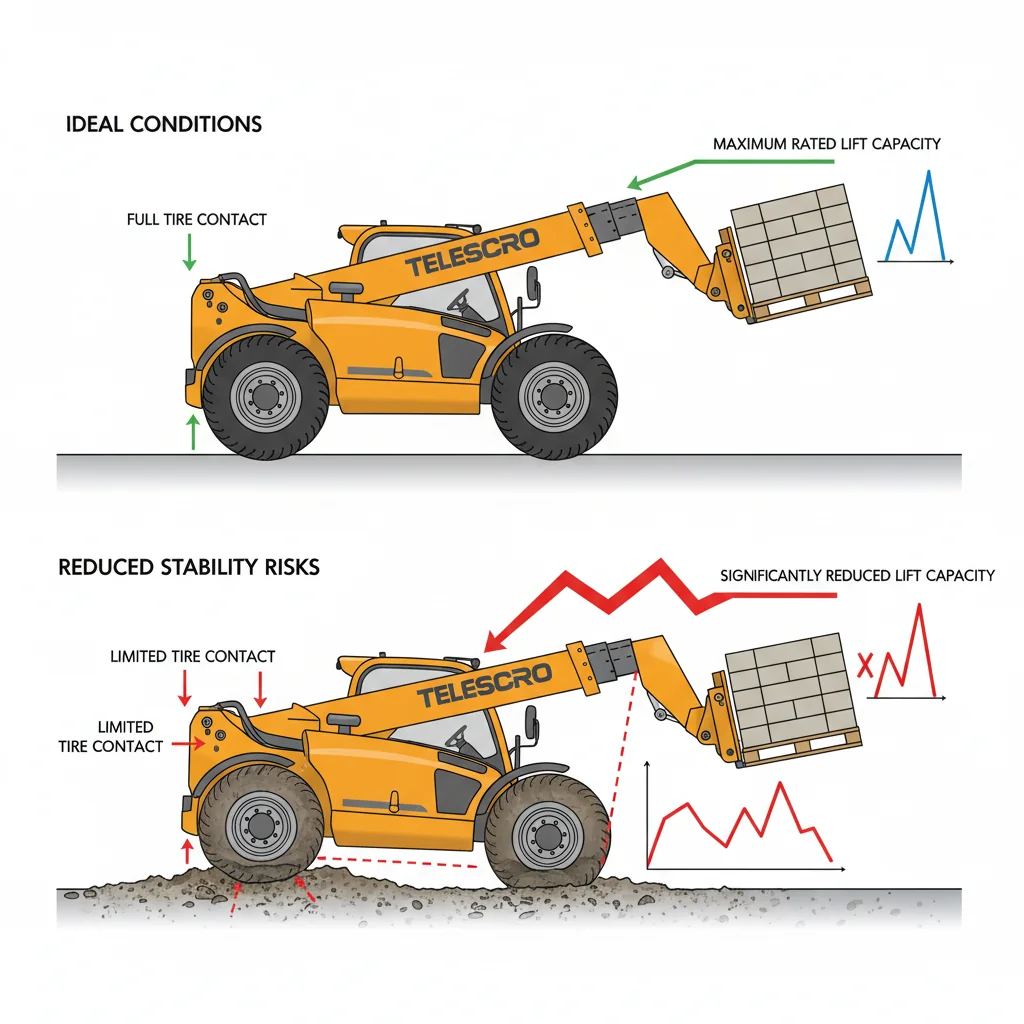
I’ve worked with customers who made this mistake—focusing on engine power or boom height, but ignoring their tires until they started feeling that dangerous tilt. Telehandler load charts are calculated based on having the exact tire size, in good condition, at the recommended pressure, and operating on solid, level ground. Over time, tires lose pressure, tread wears unevenly, and you get more “squish” in the sidewalls. On older units, I’ve seen capacity drop by 20% just from mismatched front tires—especially when lifting at full reach or working in soft ground conditions.
Last year, I visited a job site in Kazakhstan where a 4-ton, 17-meter telehandler struggled on packed gravel. The operator thought it could handle 1,500 kg at max extension, as listed on the chart. But the rear tires were half-bald and the right front was 20% low on air. The chassis leaned just enough that the moment indicator kept flashing warnings, and actual safe lift capacity slipped closer to 1,000 kg. The customer had already scheduled a second lift because their daily work plan didn’t account for such a big drop—costing hours each week.
To be honest, tire condition and ground prep matter far more on older telehandlers. Most boom failures or tip risks I’ve seen in high-hour fleets start with tire neglect. I always suggest you check tire pressure at least once per shift, swap out tires before they’re bald, and never mix different types. For tricky ground, lay mats or keep slopes under 10 degrees—especially if the machine has over 5,000 working hours. This routine helps prevent “tippy” surprises and keeps the rated capacity in your safe working zone.
Telehandler capacity can be significantly reduced by operating with under-inflated or unevenly worn tires, even if all other machine components are in perfect condition.True
Tire integrity directly affects the machine's stability and load-bearing capability; degraded tires fail to provide the structural support assumed in the manufacturer's rated capacity, making the unit more prone to tipping or load loss.
As long as the telehandler's engine runs properly, the tire condition has no effect on the machine's rated lifting capacity.False
Tire condition is a critical factor in load stability and rated capacity, as tires are part of the calculation used by manufacturers to determine safe operation limits; poor tire condition undermines these assumptions and reduces both actual and safe lifting capacity.
Key takeaway: On older telehandlers, worn tires and poor ground conditions can reduce safe working capacity by up to 30%. Checking tire pressure regularly, avoiding mix-matched or overly worn tires, and planning ground stabilization are essential to preserve stability and prevent overrating safe lifting capacity.
How should telehandler capacity be derated?
Telehandler rated capacity does not remain constant over the machine’s service life. While the load chart itself does not change, the usable capacity available to operators narrows as components wear and operating tolerances increase. For planning purposes, capacity limits should be adjusted based on machine hours, condition, and maintenance history—not treated as a fixed value.

Based on what I see in fleets globally, a practical guideline is as follows: for machines under 3,000 operating hours with consistent maintenance, critical lifts should generally remain within 90–95% of the OEM load chart9. Between roughly 3,000 and 7,000 hours, allowable working loads often need to be reduced to the 80–90% range, particularly at long reach. Beyond 7,000 hours, or where visible wear, hydraulic leakage, or boom play is present, conservative planning may require limiting lifts to around 70–85% of charted values unless recent load testing confirms higher performance.
Last month, a project manager contacted me regarding repeated lift alarms on a telehandler with just over 6,000 hours. His team had planned lifts right up to the load chart limit at full extension, assuming the machine could still deliver its original performance. On inspection, the issue was not a single failure, but a combination of aged hydraulic cylinders and minor boom play—enough to reduce the effective stability margin. I walked him through a basic derating calculation10, and it became clear that operating much beyond 85% of the charted capacity was triggering overload protection, especially when handling dense concrete blocks at maximum reach.
This situation is a planning mistake I encounter frequently. The OEM load chart reflects factory-new assumptions: correct tire pressure, level ground, standard attachments, and fully efficient hydraulics. As hours accumulate, seals wear, clearances increase, and even tire stiffness changes—subtly shifting the tipping point forward. For relatively low-hour machines that are well maintained, I advise keeping critical lifts within 90–95% of rated capacity rather than pushing to the chart limit. As machines move into mid-life, that margin needs to tighten further, especially when using buckets, winches, or attachments that move the load center outward.
I also recommend that fleet owners formalize these derating rules in writing rather than leaving them to operator judgment. In one case I handled in Kazakhstan, an operator insisted a machine “could make the chart,” yet the load moment indicator was out of calibration. The lesson is straightforward: electronic systems are safeguards, not substitutes for conservative capacity planning. As machines age, disciplined derating becomes part of safe operation—not an optional precaution.
Telehandler capacity at maximum extension should be derated when hydraulic components are visibly worn or boom play increases, even if the load chart does not mandate it.True
Mechanical wear, especially in hydraulic cylinders and boom joints, reduces stability and structural performance, making original load limits unsafe as the machine ages. Using only the load chart without considering equipment condition can lead to dangerous overload situations.
Telehandler lift capacity remains consistent throughout its lifetime as long as the machine passes annual inspections, regardless of wear symptoms.False
Routine inspections may not detect all forms of wear, such as internal hydraulic leakage or small increases in boom play, which cumulatively reduce safe working limits. Relying solely on the inspection checklist, rather than dynamic assessment, can ignore these capacity losses.
Key takeaway: Telehandler capacity margins shrink as machines age or when condition degrades. Always adjust safe working limits below load chart values based on hours and condition, using documented derating rules in fleet policy to avoid overloading, especially on high-hour or worn units.
How Does Maintenance Affect Telehandler Capacity?
Rigorous maintenance plays a decisive role in preserving telehandler capacity margins over long service life. In fleets that strictly follow OEM service intervals for hydraulic oil, filters, coolant, and boom pad adjustments11, machines commonly retain approximately 85–90% of their original rated capacity even after 10,000–12,000 operating hours. By contrast, poor maintenance practices—such as neglected fluids, worn boom pads, loose pins, or declining engine performance—can reduce effective lifting capacity to around 70% or lower well before end of service life.
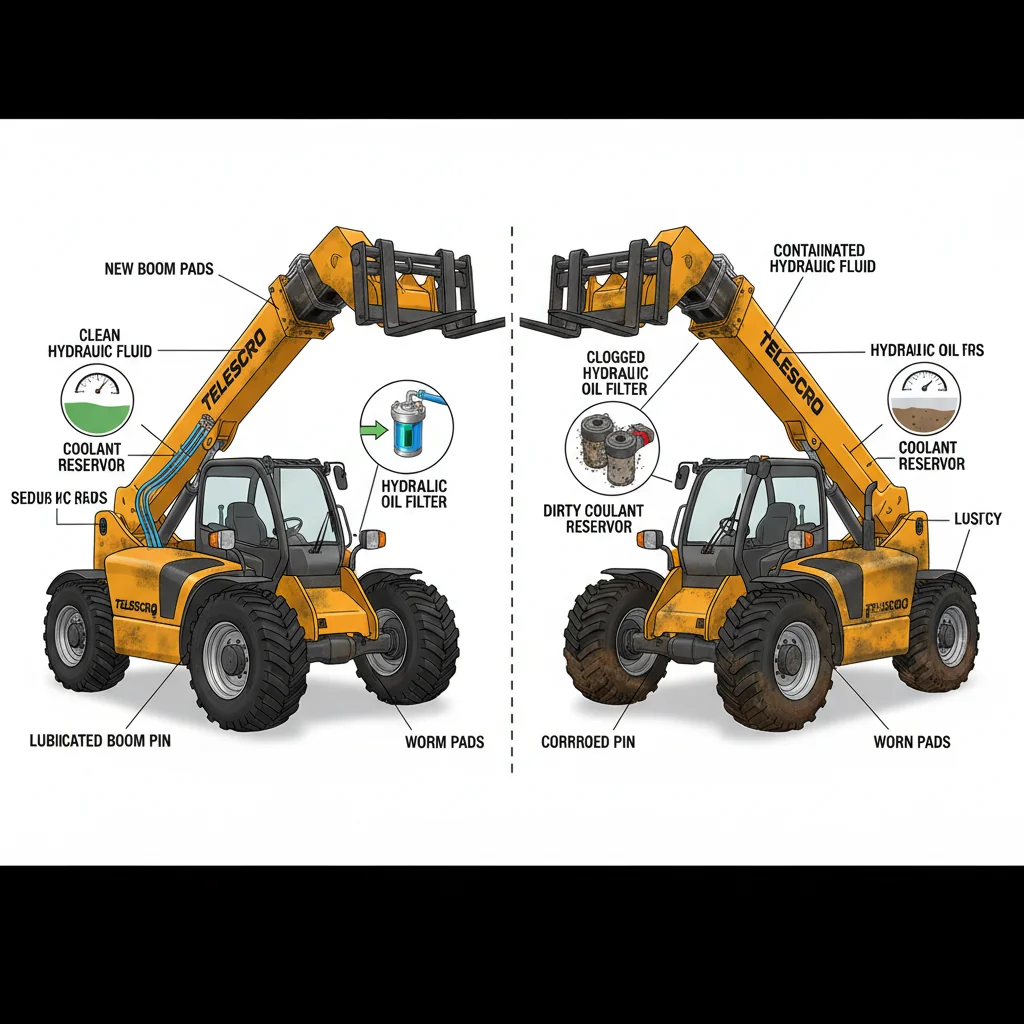
To be honest, many buyers assume a telehandler’s rated capacity stays the same over its service life. The reality can be very different. I’ve worked with several rental fleets across Southeast Asia where daily maintenance routines are the deciding factor. Two identical 4-ton units with 18-meter reach may look the same at first glance, but after 10,000 hours, their real lifting margin can be worlds apart—just because one crew changed hydraulic oil and boom pads on schedule, and the other didn’t.
Let me share what happened in Brazil last year. A contractor there ran their mid-size telehandler on the same site for about four years, clocking just over 11,000 hours. They followed every OEM interval, logging each hydraulic service, engine filter, coolant flush, and regular pin checks in a complete record. That unit still handled around 85% of its original rated load on the boom—verified against a load chart and tested at maximum reach. In contrast, a similar model from a neighbor’s fleet, neglected on engine maintenance and with dry, groaning boom pads, felt slow under load and struggled to lift more than 70% of its supposed capacity.
Hydraulic health and engine power aren’t the only issues. I see operators overlooking small things like daily tire pressure checks or annual sensor calibrations. Those details make a difference—uneven tire pressure can rob you of stability, while a worn moment indicator can give false readings. My advice: always ask for full service records when considering any used telehandler. Service history tells you far more about working capacity than hours on the clock.
Neglecting scheduled lubrication of the boom and pivot points can lead to accelerated wear, which over time may reduce a telehandler’s real lifting capacity below its rated maximum.True
Friction and wear at the main load-bearing joints can increase mechanical play and structural stress, reducing the machine’s true ability to safely lift heavy loads, even if the original rated capacity is unchanged on paper.
Routine cosmetic cleaning of a telehandler’s exterior is just as important as hydraulic system maintenance for preserving lifting capacity.False
While cleaning helps with basic visibility and corrosion prevention, it does not affect the internal systems or structural integrity critical to actual load capacity, unlike hydraulic system maintenance.
Key takeaway: Consistent adherence to OEM maintenance schedules—including hydraulic, engine, and structural checks—is crucial for retaining a high percentage of a telehandler’s practical lifting capacity over time. Service history predicts used telehandler performance more accurately than hours alone.
How Does Telehandler Capacity Fade Affect Costs?
Telehandler rated capacity does not remain constant over its service life. As operating hours accumulate—typically in the 6,000–10,000 hour range—component wear in hydraulics, boom interfaces, tires, and chassis gradually reduces usable lifting margin. At critical reach positions, this commonly results in practical derating on the order of 10–20%, even when the machine remains operational and compliant. Such capacity fade limits operational flexibility, increases dependence on higher-capacity equipment or crane rentals, and accelerates resale value depreciation—creating lifecycle costs that are often underestimated at the point of purchase.
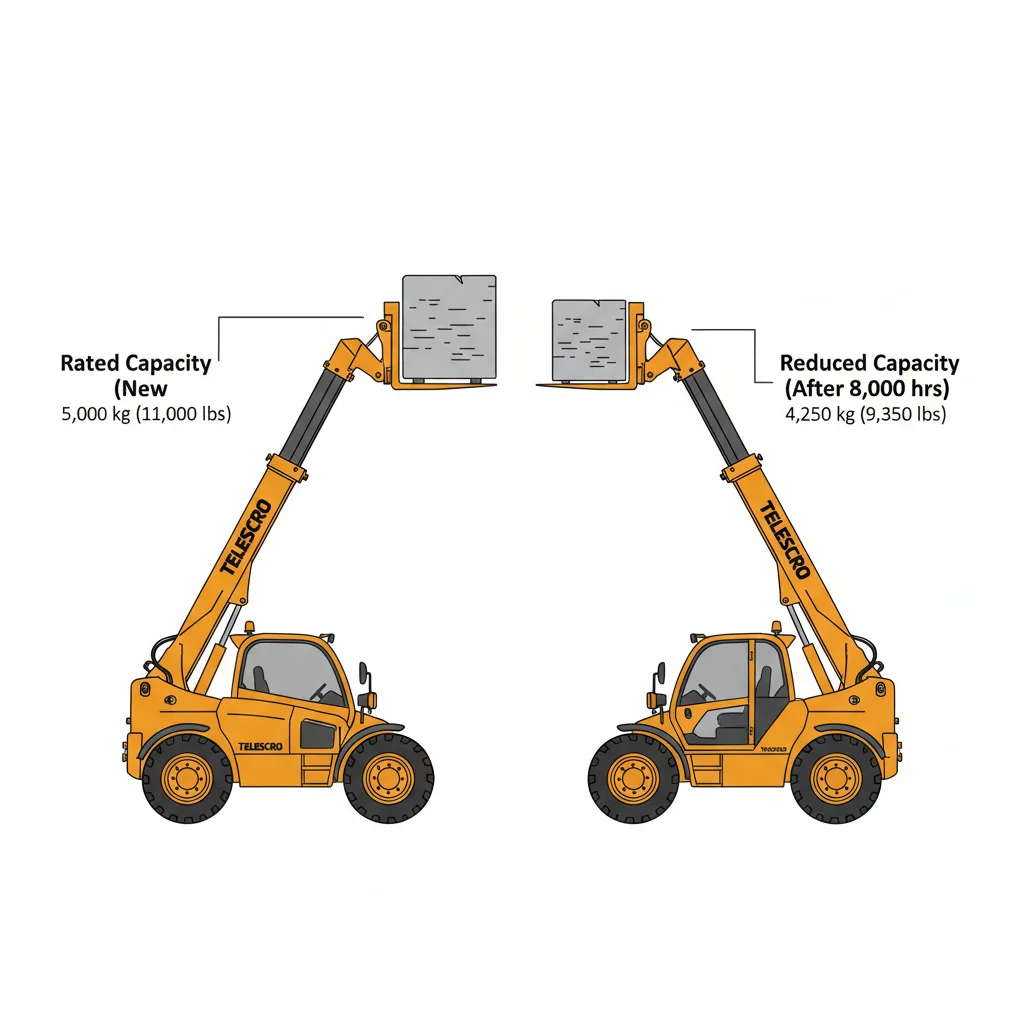
Here’s what I focus on when discussing telehandler lifecycle costs with customers: lifting capacity does not remain constant as hours accumulate. I’ve worked with several contractors in the UAE who selected a 3.5-ton telehandler strictly based on the load chart for a 12-meter reach application, expecting to lift around 3 tons at that position for many years.
After five to six years of heavy use, the picture often changes. Hydraulic drift becomes noticeable, boom sections develop measurable play, and pump response slows under load. At that stage, operators are forced to derate their working loads by 15% or more—not because the structure is failing, but because the remaining stability and control margin has narrowed as cylinders, seals, and wear points age.
I saw this clearly last year in Kazakhstan. A fleet owner was midway through a long construction project and relying on a telehandler rated for 2,700 kg at a critical reach. After roughly 8,000 operating hours, the machine could only handle about 2,300–2,400 kg consistently and safely. To keep the schedule intact, they had to rent a larger 5-ton telehandler for three weeks, adding roughly USD 4,000 in direct rental costs—before accounting for disruption and downtime.
This is the kind of cost most buyers don’t see at purchase time. When lifting requirements are tight and loads are close to chart limits, capacity fade directly reduces operational flexibility. It also affects resale value. In my experience, the secondary market looks beyond paint and appearance—machines with more than 5,000 hours are routinely discounted based on expected wear-related loss of usable lifting capacity, not just cosmetic condition.
Telehandler capacity fade can force operators to downgrade load ratings even when the machine appears visually undamaged.True
Over years of use, internal wear in hydraulics and boom structures can reduce true lifting ability. This may not be obvious in a visual inspection but is confirmed by load testing, leading to necessary derating for safety and compliance.
Hydraulic drift in an aging telehandler only affects boom extension speed, not lifting capacity.False
Hydraulic drift is a sign of internal leakage or wear in the hydraulic system, which directly undermines the telehandler's ability to hold or lift rated loads steadily—impacting both operational efficiency and maximum safe capacity.
Key takeaway: Real-world telehandler capacity fades significantly with age and heavy use, forcing operational derating and reliance on larger equipment or rentals. Factoring this lifecycle loss and the cost of workarounds into total ownership calculations is essential for accurate budgeting and fleet planning.
How should telehandler capacity be sized?
Telehandler sizing should build in a 15–25% headroom above expected routine loads and reaches to counter real-world losses from wear, temperature, and site conditions. Selecting capacity directly from load charts without margin disregards long-term performance decay and practical inefficiencies, risking overload and safety violations during the machine’s working life.

Most buyers want to match the telehandler’s rated capacity with their heaviest routine load. On paper, that sounds logical. But the real world isn’t ideal—machines wear, jobsites get muddy, and temperatures swing. If you size too tight, you leave no cushion for these everyday inefficiencies. I’ve seen crews in the UAE caught off guard after two years when their 3-ton machine could barely manage 2.5 tons at full 9-meter reach. The actual work didn’t change—the telehandler just lost a bit of hydraulic pressure and had more play in the boom.
You also have to remember, OEM load charts12 are calculated under perfect conditions: level ground (no more than three degrees of tilt), clean new tires, specified attachments, and a factory-fresh hydraulic circuit. Most jobsites can’t match that. Even a small slope or a half-worn set of forks can lower effective capacity—especially at maximum extension. That’s why I always recommend building 15–25% headroom into your capacity planning. If your typical load is 2.5 tons at 9 meters, look for a model that gives you around 3–3.2 tons at that reach on the chart.
From my experience, fleets running high annual hours—say, over 1,500 per year in places like Brazil or Kenya—should ask the dealer about capacity retention long term. Will that telehandler still hold 80% of its “new chart” rating after 6,000 or 8,000 hours? Ask them about re-shimming the boom or pin wear intervals. A bit of margin up front is cheap insurance against overload trips, gradual power loss, or LMI (load moment indicator13) faults down the line.
Telehandlers often experience a reduction in effective lifting capacity over time due to hydraulic system wear and challenging site conditions, making it important to size with extra margin beyond routine load requirements.True
Hydraulic components, seals, and structural elements can degrade with regular use, especially in harsh environments like construction sites with mud or extreme temperatures. This deterioration means the machine's actual safe lifting capacity may decrease before end of life, so sizing with additional margin protects against performance loss.
If a telehandler is sized exactly to the maximum expected load, it will always safely and reliably lift that load throughout its operational life.False
Sizing exactly to the maximum routine load leaves no allowance for equipment wear, suboptimal conditions, or reduced performance under adverse situations. Over time, the effective lifting capacity can drop due to factors like hydraulic wear or uneven surfaces, risking unsafe operation or inability to handle the expected load.
Key takeaway: Always select a telehandler model that provides at least 15–25% capacity and reach above projected routine requirements. This strategy accounts for multi-year wear, minor slopes, hot weather, and other site factors that reduce real-world capacity compared to what is published on the OEM load chart.
How to Verify Real Capacity on Used Telehandlers?
To accurately assess the real capacity of a used telehandler, conduct field testing at the most critical load chart positions—typically near maximum outreach. Use known test loads and measure boom stability, lift performance, and chassis lean with hot oil. Inspect boom play, tires, joints, LMI, and safety cut-outs for accurate capacity evaluation.

Last year, I visited a site in Dubai where the buyer trusted the load chart stickers and engine hours on a 3.5-ton telehandler. On the first job, the boom barely lifted 2,200 kg at max outreach—well below the charted 2,800 kg. That’s when they called me. Decals and hours look reassuring, but only real-world testing tells the truth about used capacity.
If you want to verify a used telehandler’s actual lift strength, field testing at critical positions is key. I always suggest bringing standard test weights and a tape measure. Start with these steps:
- Test at the hardest point first: Use the load chart to find maximum outreach and height. Set the boom to that spot—usually full extension, low boom angle, forks level.
- Use known loads: Place a pallet with an actual measured weight (for example, 2,000 kg and 2,300 kg if the chart says 2,500 kg is rated at this reach).
- Warm up the machine: Let the engine and hydraulics run until oil is hot, which exposes weakened seals and tired pumps.
- Monitor stability and alarms: The machine should lift smoothly, without boom drift or sudden beeping from the load moment indicator (LMI). If any warning lights appear or the chassis leans too much, capacity is already reduced.
I also check for boom play at the joints, tire cracks, loose axle connections, and make sure the LMI and safety cut-outs actually work. If the telehandler can’t comfortably lift close to its charted capacity, I knock 15–25% off my estimate. For any fleet over five years old, arrange a full load test every season—don’t leave your safety margin to guesswork.
Hydraulic system wear and micro-leaks over years of use can substantially reduce a telehandler’s true lift margin, especially at maximum boom extension, even if engine and transmission seem healthy.True
Hydraulics are crucial for lift performance, and internal wear or undetected leaks gradually reduce system pressure. This loss is most noticeable at critical reach positions, where capacity is already limited by leverage, explaining why real lift margins often shrink before other mechanical issues are visible.
If a used telehandler’s boom and chassis show no visible cracks or repairs, its actual lifting capacity will match the original load chart regardless of hours or previous use.False
Structural integrity is just one factor in lift capacity; hydraulic wear, sensor drift, and unseen weld fatigue can all weaken capacity over time. Visual inspection alone cannot guarantee true load performance; operational testing is required to verify actual margins.
Key takeaway: Relying on decals or engine hours alone is insufficient for assessing used telehandler capacity. Field test with actual loads at critical reach positions, measure key mechanical factors, and verify all safety systems. Expect a 15–25% capacity reduction if the machine struggles below charted values.
Conclusion
We’ve looked at why a telehandler’s real-world lifting limits shrink as parts wear and sensors drift—even when the spec sheet never changes. In my experience, applying a 10–20% capacity margin isn’t just being cautious, it’s being realistic, especially once those machines have a few years (and jobsites) under their belt. Don’t let the load chart lure you into a “showroom hero, jobsite zero” situation. If you want advice on matching capacity to your actual site needs—or just want to double check your calculations—I’m happy to help. Feel free to reach out with questions, even if it’s just to sanity-check your numbers. Every project and fleet is a bit different—choose what fits your real workflow.
References
-
Detailed insights on how wear and real-world factors reduce telehandler capacity, affecting safety margins and operational limits. ↩
-
Expert explanation on sensor drift impacts, load moment indicators, and angle sensors for maintaining telehandler accuracy and safety. ↩
-
Explore detailed guidance on interpreting telehandler load charts for safe and accurate capacity verification during field testing. ↩
-
Explains how maintaining hydraulic oil quality preserves telehandler load capacity and prevents costly performance drops. ↩
-
Explains how worn seals and components lead to leakage, affecting telehandler lifting capacity and requiring rebuilds for performance recovery. ↩
-
Details how extending telehandler load limits can cause instability, showing why derating keeps safety margins on uneven or worn equipment. ↩
-
Explore how telehandler load charts define safe lift capacities and how tire condition impacts real-world load limits. ↩
-
Understand how tire wear, pressure loss, and sidewall squish reduce lift capacity and increase the risk of chassis lean. ↩
-
Comprehensive guide on interpreting OEM load charts and adapting them based on machine age and condition to maintain lift safety. ↩
-
Detailed explanation on calculating safe lifting limits as telehandler components wear, ensuring operational safety and avoiding overload incidents. ↩
-
Details the role of boom pad maintenance in sustaining telehandler lifting capacity and reducing wear on critical components. ↩
-
Details how OEM load charts assume perfect conditions, which rarely match jobsite realities, risking unsafe telehandler operation. ↩
-
Learn how load moment indicators work to prevent overloads, with expert insights on their role in maintaining telehandler stability and operational safety. ↩