










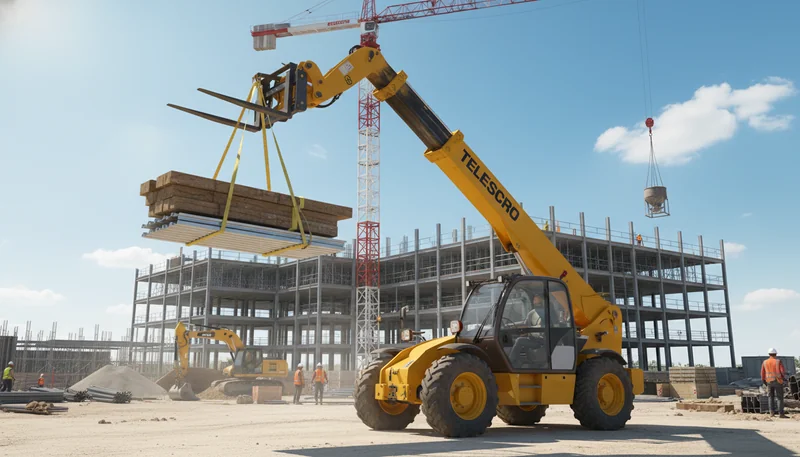
Telehandler Capacity: How Boom Angle Really Impacts Safe Lifting
A site manager in Poland once sent me a photo: his team tried lifting 2 tons at full boom extension, convinced “the machine can handle it.” The telehandler’s front wheels were off the ground. That’s when they learned capacity isn’t just a number on the spec sheet—it’s all about boom position.
Telehandler lifting capacity is dictated by the combined effect of boom angle and boom extension, which together define the machine’s forward stability limits. At steeper boom angles with minimal forward reach, the load’s center of gravity stays closer to the machine, allowing higher charted capacity. As the boom is lowered and extended to increase reach, the overturning moment rises rapidly, and the allowable lifting capacity drops sharply—often to a fraction of the nameplate rating—strictly according to the manufacturer’s load chart.
How does boom angle affect rated capacity?
Telehandler rated capacity1 is highest with the boom at a steep angle and fully retracted, keeping the combined center of gravity near the front axle and well inside the stability triangle2. As boom angle decreases and extension increases, capacity drops sharply due to greater forward reach and tipping risk, regardless of the structural strength of the boom itself.
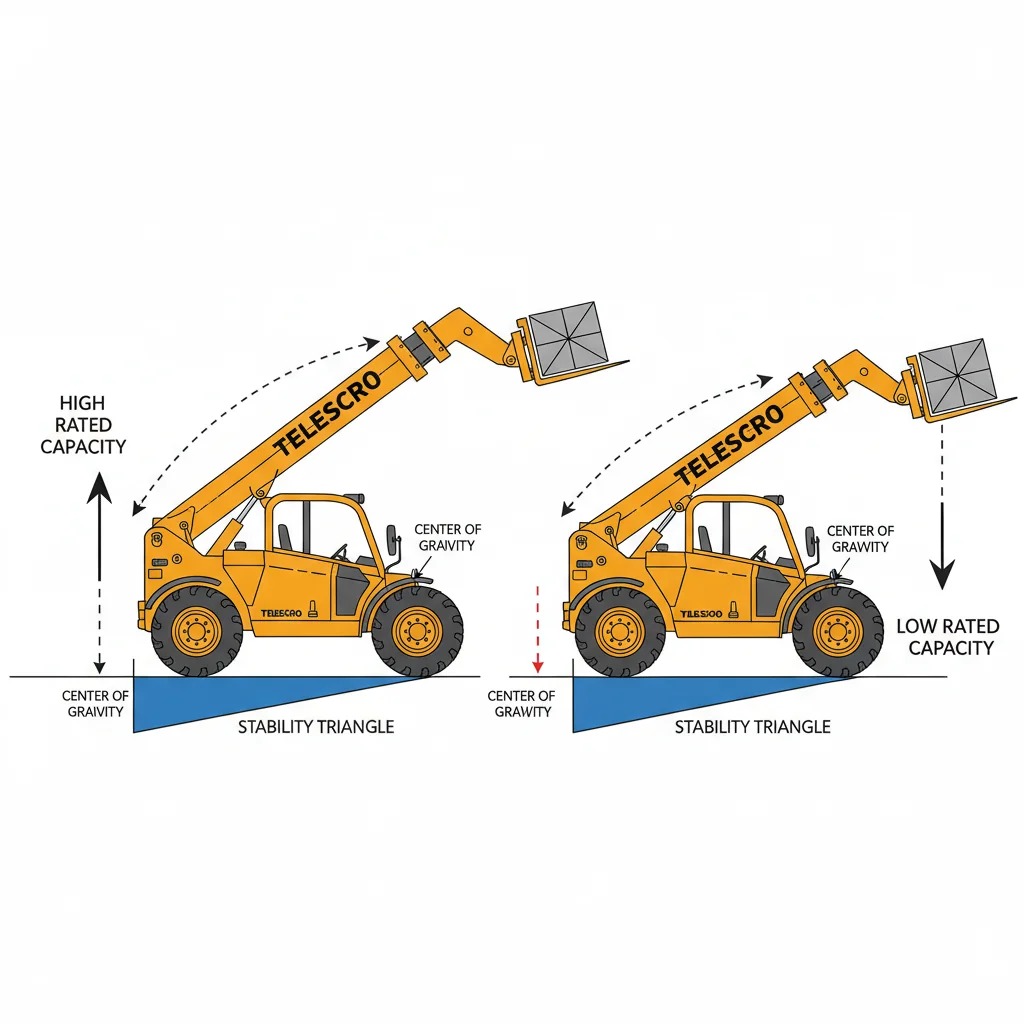
Most people don’t realize that the same telehandler can feel completely different simply by raising or lowering the boom. I’ve seen planners assume that a 4-ton rating means the machine can lift 4,000 kg at any boom position, which is not how telehandler capacity works. The load chart3 tells a very different story.
With the boom steeply raised and fully retracted, many mid-size telehandlers achieve their highest charted capacities, close to the headline rating. However, as the boom is lowered and extended to create forward reach, allowable load can drop dramatically—often to a small fraction of the nameplate figure. This sharp reduction happens even though the boom structure itself may be strong enough, because stability, not structural strength, becomes the limiting factor.
This is where buyers often get frustrated. I worked with a contractor in Brazil who needed to place HVAC units on a new office building. On paper, their telehandler looked more than capable, with a maximum reach of roughly 16 meters. But at that maximum forward reach, the allowable load dropped to only a small fraction of the headline rating, far below what they expected.
The reason is straightforward. As the boom is extended and the boom angle is lowered to create forward reach, the load’s center of gravity moves farther away from the machine, increasing the overturning moment. In straight-ahead lifting, forward instability is typically governed by the front axle line, so additional reach translates directly into a much larger tipping moment—not just higher stress in the boom structure.
I always tell customers not to rely on the brochure number alone. Real lifting capacity depends on the combination of boom angle, extension, and the actual load center4 specified by the manufacturer. The only reliable approach is to check the load chart at the exact height and reach your job requires before making a purchase decision. That simple step prevents unpleasant surprises and avoids costly delays once the machine is on site.
A telehandler's rated capacity is significantly higher when the boom is raised to a steeper angle and retracted, compared to when it is lowered and extended.True
When the boom is raised and retracted, the load remains closer to the telehandler's center of gravity, reducing the tipping moment and allowing higher lifting capacity as indicated by the load chart. Lowering and extending the boom moves the load further from the machine, decreasing stability and capacity.
Rated capacity remains constant regardless of the boom angle, as long as the telehandler is on stable ground.False
The rated capacity is directly affected by both boom angle and extension, not just ground stability. Lower boom angles and greater extensions reduce the safe lifting capacity due to increased leverage and risk of tipping.
Key takeaway: The combination of boom angle and extension dramatically impacts telehandler capacity. Maximum rated capacity is only available at high boom angles and minimum reach. Planners and buyers should always consult the official load chart for each height and reach, not rely on brochure numbers.
Where Does Rated Capacity Actually Apply?
Rated capacity on a telehandler—such as 3.5 t or 10,000 lb—applies only at the specific “closest-in” load-chart points (minimum forward reach) with the boom retracted, as defined by the manufacturer’s chart—not as a universal value across all boom angles. Boom angle and extension must be read together from the low boom angle5 / reach envelope on the chart, and load charts6 show that as height and forward reach increase, allowable capacity can drop sharply. Always check the chart for the exact height and reach of each lift.
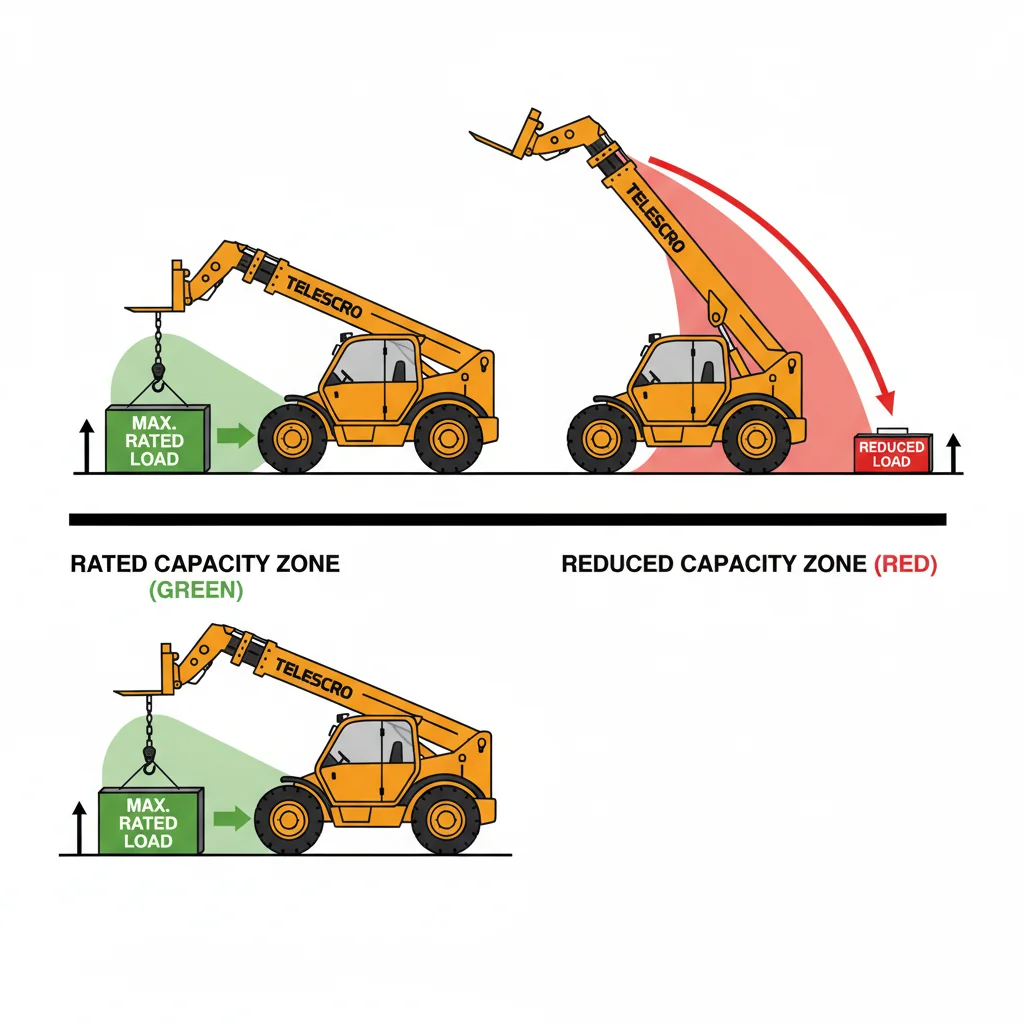
Let me share something important about rated capacity—it’s one of the most misunderstood specs in our industry. That 3.5-ton or 10,000-lb label you see on the side of a telehandler? It’s only good for one small area: when the boom is fully retracted, and you’re working right up close to the front tires on level ground. I had a project in Kazakhstan last winter where a customer tried to lift 2 tons at max forward reach, thinking his machine was easily up to the task. But on checking the load chart, we found at that 8-meter height and 4-meter reach, his real safe lifting limit was only about 1,000 kg. That’s less than half the nameplate.
Here’s what matters most when making your choice—the load chart is your rulebook, not the capacity sticker. The chart maps out every boom angle and reach combination, so you can see real numbers: at minimum reach you might have full 3.5 t, but extend out and the capacity drops—sometimes dramatically. If your job needs a 20-foot high placement with a 10-foot offset, you can’t just assume you’ll get the spec sheet figure. Always find that working point on the chart. If you’re between grid boxes, I always recommend using the lower of the two values to stay safe.
From my experience, skipping this step leads to undersized purchases and overload headaches. Jobsite performance isn’t about marketing numbers—it’s the honest capacity at your actual working position. I suggest every buyer run their pick points through the load chart before selecting a model.
A telehandler’s allowable load typically decreases as forward reach increases (more extension and/or a lower boom angle), because the load moves farther from the machine and the overturning moment rises.True
Load charts are organized around boom angle/extension and corresponding reach. As the load is carried farther forward, stability margin reduces and the charted capacity drops. Operators must reference the load chart for the exact boom position and attachment.
Rated capacity applies equally no matter the boom angle or extension, as long as the telehandler is on level ground.False
This is false because boom angle and extension have a critical impact on lifting capacity; rated capacity only applies when the boom is fully retracted and close to the chassis, not at all positions.
Key takeaway: Rated capacity is not a universal figure across the entire working envelope. Actual safe lifting capacity depends on boom angle, height, and reach—verified by the load chart. Relying solely on nameplate figures can lead to dangerous overloads and incorrect machine selection.
How do telehandler boom angles affect capacity?
Telehandler rated capacity decreases as boom angle lowers and extension increases. Load charts display these limits as grids intersecting boom angle, extension zone, and reach from the front tire edge, all at a specified load center. Operators must reference exact boom position to determine safe lifting capacity for each attachment.
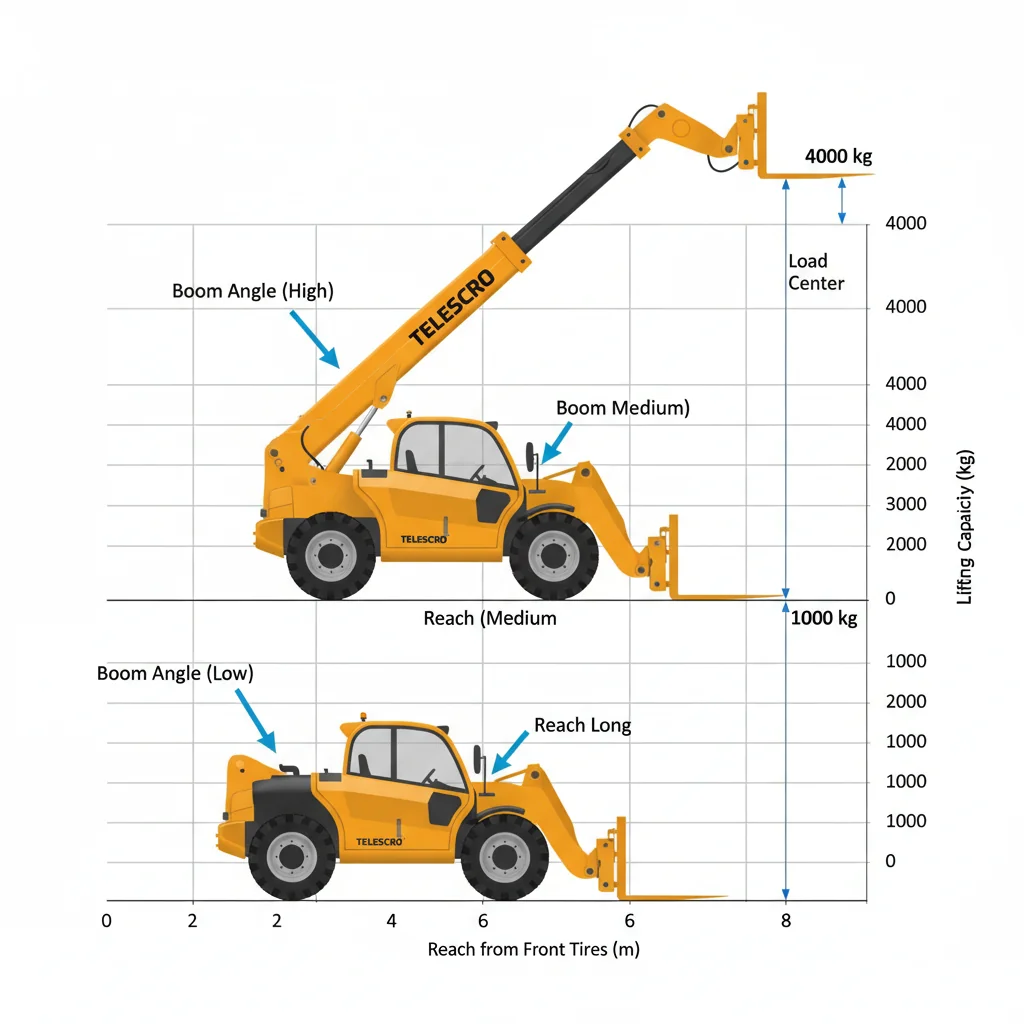
The biggest mistake I see is operators trusting the telehandler’s headline capacity, without thinking about the boom angle or extension. I get calls from sites in Dubai and Singapore every year—guys stuck with a pallet in the air, alarms beeping, because they tried to lift two tons at full reach. They look at the side sticker and see “Rated 4,000 kg,” but once the boom angles down below 30°, and you extend past halfway, real-world capacity drops fast. I’ve seen standard 4-ton models only lift 1,200 kg safely at maximum outreach, especially with the boom low and fully out.
Here’s what matters most when you read load charts: the grid shows safe lifting limits at every mix of boom angle and extension. You’ll usually see zones marked right on the boom—letters like A, B, C, D, or numbers from 1 to 5. In the cab, check your boom angle arc—it might read from 0° to 60°. Match both indicators to their box on the chart for your chosen attachment; forklift tines at a 24-inch load center are standard, but every tool changes the math. If your boom sits between two values, always use the lower number. That’s your safety net.
I always tell teams in Brazil and Kazakhstan to reverse the planning—decide your load weight and lift height first, then check if your machine can handle it in that position with the correct attachment. Never assume the nameplate covers all angles or reaches. It’s the fastest way to keep both crew and equipment safe.
A telehandler's maximum rated capacity is only valid when the boom is retracted and at a higher boom angle, usually above 45 degrees.True
At higher boom angles and with the boom retracted, the load is closer to the machine's center of gravity, minimizing leverage and maximizing lifting capacity according to telehandler load charts.
A telehandler’s rated capacity is unaffected by the angle of the boom, as long as the total load does not surpass the stated limit.False
Telehandler capacity is highly dependent on both boom angle and extension. Lowering the boom angle or extending the boom increases leverage and reduces stability, decreasing safe lifting capacity even if the load is below the headline rating.
Key takeaway: Always consult the telehandler’s load chart using actual boom angle and extension, not just the rated capacity. Safe lifting limits decrease dramatically with increased reach or lower boom angles—operators must confirm allowed weight for every lift scenario and attachment before proceeding.
Why are low boom angles risky for capacity?
Low boom angles combined with extended forward reach move the telehandler’s load center closer to the front axle, significantly reducing forward stability. Under dynamic conditions—such as braking, steering, or uneven ground—this reduced stability margin increases the risk of forward tip-over, even when operating within the static load chart limits. In practice, many stability incidents are associated with low to mid boom positions where forward reach is greatest, rather than with near-vertical lifts.

Here’s what matters most when it comes to telehandler stability: low boom angles with an extended reach are where most people run into real trouble, even if they believe they’re within the rated load chart. Last year, I worked with a team in Dubai—brand new 4-ton telehandler, 14-meter boom, running flat-out to unload concrete blocks. Their biggest risk? Extending the boom low and far out, instead of retracting before moving. At those low angles, the load’s center of gravity shifts dangerously forward, right toward the front axle line—the “tipping axis” we talk about in engineering terms. If you’re traveling, turning, or braking on rough ground, even a 2,000 kg pallet can push the machine past its safe margin.
From my experience, tip-overs don’t happen at max height. Almost every accident I’ve seen—whether in Poland, Kenya, or Australia—started with a low or mid-positioned boom, load high above the ground but stretched forward. The forward stability margin gets tiny at these angles, and a rut or sudden brake is enough to lose control. The load chart makes this clear: as you lower and extend the boom, rated capacity drops sharply, sometimes to only 800 kg at full reach on a mid-size machine.
I always tell crews: only extend and lower the boom when your telehandler is stationary and on level ground. If you have to travel, keep the boom low and retracted, right above the cab, well behind the front wheels. Double-check the “travel with load” values in your load chart before moving—even a small overreach can be risky.
"AtFalse
"Telehandler
Boom angle does not significantly affect stability as long as the telehandler is operated within the rated load chart values.False
Even if you remain within the stated load chart values, low boom angles with an extended boom change the machine's balance and increase the risk of tipping, contrary to the belief that following the chart alone guarantees stability.
Key takeaway: Low boom angles combined with extended reach bring the load’s center of gravity dangerously close to the tipping axis, shrinking the safety margin. Operators should only extend and lower the boom when stationary and avoid maneuvering with load at low boom angles, always referencing the load chart limits.
How do telehandler attachments affect capacity?
Telehandler lifting capacity varies significantly with different attachments and boom angles. Each attachment—such as buckets, platforms, or side-shift carriages—adds weight and increases the load center, reducing stability and rated capacity at every boom angle. Manufacturers provide attachment-specific load charts; never rely on the base machine chart for safe operation.
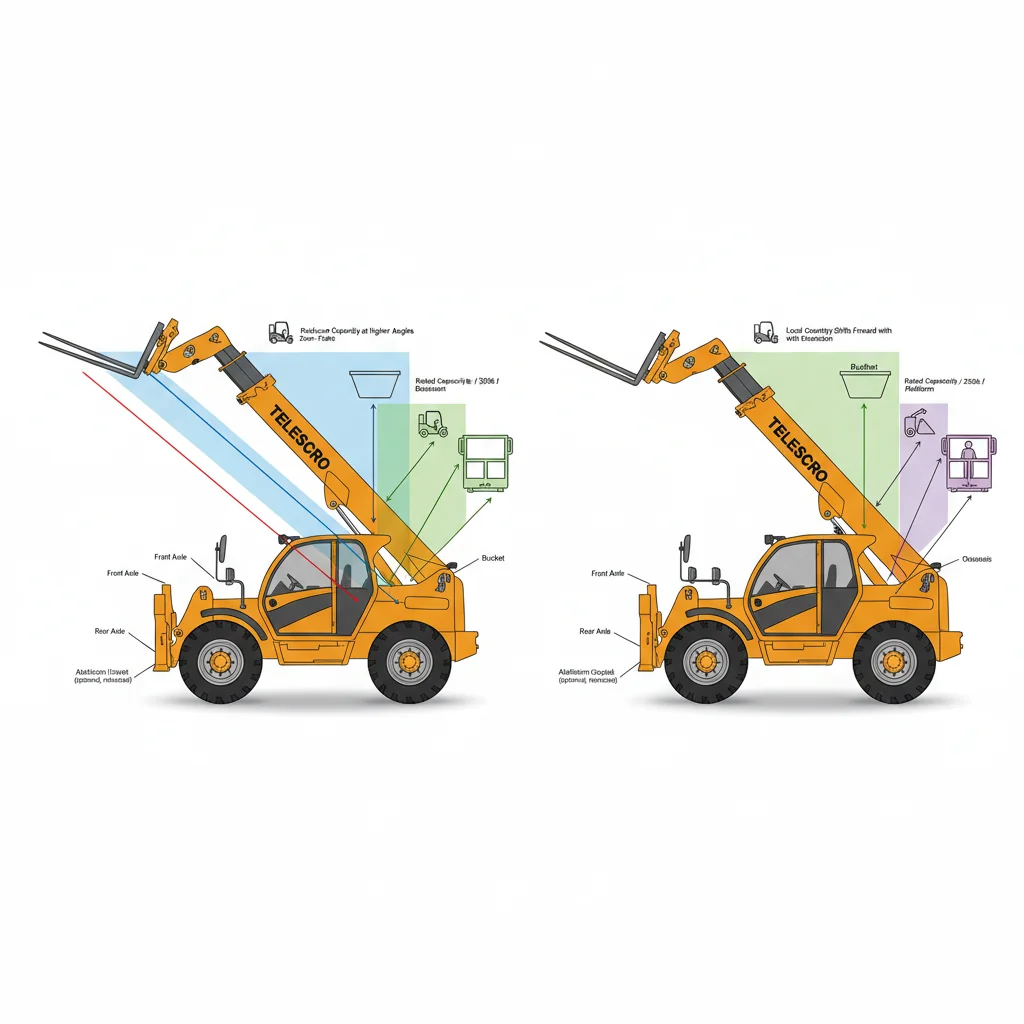
Last year, a client in Qatar called me with a problem most buyers don’t expect—their 3-ton telehandler couldn’t handle basic bucket work at full reach. The issue wasn’t the base machine, but the attachment. That’s a classic trap: every accessory changes your safe working limits. The moment you swap standard forks for a bucket or a side-shift carriage, you add dead weight and shift the load center forward. Each extra kilogram means more forward leverage, and the machine’s rated capacity drops in every boom position—not just at full extension, but even close in.
Common telehandler attachments and their impact include:
- Buckets – Heaviest attachment, moves load center furthest forward; expect up to 30% reduction in rated capacity at the same reach compared to forks.
- Side-shift carriages – Add mechanism weight and extra offset; can reduce safe lift by 15–25% depending on model.
- Work platforms – Strict safety rules apply; platform weight plus operator load quickly eats up usable capacity.
- Truss booms or winches – Less common, but even modest weight increases at the boom tip create big losses in rated load.
From my experience, capacity changes aren’t always intuitive. A 3.5-ton telehandler might handle only 2.3 tons with a side-shift carriage at moderate reach. And don’t assume all brands or models react the same way—OEMs use different load center specs, and the only safe way is checking the attachment-specific load chart for your unit. I always tell customers: ask for those charts up front, not just the base machine data. It’s the only way to avoid surprises on site.
Telehandler rated capacity is significantly reduced when using attachments like buckets because they both add weight and move the load’s center of gravity further forward, increasing the tipping risk at extended boom angles.True
Attachments such as buckets are heavier than standard forks and shift the load away from the telehandler’s front axle. This increased leverage, especially as the boom extends and lowers, makes the machine prone to tipping at much lower loads than its base rating, requiring recalculated capacity charts for each attachment.
Telehandler capacity remains the same regardless of what attachment is used, as long as the load itself does not exceed the original rating.False
Each attachment has its own weight and geometry, affecting how far the load is carried from the forks or carriage. This changes the machine’s load center and the boom’s leverage, reducing the actual lifting capacity to prevent tipping or overloading the structure, even if the load doesn’t exceed the base machine’s nominal rating.
Key takeaway: Always use the load chart specific to each attachment and telehandler model combination. Attachments increase load center and reduce allowable capacity at every boom angle and reach. Comparing rated capacities without reference to attachment-specific charts is inaccurate and potentially unsafe.
How does boom angle affect telehandler capacity?
Telehandler rated capacity varies significantly with boom angle and reach. At lower boom angles with longer forward reach—common in tasks like truck unloading—actual capacity may be half or less of the nameplate figure. Accurate telehandler selection requires reviewing load charts at typical working points, not just the maximum rating.
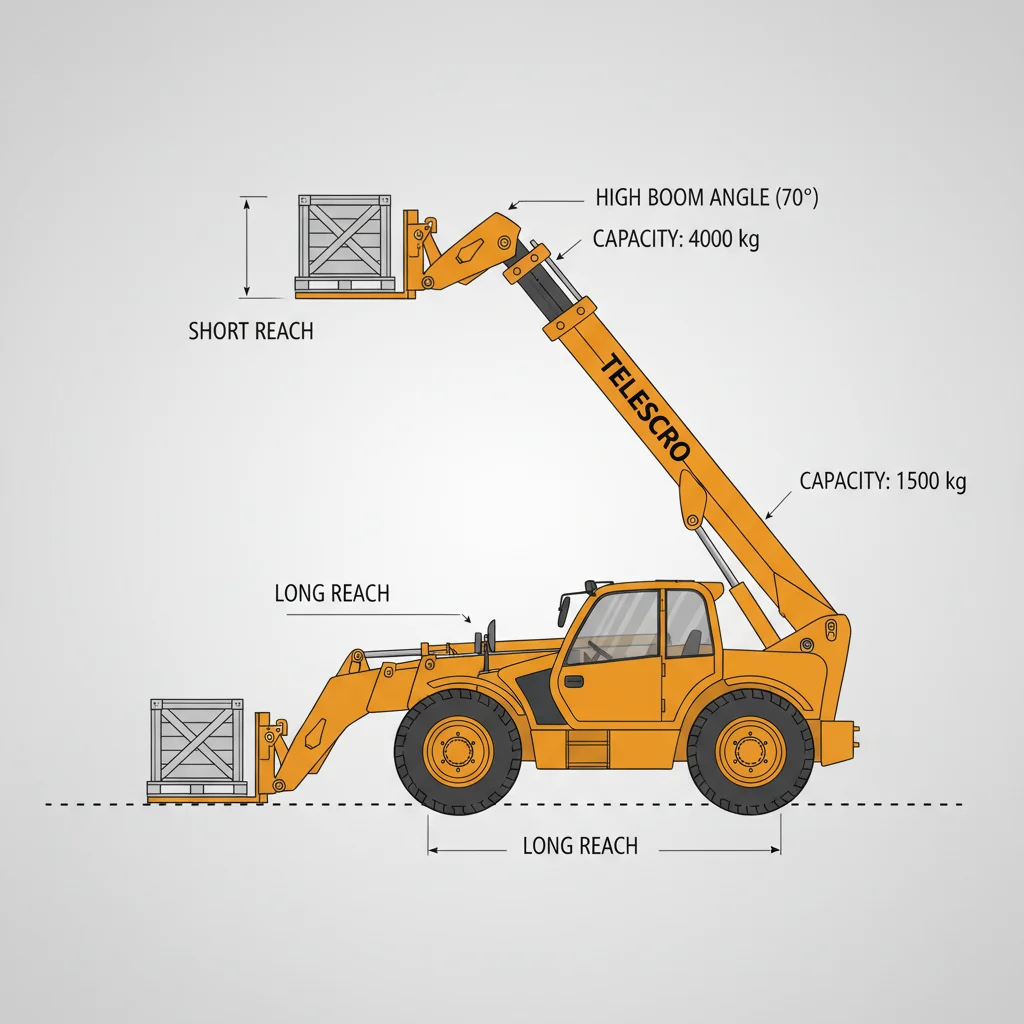
From my experience, too many buyers get hooked on the “rated capacity” in the brochure and forget how quickly it drops at typical working positions. I see this mistake everywhere—last month, a crew in Dubai wanted to unload 1.8-ton pallets from a truck using a 4-ton telehandler. The spec sheet looked fine on paper, but with the boom at a low angle (about 40 degrees) and over 2.5 meters of reach from the front tires, the load chart only allowed around 2 tons—barely enough margin for safe handling. That operator was shocked when the overload alarm cut in halfway through the shift.
Here’s what matters most: the lower and farther you work the boom, the more capacity shrinks. Tasks like feeding concrete mixers, loading hoppers over barriers, or unloading materials across scaffolding almost always happen below 50-degree boom angles, with 2–4 meters forward reach. At these points, many “3.5-ton” machines can only safely handle 1,500 to 2,000 kg. If you choose a telehandler based only on the max number, you risk a “showroom hero, jobsite zero” situation—impressive rating, disappointing performance onsite.
I always suggest mapping out your real jobs before purchasing. For example, estimate your typical load: “2 m elevation, 3 m forward reach, 1.6 t pallet.” Then sit down with the manufacturer’s load chart, not just the sales brochure. Sometimes a heavier, lower-reach model outperforms a taller, more expensive one at these angles. Build in at least 25–30% margin above your heaviest routine task—running at rated limit wears out hydraulics and risks downtime nobody needs.
Telehandler lifting capacity decreases significantly when the boom angle is lower, even if the machine's rated capacity appears high on paper.True
As the boom angle decreases, the telehandler boom extends further from the machine's center of gravity, increasing leverage and thereby reducing safe lifting capacity due to greater tipping risk.
The telehandler's rated capacity applies equally at any boom angle as long as the machine is on stable ground.False
The rated capacity is only valid at a specific boom angle and retracted position. As the boom is lowered and extended, the leverage increases, causing the allowable lifting capacity to decrease sharply regardless of ground stability.
Key takeaway: Telehandler selection should focus on capacity at the boom angles and reaches used most frequently, not just the maximum rated value. Always use manufacturer load charts to compare models at specific working points, and build in an adequate capacity margin for everyday jobs.
How Do Telehandlers Monitor Boom Angle Safety?
Telehandlers manage boom-angle safety through a combination of physical boom markings and electronic monitoring systems. Angle scales and extension labels align with each model’s printed load chart, while calibrated sensors feed a load moment indicator8 (LMI) or load control system that continuously compares boom position against the manufacturer’s load chart, warning operators or limiting functions as rated capacity is approached.

I’ve worked with customers who made the mistake of trusting only the electronic display without ever checking the physical boom markings. That’s risky. On most modern telehandlers, you’ll see angle scales and colored extension labels directly on the boom. They match up with the load chart that usually sits in the cab. This gives you a “first checkpoint” for whether you’re in the safe zone—especially if you notice the sensor’s readings don’t quite match the physical labels.
Inside the machine, calibrated angle and extension sensors constantly monitor your boom’s position. These feed live data to the load moment indicator, or LMI, which basically acts as your safety guardian. For example, a 4-ton machine with 17-meter reach might be fine at 2,800 kg when the boom is above 60 degrees. But at a low angle with full extension, safe capacity could drop to just 600 kg. I’ve seen this trigger alarms on jobsites in Dubai and Brazil, often when someone overloads thinking the machine “feels stable.” The LMI always refers back to the exact load chart programmed by the manufacturer—no shortcuts or guesses.
If the sensors or LMI are out of calibration—even by a few degrees—the displayed safe working load can be way off. I always tell clients in Australia and Kenya to request a full system calibration as part of their annual inspection. If an operator ever reports odd warnings or, worse, no warning at all during risky lifts, treat it as urgent. Never override these systems just to “get the job done”—it’s a fast track to instability and possible tipping.
Telehandler boom angle directly determines when specific load capacities apply, because the rated capacity changes as the boom is raised or lowered.True
Load charts are designed based on the relationship between boom angle, extension, and stability. As the angle changes, leverage and tipping forces also change, which means the actual safe lifting capacity can vary even at the same extension.
Once a telehandler boom is fully extended, its rated capacity remains constant regardless of the boom angle.False
At full extension, the boom angle still plays a critical role in stability and rated capacity. Lower boom angles increase leverage and the risk of tipping, so capacity decreases as the boom lowers, even if it's fully extended.
Key takeaway: Telehandler boom angle safety relies on the consistent accuracy of physical indicators and sensor-driven electronic systems that reference the manufacturer’s load chart. Always ensure angle sensors and LMIs are properly calibrated during regular maintenance—never override or ignore safety warnings, as these safeguards are essential for preventing instability and tipping.
How Does Boom Angle Affect Telehandler Capacity (Continued)?
Boom angle and extension critically determine telehandler rated capacity. A more horizontal and extended boom reduces stability and lifting ability, as shown in the manufacturer’s load chart. Best practice is to lift with the boom low and retracted, only raising and extending as strictly required for each specific operation and load.
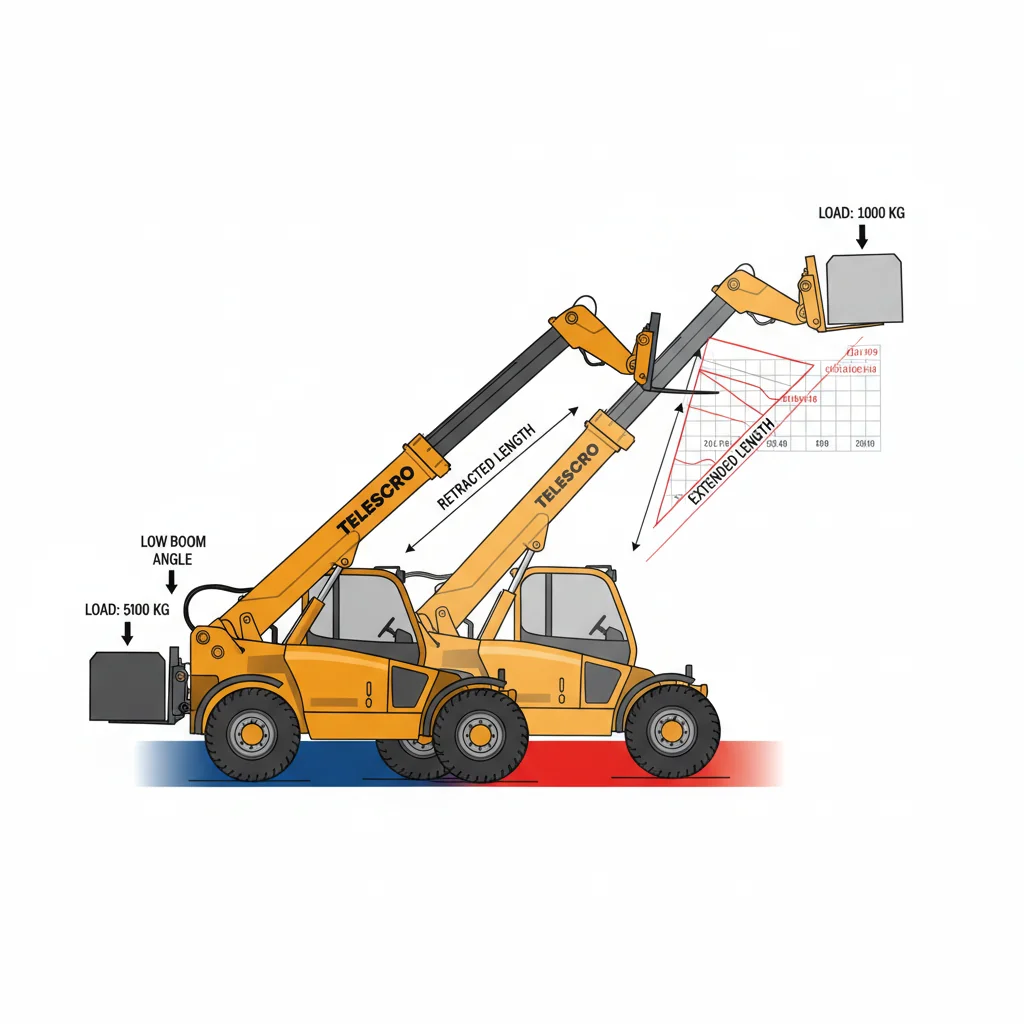
To be honest, the spec that really matters isn’t the headline “rated capacity” in the brochure—it’s how much capacity you lose as the boom moves forward and down. That’s the part many buyers underestimate.
When you lift with the boom extended at a low angle, the load’s weight shifts forward toward the machine’s forward stability limit, typically governed by the front axle in straight-ahead lifts. As that forward reach increases, stability drops fast, even though the boom itself may feel solid.
The difference can be dramatic. On a typical mid-size telehandler with around 13 meters of maximum reach, you might see close to the full headline capacity when the boom is retracted and working close in. But once you extend the boom toward the far end of its working envelope and lower the angle to gain reach, the allowable load can fall to only a few hundred kilograms. I’ve seen new operators genuinely shocked by this—especially when the load moment indicator starts warning well before the boom reaches full extension.
I remember walking a new operator through this on a site in Dubai. On paper, the machine looked oversized for the job. In practice, as soon as we extended the boom at a low angle, the system warned and limited movement long before he expected it to. That moment usually makes the lesson stick.
A simple rule of thumb I teach on jobsites is this: approach the load with the boom retracted, set the machine up on firm, level ground per the manufacturer’s level indicator, and only extend or lower the boom when it’s strictly required for placement. This approach preserves forward stability and leaves more margin for uneven ground, which is something I’ve seen catch operators out on sites in places like Kazakhstan.
What you should never do is try to “save time” by grabbing a pallet with the boom already extended and low. That’s where usable capacity is weakest and where tip-over risk increases sharply. Before each shift—or anytime the task changes—I always recommend a quick review of the load chart at the actual height and reach you’ll be working. It’s a small habit that prevents big problems later.
Telehandler capacity decreases significantly as the boom angle lowers, because more of the load's weight is transferred forward toward the machine's tipping axis.True
A lower boom angle changes the load's leverage against the machine, increasing the risk of tipping and reducing the safe lifting capacity at that position.
The maximum rated capacity listed in the telehandler’s brochure applies equally, regardless of how far the boom is extended or its angle.False
The maximum rated capacity only applies under specific boom retraction and angle conditions. With greater boom extension and a lower boom angle, actual lifting capacity is much lower due to stability factors.
Key takeaway: Safe telehandler operation relies on consistently applying habits such as referencing the manufacturer’s load chart, checking boom indicators, and positioning the boom low and retracted when lifting. Operator awareness of how angle and extension reduce capacity is fundamental to preventing tip-overs and maintaining site safety.
Conclusion
We explored how boom angle and extension play a huge role in what your telehandler can safely lift—not just the maximum numbers you see in the brochure. From my experience, the real risks come when teams forget to check the load chart for their actual working height and reach. I’ve seen more than one “showroom hero, jobsite zero” situation when people pick on big specs and ignore how fast capacity drops as you extend. If you’re unsure how to match a machine to your jobsite or want to double-check load limits, feel free to reach out. I’m always happy to help fellow builders find what truly works—every site is different.
References
-
Explore the detailed impact of boom angle and extension on telehandler lifting capacity with expert insights and safety considerations. ↩
-
Details the critical stability triangle concept that governs tipping risk and load safety during telehandler boom movements. ↩
-
Learn how to correctly interpret telehandler load charts to ensure safe lifting at various heights and boom reaches. ↩
-
Detailed insights on how shifting load center forward reduces stability and safe lift limits, vital for telehandler users. ↩
-
Explains how low boom angles shift load center, reduce stability, and increase tipping risks during telehandler operation under dynamic conditions. ↩
-
Learn to accurately interpret telehandler load charts for safe lifting limits considering boom position and attachment specifics. ↩
-
Understand the technical factors behind forward tipping risk and learn best practices to enhance telehandler safety and operational stability. ↩
-
Explore expert insights on how load moment indicators calculate safe load limits to prevent accidents during lifting operations. ↩