










Telehandler Buying Steps from China: Field-Tested Guide to Avoid Common Pitfalls
About two months ago, I helped a Polish construction manager untangle a shipping delay that nearly sidelined his entire jobsite. His team had ordered a telehandler from China, but key steps were missed—turns out, that kind of mistake happens more often than most people think when buying overseas.
Purchasing a telehandler from China involves a structured multi-step process that extends beyond a basic transaction. Buyers must first define operational requirements, shortlist direct manufacturers1, and thoroughly compare technical specifications. Negotiation of price, lead times, and payment terms is essential, followed by formalizing details in a Proforma Invoice and contract. Factory inspections—either in person or virtually—help verify build quality prior to shipment.
What Are the Steps to Buy a Telehandler?
The telehandler procurement process from China involves nine critical steps: specifying operational needs and budget, shortlisting suppliers, comparing technical specifications, negotiating pricing and terms, confirming with a Proforma Invoice and contract, payment of deposit, factory/video inspections, arranging shipping and customs, and managing after-sales support. This structured approach minimizes delays, inspection issues, and delivery miscalculations.
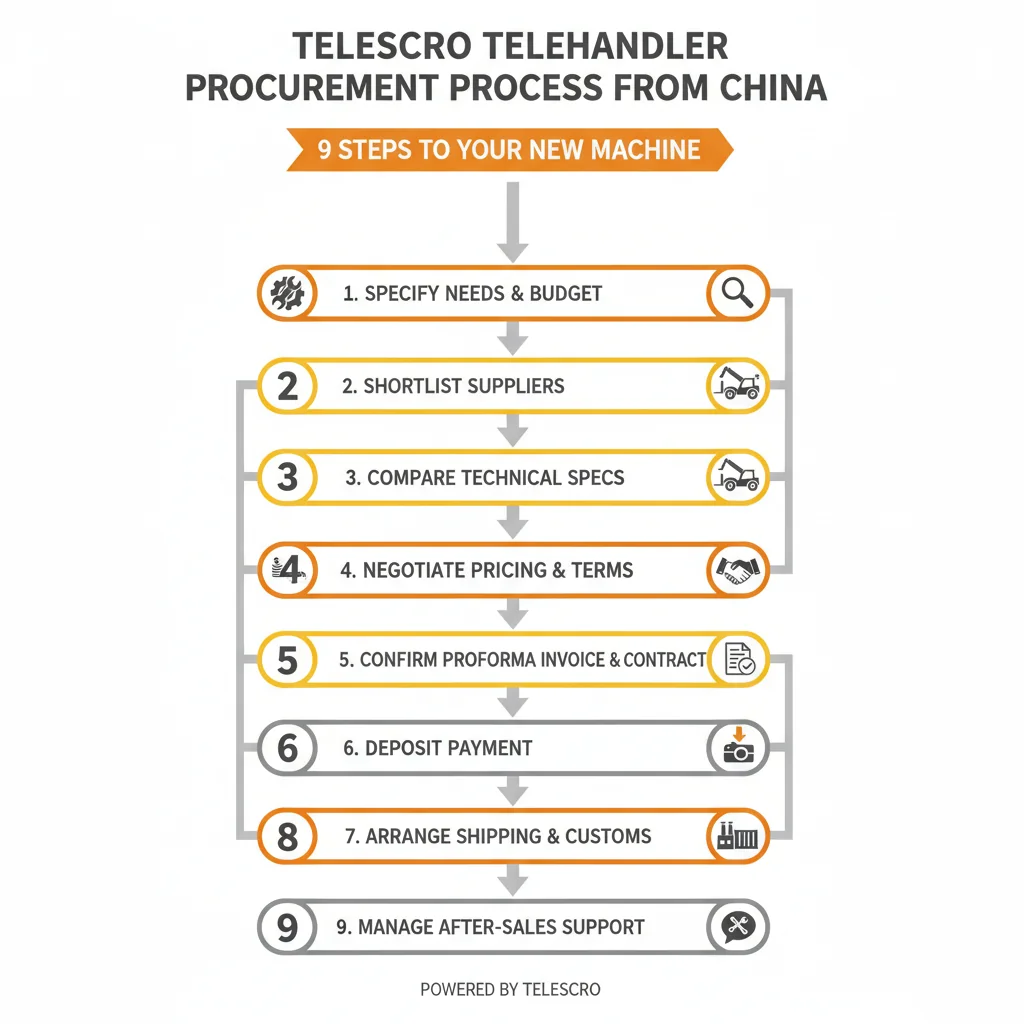
Last month, a contractor in Dubai asked me why his machine was delayed by three weeks. It turned out he approved the Proforma Invoice without first arranging a video inspection—which is a common step many buyers skip. Missing a single stage like that can stall your whole project. To help you avoid these headaches, let me break down the step-by-step process I recommend for purchasing a telehandler from China:
- Clarify your project needs and budget: Nail down max lift capacity, working height, attachments (like buckets or man baskets), and jobsite requirements. For example, if you’re lifting pallets up to 12 meters on a tight site, a compact 3-ton model with a turning radius under 4.5 meters may be ideal.
- Shortlist reliable suppliers: I always suggest narrowing your options to 2–4 factories. Check their export experience, support track record, and ability to share real customer references (not just glossy catalog photos).
- Deep-dive on specifications: Compare load charts (shows real max capacity at different reaches), engine models, hydraulic circuit design, and safety features like moment indicators or backup alarms. I’ve seen buyers in Kenya overlook the difference between 70 hp and 100 hp engines—costing them productivity on steep grades.
- Negotiate and confirm details: Pin down lead time, payment terms, and which parts (filters, tires, hoses) are included. Only sign the contract and PI after double-checking these points.
Arranging a video inspection before approving the Proforma Invoice can prevent shipment delays by verifying machine condition and specifications remotelyTrue
A video inspection allows buyers to confirm that the telehandler meets their exact requirements and is in good condition before committing funds, which helps avoid disputes or delays that arise from discovering issues post-approval.
The final purchase price of telehandlers from China is always inclusive of customs duties and local taxesFalse
Customs duties and local taxes vary by destination country and are typically the responsibility of the buyer; Chinese suppliers generally quote ex-works or FOB prices, so buyers must budget separately for import fees and compliance costs.
Key takeaway: Mapping each step in the China telehandler buying process to project schedules prevents costly delays, missed inspections, and premature payments. Transparent supplier communication, detailed documentation, and allowing 30-60 days for production plus shipping are essential for risk reduction and on-time delivery in international equipment procurement.
How to Vet Chinese Telehandler Suppliers?
Vetting Chinese telehandler suppliers requires targeting direct manufacturers on platforms like Alibaba, Made-in-China, or their official sites to avoid dealer markups. Evaluate factory photos, telehandler model ranges, and detailed spec sheets. Confirm credibility via ratings, transaction history, certifications, buyer references, and ensure video evidence from production and test lines. Inconsistent communication or reluctance for video calls are strong supplier red flags.
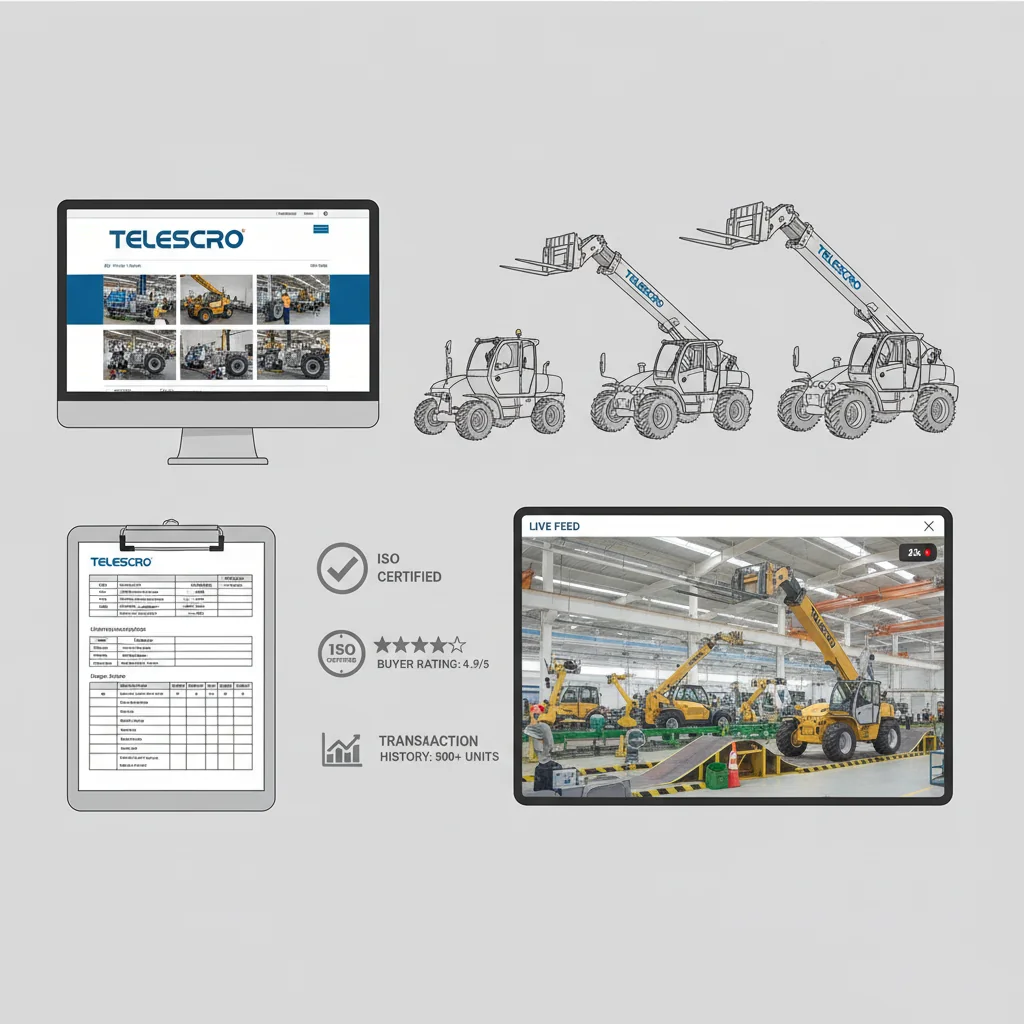
The biggest mistake I see is buyers jumping on the first low price they find online—without digging into who’s actually behind that offer. I’ve worked with clients in Brazil and Kazakhstan who paid deposits to “factories” that were just trading companies, then faced weeks of silence and delays. The smartest approach? Target manufacturers directly on Alibaba, Made-in-China, or, even better, their own official website. Look for real factory photos: not just a shiny showroom, but images of welders, boom assemblies, and test yards with several units in production.
If the supplier claims to export telehandlers, confirm with test videos showing the exact model—like a 3-ton 14-meter unit lifting loads at full extension. I always suggest requesting reports from their last export—actual Bill of Lading, inspection certificates2, or even a short email from a previous buyer in your country.
This step weeded out two risky suppliers for a Kenyan client last year. Here’s what matters most when narrowing your shortlist: cross-check the company name and bank details on invoices with those on their business license. It’s surprisingly common for trading companies to use slightly different names or personal bank accounts. Ask for a video call—an honest factory will show you the workshop, assembly lines, and maybe even introduce the technical director. If the supplier hesitates, gives canned answers, or refuses a call, treat that as a major red flag.
Verifying the presence of certified welding procedures in factory photos helps confirm a Chinese telehandler manufacturer's quality control processesTrue
Certified welding procedures ensure structural integrity and safety in telehandlers. Factories that share detailed images of welders following these procedures demonstrate adherence to quality standards uncommon in mere trading companies. This reduces the risk of purchasing substandard equipment.
Chinese telehandler suppliers that offer a 50% deposit upfront guarantee immediate shipment and product availabilityFalse
A high upfront deposit often raises risk rather than guarantees delivery, especially without verified factory credentials. Genuine manufacturers typically require lower deposits with signed contracts, while excessive advance payments can indicate trading companies or brokers delaying shipments and causing lengthy lead times.
Key takeaway: Directly vetting Chinese telehandler suppliers by demanding detailed specs, factory evidence, and export documentation greatly reduces risk. Reliance on third-party validation, video calls, and reference checks helps buyers avoid trading companies and scams, improving quality outcomes and minimizing costly supply chain issues.
How to Match Telehandler Specs to Application?
Matching telehandler specs requires identifying primary tasks, typical load weights, required lift height3 (4–17 m), and load capacity4 (1.5–3+ tons). Consider aisle or door widths, surface conditions, and planned runtime. Farmers favor compactness and versatility, while construction demands more reach and capacity. Suppliers should recommend models based on these constraints; comparing options prevents operational bottlenecks or unnecessary overspending.

Let me share something important about matching telehandler specs to real jobsites. Too many buyers just ask, “What’s your max lift height?” and stop there. I had a customer in Kazakhstan who needed to unload big fertilizer bags—about 1.8 tons each—inside a barn with 2.3-meter-wide doors and loose gravel flooring. He originally considered a 17-meter model, but once we factored in his low door height and tight turns, a compact 6-meter telehandler made much more sense. The smaller unit saved him at least €8,000 upfront and didn’t get stuck in the mud.
Here’s what I always recommend sharing when talking to your supplier:
- Primary Task: What do you lift most—pallets, bales, bricks, bulk loads?
- Typical Weights: Heaviest single load, plus averages (not just “max” cases).
- Lift Height Needed: Maximum working height required (not just spec sheet maximum).
- Environment: Aisle or door widths, surface type (mud, concrete, slope), open/indoor.
- Duty Cycle: Expected hours per day—some hydraulic pumps can overheat on long shifts.
Farm operations usually benefit from compactness and multiple attachments, like buckets or hay forks. Construction contractors in places like Dubai often require higher-reach machines—12 to 17 meters—and 3-ton or greater capacities for handling materials on upper floors. For warehouses with narrow aisles, I’ve seen 4.5-meter units (under 2 meters wide) speed up tasks and reduce collision risk.
My suggestion? Ask suppliers to recommend two models based on your real constraints. Compare load charts at working heights—not just “max” specs. That’s how you avoid workflow headaches and wasted investment.
Choosing a telehandler with a compact footprint under 2.5 meters wide is critical for navigating doorways narrower than 2.5 meters on congested yardsTrue
Telehandlers wider than the access points can cause operational delays and damage, so matching machine width to site constraints like door widths ensures smooth material handling and reduces the risk of costly modifications or equipment damage.
When buying a telehandler from China, the maximum lift height should always be prioritized over engine horsepower for better performance on all job sitesFalse
While lift height is important, engine horsepower significantly affects the telehandler's ability to maneuver under load, drive on uneven terrain, and operate attachments. Ignoring horsepower can lead to underpowered equipment that struggles in real job conditions.
Key takeaway: Successful telehandler procurement begins with a detailed analysis of real job site requirements—load, lift height, environment, and duty cycle. Customizing specifications to actual applications prevents workflow delays and financial waste, ensuring the imported machine integrates efficiently into existing operations.
How to Ensure Attachment Compatibility?
Ensuring attachment and hydraulic compatibility with a telehandler requires providing detailed specifications—mounting system, pin diameter, spacing, hydraulic requirements, and connector type—to the supplier. Written confirmation and video demonstrations using equivalent attachments validate compatibility. Verifying auxiliary hydraulic circuits, quick-hitch standards, and documenting all specs in contracts prevents costly rework or downtime due to mismatched components.
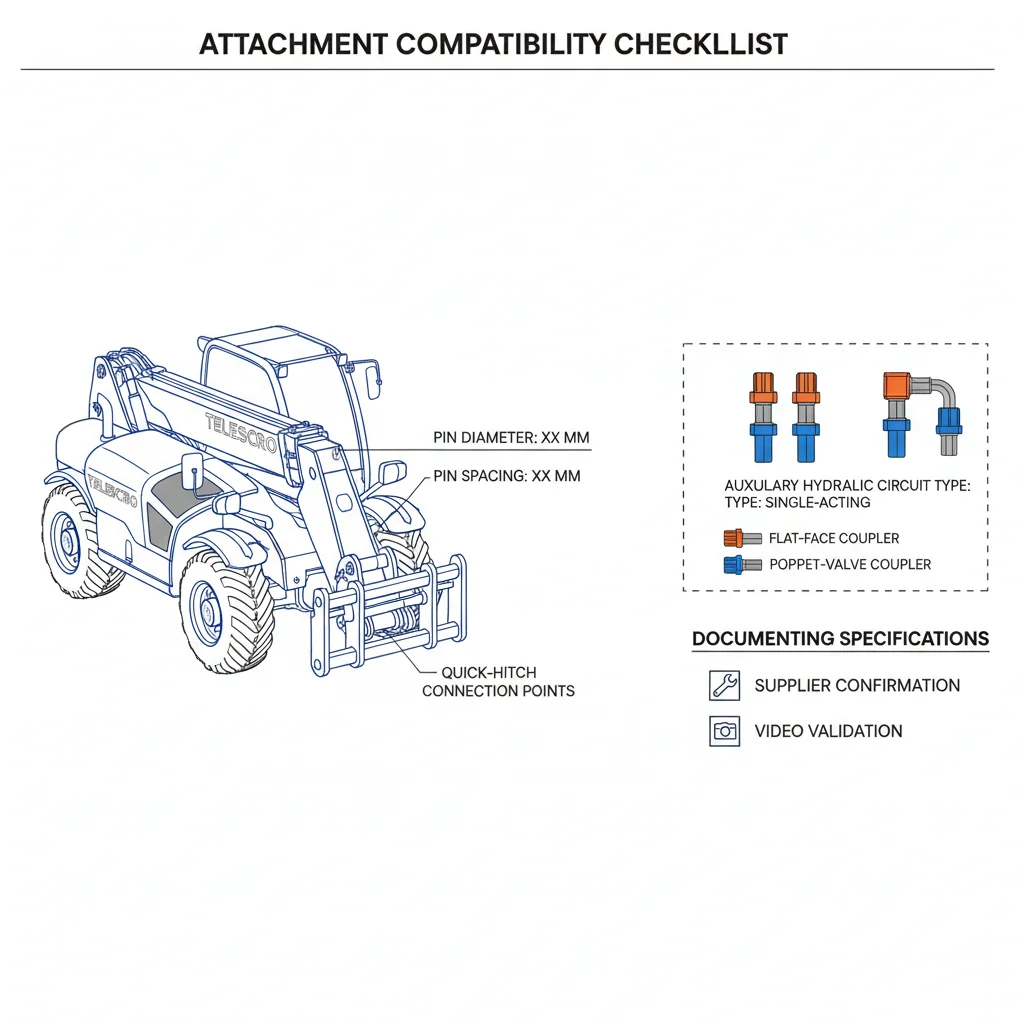
Most people don’t realize that telehandler attachment compatibility can turn into a real headache if the details are missed up front. I’ve worked with teams in Poland and Malaysia who expected their imported machines to fit existing buckets, only to find the quick hitch system was different by a few millimeters. That’s when the rework costs—and frustrating delays—start stacking up. Accurate compatibility isn’t just about the major dimensions, either. The devil’s in the small stuff: pin diameter, spacing, even hydraulic coupler5 thread type.
For every project, I recommend gathering the following specs before shipping:
- Mounting system details – quick hitch type6 (Euro, ITA, or custom) and latch dimensions
- Pin and spacing measurements – diameter, length, and distance between pins, measured to the nearest millimeter
- Hydraulic requirements – working pressure, recommended flow rate, and type of quick coupler (flat face, push-pull, etc.)
- Number and type of auxiliary circuits – proportion control or simple on/off, especially for attachments like winches or rotators
- Electrical connectors – if your site uses powered attachments, confirm voltages and plug styles
I always suggest sending your exact current attachment measurements—photos next to a caliper help—and requesting written confirmation from the supplier. Some of my customers in South Africa go a step further and ask for video clips showing the factory staff attaching and operating the same or similar tools on their actual telehandler build. That’s how you avoid expensive surprises. Finally, document every agreed detail in your contract or pro forma invoice. This effort up front keeps your machine running—not waiting for adapter plates or new hoses.
When purchasing a telehandler from China, verifying the exact quick hitch pin diameter to within 0.5 mm tolerance is crucial to ensure attachment compatibilityTrue
Small differences in pin diameter—even as little as half a millimeter—can prevent attachments from fitting properly, leading to costly modifications or delayed operations, especially since manufacturers may have slight dimensional variances.
All Chinese telehandlers use a universal quick hitch system standardized globally, so any attachment designed for European or American models will fit without modificationFalse
There is no global standardization for quick hitch systems; Chinese telehandlers often use different or proprietary designs, meaning attachments from other regions may require adapters or replacements to ensure proper fit.
Key takeaway: Accurate, detailed confirmation of attachment and hydraulic specifications—along with supplier-verified compatibility and thorough documentation—minimizes risks of mismatches and costly modifications when importing telehandlers from China. Addressing these factors early ensures smooth integration with existing equipment and optimal operational uptime after delivery.
What Safety and Compliance Docs Are Needed?
Telehandlers imported from China must meet target-market standards, such as CE conformity7 and EN standards for Europe, or EPA engine certification8 and OSHA requirements for the US. Essential documentation includes safety certificates, sample machine labels, calibration/test reports, and Declaration of Conformity. Missing or incorrect paperwork can delay customs clearance and prevent site acceptance.
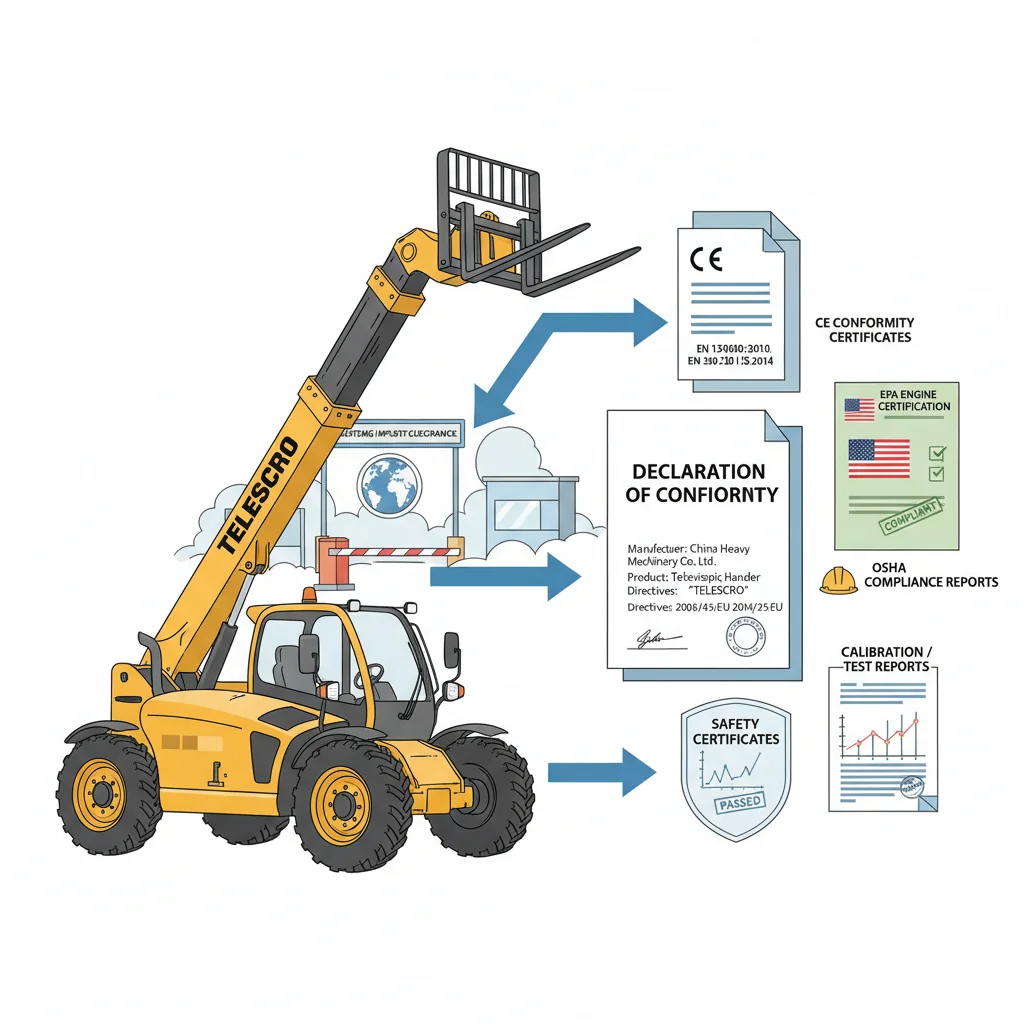
I’ve worked with customers in Germany and the US who ran into real trouble at customs—just because one piece of documentation was missing or outdated. The stakes are higher than most buyers realize. For Europe, CE conformity is essential. That means your supplier needs to provide a valid Declaration of Conformity, plus proof the machine meets EN standards like EN 1459 for stability and safety. One customer in Frankfurt imported a 3.5-ton unit with an 11-meter reach. Their forwarder called me when customs stopped the shipment—because the machine’s load chart and safety label were only in Chinese. Sorting translations took a week and held up their project.
In the US, the focus shifts to engine emissions and OSHA rules. I always suggest confirming the telehandler’s engine has EPA Tier 3 or Tier 4 certification, depending on your state. I’ve seen machines turned away at the port for failing this check. Contractors on big sites in Texas now ask for ROPS (Roll-Over Protective Structure), LMI systems (load moment indicator), and full operational manuals in English. Some project managers run spot checks—if your plate or decal doesn’t match their site or state requirements, they’ll send the unit offsite. No exceptions.
So, what should you request from your supplier before shipping? Ask for:
- Declaration of Conformity (CE or local equivalent)
- Engine emission certificate, if required
- Sample safety labels and data plates (in your language)
- Stability test or calibration reports
- Detailed load charts, with real-world figures
This checklist may sound basic, but it saves time and headache later. I recommend double-checking every document—it’s much easier than trying to fix these issues after arrival.
Key takeaway: Verifying and obtaining all required safety and regulatory documents—including certificates, sample labels, and compliance reports—before importing a telehandler is crucial. This process prevents customs issues, demonstrates due diligence to contractors, and ensures operators comply with jobsite and legal requirements in the destination country.
What About What contract terms, Incoterms, and documents?
What contract terms, Incoterms, and documents are essential?: Once you’ve aligned on model and options, ask for a detailed Proforma Invoice (PI). This
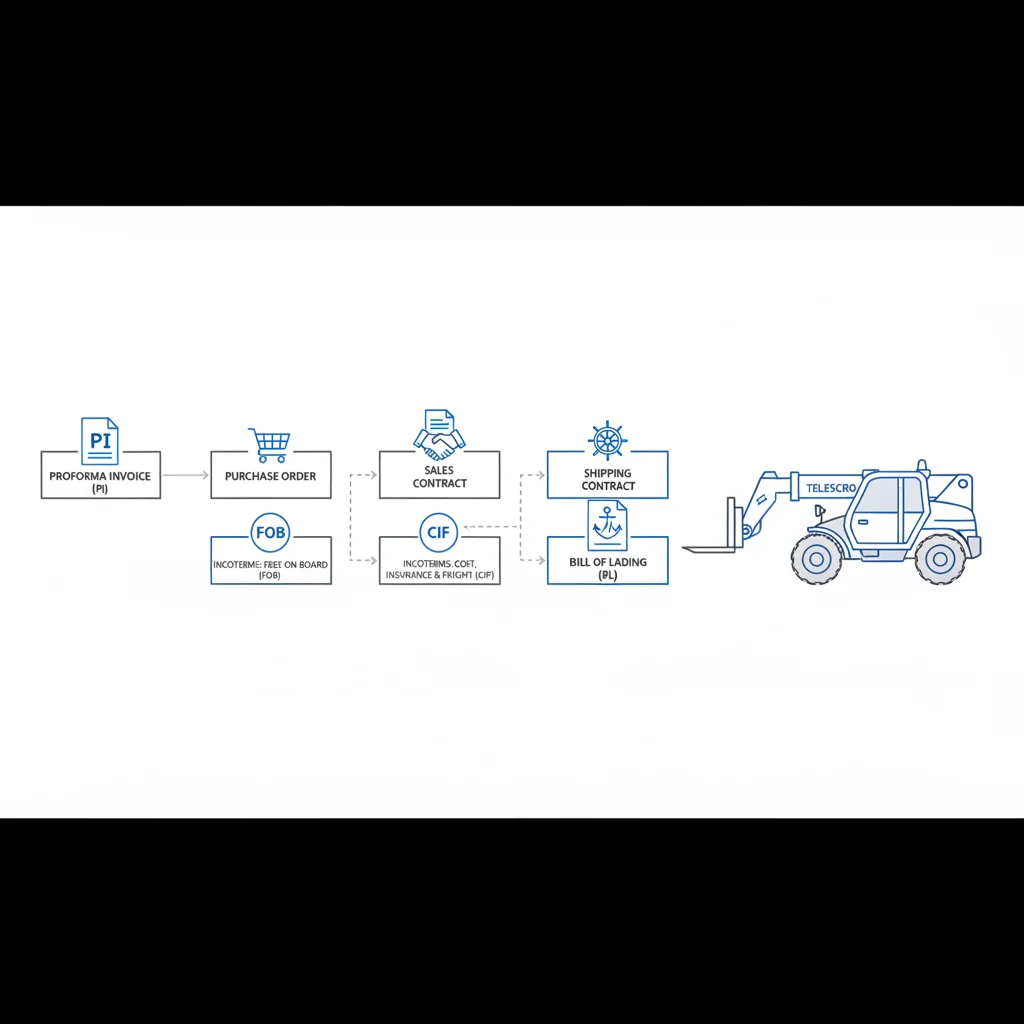
Most people underestimate how much paperwork and detail goes into an overseas telehandler order. The contract terms set the foundation for everything—get them right, and you avoid weeks of back-and-forth or worse, expensive surprises. After you’ve chosen your model and agreed on specs, ask your supplier for a Proforma Invoice (PI). This document is more than just a quote. It should list every crucial detail: model, full technical specifications (like lift capacity, max height, engine and hydraulics brands), unit price, total quantity, Incoterm9, delivery port, estimated lead time, payment milestones, and warranty coverage.
I’ve worked with a contractor in Kazakhstan who only checked the price and model on their PI. Six weeks later, they found out the tires and fork carriage were different from what their jobsite needed. Their downtime cost them at least three full working days. That’s why I always tell customers to make sure the PI and purchase contract match their exact job requirement. Check for details like tire type, color, included attachments (buckets, jibs, platforms), and even the paint finish. Locking this in now avoids major headaches later.
Choosing the right Incoterm is key. If you prefer handling your own shipping and insurance, go with FOB. If you want less risk, CIF or DDP means the seller covers more logistics. Either way, clarify document requirements: commercial invoice, packing list, Bill of Lading, and compliance certificates (like CE or ISO) for customs clearance. I suggest confirming all documents before you pay the deposit. This protects you if the machine arrives late, incomplete, or not as promised.
A Proforma Invoice (PI) for overseas telehandler purchases typically includes not only detailed technical specifications but also precise Incoterms, which clarify the allocation of shipping responsibilities and costs between buyer and seller.True
Incoterms like FOB, CIF, or DDP define who handles transport risks, insurance, and customs clearance, making them critical to avoid disputes or unexpected fees in international telehandler transactions. Including them in the PI ensures mutual clarity from the outset.
The standard purchase contract for importing telehandlers from China usually exempts buyers from verifying the declared engine emissions compliance, as this is solely the supplier's responsibility under international trade law.False
Buyers must verify engine emissions compliance themselves or through third parties; international trade law does not exempt them. Non-compliance risks import rejection, fines, or operational bans, so accurate verification is a crucial contractual and regulatory step.
Key takeaway: What contract terms, Incoterms, and documents are essential?
How Should Telehandler Payments Be Structured?
Standard telehandler purchases from China use staged payments10, typically 30–50% deposit after contract signing and the balance due before shipment or against shipping documents. For high-value orders, Letters of Credit11 provide additional security. Always require proof of completion and inspection, use company bank accounts, and retain all payment documentation for fraud prevention and compliance.
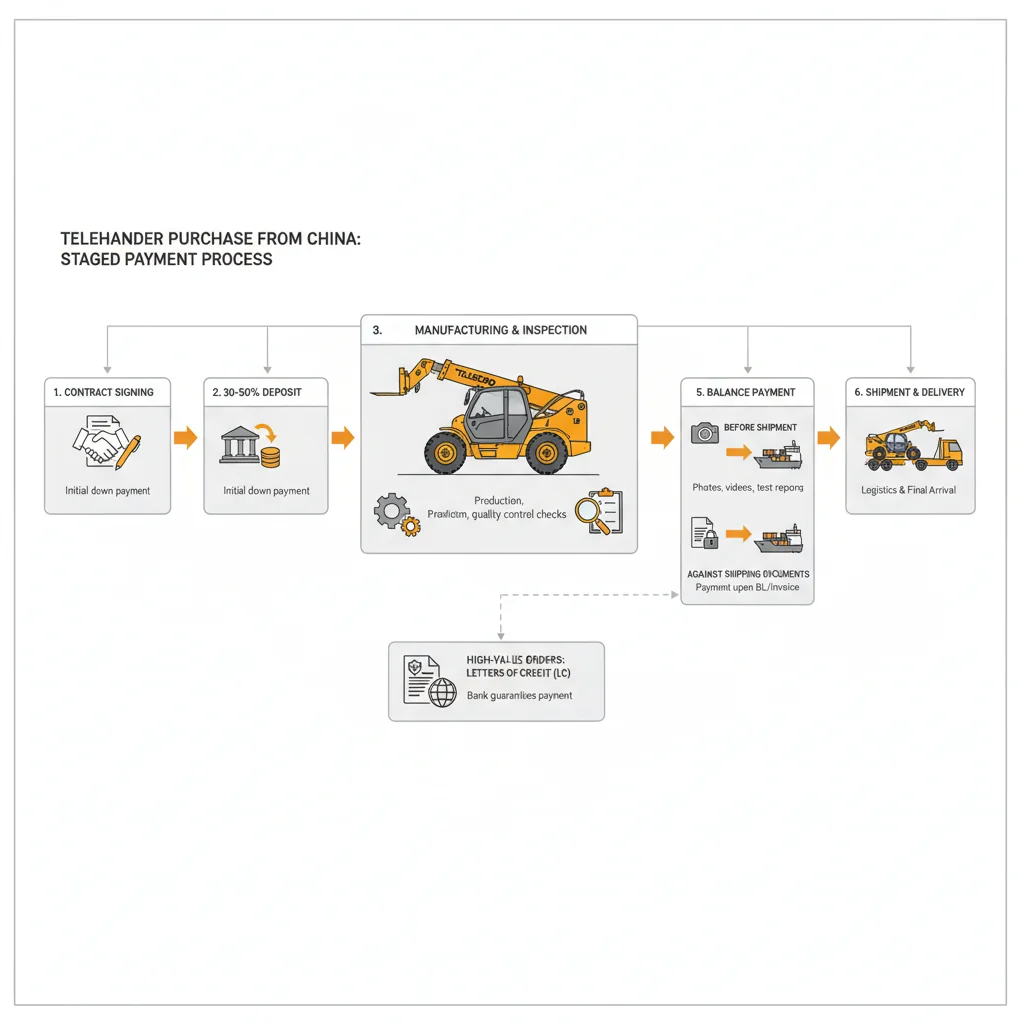
When I first started dealing with cross-border telehandler orders, I didn’t realize how much payment terms could impact trust and project timing. In China, the standard structure is a 30–50% deposit after you sign the contract or proforma invoice. This upfront amount helps factories buy the steel, hydraulic cylinders, and import some key components. The remaining balance—usually 50–70%—is due before shipment or released against shipping documents, like the bill of lading or packing list. I’ve seen customers in Kenya and Brazil benefit from insisting on inspection proof before making the final payment. One Brazilian client used third-party photos and a video walkaround to confirm the tilt cylinder and boom welds—simple, but it saved weeks of dispute.
For larger orders, where the value exceeds $100,000, Letters of Credit (LCs) are popular. This adds a safety net because your bank only releases funds when they see all the agreed documents—usually inspection reports, shipping documents, and the invoice. It’s slower and costs a bit more, but for a fleet of five 4-ton telehandlers, every safeguard counts. Whatever the method, I always suggest making payments to the registered company account. In Kazakhstan, a client nearly lost $8,000 by wiring funds to a personal account someone claimed was “faster.” Company accounts protect you from fraud, and you need those SWIFT receipts for both customs and accounting audit.
In the end, structured staged payments and solid documentation aren’t just paperwork—they’re your insurance. I recommend linking every payment to proof of completion, then double-checking business names and banking details before every transfer.
In China, suppliers typically require a 30–50% deposit upfront to purchase essential materials like steel and hydraulic cylinders before manufacturing a telehandler beginsTrue
This deposit secures raw materials and key components needed for production, ensuring the factory can start building the telehandler without financial risk, which is standard practice to manage cross-border order trust and timing.
The remaining 50–70% payment for a telehandler from China is usually made only after the equipment arrives at the destination job siteFalse
Final payments are generally due before shipment or released against shipping documents like the bill of lading, ensuring sellers receive payment prior to or during transit, not after delivery to the buyer’s site.
Key takeaway: Structured, staged payment terms with clear documentation reduce risk and protect both parties in telehandler purchases from China. Requiring proof of completion, utilizing Letters of Credit for large orders, and ensuring payments go to verified company accounts help prevent fraud and ensure equipment meets contract specifications.
Why Are Pre-Shipment Telehandler Inspections Vital?
Pre-shipment inspections12 and remote acceptance tests13 are essential when buying telehandlers from China because in-person checks are rarely feasible. Detailed photos, videos, and serial number verification provide visual proof of condition and specifications. Third-party inspectors, like SGS or CCIC, identify leaks, mis-specified parts, or missing attachments, protecting buyers from costly post-delivery issues or unsafe machines.

Honestly, not enough buyers build a proper pre-shipment inspection into their telehandler deal—especially when importing from China. Once that machine lands on your site, any mistake is yours to fix, usually at double the cost and effort. I’ve seen it happen in Kazakhstan: a client ordered a 3.5-ton telehandler with a 14-meter boom. When it arrived, the serial plate matched the contract, but the actual hydraulic circuit wasn’t rated for full pressure. The result? Weak lifting. It took weeks to get upgraded parts shipped—and by then, the project was already behind schedule.
Pre-shipment inspections act as your safety net. Even if you can’t visit the factory, you can request detailed photos and videos of the actual machine—serial numbers, close-ups of the engine, hydraulic lines, outriggers, and all safety systems like the load moment indicator (LMI) and alarm functions. I always suggest asking for a functional video: lifting a real load to full height, steering, braking, and checking boom extension. For less than $500, a third-party inspector (SGS or CCIC) can spot hydraulic leaks, dodgy welds, mis-specified tires, or missing attachments before the machine ships.
Remote acceptance tests give leverage. Tie your final payment to a clean inspection report—if the telehandler fails, the supplier still has everything on hand to correct the problem fast. If you’ve specified attachments (like a work platform or pipe handler), request video proof of those in action on your exact unit. Skipping inspection is a shortcut to headaches—a strong process saves money, time, and most importantly, jobsite safety.
Pre-shipment telehandler inspections in China commonly include verifying hydraulic circuit pressure ratings against contract specifications to ensure full lifting capacityTrue
Hydraulic circuit specifications critically affect telehandler performance; inspections verify that installed components meet designed pressure ratings, preventing underperformance or safety issues on site.
Serial plate verification alone during pre-shipment inspection guarantees the telehandler will meet all operational performance specificationsFalse
Serial plate verification confirms machine identity but does not assess functional components; hydraulic systems, boom structure, and safety features must be physically inspected to ensure operational compliance and avoid costly defects.
Key takeaway: Building an inspection and remote acceptance test into the telehandler buying process reduces risk, uncovers critical defects or misrepresented specs before shipping, and gives buyers leverage for correction. Linking final payment to passing inspection helps ensure a safe, fully functional machine on arrival.
How to Negotiate Telehandler Terms from China?
Negotiating telehandler purchases from China involves more than unit price; buyers should address production lead time14 (typically 30–60 days), FOB/CIF delivery port options, payment terms, and extras such as upgraded tires15, spare part kits, and extended warranties. Evaluating total package value and clarifying remedies for lead time slippage are crucial for a cost-effective, reliable procurement.

Many buyers think negotiating with Chinese suppliers is just about haggling the unit price. To be honest, that approach usually leaves money—and crucial features—on the table. When I worked with a client from Kazakhstan last year, their focus was on getting the lowest price for a 3.5-ton, 14-meter telehandler. But after we dug into the details, it turned out that adding a heavy-duty tire upgrade and a basic spare parts kit only increased the package cost by about 2%, while saving them headaches down the line.
Start by sharing your delivery schedule and budget range upfront. If you need your telehandler on-site in 45 days, say so. Most factories in China quote lead times from 30 to 60 days, but real capacity varies. I’ve seen situations where a supplier offered 35 days but actually needed 50—causing problems for project kick-off. Always ask what happens if production is delayed. Can they offer air shipment of key parts, or a penalty discount if they miss the window?
It also helps to clarify small spec adjustments. For example, does swapping an engine brand or requesting extra safety manuals in your language change the price by 1% or 10%? This is where the real cost differences show up. Compare the “total package value”—not just the sticker price—across your short list of suppliers. I suggest confirming in writing who handles what if the machine shows up missing the auxiliary hydraulic kit or other ordered extras. Careful negotiations build trust and can cut unexpected costs later on.
Negotiating telehandler purchase terms with Chinese suppliers should include not only unit price but also options like heavy-duty tire upgrades and spare parts kits, which often add less than 5% to the total cost but significantly improve machine reliability and uptime.True
Including upgrades such as heavy-duty tires and spare parts kits in negotiations is cost-effective since these add-ons typically represent a small percentage increase in price yet provide substantial operational benefits, reducing maintenance delays and increasing durability, as demonstrated in real buyer experiences.
Chinese telehandler suppliers usually offer standard contracts that do not allow any flexibility in payment terms or delivery schedules, so buyers must accept the terms as-is or look elsewhere.False
Chinese suppliers commonly expect buyer negotiations on payment terms and delivery timelines; flexibility is often available and can be critical to aligning with the buyer’s cash flow and project schedule requirements, contrary to the misconception that terms are fixed and non-negotiable.
Key takeaway: Effective negotiations with Chinese telehandler suppliers should encompass product spec flexibility, production timelines, comprehensive package value, and remedies for delays—not just base price. Clear communication of budget, order potential, and specific extras can deliver lower costs and better operational outcomes without overcommitting to unrealistic terms.
How to Calculate Telehandler Landed Cost?
The true landed cost of a telehandler from China includes the FOB or ex-factory price plus sea freight ($2,000–$4,000 per unit), marine insurance, port charges, customs clearance, import duty, VAT or sales tax (typically 5–20%), third-party inspection fees, and local modification costs. Accurate budgeting prevents surprises and aids ROI planning.
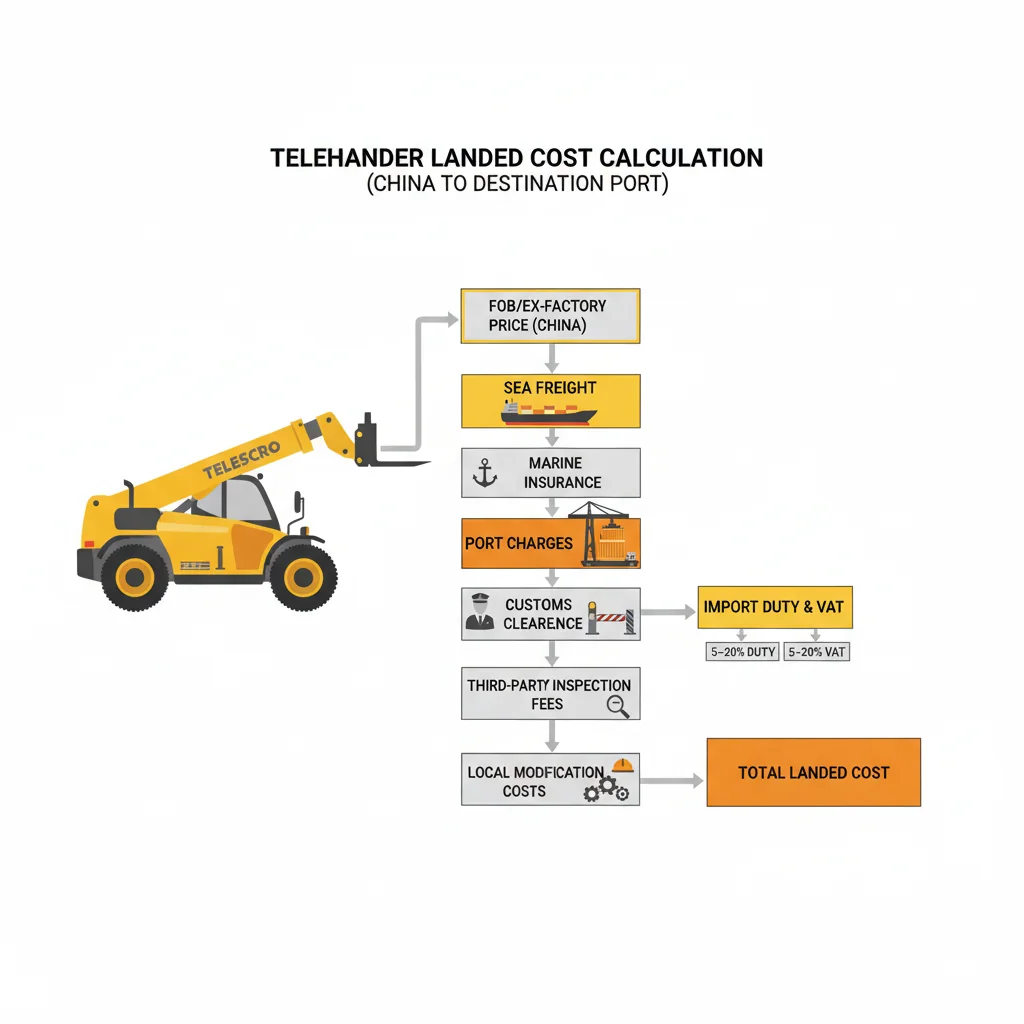
Most buyers start with the factory price, but that’s really just the tip of the iceberg. You need to build out the full landed cost—otherwise budgeting gets messy fast. I worked with a rental company in Kenya last year. They ordered three 4-ton, 13-meter telehandlers from a Chinese supplier. They were excited about the low ex-factory price, but once we factored in sea freight (about $2,700 per unit), marine insurance, port handling charges, and local customs clearance fees, the price per machine jumped by nearly 18%. And that’s before taxes.
Import duty and VAT are two big variables—some countries waive one, but others stack both. For Kenya, duties totaled almost 13% and the VAT pushed total taxes up towards 25%. On top of that, the client paid inspection fees to meet local safety standards and about $900 per unit for local modifications—extra mirrors and mandated fire extinguishers. Not all buyers realize that destination regulations can require these upgrades before you’re allowed to put the machine to work.
From my experience, currency swings or unexpected storage charges at the port can pop up if there are shipping delays. I always suggest budgeting at least 10% extra for these “surprises.” If you’re comparing overseas units to local options, get your forwarder or customs agent to lay out every line item in advance—FOB, CFR, all the way to modifications. That’s how you avoid shock and make a fair ROI call. It takes discipline, but it’s worth it for your bottom line.
When calculating the landed cost of a telehandler imported from China, sea freight charges alone can add approximately 10-15% to the total machine price, significantly affecting the overall budgetTrue
Sea freight costs for heavy equipment like telehandlers typically represent a sizable portion of landed cost due to shipping weight and volume; for example, a $2,700 sea freight fee on a $20,000 ex-factory price equates to roughly 13.5%, which buyers must include for accurate budgeting.
The ex-factory price of a telehandler typically includes marine insurance and local customs clearance fees, so these do not need to be added separately when calculating landed costFalse
Ex-factory price only covers the manufacturer’s price at the factory gate and excludes downstream costs like marine insurance, port handling, and customs clearance, which must be accounted for separately to determine the full landed cost.
Key takeaway: Always request a total landed cost estimate from a forwarder or customs broker before committing to a telehandler purchase. This ensures accurate budgeting, avoids surprise expenses, and supports well-informed ROI comparisons between imported machinery and local sourcing options.
How to Manage Telehandler Shipping Logistics?
Managing telehandler shipping logistics from China involves early decisions on Incoterms like FOB versus CIF/DDP, engaging a freight forwarder with heavy equipment experience, and preparing key documents such as the Bill of Lading and Importer Security Filing. Strict timeline coordination and proactive customs broker involvement minimize port delays and additional charges. Always request shipment tracking and milestone documentation from the supplier.
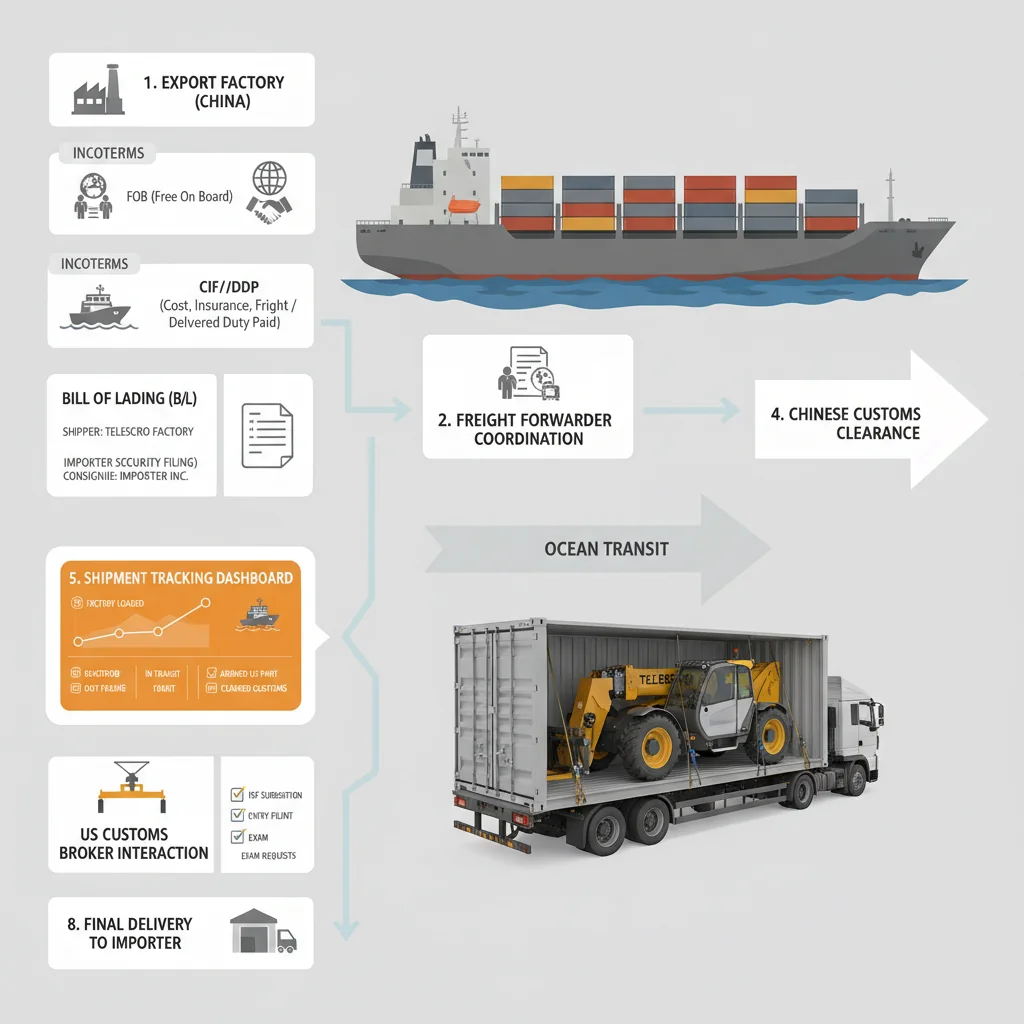
Last year, a project manager from Kazakhstan called me, stuck with three telehandlers sitting at the port—paying storage charges every day. Their logistics plan sounded good on paper but missed one key step: looping in a local customs broker before shipping. When importing a 4-ton, 14-meter telehandler from China, details like Incoterms really matter. I always ask buyers early, “Do you want to control shipping (FOB), or would you rather let your supplier coordinate the main freight leg (CIF or DDP)?” Your choice affects everything, from costs to who solves problems when port congestion hits.
From my experience, working with a freight forwarder who knows heavy equipment shipping is non-negotiable. I’ve seen customers in Brazil lose weeks because they used a low-cost forwarder with no experience in oversized cargo. Make sure your partner can handle things like reinforced packaging, lashing plans, and proper documentation. The essentials? Bill of Lading (it proves you own the machine), commercial invoice, packing list, and—if you’re sending to the US—Importer Security Filing, submitted at least a day before vessel loading. Forgetting this can lead to expensive penalties.
Sea transit usually takes at least three weeks, sometimes up to six if the destination port is busy or routes are indirect. I suggest always requesting the vessel name, shipping schedule, and live tracking links. Ask for production photos and scanned shipping docs right after loading, not weeks later. Keep your customs broker in the loop from the start to avoid surprise delays. That’s how you keep your telehandler working on site, not gathering dust at the port.
When importing a telehandler from China, choosing CIF Incoterms means the supplier is responsible for main freight and insurance until the port of destination, reducing logistical complications for the buyerTrue
CIF (Cost, Insurance, and Freight) requires the seller to handle shipping and insurance to the agreed destination port, simplifying import logistics for the buyer by transferring responsibility for the main shipping leg to the supplier. This contrasts with FOB where the buyer manages freight beyond the loading port.
In telehandler shipping logistics, paying storage charges at the destination port is generally avoidable if the buyer skips involving a customs brokerFalse
Skipping a local customs broker often leads to delays in customs clearance and payment of demurrage or storage fees, as brokers facilitate timely handling of import documentation and customs compliance to prevent unnecessary port storage costs.
Key takeaway: Early planning for logistics, selecting the right Incoterms, and thorough documentation are essential for smooth telehandler imports from China. Collaborating with experienced freight forwarders and customs brokers helps prevent delays, minimizing costly storage or demurrage charges while keeping equipment delivery on schedule.
How to Plan Telehandler Support from China?
Effective telehandler support planning includes negotiating a written warranty16—ideally 12 months on main components with specified coverage and freight terms. Ensure suppliers provide a detailed spare parts book, branded components for global sourcing, and user-friendly manuals. Confirm local service or parts depots, or obtain a recommended spares list17 for year one to minimize downtime.

When you’re importing a telehandler from China, thinking ahead about support makes all the difference. I’ve seen customers in Brazil run into trouble because they didn’t get a written warranty specifying exactly what’s covered, or who pays for shipping if something major—like the hydraulic pump—fails. Always ask for at least twelve months of warranty on the engine, transmission, and main hydraulic components. Don’t settle for vague promises. Get the actual coverage written down, and clarify whether they’ll airfreight critical parts if you’re stuck on a jobsite.
One Kenyan contractor I worked with learned this the hard way. They bought a 3.5-ton model with 13-meter reach, but didn’t request a spares list before shipping. When a cylinder seal started leaking after eight months, their project ground to a halt for over a week. Freight from China took too long, and the local supplier didn’t stock that part. Now I always suggest you negotiate a recommended list of first-year consumables and fast-moving spares—think filters, hoses, seals, and fuses—before your machine even leaves the factory.
Another smart move is to check the spare parts book and user manual. Make sure they come in your local language, not just Chinese or bad translation. Good suppliers provide electrical and hydraulic diagrams, full part numbers, and simple troubleshooting steps. Also, verify that key components—like the engine or main pump—are brands with service agents in your country. This makes sourcing replacements much easier if issues arise. Proactive planning now means fewer surprises and less downtime later.
Chinese telehandler manufacturers often provide detailed warranty coverage of at least 12 months for engine, transmission, and main hydraulic components, which helps mitigate costly downtime during initial operation.True
Many reputable Chinese telehandler suppliers include a comprehensive 12-month warranty on critical components, ensuring buyers are protected against early mechanical failures and aiding in trust-building during international transactions.
Shipping the telehandler back to China for repairs is always covered free by the manufacturer within the warranty period.False
Most warranties require the buyer to bear the cost of shipping telehandlers back to China for major repairs, as manufacturers typically do not cover international freight, which can be expensive and logistically complex.
Key takeaway: Proactive planning for warranty terms, technical documentation, spare parts, and local service access transforms a telehandler import from China into a dependable long-term asset, reducing future downtime and ensuring ongoing maintenance support, even when immediate local supplier presence is unavailable.
Conclusion
We’ve laid out the key steps for buying a telehandler from China—from aligning timelines with your project, to checking documentation and clear communication with your supplier. From my experience, the biggest pitfall isn’t always price, but what I call "parts roulette"—waiting weeks for replacements when a job can’t stop. Before you finalize anything, I always suggest confirming parts availability in your location and building some buffer time into your delivery schedule. If you have questions about specs, lead times, or want to compare models based on real field usage, feel free to reach out—I’m happy to share what has worked (and not worked) for crews in similar situations. Every site is different—choose what actually works for your workflow.
References
-
Explore how targeting direct manufacturers helps avoid dealer markups and ensures sourcing authentic telehandlers with verified specs and videos. ↩
-
Learn how inspection certificates and export reports verify product quality and reduce risks when purchasing telehandlers from Chinese suppliers. ↩
-
Detailed guidance on calculating precise lift height needs prevents overspending and operational inefficiencies in telehandler selection. ↩
-
Insights into matching load capacity with jobsite demands help optimize telehandler choice, improving safety and cost-effectiveness. ↩
-
Expert guidance on hydraulic coupler types and thread standards ensures compatibility and reliable auxiliary hydraulic connections. ↩
-
Detailed comparison of quick hitch standards helps avoid costly mismatches and downtime in telehandler attachments. ↩
-
Detailed insights on CE conformity requirements ensure telehandlers meet EU safety and stability standards, avoiding customs delays and legal issues. ↩
-
Explains EPA Tier 3 and Tier 4 engine certifications critical for compliance with US emissions rules, preventing shipment rejection at ports and onsite issues. ↩
-
Explains key Incoterms like FOB, CIF, and DDP to help buyers choose efficient shipping terms and reduce import risks. ↩
-
Explores how staged payments reduce risk by balancing supplier trust and buyer security during telehandler deals, especially in international markets. ↩
-
Detailed insights on Letters of Credit provide key financial safeguards and ensure secure cross-border telehandler transactions with document verification. ↩
-
Explains how pre-shipment inspections prevent costly delivery issues and ensure telehandler safety before arrival on site. ↩
-
Details how remote tests use photos, videos, and third-party checks to confirm telehandler specs and functionality without factory visits. ↩
-
Explains how varying lead times impact project schedules and strategies to handle delays and penalties in telehandler purchases. ↩
-
Details the advantages of heavy-duty tire upgrades, including cost-effectiveness and durability improvements for telehandlers. ↩
-
Explains why a clear, written warranty avoids costly disputes and downtime, detailing key coverage for telehandler components. ↩
-
Details how identifying critical spare parts upfront prevents project halts and long repair waits, crucial for efficient telehandler operation. ↩