










Telehandler Boom Geometry: Field-Tested Tips to Avoid Stability Mistakes
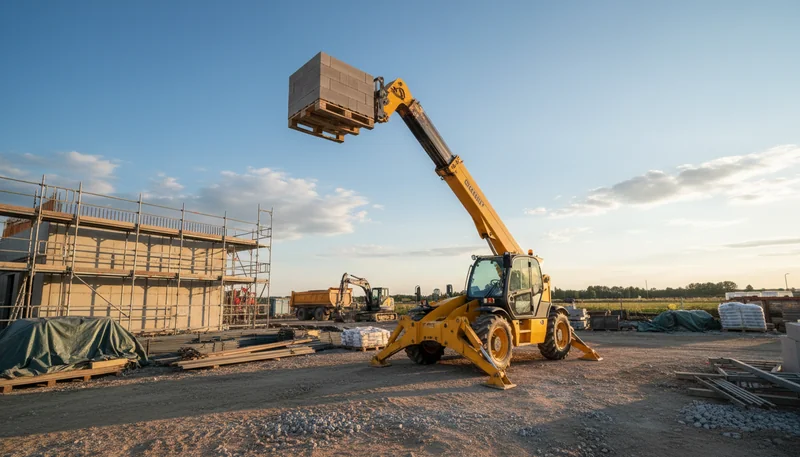
A site manager in Poland once sent me footage of a loaded telehandler tipping dangerously while placing bricks over a fence—classic front-wheel lift. His crew had followed the rated capacity, but missed how quickly things change when working at low boom angles1 and full extension.
Telehandler boom geometry critically influences machine stability across all working positions. As boom angle decreases toward horizontal, the load’s center of gravity2 shifts rapidly forward, increasing the risk of tipping despite the boom’s structural capacity. Stability is determined by the relationship between boom pivot height3, wheelbase, counterweight, and load radius at different angles and extensions. Low-boom, long-reach scenarios pose the highest risk, with even safe static loads becoming dangerous as the overturning moment4 escalates.
How does boom angle affect telehandler tipping?
Boom angle directly affects telehandler stability by changing the horizontal load radius relative to the front axle tipping line. As the boom angle approaches horizontal, the overturning moment rises quickly—even with the same load—so load charts typically show sharp derating as forward reach increases.
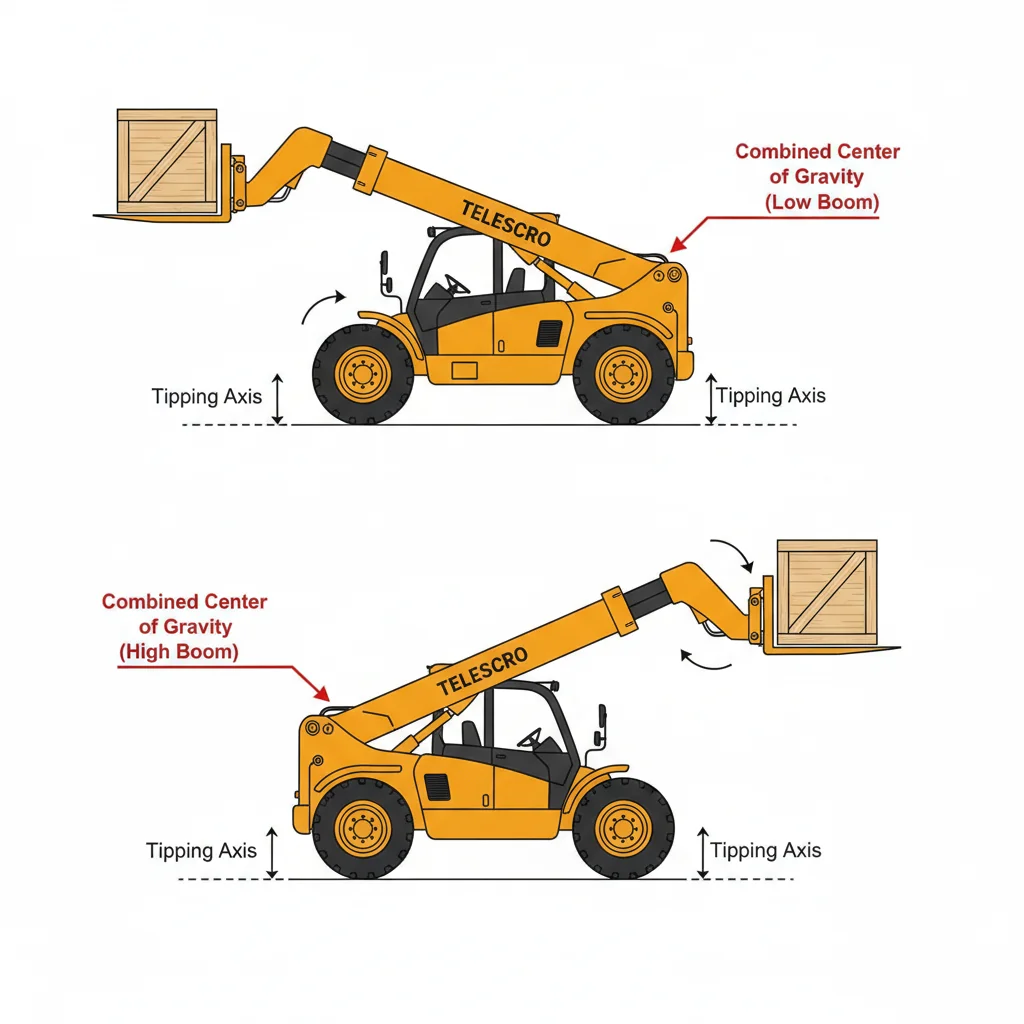
Most people don’t realize that boom angle, not just load weight, is what gets operators in trouble with telehandler tipping. The higher you raise the boom, the safer things usually feel, but as soon as you go low—say, below 15°—your margin for error drops fast. I’ve seen this firsthand in Dubai, where a customer insisted their 3,500 kg telehandler could handle lifting a 2,000 kg pallet. At minimum boom angle, the load was simply too far forward. Their machine started to tip, even though the boom was nowhere near its max length.
Let me share something important about how stability really works on these machines. For forward stability, the critical tipping line is at the front wheels’ ground contact line—once the combined center of gravity moves past that line, the machine will tip forward.
More of the load ends up acting like a lever, working against your stability. The same 2-ton load that feels solid at 60° can put you on the edge at 10°, even if your hydraulic circuit isn’t breaking a sweat.
Contractors in Kazakhstan often ask me why the load chart derates capacity so aggressively at shallow boom angles. The answer is straightforward: at low angles and longer forward reach, forward stability—not boom strength—becomes the limiting factor. Load chart values are based on the machine operating on firm, level ground with the specified load center. Once you work flatter or reach farther out, the load’s horizontal radius grows quickly and the combined center of gravity moves closer to the front wheels’ tipping line.
That’s why I always check the load chart at the actual boom angle, reach, and attachment/load-center I plan to use before committing to a lift. It’s the simplest way to avoid surprises on site.
Lowering the boom to a shallow angle, especially below 15°, significantly reduces telehandler stability even if the load is within the rated weight limit.True
At low boom angles, the load's center of gravity moves further away from the front axle, increasing tipping risk regardless of whether the load is within capacity. This effect is due to the leverage created by the horizontal extension of the boom.
A telehandler is always more stable with the boom fully retracted, regardless of the angle at which the boom is positioned.False
While retracting the boom generally improves stability, if the boom is at a low angle, the horizontal distance from the load to the front axle can still create significant tipping forces, making boom angle just as critical to safe operation as the boom's extension.
Key takeaway: Telehandler rated capacity declines steeply as boom angle lowers and reach increases—not because the boom loses structural strength, but because forward stability becomes the limiting factor. Always consult the load chart for safe capacity at specific boom angles and reach distances, especially near horizontal positions.
Why is low-angle long-reach work risky?
At low boom angles (0–25°) with long reach, a telehandler’s rated capacity drops rapidly because the horizontal reach from the front axle to the load increases, amplifying the overturning moment. This position—typical when loading trucks, reaching over obstacles, or trench work—creates the most demanding stability scenario, even with modest loads.

Let me share something important about low-angle, long-reach work—this is where I see even experienced operators run into trouble. At boom angles between 0 and 25 degrees, every additional meter of extension increases the horizontal distance from the front tire edge (the true tipping axis) to the load center. That increase in radius rapidly multiplies the overturning moment, even when the load itself seems relatively light.
On a project I supported in Ecuador, a crew was unloading brick packs into a drainage trench behind a 2.5-meter-wide retaining wall. On paper, their telehandler was rated at 4,000 kg, and at first glance the load chart appeared to cover the task. But at the required low boom angle and maximum forward reach, the charted safe capacity dropped to just over 1,300 kg. That gap between the headline rating and the usable capacity caught the operators off guard—and it’s a scenario I see repeatedly on trench, truck, and over-the-wall work.
This is why low-angle, long-reach lifts demand extra attention: stability erodes far faster than most operators expect, long before you reach the machine’s structural or hydraulic limits.
The biggest mistake I see is choosing a machine based purely on max lift height or headline rated capacity. Stability in the low-angle, long-reach zone is the real challenge. The moment you push the boom out straight to load a high-walled truck or reach over a barrier, the stability envelope shrinks fast. Rainy conditions or a slight slope can make things worse. From my experience, some models add frame leveling or beefier counterweights, but not all telehandlers in the same tonnage class perform equally here. You need the load chart specific to your work—especially the 0–25° boom range—before deciding.
If you’re doing frequent truck loading or trench placement, prioritize stability and working capacity at forward reach. I suggest reviewing the load chart for reach at tire-edge to load center, not just vertical lift. That’s usually where jobsite reality tests the machine—and where I see the most callbacks for upgrade advice.
At low boom angles, increasing reach moves the load center much farther from the telehandler’s tipping axis, greatly reducing stability even if the load weight itself stays the same.True
As the boom extends horizontally at a low angle, the load’s distance from the front wheels—the machine’s tipping point—increases. This longer radius amplifies tipping forces, and small increases in horizontal reach at these angles have a much bigger destabilizing effect than similar movements at steeper boom angles.
Low-angle long-reach work is safer because the telehandler’s boom remains closer to the ground, which lowers the center of gravity and reduces tipping risk.False
While a low boom may seem more stable due to its proximity to the ground, the real risk comes from the horizontal extension. At low angles, the distance from the tipping axis to the load grows rapidly, making the machine more prone to tipping despite any perceived stability from a low center of gravity.
Key takeaway: Telehandlers operating at low boom angles with long reach experience the greatest reduction in stability and rated capacity. When selecting equipment for frequent long-reach or over-the-side tasks, prioritize models with strong stability and load chart performance in the 0–25° boom angle range.
How does mid-angle boom geometry affect stability?
In telehandlers, mid-angle boom geometry (20–45°) strongly influences stability and rated capacity. Small variations in boom pivot location or extension pattern can shift the center of gravity forward by significant margins, reducing the stability envelope and load chart capacity5—often by 30% or more between models with identical tonnage ratings.

Here’s what matters most when looking at mid-angle boom geometry: this is the zone—20 to 45 degrees—where most daily lifting actually happens on a real jobsite. It’s not the flat-out reach for rooftop HVAC or the retracted boom you see in the showroom. Instead, you’re lifting blocks up to a second floor, or placing pallets onto a mixer. I’ve seen this firsthand in Kazakhstan: two teams using 3.5-ton, 13-meter telehandlers thought they bought nearly identical machines. But on-site, both units set their booms at around 35 degrees to slide material inside a warehouse. One handled loads above 1.2 tons at 7 meters reach. The other could only manage around 900 kg—same “tonnage class,” but a huge difference where the work actually gets done.
The reason for this? Small changes in boom pivot location, chassis shape, or extension pattern can move the load’s center of gravity forward by 20–30 cm at mid-angle. That shifts the tipping axis dangerously close to the front axle—shrinking the safety margin. When I train new operators, I stress: never judge stability by just the rated capacity. Always look at the load chart for 30 to 45 degrees—those numbers decide whether a pallet makes it to the fourth row safely or not.
So, my advice is simple. Before signing the order, ask the dealer for the full load chart, not just the maximum figures. Compare the models at mid-angle, where your crews will spend most of their day. Tonnage alone isn’t enough—the real capacity comes down to geometry and physics at these working positions.
Mid-angle boom geometry often exposes differences in stability between telehandlers that appear identical on paper, because frame and axle design affect weight distribution most in this range.True
At middle boom angles (approximately 20 to 45 degrees), the load's center of gravity shifts in ways that amplify minor design differences in frame, axles, and counterweight configuration—making stability vary between similar models.
Telehandlers are always as stable at mid-angle boom positions as they are with the boom fully retracted.False
Stability typically decreases at mid-angle boom positions compared to a fully retracted boom, because the load's leverage over the chassis increases as the boom extends away from the telehandler's core, placing more demand on the machine's design.
Key takeaway: Mid-angle boom positions cover most real-world telehandler tasks. Machine-specific boom geometry and pivot placement are critical to stability and productivity, making direct load chart comparison at typical working angles essential. Tonnage class alone does not predict safe or effective telehandler capacity for routine jobs.
How do boom pivot height and wheelbase affect?
Telehandler stability is governed by the combined effects of boom pivot height, wheelbase length6, counterweight distribution, and overall chassis geometry. A lower boom pivot generally helps keep the machine’s center of gravity lower and closer to the wheelbase, improving stability as the boom is raised. Higher boom pivot designs can improve visibility and attachment clearance, but often rely more heavily on wheelbase length and counterweight to maintain adequate stability margins. These design trade-offs influence both lifting confidence and maneuverability on real jobsites.
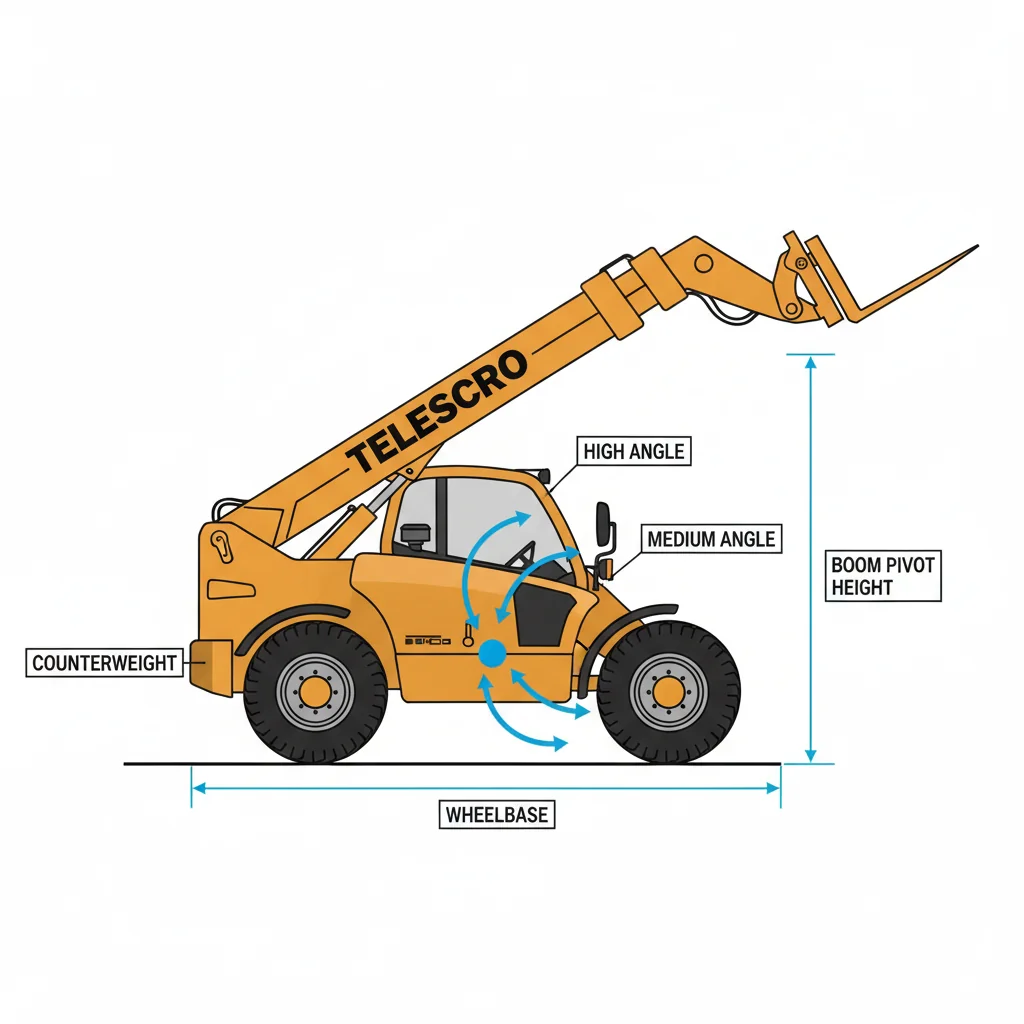
The biggest mistake I see is choosing a telehandler just by capacity and height, without considering how boom pivot height and wheelbase interact on real jobsites. I had a customer in Dubai last year—he picked a high-pivot, short wheelbase model for a high-rise project, thinking better visibility would make life easier. Once they started moving gypsum bundles to a tenth-floor slab, the machine felt nervous every time the boom hit 30 degrees with a 1,800 kg load. That “floating” sensation? It comes from the center of gravity sitting higher and further forward, which eats into the stability margin, especially when the boom is raised but not fully extended. A lower boom pivot—usually below the operator’s shoulder—keeps the center of gravity down and closer to the wheelbase center. This setup feels much more planted when working at 35 or 40 degrees of boom angle, even with heavy prefab loads. But there’s a trade-off: lower pivots can reduce your line of sight and make cab access tighter. That’s why engineers match boom pivot to a carefully chosen wheelbase. Longer wheelbase, paired with the right counterweight, can stretch the stability triangle forward, giving you more room to work safely at mid-reach. But I warn customers: a longer wheelbase does mean larger turning circles. On crowded sites like in Hong Kong, this definitely matters. If you’re test-driving, load up to 80% of rated capacity at mid-reach—say, around 10 meters with a standard fork. Lift to about 35 degrees and steer slowly.
A telehandler with a higher boom pivot point can experience increased forward instability at moderate boom angles, especially when combined with a shorter wheelbase.True
A high boom pivot elevates the load's center of gravity as the boom is raised, and a short wheelbase reduces the machine's overall stability, leading to a greater tendency for the telehandler to tip forward during load handling.
A telehandler’s wheelbase length has no influence on its tendency to feel unstable or 'floaty' when lifting heavy loads to elevated positions.False
Wheelbase length is a key factor in overall stability. A short wheelbase reduces the distance between the front and rear axles, diminishing the telehandler’s resistance to tipping and increasing the sensation of instability, especially when handling loads at height.
Key takeaway: Boom pivot height, wheelbase, and counterweight choices form the core of a telehandler’s stability architecture. Lower boom pivots and well-matched wheelbases generally deliver more predictable handling, while high pivot designs or short wheelbases can reduce the stability margin, especially at low to mid boom angles.
How Does Boom Extension Impact Stability?
Each additional metre of telehandler boom extension increases the overturning lever arm and boom slenderness, reducing the effective buckling load7 and increasing deflection. The highest tipping risk occurs at full extension and low boom angles. Extension sequence also influences stability—designs that keep inner boom sections nested longer generally maintain better stability margins.

To be honest, the spec that actually matters is how a telehandler’s stability changes with every metre of boom extension. Most buyers see the max rated capacity and think it applies at all reaches—but that’s almost never true. What happens mechanically is simple: as the boom extends, your load moves farther from the tipping axis (the line through the front tires). That increases the overturning moment dramatically. The boom itself also becomes longer and more slender, so it’s more likely to flex or even buckle under heavy loads.
I’ve worked with a customer in Kazakhstan who ordered a 4-ton, 17-meter telehandler for lifting masonry blocks to the ninth floor. On paper, the supplier promised more than 1,000 kg at full extension. But on site, they realized that at a low boom angle with the boom fully out, the safe capacity dropped to around 500 kg. The operator found the rear wheels started lifting off the ground long before they hit that limit—it’s a classic tipping scenario. Why? With the inner boom sections fully extended, there’s far less steel nested together, and the whole structure is both weaker and more top-heavy.
Not every machine handles extension the same way. Some models extend the inner sections first, keeping more of the boom’s weight and strength close to the chassis for longer. Others run the smallest section out earliest, so stability and capacity drop much faster. When you’re comparing telehandlers, I suggest tracking how fast the load chart curve falls as you extend past 70% reach. That’s where the real work happens—and where the biggest stability risks appear.
When a telehandler's boom is extended at a low angle, the risk of forward tipping increases significantly, even if the load is below the machine’s maximum rated capacity.True
As the boom extends at a lower angle, the load’s horizontal distance from the tipping axis (front tires) increases, resulting in a larger overturning moment. This means the center of gravity shifts forward, making the telehandler more prone to tipping—even with loads under the max capacity, which is only valid when the boom is retracted and/or steeply elevated.
The stability of a telehandler remains constant regardless of how far the boom is extended, as long as the weight of the load does not change.False
Stability is not just a function of load weight but also load placement. Extending the boom moves the load farther from the machine’s center of gravity and tipping axis, which greatly increases the tendency to overturn, even if the load itself doesn’t get heavier.
Key takeaway: Telehandler stability drops sharply as the boom is extended, especially at low angles, due to increased overturning leverage and structural slenderness. Comparing extension patterns is critical—models that keep inner boom sections nested longer maintain superior stability and usable capacity through the working envelope.
How Does Boom Geometry Affect Stability?
Boom geometry impacts telehandler stability by influencing stiffness, hinge behavior8, and deflection under load. Robust boom-to-chassis hinges, large base sections, and quality welds minimize flex and nonlinear tip movement—especially at long reach and heavy loads—reducing instability and unexpected ‘whip’ during driving, braking, or slewing.
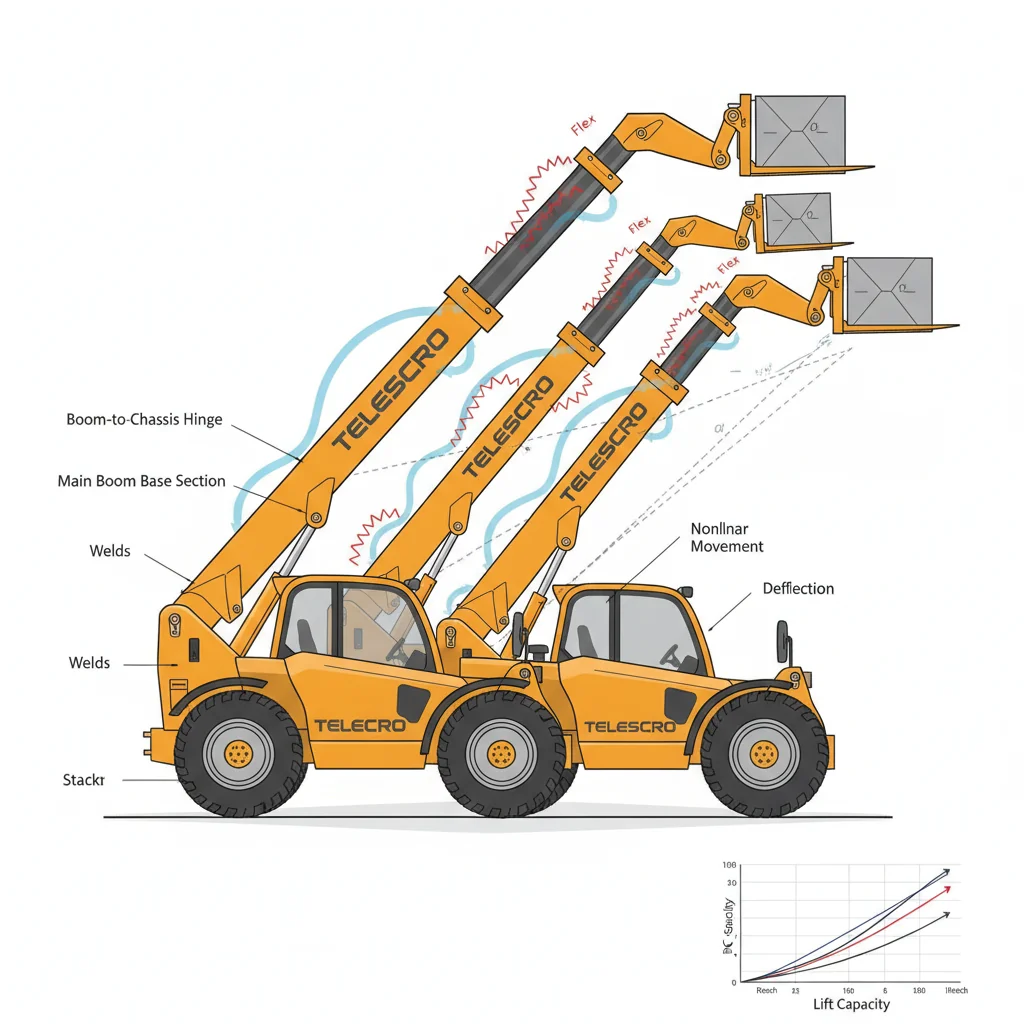
I’ve worked with customers in Kazakhstan who assumed that a longer boom automatically meant better stability. The reality is, the details of boom geometry—like how stiff the boom is, and how robust the hinges are at the base—matter just as much as the length or lifting angle. Honestly, I’ve seen two telehandlers in the same 4-ton class perform very differently on site, just because one had heavier base castings and much larger hinge pins. That extra structural support kept the boom “true” during heavy lifts. The other machine flexed so much at 75% reach that the operators felt the load tip moving unpredictably, especially when slewing or braking.
What’s really happening? When you lift a load out at maximum reach—say, a 1,000 kg pallet at 12 meters—the entire boom structure acts like a lever. If the boom or its hinge joints have too much flex, even small movements at the base amplify out at the tip. On a jobsite in Dubai, an operator told me it felt like the load had a mind of its own when they drove with the boom raised. That “whip” isn’t just discomfort—it eats up your working margin and increases the risk of accidents. That’s why I always look for telehandlers with solid boom-to-chassis hinge blocks, wide base boom sections, and minimal visible deflection under load.
I suggest checking for these features during any inspection—especially if you’ll be working at long reach. A stiffer, well-supported boom allows operators to place loads more accurately and with greater confidence, making the worksite safer and more efficient.
Telehandlers with stiffer booms and larger base hinge pins can maintain higher stability at steep boom angles compared to machines with less robust boom assemblies, even if overall boom length is identical.True
Stiffness and robust hinges reduce flexing and unwanted movement, especially at steep boom angles, which helps keep the load closer to the intended arc and center of gravity, increasing stability regardless of boom length.
A telehandler with a longer boom will always be more stable at maximum extension than one with a shorter boom, assuming both have the same lifting class.False
Longer booms actually increase leverage and can reduce stability at full extension unless additional structural and counterbalance measures are in place; length alone does not guarantee better stability.
Key takeaway: Telehandler stability depends on more than just boom length or angle. Stiffness and hinge design are critical—well-supported booms with solid base structures and large-diameter hinge pins help maintain geometry and control unwanted movement, allowing safer, more precise load placement at maximum reach.
How Do Attachments Affect Telehandler Stability?
Attachments such as carriages, quick-couplers, and specialized tools alter telehandler boom geometry by shifting the load centre forward. Even a 200–300 mm increase in load-centre offset can significantly raise the overturning moment at height—particularly beyond 10 m. Always reference the attachment’s weight, centre-of-gravity offset9, and OEM-approved load chart for that configuration.
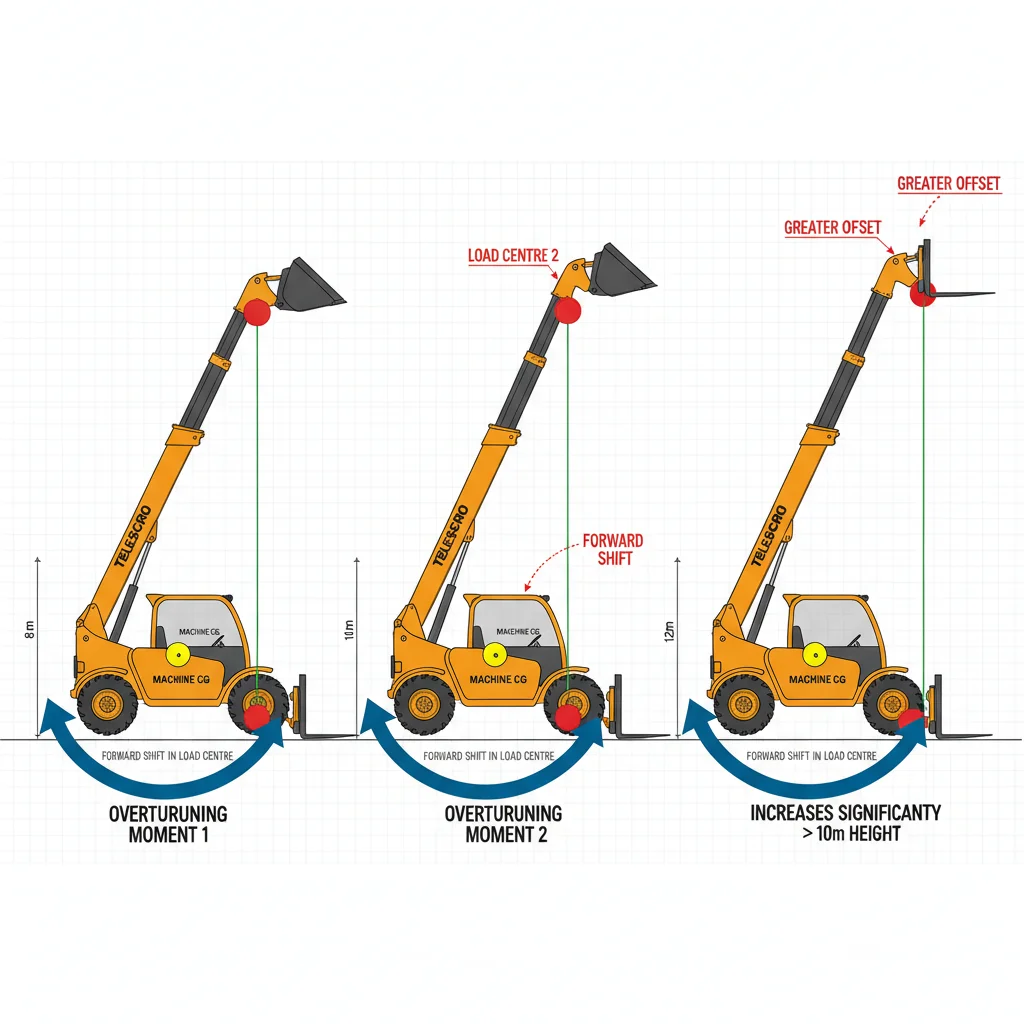
A lot of the confusion about telehandler stability comes from what happens after an attachment is installed. I’ve seen this firsthand with customers in Dubai who switched from a standard fork carriage to a long-material platform without reassessing weight and load-centre position.
On paper, their 4-ton telehandler appeared to have sufficient margin to place steel beams at around 12 meters. In reality, the additional forward offset—roughly 250 mm introduced by the attachment—reduced the allowable capacity at that height by well over 30%, pushing the machine outside its safe working envelope.
This happens because attachments effectively become an extension of the boom. The forward tipping axis is defined by the front axle contact points, not the boom nose. When a heavier carriage or work platform is added, you are not just increasing mass—you are moving the combined load centre farther away from the front tires, which increases the overturning moment at height.
Even a relatively small 200 mm forward shift, combined with a high boom angle at 10–15 meters, can materially reduce stability margins—often more than operators expect if they are relying only on the base machine rating.
- Attachment weight – Extra mass reduces rated capacity at every boom position.
- Load-centre (CG) offset – Small forward shifts have a disproportionate impact at height.
- OEM compatibility – Only use attachments listed for the machine, with matching load charts.
- Application fit – Wide platforms or clamps may require a higher-stability machine class.
Using attachments that increase the forward offset on a telehandler boom, such as a long-material platform, can significantly reduce the machine’s lifting capacity at higher boom angles, even if the rated load appears safe at ground level.True
This is true because extending the load further from the pivot point increases the overturning moment, making the telehandler less stable even when the base-rated capacity seems adequate. The effect is more pronounced at greater boom angles and extensions.
The type of attachment used on a telehandler only affects the functionality of the machine, not its stability, as long as the attachment weight is within the recommended limits.False
This is false because attachments can shift the center of gravity and change the load's effective position, which can compromise stability even if the attachment’s weight itself falls within guidelines. Functional differences are just one aspect; stability is also heavily impacted by weight distribution and offset.
Key takeaway: Small forward offsets from heavy or extended attachments can greatly reduce telehandler stability—especially at high boom angles. Always account for attachment weight and centre-of-gravity shift when picking both telehandler and attachment, and use OEM load charts for each specific configuration.
How does rear axle locking impact stability?
Rear axle locking directly affects telehandler stability by determining when the oscillating rear axle10 transitions to a fixed state. If the lock engages after the boom moves the load forward, the centre of gravity may approach the tipping axis, causing momentary instability. Proper lock timing ensures predictable, safe transitions during lifting.
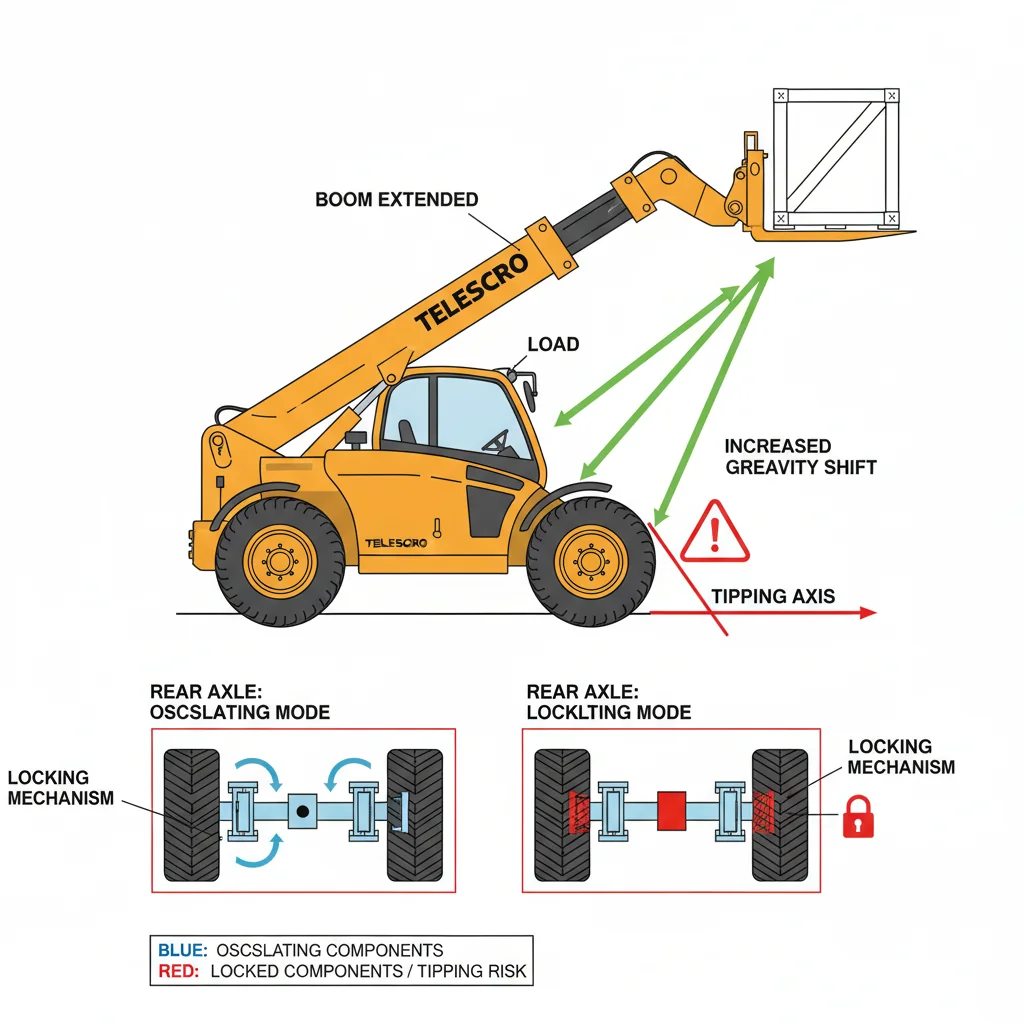
To really understand how rear axle locking impacts stability, picture a telehandler on uneven ground—say, a muddy site in Malaysia where contractors move bricks to the second floor. Most telehandlers need the rear axle to oscillate for better traction, but this comes at a price. While that axle is still moving, the whole stability triangle floats—there’s no solid anchor at the back. When you start lifting a heavy pallet and the boom moves forward, the machine’s centre of gravity shifts toward the tipping axis, which runs along the front wheels. If the axle lock doesn’t engage fast enough, there’s a few seconds where things feel “loose.” I’ve seen operators in Kenya pause halfway up because the machine starts to rock just as the load hangs over the edge.
What really matters is the moment that rear axle stops oscillating and locks itself. On most units, the hydraulic circuit triggers the lock when the boom reaches a certain angle or height, but the timing can vary by manufacturer. I always tell my customers to test the timing themselves. Take a realistic load—maybe a full pallet of tiles, around 1,000 kg—and raise the boom from ground level to mid-reach. If you notice any sudden shift or “snap” as the lock comes on, that’s a signal. A smooth and early transition is much safer.
You want the centre of gravity firmly inside the stability envelope before the boom reaches its furthest point. Operators and site managers should always check where that lock happens—not just by reading the manual, but by feeling the transition under a real load.
Locking the rear axle stabilizes the telehandler by preventing oscillation, which helps maintain a fixed stability triangle during high or extended boom lifts.True
When the rear axle is locked, the points of contact with the ground become fixed, ensuring the triangle of stability does not shift. This is especially critical when the boom is extended forward or raised, as the machine’s center of gravity can move outside the triangle if the rear axle remains free to oscillate.
Locking the rear axle always improves traction on uneven or muddy ground.False
While axle locking improves stability during lifting, it actually reduces the axle’s ability to adapt to uneven terrain. This can decrease traction because the wheels may lose constant ground contact, making the telehandler less effective at navigating rough or slippery worksites.
Key takeaway: The timing of the rear axle lock, relative to boom movement and load position, is critical for telehandler stability. Operators and evaluators should test machines for smooth, early axle locking that maintains the centre of gravity within the stability envelope before the boom reaches critical reach or height positions.
How Does Boom Geometry Affect Stability (Continued)?
As telehandler boom length and angle11 increase, the machine acts like a long, flexible cantilever. This amplifies sensitivity to lateral wind and dynamic forces, especially at high reaches. Lateral loads at the boom tip create substantial bending and torsion at the base, leading manufacturers to derate capacities in these positions.

Last month, a contractor in Uruguay asked why the load swayed so badly whenever their 17-meter telehandler reached above 14 meters in strong wind. At first, they blamed the operator. The real problem? High boom angle and long extension make the whole structure act like a giant cantilever. Every small gust or sideways nudge at the boom tip gets massively amplified at the base. This isn’t just a theory—on some sites, I’ve watched loads swing nearly 30 cm left and right, even though operators barely touched the controls.
From my experience, the biggest risks start as soon as you get into that upper third of the working envelope, especially with platform or panel attachments. Lateral wind forces12, even those below 12 km/h, start pushing against the load more than most crews expect. That’s because at full stretch, the moment arm from load to tipping axis is at its maximum. I’ve seen telehandlers with impressive “on paper” capacity lose nearly 70% of their rated capacity above 15 meters on the load chart. That’s why most manufacturers add warnings or even lock out certain angles if wind picks up.
The reality is, high reach work isn’t just about lift height. If you’re on a coastal site or anywhere with unpredictable wind, I always recommend choosing a model with a stiffer boom and a responsive moment indicator. Slower boom movements and a load chart buffer of at least 20% above your heaviest expected load help reduce instability risks. Whenever loads get big or reach gets long, those small details make the difference.
A telehandler’s stability decreases noticeably when the boom is both highly elevated and fully extended, due to increased leverage amplifying any movement or gusts at the tip.True
As the boom extends and elevates, it acts more like a cantilever beam, increasing leverage on the base and making small disturbances much larger, which compromises overall stability, especially in windy conditions.
Boom geometry has minimal effect on lateral stability as long as the outriggers are deployed, regardless of extension or angle.False
Even with outriggers deployed, high boom angles and long extensions significantly increase lateral instability because the load acts further from the base, magnifying the impact of side forces such as wind or sudden motions.
Key takeaway: Longer, higher booms dramatically increase sensitivity to side loads from wind and dynamic movements. Always factor in extra safety margins and choose stiffer booms or better damping when operating at high angles or in wind-prone environments to prevent critical stability mistakes.
How Does Boom Geometry Impact Wear Costs?
Aggressive telehandler boom kinematics13 increase component wear by forcing hydraulic systems to generate higher peak pressures, especially at low boom angles. This accelerates fatigue on pins, bushings, cylinder seals, and slides—critical wear points during ground-level pick-and-place. Geometry that spreads lift forces evenly can significantly reduce maintenance intervals and lifecycle costs over years of heavy-duty operation.
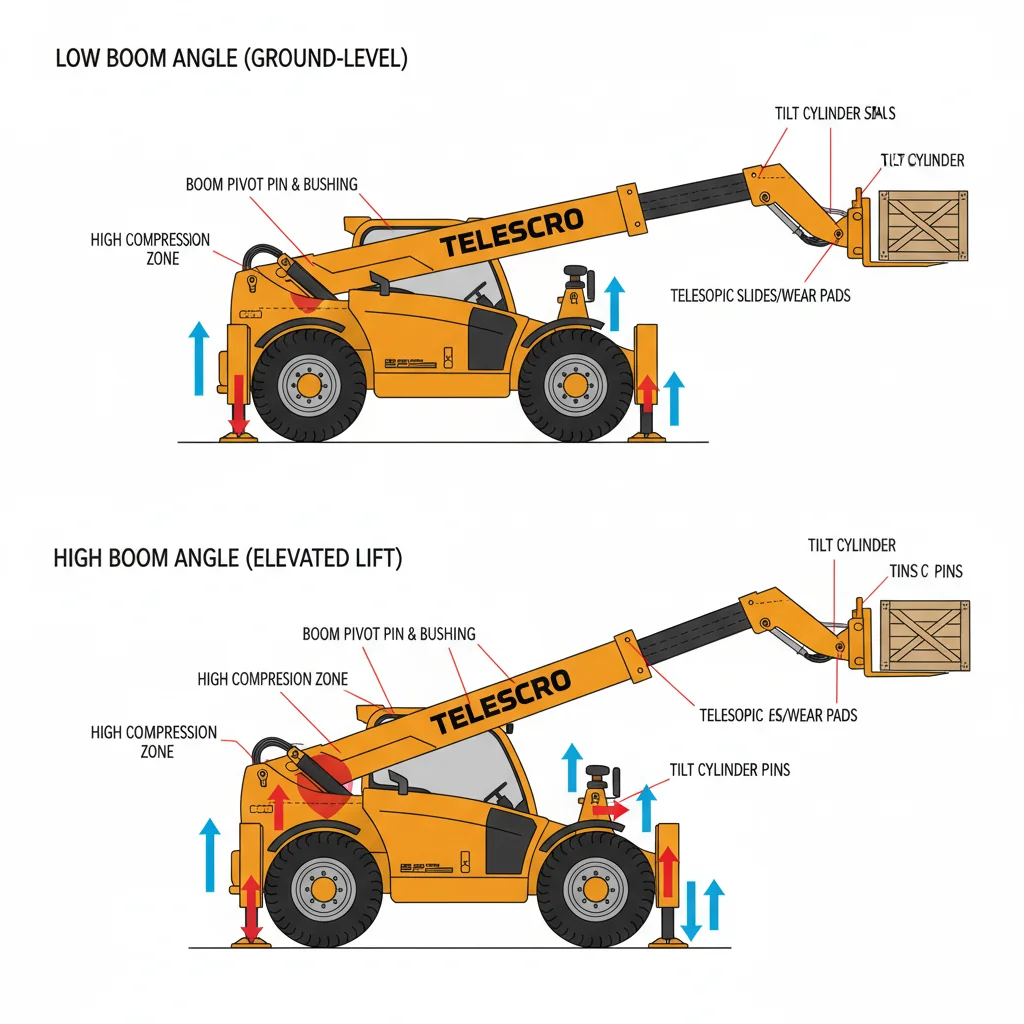
Let me share something important about telehandler wear that often gets missed: boom geometry isn’t just engineering—it’s a maintenance cost driver. In the field, I’ve seen two 4-ton telehandlers with nearly the same lift charts, but after two years, their repair bills looked totally different. The main reason? One machine had a boom setup that forced its hydraulic cylinders to work extra hard below 30 degrees. Every time that contractor in Romania lifted heavy loads off the ground, the pressure spikes hammered the pins and bushings. By month 18, the play in the boom was so bad they needed a major overhaul. The other machine, with a more balanced boom path, kept running smooth after 2,500 hours.
From my experience, most ground pick-and-place jobs mean you’re spending nearly half your cycles with the boom at low angles—exactly where aggressive kinematics hurt you. The pivot geometry14 decides whether those forces focus onto a couple of pins or get shared more evenly along the structure. I always tell customers in Kenya and Dubai: ask how thick the main hinge pins are, and check if the boom slides use treated bronze or cheap polymer. Some models cut material costs here, and you’ll pay later when slides start sticking or seals blow out early.
If your projects involve frequent heavy picking near ground level, I suggest asking your dealer for hydraulic pressure data across the boom range, not just at max lift. Designs that spread forces throughout the stroke—and use quality pins or bushings—can save you weeks of downtime and thousands in repairs over five years.
Telehandlers with booms designed for a low starting angle can increase cylinder wear because hydraulic pressure spikes when lifting heavy loads close to the ground.True
When a boom is configured to operate at a low angle, especially under heavy load, the force required from the hydraulic cylinders rises sharply. This leads to more stress and wear on those components compared to machines that distribute lifting forces more evenly throughout the boom’s range of motion.
Boom geometry has little effect on stability or wear, since telehandlers are engineered to distribute force evenly at all angles.False
Boom geometry plays a critical role in both stability and wear. The angle and position of the boom determine how load forces are applied to the frame and hydraulic system. Engineering cannot perfectly equalize force at all operational angles; some boom geometries inherently subject components to higher concentrations of stress, especially at low or extended angles.
Key takeaway: Telehandler boom geometry directly affects wear costs by concentrating high forces at low angles, driving premature wear on key components. Designs that distribute forces more evenly and use robust materials can extend service life and minimize maintenance, even between units with similar specifications.
How to Compare Telehandler Boom Geometry?
To compare telehandler boom geometries, analyze full load charts15 by zone—0–20°, 20–40°, and max height—matching each to typical site tasks. Field-check pivot position and boom overhang at full extension. Lift near-rated loads to observe stability cut-outs and boom flex, revealing real-world performance differences beyond headline figures.
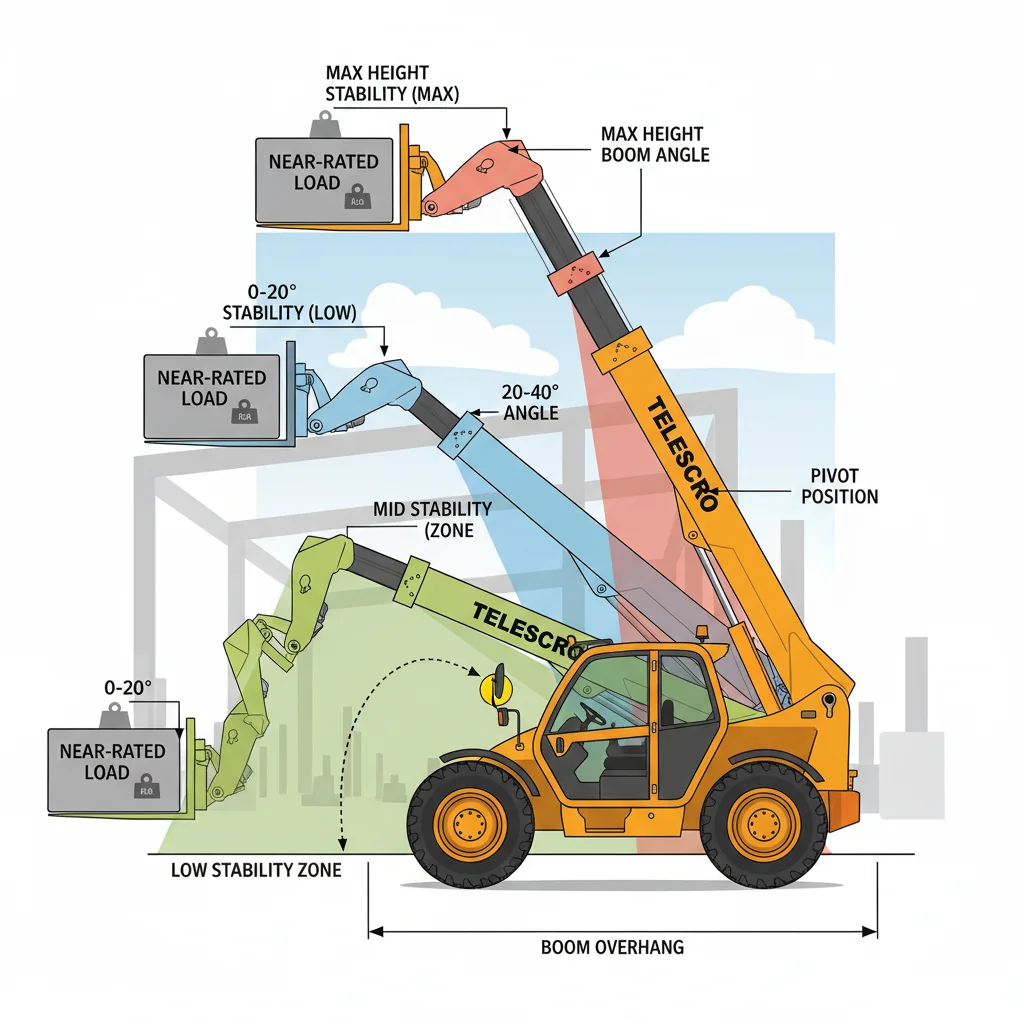
I get lots of questions from buyers who compare telehandlers mostly by max capacity and height. The real value is in the details of boom geometry—where the load chart really shows what you can do at each angle. For example, in Kenya, I helped a team who needed to place blocks onto a floor slab at 8 meters. Their new 4-ton machine only managed about 1,600 kg there, not even 50% of its headline capacity. That’s why I always pull up the full load chart, not just the spec sheet. When you’re comparing machines, look at the load chart zones side by side. I suggest focusing on three working areas: low boom (0–20°, great for unloading trucks), mid-range (20–40°, your bread and butter for stacking), and max height (where stability can fall off fast).
A good rule? Machines that keep 50–60% of base capacity at your main working position usually feel much safer and more productive on real sites.
Here’s a simple table I use to compare boom geometry in practice:
| Boom Zone | Typical Task | Capacity (kg) | % of Base Load | Notes on Stability |
|---|---|---|---|---|
| 0–20° (Low) | Truck unloading | 2,000–2,800 | 55–70% | Generally stable; watch boom flex |
| 20–40° (Mid) | Stacking pallets | 1,500–2,200 | 40–60% | Primary working zone on most jobsites |
| Max height | Top lift / placement | 900–1,200 | 25–35% | Least stable; cut-outs likely |
A telehandler's maximum rated capacity is only achievable when the boom is fully retracted and positioned at a specific low angle, rather than extended.True
This is true because the load capacity of a telehandler decreases substantially as the boom is extended and raised due to increased leverage and decreased stability. The load chart details how capacity changes at different boom angles and extensions, highlighting that published maximum capacities are only valid under certain, limited configurations.
If two telehandlers have the same maximum lift height, they will perform identically when placing loads at all those heights, regardless of boom geometry differences.False
This is false because boom geometry—including articulation points and extension design—varies between models, which directly affects stability and load capacity at different heights and reaches. Two machines with the same maximum height can have drastically different safe loading limits when extended horizontally or working at intermediate boom angles.
Key takeaway: Comparing telehandlers requires both detailed load chart analysis for key working positions and field checks of boom design and extension stability. Simple on-site observations—pivot height, overhang, and real load extension—expose critical stability differences that specification sheets alone will not reveal.
Conclusion
We just looked at how boom angle and reach impact your telehandler’s real-world lifting capacity—not the structural strength, but forward stability is the main concern. From my experience, I see “showroom hero, jobsite zero” mistakes when folks only check max capacity and ignore the load chart at low boom angles. Before picking a model, I suggest you grab the load chart and check your most common working positions, especially at longer reaches. If you want help interpreting those numbers or choosing for your site, just reach out—I’m happy to share what’s worked for similar crews in other countries. The right choice really depends on your actual jobs, not the headline specs.
References
-
Explores how low boom angles reduce telehandler stability by increasing overturning moments, vital for safe operation understanding. ↩
-
Understand the critical role of center of gravity shifts in telehandler tipping to prevent accidents and improve load handling safety. ↩
-
Explores how varying boom pivot heights influence the center of gravity and stability, vital for safe telehandler operation on complex jobsites. ↩
-
Details the mechanics of overturning moment and its critical role in telehandler tipping risks during low-angle long-reach tasks. ↩
-
Understand the critical role of load charts in telehandler safety, showing how small geometry changes drastically alter safe lifting limits. ↩
-
Provides insights on how wheelbase length balances stability with maneuverability, essential for optimizing telehandler performance in tight workspaces. ↩
-
Comprehensive explanation of buckling load limits and how boom slenderness influences telehandler structural integrity under stress. ↩
-
Detailed insights into how hinge robustness and flex affect telehandler boom movement and overall machine stability under load. ↩
-
Understand how centre-of-gravity shifts with attachments affect telehandler performance and stability using OEM load chart data. ↩
-
Comprehensive explanation of oscillating rear axles’ role in uneven terrain traction and how it impacts telehandler stability. ↩
-
Explains how boom geometry impacts machine stability and load capacity, vital for safe operation at high reaches. ↩
-
Details how wind impacts load sway and capacity loss, helping operators understand site safety and equipment limits. ↩
-
Explore how boom movement patterns increase hydraulic pressure and accelerate wear on pins, seals, and bushings in telehandlers. ↩
-
Learn how balanced pivot geometry evenly distributes lift forces to extend component life and lower expensive repairs in telehandlers. ↩
-
Detailed guide on interpreting full load charts to assess telehandler capacity and stability at different boom angles for safer operations. ↩