










Telehandler Beginner Field Guide: What Operators Must Know to Avoid Costly Mistakes
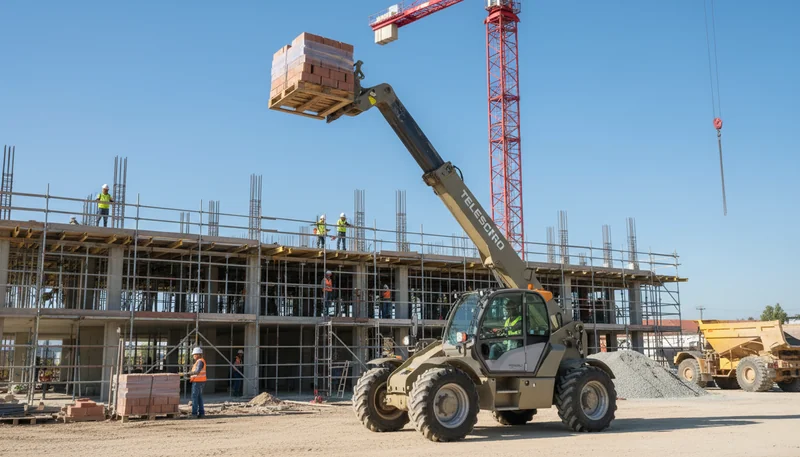
Earlier this year, I watched an eager operator in Vietnam confidently maneuver a brand-new telehandler—until he extended the boom for just one more meter and nearly tipped the whole machine. That close call wasn’t about skill; it was about not knowing the critical limits built into these remarkable but unforgiving machines.
A telehandler is a telescopic handler designed to lift, move, and position loads using a boom and a range of attachments. Its performance is defined by engineered limits—rated capacity, maximum height, and reach—shown on the load chart for a specific configuration. Operating beyond that envelope increases the risk of tip-over, structural damage, and costly downtime. Formal operator training and competent supervision—supported by correct load chart use and on-site hazard checks—are essential.
What Are Telehandler Limits and Uses?
A telehandler is a wheeled lifting machine with a telescopic boom, built for moving, lifting, and positioning loads using forks or attachments. Key specs—rated capacity, lift height, and horizontal reach—apply only under the conditions defined by the manufacturer (typically firm, level ground and the correct configuration). Exceeding these engineered limits increases the risk of tip-over, structural damage, and costly downtime.

Most people don’t realize that a telehandler’s headline figures—such as a 3,500 kg rated capacity or a 13-meter lift height—only apply under the manufacturer’s stated conditions, with the correct attachment and the machine on firm, level ground. I’ve seen customers in Dubai assume their telehandler could carry full load at maximum extension and then be surprised when the load chart1 showed a much lower allowable capacity for that boom position. As the boom extends, usable capacity can reduce sharply, which is where tip-over risk and mechanical stress increase.
Site supervisors quickly learn that stability systems and moment indicators are not theoretical features—on sloped or unstable ground, they activate frequently because the machine is operating close to its engineered limits.
Here’s what a telehandler actually does best:
- Lifting and positioning palletized goods (like bricks, blocks, or prefab panels) to upper floors or hard-to-reach spots
- Placing steel beams, pipes, or formwork across rough ground where normal forklifts can’t go
- Handling non-standard and oversized loads—for example, moving wire coils or irregular bundles in industrial yards
- Supporting maintenance or installation jobs—especially when fitted with work platforms or buckets for quick access
But there are limits you can’t ignore. Telehandlers aren’t designed for high-speed travel, earthmoving, or doing a crane’s job on heavy long components. Every lifting number on the load chart depends on boom extension, angle, and whether stabilizers are deployed—the safe range shrinks as you go higher or further out. Before letting any operator work alone, I always have them show me the machine’s rating plate and explain its load chart positions. I suggest you do the same—it’s the difference between safe lifting and a jobsite shutdown.
A telehandler's maximum rated lifting capacity applies only when the boom is fully retracted and the machine is on firm, level ground.True
Manufacturers determine the rated capacity based on optimal conditions: boom fully retracted, correct attachment, and machine sitting level. As the boom extends or the ground becomes uneven, the actual safe lifting capacity decreases significantly.
A telehandler can safely lift its maximum rated load at any boom angle and extension, regardless of terrain.False
Telehandler load capacity decreases as the boom extends or raises, and uneven or unstable ground further reduces safe limits. Ignoring these factors can lead to tip-overs and safety hazards.
Key takeaway: Telehandlers are not substitutes for cranes or earthmovers and have strict, manufacturer-rated limits for lifting and reach. Rated capacity, lift height, and reach numbers apply only on level, stable surfaces and in specific configurations—a critical safety and cost-control concept for all new operators.
Why is operator certification mandatory for telehandlers?
Formal operator training and documented competence are required by many employers and regulators before operating a telehandler, but the exact rules vary by region. In the U.S., OSHA requires employers to train and evaluate powered industrial truck operators (commonly applied to telehandlers used as rough-terrain forklifts). In the U.K. and parts of Europe, site access often depends on recognized competence schemes (e.g., CPCS/NPORS) and employer verification. Proper training ensures competence with model-specific controls, safety systems, load chart usage2, and local compliance—reducing accidents caused by inexperience.
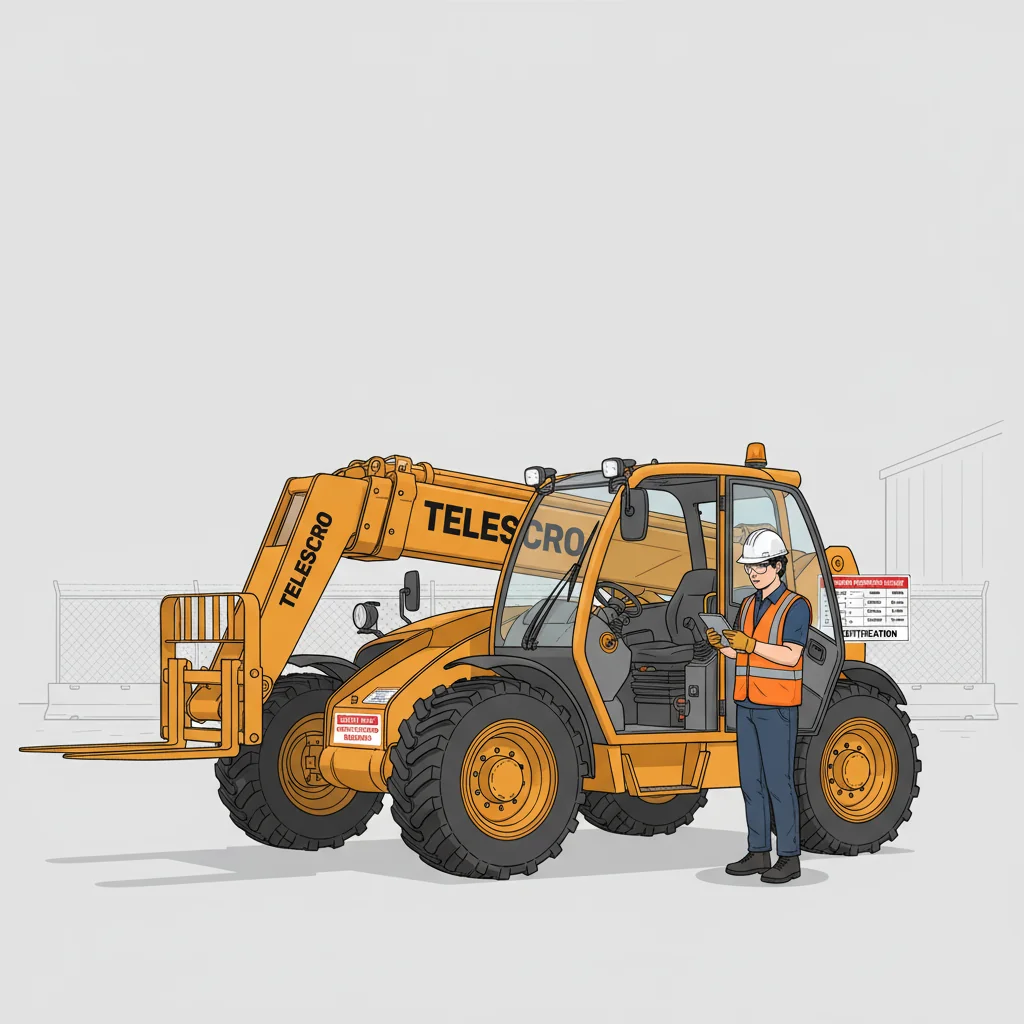
Let me share something important about operator certification—this isn’t just a paperwork exercise. Certification for telehandler operators is mandatory because these machines can be dangerous in the wrong hands. I often hear from site managers in places like Dubai and Singapore who assume new hires can “pick it up on the job.” That mindset leads to accidents. Telehandlers aren’t forklifts—they have long, extendable booms and, depending on configuration, might be rated for over 4,000 kg at 10 meters or even higher. Without certified training, there’s a real risk someone will misread the load chart or ignore stability rules, especially when attachments like work platforms or buckets are involved.
The biggest mistake I see is underestimating how complex telehandler operation gets under pressure. Last year, a project in Kenya needed to pick and place loads on uneven ground. Their new operator—no formal training—overextended at a low boom angle, nearly tipping the machine.
Why? He glanced at the wrong part of the load chart. In most countries, legal requirements mean the operator must hold a relevant certificate, whether that’s OSHA-driven employer certification (U.S.), a recognized plant competence card scheme (e.g., CPCS/NPORS in the U.K.), or another locally accepted qualification and employer assessment process. Supervisors also need to check which certificates or records must be kept on-site and what extra requirements apply—using man baskets often has separate rules and inspections.
From my experience, certified training covers hands-on exercises—lifting at maximum reach, maneuvering around tight obstacles, and managing communication using hand signals or radio. I always recommend a controlled assessment before letting new staff operate near live construction or production. It’s not about ticking boxes. It’s about sending everyone home safe each night.
"TelehandlerFalse
"Telehandlers
Anyone with a standard forklift license is automatically certified to operate telehandlers on construction sites.False
Telehandlers require different skills and an understanding of unique hazards compared to standard forklifts—especially due to their extendable booms and increased tipping risks. Most regulations mandate specific certification for telehandlers, regardless of prior forklift qualifications.
Key takeaway: Formal training and operator certification are not optional for telehandlers; they are essential for legal compliance and workplace safety. Certification guarantees that operators understand the precise requirements for safe operation, reducing accident risks and ensuring both regulatory and site-specific documentation standards are met.
How to read a telehandler load chart?
A telehandler load chart is the authoritative safety guide showing rated capacity at specific boom angles, extensions, and with the exact attachment fitted. Operators must identify the correct chart, find the current boom configuration, and treat the charted capacity as an absolute limit. Exceeding these values risks tip-over and severe equipment damage.
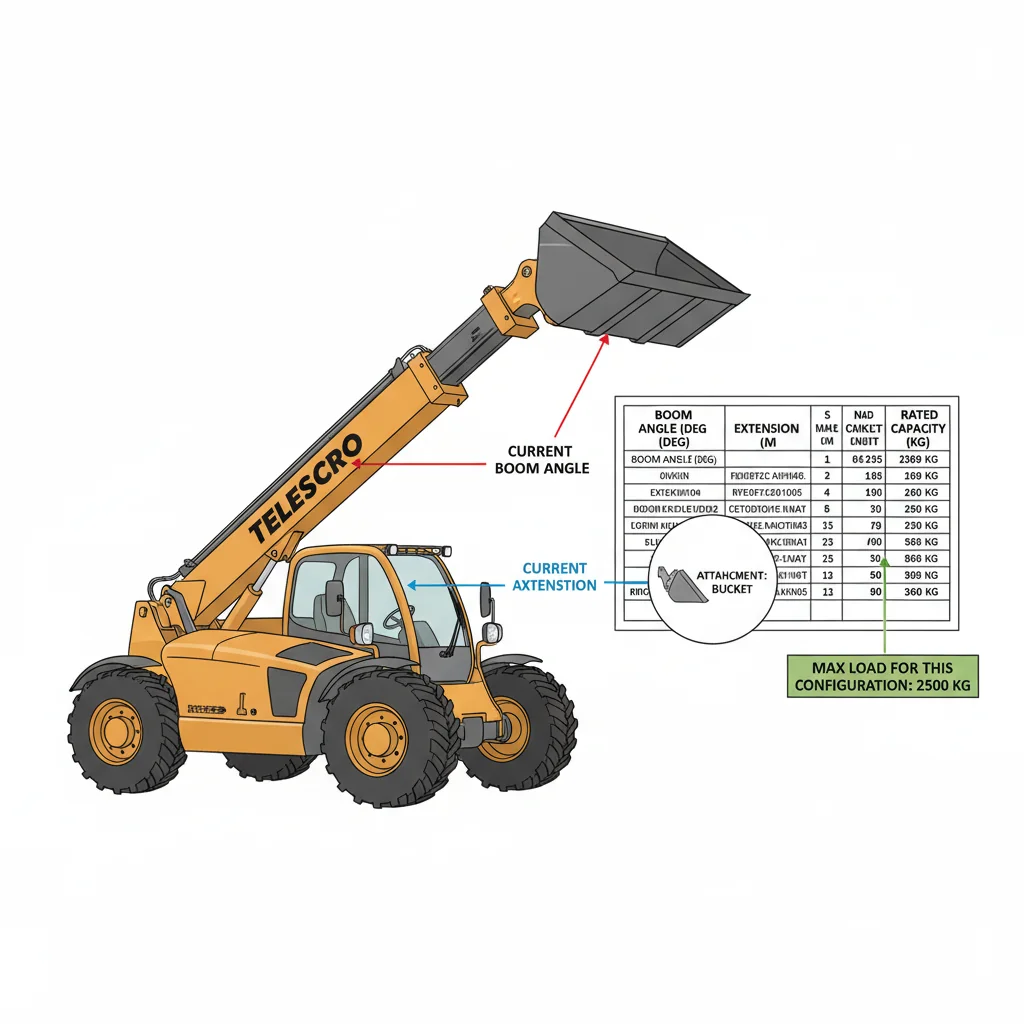
The biggest mistake I see is people assuming the telehandler’s “rated capacity” is constant, no matter how the boom is positioned. In reality, that number is only valid at the shortest boom, lowest height, and with the right attachment. I’ve worked with several crews in Dubai who ran into trouble because they ignored these details. For example, a contractor there asked why their 3.5-ton telehandler tipped alarmingly when lifting just 1.5 tons at full extension. When I checked, their boom was out past 12 meters and angled up—according to the load chart, safe capacity in that exact spot was barely 1.2 tons. They hadn’t matched their setup to the right chart and paid the price.
Here’s what matters most when reading a load chart. First, identify the chart for the specific attachment fitted—forks, buckets, jibs, and work platforms all have different ratings. Second, determine your current boom height and extension. Most load charts are presented as grids, showing allowable capacity at different boom angles and reaches. If you’re unsure of the exact position, use the telehandler’s indicators or verify manually.
Remember, the listed capacity is not a guideline—it is the maximum permitted load for that exact configuration under the manufacturer’s stated conditions, which typically assume the machine is stationary on firm, level ground. If the telehandler is not properly leveled or the ground is unstable, the charted capacity may no longer apply, and the risk of instability or tip-over increases significantly.
I always suggest practicing load chart drills with new operators. Pick any boom position, find it on the chart, and verify the capacity. If you’re ever unsure, play it safe and reduce the load. That’s the habit that prevents accidents and protects your machine investment.
A telehandler's maximum lifting capacity decreases significantly as the boom extends further and the lifting height increases.True
This is true because the load chart accounts for stability and leverage; as the boom extends or raises, the machine becomes less stable, requiring a reduction in load to prevent tipping.
The rated capacity listed on the side of a telehandler applies at any boom extension or height, as long as the machine is on level ground.False
This is false because the rated capacity is only valid for specific configurations, typically with the boom retracted and low. The load chart provides different capacities for different boom positions, and exceeding these limits can cause tipping even if the ground is level.
Key takeaway: Beginners must consult the correct load chart for the fitted attachment and machine configuration, and never guess load weights or capacities. The chart’s limits are absolute—ignoring them is the primary cause of accidents and costly equipment failures in telehandler operation.
How do ground conditions affect telehandler stability?
Telehandler stability relies on the machine maintaining its center of gravity inside the stability base formed by its wheels and, if equipped, stabilizers. Soft soil, trenches, voids, or steep/uneven terrain shrink this stability zone. Even within rated load chart limits, poor ground can cause a rollover or instability.
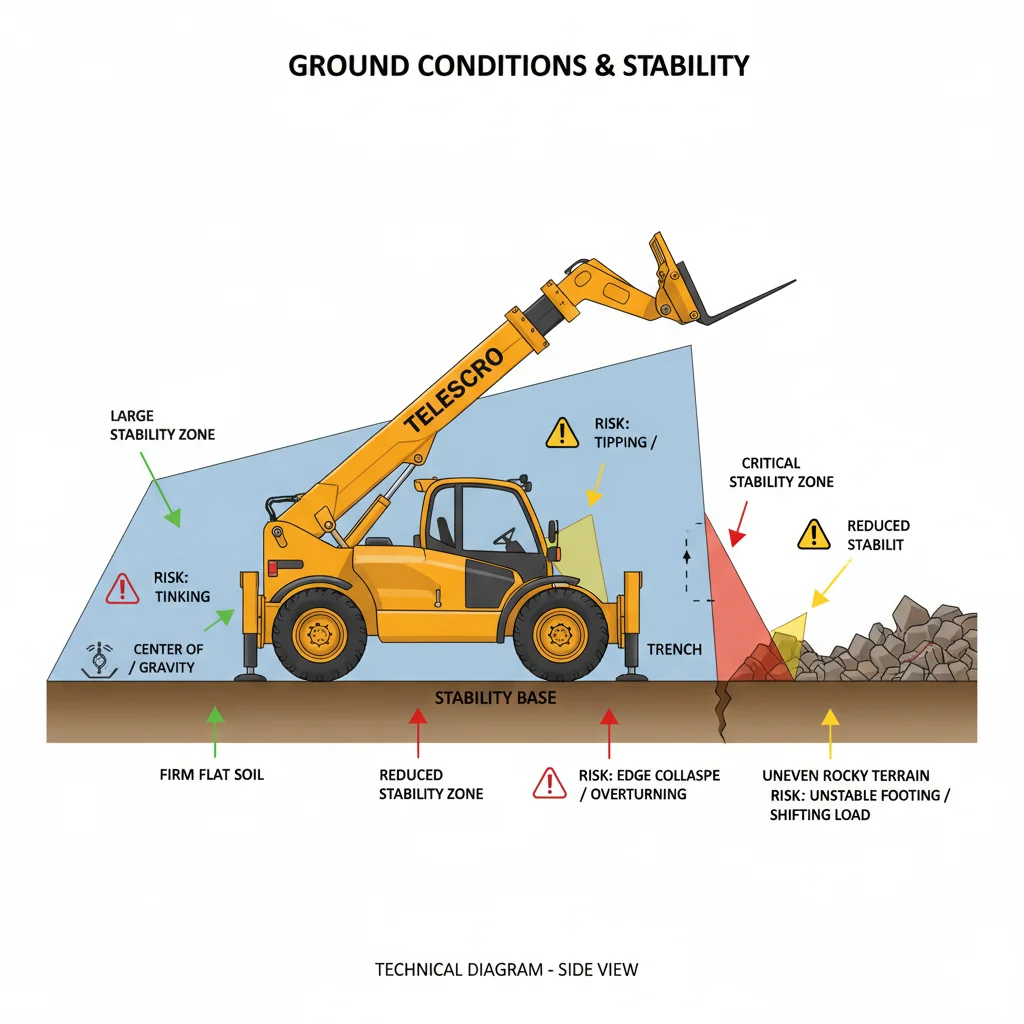
I’ve worked with customers from Dubai to Kazakhstan who overlooked ground conditions and paid the price. Just last month, a crew in southern China tried to operate a 4-ton telehandler near a newly backfilled trench. They checked the load chart—everything seemed safe. But once they started lifting, the front wheels began to sink nearly 10 centimeters, pushing the machine off level and triggering the stability alarm. They had to halt work, reposition, and reinforce the ground before safely finishing the job. Even when you stay within rated capacity, ground that isn’t firm or level changes everything instantly.
Here’s the thing: the moment your telehandler leaves firm, level ground, the assumptions behind the load chart may no longer hold. Most manufacturers base rated capacities on a stationary machine on solid, level ground, and soft soil, edges, voids, or backfilled areas can quickly change stability even when the chart looks “OK.”
Before any operation, I always suggest walking your planned path. Look for soft patches, hidden voids, manholes, or anything that could shift under load. Use built-in level indicators, and when possible, engage stabilizers or chassis leveling systems before lifting. If you’re unsure, lower your boom or relocate the lift. It only takes one bad patch of ground to put both operator and equipment at serious risk.
Uneven or soft ground can cause a telehandler's onboard load sensors to misread stability, leading to false alarms or unexpected machine behavior.True
Telehandlers rely on level ground for accurate sensor readings—when positioned on soft or sloping surfaces, the sensors may detect dangerous tilting even if the load is within chart limits, resulting in stability alarms or safety cutouts.
If a telehandler's outriggers are fully extended, ground conditions are no longer a critical factor for stability.False
Even with outriggers extended, poor ground conditions like soft soil or recently disturbed earth can cause sinking or instability. Outriggers increase stability, but only when placed on firm, stable ground capable of supporting the machine’s weight.
Key takeaway: Always inspect ground conditions—including soil firmness, voids, slopes, and edges—before operating a telehandler. Adhering strictly to manufacturer-prescribed level and stability requirements is essential, as load charts only apply to level, stable ground. Unstable surfaces immediately increase the risk of rollover and invalidate rated capacities.
How can telehandler beginners drive safely?
Safe telehandler operation requires adjusting the cab seat and mirrors for maximum visibility, securing the seatbelt, and maintaining three-point contact4 when entering or exiting. Drive with the boom low and slightly retracted, and keep the forks/load as low as practical (many training guides use roughly 15–30 cm as a rule of thumb, but always follow the operator manual for your model). Travel slowly, avoid sharp turns, and use a trained spotter when visibility is limited.

Here’s what matters most when you’re new to telehandler driving—visibility and load stability5. Telehandlers have serious blind spots, especially with the boom raised or a bulky load on the forks. Even a compact 2.5-ton model can hide a coworker standing just a few meters in front. That’s why I always stress: before you move an inch, adjust your seat and all mirrors so you can see as much as possible around the machine. Fasten your seatbelt, and use three points of contact climbing in and out. It sounds simple, but I’ve seen small falls turn into broken ankles because people skipped this step.
Last year, I trained a first-time operator in Kazakhstan on a mid-sized 3-ton, 12-meter telehandler. The number one issue? He tried driving with the boom too high and the forks nearly a meter off the ground—easy mistake when you’re worried about ground clearance. But the higher the boom, the less stable the machine becomes. I showed him how keeping the boom low and slightly retracted, with forks around 20 to 30 centimeters off the ground and tilted back, keeps the load stable. It also prevents tipping if you have to stop suddenly or hit uneven ground.
Travel speed is another trap for beginners. Most telehandler accidents I’ve seen happen at low speed on busy or rough sites, trying to make tight turns. In crowded areas or with blocked sight lines, I suggest using a trained spotter. Slow, steady, and always prioritizing visibility—that’s how you avoid expensive mistakes and keep the job moving safely.
A telehandler’s blind spots increase substantially as the boom elevates, making frequent mirror and seat adjustments essential for safe maneuvering.True
Raising the boom on a telehandler blocks more of the operator's line of sight, expanding blind spots. Regularly adjusting mirrors and seat position helps maximize visibility despite these changes.
It is safe for beginners to rely solely on their mirrors when reversing a telehandler with a raised boom.False
Mirrors alone do not provide complete coverage of a telehandler’s surroundings, especially with the boom raised. Blind spots can still hide people or objects, so direct observation and, when necessary, a spotter are recommended.
Key takeaway: Most beginner telehandler accidents occur at low speed during traveling or load handling. Operators should prioritize visibility, maintain a low boom and stable load position, avoid sudden movements, and use trained spotters in low-visibility or busy areas to prevent costly mistakes and accidents.
What Daily Telehandler Checks Prevent Failures?
Critical daily telehandler inspections include checking tire inflation6, hydraulic and fuel leaks, hose and cylinder condition, fork blade integrity, attachment security, and boom wear. Functional tests of lights, alarms, interlocks, and fluid levels are required. Proper end-of-shift shutdown—plus documentation—reduces failures and prolongs equipment lifespan.
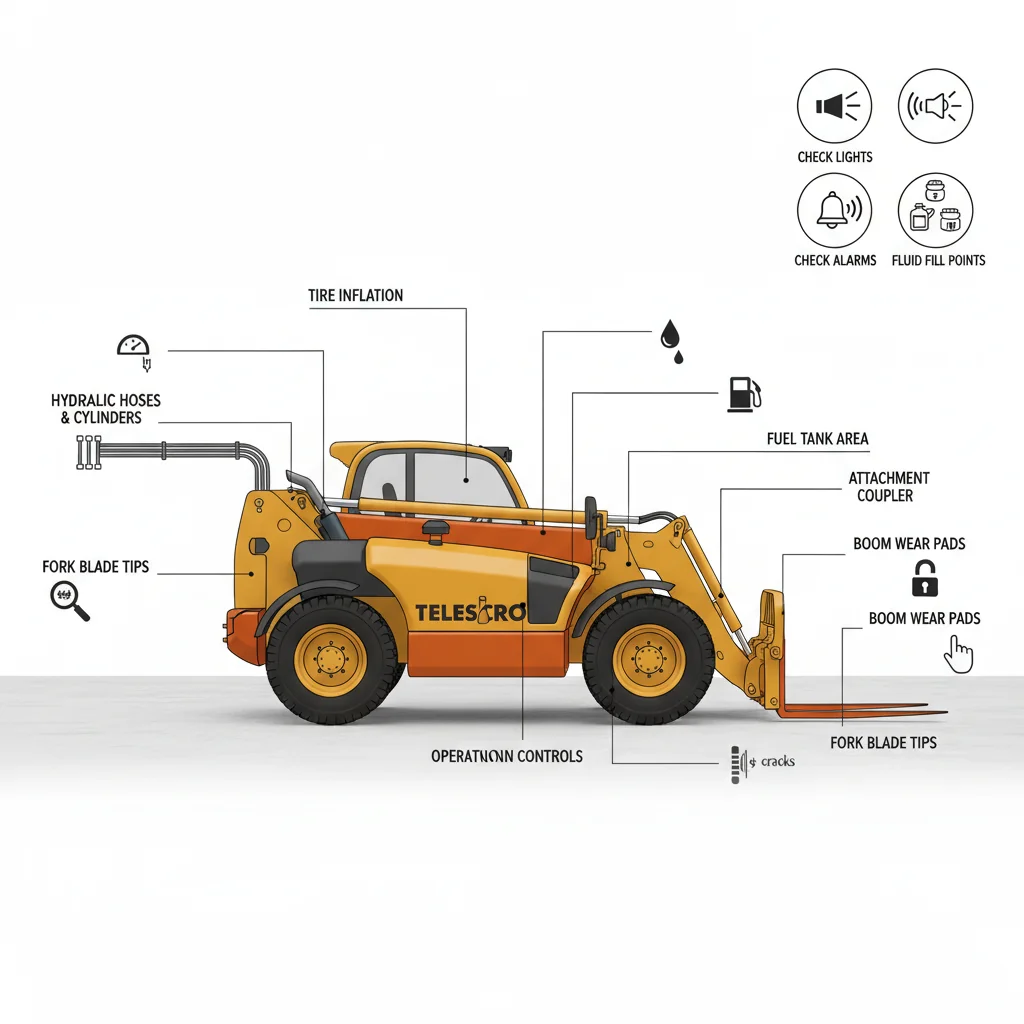
I’ve worked with customers who made the mistake of skipping daily checks—usually because they’re in a rush or think yesterday’s inspection is “good enough.” But that one missed walk-around can cost thousands. For example, a client in Kazakhstan ignored a slow hydraulic leak7. Within a week, a worn hose burst under load, leading to at least two days of downtime. That whole jobsite lost productivity. Five minutes every shift could have caught an oil drip before it turned into a major fault. Here’s what smart operators look at each morning: First, walk around and check that all four tires are properly inflated and free from sidewall cracks or debris. Next, scan the ground under the machine for fresh hydraulic or fuel leaks—dark spots or slick patches are a warning sign. Inspect each hydraulic hose and cylinder in the boom for bulges or abrasion. I always tell crews to examine the fork blades and heels closely—cracks or any visible bending need attention before lifting even one pallet. During a project in Brazil, a rental customer overlooked a loose quick-attach pin. With a heavy bucket, that cost them half a shift after the attachment shifted out of place. So, always confirm attachments are locked, pins are secure, and all safety interlocks work. Test the lights, alarms, and the moment indicator if your machine has one. Check engine oil, coolant, hydraulic fluid, and fuel—the basics, but easy to forget on busy sites.
Neglecting to check for even small hydraulic leaks during a pre-shift inspection can lead to catastrophic hose failures under pressure, as the wear worsens rapidly with use.True
Hydraulic systems operate under high pressure, and minor leaks often indicate internal hose degradation. Continued operation without repair accelerates wear, increasing the risk of sudden failure, which can lead to unplanned downtime and expensive repairs.
If the telehandler was operated without issues the previous day, it is safe to assume all fluid levels and parts remain adequate for the next shift.False
Fluid levels can drop due to small leaks, evaporation, or routine operation between shifts. Components like tires and hoses can degrade or develop faults overnight. Daily checks are critical because issues may arise at any time, not just when the equipment was operated previously.
Key takeaway: Diligent 5–10 minute daily telehandler checks and correct shutdown steps significantly reduce expensive failures, safety incidents, and downtime. Following the manufacturer’s inspection, lubrication, and service schedule maximizes longevity and productivity—protecting both operator safety and investment value over time.
How should telehandlers manage power lines?
Telehandlers must maintain minimum approach distances8 from overhead power lines based on local regulations and voltage, as electricity can arc without direct contact. Supervisors should map, mark, and enforce approach limits. For lifting people, only manufacturer-approved platforms9 are permitted—never improvised baskets or pallets—with all operations meeting equipment and regulatory safety requirements.
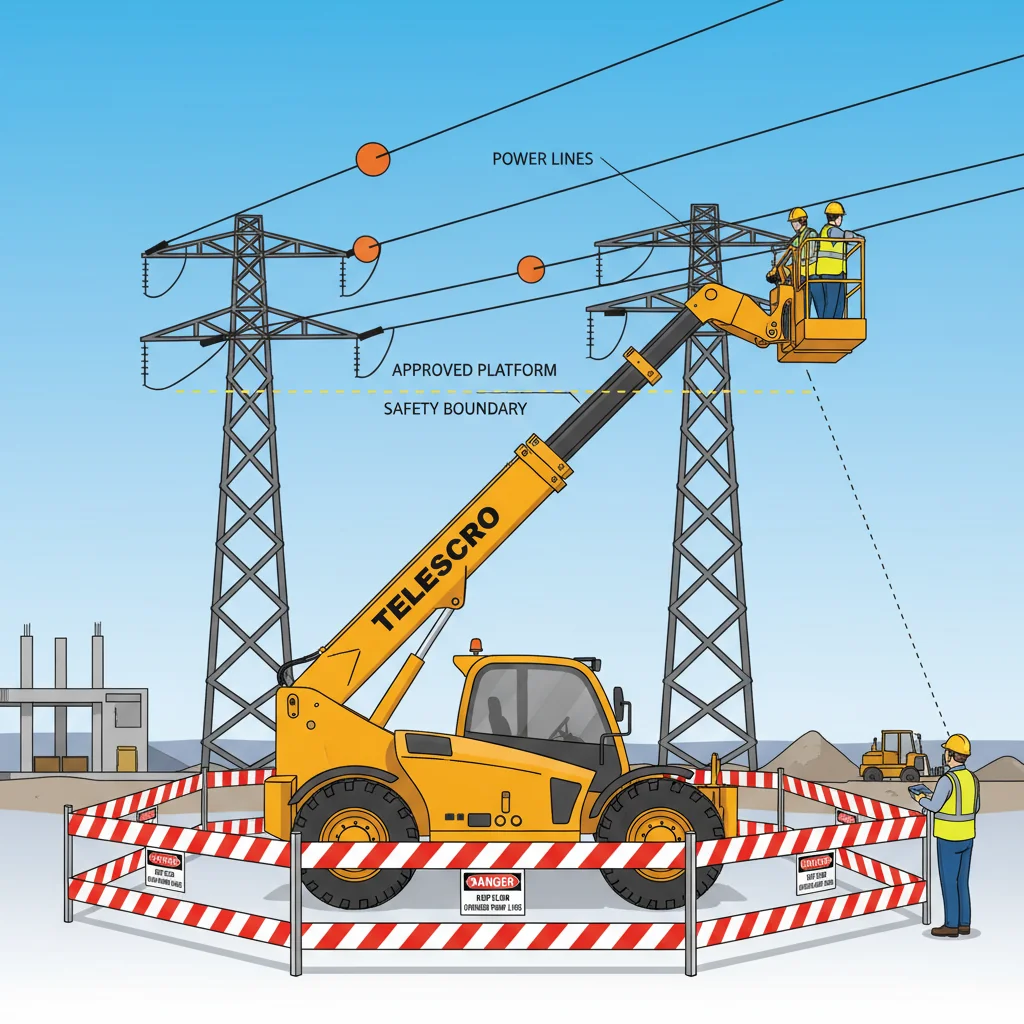
Last month, a contractor in Kazakhstan called me after a close call with a telehandler working near a 33 kV overhead line. His crew thought keeping a two-meter gap was enough, but electricity can arc much farther at that voltage. I explained that local rules required at least a three-meter minimum approach distance, and the supervisor needed to mark those limits clearly on site. Even experienced teams overlook that electricity doesn’t need direct contact—it can jump, especially if it’s humid or the boom is wet. Mapping all power lines and marking danger zones isn’t paperwork—it’s survival.
I’ve seen jobs where site managers tried to speed up facade installs by using pallets or makeshift baskets to lift workers. This is extremely dangerous and, to be direct, never acceptable. Only manufacturer-approved work platforms that are specially engineered and fixed directly to the telehandler boom are legal. These platforms often require stability monitoring—like a load moment indicator or tilt sensors—and every person aloft must be harnessed. Anything else puts lives at risk and breaks both equipment warranties and legal requirements.
Before starting any operation near power lines or considering personnel lifting, I always recommend three steps: check the local regulations for approach distances, inspect the telehandler’s approval paperwork (not just the sales brochure), and review your emergency response plan. If the machine or its load contacts a power line, stop work immediately and follow rescue protocols—never try to move the machine yourself. I suggest walking every site perimeter and making these danger zones visible to all operators. That’s what keeps everyone safe.
Electricity from high-voltage power lines can arc several meters to a telehandler even if the equipment never physically contacts the wire.True
High-voltage electricity can jump (arc) through the air, especially in humid or dusty conditions, so maintaining appropriate minimum approach distances is essential for safety.
Rubber tires completely protect a telehandler operator from electrical shock if the machine contacts an overhead power line.False
Rubber tires do not offer reliable electrical insulation at high voltages; electricity can travel through the ground or arc around the tires, so operators are still at risk even if tires are rubber.
Key takeaway: Risk of electrocution and fatal accidents is high near power lines or with improvised platforms. Operators must strictly use only manufacturer-approved equipment, respect regulatory minimum approach distances, and deploy clear emergency plans. Never use makeshift platforms or allow anyone to ride non-compliant attachments.
How do attachments affect telehandler capacity?
Telehandler attachments significantly alter rated capacity and machine behavior. Each attachment has its own weight and shifts the load center10, reducing usable lifting capacity. Operators must use the specific load chart for the chosen attachment, not the base machine chart, and only fit approved, compatible attachments to avoid safety and compliance risks.
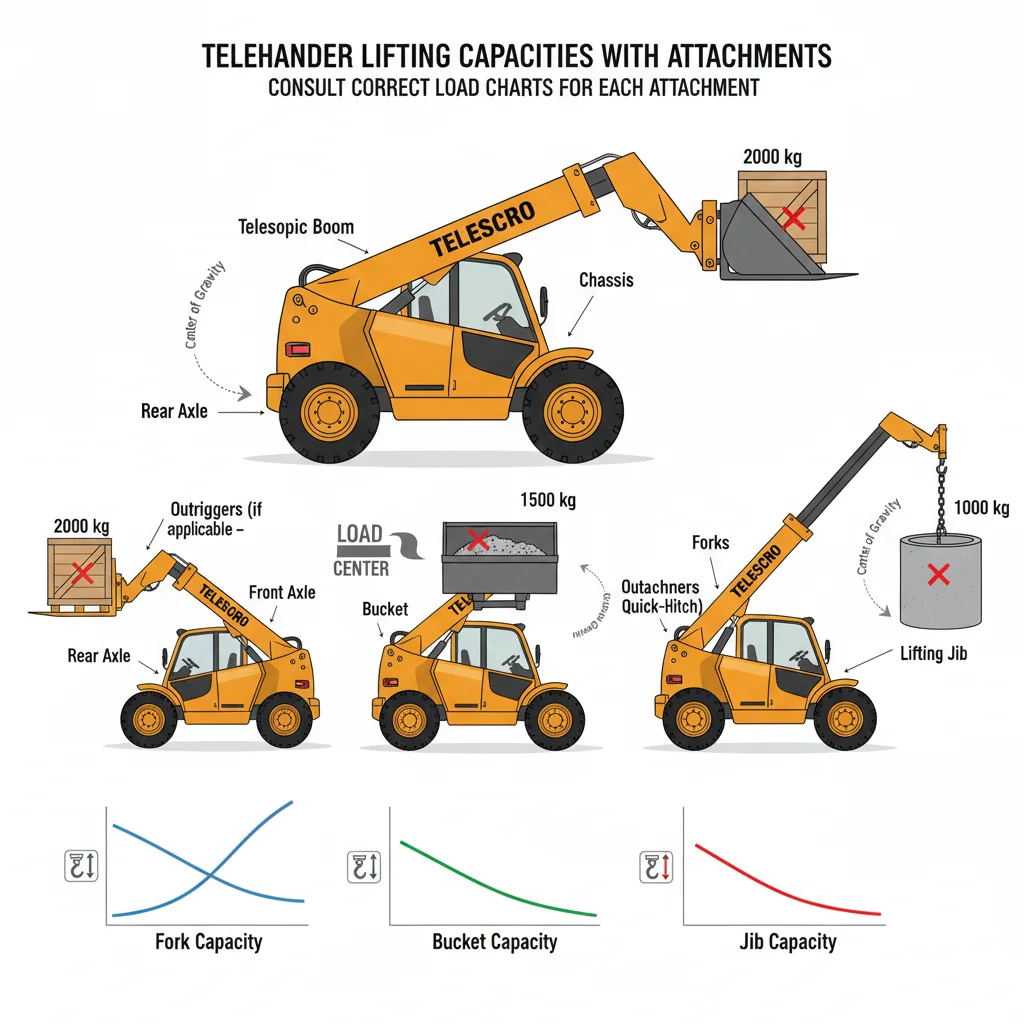
From my experience, the way a telehandler is configured can turn a straightforward lift into a safety problem. Attachments are not just accessories—they directly affect how much weight the machine can safely handle. I’ve seen cases where forks were swapped for a work platform without checking the attachment-specific load chart, resulting in a dramatic reduction in allowable capacity at reach. The risk in these situations is real and often underestimated.
Every attachment affects performance in two fundamental ways: it adds its own weight, and it shifts the load center forward. Both factors reduce the usable lifting capacity shown on the load chart. Typical impacts include:
- Forks: Standard forks are the reference point, but longer or heavier forks increase the load center and reduce usable capacity, especially at reach.
- Buckets: Generally heavier than forks, with shifting material loads; usable capacity is significantly reduced compared to fork operation and must be verified on the bucket-specific chart.
- Jib hooks and winches: Extend the effective load radius, which can substantially lower allowable capacity as boom extension increases.
- Man baskets / work platforms: Only manufacturer-approved platforms may be used, and permitted loads and travel functions are usually heavily restricted by the OEM load chart.
- Bale grabs / clamps: Attachment weight, bale size, and moisture content all matter; actual bale weight can vary widely and must be checked against the attachment rating and load chart.
I always remind supervisors and operators: never assume capacity based on the base machine rating. Each attachment has its own approved configuration and load chart for a reason.
Changing from standard forks to a specialized attachment like a jib or man basket can significantly lower a telehandler’s rated lifting capacity, even if the telehandler itself remains unchanged.True
Attachments often shift the load center farther from the machine and add their own weight, which reduces the safe lifting capacity according to manufacturer load charts.
Once an attachment is installed on a telehandler, the rated lifting capacity remains the same as with the original forks, as long as the load is properly balanced.False
This is incorrect because every attachment has its own load rating, weight, and changes the center of gravity, all of which can reduce the maximum allowable lift capacity compared to the standard forks.
Key takeaway: Every telehandler attachment changes lifting limits and stability by adding weight and altering the load center. Always reference the correct load chart for each attachment, and never use non-approved or makeshift tools. Proper attachment use is vital for safe, efficient operation and avoiding costly mistakes.
How should telehandler routes be planned?
Effective telehandler route and material staging planning11 involves designating fixed truck loading zones, maintaining clear, wide travel corridors, and separating pedestrian walkways with physical barriers or markings. Staging materials near, but not directly under, their end-use location reduces handling, minimizes unnecessary travel, and limits risky maneuvering around obstacles and personnel. Routes and exclusion zones should be reviewed daily.

The biggest mistake I see is treating telehandler routes like an afterthought—just moving wherever there’s room. That’s a fast way to create chaos on site. Every project, whether it’s a commercial build in Singapore or a farm in Australia, runs smoother when the telehandler’s pathway is set before the first delivery. Fixed loading and unloading zones make a huge difference. I worked with a team in Kenya who marked out their truck bay and telehandler lane using cones and tape—simple, but it kept trucks, machines, and people out of each other’s way. Their travel corridor was at least 4 meters wide, allowing safe passage even with materials onboard.
But planning the path isn’t enough if you ignore where materials are staged. I’ve seen jobsites where pallets are stacked right under scaffolding, forcing operators into tight, awkward turns. The smarter move is to position everything as close as possible to the work area without blocking trades or leaving loads directly underneath elevated work. On a housing site in Brazil, they used a 3-ton telehandler to pre-stage bricks at the ground floor corner of each building section. This cut unnecessary handling and halved the time the machine spent in congested spaces.
I always tell customers: use some kind of visual barrier—paint, tape, even fencing—to separate pedestrian walkways from equipment routes. And don’t set the plan once and forget it. As the site evolves, review and adjust your routes daily. One blocked lane or new stockpile can turn yesterday’s safe path into today’s hazard. That extra five minutes to check can prevent days of downtime.
Designating fixed telehandler routes reduces the likelihood of pedestrian-equipment collisions on busy construction sites.True
Defining clear pathways for telehandlers helps separate moving machinery from workers on foot, minimizing confusion and the chance of accidents in congested areas.
Telehandler routes should always be improvised based on the movement of other equipment during the day.False
Improvising telehandler routes increases the risk of congestion and accidents. Pre-planning routes ensures smoother logistics, safer operation, and helps maintain site organization.
Key takeaway: Organizing sites around a telehandler’s capabilities—with fixed routes, clear staging, and separated walkways—greatly improves safety and efficiency. Fewer trips reduce fuel costs, machine wear, and accident risks. Route planning must adapt daily as site conditions change to maintain these benefits.
How to select the right telehandler?
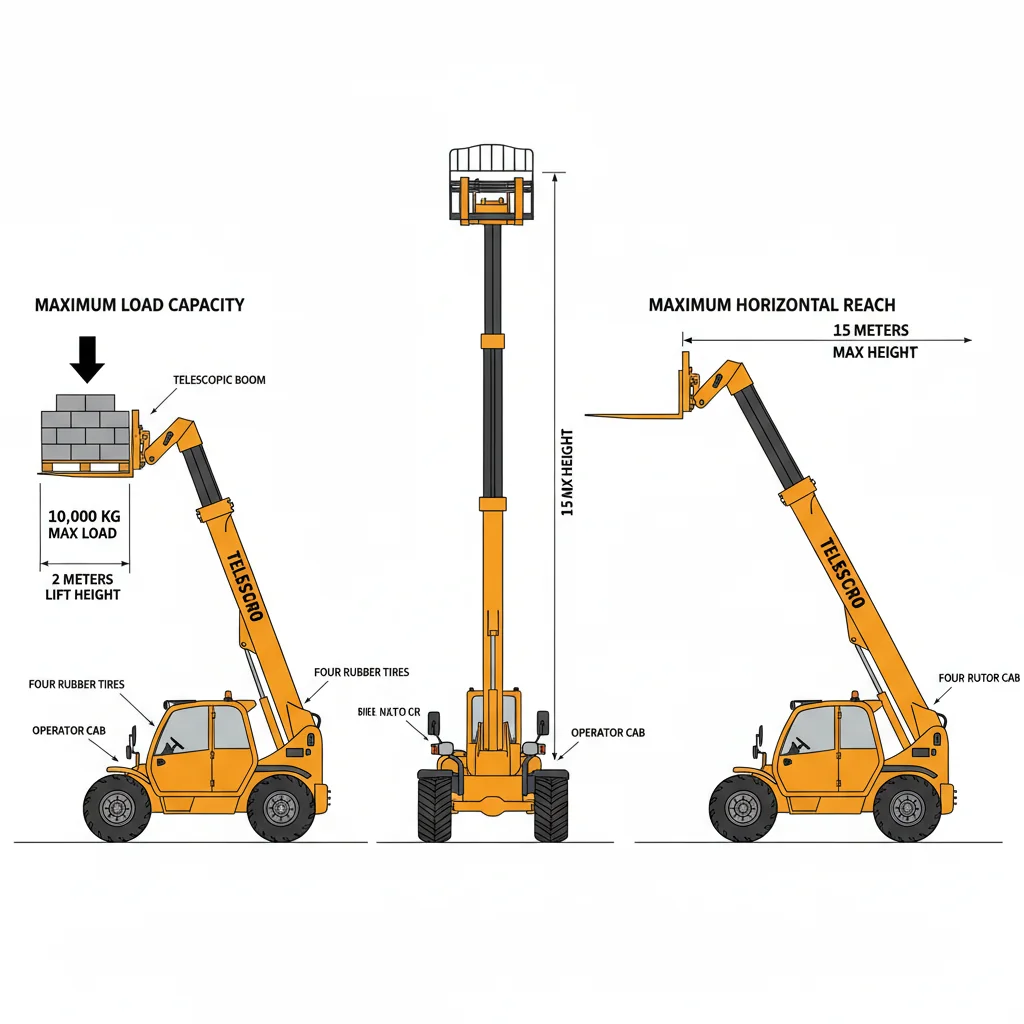
Selecting the right telehandler involves defining the heaviest regular load, maximum lift height, and maximum horizontal reach required for the job. Supervisors must consult the manufacturer’s load chart12, ensuring a 20–30% capacity margin13. Oversizing increases costs, while undersizing pressures operators to exceed rated capacity, risking safety and higher maintenance.
To be honest, the spec that actually matters is regular jobsite workload, not the one-off heaviest lift. I’ve seen buyers in Saudi Arabia select an 18-meter telehandler with 4-ton max capacity just because they had a single oversized pallet to unload once a month. For daily lifting, their loads rarely topped 2,500 kg. That “extra capacity” cost them more upfront, increased tire wear, and drove up fuel bills for no real gain. So, always start by listing your true daily loads, not exceptions.
I always suggest you define three numbers: your regular heaviest load (let’s say 2,000 to 3,000 kg), your top required lift height (for example, 10–12 meters), and your furthest reach (maybe 8 meters out). Then get the load chart—the chart shows what a telehandler can safely lift at each position. Never trust the marketing “max capacity” alone. The reality? A 4-ton telehandler might handle only 1,200 kg at full extension. You want at least a 20–30% safety cushion above your actual needs. That margin keeps operators comfortable and protects the hydraulic circuit from constant overload.
Last year in Brazil, a client tried to save money by renting a smaller 2,500 kg telehandler for stacking cement blocks six floors up—around 18 meters. They ended up overloading it and blowing a hydraulic pump. Downtime cost them at least two working days and hefty repair fees. I strongly recommend checking local parts support before choosing, especially if your jobsite is remote. The right machine isn’t always the most expensive—it’s the one that fits your real needs and can be serviced quickly when it counts.
Choosing a telehandler based on the most frequent daily loads, rather than occasional maximum loads, can result in lower operating costs and better equipment longevity.True
Telehandlers sized for regular tasks use less fuel and experience less wear, compared to overspec’d models that are heavier and more expensive to maintain.
A telehandler with a higher maximum lift capacity will always be more stable when carrying lighter loads.False
Stability depends on several factors, including counterweight distribution, boom extension, and load placement, not just capacity rating. Oversized machines can actually be less maneuverable and harder to control in tight spaces.
Key takeaway: Always select a telehandler based on typical load, height, and reach requirements—not rare extremes. Confirm the model’s rated capacity under level, specified conditions using the load chart, and factor in duty cycle and service support to avoid costly, unsafe choices.
Conclusion
We’ve looked at where telehandlers fit best and why it’s critical to respect their rated limits, especially with lift height and reach. From my own jobsite experience, the operators who avoid problems always pay close attention to the load chart at different boom positions and never rush past checks just to save a few minutes. I’ve seen "parts roulette" catch out too many teams who focused only on upfront price and paid for it with expensive downtime. If you have questions about machine capability, attachments, or how to make sure service and spares are reliable in your area, feel free to reach out—happy to help with what’s worked for real crews. The smartest telehandler choice always comes from understanding your site’s daily realities.
References
-
Explains how load charts ensure safety by reflecting actual lifting capacity changes with different attachments. ↩
-
Learn how correct interpretation of load charts ensures stability and safety, preventing tipping and overload incidents. ↩
-
Explore how boom angle and extension impact telehandler load limits and stability, backed by real-world safety examples. ↩
-
Explores the safety principle of three-point contact to prevent falls and injuries during telehandler operation, backed by expert training insights. ↩
-
Details how proper boom and fork positioning enhances load stability, reducing tipping risks during telehandler operation with technical guidelines. ↩
-
Detailed guidance on maintaining correct tire inflation improves safety and equipment lifespan, reducing operational disruptions. ↩
-
Expert insights explain how early detection of hydraulic leaks prevents failures and downtime, saving thousands in repair costs. ↩
-
Provide a detailed overview of minimum safe clearance requirements from power lines at different voltage levels, including regulatory references and real-world examples, to support effective jobsite safety management. ↩
-
Analyze the safety design principles and regulatory requirements behind manufacturer-approved platforms, highlighting the risks associated with unauthorized equipment and helping ensure personnel safety during work at height. ↩
-
Details how load center changes reduce lifting capacity, vital for safe telehandler operation and attachment use. ↩
-
Explains how strategic material placement reduces handling time and increases site productivity while enhancing operator safety. ↩
-
Explains how to read and apply load charts for safe telehandler operation, preventing overload and enhancing jobsite safety. ↩
-
Details the benefits of capacity margins in telehandlers, including safety improvements and reduced maintenance costs. ↩