










Telehandler Attachments for Construction: Field-Tested Choices & Buyer Tips
Last month, I was helping a project manager in Turkey frustrated about wasting an entire morning swapping attachments on a congested high-rise site. It’s a situation I’ve seen all over—from Poland to Malaysia. Whether it’s bricks, boards, or beams, the real question is: which attachments truly deserve a permanent spot on every telehandler?
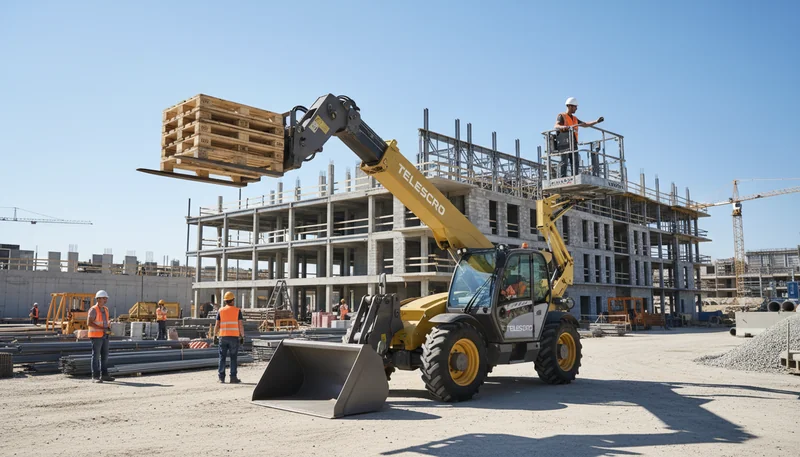
Core construction telehandler attachments include pallet forks with side-shift1 carriages, general-purpose buckets, and secondary fork sets for varied pallet sizes. Pallet forks handle most lifting cycles, especially for dense pallet loads like masonry and bagged materials, while side-shift features can halve repositioning time. Buckets, sized to machine capacity, manage loose materials efficiently. Work platforms2, when certified, allow safe personnel lifting and can consolidate machine needs, though must
Which Telehandler Attachments Suit Most Construction Tasks?
Pallet forks with side-shift carriages and general-purpose buckets are the most field-proven telehandler attachments for construction. Pallet forks handle over 60% of cycles on vertical sites, efficiently moving palletized loads. Buckets (1.0–2.5 m³) are ideal for loose material handling, backfilling, and site cleanup. Attachment sizing must match machine load charts3 to avoid tipping risks.
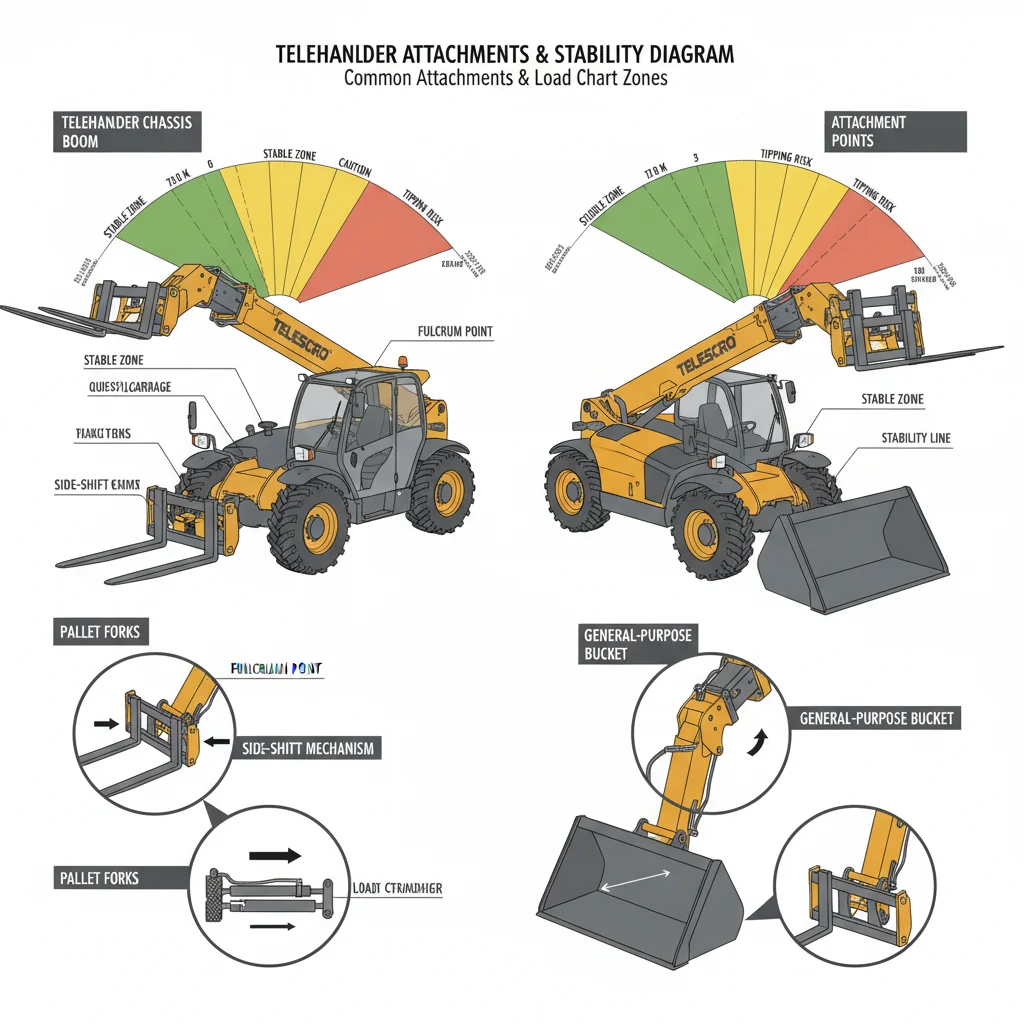
The biggest mistake I see is contractors underestimating how much work gets done with just two core attachments. Whether I’m helping a team in Dubai or supporting a mid-sized project in Kazakhstan, pallet forks with side-shift and a well-sized bucket make up more than 80% of telehandler use on site.
Here’s how the core attachments really measure up in typical construction environments:
| Attachment | Main Tasks | Typical Capacity | Key Benefit | Common Risks |
|---|---|---|---|---|
| Pallet forks (side-shift) | Palletized loads, masonry, steel | Up to 5,500 kg | Precise placement, less repositioning | Tipping at full reach if overloaded |
| General-purpose bucket | Sand, gravel, spoil, cleanup | 1.0–2.5 m³ (up to 2,000 kg) | Site cleanup, backfilling | Quick overloading, lost materials |
| Fork carriage (fixed) | Bulkier, non-pallet loads | 3,000–6,000 kg | Simple, robust setup | Less maneuverability |
Pallet forks with side-shifting save hours on tight urban sites. Last year in Brazil, I visited a seven-floor residential build where side-shift forks reduced repositioning moves by half. That let two machines handle all vertical deliveries, moving up to 10 tons of block per shift with just one operator each. Buckets are next—essential for spreading gravel or clearing debris fast. I always remind customers: size the bucket according to your telehandler’s load chart, not just capacity stickers.
Pallet forks with side-shift attachments enable telehandlers to precisely position heavy loads within a lateral adjustment of up to 150 mm, reducing the need for repositioning the entire machine on siteTrue
Side-shift forks allow operators to move loads sideways without moving the telehandler itself, improving placement accuracy and efficiency especially in tight construction environments where site mobility is limited. Typically, side-shift range can reach about 150 mm depending on the model.
Using a standard bucket attachment on telehandlers always increases lifting capacity by at least 20% compared to pallet forks due to the bucket’s design and weight distributionFalse
Bucket attachments generally reduce telehandler lifting capacity compared to pallet forks because of their additional weight and less favorable load center. The lifting capacity typically decreases, not increases, when fitted with buckets.
Key takeaway: For most construction jobs, a set of pallet forks (preferably with side-shift carriage) and a general-purpose bucket provide maximum versatility and productivity. Always verify load chart compatibility at typical boom heights—oversized buckets or overloaded forks can cause stability issues and project delays.
How Do Telehandler Work Platforms Compare to Lifts?
Work platforms, also known as man baskets, transform telehandlers into versatile access machines, often replacing scissor or boom lifts for façade, glazing, or MEP tasks. When matched and certified, they attach via quick coupler in minutes. Platform use mandates compliance with EN 1459/ANSI standards4, altering load charts and requiring operator training and site-specific approvals.
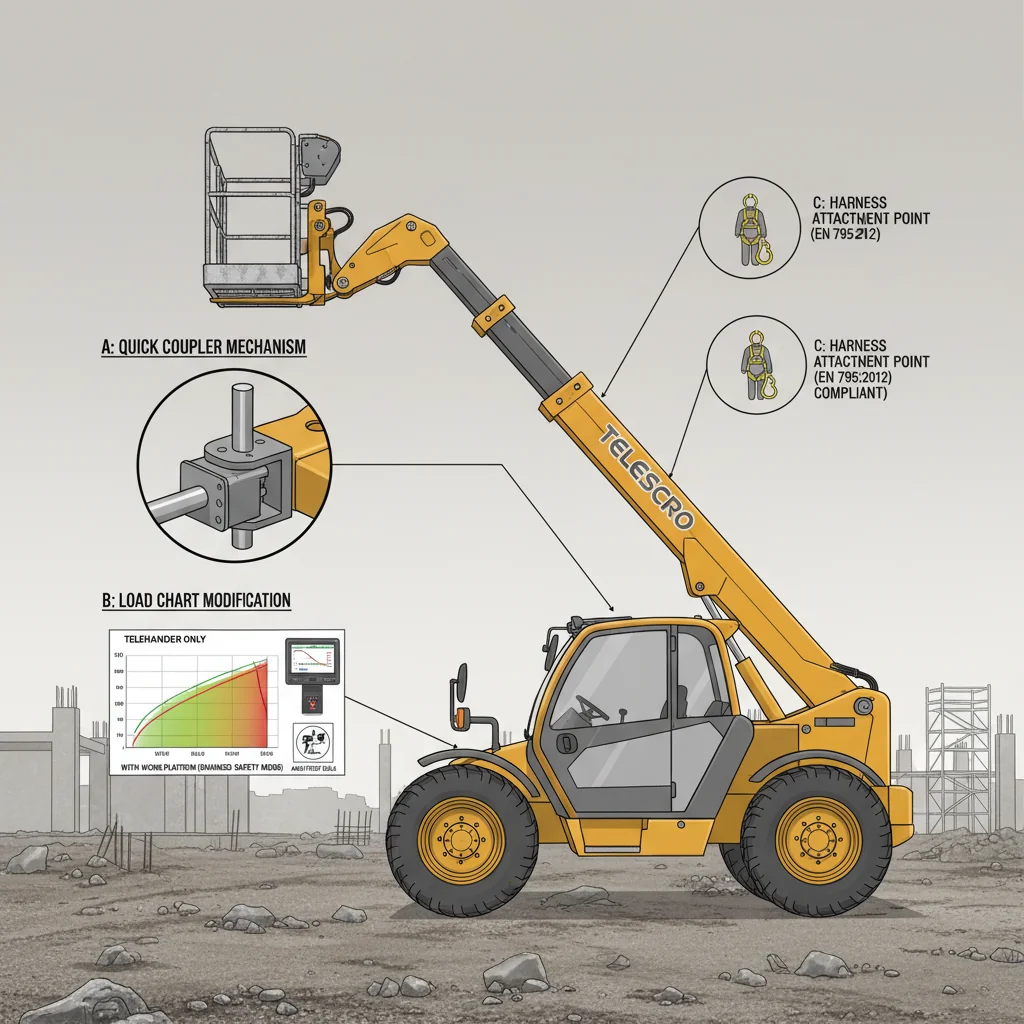
Let me share something important about using work platforms with telehandlers versus dedicated lifts. Many contractors tell me they’re considering swapping their old scissor lifts for platforms attached to telehandlers, especially for façade and MEP jobs. It’s a real trend—last month, a site manager in Dubai asked me if this switch would actually simplify his fleet or just create headaches with local inspectors.
Here’s how the two options compare:
| Feature | Telehandler Work Platform | Scissor/Boom Lift |
|---|---|---|
| Setup Time | 3–5 min (quick coupler, matched unit) | Ready to use (drive & deploy) |
| Max Capacity | 300–1,000 kg (check load chart!) | 230–450 kg typical |
| Max Height | Up to 18 m (depends on telehandler) | 10–22 m common |
| Reach/Flexibility | Elevated + telescopic reach | Vertical (scissor), articulated (boom) |
| Certification | Requires EN 1459/ANSI, telehandler + platform | Built-in, platform-only |
| Operator Training | Telehandler + platform specific | Standard MEWP training |
| Site Approval | Varies (often stricter) | Commonly accepted |
From my experience, telehandler work platforms really shine when you’re combining lifting materials with elevating people—especially in tight, constantly changing sites. I remember a job in Kazakhstan where a single 4-ton telehandler handled glass panels and sent two installers up 14 meters—one machine instead of two. But it’s not automatic: the platform plus machine must be certified for personnel, and load charts change.
Telehandler work platforms typically require additional safety features such as guardrails and fall arrest anchor points that are often integrated as standard on dedicated liftsTrue
Unlike dedicated lifts designed specifically for personnel, telehandler platforms are attachments that may not incorporate all standard safety features by default, requiring contractors to add compliant guardrails and fall arrest systems to meet safety regulations.
Switching from scissor lifts to telehandler work platforms universally reduces inspection complexity and approval times across all local jurisdictionsFalse
Local regulatory bodies may have different requirements; while telehandler platforms add versatility, they often complicate inspections due to needing separate certification and compliance checks not required for certified scissor lifts.
Key takeaway: Certified work platforms can turn telehandlers into multi-role access solutions, consolidating lifting and worker elevation. Buyers must verify compatibility, comply with safety standards, and provide training to ensure safe, approved use. Always account for load chart changes and site requirements when considering platform attachments.
When Are Truss Booms and Lift Hooks Essential?
Truss booms and lift hooks become indispensable for telehandlers during precise picks or when loads must be placed beyond the reach of standard forks. These attachments excel on framing, steel erection, and renovation jobs, allowing secure handling of trusses, panels, and slung materials without repositioning the machine or needing a separate crane for lighter lifts.
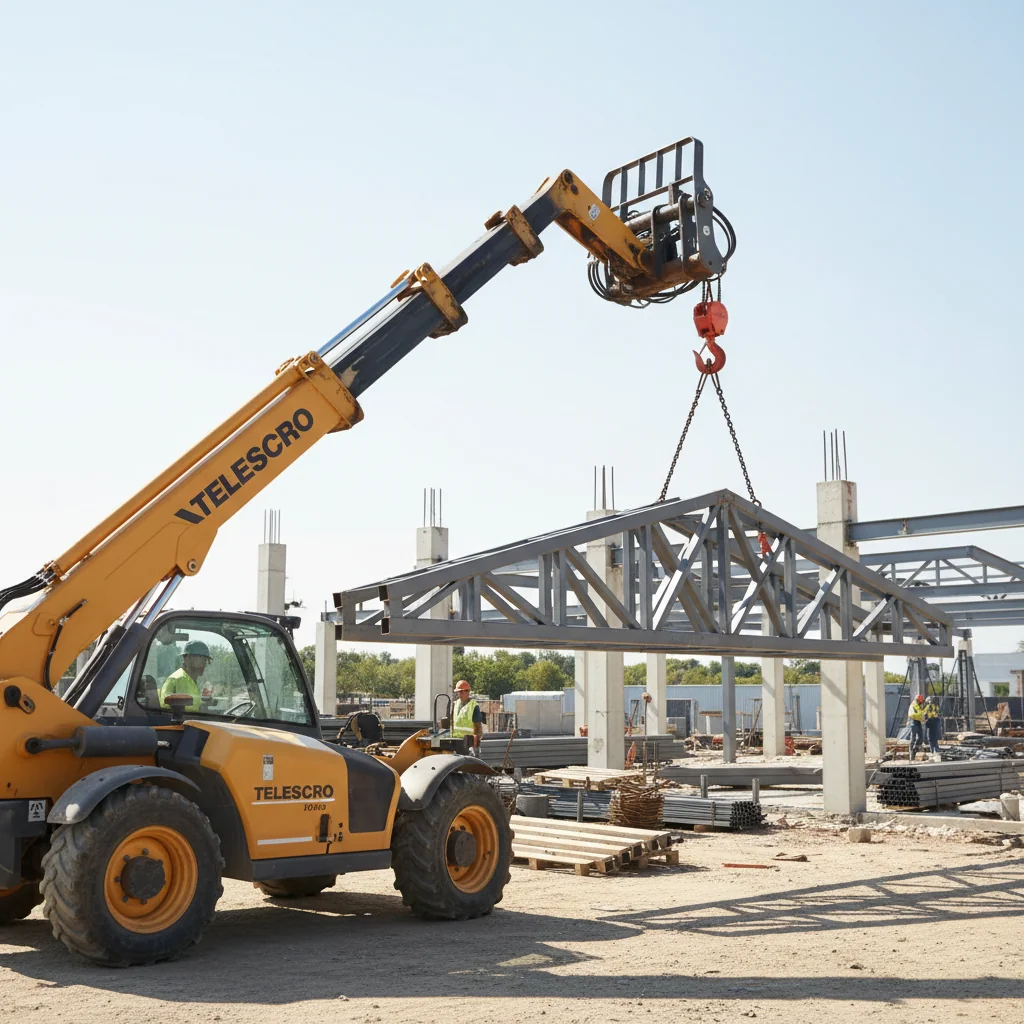
I’ve worked with contractors who underestimated just how limiting standard forks can be on certain sites. For example, a team in Dubai was framing a warehouse with a 4-ton telehandler rated for 13-meter reach. Their challenge? They had to set roof trusses over 11 meters from the slab edge—way beyond the safe reach of unloaded forks. Switching to a 4.5-meter truss boom let them pick each truss from a safe distance, then position it precisely onto the columns without shifting the machine. That move alone saved them at least two full days on steel erection, all without renting a separate crane.
Truss booms really prove their value when you’re handling long, awkward loads—roof trusses, precast wall panels, even structural steel. I’ve seen smaller crews in Kazakhstan use lift hooks to move bundles of pipe or HVAC units that can’t safely sit on forks. Instead, they rigged slings straight to the hook, then used the telehandler’s hydraulics for fine positioning. No need to crowd the jobsite with extra gear or wait for a mobile crane to become available.
To be honest, one spec that gets overlooked is the working load limit (WLL) both for the attachment and at the end of the boom. Always check the telehandler’s load chart at your maximum planned radius. If you’re extending out 10 meters with a 1.2-ton load on a truss boom, you might hit the safe limit quicker than you expect. I suggest confirming your rigging method with a qualified rigger and making sure outriggers or stabilizers are deployed whenever called for on the chart.
Truss booms extend the safe lifting reach of telehandlers by allowing operators to place loads beyond the standard forward reach limits of forks, particularly useful for setting roof trusses over 11 meters from the slab edgeTrue
Truss booms provide a safe, extended reach while maintaining machine stability, enabling precise placement of heavy materials at distances that exceed the reach of standard forks, which must remain within rated load charts to avoid tipping.
Using a lift hook instead of forks on a telehandler significantly increases the maximum load capacity due to better load distributionFalse
Lift hooks do not increase the machine’s rated load capacity; the maximum allowable load is determined by the telehandler’s design and stability parameters, and attaching a hook does not alter the load chart or the machine’s structural limits.
Key takeaway: Truss booms and lift hooks maximize telehandler versatility for challenging lifting scenarios, especially in framing and steel erection. Used correctly, they eliminate extra equipment, improve jobsite efficiency, and enable precise placement of awkward or suspended loads. Always verify load limits and use proper rigging for safety.
Which Telehandler Attachments Handle Sheets and Steel?
Sheet material handler attachments5 offer precise placement of drywall, plywood, and cement board, with fork spreads up to 72 inches and up to 3,000-lb capacity, plus advanced tilt and swing features. For steelwork, clamp and magnetic attachments6 maintain secure grip on beams or plates, minimizing slip risk during critical positioning.
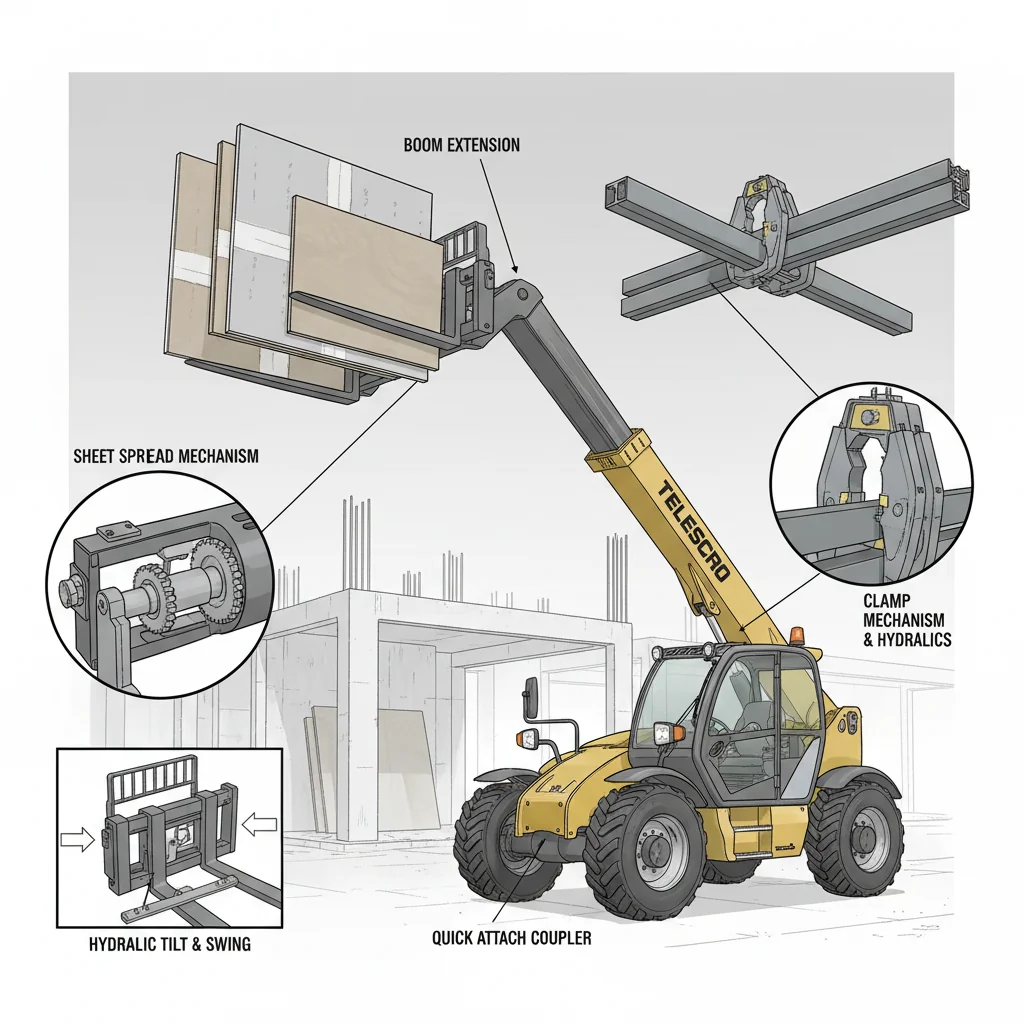
Most people don’t realize that attachments can completely change how a telehandler handles sheet goods or steel. On sites in Dubai, I’ve seen jobs grind to a halt because teams tried to use standard forks for lifting wide drywall sheets—too much flex, not enough control, and a real risk of damaging materials or straining workers.
That’s where sheet material handler attachments shine. They’re designed with wide fork spreads up to about 72 inches and rated around 2,700 to 3,000 pounds. Advanced models offer up to 100 degrees of fore/aft tilt and a full 180 degrees of side-to-side swing, letting operators position heavy boards precisely, even through tight window openings or up to higher floors.
Less manual handling means lower fall risk and less crew fatigue by the end of the shift. For steelwork, clamp or magnetic attachments make a big difference. Last year, a customer in Kenya needed to place steel beams—300 to 500 kg each—onto a framework at 10 meters up. The clamp-style attachment used hydraulic pressure to hold each beam securely, minimizing the slip risk, which matters most on critical lifts above ground. Magnetic heads also help for steel plates, but require a good hydraulic circuit and, in my experience, work best on flat, clean steel.
Here’s a quick comparison:
| Attachment Type | Best For | Typical Capacity | Key Features | Hydraulic Requirement |
|---|---|---|---|---|
| Sheet Material Handler | Drywall, plywood | 2,500–3,000 lbs | 72” spread, tilt, side swing | Standard + auxiliary |
Sheet material handler attachments for telehandlers often feature fork spreads up to 72 inches and load ratings between 2,700 and 3,000 pounds to safely handle wide and heavy sheet goods without flexing.True
These wide fork spreads distribute weight evenly and prevent flexing, which is critical when lifting large sheet materials like drywall or steel to avoid damage or accidents on site. The 2,700 to 3,000 pounds rating matches typical sheet material weights, ensuring safe handling within telehandler capacity.
Telehandler attachments designed for sheet goods are universally compatible with any telehandler brand without requiring adjustments to load charts or lifting capacities.False
Attachment compatibility and safe load handling depend on specific telehandler models, hydraulic capacities, and manufacturers' load charts. Using attachments without verifying compatibility or recalculating rated capacity can lead to unsafe lifting conditions and equipment damage.
Key takeaway: Selecting sheet material handlers or clamp/magnetic attachments boosts accuracy and safety when positioning flat materials or steel at height. Operators and fleet managers should ensure telehandler compatibility with these attachments and available hydraulics for effective, precise handling on demanding construction jobs.
Which Telehandler Attachments Boost Site Productivity?
Specialty telehandler attachments, such as auger drives7, grapples, trash hoppers, and pipe handlers, enable operators to perform drilling, debris handling, material collection, and bundled pipe transport using a single machine. Quick couplers8 streamline switching between attachments, maximizing utilization and reducing reliance on multiple niche machines, particularly for recurring tasks in demolition, utilities, and site cleanup.
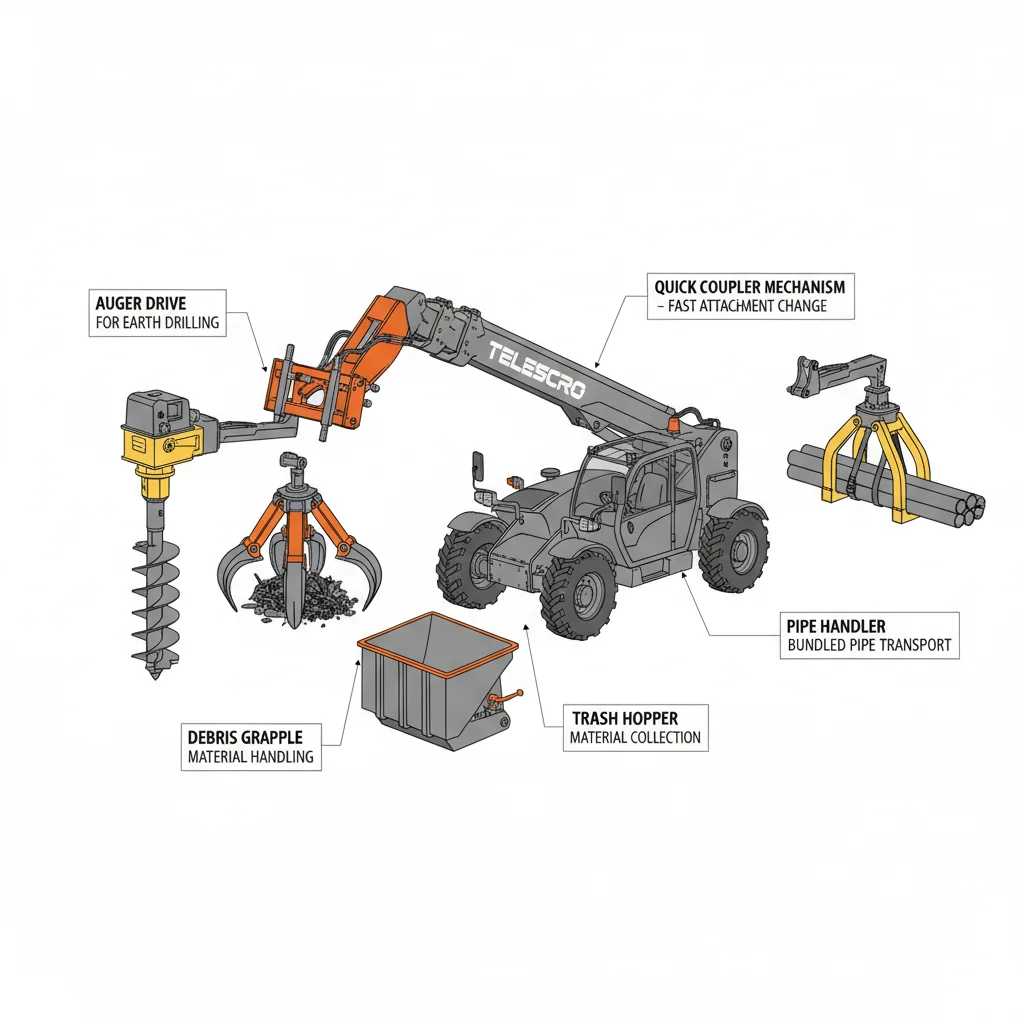
Last month, a contractor in Dubai asked me how telehandlers could do more than just lift pallets. They had a utility project where drilling, cleanup, and moving bundled pipe all came up, often in the same day.
That’s where specialty attachments really shine. When I see operators using auger drives, for example, they drill post holes or foundation piers much faster—no need to haul in extra drilling rigs. On one job in Brazil, a 3.5-ton telehandler with an auger managed over 60 holes in two days—accessing spots a regular skid steer couldn’t reach because of debris piles and uneven ground.
Here’s a quick breakdown of productivity-boosting attachments:
- Auger Drives – Drilling fence posts, utility poles, and signage supports, even through hard ground.
- Grapple Buckets – Grabbing demolition debris, green waste, or scrap without extra labor.
- Trash Hoppers – Collecting and dumping waste quickly, reducing worker exposure to sharp materials.
- Pipe Handlers – Moving bundled conduit or pipe safely, especially for civil or utilities work.
The real advantage shows up when these tasks repeat every week. Quick couplers let one telehandler switch between attachments in about three minutes. I’ve seen clients in Kazakhstan trim equipment rental costs by combining three niche jobs into one machine.
To be honest, I always suggest piloting a specialty attachment rental first. It’s the smart way to see real productivity gains before committing to purchase. Try matching the attachment to your most frequent non-lifting tasks—that’s where you’ll get the real value.
Auger drive attachments on telehandlers can increase post hole drilling speed by up to 40%, enabling operators to complete over 60 holes in just two days with a 3.5-ton telehandlerTrue
Auger drives convert the telehandler’s hydraulic power into rotational drilling force, making it possible to drill holes rapidly without additional equipment, as demonstrated in field use where small telehandlers efficiently completed high-volume drilling tasks.
Boom extensions on telehandlers double the machine’s maximum lifting capacity, allowing operators to handle loads twice as heavy as the standard ratingFalse
Boom extensions increase reach but do not improve lifting capacity; in fact, extending the boom often reduces the rated capacity due to increased leverage and stability concerns, so capacity ratings must be respected to maintain safe operation.
Key takeaway: Matching specialty attachments—like augers, grapples, and trash hoppers—to frequent, non-standard tasks allows telehandlers to handle drilling, material handling, and cleanup, reducing the need for additional machines. Piloting attachments via rental helps verify productivity gains before investing in ownership.
How Do Compatibility and Capacity Affect Attachment Choice?
Attachment selection for telehandlers depends on both compatibility and rated capacity. Carriage type9, mounting pattern, hydraulic flow10, and auxiliary couplers must match between the attachment and machine. Capacity mismatches, such as oversized buckets on smaller units, significantly elevate tip-over risk. Capacity ratings incorporate attachment weight, boom angle, and extension, requiring careful reference to OEM load charts.
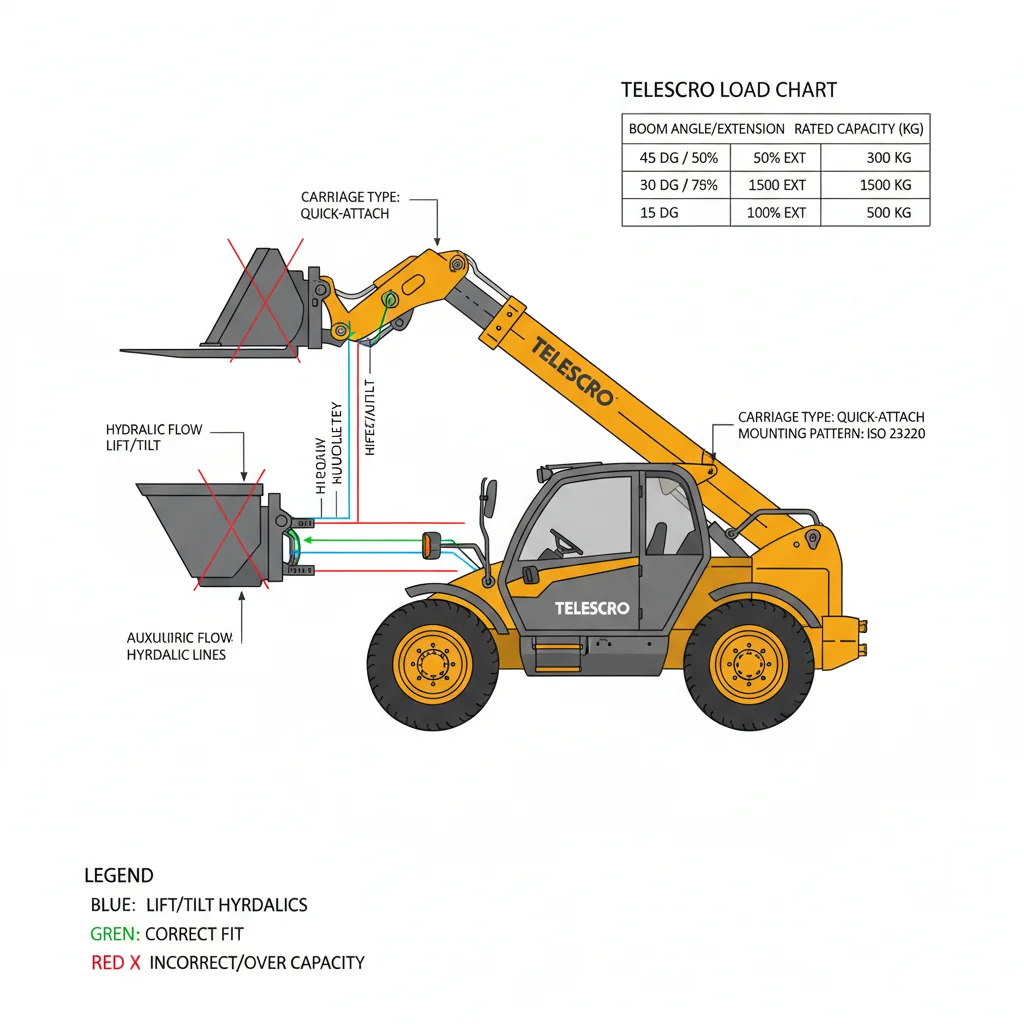
To be honest, the spec that actually matters is compatibility—more than most buyers realize. Think about carriage type first. Not every telehandler uses the same quick-coupler or mounting pattern. I’ve seen jobs in Kazakhstan where operators struggled for hours because a tilting fork carriage from their rental didn’t fit their 3.5-ton telehandler.
That lost them at least a day and a half. Matching the carriage and coupler means you actually get work done, not just move attachments around the yard. Hydraulic requirements are another common pain point. I always tell customers: a grapple, auger, or rotator needs the right auxiliary coupler and enough hydraulic flow.
Under-powered machines deliver weak performance, which leads to frustrated teams and sometimes even burnt-out tools. For example, a contractor in Kenya tried running a hydraulic sweeper attachment on a 2.5-ton compact model—cleaning was terribly slow, and gearbox failure came after four months.
Capacity can’t be ignored. Attachments add weight, and using something oversized—like a 2m³ bucket on a 3-ton machine—will quickly overload your telehandler, especially with the boom extended. The safest way to choose? Always check the OEM load chart for your exact machine and attachment combination. These charts account for boom extension, angle, and the attachment’s weight.
When you’re pairing attachments and machines, here’s my quick checklist:
- Confirm carriage type and mounting pattern fit your telehandler.
- Verify hydraulic flow and auxiliary coupler specs match attachment needs.
- Review OEM load charts for working loads at real boom angles.
Telehandler quick-coupler compatibility often depends on matching both the mounting pattern and the hydraulic connections, as mismatched hydraulics can prevent attachment tilt or auxiliary functions from operating correctlyTrue
Many telehandlers share similar carriage mounting patterns but differ in hydraulic hookup configurations, so even if an attachment physically fits, incompatible hydraulic connections can render its functions unusable, causing operational delays.
Telehandler lifting capacity ratings always remain constant regardless of the type or weight distribution of the attachment usedFalse
Lifting capacities vary significantly depending on the attachment’s weight, load center, and configuration; using heavier attachments or those with longer load centers reduces the effective lifting capacity of the telehandler and can compromise safety.
Key takeaway: Attachment selection must always start with compatibility and machine capacity. Confirm carriage type, fit, and hydraulic requirements before purchase, and consult OEM load charts for payload limits. Skipping these checks leads to unsafe operations, reducing productivity and increasing downtime.
What ROI Justifies Telehandler Attachment Investment?
Telehandler attachments act as capital multipliers by increasing utilization rates and financial returns. Typical costs range from $1,000–$12,000 depending on type and certifications. When matched to specific site demands, attachments often boost monthly machine utilization by 20–35%, frequently paying for themselves within a single large project by reducing equipment overlap, rentals, and subcontracting needs.
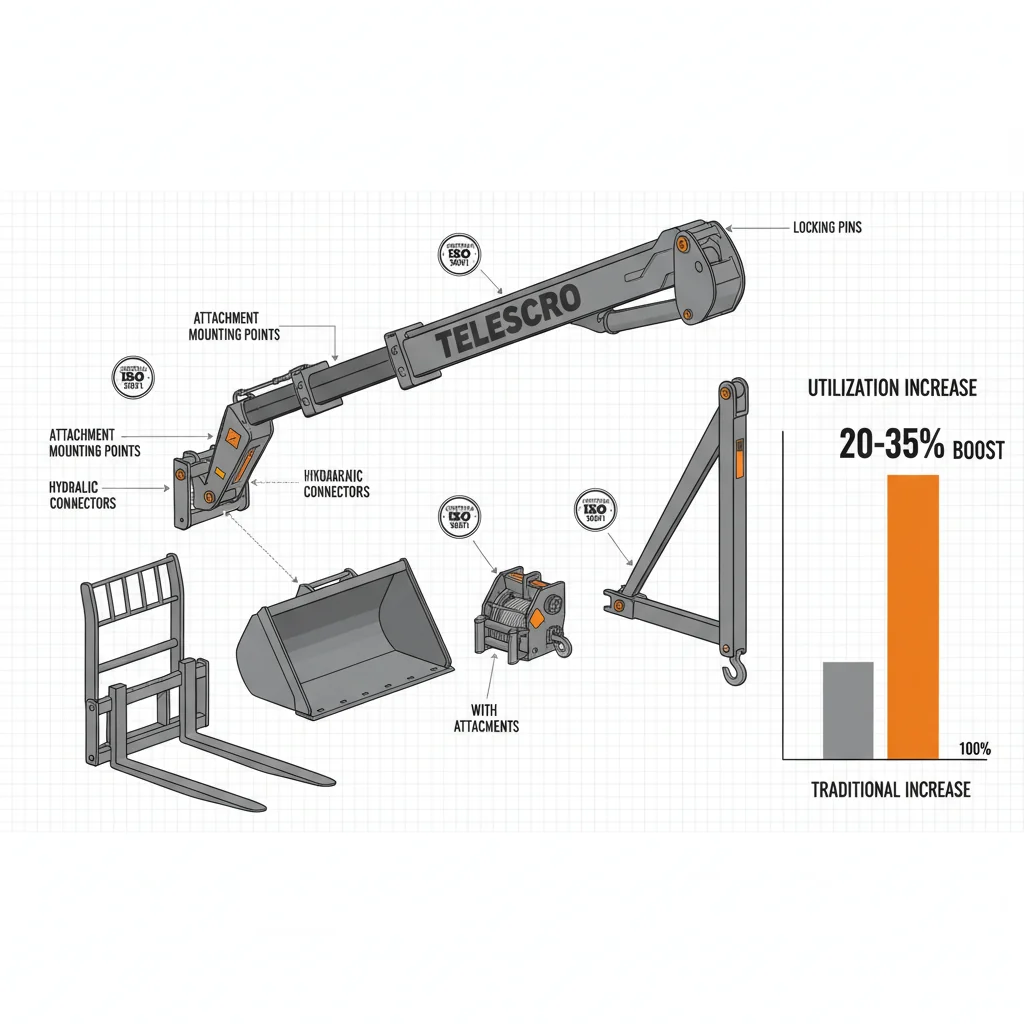
When customers ask me about ROI on telehandler attachments, I always look at real jobsite impact. A few months ago, a contractor in Kazakhstan upgraded their 3.5-ton telehandler with a certified hydraulic bucket and a rotating work platform—total investment was about $8,500.
On one commercial build, these attachments let them handle cleanup, place materials, and lift crews for HVAC installs—jobs they previously outsourced or rented extra machines for. The result? Their main telehandler’s monthly utilization jumped from under 80 hours to nearly 110. They told me those attachments paid for themselves before the first project was finished.
The financial case for attachments comes down to simple math and practical benefits like these:
- Increased utilization: Attachments like buckets, grabs, or platforms can add 20–35% more working hours per month. That means less downtime and faster ROI.
- Capex savings: With the right setup, one telehandler can replace the need for a forklift, mobile access platform, and even a small crane on many jobs.
- Lower rental and subcontracting costs: I’ve seen companies in Kenya cut their outside equipment rentals in half by investing $5,000–$10,000 in additional certified attachments.
- Lower transport and maintenance overhead: Fewer machines means simpler logistics, reduced storage, and consolidated service schedules.
I suggest mapping attachment choices directly to frequent jobs on your sites—think board handling, pipe lifting, site cleanup, light trenching. To be honest, going for uncertified, low-cost attachments often leads to failed safety checks or telehandler warranty problems. I recommend prioritizing certified options, even if the upfront cost is higher. That decision usually pays off in reliability and project savings.
Using a rotating work platform attachment on a telehandler can reduce the need for separate aerial lifts by up to 40% on jobs involving crew liftsTrue
Rotating work platforms enable telehandlers to safely position workers at height without additional machines, streamlining operations and cutting rental or purchase costs on multi-task sites. This can significantly reduce reliance on specialized aerial lift equipment.
"HydraulicFalse
"While
Key takeaway: Strategic investment in certified telehandler attachments can significantly increase fleet utilization, lower overall equipment and rental costs, and rapidly generate ROI—often within a single major project. Prioritize quality and compliance over initial low-cost options to avoid safety, warranty, and downtime risks.
What Safety Rules Apply to Telehandler Attachments?
Safety regulations for telehandler attachments mandate using the precise load chart matched to the specific attachment, as each affects capacity and reach. Attachments like work platforms must comply with EN 1459 or ANSI standards and receive manufacturer approval. Secure installation, operator training, and documentation in the cab are essential to ensure site compliance, prevent accidents, and avoid penalties.
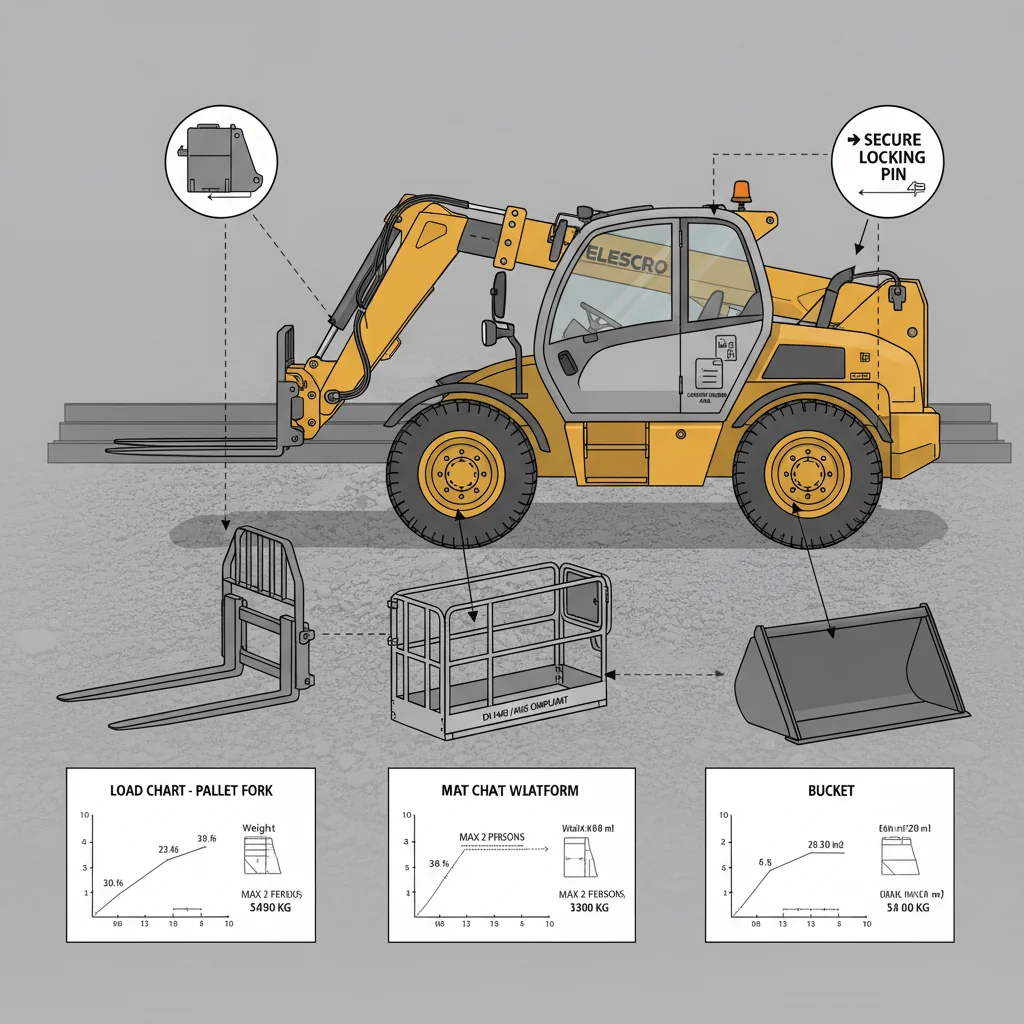
Here’s what matters most when handling telehandler attachments: every single attachment isn’t just a bolt-on accessory—it directly changes your capacity, reach, and safety responsibilities. A bigger material bucket or a lifting hook can drop your safe working load substantially. Last summer, a customer in Kazakhstan added a 500 kg jib to a 4-ton, 17-meter telehandler and assumed the max lift stayed the same. In reality, the updated load chart showed capacity at full reach dropped from around 700 kg to barely 400 kg. Using the wrong chart would have put their team—and project—at serious risk.
For safe telehandler attachment use, I always recommend paying close attention to these points:
-
Check manufacturer-approved load charts12 for every attachment—Don’t use the standard fork chart when you mount a work platform or bucket. Charts should be attachment-specific.
-
Confirm attachment locking pins and hydraulic connections are 100% secure. I make a habit of checking visual indicators every time.
-
Make sure work platforms meet local safety standards—in the EU, that’s EN 1459; in the US, ANSI. The platform also needs official approval from your telehandler manufacturer.
-
Keep updated documentation in the cab—load charts, certificates, and operator manuals. Inspectors in Kenya and the UK increasingly ask for hard copies during safety audits.
-
Train every operator on the specific attachment in use, not just general telehandler controls.
One final thing—I’ve seen fines reach five figures for using the wrong-rated platform or missing paperwork. I suggest reviewing your attachment setup before starting each shift. Shortcuts here don’t just cost money—they put your people at risk.
Adding a heavier attachment like a jib can reduce the telehandler’s maximum lift capacity by up to 50% at full extension, depending on the attachment weight and reachTrue
Attachments increase the machine's moment arm and total load, which directly affects stability and capacity. For example, a 500 kg jib added to a telehandler with a nominal 4-ton capacity can halve the safe lifting load at maximum reach, as load charts demonstrate the decreased capacity due to shifted center of gravity and leverage effects.
Telehandler attachments universally maintain the original machine’s maximum lift height regardless of their weight or typeFalse
Attachments affect both the stability and the center of gravity of the telehandler, which typically reduces the maximum safe lift height and load capacity. The lift height indicated on the machine’s original specifications assumes no additional weight or leverage from attachments, so using heavier or longer attachments often requires consulting updated load charts to ensure safety.
Key takeaway: Each attachment alters a telehandler’s performance and legal limits, requiring dedicated load charts, strict installation checks, and compliance with safety standards. Comprehensive operator training and onsite documentation help maintain safety and prevent costly violations during inspections.
How Should Telehandler Attachments Be Maintained?
Telehandler attachments require routine, task-specific maintenance to ensure reliability and safety. Mechanical forks and carriages need inspections for cracks, bent tines, and worn heels. Hydraulic attachments should have hoses, fittings, and oil checked per manufacturer guidelines. Daily greasing, cleaning couplers, and keeping spare pins on site prevent costly downtime and extend equipment lifespan.
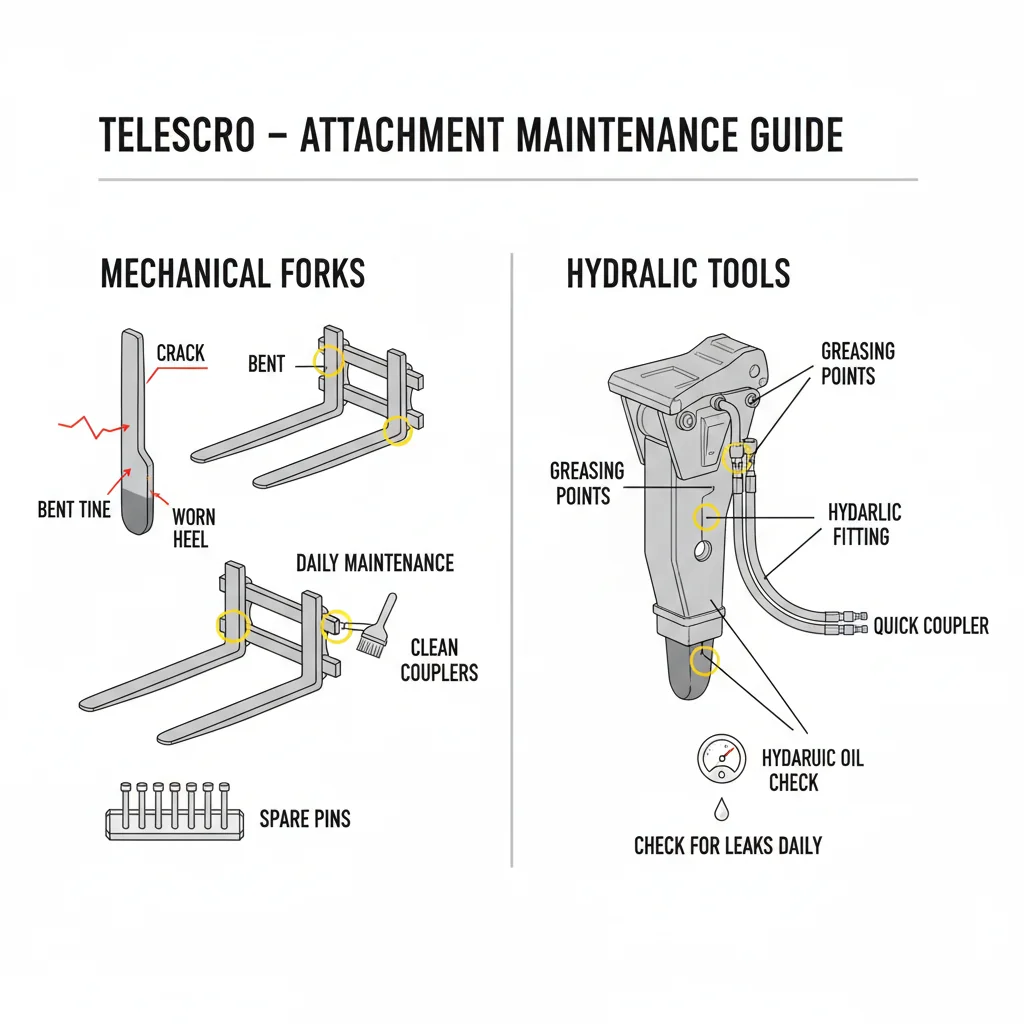
I’ve worked with contractors who underestimated just how much attachment upkeep impacts jobsite productivity. In Kazakhstan, one team lost nearly a full shift because a single fork retaining pin13 vanished—and no spare on site. Telehandler attachments aren’t complicated, but ignoring routine checks will cost you more than just repair bills. Daily inspections identify bent tines, cracked welds on carriages, or damage at the fork heel—concerns that, if left alone, can turn a 4-ton capacity fork into a safety hazard within weeks.
For heavy-use jobs like block carrying or demolition cleanup, I always suggest greasing bucket pivots before every shift. Keeps everything smooth, especially in dusty or wet sites. When it comes to hydraulic attachments, there’s no room for shortcuts. Oil leaks from a worn hose or loose fitting will ground your grapple quickly—and leak cleanup alone can eat half a day. I saw this last year on a Brazilian site: a failed coupler on a powered bucket meant a five-hour stoppage while they sourced a replacement.
For long projects, keep at least two spare quick couplers and a full set of locking pins close by. Filter changes and oil checks (monthly or per manufacturer guidelines) are key. It’s amazing how many machines hit “second-year surprise” breakdowns because simple filter swaps were skipped.
Routine lubrication of telehandler attachment pivot points can extend component life by up to 40%, reducing unexpected failures on siteTrue
Regular lubrication minimizes friction and wear on moving parts like pins and bushings, which are critical in telehandler attachments; this preventive maintenance significantly reduces downtime and repair costs.
Using non-manufacturer specified fork retaining pins on telehandler attachments has no impact on load capacity or safety ratingsFalse
Fork retaining pins are designed to meet specific strength and safety standards; substituting them with unauthorized components can compromise load capacity and safety, increasing the risk of accidents and equipment damage.
Key takeaway: Consistent inspection, lubrication, and part replacement are crucial for telehandler attachment longevity. Prioritizing both mechanical and hydraulic maintenance, adhering to daily checklists, and storing spare components minimizes unplanned downtime and maximizes return on investment through extended service life and improved jobsite safety.
Conclusion
We’ve looked at which telehandler attachments make the biggest difference on typical construction sites and what to check before you buy. From my experience, the contractors who run smooth projects double-check load charts with their real attachments—not just the basic forks or a spec-sheet bucket. I’ve seen people get caught out by ‘parts roulette’ when choosing less common brands or unusual attachments, which can mean unplanned downtime. Have questions about attachments, load charts, or what’s most practical in your region? I’m happy to share what’s worked (and what hasn’t) for real crews—not just what looks good in brochures. Every site is different, so focus on what actually fits your workflow.
References
-
Explains how side-shift pallet forks enhance load placement precision and reduce repositioning time in tight urban construction environments. ↩
-
Details relevant safety standards like EN 1459 and ANSI, ensuring compliant and secure use of work platforms on telehandlers. ↩
-
Explains the importance of load charts in telehandler operation, how to interpret them for safety and maximum capacity adherence. ↩
-
Detailed overview of EN 1459 and ANSI standards ensuring safe use and compliance of telehandler work platforms, essential for construction safety. ↩
-
Explore how wide fork spreads and advanced tilt/swing improve precise material handling and reduce damage risks in construction. ↩
-
Understand how clamp and magnetic attachments enhance secure grip on steel beams, minimizing slip risk during critical lifts and improving safety. ↩
-
Explore detailed benefits and applications of auger drives for faster post hole drilling, reducing need for extra machinery and speeding up projects. ↩
-
Learn how quick couplers enable fast attachment changes, boosting machine utilization and streamlining site operations for demolition and cleanup. ↩
-
Explains how matching carriage types ensures proper attachment fit and avoids costly delays and inefficiencies on job sites. ↩
-
Details the necessity of correct hydraulic flow and auxiliary couplers for powerful attachment operation and avoiding equipment damage. ↩
-
Comprehensive guidance on inspecting hoses, fittings, and oil management to prevent leaks and ensure hydraulic attachments’ reliability. ↩
-
Explains the critical role of load charts in maintaining safety and compliance when using different telehandler attachments. ↩
-
Detailed insights on how missing or damaged fork retaining pins can cause costly delays and safety hazards on construction sites. ↩