










Telehandler Attachments for Agriculture: Field Guide to Making the Right Choice
Just this spring, a dairy coop in New Zealand sent me a video of their operator gingerly moving a heavy silage bale—using only pallet forks. One misjudged tilt, and the whole bale tumbled right off, nearly hitting a feed barrier. It’s the kind of close call I’ve seen repeated in fields from Poland to Brazil.
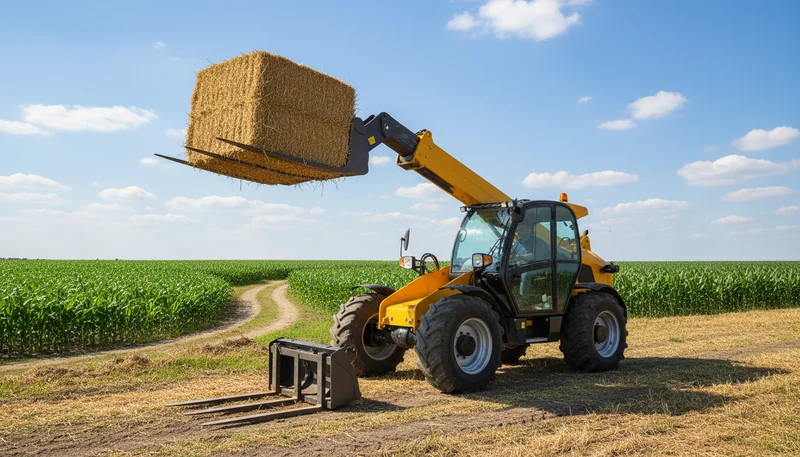
Telehandler attachments used in agriculture transform these machines from simple lifters into versatile, task-specific workhorses. Bale spears1, grabs, and clamps handle hay and straw with minimal crop loss. Manure forks2 and silage grabs3 improve livestock yard hygiene and silage quality. Grain buckets optimize bulk material handling, while multi-purpose buckets provide added dozing and clamping functions for mixed operations.
Which Telehandler Attachments Are Essential for Farms?
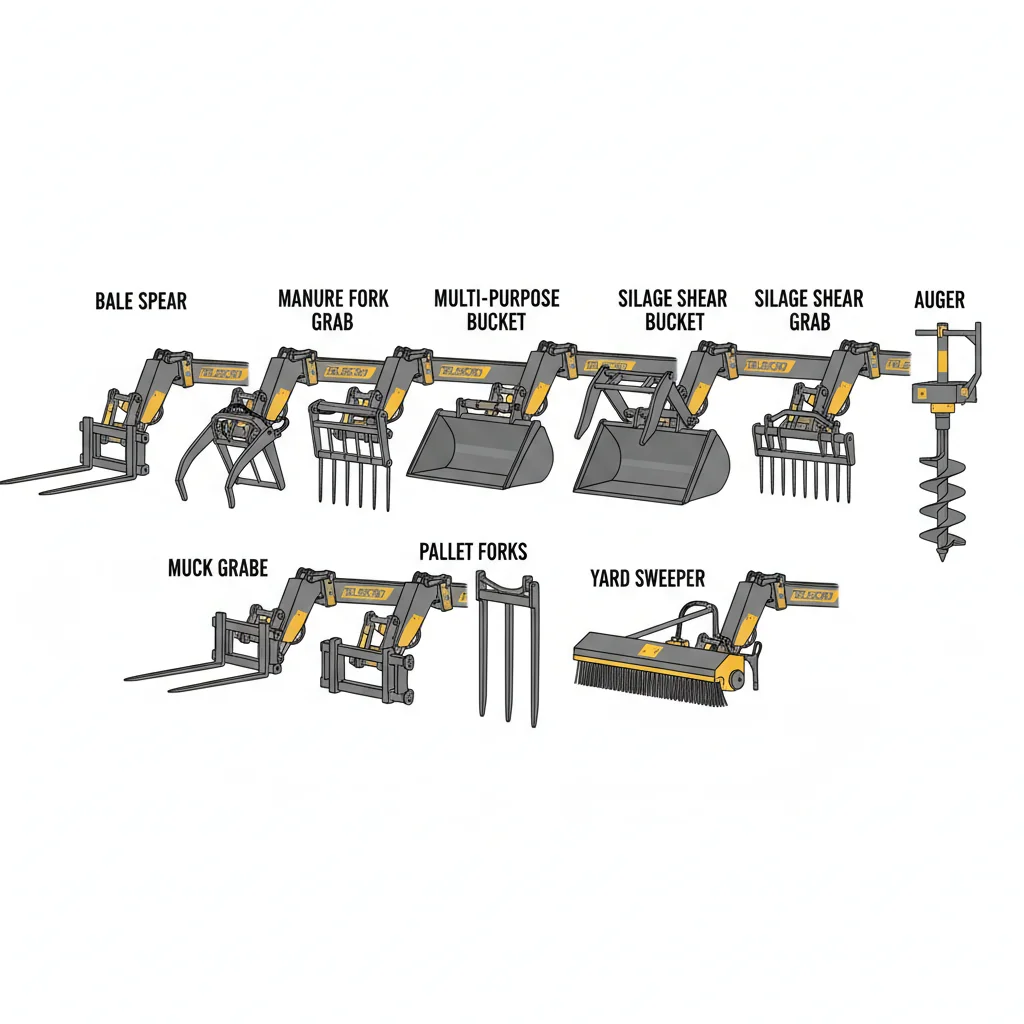
Core telehandler attachments for agriculture include bale spears, bale grabs, manure forks, muck grabs, grain and multi-purpose buckets, silage shear grabs4, pallet forks, yard sweepers, and augers. Each is designed for specific farm materials and tasks. Using the proper tool boosts efficiency, minimizing spills, material damage, and operator fatigue.
Most people overlook how much the right attachment changes daily farm work. I’ve seen dairy farms in New Zealand double their silage loading speed just by switching from a bucket to a silage shear grab—less spillage, much cleaner cuts. On a large cattle operation in Kazakhstan, the team struggled with round bale stacking until they upgraded to heavy-duty bale spears. Suddenly they were moving twice as many bales per hour, with far fewer damaged bales.
Here’s a breakdown of the core attachments farmers actually use most:
- Bale spears/spikes – For lifting and stacking round or square hay bales. Vital in almost every season.
- Bale grabs/clamps5 – Great for wrapped silage bales, which bruise easily if handled by spears.
- Manure forks and muck grabs – Designed for cleaning animal pens and working with straw bedding or semi-solid manure.
- Grain/multi-purpose buckets – For handling bulk cereals or sand. Choose a design that matches your machine’s hydraulic pump flow, or you’ll lose efficiency.
- Silage shear grabs – Cut and scoop silage from the face—much cleaner than buckets, less wastage.
- Pallet forks – Move seed bags, chemical drums, and fertilizer pallets—key for plant and supply management.
- Sweepers/yard brushes – Keep concrete yards and cow passes debris-free.
- Augers – Drill fencing or tree holes fast, especially in hard ground.
Silage shear grab attachments can reduce silage loading time by up to 50% compared to standard bucket attachments due to their ability to cut and hold material more cleanlyTrue
Silage shear grabs are designed with sharp blades that slice through silage instead of scooping it, minimizing spillage and allowing faster, more controlled loading, which can double operational speed as observed on specialized dairy farms.
Standard pallet forks are the most effective attachment for stacking round bales because they prevent any bale damage during handlingFalse
While pallet forks can move round bales, they often cause damage due to insufficient support and piercing pressure; heavy-duty bale spears specifically designed to pierce and securely hold round bales are more effective for stacking without damage.
Key takeaway: Selecting the right telehandler attachment for each recurring farm task—bale handling, grain loading, mucking out, silage feeding, pallet movement, and yard cleaning—drives productivity and investment returns. Prioritizing attachments by frequency of use ensures that telehandlers deliver maximum flexibility and efficiency across diverse agricultural operations.
How to Safely Handle Bales with Telehandlers?
Bale spears/spikes are ideal for quick transport of unwrapped hay or straw, while grapple forks6 and bale grabs/clamps provide superior security for wrapped silage bales or irregular loads. Field data shows grapple-style forks reduce rolling risk by 40–60%, making them essential for safe stacking and handling on steep or uneven ground. Always match attachments to bale size and weight.
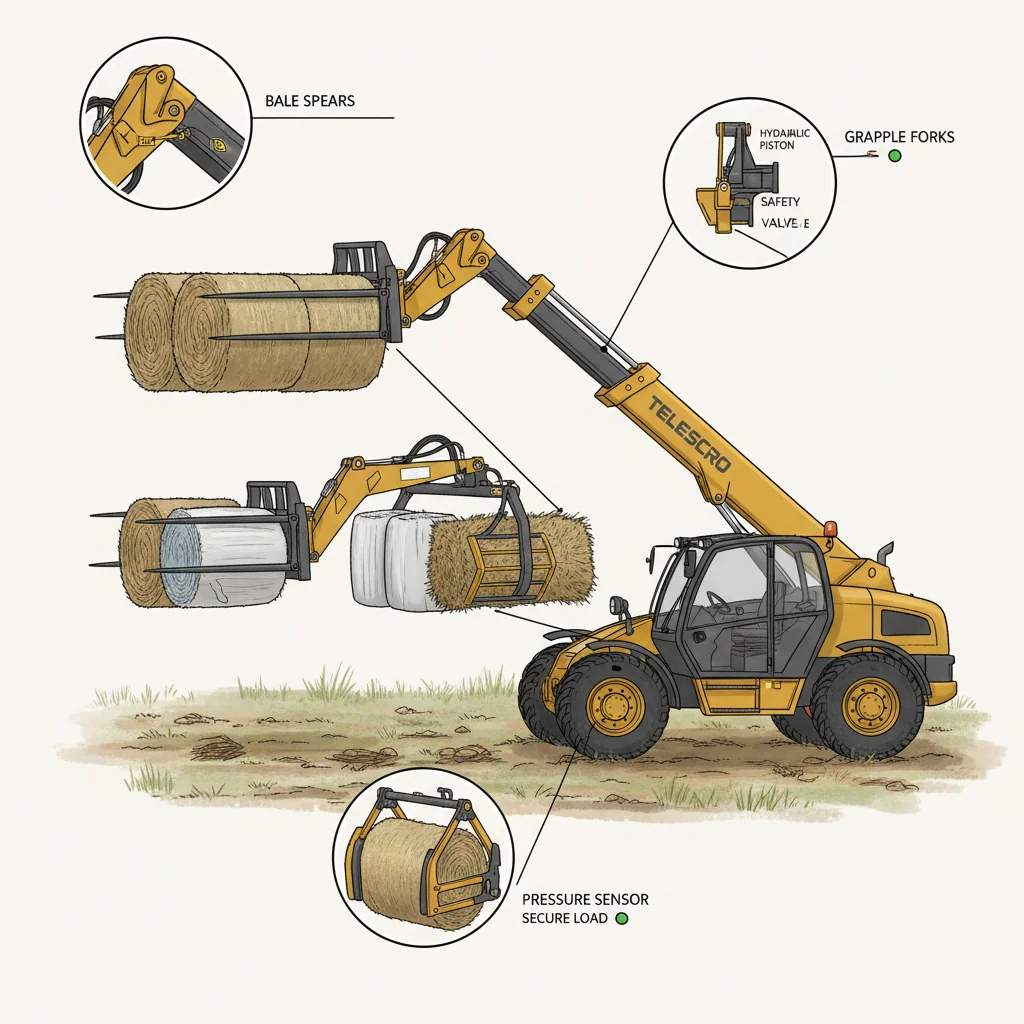
Let me share something important about bale handling with telehandlers—equipment choice really does make or break jobsite safety. Last year, a farming client in Kazakhstan reached out after a close call stacking heavy silage bales in an uneven yard. They’d always used simple bale spears for round bales, never had issues with dry straw, but the moment they switched to denser, plastic-wrapped silage, the bales started shifting. One nearly rolled off the fork from about three meters high. Luckily, no one was hurt. That’s when I explained why grapple forks and bale grabs are worth the investment for wrapped or loose bales. Field data—and I’ve seen this from several sites—puts the reduction in rolling risk at around 40 to 60%. Those clamp arms stop the bale from moving, even if the ground isn’t level.
Here’s what matters most when picking attachments: always match the tool to both bale type and your terrain. For dry, unwrapped bales—like straw or hay—simple spears are fast and minimize damage. But once you handle wrapped, slippery, or oddly shaped bales, grabs with upper clamps or full grapples keep things secure during stacking and transport. I always tell customers to check the attachment’s tine length and clamp opening—make sure it fits your largest bale, not just the average ones. And don’t forget: loaded weight at full lift height might be lower than you expect. Always study your telehandler’s load chart7 and, if possible, try a test lift before you buy a new attachment. That little step saves big headaches later.
Using bale clamps instead of spears for dense silage bales reduces the risk of load shifting and falling by securely enveloping the entire bale, which is especially important at heights above 2 metersTrue
Bale clamps distribute pressure evenly and grip the bale's surface, preventing movement during lifting and stacking. Spears, while effective for dry straw, penetrate the bale and may allow denser or wrapped bales to shift, increasing risk when handling at elevated positions.
Bale spears equipped with hydraulic rotation can completely eliminate the risk of bales rolling off telehandler forks, even when stacking over 3 meters highFalse
While hydraulic rotation aids precise positioning, it does not inherently secure bales against lateral rolling or shifting, especially dense or plastic-wrapped silage bales, which require specific gripping attachments like bale clamps for stability.
Key takeaway: The safest, most efficient telehandler bale handling attachments depend on bale type and terrain. Simple spears are best for unwrapped material, while grapple forks or bale grabs should be used for wrapped or unstable bales to reduce shifting risks and improve operator safety during stacking and transport.
Which bucket types suit agricultural telehandlers?
In agriculture, grain buckets (1.5–3 m³) efficiently handle grain, soil, and silage, with 2 m³ common for mid-range telehandlers. Multi-purpose 4-in-1 buckets8 enable scooping, grading, and clamping; grapple buckets improve handling irregular loads. Always size buckets for wet, heaviest material and cross-reference machine capacity charts to avoid overloading and tip-over risks.
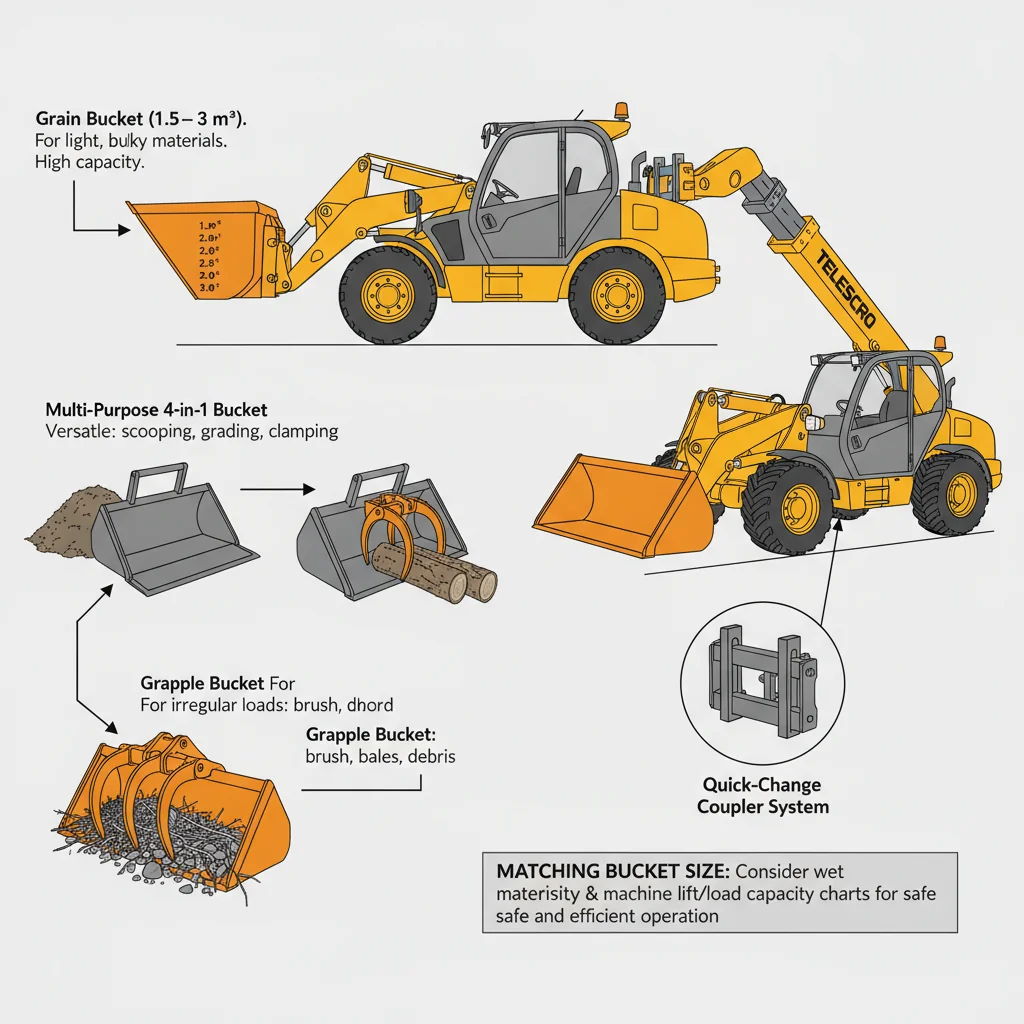
Here’s what matters most when choosing buckets for agricultural telehandlers: start with the heaviest, wettest material you’ll handle—not the dry average. I’ve worked with farm operators in Kazakhstan who often move both dry grain and soaked silage. One farmer there tried a full 3 m³ grain bucket on his 2.5-ton telehandler. With dry wheat, no problem. But when that bucket was loaded with wet manure after heavy rain, his machine strained, and the rear wheels barely touched the ground. That’s a classic case of risking tip-over by ignoring true material weight.
Let’s break down the main bucket types you’ll see on the job:
| Bucket Type | Best For | Typical Volume | Main Functions | Example Use |
|---|---|---|---|---|
| Grain Bucket | Grain, soil, silage | 1.5–3 m³ | Bulk loading/unloading | Grain pits |
| 4-in-1 (Multi-Purpose) | Mixed tasks, light grading | 1.2–2.5 m³ | Scoop, clamp, doze, spread | Mixed farming |
| Grapple Bucket | Loose, irregular materials | 1.2–2.2 m³ | Clamp with hydraulic top jaw; hold debris | Manure, green cut |
Multi-purpose (4-in-1) buckets are a smart investment for mixed farms—I’ve seen these cut changeover time by 20% in customers’ yards from Germany to Brazil. Grapple buckets, with powered clamps, keep awkward loads like branches or messy silage safer to move. But whatever you pick, always check the load chart for your telehandler at maximum outreach.
Agricultural telehandler buckets should be sized and rated based on the maximum wet material density rather than the average dry material to prevent overloading the machine's stabilizers and hydraulic system.True
Wet materials like soaked silage or manure have significantly higher densities than dry grain, increasing load weight substantially. Sizing buckets for these peak loads helps maintain machine balance and prevents hydraulic overload, ensuring safe and efficient operation.
Telehandler agricultural buckets are universally designed with a fixed volume of 3 m³, regardless of material weight considerations, ensuring consistent handling capacity across different farm tasks.False
Bucket volumes vary widely and must be matched to the telehandler’s capacity and the material’s weight. Using fixed-volume buckets without regard for material density risks machine instability and damage. Operators often choose smaller volumes for heavier materials to maintain safe operating conditions.
Key takeaway: Select telehandler buckets based on the heaviest wet material to be handled, matching bucket volume to the machine’s rated capacity and consulting manufacturer charts. Multi-purpose and grapple buckets offer versatility on mixed farms but must not exceed safe handling limits, especially with bulkier or wet materials.
When Are Manure Forks or Silage Grabs Needed?
Manure forks and silage shear grabs are vital for livestock and dairy farms. Manure forks, with reinforced tines and open backs, efficiently handle wet, compacted muck and slurry bedding. Silage grabs neatly cut silage blocks, minimizing spoilage and maintaining feed consistency. Using these specialized attachments reduces equipment stress and speeds chores, outclassing standard pallet forks or light buckets for demanding materials.

The biggest mistake I see on livestock farms is trying to manage heavy, wet manure and silage with basic buckets or pallet forks. Standard forks look strong, but the loads on a dairy yard are far beyond what they’re designed for. Pallet forks can’t handle a half-ton of soaked bedding or break up compacted manure. In Kazakhstan, I visited a dairy using a compact 3-ton telehandler. The owner switched to a reinforced manure fork after bending three sets of pallet tines in one season. He told me mucking out the main shed used to take over two hours with a light bucket—after the switch, his crew finished in about 45 minutes and the tines held up.
Manure forks are worth their weight on any farm dealing with wet or dense material. Their open backs prevent clogs, and the thicker tines can handle tough straw or packed manure without folding under load. I’ve seen big improvements even with mid-sized units—using the right attachment protects the hydraulic circuit and reduces stress on the boom. Repairing bent forks and a damaged carriage can cost over $1,000, not to mention downtime.
Silage grabs are just as important during feedout. If you’re cutting directly from a pit or bunker, a proper shear grab slices off neat, tight blocks. That keeps the silage face sealed—reducing air pockets and spoilage. In Brazil, one customer’s feed losses dropped sharply when they switched from a bucket to a silage shear with a bolt-on blade and heavy clamp, handling around 900 kg per grab. For daily work, I always suggest matching attachments to your heaviest routine task.
Reinforced manure forks typically feature tines that are at least 25% thicker and made from higher-grade steel compared to standard pallet forks, enabling them to handle heavy, wet loads without bendingTrue
Standard pallet fork tines are designed for uniform, stable loads like pallets, not irregular, dense materials such as wet manure or silage, which exert uneven stresses requiring stronger and thicker tines to prevent deformation and ensure durability.
Using standard pallet forks for handling soaked bedding and manure is generally more effective than specialized manure forks because they have a wider tine spacing allowing better gripFalse
Standard pallet forks have narrow, evenly spaced tines optimized for palletized loads, which do not provide the strength or tine thickness needed to break up or carry heavy, compacted manure or wet bedding. Specialized manure forks use reinforced, closely spaced tines to improve durability and material retention.
Key takeaway: On livestock or dairy farms, manure forks and silage grabs are essential attachments for telehandlers. They handle challenging materials that standard forks cannot, improve operational speed, enhance hygiene, and prevent damage to the telehandler, making these specialized tools a worthwhile investment for daily mucking and silage feeding tasks.
How to Match Attachments to Telehandler Capacity?
Attachment selection must align with the telehandler’s rated capacity, not just fitment. Each attachment alters the safe lifting envelope by adding weight and shifting the load center. Consulting the machine’s load chart, verifying hydraulic compatibility9, and using correct quick-attach systems10 are essential to prevent dangerous overloads, especially when using large buckets or handling wet agricultural materials.

Honestly, I’ve worked with customers in countries like Kazakhstan and Vietnam who thought picking attachments was just about what fit their machine. That’s a risky shortcut. Every time you add a bucket, boom, or bale grab, you’re not just adding work tools—you’re changing the machine’s physics. Take a 10,000 lb telehandler with a 17-meter reach. Put a 1 m³ wet grain bucket on it, and safe lift capacity at full extension can drop by almost half. One farm in Brazil overloaded a compact model with a 3 m³ bucket for silage. The warning buzzer went off at just 50% boom because the load center moved out, making the machine unstable.
It’s not complicated, but you do need to follow a process every time you size up attachments:
- Check the load chart for each attachment and boom position—never guess. Each chart reflects specific limitations, especially when the boom is fully raised or extended.
- Confirm the hydraulic requirements. Some grabs or augers need more flow or higher pressure than your pump can give, making them slow or unworkable.
- Use only matched quick-attach systems—Euro, ITA, Q-fit, or others. Using adapters may seem convenient, but I’ve seen them cause unsafe play and even dropped loads.
- Weigh the attachment itself. A heavy bucket eats into your rated capacity before you move a single kilo of material.
- Factor in the real material weight. Wet manure or grain is denser than you think—often 20-40% heavier than dry volumes.
I always tell customers: If you’re unsure, choose a smaller attachment or invest in a bigger telehandler. Cutting corners here can cost you stability, time, and safety.
Adding agricultural attachments like a 1 m³ wet grain bucket to a telehandler can reduce its safe lift capacity at full boom extension by nearly 50%True
Attachments increase the load at the boom tip, shifting the center of gravity and dramatically decreasing the safe lifting capacity, especially at maximum reach. This effect can halve the rated load in some cases, as load charts account for attachment weight and reach effects.
Using bale grab attachments on telehandlers does not affect the machine’s lifting capacity because they are lightweight compared to the telehandler’s own weightFalse
Even though bale grabs are relatively light, they extend the load center and affect the lifted load’s moment, which reduces the telehandler’s lifting capacity. Load capacity must always be recalculated with the specific attachment mounted, regardless of attachment weight.
Key takeaway: Always choose telehandler attachments based on capacity and compatibility, not just mechanical fit. Large or heavy attachments can drastically reduce safe lifting capacity—especially at full boom extension—so always check load charts, confirm hydraulic match, and use correct hitch systems to ensure safety and performance in agricultural environments.
How Do Quick-Attach Systems Boost Productivity?
Modern quick-attach systems such as Euro-hitch and JCB Q-fit enable single-operator attachment changes—like pallet forks, bale spikes, or grain buckets—in under two minutes, often without leaving the cab. This efficiency allows one telehandler to replace multiple machines, handling up to 80–90% of daily agricultural tasks and significantly reducing total equipment hours.
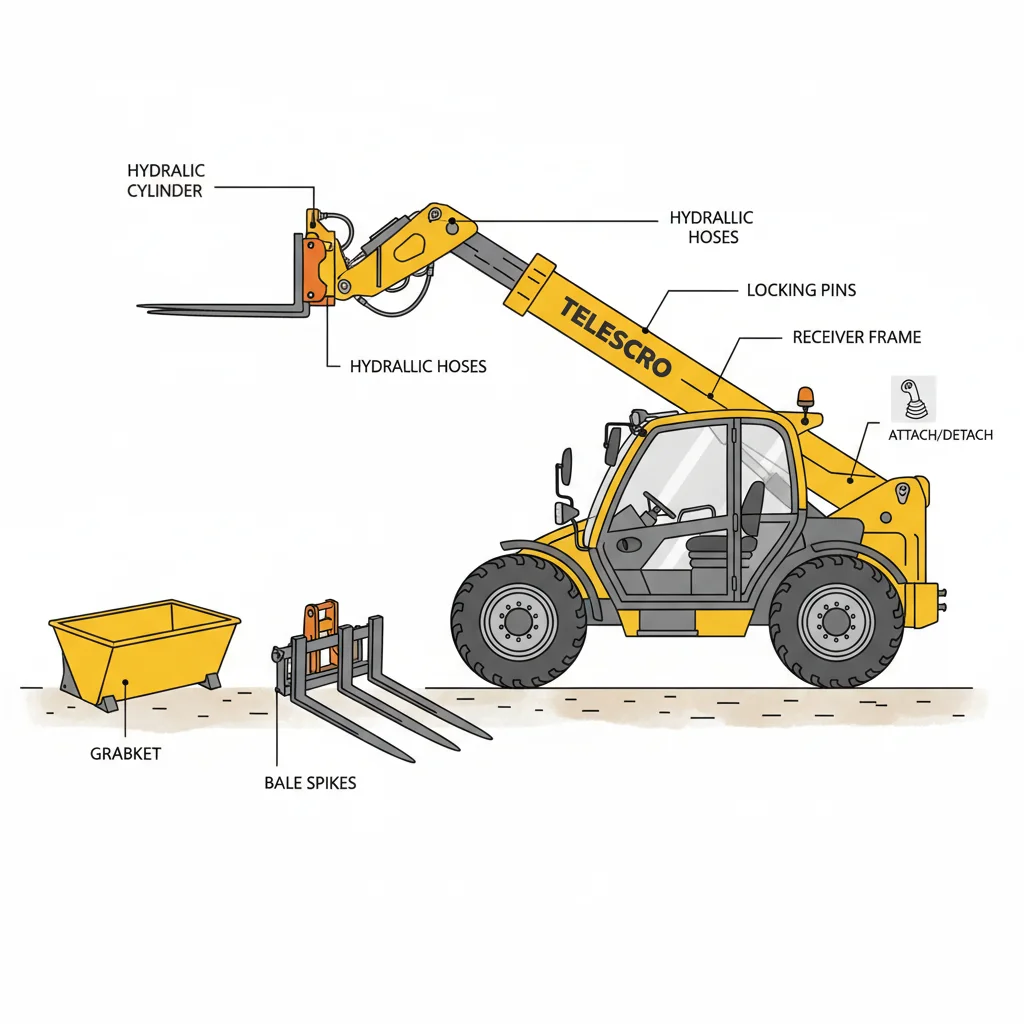
The biggest mistake I see is farms buying a quick-coupler telehandler but sticking with old loader attachments that aren’t actually made for that system. On a jobsite in eastern Poland last year, a dairy farm manager called me after his team spent over 20 minutes swapping from forks to a grain bucket—because the pin spacing was off and hydraulic couplers were tough to reach. That 20 minutes, repeated 6 or 7 times a day, really adds up. When you have the right quick-attach setup, I’ve watched a single operator change from handling silage to stacking pallets in under two minutes, sometimes without even stepping out of the cab. That’s a real productivity boost, and it frees up people for other work.
From my experience, the telehandler takes over work that would’ve needed two or three separate machines. For example, on a mixed-use farm in Romania, the owner swapped to a 3.5-ton compact telehandler with a euro hitch system11 and three core attachments: forks, multipurpose bucket, and bale clamp. In the first harvest season, telehandler operating hours shot up, but tractor hours dropped by roughly half. Tasks like mucking out, feeding, and moving bulk feed could all be done with one machine. When you reduce machine overlap and idle time, the math starts to make sense.
I always suggest focusing your budget on well-built high-use attachments first—like a grain bucket, bale spike, and true euro-fork set. Check that hydraulic couplers are fast to access and protected from dirt. Cheap adapters and manual pin sets? They look like a bargain but eat up more time than most people realize.
Using quick-attach systems specifically designed for telehandlers can reduce attachment changeover times from over 20 minutes to under 2 minutesTrue
Quick-attach systems engineered for telehandlers have standardized pin spacing and accessible hydraulic couplers, enabling operators to switch attachments rapidly, significantly improving daily productivity by eliminating prolonged manual adjustments.
All quick-attach telehandler systems are universally compatible with any loader attachment regardless of manufacturer or typeFalse
Quick-attach systems vary in mounting design, pin spacing, and hydraulic connections; incompatibilities often cause long swap times or require adapters, which negates productivity gains and highlights the importance of matching attachments to the correct system.
Key takeaway: Investing in advanced quick-attach systems and truly compatible attachments allows farms to maximize telehandler versatility, reducing reliance on tractors and loaders. Prioritizing high-use tools and proper coupler configurations is crucial to fully realize productivity gains and streamline day-to-day agricultural operations.
What Maintenance Extends Telehandler Attachment Life?
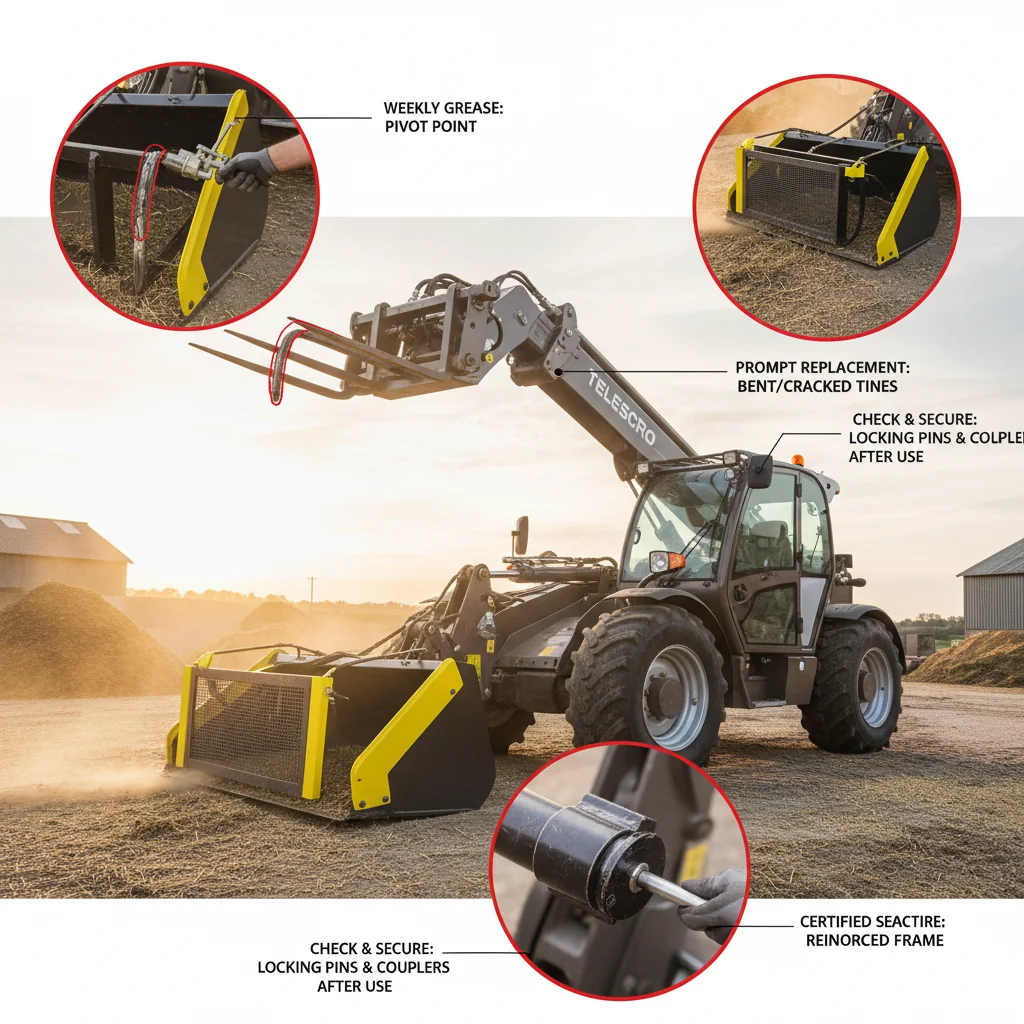
Telehandler attachments in agriculture face harsh conditions like wet silage and abrasive grain dust, making maintenance essential for longevity. Key practices include weekly greasing12 of pivot points, prompt replacement of bent or cracked tines, ensuring locking pins and couplers13 are secured after each use, and using attachments with certified safety features for improved operator visibility.
To be honest, the biggest issue I see on jobsites—especially on demanding farms in places like western Australia—is neglected daily checks on telehandler attachments. It’s easy to assume that robust tines or buckets can take abuse day after day, but even the strongest grabs can fail early if you ignore the basics. I’ve watched a $2,000 silage grab get scrapped in just 18 months because no one bothered with simple greasing or tine inspection.
If you want attachments to last more than just a couple seasons, there are four steps I always recommend:
- Weekly greasing: Lubricate all pivot points and moving joints, especially shear grabs and articulated buckets. In muddy or wet silage conditions, some customers in Germany have told me they re-grease key points every three days.
- Inspect and replace tines: Bent or hairline-cracked tines cost almost nothing to replace compared to blown-out booms or leaking hydraulics. In Brazil, I saw a loader lose two weeks after an $80 tine broke off mid-lift.
- Secure locking pins and hydraulic couplers: After every attachment change, check that pins click into place and hydraulic quick-couplers are clean and firmly locked. Dirt in couplers can contaminate both attachment and machine hydraulics—something that’s led to $1,000 repairs in Kenya.
- Choose visibility and safety-certified attachments: Opt for models with visibility slots or lower-sided designs so operators can see what they’re handling. Whenever possible, confirm that safety standards (like an EU certificate) are met.
I suggest setting a maintenance reminder and spending 10 minutes on these checks. It could easily save you thousands and keep your telehandler safe in even the worst harvest weather.
Regular greasing of the pivot points on telehandler attachments can extend their operational life by up to 30% by preventing premature wear and corrosionTrue
Greasing maintains lubrication between moving parts, reducing friction and wear. This prevents rust and material fatigue, which can significantly prolong attachment lifespan, especially under harsh agricultural conditions.
Using telehandler attachments without daily hydraulic pressure checks does not affect their lifespan since the attachments are independent of the hydraulic systemFalse
Telehandler attachments rely on the hydraulic system for operation, and incorrect pressure can cause accelerated wear or failure of hydraulic components within the attachment. Neglecting daily hydraulic checks can reduce attachment life by causing internal damage and leaks.
Key takeaway: Consistent maintenance of telehandler attachments—including lubrication, regular inspections, and secure connections—prevents premature failure and reduces costly downtime. Prioritizing health checks on attachment components and selecting models with visibility and safety certifications enhances not only attachment lifespans but also overall machine safety in demanding agricultural environments.
How Should Cost and Brand Impact Attachment Choice?
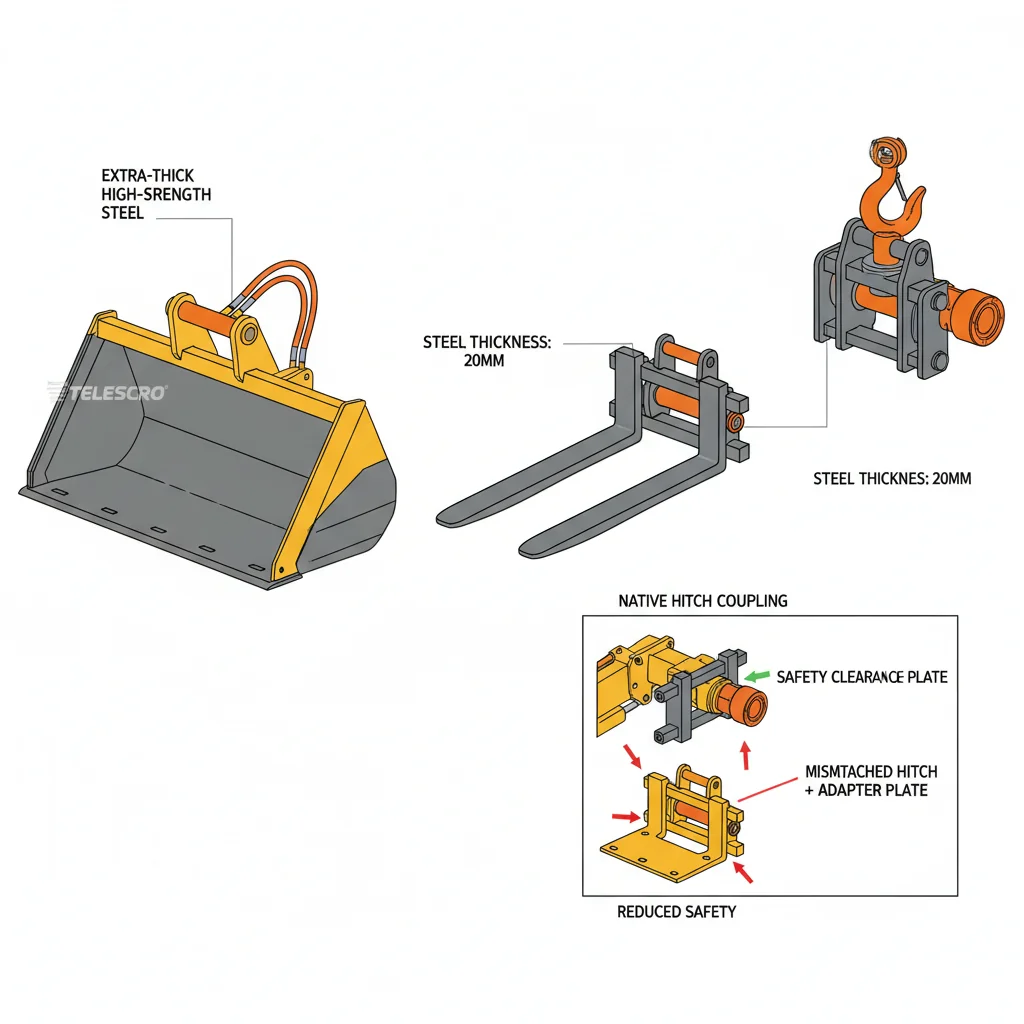
Attachment cost goes beyond upfront price. Leading agricultural brands like Manitou, JCB, and Merlo use premium steel, thicker wear plates, and robust hydraulics, minimizing downtime and repair. Cheaper, generic attachments often suffer from poor fitment and faster wear, while mismatched hitches may require costly adapters that compromise safety and visibility. Standardizing on native coupling optimizes long-term value.
Last year, I worked with a farm in Kazakhstan struggling with constant breakdowns on their bale grabs. They chose lower-cost attachments to save upfront, but after only six months, the brackets started bending and the pins wouldn’t align. They lost almost a week of work waiting for repairs and spent extra on a hitch adapter—nearly $900—just to get basic compatibility. Their experience highlighted what I see often: cutting costs early can mean more downtime and hidden expenses later.
Here’s what I always suggest customers consider before buying attachments:
- Steel Quality14: Premium brands typically use thicker plates and much better heat treatment. For example, wear edges on branded buckets often start at 8 mm or more. Cheaper options can be under 6 mm and wear out twice as fast.
- Fitment and Safety15: Generic attachments may not fit your machine’s native coupling well. Mismatched brackets or pins can create unsafe connections and force you to buy adapters, which can reduce your real working visibility.
- Hydraulic Performance: I’ve seen low-cost grabs leak oil from poor cylinder seals. Over two years, higher-quality valves and hoses usually save at least several days of downtime.
- Long-Term Value: While upfront savings look good, replacing a worn attachment after only two seasons can cost nearly as much as double-buying.
For truly low-use or seasonal tools—like snow blades or beet buckets—quality used units can be good value if sourced from a reputable dealer. Just make sure to inspect for cracks in welds and check service history. I suggest matching attachments to your machine’s standard coupling to avoid the “second-year surprise” of hidden maintenance costs.
Choosing telehandler attachments from reputable brands often guarantees compatibility with industry-standard brackets and pin sizes, reducing the need for costly adapters and minimizing downtimeTrue
Well-known brands adhere to standardized dimensions and quality controls, ensuring that attachments fit the telehandler without modification. This prevents mechanical issues like bent brackets and misaligned pins that commonly arise with cheaper, non-standardized attachments.
Lower-cost telehandler attachments typically have stronger wear resistance due to the use of harder steel alloys compared to premium brandsFalse
Lower-cost attachments often use cheaper, less durable materials to reduce expenses, which compromises wear resistance. Premium brands invest in higher-quality steel treatments and alloys that provide better durability and longevity in agricultural conditions.
Key takeaway: Investing in reputable-brand telehandler attachments for high-use agricultural tasks offers longer life, less downtime, and greater safety than cheaper options. For infrequently used implements, quality used units can offer value when sourced from trusted dealers and carefully inspected for defects.
When Are Telehandler Augers Worth Buying?
Telehandler auger attachments are worth purchasing when frequent, large-scale post or planting work is required—such as installing hundreds of fence posts, orchard trees, or vineyard supports—especially on tough or uneven terrain. Specialized attachments deliver value for recurring seasonal tasks, but for infrequent or single-use needs, renting or buying used options may be more economical.

Most people don’t realize that telehandler augers really prove their value on jobs needing hundreds of repetitive holes—fencing, orchard planting, or vineyard supports across rough ground. I’ve seen a big difference firsthand. Last autumn, a farm owner in Kazakhstan called frustrated after renting a small tractor-mounted auger for a 10-hectare apple orchard project. The soil was stony, ground uneven—he broke three auger bits in one week, and his team barely managed 25 holes each day. After switching to a 3-ton telehandler fitted with a heavy-duty hydraulic auger16 (1800 Nm torque, interchangeable bits from 200 mm to 500 mm), they pushed through 80 holes daily and completed the job twice as fast—with no hydraulic overheating, even working six hours straight.
If you plant or fence more than 100 holes per season, buying makes sense—especially if your jobs involve compacted soils that can stall smaller equipment. The hydraulic circuit on most 3–4-ton models17 provides the constant flow needed for high-torque digging, while the boom’s reach lets you work over drainage ditches or tight rows. On jobs where augers see only a few weeks’ use per year (like snow blades or beet buckets in colder climates), I often suggest looking for used attachments from reputable dealers. I’ve helped customers in Poland pick up barely-used augers or sweepers for 40–60% less than new, but I always advise inspecting for worn cutting edges, hose leaks, and cracked welds before buying.
For rare or one-off jobs, renting or subcontracting makes more sense—you avoid the hassle of long-term maintenance or storing gear you’ll hardly use. I recommend weighing your yearly workload and soil conditions before deciding.
Telehandler augers designed with reinforced steel flighting and replaceable carbide tips can reduce bit breakage by over 40% when working in stony soils compared to standard augersTrue
Reinforced steel flighting provides greater durability against rocks, while replaceable carbide tips maintain sharpness and wear resistance, significantly decreasing downtime and breakage in challenging soil conditions.
Using telehandler augers for planting vineyard supports is inefficient because their hydraulic motors cannot deliver the torque necessary for drilling holes deeper than 50 cmFalse
Modern telehandler augers are equipped with hydraulic motors capable of producing high torque, allowing them to efficiently drill holes well beyond 50 cm deep, suitable for vineyard support installation even in tough soil.
Key takeaway: Invest in telehandler augers or niche attachments when projects are large, frequent, or recurring—particularly in challenging soil conditions. For intermittent or one-off tasks, consider renting or purchasing second-hand equipment after thorough inspection to optimize operational efficiency and control costs.
Conclusion
We’ve looked at which telehandler attachments work best for key farm jobs, and why matching them to real, everyday needs makes a difference. From my experience, it’s easy to get distracted by new gadget options, but the most successful farm operators always prioritize attachments they’ll use weekly—not just what looks impressive at first glance. That’s how you keep productivity up and avoid what I call "showroom hero, jobsite zero" regrets. If you’re unsure which attachments will actually pay off for your specific tasks, or want a second opinion before committing, feel free to reach out—I’m happy to share real-world examples from across 20 countries. The best setup is always the one that fits how you really work day to day.
References
-
Explore the role of heavy-duty bale spears in increasing bale stacking speed and minimizing damage, backed by real-world farm improvements. ↩
-
Explore expert advice on using reinforced manure forks to efficiently handle wet or compacted manure, reducing equipment damage and workload time. ↩
-
Learn how silage grabs cut silage blocks precisely to minimize spoilage and maintain feed quality, improving farm productivity and equipment lifespan. ↩
-
Detailed insights into silage shear grabs highlight their efficiency in clean cutting and reducing silage wastage, critical for farm operations. ↩
-
Learn why bale grabs/clamps secure wrapped bales better, preventing shifts and accidents on challenging ground conditions. ↩
-
Explore detailed data on how grapple forks reduce bale rolling risk by up to 60%, enhancing jobsite safety on uneven terrain. ↩
-
Detailed understanding of load charts prevents overloads and accidents, showing safe lift limits across boom positions and attachment types. ↩
-
Learn about multi-purpose 4-in-1 buckets that scoop, grade, clamp, and doze, improving productivity across mixed farming tasks. ↩
-
Learn how matching hydraulic flow and pressure specs avoids slow or unworkable attachments, ensuring optimal telehandler performance. ↩
-
Explore how quick-attach systems slash attachment change times to under two minutes, boosting efficiency on farms and construction sites. ↩
-
Understand why the euro hitch system is favored for multi-attachment telehandlers, helping replace multiple machines and cut equipment hours. ↩
-
Explore best practices for lubricating pivot points to prevent wear, reduce downtime, and extend telehandler attachment lifespan. ↩
-
Learn how securing locking pins and hydraulic couplers after each use prevents accidents and maintains attachment reliability. ↩
-
Explore how premium steel with thicker wear plates extends attachment life and reduces downtime in heavy equipment operations. ↩
-
Learn why proper fitment prevents costly adapters and enhances operator safety and visibility during equipment use. ↩
-
Explains how heavy-duty hydraulic augers improve efficiency and durability when handling tough soils and large-scale planting tasks. ↩
-
Details why 3–4-ton telehandlers offer optimal hydraulic flow and boom reach for demanding auger work in compacted soils. ↩