










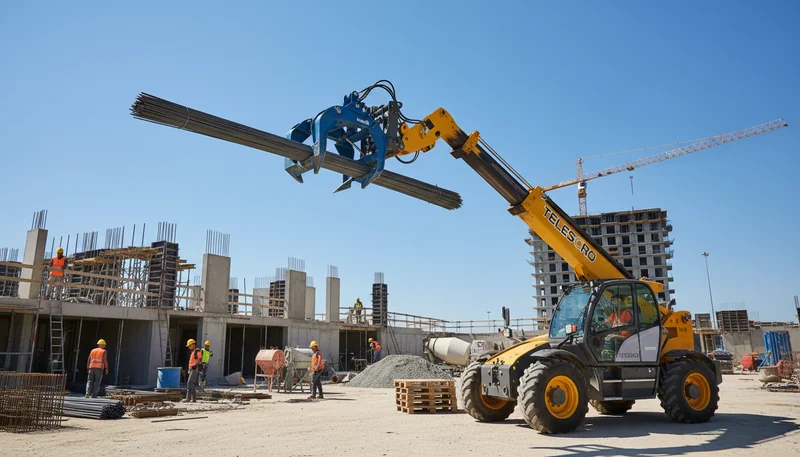
Telehandler Attachment Compatibility: Expert Guide to Fitting European Tools on Chinese Machines
Just last month, a German rental fleet manager sent me photos of a bucket refusing to lock onto his new Chinese telehandler—despite both being sold as "Euro compatible." The difference? Less than 15 millimetres at one pin, but enough to halt his jobsite for hours and put his safety checks in question.
Telehandler attachment compatibility depends on precise matching of quick-coupler geometries, hydraulic specifications, and certified load ratings. Minor dimensional differences between European and Chinese coupler patterns can prevent secure locking, introduce instability, or even compromise machine warranties. Hydraulic system pressures and flows often differ, affecting attachment behavior and operational reliability. Adapter plates1 add weight and alter the load center, which can reduce rated lifting capacity and accelerate wear.
Will European attachments fit Chinese telehandlers?
European telehandler attachments rarely fit Chinese machines without modification. Locking via quick-coupler systems2, they rely on precise patterns like Euro 8, Manitou, JCB, or Merlo. Chinese telehandlers often use proprietary or “near copy” couplers, differing by as little as 10–20 mm in hook or pin dimensions, making direct interchangeability unreliable.
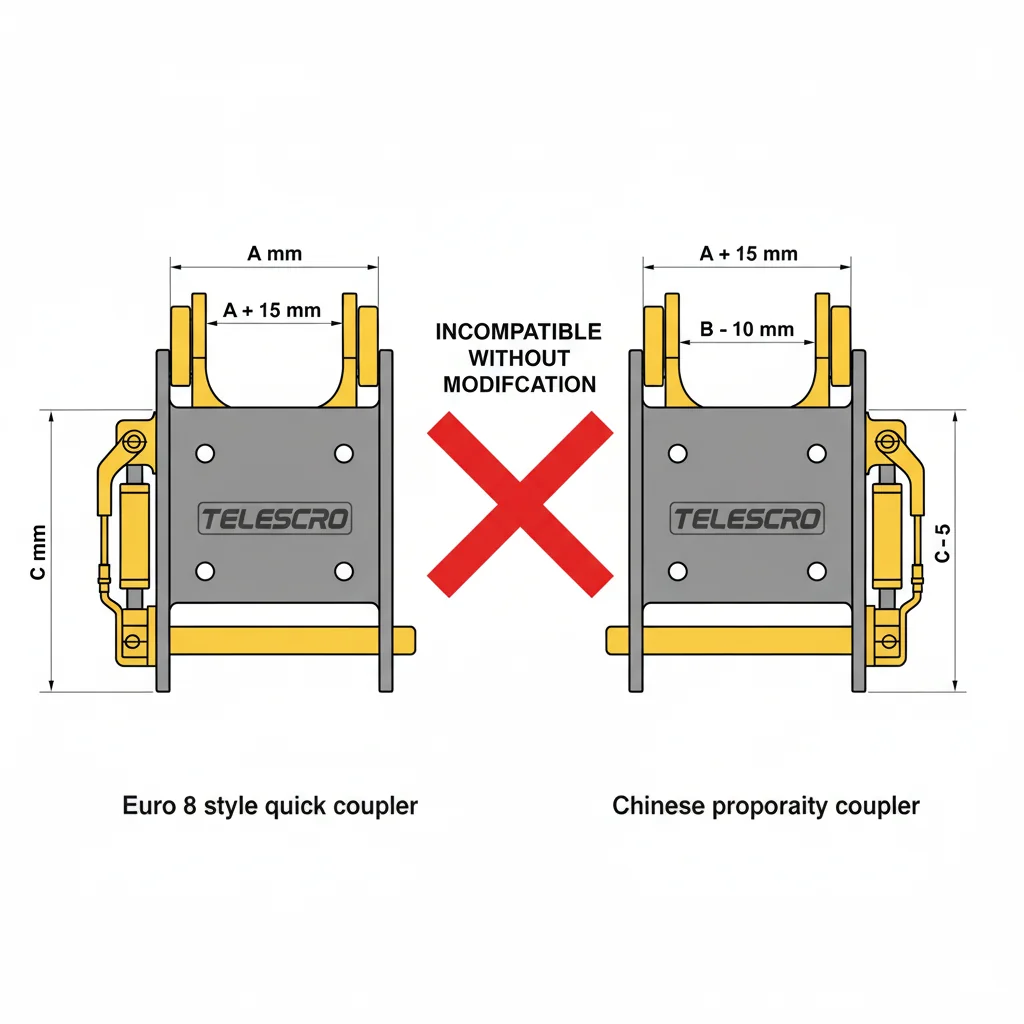
Let me share something important about attachment fitment—small differences matter more than most buyers realize. I’ve seen cases where a pallet fork looks like it should fit a Chinese telehandler, but the locking hooks sit just 15 mm off, leaving a dangerous gap at the top. In Dubai last year, a rental company tried using their existing 3-ton brick grab (set up for Euro 8) on new 4-ton units from a Chinese supplier. It looked close, but the quick-coupler pins wouldn’t seat fully. The operator almost loaded a full pallet before noticing the attachment could twist. That kind of mismatch risks equipment damage and can void the machine’s warranty.
Here’s what you absolutely need to check before mixing attachments and machines:
- Identify your current coupler type – Is it Euro 8, JCB pattern, or a less standard geometry?
- Request a dimensioned coupler drawing from your telehandler supplier—including pin spacing, hook depth, and lock position.
- Check the actual measured gap between hooks and pins—10–20 mm out of spec can cause attachment instability.
- Test-fit before committing on large orders—even “compatible” designs may need shims or welding to work safely.
From my experience handling import setups in South Africa, many “Euro-style” claims mean the shape is similar, but not exact. A fork carriage that works on a European machine might tilt or rattle on a Chinese unit. To be honest, I always suggest building a detailed fit check into your purchase process—especially before you invest in new attachments or plan to re-use your existing fleet. Better to confirm now than face downtime later.
European attachments often use ISO 23727 or similar standard interface dimensions, which can differ by 10-20 mm from Chinese telehandler quick-coupler designs, causing fitment issuesTrue
Many European attachments follow ISO standardized dimensions, but Chinese telehandlers frequently use proprietary or region-specific quick-coupler designs that vary by several millimeters, leading to misalignment and unsafe gaps if compatibility is presumed without verification.
Chinese telehandlers universally adopt European quick-coupler standards, ensuring all Euro 8 attachments directly fit without modificationFalse
Although some Chinese telehandler models conform to European quick-coupler standards, many utilize different pin spacings or locking mechanisms, so Euro 8 attachments often require adjustment or adapters to fit safely and securely.
Key takeaway: Direct compatibility between European attachments and Chinese telehandlers is uncommon due to small but critical variations in coupler systems. Always confirm both attachment and machine specifications—never assume ‘Euro-style’ means true compatibility. Verification prevents fitting issues, equipment damage, or safety risks.
Does Attachment Compatibility Affect Load Ratings?
Attachment compatibility does not guarantee preserved load ratings. Rated capacities are machine-specific, based on boom geometry, chassis stiffness, counterweight, wheelbase, and attachment center of gravity. European attachments fitted to Chinese telehandlers may compromise stability, as manufacturer load charts do not transfer. Operating beyond certified parameters risks unsafe conditions, regardless of whether the attachment physically fits and functions.
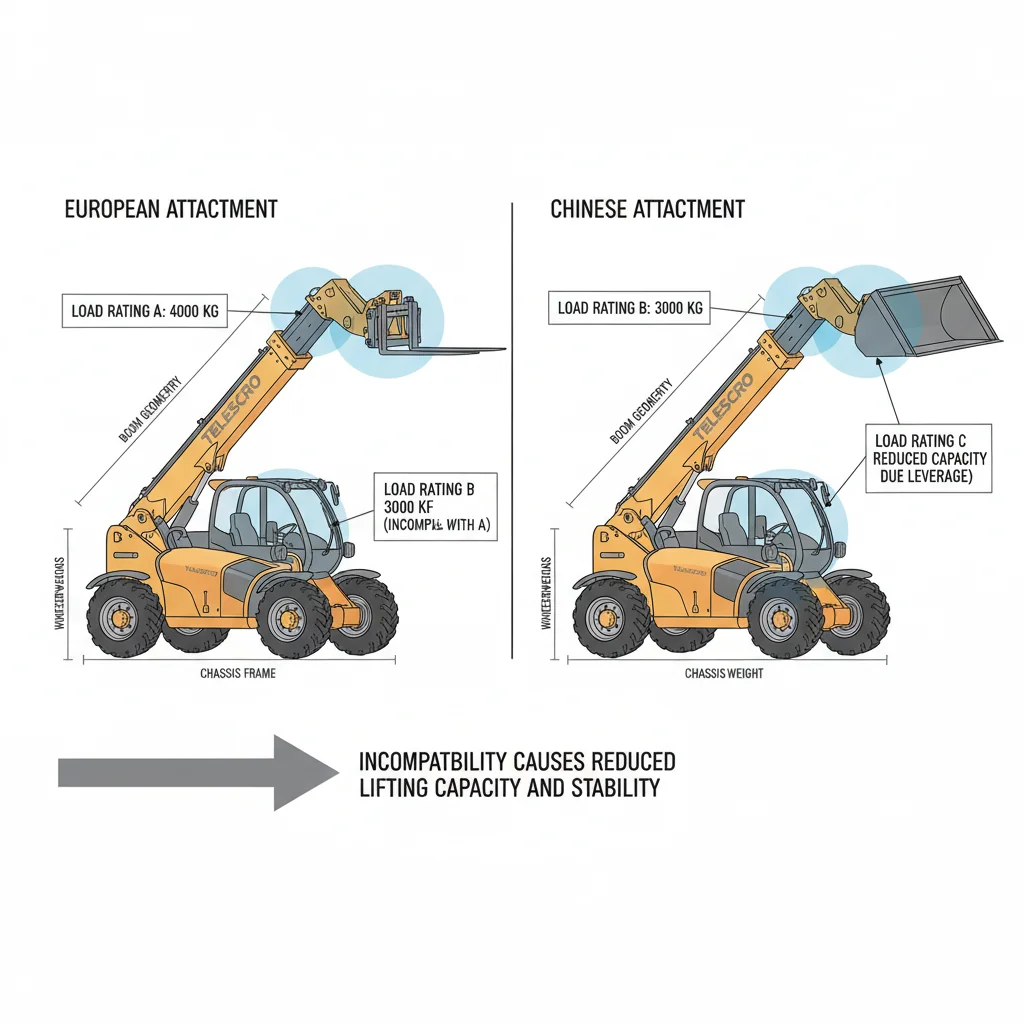
Most people don’t realize that fitting a European bucket or man basket onto a Chinese telehandler doesn’t mean the load chart from either machine still applies. I’ve seen this problem firsthand in Kazakhstan. A rental company there urgently swapped a 900-kg European pallet fork onto a 3-ton Chinese telehandler to finish a project. On flat ground with short lifts, everything seemed fine. But when they tried to extend the boom to nearly 12 meters on a sloped jobsite, the rear wheels started to lift—no warning from the in-cab moment indicator. The situation went from “compatible” to “close call” in an instant.
Why does this happen? To be honest, the factors that determine rated load are much more than attachment pin size or fitment type. They include the machine’s center of gravity, boom geometry, frame rigidity, wheelbase, and counterweight mass. Even two telehandlers with similar lift capacity and reach can react very differently to the same attachment if one is built with a lighter chassis or different rear ballast.
Here are the key points I always share with my customers:
- Never trust a physical fit alone—proper load rating depends on full machine/attachment integration.
- Request updated load charts—the machine manufacturer should supply data for your exact combination and setup.
- Treat unlisted combinations as uncertified—derate your working limit or avoid use if unsure.
- Train operators—don’t let them assume that “if it fits, it’s safe.”
- Watch for stability issues at full outreach or on uneven ground—that’s when problems show up.
I suggest checking every new attachment pairing against official data—guesswork in this area can cost far more than a few extra minutes of paperwork.
Using a European pallet fork rated for 900 kg on a Chinese telehandler with a 3-ton capacity can lead to load chart inaccuracies, especially when extending the boom beyond 10 metersTrue
Load ratings are calibrated for specific attachments and chassis dynamics; mismatching a lower-rated attachment on a higher-capacity telehandler, particularly at extended reach or uneven terrain, can shift the machine’s center of gravity and reduce stability, invalidating the original load charts.
European attachments are universally compatible with Chinese telehandlers without affecting load ratings because all telehandlers follow standardized ISO mounting interfacesFalse
Despite some standardization efforts, many telehandlers use proprietary or region-specific mounting systems, and load ratings depend on the combined machine and attachment dynamics, so assuming universal compatibility disregards critical differences that affect safety and performance.
Key takeaway: Physical compatibility between European attachments and Chinese telehandlers does not ensure safe or certified lifting capacity. Always require updated load charts for each unique combination to verify rated limits. Treat undocumented setups as uncertified, and train operators to avoid assuming compatibility equates to safety.
Are hydraulic pressures and flows compatible?
European and Chinese telehandlers often differ in hydraulic pressure3 (typically 210–280 bar vs. 200–250 bar) and flow rates, affecting attachment compatibility. Mismatched hydraulics may cause sluggish operation, seal failure, or overheating. Comparing both maximum pressure and rated flow on both machine and attachment is essential for safe, effective performance.
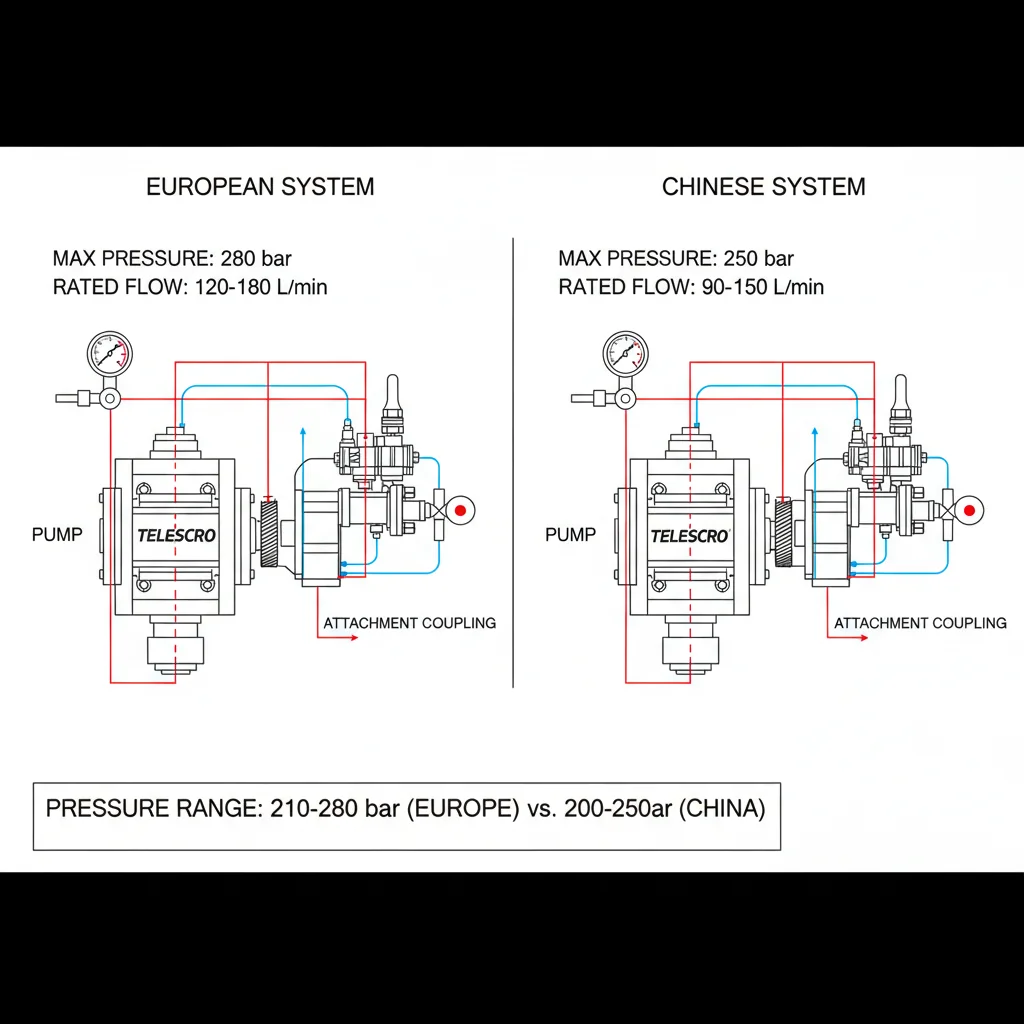
Here’s what matters most when checking hydraulic compatibility—pressure and flow aren’t just numbers on a spec sheet; they directly control how your attachments perform on the jobsite. I’ve seen this firsthand in Dubai, where a client tried pairing a European man basket—rated for 250 bar, 80 L/min—with a Chinese telehandler supplying only 220 bar and 62 L/min.
The platform lifted, but movement lagged and the clamp struggled to lock properly. Operators noticed the oil temp creeping up after just an hour of use. In that case, running below the attachment’s design spec created both sluggish responses and early overheating.
I often see contractors focus only on connectors or mounting, but the real challenge comes from these hydraulic details. If your telehandler pump can only deliver 60 L/min, but the attachment expects 90, you’ll get weak motion or even motor stalling. Too much pressure, on the other hand, can blow seals—especially with rotating grabs or augers.
In Kazakhstan, a customer burned through three sets of swing motor seals in one season because his flow exceeded the rated limit by 20%. Not every mismatch is obvious at first; sometimes problems only appear after hours of operation in hot climates or during heavy cycles.
To be honest, the safest approach is always to compare both maximum allowable pressure and rated flow on both the machine and the attachment’s placard—or manual if you have it. If you’re operating near the upper limit, consider fitting a pressure- or flow-limiting valve. I suggest testing slowly after hookup, watching your response, holding power, and especially oil temperature. Catching problems early will save time and long-term costs.
Hydraulic attachments designed for 250 bar and 80 L/min may underperform or cause overheating if paired with a system delivering only 220 bar and 62 L/min, due to insufficient pressure and flow limiting actuator speed and oil temperature regulationTrue
Attachments require hydraulic parameters within their specified range to operate efficiently; lower pressure reduces the force available while lower flow limits speed, causing sluggish responses and increased oil internal friction, which generates heat.
As long as the hydraulic pressure ratings match, any European attachment can operate flawlessly on a Chinese telehandler regardless of flow rate differencesFalse
Pressure alone doesn't guarantee compatibility; flow rate determines how quickly hydraulic cylinders and motors can move. Even if pressure matches, insufficient flow will slow or prevent proper attachment operation, causing performance issues or component stress.
Key takeaway: Always verify both hydraulic pressure and flow rate specifications on European attachments and Chinese telehandlers before use. Incompatible hydraulics risk overheating, component damage, and poor attachment performance. Professional evaluation and pressure/flow-limiting devices are recommended for borderline cases to maximize safety and reliability.
Are Adapter Plates Safe for Telehandlers?
Adapter plates enable the connection of European attachments to Chinese telehandlers when couplers differ, but introduce significant safety and performance considerations. The added weight and forward shift may decrease maximum tip load4 or lift height by around 5%. Additional welds and locking points risk failure if poorly engineered, and most warranties exclude unsupported adapters.
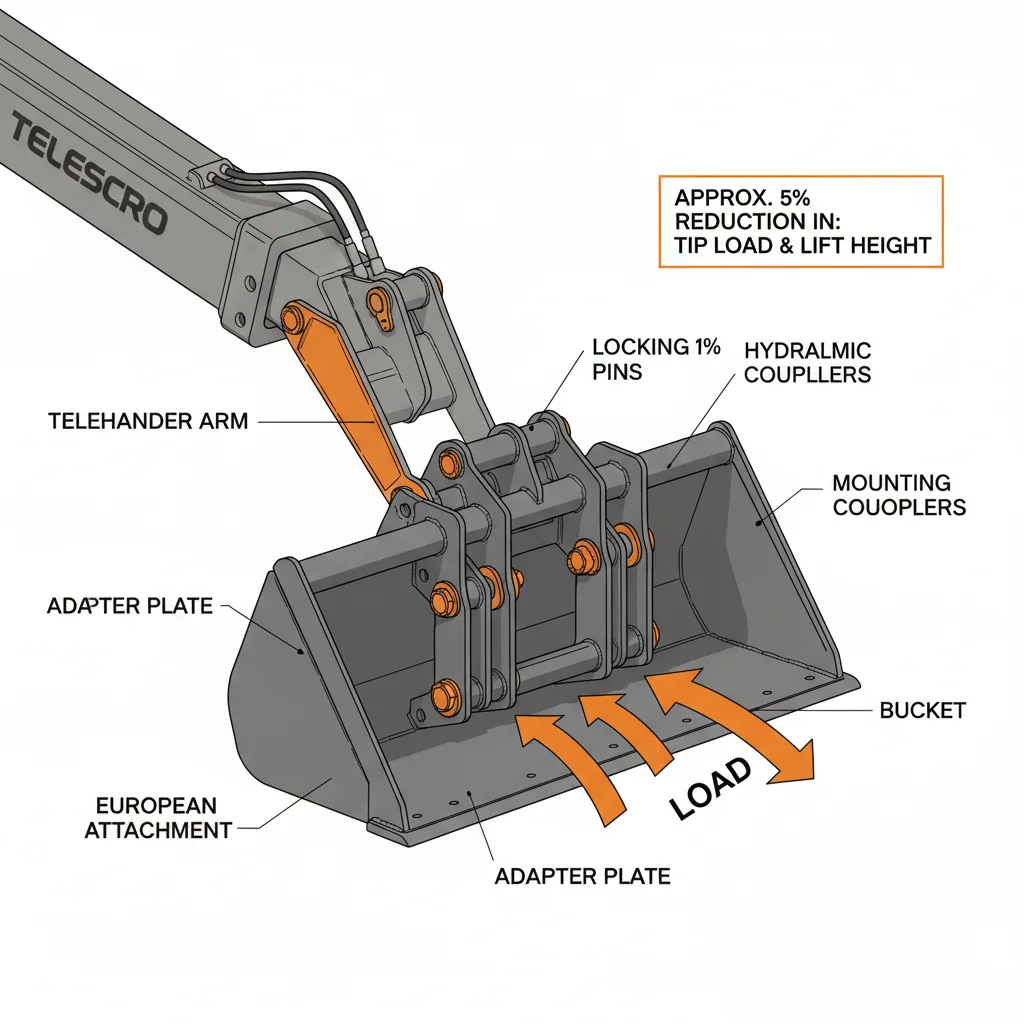
The biggest mistake I see is treating adapter plates as a simple bolt-on solution. It sounds convenient, but every jobsite I’ve visited where adapters come into play—like last year in Kazakhstan—ends up with new risks nobody expected. For example, a crew there used a heavy-duty 60 kg steel adapter to run their European pallet fork on a 3.5-ton Chinese telehandler.
The problem? The extra weight and forward shift shaved at least 5% off their maximum safe load at full extension, dropping it under 1,600 kg at 12 meters when they expected more. Add a bucket or work platform, and the safety margin gets razor thin.
From my experience, the added interface introduces more wear points—pins, hooks, welds. These are prone to crack if the plate isn’t professionally engineered. In Dubai, I saw a locking pin shear off mid-lift because an undocumented adapter used subpar steel. That shut down the project for two days and voided both the machine and attachment warranties. Keep in mind: Most OEMs will not cover failures that involve non-tested adapters, no matter how skilled your crew is.
I always suggest only using factory-engineered or fully documented adapters, with load limits stamped right on the plate. Ask your OEM directly how using an adapter will affect the rated load and warranty. Make it routine to inspect welds, pins, and locks every 200 hours—don’t wait until you spot cracks. My advice: If a shop can’t provide full specs or test reports, it isn’t worth the risk, especially on high-reach or heavy lifts.
Using a heavy-duty steel adapter plate weighing around 60 kg on a 3.5-ton telehandler can reduce its maximum safe load capacity by approximately 5% at full boom extensionTrue
The additional weight of the adapter plate shifts the load center forward, reducing the machine's stability and effectively decreasing its rated lifting capacity, especially at maximum extension where leverage effects are greatest.
Adapter plates universally increase the safe load capacity of telehandlers by distributing the attachment weight more evenlyFalse
Adapter plates typically add extra weight and can shift the load center forward, which reduces stability and safe load capacity rather than increasing it; their primary purpose is to enable attachment compatibility, not to enhance lifting limits.
Key takeaway: Adapter plates offer attachment versatility but impact telehandler performance and safety. Always use engineered, tested adapters with clear specifications, consult OEMs about warranty and load ratings, and conduct regular detailed inspections. Poorly made or undocumented plates raise risk of structural failure, accelerated wear, and warranty voids.
Do Mixed Attachments Void Telehandler Warranty?
Combining non-approved European attachments with Chinese telehandlers, especially via non-OEM adapters5, can breach both safety regulations and manufacturer warranties. Jurisdictions like the EU require the entire system—machine, coupler, and tool—to be certified. Using uncertified combinations risks voiding warranties, insurance denial, and potential legal liability if involved in an incident. Always obtain written compatibility documentation from both suppliers.
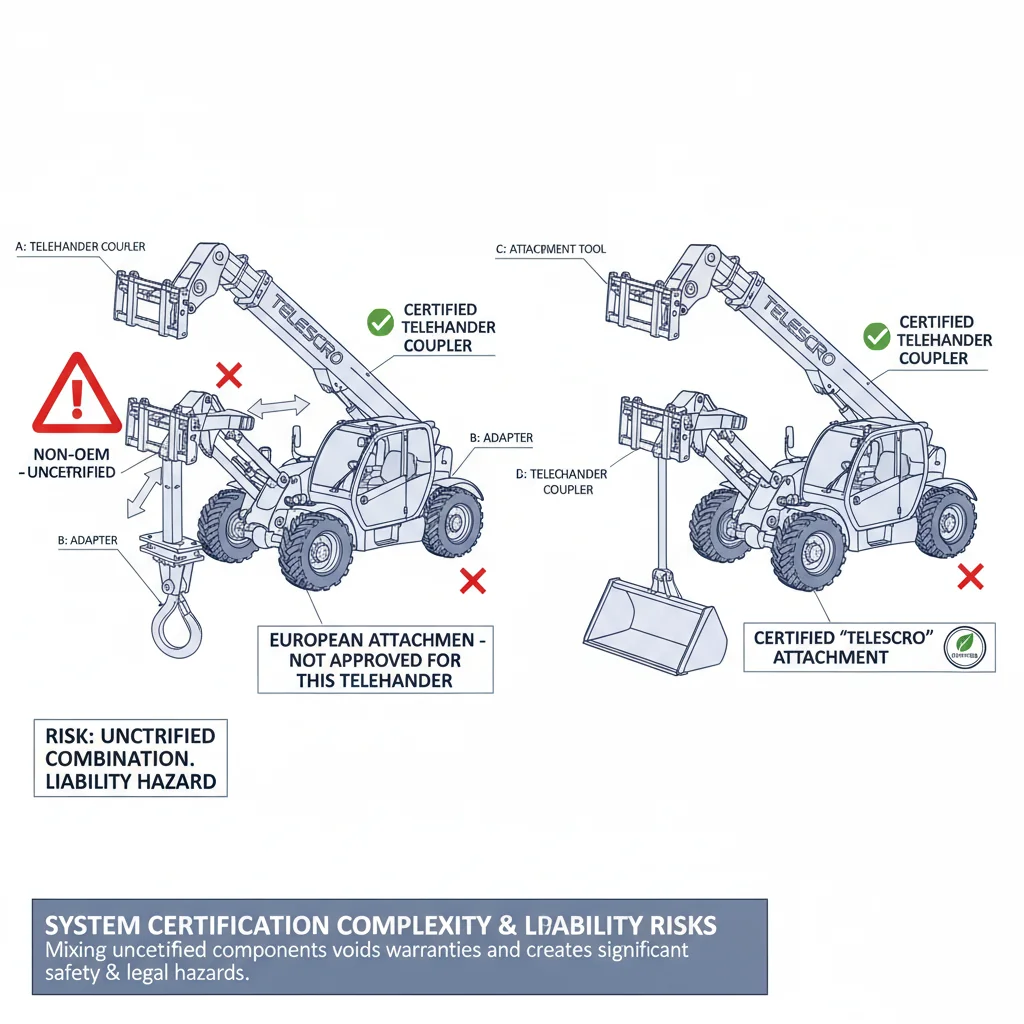
Last year, a project manager in Dubai called me with a tough question—could he use a European block grab attachment on his new 4-ton Chinese telehandler, using a locally-made coupling adapter? I’ve seen this type of mix quite often, especially where budgets are tight or import options are limited.
The reality is, mixing attachments and adapters like this can lead to serious headaches. Many people assume that as long as the adapter physically fits and the hydraulic lines match, the setup is good to go. But what counts on paper doesn’t always keep you covered in real-life situations.
The main risk is simple: most telehandler warranties—and insurance policies—are only valid when you use system-approved combinations. In Europe, for example, CE certification6 applies not just to the machine itself, but to the entire load-handling system. If a 1,800 kg fork carriage from Europe is paired with a Chinese unit and a non-OEM adapter, no manufacturer will back that combo unless it’s specifically tested.
Here are the key steps I recommend before mixing attachments:
- Get written confirmation from both the telehandler and attachment suppliers that your planned combination is approved.
- Request supporting documents—load charts for your exact setup, declarations of conformity, or approval letters mentioning your adapter model.
- Check local regulations—in the EU, using uncertified combinations can lead to insurance claim rejections after an incident.
- Consider field tests under supervision—some jobsites in Kazakhstan have insisted on certified engineers observing first use.
If neither supplier will provide documentation, treat the setup as “use at your own risk.” I always suggest staying on the safe side when it comes to safety and liability.
Using an unapproved European block grab attachment with a locally-made coupling on a Chinese telehandler can void the telehandler's warranty due to mismatched load ratings and non-certified hydraulic connectionsTrue
Manufacturers specify attachments and adapters that meet strict engineering and safety standards; using non-certified components, even if physically compatible, risks damaging the machine and typically voids warranty coverage because the telehandler isn’t tested with those parts.
All European attachments are fully compatible with Chinese telehandlers if hydraulic hoses and mechanical fittings match, ensuring warranty remains validFalse
Physical fitting and hydraulic compatibility alone do not guarantee safe operation or warranty compliance; differences in hydraulic pressure ratings, structural design, and certification standards mean many European attachments are not compatible by default and using them may void the warranty.
Key takeaway: Using mixed or non-certified attachment combinations may nullify the telehandler and attachment warranties, trigger insurance claim rejections, and expose operators to legal risks. Always verify and document compatibility with both the telehandler and attachment suppliers to ensure system certification and maintain compliance.
Can Euro couplers fit Chinese telehandlers?
Many Chinese telehandlers for export can be factory-fitted with genuine or closely dimensioned Euro couplers, enabling compatibility with European attachments. However, precise specification is essential, as domestic-market models often use proprietary designs and ‘Euro-type’ options may differ from true Euro dimensions. Confirming with coupler drawings7 and attachment samples is critical for seamless integration.
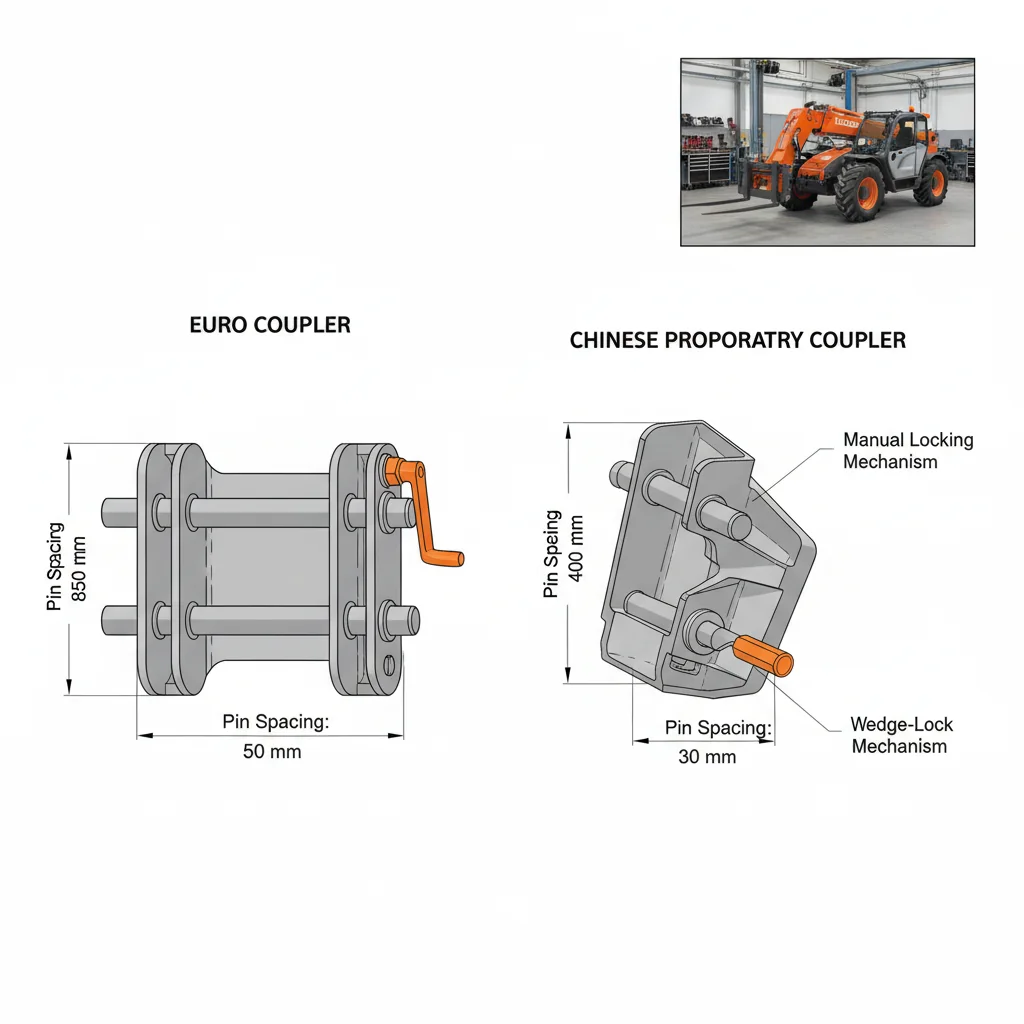
The biggest mistake I see is assuming all “Euro” couplers from China are truly identical to what you use in Europe. I’ve worked with three clients in Poland and the Netherlands who ran into trouble here. They ordered 3-ton telehandlers fitted with “Euro-type” carriages, but when their farm attachments arrived—buckets, pallet forks, bale clamps—the locking pins didn’t line up.
Sometimes, even a 10-millimeter difference meant the attachment wouldn’t lock securely or sit flush. One customer ended up spending around €1,200 and lost almost a week on site waiting for a retrofit kit. That’s not something you want when schedules are tight.
To be honest, the spec that actually matters is a true Euro carriage drawing8—measured bolt holes, width, pin spacing. Chinese factories usually offer several coupler styles: genuine Euro, “Euro-compatible,” and their own domestic types.
From my experience visiting factories near Changsha, if you confirm the right design and send attachment drawings before production, most OEMs will match exactly—for little or no extra cost at the start. But ask late, and a retrofit will cost more and delay delivery by weeks.
Here’s what I advise: when you request a quote, specify both your attachment type and a sample brand or model. Get the factory’s coupler drawing, then compare it carefully with your current fleet. If possible, even test-fit a sample. In my opinion, double-checking coupler specs at the factory stage saves a lot of stress—and money—down the line. I always suggest sorting these details up front to ensure your telehandler and attachments work together seamlessly from day one.
Chinese telehandlers marketed with 'Euro-type' carriages often have locking pin spacing variations up to 10 millimeters compared to genuine European standards, causing compatibility issues with European attachmentsTrue
Despite being labeled 'Euro-type,' Chinese manufacturers may not strictly adhere to exact European ISO mounting dimensions, resulting in small but critical mismatches like pin spacing that prevent secure locking and proper attachment fit.
All telehandlers equipped with Euro couplers, regardless of origin, can interchange European attachments without modification due to strict global ISO standardizationFalse
Although there are international standards for Euro couplers, variations in manufacturing tolerances and regional interpretations cause dimensional differences, especially from Chinese manufacturers, meaning attachments often require adjustments or cannot be used directly.
Key takeaway: Specifying true Euro couplers at the factory stage ensures Chinese telehandlers work safely and efficiently with existing European attachments, saving on retrofit costs and avoiding compatibility risks. Confirm specs with drawings and samples before signing, as many OEMs accommodate coupler preferences when requested early.
How to Verify Telehandler Attachment Fit?
Verifying mechanical compatibility between European telehandler attachments and Chinese machines requires more than photo comparisons. Small differences—just 10–20 mm in pin centre distance9, hook profile, or lock bar position—can prevent safe coupling. Always request detailed coupler drawings from both suppliers and compare key measurements in millimetres before purchase for reliable, safe fitment.
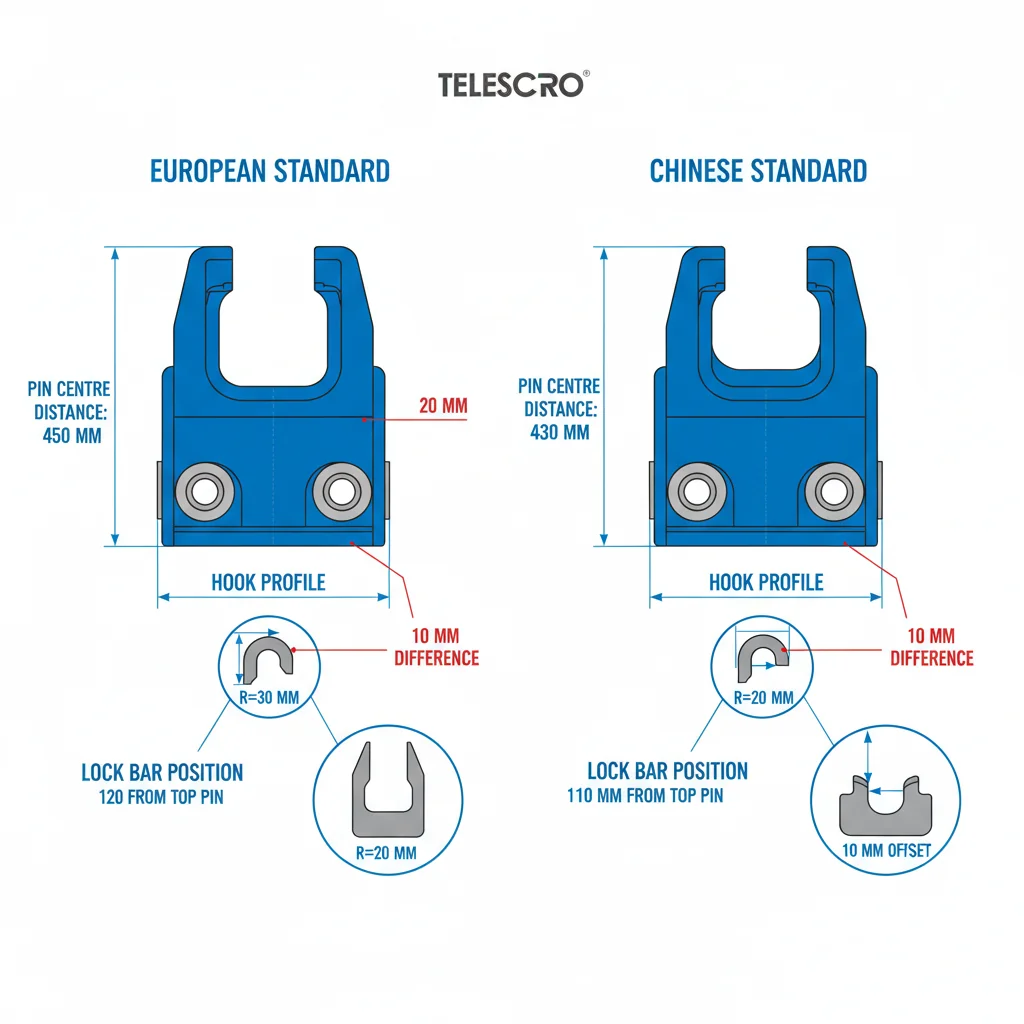
To be honest, the spec that actually matters is the pin centre distance on your coupler—just a 15 mm mismatch can stop an entire project. I’ve seen this first-hand with a customer in Poland who ordered a 3-ton block grab for a Chinese telehandler.
On paper, both sides said “European standard.” In reality, the hook width was off by 12 mm and the lock bar sat 18 mm out of position. Nothing locked safely. Their team spent three days fabricating shims and grinding steel, plus an extra USD 350 in downtime—money that could have gone into safer, faster lifting.
If you want to avoid that, visual checks and quick photos are not enough. Precise fit needs millimetre-by-millimetre measurement. Here’s what I always suggest before you sign any order:
- Request detailed coupler drawings (in millimetres) from both the machine and attachment suppliers—never settle for “should fit” or guesswork.
- Directly compare these critical dimensions: pin centre to pin centre, hook profile shapes, and lock bar slot position.
- Have the drawings reviewed by an independent inspector or local fabricator if you’re not confident interpreting them yourself. This third-party check can spot issues you might miss.
- Already own the attachment? Measure it out or, better, ship it to the telehandler supplier for a physical jig fit. I’ve done this in Kazakhstan—one afternoon saved weeks of regret later.
- Double-check wear allowances: Even a minor difference leads to accelerated wear or unsafe play under load.
These steps take extra time upfront, but I promise, it’s far less than dealing with site stoppages and emergency repairs after delivery.
A pin centre distance mismatch as small as 10-15 mm between European attachments and Chinese telehandlers can prevent the coupler from locking safely, causing significant onsite delaysTrue
Coupler systems rely on precise alignment of pins to ensure secure attachment; even minor deviations in pin centre distance disrupt locking mechanisms, requiring costly modifications or replacement parts to restore compatibility.
Because both European and Chinese telehandlers adhere to the 'European standard' for attachments, all their couplers and pins are interchangeable without modificationFalse
Despite both claiming to follow the 'European standard,' manufacturing tolerances and slight design variations, such as hook width and lock bar positioning, often differ enough to prevent direct interchangeability without custom adjustments.
Key takeaway: Never trust verbal assurances or visual checks alone when matching European attachments to Chinese telehandlers. Request dimensioned technical drawings from both parties and compare critical measurements. Even minor discrepancies can lead to unsafe coupling, accelerated wear, or failure—resulting in costly modifications or downtime after delivery.
Will European attachment electrics work correctly?
Electrical compatibility between European telehandler attachments and Chinese machines often presents challenges, as solenoids, sensors, and electro-hydraulic valves may require specific voltages, connector types, or signal protocols. Adapter cables may not resolve differences in proportional control10 or logic, potentially resulting in limited, inoperable, or harsh-all-or-none attachment functions. Proper verification and custom solutions are recommended.
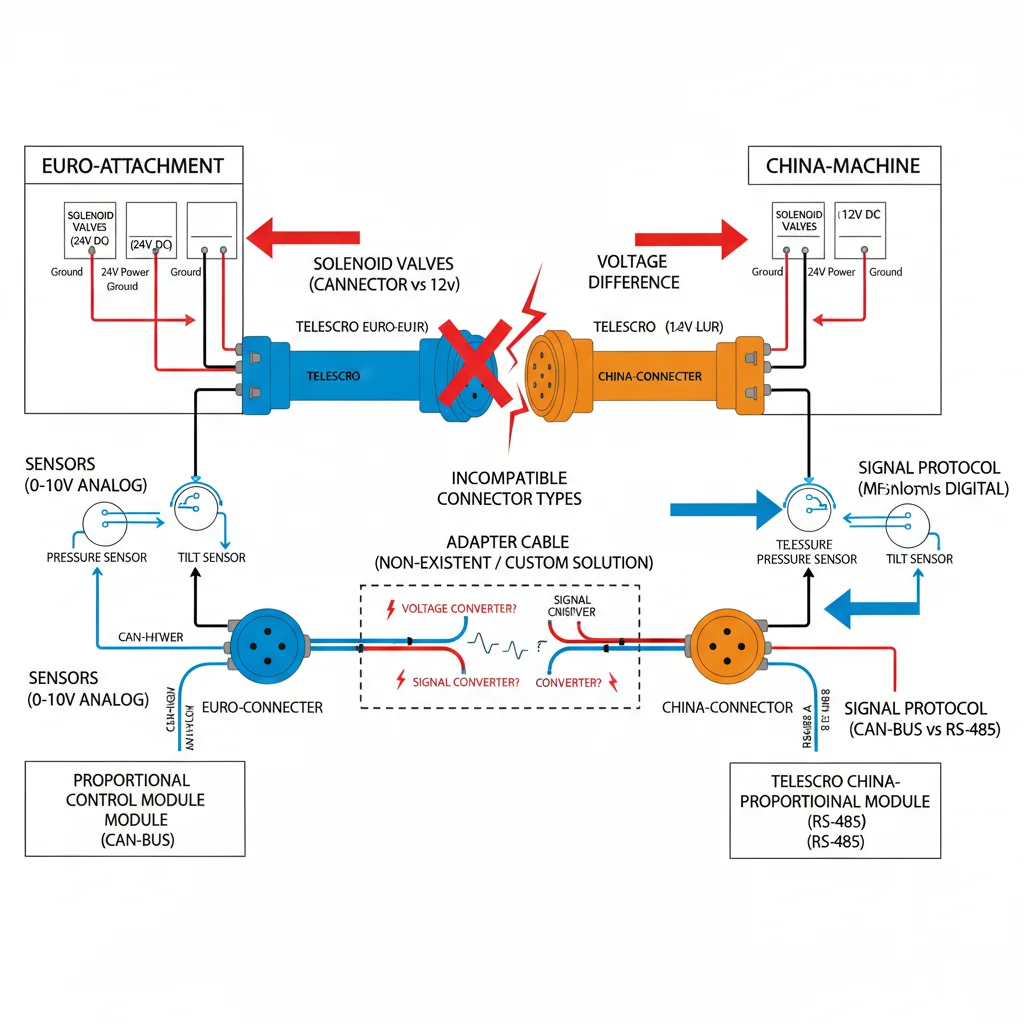
I’ve worked with several European contractors, and one story from Poland stands out. Their team brought over a high-spec rotating fork attachment expecting it to “click and play” with a 4-ton telehandler from a Chinese manufacturer.
On paper, both the attachment and the machine supported 24V electrics and auxiliary plugs, but at the jobsite, only the basic fork tilt worked—side-shift and rotation were stubbornly dead. What happened? The control logic didn’t match; the machine sent a simple on/off signal, while the attachment needed proportional input for smooth operation.
Technical mismatches like this aren’t rare. Many European attachments use advanced proportional valves, CANbus communication11, or unique Deutsch connectors. Chinese telehandlers might only offer basic on/off controls or different connector pin configurations. Even using an adapter cable, you may see only “full speed or zero”—no feathering, no smooth clamp, just harsh starts and stops. I’ve seen customers in Brazil damage their expensive clamps this way, crushing boxes instead of gripping gently.
To avoid problems like these, I suggest taking these steps before pairing European attachments with Chinese telehandlers:
- List all required attachment functions—tilt, side-shift, rotation, clamp.
- Check the telehandler’s available electrical circuits (number, voltage, signal type).
- Compare connector types and wiring diagrams for both machines.
- Plan for custom adapter harnesses or electronic control boxes if the logic isn’t compatible.
- Test all functions at low speed, in a safe spot, before putting the setup into daily use.
Taking time to verify these details prevents costly downtime and protects both your machine and your reputation on site.
Even if both a telehandler and attachment support 24V electrics, differing control signal protocols can prevent full functionality of auxiliary hydraulics like side-shift and rotationTrue
Voltage compatibility alone doesn’t guarantee interoperability. European attachments often use specific CANbus or PWM signals for multiple functions, while some Chinese telehandlers rely on simple on/off signals, causing certain features to fail despite apparent electrical compatibility.
All European telehandler attachments operate on a universal 24V standard that ensures complete plug-and-play compatibility with Chinese telehandlersFalse
There is no universal European standard guaranteeing plug-and-play between telehandler brands, as manufacturers use proprietary control logics and connectors. This often leads to partial or total incompatibility despite matching voltage ratings.
Key takeaway: Simply plugging in a European attachment to a Chinese telehandler may not guarantee full electrical function or proportional control. Verify all electrical requirements and plan for custom wiring or controls to ensure safe, precise, and damage-free operation, especially for attachments relying on advanced electronic functions.
What Are Hidden Costs of Attachment Adaptation?
Adapting European attachments to Chinese telehandlers involves hidden costs beyond initial purchase savings. Typical expenses include custom adapter plates12, coupler modifications, hydraulic replumbing13, and electrical rewiring, averaging $500–$1,500 per machine. Additional lifecycle costs stem from downtime, engineering checks, reduced lifting capacity due to extra weight, and recurring inspections, all of which impact overall return on investment.
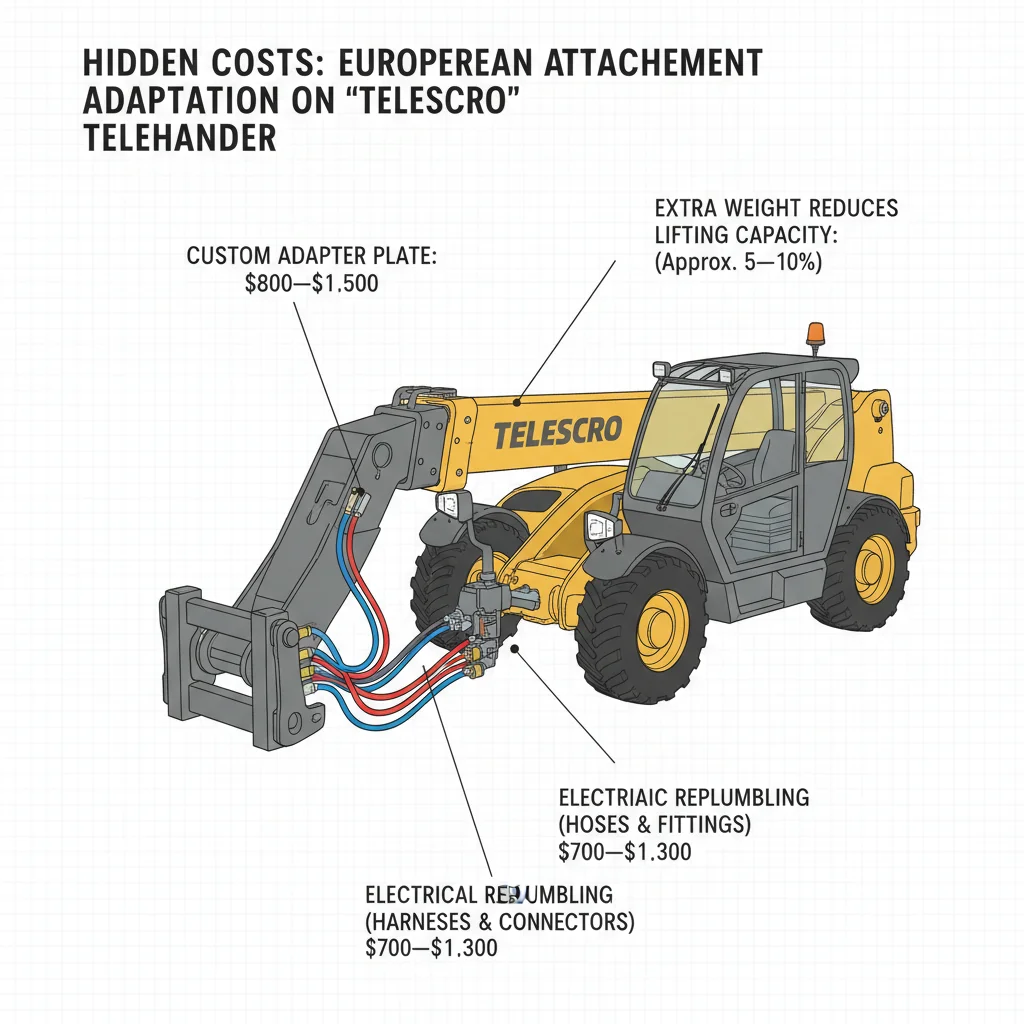
Last month, a contractor in Kazakhstan contacted me after his team tried adapting European forks to a 3.5-ton Chinese telehandler. He was excited about the savings upfront, but I quickly pointed out that adaptation brings more than just a quick weld and fit. Here’s what usually gets overlooked when you adapt attachments across standards:
- Custom adapter plates – Fabrication and fitting typically run $300–$600, depending on metal thickness and jobsite welding.
- Hydraulic replumbing – Extra circuits or flat-face couplers are often needed for rotating buckets or man platforms, adding $200–$400 in parts and labor.
- Electrical rewiring – If your attachment has sensors or tool recognition pins, expect $100–$250 more for safe integration.
- Machine downtime – Swapping couplers or waiting on custom steel can sideline a unit for at least two working days per adaptation.
- Ongoing inspections – Local safety codes in places like Australia or Germany sometimes require annual re-certification if you use non-standard adapters, which can cost $150 each time.
- Reduced lifting capacity – For heavier adapters (sometimes 30–50 kg), the machine’s rated load drops. I’ve seen cases where a 3.5-ton telehandler was suddenly limited to just 3 tons once all adaptation hardware was factored in.
If your crew counts on full capacity, that derating matters. One customer in Brazil ended up renting a second telehandler for a month—so much for the initial savings. I always suggest building a total cost comparison with all adaptation costs, lost time, and possible load reduction included. This way, you can negotiate more effectively with your supplier and avoid “the second-year surprise.”
Adapting European forks to a 3.5-ton Chinese telehandler often requires custom adapter plates costing $300–$600 due to differences in mounting dimensions and metal thicknessTrue
European and Chinese telehandler attachment standards vary in plate thickness, pin diameter, and spacing, making bolt-on compatibility rare. Custom adapter plates are necessary to ensure secure mounting, which usually incurs fabrication and welding costs in the $300–$600 range.
Hydraulic replumbing is rarely needed when fitting European attachments to Chinese telehandlers because hydraulic connectors and pressures are standardized globallyFalse
Hydraulic systems differ widely by manufacturer and market. European attachments often operate at different pressures and use incompatible connectors compared to Chinese telehandlers, necessitating replumbing and potentially new hoses or valves to ensure safe and reliable operation.
Key takeaway: Modifying Chinese telehandlers to accept European attachments can significantly increase total ownership costs. Factoring in adaptation hardware, labor, downtime, and possible capacity reduction is essential for accurate cost comparison and informed negotiations with suppliers.
Conclusion
We’ve talked about why European attachments rarely fit straight onto Chinese telehandlers, and the critical need to double-check both sides of the spec sheet before buying. In my experience, assuming “Euro-style” means plug-and-play is a common pitfall—even a few millimeters off in the coupler can cause problems on site. Before you invest, I suggest confirming fitment personally and making sure you can source parts locally. That’s how you avoid the “parts roulette” nobody wants.
If you’re unsure about an attachment or want a sanity check before a purchase, I’m always happy to help. Feel free to reach out—real jobsite answers, no pressure. The right fit keeps your team moving safely and efficiently.
References
-
Detailed insights on safety and performance issues when using adapter plates, including load reductions and structural risks on telehandlers. ↩
-
Detailed insights into quick-coupler designs and their role in secure attachment locking for telehandlers, preventing costly mismatches. ↩
-
Explore detailed insights on how mismatched hydraulic pressure impacts performance, seal durability, and equipment safety in telehandlers. ↩
-
Expert explanation of how adapter plates can reduce maximum tip load by around 5%, impacting telehandler lifting safety and performance. ↩
-
Detailed explanation of warranty and safety risks when using non-OEM adapters, highlighting compliance and liability concerns. ↩
-
In-depth insight into CE certification requirements for telehandler systems, ensuring legal compliance and warranty validity in the EU market. ↩
-
Details the importance of detailed coupler drawings for matching key dimensions and preventing unsafe fits between machines and attachments. ↩
-
Explains the importance of precise Euro carriage specifications to avoid costly mismatches and retrofit delays on construction sites. ↩
-
Explains how millimetre precision in pin centre distance ensures safe coupling and avoids costly on-site modifications. ↩
-
Explore how proportional control enables smooth, variable operation of telehandler attachments beyond simple on/off signals. ↩
-
Gain insights on how CANbus protocols facilitate advanced machine-to-attachment data exchange and why mismatches cause operational issues. ↩
-
Explains fabrication and fitting costs of adapter plates vital for cross-standard attachment compatibility in telehandlers. ↩
-
Details parts and labor involved in hydraulic circuit modifications required when adapting attachments for telehandlers. ↩