











Telehandler 4-Wheel Steering Mode: How It Works & Operator Mistakes to Avoid
Not long ago, a site manager in Brazil sent me a video: their new 12-ton telehandler was squeezing down an alley barely wider than the machine itself. Impressive maneuver—but then he admitted half his crew kept “dog-walking” the telehandler after switching steering modes1, burning through tires and causing near-misses. This isn’t unusual.
Telehandler four-wheel steering mode employs simultaneous, coordinated articulation of the front and rear axles, with the rear wheels counter-steering at a calculated ratio to the front to achieve an exceptionally tight turning radius2. Steering is controlled via hydraulic or electrohydraulic systems3, using sensors and integrated controllers for precise wheel synchronization and safety interlocks.
How Does Telehandler 4-Wheel Steering Work?
Telehandler 4-wheel steering enables both front and rear axles to steer, with the front wheels and rear wheels turning in opposite directions. This counter-steer geometry4 allows the machine to rotate around a common center, achieving turning circles as tight as 3–4 meters, which is far superior to fixed-rear-axle machines.

Most people don’t realize that 4-wheel steering on a telehandler is more than just a fancy feature—it completely changes how the machine handles in tight spots. I’ve watched a 12-meter reach telehandler with all-wheel steering navigate warehouse aisles in Dubai that were barely wider than a city street—no need for constant forward-reverse shuffling. It’s possible because both the front and rear axles steer independently, with the rear wheels turning opposite the front. This is called “counter-steer geometry.” The machine basically rotates around a common center, not just pivoting around the front axle like a typical loader or fixed-rear telehandler.
Here’s a real scenario from a customer in Brazil. Their team used a 4-ton telehandler with 11-meter reach to place insulation panels between tight columns—turning radius was under 4 meters. On their old fixed-rear-axle unit, they needed at least 7 meters of open space, which often meant moving other equipment and losing time. I checked the hydraulic system configuration—it uses a dedicated steering circuit so the operator can switch between front, rear, crab, or all-wheel modes at the touch of a button. That flexibility is a big deal where jobsite layouts change daily.
I always suggest asking for a demonstration of the actual turning radius. Sometimes, “all-wheel steer” looks great in specs but falls short on a crowded site. Check for smooth hydraulic response and stability, especially with heavy loads. If you’re in a tight yard or small warehouse, seeing the machine reverse cleanly out of a narrow space can be the real proof—not just what the brochure says.
Telehandler 4-wheel steering typically enables a turning radius reduction of up to 40% compared to traditional 2-wheel steering, by allowing the rear wheels to turn opposite the front wheels at angles of up to 15 degreesTrue
By independently steering both front and rear axles in opposite directions, 4-wheel steering significantly shortens the turning radius, often by around 40%, which enhances maneuverability in confined spaces such as narrow warehouse aisles. Rear wheels usually turn up to about 15 degrees for optimal counter-phase steering.
In telehandler 4-wheel steering, the rear wheels always turn in the same direction as the front wheels to improve stability during high-speed travelFalse
In fact, telehandler 4-wheel steering uses counter-phase steering where rear wheels turn opposite to the front wheels at low speeds to minimize turning radius. When stability at higher speeds is desired, the system may switch to crab steering where both axles turn in the same direction, but this is not the default mode for tight maneuvering.
Key takeaway: 4-wheel steering allows long-wheelbase telehandlers to maneuver in tight sites by sharply reducing turning radius. Understanding the geometry and requesting a demonstration of minimum turning radius5 is crucial to ensure safe, practical mobility in operational environments requiring agile machine movement.
How Does 4-Wheel Steering Operate in Telehandlers?
Telehandler 4-wheel steering uses hydraulic or electrohydraulic systems, where the steering wheel sends signals to a valve that directs oil to cylinders on both axles. In this mode, rear wheels steer in opposite phase to the front, controlled by sensors and a controller for precise coordination. Modern systems enhance consistency, diagnostics, and recalibration efficiency.

Let me share something important about how 4-wheel steering actually works in telehandlers. Unlike a car, where the steering system is mostly mechanical, these machines rely on hydraulic or electrohydraulic circuits. When you turn the steering wheel, it sends either a hydraulic or electronic signal to a valve that directs oil flow into steering cylinders on both the front and rear axles. In 4-wheel mode, the rear wheels always steer in the opposite direction to the front—at a preset ratio. This coordination lets even a large 4-ton, 18-meter reach machine achieve a turning radius under 4.5 meters, which makes a massive difference in tight sites.
I’ve worked with a team in Dubai who switched from an older mechanical system to a modern electrohydraulic setup. Their challenge? Frequent steering misalignments and slow recalibration after maintenance. With the newer electronics, sensors track the exact wheel angles at all times. A controller then keeps those angles synchronized, adjusts automatically if one wheel lags, and enforces a safe mode when travel speed gets too high for rear-axle steering. After servicing, recalibration took under 20 minutes—down from over an hour previously—which cut their downtime substantially.
What I see on mixed-brand fleets, especially in Kazakhstan and Brazil, is that advanced systems offer more consistent steering response between operators and brands. Fault codes often pop up in the cab if there’s a sensor issue—making it easier for mechanics to diagnose without tearing everything down. I always suggest checking if the telehandler you pick has CAN-bus diagnostics and fast steering recalibration. It pays off when maintenance schedules get tight.
In 4-wheel steering mode, telehandlers typically use a steering ratio between the front and rear wheels ranging from 1:1 to 1:2, meaning the rear wheels turn up to half as much as the front wheels but always in the opposite directionTrue
This specific ratio allows for a tighter turning radius and enhanced maneuverability, while maintaining stability by limiting the rear axle steering angle relative to the front axle. It balances agility with control on varied construction sites.
The rear wheels in telehandler 4-wheel steering mode always turn in the same direction as the front wheels to reduce tire wear and improve stability on uneven terrainFalse
In reality, the rear wheels turn opposite to the front wheels in 4-wheel steering mode to significantly reduce the turning radius, allowing the telehandler to maneuver in confined spaces. Turning in the same direction would increase the turning circle and reduce maneuverability.
Key takeaway: Advanced 4-wheel steering in telehandlers relies on hydraulic or electrohydraulic controls that synchronize axle movements for precise maneuvering. Buyers benefit from greater operational predictability, improved diagnostics, and faster recalibration, especially useful in mixed-brand fleets or when minimizing downtime after maintenance.
When Should Telehandler Steering Modes Be Switched?
Operators should only switch telehandler steering modes—front-wheel, 4-wheel, or crab—when the wheels are completely straight and the machine is squared up. Changing modes with turned wheels can cause controller reference errors, resulting in dog-tracking, tire scrub, and unpredictable handling. Slowing to creep speed and retracting the boom further enhance safety and precision.
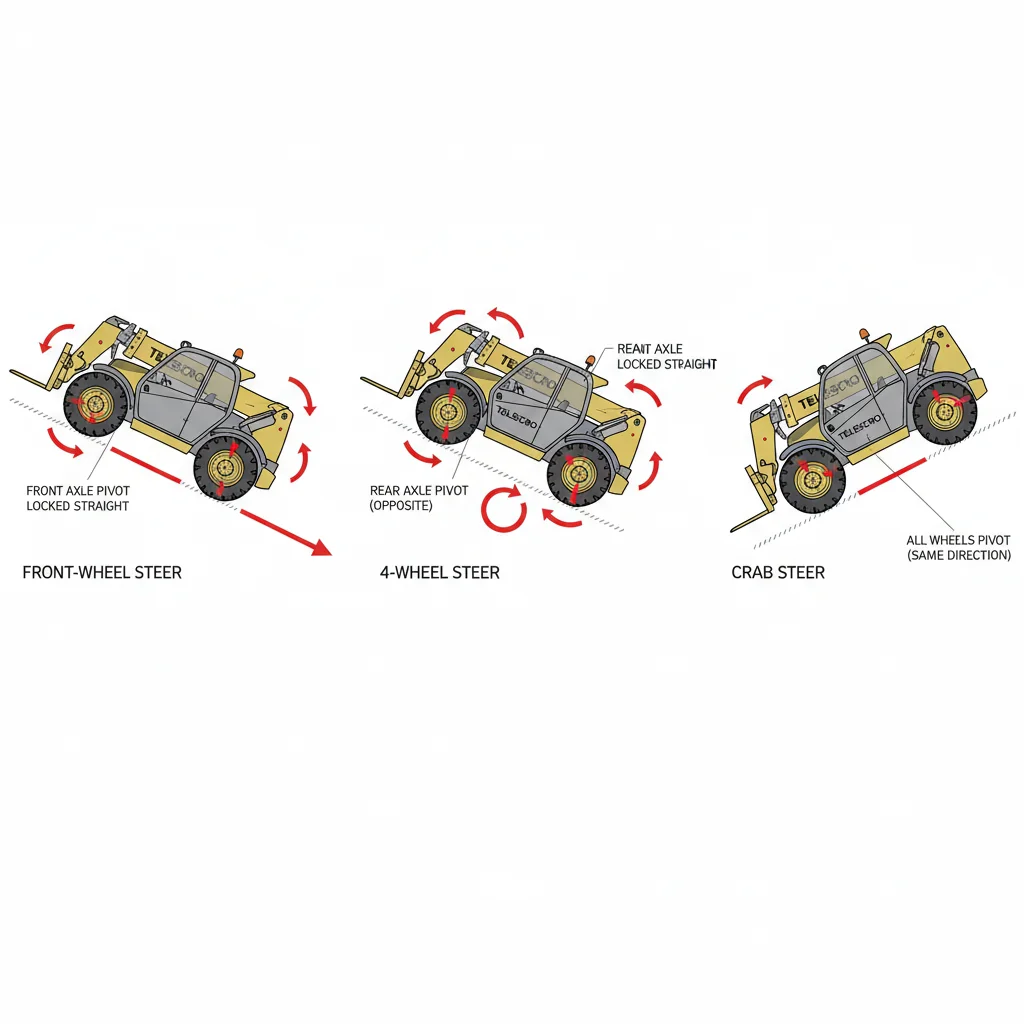
The biggest mistake I see is operators switching steering modes while the wheels are still turned—especially in busy yard work or tight sites. Last year, a team in Dubai called me about sudden “dog-tracking” after trying to change from 4-wheel to crab while turning. Their 4-ton telehandler started drifting sideways, and it cost them half a day to get the machine realigned. This happens because when the machine’s wheels aren’t straight, the controller gets confused—the reference point doesn’t match the physical wheel angle. The result? Tire scrub, rough handling, and extra wear on the hydraulic system.
Here’s what matters most when you’re thinking about changing steering modes: slow right down, ideally under 5 km/h, and make sure all wheels are pointing directly forward. In Kazakhstan, I trained a crew running a high-reach 18-meter model through narrow warehouse aisles. We made it a rule—stop, check the wheel alignment on all four corners, and retract the boom before touching the mode switch. It sounds basic, but even experienced drivers get it wrong when they’re rushing. If the boom is extended, it actually exaggerates handling problems during a mode change. Keeping it retracted gives your center of gravity more stability.
Some newer models have auto-centering, but I still see older machines where there’s no safeguard at all. I always suggest treating steering mode changes like any planned maneuver: pause, double-check, and only proceed when you’re sure the machine is fully squared up. It prevents future headaches, protects your tires, and keeps everyone on the job safer.
Switching from 4-wheel steer to crab steer mode with the wheels not perfectly straight can cause the telehandler’s control system to misinterpret wheel angles, resulting in unpredictable lateral drift and increased tire wearTrue
The telehandler’s steering controller relies on precise wheel alignment as a reference; changing modes while the wheels are angled confuses the system, causing misalignment between intended and actual wheel paths, which leads to dog-tracking and undue tire stress.
Crab steering mode automatically realigns the wheels to zero degrees before switching, allowing operators to change steering modes safely at any wheel angle without causing driftFalse
Most telehandler systems do not automatically straighten wheels before mode changes; operators must manually ensure wheels are centered to prevent control errors, as realignment is a manual process to avoid control system conflicts and mechanical strain.
Key takeaway: Always ensure the telehandler’s wheels are straight and machine squared before switching steering modes. This prevents control mismatches and reduces tire wear or handling issues. Operators should slow to creep speed, retract the boom, and treat every mode change as a deliberate maneuver, not a shortcut.
How Does 4-Wheel Steering Aid Maneuverability?
4-wheel steering dramatically improves telehandler maneuverability in tight or congested worksites by synchronizing the rear axle with the front, enabling the machine to pivot tightly around obstacles. This minimizes multi-point turns, reduces the need to reposition barriers, and increases the speed and safety of approach cycles in narrow aisles or restricted spaces.

Last month, a contractor in Dubai called me, frustrated about wasted time during material runs in a crowded warehouse. His site was packed. Pallets stacked high, maybe 4 meters between aisles. He was using a 7-meter telehandler with standard steering and found himself doing three-point turns just to navigate. It slowed the process, and the crew spent extra hours shifting barriers.
When I suggested trying a unit with 4-wheel steering, the difference was immediate. With the rear wheels matching the front—what’s called “all-wheel steer”—that same 7-meter model swung around obstacles with a turning radius under 4.5 meters. Suddenly, aisles that used to require complicated multi-point maneuvers were no problem. The telehandler “bent” around corners. Approach and exit times at each pallet stack dropped by at least 20%. Multiply that over a day, and you save hours—plus frustration.
From my experience, this advantage really stands out on livestock farms or tight urban sites. Think of a barn in Kazakhstan, where feed alleys are narrow, maybe just 3.5 meters wide. A compact 3-ton telehandler with 4-wheel steering can load, turn, and exit without bumping gates or fences. There’s a lot less risk of nudging a parked truck or damaging stored materials.
For fleet managers, this means more productive cycles, less labor shifting things out of the way, and fewer scratches on machinery or structures. I suggest considering all-wheel steer if your jobsite has limited space or frequent obstacles. It’s a real timesaver, not just a technical feature on a spec sheet.
4-wheel steering on telehandlers reduces the turning radius by up to 30%, allowing operators to maneuver in aisles narrower than the machine’s overall lengthTrue
By steering both front and rear axles, 4-wheel steering enables the rear wheels to follow the front's path more closely, significantly reducing the pivot space needed, which is especially valuable in confined warehouse environments.
4-wheel steering systems on telehandlers increase the maximum lifting capacity by distributing weight evenly across all wheelsFalse
While 4-wheel steering enhances maneuverability, it does not affect lifting capacity, which is determined by the boom design, hydraulic system, and chassis strength rather than steering configuration.
Key takeaway: 4-wheel steering enables telehandlers to bend around obstacles rather than push through wide turning arcs, making them the superior choice for tight construction plots, livestock barns, or crowded warehouses. This efficiency leads to faster operations, less labor, and a reduced risk of accidental impacts onsite.
How Does 4-Wheel Steering Impact Safety?
4-wheel steering improves telehandler maneuverability but alters machine movement, causing the rear to swing wider than the front during sharp turns. This unexpected tail swing heightens collision risks near obstacles and personnel. Stability is further compromised by high speeds or an elevated boom, requiring cautious operation and clear in-cab mode indicators for safety.

I’ve worked with customers who made this mistake—assuming that 4-wheel steering would always improve safety just because it boosts maneuverability. In Kazakhstan, a warehouse contractor switched to a 4-ton telehandler with 4-wheel steer, thinking it would solve their tight aisle problems. It definitely helped them make tighter turns—turning radius under 4.5 meters compared to nearly 6 meters with their old front-steer unit—but the team didn’t expect the tail to swing so far out. During training, one operator clipped a storage rack because the rear wheels tracked outside the front, creating almost a full meter of extra swing. That’s a big hazard with racks, walls, or even people moving close by.
From my experience, stability is the other area where operators need extra caution. If you turn sharply at anything above 8-10 km/h, especially with the boom raised or extended, the telehandler feels noticeably less stable. The load moment indicator6 (which warns of unsafe angles or overloading) can go off much sooner in those situations. One supervisor in Dubai asked why the reverse beeper wasn’t enough for safety—in reality, the mode indicator and steering feedback screen matter more. If operators don’t know which steering mode they’re using, accidents happen fast.
I always suggest buyers invest in machines with clear in-cab mode displays and wheel position feedback. Comprehensive operator training is critical. Review the load chart and moment indicator alarms for your exact model. For jobsites with pedestrians or parked equipment, conservative speed limits in 4-wheel steer are essential. The gains in maneuverability are real—but the safety trade-offs can’t be ignored.
4-wheel steering reduces the turning radius by redirecting the rear wheels in opposite or same-phase angles to the front wheels, which can cut the turning radius by up to 25% compared to front-wheel steering aloneTrue
By enabling the rear wheels to steer either counter to or in parallel with the front wheels, 4-wheel steering systems significantly improve maneuverability. This coordinated steering reduces the overall turning circle, often by around 20-30%, allowing telehandlers to navigate tight spaces more effectively.
4-wheel steering eliminates any tail swing off the rear of a telehandler, making it equally safe to operate in confined spaces as units without tail swingFalse
Although 4-wheel steering reduces the turning radius, it often increases tail swing because the rear wheels pivot, causing the counterweight to swing wider. Operators must remain vigilant as this tail swing can pose collision risks in confined environments, contradicting the assumption that 4-wheel steering removes tail swing hazards.
Key takeaway: Operators must be aware that 4-wheel steering introduces significant tail swing and stability trade-offs, especially during tight turns or with the boom raised. Prioritize in-cab feedback systems and formal training to reduce collision risks and uphold safe practices in environments with pedestrians or nearby equipment.
How Does 4-Wheel Steering Affect Tire Wear?
When precisely aligned, 4-wheel steering on telehandlers reduces tire scrubbing7 during tight turns, as each tire follows a natural arc. This minimizes uneven lateral forces and can extend tread life, especially in high-duty scenarios. However, misalignment or component wear may cause unintentional crabbing, leading to increased tire and steering joint wear.

Here’s what matters most when it comes to 4-wheel steering and tire wear on telehandlers: alignment is everything. When all four wheels follow their natural arc, tire scrubbing drops sharply—especially noticeable on jobsites like logistics yards or produce markets where machines are constantly weaving in and out of tight spaces. That natural tracking means lateral forces are spread more evenly. I’ve seen this save serious money on high-duty machines. For example, a rental fleet in Saudi Arabia running 3.5-ton, 14-meter units reported at least 20% longer tread life after switching their operators to strict “all-wheel steer only when aligned” rules. The tires looked less chewed up, even after months on abrasive concrete.
But there’s a trade-off. If the rear steer sensors drift, or a steering cylinder starts to leak, the machine can “crab”—move sideways—without the operator noticing right away. That’s when you see tires worn nearly bald on one edge, plus extra wear on ball joints and linkages. I recall a case last year in Brazil. A customer was frustrated by his tire costs, thinking it was just low-quality rubber. When I checked, the rear steering linkage was bent after a mild collision. Fixing that alignment issue brought tire life from barely 600 hours to over 1,000.
Tight turns stress all the steering parts, too. On high-hour machines, you’ll want to stick to greasing every 50 hours—don’t push it. I always suggest fleet managers add a quick alignment check to their weekly routine. It’s a simple step that can prevent a lot of hidden tire and component costs.
4-wheel steering on telehandlers reduces tire scrub by up to 40% in tight-radius turns by synchronizing rear wheel angles with front wheels, allowing all tires to follow natural rolling arcs.True
By coordinating the steering angles of all four wheels, 4-wheel steering minimizes lateral slip and scrub, especially during tight maneuvers. This alignment ensures tires wear evenly and last significantly longer, as demonstrated in fleet studies where tire replacement intervals extended by several thousand operating hours.
Using 4-wheel steering on telehandlers increases overall tire wear because the rear wheels turn against the natural rolling direction, causing more friction and heat buildup.False
Contrary to this claim, 4-wheel steering is designed to reduce tire wear by aligning all wheels along natural turning arcs, thereby minimizing lateral forces and scrub. Rear wheels turning in coordination with front wheels actually decrease friction and heat, which helps extend tire life rather than accelerate wear.
Key takeaway: Properly maintained 4-wheel steering systems can extend tire life and reduce wear in telehandlers. However, unchecked misalignments or worn steering parts will increase tire scrubbing and component damage. Regular alignment checks, lubrication, and repairs are essential to prevent hidden costs for fleet operators.
What Should Buyers Compare in 4-Wheel Steer?
Buyers should compare telehandler 4-wheel steering systems by evaluating minimum turning radius at full lock, noting if this is measured at the outer wheel or total machine width. Key differentiators include available steering modes—front, 4-wheel, crab, and advanced options—along with operator effort, electronic controls, diagnostic features like CAN fault codes, and rear-axle sensor integration.

From my experience, buyers often get too focused on basic “4-wheel steer” labels—without digging into what the system actually delivers onsite. I’ve worked with teams in Kazakhstan who discovered their telehandler’s spec sheet showed a turning radius under 4 meters, but this number only applied to the outer tire, not the entire machine width. The real clearance needed in a tight warehouse ended up closer to 4.8 meters—a costly oversight. Always ask whether turning radius is measured from the outer wheel or total machine span, especially for mid-size machines around 3.5 to 4 tons.
What really sets machines apart is steering flexibility. Most systems let you switch between front-wheel, 4-wheel, and crab steer. However, some advanced units offer smart positioning—like semi-crab—which really helps tracking along tight feed barriers or when docking to a loading bay. I spoke with a client in Brazil last year running bulk fertilizer loads; he found that having those extra modes cut maneuvering time by over an hour each shift. Operator fatigue is another factor many miss.
Some systems use hydraulic circuits needing four full turns lock-to-lock, while others use clever designs that manage the same maneuver in just one full turn. That can make a real difference when you’re racking up over a hundred turns a day on a busy job.
Telehandler 4-wheel steering systems often provide a smaller turning radius measurement based on the outer tire path, which may underestimate the actual space needed for the full machine width.True
Manufacturers commonly measure turning radius from the outer tire trajectory rather than the machine’s full width, so the true clearance needed onsite can be significantly larger, affecting maneuverability in confined spaces.
4-wheel steering in telehandlers always guarantees a turning radius below 4 meters, regardless of machine width or configuration.False
Turning radius depends on multiple factors including machine width, steering geometry, and wheelbase. 4-wheel steer improves maneuverability but does not universally ensure a sub-4-meter turning radius, especially on wider models.
Key takeaway: Comparing 4-wheel steering systems means looking beyond basic functionality. Analyze turning radius, mode variety, ergonomic enhancements, and electronic diagnostics to ensure efficient, safe maneuvering in tight spaces and high-cycle operations. Feature-rich systems give operational consistency, easier troubleshooting, and reduced operator fatigue, especially valuable for demanding fleets.
What Are 4-Wheel Steer Maintenance Risks?
Telehandler 4-wheel steering enhances maneuverability but introduces additional failure points, including hydraulic cylinders, joints, hoses, and electronic sensors. Common risks involve hydraulic leaks8, worn steering joints, misaligned linkages, and centering sensor faults. Preventive maintenance, such as greasing, oil checks, and electronic calibrations, is essential to avoid downtime, costly repairs, and rental penalties.

To be honest, the steering system is often where telehandler owners underestimate the risks. Four-wheel steering sounds great—tight turns, nimble movement—but every extra pivot point means more things to watch. Last year, I had a client in Kazakhstan with a 4-ton telehandler rated for 17-meter reach. After just 18 months, they called about erratic rear steering. The jobsite was busy, rented by the week, so any downtime was costly—$400 per day in lost fees alone. I inspected their machine and found a simple problem: rear steering joints were dry and the centering sensor was misaligned. As simple as it sounds, neglected greasing and skipped calibration had already worn down a $180 steering link.
With four-wheel steer, you’re maintaining double the usual steering joints and hydraulic cylinders. Hydraulic leaks often show up first at the rear steer cylinder—I’ve seen it in several 3,000-kg class models operating on rough ground in Brazil. It’s usually a nicked hose or seal from loose debris or bad routing. If left unchecked, fluid loss can trigger steering faults. Next thing you know, the system locks in 2-wheel mode or, worse, starts pulling to one side under load.
Regular system checks change everything. Greasing the pivot points every 100 hours, keeping hydraulic oil clean, and running a quick steering mode test during daily walk-arounds makes a real difference. I suggest planning for a yearly inspection and sensor recalibration—budgeting $300–500 is far better than an unexpected $1,500 rear cylinder swap. In my experience, disciplined maintenance transforms four-wheel steer risk into a true long-term advantage.
Four-wheel steering systems on telehandlers include additional hydraulic actuators at the rear wheels, increasing the complexity of the hydraulic circuit and requiring more frequent inspections to prevent leaks and pressure drops.True
The rear wheel steering in telehandlers operates through dedicated hydraulic cylinders and controls, adding extra hydraulic lines and seals compared to two-wheel steering. This complexity raises the risk of leaks and degradation, making regular inspection crucial to maintain precise steering function.
Telehandlers with four-wheel steering do not require alignment checks more often than those with traditional two-wheel steering, since their systems self-adjust automatically during operation.False
Four-wheel steering systems have multiple pivot points and tight tolerances that can shift due to wear or impact, meaning alignment can drift more quickly than in two-wheel systems. They do not self-correct alignment, so regular checks are essential to avoid uneven tire wear and steering imprecision.
Key takeaway: Disciplined preventive maintenance—greasing joints, monitoring hydraulic oil, and regular system inspections—is essential for telehandlers with 4-wheel steering. Neglect leads to expensive repairs and operational penalties, while proper care transforms advanced steering from a potential risk into a sustained productivity advantage, especially for rental fleets and busy worksites.
When Should Telehandlers Use Crab Steering?
Crab steering mode allows all four wheels of a telehandler to turn in the same direction, enabling precise diagonal movement without altering machine orientation. Ideal for parallel work along trenches, silage clamps, or tight loading docks, crab and semi-crab modes offer precise side-to-side positioning, minimizing multiple maneuvers. Active switching between steering modes improves efficiency and reduces collision risks in confined spaces.

One situation that stands out was on a jobsite in Kazakhstan, where a customer needed to stack silage along a trench with only about 4 meters between the machine and the wall. Their team tried using standard 4-wheel steering, but constant forward and reverse corrections wasted time and risked bumping the wall. That’s when I suggested switching to crab steer mode. Instantly, the operator could side-step the telehandler, keeping the attachment perfectly parallel to the trench. No wasted moves—just a steady diagonal motion that finished the task at least an hour quicker each day.
Crab and semi-crab steering modes aren’t just for open fields—they’re ideal when you need precise, lateral control in areas with tight boundaries or complicated layouts. Here are situations where these modes make a real difference:
- Loading Parallel to Obstacles: Alongside walls, trenches, or silage clamps, diagonal movement keeps the boom lined up with the load—no constant turning.
- Confined Loading Docks: In factories or distribution centers, crab steer lets you nudge the machine sideways while keeping the forks pointed straight.
- Barns and Feed Lines: Semi-crab helps in narrow aisles, shifting slightly without losing maneuverability—a common challenge I’ve seen in dairy operations in Brazil.
- Fence or Barrier Work: If you’re placing materials where there’s limited working width, lateral adjustment helps avoid knocks and scratches.
From my experience, operators who stay in one steering mode miss out. Switching actively between front-wheel, 4-wheel, and crab modes saves time, reduces collisions, and boosts jobsite safety. I suggest taking time to train your crew on these features—they’re more than just sales talk. Proper use pays off in both efficiency and reduced downtime.
In crab steering mode, all four wheels of a telehandler turn in the same direction and at the same angle, allowing the machine to move diagonally without changing its orientationTrue
Crab steering synchronizes the wheels to pivot together, enabling the telehandler to 'side-step' laterally while keeping the chassis parallel to the original heading, which is ideal for working alongside narrow trenches or walls.
Telehandlers cannot use crab steering mode when carrying loads heavier than 2 tons because it compromises stabilityFalse
Crab steering does not inherently reduce stability based on load weight; stability depends more on the machine’s load chart and terrain conditions. Operators can use crab steer mode safely within the telehandler’s rated capacity.
Key takeaway: Using crab and semi‑crab steering modes enables telehandler operators to achieve precise lateral adjustments in restricted work areas. Properly trained operators can complete repetitive positioning tasks faster and with fewer collisions, highlighting the tangible benefits of these steering features for productivity and safety.
Conclusion
We’ve looked at how 4-wheel steering helps telehandlers turn tighter and why understanding its mechanics can keep your site moving smoothly. From my experience, the real issues happen when operators underestimate the machine’s turning radius in crowded spaces—or skip a live demo and rely solely on specs. Before you choose, try to see a turning demonstration and check the load chart at realistic extensions. If you have questions about steering modes, load handling, or want advice for your specific jobsite, just reach out. I’m always happy to share what’s worked for other crews around the world. Every project has its own challenges—let’s find what fits for yours.
References
-
Learn about front, 4-wheel, crab, and advanced steering modes, and how they enhance operator efficiency and reduce fatigue onsite. ↩
-
Understand the benefits of a reduced turning radius for faster, safer handling in narrow aisles and restricted spaces on construction sites. ↩
-
Explore how electrohydraulic systems enhance steering precision, diagnostics, and recalibration efficiency in modern telehandlers. ↩
-
Learn the technical principles of counter-steer geometry and how it allows telehandlers to rotate around a common center for superior control. ↩
-
Explore detailed insights on how minimum turning radius affects maneuverability and site clearance for telehandlers in tight spaces. ↩
-
Explains how load moment indicators enhance telehandler stability by warning of unsafe boom angles and overloading risks. ↩
-
Details the causes of tire scrubbing and its impact on uneven tire wear, helping operators reduce maintenance costs. ↩
-
Detailed insights into hydraulic leak causes, detection, and prevention to avoid costly repairs and downtime in telehandler operations. ↩