










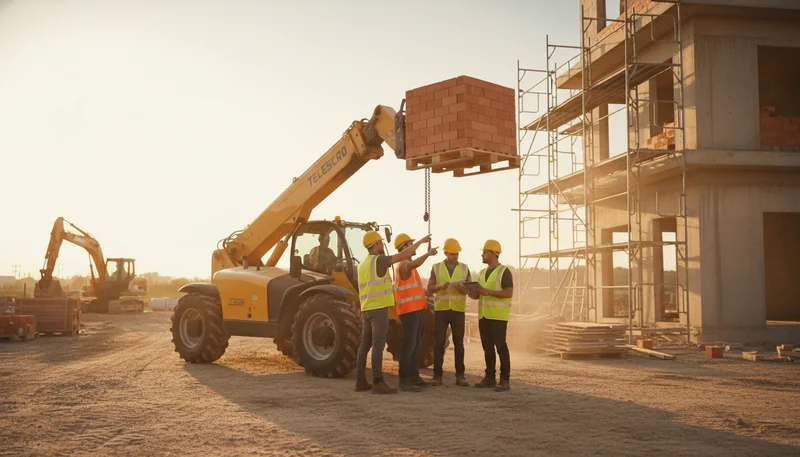
Telehandler 30% Deposit Safety: Field-Tested Buyer Precautions
Not long ago, an Australian project manager messaged me: “Is it actually safe to wire $30,000 to China for a telehandler deposit1?” He’d heard mixed stories—from smooth deliveries to painful disputes—and wasn’t sure whether a 30% upfront payment is just standard practice or a risky leap of faith.
A 30% deposit for telehandler purchases is widely accepted in global equipment trade, especially for customized or made-to-order units from China. This percentage covers supplier material costs and secures manufacturing capacity, but it also exposes buyers to non-delivery, specification shortfalls, and regulatory compliance risks. These risks become critical when deposits are paid internationally or to unknown suppliers. Transaction safety depends not just on the deposit size but on supplier verification, contractual clarity,
When is a 30% telehandler deposit justified?
A 30% telehandler deposit is considered standard in construction equipment sales—especially for overseas or made-to-order machines. This amount, covering $24,000–$60,000 on an $80,000–$200,000 unit, secures steel and production resources. Higher deposits are common with custom specifications2 or trusted suppliers, while in-stock units and first transactions can often involve a lower upfront percentage.
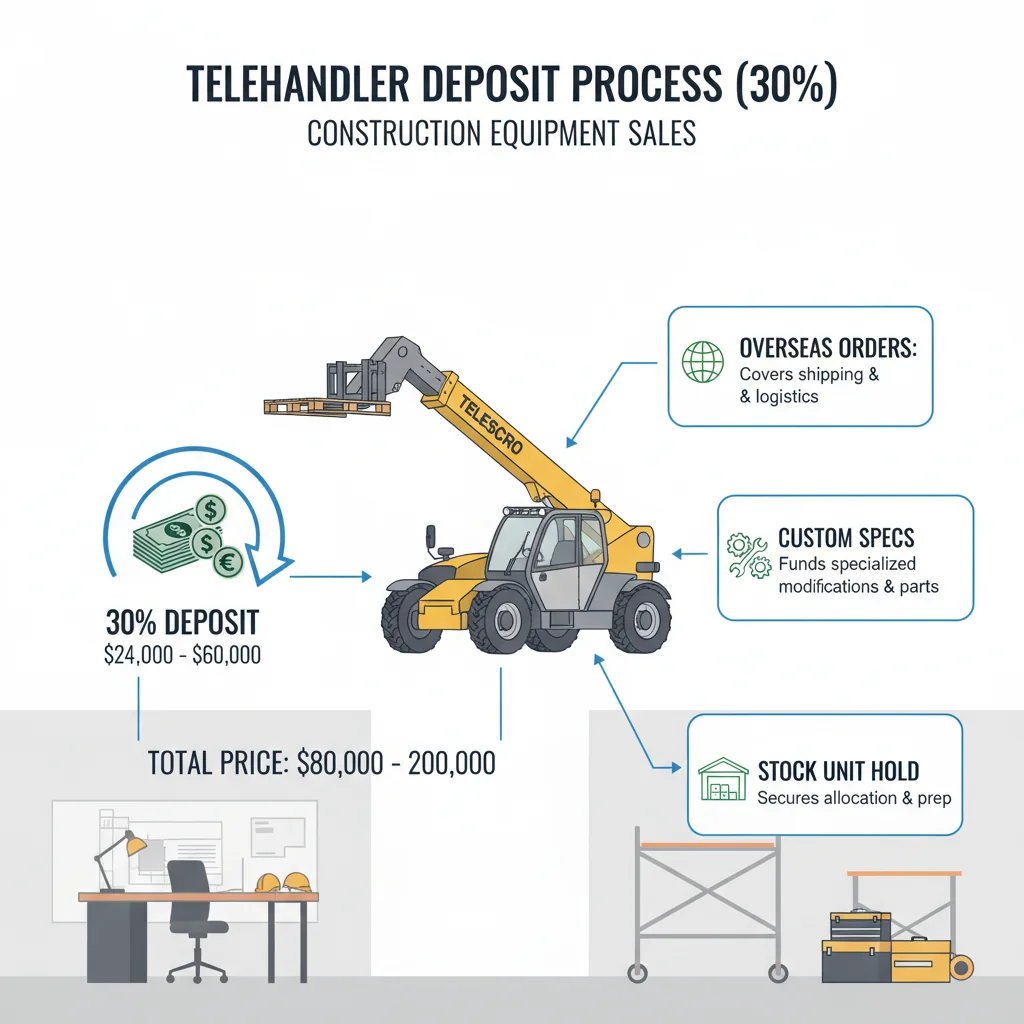
Last year, a client in Dubai needed three 4-ton telehandlers with non-standard boom lengths and special sand tires. For that kind of customization, a 30% deposit made sense—it locked in the factory’s production line and covered the extra manufacturing cost for custom booms and tires. Suppliers often won’t even order steel or key hydraulic components unless they see a significant upfront payment. I’ve seen this firsthand in China’s factories: they won’t allocate resources without commitment, especially when specs go beyond what’s in the catalog.
On the other hand, if you’re ordering a standard 3-ton, 12-meter telehandler sitting in stock, paying the same percentage doesn’t always add up. I worked with a contractor in Brazil who negotiated a 15% deposit—about $12,000 for an $80,000 machine—because the unit was available for immediate shipment. This approach gives buyers more security on their first order, and it’s something I suggest if you haven’t built trust with the supplier yet.
For larger projects, milestone payments can make sense. For example, another customer in Kazakhstan split the deposit into two stages: 20% at order, 10% after pre-shipment inspection. That way, they saw the machine (and test results from the load chart and moment indicator) before releasing the full 30%. I always recommend confirming production deadlines, technical drawings, and specs before transferring big amounts. The more custom or distant the order, the more fair a 30% deposit is—just verify supplier reliability first. A little negotiation up front protects both sides in the long run.
A 30% deposit on custom telehandler orders is often necessary because suppliers use it to secure the purchase of specific raw materials like high-grade steel tubes and hydraulic components, which can have lead times exceeding 8 weeksTrue
Customizations like non-standard boom lengths or specialized tires require manufacturers to order specific materials that are not kept in regular stock. The deposit ensures financial commitment, allowing suppliers to allocate scarce raw materials with long lead times, thus avoiding production delays.
Paying a 30% deposit on telehandler purchases guarantees full delivery insurance coverage against manufacturing defectsFalse
A deposit payment secures order commitment and production, but it does not equate to insurance coverage. Warranty and defect liabilities are governed separately by contract terms and industry standards, not by upfront payment amounts.
Key takeaway: In the telehandler industry, a 30% deposit is typical for custom-built or imported machinery and helps cover material and production costs. For standard, ready-stock models—especially with new suppliers—negotiating a reduced or milestone-based deposit offers added security for buyers.
What Risks Does a 30% Telehandler Deposit Pose?
A 30% deposit on telehandler purchases exposes buyers to significant supplier non-performance risks3—such as late delivery, non-arrival, and out-of-spec equipment. Financial loss, compliance failures4, and costly project delays can result, especially with overseas suppliers where fund recovery is difficult. Industry best practice mandates strong safeguards with contracts, vetted suppliers, and secure payment structures.
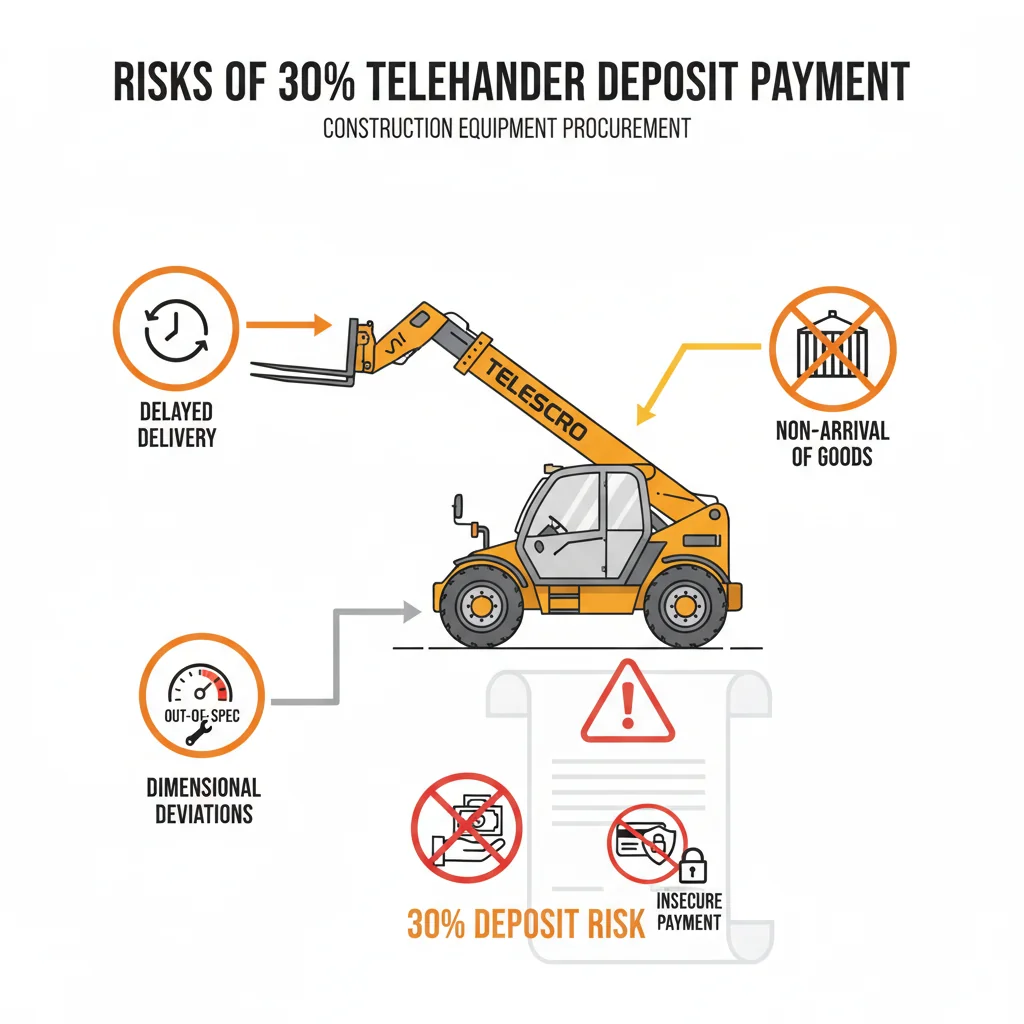
The biggest mistake I see is buyers paying a 30% deposit to a supplier they barely know—especially for overseas deals. A few years back, I worked with a contractor in Kenya who ordered a 4-ton, 18-meter telehandler and wired a $30,000 deposit. Six months later, he still had no machine and just excuses about shipping. Chasing that deposit through international banks was a nightmare. For projects running on tight schedules, even a two-month delay can force you into emergency rentals at higher cost—or worse, stall site progress completely. On a $100,000 machine, that upfront payment isn’t small change.
Another risk comes when the telehandler finally arrives but fails to match the agreed specs or local compliance requirements. I’ve seen customers in Eastern Europe receive units that fell short on rated lift or lacked a proper moment indicator—the safety system that prevents overload. Local authorities wouldn’t approve the machine for site work due to missing emissions certifications. Suddenly, you’ve paid 30% and are stuck with equipment you can’t use or register. Recovering funds or getting a swap takes months, if it happens at all.
Here’s what matters most when structuring your payment terms: always link your deposit to clear milestones and third-party inspection. I suggest keeping retention on the final 70% until the telehandler passes destination inspection for both performance and compliance. Vet suppliers carefully, agree on all specs in writing—including hydraulic circuit setup and load charts—and use secure payment channels. This minimizes your risk if something goes wrong. On big-ticket items, safeguards aren’t a formality—they’re essential.
Paying a 30% deposit to an unfamiliar overseas telehandler supplier often reduces your leverage to demand timely shipment or quality assurance, increasing financial risk if the machine is delayed or not deliveredTrue
A substantial upfront deposit commits a large portion of funds before receiving the equipment, and in international transactions, legal remedies and recovery can be slow or expensive, making it difficult to enforce delivery timelines or quality disputes.
Standard industry practice guarantees that telehandler suppliers will ship machines within three months of receiving a 30% deposit, regardless of order complexity or locationFalse
Shipping times depend on manufacturer capacity, customization, logistics, and destination. No universal guarantee exists, and assuming shipment within a fixed timeframe can lead to unrealistic expectations and project delays.
Key takeaway: Paying a 30% deposit for a telehandler from unfamiliar or overseas suppliers carries major financial and compliance risks. Always implement strict due diligence, clear specifications, and secure payment controls to protect against supplier non-performance, lost funds, and project setbacks.
How to Vet a Telehandler Supplier?
Conduct strict supplier due diligence5 before paying any 30% telehandler deposit. Confirm legal business registration, manufacturing authorization, and inspect via video call and factory tour6 to verify assembly operations and inventory. Reference-check two recent buyers, confirming serial numbers and export history. Avoid suppliers resisting transparency, omitting references, or pressuring urgent payment for supposed discounts.

Let me share something important about telehandler suppliers—especially when you’re about to wire an overseas deposit. Too many people assume a nice website means a real factory behind it. That’s not always the case. Last quarter, a project manager from South Africa called me after nearly losing his 30% deposit to a “supplier” who ended up renting showroom space and couldn’t produce a single reference. He only found out because he insisted on a live video call—once it was scheduled, the supplier kept making excuses and disappeared. That’s why I always suggest starting with hard verification: Check the business license and tax registration, and match the factory address with official Chinese government records.
From my experience, a genuine manufacturer will gladly take you through the fabrication lines via video—showing boom welding, cylinder installation, and actual assembly, not just parked machines. If you see stacks of labeled booms and a working test platform, that’s a good sign. On one job in Kazakhstan, I asked a supplier to walk through their warehouse with a smartphone. They showed around 40 telehandlers at different build stages and even scanned barcoded serial plates. Then I asked for two recent buyers in the Middle East. I called them directly. Both confirmed the machines arrived—one was an 18-meter unit for steel erection, and the other a 3-ton compact for a logistics park.
The best suppliers respond with real transparency. If someone refuses a live tour, avoids reference checks, or demands urgent payment for a “last-minute discount,” that’s a clear red flag. For any capital equipment, due diligence isn’t just paperwork—it’s your insurance.
Requesting a live video tour of the telehandler manufacturing facility is an effective way to verify a supplier's legitimacy before wiring any depositTrue
A live video tour helps confirm the physical existence of the factory and its production capabilities, reducing the risk of fraudulent transactions that rely solely on digital impressions like websites or photos. This can prevent losses like a 30% deposit sent to a non-producing showroom.
Paying the full 30% deposit upfront to any overseas telehandler supplier guarantees priority in production and delivery schedulesFalse
While deposits are common, paying 30% upfront does not guarantee production priority, especially if the supplier is unverified or fraudulent. Priority depends on contract terms and supplier practices, and unverified suppliers may misuse deposits without fulfilling orders.
Key takeaway: Always authenticate a telehandler supplier’s legal status, inspect real factory operations, verify past exports, and speak with previous clients before remitting a 30% deposit. Avoid proceeding with suppliers that resist transparency or pressure for fast payment—due diligence is non-negotiable for capital equipment safety.
What Payment Methods Best Protect Telehandler Deposits?
Secure telehandler deposits by favoring bank transfers with clear references, escrow accounts, or trade-assurance tools like Alibaba Trade Assurance and Letters of Credit. Avoid cash payments due to traceability and recovery risks. Credit cards may offer chargeback protection for smaller domestic deposits, but typically aren’t practical for full 30% payments on heavy equipment. Always require a pro forma invoice and stamped contract.

Most people don’t realize that how you pay the deposit protects you much more than the deposit size itself—especially with international telehandler deals. I’ve seen cases where a buyer sent cash by courier or handed money over to a middleman in the Middle East. Weeks later, the “seller” disappeared. No trace, no paper trail, and the client lost over $12,000. That’s a tough lesson to learn.
If you’re putting down 30%—often $8,000 to $20,000 on a 4-ton, 18-meter reach machine—you need traceability and leverage. Safer options for telehandler deposits include:
- Bank transfer with clear reference7
– Always request a pro forma invoice first. Make sure your payment mentions the machine’s model, serial, and contract number. If something goes wrong, this documentation is vital for bank or legal support. - Escrow account8 – Funds stay in a neutral third party’s control until agreed jobsite proof is supplied, such as inspection photos or shipping docs. In recent projects in Kenya, I worked with partners using this for mixed fleets; payment only released after loading confirmation.
- Trade assurance platforms – On sites like Alibaba, the platform holds your deposit until shipment requirements—like loading deadlines or third-party inspection—are met. It costs a bit more, but I’ve seen disputes resolved quickly, so buyers didn’t lose their deposit.
- Letter of Credit (L/C) – For large orders, an L/C at sight binds both buyer and seller to delivery and payment terms. It’s common for cross-border deals above $50,000.
Using an escrow service for telehandler deposits creates a legally binding paper trail and ensures funds are only released upon verified delivery, significantly reducing fraud risk in international transactionsTrue
Escrow services hold the buyer’s deposit securely and require both parties to meet contractual conditions before releasing funds, providing traceability and legal recourse if the seller disappears, which protects large deposits like the typical $8,000 to $20,000 required for telehandlers.
Paying telehandler deposits by international wire transfer without additional verification steps is as safe as using an escrow accountFalse
While wire transfers provide a documented payment trail, without additional safeguards like escrow or verified third-party intermediaries, funds can be irreversibly lost if the seller is fraudulent, offering less protection compared to escrow arrangements.
Key takeaway: Choose enforceable, traceable payment channels like bank transfers, escrow, and trade-assurance platforms instead of risky large cash deposits. These methods, alongside formal paperwork, reduce fraud risk and improve recoverability for 30% telehandler deposits—especially for cross-border transactions and large sums.
What Telehandler Deposit Terms Ensure Buyer Safety?
Telehandler deposit safety depends on clear contract terms. Agreements should specify whether the 30% is refundable, define refund conditions (such as non-delivery or failure to meet specs), set refund timelines, and state payment methods. Technical specs9, regulatory certificates, warranty details, and after-sales support must be included in the contract for enforceable buyer protection.
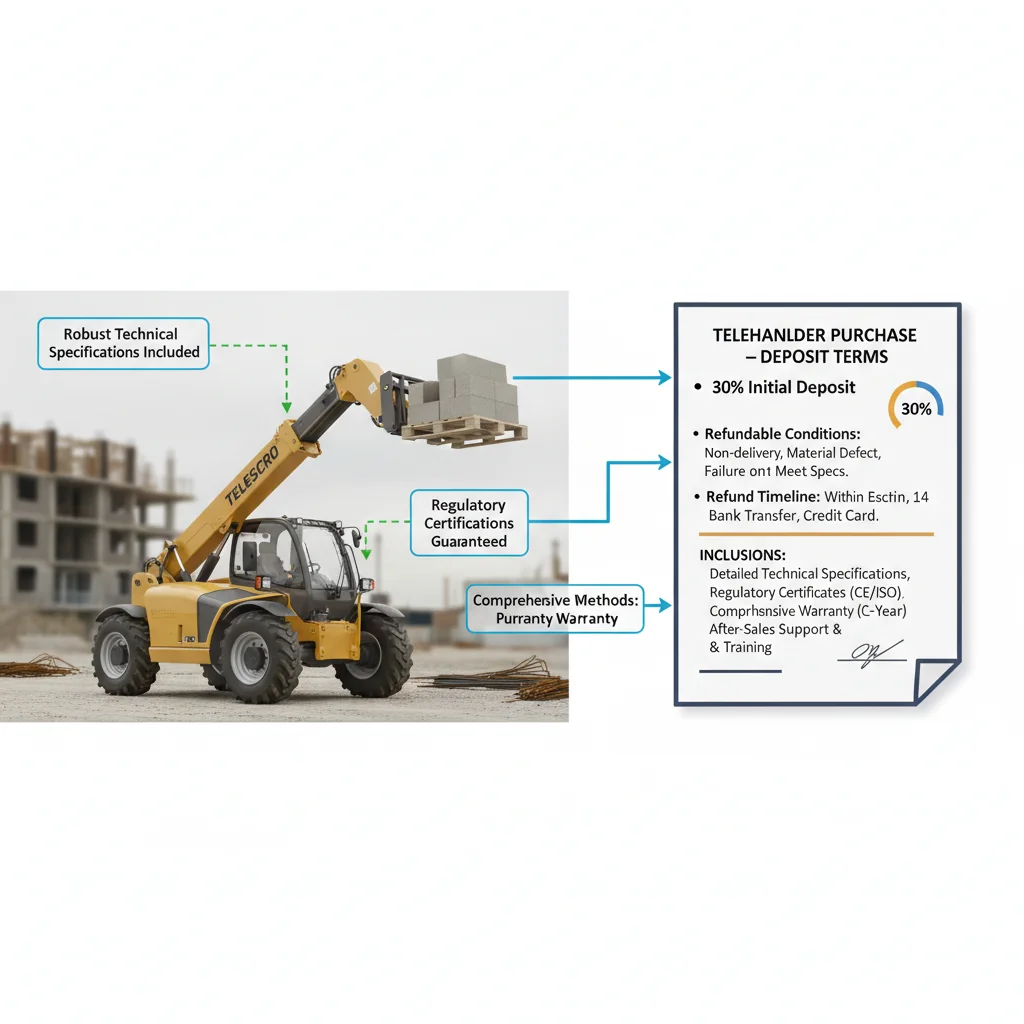
Here’s what matters most when negotiating telehandler deposit terms: the details must be in writing, not just talked about. Last month, I worked with a contractor in Kazakhstan who nearly lost his deposit because the agreement called it a “down payment”—with no clause for refund if delivery slipped or if the machine failed inspection. From my experience, the safest contracts define the 30% as a refundable deposit10 tied to clear performance requirements. For example, state that if your 4-ton, 17-meter unit isn’t delivered by the agreed date, or if the boom can’t lift rated loads at full extension, you get your money back—simple as that.
I’ve seen cases where buyers relied on WhatsApp messages for promises about emissions certificates or technical documents. That approach offers zero protection. Insist that the contract lists technical specs—like maximum lift height, load capacity, engine brand, and safety systems such as the moment indicator. In Kenya, one client demanded written proof the machine met regional emission rules and required CE and ISO certificates included in both the paperwork and owner’s manual. When those documents weren’t provided, he held back the final payment until compliance was proven.
Don’t forget the after-sales terms: specify warranty coverage (24 months is standard for most new machines), spare-part availability within a set time (I suggest 72 hours), and training or on-site support commitments. Every key promise belongs in the contract, not scattered across emails. I always suggest double-checking refund triggers and documentation before sending any deposit. It’s the only way to truly protect your investment.
A 30% telehandler deposit labeled explicitly as 'refundable' and linked to delivery and inspection milestones significantly reduces the risk of losing the deposit if the seller fails to meet termsTrue
Specifying that a 30% deposit is refundable contingent on key performance indicators like timely delivery and pre-acceptance inspection protects the buyer by legally binding the seller to these conditions, unlike generic down payments which may be non-refundable. This clarity enables dispute resolution and reduces financial risk.
Deposits for telehandlers above 20% are generally non-refundable regardless of contract terms due to industry standard policiesFalse
While some sellers may prefer non-refundable deposits, the refundability of a deposit depends entirely on the specific contract terms negotiated between buyer and seller. There is no universal industry rule making deposits over 20% automatically non-refundable; proper contract clauses can ensure deposit protection and refund rights.
Key takeaway: Written telehandler deposit contracts must state refund triggers, technical compliance, certification proof, and after-sales commitments. Verbal promises or informal communications provide no legal leverage, making written clauses essential for safeguarding buyer funds and ensuring full performance before additional payments.
How Can Telehandler Deposits Be Made Safer?
Telehandler deposit safety is improved by requiring pre‑shipment inspection11 by a neutral third party, such as SGS or BV, to verify serial number, welding, hydraulics, safety systems, and compliance labeling. Detailed photo and video updates during production document the process. Final payment should follow independent inspection, not just a pro forma invoice or shipping promise.
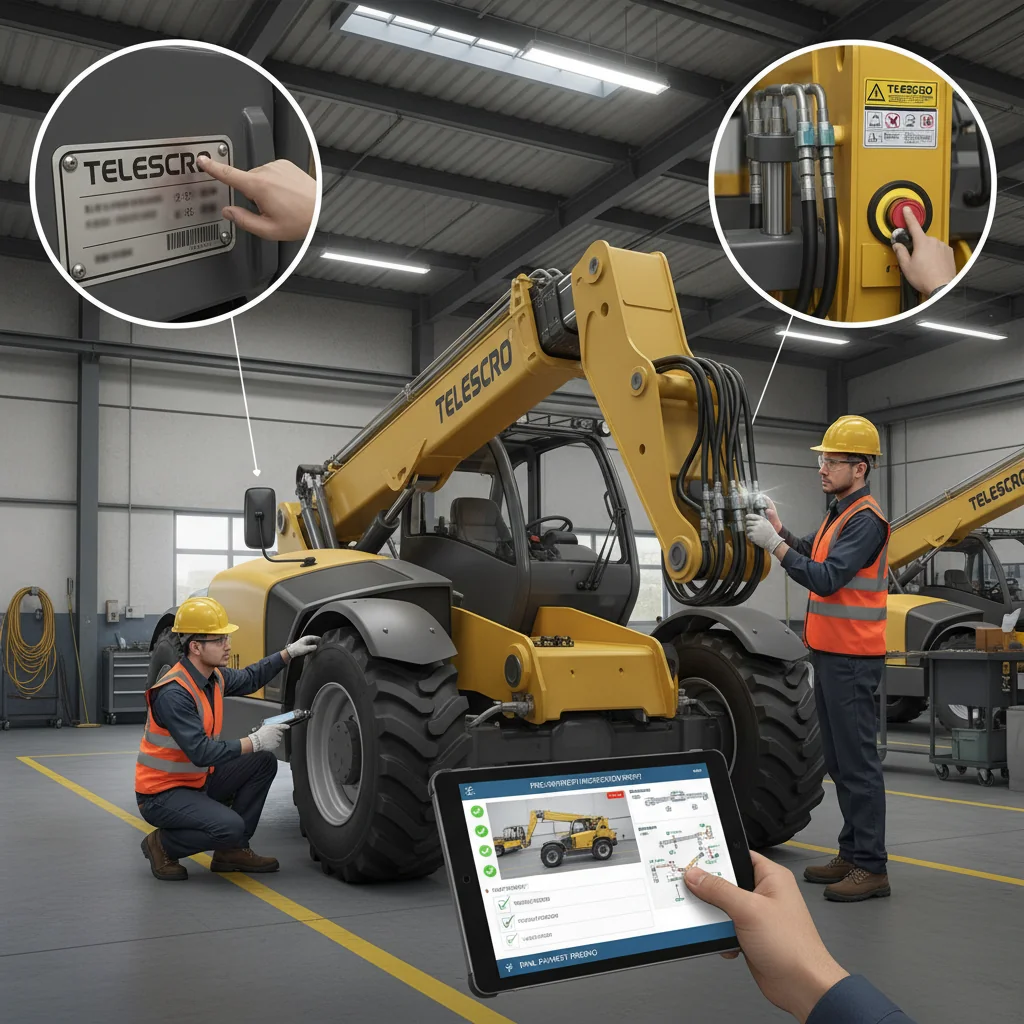
To be honest, the biggest reason deposits go wrong is blind trust—just sending money and hoping the machine matches the promise. Last autumn, I worked with a customer in Kazakhstan facing exactly this situation. They’d paid a 30% deposit for a 4-ton telehandler with 13-meter reach. But when photos arrived just before shipping, the serial tag didn’t match their contract—plus, welds at the boom joints looked rough, like the welding hadn’t been properly inspected. They asked for a third-party check. That step saved them. The inspection revealed missing safety cut-outs and weak hydraulic pressure in one circuit. If they’d paid the balance before checking, they’d have inherited those headaches.
A smarter way is to write independent inspection into your contract right from the beginning. I always suggest using well-known firms—SGS or BV, for example—who can check not just paperwork but the machine itself, on-site. They should verify several things: the serial number, boom structure welds, condition of hydraulic lines (look for leaks or improper routing), function of load chart indicators, cut-outs, warning alarms, and the correct compliance labels for your market. Inspection usually happens after assembly and testing, but before the final 70% payment. That timing gives buyers the most leverage.
Throughout production, ask for photo and video updates showing each stage: frame welding, boom installation, hydraulic tests, load testing with real weight, and a close-up of the serial plate. These updates can’t replace a real inspection, but they provide a clear record if something turns into a dispute. I suggest always linking your final payment to a passed inspection report—it’s your best insurance against surprises.
Requesting a third-party inspection before finalizing telehandler deposits can prevent costly mismatches in serial numbers and quality issues, as weld defects and incorrect parts often go unnoticed during initial vendor inspectionsTrue
Third-party inspections provide an independent assessment of machine condition and compliance, identifying discrepancies like mismatched serial tags or poor welding that vendors may overlook or conceal, thus safeguarding the buyer’s deposit.
Paying a 30% deposit is sufficient to guarantee that the telehandler's specifications and build quality will perfectly match the contract without the need for further verificationFalse
A 30% deposit only secures part of the payment but doesn't assure conformity to specifications; without thorough verification such as third-party inspections, buyers risk receiving equipment with incorrect serial numbers or substandard workmanship despite prior payments.
Key takeaway: Always tie the release of the remaining balance on a telehandler purchase to an independent, on-site inspection that confirms quality and compliance. Regular production updates and thorough pre-shipment verification significantly reduce buyer risk and protect against disputes or substandard equipment.
Does Insurance Replace a Telehandler Deposit?
Insurance and a 30% telehandler deposit serve distinct functions. The deposit secures commercial commitment, ensuring suppliers allocate or build the telehandler specifically for a buyer and discouraging casual cancellations. Insurance, on the other hand, provides financial protection against physical risks like damage, theft, or accidents. Both are essential safeguards in telehandler procurement and should complement—not replace—each other.
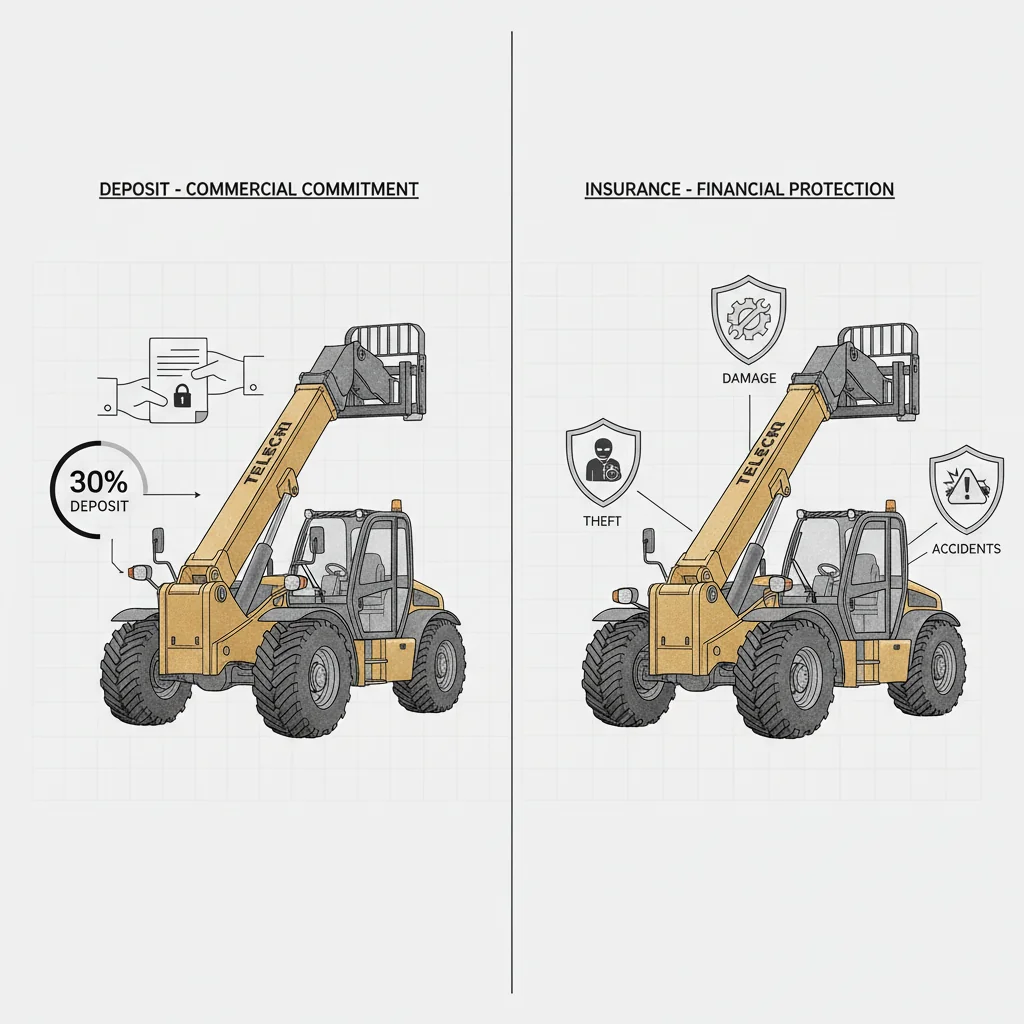
I’ve worked with customers who made this mistake—assuming that paying for insurance means a deposit isn’t really necessary. In reality, they cover completely different risks. Take one example: a contractor from Kazakhstan ordered three 4-ton telehandlers, each with a reach of 17 meters. He was hesitant about the 30% deposit—around $36,000 per unit—thinking his all-risk insurance policy would protect his investment if something went wrong. But the supplier needed that deposit before production started. Without it, they couldn’t allocate his machines or reserve his build slot, especially during peak demand. In this situation, the deposit wasn’t about risk—it was the supplier’s guarantee the order was real and wouldn’t be canceled last minute.
From my experience, insurance comes into play later—once your unit ships or arrives on site. I’ve seen cargo insurance12 save clients thousands after storm damage in transit between Shanghai and Mombasa port. But that same insurance wouldn’t help if the client decided to walk away after the factory had built the machines. That’s exactly what the deposit is designed for. On the other hand, besides transport, most contractors I work with add operational insurance once the telehandler lands on their project. Typical polices cover things like accidental damage, rollovers, or even cab electrical fires—risks that have nothing to do with the deposit.
Practically, I always suggest both: treat the deposit as your commercial handshake, locked in by a clear contract, and use insurance to actively protect your investment through shipping and daily use. Don’t rely on one to replace the other—it leaves gaps that could cost much more than you expect.
A 30% deposit before telehandler production is a common industry practice to mitigate financial risk for suppliers and is not replaced by insurance policies, which cover post-delivery damage or loss.True
The deposit serves as a financial commitment to begin manufacturing, protecting suppliers from cancellation or non-payment. Insurance, such as all-risk coverage, protects against physical damage or theft during transit and operation but does not cover supplier risk before delivery.
Paying for an all-risk insurance policy before telehandler delivery eliminates the need for a 30% deposit since it fully protects the buyer’s financial interest during production and shipping.False
Insurance protects against loss or damage after the equipment is produced and shipped, but it does not cover the supplier’s risk if the buyer cancels or fails to pay after production starts. Hence, deposits remain necessary to secure production costs.
Key takeaway: A 30% deposit secures the commercial transaction, while insurance manages operational and transit risks. Relying solely on one exposes buyers to unnecessary risk; best practices require both a securely structured deposit and appropriate insurance coverage throughout shipment and operation stages for optimal protection.
Conclusion
We’ve talked through why a 30% deposit is standard for custom or imported telehandlers, and how negotiating better terms for off-the-shelf models with new suppliers can help protect your interests. From my own experience in this industry, the buyers who avoid headaches always pair a good deposit strategy with checking parts availability and clear build timelines—not just price tags. If you’re not sure about a supplier, don’t hesitate to ask for references and confirm their track record on deliveries and after-sales support. Need help sorting out deposit terms or choosing between suppliers? I’m happy to share what’s actually worked for customers in real jobsite situations. Every site and deal is different, so choose what truly fits your workflow.
References
-
Explains how a telehandler deposit secures commercial commitment and prevents last-minute order cancellations, crucial for buyers and suppliers. ↩
-
Details how custom specs impact deposit amounts and why upfront payments secure specialized manufacturing resources. ↩
-
Explore detailed insights on risks like late delivery and non-arrival, helping buyers avoid financial losses and project delays. ↩
-
Understand the impact of missing certifications and safety features on equipment approval and site operation compliance. ↩
-
Detailed guide on verifying telehandler suppliers’ legitimacy and trustworthiness to avoid scams and ensure secure transactions. ↩
-
Explains how live factory tours via video confirm assembly processes and inventory authenticity, reducing supplier fraud risks. ↩
-
Explore why using bank transfers with clear references ensures traceability and legal support for large telehandler equipment payments. ↩
-
Learn how escrow accounts hold funds securely until jobsite proof is supplied, reducing risks in telehandler international transactions. ↩
-
Details essential technical specifications like lift height, load capacity, and safety systems needed in enforceable telehandler contracts. ↩
-
Explains key contract terms ensuring buyer protection by outlining refundable deposits with clear refund conditions and timelines. ↩
-
Explains how independent pre-shipment inspections prevent fraud and ensure equipment matches contract specs, reducing financial risk. ↩
-
Details how cargo insurance covers risks during transit, protecting costly telehandler shipments from damage or loss, saving clients thousands. ↩