










How to Choose Between Fixed Boom and Rotating Telehandlers (Field Guide to Avoid Costly Mistakes)
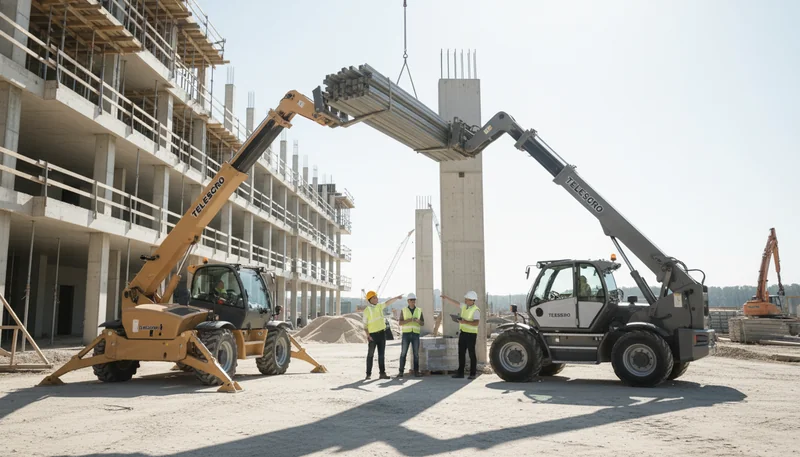
Last autumn, I watched a site crew in Singapore struggle for hours trying to maneuver a fixed boom telehandler1 around tight corners—while their competitor on the next block just swiveled a rotating model to every face of the high-rise with barely a hiccup. That day hammered home how much the right choice matters.
Fixed boom telehandlers2 feature a rigid telescopic arm mounted directly onto the chassis, limiting lateral load placement to machine repositioning. Rotating telehandlers employ a 360-degree turret3, allowing the upper structure and boom to slew independently of the chassis, significantly enhancing load placement flexibility. Site layout, ground conditions, and task repetition fundamentally influence performance and ROI differences between types.
What’s the key difference: fixed vs. rotating telehandlers?
A fixed boom telehandler features a telescopic arm rigidly attached to the chassis, requiring the entire machine to reposition loads. In contrast, a rotating telehandler mounts the boom and cab on a turret capable of 360° rotation, enabling precise load placement around three sides without moving the chassis.
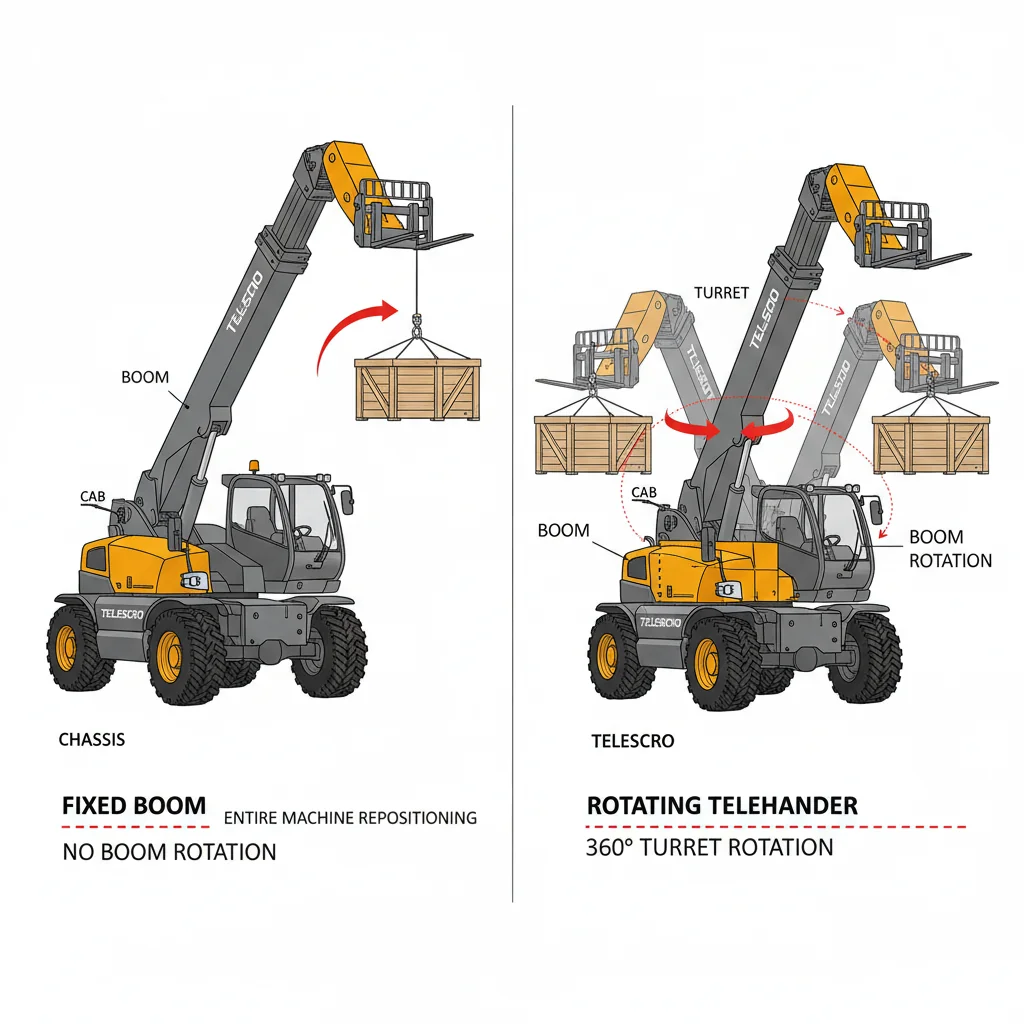
Most people don’t realize that this one design choice—fixed or rotating—completely changes how the telehandler fits the job. With a fixed boom, you’re basically working with a rugged, off-road forklift that can extend. If your tasks mean moving loads across different spots, you’ll be driving and repositioning all day. Operators in rural Kenya told me their 4-ton, 14-meter fixed boom models spent as much time shuttling around site as lifting.
Tight turning radius (under 4.5 meters) helps, but you still need clear travel paths. Rotating models, often called Rotos, are a different beast. The upper section sits on a 360° turret. Deploy the stabilizers4—those extendable legs—and you can pick, lift, and swing a pallet of bricks from one corner to the next without moving the tires. I’ve seen sites in Dubai where a single 6-ton, 25-meter rotating telehandler handled three building facades from the same spot. That would take two or three fixed units.
Load charts matter though—capacity drops at maximum outreach, especially on a rotating model with longer boom and no counterweight moving behind the wheels. Here’s a quick comparison:
| Telehandler Type | Boom Movement | Placement Reach | Typical Capacity | Ideal Situations | Maneuverability |
|---|---|---|---|---|---|
| Fixed Boom | Telescopes only | Front, must drive | 2–5 tons | Drive-and-lift, open sites | Higher; drive to reposition |
| Rotating (Roto) | 360° turret | All around | 3–6 tons | Confined, lift-and-rotate | Swivel in place; stabilizers needed |
Rotating telehandlers generally have a tighter average turning radius than fixed boom models, often under 3.5 meters, enabling more precise maneuvering in confined spaces.True
Rotating telehandlers feature a rotating turret enabling the boom to turn independently of the chassis, which combined with articulated steering often results in a smaller turning radius compared to fixed boom models limited to steering the entire machine. This design improves maneuverability on tight job sites.
Fixed boom telehandlers can rotate their booms up to 360 degrees, allowing operators to work efficiently without repositioning the entire machine.False
Fixed boom telehandlers have a rigid boom attached to the chassis and lack any rotational capability beyond boom articulation. Unlike rotating models, they must be repositioned physically to change load direction, which can reduce efficiency on multi-position jobs.
Key takeaway: The core distinction is movement—fixed boom telehandlers must drive to reposition, while rotating telehandlers swivel loads efficiently with a 360° turret. Choosing between them depends on whether most tasks require frequent driving or precise placement in confined work areas.
When Does a Rotating Telehandler Excel?
Rotating telehandlers deliver optimal performance on confined, complex, or multi-level sites where frequent repositioning is impractical or unsafe. Their 360-degree turret enables material placement to multiple elevations and facades from a single location, eliminating tedious driving and maneuvering. Industry case studies show up to 100% productivity gains over fixed boom units in dense urban and multi-story construction environments.
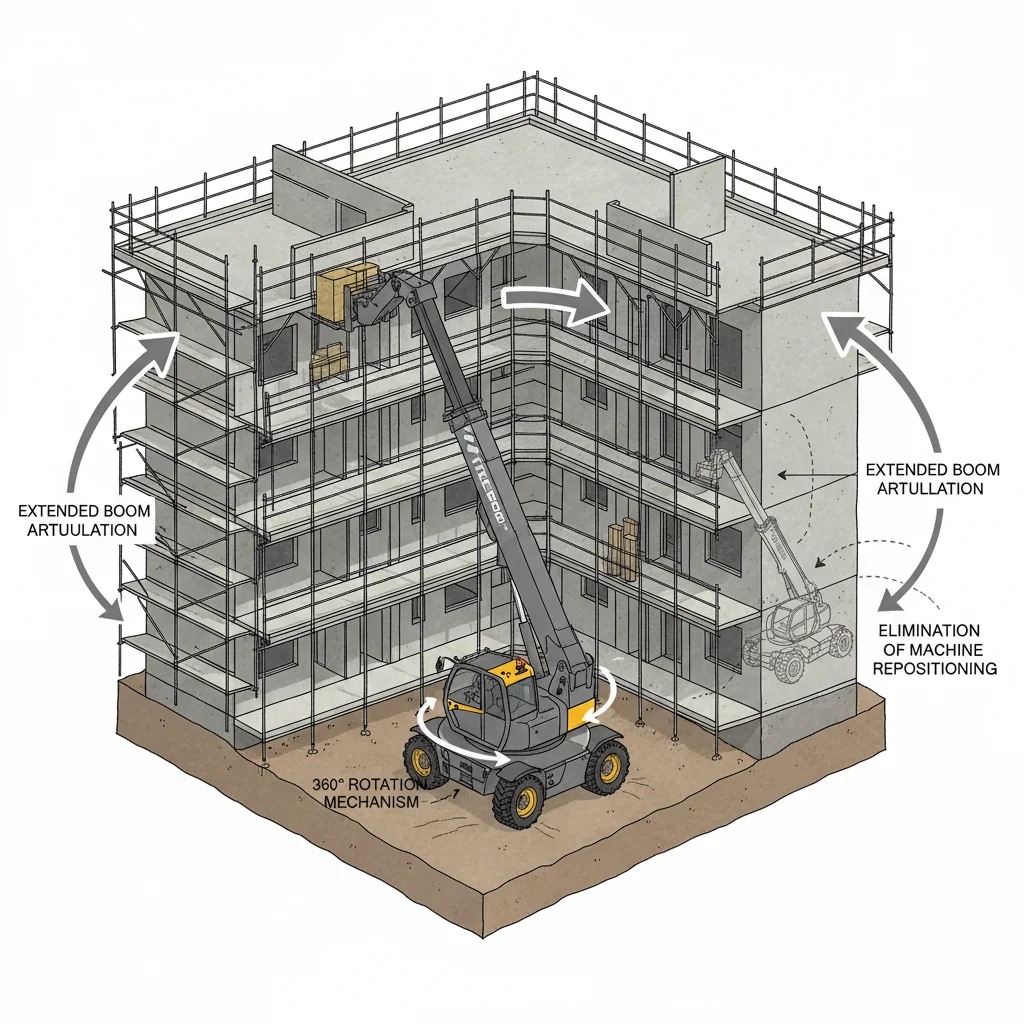
Let me share something important about rotating telehandlers: their real advantage shows up on jobsites where moving heavy equipment is tough or risky. I’ve seen this firsthand in Dubai, where a contractor needed to lift glass panels to several floors on a high-rise—right up against neighboring buildings. The site only allowed a single landing spot. With a traditional fixed boom unit, they would need constant repositioning, plus a ground crew to direct traffic through tight access roads. Instead, they used a rotating telehandler rated for 4,000 kg with a 25-meter reach. From one spot, the operator swung the turret, servicing three elevations and both building facades. No need to drive around the site.
On dense urban infill projects, the difference is dramatic. Last year, a customer in France told me their Roto reduced ground logistics by half. Fewer blind reverses, less time spent clearing paths, and much lower risk of hitting pipes or curbs. Productivity jumped—crews could keep working while the telehandler fed them material from one location. When delivery zones are shared with other trades or time windows are tight, this flexibility is priceless.
From my experience, you should look at your material flow carefully. If your plans show congested areas, multi-level work, or obstacles that restrict machine movement, a rotating telehandler pays off—especially over a multi-week schedule. Yes, day rates are higher, but when you factor in fewer labor hours and less equipment downtime, the numbers start to make sense. I always suggest mapping your critical lifts before deciding.
Rotating telehandlers typically have a slewing radius of 360 degrees, allowing precise load placement without repositioning the entire machine, which can save up to 30% of jobsite time compared to fixed boom modelsTrue
The 360-degree rotation capability of these telehandlers lets operators place loads in confined spaces or multiple directions from a single position, significantly reducing setup and cycle times on constrained sites.
Rotating telehandlers can lift heavier loads than fixed boom telehandlers because the rotation mechanism increases maximum load capacity by distributing weight evenlyFalse
The rotation feature primarily adds maneuverability and versatility, but it does not inherently increase the maximum lifting capacity, which depends on the chassis, boom design, and stabilizers rather than the slewing mechanism.
Key takeaway: On tight, multi-access sites—especially urban infills and high-rise jobs—rotating telehandlers justify higher rates by slashing machine moves and labor hours. Consider a rotating unit where single-location flexibility and access to multiple points outweigh the cost of repositioning standard fixed boom telehandlers.
When Are Fixed Boom Telehandlers Best?
Fixed boom telehandlers provide optimal value in repetitive, front-facing tasks across open ground, such as on farms, construction sites, and material yards. Their lower center of gravity5 enhances stability on rough terrain, delivering quick cycle times and straightforward controls. Fixed booms also offer lower capital costs and efficient cost-per-hour metrics when rotation and slewing are rarely required.
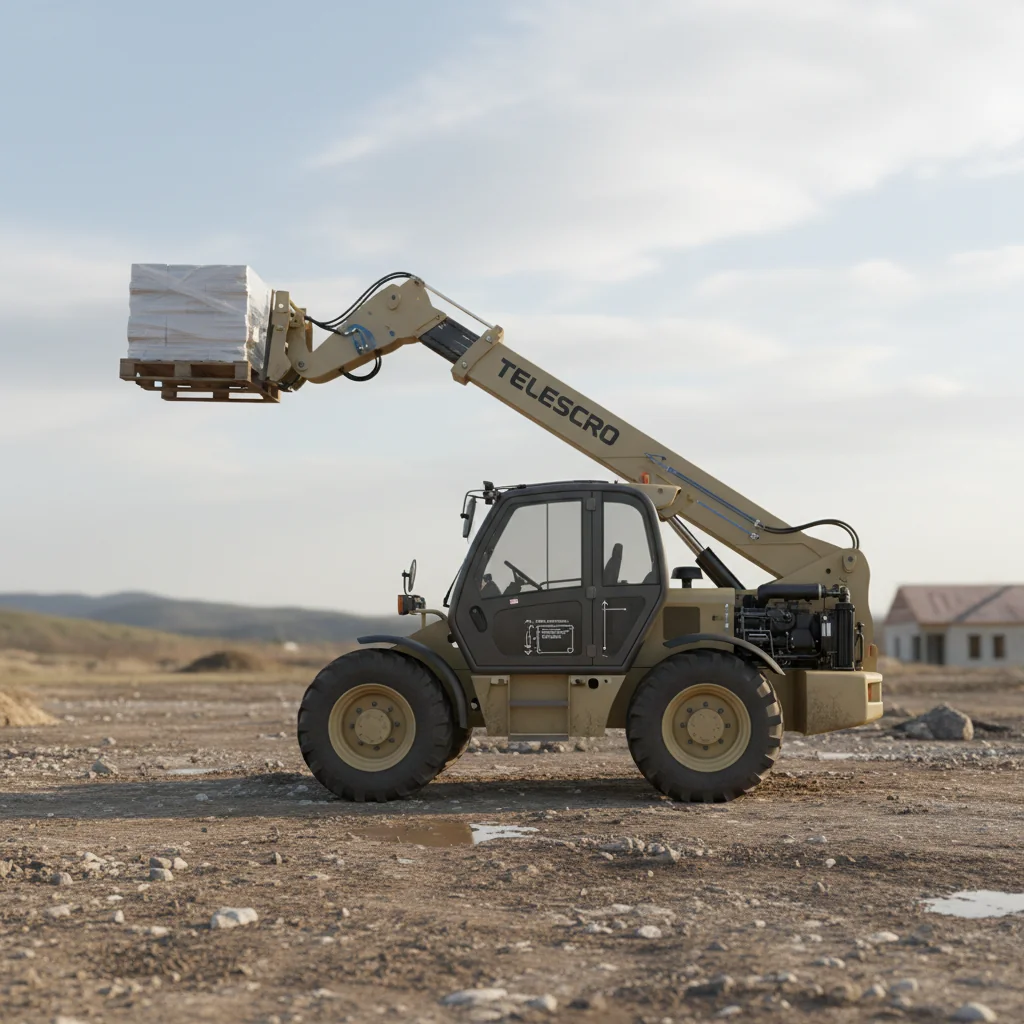
The biggest mistake I see is buyers choosing a rotating model when 90% of their work is actually straight-line lifting across open ground. Fixed boom telehandlers shine in exactly this situation. I worked with a large farm in Kazakhstan last year—they needed to move bales, feed, and fertilizer between storage and livestock barns, day after day. Their jobsite was wide open, with only a few dirt tracks to cross. A fixed boom 4-ton telehandler, standard 7-meter reach, made perfect sense. No rotation needed, just reliable, fast movement with forks or a bucket.
From my experience, fixed booms keep training and operating costs low. New operators learn the controls in under an hour because everything’s so direct—forward, up, down, and back. In Dubai, one client reported staff turnover above 50% during peak season. With a rotating telehandler, he struggled to keep everyone productive and safe. After switching to a fixed boom model, downtime dropped and accident risk went way down. The machine’s low center of gravity gives excellent stability, especially when you’re running full loads over ruts or bumpy ground.
Here’s what matters most when budgets are tight: fixed booms cost 20–30% less upfront compared to similar rotating models, and you avoid extra components like stabilizers and rotation gears. Hydraulic systems are simpler, which means less risk of expensive downtime and easier service. If 80% of your jobs can be done without swing or slew, I suggest looking at a fixed boom first. Verify your load chart at typical working height—and see if the straightforward approach fits your workflow.
Fixed boom telehandlers typically have a higher maximum load capacity than rotating models of the same size, because their simpler structure allows for stronger chassis designsTrue
Fixed boom telehandlers lack the complex slewing mechanisms found in rotating models, enabling manufacturers to reinforce the chassis and boom structure to handle heavier loads safely within a given size and reach category.
Rotating telehandlers always have longer reach distances than fixed boom models, regardless of their lift capacityFalse
Reach distance depends on the boom design and extension capability, not just the rotation feature. Fixed boom telehandlers can have comparable or even longer reach lengths for the same lift capacity because they prioritize straight-line stability and boom extension over rotational versatility.
Key takeaway: Fixed boom telehandlers excel in scenarios where straight-line, repetitive material handling is required across open ground. Their simple, stable design minimizes training and capital costs, making them the optimal choice when extensive rotation is unnecessary and equipment turnover or rough terrain is common.
How Do Stability and Terrain Impact Telehandler Choice?
Fixed boom telehandlers use chassis weight and a low center of gravity for stability, making them well-suited for uneven or harsh terrain such as quarries or construction sites. Rotating telehandlers rely on stabilizers for their full lifting capability and require flat, prepared ground for safe operation, especially when lifting at extreme heights or outreach.
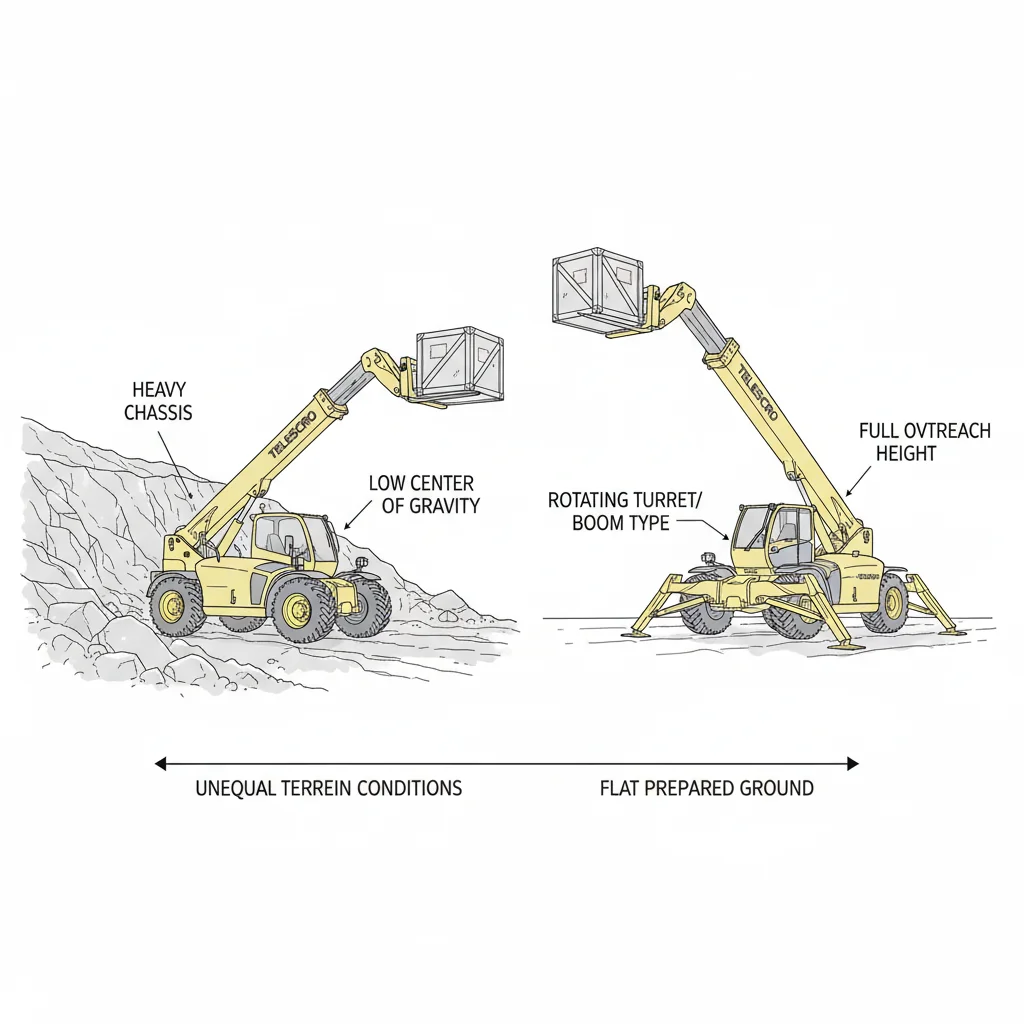
Here’s what matters most when matching a telehandler to your site: take a hard look at your ground conditions before anything else. The reality is, fixed boom telehandlers earn their reputation for a reason. They balance their own weight low to the ground, so even in places like quarry sites in Kazakhstan or rough mining roads in Western Australia, I’ve seen them handle dips and ruts without drama. Most 4-ton rated units with wheel drives can keep working when tracked cranes or truck-mounted lifts get sidelined by mud or loose rock. It’s not just about power—the low center of gravity means you’re less likely to tip from a sudden shift or side load.
On the flip side, I’ve seen a few projects in Dubai try to use high-reach rotating telehandlers on sandy foundations. It’s risky if stabilizers aren’t perfectly grounded. A 25-meter reach Roto promises amazing flexibility, but to hit that full 4,500 kg capacity at maximum outreach, you need all four stabilizers stretched out—on level, compacted ground. Operators also need to double-check the load chart and respect the moment indicator, or a small mistake can lead to dangerous overloading.
If your site is unpredictable or you’re working in fields, I always suggest the fixed boom. Setup’s faster. Less can go wrong. For big urban builds or whenever you can properly prepare a base, go Roto for that outreach and 360-degree flexibility. In the end, let your typical terrain and your crew’s experience decide which machine works safest and fastest for you.
Fixed boom telehandlers typically provide greater stability on uneven terrain due to their lower center of gravity compared to rotating telehandlersTrue
Fixed boom telehandlers have their weight distributed lower and more evenly, which enhances stability when operating on rough or sloped ground; rotating telehandlers have higher centers of gravity because of the rotating turret, which can reduce stability under the same conditions.
Rotating telehandlers can safely operate with longer reach heights on steep slopes without additional stabilizers, thanks to their rotating boomsFalse
Rotating telehandlers typically require additional outriggers or stabilizers on steep or uneven terrain to safely manage longer reach heights because their higher center of gravity increases the risk of tipping, especially when the boom is extended or rotated.
Key takeaway: For marginal, rough, or unpredictable ground, fixed boom telehandlers maximize safety and operational speed with minimal setup. Rotating telehandlers offer exceptional reach and versatility but require disciplined operator practices and stable ground conditions to ensure safe, full-capacity lifts. Match equipment to typical site environments and crew proficiency for safest, most efficient results.
How Do Attachments Impact Telehandler ROI?
Rotating telehandlers offer significantly greater attachment versatility, supporting man baskets6, winches, jibs, and more. This enables one machine to replace multiple roles—material handler, crane, and aerial platform. Such multi-role capability can deliver higher ROI, especially on complex, space-restricted sites, while fixed boom telehandlers are suited to standard attachments like forks and buckets.
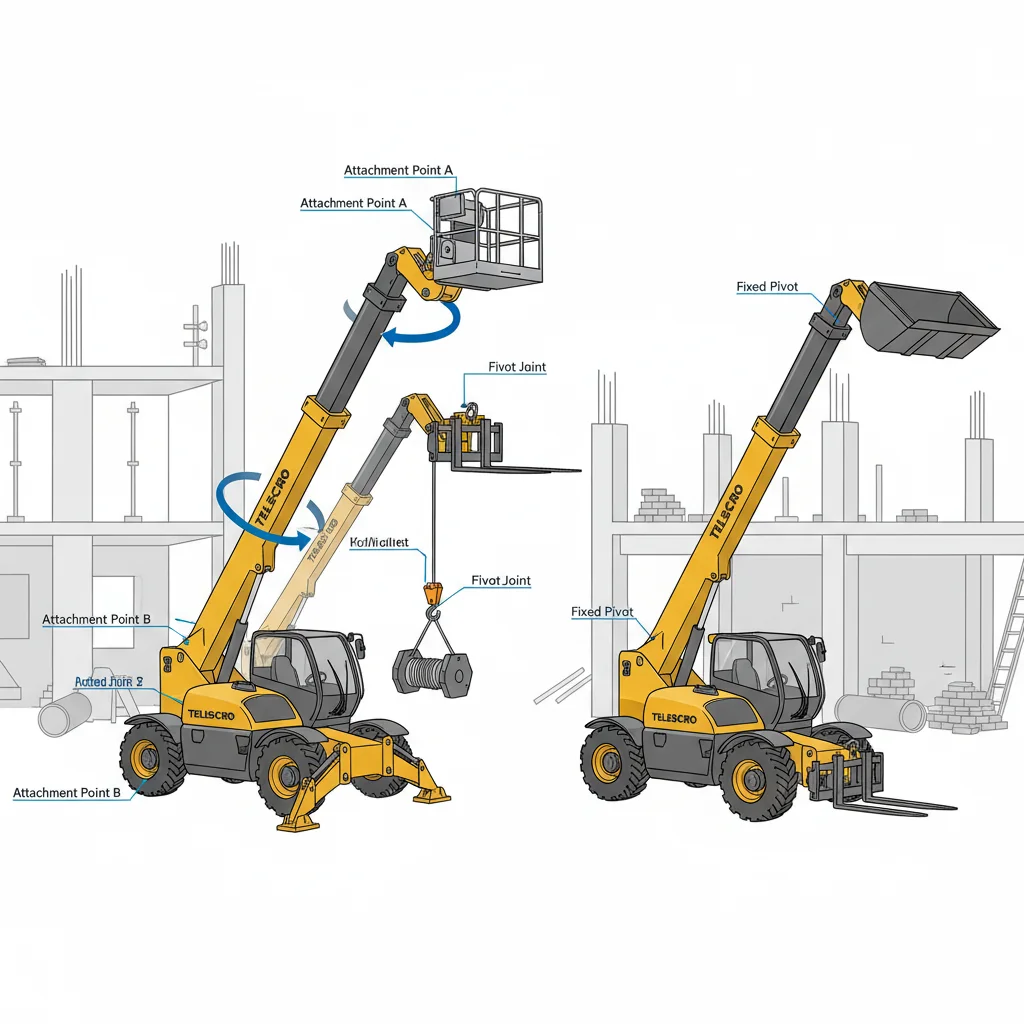
A question I hear a lot: “Will attachments really change my ROI, or is that just sales talk?” From my experience, this is where rotating telehandlers show their true value, especially on sites with heavy logistics demands. For example, last year I worked with a contractor in Dubai retrofitting a high-rise. Their team used a 5.5-ton rotating model with a man basket one week, then switched to a winch and lifting hook the next. That single machine replaced their need for a mobile crane and a rented boom lift—saving at least $8,000 in rental costs over two months.
Here’s how the right attachments can directly affect your returns:
- Man baskets – Allow the telehandler to become an aerial platform; ideal for facade work or pipe installation up to 24 meters high.
- Winches and hooks – Handle suspended loads when tight sites make crane mobilization expensive or impossible.
- Hydraulic jibs and clamps – For precision placement of steel, glass, or prefab elements. I’ve seen this save hours per shift compared to manual rigging.
- Buckets and standard forks – Essential for general material handling; especially productive where jobsite space changes day-to-day.
- Specialized attachments – Like pipe handlers or sweepers—great for infrastructure or utility projects with unique needs.
To be honest, fixed boom telehandlers still do a great job on open sites where you mostly move pallets or bulk material. My advice: forecast your needs for the next few years. If multi-role work (lift, access, install) will be frequent, investing in a rotating unit with several attachments can genuinely simplify your fleet and boost ROI.
Rotating telehandlers with multiple quick-change attachments can increase on-site utilization rates by up to 30% compared to fixed boom models that require separate machines for different tasksTrue
Rotating telehandlers enable operators to switch rapidly between attachments like man baskets, hooks, and winches without repositioning, reducing downtime and the need for additional equipment, thereby significantly improving overall equipment effectiveness and ROI.
Fixed boom telehandlers are generally more cost-effective than rotating models for heavy lifting above 6 tons due to simpler mechanics and lower maintenance costsFalse
While fixed boom telehandlers have fewer moving parts, rotating models often provide better maneuverability and versatility on site without a large cost penalty. For loads above 6 tons, rotating telehandlers maintain comparable maintenance costs but offer greater operational flexibility, often delivering better ROI in complex job environments.
Key takeaway: Evaluating long-term project needs is essential. For specialized, multi-role jobs, rotating telehandlers with broad attachment support maximize ROI and can consolidate equipment use. For standard material handling on open sites, fixed boom units typically suffice, avoiding unnecessary spending on underused capabilities.
What Drives ROI for Fixed vs Rotating Telehandlers?
Rotating telehandlers typically cost 30–50% more upfront and involve higher rental, maintenance, and insurance expenses due to their complex classification and capabilities. While they can cut project durations by up to 20% on tight or multi-level sites, over-specifying rotators for open projects usually leads to underutilization and weaker ROI compared to fixed boom alternatives.
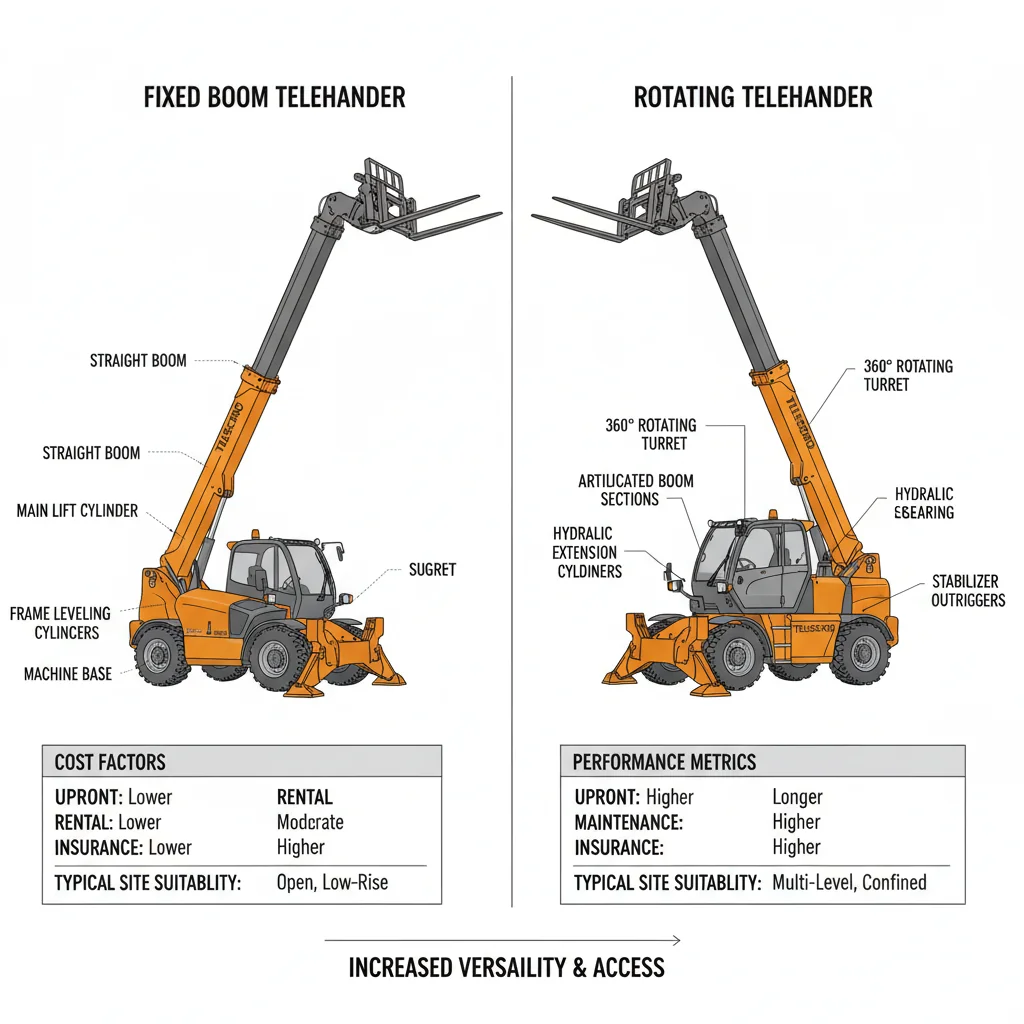
To be honest, the spec that actually matters is how often you truly use the rotation on-site. Many buyers assume the extra features of a rotating telehandler will pay for themselves, but in practice it comes down to jobsite fit. I’ve seen sites in Dubai where a rotator’s 360-degree turn replaced both a crane and a boom lift. That crew finished two weeks early and cut equipment idle time across three trades. But last year, I worked with a team in Kazakhstan—wide open jobsite, long straight runs. Their rotating model sat unused half the shifts.
When we looked at costs, it was 40% more expensive up front, and extra training and insurance added at least 12% on top. Here’s how fixed and rotating telehandlers line up on core ROI factors:
| Feature | Fixed Boom Telehandler | Rotating Telehandler |
|---|---|---|
| Upfront Cost | Baseline | 30–50% higher |
| Rental Rates | Standard | 30–50% higher |
| Maintenance | Lower (simple hydraulics) | Higher (rotation circuit, sensors) |
| Operator Training | Standard | Extra certification often needed |
| Insurance | Lower (standard mobile plant) | Higher (often crane-class rates) |
| Utilization Risk | Predictable on most builds | High if rotation underused |
| Project Fit | Best for open/standard sites | Tight, multi-level, congested sites |
The risk is over-specifying. A rotator helps only if you regularly need side reach, precision positioning, or you can drop another machine from your fleet.
Rotating telehandlers can often replace multiple pieces of equipment like cranes and boom lifts on confined urban job sites by providing a full 360-degree rotation, reducing project timelines by up to 15%True
The rotation capability allows a single rotating telehandler to access multiple directions and heights without repositioning, effectively combining the functions of cranes and boom lifts, which streamlines operations and cuts idle equipment time, as demonstrated by real-world cases where projects finished weeks early.
Fixed boom telehandlers are generally more fuel-efficient on open, linear job sites because their simpler hydraulic systems require up to 30% less fuel than rotating telehandlersFalse
While fixed booms have simpler hydraulics, the difference in fuel consumption between fixed and rotating telehandlers is typically minimal; actual fuel efficiency depends more on operational patterns and engine technology rather than rotation mechanisms alone.
Key takeaway: Rotating telehandlers justify their higher cost and complexity only when project conditions allow them to replace other machines or cut work durations substantially. Otherwise, fixed boom models deliver a stronger and more predictable return on investment, especially on open or standard project sites.
How Do Maintenance Costs Differ by Telehandler Type?
Fixed boom telehandlers typically require less maintenance due to their simpler design, lacking slew rings7, stabilizers, and turret hydraulics. This results in lower annual service costs and shorter inspections. Rotating telehandlers involve 15–25% higher maintenance spend, with more daily checks and specialized technician needs, impacting uptime particularly in remote or high-utilization scenarios.
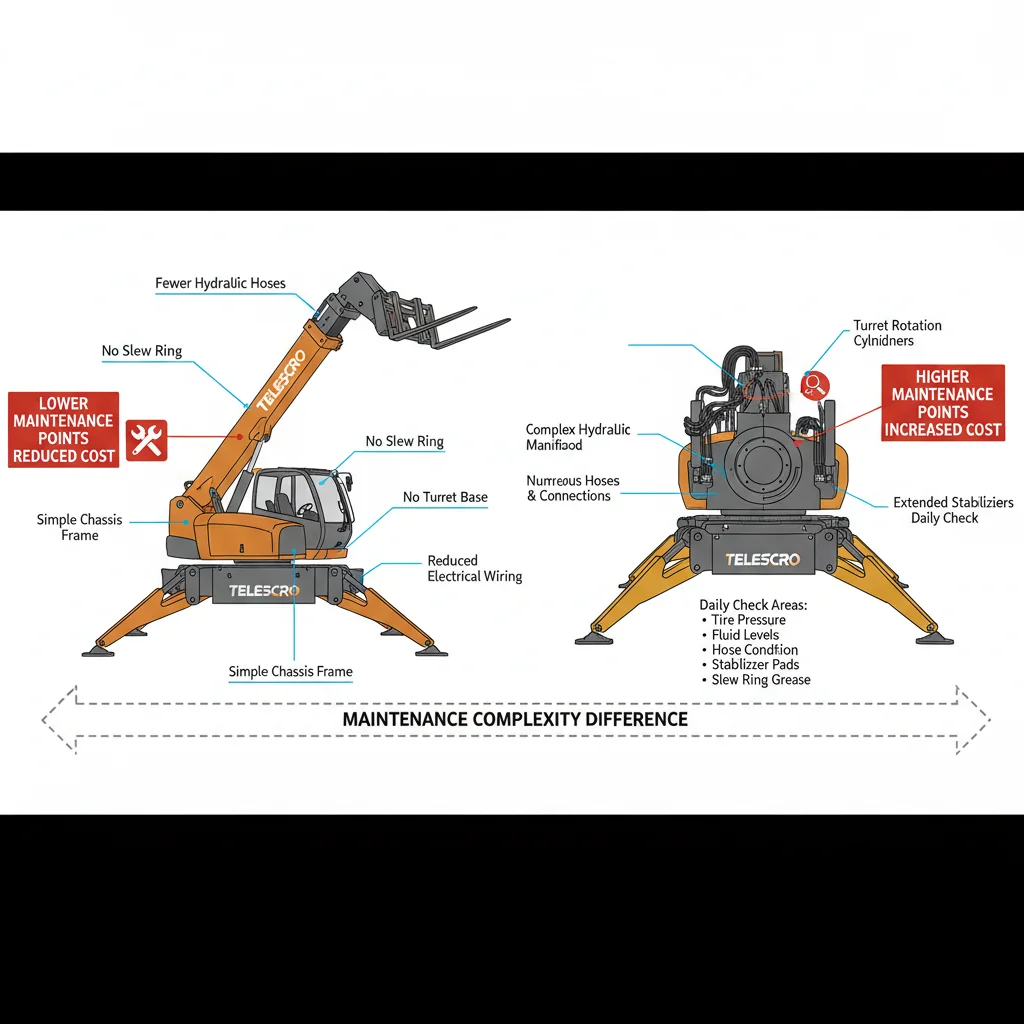
Last month, a fleet manager in Kazakhstan called me with a question about maintenance costs for his new telehandler line-up. He was surprised how the fixed boom machines needed far fewer repairs, especially compared to his rotating models. In his case, the fixed boom units ran almost non-stop through the winter with little more than routine oil changes and daily checks—no major downtime. That’s not unusual. I’ve found that simpler machines, especially fixed booms without slew rings or stabilizers, just hold up better in remote or rugged conditions. The core difference comes down to complexity.
Fixed boom telehandlers rely on standard hydraulic circuits, basic electrical systems, and fewer moving parts. There’s no rotation turret or electrical slip rings to worry about. Technicians can finish scheduled service in about half a day, and even general mechanics can handle 80% of issues on-site. With rotating models, maintenance quickly gets more specialized. Beyond the routine hydraulic and tire inspections, you have additional checks: slew ring bolts, stabilizer arms, turret hydraulics, and advance electronics. Even on well-supported jobs in Dubai, I’ve seen customers budget at least 20% higher for maintenance on their Roto fleet.
Here’s a direct comparison based on what I’ve tracked in the field:
| Telehandler Type | Annual Maintenance Cost (USD, typical) | Daily Checks Needed | Technician Skill Level | Best For |
|---|---|---|---|---|
| Fixed Boom | $2,500–$3,200 | Basic (fluids, filters, tires) | General mechanic | Remote sites, limited support |
| Rotating Boom | $3,000–$4,000 | Full boom/rotation checks, sensors, LMI | Advanced technician | Complex projects, tight urban lifting |
Fixed boom telehandlers typically incur 20-30% lower annual maintenance costs than rotating boom models due to fewer moving joints and simpler hydraulic circuitsTrue
Fixed boom machines lack slew rings and stabilizers, which are high-wear components in rotating models; this reduces mechanical complexity and points of failure, resulting in measurable maintenance cost savings over time.
Rotating boom telehandlers generally have lower maintenance costs in cold climates because their slew rings and stabilizers prevent ice buildup and mechanical wearFalse
In cold climates, additional moving parts like slew rings and stabilizers are prone to ice accumulation and require more frequent servicing, leading to higher—not lower—maintenance costs compared to fixed boom units.
Key takeaway: Fixed boom telehandlers minimize maintenance costs and downtime, making them ideal for remote sites or fleets with limited technical support. Rotating telehandlers, while offering greater versatility, demand more specialized maintenance and higher budgets—best suited for operations with robust dealer support and a need for maximum productivity.
What Training Is Needed for Telehandler Types?
Fixed boom telehandlers typically require basic operator training and straightforward certification, with simple drive-position-lift routines and forgiving stability. Rotating telehandlers demand advanced operator qualifications, including crane-adjacent certification8, mastery of stabilizers, turret controls, and complex load charts. Regulations and insurance policies often mandate higher-level licensing, affecting operator availability, training costs, insurance premiums, and project scheduling.
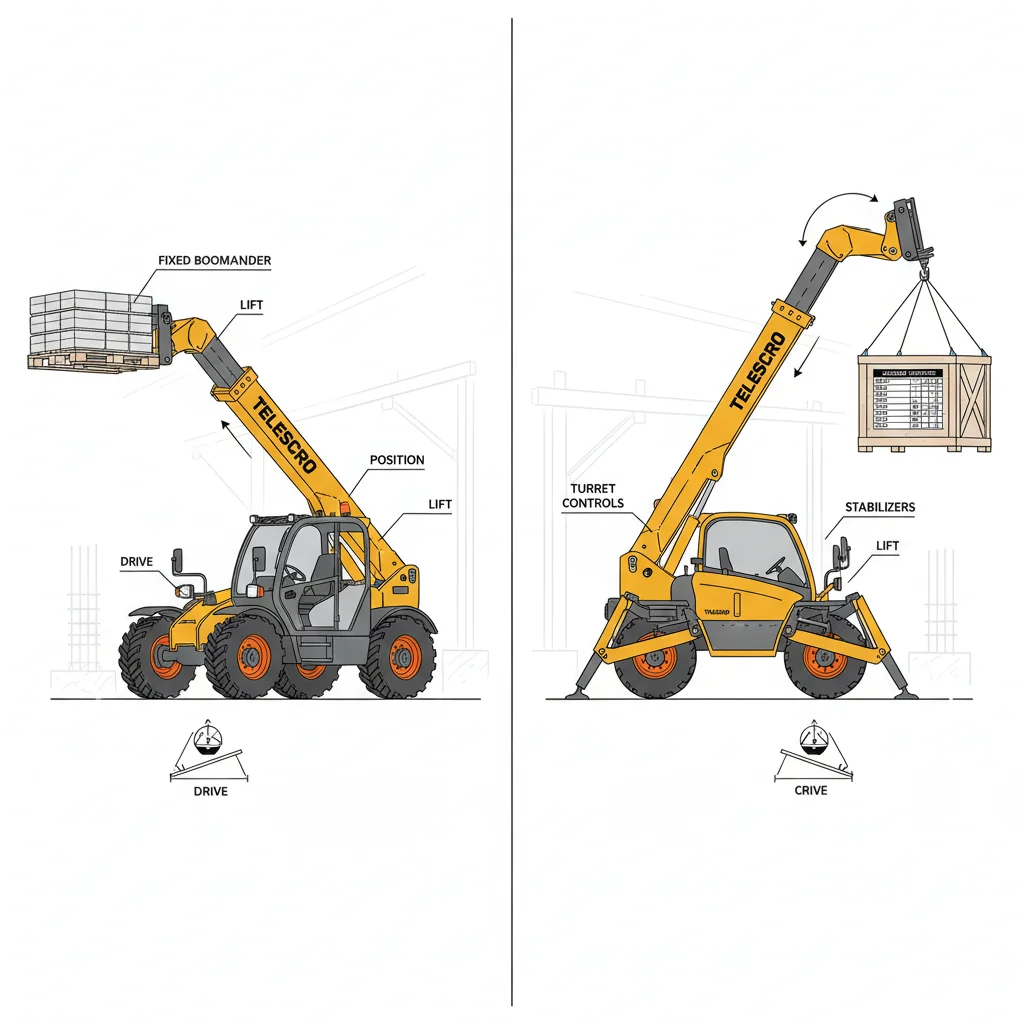
Last spring, a client from Dubai called me after his crew struggled to meet tight deadlines—he had two fixed boom telehandlers on site, but the owner insisted on adding a rotating model for heavy facade panels. The problem? His operators weren’t ready. They got basic training for fixed units—drive, position, lift—but the rotating telehandler was a different animal.
Suddenly, they had to learn turret controls, how to extend stabilizers, and read more complex load charts that go way beyond just lift height. Even the daily pre-checks took twice as long because of the slew ring and extra hydraulic circuits. In markets like the EU and Australia, you often need “crane-adjacent” certification, or special insurance rider, just to operate a rotating model.
Here’s a table comparing training requirements—something I show clients who aren’t sure which type to pick:
| Telehandler Type | Minimum Training | Certification Needed | Insurance Impact | Typical Learning Curve |
|---|---|---|---|---|
| Fixed Boom | Basic operator course | Telehandler license | Standard premium | 2–3 days |
| Rotating (Roto) | Advanced operator + crane | Telehandler + crane-adjacent | Higher premium | 5–7 days, or more |
From my experience, projects with frequent staff turnover—like busy sites in Kenya or temporary crews in the UK—do better with fixed boom machines. The operating routine is just more straightforward. But if you need the reach and flexibility of a Rotator, factor in both the extra cost and the time to get everyone up to speed. I always suggest checking your local licensing rules early, so insurance and operator certification don’t become surprise bottlenecks mid-project.
Rotating telehandlers typically require operators to learn how to deploy stabilizers because their higher lifting capacity and boom rotation demand additional machine stability compared to fixed boom modelsTrue
Unlike fixed boom telehandlers, rotating models often have outriggers or stabilizers that must be extended and leveled to safely handle loads at maximum reach and rotation, requiring specific operator training to ensure safe setup and operation.
Fixed boom telehandlers generally have turret controls identical to rotating models, so operators trained on fixed booms can operate rotating telehandlers without additional trainingFalse
Fixed boom telehandlers do not have turret or rotation controls since their boom is fixed in one direction, meaning operators must undergo separate training to safely operate the turret and extended functionalities on rotating telehandlers.
Key takeaway: Rotating telehandlers introduce higher training, certification, and safety requirements than fixed boom models. These factors can increase costs, extend project timelines, and require careful planning regarding compliance and operator availability—especially on regulated sites or projects with frequent personnel turnover.
How Do Resale and Rental Values Compare?
Resale and rental values for rotating telehandlers (Rotos) are highly variable, subject to regional demand, and tend to fluctuate more than those for fixed boom models. In urban or industrial markets, Rotos can command premium rental rates, while fixed booms maintain broader, more predictable demand in construction and agriculture, supporting stable resale values.
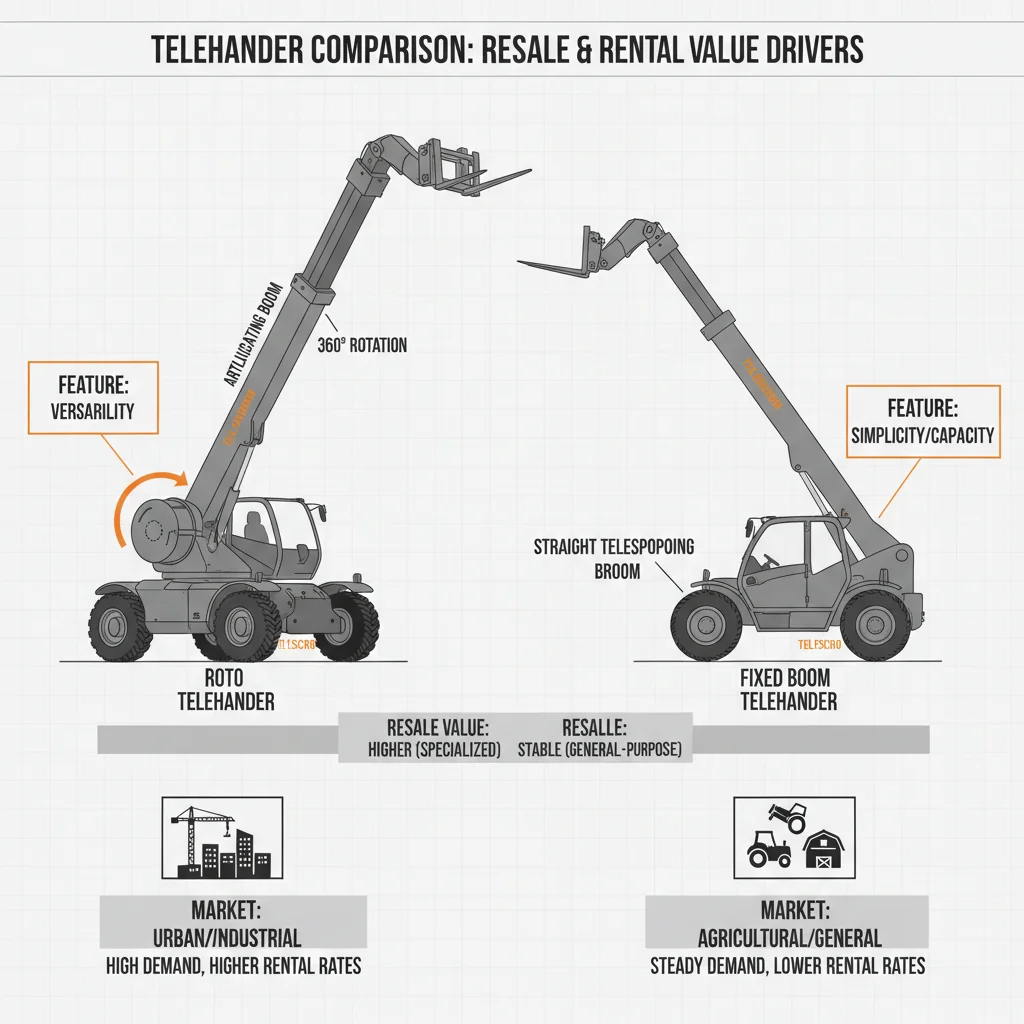
Last month, a contractor in Singapore asked me why his fleet’s rotating telehandler wasn’t attracting the same rental interest as his fixed boom units. The answer comes down to market dynamics—Rotos often shine in dense city jobs with tight access, but they don’t have the same steady pull everywhere. In urban areas, I’ve seen rotating models secure daily rates 15-30% higher than similar fixed booms, especially for projects needing slewing and multi-function work.
But in regions like rural Kazakhstan or agricultural zones in Brazil, demand drops off. One customer struggled six months to sell a 6-ton rotating telehandler, finally letting it go below expected value. Fixed boom units, on the other hand, generally sell within 4-8 weeks, especially if they’re under 5 years old and have clean maintenance logs.
Here’s a quick comparison based on what I’ve seen:
| Telehandler Type | Rental Rate Potential | Resale Value Stability | Market Demand | Typical Buyer/Lessee |
|---|---|---|---|---|
| Rotating (Roto) | High in urban/industrial | Volatile, region-specific | Niche (urban/industrial) | High-rise, plant maintenance |
| Fixed Boom | Steady, broad | Predictable, stable | Wide (agri/construction) | Construction, agriculture |
If your business focuses on city builds—tower cranes, glass placement, complex logistics—a rotating unit can pay for itself faster, provided you have skilled operators and consistent rental customers. For most agricultural or open-site work, a fixed boom delivers simpler operation and clearer resale paths. I always suggest checking recent auction prices and local rental catalogs before buying. That quick research can prevent costly surprises—like holding specialized machines nobody local wants to buy or rent.
Rotating telehandlers typically command 15-30% higher daily rental rates in dense urban markets due to their versatility in slewing and tight access applicationsTrue
Rotating telehandlers offer 360-degree rotation allowing maneuverability in confined spaces, which is highly valued in city projects, driving up rental demand and pricing relative to fixed boom models with limited directional reach.
Fixed boom telehandlers generally have higher resale values than rotating telehandlers because their simpler design reduces maintenance costs over timeFalse
Although fixed boom telehandlers are mechanically simpler, rotating telehandlers usually have higher resale values in urban markets due to their increased versatility and demand, outweighing any potential maintenance differences.
Key takeaway: Rotating telehandlers offer higher potential returns in urban regions with strong rental markets, but face more volatility and lower resale predictability in rural settings. Fixed boom telehandlers, with steadily broad demand, typically deliver more consistent utilization rates and easier resale, especially for agriculture or open-site use cases.
Which Telehandler Type Suits Project Needs?
Project-specific factors drive the decision between fixed boom and rotating telehandlers. Critical considerations include site constraints, multifunctional equipment needs, frequency of repositioning, terrain variability, and support capabilities. Successful selection involves mapping common project scenarios and aligning equipment choice with actual usage frequency, not just technical capability.
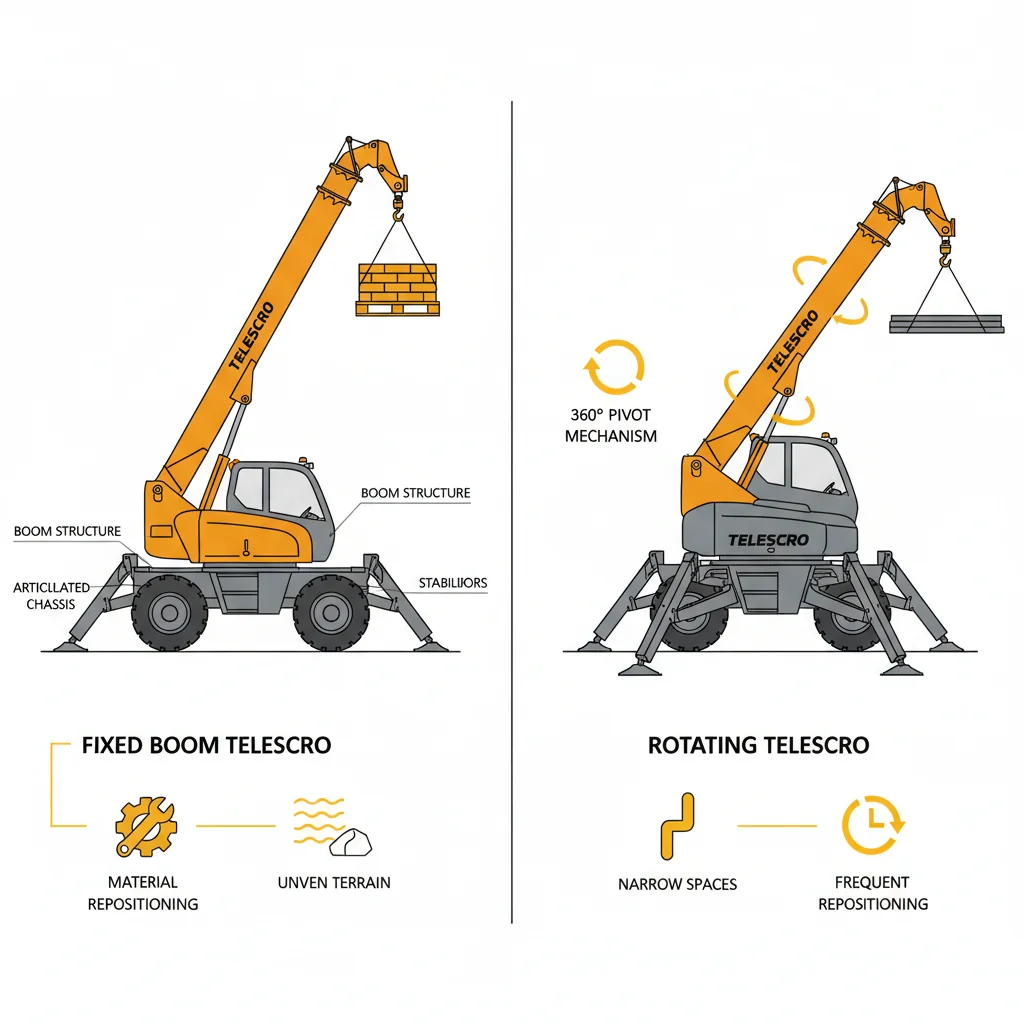
Last year, a customer in Turkey called me with a challenge: tight urban site, five subcontractors, and only one access lane. He was leaning toward a high-reach fixed boom, but after we walked through his project checklist, things looked different. I always start with the basics: Is maneuverability or multifunction the main headache? Can downtime from repositioning really disrupt the whole crew?
In his case, the constant need to switch from pallet handling to light lifting and basket work was the decider. Space restrictions and the pace of other trades made a standard fixed-boom telehandler less practical than it looked on paper.
Here’s a direct comparison to help clarify the options:
| Type | Best For | Capacity | Max Reach | Turning Radius |
|---|---|---|---|---|
| Fixed Boom | Repetitive tasks, rough terrain | 3,000–6,000 kg | 7–18 m | Under 4.5 m |
| Rotating | Confined, multi-function sites | 2,500–5,500 kg | 14–30 m | Around 4.5–5 m |
If your work is mostly straightforward—lifting bricks, moving pallets, on rough or uneven ground—a fixed boom shines. Lower complexity, less training, and simpler maintenance. But if you’re working in city centers or industrial refits, with tasks changing from hour to hour, the rotating type often saves time and labor. I’ve seen crews in Dubai finish installations a week faster by using one rotating telehandler as a crane, access platform, and lift—all in a zone barely wide enough for a delivery truck.
My advice: document your next year’s sites. List out where each type would be the "right" tool. That’s the only way to avoid costly underutilization and get the best value long term.
Rotating telehandlers generally offer up to 360-degree rotation, allowing operators to switch between multiple tasks without repositioning the machine, which can save up to 30% of time on congested sitesTrue
Rotating telehandlers are designed with a fully rotatable boom, enabling continuous rotation and reducing the need for machine repositioning, which increases operational efficiency especially on tight urban projects where maneuvering space is limited.
Fixed boom telehandlers can achieve the same lifting heights and reach capabilities as rotating telehandlers, making boom rotation unnecessary for most construction projectsFalse
While fixed boom telehandlers can reach substantial heights, rotating telehandlers often have superior reach versatility due to their 360-degree boom rotation, allowing lifting in multiple directions without repositioning, which fixed booms cannot replicate.
Key takeaway: Evaluate telehandler selection with a structured checklist tailored to project types. Matching machine features to expected jobsite requirements—rather than defaulting to perceived versatility—prevents costly underutilization and ensures optimal return on investment over the coming project cycle.
Conclusion
We’ve gone over how fixed boom and rotating telehandlers each suit different site needs—mainly whether you need to drive often or rotate in tighter spaces. From my own experience, the smartest decisions usually come down to understanding real workload—especially how much precise placement versus travel your typical day involves. I suggest always checking the load chart at common working heights and confirming how easy it is to get replacement parts locally. That way you won’t face the “parts roulette” I see too often on remote jobsites. If you have questions about what fits best for your site, or want to talk through load charts and attachments, feel free to reach out. Every project is unique, so the right choice will always depend on your actual workflow.
References
-
Explore detailed functions and operational challenges of fixed boom telehandlers for construction tasks requiring load repositioning. ↩
-
Explore the advantages of fixed boom telehandlers in repetitive and front-facing lifting tasks with enhanced stability and lower costs. ↩
-
Learn how a 360-degree turret eliminates the need for equipment repositioning and reduces ground logistics risks on complex jobsites. ↩
-
Understand the crucial role of stabilizers in ensuring safe operation and maximum lifting capacity for rotating telehandlers on flat ground. ↩
-
Discover how a lower center of gravity enhances telehandler stability on rough terrain, reducing accident risks and improving safety. ↩
-
Learn how man baskets convert telehandlers into aerial platforms for safe, efficient facade and pipe installation up to 24 meters high. ↩
-
Understand the role of slew rings in rotating telehandlers and how their complexity drives higher maintenance needs with specialist checks. ↩
-
Explore detailed requirements and benefits of crane-adjacent certification critical for operators handling rotating telehandlers with complex controls. ↩