










What does “load center” mean in telehandler lifting? Field Mistakes Buyers Overlook
A site manager in Australia once told me his “5-ton telehandler” could handle anything—until a pallet of concrete blocks tipped the machine forward with barely any warning. The culprit wasn’t obvious from the spec sheet: it was all about load center, not just maximum capacity.
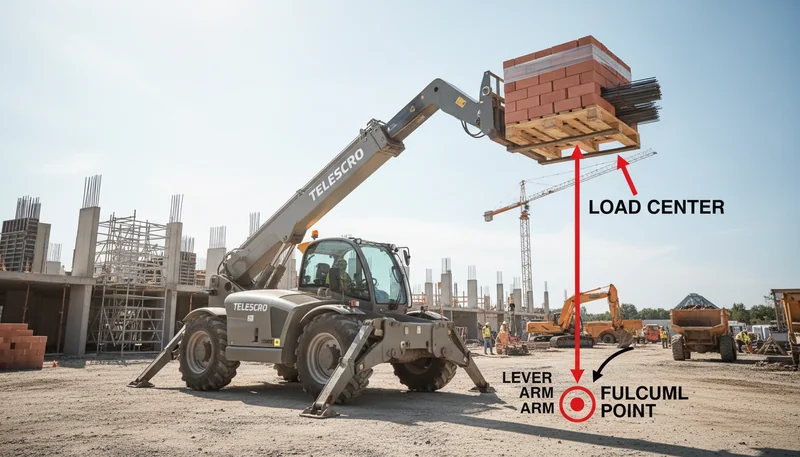
On telehandlers, “load center” is the horizontal distance from the OEM-defined fork/attachment reference face to the load’s center of gravity. Telehandler capacities are rated at a specified load center (commonly 500–600 mm, or 24 in/≈610 mm depending on market), so the headline capacity only applies under that assumption and the correct attachment. If the load center moves outward—because of long, overhanging, uneven, or poorly stacked loads—the allowable capacity can drop sharply. Always confirm the actual load center and check the OEM load chart (and attachment-specific charts) before lifting.
What is load center on a telehandler?
On a telehandler, the load center is defined as the horizontal distance from the fork or attachment face to the load’s center of gravity. Rated capacity, load charts, and safety certifications are all based on a specified load center, typically 500–600 mm, matching standard pallet dimensions.

Most people underestimate how critical load center really is to telehandler safety and usable capacity. If you look closely at any load chart, you’ll see that the stated capacities are tied to a defined load center specified by the manufacturer—commonly 500 mm or 600 mm in many markets, and often 24 in (≈610 mm) in North America. These values are not arbitrary; they reflect typical palletized loads where the center of gravity is assumed to sit near the midpoint of a standard load under controlled conditions.
Problems arise when real jobsite loads don’t match that assumption. I’ve seen cases in the UAE where contractors placed long concrete beams directly on the forks, pushing the actual center of gravity well beyond the charted load center. In those situations, the effective lifting capacity dropped dramatically, and one operator came close to losing the load at a weight far below the headline rated capacity shown on the chart.
Let me share something important here: every capacity plate, load chart, and regulatory test—no exceptions—assumes that specific horizontal load center. Change the attachment or let a load overhang, and you’ve now shifted the center of gravity outward. A customer in Poland asked me why his 4-ton telehandler handled only around 2,700 kg when he used fork extensions for extra-long crates. The answer was simple—the load’s real center of gravity was 900 mm out, and the moment indicator didn’t alarm until the telehandler was already on the tipping edge.
There is no universal percentage rule for determining capacity loss as load center increases. Manufacturers address this differently: some provide reduction factor tables, while others require converting the actual load into an equivalent load and checking it against the OEM load chart. Whenever a load overhangs the forks or differs from a standard pallet, the only safe approach is to consult the model-specific technical manual and attachment-specific load chart before lifting.
A telehandler’s rated lifting capacity can decrease dramatically if the load center extends beyond the specified distance from the fork face, even if the total weight remains within the maximum limit.True
Moving the load's center of gravity further from the fork face increases leverage on the telehandler, decreasing its lifting capacity. Load charts specify capacities at certain load centers for this reason, so exceeding that specified distance reduces both stability and safe working load.
As long as the load does not exceed the maximum rated capacity, it does not matter where the load center is positioned on the forks.False
The load center is crucial to telehandler stability and safe operation. Even if a load weighs less than the maximum capacity, positioning its center of gravity further out increases the risk of tipping and overstressing the machine, because the capacity rating assumes a specific load center based on standardized measurement.
Key takeaway: Every telehandler’s rated capacity and regulatory certification rely on a specified load center—usually 500–600 mm. Lifting with a greater load center than shown on the load chart means actual stability and capacity will be lower, even if alarms don’t trigger or the machine hasn’t tipped.
How does load center affect telehandler capacity?
Telehandler lifting capacity decreases as the load center increases. Since telehandlers act like levers, moving the center of gravity further from the fork face increases the overturning moment1, reducing safe capacity. Capacity ratings depend on load chart values, including boom angle, extension, attachment, and specified load center, not just the nominal tonnage.
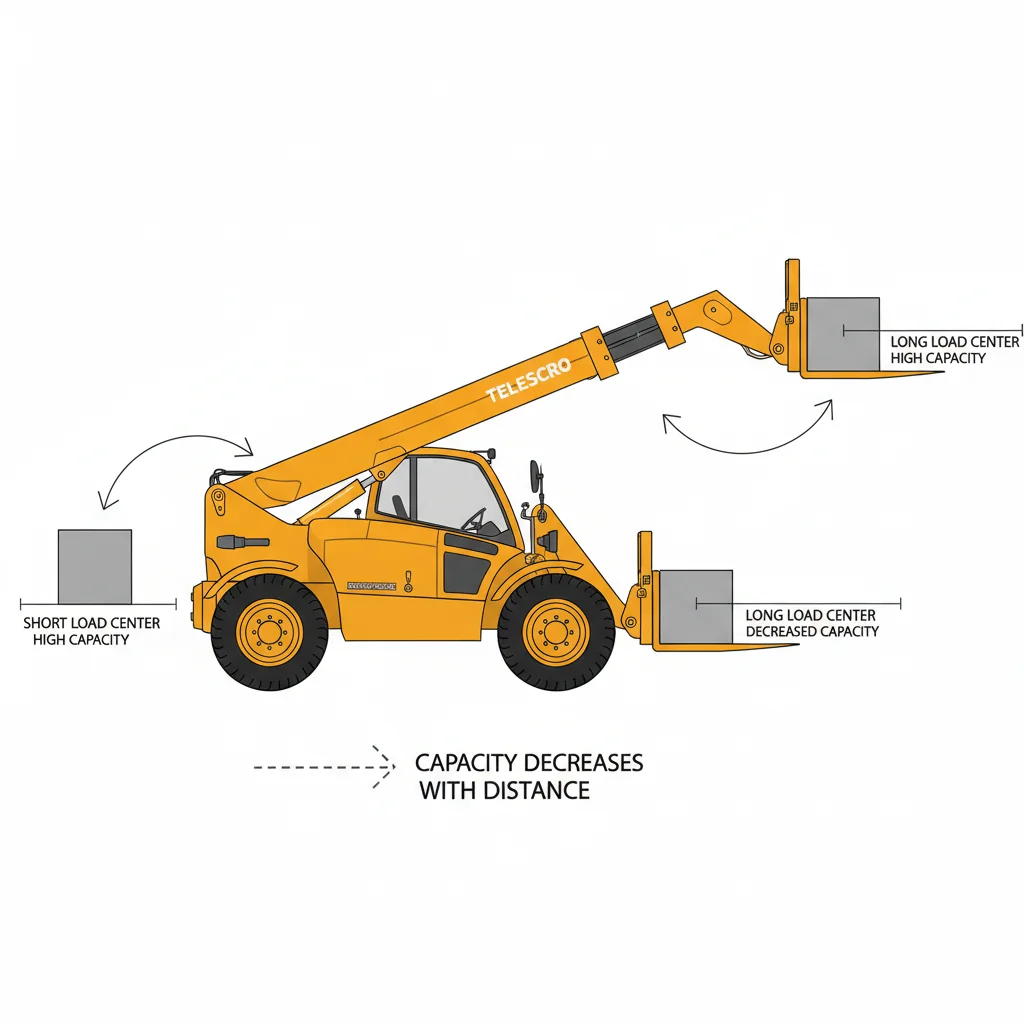
The biggest mistake I see is focusing only on the telehandler’s headline lifting capacity—often written as “4,000 kg” or “3.5 tons”—and ignoring the load center figure right next to it. But the reality is, that number only holds true at a specific distance from the fork face, often just 500 or 600 mm. Once your load extends further out, that capacity drops fast. I’ve seen this play out on jobsites from Dubai to Thailand: a steel supplier orders a mid-size telehandler, assuming they can safely lift long, heavy beams. But when those beams stick out 1 meter past the forks, the real safe lifting capacity can be less than half the rated value.
Here’s what matters most when checking capacity: telehandlers behave like giant levers. As the boom extends and the load center shifts outward, the overturning force—what engineers call the “moment”—grows quickly. For example, a 3.5-ton model might manage 2,800 kg close to the machine. Stretch that same load out to 13 meters with a 900 mm load center, and you might only have 1,200 kg of safe capacity. I once had a client in Kazakhstan who damaged a machine’s hydraulic system by ignoring the load chart when handling oversized scaffolding. The risk isn’t just tipping—the whole structure and hydraulics are working close to their limits.
If you ever need to lift long materials—pipe, rebar bundles, roof panels—I suggest double-checking the load chart’s vertical and horizontal reach limits paired with your actual load dimensions. Always ask: “How far out, and what shape is my load?” That’s how you keep your team and your equipment safe on site.
A telehandler’s rated lifting capacity is only accurate when the load’s center of gravity is positioned at the specified load center distance, typically 500 or 600 mm from the fork face.True
Manufacturers determine telehandler capacity based on a standard load center distance; if the load extends beyond this point, leverage increases and effective lifting capacity decreases.
If the load center increases beyond the manufacturer’s specified distance, the telehandler’s lifting capacity remains unchanged as long as the load weight does not increase.False
As the load center increases, the lever arm grows longer, causing more tipping force. This means the machine’s maximum safe lifting capacity decreases, even if the overall weight is the same.
Key takeaway: Load center directly impacts a telehandler’s safe lifting capacity. Rated capacity is only valid at the specified load center, ground level, and boom position. For extended loads or increased reach, always reference the OEM load chart and correction tables—not just the machine’s nominal tonnage rating.
How to Calculate Telehandler Derated Capacity?
Telehandler derated capacity can be roughly screened by comparing the rated load center with the actual load center: as the load center increases beyond the rated value, available lifting capacity drops rapidly. This approach is only a conservative check. Actual safe limits must always be confirmed using the manufacturer’s load chart for the specific boom height, reach, and attachment.

Let me share something important about derating telehandler capacity—it comes up on almost every project site I support. The basic formula—rated capacity times (rated load center divided by actual load center)—gives you a quick, conservative estimate. For example, if you have a telehandler rated for 5,000 lb at a 24-inch load center but your load sits out at 36 inches, the math is simple: 5,000 × (24 ÷ 36) equals about 3,333 lb. That’s a steep drop, but it keeps you out of dangerous territory when your load extends further out than the manufacturer’s test scenario.
I’ve seen this play out for a customer in Dubai lifting HVAC units onto a rooftop. Their loads were heavier and had to sit further out on the forks due to crate design. Since the actual load center was almost 32 inches, the operator had to cut their initial plan. Using the same formula—5,000 × (24 ÷ 32)—their safe limit dropped to 3,750 lb. They nearly overloaded the machine before running the numbers. I always stress: this is a screening tool only. The real limitations are in the manufacturer’s load chart, which sets capacity based on reach, boom height, attachment, and stabilizer use.
You can’t shortcut this process by applying percentages or guessing. Rated capacity assumes level ground, the specific attachment, and a defined load center. So if your quick calculation tells you the load is close to the limit, don’t risk it—double-check the model’s load chart for every working height and extension. That’s where safe lifting starts.
A telehandler’s lifting capacity drops significantly when the load center distance increases beyond the machine’s rated load center, even if the load weight remains unchanged.True
This is true because increasing the load center creates a larger moment arm, putting greater stress on the telehandler’s boom and stability system, which directly lowers safe lifting capacity.
If a telehandler is rated for a certain capacity at a 24-inch load center, it can safely lift the same amount at any load center, as long as the load weight does not change.False
This is false because changing the load center alters the leverage exerted on the telehandler; capacities are based on specific distances, so increasing the load center beyond the rated point reduces the maximum safe lifting capacity.
Key takeaway: Simple ratios allow quick, conservative screening for telehandler capacity reduction when actual load center exceeds rated specifications. However, this approximation cannot replace the manufacturer’s load chart, which factors in boom height, reach, and attachment. Always confirm suitability using model-specific charts before lifting any load.
How Do Long Loads Affect Telehandler Load Center?
Long, overhanging, or uneven loads shift the actual load center beyond standard 500–600 mm assumptions, often reaching 800–1,000 mm or more from the fork face. This forward shift increases the overturning moment, significantly reducing safe rated capacity and height per the load chart. Precise load center measurement is vital for safe operation.

I’ve worked with customers who made this mistake, especially when handling long timber packs or roof trusses. They relied on the standard 600 mm load center from the load chart, not realizing that the real center of gravity was more than 900 mm out from the fork face. In Dubai, I watched a team try to lift a 7-meter steel beam rated at 1,000 kg. On paper, their 3.5-ton telehandler should have handled it easily. But with the center of gravity stretched far ahead—nearly 1 meter forward—the telehandler’s safe capacity at that reach dropped below 1,200 kg, and stability became marginal.
Here’s what matters most when you’re working with long or uneven loads: the further forward your load’s center of gravity, the bigger the overturning force at the tipping axis (the front wheel line). Every extra centimeter moving forward eats into your safe lifting margin. If your load is stacked unevenly—say, heavy material at the front edge of the pallet, with voids behind—it silently pushes the center out even further, making the actual load center “worse than chart” without you noticing. At that point, the load moment surges and even a small miscalculation can cause the machine to tip, especially at height.
I always suggest supporting the load as far back against the fork heel as possible and refusing poorly stacked or overhanging pallets. If you can’t measure the real load center, treat it conservatively—use the lowest safe estimate from your load chart or reduction factor table. It only takes one close call to realize how quickly stability can vanish if you ignore this detail.
When handling long loads that extend the load center beyond the standard 600 mm, the telehandler’s actual lifting capacity can decrease dramatically, even if the load’s weight doesn’t exceed the machine’s rated maximum.True
The telehandler’s load chart assumes a standard load center distance, typically around 600 mm from the fork face. When the actual load center is farther out due to long loads like roof trusses or steel beams, the leverage increases and reduces effective capacity. Even if total weight is within the machine’s specified limit, this increased leverage can overpower the telehandler or even tip it over.
The length of the load has no effect on telehandler stability as long as the total weight stays within the rated capacity.False
Longer loads move the center of gravity farther from the machine, which increases the leverage forces acting on the telehandler. This significantly impacts both stability and lifting ability, even if the total weight is under the rated maximum shown on the machine’s load chart.
Key takeaway: Long or uneven telehandler loads move the center of gravity farther forward, greatly reducing capacity and stability. Always reference the actual load center, not just standard chart values, support the load as far back as possible, and treat irregular loads conservatively unless precisely measured.
How do attachments affect telehandler load center?
Attachments move the load farther forward from the telehandler, increasing the effective load center and reducing usable lifting capacity—especially at reach. Because each attachment changes both load position and weight, manufacturers provide attachment-specific load charts. Using a standard fork load chart with attachments is unsafe and not compliant.
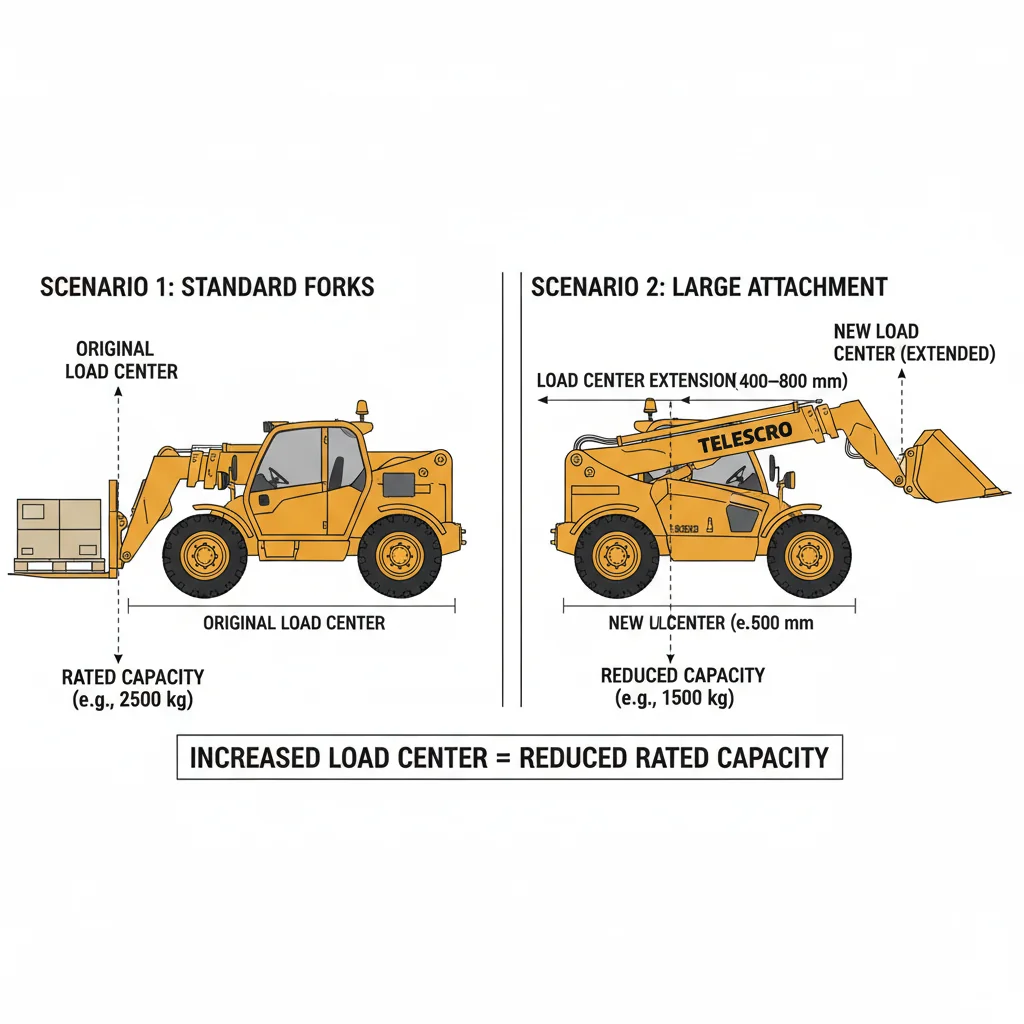
Here’s what matters most when thinking about attachments and the load center on your telehandler: every attachment you fit—whether it’s a jib, bucket, or man basket—shifts your load farther out from the fork carriage. That extra distance radically reduces your usable lifting capacity, especially at full boom extension. I’ve seen this mistake happen in Dubai, where a crew installed a 600-kg man basket to reach the fifth floor. Their telehandler, rated at 3,500 kg on forks, could barely lift 850 kg safely when the basket’s extra 700 mm was factored in. The operator only realized the risk when the moment indicator flashed an overload warning at half boom—scary.
If you want an accurate picture of what you can truly lift, always look at the attachment-specific load chart2, not just the one for forks. Here’s what you need to check before any lift:
- Attachment weight – All attachments count against your rated capacity. Even a light jib often weighs over 200 kg.
- Shifted load center3 – Most attachments move your load 400–800 mm forward, reducing safe capacity as much as 50% at maximum reach.
- Attachment-specific load chart – Manufacturers issue separate charts for buckets, baskets, jibs. Never guess based on the forks.
- Real job heights and reach – Always check what you can pick at working positions, not just at minimum extension.
If you need to lift heavy materials like bricks to 12 meters, I suggest checking realistic numbers—on a typical 4-ton machine, an attachment might knock you down to just 1,600 kg at full reach. That difference can make or break your project’s workflow.
When a telehandler is fitted with a long attachment like a jib or man basket, the load center shifts farther from the fork carriage, which significantly reduces the machine’s rated lifting capacity at maximum extension.True
Attachments increase the horizontal distance between the telehandler’s pivot point and the load, which means the load center moves outward. This added leverage dramatically lowers safe lifting capacity, regardless of the machine’s original rating.
Adding a lightweight attachment to a telehandler, such as a small bucket, has no effect on the load center or lifting capacity as long as the total weight does not exceed the original machine rating.False
Any attachment that changes the distance between the fork carriage and the load—even if it is lightweight—alters the load center. This change always affects lifting capacity, since telehandler ratings are calculated with specific load centers in mind.
Key takeaway: Attachment choice directly impacts usable lifting capacity by increasing the effective load center, often requiring specific load charts. Always review attachment-specific capacity ratings and never rely on standard fork charts to avoid unsafe lifting and regulatory violations in telehandler operations.
How does load center affect telehandler stability?
Load center dictates how far the load’s weight acts from the front tires, directly impacting telehandler stability. As the boom extends or load center increases, the combined center of gravity moves toward the front axle, risking tip-over if it crosses outside the stability triangle—a critical factor verified under standards like EN 1459 and ANSI/ITSDF B56.6.
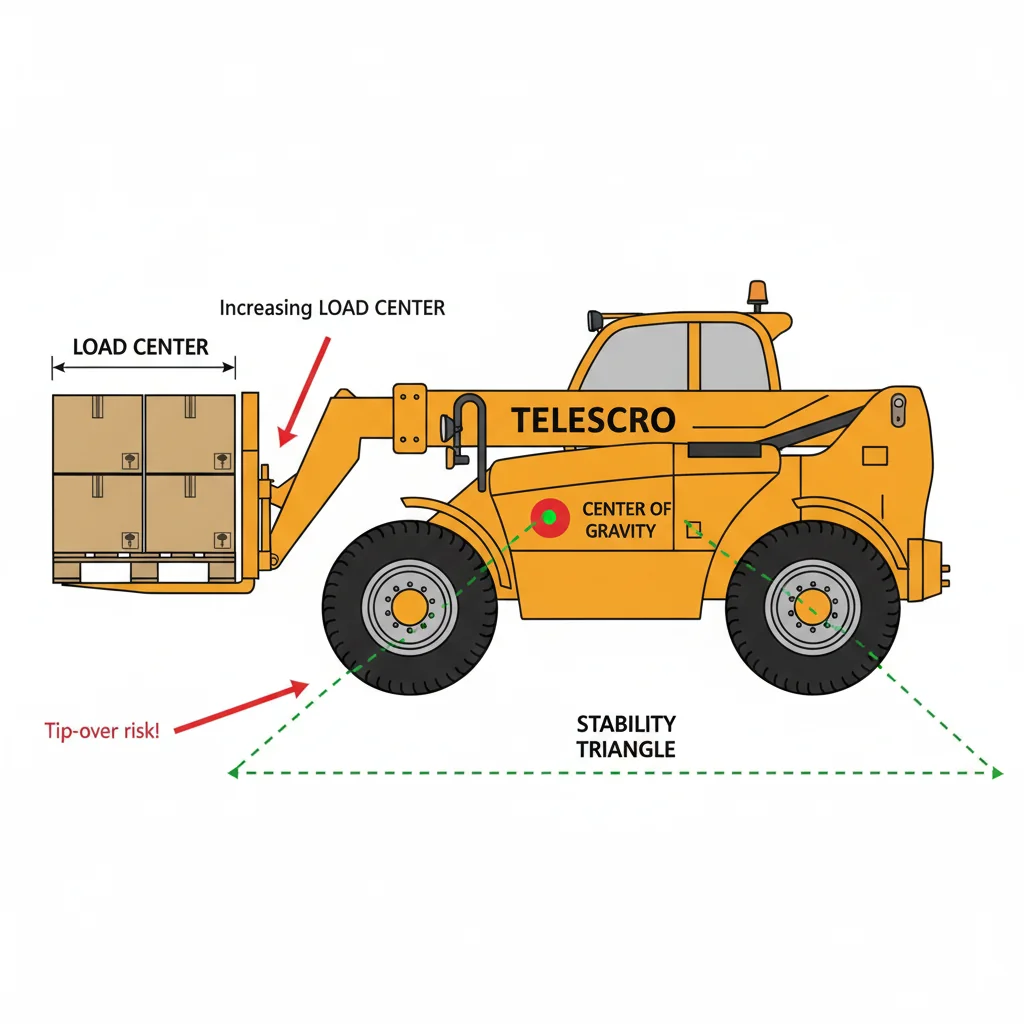
I’ve worked with several teams in the Middle East who underestimated how quickly the center of gravity shifts as the boom extends. One project in Dubai had a 4-ton telehandler moving pallets of tile to the fourth floor—about 13 meters up. When the operator overlooked the actual load center, the combined center of gravity crept dangerously close to the front axle. Even on level ground, just an extra 200 mm forward on the forks sent the warning alarm on the moment indicator, forcing them to back off mid-lift. That’s exactly why I push operators to actually read the load chart, not just trust their instincts.
In practical terms, telehandler stability is governed by how the combined weight of the machine and the load acts relative to the front axle, which serves as the primary tipping axis in most lifting situations. As the load center increases or the boom is extended, the effective center of gravity moves forward, reducing the available lifting capacity shown on the load chart.
This effect becomes very noticeable at longer reach. A machine that can handle a relatively heavy load close to the chassis may be limited to a much lower allowable weight once the boom is extended, depending on the specific model and configuration. I see this issue most often with heavy palletized loads that do not sit tight against the carriage—every extra centimeter forward increases the overturning moment acting on the machine.
From my experience, always verify two things before lifting: the exact load center your pallet creates and the corresponding position on your telehandler’s load chart. I suggest running through the worst-case scenario—maximum reach, uneven ground, or a slippery worksite. If your calculated center of gravity gets close to that triangle’s front edge, you’re running a real risk of tip-over. Play it safe: check the numbers, every time.
If the load center extends further out on the forks, the combined center of gravity moves closer to the front axle, reducing the telehandler’s stability even when operating on flat ground.True
The further the load’s center of gravity is from the carriage, the further forward the overall center of gravity shifts. This reduces the safe operating margin before the telehandler reaches its tipping point, especially at height.
As long as the telehandler is rated for the load’s total weight, the distance of the load center has minimal effect on stability.False
The rated capacity of a telehandler is only valid at a specified load center distance. If the load center moves further away, the effective safe lifting capacity drops substantially, making stability highly sensitive to load center position.
Key takeaway: The load center is a primary factor in telehandler stability. Increasing load center or extending the boom causes the center of gravity to move forward, which can breach the stability envelope and result in tip-over. Always reference the load chart for the actual load center involved.
How does load center affect load charts?
In telehandler load charts, the rated capacity depends on the specified load center, boom angle, reach, and attachment type. If the actual load center exceeds the chart’s assumed value (typically 500–600 mm), the safe lifting capacity decreases. Always verify the load center and consult the manufacturer’s reduction tables4 for adjustments to avoid unsafe lifting scenarios.
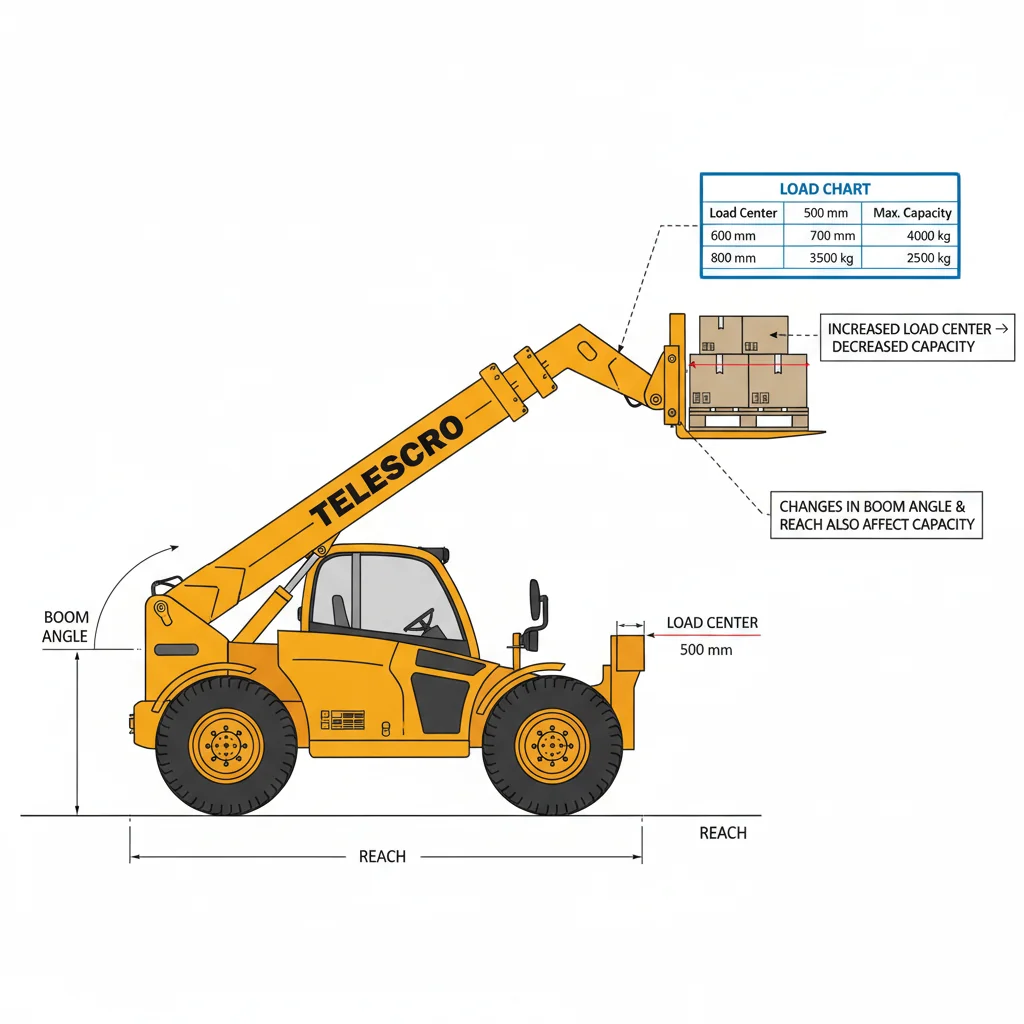
From my experience, even experienced operators can get caught out by load center assumptions on site. Two years ago, I supported a project in Kazakhstan where the customer used a 4-ton telehandler to lift prefab beams. The load was positioned 900 mm from the fork face—far more than the 600 mm that the load chart assumed. On paper, that machine showed 4,000 kg capacity at short reach. But with the real-world load center, the maximum safe lift dropped below 2,800 kg. Their foreman didn’t realize they needed to check the manufacturer’s reduction table for this attachment configuration. They were lifting comfortably—until one close call forced a review.
Every telehandler load chart is built around specific assumptions: attachment type, load center (usually 500–600 mm), boom angle, and reach. Most charts illustrate capacity as a grid, with height on one axis and reach (measured from the front tire edge to the load center) on the other. If your actual pallet or load sticks out further than the charted load center, you must apply the OEM’s reduction factor. There’s no shortcut or universal “percentage rule”—each manufacturer supplies detailed tables for adjustments. Ignoring those details is risky. In Brazil, I’ve seen teams derate by “about 20%” for extra-long pipes, only to find their margin wasn’t enough when working near maximum extension.
So, plan lifts against the exact load chart and confirm both attachment and load center match your situation. I always recommend marking your planned load center on paper before work starts. That extra five minutes prevents many costly surprises.
Increasing the load center distance on a telehandler reduces its safe lifting capacity, even if the total load weight remains unchanged.True
This is true because telehandler load charts assume a specific load center, usually referenced from the fork face. Moving the load center further out increases the overturning moment, which lowers the maximum safe load to prevent instability.
As long as the load weight does not exceed the machine’s rated capacity, the load center distance has no effect on telehandler stability.False
This is false because the rated capacity is only valid at the specified load center. Moving the load further out increases leverage on the boom, which can cause tipping even if the load is under the maximum weight shown in the load chart.
Key takeaway: Always check the load chart for the correct load center and attachment configuration. Lifting with a longer load center than specified reduces safe capacity. Never use fixed percentage rules—only apply manufacturer-provided reduction factors. Plan each lift position against the actual load chart before operating.
How is load center measured onsite?
Load center is the horizontal distance from the fork or attachment reference face specified in the manufacturer’s load chart to the load’s center of gravity. For standard, evenly distributed pallet loads, this is typically about 500–600 mm (or 24 in / 610 mm, depending on market). For long or overhanging loads, the actual center of gravity moves farther forward, increasing the load center and reducing the telehandler’s available lifting capacity.

Last month, a contractor in Dubai asked me why their 3.5-ton telehandler “felt weak” lifting timber packs. Their crew was working with standard 1,200 mm pallets, which normally means a 600 mm load center from the fork heel to the center of the pallet. But when they switched to four-meter-long timber, only about 1.2 meters sat fully on the forks. The actual midpoint of the load—the real center of gravity—was two meters from the fork heel, not 600 mm. That change alone knocked more than half off the rated capacity. The machine was not underperforming; the real operating scenario required far more capacity than they realized. Measuring the load center onsite isn’t just about using a tape measure on the pallet. You need to check where the load actually sits in relation to the fork heel—the spot where the fork blade meets the upright shank. For a typical 1,200 mm pallet, measure from this fork heel to the midpoint. But with long or unevenly balanced materials, always measure the total length and divide by two. If the forks only support part of the load, the effective center may shift even further out. This increases the overturning moment, so your working zone shrinks fast. To be honest, I always suggest sliding the load right up to the carriage backrest before lifting. Every extra 100 mm forward may cost you hundreds of kilos in capacity. When calculating in the field, be conservative.
If a load extends far beyond the standard 600 mm load center, its true load center must be measured from the heel of the fork to the midpoint of the entire load, not just to the pallet edge.True
The actual load center is the distance from the fork heel to the center of gravity of the load—even if the load extends much further than typical pallets. This increases leverage on the telehandler and drastically reduces capacity, which is critical for safety and performance.
The rated lift capacity of a telehandler remains constant regardless of where the center of gravity of the load sits on the forks.False
The rated lift capacity decreases as the load center increases beyond what the equipment is designed for. As the center of gravity moves out, the machine’s effective lifting capability is reduced due to increased leverage and tipping risk.
Key takeaway: Accurately measuring load center on site is crucial for telehandler safety and correct machine selection. For standard pallets, use the fork heel to midpoint distance. For long or unevenly supported loads, calculate the actual center of gravity and reference conservative load charts for safe operation.
How does load center affect telehandler choice?
Load center significantly impacts telehandler selection by determining actual lifting capacity at specific heights and reaches. The rated capacity assumes a standard load center, but real-world loads often extend this distance, substantially reducing capacity. Buyers must match equipment to their actual load centers using manufacturer load charts5, not just base rated capacities.
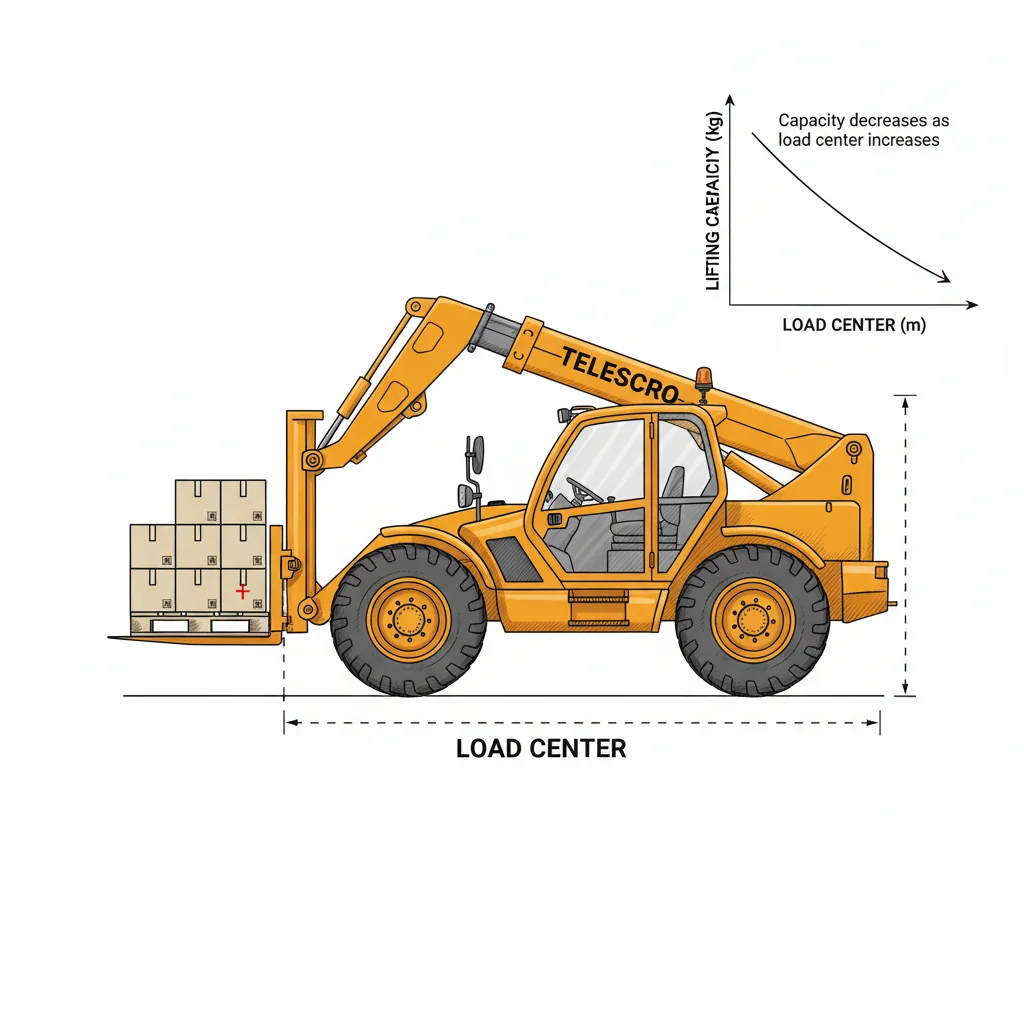
To be honest, the spec that actually matters is what your machine can lift at the load center you’ll use on site—not just the number stamped on the side. The rated capacity is usually based on a standard load center, often 500 or 600 mm from the fork face. But in reality, things like long timber packs, block stacks, or awkward pallets can push that load center out to 900 mm or even more. The farther your load’s center of gravity is from the front tires, the more leverage it has. That dramatically reduces safe lifting capacity, especially once you extend the boom. I’ve seen teams in South Africa caught off guard by this. One contractor ordered a 3.5-ton telehandler, planning to place heavy steel beams at about 8 meters reach. On paper, their spec was fine. But those beams were over 1.2 meters deep, pushing the load center much further out than standard. By the time we checked the manufacturer’s load chart for that extended load center and reach, the safe capacity dropped to just above 1,300 kg. They ended up renting a larger 4.5-ton machine to avoid delays—costing extra time and money. Here’s the thing: manufacturers provide detailed load charts showing exactly what each model can safely lift at every combination of reach, height, and load center. Always ask for these charts at your actual working points. If your job involves changing attachments or unusually long loads, don’t trust the base rating.
A telehandler's maximum lifting capacity decreases significantly as the load center distance increases beyond the standard measurement point.True
This is due to the increased leverage effect caused by moving the load further from the front axle, which reduces the machine's stability and safe lifting capability.
Telehandler specifications for rated capacity apply equally, regardless of whether the load center is standard or extended.False
Rated capacities are based on a standard load center, and lifting with a greater load center reduces the actual safe lifting limit due to the increased moment arm and risk of tipping.
Key takeaway: Always factor in real load center, height, and reach for each typical lift—not just base rated capacity. Reviewing manufacturer load charts at actual working points prevents costly under-specification and safety risks. Stepping up one machine size is often more efficient than constant rentals, delays, or working at the margins.
How does wear affect telehandler load center?
Wear in forks, carriages, or attachments reduces a telehandler’s effective lifting capacity and safety margin. Fork heel wear, bent forks, loose pins, or fatigued attachments compromise load support and stability, especially at height and reach. For example, industry inspection standards commonly note that significant fork heel wear can result in a substantial reduction in allowable fork capacity, making conservative self-derating and timely maintenance essential.
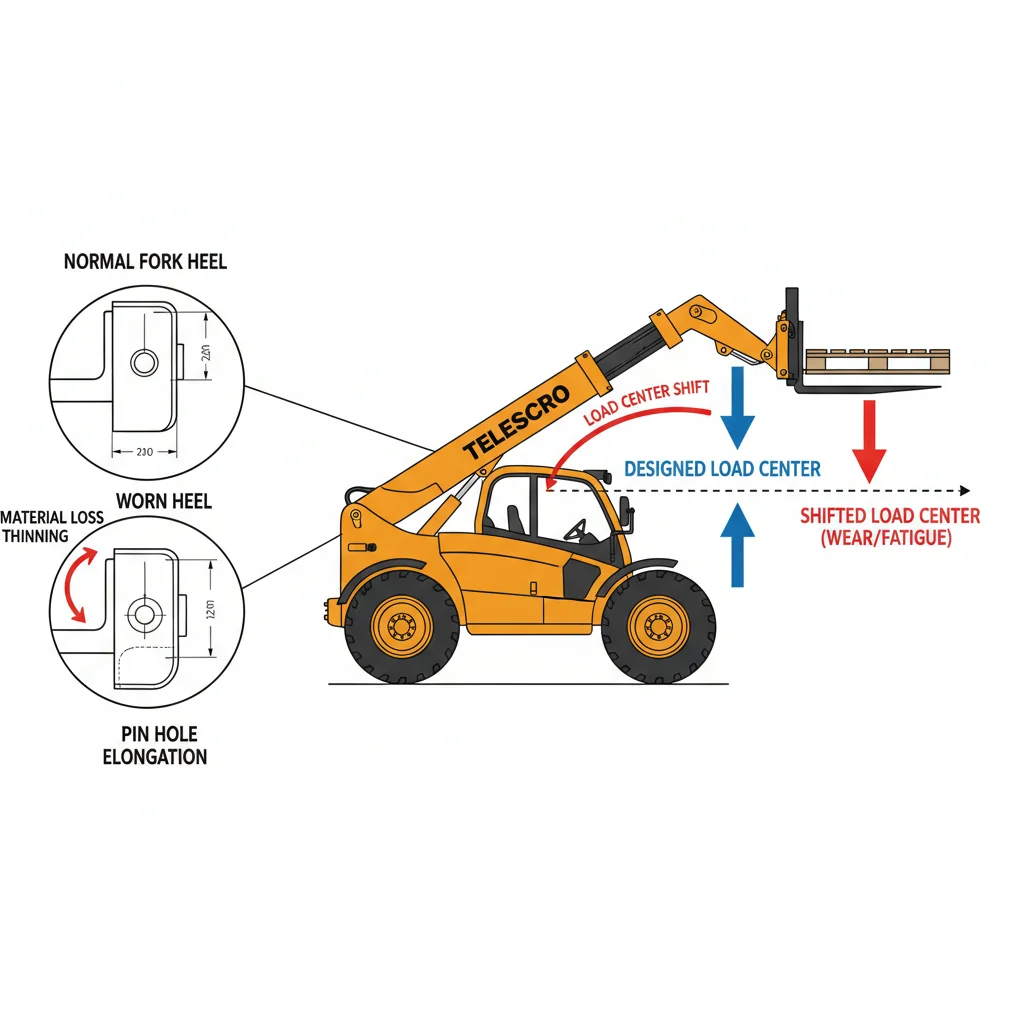
A question I always ask operators is: have you ever measured how much fork wear6 changes your real load center? On paper, your telehandler’s rated capacity assumes forks and carriage are in perfect condition, with the load sitting exactly at the manufacturer-specified load center. But once fork heels wear down—even just by 10%—and the carriage pins develop play, things aren’t so clean. I’ve been on sites in Kazakhstan and Singapore where routine checks showed fork capacity dropping by nearly 20% from heel erosion alone. What often goes unnoticed is that this reduces your safety margin, especially when the boom’s up high or fully extended. Now, even a small shift—maybe just 30–40 mm forward due to bent forks or loose pins—moves the tipping axis further out from the front tire edge, which is where OEMs measure reach in the load chart. From my experience, this effect seems minor on paper but grows fast at height or long reach. Imagine lifting 1,800 kg at 14 meters with a standard 4-ton telehandler. If your forks sag and there’s any play, the true load center creeps forward, which the load chart doesn’t account for. That’s when a moment indicator can start flashing or, worse, the machine begins to feel unstable. Loads like bricks or pipes rarely sit perfectly balanced—which is another headache. I saw a team in Kenya underestimate this problem; their odd-sized timber bundles slid forward on worn forks and exceeded safe reach before anyone noticed.
Fork wear moves the effective load center further from the carriage, reducing actual lifting capacity even if the load weight stays within the original chart limits.True
As fork heels wear down, the load rests farther from the carriage, increasing leverage on the telehandler and reducing safe lifting capacity—an effect not accounted for in factory load charts.
Worn forks have no impact on the telehandler's load center as long as the load is placed in the same position on the forks.False
Fork wear shortens the heel and can shift the load point outward, which increases the load center distance and reduces effective capacity, regardless of where the load is placed on the surface of the forks.
Key takeaway: Progressive wear and mechanical play in telehandler forks and attachments effectively increase the load center, reducing stability and rated capacity—especially at high reach. Since real-world loads are often uneven or odd-shaped, conservative self-derating and timely maintenance are essential to maintain safe working margins.
Conclusion
Understanding the importance of load center in telehandler lifting comes down to more than just numbers on a chart—it’s about knowing how real jobsite stability and capacity can change if the load is positioned further out. From my experience, too many buyers get caught by the “3-meter blind spot”—focusing on what the brochures promise and missing that actual safe lifting depends on sticking to the rated load center. Before you make any choice, I always recommend looking at the load chart at your typical working extension and checking if local parts supply is reliable. Have questions about choosing a telehandler, or not sure how to read your load chart? I’m happy to help—just reach out anytime. Every site is different—choose what actually works for your workflow.
References
-
Provides a technical explanation of overturning moment and its effect on telehandler safe working load limits. ↩
-
Details why relying on generic fork load charts is unsafe and how attachment-specific load charts ensure compliance and accurate lifting capacity. ↩
-
Explains how attachments shift the load center forward, critically reducing safe lifting capacity by up to 50%, essential for safe telehandler operation. ↩
-
Insights into why consulting OEM reduction tables is crucial to adjust load capacity safely and prevent accidents on site. ↩
-
Learn the critical importance of using manufacturer load charts for safe telehandler operation beyond just base rated capacities. ↩
-
Explains how fork wear reduces rated capacity and safety margin, highlighting the importance of maintenance to prevent load failures. ↩