










Telehandler vs Forklift: Key Differences Every Buyer Should Know
From my experience working with equipment buyers in places like Canada, Saudi Arabia, and Vietnam, the biggest mistake I see is treating forklifts and telehandlers as almost interchangeable. I get calls every month about jobs that turn into a headache because someone picked the wrong machine for their real needs.
In this article, I’ll break down the practical differences between telehandlers and forklifts—the kind that show up on actual jobsites, not just in spec sheets.
We’ll look at reach, height, terrain handling, maneuverability, lifting power, and attachments. My goal is to help you match the machine to your daily reality, not just a checklist.
How Do Telehandler and Forklift Reach?
Telehandlers feature a 텔레스코픽 붐1 that lifts loads up to 60 feet high and 40 feet forward, even over obstacles. Standard forklifts use a vertical mast, typically reaching 10–20 feet upward with little forward range. Telehandlers excel where high or extended reach is essential.
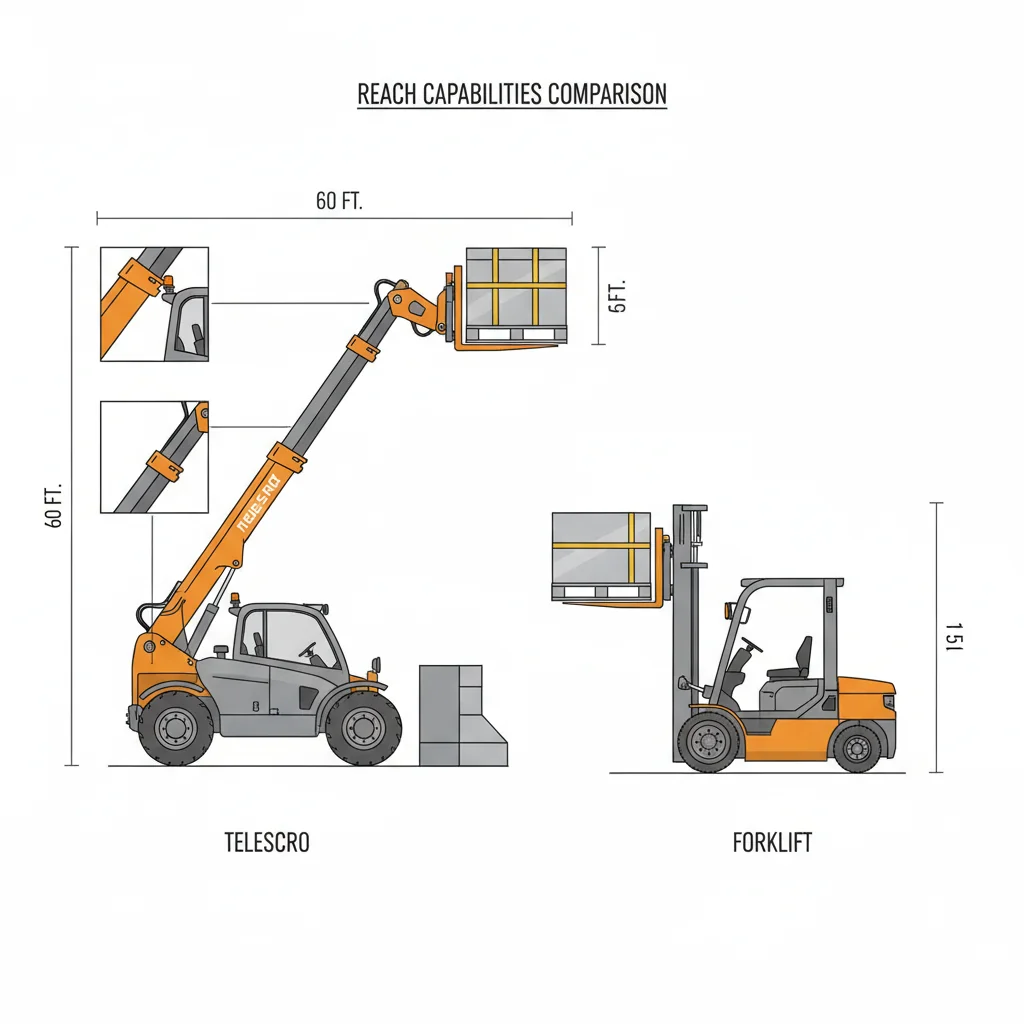
Most people don’t realize that a telehandler’s biggest advantage isn’t just height—it’s being able to reach far forward, too. I’ve seen crews in Dubai using a 4-ton, 17-meter telehandler to place palletized tile bundles straight onto a rooftop, about 14 meters up and 8 meters out. The boom extended high and over scaffolding, so there was no need to reposition the machine. Standard forklifts simply couldn’t get close unless the ground was clear and access was direct. For warehouse jobs, a 3-ton forklift with a 5-meter mast is quick and efficient on flat concrete, but its reach stops at the vertical—maybe 5 to 6 meters up and no further out.
Let me share something important about real jobsites. One contractor I supported in Kazakhstan needed to unload rebar into a foundation pit, over a retaining wall about 2 meters high and 6 meters from the access road. A compact telehandler2 with a 9-meter boom solved the problem easily. If they’d relied on a regular forklift, workers would’ve been forced to hand-carry each bundle over the wall—doubling labor time and risk.
Telehandlers are designed with hydraulic booms and complex 로드 차트3 (these show safe lifting at different positions), so you can place heavy loads up to 60 feet high and 40 feet out, depending on the model. Most machines also have a load moment indicator, which warns if you’re getting close to tipping. Forklifts are simpler—just a vertical mast with a maximum lift height4 and no forward outreach.
I suggest checking your required height and outreach zone before choosing—this one spec drives most decisions.
Telehandlers typically have boom outreach capabilities exceeding 15 meters, allowing them to place loads at considerable heights and distances, unlike standard forklifts that mainly rely on vertical mast height of about 4-6 meters.True
Telehandlers feature telescopic booms that can extend far forward and upward, enabling precise placement over obstacles and at distance, whereas forklifts generally have fixed vertical masts limiting their horizontal reach to near the vehicle only.
Forklifts can usually extend their forks horizontally up to 12 meters, which is comparable to telehandler boom reach, making them equally effective at placing loads at remote locations.False
Forklifts lack telescopic booms and cannot extend forks far forward; their horizontal reach is limited to the fork length and minor maneuvering, generally under 3 meters. This makes telehandlers uniquely suited for reaching distant or elevated locations on construction sites.
핵심 요점: Telehandlers offer far greater vertical and forward reach compared to forklifts, thanks to their telescopic booms. For jobs needing material placement over obstacles, onto rooftops, or deep into a site, a telehandler is often the only practical option, surpassing standard forklifts’ reach limits.
How Do Telehandlers Handle Rough Terrain?
Telehandlers excel on rough, uneven ground thanks to large all-terrain tires, high ground clearance, robust frames, plus options for four-wheel drive and steering. In contrast, standard forklifts are optimized for smooth, hard surfaces and can struggle or get stuck outdoors or on soft, unfinished ground.
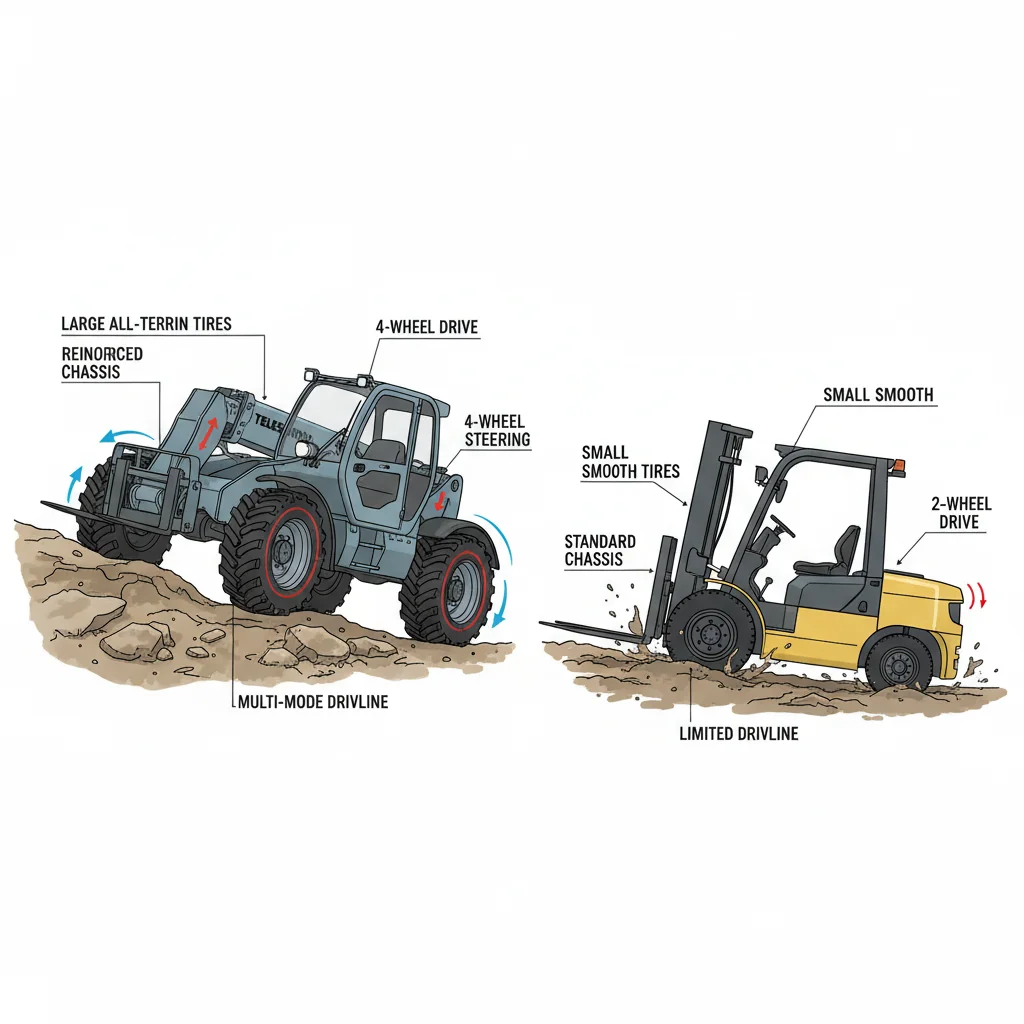
Let me share something important about rough terrain: telehandlers are built for exactly these conditions, and that’s no accident. Last year, a customer in Kazakhstan called me when their site was still just dirt, full of muddy patches and loose gravel. Their standard warehouse forklift got stuck three times in one week, costing them almost two days of lost work. When they switched to a compact 3-ton telehandler with four-wheel drive, the machine powered straight through mud and slopes that would stop a forklift cold. The ground clearance—usually around 400 mm—lets the chassis clear rocks and ruts easily, while those big, deep-tread tires provide traction even in fresh snow or sticky clay.
From my experience, the real difference comes when you work on unfinished sites or soft ground. Forklifts have small, hard tires designed for flat concrete. It makes them agile indoors, but outside? They can dig themselves in within minutes, especially if the ground is wet. Telehandlers’ heavier frames and wide wheelbase mean better stability on uneven surfaces, and the hydraulic stabilizers (outriggers) on some models offer peace of mind if you’re lifting on a slope over 10 degrees.
One Dubai contractor told me last winter that their 4-ton, 14-meter telehandler saved them at least a week on a stadium project just by keeping materials moving after heavy rain. It’s details like this—traction, ground clearance, real stability—not just the lift height you see on the spec sheet. I suggest matching your machine to your worst terrain, not just the best. That’s how to keep your site productive and safe.
Telehandlers typically feature oscillating front axles that allow each wheel to maintain ground contact independently, enhancing stability and traction on uneven terrain unlike standard forklifts which have rigid axles.True
Oscillating axles help telehandlers adapt to rough ground by allowing each wheel to move vertically without lifting others off the ground which improves traction and reduces tipping risk, a key advantage on uneven or soft surfaces.
Standard forklifts often outperform telehandlers in rough terrain because their smaller wheelbase provides better maneuverability on uneven surfaces.False
Although forklifts have a smaller wheelbase, they lack specialized features such as four-wheel drive, large pneumatic tires, and oscillating axles found on telehandlers, making them less capable and prone to getting stuck or tipping on rough terrain.
핵심 요점: For worksites with mud, gravel, slopes, or unfinished surfaces, telehandlers offer superior safety and efficiency compared to standard forklifts. Forklifts work best on flat, stable surfaces. Choosing the right machine for your terrain directly impacts productivity and reduces the risk of costly downtime.
How Do Lifting Capacities Compare?
Forklifts can handle extremely heavy loads (up to 60,000 lb), especially at ground level, while large telehandlers typically cap out at 20,000–24,000 lb. Telehandler capacity5 drops significantly as the boom extends, often to just 25–40% of its base rating at full reach.
Here’s what matters most when you’re comparing lifting capacities: it’s not just the maximum number on the machine’s spec sheet—it’s where that number still applies. For forklifts, I’ve seen operators in Dubai moving steel coils weighing over 15,000 kg, and their machines stay stable because the rated load is valid at ground level and, usually, all the way up if you keep the mast vertical. Telehandlers work differently. Their big advantage is reach, but there’s a catch—capacity drops sharply as the boom extends. For example, a 10-ton telehandler might handle that full load retracted, but at maximum reach—say 14 meters out—safe capacity drops to as little as 2.5–4 tons.
I’ve worked with a team in Kazakhstan placing concrete blocks for a logistics warehouse. They needed to lift 3-ton loads onto a platform 12 meters high and 8 meters away from the base. Their 7-ton telehandler could only manage about 2.5 tons at that reach, forcing them to reduce pallet size and make extra trips. Meanwhile, their older 8-ton forklift handled even heavier loads, but only at ground level and within a short radius—there was just no way to place materials at distance or height. Here’s a quick comparison:
| 기계 유형 | Max Rated Capacity | Capacity at Full Reach | 최상의 대상 | Reach Capability |
|---|---|---|---|---|
| 지게차 | up to 27,000 kg | Near max | Heavy, dense loads | No extension (mast only) |
| 텔레핸들러 | up to 11,000 kg | 25–40% of base rating | Placing at height / forward reach | Telescopic boom (forward/vertical) |
Forklifts maintain their maximum rated lifting capacity up to about 4 meters high when the mast is kept vertical, allowing operators to handle loads over 15,000 kg safely at relatively consistent heights.True
Forklifts are designed with stabilizing counterweights and rigid masts, ensuring their rated capacity applies close to the ground and up to moderate lift heights, provided the mast angle stays vertical, which maintains load stability and reduces tipping risk.
Telehandlers have a constant lifting capacity at all outreach distances because their hydraulic systems automatically compensate for leverage forces.False
Telehandler lifting capacity decreases significantly as boom extension increases due to leverage and stability factors; hydraulic compensation cannot negate the physical limitations imposed by longer outreach and raised load centers.
핵심 요점: Forklifts are superior for safely handling dense, heavy loads close to the ground, while telehandlers excel at placing moderately heavy materials at height or distance—but capacity drops with extension. Always consult load charts when operating telehandlers at varying heights or reaches to maintain safety.
Which Machine Is More Maneuverable?
Forklifts offer superior maneuverability for indoor spaces, thanks to their compact size, tight 회전 반경6, and low mast profile. Telehandlers are larger but benefit from four-wheel steering7, making them agile on open job sites where space and turning room are less restricted.
The biggest mistake I see is people assuming telehandlers and forklifts are equally nimble just because both can steer tightly. They’re not. Last year, a client in Dubai tried using a 3-ton telehandler to unload containers inside a warehouse. The problem? The telehandler’s overall length—including boom and counterweight—was nearly 6 meters.
Even with four-wheel steering and crab mode, it struggled in narrow aisles and clipped racking when making sharp turns. By contrast, their 2.5-ton forklift with a low mast moved pallets all day in under 3.5-meter aisles, ducking under a 2.2-meter mezzanine. That job proved something: maneuverability depends on more than just steering technology—it’s about size, layout, and clearance.
Here’s a practical comparison I always share with customers who manage both indoor and outdoor jobsites:
| 기계 유형 | 회전 반경 | Height (Mast/Boom) | 최상의 대상 | Limitation |
|---|---|---|---|---|
| Standard Forklift | <2.5 m | 2–2.5 m | Narrow aisles, indoor storage | Poor rough terrain ability |
| 소형 텔레핸들러 | 3.5–4 m | 2.4–2.6 m (folded) | Small yards, semi-open sites | Limited indoor clearance |
| High-Reach Telehandler | 4.5–5.5 m | 2.6–3 m (folded) | Open job sites, outdoor handling | Too large for tight spaces |
If you’re working between racking or inside tight facilities, forklifts are quicker, safer, and less likely to bump into things.
Despite having four-wheel steering and crab mode, telehandlers longer than 5.5 meters often struggle with maneuvering in tight warehouse aisles due to their extended boom and counterweight length.True
Telehandlers combine boom extension and substantial counterweights for stability, increasing their overall length beyond typical forklifts; even advanced steering modes can’t fully compensate for physical size constraints in confined spaces.
Forklifts generally lack four-wheel steering and crab mode, making them less maneuverable than telehandlers in narrow indoor environments.False
Many forklifts feature four-wheel steering, allowing tighter turning radii and excellent maneuverability indoors; this is why forklifts are often preferred in confined warehouse settings over larger, less agile telehandlers.
핵심 요점: Forklifts excel in tight indoor environments, narrow aisles, and under low clearances due to their compact build, while telehandlers are best for spacious worksites and rough terrain, where their four-wheel steering delivers enough maneuverability along with extended reach capabilities.
How Do Attachments Affect Versatility?
Forklifts mainly use forks for palletized loads, with limited attachment options like clamps or sideshifters. Telehandlers accept varied attachments—buckets, crane jibs8, winches, and platforms—making them multi-role machines. Compatibility depends on model and regulations, so always check attachment approvals for your specific telehandler.
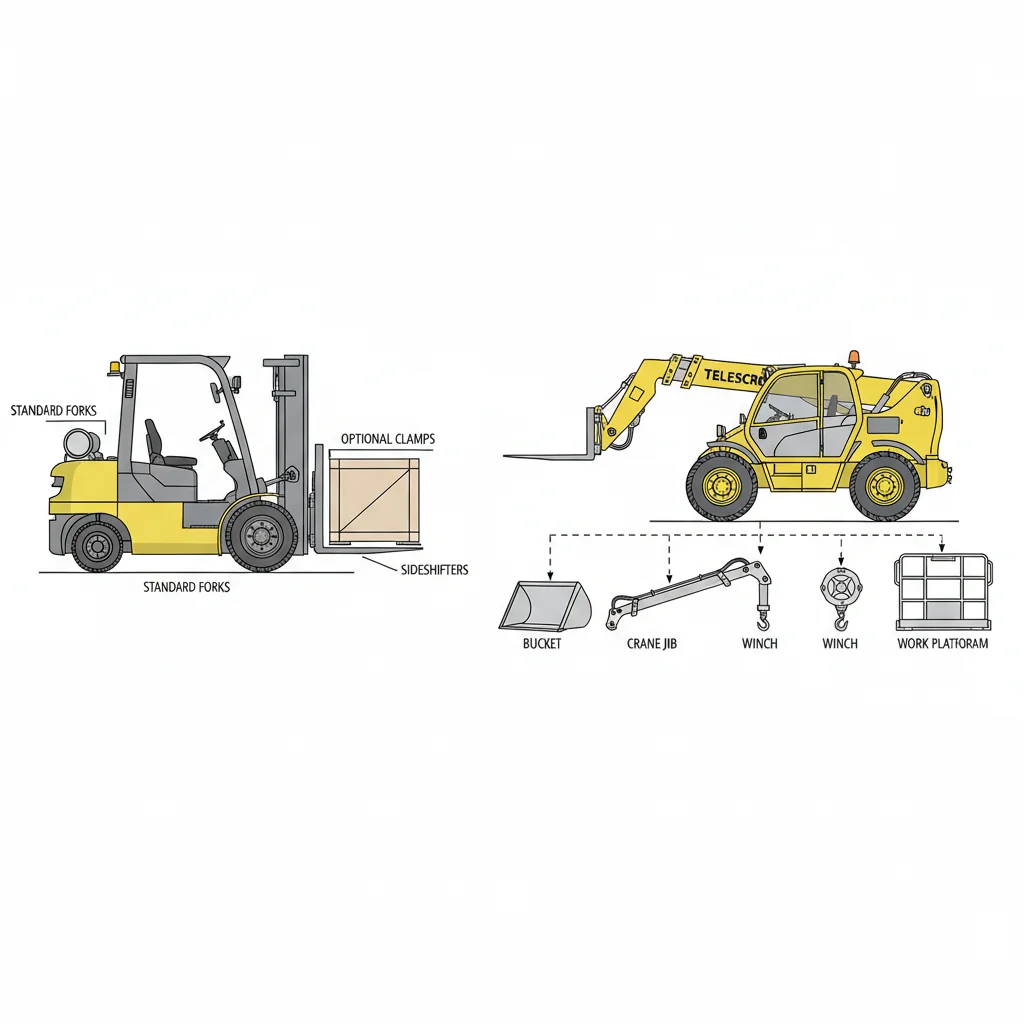
To be honest, the spec that actually matters is how attachments change what your telehandler can do each week on the job. A few months ago, I supported a site in Kazakhstan where they started with just forks to unload materials—standard forklift work. But the project soon called for pouring sand and gravel, then lifting HVAC units onto a third-floor deck. Instead of bringing in two more machines, the crew swapped on a bucket and then a crane jib. It saved them at least two full working days and cut rental costs by almost 20%.
Here are the most common ways attachments boost versatility:
- 버킷 – For moving sand, gravel, or debris, turning your telehandler into a loader.
- Crane jibs and winches – For lifting trusses, beams, or heavy equipment where a crane would be overkill.
- 작업 플랫폼9 – Used for safe, elevated access when you need to work at height, like inspections or installations.
- 팔레트 포크 – The classic attachment for palletized goods, but larger and with more reach than a typical forklift.
- Sweepers and augers – On some models, you can even add these for niche maintenance or groundwork.
Keep in mind, not every telehandler matches every attachment. I always check the coupler system—some use quick couplers, others need manual pin-on types. Local regulations matter too; for example, in Dubai, only telehandlers certified for lifting personnel can legally use work platforms. I suggest confirming attachment approvals with your model and asking for the relevant safety documentation. This single step prevents expensive mistakes and ensures true onsite flexibility.
Telehandler attachments like crane jibs can increase a machine's maximum lifting height by up to 40%, enabling tasks unreachable by standard forkliftsTrue
Crane jib attachments extend the reach and height capabilities of telehandlers beyond their fixed boom lengths, allowing operators to position loads with greater vertical and horizontal flexibility compared to standard forklifts which typically have fixed mast height limits.
Forklift attachments can be swapped in under 5 minutes without any hydraulic adjustments, making them more versatile on construction sites than telehandlersFalse
While some forklift attachments are designed for quick changes, many require hydraulic connections and adjustments that take longer than 5 minutes to ensure safe operation. Telehandlers are generally engineered with easier attachment coupling systems specifically to maximize versatility on varied jobsite tasks.
핵심 요점: Telehandlers significantly outpace forklifts in attachment versatility, often replacing multiple machines on-site. However, attachment options, compatibility, and legal certifications vary by model. Always confirm that needed accessories are approved for your telehandler and compliant with local safety regulations before purchase or rental.
How Do Telehandler Costs Compare?
Telehandlers typically cost 20–60% more to purchase or rent than similar forklifts. Their advanced booms, hydraulics, and 4WD increase both upfront and maintenance expenses. Insurers may charge higher premiums, and fuel consumption is greater—especially for diesel models—while operators generally require more training and earn higher wages.
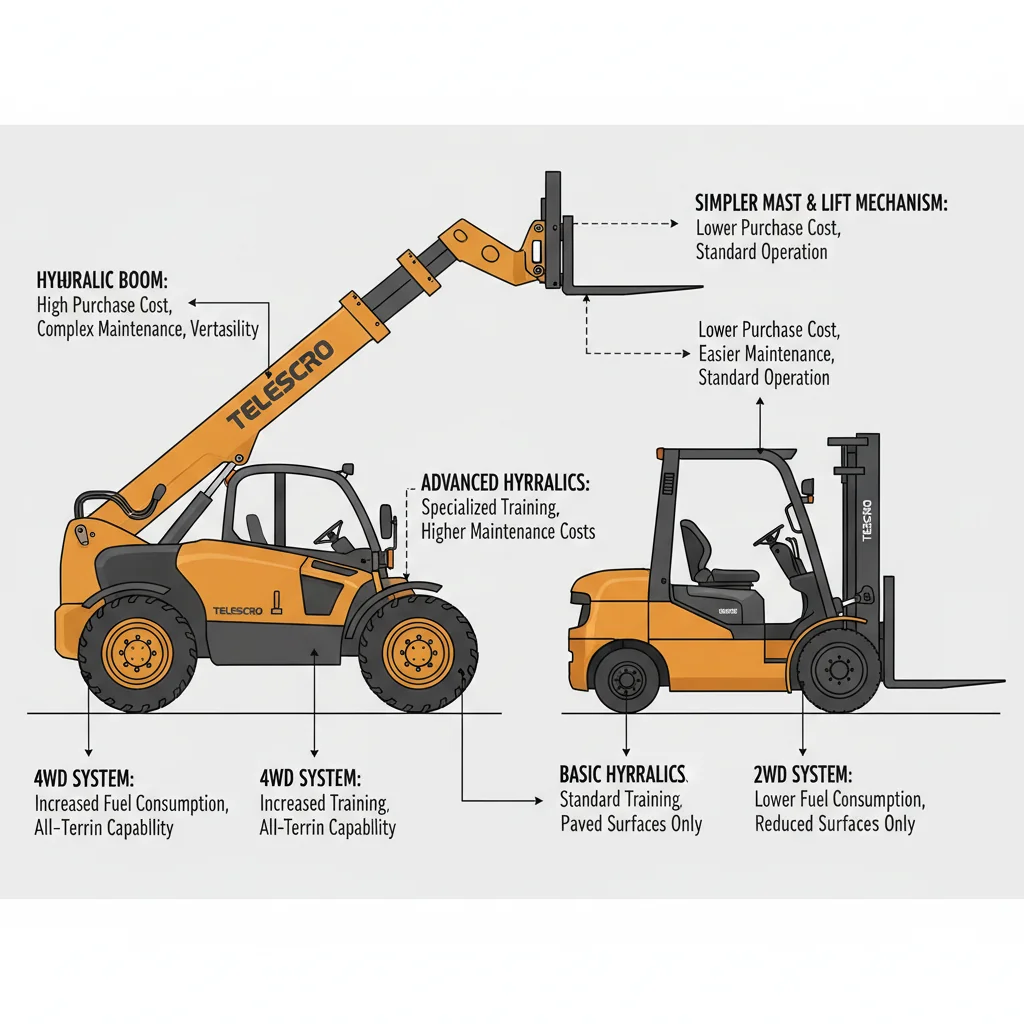
Last month, I got a call from a project lead in Dubai struggling with budget approvals for telehandler rentals. He wanted to know why the costs seemed so much higher compared to forklifts. The main reason? Telehandlers use a telescopic boom, complex hydraulic circuits, and four-wheel drive. That extra engineering brings higher purchase and maintenance costs. For example, a 4-ton standard telehandler with 14-meter reach might cost 20–60% more upfront than a similar-capacity mast forklift. Rental rates follow the same pattern—expect to pay at least one and a half times the forklift price for a daily or monthly rental.
Let me break down how the numbers stack up in real-life jobsite scenarios:
| 장비 | Avg. Purchase Price (USD) | Typical Rental Rate (per month) | Fuel Usage (L/hour) | Training/Operator Cost |
|---|---|---|---|---|
| 3-ton Forklift | $28,000–38,000 | $650–1,200 | 3–6 | Lower, basic certification |
| 4-ton Telehandler | $37,000–60,000 | $1,100–1,900 | 8–12 | Higher, advanced cert |
A customer in Kazakhstan told me his mid-size telehandler burned through at least 10 liters of diesel per hour, while their indoor forklifts ran almost twice as long on the same fuel. Insurance also plays a part—telehandlers are rated as higher risk because of their height and reach, so premiums rise.
One big advantage, though: with hydraulic quick couplers for attachments, one telehandler can often replace both a forklift and a light crane on mixed-use sites. I always suggest weighing total cost against how many machines you can consolidate. For basic pallet moves on flat indoor ground, though, forklifts win for return on investment every time.
Telehandlers generally incur 20–60% higher upfront costs than equivalent-capacity mast forklifts primarily due to their telescopic booms and advanced hydraulic systemsTrue
The telescopic boom requires more complex hydraulic circuits and structural components, increasing manufacturing and maintenance costs compared to the simpler mast and fork assembly of forklifts. This complexity drives the significant price differential observed in machines with similar load ratings.
Telehandlers typically have lower maintenance costs than forklifts because their hydraulic systems are simpler and less prone to failureFalse
Telehandlers have more complex hydraulic systems, including telescopic booms and four-wheel drive, which increase maintenance complexity and costs compared to forklifts that use simpler mast hydraulics and usually two-wheel drive. This results in higher rather than lower maintenance expenses for telehandlers.
핵심 요점: Telehandlers involve higher purchase, rental, and operational costs due to their complex design and fuel needs. However, their ability to replace multiple machines on versatile job sites can justify the investment. For predictable, indoor pallet work, forklifts offer superior ROI thanks to lower costs and simpler requirements.
How Do Telehandler and Forklift Training?
Telehandler operators require specialized training on load charts, boom angles, and stabilizer use, as extending the boom alters stability and risk. Forklift training focuses on maintaining vertical stability with heavy loads and minimizing indoor collision risks. Regional regulations may mandate distinct certification for telehandlers beyond standard forklift licensing.
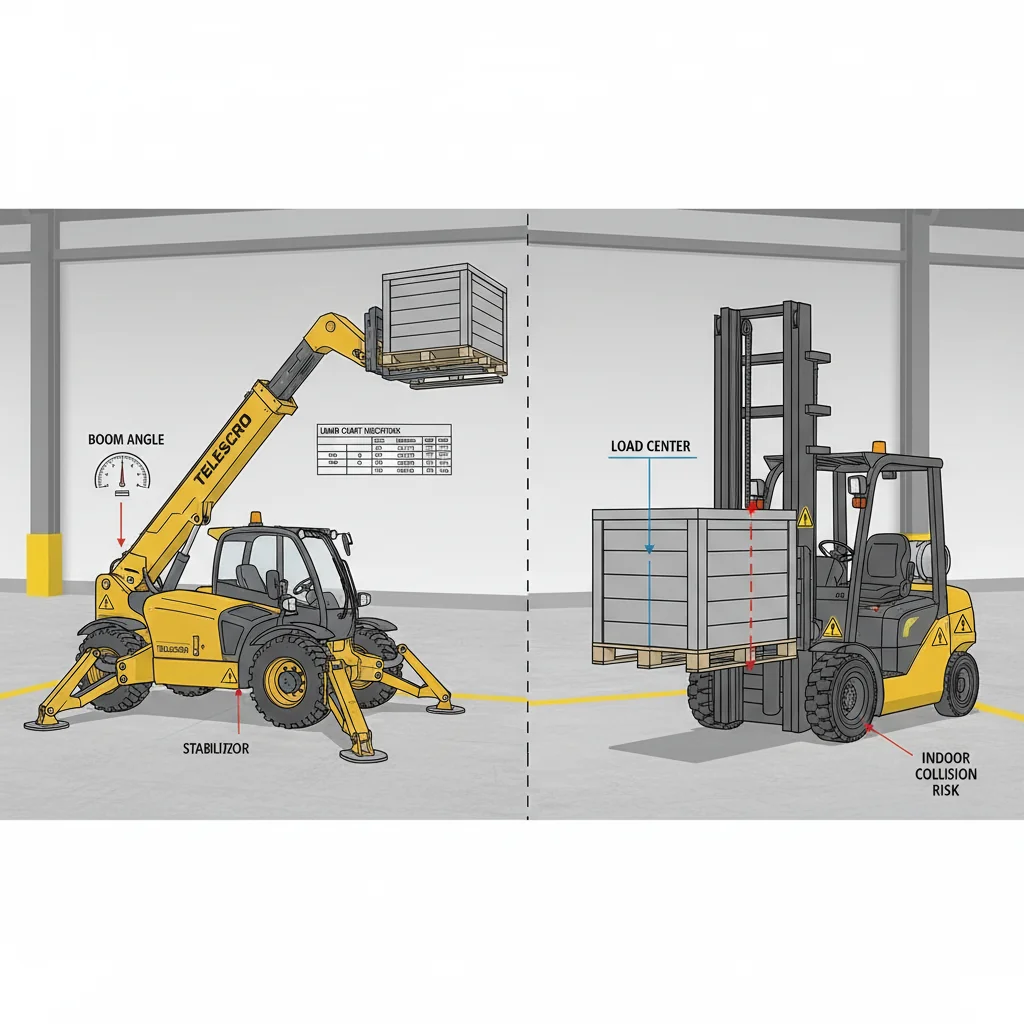
When buyers ask if forklift training “covers” telehandlers, I always tell them it’s a very different skillset. Last year, I supported a project in Dubai where the team used a 4-ton telehandler with a 16-meter boom for steel erection. Their forklift operators had solid experience indoors, but the moment they faced an extended boom—things changed fast. At just half extension, the 로드 차트10 warned: their maximum capacity dropped by almost 40%. One operator nearly tipped the machine by swinging the boom sideways on a slope. That kind of risk is unique to telehandlers. The center of gravity moves forward and up as you extend the boom. Wind, uneven ground, sudden stops—it all gets magnified. That’s why many regions, including Australia and the UK, mandate telehandler-specific certification11, not just a general forklift license.
In contrast, forklift training focuses on keeping loads stable when traveling and stacking vertically. Most risks are about turning with a heavy pallet or hitting racking indoors. I’ve seen warehouses in South Africa where teams use compact 2.5-ton forklifts—vertical stability is the challenge, not boom handling. They do need sharp awareness for pedestrians and speed limits due to tighter spaces. But you’re not dealing with hydraulic circuits, outriggers, or angle sensors.
For buyers, the takeaway is clear: If your jobsite has uneven ground, multi-level work, or frequent need to reach out over an edge, you must schedule thorough telehandler training. If not, a standard forklift may keep things simpler—and safer. I always suggest clarifying your certification needs before purchasing.
When a telehandler's boom extends to half its full length, its maximum lifting capacity can decrease by nearly 40% due to changes in leverage and stabilityTrue
Unlike forklifts which have fixed load centers, telehandlers use an extendable boom, significantly affecting the load chart as extension increases. This means operators must carefully calculate capacity reduction at various boom lengths to prevent tipping or structural failure.
Forklift operators can safely operate telehandlers without additional training since both machines share identical control layouts and load management principlesFalse
Telehandlers involve different operational dynamics such as boom extension, variable load centers, and different stability profiles, requiring specialized training beyond basic forklift certification to ensure safe and effective use.
핵심 요점: Buyers should know that telehandlers and forklifts have different safety and certification requirements. Telehandlers demand more technical operator training, especially for boom handling and stability. Evaluate your site and team capacity: if you cannot support in-depth telehandler training, a forklift may be safer and more practical.
How Do Telehandler and Forklift Tasks?
Telehandlers excel on construction sites and farms with elevated placement and handling over barriers, while forklifts dominate warehouses and factories with repetitive pallet stacking and indoor transport. Specific task frequency—like lifting over obstacles versus ground-level stacking—guides buyers toward the most suitable equipment for their needs.
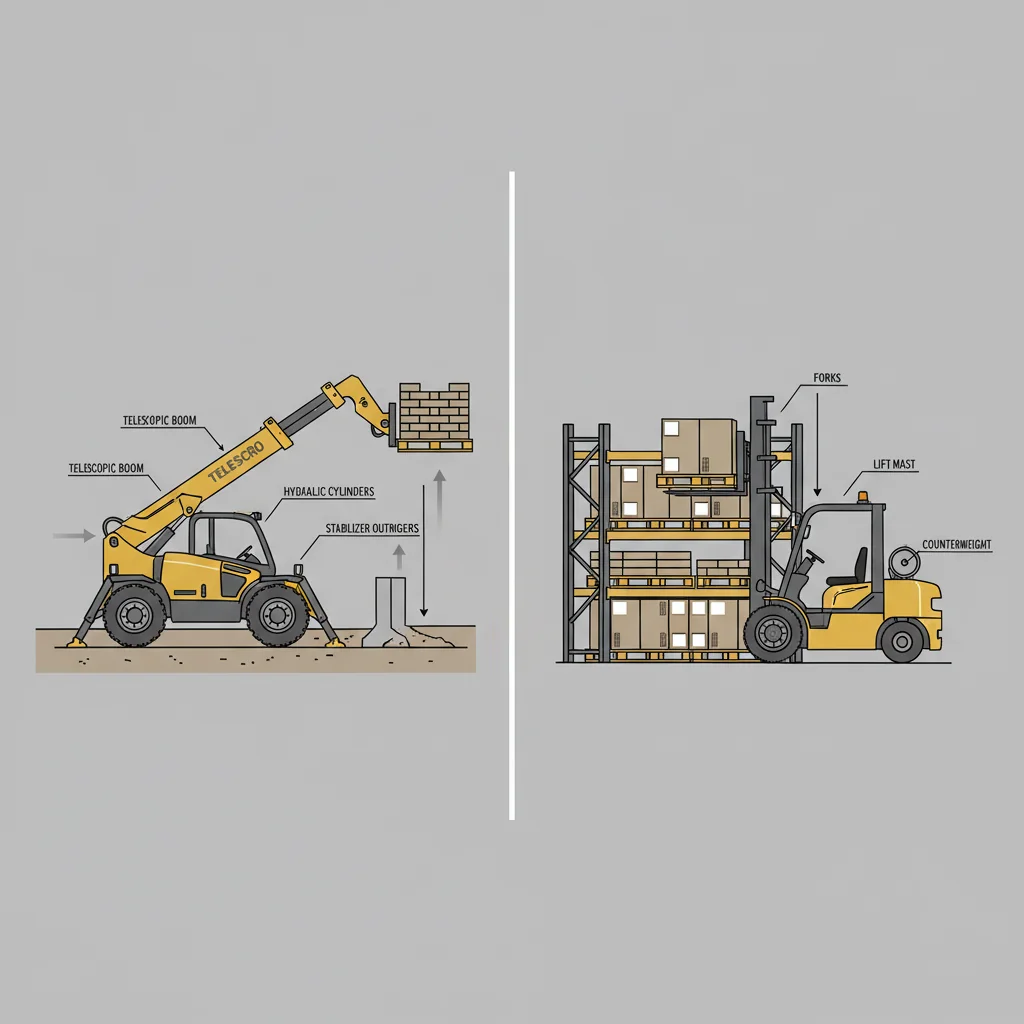
I’ve worked with customers who made the mistake of picking a machine based only on load capacity or price—then realized too late that jobsite layout dictates everything. Take a site in Dubai last year: their team needed to place concrete blocks on the second-floor slab, about 8 meters up, but rebar and fencing blocked direct access. A standard 3-ton warehouse forklift couldn’t reach; even with ramps, the risk of tipping was too high. They swapped to a compact telehandler with a 9-meter boom and hydraulic stabilizers. Suddenly, the job moved twice as fast. That’s the kind of real-world difference I see all the time.
To make it clearer, I’ve put together a simple table showing the key job differences:
| 기계 | 일반적인 사용 | 용량 | 도달 | Surface |
|---|---|---|---|---|
| 텔레핸들러 | Over-barrier, multi-level lifting | 2–5톤 | 6–18 m boom | Rough/uneven |
| 지게차 | Ground-level pallet moving | 1.5–5 tons | 3–6 m mast | Flat, indoor |
| Rough Fork | Yard work, moderate outdoor lifts | 2–3 tons | 3–6 m mast | Semi-rough |
On a farm in Kazakhstan, I saw a telehandler stack 1,000-kg hay bales up to 7 meters. The hydraulic circuit made micro-adjustments easy. In contrast, when I visit logistics warehouses in Brazil, forklifts dominate—moving pallet after pallet, back and forth all day.
My advice: list how often you need to lift over obstacles versus just move material across the floor. This single habit saves time and avoids costly mistakes in equipment choice. Consider the actual job, not just the spec sheet.
Telehandlers typically have a variable reach boom extending up to 9 meters, allowing loads to be placed at heights and distances that forklifts with fixed forks cannot safely achieveTrue
Unlike forklifts, which primarily lift vertically within a limited height range, telehandlers combine lifting with telescopic boom extension, enabling operators to place loads in hard-to-reach locations such as upper floors or over obstacles while maintaining stability.
Forklifts generally have higher ground clearance and superior off-road capability compared to telehandlers, making them better suited for uneven jobsite terrainFalse
Forklifts are designed mainly for smooth, flat surfaces like warehouses and have lower ground clearance, whereas telehandlers feature four-wheel drive and higher clearance, providing better maneuverability and traction on rough or uneven construction sites.
핵심 요점: Choose telehandlers when your operations demand frequent material handling at heights or across obstacles, especially on uneven or restricted-access sites. Forklifts are best for repetitive, indoor pallet movement and stacking. Analyzing how often you need elevated access versus ground-level transport clarifies the right investment choice.
어떤 텔레핸들러 사양이 가장 중요할까?
Buyers should compare maximum lift height, maximum forward reach, rated capacity at minimal and maximum reach, and study the load chart—not just brochure figures. For forklifts, evaluate rated capacity at full lift, lift height for your racking, turning radius, and ground clearance for outdoor use.
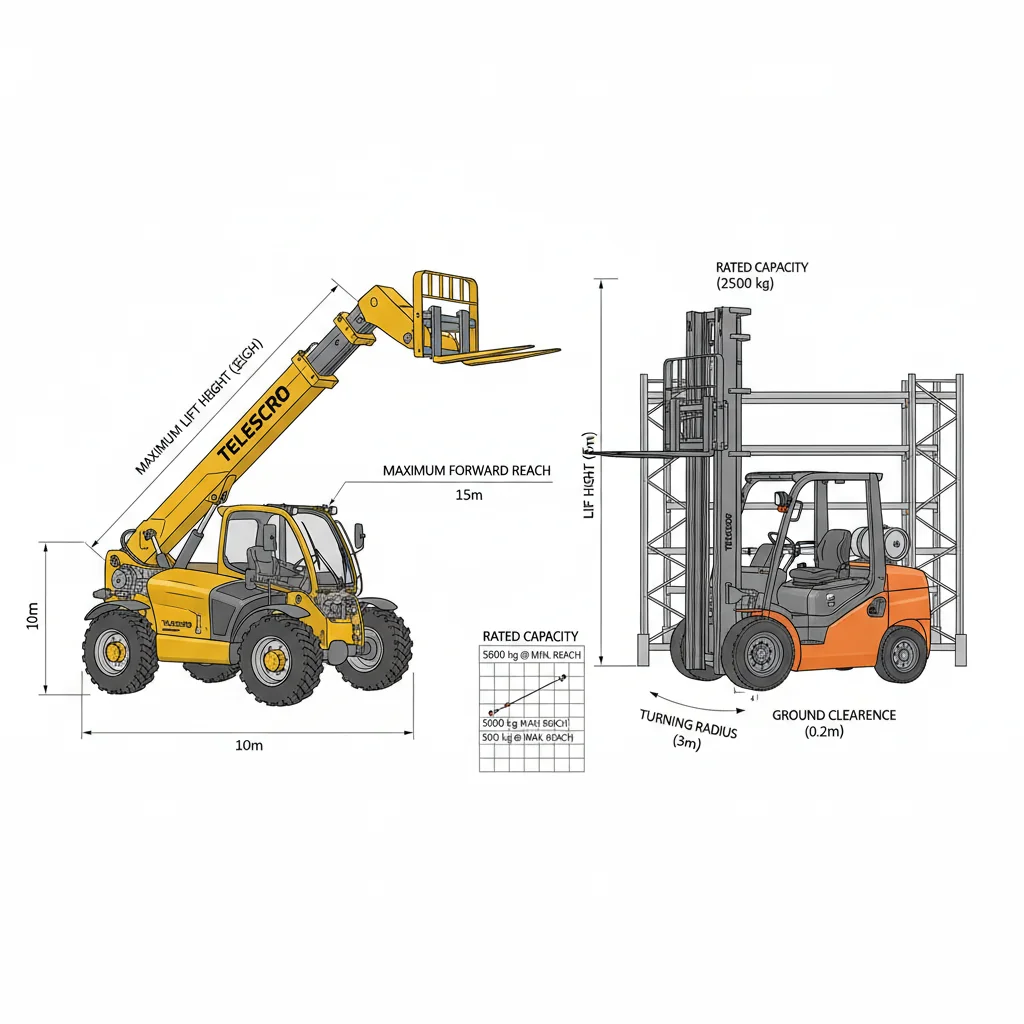
From my experience, buyers often get distracted by headline specs—like max lift height or boom length—without digging into the numbers that matter for real jobsites. I remember working with a contractor in Dubai who picked a 12-meter telehandler because it "looked strong enough" in the brochure. When they started lifting HVAC units to a rooftop, the machine could barely handle 1,000 kg at full extension.
They needed 1,400 kg. That shortfall cost at least two days of project time and an expensive rental. What really matters? Compare four specs side-by-side: maximum lift height, maximum forward reach, rated capacity at minimal reach, and rated capacity at maximum reach. The last one is where most projects run into trouble—actual safe weight at max height or forward boom extension. Always check the load chart (the table in the manual showing what the machine can safely lift at different boom positions).
Those numbers reflect hydraulic limits, counterweight balance, and even outrigger use. Here’s a quick reference for telehandler and forklift essentials:
| 사양 | Telehandler (mid-size) | Forklift (outdoor) |
|---|---|---|
| 최대 리프트 높이 | 9–18 m | 3–8 m |
| 최대 전방 도달 범위 | 6–14 m | N/A |
| Rated Cap. (Min Reach) | 5,000–12,000 lb (2.5–6 t) | 6,000–10,000 lb (3–5 t) |
| Rated Cap. (Full Height) | 2,000–5,000 lb (1–2.5 t) | Near max (minimal reduction) |
Telehandlers typically have lower rated capacities at maximum reach compared to forklifts because their extended booms create leverage that limits safe lifting loadsTrue
As the boom extends, the load moment increases, reducing the maximum safe load based on stability calculations. Forklifts, with fixed forks and tighter centers of gravity, maintain higher rated capacities at their maximum reach compared to telehandlers.
Telehandlers and forklifts have identical load charts, so rated capacities can be directly compared without adjustmentsFalse
Telehandlers and forklifts use different load chart calculations due to boom extension and stability differences. Telehandler charts account for boom length and angle, which significantly affect load capacity, making it incorrect to directly compare capacities without considering these factors.
핵심 요점: Always prioritize your site’s tallest lift, tightest space, and heaviest regular load when selecting telehandlers or forklifts. Focus on real-world capacity at maximum reach, not peak numbers, and ensure any model chosen includes a comfortable safety margin for efficient and safe operation.
What Maintenance Do Telehandlers Require?
Telehandlers need daily checks on booms, pins, 유압 호스12, 및 attachment locks13 due to their complex moving parts. Parts sourcing can be slower, especially for aging or rare models. Forklifts are mechanically simpler but demand disciplined engine or battery maintenance to minimize costly downtime.
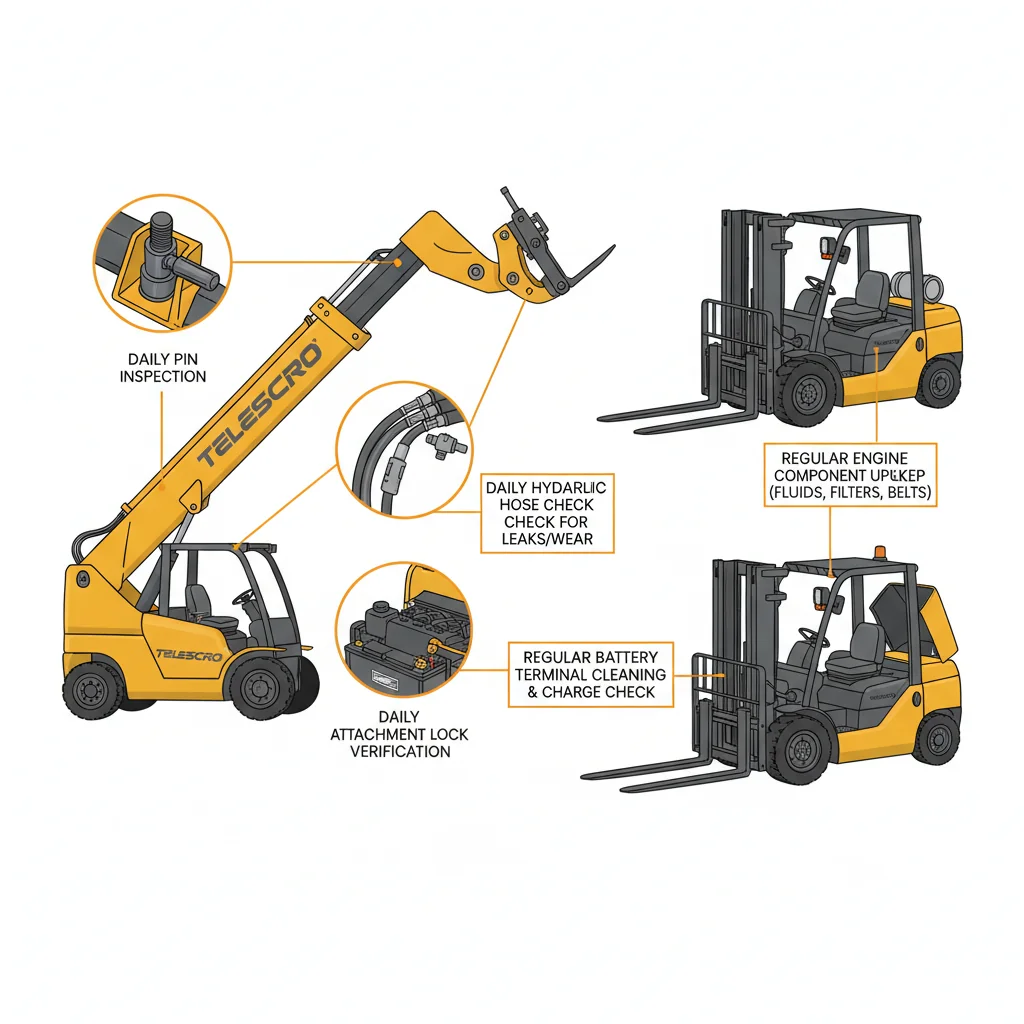
Last year in Dubai, a contractor called me after their 4-ton, 13-meter telehandler broke down—right in the middle of their foundation work. Hydraulic oil was leaking from a boom hose, and they couldn’t source the replacement locally. They lost nearly four days waiting for parts to come from Europe. That’s a real hit on both schedule and labor costs. I see this more often with telehandlers than forklifts because of their specialized hydraulic systems and long, telescopic booms.
Telehandlers rely on complex moving structures—multiple boom sections, heavy-duty pins, wear pads, and intricate hydraulic circuits. All these components get exposed to dust, impact, and high pressure every day. I always recommend a daily inspection routine: check each boom section for wear, verify every pin for looseness, look closely at hydraulic hoses near joints, and make sure the attachment lock system actually clicks into place. It’s a lot more involved than the checks for a conventional forklift.
With forklifts, maintenance usually means keeping up with engine servicing for diesel or LPG models, or staying disciplined with battery care on electrics—like checking charging schedules and coolant levels. Parts are much more standardized, so a water pump or air filter is easier to source, even for an older forklift. But on many telehandlers, even a small auxiliary hydraulic valve might take two weeks to arrive if the model isn’t common in your country.
To minimize downtime and unexpected costs, I suggest confirming what kind of dealer support is nearby and factoring realistic maintenance hours into your decision. Reliable daily checks are what protect your investment, not just a warranty on paper.
Telehandlers typically require more frequent hydraulic hose inspections than forklifts because their telescopic booms subject hoses to higher stress and flexing cyclesTrue
The extendable boom on telehandlers causes hydraulic hoses to bend and extend repeatedly, increasing wear and risk of leaks, so maintenance schedules must include more rigorous hose checks compared to the fixed mast of forklifts.
Forklifts generally need more specialized hydraulic maintenance than telehandlers due to their complex mast-lifting systemsFalse
Telehandlers have more complex hydraulic systems because of their telescopic boom extension and multifunctional attachments, whereas forklifts typically use simpler vertical mast hydraulics, resulting in less specialized hydraulic maintenance.
핵심 요점: Telehandlers are more maintenance-intensive than forklifts due to their advanced hydraulic systems and telescopic booms, with harder-to-source parts. Assess service access, dealer support, and daily inspection routines before purchase to better control downtime and unexpected repair expenses, safeguarding your investment.
결론
We’ve talked about where telehandlers and forklifts fit best—mainly how telehandlers outshine forklifts when you need reach and flexibility over obstacles. From my experience, the contractors who avoid headaches look past just reach or price tags. They actually review the load chart at the working height and check if critical parts are available locally. I see too many crews hit with “parts roulette”—weeks of downtime just for a simple replacement. Need a hand figuring out what suits your jobsite or want a second opinion on specs? I’m happy to share what’s actually worked for real crews—just reach out anytime. Remember, the best machine is the one that keeps your job moving, not stuck waiting on parts.
참조
-
Explore detailed technical insights about telescopic booms and how they enable telehandlers to lift loads higher and farther than standard forklifts. ↩
-
Explore detailed advantages of compact telehandlers like extended reach and hydraulic stabilizers for safer, faster multi-level lifting. ↩
-
Learn how complex hydraulic load charts help operators understand safe lifting capacities at various boom positions to prevent accidents. ↩
-
Explains how maximum lift height affects jobsite versatility and safety, backed by expert tips and real-world examples. ↩
-
Understand the critical factors causing capacity reduction in telehandlers with boom extension, supported by real-world lifting examples. ↩
-
Understand how turning radius impacts equipment performance in confined indoor spaces versus outdoor job sites, backed by real job scenarios. ↩
-
Explore the technical benefits of four-wheel steering that enhance telehandlers’ agility on uneven or spacious job sites. ↩
-
Explore expert insights on using crane jibs to lift heavy loads efficiently without needing a full crane, saving time and costs on site. ↩
-
Learn how work platforms provide safe, elevated access for inspections and installations, reducing fall risks during construction tasks. ↩
-
Offers detailed guidance on interpreting load charts to avoid overloads and optimize telehandler performance safely. ↩
-
Explains regulatory requirements and unique skillsets needed for telehandler operation, ensuring compliance and enhanced safety. ↩
-
Detailed guidelines on inspecting hydraulic hoses ensure safety and prevent costly breakdowns by catching wear and leaks early in telehandlers. ↩
-
Expert advice on attachment lock maintenance helps operators avoid equipment failure and improves job site safety in demanding telehandler operations. ↩