










How to Import a Telehandler from China (Field Guide to Avoid Costly Mistakes)
From my experience working with customers across 20 countries, the biggest mistake I see buyers make is focusing only on price or max lift height—then getting stuck with a machine that can’t handle their real jobsite needs. Last year, I helped a client in Poland who learned this lesson the hard way.
If you’re thinking of importing a telehandler from China, there’s a lot more to it than picking a model and sending payment. It’s a process I’ve navigated dozens of times, and trust me, the details matter.
In this article, I explain how I match the machine to your application, why you absolutely must avoid compliance headaches, and how to understand the real costs—from the factory floor to your site. I’ve seen good projects run into costly delays, not because of the machine itself, but from missing critical paperwork or ignoring a simple inspection.
How Do You Select a Telehandler?
Start by matching telehandler specs—such as lift capacity, height, and attachments—to your primary use, whether construction or agriculture. Compare engine brands, transmissions, and hydraulic controls. Always check the 로드 차트1 and ensure parts support is available in your country to avoid future downtime.

The biggest mistake I see is buyers choosing a telehandler just by looking at maximum lift capacity or height, without considering their true daily needs. Last month, a client in Kazakhstan asked for a 5-ton, 17-meter machine for warehouse work. Impressive specs on paper. But their actual loads rarely exceeded 2 tons, and their aisles were tight. They could have saved thousands with a 3-ton, 10-meter model—it would have been faster to maneuver and much easier for their drivers.
Here’s what matters most when selecting a telehandler: start with your main application. Are you lifting pallets in urban construction, or moving hay bales on farmland? For construction, I always suggest looking at compact wheelbases—a turning radius under 4.5 meters makes a huge difference on crowded sites. For agriculture, longer booms and all-terrain tires help more than just adding maximum height. Most Chinese telehandlers offer between 2.5 and 5 tons capacity and 6 to 18 meters of reach. But you need to check the load chart carefully—capacity drops dramatically as the boom extends. A telehandler rated for 4 tons may only handle 1.6 tons at 14 meters.
I always compare the core components. Transmission type2—powershift versus torque converter—impacts maintenance needs down the road. Hydraulic controls differ too; pilot controls give you smoother, more precise handling, but they might increase the initial cost slightly. Before you commit, I advise double-checking the availability of engine and transmission parts in your country. I’ve seen a project in Kenya delayed for weeks—just waiting on a special hydraulic pump. Spare parts support is the detail that saves real downtime.
핵심 요점: Defining your application and carefully checking specifications—including capacity, core components, and available attachments—reduces the risk of inefficient operation, unexpected upgrade costs, and downtime after importing a telehandler from China. Always check parts availability for mission-critical components before finalizing your choice.
How Validate Telehandler Regulatory Compliance?
Ask for full technical datasheets and genuine certification (CE/EN for EU, EPA or Stage V for US/EU). Verify inclusion of safety features and warning labels in your local language. Use third-party inspection if needed. Non-compliance may result in customs delays and costly port storage fees.

Let me share something important about telehandler regulatory compliance—more buyers get tripped up here than they realize. I recently had a client in Dubai who ordered a 4-ton, 17-meter telehandler. They assumed a generic “CE” stamp on the machine was enough. But customs held the unit, demanding full CE/EN certificates with test reports, proof of an EN15000 load moment control system3, and warning labels in both English and Arabic. The delay cost them almost three weeks in lost time and over $2,000 in storage fees. This isn’t rare—regulations and language requirements can vary a lot by country.
From my experience, before paying any deposit, you need to ask for a digital copy of the technical datasheet plus emission and safety certificates matching your actual market. For the EU, you’ll want CE and the EN15000 documentation; for the U.S., look for EPA/Tier or Stage V documents, and ask for ISO test reports when possible. Check the datasheet closely—does it list emergency stops, seat interlocks, hydraulic overload protection, and a functioning moment indicator? Ask the supplier if the machine comes with warning labels in your local language. If their answers sound vague, or the documents look generic, proceed with extreme caution. Traders sometimes skip these steps or substitute incomplete paperwork.
In Kazakhstan, I saw a client save themselves a huge headache by using a third-party inspection firm to check compliance before their 3.5-ton telehandler left the port. The inspection cost about $300—but prevented $1,500 in port fees plus a month of downtime. I suggest factoring this modest cost into your planning. Making sure your telehandler is compliant before shipment protects your budget and your jobsite schedule.
Importing telehandlers into the UAE requires proof of compliance with EN15000 standards, including a load moment control system certified through documented test reportsTrue
The EN15000 standard regulates the safe operation of telehandlers, mandating specific safety features like load moment control systems that must be certified through detailed testing and presented at customs to prevent import delays.
A generic CE stamp on a telehandler is sufficient to clear customs in most countries, including the UAE, without needing supplementary documentationFalse
Many countries, including the UAE, require detailed CE/EN certificates, test reports, and multilingual safety labeling beyond a generic CE mark to ensure full regulatory compliance for telehandler imports.
핵심 요점: Always confirm that Chinese telehandlers comply with local regulations—request proper certificates and technical data before paying. Non-compliant machines risk port delays, expensive storage fees, or forced return. Enlist a compliance expert or inspector to safeguard against costly import mistakes.
Which Telehandler Contract Terms Reduce Risks?
Set clear contract terms when importing a telehandler from China. Specify Incoterms4 like CIF or DDP, detailed technical specs5, attachments, warranty coverage, delivery deadlines, and remedies for late shipments. Require bilingual contracts and spare parts kits. Define after-sales support and who covers costs for commissioning and shipping damage.
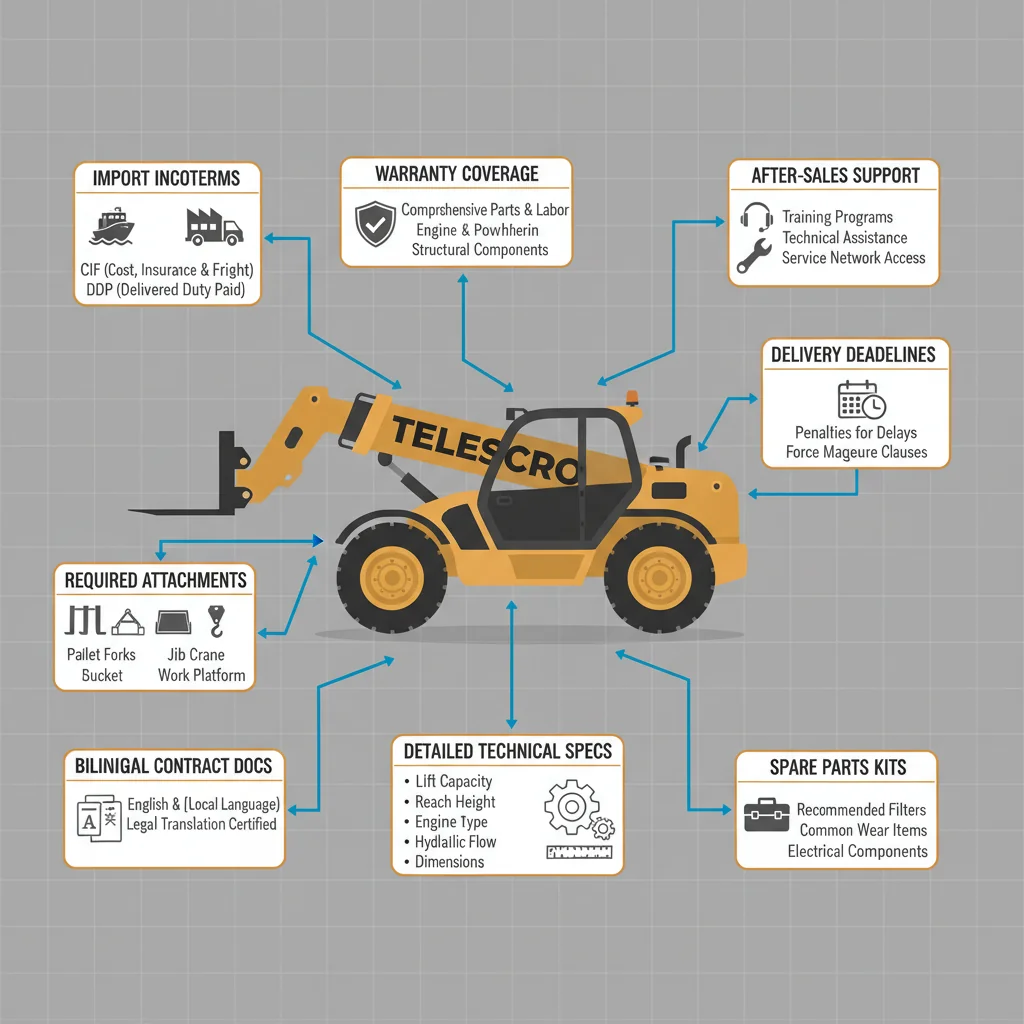
Most people don’t realize that your telehandler import contract is the main tool for controlling risk, not just paperwork. I’ve seen buyers in Kazakhstan avoid big losses simply by locking down terms like Incoterms and technical specs. For example, one contractor specified DDP (Delivered Duty Paid) and saved themselves dealing with customs delays—the machine arrived, ready to use, without extra surprise fees. Details go further than just shipping. When you specify the exact engine model, color, cab style, attachment types, and even make the supplier list hydraulic pressures and options like camera kits, you close the door on “spec downgrades.” I remember a case in Dubai where a 4-ton, 16-meter telehandler showed up with a lower-rated pump and a missing joystick—the contract only had generic descriptions, so the buyer had no leverage to demand correction. Let’s compare a few critical contract items that reduce common import risks:
| Contract Term | 왜 중요한가 | Example Impact |
|---|---|---|
| Incoterms (CIF/DDP) | Defines delivery, customs, and cost risks | DDP = no import headaches |
| Detailed Specs | Prevents unwanted substitutions | Avoid “spec downgrade” |
| 보증 범위 | Clarifies what’s really covered | Parts & labor? Just parts? |
Specifying DDP (Delivered Duty Paid) Incoterms in your telehandler import contract from China shifts all customs clearance and import duties to the seller, minimizing unexpected delays and costs on arrivalTrue
DDP requires the seller to handle export, shipping, import clearance, and duties, ensuring the buyer receives the equipment ready to use, eliminating customs and tax risks that often cause delays and extra fees.
Including an estimated delivery window in your telehandler import contract from China legally obligates the seller to pay penalties for any delays beyond that timeframeFalse
While delivery windows provide guidance, most import contracts lack automatic penalty clauses unless explicitly included; standard contracts do not legally enforce liquidated damages for shipping delays without specific terms.
핵심 요점: Precise, detailed import contracts reduce costly errors when sourcing Chinese telehandlers. Lock in specs, clarify warranty coverage, delivery dates, and after-sales responsibilities. Insist on a bilingual contract and define solutions for shipping damage claims to protect your investment and streamline commissioning.
Which Incoterms Suit Telehandler Imports?
CIF and DDP Incoterms6 are best for first-time telehandler buyers from China, as the supplier manages freight and delivery. Sea freight is typically the most cost-effective shipping method; always request multiple Incoterm quotes and confirm insurance responsibilities before finalizing the purchase.

Last year, I helped a contractor in Kenya who almost gave up on importing telehandlers from China because of confusion over Incoterms. To be honest, picking the wrong trade term is a headache—especially on your first order. Let me break down what actually matters here. CIF (Cost, Insurance, Freight) and DDP (Delivered Duty Paid) are the two I see working best for first-time buyers. Why? With CIF, the supplier handles sea freight and insurance to your port, so you skip negotiating with shipping lines. DDP goes even further—the supplier manages everything, including customs clearance and final delivery to your site. I’ve seen this save at least a week on delivery schedules in places like Brazil and Kazakhstan, where port paperwork can drag out surprisingly long. Here’s a quick comparison based on real jobsite experience: | Incoterm | Supplier Arranges | Buyer Arranges | Risk Transfers | Best For | Typical Cost Impact | |———-|——————-|—————|—————|——————-|——————–| | FOB | Export docs | Freight, ins, import | At port of loading | Experienced importers | Lowest, but more risk | | CIF | Freight, ins | Import, taxes | At destination port | First-timers | Slightly higher | | DDP | All steps | None | At jobsite | Total newcomers | Highest, simplest | For telehandlers, sea freight is nearly always the cost-effective choice. Air freight? I’ve only seen it used once, in Dubai, for urgent oilfield work, and the cost was astronomical.
Using DDP Incoterms for telehandler imports shifts all customs clearance and local tax responsibilities to the supplier, significantly reducing import-related delays for first-time buyersTrue
DDP (Delivered Duty Paid) means the seller manages all duties, taxes, and customs formalities, ensuring the telehandler arrives fully cleared at the buyer's door. This simplifies the process for buyers unfamiliar with local import regulations, avoiding costly hold-ups.
False
"Under
핵심 요점: For importing telehandlers from China, CIF or DDP Incoterms minimize risk and confusion for beginners. Always get comparative quotes and clarify who arranges insurance. Sea freight offers the best mix of cost and reliability for such heavy machinery, while air freight is seldom practical.
How Calculate Landed Telehandler Cost?
The real landed cost of a Chinese telehandler includes far more than the FOB price. You must add packaging, inland trucking, export handling, shipping, insurance, terminal handling, broker fees, import taxes, inspections, and final delivery—often totaling 25–40% above the equipment price.
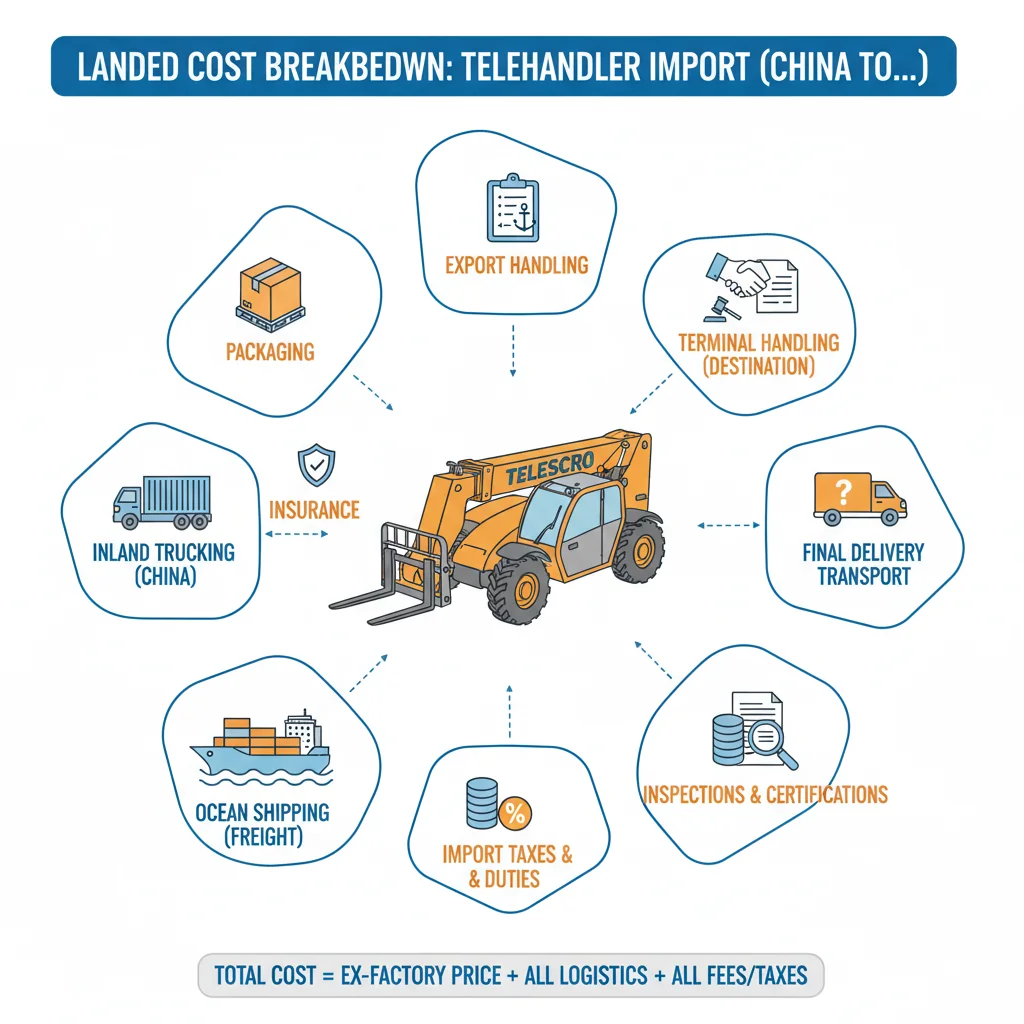
Here’s what matters most when you’re calculating the landed cost of a telehandler8: the FOB price is just the beginning. I’ve worked with clients in South Africa who thought a $30,000 quote for a 3-ton, 12-meter unit was the full story. After factoring packaging, inland transport to the port in Shanghai, export paperwork, and loading fees, they realized the machine cost closer to $36,000 before even leaving China. For ocean transport, you’ll need to budget sea freight (usually $1,200–$2,000 per unit for Africa or South America), plus marine insurance—about 0.5–1% of the cargo value.
At the destination port, expenses stack up quickly. Terminal handling fees, customs broker9r services](https://www.shipmoto.com/shipping-news/what-is-a-customs-broker)[^9] (often $500–$1,000), and local import taxes can add thousands. In Dubai, I saw one customer spend at least 5% extra due to delayed customs clearance—just from port storage and demurrage penalties. Don’t forget the final step: local trucking to your site. Depending on distance and road conditions, that can range from a few hundred to over $2,000 per machine.
To be honest, the only way to avoid ugly surprises is to build a detailed spreadsheet of every line item. Ask both your supplier and freight forwarder for breakouts on packaging, inland costs, export charges, and port-side handling. Carefully check if CIF or DDP includes local delivery and offloading. I always suggest comparing the “all-in” landed figure against your local dealer’s delivered price. That’s the only fair way to evaluate total cost—and avoid budget overruns halfway through your job.
When importing a telehandler from China, inland transport and export paperwork can add up to 15-20% on top of the FOB price before international shipping costs are even appliedTrue
Additional costs like inland trucking to the port and export documentation fees are often underestimated. For equipment like telehandlers, these can increase the initial FOB cost by approximately 15-20%, significantly affecting the total landed cost.
Including ocean freight in the landed cost calculation is optional because most suppliers incorporate it within the FOB priceFalse
FOB (Free On Board) pricing means the seller’s responsibility ends once the goods are loaded on the vessel, so ocean freight costs are separate and must be explicitly budgeted for when calculating the landed cost.
핵심 요점: Calculating true landed cost for imported telehandlers requires adding up all fees beyond the FOB price—shipping, handling, taxes, and local delivery. Always request a detailed cost breakdown from both supplier and freight forwarder to avoid surprises and compare with local options accurately.
How Do Tariffs Affect Telehandler Costs?
Tariffs and import duties on telehandlers from China typically range from 3–25% of the declared value, based on your country’s HS code classification10. In the U.S., extra punitive tariffs may apply, and misclassification can result in stiff penalties or sudden cost increases at customs.
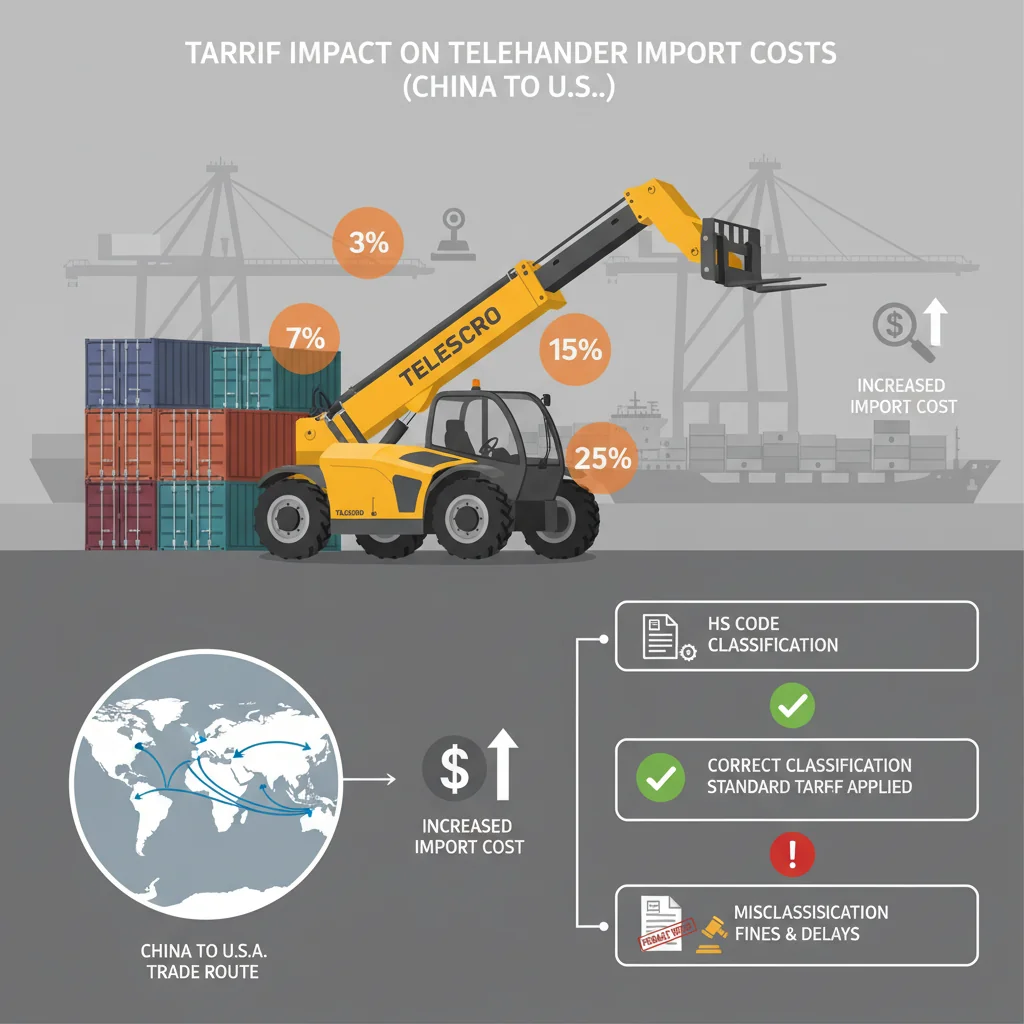
To be honest, tariff planning can make or break your telehandler import budget. I’ve worked with clients in the U.S. who thought they were getting a bargain—a 4-ton, 17-meter telehandler quoted at $48,000 FOB China. But after U.S. base duty, Section 301 tariffs11, and local port fees, their total landed cost ballooned by almost 30%. That’s a shock no one enjoys right before delivery.
One critical step is getting the HS code classification right. From my experience, even seasoned importers sometimes rush this and end up misclassifying the machine—say, labeling it as a generic loader instead of a telescopic handler. In Dubai, I helped a fleet buyer who planned for 5% duty, only to find customs wanted to reclassify his machines for 15%. Thankfully, he checked early with his broker, so he budgeted for the higher amount and had no jobsite delays. Misclassification isn’t just a paperwork hassle—it can get units held at customs, rack up fines, or lead to surprise duties payable months later.
The technical specs you provide affect how authorities assign HS codes. Include detailed info—rated capacity, max reach, four-wheel steering, even whether it has a rotating cab. Sending full specs to your customs broker up front is the best way to avoid traps. For large fleets, I suggest exploring split shipments or even comparing different models. Sometimes a small tweak in configuration, like removing optional attachments, can change your duty rate.
Budget conservatively, verify everything in writing, and get your broker involved early. That’s how you avoid those nasty cost surprises.
Misclassification of a telehandler’s HS code can trigger additional anti-dumping duties beyond standard tariffs, increasing landed costs by up to 15%True
HS codes dictate tariff rates; if a telehandler is classified under an incorrect or more general category, customs authorities can apply anti-dumping duties specific to machinery types, significantly raising import expenses. Accurate classification avoids unexpected fees.
Local port fees typically account for more than 50% of the total landed cost of importing a telehandler from ChinaFalse
Although port fees contribute to landed costs, they generally represent a small fraction—often under 10%. The major cost increases come from tariffs, duties, and inland transportation rather than port-related charges.
핵심 요점: Exact HS code and tariff planning are critical when importing telehandlers from China. Consult with a customs broker early, request written duty estimates, and budget for possible changes. Correct classification and conservative planning can prevent costly surprises and improve your overall import economics.
What Documents Ensure Smooth Customs Clearance?
Essential customs documents for importing a telehandler from China include the Bill of Lading12, Commercial Invoice (detailing all charges), Packing List, and Certificate of Origin. Hiring a knowledgeable customs broker is highly recommended to prevent costly errors, shipment delays, or seizures due to incomplete or inconsistent paperwork.
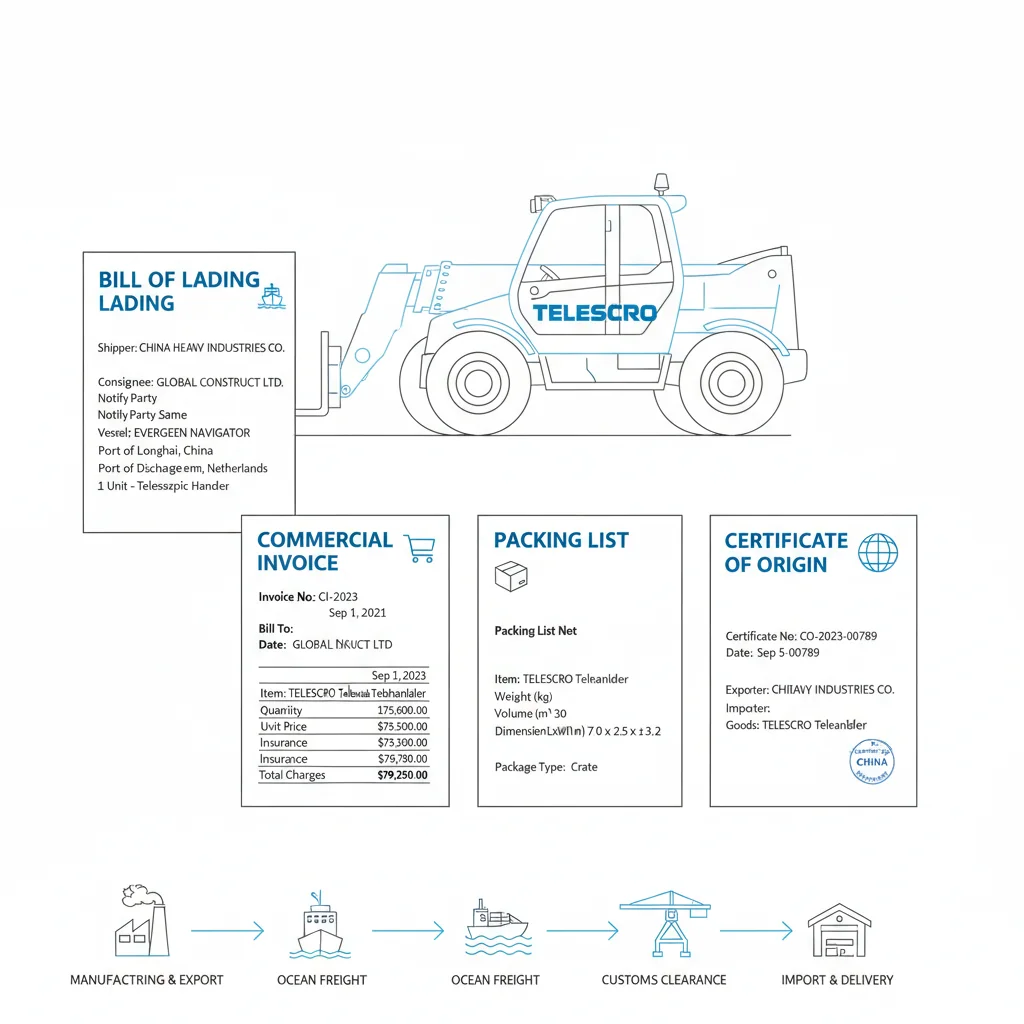
Most people don’t realize that incomplete paperwork is the fastest way to get your telehandler stuck at port—sometimes for weeks. I’ve worked with customers in Kenya and Brazil who quickly learned how critical it is to organize the right documents. The main ones you need are the Bill of Lading, Commercial Invoice (with every charge spelled out), Packing List, and Certificate of Origin. The Commercial Invoice should list not only the equipment’s cost, but also any packaging, local truck delivery, or insurance. If charges are missing or the numbers don’t match across documents, customs officials will likely flag your cargo for inspection. One Brazilian client sent me scans showing the HS code didn’t match between the invoice and packing list; their shipment sat for eight extra days and they paid unnecessary storage fees.
From my experience, a knowledgeable customs broker is worth every cent—especially for heavy equipment. Most charge around 1–3% of the shipment value. In return, they handle electronic customs entries, double-check all paperwork, calculate duties, and talk to customs if any issues come up. I always tell clients to bring the broker onboard before shipping, not after the unit is already on the vessel. That way, you can send them proforma invoices and draft documents early, so they catch any inconsistencies before you lose time.
One more detail: check all names, addresses, and HS codes line up perfectly on every document. Even a minor typo can cause big delays. My advice? Treat your broker as part of your team from day one—it’s the best way to protect your investment and timeline.
Including the local truck delivery charge separately on the Commercial Invoice can expedite customs clearance by clearly identifying transport logistics costs and preventing undervaluation disputesTrue
Customs officials require transparent breakdowns of all charges involved in importation. Separately listing local delivery charges on the Commercial Invoice ensures accurate duty assessment and avoids delays caused by document discrepancies.
A Certificate of Origin is unnecessary for telehandler imports from China because China is part of a global free trade agreement that exempts construction equipment from customs dutiesFalse
China is not part of a comprehensive free trade agreement that removes duties on construction equipment worldwide. The Certificate of Origin remains essential to verify the product’s country of manufacture and determine applicable tariffs during customs clearance.
핵심 요점: Proper documentation—Bill of Lading, Commercial Invoice, Packing List, and Certificate of Origin—is vital for smooth customs clearance when importing telehandlers from China. Engaging an experienced customs broker early can prevent delays, inspection, or legal trouble due to incorrect paperwork, safeguarding your investment.
Why Inspect Telehandlers Before Delivery?
Pre-shipment and arrival inspections help verify your telehandler matches contract specs, operates correctly, and is damage-free. Using specialists like SGS or BV before shipment, and thorough checks on arrival, prevents disputes and protects you from accepting faulty or substandard equipment.
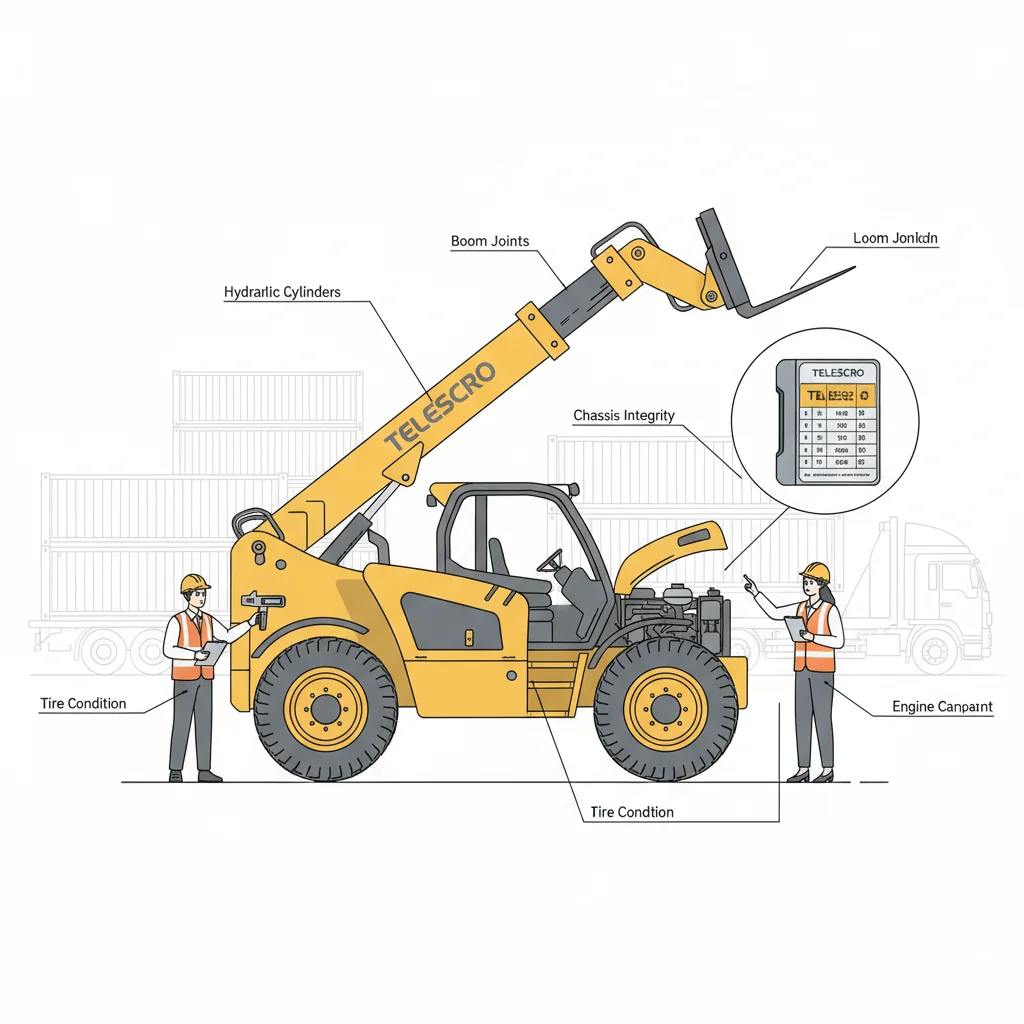
Last month, I spoke with a project manager in Kazakhstan who ran into a major headache after skipping a pre-shipment inspection. He ordered a 3.5-ton telehandler with a 13-meter reach—on paper, exactly what his team needed. But when the unit arrived onsite, the hydraulic circuit was leaking. The boom wouldn’t extend smoothly, and the outriggers had minor bends—likely from rough handling during transit. Since he signed off on delivery without inspecting first, the supplier said damage could’ve happened after receipt. Sorting out the claim took weeks, and the site lost valuable working days.
I always advise buyers to arrange both pre-shipment and arrival inspections. The logic is simple—risks exist at every stage. Before shipping, hiring a reputable third-party inspector (someone like SGS or BV) for $300–$800 gives you proof the telehandler matches contract specs and is damage-free before it leaves the factory. They’ll check the serial number, load chart plate, and even test-drive key functions. I suggest making “inspection passed” a precondition for your final payment—it gives you leverage if issues show up.
On arrival, never let your team rush the process. Even a quick walkaround can catch transport damage—a cracked windscreen, bent fork carriage, or fresh hydraulic oil leaks. Compare specs and serial numbers with your original order. Take timestamped photos and video. If you find anything, notify both your supplier and insurer immediately—before you sign for delivery. Claims move faster and are much easier to resolve this way. In my experience, these steps protect buyers from costly mistakes no one budgets for upfront.
Pre-shipment inspections often reveal minor structural defects like bent outriggers that can compromise telehandler stability but are commonly overlooked during standard factory quality checksTrue
Outriggers are subjected to stresses during shipping that can cause subtle bends or misalignments; these defects may not be caught in factory inspections focused mainly on mechanical and hydraulic systems, making pre-delivery onsite inspections essential to ensure operator safety.
Telehandlers with a rated capacity of 3.5 tons and a 13-meter boom reach always require a secondary hydraulic circuit specifically for boom extensionFalse
While some models may include a secondary hydraulic circuit for gradual boom control, it is not a universal requirement; many telehandlers operate their boom extension with standard single-circuit hydraulics managed through proportional valves depending on manufacturer design.
핵심 요점: Always organize both pre-shipment and arrival inspections when importing a telehandler from China. This safeguards you against receiving damaged or non-compliant machinery, streamlines potential claims, and enables you to hold suppliers accountable—especially when inspections and terms are clearly outlined in your contract and aligned to your Incoterms.
결론
We’ve covered what to look for when importing a telehandler from China—key specs, attachments, and parts backup. From what I’ve seen, the customers who avoid headaches long-term pay close attention to the load chart and double-check sourcing for mission-critical parts. Too many folks get drawn in by price or max reach, only to run into “parts roulette” on their first breakdown. If you’re weighing your options, I’m happy to help walk through real-life scenarios or sort out questions specific to your jobsite. Feel free to reach out anytime—the right telehandler really depends on your workflow.
참조
-
Detailed explanations on interpreting telehandler load charts prevent overloading and improve safety and machine efficiency on-site. ↩
-
In-depth comparison of transmission types helps operators choose systems that optimize telehandler performance and fuel efficiency. ↩
-
Gain expert insights on how the EN15000 standard ensures telehandler stability and safety through advanced load moment detection technology. ↩
-
Explore detailed explanations of Incoterms like CIF and DDP, and learn how they protect buyers from customs delays and extra fees. ↩
-
Understand how precise technical specifications prevent spec downgrades and ensure the telehandler meets exact operational needs. ↩
-
Expert explanation on DDP Incoterms covering full supplier responsibility including customs, which can speed up delivery and reduce buyer stress. ↩
-
Detailed insights on CIF Incoterms explaining supplier-managed freight and insurance, helping first-time telehandler importers avoid costly errors. ↩
-
Detailed insights on all cost factors—shipping, taxes, fees—to accurately budget telehandler acquisitions and avoid hidden expenses. ↩
-
Explains the critical role of customs brokers in navigating import paperwork, calculating duties, and ensuring smooth clearance of heavy machinery. ↩
-
Detailed explanation of the impact of HS code classification on import and export equipment tariffs, helping importers avoid misreporting and customs penalties, and ensuring accurate cost budgeting. ↩
-
In-depth explanation of the impact of the US Section 301 tariff policy on the cost of imported equipment from China, suitable for importers involved in budget planning and compliance monitoring. ↩
-
Provides in-depth understanding of Bill of Lading’s role in customs clearance and shipment documentation to avoid delays and fees. ↩