










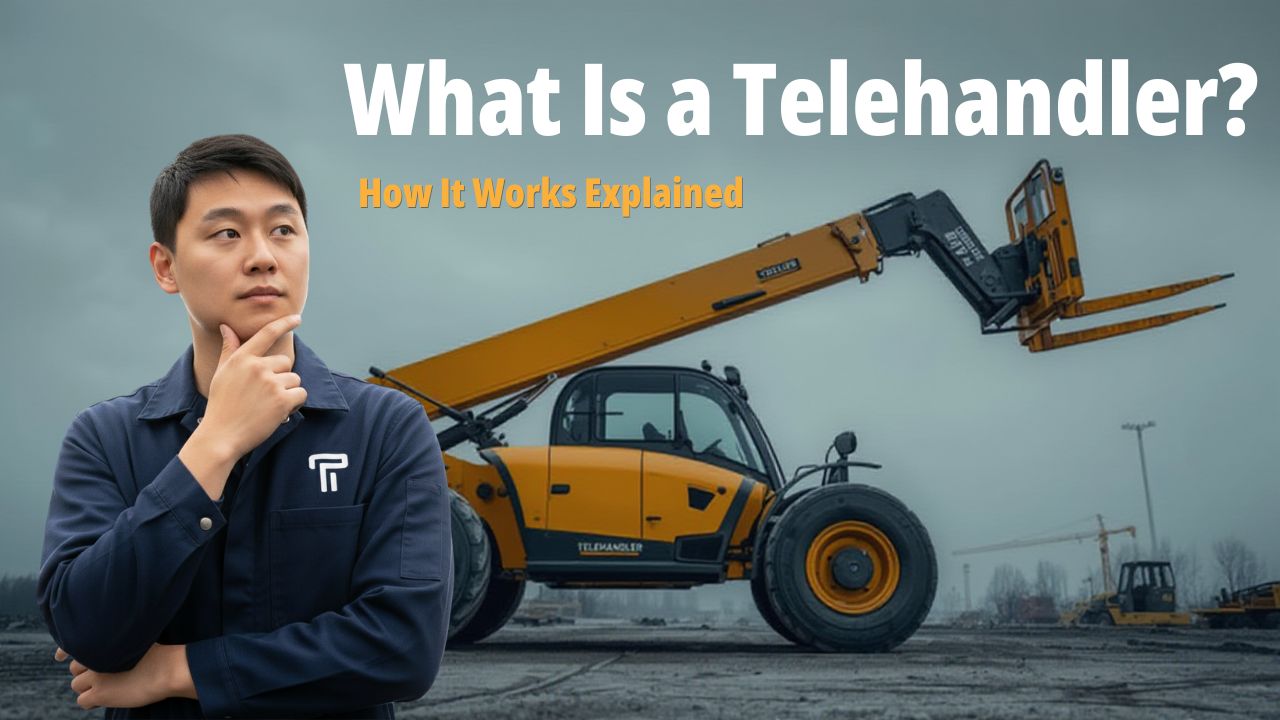
A telehandler (short for telescopic handler) is a versatile lifting and material handling machine designed to lift, move, and place loads at various heights and distances using a telescopic boom.
It combines the functions of a forklift, crane, and work platform, making it one of the most flexible machines in construction, agriculture, and industrial applications.
1. Basic Structure and Components
A telehandler consists of:
- Telescopic Boom – Extends forward and upward to reach distant or elevated positions.
- Attachment Interface (Carriage or Quick Coupler) – Allows the operator to switch between forks, buckets, jibs, or platforms.
- Chassis and Frame – Designed for stability and load distribution.
- Hydraulic System – Powers the boom extension, steering, and attachment operation.
- Engine and Transmission – Usually diesel-powered, driving both travel and hydraulic functions.
- Axles and Tires – Typically equipped with large, rough-terrain tires and 4-wheel drive for uneven ground.
2. Operating Principle
The telehandler lifts loads using a telescopic boom that can extend and retract to reach heights typically between 6 to 20 meters, depending on the model.
Load capacity decreases as the boom extends due to leverage, which is illustrated on the load chart provided by the manufacturer.
3. Attachments and Functions
Common attachments include:
- Pallet Forks – For lifting pallets or materials.
- Buckets – For handling loose materials (e.g., sand, gravel).
- Lifting Jibs or Hooks – For suspended loads.
- Work Platforms – For personnel lifting.
This modular attachment system allows one telehandler to perform multiple roles on site.
4. Application Fields
- Construction: Material placement at height, loading/unloading, handling pallets and equipment.
- Agriculture: Handling bales, feed, and bulk materials.
- Industrial & Logistics: Stacking, warehouse support, and maintenance operations.
- Rental Fleets: Preferred for versatility and high utilization rate.
5. Key Advantages
- Extended Reach: Can place loads beyond obstacles or onto upper floors.
- Rough Terrain Mobility: Suitable for uneven ground conditions.
- Attachment Flexibility: One machine serves multiple purposes.
- Compact Size: Easier maneuverability compared to cranes.
6. Safety and Standards
Operators rely on load charts, stabilizers, and boom angle indicators to ensure safe handling under varying reach and lift conditions.
Summary
A telehandler is a multi-purpose lifting machine combining the reach of a crane with the handling ability of a forklift.
Its telescopic boom, versatile attachments, and off-road capability make it indispensable for modern construction and material handling operations.