










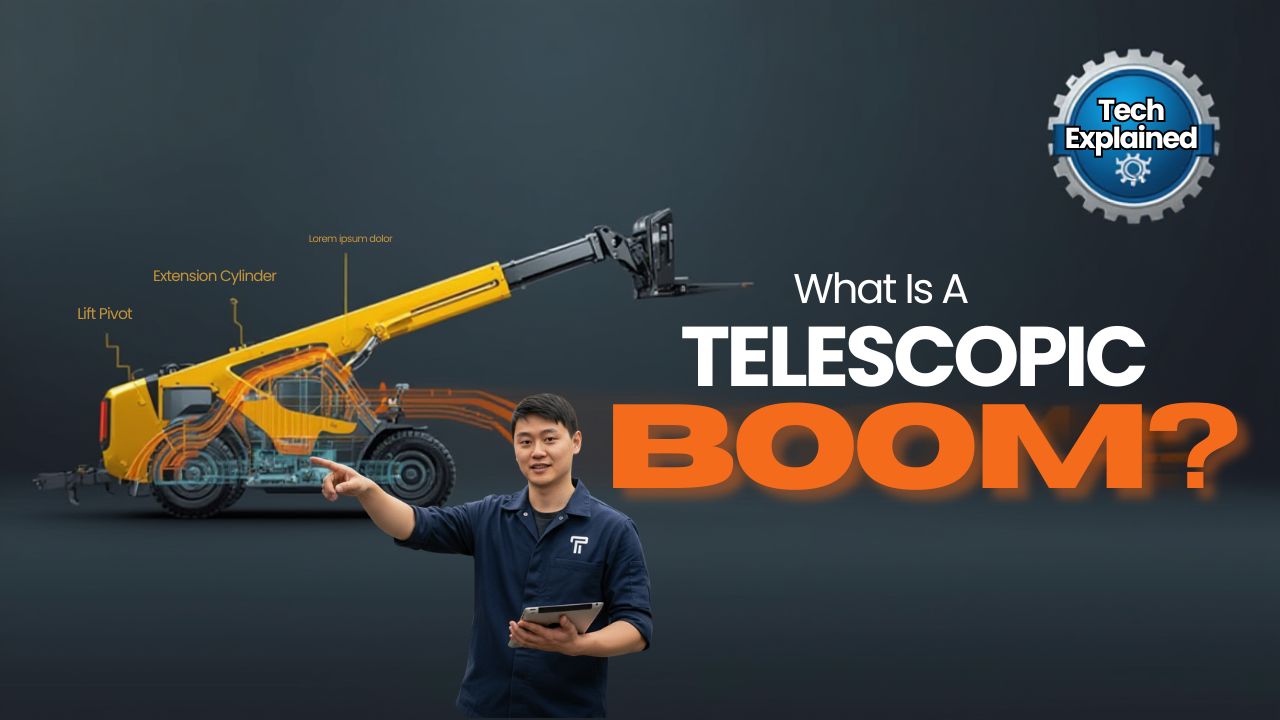
What Is a Telescopic Boom (in a Telehandler)?
A telescopic boom on a telehandler is a hydraulically powered, multi-section arm that extends upward and outward to lift and place loads at different heights and distances.
It’s the key component that allows a telehandler to reach where conventional forklifts cannot telehandler boom1.
Structure and How It Works
A telescopic boom is built from several nested steel sections that slide smoothly inside one another. When you operate the controls in the cab, pressurized hydraulic oil drives the extension cylinder, pushing the inner boom sections forward for reach or pulling them back for compact maneuvering. The boom pivots on a heavy-duty mounting point at the chassis, and a separate lift cylinder raises or lowers the whole arm boom mechanism2.
At the boom head, the carriage or quick-attach plate includes a tilt function, which lets you keep forks level, control bucket dumping angles, or position other attachments precisely. Inside the boom, wear pads and guide blocks help maintain alignment under load and provide smooth extension even when the machine is working near its rated capacity.
What the Boom Allows You to Do
The real value of the telescopic boom comes from its ability to reach over obstacles. Whether you’re placing pallets on an upper floor, unloading a truck from one side, or positioning materials behind barriers, the boom gives you the reach to get the job done without constantly repositioning the machine.
This reach is especially useful in tight or uneven spaces where moving the machine isn’t easy. With steering modes like front-wheel, four-wheel, and crab steering, you can position the telehandler exactly where you want it, then let the boom extend to the work point telehandler applications3.
Capacity, Stability, and Safety Systems
As the boom extends, lift capacity naturally decreases. More reach means more leverage on the chassis, so the telehandler must maintain stability. To help you work safely, two systems are essential:
- Load charts, which show how much weight you can lift safely at each boom angle and extension length.
- Load Moment Indicator (LMI) or similar stability-monitoring systems, which warn you when the machine approaches its safe operating limits.
These systems are standard on modern CE- and ANSI-compliant telehandlers and are critical whenever the boom is working at long reach or full height safety systems4.
Why the Telescopic Boom Defines a Telehandler
The telescopic boom is what transforms a telehandler from a simple lifting machine into a multi-purpose tool. With reach in both height and distance, you can handle pallets, buckets, lifting jibs, or work platforms using the same base machine. This flexibility is what makes telehandlers so common on construction sites, industrial yards, farms, and logistics operations—they adapt to your work, not the other way around telehandler overview5.
Summary
A telescopic boom is the engineered core of a telehandler—a multi-section, hydraulically driven arm designed for controlled lifting, extended reach, and precise material placement. When paired with the right safety systems and attachments, it gives you capabilities far beyond what a traditional forklift can offer.
References
-
A technical explanation of how telehandler booms function and extend under hydraulic power. ↩
-
Operator-focused guidance on boom movement, hydraulics, and working principles. ↩
-
An overview of telehandler applications and how boom reach affects jobsite versatility. ↩
-
Safety information on load limits, stability, and best practices for telehandler operation. ↩
-
A general introduction to telehandler structure, function, and work scenarios. ↩